







Abstract
There is a growing interest in new type of biocidal compounds with antibacterial properties against bacteria. In this study, new antibacterial synthetic materials bearing curcumin and cationic polymers were synthesized. In the synthesis stage, the methacrylate functional cationic monomer was synthesized via the Michael addition route by using 3-acryloxy-2-hydroxypropyl methacrylate and 3-amino pyridine to obtain Monomer 1. Monomer 1 was further quaternized with hexyl bromide to obtain a cationic methacrylate functional monomer. Free-radical polymerization of Monomer 1 and methyl acrylate was conducted in the presence of azobisisobutyronitrile under dimethylformamide solvent. The composite formulation was conducted by using turmeric extract Curcuma longa (curcumin), hydroxyapatite, montmorillonite, and silver nitrate. The materials were analyzed by using the methods of X-ray diffraction, nuclear magnetic resonance, Fourier transform infrared spectroscopy, and scanning electron microscopy. The biocidal activities against the bacteria Escherichia coli, Listeria monocytogenes, Salmonella, and Staphylococcus aureus were analyzed using agar well diffusion method. From the Fourier transform infrared, X-ray diffraction, and scanning electron microscopy analysis results of the synthesized nanocomposites, it is seen that they form strong connections with the components added to the composites and form an exfoliated structure. According to the antibacterial analysis results, the nanocomposites obtained have showed a strong antibacterial resistance against E.coli, L.monocytogenes, Salmonella, and S. aureus bacteria, and the high inhibition zone areas were obtained.
Introduction
In the paint industry, some major dyestuff classifications have been made and many dyestuffs from each class have been discovered. Today, it is understood that many of the synthetic dyestuffs cause environmental pollutions of toxic and carcinogenicity, and this result has led to new searches. However, due to its carcinogenicity and toxic effects in living organisms, it causes serious health problems and environmental pollution. In addition, molds and bacteria are formed on the surface as the dyes used are exposed to moisture over time. Moisture is a severe problem of reducing the life of paints. Therefore, the antibacterial property is gaining importance and the deep dirt-holding property of the paints should be strengthened.1–3 Therefore, there is a unique need for biocidal products, especially in the paint industry. Many washing and cleaning materials, coating materials, personal products, dyeing industry wastes, and household wastes are directly mixed into sewage and wastewater. 4 Biocidal products are active substances that contain one or more active substances, which have a controlling effect on any chemical or biologically harmful organism or that restrict, remove, render harmless, or destroy its movement. 5 In this context, antibacterial biocidal products against biologically harmful organisms gain considerable importance; otherwise they cause serious infection problems for human, animal, and environmental health. 6 According to the literature research, nanocomposites of poly(methyl methacrylate) (PMMA) with silver nanoparticles (AgNPs) were produced using an in situ radical polymerization technique and were characterized. 7 In another literature, curcumin-loaded ZnO nanoparticles were synthesized and encapsulated with copolymer PMMA-AA (Cur/PMMA-AA/ZnONPs). 8 According to the research, it is seen that the modified PMMA composites can be a promising candidate for bioapplications. In particular, mechanical stability, gas barrier properties, and antibacterial properties support studies in this area.9,10 PMMA is one of the important materials used in a variety of optical devices such as polymer optical fibers, optical films for liquid-crystal displays, optical disks, lenses, and so on because of its exceptional clarity in the visible range.9,11
Curcumin is an important representative of easily metabolized curcuminoids and biocompatible and biodegradable polyphenolic compounds. Curcumin shows broad therapeutic properties such as antibacterial, antiviral, and antitumor properties. Research has shown that it has anticoagulant, antioxidant, and anti-inflammatory activity.12,13
In this study, new synthesized cationic methacrylate functional Monomer 1, curcumin, which has a strong antimicrobial effect and strong resistance to infection in the synthesis stage; hydroxyapatite (HA), which supports biocompatibility; montmorillonite; and silver were used as an additive in the copolymer synthesis using methyl acrylate. Furthermore, the antibacterial properties of these composites were analyzed. Figure 1 shows the synthesis reaction of Monomer 1.
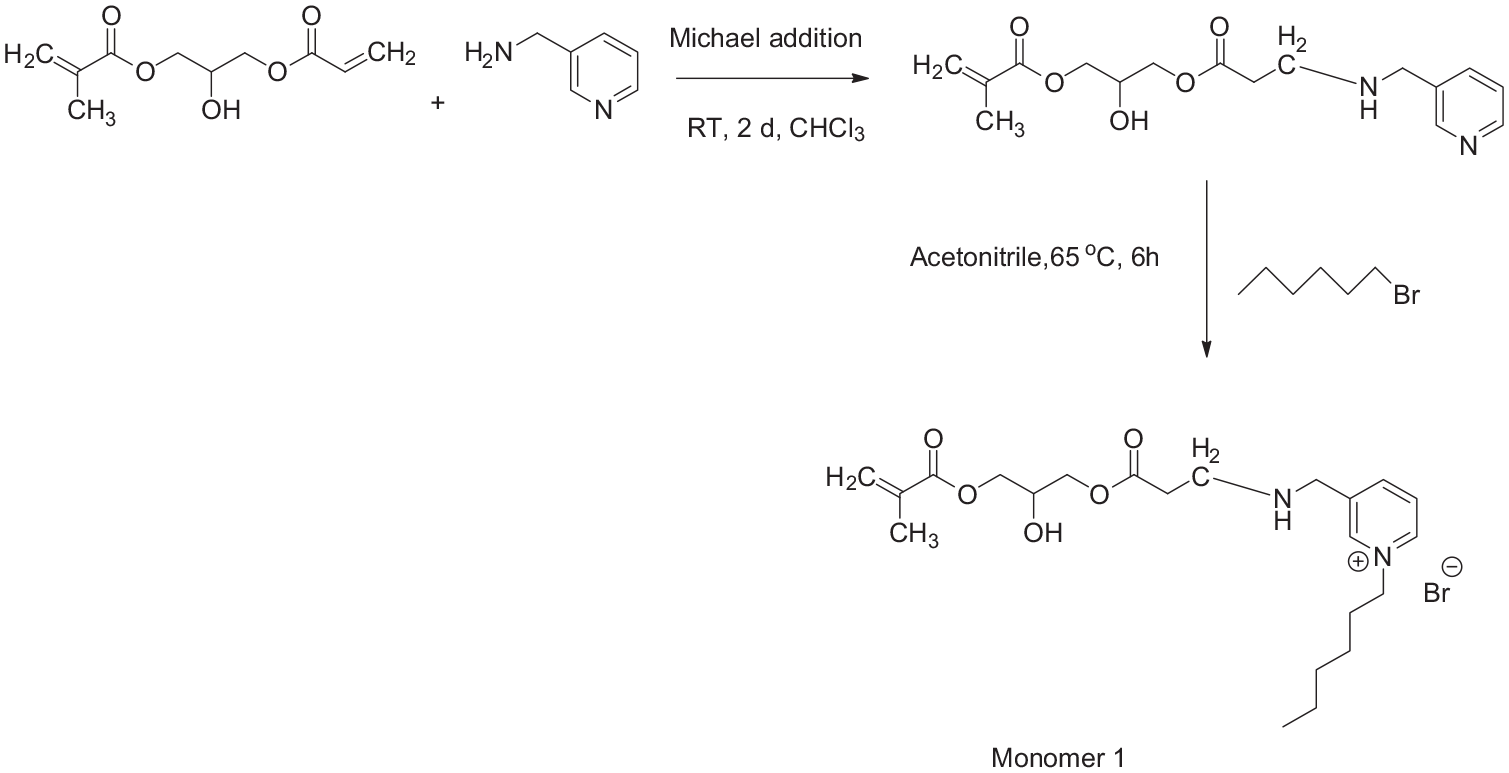
Synthesis of Monomer 1.
Materials and methods
Materials
Curcuma longa (turmeric, molecular weight: 368.38 g mol−1, curcuminoid content ⩾94%), azobisisobutyronitrile (AIBN), 3-acryloxy-2-hydroxypropyl methacrylate (AHM), HA (CAS number: 12167-74-7; molecular weight: 502.31 g mol−1), methyl methacrylate (MMA; CAS number: 80-62-6; molecular weight: 100.12 g mol−1), 3-(aminomethyl) pyridine, dimethylformamide, pyridine, diethyl ether, chloroform, acetonitrile, bromhexine, and silver nitrate used were purchased from Sigma-Aldrich. Na+-montmorillonite was provided by Southern Clay Products Inc. (USA).
Modification of Ag+-montmorillonite
The sodium montmorillonite (1.0 g) was added to 50 mL of 0.05 M silver nitrate solution and mixed for 3 h at 25°C in a dark room. The mixture was then centrifuged at 3000 rpm for 15 min. The liquid phase from the obtained product was decanted and washed with distilled water for 4–5 times to remove the precipitated nitrate ions. The final product was left to dry in a dark environment under room conditions. 14
Curcumin-doped montmorillonite synthesis
Ag+-montmorillonite (Ag+-Mt; 2.0 g) was weighed and 50 mL of distilled water and 50 mL of ethanol were added to it and stirred for 1 h at room temperature with a magnetic stirrer. Curcumin (1.0 g) was weighed and 50 mL of distilled water and 50 mL of ethanol were added to it and stirred for 1 h at room temperature with a magnetic stirrer. The two separately prepared solutions were mixed with each other and stirring continued for 24 h. After 24 h, the solution mixture was passed through filter paper and washed 3–4 times with water/ethanol mixture prepared in a ratio of 1:1. The resulting filtrate was dried in an oven at 70°C for 24 h. The resulting product was named Ag+-Mt-curcumin.15,16
Synthesis of methacrylate functional quaternary Monomer 1
AHM (3.2 g, 15 mmol) and 3-(aminomethyl) pyridine (1.62 g, 15 mmol) were mixed with 8 mL of chloroform solvent at room temperature for 24 h on a magnetic stirrer. The mixture was dissolved in 20 mL of acetonitrile and transferred to a 100-mL flask and then mixed with 10 mL of acetonitrile and bromhexine (9.6 g, 58.8 mmol) and stirred at 60°C for 24 h. After stirring for 24 h, the resulting mixture was washed with diethyl ether and passed through an evaporator and the solvent was removed. A precipitate was obtained in the form of a dark red resin.
Synthesis of composites
Monomer 1 (0.5 g), 2.0 g of MMA, 0.05 g of HA, 0.25 g of curcumin, and 0.25 g of AIBN were added to 8 mL of dimethylformamide solvent and stirred at 60°C for 5 h. After 5 h, the mixture was cooled and 60 mL of diethyl ether was added to precipitate. The supernatant phase was separated from the precipitate, and the precipitate was dried with nitrogen and stored as a final product in a refrigerator in dark at +4°C. Four products were obtained by this method and summarized in Table 1.
Synthesis steps and chemical ratios of Compounds 1, 2, 3, and 4 (g).
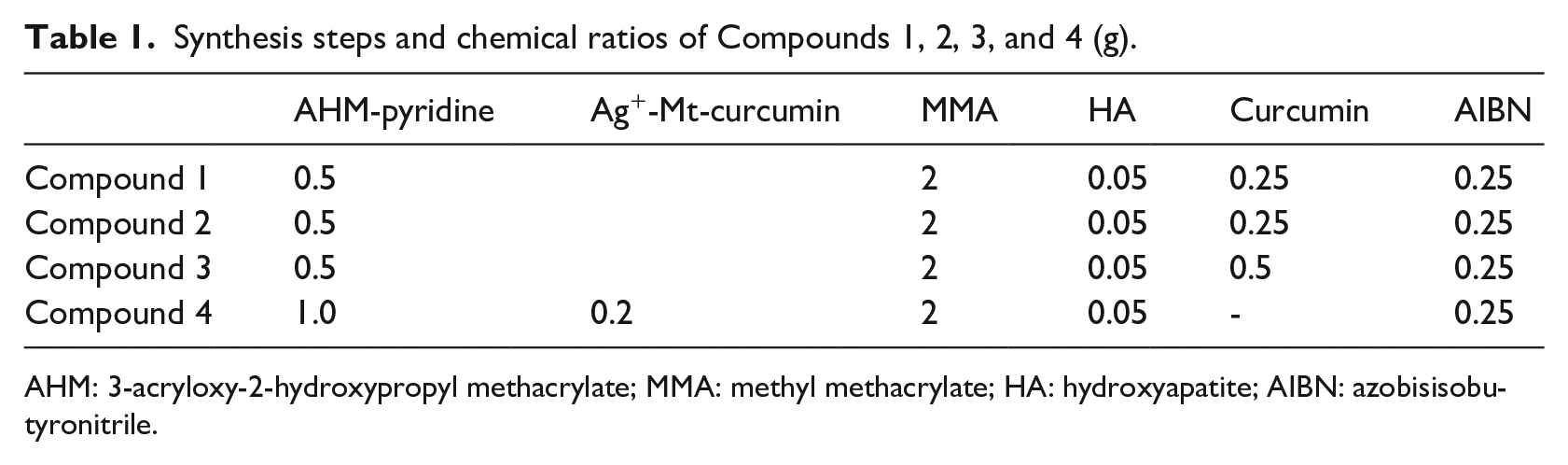
AHM: 3-acryloxy-2-hydroxypropyl methacrylate; MMA: methyl methacrylate; HA: hydroxyapatite; AIBN: azobisisobutyronitrile.
Characterization
Antibacterial analysis
This study used the well diffusion method for antibacterial analyses. The bacteria Escherichia coli, Listeria monocytogenes, Salmonella, and Staphylococcus aureus were inoculated onto nutrient agar and incubated at 37°C for 24 h in an aerobic setting. Fresh culture of target bacteria adjusted to 1 × 10⁸ CFU/mL with 0.5 McFarland standards were inoculated over the surface of nutrient agar. The cells were spread in the same medium, and after 24 h, composites created inhibition zones around the disk that was applied and inhibition concentrations were checked. The radii of the inhibition zones were measured in units of mm2, and the sensitivity of the microorganisms to the antibacterial substances was determined.15,16
Scanning electron microscopy
The synthesized dye additive materials were observed and examined by using a JEOL JSM 5600 LV scanning electron microscope (SEM) with an accelerating beam at a voltage of 40 kV.
Fourier transform infrared spectroscopy
Fourier transform infrared spectroscopy (FTIR) was used to determine and examine the organic groups on the nanocomposite films. The infrared spectra were observed at wavelengths 4000–400 cm−1 by using the potassium bromide with a Mattson 1000 infrared spectrophotometer.
X-ray diffraction
The crystallinity of the organoclays in the composites was examined by X-ray diffraction (XRD) measurements. A Rigaku Rad B-Dmax II powder X-ray diffractometer was used for the XRD patterns of these samples. The 2θ values were taken from 20° to 110° with a step size of 0.04° using Cu Kα radiation (λ value of 2. 2897 Å). The Bragg’s law was used to calculate the distances between clay layers.
Nuclear magnetic resonance
The nuclear magnetic resonance (NMR) experiments were performed with high-resolution Bruker Biospin spectrometer at the resonance frequency of 300 MHz. Samples of 10 mg were dissolved in chloroform-D1 for 1H NMR and 13C NMR, respectively.
Results and discussion
Monomer and polymer synthesis
NMR
Monomer 1 is obtained via the Michael addition route at room temperature. Figure 2 shows the NMR spectrum of Monomer 1. The addition of -NH2 functional group in polyethyleneimine to the acrylate double bonds of AHM resulted in a 100% conversion. There is no remained unreacted AHM in the reaction (followed by thin-layer chromatography (TLC)). Figure 2 shows the NMR spectra obtained after the synthesis of the Monomer 1. The 13C NMR spectrum of Monomer 1 (Figure 2(a)) shows double-bonded methyl group carbons at 18.4 ppm, double-bonded carbon peaks in the methacrylate group at 137.3 and 127.2 ppm, a conjugated carbonyl peak at 168.4 ppm, methylene carbon peaks attached to the secondary amine group and carbons on the pyridine ring at 62.3, 64.2, 65.7, and 69.9 ppm. 17
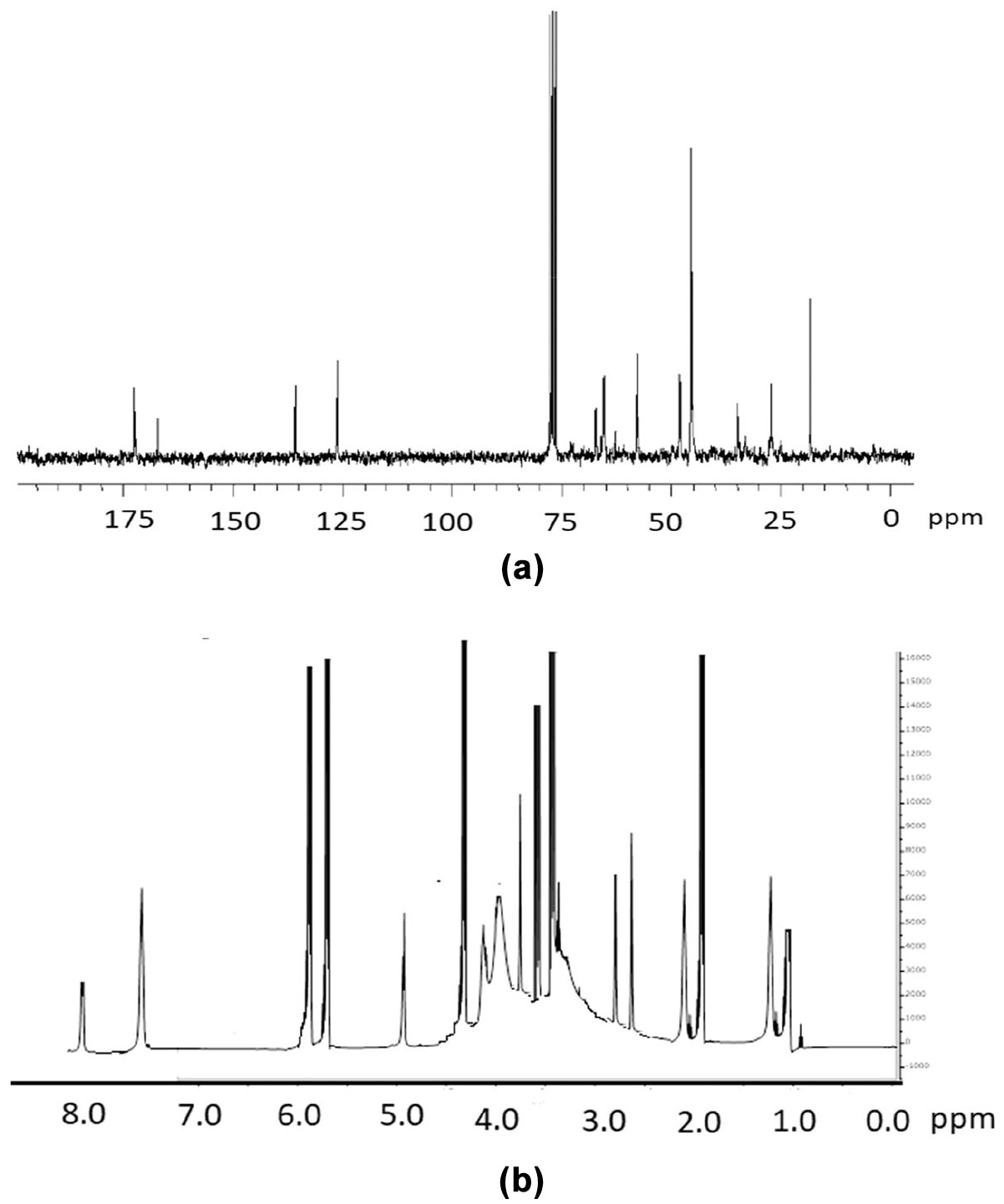
(a) 13C NMR and (b) 1H NMR spectra of Monomer 1.
The vinylidene (δ = 6.18 ppm) and vinyl (δ = 6.32 and 5.97 ppm) protons of the acrylate group disappeared, while the proton resonances of the methacrylate group at (a) δ = 6.06 ppm, (b) δ = 5.68 ppm, and (c) δ = 1.88 ppm remained intact in 1H NMR spectra. The pyridine showed its presence in the spectrum of Monomer 1 with peaks appearing at 8.29 and 7.63 ppm. After Monomer 1 was synthesized, it is used in the composite formulation. In this content, HA, montmorillonite, AgNO3, and curcumin were added to the in situ copolymerizations of Monomer 1 and MMA. The product is precipitated over hexane and dried under vacuum. See Table 1 for the preparation of composites.
XRD
Figure 3 shows the XRD spectra of Compound 1, 2, 3, and 4 samples. When XRD spectra are examined, Figure 3(a) and (c) shows the spectra of exfoliated structures of the samples. This exfoliated structure shows that the amorphous structure of PMMA is supported by compositions added to the end product obtained.8,18 The compounds showed an XRD pattern characteristic of partially crystalline materials (Figure 3(b)), with only one diffraction peak at 2θ = 44.2°. The amount of quaternary pyridine group in the Compound 2 sample was increased. This increase did not yield positive results and caused the structure to protect itself in the crystal structure. 19 This result shows that the organic character of the molecular structure of curcumin has a very effective role in transferring the compounds to exfoliated structure and in the synthesis of stronger bonds. In Compound 4 sample, montmorillonite clay was used unlike the other samples; the clay was first modified with curcumin and then added to the synthesis step. It is seen that the addition of curcumin to montmorillonite and then adding to the synthesis step is effective in the loss of crystal structures and obtaining a more amorphous structure. 20 The peak observed at 26.7° of the crystal structure shows the crystal structure of the montmorillonite clay. This can be interpreted as the excess amount of organoclay added leads to aggregation. According to the analysis results, the peak shapes closest to the amorphous structure were obtained as shown in Figure 3(a) and (c).19,20
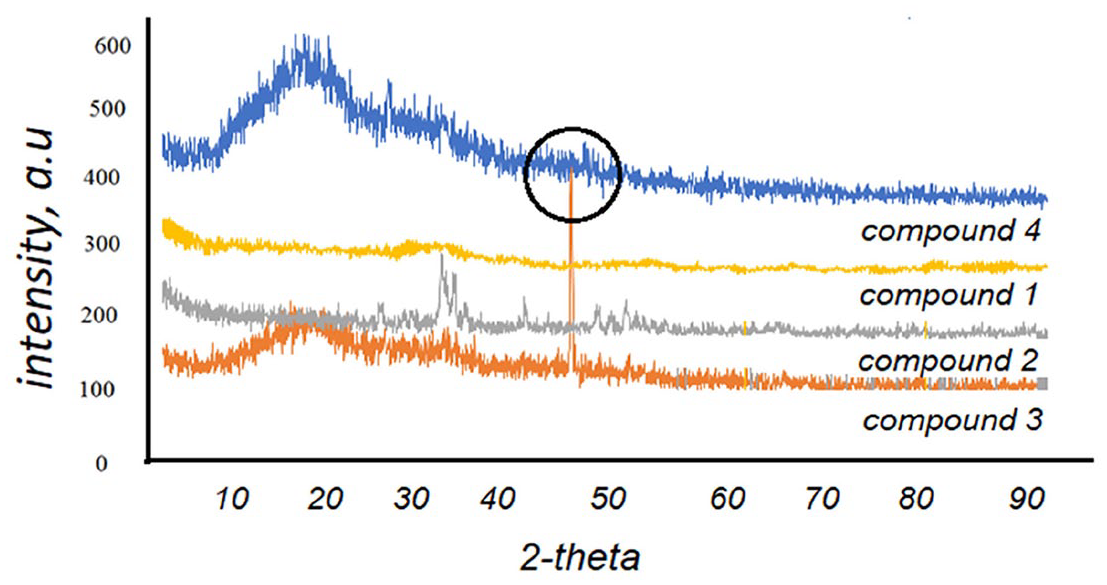
XRD spectra of Compound 1, Compound 2, Compound 3, and Compound 4.
FTIR
FTIR analysis was also performed for the analyzing the composites. Figure 4 shows the FTIR spectra of the Compounds 1, 2, 3, and 4. Because of the polymethacrylate (PMMA) structure, FTIR spectra of all samples show peaks due to the C–H tensile bands in 2950, 2951, 2930, 2933 cm−1. The characteristic peaks of the PMMA also represent the C=O carbonyl group of about 1730–1725 cm−1, the C–O–C groups of about 1100–1190 cm−1, and the off-axis and in-axial bending peaks of about 800–700 cm−1. The wideband peaks seen in the FTIR spectra at 3434–3450–3402 cm−1 are due to the axial stretching of the O–H groups forming the H bonds with the polymeric material.19,20 Although the density of this peak is more pronounced in the peak of Compound 1 for H bonds at about 3500 cm−1, it is seen that it decreases especially in Compound 4. This result can be interpreted as the increased hydrophobicity of the matrix due to the high interest of curcumin in the matrix.19,20–22 The peaks at 600–700 cm−1 in the FTIR spectra are due to the O–H vibration mode peak of the HA present in the additive materials at 630 cm−1.20,21,23 The peaks seen at 2996, 2993, 2856, 2860, and 2863 cm−1 also represent C–H stress vibration bonds in the structure of curcumin, and the increase in peak intensity is defined as an indication that bonding is stronger. Peaks around 1436, 1485, 1416, 1437, and 1200 cm−1 represent the C–H and C–O tensile bands.19,20,22,23 The FTIR spectra confirm a strong interaction between the compounds and confirm the XRD results.
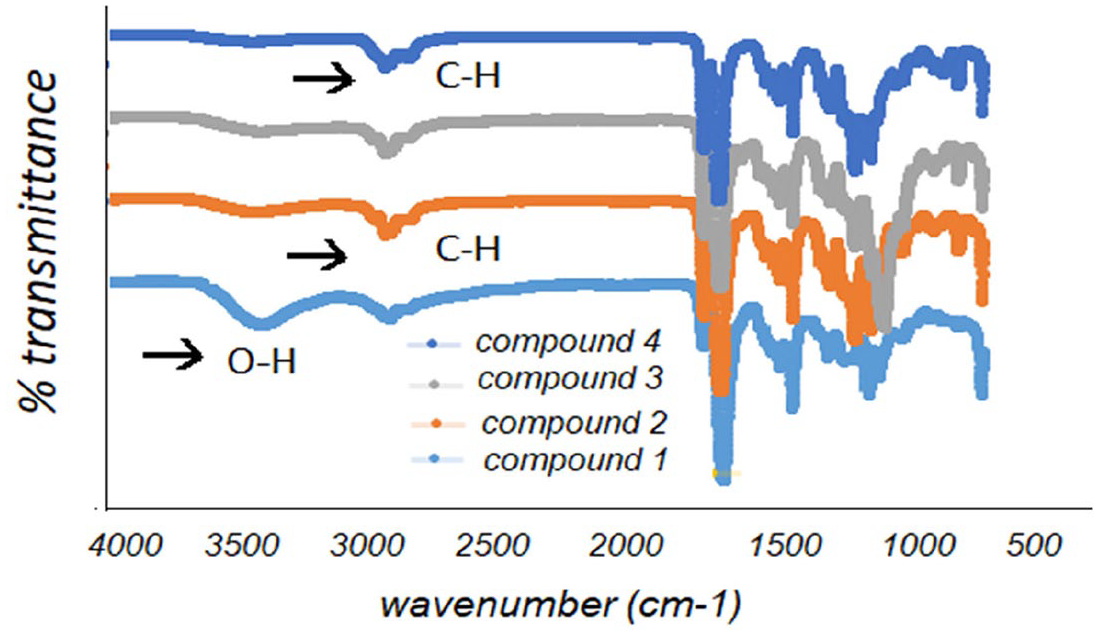
FTIR spectra of Compounds 1, 2, 3, and 4.
SEM
SEM analysis was performed for analyzing the microstructure. SEM images of the surface morphology of pure PMMA, Compound 1, Compound 3, and Compound 4 samples were examined at magnification scales of 10 to 100 µm, respectively. The morphological surface images of Compound 2 were not suitable for analysis due to their resin forms. The morphological surface analysis of the samples was interpreted as the cold-fracture images on the surface.
The surface morphology of the pure PMMA SEM images was examined and a homogeneous and smooth image was obtained. 22 However, the surface morphology of the composites has changed significantly and the surface has become a rough and porous structure. The high porosity of the surface is due to the strong adsorption of other compounds that react with methyl acrylate.23–25 When SEM images of paint additive materials were compared, it was seen that the highest roughness was obtained for Compound 1. According to the results obtained, the most optimal interaction conditions belong to Compound 1 material. This result is also consistent with XRD analysis and antibacterial analysis results.
Antibacterial analysis
E. coli and Salmonella bacteria are gram-negative rods of the genus Escherichia belonging to the Enterobacteriaceae family. Gram-negative bacteria are more pathogenic in their susceptibility to antibiotics due to their small numbers. Pathogenic bacteria are bacteria that cause infectious diseases. It causes colibacillosis, cystitis and pyelonephritis, mastitis, pneumonia, and severe wound infections in domestic animals and causes severe intestinal infections in humans, and the consequences can be fatal if the necessary precautions are not taken. 26 Among the Listeria species in the Listeriaceae family, the most pathogenic species is known as L. monocytogenes. It is a gram-positive short coccobacillary, facultative anaerophilic, catalase-positive, oxidase-negative, non-spore-free, and non-capsule bacterium. S. aureus, the most pathogenic species in the Staphylococcaceae family, is a gram-positive, immobile, non-spore, encapsulated, facultative anaerophilic, mesophilic bacterium. 27 They are found on human and animal skin, upper respiratory system, lower urogenital system, and digestive system mucosa and are considered the most commonly isolated pathogens from food poisoning. 28
Composites were tested for their biocidal activity according to the well diffusion method. Table 2 shows the antibacterial resistance of the synthesized Compound 1, 2, 3, and 4 additive materials against E. coli, L. monocytogenes, Salmonella, and S. aureus bacteria, and their inhibition zones. Inhibition zone areas are calculated as the unit of mm2.
The inhibition zone areas of the samples (mm2).
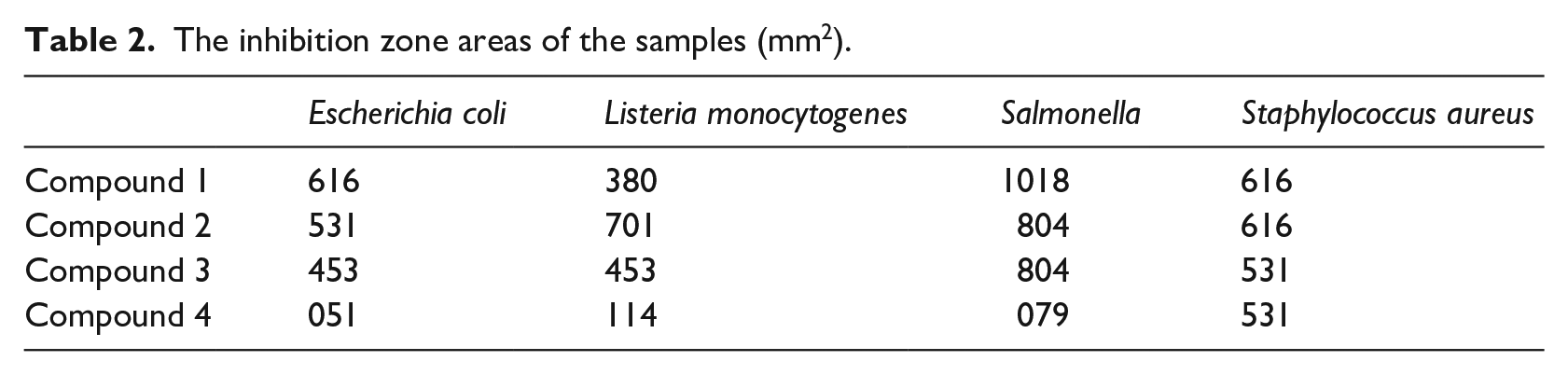
As a result of the antibacterial analysis, it is seen that all composite structures have high antibacterial resistance against E. coli, L. monocytogenes, Salmonella, and S. aureus bacteria. Compound 1, 2, and 3 composites have the highest resistance to salmonella bacteria and showed resistance in an area of 1018 mm2. According to Table 2, a direct addition reaction between cationic polymer and curcumin produced a much better synergistic effect and increased antibacterial resistance, also determined the optimium reaction rates. Compound 4 showed the lowest resistance to bacteria but formed a 531-mm2 inhibition zone against S. aureus. As a result, we can say that Compounds 1, 2, and 3 have high antibacterial properties against both gram-negative and gram-positive bacteria. According to Table 2, Compound 4 showed more biocidal activity, especially to gram-positive bacteria. Since Compound 4 contains Ag+-Mt-curcumin, its antibacterial resistance is lower than other compounds. The antibacterial resistance of composite compounds was inhibited because the curcumin was added as an organoclay in Compound 4. The curcumin is a diferuloyl methane compound. These compounds disrupt the structure of bacterial membranes and inactivate bacteria. Therefore, it may be advisable to increase the amount of organoclay and curcumin.
Conclusion
In this study, new biocidal dye additive materials were synthesized. First AHM-pyridine was synthesized and then a new material was synthesized using AHM-pyridine, MMA, HA, curcumin, and Ag+-montmorillonite. The synthesized dye additive materials were characterized by XRD, NMR, FTIR, and SEM analyses. The crystal layers of nanocomposites obtained according to the XRD results turned into exfoliated structure and proved that nanocomposites have amorphous structure. Besides, FTIR spectra confirmed that curcumin, MMA, HA, AHM-pyridine, and Ag-Mt-curcumin structures are bound by strong bonds in the nanocomposite. From the results of SEM analysis, the surface morphology of nanocomposites was examined, and it was seen that porous and rough surfaces were obtained. This result also supports the direction of increasing the mechanical strength of nanocomposites. Antibacterial resistance of synthesized new dye additive materials against E. coli, L.monocytogenes, Salmonella, and S. aureus bacteria was measured by using the agar well diffusion method. The inhibition zones obtained according to the results of the analysis confirmed that the synthesized new materials have a compelling antibacterial character against both gram-negative and gram-positive bacteria. Inhibition zone areas of nanocomposites measured against bacteria showed high performance at 1018, 804, 701, and 616 mm2, respectively. The Compound 1 showed the highest resistance to salmonella bacteria with its 1018-mm2 inhibition zone area. As a result, newly synthesized biocidal dye additive materials were synthesized to be won to literature and industry.
Footnotes
Authors’ note
All data, models, and code generated or used during the study appear in the submitted article.
Declaration of conflicting interests
The author(s) declared no potential conflicts of interest with respect to the research, authorship, and/or publication of this article.
Funding
The author(s) disclosed receipt of the following financial support for the research, authorship, and/or publication of this article: This study was carried out with the support of Istanbul Aydin University, The Scientific Research Project, Project number: 27/06/2018-10.
