







Abstract
This commentary examines how Artificial Intelligence (AI) and Machine Learning (ML) are transforming biomedical polymers, drug delivery systems, wearable electronics, smart materials, advanced manufacturing, and neuromorphic technologies. AI enhances prediction accuracy, optimizes material properties, accelerates development, and enables innovative applications such as smart biomaterials, personalized medicine, and tissue engineering. Specific applications include predicting polymer properties, optimizing drug release kinetics, improving drug delivery system design, and creating responsive materials for advanced biomedical devices. AI also advances wearable sensors, flexible electronics, 3D/4D printing, sustainable materials, and neuromorphic computing, leading to breakthroughs in health monitoring, human-computer interaction, and environmental sustainability.
Keywords
Introduction
The rapid integration of Artificial Intelligence (AI) into biomedical engineering marks a transformative era in healthcare and materials science. With a growing need for more targeted and efficient therapeutic solutions, AI has emerged as a crucial tool in accelerating research and development in biomedical polymers and drug delivery systems. These computational techniques have enhanced the capabilities of traditional methodologies, enabling scientists to explore vast design spaces, optimize materials, and predict complex behaviors that were previously challenging. Moreover, the application of AI extends to wearable electronics, smart materials, advanced manufacturing, and neuromorphic technologies, pushing the boundaries of personalized medicine, tissue engineering, and sustainable solutions. This commentary delves into how AI is reshaping these diverse fields, exploring its multifaceted applications and implications. Moreover, specific examples of AI applications in these fields are discussed in the following sections.
AI in biomedical polymers and drug delivery systems
The integration of machine learning into biomedical polymers and drug delivery systems increases prediction accuracy, optimizes material properties, and speeds up development, leading to progress in smart biomaterials, drug delivery, tissue engineering, and personalized medicine. This synergy between advanced computational methods and biomedicine is opening up new possibilities for innovative and targeted therapeutic solutions.
Machine learning techniques have been widely used to predict polymer properties and streamline their development. For example, models like Bayesian logistic regression, K-nearest neighbors (KNN), and Naive Bayes have been applied to predict the anti-inflammatory properties of polymers, accelerating biomaterial development by analyzing cellular assay data. 1 Furthermore, computational models such as artificial neural networks (ANN) and least squares support vector machines (LS-SVM) have shown high accuracy in predicting the deswelling behaviors of pH- and temperature-responsive hydrogels, enhancing the understanding and application of these materials. 2
Significant advancements are also being made in drug delivery systems (DDS) and tissue engineering. Techniques like high-content liquid handling combined with machine learning are expected to open up new opportunities in constructing Layer-by-Layer (LbL) films, which play a key role in drug delivery and tissue engineering. 3 Additionally, when paired with 3D printing technology, these computational methods improve the precision and effectiveness of DDS by optimizing drug release kinetics, supporting personalized medicine, and increasing patient compliance by creating customized dosage forms that are easier for patients to use and adhere to. 4 For instance, patient-specific implants or oral dosage forms tailored to individual needs can enhance comfort and acceptance, thereby improving compliance. Simulations based on these advanced techniques are being used to refine DDS design, resulting in more effective pharmaceutical treatments. 5
In the development of smart biomaterials and nanocomposites, machine learning plays a vital role. For instance, it has been integrated into creating biomimetic elastomeric and conductive nanocomposites for skeletal muscle regeneration, enabling the design of multifunctional materials that mimic muscle-like properties. 6 In stimuli-responsive biomaterials, intelligent modeling facilitates behaviors such as self-folding, controlled drug release, and guiding stem cell behavior for tissue regeneration, which has significant implications for advanced biomedical applications. 7
Applications extend to self-healing polymers, enhancing the material’s ability to repair physical damage, thereby broadening its use in biomedical monitoring, radiation shielding, and environmental sustainability. 8 Big data analytics are also key in personalized medicinal therapy, particularly in optimizing treatment outcomes for patients after heart stent implantation through pharmacogenomic selection and risk-scoring systems. 9
In refining gene delivery systems, advanced computational approaches analyze polymer component distribution (PCD) in gene delivery vectors, creating highly efficient polymer vectors that outperform existing commercial systems. 10 Moreover, they optimize delivery systems such as those based on polyurethane (PU), leading to more targeted and effective treatments. 11 Polyurethane possesses versatile properties, such as biocompatibility, mechanical strength, and biodegradability, making it an excellent candidate for drug delivery applications. The use of advanced computational approaches allows for the optimization of PU’s properties to enhance drug loading and release profiles, tailoring them for specific therapeutic needs. In the field of nanotechnology, these methods support the development of carbon dot-based drug delivery systems designed to penetrate the blood-brain barrier, offering potential solutions for conditions like Alzheimer’s disease and brain tumors. 12
In tissue engineering, machine learning assists in designing and fabricating resorbable scaffolds, improving the replication of natural bone structures and enhancing therapeutic outcomes. 13 A genetic algorithm (GA)-coupled ANN model has been developed to predict the porosity of alginate gel scaffolds, showing high accuracy in optimizing scaffold fabrication parameters. 14 Additionally, optimization techniques in the production of electrospun scaffolds have advanced wound healing, particularly in promoting neoangiogenesis. 15
The role of computational modeling in biomedical polymers also extends to emerging technologies such as organ-on-a-chip (OoC) devices, where data-driven methods enable precise and cost-effective clinical monitoring and personalized treatment. 16 Furthermore, these methods are being explored in designing colon-targeted therapeutics by integrating in vitro, in vivo, and in silico preclinical investigations to fine-tune drug formulation and minimize off-target effects. 17 Deep learning is also being proposed to enhance the cleaning, disinfection, and sterilization processes of reusable medical devices, addressing infection control challenges and ensuring patient safety. 18
The advancements in AI and ML within drug development and broader biomedical research have direct implications for material science and biomedical polymers. The computational power of AI/ML technologies, which reduces both the time and costs associated with drug development, 19 can similarly streamline the research and development of biomedical polymers by facilitating the prediction and optimization of polymer properties. This ability is pivotal for the creation of smart biomaterials and drug delivery systems that require precision engineering.
AI’s applications, including virtual compound screening and ADMET (absorption, distribution, metabolism, excretion, and toxicity) modeling,20,21 are transferable to the design of biocompatible polymers, where optimizing characteristics like biodegradability, mechanical strength, and response to environmental stimuli are essential. The use of ML to analyze large datasets20,22 is similarly beneficial in the development of responsive materials that interact effectively with biological environments, thus supporting more personalized and efficient drug delivery systems.
The success of platforms such as Chemistry42 in generating novel molecular structures 21 suggests that similar frameworks can be applied to developing new polymer composites with targeted properties for applications in tissue engineering and regenerative medicine. Moreover, industry collaborations facilitated by AI, like those between Numerate and Takeda or Atomwise’s partnerships with academic labs,20,21 highlight the potential for cross-sector innovations that can extend to polymer science. Finally, breakthroughs like AlphaFold2′s protein structure prediction and Insilico Medicine’s Chemistry42 19 exemplify how AI-driven models can solve complex structural problems, a capability that can potentially translate into better design and application of biomedical polymers for therapeutic use.
AI in wearable electronics, sensors, and smart materials
The integration of advanced computational techniques into wearable electronics, sensors, and smart materials is transforming these technologies in areas like healthcare, robotics, and human-computer interaction. This enhances the functionality, responsiveness, and applicability of flexible electronics, smart materials, and biocompatible sensors. Such advancements pave the way for innovative solutions in personalized medicine, health monitoring, and intelligent interfaces, shaping the future of wearable technology and smart materials.
Machine learning and other computational methods are increasingly used in developing flexible electronics, particularly Organic Thin Film Transistors (OTFTs) utilized in neuromorphic computing that mimics the neural architecture of the human brain. These OTFTs are essential for advancing Internet of Things (IoT) devices and flexible sensors. 23 Similarly, signal processing in smart tactile sensing systems made from carbon nanotube/polypropylene composites benefits from artificial neural networks, leading to highly accurate wearable sensor systems. 24
In the field of wearable sensors, data-driven techniques play a key role. For example, they are involved in developing a fiber strain sensor for wearable electronics, which forms part of a data glove linking gestures to an intelligent gesture-expression control system. 25 Furthermore, such systems are utilized in designing biodegradable wearable sensors for human motion and sweat monitoring, facilitating real-time data collection and analysis. 26
These techniques significantly contribute to the advancement of smart materials, including electro-stimulated gels, which are expected to find increasing use in robotics and wearable artificial muscles. 27 They also enhance electronic skin (E-skin) properties, improving stretchability and self-healing capabilities for applications in prosthetics, robotics, and personal health monitoring devices. 28 Additionally, advanced design approaches have led to the creation of silk fibroin-based flexible pressure sensors, useful in human-computer interaction, personalized medicine, and sustainable electronics. 29
In personalized medicinal platforms, the integration of flexible biosensors, heaters, and processing units enables automated, continuous therapy conformal to the skin. This system is cost-effective and particularly suitable for low-resource environments. 30 Data-driven design is also critical in advancing skin-interfaced triboelectric sensors (SITSs) made from biocompatible polymers for human-machine interfaces and physiological sensing. 31
In bioprinting, particularly for wound healing, machine learning helps optimize processes, enhancing the design and functionality of bioprinted devices and supporting personalized wound care solutions. 32 This technology is also utilized in developing stimuli-responsive hydrogels with programmable shape changes for soft robots, 4D printing, and biomedical devices, highlighting its role in creating intelligent materials. 33
The development of multifunctional composite hydrogel sensors capable of detecting various stimuli like force, temperature, and UV light benefits significantly from these computational methods, broadening their application in flexible electronic devices. 34 Additionally, the design of flexible piezoelectric nanogenerators for energy harvesting from mechanical activities sees improvements in efficiency and performance for integration with wearable systems and biomedical applications. 35
In creating conductive hydrogels with antibacterial properties for flexible electronic devices, these techniques enhance functionality as strain sensors for monitoring physiological activities. 36 They also assist in designing and optimizing biodegradable, flexible, and biocompatible memory devices made from carboxymethyl cellulose and graphene oxide nanocomposites, offering potential for wearable electronics and e-skin technologies. 37
In 4D printing technologies, computational methods are used to develop flexible artificial intelligence materials (AIM) for biomedical applications, such as shape memory polymers for tissue engineering. 38 In this context, 4D printing refers to 3D-printed objects that can change their shape or properties over time in response to external stimuli like temperature, light, or moisture—the fourth dimension being time. This technology enables the creation of dynamic structures that can adapt to their environment, which is particularly useful in biomedical applications. Design improvements extend to water-responsive shape memory films used in resistive bending sensors for smart textiles, mimicking natural human skin and expanding applications in electronic skin and health-monitoring devices. 39
The role of advanced analytics in health monitoring is evident in its integration with piezo- and pyro-electric wearable sensors for remote monitoring of physiological signals, which has been particularly relevant during the COVID-19 pandemic for early detection and continuous health status monitoring. 40 Algorithms also support the development of disposable triboelectric nanogenerator (TENG) sensors for evaluating urination conditions, providing an innovative approach to healthcare monitoring with applications in telemedicine. 41
AI in 3D printing, 4D printing, and advanced manufacturing
The integration of advanced computational techniques in 3D and 4D printing is transforming advanced manufacturing by enhancing precision, efficiency, and customization. These techniques optimize processes, improve material properties, and drive innovation in fields like biomedical engineering, robotics, and pharmaceuticals. This synergy between intelligent systems and additive manufacturing enables the creation of responsive materials and devices, leading to groundbreaking advancements in technology and medicine.
One key application is in optimizing 3D printing processes, particularly for enhancing the mechanical properties of polymer composites. Incorporating machine learning into additive manufacturing (AM) significantly improves the quality and performance of printed materials, shaping the future of 3D printing (3DP) and exploring the emerging field of 4D printing (4DP). 42 Additionally, machine learning models are used to predict the printability and drug dissolution profiles of 3D-printed tablets based on rheological data, facilitating high-throughput screening and more efficient drug formulation processes. 43
Advanced computer-aided design (CAD) software, powered by intelligent algorithms, enhances the design and fabrication of smart products, such as eyeglass frames. These “smart” eyeglass frames are not only customized for individual ergonomic comfort but may also incorporate adaptive features like shape memory materials that adjust fit over time or integrate sensors for health monitoring, thereby qualifying them as smart products. This allows for greater customization and improved mechanical properties, making these products more sustainable and functional. 44 Similarly, these techniques are applied in designing and manufacturing shape memory elastomers (SMEs), predicting and optimizing SME properties, which are crucial for applications in robotics, space engineering, and biomedical devices. 45
In 4D printing, the design and functionality of materials that change shape or properties in response to external stimuli are greatly enhanced. The fourth dimension in 4D printing is time and stimuli, representing the ability of the printed object to change its shape or properties over time when exposed to specific stimuli like heat, light, or moisture. For instance, shape memory polymers (SMPs) reinforced with MAX and MXene fillers exhibit significantly improved shape recovery speed and thermal/electrical properties due to computational optimization. 46 The concept extends to 5D printing, where additional degrees of freedom are introduced during the printing process, allowing for even more complex geometries and functionalities. In 5D printing, the print head can move along axes beyond the x, y, and z axes, enabling the creation of structures with enhanced strength and intricate designs that are not possible with traditional 3D printing. The additive manufacturing of smart polymeric composites also benefits from process optimization, creating materials that react to external stimuli, which is essential for advanced biomedical devices and personalized structures. 47
The impact on biomedical applications is especially prominent in the fabrication of 3D, 4D, and even 5D printed formulations and devices for drug delivery. These computational methods facilitate real-time sensing, adaptation, and prediction during the printing process, improving precision, speed, and complexity, particularly in personalized medicine. 48 Furthermore, integration with 4D printing technology has led to the development of customized cardiovascular devices, offering both preventive and reactive treatment options for cardiovascular diseases. 49
In materials science, machine learning models assist in the de novo design of organic molecules and polymers, enhancing the accuracy and efficiency of predicting material properties. This model-assisted design accelerates molecular generation and inverse molecular design, meeting the demand for new materials with tailored properties across various fields. 50 An artificial neural network (ANN) model has also been developed to predict the electrical conductivity of polymer nanocomposites, such as graphene-polypyrrole composites, thereby reducing experimentation time and costs. 51
Optimization techniques play a crucial role in the design and functionality of polymer therapeutics, aiding in high-throughput synthesis and screening. Establishing quantitative structure-property relationships (QSPRs) enhances the development of effective drug delivery systems. 52 Furthermore, research is exploring these technologies in the context of shape memory polymers (SMPs) for applications in robotics, aerospace, and biomedical engineering, showcasing notable improvements in material properties. 46
In the broader field of chemical engineering, process simulation, control, and numerical techniques, such as neural networks, have expanded chemical engineering into areas like biotechnology, renewable energy, and nanotechnology, driving significant advancements. 53 Within microfluidics, intelligent methods are integrated with flow chemistry and lab automation to streamline the fabrication of polymer multilayered nanofilms, improving efficiency and enabling potential biomedical applications. 54
AI in material design, characterization, and optimization
Advanced computational techniques are transforming material design, characterization, and optimization by leveraging machine learning. Researchers can speed up material development, enhance characterization accuracy, and create novel materials with tailored functionalities. These data-driven techniques optimize processes, predict material properties, and increase the efficiency of material synthesis, fostering innovation in advanced materials and enabling new applications in biomedical engineering and beyond.
Machine learning (ML) plays a crucial role in accelerating the design and development of biomedical polymers. Data-driven approaches manage extensive material databases, predict material properties, and generate new molecular structures, addressing challenges in the vast design space of biomedical polymers. 55 For example, ML techniques aid in the design and characterization of graphene quantum dots (GQD) in polymer nanocomposites, allowing researchers to efficiently explore parameter spaces to achieve desired properties. 56 Additionally, optimization methods enhance the development of polymer gel materials, which have applications in oil and gas drilling, biomedical fields, and firefighting, improving their intelligent functionalities and performance characteristics. 57
The integration of computational methods with advanced characterization techniques provides deeper insights into material properties. For instance, combining inverse gas chromatography (IGC) with computer vision—a field of AI that enables computers to interpret and understand visual information— enhances material analysis, particularly in understanding surface texture and roughness. By analyzing images of the material’s surface, computer vision algorithms extract quantitative data about surface features, which, when combined with IGC data, provide a comprehensive understanding of surface properties. This approach offers more detailed and accurate characterization data, facilitating research in advanced materials. 58 Furthermore, algorithms like XGBoost, CNN, and MLP are employed to predict the viscosities of complex polymers, significantly improving the reliability of these predictions, which are crucial for various polymer applications. 59
In the production of bioplastics, integrating genetic and metabolic engineering with computational optimization enhances the commercial synthesis of bioplastics from microalgae, reducing costs and increasing efficiency. 60 Within polymer informatics, machine learning accelerates performance prediction and process optimization for new polymers. These data-driven methods utilize large databases and advanced algorithms to streamline the development process in polymer science and engineering. 61
In biomedical applications, intelligent systems improve the functionality and application of biomaterials. Software powered by these techniques evaluates the vascularization induced by collagen and non-collagen scaffolds in biomaterials, providing an alternative to animal experimentation during pre-screening. 62 Additionally, the study of thermosensitive conducting hydrogels (TCH) benefits from computational analysis, helping to understand the chemical interactions that affect the volume phase transition (VPT) of these materials, which is crucial for their use in biomedical and environmental fields. 63
AI in environmental sustainability and green materials
Advanced computational methods are transforming the development of environmentally sustainable and green materials by optimizing synthesis, production processes, and material properties. These techniques enhance the sustainability and efficiency of materials used in health and environmental monitoring. This approach enables the creation of eco-friendly products, optimizes biodegradable materials, and advances health-monitoring technologies, driving innovation in sustainable material science and green technology.
One crucial application is in optimizing the synthesis and fabrication of green materials. For example, computational modeling is used in synthesizing superabsorbent polymers (SAPs), which are vital for sustainable menstrual health management. By predicting polymer properties and optimizing synthesis pathways, these methods contribute to producing more affordable and eco-friendly menstrual products. 64 Similarly, teaching-learning-based optimization (TLBO) algorithms have been applied to improve weld quality in laser transmission welding of dissimilar polymers, enhancing process efficiency and welding outcomes. 65
In the domain of biodegradable materials, data-driven techniques optimize the fermentation process for the biosynthesis of pullulan, a biodegradable hydrogel biopolymer. Using decision tree learning algorithms helps identify key variables in the process, reducing costs and improving sustainability. 66 Furthermore, they influence the development of environmentally self-degradable conjugated polymers, essential for flexible electronics and smart devices, showcasing the broader impact on material innovation. 67
Research into hemicellulose-based hydrogels for biomedical applications also benefits from computational methods. These hydrogels, known for their stimuli-responsive and biocompatible properties, are optimized through data-driven approaches, expanding their potential in drug delivery systems and tissue engineering. 68 These techniques further enhance the fabrication and application of such materials, increasing their effectiveness in various biomedical fields.
Another significant contribution is in evaluating the bioactivity of essential oils (EOs) based on their chemical composition and structure. By predicting the biological activity of EOs, researchers can bypass complex laboratory analyses, saving time and costs while improving product consistency. 69 Additionally, pattern recognition algorithms are employed in analyzing fluorescence response patterns generated by polymer-based chemical tongues, enabling non-invasive monitoring of osteogenic stem-cell differentiation and cancer-cell contamination detection. 70
In the development of novel composite materials for real-time environmental and physiological monitoring, these methods play an integral role. For instance, they are involved in designing a graphene/leather-based composite for mechano-monitoring human motion. This enhanced sensor improves the monitoring of physiological signals, contributing to more effective human-machine interactions and health-monitoring technologies. 71
AI in neuromorphic computing and brain-machine interfaces
Neuromorphic computing and brain-machine interfaces (BMIs) are being transformed by advanced computational methods, enhancing the design, performance, and adaptability of the materials used in these technologies. These methods optimize neuromorphic devices, improve the biocompatibility and functionality of BMIs, and contribute to advanced biomedical applications. These innovations push the limits of bioelectronics, enabling sophisticated systems that mimic neural processes and enhance human-machine interaction.
Machine learning plays a pivotal role in developing neuromorphic computing devices designed to emulate the synaptic functions of the human brain. For instance, computational techniques are employed in creating organic phototransistors (OPTs) that function as artificial synapses, allowing for more accurate emulation of biological synaptic functions and facilitating advanced applications in neuromorphic computing. 72 Enhancements in the functionality of biomemristors—critical components in bioelectronics for information processing and human-machine interaction—are achieved through optimization methods, making these biomaterial-based devices more suitable for both biomedical and environmental uses. 73
In designing and optimizing materials for BMIs, machine learning techniques aid in the development of advanced materials, such as conducting polymer-based nanostructures, which combine biocompatibility, electrical conductivity, and mechanical properties essential for neurological applications. 74 Additionally, these methods boost the performance of flexible electronics made from 2D materials. The optimization of such devices, which integrate multiple functionalities, shows potential to surpass current technologies in creating high-performance, flexible, and wearable electronics. 75
In the field of biomedical devices, especially for managing chronic conditions like diabetes, artificial neural networks (ANNs) are utilized to predict blood glucose levels in diabetic patients. These predictions are then integrated into hardware systems using organic polymer-based electronics, paving the way for developing implantable devices that could potentially function as a fully artificial pancreas, revolutionizing diabetes management. 76 The combination of big data and 5G communication with flexible sensors further builds cyber-human interaction systems, enhancing the sensitivity and stability of monitoring signals—crucial for intelligent e-healthcare and biomedical applications. 77
Advancements in materials used for neuromorphic computing and BMIs also benefit from data-driven techniques. These methods assist in studying PEDOT-ZnO nanoparticle hybrid film-based memristors designed to mimic synaptic behavior in intelligent systems, thereby helping create more efficient neuromorphic computing architectures. 78 Furthermore, the development of carbon-based magnetic polymers for applications in spintronics, high-density data storage, and quantum computing sees significant improvements in magnetic properties, facilitating their use in next-generation technologies. 79
The concept of chemical artificial intelligence systems represents an emerging field where principles of computational analysis are applied to chemical systems to mimic human intelligence. This includes exploring computational power in chemical reactions, such as the Belousov-Zhabotinsky reaction, to replicate neural dynamics and the human mind’s processing capabilities. 80 Additionally, enhancing biomaterials for bioelectronics is supported by image processing and information extraction techniques in electron microscopy, allowing for improved analysis and performance of materials like nanostructured polymers. 81
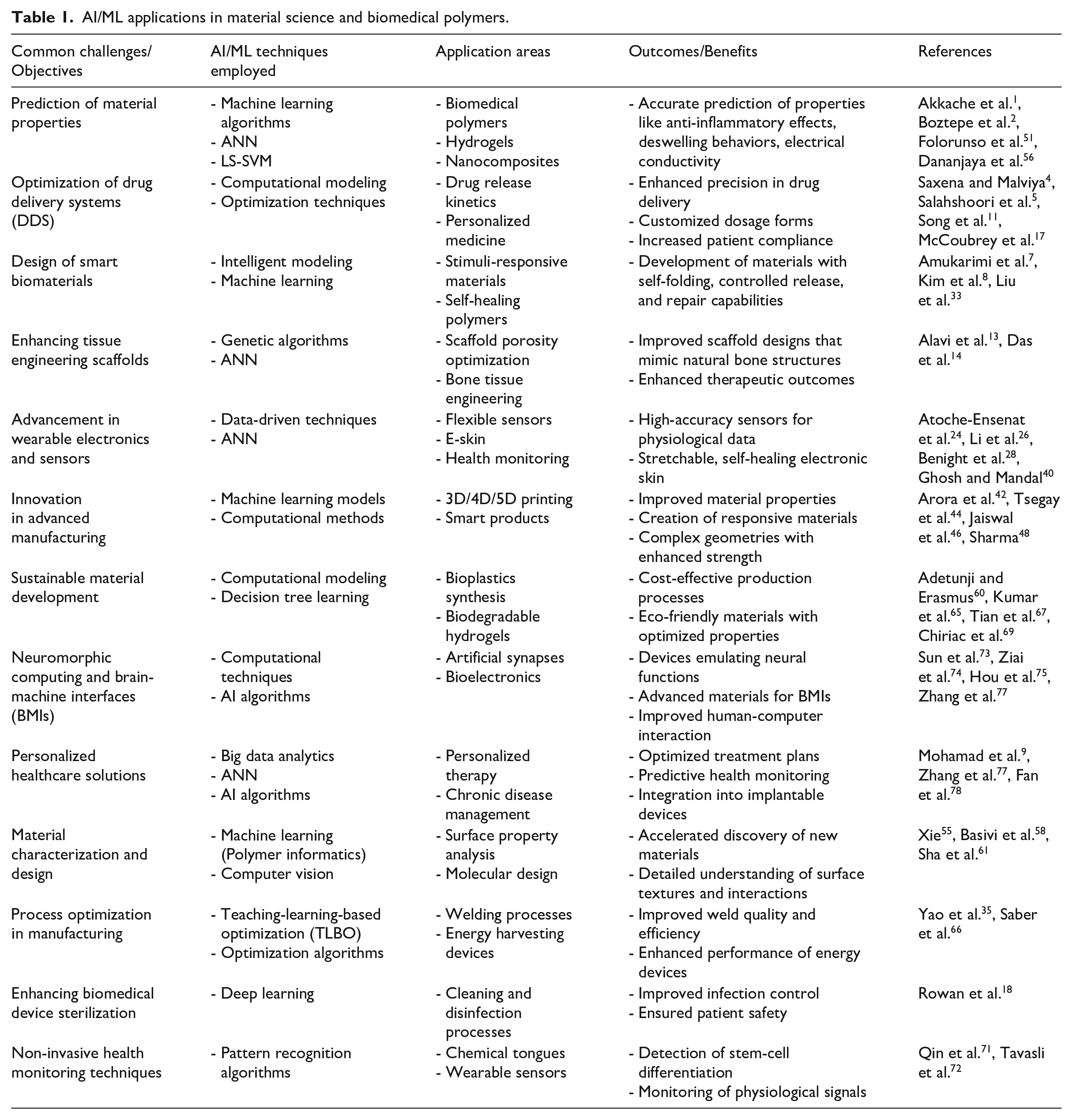
Table 1 outlines various patterns in AI/ML applications within material science and biomedical polymers. It categorizes challenges and objectives such as prediction of material properties, optimization of drug delivery systems, and the design of smart biomaterials. Techniques employed include machine learning algorithms, artificial neural networks (ANN), and computational modeling. Application areas span biomedical polymers, tissue engineering, and wearable electronics. Outcomes highlight benefits like improved material properties, enhanced therapeutic results, and sustainability.
AI/ML applications in material science and biomedical polymers.
Concluding remarks
This commentary emphasizes the transformative impact of Artificial Intelligence (AI) in advancing biomedical polymers, drug delivery systems, and neuromorphic technologies. AI has greatly improved predictive modeling, optimized material properties, and accelerated the development of novel biomedical solutions, leading to faster development cycles and more targeted applications. Additionally, AI has been instrumental in optimizing drug release kinetics, designing drug delivery systems (DDS), and creating smart biomaterials that mimic biological functions, enhancing tissue regeneration and personalized medicine. AI’s integration with wearable electronics and neuromorphic technologies has also driven significant progress in healthcare monitoring and human-computer interaction. However, challenges like data availability, computational complexity, and the interpretability of AI models persist. These limitations can restrict AI’s predictive power and complicate its adoption in clinical settings where transparency is crucial. Ethical and regulatory concerns, particularly related to data privacy and potential biases in AI-driven decision-making, further complicate the broader use of AI in biomedical applications.
While AI is propelling significant advancements in biomedical engineering, addressing challenges related to data quality, computational complexity, model interpretability, and ethical considerations is necessary to fully harness its potential. Future research directions include developing AI-integrated multiscale models, optimizing AI for sustainable materials, and enhancing real-time monitoring in biomedical applications. Establishing ethical frameworks and regulatory guidelines will be vital for the safe and equitable use of AI in healthcare. Continued interdisciplinary collaboration will be essential to overcome these challenges and further advance the field.
Footnotes
Declaration of conflicting interests
The author declared the following potential conflicts of interest with respect to the research, authorship, and/or publication of this article: Authors partly used OpenAI Large-Scale Language Model to maximize accuracy, clarity, and organization.
Funding
The author received no financial support for the research, authorship, and/or publication of this article.
