







Abstract
This study aimed to synthesize edible coating membranes composed of carboxymethyl chitosan/polyvinyl alcohol/curcumin nanoparticles (CMCS/PVA/Cur-NPs) using γ-irradiation, to extend the shelf life of sweet orange (Valencia) fruits stored at room temperature up to 70 days. CMCS/PVA/Cur-NPs membranes were fabricated via the casting method by blending the CMCS/PVA copolymer solution with 2.5% Cur-NPs. The mixture was subjected to thermal curing in an oven at 40°C until completely dried, after which the membranes were exposed to γ-irradiation at doses ranging from 5 to 25 kGy for subsequent characterization and evaluation in packaging applications. The chemical properties of CMCS/PVA/Cur-NPs membranes were analyzed using Fourier transform infrared spectroscopy (FTIR). In addition, the influence of γ-irradiation dose on gel content, water swelling behavior, mechanical properties, and antimicrobial activity was systematically investigated. Medium-sized Valencia oranges were packaged using CMCS/PVA/Cur-NPs membranes, sealed with Teflon tape, and stored under controlled conditions at room temperature (22°C ± 2°C) with relative humidity maintained at 65%–70% ± 5%. At the end of the storage period, coating efficiency was evaluated based on several quality parameters, including decay percentage, weight loss, pH, vitamin C content, total soluble solids (TSS), titratable acidity (TA), and the TSS/TA ratio. The results indicated that fruits coated with CMCS/PVA/Cur-NPs membranes retained superior external appearance and internal quality attributes compared to the uncoated control fruits. These findings demonstrate that CMCS/PVA/Cur-NPs membranes are effective and safe materials, highlighting their potential for application in food packaging to extend shelf life and preserve fruit quality.
Keywords
Introduction
Recent fluctuations in global temperature associated with climate change have altered the growing seasons of several crops. Fruits, once harvested, are often stored for extended periods, which reduces their shelf life and diminishes both commercial and economic value. To mitigate spoilage during storage and transportation, various preservation methods have been developed and applied. 1
Citrus fruits belonging to the family Rutaceae, such as mandarins, limes, lemons, sour oranges, and grapefruits, are rich in bioactive compounds. They exhibit notable antioxidant activity and contain high levels of ascorbic acid, carotenoids, flavonoids, and phenolic compounds. 2 Valencia orange (Citrus sinensis (L.) Osbeck) is widely consumed due to its low acidity, juiciness, pleasant flavor, and high vitamin C content. 3 Citrus fruits are highly susceptible to mechanical injury and fungal colonization during harvesting, handling, transportation, and storage. The major challenges encountered during storage include fungal infection, accelerated respiration, excessive water loss, and a pronounced decline in sensory quality.
Food packaging plays a vital role in preserving and protecting food products throughout the supply chain, acting as a barrier against external contaminants such as microorganisms, dust, gases, and light. In recent years, biodegradable materials have gained increasing attention as sustainable alternatives to conventional plastics. Derived from renewable biological resources, biodegradable packaging materials address environmental concerns associated with synthetic polymers such as polyethylene terephthalate (PET), high-density polyethylene (HDPE), and polyvinyl chloride (PVC). Despite their versatility, affordability, and lightweight nature, these synthetic polymers dominate the packaging sector due to their ease of manufacture and low cost, yet their non-biodegradable nature has intensified global concerns over plastic waste. Consequently, recyclable and biodegradable plastics are being actively explored as more sustainable options for food packaging applications.
Food packaging provides multiple benefits, including extending shelf life, preventing peel injuries, preserving quality, reducing spoilage, ensuring safety, and improving efficiency during transportation and storage. It also contributes to sustainability, improved waste management, reduced dependence on fossil fuels, and ensures that oranges reach the market in good condition. Among the sustainable packaging options, biopolymers have emerged as promising candidates. Derived from renewable feedstocks, biopolymers can compete with conventional polymers in terms of functionality and cost. However, biodegradable food packaging materials still face limitations, such as inferior moisture and gas barrier properties, low heat resistance, poor mechanical strength, and higher production costs compared to synthetic plastics. Despite these challenges, biopolymers, including polylactic acid (PLA), polyvinyl alcohol (PVA), starch, alginate, chitosan, gelatin, cellulose, cellulose acetate, collagen, and carrageenan, are increasingly being explored for food packaging applications. 4
Polymer blending of natural and synthetic polymers represents a new class of materials with enhanced properties, often referred to as biosynthetic polymeric materials. Natural polymers such as collagen, chitin, chitosan, starch, cellulose, and pectin can be combined with synthetic polymers like polyvinyl alcohol (PVA) through various techniques to develop innovative materials. PVA is a water-soluble synthetic polymer with excellent film-forming ability, mechanical strength, thermal stability, and water resistance. 5 It also exhibits biodegradable properties and has been widely applied in industrial, biomedical, and food packaging fields. Chitosan, a cationic natural polymer obtained by deacetylation of chitin from crustacean exoskeletons (e.g. crab shells, shrimp, cuttlebone), has been extensively studied in different applications such as food preservation,6–11 agriculture,12–15 pharmaceuticals,16–18 and biomedicine.19–22 Carboxymethylation of chitosan yields carboxymethyl chitosan (CMCS), which possesses improved water solubility. CMCS, when enriched with other functional materials, offers promising potential for diverse applications, including fruit preservation and packaging. 7
The development of alternative packaging solutions, such as films and composites with intelligent functionalities, represents a promising approach. Incorporating essential oils, natural extracts, or nanoparticles into packaging materials has proven effective in enhancing performance and extending food shelf life. Among natural extracts, curcumin is considered safe and suitable for food applications. Curcumin (1,7-bis(4-hydroxy-3-methoxyphenyl)-1,6-heptadiene-3,5-dione), isolated from the turmeric plant (Curcuma longa L.), exhibits multiple beneficial properties, including antioxidant, antimicrobial, anti-inflammatory, and anticancer activities. In addition, curcumin inhibits lipid peroxidation and effectively scavenges reactive oxygen species such as superoxide anions, singlet oxygen, nitric oxide, and hydroxyl radicals.23–25 However, the poor dissolution and limited solubility of curcumin remain major challenges for its processing and application. Converting curcumin into curcumin nanoparticles (Cur-NPs) has emerged as an effective strategy to improve its dissolution, solubility, bioavailability, and surface activity. 26 Several approaches have been developed for fabricating nano-sized curcumin to overcome its inherent limitations. These strategies aim to improve solubility, enhance chemical and physical stability, increase bioavailability and release rate, and expand the effective surface area of curcumin. 27 Curcumin nanoparticles (Cur-NPs) show considerable promise for enhancing bioavailability and therapeutic efficacy; however, safety concerns remain regarding potential toxicity, stability, and unintended biological interactions. Although many studies report biocompatibility, risks such as oxidative stress, cytotoxicity at high concentrations, and long-term accumulation must be carefully assessed prior to widespread application. In parallel, improved functional properties for diverse applications have been achieved through the blending of biopolymers with curcumin using various techniques. Examples include cellulose, cellulose acetate, collagen, gelatin, carrageenan, agar, chitosan, and polylactic acid (PLA), which provide enhanced mechanical, barrier, and bioactive characteristics when combined with curcumin.28–31
Gamma irradiation is recognized as one of the most important techniques for the preparation of biopolymers, films, and coatings. It is an economically favorable, safe, fast, clean, and well-controlled process that enables single-step fabrication and simultaneous sterilization, producing high-performance materials. The biopolymers prepared through irradiation are suitable for applications in food packaging, preservation, and healthcare. Moreover, the use of gamma irradiation in food protection enhances the shelf life of fruits and vegetables, improves food safety, reduces microbial growth, and delays the ripening of climacteric fruits. 32
Gamma irradiation is already established at an industrial scale for the sterilization of medical devices and food packaging, making its application to polymer films technically feasible. The process is highly scalable, with commercial irradiation facilities capable of handling bulk packaging materials continuously. Cost considerations are favorable compared to chemical crosslinking, since irradiation eliminates the need for additional reagents and reduces downstream purification steps. Importantly, gamma irradiation is compatible with existing packaging systems, as it can be applied to finished products without altering their geometry or requiring specialized equipment modifications. These factors collectively support the translational relevance of irradiation-based polymer modification for sustainable packaging applications.
This study aims to employ gamma irradiation to synthesize an eco-friendly CMCS/PVA/Cur-NPs membrane for use as a preservative coating to extend the shelf life of sweet orange (Valencia) during 70 days of storage at ambient temperature and 65%–70% relative humidity (RH). The quality parameters of coated fruits, including weight loss, decay percentage, juiciness, pH, vitamin C content, total soluble solids (TSS), titratable acidity (TA), and the TSS/TA ratio, were systematically evaluated throughout the storage period.
Materials and methods
Materials
Poly(vinyl alcohol) (PVA) with a molecular weight of 17–18 kDa and a degree of hydrolysis of 87%–89%, glutaraldehyde, dichloromethane, and Tween 80 were procured from Qualikems, India. Carboxymethyl chitosan (CMCS) and curcumin nanoparticles (Cur-NPs) were synthesized and characterized according to the procedures described in our previous work. 33
Fruits of sweet orange (Valencia) were manually harvested in mid-February 2022 from orchards belonging to Al-Shams Group for Advanced Agriculture, located along the Cairo–Ismailia agricultural road. The fruits had not undergone any postharvest treatment. They were transported to the Food Irradiation Department, National Centre for Radiation Research and Technology, Egyptian Atomic Energy Authority, Cairo, Egypt, for packaging and storage experiments. A curing process was applied for 2 days to allow partial moisture loss from the peels, thereby reducing susceptibility to fungal infection. Subsequently, the fruits were graded, washed with tap water, and air-dried. Medium-sized fruits of uniform appearance were selected, with each experimental group consisting of three replicates (six fruits per replicate).
Preparation of CMCS/PVA/Cur-NPs membranes
Briefly, a 6 wt% CMCS/PVA copolymer blend was prepared by mixing 2 wt% CMCS with 4 wt% PVA solution under continuous stirring at 60°C until a homogeneous mixture was obtained. Subsequently, 2.5% Cur-NPs (relative to CMCS content), dissolved in 5 mL of ethanol/water solution, were added to the CMCS/PVA mixture with stirring until complete homogeneity. Finally, 0.5% w/w glutaraldehyde (crosslinking agent) and 1% w/w glycerol (compatibilizer) were incorporated into the solution. After complete mixing, the reaction solution was maintained in a water bath at 60°C for 2 h under continuous stirring. The CMCS/PVA/Cur-NPs mixture was then cast into sterile Petri dishes and subjected to thermal curing in an oven at 40°C until fully dried. The resulting membranes were subsequently exposed to γ-irradiation at doses ranging from 5 to 25 kGy for further characterization and evaluation in packaging applications. Irradiation was performed using a 60Co source with a dose rate of 0.833 kGy/h at the National Center for Radiation Research and Technology, Egyptian Atomic Energy Authority, Cairo, Egypt.
Packaging test of orange fruits by CMCS/PVA/Cur-NPs membrane
The Valencia orange fruits exhibited normal appearance with no structural defects. They were thoroughly washed, air-dried, and subsequently divided into groups, each consisting of six fruits. The experimental design was conducted in triplicate. The first group served as the control (uncoated fruits). Two experimental groups were coated with the CMCS/PVA/Cur-NPs membrane, sealed with Teflon tape, and stored for 28–70 days, respectively. Storage conditions were maintained at ambient temperature (22°C ± 2°C) and relative humidity (65%–70% ± 5%), consistently applied to both control and treated groups throughout the study. Quality parameters—including decay percentage, weight loss percentage (WL%), juice yield (mL/fruit), pH, vitamin C content (mg/100 mL), total soluble solids (TSS), titratable acidity (TA), and the TSS/TA ratio—were evaluated and compared with control samples under identical storage conditions as follows:Temperature: 25°C ± 2°C and Relative Humidity: 80% ± 5%.
Characterization of CMCS/PVA/Cur-NPs membranes
Gel fraction
A known weight of dried CMCS/PVA/Cur-NPs membranes was immersed in hot distilled water for 24 h and then reweighed after removing the excess water with filter paper. The gel fraction percentage was determined using equation (1):

Where W o and W d are the initial and the dried weights of membranes, respectively.
Equilibrium swelling degree (ES)
Membrane samples of CMCS/PVA/Cur-NPs, each with a known weight and dimensions of 20 × 20 mm, were immersed in distilled water for 24 h. The swollen samples were subsequently re-weighed, and the equilibrium swelling degree (ES) was determined using the following equation (2):

Where W s and W o are the weights of swollen and dried samples, respectively.
Investigation of the quality parameters of sweet orange “Valencia”
Decay (%)
Decay percentage was determined as a percentage of rotted and dry spotted peel fruits during storage.9,34
Weight loss (WL %)
Differences between the initial weight of nine oranges for all treatments at zero time and the weight of the same fruits at time intervals were recorded weekly by an electronic balance with a sensitivity of about 0.01 g.34–37 The WL (%) for each group was calculated using equation (3):

Juiciness (mL/ fruit)
The fruit juice from nine oranges of each group was extracted every week with a manual juicer during storage; the fruits were cut in half using a sharp knife after washing with tap water, then the juice was extracted and transferred to a 200 mL cylinder to estimate the volume of juice.35,36
Total soluble solids (TSS)
A drop of juice from each group was placed in a manual refractometer (0–30 Brix % mass sucrose, ATC), and the reading was recorded as a Brix at room temperature.38,39
pH measurement
The acidity in Valencia orange juice of each group was determined using a digital pH meter, Beekman model, with a combination electrode at room temperature.34,39
Titratable acidity (TA)
TA was estimated by titrating 10 mL of juice of each group with 0.1 sodium hydroxide using two drops of phenolphthalein as an indicator until the light pink color appeared. The results of TA were expressed as a percentage of citric acid.34,36,38,39
TSS /TA ratio
TSS/TA ratios of the fruit samples were calculated from the data of TSS and TA of each group by dividing TSS values by TA values.36–40
Vitamin C (Ascorbic acid mL/100 mL)
Determination of ascorbic acid was carried out according to the official method of analysis of the Association of Official Analytical Chemists 199. 39 A 5 mL of juice was mixed with 5 mL of acetic acid (3%), then titrated by the self-indicator dye 2,6-dichlorophenol indophenol up to color change to a sustainable pink. The strength of the dye was determined by using a standard solution of ascorbic acid, which was 0.02 mg. The ascorbic acid concentration in fruit juice is calculated by the following equation (4):

Characterization analysis
The structural characteristics of the prepared samples were analyzed using attenuated total reflectance–Fourier transform infrared (ATR-FTIR) spectroscopy (Bruker Optik GmbH). The tensile strength (TS) and elongation at break (%) (Eb%) were determined using dumbbell-shaped specimens (50 mm length, 4 mm neck width) at a crosshead speed of 500 mm/min and a tension speed of 25 mm/min at room temperature, employing a computerized tensile testing machine (Qchida, Dongguan Haida Equipment Co., Ltd., China).
Antimicrobial activity
The antimicrobial activity of the CMCS/PVA/Cur-NPs membrane was evaluated using the agar disc diffusion method, with results expressed as inhibition zones (mm). 41 Antimicrobial activity was assessed against representative microorganisms, including Gram-positive bacteria (Bacillus subtilis and Staphylococcus aureus) and Gram-negative bacteria (Escherichia coli and Klebsiella pneumoniae). In addition, two fungal strains, Candida albicans and Aspergillus niger, were tested to evaluate antifungal performance. The antimicrobial activity of the CMCS/PVA/Cur-NPs membrane was evaluated using the agar disc diffusion method. The inoculum level was standardized to approximately 1 × 10 6 CFU/mL, and plates were incubated at 37°C for 24 h. Membrane samples were cut into discs of uniform dimensions (10 mm diameter, 0.2 mm thickness). The positive controls (Gentamycin for bacteria, Fluconazole for fungi) and negative controls (solvent). Each test was performed in triplicate. After incubation, the diameter of the inhibition zone (mm) was measured as mean ± standard deviation (SD) around each disc/membrane using a digital caliper.
Experimental design and statistical analysis
The design of the experiment was completely randomized with three replicates. The data were analyzed using the analysis of variance technique (two-way ANOVA) to compare the average value of the parameters. Duncan’s multiple range test (DMRT) was used to compare the mean values between pairs of treatments. 42
Results and discussion
Effect of irradiation doses on gel fraction and equilibrium swelling of CMCS/PVA/Cur-NPs membranes
Figure 1 depicts how irradiation doses impact the gel fraction and equilibrium swelling behavior of CMCS/PVA/Cur-NPs membranes. The gel fraction percentage increased with irradiation dose, reaching 97.4% at 15 kGy (Figure 1(a)). Higher doses (20–25 kGy) exert no significant effect on the gel fraction percentage. At 15 kGy, irradiation is sufficient to induce desired structural changes such as crosslinking, and it was a suitable dose for comparing irradiation effects on the gelation between polymer components of the composite membrane. This suggests enhanced intermolecular crosslinking among the membrane component chains, leading to the formation of a stable network structure. As a result of CMCS and PVA crosslinking with Cur-NPs, the membranes exhibited reduced water uptake. The equilibrium swelling percentage (ES%) of CMCS/PVA/Cur-NPs membranes decreased with increasing irradiation dose, while the presence of phenyl rings and methyl groups in curcumin further contributed to their hydrophobic character. 43 Enhanced crosslinking at irradiation doses of 15, 20, and 25 kGy corresponded to reductions in ES% to 23.7, 19.8, and 18.6%, respectively (Figure 1(b)). The notable variation in ES% can be attributed to differences in crosslinking density arising from the gel content of the prepared membranes. Importantly, membranes with lower swelling degrees are advantageous in food packaging, as they limit moisture penetration and help maintain product freshness. 44
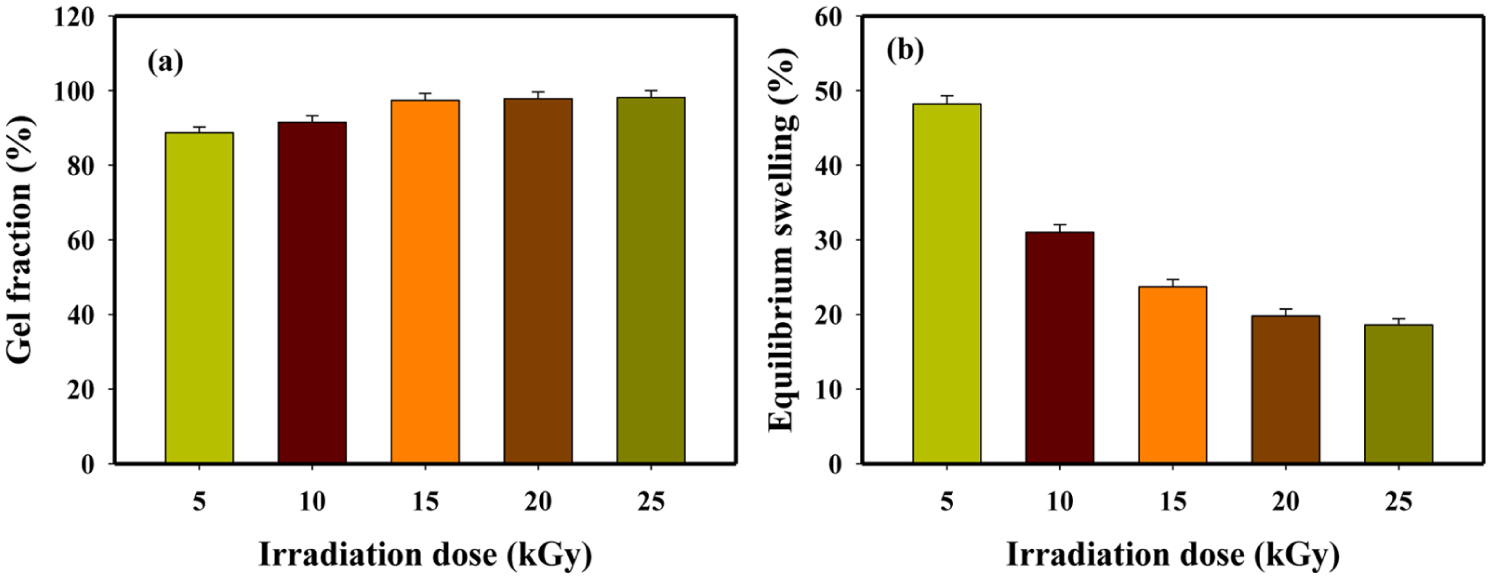
Influence of irradiation dose on (a) gel fraction and (b) equilibrium swelling percentage of CMCS/PVA/Cur-NPs membranes.
Mechanical properties
For fruit packaging applications, the mechanical performance of CMCS/PVA/Cur-NPs membranes must meet practical expectations that balance strength, flexibility, and barrier properties. Films should be strong enough to resist tearing during handling, transport, and storage. Figure 2 presents the changes in tensile strength (TS) and elongation at break (Eb%) of CMCS/PVA/Cur-NPs membranes under different irradiation doses. CMCS/PVA/Cur-NPs membranes exhibited enhanced tensile strength (TS) accompanied by a reduction in elongation at break (Eb%) as the irradiation dose increased. The TS rose from 31.75 to 37.32 MPa, showing a marked increase up to 15 kGy, followed by only marginal improvements at higher doses (20–25 kGy; Figure 2(a)). This behavior can be attributed to the formation of a crosslinked network structure, where CMCS and PVA interact with Cur-NPs through hydrogen bonding and stronger intermolecular interactions, thereby restricting chain mobility and producing a denser matrix. For fruit packaging, the typical tensile strength range was 20–35 MPa,45,46 ensuring durability without excessive rigidity.
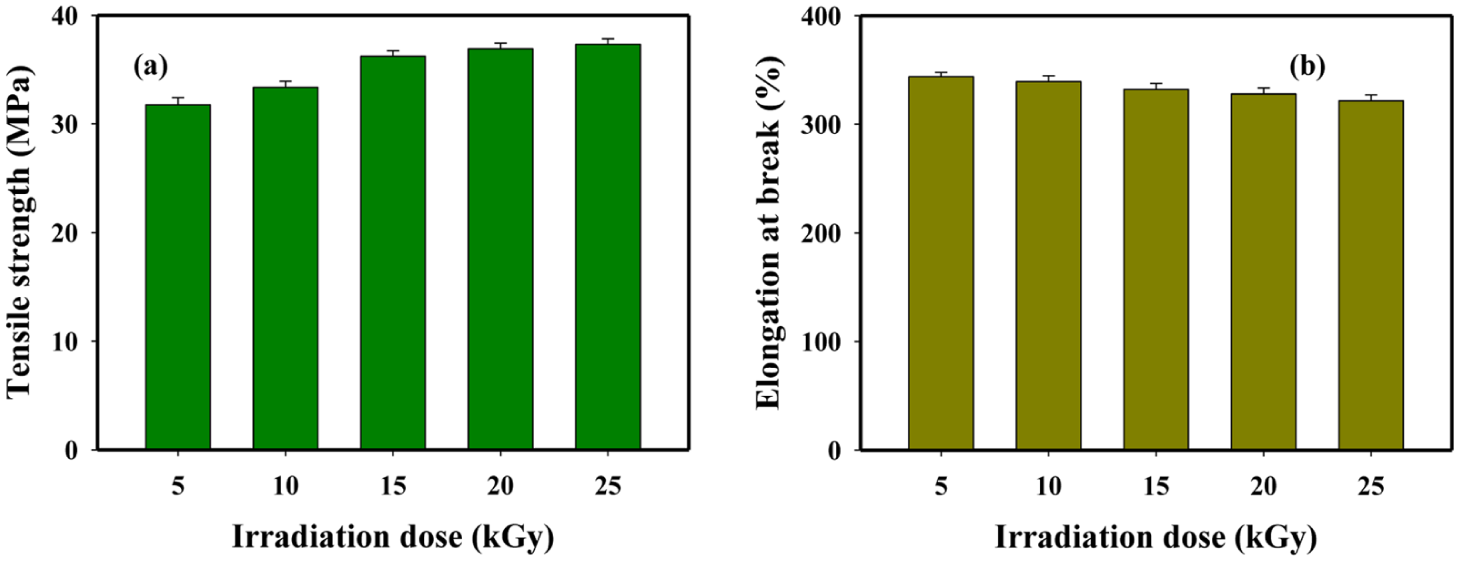
Effect of irradiation dose on (a) the tensile strength and (b) elongation at break (%) of CMCS/PVA/Cur-NPs membrane.
Flexibility is essential to accommodate the irregular shapes of fruits and to prevent film cracking. The results indicated that the elongation at break (Eb%; Figure 2(b)) exceeded 321% and was only slightly influenced by increasing irradiation dose. For practical applications in fruit packaging, elongation values in the range of 50%–150% are considered optimal, as they provide sufficient flexibility while maintaining structural integrity. 45 Blending PVA with CMCS and incorporating Cur-NPs resulted in improved elongation at break (Eb%). The findings clearly indicate that increasing the irradiation dose to 15 kGy enhances the mechanical properties of CMCS/PVA/Cur-NPs membranes. This enhancement is attributed to γ-irradiation–induced crosslinking and the formation of interfacial adhesion bonds between CMCS, PVA, and Cur-NPs, which strengthen intermolecular interactions and reinforce the membrane structure. 47 The CMCS/PVA/Cur-NPs membrane demonstrates superior mechanical strength and flexibility compared to many commercial films, offering better tensile properties and barrier performance while maintaining biodegradability. This positions it as a promising candidate for active food packaging applications. While starch-based films were cheap, but weak mechanical stability, with a TS of 5–15 MPa, and Eb% was 30%–60%. 48
FTIR results
Figure 3(a) presents the FTIR spectrum of Cur-NPs, showing characteristic peaks at 3436 and 3260 cm−1 corresponding to phenolic O–H stretching vibrations. Peaks at 3098, 1645, and 1585 cm−1 are attributed to aromatic C–H stretching, C=O stretching, and C=C vibrations in unsaturated hydrocarbons and aromatic rings, respectively. The band at 1507 cm−1 is associated with C–O and C–C vibrations, while peaks at 1433 and 1275 cm−1 correspond to C–O stretching in the phenolic structure. Additional peaks at 1123 and 1053 cm−1 indicate C–O–C stretching vibrations. Finally, peaks at 976, 834, and 720 cm−1 are assigned to –CH2 stretching and aromatic C–H bending vibrations. 49
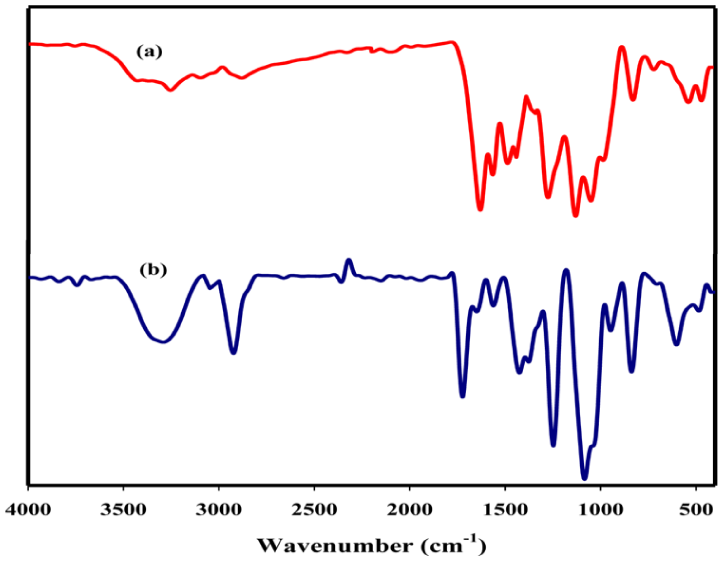
FTIR spectra of (a) Cur-NPs and (b) CMCS/PVA/Cur-NPs membranes.
Figure 3(b) displays the FTIR spectrum of the CMCS/PVA/Cur-NPs membrane. Characteristic peaks at 3293 and 2935 cm−1 correspond to –OH/–NH stretching and –CH2 stretching, respectively, while peaks at 1729, 1568, and 1438 cm−1 are attributed to C=O, C–O stretching, and N–H vibrations. The broad band at 3310 cm−1 reflects overlapping –OH and –NH stretching from CMCS/PVA and Cur-NPs. Several Cur-NPs peaks appeared with reduced intensity and slight shifts, including those at 3310, 3059, 1645, 1566, and 1438 cm−1, assigned to –OH stretching, aromatic C–H stretching, C=C stretching, symmetric vibrations of aromatic C=C, and olefinic C–H bending, respectively. Additional peaks at 1262 and 1096 cm−1 indicate enolic C–O and C–O–C stretching, while bands in the 956–622 cm−1 region correspond to aromatic C=C vibrations of curcumin. The presence of these peaks confirms successful interactions between Cur-NPs’ functional groups and those of CMCS and PVA.49,50
Use of CMCS/PVA/Cur-NPs membrane in packaging applications
Investigation of the quality parameters of sweet orange (Valencia) was carried out to evaluate the effectiveness of the CMCS/PVA/Cur-NPs preservative membrane. The assessment included measurements of decay percentage, weight loss percentage, juice yield, pH, vitamin C content, total soluble solids (TSS), titratable acidity (TA), and the TSS/TA ratio. These parameters were systematically monitored throughout the storage period to determine the impact of the coating on fruit quality compared with uncoated control samples. In food-contact applications, CMCS was widely accepted as GRAS (Generally Recognized as Safe) for use in food and certain packaging applications as an additive in coatings and adhesives. It is widely recognized as a direct edible coating, approved as a food additive, and commonly applied to fruits, vegetables, and confectionery to enhance shelf life and quality. Additionally, CMCS was permitted as a stabilizer/thickener in coatings and films due to its non-toxic profile. PVA was commonly used in food-contact coatings, packaging adhesives, biodegradable films, and coatings as a non-edible contact layer. Curcumin nanoparticles are gaining attention as a direct edible coating in food packaging research because they combine natural bioactivity with nanotechnology advantages. Thus, Cur-NPs can be incorporated into biodegradable polymers like PVA, CMCS to create films that actively protect food, making active packaging films with different characteristics such as antimicrobial surfaces, antioxidant protection. In addition, radiation could affect their properties, since irradiation is often used for sterilization and can also modify polymer structures to improve film performance, making them strong candidates for sustainable food packaging.
Figure 4 shows the effect of the CMCS/PVA/Cur-NPs membrane as packaging stretch material on the quality of orange fruits after 70 days of storage and their quality parameters compared with uncoated fruits (control).
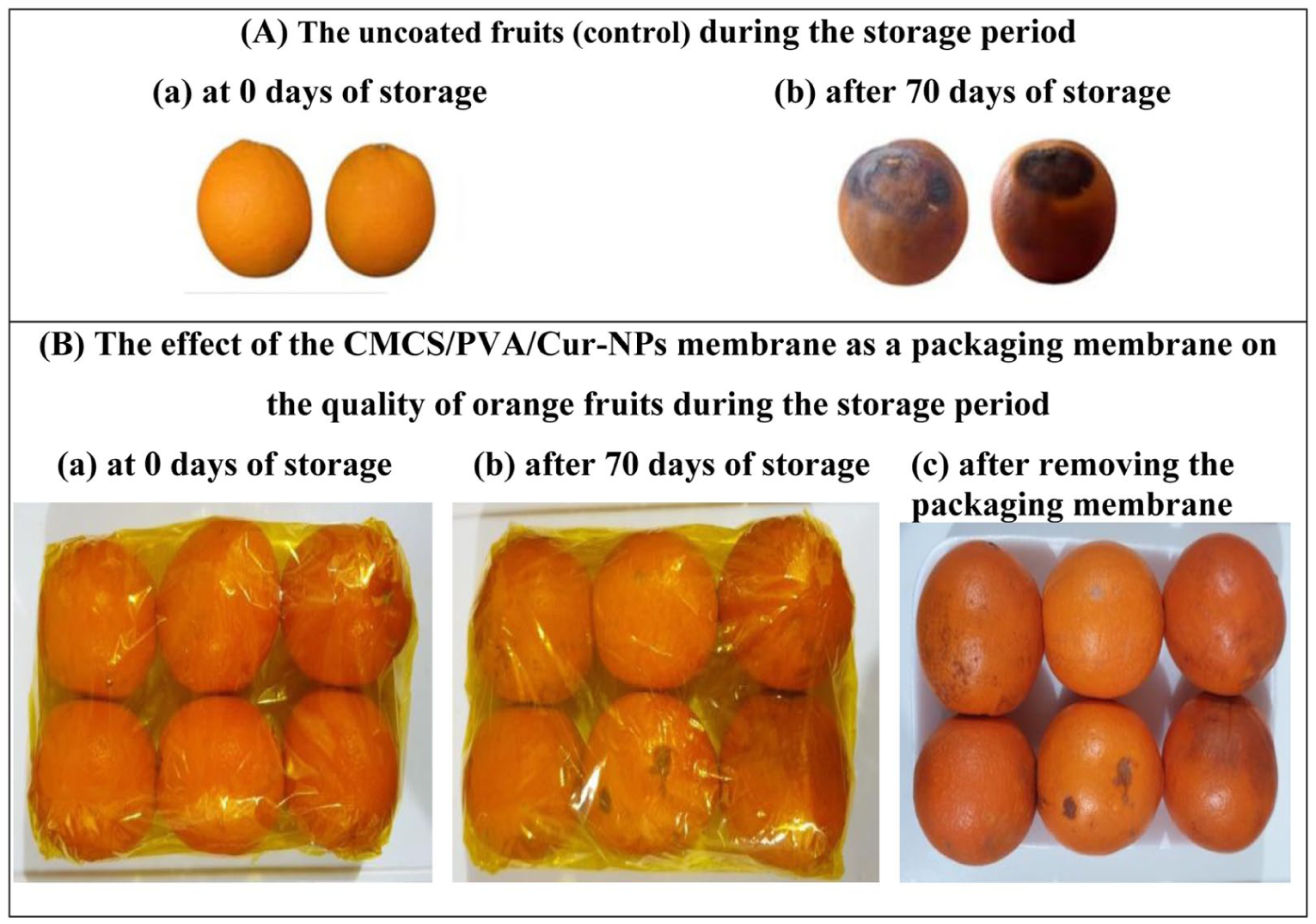
(A) The un-coated fruits (control) during the storage period: (a) at 0 days of storage and (b) after 70 days of storage. (B) The effect of the CMCS/PVA/Cur-NPs membrane as packaging membrane on the quality of orange fruits (a) at 0 days of storage, (b) after 70 days of storage, and (c) after removing the packaging membrane.
Figure 4A(a) illustrates fresh orange fruits at day 0 of storage, displaying a bright orange color and intact external appearance. In contrast, Figure 4A(b) depicts fruits after 70 days of storage, which exhibited pronounced decay characterized by darkened coloration, loss of freshness, and the presence of brown burns on the peel. The fruits also showed signs of drying, scalding, shrinkage, and fungal infection.
Figure 4B illustrates the effect of the CMCS/PVA/Cur-NPs membrane as a packaging material on the quality of orange fruits during storage. The application of this membrane markedly preserved fruit freshness and extended shelf life, with no visible deterioration. As shown in Figure 4B(b), the coated oranges maintained their bright color and morphological integrity throughout 70 days of storage. After removal of the packaging membrane, Figure 4B(c) demonstrates that the fruits retained their quality at room temperature, comparable to the initial state observed at day 0 in Figure 4B(a).
Figure 5 presents the changes in quality parameters of packaged “Valencia” oranges during storage. As shown in Figure 5(a), fruits coated with the CMCS/PVA/Cur-NPs membrane exhibited minimal decay, with only 3.5% and 6.5% deterioration after 28 and 70 days, respectively. In contrast, uncoated control fruits showed markedly higher decay rates of 24% and 40% at the same time points. The observed decay is primarily attributed to metabolic activity and moisture loss through the flavedo layer, compounded by fungal infections, which collectively lead to shrinkage, loss of gloss, and fruit rot-factors that contribute to significant economic losses.
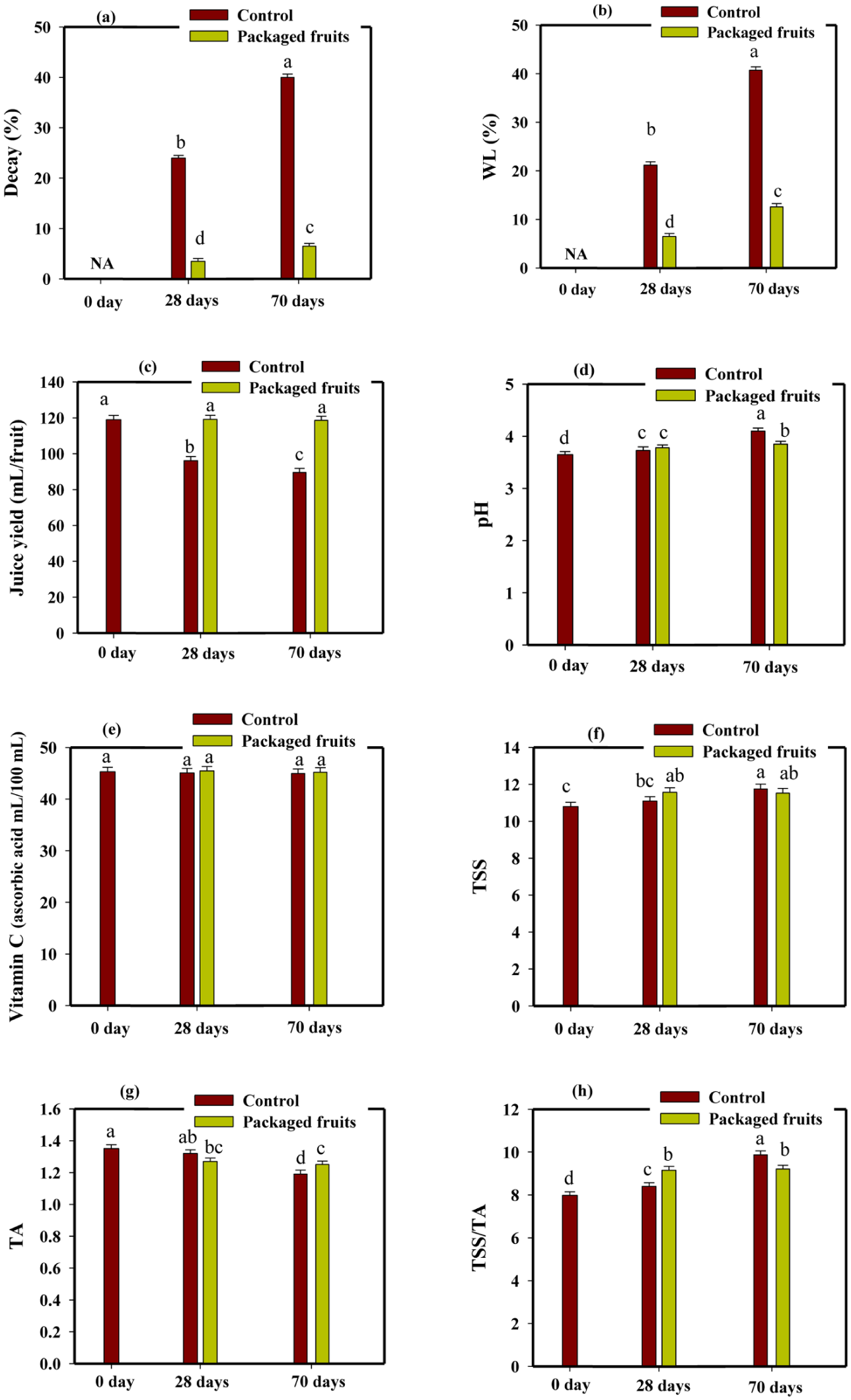
The change in the quality parameters of packaged orange “Valencia” fruits at different storage days; (a) decay %, (b) WL%, (c) juice yield (mL/ fruit), (d) pH, (e) vitamin C (ascorbic acid mL/ 100 mL), (f) TSS, (g) TA, and (h) TSS/TA ratio. Duncan’s multiple range test (DMRT) was used to compare the mean values between pairs of treatments. Means followed by the same letters are not significantly different at 5% level.
Figure 5(b) shows the changes in WL% of “Valencia” oranges during storage. In uncoated fruits, WL% increased progressively, reaching 21.5% after 28 days and 28.5% after 70 days. In contrast, fruits packaged with the CMCS/PVA/Cur-NPs membrane exhibited significantly lower WL%, ranging from 6.5% to 8.8% over the same periods. This reduction is attributed to the membrane’s ability to limit metabolic activity, moisture evaporation through the flavedo layer, and respiration rate, thereby preserving fruit quality during extended storage. 34 Figure 5(b) illustrates the changes in weight loss percentage (WL%) of “Valencia” oranges during storage. In uncoated fruits, WL% increased steadily, reaching 21.5% after 28 days and 28.5% after 70 days. By contrast, fruits packaged with the CMCS/PVA/Cur-NPs membrane exhibited markedly lower WL%, ranging between 6.5% and 8.8% over the same periods. This reduction is attributed to the membrane’s ability to suppress metabolic activity, limit moisture evaporation through the flavedo layer, and reduce respiration rate, thereby preserving fruit quality during prolonged storage.
Figure 5(e) demonstrates that coated fruits maintained a stable vitamin C content throughout the storage period. This stability is attributed to the CMCS/PVA/Cur-NPs membrane, which acted as a semi-permeable barrier, reducing moisture loss and thereby slowing senescence and oxidative processes. Figure 5(f) shows that the total soluble solids (TSS) value of packaged fruits remained stable, whereas the control fruits exhibited a gradual increase in TSS during storage, indicating faster biological changes. Figure 5(g) illustrates that the coating preserved the titratable acidity (TA, expressed as citric acid %) of the oranges, while the TA of control fruits declined steadily, leading to reduced acidity. This reduction is explained by the consumption of sugars and organic acids such as citric and malic acid during respiration, which negatively impacts flavor. It is well established that TA in fruits decreases slightly during storage, and the observed decline in citric acid percentage follows this general trend.39,51 Figure 5(h) illustrates the TSS/TA ratio, a critical indicator of fruit quality and flavor. Coated oranges maintained a balanced ratio of sweetness to acidity throughout 70 days of storage, demonstrating the effectiveness of the CMCS/PVA/Cur-NPs membrane in preserving sensory attributes. In contrast, control fruits exhibited a progressive imbalance, reflecting accelerated biochemical changes during storage.
The packaging test results revealed that the prepared CMCS/PVA/Cur-NPs membrane had a pronounced effect on extending shelf life and maintaining fruit freshness. The membrane functioned as an active food packaging material, effectively reducing contamination risks while preserving orange quality. Incorporation of Cur-NPs into CMCS/PVA polymer films endowed the packaging with antioxidant, antimicrobial, and sensory-enhancing properties, thereby acting as an active component within the matrix. This application is considered an indirect edible coating, as the film itself is not intended for direct consumption. Consequently, curcumin in nanoparticle or film form requires specific migration studies and regulatory approval before adoption in food-contact applications.
Cur-NPs are stable, water-dispersible particles with a size range of 100–200 nm, enhancing curcumin’s bioavailability and solubility. These nanoparticles are well-dispersed in aqueous media, which improves curcumin’s solubility and facilitates consistent interaction with biological systems. Cur-NPs are emerging as effective agents in fruit preservation due to their potent antimicrobial activity, nanoscale size, and uniform dispersion, which collectively enhance stability and bioavailability. They are widely incorporated into edible coatings and active packaging systems, providing protection against microbial spoilage and extending the shelf life of fruits such as oranges, mangoes, and berries.52,53
Antimicrobial activity
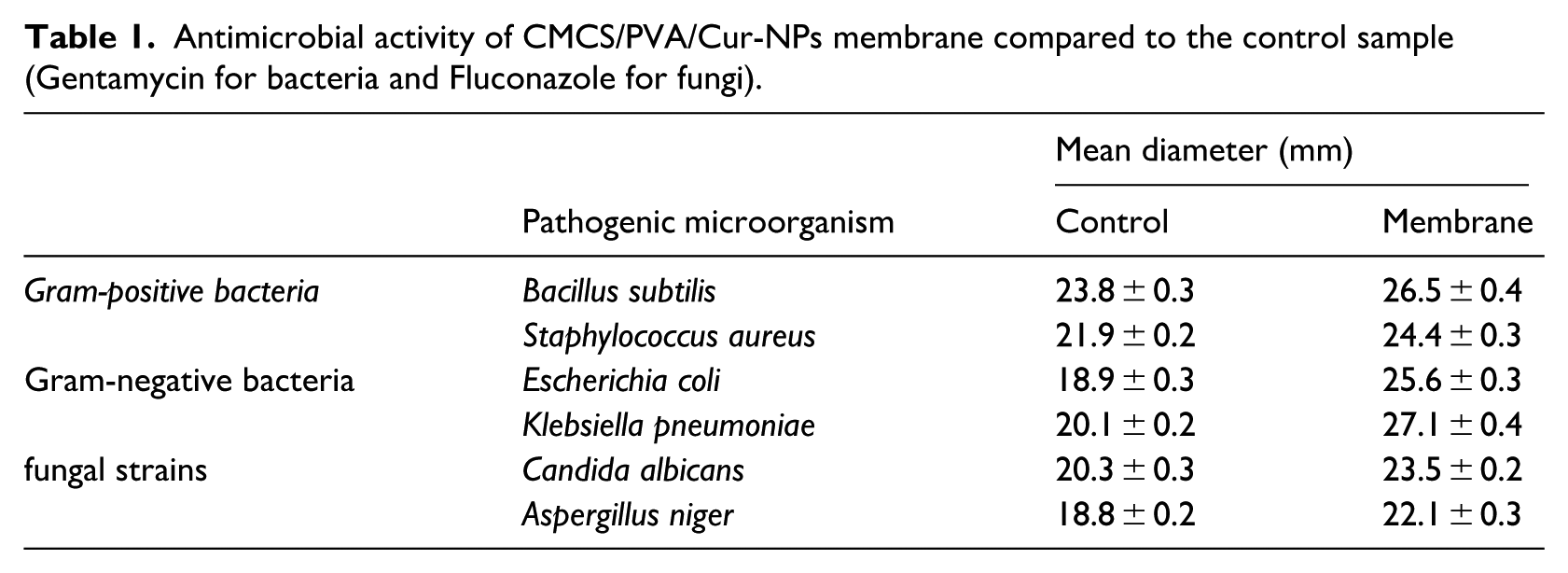
Table 1 shows the antimicrobial activity of CMCS/PVA/Cur-NPs membranes against fungi (Candida albicans, Aspergillus niger) and bacteria, including Gram-positive (Bacillus subtilis, Staphylococcus aureus) and Gram-negative (Escherichia coli, Klebsiella pneumoniae). The CMCS/PVA/Cur-NPs membranes exhibited superior antimicrobial activity compared to the control agents (Gentamycin for bacteria and Fluconazole for fungi). The inhibition zones produced by the membranes ranged from 24 to 27 mm, exceeding those observed for the control samples. The CMCS/PVA/Cur-NPs membranes demonstrated strong sensitivity against fungi as well as both Gram-positive and Gram-negative bacteria. The pronounced antimicrobial activity can be attributed to the presence of Cur-NPs, which interact with microbial DNA, thereby inhibiting replication. In addition, curcumin disrupts the integrity of the bacterial cell membrane and reduces microbial motility, ultimately leading to cell death. 54
Antimicrobial activity of CMCS/PVA/Cur-NPs membrane compared to the control sample (Gentamycin for bacteria and Fluconazole for fungi).
Crosslink density acts as a tuning parameter; higher density favors stability and surface-contact antimicrobial action. A stronger network between components of CMCS/PVA/Cur-NPs restricts diffusion of curcumin, limiting their migration into the surrounding medium. Incorporation of Curcumin into polymer films can act through surface-contact mechanisms in antimicrobial activity. Antimicrobial activity relies more on direct contact at the film surface. The presence of curcumin on the surface of CMCS/PVA membrane has a pronounced effect on microbes contacting the film surface that are directly exposed to curcumin’s bioactive sites, leading to enhanced antimicrobial efficacy. Curcumin molecules interact with microbial cell membranes, disrupt metabolic pathways, and generate reactive oxygen species (ROS). This localized interaction can inhibit microbial adhesion and growth without significant migration into the food.
Cytotoxicity assay
The viability and cytotoxicity of CMCS/PVA/Cur-NPs membranes against Vero cells were assessed using the MTT assay, as shown in Figure 6. The results demonstrated high cellular viability, exceeding 98.6% at all tested concentrations. At the highest concentration (1000 µg/mL), the observed cytotoxicity was only 1.42%, confirming the non-cytotoxic nature of the membranes. These findings are consistent with numerous toxicological studies that have examined curcumin’s safety profile, which collectively indicate that curcumin is safe and non-toxic even at very high oral doses.55,56
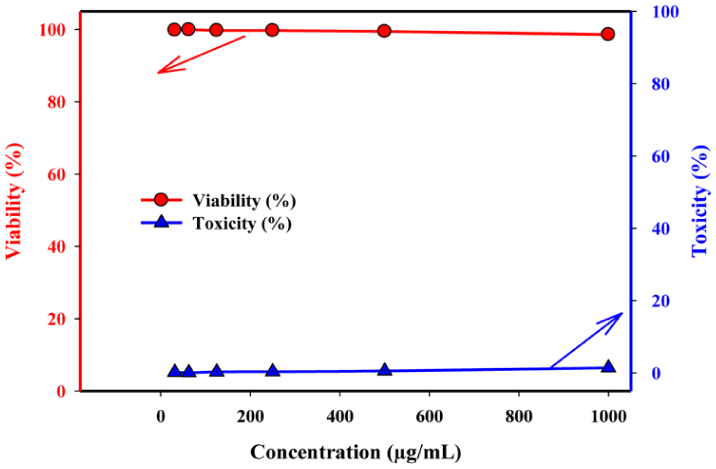
The viability/toxicity percentages of the CMCS/PVA/Cur-NPs membrane at different concentrations against Vero cells.
Conclusion
Gamma irradiation proved to be an effective technique for synthesizing CMCS/PVA/Cur-NPs membranes as eco-friendly packaging materials to extend the shelf life of sweet orange (Valencia). The CMCS/PVA/Cur-NPs membranes exerted a pronounced effect on fruit freshness, maintaining quality and prolonging storage life without visible changes. Fruits coated with the CMCS/PVA/Cur-NPs membrane exhibited minimal decay and reduced weight loss compared with the control group. Specifically, fruit decay and weight loss percentages decreased compared to the control samples. In addition, the coating preserved other quality parameters throughout storage. The results demonstrated the non-cytotoxic nature of the CMCS/PVA/Cur-NPs membranes, with consistently high cellular viability observed across all tested concentrations. These findings confirm that the synthesized CMCS/PVA/Cur-NPs membrane functions as an active antimicrobial food packaging material, effectively preventing contamination, extending shelf life, and maintaining the quality and freshness of Valencia orange fruits during storage.
Footnotes

Funding
The authors received no financial support for the research, authorship, and/or publication of this article.
Declaration of conflicting interests
The authors declared no potential conflicts of interest with respect to the research, authorship, and/or publication of this article.
Data availability statement
The data that support the findings are available from the corresponding author upon request.*