







Abstract
Background:
The aim of the present study was to investigate the effect of the Lanz system on air sealing by self-inflation in high volume–low pressure (HVLP) tube cuffs.
Methods:
In vitro tracheal air sealing was studied in HVLP tracheal tube cuffs (internal diameter [ID] 8.0 mm) made from polyurethane ([PU] Seal Guard tracheal tube, Covidien, Athlone, Ireland) and from polyvinylchloride ([PVC] HiLo tracheal tube, Covidien) with and without Lanz pressure regulating valve. Tube cuffs were placed in a vertical 22 mm ID artificial trachea and inflated to 5, 10, 15, 20, 25, or 30 cm H2O cuff pressures. Pressure control ventilation with peak inspiratory pressures (PIPs) of 20 or 25 cm H2O was applied and air leakage was assessed spirometrically as the ratio of expiratory to inspiratory tidal volumes. Nonparametric Mann-Whitney test was applied to compare the air leakage with and without Lanz system for both cuff types at each cuff pressure and PIP (P < .05).
Results:
The PVC tube cuffs with Lanz system resulted in significant air leakage at both 20 and 25 cm H2O PIP as compared to those without the Lanz system, especially at cuff pressures lower than the preset PIP (P < .05). Although PU tube cuffs with Lanz system showed reduced air sealing when compared with cuffs without Lanz, the difference was not statistically significant.
Conclusion:
Cuff pressure compensation with the Lanz system during cyclic respiratory pressure changes interferes with the self-sealing mechanism in HVLP tube cuffs at cuff pressures lower than PIP level. This results in larger air leak across tube cuffs particularly in tube cuffs made from PVC.
Introduction
It is known that the high volume–low pressure (HVLP) tracheal tube cuffs seal the trachea at baseline cuff pressures lower than peak airway pressure by the self-sealing mechanism. 1 –3 Increasing positive pressure during inspiration in mechanically ventilated trachea is transmitted to the cuff and the cuff moves away from the area of high pressure (distal cuff) toward the area of low pressure (proximal cuff). 4,5 Thereby, the cuff collapses distally and bulges proximally thus creating a self-sealing mechanism which allows tracheal occlusion despite distal tracheal pressure being higher than the cuff inflation pressure. Low cuff pressures effectively sealing the trachea is regarded as an important advantage in patient particularly at risk from pressure injuries due to the tracheal tube cuff, such as pediatric patients, patients on long-term mechanical ventilation, and critically ill patients.
The Lanz pressure regulating valve (Figure 1) introduced in early 1970s limits cuff inflation pressure to prevent cuff hyperinflation and related tracheal injury. 6 It has an external reservoir pilot balloon that communicates with the tube cuff guarded by a pressure regulating valve designated to maintain intracuff pressure at 26 to 33 cm H2O (Figure 1). 7 Any increase in the intratracheal pressure will squeeze out air from within the cuff into the external pilot balloon reservoir, hence preventing subsequent rise in the intracuff pressure.
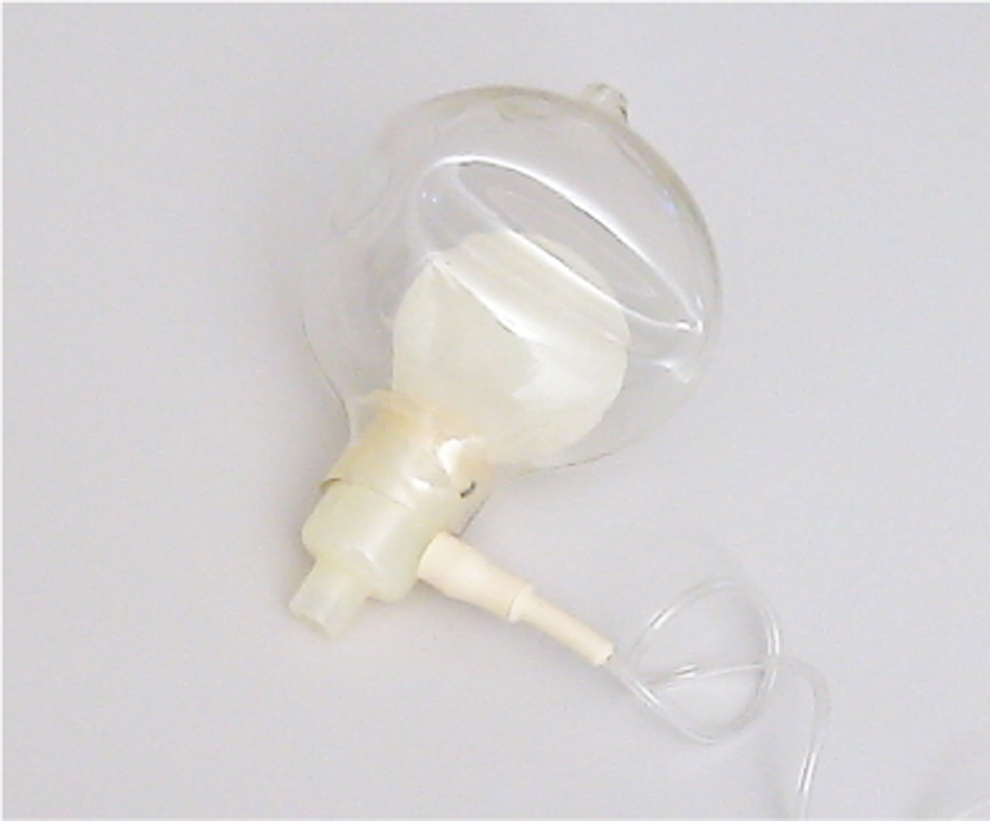
Lanz system.
Whether this pressure controlling mechanism of the Lanz system interferes with the self-sealing mechanism in modern HVLP tracheal tube cuffs has not been investigated so far and hence was aimed on in this study.
Materials and Methods
In vitro tracheal air sealing was investigated in 8.0 mm internal diameter (ID) tracheal tubes with HVLP tube cuffs made from polyurethane (PU) or from polyvinylchloride (PVC) and without and with Lanz pressure regulating valve (specially manufactured for this study by Covidien, Athlone, Ireland; Figure 2).
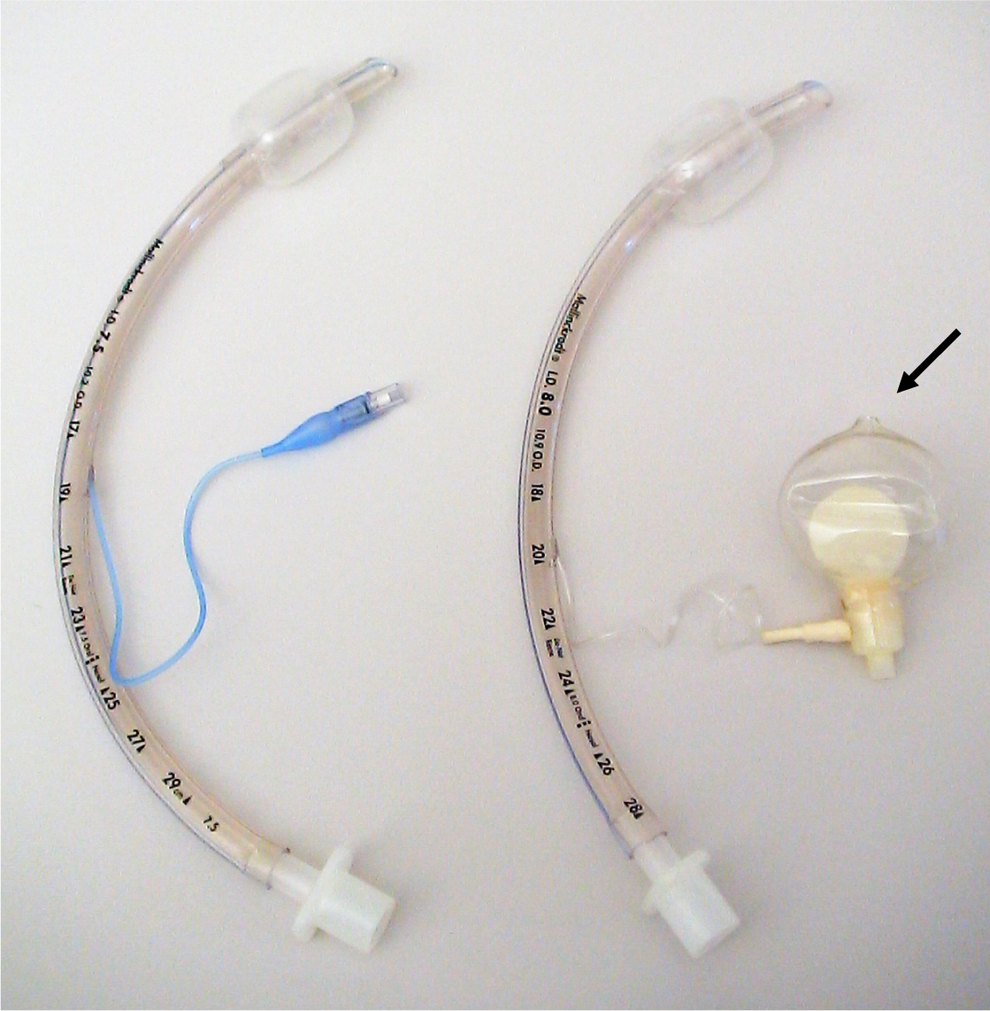
High volume–low pressure endotracheal tube with polyvinylchloride tube cuffs without (left) and with (right) Lanz pressure regulating valve (arrow).
Tube cuffs were inserted in a vertically placed 22 mm ID artificial trachea and inflated to 5, 10, 15, 20, 25, or 30 cm H2O cuff pressures and continuously monitored by a manual cuff pressure manometer (Cuff pressure Gauge, Mallinckrodt, Athlone, Ireland). The artificial trachea was attached to a test lung (Testlung, Carbamed, Zürich, Switzerland—Compliance 22 mL cm H2O−1). Tracheal tube was connected to the respiratory circuit of the AS/5 anesthesia delivery unit (ADU Ventilator, Datex Ohmeda, Helsinki, Finland). Respirator settings were fresh gas flow (air) 4 L/min; respiratory rate 10 min−1; and I:E ratio 1:2. Pressure controlled ventilation was applied with Positive End Expiratory Pressure (PEEP) of 5 cm H2O and peak inspiratory pressure (PIP) of 20 or 25 cm H2O.
Air leakage was assessed spirometrically and the percentage ratio of expiratory to inspiratory tidal volumes (VtE/VtI) was calculated. Low VtE/VtI ratio was interpreted to correspond to higher air leakage across the tracheal tube cuff. Simultaneously, maximal and minimal intracuff pressures (cm H2O) were recorded at each inspiration and expiration in all endotracheal tubes with and without Lanz system. Experiments were performed 4 times using 4 different endotracheal tubes from each brand in a randomized order (thus 16 observations per tube brand, PIP level and cuff pressure level) at room temperature of 20 to 22°C. Tracheal tube cuffs were inflated and checked by inspection prior to each test.
Calculations and Statistical a nalysis
Nonparametric Mann-Whitney U test was applied to compare the air leakage between the tracheal tube cuffs with and without Lanz system for the PVC and PU cuffs at each cuff pressure and PIP. Again Mann-Whitney U test was also applied to compare the resulted minimal and maximal intracuff pressures for each preset intracuff pressure in all endotracheal tubes without and with Lanz system and at each preset PIP. A value of P < .05 was considered to indicate statistical significance. SPSS version 16.1 (SPSS Inc, Chicago, Illinois) was used from the hospital resources for this purpose.
Results
The PVC tube cuffs with Lanz system resulted in higher air leakage (low VtE/VtI ratio) at both 20 and 25 cm H2O PIP as compared to those without the Lanz system. At preset cuff pressures lower than 20 cm H2O, the air leakage was significantly higher (P < .05) in tracheal tubes with Lanz system as compared to those without Lanz (Figure 3A). Although PU tube cuffs with Lanz system showed reduced air sealing as compared to cuffs without Lanz, the difference was not statistically significant (Figure 3B).
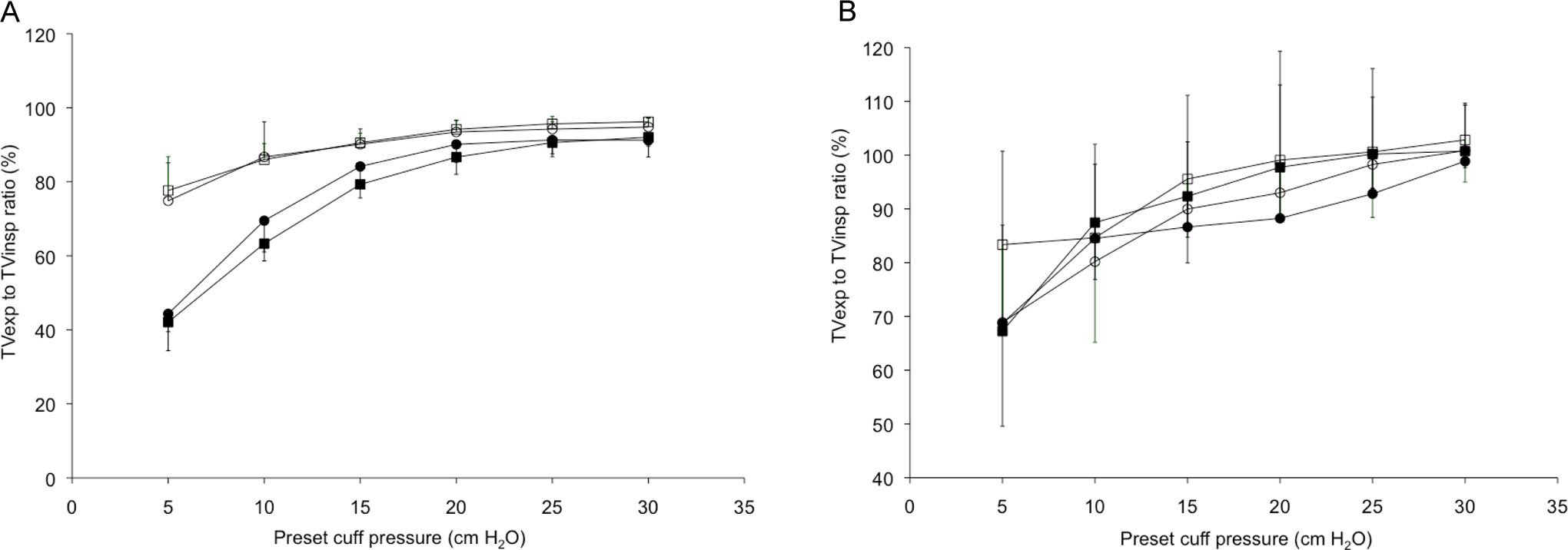
A, Air leakage assessed as percentage ratio of expired to inspired tidal volume (VtE/VtI ratio) in the HiLo tracheal tube with polyvinylchloride cuff. B, Air leakage assessed as percentage ratio of VtE/VtI in the SG tracheal tube with polyurethane cuff. ○, indicates HVLP tracheal tube cuff without Lanz system, PIP 20 cm H2O; •, HVLP tracheal tube cuff with Lanz system, PIP 20 cm H2O; □, HVLP tracheal tube cuff without Lanz system, PIP 25 cm H2O; ■, HVLP tracheal tube cuff with Lanz system, PIP 25 cm H2O; PIP, peak inspiratory pressure; HVLP, high volume–low pressure.
Measured intracuff pressures during inspiration and expiration at all cuff pressure levels were consistently significantly higher (P < .001) than the preset intracuff pressures in endotracheal tubes without Lanz system (Figure 4C and D). In tubes with Lanz system, measured intracuff pressure during inspiration and expiration was comparable to the preset intracuff pressure except at preset cuff pressures <15 cm H2O (P < .05; Figure 4A and B).
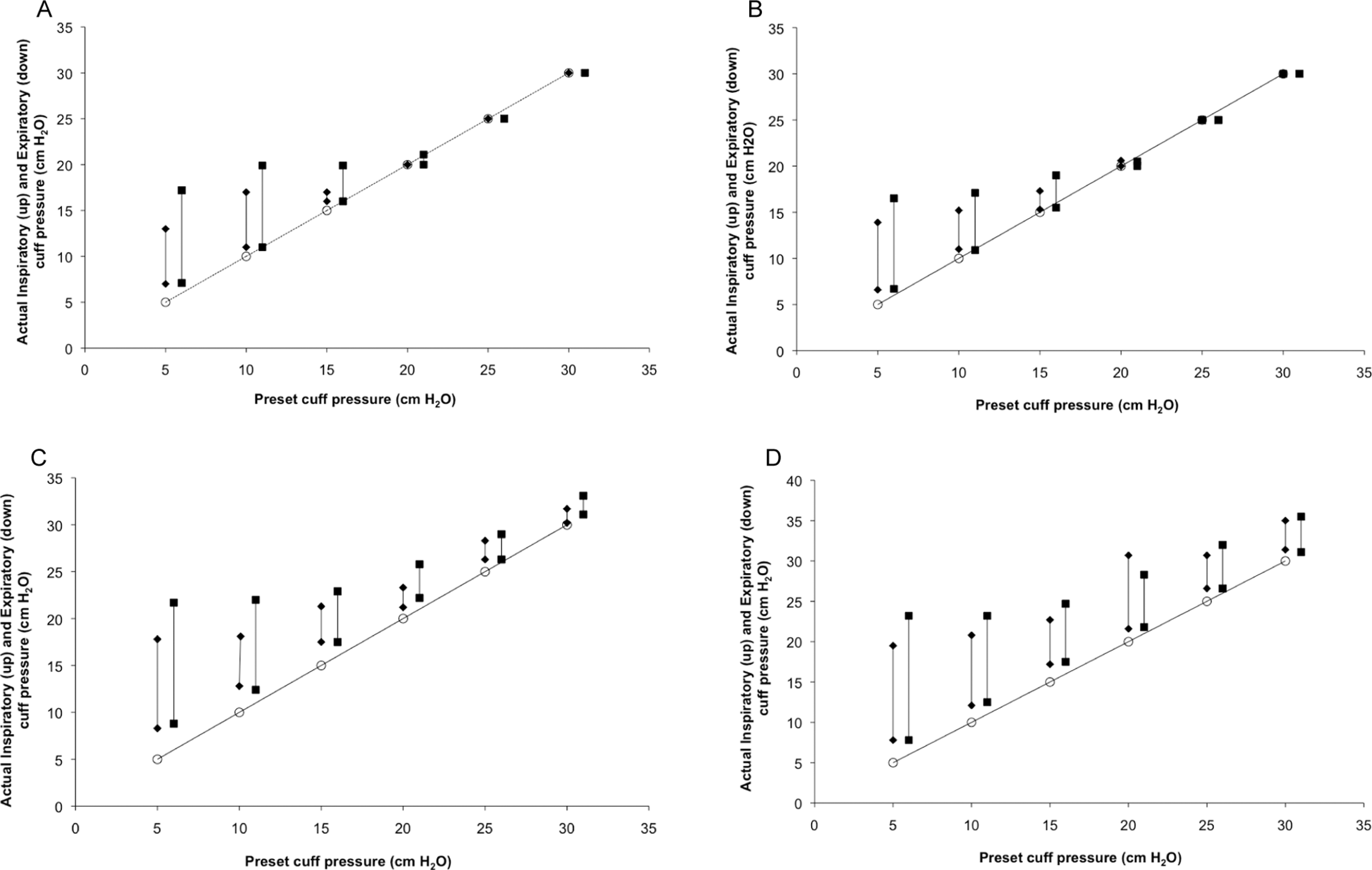
Actual intracuff pressure measured during inspiration (upper data points) and expiration (lower data points) in (A and C) PVC HVLP HiLo tracheal tube with and without Lanz system, respectively, and (B and D) PU HVLP SG tracheal tube with and without Lanz system, respectively.○, indicates preset cuff pressure; ♦, actual inspiratory and expiratory cuff pressure at PIP 20 cm H2O; ▀, actual inspiratory and expiratory cuff pressure at PIP 25 cm H2O; PIP, peak inspiratory pressure; PVC, polyvinylchloride; PU, polyurethane; HVLP, high volume–low pressure.
Discussion
This bench top model investigated the impact of the Lanz endotracheal tube system on the self-sealing mechanism of HVLP tube cuffs and their intracuff pressures changes during positive pressure ventilation in a bench top model. The main finding was that the Lanz pilot balloon provides rapid compensation of the cyclic respiratory intracuff pressure changes and, therefore, impairs the self-sealing mechanism of HVLP tube cuffs resulting in higher air leak, particularly in tube cuffs made from PVC.
The Lanz pressure regulating valve system with pilot balloon is designed to automatically compensate intracuff pressure changes without the need for additional cuff pressure monitoring or regulation. 8 Any increase in the pressure of the tracheal cuff is automatically offset by the regulating valve and intracuff air is moved to the pilot balloon visible through the outer transparent balloon (Figure 1). Seegobin et al studied tracheal mucosal blood flow during intubation with endoscopic photographic technique in 40 patients and reported normal blood vessel caliber with uniform hue in patients intubated with the Lanz system endotracheal tubes thought to be due to inherent impossibility to over inflate the cuff with reservoir pilot balloon. 9 Several earlier studies10,11 also support this notion suggesting the Lanz system to be safe and advantageous because over inflation of cuff thought to be the major culprit causing tracheal injury seems to become difficult or unlikely with the Lanz system. This mechanism was proposed to be favorable, for example, during long N2O gas anesthesia or at varying altitudes during air transportation.8,12 In a study by Abud et al, 12 Lanz was found to decrease tracheal intubation injury in dogs under N2O anesthesia as proved by smaller microscopic tracheal lesions when compared with other endotracheal tube cuffs without pressure regulation. 10 Interestingly, they also noted higher intracuff pressures required to seal the trachea as compared to control group without Lanz tube cuff, which is consistent with our results.
Weiss and colleagues demonstrated that rapid compensation or even overcompensation of respiratory intratracheal pressure changes by some commercial cuff pressure regulating devices could deleteriously worsen tracheal air sealing and probably favor microaspiration across the tube cuff. 3 The cyclic redistribution of air within HVLP tracheal tube cuffs during intermittent positive pressure ventilation allowing tracheal sealing at tracheal airway pressure being above baseline cuff inflation pressure is impaired or omitted in tubes with Lanz system. Consecutively, air sealing at a preset cuff pressure was increased in the PVC tube cuffs without the Lanz system as compared to those with. Again we could simultaneously observe that measured maximum intracuff pressure was higher than the preset cuff pressure in these tube cuffs without Lanz system, indicating an unimpaired self-sealing mechanism with better air sealing and less leakage. The finding that we did not observe a significant difference in the air leakage between PU tracheal tube cuffs with and without Lanz system is not a surprise since PU tube cuffs are known to have better sealing characteristics. 13
We did not use N2O during ventilation since that would itself influence the intracuff pressure. We also did not use lubrication (imitating the contact surface between the tracheal mucosa and the cuff wall), since it is known to facilitate better sealing by filling the longitudinal folds in the HVLP cuffs and, therefore, to impair evaluation of difference between systems and tube cuffs. 14,15
Tracheal tube cuffs with Lanz system clearly interfere with the self-sealing mechanism during ventilation and hence favor leakage of air across the HVLP tube cuffs, particularly in those made from PVC. Consecutively, higher preset cuff pressure would be needed if Lanz system is used to obtain the same level of air sealing compared with tracheal tubes without Lanz system. This represents a disadvantage in patients benefitting from lower tracheal cuff pressure, such as children and critically ill patients on long-term mechanical ventilation. Slow reacting electronic pressure cuff regulation apparatus is proposed to allow air sealing at very low cuff pressures and to avoid hyperinflation in endotracheal tube cuffs.
Footnotes
Declaration of Conflicting Interests
The authors declared no potential conflicts of interest with respect to the research, authorship, and/or publication of this article.
Funding
The authors received no financial support for the research, authorship, and/or publication of this article.