






Abstract
Purpose:
To evaluate the accuracy of the imminent brain death (IBD) diagnosis in predicting brain death (BD) by daily assessment of the Full Outline of Unresponsiveness (FOUR) score and the Glasgow Coma Scale (GCS) with the assessment of brain stem reflexes.
Materials and Methods:
Prospective multicenter pilot study carried out in 5 adult Italian intensive care units (ICUs). Imminent brain death was established when the FOUR score was 0 (IBD-FOUR) or the GCS score was 3 and at least 3 among pupillary light, corneal, pharyngeal, carinal, oculovestibular, and trigeminal reflexes were absent (IBD-GCS).
Results:
A total of 219 neurologic evaluations were performed in 40 patients with deep coma at ICU admission (median GCS 3). Twenty-six had a diagnosis of IBD-FOUR, 27 of IBD-GCS, 14 were declared BD, and 9 were organ donors. The mean interval between IBD diagnosis and BD was 1.7 days (standard deviation [SD] 2.0 days) using IBD-FOUR and 2.0 days (SD 1.96 days) using IBD-GCS. Both FOUR and GCS had 100% sensitivity and low specificity (FOUR: 53.8%; GCS: 50.0%) in predicting BD.
Conclusions:
Daily IBD evaluation in the ICU is feasible using FOUR and GCS with the assessment of brain stem reflexes. Both scales had 100% sensitivity in predicting IBD, but FOUR may be preferable since it incorporates the pupillary, corneal, and cough reflexes and spontaneous breathing that are easily assessed in the ICU.
Introduction
Organ transplantation is currently the only treatment for some terminal diseases and is the gold standard for the treatment of many other end-stage conditions; however, organ availability is limited. Although current practice in organ donation is based on the “dead donor rule,” many patients with a poor neurological prognosis are not identified as possible organ donors, while other patients suffer irreversible cardiovascular deterioration between the period of possible brain death (BD) recognition and a formal declaration of BD.
Imminent brain death (IBD) has recently been proposed to facilitate the early recognition of potential organ donors. 1 The Organ Procurement and Transplantation Network (OPTN) introduced the definition of IBD as “a patient who is 70 years old or younger with severe neurological injury and requiring ventilator support who, upon clinical evaluation…has an absence of at least three brainstem reflexes” 2 ; however, OPTN definition was not proposed for clinical recognition of potential organ donors. De Groot and colleagues 1 (p. 1490) refined the definition of IBD as “a state in which a deeply comatose, mechanically ventilated patient, admitted to an intensive care unit (ICU), with irreversible catastrophic brain damage of known origin has a Glasgow Coma Scale (GCS) of 3 and at least three or more absent brainstem reflexes or a Full Outline of Unresponsiveness (FOUR) score of zero,” and proposed it as a consistent and reliable estimate of the number of potential organ donors.
To date, IBD criteria have been evaluated only in retrospective series. The main objectives of this prospective, multicenter, pilot study were to evaluate the feasibility of daily assessment of IBD and to test the accuracy of IBD diagnosis in predicting BD through use of the FOUR and GCS.
Material and Methods
The study took place between May 2013 and August 2014 in the following 6 intensive care units (ICUs) located in Lombardia, Italy: Brescia University Hospital (coordinating center); Brescia, Fondazione Poliambulanza; Cremona, Istituti Ospitalieri; Desenzano del Garda and Manerbio, Azienda Ospedaliera Desenzano del Garda. The study was approved by the local ethics committee of Brescia (05/08/2013; n. 1431). Since patients were in coma, the ethics committee waived the requirement for informed consent; in fact, the definition of the legal representative, or surrogate, of temporarily incapacitated adult ICU patients is absent in Italy, and relatives are not regarded as legal representatives of the patient in the absence of a formal designation. 3 Detailed written information was provided to the family members about the study protocol, and all clinical investigations were conducted according to the principles expressed in the Declaration of Helsinki.
We included all adult patients older than 18 years admitted to the ICU who were ventilated, had severe brain damage of known etiology (subarachnoid hemorrhage, traumatic brain injury, intracerebral hemorrhage, subdural hemorrhage, ischemic stroke, postcardiac arrest hypoxic–ischemic encephalopathy), were comatose (patients not opening the eyes, not obeying commands, nor uttering comprehensible words after painful stimulation), and had an ICU stay of at least 24 hours. Patients were excluded if they were younger than 18 years, were not in coma, had facial trauma, or basal skull fractures precluding the possibility to evaluate the brain stem reflexes, were expected to die not for brain damage within few hours, or had a diagnosis of BD at ICU admission.
Patients were evaluated daily during their ICU stay with both FOUR 4 and GCS. 5 In accordance with the Italian legislation for BD determination in adults, the neurological evaluation was performed only if the effects of sedative drugs had been excluded or their plasma level was undetectable and the body temperature was >35°C. 6 The following brain stem reflexes were evaluated: pupillary reactivity to bright light (without using a pupillometer, since the Italian law does not foresee its use); the oculovestibular, corneal, pharyngeal, and carinal (cough) reflexes; and motor response after painful stimulation applied in the trigeminal territory (hereafter defined as trigeminal reflex). 6 Diagnosis of IBD was established if (1) the FOUR score was 0 (absence of eye opening and motor response to pain with absence of pupillary light, corneal and cough reflexes, and spontaneous breathing [IBD-FOUR]) or (2) the GCS score was 3 (absence of eye opening, motor and verbal response to pain stimulation) and at least 3 brain stem reflexes were absent (IBD-GCS).
Patients who died in the ICU were categorized as BD (deep coma, absent brain stem reflexes, and flat electroencephalogram) or cardiac death (irreversible cessation of cardiac beats with asystole) in accordance with current Italian legislation. 6
Data Presentation and Statistical Analysis
We expressed continuous variables as means (standard deviation, SD), ordinal variables as median (interquartile range (IQR) or absolute range), and discrete variables as counts (percentage), unless otherwise stated. We determined the number of organ donors and calculated both the interval between IBD diagnosis and death and the donor conversion rate (DCR), defined as the actual number of organ donors divided by the number of IBD diagnosed (potential organ donors). 7
We used Student t test to compare age and the nonparametric Mann-Whitney test to compare the ICU length of stay (ICU-LOS) between patients with BD and cardiac death. A P < .05 was considered statistically significant. We calculated the sensitivity and specificity with their 95% confidence intervals (CIs) as summary measures of prediction accuracy.
As a pilot cohort study, the dual purposes of this study were to establish feasibility and to calculate a sample size for a future definite project. Among several measures of test accuracy, we selected the sensitivity to estimate sample size since a high sensitivity test can be used as a screening test. Sample size estimation was based on the expected sensitivity of the test (IBD), the prevalence of the disease (BD), and the minimal acceptable lower confidence limit. 8 STATA (version 13; StataCorp, College Station, Texas) was used for the statistical analyses.
Results
During the 15-month study period, 569 acutely ill neurological patients were admitted to the participating ICUs, 40 of whom met the criteria and were enrolled (Figure 1). Table 1 shows the demographic characteristics and admission diagnoses of the investigated population. Patients were deeply comatose with a median GCS of 3 (range: 3-8). The mean patient age was 64.4 (15.8) years and was not different in patients with BD compared with patients with cardiac death (63.7 [13.8] years vs 68.6 [15.2] years; P = .391]). Diagnoses upon ICU admission included cerebrovascular disease (72.5%), traumatic brain injury (22.5%), and other causes such as postcardiac arrest hypoxic–ischemic brain injury, and bacterial meningitis (5%).
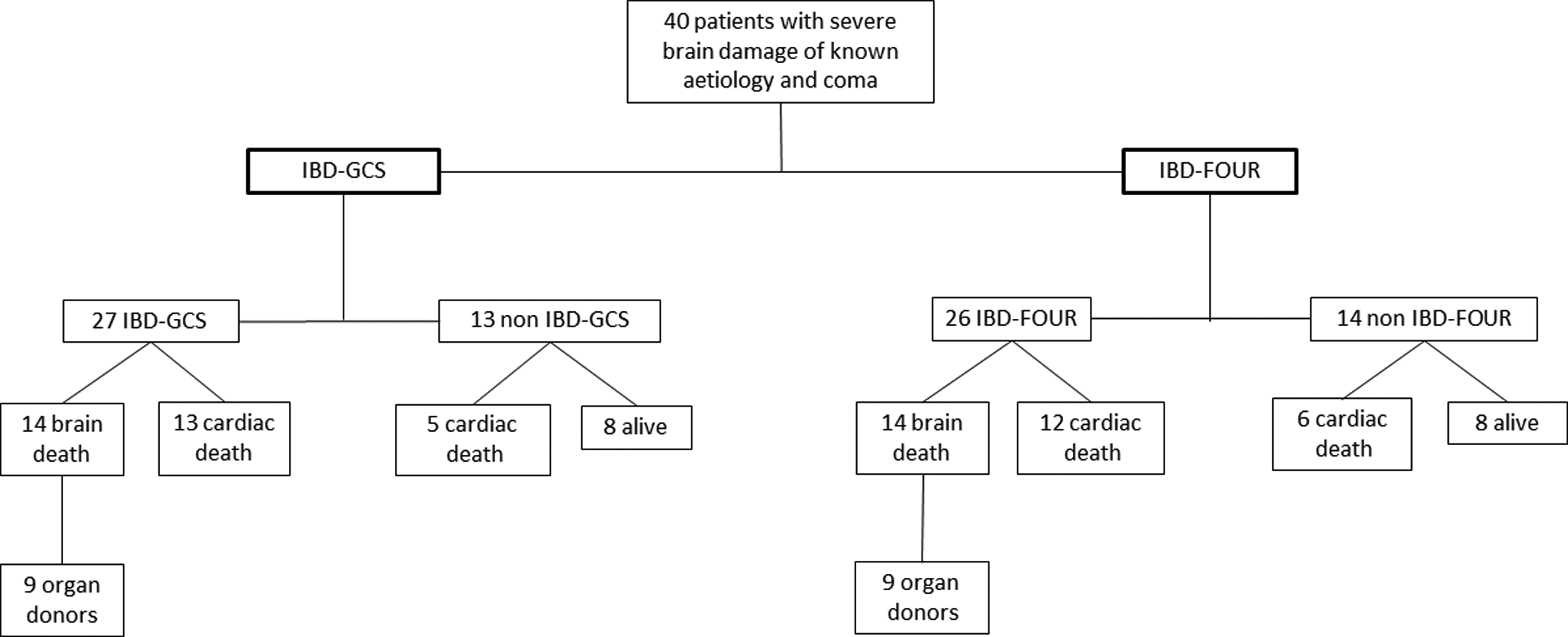
Outcome of patients with imminent brain death (IBD). IBD-FOUR indicates imminent brain death diagnosed with the Full Outline of Unresponsiveness (FOUR) scale (FOUR = 0); IBD-GCS, imminent brain death diagnosed with the Glasgow Coma Scale (GCS) scale (GCS score of 3 and at least 3 brain stem reflexes absent).
Characteristics of the Study Population.
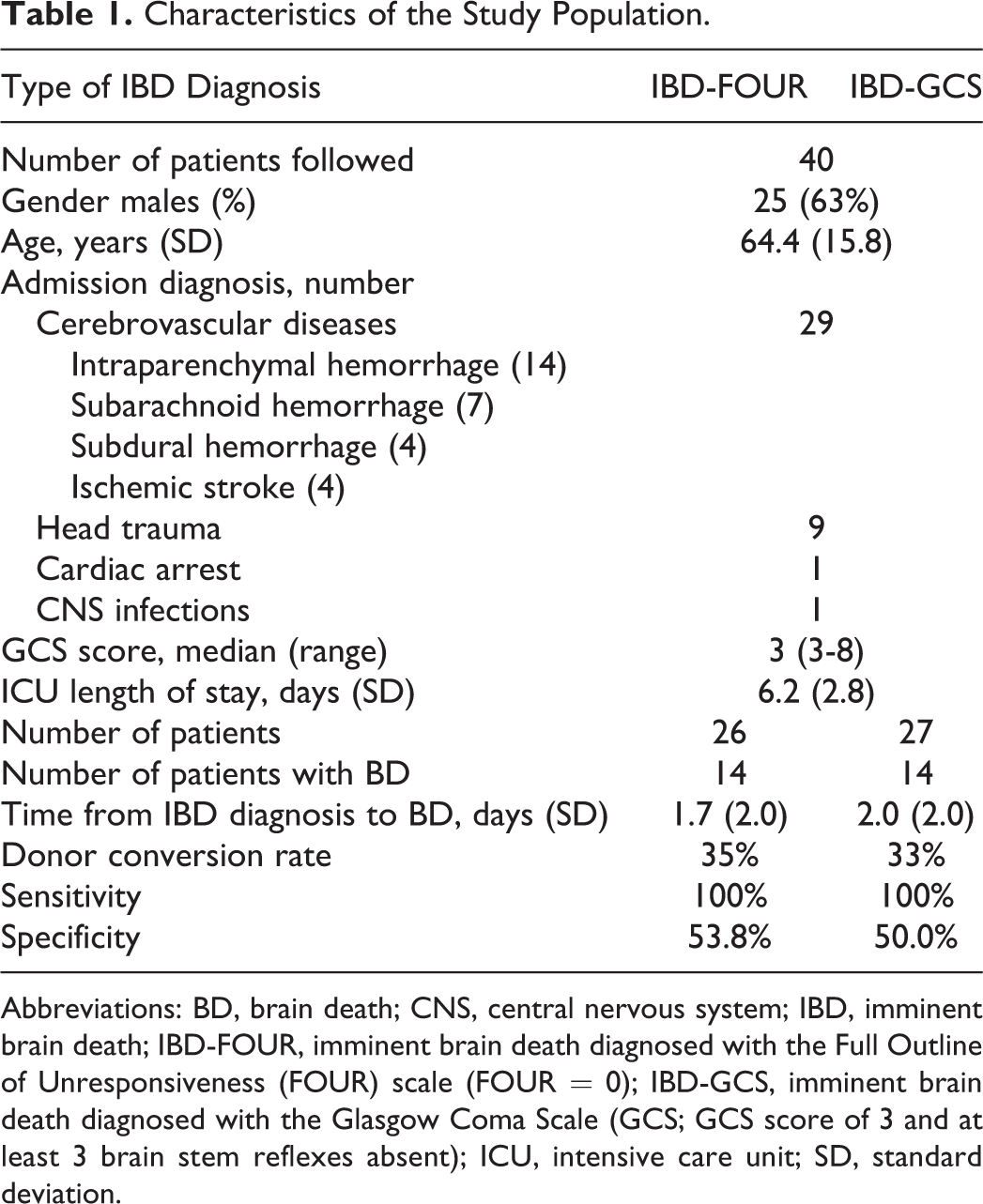
Abbreviations: BD, brain death; CNS, central nervous system; IBD, imminent brain death; IBD-FOUR, imminent brain death diagnosed with the Full Outline of Unresponsiveness (FOUR) scale (FOUR = 0); IBD-GCS, imminent brain death diagnosed with the Glasgow Coma Scale (GCS; GCS score of 3 and at least 3 brain stem reflexes absent); ICU, intensive care unit; SD, standard deviation.
The median ICU-LOS of the study population was 3.0 days (IQR: 2.0-5.0 days) and was significantly longer in patients with BD than in patients with cardiac death (4.0 [IQR: 2.2-6.7] days vs 3.0 [IQR: 1.5-3.0] days; P = .046). The average duration of the study period for each patient was 6.2 (2.8) days for a total of 246 study days. Patients were submitted to 219 neurological evaluations. The pupillary light, corneal, pharyngeal, and cough reflexes were evaluated in all cases, whereas the oculovestibular and the trigeminal reflexes were evaluated in 56% and 82% of cases, respectively.
Of the 40 patients with severe brain damage of known etiology and coma enrolled in the study, 8 survived (20%) and 32 died (80%; Figure 1). Brain death was declared in 14 (35%) of the 40 patients. Imminent brain death diagnosis was established in 26 (65%) of the 40 using the IBD-FOUR and in 27 (68%) of the 40 using the IBD-GCS (Figure 1).
Declaration of BD was preceded by a diagnosis of IBD in all cases. One patient with brain stem hemorrhage, meeting the definition of IBD with both FOUR and GCS, regained spontaneous respiration and cough, and hence, the diagnosis of IBD was no longer fulfilled. This patient remained deeply comatose and died a few days following transfer to another ICU due to cardiac arrest.
All IBD patients died, 14 (54%) of 26 FOUR-IBD patients were declared brain dead, while 12 of 26 had a cardiac death; 14 (52%) of 27 IBD-GCS patients were declared brain dead, while 13 (48%) of 27 had a cardiac death. The mean interval between IBD diagnosis and BD was 1.7 days (SD, 2.0 days; range, 0-7 days) using the IBD-FOUR and 2.0 days (SD, 2.0 days; range, 0-7 days) using the IBD-GCS. The mean interval between IBD diagnosis and BD or cardiac death was 1.3 days (SD, 1.5 days; range, 0-7 days) days using the FOUR scale and 1.5 days (SD, 1.4 days; range, 0-7 days) using the GCS.
Of the 14 patients with BD, 9 were organ donors. Five (36%) patients did not donate their organs either because the family refused to consent to organ donation (4 patients) or the patient had meningitis (1 patient). The DCR-FOUR (9 organ donors/26 IBD) and DCR-GCS (9 organ donors/27 IBD) were 35% and 33%, respectively.
Both FOUR and GCS had 100% sensitivity and low specificity. Positive and negative predictive values are reported in Table 2. To define the optimal sample size of future study, we reasoned that a substantially greater precision (ie, smaller 95% CI) would be needed to accept IBD as a reliable, high sensitivity predictor of BD. With a prevalence of 0.54 (14 BD/26 IBD-FOUR), a sensitivity of 0.99, and a minimal acceptable lower confidence limit of 0.95, we calculated that 335 patients—181 controls (patients without IBD) and 154 cases (patients with IBD)—would be required to achieve such an objective.
Sensitivity, Specificity, Positive Predictive Value, and Negative Predictive Value for Both IBD-FOUR and IBD-GCS.
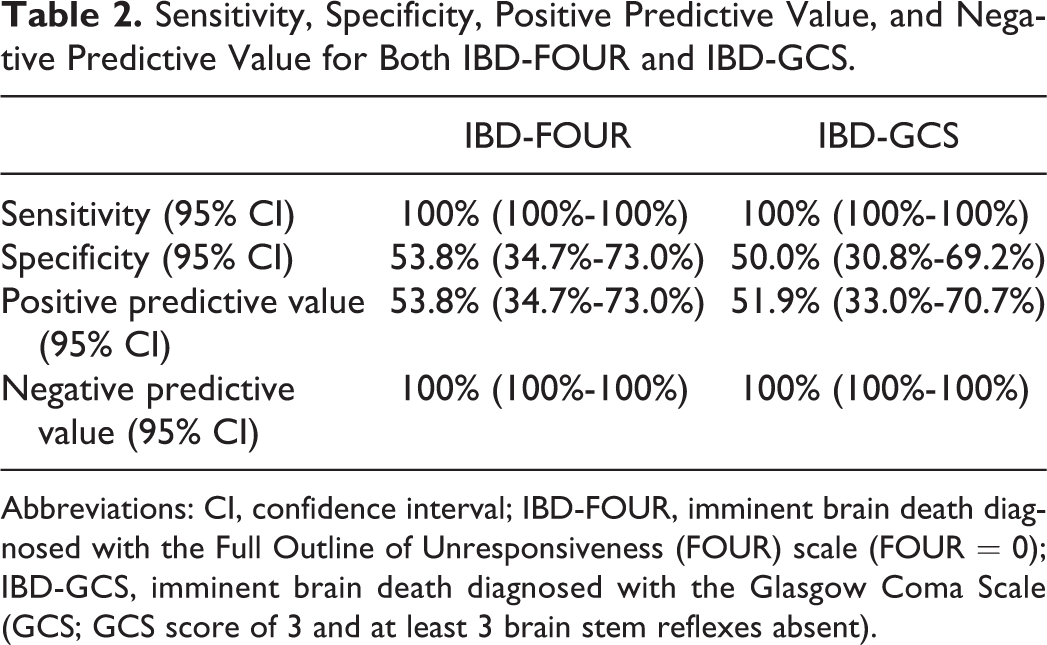
Abbreviations: CI, confidence interval; IBD-FOUR, imminent brain death diagnosed with the Full Outline of Unresponsiveness (FOUR) scale (FOUR = 0); IBD-GCS, imminent brain death diagnosed with the Glasgow Coma Scale (GCS; GCS score of 3 and at least 3 brain stem reflexes absent).
Discussion
This prospective multicenter study demonstrated that daily IBD assessment was feasible in all participating centers and showed that IBD is a common diagnosis in patients with severe brain damage, being described in 65% of patients using FOUR and 68% using GCS. Both FOUR and GCS had 100% sensitivity in predicting BD. All patients with a diagnosis of IBD died and half of them were declared brain dead. Finally, the mean time between IBD and BD was 2 days in our study.
To date, IBD criteria have been evaluated only in retrospective series. 1,7 Therefore, the result that IBD evaluation is feasible in daily clinical practice is valuable. Daily IBD clinical assessment can be easily achieved in both academic and nonacademic hospitals and may represent an efficient method to identify at an early stage potential organ donors among patients with severe brain damage. Diagnosis of IBD based on GCS was established with the assessment of at least 4 brain stem reflexes, namely the pupillary light, corneal, pharyngeal, and cough reflexes, whereas the oculovestibular and trigeminal reflexes were less commonly evaluated. Diagnosis of IBD based on FOUR was established with the assessment of the pupillary light, corneal, and cough reflexes that are an integral part of the FOUR scale and were evaluated in all cases. Since the 2 methods had comparable diagnostic accuracy and were based on the assessment of 4 brain stem reflexes, FOUR may be the preferred method for daily neurological monitoring and early IBD detection. Based on our results, 335 patients would be needed to confirm IBD as a screening test with 95% CI of sensitivity comprised between 99% and 100%. Due to the high prevalence of IBD, this seems to be an achievable target for future collaborative clinical research.
All IBD patients died, but almost half of them had cardiac arrest before fulfilling the criteria for BD. Patients with cardiac death were on average 5 years older than patients with BD and had shorter duration of ICU stay. Although the age difference did not reach statistical significance, a false-negative result cannot be excluded due to the small sample size of the study. Age has a strong impact on cardiovascular risk. 9 Moreover, in brain injury, older age is significantly associated with worse outcome. 10 This may explain, at least in part, the shorter ICU-LOS in patients with cardiac death compared to patients with BD: the sicker the patient, the shorter the LOS terminating with death. 11 However, predictive modeling is particularly difficult when considering the many risk factors for mortality that occur in severe brain injury. Among the potential predictors of cardiac death, clear identification of decision to withdraw treatments should have absolute priority because cardiac arrest is the inevitable outcome in terminally ill patients for whom a permission to donate organs is denied. Future large-scale prospective studies are needed to evaluate the role of age, preexisting cardiac comorbidity (ie preexisting cardiac disease, diabetes, systemic hypertension), cardiovascular complications arising during the acute stage of disease (ie sympathetic overactivation with hypertension or hypotension, cardiac arrhythmias, left ventricular dysfunction), and decision to withdraw treatment as independent predictors of cardiac death in patients with IBD.
The time between IBD and BD was 2 days; this period of time may enable physicians to establish more effective communication with family members and to optimize the donor treatment. Improving the information imparted by the ICU staff to the family during the consent process is likely to lead to better consent rates. 12
Limitations
Some limitations of the study are worth noting. Patients enrolled were deeply comatose at the ICU admission, which explains the fact that more than 60% of them were diagnosed with IBD. While this limits the generalizability of results to other populations of critically ill neurologic patients, the prediction ability of IBD remains unaffected. In fact, once IBD is diagnosed, progression to BD is influenced by factors unrelated to IBD prevalence. Secondly, clinicians were not blinded to the diagnosis of IBD and the treatment of IBD patients was not protocolized among participating centers.
Finally, the decisions to withdraw treatments were not recorded: Diagnosis of IBD, once established, may motivate treatment withdrawal if organ donation is unlikely. This might explain the low specificity of IBD, since only half of IBD patients were declared brain dead, whereas half had irreversible cardiac arrest. Future studies should more accurately define treatment protocols for IBD patients and criteria for treatment withdrawal.
Conclusion
These results indicate that the FOUR and GCS scales with the assessment of 4 brain stem reflexes can both be used in daily evaluation of IBD. The FOUR scale includes brain stem reflexes that are easily evaluated, and it may be the preferred method for IBD diagnosis. The time between IBD-FOUR and IBD-GCS diagnosis and BD is not different. The FOUR and GCS scales with the assessment of 4 brain stem reflexes can both be used in daily evaluation of IBD and are able to intercept all the patients who develop BD. 3
Footnotes
Appendix A
IBD Network investigators: B. Antonini, N. Petrucci, K. Vettoretto, and G. Bianchetti, at Azienda Ospedaliera di Desenzano del Garda, Desenzano del Garda and Manerbio, Italy; G. Natalini, and P. Ferretti, at Fondazione Poliambulanza, Brescia, Italy; L. Crema, A. Bonvecchio, and S. Stringhini, at Istituti Ospitalieri di Cremona, Cremona, Italy.
Declaration of Conflicting Interests
The author(s) declared no potential conflicts of interest with respect to the research, authorship, and/or publication of this article.
Funding
The author(s) disclosed receipt of the following financial support for the research, authorship, and/or publication of this article: this study was partially funded with a grant from the North Italian Transplant (NIT, Fondazione Trapianti Onlus, May 2014), and from AIDO (Associazione Italiana per la Donazione di Organi, Tessuti e Cellule).