







Abstract
Physico-chemical and mechanical properties of hyaluronic acid/carbon nanotubes nanohybrids have been correlated with the proportion of inorganic nanophase and the preparation procedure. The mass fraction of -COOH functionalized carbon nanotubes was varied from 0 to 0.05. Hyaluronic acid was crosslinked with divinyl sulfone to improve its stability in aqueous media and allow its handling as a hydrogel. A series of samples was dried by lyophilization to obtain porous scaffolds whereas another was room-dried allowing the collapse of the hybrid structures. The porosity of the former, together with the tighter packing of hyaluronic acid chains, results in a lower water absorption and lower mechanical properties in the swollen state, because of the easier water diffusion. The presence of even a small amount of carbon nanotubes (mass fraction of 0.05) limits even more the swelling of the matrix, owing probably to hybrid interactions. These nanohybrids do not seem to degrade significantly during 14 days in water or enzymatic medium.
Introduction
Hyaluronic acid (HA) is one of the most commonly proposed hydrogels for tissue engineering, not only for being present in the organism but also because of its unique properties. HA is an abundant glycosaminoglycan distributed throughout the extracellular matrix (ECM) of many tissues and organs such as lungs, kidneys, or brain. 1 HA has a structural function, but it also works as a signaling molecule, and takes part in the embryonic development and wound healing processes.2,3 Furthermore, it plays a key role in the hydration balance and provides elasticity to the tissues because of its highly hygroscopic character, 2 viscosity, and high molecular weight. HA has been shown to also scavenge free radicals, to cause bacteriostasis, and to assist in tissue repair. 4 Moreover, low-molecular-weight HA has been found to be angiogenic. 5 HA is commonly used in medical applications, for example in ophthalmic viscosurgery, in osteoarthritic treatments, or as wrinkle filler. 6 Concerning applications in the tissue engineering field, HA hydrogels have been modified with laminin and tested in brain lesions, 7 where they have shown to promote neurite extension. The combination of HA with collagen has also been studied with suitable results for brain tissue engineering.8,9 Nonetheless, HA exhibits poor mechanical properties in its natural state, it is water-soluble, and thus it is cleared quickly. 10 To overcome these limitations, in tissue engineering strategies, HA has been for example cross-linked with ethyl esters or benzyl esters, 4 such as divinyl sulfone (DVS), showing good biocompatibility. 11
On the other hand, carbon nanotubes (CNTs) are graphene sheets rolled into continuous cylinders with diameters of approximately 1 nm. 12 CNTs exhibit exceptional electrical and mechanical properties, and are biostable. 13 Consequently, their incorporation into HA hydrogels is expected to improve their mechanical properties, stability, and conductivity. In addition, the structure and dimensions of CNTs are similar to some elements of the neural system, such as ion channels, signaling proteins, or elements of the neuronal cytoskeleton, being an advantage by enhancing molecular interactions and consequently yielding to a better control over physiological activity and neural information processing. 14 For these reasons, CNTs have been proposed for their use in neural regeneration. For instance, CNTs combined with collagen scaffolds 15 enhanced the levels of neuronal markers and neural grown factors expressed by mesenchymal cells. In Serrano et al., 16 a nanohybrid consisting in chondroitin sulfate and CNTs induced the formation of neuronal networks.
Herein, CNTs functionalized with carboxylic groups (-COOH) have been used in combination with HA, due to their good dispersion in polar solvents 17 (better than that of non-functionalized CNTs) and their low cytotoxicity. 18 HA/CNTs nanohybrid scaffolds have here been obtained by freeze-drying (highly porous, due to the sublimation of water contained in the gels), with several proportions of CNTs. The spotlight of this work is set on the different roles of CNTs in HA-based nanocomposites, attained by their processing methodology. Homologous nanohybrids obtained by solvent casting (bulk samples) have been produced as controls. Both series have been physico-chemically characterized. The effect of the production method and the fraction of incorporated nanotubes on the mechanical properties and stability in physiological conditions have been assessed.
These scaffolds are intended to be used to induce neural regeneration in tissues of the central or peripheral nervous system, on the one hand because HA resembles them in terms of mechanical properties,19,20 and thus has been proposed for this purpose in several works,21–23 and on the other hand CNTs electrical conductivity makes them ideal for therapeutic applications at the neural tissue interface. 24 It is though beyond the scope of this paper to evaluate their biological development.
Materials and methods
Preparation of lyophilized HA/CNTs (L) nanohybrids
A 5 wt% HA (hyaluronic acid sodium salt, 1.63 MDa, obtained by fermentation of streptococcus equi. bacteria, 99%, Sigma) solution was obtained by stirring in a 0.2 M sodium hydroxide (NaOH; extrapure, Scharlau) aqueous solution during 24 h. To obtain the nanohybrids, different amounts of carbon nanotubes (MWCNT 95 wt% 30–50 nm, 10–20 um long -COOH, Cheap Tubes Inc.) were previously dispersed in the NaOH solution by sonication (VWR USC300TH, Pennsylvania, USA) during 10 min at room temperature (RT) to avoid their aggregation. CNTs were added to the basic solutions to obtain a final mass fraction in the HA/CNT nanohybrid, ωCNT, of 0, 0.5, 1, and 5 wt%.
Next, divinyl sulfone (DVS; 97%, Sigma Aldrich) was added to each hybrid solution as cross-linker at a ratio of 0.9 mol DVS per mol of HA monomeric units. After stirring for 10 s, 10 grams of each solution were poured into an 8.5 cm-diameter Petri dish. The Petri dish was covered by a mesh fabric during 10 min, and next frozen overnight at −20℃. Then, the samples were lyophilized (Telstar Lyoquest −85) at −80℃ during 24 h to create porous structures due to the sublimation of water. After demolding, the xerogels were swollen in water for 1 h and punched into 5-mm diameter samples, next washed in a 50:50 vol% water:acetone mixture for 2 days with a renewal at mid-time, followed by rinses in water for 3 days with renewals every 12 h and lyophilized again to dry them. Samples were stored under vacuum protected from light until use. Hereafter, this series of samples will be referred to as Lx, where L means lyophilized and x refers to the mass fraction of CNTs.
Preparation of non-lyophilized HA/CNT nanohybrids
An analogous procedure to that of the lyophilized hybrids series was followed. In this case, though, after the addition of DVS, the mixed solutions were allowed to crosslink in Petri dishes during 2 h, covered with mesh fabrics. Next, they were frozen overnight at −20℃. Then, the samples were thawed to room temperature and swollen for 1 h. Finally, the nanohybrids were punched into 5-mm-diameter samples and the previously described washing procedure was followed. Samples were stored under vacuum protected from light until use. Hereafter, this series of samples will be referred to as NLx, where NL means non-lyophilized and x refers to the mass fraction of CNTs.
Scanning electron microscopy
The influence of CNTs at different mass fractions in the materials morphology was assessed in a JSM-5410 scanning electron microscope (SEM; JEOL. Ltd., Tokyo, Japan), at 15 kW of acceleration voltage and 15 mm of working distance. The samples were fractured in liquid nitrogen to obtain cross-section images and sputter-coated with gold under vacuum before observation.
Determination of equilibrium water content
Swelling of the nanohybrid materials was quantified at equilibrium, by weighing the dry samples, m, and after equilibration at 37℃ in two different ambients: at 97% relative humidity (RH), and immersed in water. The first swelling medium was prepared with a potassium nitrate (Scharlab) supersaturated solution in a closed moisture chamber. 25
The samples were withdrawn from the moisture chamber after different times and immediately weighed, until no weight change was further observed; this value was taken for each nanohybrid as the equilibrium value, mw. The equilibrium water content, EWC, was calculated as
Determination of the density and porosity of the nanohybrid materials
A Mettler AX205 (Mettler Toledo Inc., Columbus, OH, USA) balance, equipped with a Mettler ME 33360 density accessory kit, was used to determine the density and porosity of dry samples and analogous series previously equilibrated in water. N-octane (Sigma Aldrich, 98% purity, n-octane = 0.703 gcm−3), which does not swell the nanohybrids, was used to make these quantifications. Three replicates per composition and conditioning were measured. The samples were weighed in air, m, after injection of n-octane in their pores with the help of vacuum, mi, and finally with their pores previously filled and the scaffold immersed in the liquid, ml. The density, ρ, was calculated as the mass of the sample in air divided by the volume occupied by the nanohybrid, V, obtained by subtracting the pores volume, Vpores, from the apparent volume (geometrical volume of the sample), Vap

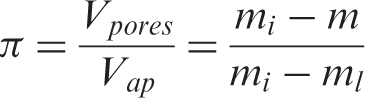
The porosity, π, was next obtained as the pores volume fraction
Compressive tests
Compressive mechanical tests were performed in a Seiko TMA/SS6600 dilatometer (Seiko Instruments Inc, Chiba, Japan) in water at 37℃, with the samples previously swollen in water, to simulate physiological conditions. A steel rod of 3 mm of diameter was used for this purpose. Five replicates per composition were tested, from 0 to 1500 mN at 100 mN/min. The compressive elastic modulus, E, was obtained as the slope of the stress–strain curves in the initial linear region.
Degradation/stability assays
In order to investigate the enzymatic degradation process of HA, as well as the effect of CNTs on it, HA lyophilized (L) and non-lyophilized (NL) samples and nanohybrids with 0.5 wt % in CNTs (L0.005 and NL0.005) were subjected to degradation, eight replicates per time point. For that purpose, the samples were immersed in an aqueous solution of bovine testicular hyaluronidase (BTH, Type IV-S, 750-3000 units/mg, Sigma-Aldrich) 10 u/ml at 37℃, for 24, 72, 168 and 336 h. The solution was not changed throughout the experiment.
HA degrades naturally in human body by hyaluronidase enzymes and reactive oxygen species (ROS). 26 As degradation products, hexa and tetrasaccharides are mainly obtained. The BTH enzyme was selected for having the same action mechanism as human hyaluronidase and for having been used in other works.27–30 The concentration used mimics that of physiological environment.
Degradation assays are usually carried out in PBS (ionic strength of 0.165 M) because at its ionic strength the enzyme activity is optimized.31,32 However, distilled water was used here in its place to dissolve the enzyme as a compromise choice, to avoid the presence of salts that gives false positives in terms of weight loss.
In parallel, stability in mili-Q water was assessed by introducing a second set of samples in the same volume (2 ml/sample) of water at 37℃ (non-enzymatic degradation). Samples were conditioned in water before any assay. After withdrawal, the enzyme in each vial was thermally inactivated at 100℃ for 90 s (the same procedure was applied to those samples immersed in a non-enzymatic medium, for comparison) and vials were stored at 4–8℃ until use.
The variation of the materials properties over time was evaluated by mass loss determination, morphology observation under SEM, and compressive tests; for the first two experiments, samples were previously lyophilized, whereas for the latter, samples were conditioned in water. Mass loss was calculated at time t as
Statistics
All the experimental data are given as mean ± standard deviation. Statistical assessment of significant variance was performed through a one-way ANOVA with the Statgraphics Centurion XVI.II software (Statistical Graphics Corp., Princeton, NJ). Statistical tests were performed at 95% significance level (p < 0.05). Differences are statistically significant unless otherwise stated.
Results and discussion
Morphology of the nanohybrids
The samples acquired an increasingly darker blackish tone (Figure 1) as the fraction of CNTs increased. After drying, the gels became rigid (vitreous), and pure HA, which was transparent as a gel, became white.
Macroscopic image showing the nanohybrids with different CNTs mass fraction (above row) and SEM images of the surface (a–d; i–l) and section (e–h; m–p) of the lyophilized (a–h) and non-lyophilized (i–p) series. Scale bar: 300 µm.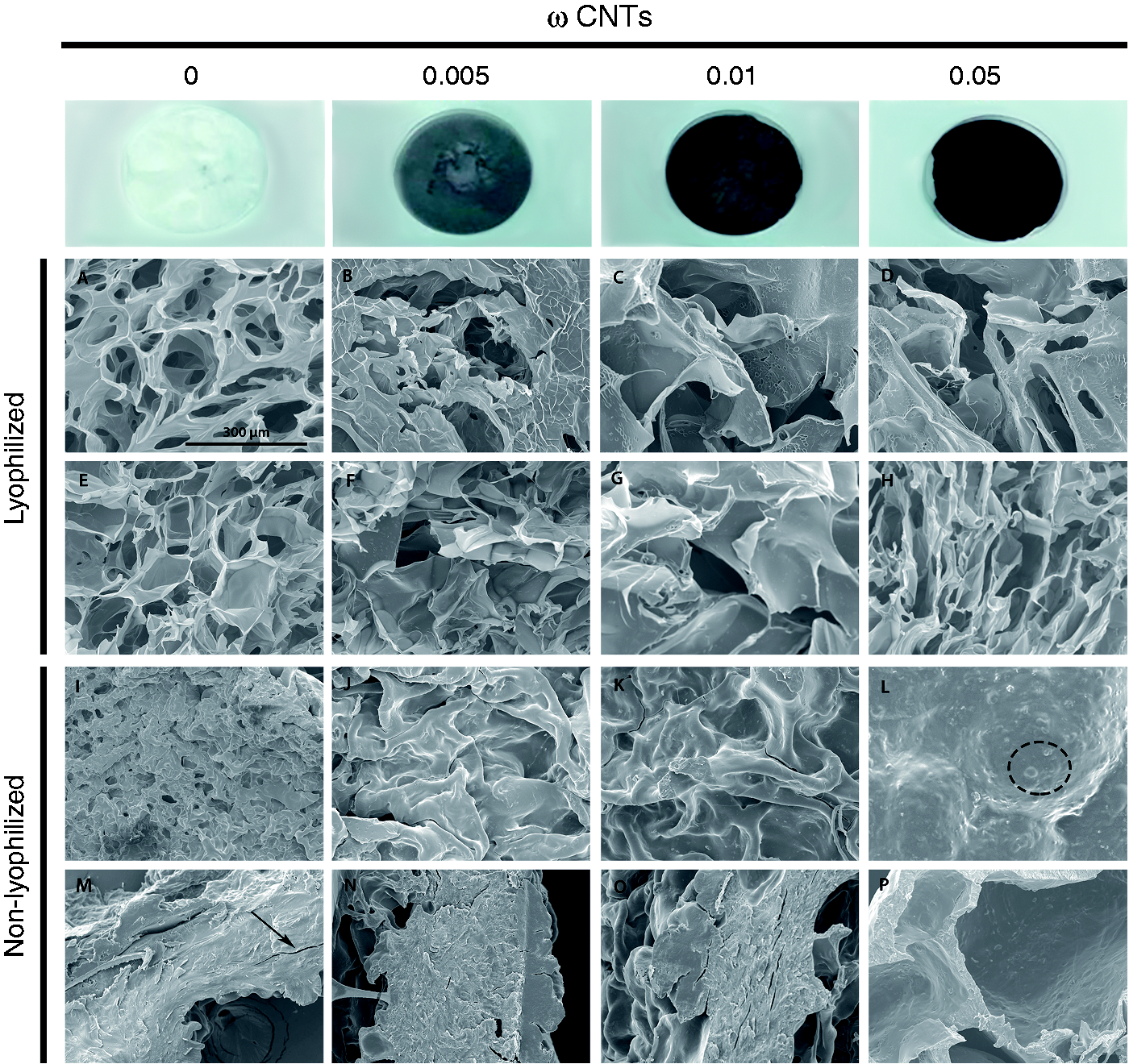
Figure 1 also shows the surface and section SEM images of the lyophilized HA/CNTs nanohybrids series. The L-samples show a microporous honeycomb structure, attributed to the formation of water crystals upon freezing and their subsequent sublimation during the lyophilization step. On the L0 surface and transversal section (images a and e), uniform pore sizes were observed, with diameter of 152.1 ± 22.1 µm. Evidence of CNTs aggregates was not found in any case; in all nanohybrids an interconnected honeycomb-type porous structure (typical of lyophilized hydrogels) was observed. This structure, though, seems to be slightly modified by the presence of CNTs, the average size of the pores increases up to around 340 µm and their number decreases, especially in the L0.05 nanohybrids (pore diameters are 259.9 ± 157.4 for L0.005, 285.7 ± 63.2 for L0.01 and 341.5 ± 46.1 for L0.05). This could be due to the difficulty in obtaining completely homogeneous aqueous solutions with this CNTs fraction, and partial phase separation, yielding to larger water domains that sublimate resulting in pores. These results are in good agreement with those obtained in Bhattacharyya et al. 33 where a low CNTs concentration (2 wt%) opens the structure giving rise to large pores.
As for the NL samples (images i–p), the SEM micrographies show non-porous surfaces, wrinkled and folded due to the collapse of highly hydrated structures. For the highest concentration of CNTs, randomly dispersed bulges with an average size of 30 µm were observed (highlighted by a dotted line), which might be aggregations of CNTs. A similar finding was reported in Vallés-Lluch et al. 34 : HA nanohybrids with mass fractions of silica up to 0.05 display a particulate-HA matrix morphology, with silica aggregates more or less homogeneously distributed throughout the organic matrix, that progressively disappear at higher silica mass fractions to give a fine continuous interpenetrated silica network.
The dependence of the density of L and NL nanohybrids on the mass fraction of CNTs is shown in Figure 2(a). This figure sheds some light on the interaction between HA and CNTs at varying concentrations. In the dry state, the density of L samples was expected to be higher than those of NL samples, according to the hypothesis that lyophilization yields a denser HA network, with intra and intermolecular interactions, and pores of larger sizes. However, the density was somewhat lower at low CNTs concentrations (up to 1%) and non-statistically significant differences could be found. This could be attributed to the discrepancy in the crosslinking times: NL samples were allowed to crosslink for 2 h instead of 10 min and it seems that at low ωCNT the crosslinking through DVS that occurs as the solution dries during this extra time is more effective than the hydrogen bonds between HA units (inter and intramolecular ones) promoted by lyophilization. This does not happen at higher ωCNT, because CNTs impede such drying and molecules are less likely to meet and crosslink, and so the L homologous hybrids get denser. Lyophilization allows a more effective elimination of water and vitrification of HA, and are thus the data for the L samples those that reveal the effect of CNTs increasing its density.
Density of lyophilized and non-lyophilized nanohybrids (a), and porosity of dry (b) and swollen (97% RH atmosphere) samples (c) as a function of the CNTs mass fraction. Differences in densities (a) are not statistically significant either with the drying process or with the composition of the samples. Variations in (b) attributed to the CNTs variation for samples dried likewise are not statistically significant.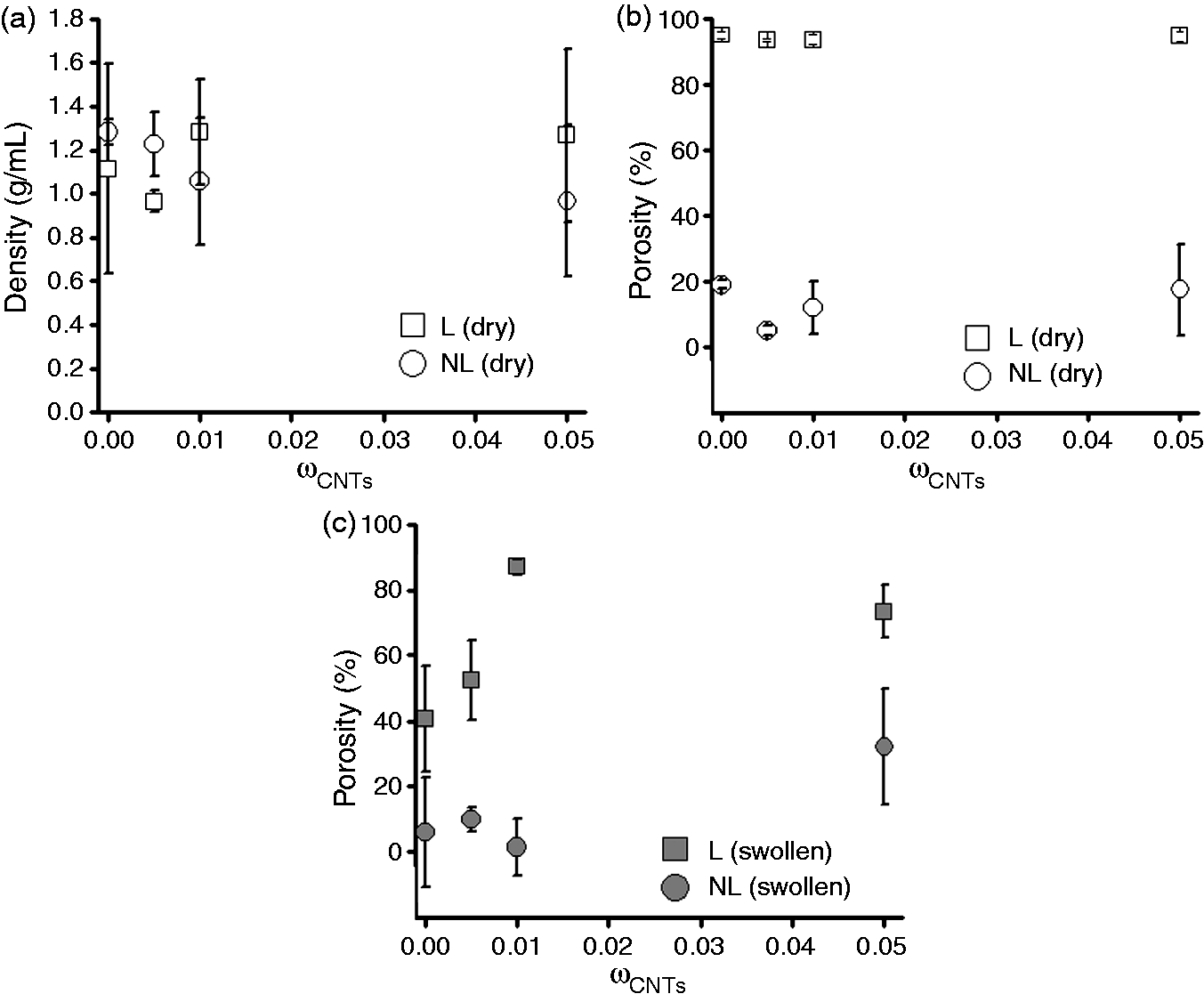
These results can be compared with those obtained in Vallés-Lluch et al. 34 for NL HA hybrids with SiO2 nanoparticles, where the density of HA increased from 1.43 g/ml to 1.52 g/ml with 5% SiO2. Herein, the density increases provided that samples are dried by lyophilization, but not the other way. Maybe the drying process, which consisted there in a long curing not disturbed by freezing, is behind such tighter packing.
The scaffolds’ porosity is a key parameter in determining their suitability for the intended application, as it affects different processes such as nutrients diffusion, vascularization, or cells colonization. The porosity of dry and swollen samples is presented in Figure 2(b and c). It is high for lyophilized materials (∼95%) when dry, and decreases as the samples swell, mainly for those with low ωCNT, which have less impediments to swell or those with high ωCNT (0.05), which lodge more water because of greater availability of -COOH groups from CNTs. Upon swelling, the diameter of pores is reduced by water opening and stretching the polymeric network. For NL ones, the porosity does not reach 0 (∼20%) in either state, probably due to the folds observed in the SEM micrographies (Figure 1i–p), which play as voids and hold water.
Modulation of HA swelling by the inclusion of CNTs
The influence of CNTs on the HA-network’s capacity to swell was followed by equilibrating the weight of nanohybrids immersed in liquid water and in a water vapor ambient of 97% RH. Figure 3 represents the EWC of the samples swollen in both media. To better analyze the effect of the inclusion of inorganic particles, the incorporated water was also referred to the HA mass (in place of the nanohybrid mass), assuming that only HA contributed to the sorption, independently of the CNTs content, Water content after equilibration (EWC) of L- (a, b) and NL-samples (c, d) in liquid water (a, c) and in a 97% RH vapor ambient (b, d), as a function of the CNTs mass fraction content: referred to the dry mass of each nanohybrid (EWC) and to the HA mass in it (EWC′), and predicted from the EWC of HA (EWCid). Differences between L- samples with different CNTs mass fractions are not statistically significant when swollen in water (a).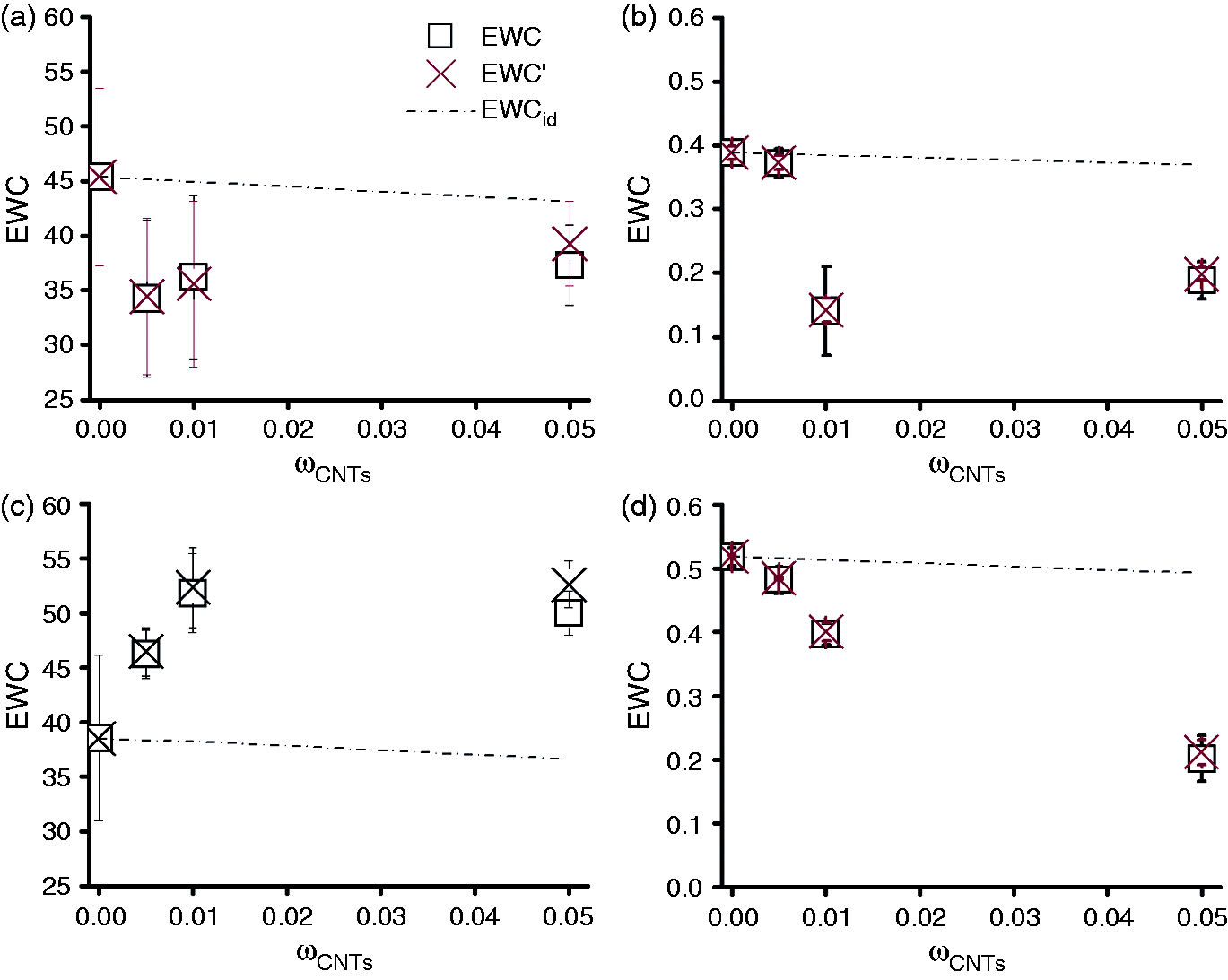
As expected, EWC in a vapor ambient was much lower (0.1 to 0.55 times its dry weight depending on the CNTs mass fraction) than in liquid water (35- to 55-fold) because only water molecules establishing hydrogen bonds with the polymer chains are computed in the former, whereas in the latter large volumes of free water can also be lodged in the HA matrix as it expands, in addition to the water lodged in the scaffold’s pores of lyophilized samples. Water can indeed be found in hydrogels as one of three types: bound water, i.e. that ascribed to those water molecules strongly interacting through hydrophilic groups of the polymer, free water, which refers to bulk domains lodged in the gel network (and in large pores obtained by lyophilization) that do not take part in hydrogen bonds with polymer molecules, and semi-bound water, with intermediate properties between those of bound and free water. 35 Free water can be found when samples are immersed in water but not equilibrated in a humid atmosphere.
As for the drying effect, lyophilized materials swelled less than NL ones in a humid ambient (b and d). This result was expected since freeze-drying packs the HA polymer chains, favoring irreversible hydrogen bonds between them, thus hindering the water diffusion through the material. In contrast, the absence of such extra interactions in NL materials allows the easier diffusion of water, and hence a greater EWC. As far as the role of CNTs is concerned, for 97% RH one can compare their influence on the EWC depending on the drying process: the presence of even a small fraction of CNTs elicits a decrease on the swelling capacity. The EWC’ values changed with the CNTs fraction similarly as EWC, being always slightly above them, but below the EWCid linear behavior. This trend suggests that the presence of CNTs within the polymeric network modifies the hydrophilicity of HA molecules: even at very small amounts they constrain the swelling of the organic network. This regulation is though more pronounced in NL materials: in lyophilized ones HA chains are packed in the drying process itself that leaves less polar groups exposed, whereas in NL ones, this regulation plausibly occurs as long as CNTs carboxyl groups interact with HA chains through hydrogen bonds.
When samples were immersed in liquid water those NL showed, though, a different pattern: the inclusion of CNTs enabled the materials to swell more. This effect was previously observed in Vallés-Lluch et al. 34 for NL nanohybrids with SiO2 particles, and was attributed to a changing hydrophilicity of the HA network when in interaction with inorganic ‘defects’, together with a plausible contribution of the inorganic species to the overall hydrophilicity. Lyophilization forces the packaging and interaction of HA chains in spite of the presence of CNTs, which will end up entrapped, so both will be less available to interact with water and differences between samples are not herein statistically significant.
Improvement of mechanical properties
Figure 4(a and b) shows the stress–strain curves from the compression tests of some samples as examples and the elastic modulus obtained from the initial linear region of such curves for each CNTs content and treatment. For lyophilized plasticized (equilibrated in water) samples, an elastic modulus around 30 kPa was obtained and no influence of the CNTs was observed. Nonetheless, NL materials reached higher values, between 135 and 235 kPa. These differences are due to the porous structure of the L-samples, so they have less water retained within the matrix than NL ones. Moreover, the porous structure allows the water extrusion more easily through the pores than from the bulk material of the NL-samples, i.e. because of its incompressibility, water retained in the material plays an important role on the resulting elastic modulus.
Stress–strain curves for L0, L0.05, NL0, and NL0.05 as example, showing the zone where data were fitted to a linear regression to get the elastic moduli (a). Compressive elastic moduli of lyophilized and non-lyophilized samples as a function of the CNTs mass fraction (b) and EWC (c). Differences due to variations in the CNTs mass fraction are not statistically significant.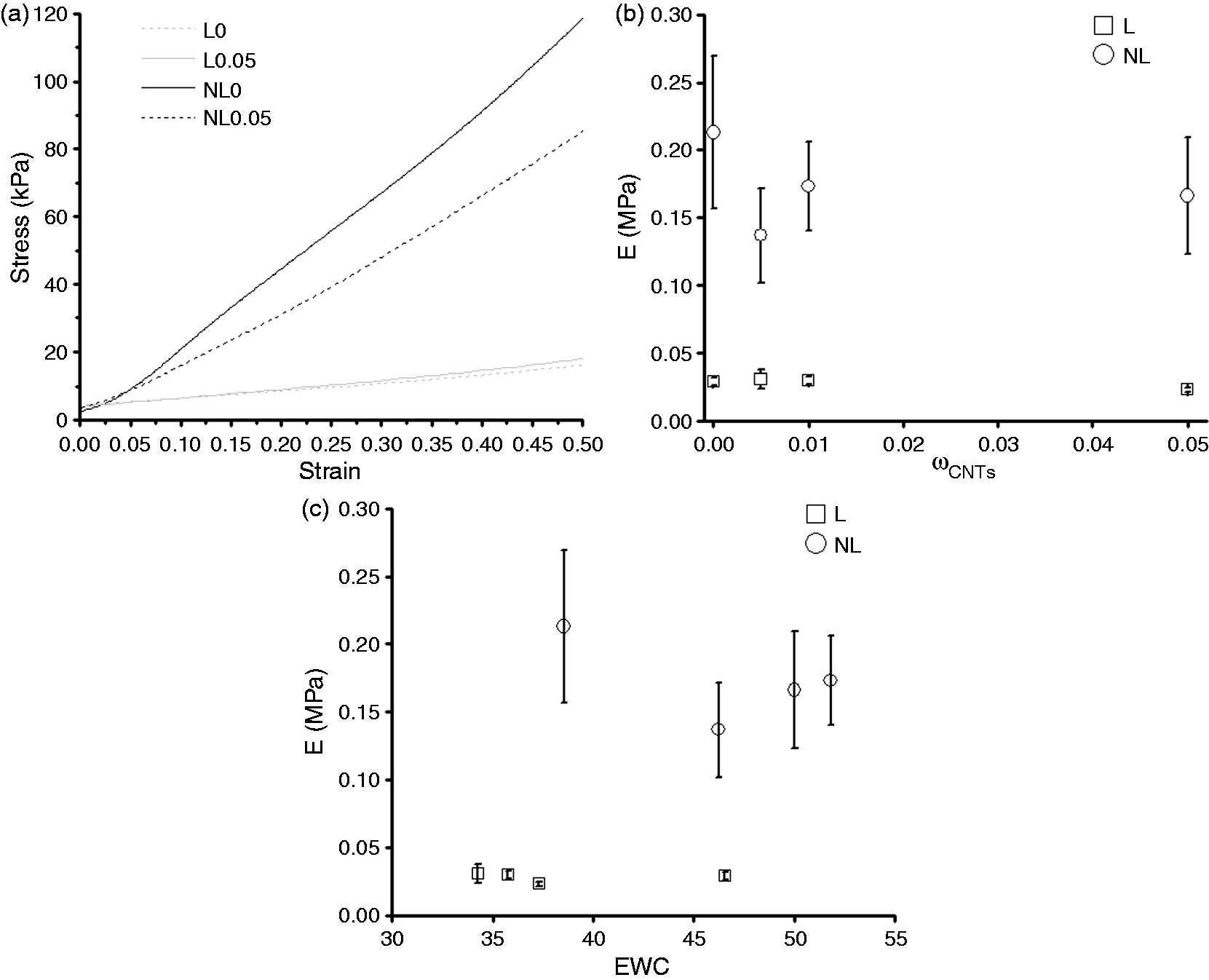
In contrast, the presence of CNTs seemed to slightly affect the elastic modulus in NL-samples, probably due to the fact that CNTs, disconnected at low concentrations, are only able to reinforce the polymeric network once their concentration is high enough.
To better analyze the effect of entrapped water on the mechanical properties, the elastic modulus of the samples is depicted in Figure 4(c) against their EWC, which had been quantified before the compression tests. L-samples did not show a significant variation of the elastic modulus with EWC, probably due to the easy extrusion of water from their pores, as mentioned before. The porosity is the parameter that governs the mechanical properties of these scaffolds. On the contrary, in NL-samples, the higher the EWC the greater their elastic modulus; this is because of poroelasticity,36,37 which arises from the combination of the incompressibility of water and its hindered extrusion from the gelly matrix. In this series, the role of CNTs is linked to that of water: at low concentrations they hinder the expansion and swelling of the HA matrix and thus reinforce it, and at higher mass fractions they contribute to swelling and it is water which improves indeed mechanical properties.
Improvement of stability in aqueous media
Macroscopically, after two weeks, samples submitted to degradation tests exhibited the same appearance and consistence as non-degraded ones. Nonetheless, holes of some microns were observed for the hyaluronidase-degraded samples under SEM (Figure 5); these holes were more abundant in pure samples than in those with 0.5% CNTs, and their number and size increased with time. NL-samples did not show any evidence of degradation (Sup. Figure 1).
SEM surface images of HA-based lyophilized materials (a–d) without CNTs and (e–h) with a CNTs mass fraction of 0.005, degraded in water during 168 (a, e) and 336 h (b, f), and in the presence of hyaluronidase during 168 (c, g) and 336 h (d, h). The dotted circles show possible areas of hydrolysis.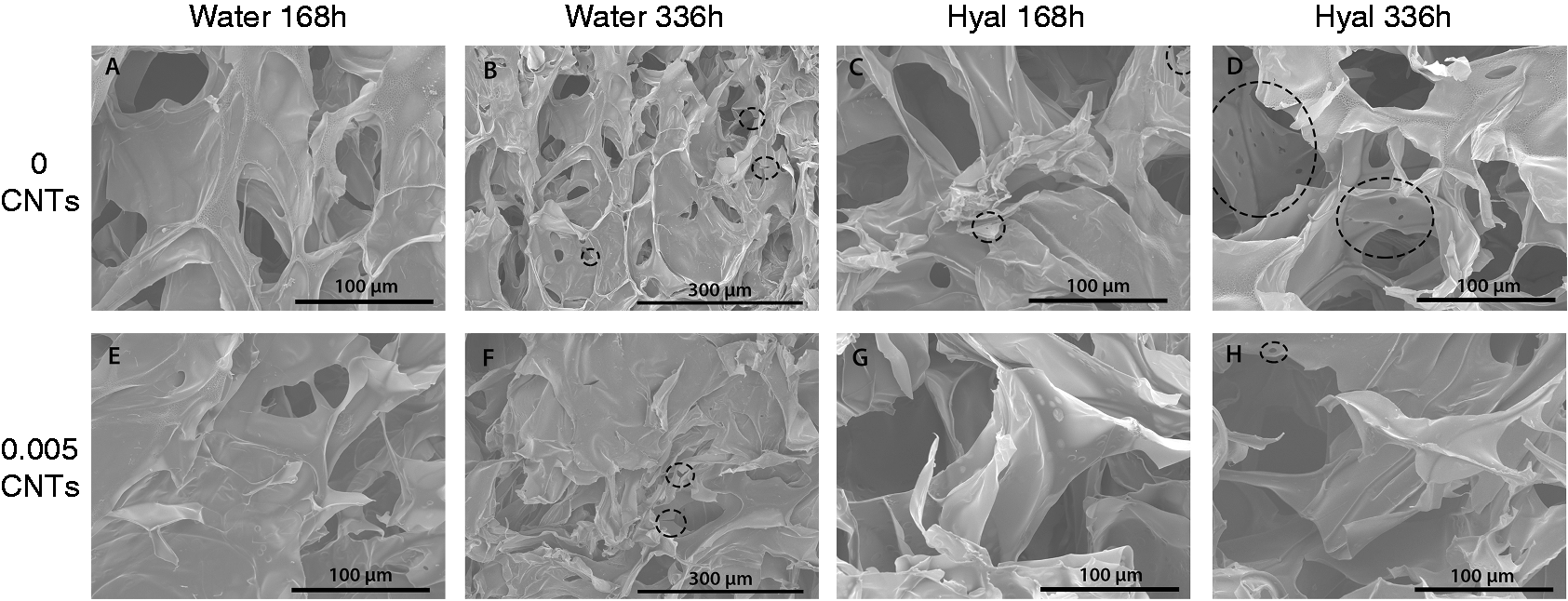
In order to better analyze the evolution of properties with the degradation time, the weight loss (Figure 6) was also quantified. Lyophilized materials slightly lost more weight than NL ones: for the lyophilized series the mass loss reached 5% in bare samples and 4% in those with 0.5% CNTs, whereas the NL homologous samples had losses of 1.7% and 1.6%, respectively. This difference could be attributed to the hindered diffusion of HA fragments from the gelly NL samples, in comparison with that from scaffolds with sizable pores. Weight loss occurs mainly during the first 150 h, and smoothes later on. CNTs seem to confer more stability to the lyophilized samples against degradation; results are, though, not statistically significant. Non-enzymatic degradation did not result in a significant weight loss during the 300 h of experiment.
Weight loss of lyophilized (a) and non-lyophilized (b) bare samples and nanohybrids with 0.05% CNTs in medium containing hyaluronidase. Pure HA samples degraded non-enzymatically are used as control. Non-statistically significant differences were found between samples prepared following the same drying procedure.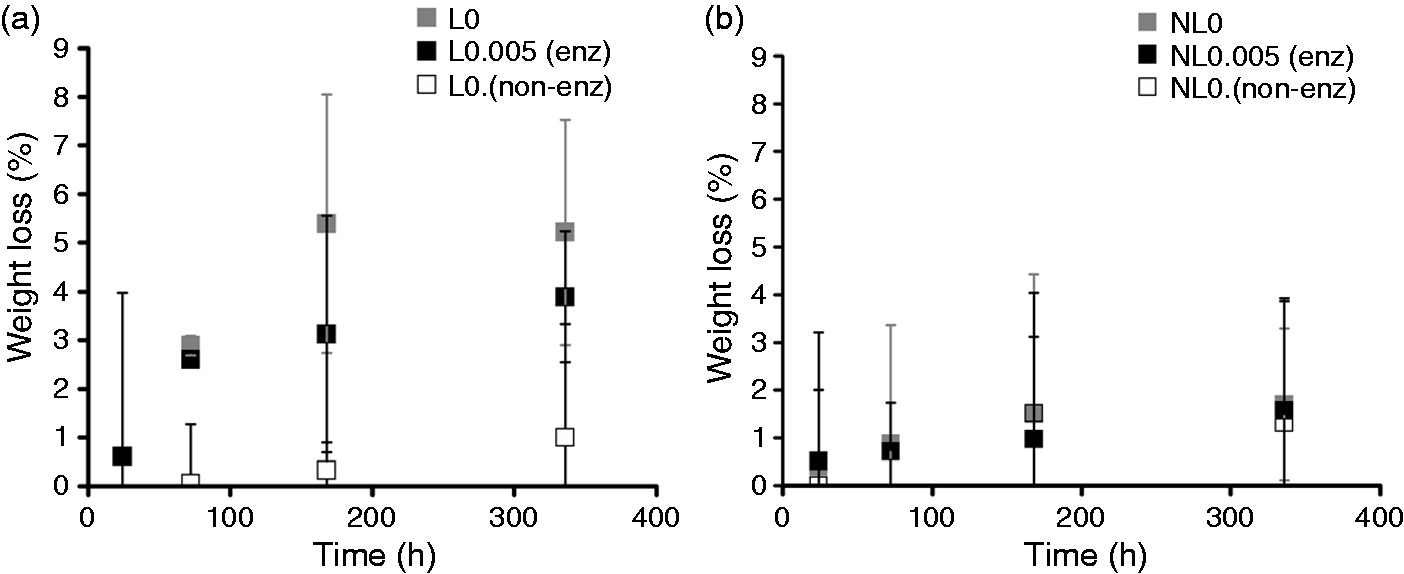
The elastic moduli of the samples did not show significant changes with the degradation time up to 14 days; they kept the initial values independently of their drying process. The presence of hyaluronidase in the medium did not affect significantly, either, the mechanical properties of the samples (Sup. Figure 2).
Conclusions
The two-steps freeze-drying procedure followed herein, with a swelling in water and an acetone/water rinsing in between, allowed the fabrication of porous materials based on HA, with CNTs mass fractions up to 0.05. These scaffolds showed a highly porous network with interconnected pores of 100 to 300 µm in diameter, suitable for tissue engineering applications. Lyophilization itself forces the packing and interaction of HA molecules, modulating their swelling. The presence of even a small amount of CNTs acts in the same direction, leading to equilibrium water contents between 35 and 55 fold. The porosity governs the mechanical properties of these scaffolds (135–235 kPa), whereas in NL nanohybrids the water sorption, regulated by CNTs, explains the higher elastic moduli because of a poroelasticity effect. None of the samples showed a significant degradation after 336 h, either in water or hyaluronidase-containing medium.
Footnotes
Declaration of Conflicting Interests
The author(s) declared no potential conflicts of interest with respect to the research, authorship, and/or publication of this article.
Funding
The author(s) disclosed receipt of the following financial support for the research, authorship, and/or publication of this article: Contract grant sponsor: Spanish Ministerio de Economıa y Competitividad; contract grant numbers: MAT2011-28791-C03-02 and -03.