







Abstract
The purpose of this article is to explore infrastructure and functions to serve as a foundation for collaborative community problem solving. The literature reviewed in this article focuses on problem solving in the health, education, and social services arenas. However, the recommendations and perspectives would appear to apply to collaborative community problem solving focused on any complex social issue. It is imperative that as local, state, and national policies and practices evolve supporting collaborative efforts to address a variety of issues, planners be prepared to facilitate community dialogue designed to build strong partnerships at the local level.
Planners have a long history of involvement in developing and maintaining “healthy communities” and the collaborative relationships necessary to address complex social issues. The concept of a healthy community has been addressed in detail in various literatures. Early sociological theory defined communities as social structures supporting day-to-day activities (Warren 1963). Psychological theorists focused on the feelings or characteristics of individual community members (Brucker 1988; Davidson and Cotter 1986; McMillan and Chavis 1986). Other theorists addressed the characteristics of well-functioning communities (Lackey, Burke, and Peterson 1987; Smith 1984). This provided a back drop for efforts to enhance community health (Hawkins and Catalano 1992; Nelson et al. 2004; Watson-Thompson, Fawcett, and Shultz 2008). Norris (1998) referred to the aggregation of these efforts as the “Healthy Communities Movement.”
Kendziora and Osher (2004) provide a definition of a healthy community that appears to capture the various perspectives identified above. They define a healthy community as one which buffers the risks faced by all community members and fosters basic protective factors (Kendziora and Osher 2004). Such communities promote positive development and mediate adverse outcomes. Corburn (2009) links the notion of healthy communities or cities to concerns of planners in his description of the impact of governmental policies on well-being. Development of economic opportunities, control of land uses, abatement of environmental hazards, and promotion of efficient transportation are examples of areas in which planners have historically operated to promote healthy communities. As local, state, and national policies and approaches evolve supporting collaborative problem solving, planners must be prepared to facilitate community dialogue designed to build strong partnerships and healthy communities.
The purpose of this article is to explore infrastructure and identify functions that might serve as a foundation for collaborative community problem solving. The conventional definition of infrastructure in planning focuses on physical facilities such as water and sewer service (Levy 1994). Expanded definitions include a broad range of facilities, programs, and social networks that interact to enhance quality of life (Corburn 2009). For example, the Family Services Association of Toronto (2005) defines six clusters of services and facilities that define community infrastructure. Services and facilities are grouped into one of the following six categories: physical health, human development, services for specific populations, rights and advocacy, economy, and safety and aesthetics.
This definition of infrastructure is similar to conventional definitions of social capital. The World Bank (n. d.) refers to social capital as norms and networks that enable collective action. Such networks and social relationships assist individuals and/or groups in achieving desired outcomes. While social capital provides a theoretical perspective, infrastructure refers to formal mechanisms necessary to manage social capital in the interest of achieving desired outcomes. For the purposes of this article, community infrastructure will be defined as resources, structures, roles, processes, and procedures supporting collaborative community problem solving. This definition goes beyond the traditional definition of infrastructure in planning and incorporates social networks and interventions designed to promote human development. The infrastructure defined in this review is intended to facilitate the management of collaborative community problem solving.
The Importance of Effective Collaborative Community Problem Solving
Resources, structures, roles, processes, and procedures supporting collaborative community problem solving are critically important, given the complexity of issues faced by contemporary planning professionals. Unemployment, crime, academic failure, and other social problems have proved to be vexing issues for local jurisdictions. Problem solving related to such issues is typically plagued by diverse points of view, conflicting interests, and a variety of disciplinary perspectives (Innes and Booher 2010). It can be argued that the resolution of problems like those noted above is the responsibility of the community and that community representatives should be actively engaged in the problem solving process (Innes and Booher 2010; Wolff 2010).
However, experience suggests that community representatives and the planning professionals charged with facilitating collaboration may lack sufficient resources to ensure optimal outcomes. The authors review a variety of local, state, and national reports related to collaborative problem solving in an effort to address issues related to community infrastructure necessary to support effective collaboration. The authors argue that the creation of such infrastructure may assist planning professionals and communities in their efforts to address complex social issues through collaborative approaches to problem solving.
For example, Hanleybrown, Kania, and Kramer (2012) provide a number of examples of situations where collaborative approaches to problem solving have successfully addressed seemingly intractable problems. The organizations noted in their review have addressed issues such as environmental clean-up, nutritional deficiencies, binge drinking, educational achievement, childhood obesity, employment, crime prevention, and poverty. These organizations used collaborative strategies synonymous with an approach referred to as “collective impact.” Kania and Kramer (2011) suggest that the concept of collective impact is characterized by five key factors. Collaborating organizations must share a common agenda, employ consistent measurement procedures, engage in coordinated and reinforcing activities, and communicate in a continuous and open fashion. Kania and Kramer also suggest that effective collective impact must be managed and supported by a separate entity or “backbone” organization.
Collaborative Community Problem–Solving Literature
The remainder of this article is divided into four major sections. The first section focuses on the review of selected literature related to collaborative community problem solving. The authors review “foundational” literature to provide context and background. This material addresses the concepts of “collaboration” and “community” and an existing problem solving framework called the “Interactive Systems Framework for Dissemination and Implementation” (Wandersman et al. 2008). The authors also review highlights from theoretical literature, case studies, and findings from empirical studies. The second major section of this article uses the literature reviewed previously to develop guidelines for developing community infrastructure. The third section provides a conceptual model defining the relationship between infrastructure and collaborative community problem solving. The final section highlights conclusions and implications for the development of infrastructure that might function to support collaborative community problem solving.
Review of the Literature
Foundational Literature
Defining Collaboration
Collaborative community problem solving has been addressed by several theorists and practitioners (Foster-Fishman et al. 2001; Julian 1994; Wolff 2010). Gray (1989) suggests that collaboration is a process through which stakeholders can explore problems and consider solutions that transcend each party’s possible responses. According to Lawson (2004), collaboration occurs when autonomous stakeholders mobilize resources in a harmonious and synchronous manner to solve shared problems. Brown et al. (2008) define prevention collaboration in terms of shared efforts of organizations and other groups to prevent youth problem behaviors.
Himmelman (2001) suggests that specific characteristics distinguish collaboration from other forms of partnerships. According to Himmelman, “networking” is the exchange of information for mutual benefit. “Coordinating” can be thought of as exchanging information and altering activities for mutual benefit and in the interests of a common goal. “Cooperating” involves exchanging information, altering activities, and sharing resources in order to achieve desired results. True collaboration requires that stakeholders exchange information, alter activities, share resources, and be willing to enhance the capacity of others. Claiborne and Lawson (2005) suggest that collaboration is a developmental progression that proceeds from communicating to coordinating to conflict resolution and power negotiation.
Recent planning theory has captured the notion of collaborative community problem solving as a critical aspect of local governance. Healey (2006) describes three traditions including economic planning, physical development planning, and policy analysis and suggests that current conditions call for a more “communicative” approach to planning. This perspective places less emphasis on expert knowledge and rational action and more on the expression of diverse interests and consensus building. Innes and Booher (2010) echo this point of view in their description of “collaborative rationality.” They suggest that a process is collaboratively rational (Innes and Booher 2010, 6) “to the extent that all the effected interests jointly engage in face to face dialogue, bringing their various perspectives to the table to deliberate on the problems they face together.”
As the literature summarized above suggests, collaboration represents a distinct approach to addressing complex problems. One might argue that collaboration can be applied in a consistent manner whether the problem being addressed is related to health, education, social services, or derived from other domains such as sustainable development or transportation. In general, collaboration is an appropriate response when an individual stakeholder is not able to address a specific issue. Innes and Booher (2010) suggest that problems appropriate for collaboration are characterized by disagreement about goals and few or no guidelines as to what constitutes an appropriate response. The authors of this article argue that the collaborative process and the consensus building goals of collaborative problem solving are similar regardless of the problem being addressed.
The Concept of Community
The traditional definition of community emphasizes social organization necessary to support day-to-day life (Warren 1963). Warren notes that the community provides opportunities for production, consumption, socialization, and social control. Other theorists have defined characteristics of the “competent” community (Iscoe 1974; Smith 1984). Smith defines twelve functions of the competent community that include information sharing, social interaction, power sharing, and formal means to address collective goals. Julian (2006) suggests that interventions consistent with the principles of community competence must strengthen local capacity to meet the needs and dreams of community members.
McMillan and Chavis (1986) define “sense of community” in terms of a feeling of belonging and a belief that one’s needs will be met through a commitment to be together with other community members. They suggest that a strong sense of community is defined by four central characteristics. First, members must feel a sense of belonging and identification as a member of the community. Second, community members must feel that they can be influential and at the same time be willing to acquiesce to community influences. Third, members must believe the community can satisfy important needs and desires. Finally, individual members must feel a “shared emotional connection” to the larger community.
Julian et al. (2008) have proposed a model that illustrates the potential collaborative linkages between community systems focused on well-being and human development. This model portrays the community as a series of “silos” or vertically organized systems. Each services delivery system consists of an administrative hub and subunits (i.e., organizations, agencies, grassroots groups) that provide services in the form of programs or interventions. Julian et al. suggest that a potential collaboration exists if multiple community systems work together to address a specific issue(s). For example, a potential school and community collaboration exists when the education system interacts with another community service delivery system such as the local planning department to address neighborhood development and its relationship to academic achievement.
It can be argued that partnerships of this type are the predominant approach to collaborative problem solving currently available. Ad hoc groups are convened and charged with addressing a specific issue. Community involvement in educational reform required by federal Race to the Top (2011) and the Substance Abuse and Mental Health Services Administration’s (SAMHSA’s) efforts to develop “systems of care” for individuals with substance abuse problems (Witter and Hillman 2010) are recent examples of the traditional approach to facilitating collaborative community problem solving. However, theory and empirical evidence are beginning to emerge that suggest an adjunct to the traditional model. Kania and Kramer’s (2011) “backbone” organization is consistent with this adaptation. The backbone organization might function as an existing community resource focused on the management of collaborative community problem solving. Backbone functions might be housed within planning agencies, community foundations, universities, or other organizations. Ideally, the backbone organization can function as a facilitator as opposed to stakeholder with a vested interest in specific outcomes.
The Interactive Systems Framework for Dissemination and Implementation
Wandersman et al. (2008) synthesize selected literature related to collaborative community problem solving in their description of the “Interactive Systems Framework for Dissemination and Implementation.” They describe three types of activities or functions necessary to provide effective and efficient prevention services. Specific functions are undertaken by the “Prevention Synthesis and Translation System,” “Prevention Support System,” and “Prevention Delivery System.” The Prevention Synthesis and Translation System develops, evaluates, and disseminates model programs and other innovations. The “Prevention Support System” focuses on building innovation specific and general capacities within the community. Finally, the “Prevention Delivery System” takes actions necessary to implement innovative interventions. Thus, the Interactive Systems Framework for Implementation and Dissemination might be thought of as community infrastructure necessary to support effective prevention programming.
The literature reviewed above suggests that a “potential” community collaboration can be defined as a situation in which multiple community systems interact to achieve a common outcome. In addition, the Himmelman definition of collaboration provides a perspective on which to consider collaborative community problem solving. That is, even when systems interact, collaboration is dependent on the willingness of system representatives to exchange information, alter activities, share resources, and enhance the capacity of partners. In the view of the authors of this article, such situations represent optimal collaborative problem solving. Furthermore, collaborative community problem solving can be thought of as a critical component of a healthy or competent community (Corburn 2009; Smith 1984). Such problem-solving activities contribute to community health by providing a means to identify and address local community issues. Finally, the “Interactive Systems Framework for Dissemination and Implementation” (Wandersman et al. 2008) provides a starting point to consider community infrastructure that might optimize collaborative community problem solving.
The literature reviewed in the following paragraphs moves beyond foundations and speaks directly to factors thought to foster optimal collaborative community problem solving. First, the authors review relevant theoretical literature including various technical assistance guides, case studies, and community processes. Technical assistance guides and descriptions of community processes are typically developed and issued as a means to assist communities in efforts to initiate and support collaborative problem solving. Second, two reviews of the literature that summarize key empirical research are reviewed. Most of the literature reviewed in this article focuses on health, education, and other social services because such theory and research may not be routinely available to the planning community. The literature reviewed in this article is meant to supplement the well-developed literature related to collaborative approaches to planning (Corburn 2009; Healey 2006; Innes and Booher 2010).
Theoretical Literature
Formal theory, case studies, technical assistance materials, and community process manuals might be thought of as a theoretical literature related to collaborative community problem solving. Much of this literature provides guidelines for facilitating collaboration. A key concept that emerges from this literature is referred to as “readiness” (Feinberg, Greenberg and Osgood 2004). Chilenski, Greenberg, and Feinberg (2007) define readiness in terms of being connected to the community; engaged in community activities; believing that community actions will be effective; and skills of coalition leaders. Donnermeyer et al. (1997) equate community readiness with the level of acceptance of an intervention expressed through “a consensus of values” and local leadership. As is implied, readiness is equated with more effective collaboration.
There are a number of technical assistance materials including detailed descriptions of community processes describing roles and functions that might be utilized or adapted to support collaborative community partnerships. For example, the Ohio Department of Education (2009) developed roles and responsibilities for various stakeholders engaged in school and community engagement activities. Stakeholders included schools; families and members of the community; early childhood centers; school districts; and various technical assistance providers. The Ohio Department of Education grouped responsibilities into seven categories including: (1) policy; (2) staffing; (3) funding; (4) educator competency; (5) research and evaluation; (6) tools and products; and (7) community connections and relationships and assigned responsibilities to the previously identified stakeholder groups.
Similarly, the National Training and Development Consortium for School Health or TDC (2001) proposed a similar set of competencies for school health professionals and managers. These competencies were developed in order to assist school and health personnel in collaborating to address health related issues in educational settings. The TDC competencies included (1) management; (2) programmatic needs assessment and strategic planning; (3) collaboration; (4) policies; (5) curriculum, instruction, and student assessment; (6) professional development and technical assistance; (7) marketing, dissemination, and communication; (8) monitoring and evaluation; and (9) surveillance. The Ohio Department of Education (2009) and National Training and Development Consortium for School Health (2001) guidelines provided practical advice about infrastructure and functions thought critical to effective collaborative community problem solving.
Based on more than twenty case studies from the United States and Australia, Margerum (1999) defines twenty principles for successful collaborative practice that transcend three broad areas. Principles related to “initiation” include supportive laws and policies; access to resources; appropriate participation; legitimacy of processes; and leadership. Principles related to “operation” include effective communication; use of decision rules; conflict management; public involvement; and understanding of the systems that are impacted. Principles related to “outputs and outcomes” include common goals; strategic and flexible implementation strategies; appropriate management; support for implementation; development of a model for intervention; continued involvement of participants; coordination of decision making; education programs; access to implementation resources; and building confidence and momentum.
Finally, there are a number of community-based processes designed to promote local collaborative problem solving that encompass a range of roles, competencies, and functions. For example, community-based processes such as “PROSPER” (Spoth et al. 2004), “Communities that Care” (Hawkins and Catalano 1992), and “Partnerships for Success” (2008) emphasize functions including community mobilization, needs assessment, resource assessment, gaps analysis, implementation, and evaluation. These processes encompass a series of activities that provide a strong basis for decision making related to significant community issues. Other theory, case study, technical assistance, and community process literature suggest that active participation, strong leadership, access to resources, competent evaluation, and knowledge of effective practices are critical factors related to the success of collaborative community problem-solving efforts.
Empirical Research
Berkowitz (2001) provides an overview of several reviews of the empirical literature related to impacts of local coalitions. In his review, Berkowitz summarizes the conclusions derived from reviews that included 102 separate published reports and suggests there is little empirical evidence to indicate that community coalitions result in population-level outcomes. Berkowitz identifies a number of barriers to research in this arena including sampling issues, identification of extraneous variables, and political factors. However, Berkowitz’s review suggests that while sparse, empirical research and evaluation provide several insights into the infrastructure thought essential to effective collaboration.
A recent effort to summarize the literature related to community coalition effectiveness forms the basis for conclusions derived from empirical research. In a comprehensive review of the empirical literature from 1987 to 2004, Zakocs and Edwards (2006) identified coalition factors that were associated with effectiveness in twenty-six empirical studies. The research in the Zakocs’ and Edwards’ review defined “effectiveness” in a variety of ways. Most of the studies focused on internal variables such as quality of plans, member participation, satisfaction, agency collaboration, and number of actions implemented. Only two studies assessed reduction of “risky behaviors” or behavior change among community members as a dependent variable.
Zakocs and Edwards (2006) also indicated that there is little empirical evidence to indicate that collaborative approaches result in population level outcomes. However, their review suggested that collaboration is worthy of formal evaluation and may yet prove to be a viable approach to problem solving. Coalition factors associated with effectiveness identified by Zakocs and Edwards in five or more studies included formalization of processes, leadership style, member participation, member diversity, collaboration, and group cohesion. Other factors identified in five or fewer studies included quality of plans, action orientation, perceived member ownership, knowledge of issues, and member empowerment.
The material reviewed in the prior paragraphs suggests several important hypotheses. First, collaborative community problem solving might be considered a homologous activity. That is, the basic collaborative process is highly consistent regardless of the composition of the problem solving team or the issue(s) being addressed. Second, collaboration is a process that enhances problem solving or the achievement of desired outcomes. That is, collaboration implies a specific set of activities conducted in an appropriate sequence that supports collective planning, implementation, and evaluation. Planning tasks such as needs assessment, values clarification, strategy selection, and implementation are necessary whether such activities are applied to collaborative community problem solving or the actions of an independent, local agency. Third, the material reviewed above suggests the need for a language to discuss collaborative community problem solving. The literature related to collaborative community problem solving cited in the authors’ review crosses a variety of disciplines, many with unique terms and concepts.
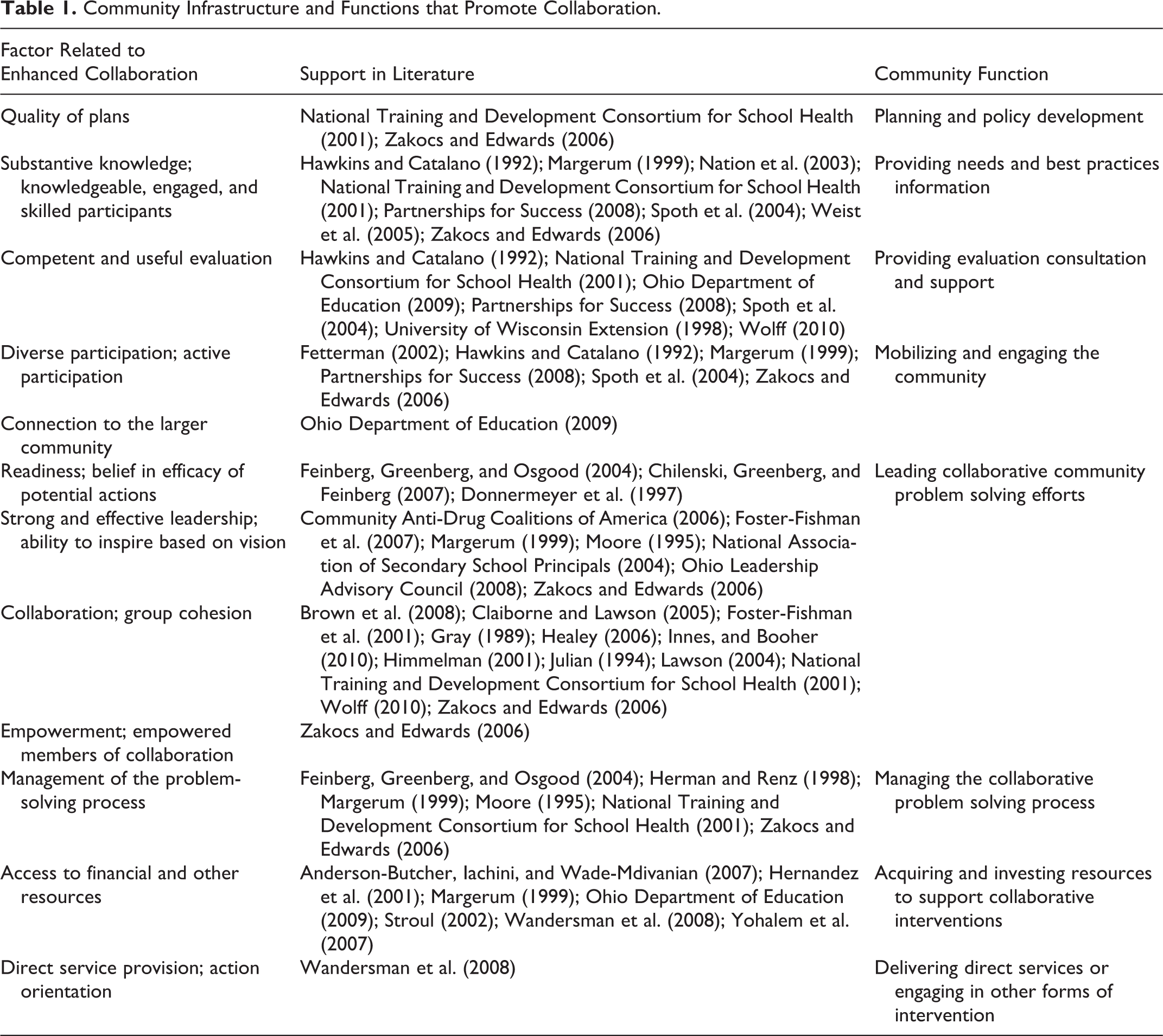
In the next section, infrastructure is described in the form of several essential functions. Functions derived from the theoretical and/or empirical literature reviewed above that appear to be strongly associated with successful, collaborative community problem solving are indicated in Table 1. Multiple authors identified the functions in column three of Table 1 as having a direct impact on the quality and effectiveness of collaborative community problem solving. Core functions that might ultimately enhance collaborative community problem solving are described below.
Community Infrastructure and Functions that Promote Collaboration.
Guidelines for Establishing Community Infrastructure
The authors suggest that one or more stakeholders involved in collaborative community problem solving be responsible for providing the types of services implied by the functions identified in Table 1. The assignment of functions formalizes infrastructure and allows stakeholders to be meaningfully involved in the problem-solving process based on existing capacities and/or allows for the development of capacities that do not exist at the community level. As noted, infrastructure can be thought of as resources, structures, roles, processes, and procedures supporting collaborative community problem solving. In the following paragraphs, the authors describe eight essential community functions that appear to be related to enhanced collaborative community problem solving. Thus, these functions and attendant resources, structures, roles, processes, and procedures represent infrastructure that might facilitate collaborative community problem solving.
The functions identified below are meant to guide practitioners charged with managing collaborative community problem solving. Managers might be planning professionals or individuals employed by “backbone” organizations (Kania and Kramer 2011). The authors of this article argue that managers of collaborative community problem–solving efforts must assure that the various functions described below are assumed by members of collaborative teams. Once such functions are available, the manager can be assured that appropriate infrastructure is in place to support the collaborative community problem–solving process. Tools, processes, and procedures can then be employed that build upon this foundation. Elaboration of tools and management processes are beyond the scope of this article. However, such resources (Partnerships for Success 2008; Hawkins and Catalano 1992; Wolff 2010) are readily available and appear to have much to offer individuals responsible for managing effective and efficient collaborative community problem solving.
Future evaluations must focus on the extent to which the presence of infrastructure as described in this article enhances problem solving. Existing empirical evidence indicates that well-managed collaborative efforts composed of team members who assume complimentary functions as indicated below may hold promise for optimizing effective problem solving. Such evidence must ultimately focus on the extent to which collaborations are successful in achieving valued outcomes. While quality of relationships, collaborative capacity, and number of actions are worthy measures, such outcomes cannot substitute for problem resolution. The paragraphs below indicate eight functions that comprise community infrastructure necessary to support collaborative community problem solving.
Function 1: Planning and Policy Development
Theory supports the planning process as a means of addressing complex social issues. Clearly, planning and policy development at the community level are key dimensions of effective collaborative community problem solving (Alexander 1979; Innes and Booher 2010; Julian and Lyons 1992; Levy 1994; So 1984). In the context of collaborative community problem solving, planning and policy development imply that a collaborative body engages in structured problem-solving activities. Given limited resources, the community must review available information and make decisions about priorities. Decisions must also be made about the appropriateness of collaboration as a problem-solving strategy. The planning and policy development function provides a basis for deciding what to do and implementing plans through the service delivery function. At least to some extent, the other functions described below support community planning and policy development.
Function 2: Providing Needs and Best Practices Information
Effective collaborative problem solving requires that community collaboration members have access to a variety of useful information (National Training and Development Consortium for School Health 2001; Margerum 1999; Partnerships for Success 2008; Zakocs and Edwards 2006). For example, collaborations need accurate “needs” information or information adequate to define actionable problems. The community processes referenced above commence with formal needs assessment or other forms of problem definition (Hawkins and Catalano 1992; Partnerships for Success 2008; Spoth et al. 2004).
In addition, knowledge concerning state-of-the-art approaches to addressing identified issues is of critical importance to collaborative community problem–solving efforts (Margerum 1999; Nation et al. 2003; Weist et al. 2005). There is little doubt that such information is a critical problem-solving resource. For example, school and community collaboration members might be charged with identifying specific academic and/or nonacademic issues that require attention. Ideally, such issues are addressed through state-of-the-art or evidence-based approaches.
Function 3: Acquiring and Investing Resources
Most of the literature reviewed for this article refers to resource acquisition indirectly. The National Training and Development Consortium for School Health (2001) refers to professional development and technical assistance as important resources necessary to support collaborative partnerships in the education arena. The Ohio Department of Education (2009) provides for developing educators’ and practitioners’ competencies. A variety of other researchers and theorists (Anderson-Butcher, Iachini, and Wade-Mdivnian 2007; Hernandez et al. 2001; Margerum 1999; Stroul 2002; Wandersman et al. 2008; Yohalem et al. 2007) refer to financial or other resources as critical to collaborative community problem solving. This argument implies that community stakeholders must identify discretionary dollars available to the community and/or opportunities for acquiring resources to address collaborative community goals.
In many cases, the resource acquisition process is dependent on extra-community inputs of dollars. Some communities and local organizations have adopted an “investment” mentality as a guide to decision making and allocation of resources to address significant issues. From this vantage point, a key planning question focuses on what intervention(s) is the best investment given specific community needs and availability of resources at a particular point in time. This suggests a willingness on the part of the community to shift investment from lower priority to higher priority interventions and to invest resources in developing collaborative community problem– solving infrastructure. As is evident from the discussion above, the development of such infrastructure is most likely to be resource intensive. It is clear that a critical community function is to identify, acquire, and invest financial and nonfinancial resources in the most efficient and effective manner possible consistent with community priorities.
Function 4: Mobilizing and Engaging the Community
Theoretical literature suggests that community engagement is a critical factor related to collaborative community problem solving (Chilenski, Greenberg, and Feinberg 2007; Feinberg, Greenberg, and Osgood 2004; Ohio Department of Education 2009). Community engagement is viewed as a critical component of “readiness” to engage in collaborative community problem solving (Chilenski, Greenberg, and Feinberg 2007; Feinberg, Greenberg, and Osgood, 2004). Local, community stakeholders must be able to generate awareness of, support for, and participation in the collaborative community problem– solving process (Innes and Booher 2010; Margerum 1999; Partnership for Success 2008).
Community problem–solving processes are typically implemented by community coalitions made up of service providers, representatives of administrative entities, and/or community residents (Wolff 2010). Such participation is felt to foster diverse opinions and ultimately good decisions. It is argued that diverse opinions and experiences enable participants to “grapple” with difficult issues and ultimately enhance problem solving (Fetterman 2002). Thus, a critical function in collaborative community problem solving focuses on promoting community awareness, support, and participation.
Function 5: Leading Collaborative Problem Solving Efforts
Community stakeholders must be able to assume leadership roles (Community Anti-Drug Coalitions of America 2006; Foster-Fishman et al. 2007; National Association of Secondary School Principals 2004; Margerum 1999; Ohio Leadership Advisory Council 2008; Donnermeyer et al. 1997) and create a specific vision to inspire others to collective action. The Community Anti-Drug Coalitions of America (2006) identifies seven aspects of leadership including leader as (1) facilitator; (2) content expert; (3) visionary; (4) strategist; (5) broker; (6) spokesperson; and (7) coordinator. The Coalition for Community Schools (2009) suggests that top down change begins with a vision while bottom-up/grassroots change begins with action initiated by stakeholders. The Coalition for Community Schools (2009, 10) states that the “most significant challenge for top down leaders is to inspire and lead change that is enthusiastically embraced by their constituency.” The authors of this article contend that effective collaborations are characterized by the ability of a leader or leaders to act as “visionaries” (Community Anti-Drug Coalitions of America 2006).
Function 6: Delivering Direct Services or Engaging in Other Forms of Intervention
Chilenski, Greenberg, and Feinberg (2007) define readiness for collaborative community problem solving in terms of a belief that actions will be effective. This implies that action will be taken to address critical issues. The community process literature is built on the notion that needs are defined and interventions implemented to address specific issues (Hawkins and Catalano 1992; Partnerships for Success 2008; Spoth et al. 2004). Community stakeholders must be able to provide effective direct services or intervene in other ways to address issues in a satisfactory manner. Adequate community infrastructure and the ability to intervene to address identified issues is the basis for outcome achievement at the program, system, and/or community levels.
The importance of direct service delivery and other types of intervention are obvious to efforts to address health, education and social services, and other issues faced by planning professionals that ultimately impact individual well-being and/or community health. For example, Anderson-Butcher, Iachini, and Wade-Mdivanian (2007) identify a number of potential services that might have significant impact on educational objectives such as the graduation rate. These services are categorized as (1) prevention and promotion; (2) early intervention; and (3) treatment. Anderson-Butcher, Iachini, and Wade-Mdivanian note that these services may be available within schools or within the community. Thus, developing and implementing effective interventions that result in the achievement of desired outcomes such as increasing graduations is a critical community problem solving role.
Function 7: Providing Evaluation Consultation and Support
Members of community collaborations are often called upon to issue reports identifying desired outcomes, actions, and results related to collaborative community problem–solving efforts. Thus community stakeholders have a significant role in reviewing and monitoring progress toward desired outcomes at the program, system, and community levels. Most theorists suggest that effective collaborations are characterized by the use of evaluative information to inform decision making (Partnerships for Success 2008; University of Wisconsin Extension 1998; Spoth et al. 2004; Wolff 2010) . In theory, evaluative information provides a basis for improving interventions and shifting resources from less effective to more effective programs. Community stakeholders might adopt the role of monitor and provide feedback related to outcome achievement.
Community stakeholders play a critical part in disseminating information and reporting progress to stakeholders. In the literature reviewed for this article, evaluation was incorporated in most community process descriptions (Partnerships for Success 2008; Spoth et al. 2004) and theoretical perspectives (Ohio Department of Education 2009; National Training and Development Consortium for School Health 2001; Wolff 2010). Interestingly, evaluation was not typically emphasized in empirical studies of the effectiveness of collaborative community problem solving. Nonetheless, the evaluation and monitoring function described here appears to play a critical role and implies that resources be made available by the community to support the collection of evaluative information.
Function 8: Managing the Collaborative Problem–Solving Process
Management as a critical factor in successful nonprofit and governmental organizations is well established (Moore 1995; Herman and Renz 1998). Similarly, community stakeholders must be able to manage the collaborative community problem–solving process (Margerum 1999). Management refers to the process of making decisions about desirable outcomes and then enacting strategies in the interest of achieving those outcomes. Moore (1995) refers to this as “creating public value” in the same way that management in the private sector creates revenue in excess of costs.
Management also implies that adequate structure and agreed upon governance procedures are in place to support collaborative problem solving (Margerum 1999; Zakocs and Edwards 2006). In addition, community stakeholders must be adept at utilizing planning and other tools to support decision making and implementation of interventions. Management and the development of processes and procedures are referenced in the theoretical literature (Feinberg, Greenberg, and Osgood, 2004; Margerum 1999; Partnerships for Success 2008) as well as the empirical literature (Zakocs and Edwards 2006). In addition, it can be argued that progression through a managed process builds “readiness” to make changes necessary to achieve desired community outcomes.
A Conceptual Model of Collaborative Community Problem–Solving Infrastructure
Figure 1 provides a conceptual model illustrating the relationship between various elements of the community infrastructure and functions described above. The problem-solving process is illustrated in the center of Figure 1. For example, Alexander’s (1979) description of the planning process indicates a series of steps focused on defining and ultimately addressing specific issues. These steps include problem definition, goals specification, alternatives development, feasibility analysis, and implementation and evaluation. Other variations could also be used to illustrate the problem-solving process (i.e., strategic planning). Evidence and theory indicate that structure and process provide a strong basis for addressing significant community issues (Margerum 1999; Zakocs and Edwards 2006).
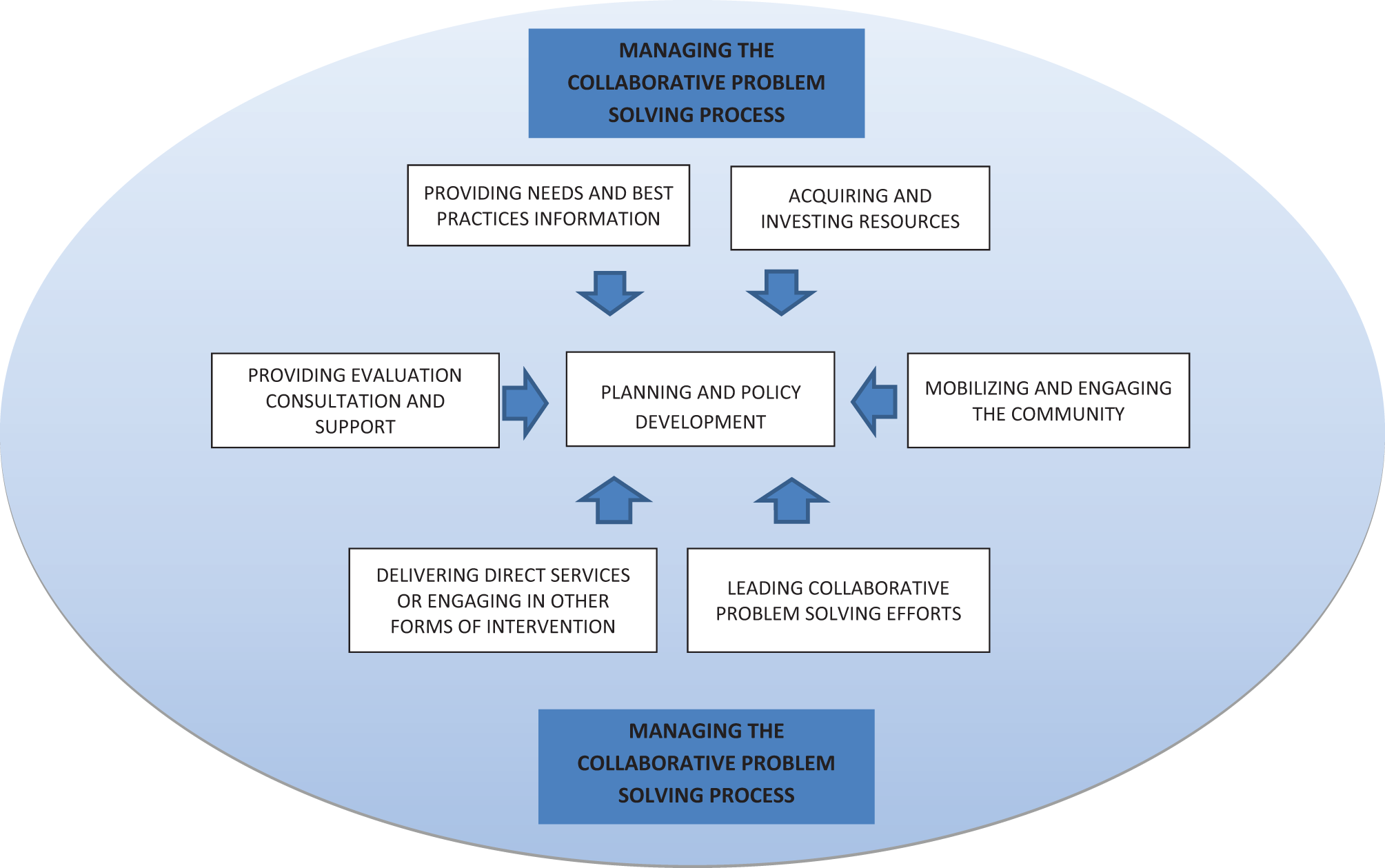
Conceptual model of community infrastructure supportive of collaborative problem solving.
The functions defined in the previous section are arrayed around the planning and policy development function. Management encompasses the remainder of the model to imply its overarching importance. Processes inherent in each function must be managed independently and in relation to other functions. Thus, effective collaborative community problem solving is enhanced to the extent that specific functions are accessible and supportive of the problem-solving process. One might argue that planning professionals charged with facilitating collaboration (Healey 2006; Innes and Booher 2010; Margerum 1999) should seek to provide or arrange for others to provide assistance consistent with the functions indicated in Figure 1. In many cases, planners might assume the role of manager of the collaborative problem-solving process.
Conclusions
It is clear that collaboration is a complex and highly specialized activity. However, many planning theorists suggest that collaborative community problem solving and other forms of collaborative planning are useful problem-solving strategies (Innes and Booher 2010; Wolff 2010). The material summarized above also indicates that collaborative problem solving is a homologous activity. The authors of this article argue that the basic collaborative problem-solving process is similar regardless of the issue being addressed. For example, the authors of this article are aware of significant state level efforts in Ohio to address prescription drug use, family and community involvement in educational reform, training of medical personnel, and development of systems of care for youth with behavioral health concerns that are being guided by collaborative processes. In the authors’ opinion, each of these efforts will be optimized to the extent that the infrastructure or functions defined in this article are available to planners and decision makers.
Empirical research and varied experiences of practitioners suggest a number of factors that are likely to facilitate effective collaboration. The Zakocs and Edwards (2006) review provides the most compelling evidence. Coalition factors associated with effective collaboration include formalization of processes, leadership style, member participation, member diversity, collaboration, and group cohesion. Other factors identified by Zakocs and Edwards include quality of plans, action orientation, perceived member ownership, knowledge of issues, and member empowerment. Theory and case study research suggest a number of additional factors that are likely to enhance collaboration. These factors include access to substantive knowledge, competent and useful evaluation, connection to the larger community, readiness, and access to financial and other resources.
The authors of this article argue that the factors identified above might be cast as specific functions that are part of a community’s infrastructure. Such infrastructure would allow communities to call upon formal supports for collaboration to address any number of complex social issues. Given the prevalence of collaborative approaches to problem solving noted by planning theorists such as Innes and Booher (2010), Margerum (1999), and Healey (2006), it would appear that investment in the development of such infrastructure would be well founded. The authors of this article suggest that practitioners engaged in collaborative community problem solving must recognize the importance of the functions identified above. In addition, individuals, teams, or organizations should be recruited to fill roles consistent with these functions in support of specific collaborative problem-solving efforts.
As evidence related to the value of such functions and infrastructure accumulates, formal community structures might be cultivated to fill these roles on a more permanent basis. Such infrastructure may ultimately function to enhance collaborative community problem solving. Two critical questions arise related to future research. First, evidence must be acquired related to the long-term results of collaborative interventions. Ultimately, collaborative community problem solving must facilitate the achievement of significant outcomes related to health and well-being. As Berkowitz (2001) and Zakocs and Edwards (2006) note, there is currently little evidence to support the relationship between collaborative problem-solving and population-level outcomes. Second, additional research must illuminate the impacts of the functions defined above, both individually and in combination, on the effectiveness of collaborative community problem solving.
Footnotes
Acknowledgments
Thanks are due to staff members of the Ohio Department of Education, Ohio Family and Children First, Center for Learning Excellence and anonymous reviewers for their thoughtful comments.
Declaration of Conflicting Interests
The authors declared no potential conflicts of interest with respect to the research, authorship, and/or publication of this article.
Funding
The authors received no financial support for the research, authorship, and/or publication of this article.