






Abstract
A reexamination of the role of equity in planning is critical at this contentious period in US history. Racism and anti-immigrant sentiments have arisen in our public policy debates, cities have again experienced riots, and inequality has grown. Equity has long been a center of tension throughout planning history, and the field has struggled to balance activism and technocratic expertise. This article provides a literature review to inform and explore how planners can engage equity in this current contentious time period.
Keywords
Twenty years ago, the Journal of Planning Literature published an annotated bibliography focused on the practice and experiences of equity (or advocacy) planning (Metzger 1996). While terminology for discussing equity concerns in planning has changed in the two decades since that publication, understanding how the planner can function as an advocate for a “Just City” is still of critical importance. The following literature review provides a historical overview of the profession’s engagement with social equity, spanning the “Social Progressive Era” of urban planning to the contemporary concept of the Just City. The literature review also assesses the relevance and utility of equity planning theory in contemporary planning practice.
The planning profession has a conflicted history with engaging social and racial equity. Urban planning throughout the twentieth century has served the needs of marginalized groups and communities. The planning profession has also been complicit in racial, ethnic, and class discrimination through both the planning practices used and the policies established (Manning-Thomas and Ritzdorf 1997; Cashin 2004; Heathcott 2015). Social equity has been a point of debate and, consequently, tension throughout the profession’s history, as it struggled to balance a need for social activism against that for professionalization and technical proficiency, while dealing with inherent bureaucracy at the local, state, and federal levels. From a historical perspective, this ongoing tension has largely mirrored overall social trends in US history, specifically patterns in immigration, migration, and economic cycles, all of which have contributed to conflict and anxiety regarding issues of equity with respect to race, economic class, and citizenship status. This legacy is important in both understanding and addressing the social equity challenges of the twenty-first century.
Urban planning practices and policies continue to influence issues of social and racial equity in cities across the United States and have been responsible for negative, as well as positive, impacts. An extensive amount of literature addresses the importance of “place” in influencing a number of life outcomes such as health, education, economic well-being, and social mobility (Sharkey 2013). As the principal discipline serving community development needs, urban planning is naturally inclined to be at the forefront of addressing place-based challenges. Planning and community development are essential in addressing such community challenges as vacant property, community safety, community health and health services, the presence of appropriate infrastructure, and other community building/empowerment issues.
The profession is also at the forefront of issues surrounding neighborhood redevelopment and can directly diminish the impact of displacement from gentrification. Planning’s impact on transportation infrastructure also directly influences issues related to a population’s mobility and ease of access to employment. The planning profession further has a role in land use control, one which can contribute to housing stability and fair housing goals or, conversely, toward exclusionary housing and economic and racial segregation. Finally, the profession’s policies and practices can influence regional development patterns, affecting the geographies of spatial inequality and opportunity in our metropolitan areas (Pastor, Benner, and Matsouka 2009).
The issue of social and economic equity in US urban planning has probably never been more important than at the current time. Racial tensions and those related to immigration are reflected not only in political debate but in civil disorder within various cities as well. Just as the nation’s demography has grown more diverse, so has a reaction against it, fueled by social and economic inequalities. Successful urban planning, however, can enhance social and racial equity when this is made a priority in establishing policies and practices.
The Evolution of Equity Planning in Theory and Practice
The Social Progressive Era: Equity in Planning’s Infancy (The Tenements and Social Reformers)
As documented in detail in Foglesong’s (1986) Planning the Capitalist City: The Colonial Era to the 1920’s, the profession emerged during the progressive period in response to the nineteenth-century free market/capitalist-dominated city. Activism surrounding urban social problems has existed since the latter half of the nineteenth century as the first US city (New York) reached a population of one million. Socially progressive activism initially developed as a response to the unsanitary and unsafe conditions, which came to characterize crowded urban tenements. One of the earliest social reformers, Jacob Riis ([1890] 1997), published and lectured on the appalling conditions in lurid detail so as to promote awareness and potential change. Riis and his contemporaries challenged the principles of Social Darwinism, then espoused by intellectual elites, citing the negative impacts of overcrowded and dysfunctional living spaces on the behavior, morals, and health of the affected inhabitants.
Riis’s efforts were accompanied by those of members of a larger social progressive movement addressing a number of social issues developing in the United States following the civil war (Fogelson 1986; Hall, Pérez, and Levy 2014). Prior to the publication of his How the Other Half Lives, the first settlement house in the United States (Neighborhood Guild) was founded on New York’s Lower East Side in 1886, followed by that of Hull House in Chicago by Jane Adams and Ellen Gates Star in 1889 (Trolander 1987).
It was during this period that quantitative “advocacy journalism” first made its appearance, journalism characterized by social surveys which were “explicitly normative and reformist in aim” (Anderson 2017, 86). Efforts on the part of public health advocates to institute reforms in public sanitation and to control the spread of infectious diseases also predate Riis’s seminal work (Foglesong, 1986). Such advocates have been described as the “first urban planners in America” (Perdue, Gostin, and Stone 2003, 557). The Progressive Era would also see the introduction of housing reform tied to city planning, as early housing reformers sought to achieve “safe, sanitary, and uncrowded housing” through the introduction of building codes and land use controls (von Hoffman 2009, 232). Recreational spaces for children were created during this period as well, not simply as an urban amenity but as a means of controlling the nature of children’s play activities (Cavallo 1981; Howell 2008).
The efforts of progressive social reformers on behalf of (often largely immigrant) urban tenement populations contributed to improved housing standards, to radical improvements in water and sewage services, and to the establishment of the first social resource centers (settlement houses), the precursors to contemporary community development organizations. From a contemporary perspective, the accomplishments of the social reformers represent place-based (infrastructure and housing) and people-based (settlement houses, educational facilities, and labor unions) approaches toward realizing an equitable city (Peterson 2003). The progressive movement emerging in early twentieth century urban America would have long-term ramifications with respect to policy as well as politics (Dreir 2005).
City Beautiful: The Moral Power of Beautiful Civic Space
City planning came to be regarded as a legitimate discipline with the emergence of the “City Beautiful” movement in the late nineteenth and early twentieth centuries (Peterson 2003). This movement, which would dramatically change cityscapes, not only addressed aesthetics but also the social ills and general dysfunctional level of urban space at the time. However, its main thrust was not combatting social ills but rather incorporated the principles of physical determinism: that through ordered design, the disorder of the city could be tamed and that this taming of disorder would consequently be reflected in the improved moral character of the inhabitants.
The City Beautiful movement sought to eradicate all urban problems through an imposition of order and exemplary design, enlightening the masses through the architectural genius of its designers. While several other important and prominent theoretical movements would follow in the planning field, the concepts and principles of the City Beautiful movement were particularly influential in the decades following the movement’s inception. Through the movement’s rigid place-based approach to urban planning, many positive changes in the urban landscape can be attributed. Aesthetically pleasing recreational, public, and civic spaces that demonstrably improved the quality of urban life were the hallmark of this movement (Peterson 2003).
The rigid physical determinism of the City Beautiful concept, however, was one of its drawbacks. The social evils afflicting tenement and slum dwellers were never fully addressed, and the City Beautiful-inspired development often physically displaced these residents. City Beautiful was a well-intentioned but largely undemocratic process. It constituted a top-down approach that, when implemented often led to inequitable outcomes in which a few were enriched, but those already economically challenged, were often further marginalized (Foglesong 1986).
Conflict in Urban Planning: The City Beautiful versus Social Progressives
As American cities continued to grow, so did the gulf in philosophy between the two leading schools of thought in city planning: that of the proponents of the City Beautiful, on the one hand; and that of the social progressives, on the other (Peterson 2003, 2009). The tension would also place social activists against those seeking to professionalize and impose order on field. Whereas both groups sought to improve the quality and character of urban life, social progressives emphasized the need for social equity and consequently political activism, while those of the City Beautiful school stressed a culture based on “civic virtues and shared aesthetics.” Notes Peterson (2003) in The Birth of City Planning in the United States: Social progressives challenged the root assumptions of City Beautiful planning head-on. Coming from the same segment of the American society as the City Beautiful advocates did, they readily grasped the cultural bias of the beautifiers toward the well-to-do and its preoccupation with public improvements to the neglect of urban slums and their inhabitants. (p. 228)
The decline of the population congestion movement was not the only “path not taken” in planning’s early development (Fogelsong 1986). Many of the planning tools envisioned as supporting social reform by progressives lost their social equity elements in implementation (von Hoffman 2009). First established in Great Britain, the Garden City movement, whose socially progressive elements were embraced by social reformers, would see those elements stripped in its implementation in the US “garden suburb” context (von Hoffman 2009). The implementation of zoning in the US context would see a similar transformation, as described by housing historian von Hoffman (2009) in Housing and Planning: A Century of Social Reform and Local Power:
…crossing the Atlantic transformed European zoning from a progressive measure to a naked weapon of local property, class and race interests. (p. 233)
Segregation in the Early Zoning Era: “A Wolf in Sheep’s Clothing”
One of the most important land use tools, which has empowered urban planners over the past century, is that of zoning, a legal concept for regulating land use within designated areas. When exercised meticulously, however, zoning can also be used not only to influence the character of physical space but to support social objectives, not all of them necessarily positive (Richards 1982).
It has been argued that during the early part of the twentieth century, zoning was used in many northern American cities to promote the segregation and social marginalization of specific groups that had migrated there in large numbers: African Americans from the Southern US, Asian immigrants, and Jewish and Catholic immigrants from Europe. The practice was also employed by colonial governments outside the United States, where it was used as a means of social control over groups whose labor was needed, but whose presence was not particularly welcomed by authorities (Nightingale 2012).
There is little doubt that racial isolation and segregation were an explicit goal of early zoning policy (Silver 1997; Foglesong 1986). Zoning was intended not only to regulate unwanted land uses but also the presence of specific “undesirable” racial or ethnic groups. Baltimore passed the first “racial zoning” statutes in 1910, followed quickly by a number of other municipalities. The ordinances, however, were ruled unconstitutional in a 1917 US Supreme Court decision (Silver 1997).
While specific racial zoning may have been outlawed, the technique of “expulsive zoning” was employed to concentrate less attractive forms of land use within marginalized communities, while barring these same forms of land use in affluent white communities (Rabin 1989). In collaboration with vested real estate interests, city administrators also aggressively supported the implementation of restrictive covenants with respect to land use, all in the same spirit as racial zoning (Gotham 2002). In many cases (and particularly in the American South), these activities were coordinated with comprehensive urban planning efforts (Silver 1997).
The New Deal Era: The Search for Equity during the Great Depression
The 1929 stock market collapse and consequent Great Depression meant that for millions of Americans, equity was less reasonable a goal than was mere survival (Katznelson 2014). In response to a wave of corporate and personal bankruptcies, the highest unemployment rate (25 percent) in the nation’s history, untold home foreclosures, and the blight of “Hooverville” camps for the homeless, the administration of Franklin Roosevelt launched the “New Deal”: the most massive intervention in the US economy on the part of a federal government to date (Leuchtenburg 2009). An emphasis was placed on infrastructure investments of an unprecedented magnitude, characterized by such regional planning efforts as the Tennessee Valley Authority (TVA). The TVA along with the Civilian Conservation Corps, the Civil Works Administration, and the Works Progress Administration all provided desperately needed employment for millions of Americans while authorizing capital investments that would benefit the economy once recovery was underway (Leuchtenburg 2009).
It was New Deal interventions with respect to the housing sector, however, which would most influence the field of urban planning. The Federal Housing Act of the 1934 led to the creation of the Federal Housing Administration, and the Federal Housing Act of 1937 created the US Housing Authority. These new bureaucracies, coupled with government influence on mortgage lending, supported a significant expansion in home ownership across the country (von Hoffman 2009). Moreover, in 1936, the Housing Division of the Public Works Administration was responsible for the construction of the nation’s first public housing development, Techwood Homes, in Atlanta (Rothstein 2017). A year later, the Wagner-Steagall Housing Act gave the federal government a more or less permanent role in the nation’s housing sector when it created the US Housing Authority. In 1939 alone, the Housing Authority constructed 50,000 affordable housing units (Nathanial 1973).
The era of the New Deal would stimulate considerable innovation with respect to urban planning policies designed to best attain social and economic equity. In practice, however, the expansions in housing and employment opportunities did not benefit all groups equally. As noted by Katznelson (2005) in When Affirmative Action Was White: An Untold History of Racial Inequality in Twentieth-century America, the benefits of many New Deal economic policies were not extended to the employment sectors most heavily represented by African Americans. Nor did federal housing policies provide significant mortgage assistance for communities of color. The Home Owners Loan Corporation, while it would help many families escape foreclosure in the early 1930s, introduced the practice of “redlining,” whereby mortgage loans would be refused to someone living in an area (generally one where the majority of residents were people of color) deemed to be a poor financial risk (Rothstein 2017). Moreover, public housing was racially segregated, and sites were often geographically isolated, further reinforcing metropolitan patterns of racial segregation (Myerson and Banfield 1955; Bristol 2015).
The Second World War would bring about new opportunities to support equity, new challenges, and once again changing demographics in US cities. The “Great Migration” of African Americans escaping deplorable conditions in the Jim Crow South would bring millions of black families to northern and western urban centers (Wilkerson 2010). Although the migration of African Americans would begin in 1915, the need for labor in northern industrial cities would accelerate movement from the south, bringing more than one million African Americans north during the war (Gregory 2005). Movement north and west would benefit from federal efforts to support antidiscrimination in defense labor practices, presenting expanded economic opportunity in the war industries.
Although expanded economic opportunities for African Americans presented promise, this was also a time period of racial violence directed toward African Americans and the internment of 120,000 in the Japanese community (Reeves 2015). African Americans would move into highly segregated urban communities, which were also struggling with housing shortages (Rucker and Upton 2006). The shortage of housing would accelerate racial tensions in northern cities, with the most explosive incident occurring in Detroit’s 1943 race riot, where white Detroit residents attacked African Americans, resulting in more than 400 injuries, US$30 million in property damage, and 30 fatalities (Capeci and Wilkerson 1990).
Rational Planning and Equity: From Redlining to Urban Renewal
In post–World War II urban America, the physical determinism of the City Beautiful concept combined with an exclusive top-down approach to planning in what would become the dominant urban planning model: rational planning theory (Fainstein 2005). Also known as the rational comprehensive model, the concept was supported by considerable organizational theory and by the modernist design movement in architecture, which characterized this period (Myerson and Banfield 1955).
Supporters of the rational planning model argued it would add the architectural benefits of modernism to planning (reflecting the vision of the Swiss pioneer in this field, LeCorbusier) while employing such quantitative techniques as cost–benefit analysis. The Housing Act of 1949 (the first official program for American urban renewal) fostered the rational planning model’s application in cities throughout the United States (Teaford 2000). Federally sponsored urban renewal, accompanied by the recently legislated Federal Highway Program, it was argued, would provide the financial incentives and infrastructure necessary to reshape and enhance the character of American cities (Teaford 2000). However, one of the priorities of the rational planning model with respect to urban renewal became slum clearance, leading to disproportionate displacement of African Americans and of other economically marginalized groups (Shester and Williams 2009). In those cases where alternative housing was offered, it often took the form of public housing towers that were as racially segregated as the neighborhoods they replaced (Teaford 2000).
The Advocacy Planning Era: A Radical Disruption
In 1959, a robust critique on the rational planning model came from the political scientist Charles Lindblom (1959) in his classic article, “The Science of ‘Muddling Through”. Lindblom questioned the rational planning model’s effectiveness within a complex sociopolitical context. Rather, he and his followers advocated incrementalism, or smaller, step-by-step approaches to urban development.
Incrementalists were joined by a host of other critics of rational planning in the 1960s. Jacobs (1961) in The Death and Life of Great American Cities charged rational planners and planning professionals in general with destroying what she regarded as the essence and spirit of individual urban neighborhoods. Jacobs did not mince words: urban planning was called a “pseudoscience,” and one with “neurotic” tendencies. Jacobs and her protégés formed the nucleus of a nascent resistance movement in the 1960s, which rejected the physically deterministic, undemocratic, and socially inequitable aspects of rational planning. While Jacobs is referenced here in the context of social advocacy, recently scholars have critiqued Jacobs as an elitist whose ideas also contributed to NIMBY disputes and gentrification (Hirt and Zahm 2012).
Advocacy planning would directly challenge the rational model and promote more “people-focused” practices and policies, with particular emphasis on serving the economically and socially marginalized (Fainstein 2005). As noted by Fainstein (2005) in Planning Theory and the City, the reaction to the rational planning model constituted a new sort of reform movement, a movement that was in the tradition of the late nineteenth-century urban reformists but distinct in its political critique of rational planning: The reform movement was attacking the prevailing rational or quasi-rational model on two grounds: first, it was a misguided process; and second, it produced a city that no one wanted. The demands of reformers on the ground expressed themselves within planning theory through political economic analysis of the roots of urban inequality and through calls for democratic participation in planning. (p. 124) The prospect for future planning is that of a practice which openly invites political and social values to be examined and debated. Acceptance of this position means rejection of prescriptions for planning which would have the planner act solely as a technician. (p. 331) Appropriate planning action cannot be prescribed from a position of value neutrality, for prescriptions are based on desired outcomes. One conclusion drawn from this assertion is that “values are the inescapable elements of any rational decision-making process.” (p. 331) Inclusion means not only permitting the citizen to be heard. It also means that he be able to become well informed about the underlying reasons for planning proposals, and be able to respond to them in the technical language of professional planners. (p. 332)
Advocacy Planning in the 1970s
As the urban violence of the 1960s gave way to the quieter 1970s, advocacy planning, nonetheless, continued to develop under such theorists and practitioners as Norman Krumholtz and John Forester (Krumholtz and Forester 1990). While Davidoff is the theorist most often identified as the face of the Advocacy Planning Era, it is important to recognize the contributions of the many other scholars, practitioners, social activists, and nonprofit and community-based organizations in the advancement and application of advocacy planning (Corey 1972). Corey’s (1972) article, “Advocacy in Planning: A Reflective Analysis,” notes that during the 1960s, “…hundreds of organizations and agencies have been engaged in planning advocacy as well as advocacy activities…” p. 47).
Organizations such as the Urban Field Service at Harvard’s Graduate School of Design, Community Human and Resources Training in the Cincinnati region, and the Architect’s Renewal Committee in Harlem are just a few of those across the country working to empower marginalized residents and better align planning practice with the needs of neglected and/or impoverished communities (Corey 1972). Advocacy planning has been a means of introducing humanism into the highly technical and bureaucratic structures which characterize local, state, and federal government (Peattie 1968; Corey 1972).
Like any planning theory, the advocacy planning movement did not escape criticism on multiple levels from both practitioners and theorists. Notes Corey (1972): On the one hand advocacy planning has been taken to task for employing confrontation tactics, and on the other hand advocacy planning has been criticized because it is not radical enough. (p. 53)
Applying the principles of advocacy planning in practice proved difficult, and many political conflicts accompanied attempts at its implementation. Advocating on behalf of the residents of economically marginalized or racially segregated communities can be challenging. Moreover, advocacy planners often come from socioeconomic backgrounds far different from that of the residents they purport to represent, creating problems with respect to communication. In many cases, advocacy planners have been accused of unreasonably raising the expectations in the communities they aimed to improve (Corey 1972).
Critics of advocacy planning also questioned the applicability of “pluralism” in supporting justice, given the inherent imbalances in power between socially and economically marginalized groups, on the one hand, and political, economic, and corporate elites, on the other (Mazziotti 1974). Mazziotti (1974) writes: “…political pluralism is a well-constructed social myth which provides the rationale for instituting social programs designed to placate the politically and economically disenfranchised” (p. 209). This criticism was employed by proponents of the radical planning model, a model that questioned the potential for the incremental approach utilized by advocacy planners to effect structural change (Grabow and Heskin 1973). Radical planners, on the other hand, felt that urban planning should be more oriented toward achieving social and economic equity (Friedmann 1987). They disparaged pluralism in favor of equitable resource distribution and a model of class-based marginalization, which would address inequities attributed to place, race/ethnicity, or gender.
The Legacy and Impact of the Advocacy Movement
The era of advocacy planning would coincide with several promising but short-lived federal efforts to address issues of urban inequality. The Demonstration and Metropolitan Development Act of 1966 would produce the “Model Cities” program (Klemons 2007). Model Cities would meld community organizing, program service delivery, and community planning by funding coordinated five-year planning efforts. Although the unique structure of Model Cities was promising, the program would end in 1974 and had mixed impacts on cities pursuing Model Cities plans. The Model Cities program suffered from external challenges such as limited funding and shifts in urban policy during the first term of President Nixon’s administration (Weber and Wallace 2012).
Following the riots of 1967, the Report of the National Advisory Commission on Civil Disorders (the Kerner Commission) directly identified the nation’s segregation as the primary reason for the lack of economic opportunity for the urban African American community. The federal commission directly implicated planning concerns such as fair housing and reforming public housing as solutions. Despite the Kerner Commission report being widely heralded by civil rights leaders, President Johnson ignored the report’s recommendations, and the shift to conservatism during the Nixon administration would further limit its influence (Risen 2009).
Efforts by the US Department of Housing and Urban Development (HUD) to be proactive in addressing fair housing during the Nixon administration would also be short-lived. In the early 1970s, Governor George Romney, HUD secretary during the Nixon administration, sought for the agency to have a strong role in fair housing regulation, particularly for communities receiving funds from the federal government (Reston 2012). The HUD Secretary proposed the “Open Communities” program that made receipt of HUD funding contingent upon communities allowing subsidized housing. The secretary’s early activist stance would not last long, as the Nixon administration pressured Secretary Romney to back down from this aggressive interpretation of the Fair Housing Act. Nixon’s displeasure with Romney’s affirmative stance of pushing for regional desegregation would lead to Secretary Romney’s early resignation from HUD.
Some have questioned whether advocacy planning has actually had any material impact on the field of urban planning. Scholars have suggested that a commitment to social equity in planning may have existed in theory, but in practice, it has been difficult to balance goals of equity and economic growth. States Campbell (1996) of the University of Michigan: …though planners often see themselves as the defenders of the poor and of socio-economic equality, their actions over the profession’s history have often belied that self-image…At best, the planner has taken an ambivalent stance between the goals of economic growth and economic justice. (p. 297)
In the decades following the inception of advocacy planning, urban planning practices would change, as a new set of tools promoting advocacy and equity were adopted in cities across the United States. For example, in 1974, inclusionary zoning was first introduced in Montgomery County, Maryland (Montgomery County 2004). The first regional fair share housing programs would be enacted by the end of the 1970s as well (Chapple 2015). And, perhaps most significantly, the practice of contemporary community development would emerge as indicated by the growth in community development corporations (CDCs). Starting with the establishment of the Bedford-Stuyvesant Restoration in Brooklyn, the number of CDCs nationwide has risen from 100 in 1966 to more than 4,600 in 2006 (Clay and Jones 2009). Whereas there have been no surveys documenting the number of CDCs since that time, an industry survey in 2010 estimated that such organizations are now annually responsible for the creation of 96,000 units of affordable housing and 7.4 million square feet of commercial space (Community Wealth 2017). Equity challenges would continue in cities after the Advocacy Era, but the advocacy planning movement would have some long-term influence on practice, particularly with respect to community engagement and community development (Chapple 2015).
The Just City Era: Equity in the Context of Contemporary Urban Planning Theory and Models
Although advocacy planning theory was eventually supplanted by other theories, more contemporary theories and practices with respect to urban planning continue to address the issue of social equity. One theory that would gain particularly wide acceptance was communicative planning theory. This theory evolved from pluralistic planning models used in the early stages of the advocacy movement (Sager 2013). Communicative planning theorists question the validity of “expert knowledge.” Dialogue and discourse are the source of finding “truth,” and this can be achieved through communicative rationality (Habermas 1981). The work of Cornell professor John Forester (1989) grounded communicative planning theory on the principle that communicative action could empower marginalized and disenfranchised communities by providing access to public decision-making processes and appropriate technical information. Planners are essential to this process both as educators, furnishing access to information, and as consensus builders, bridging diverse and sometimes competing interests (Forester 1989).
Fainstein’s (2010) Just City theory represents a new theory for promoting equity in the age of globalization and neoliberal policy. This theory focuses on diversity, democracy, and equity, attempting to integrate the three concepts to foster just and equitable processes and outcomes. The Just City theory emerged from Fainstein’s case studies in Amsterdam, London, and New York, studies which added an international perspective to equity planning theory.
The Just City theory has attempted to address what have been perceived as deficiencies in other contemporary planning theories or movements. Fainstein (2000), for example, questions the communicative planning model’s adequacy in dealing with structural conflict and challenges: “There is the assumption that if only people were reasonable, deep structural conflict would melt away” (p. 455). She argues that more than mere consensus building is necessary to address deep structural inequities. Rather, other forms of community engagement, mobilization, and organization are advocated to empower communities to combat such inequities.
The Just City theory is grounded in addressing social and geographic inequities through processes that foster participation, empowerment, and decision-making by marginalized groups, leading to more equitable outcomes. Moral neutrality (or the absence of clear moral values in framing discourse) is not a valid perspective for equitable communicative discourse; rather, the Just City requires equity in process as well as adherence to any equitable outcomes prescribed.
Fainstein also challenges the contemporary design theory of New Urbanism, speculating that it might represent merely a new form of physical determinism, which characterized both the City Beautiful movement and the architectural modernism of the rational planning theory. Fainstein views the “charrettes,” or stakeholder meetings, which characterize the community participation aspect of New Urbanism, less as an attempt to gain community input than as a means of selling the public on the New Urbanists’ own visions.
Research on the part of University of Chicago professor Emily Talen in the Mississippi Gulf Coast following Hurricane Katrina supports Fainstein’s contentions. Talen found that the use of New Urbanist planning charrettes in the region and the theorists’ design-oriented approach did not adequately address the deep structural and institutional challenges to social equity which were posed, particularly with respect to the issue of providing affordable housing in the reconstruction period following the disaster. Jennifer Evans-Cowley and Andrew Canter in their investigation of the construction of “Katrina Cottages” and other rebuilding efforts in the wake of the disaster further noted a variety of local and state regulatory barriers to affordable housing construction, barriers which frustrated social equity and fair housing goals in coastal Mississippi redevelopment (Evans-Cowley and Canter, 2011).
In her more recent work, Fainstein expands upon her Just City model and examines the role of diversity (both in the physical and social context) in planning practice and theory. In “Cities and Diversity: Should We Want It? Can We Plan for It?” Fainstein (2005) notes that diversity in land uses and physical structures in the urban environment—a goal of New Urbanism—does not necessarily equate with social diversity. Fainstein introduces a model for stimulating social justice with local urban policy, while also emphasizing the critical need for a progressive political consciousness to make the Just City possible. Fainstein further questions the social equity benefits implied by the type of mixed-use development routinely advocated by New Urbanism proponents, although she concedes that New Urbanist policy, when coupled with a progressive political consciousness, can help successfully support the concept of the Just City.
Another theoretical model that carries similar foundational elements of Fainstein’s The Just City is progressive regionalism. Similar to Fainstein’s acknowledgment that space is critical to equity and justice, progressive regionalists focus on regionalism as the correct geographic scale to remedy spatial inequities and build collective action for social justice. As described in a 2009 symposium in the Journal of Planning Education and Research: Progressive regionalists strive to eradicate root causes of poverty, social injustice, and environmental degradation in ways that take into account the complex and multi-scalar flows of material, energy, and knowledge resources constituting our increasingly globalized world. (Pizzoli et al. 2009, 337)
The Future of Equity Planning Theory: Crisis and Opportunity
Riots have reemerged in US cities in the twenty-first century. Replicating the civil disorders of the 1960s, rioting occurred in Ferguson, Missouri (outside St. Louis) in 2014 and in Baltimore, Maryland, the following year. Smaller but, nonetheless, significant protests and disorders occurred in other cities across the United States as well, largely in response to what were perceived as racially motivated police shootings. Racial discrimination, neighborhood distress, economic inequality, and police brutality were other factors cited as triggering these recent disturbances. Neighborhoods in Baltimore and Ferguson were looted and burned, precipitating the deployment of the National Guard as was done during the riots of the 1960s. These contemporary crises reflect the pervasive social injustices that characterize American urban areas and the persistent influence of structural and institutional racism, as well as that of both social and economic inequality.
A 2015 essay by Flint in The Atlantic’s CityLab blog suggested planning was experiencing an “identity crisis” . Flint stated that planners had not sufficiently recognized the complexity of the urban environment nor given enough attention to the concepts of “systems approaches” or “tactical planning” in their work, adding that the “revolt against traditional approaches to planning is being conducted by planners themselves” (Flint 2015). He further stated that not only complex systemic challenges in the urban environment but a general sense of social injustice has fueled the desire for change. Flint also reminded the reader that this was not the first time that there has been a call for change in the field of urban planning, citing the efforts of Jane Jacobs a half century earlier.
Flint’s historical reference could be expanded to identify not only Jane Jacob’s work in the 1960s but also Davidoff’s advocacy movement and the environmental movement of the 1970s, as an entire period of transformational thought in planning. As it needs to do so today (and as was needed in the late nineteenth century when faced with the pressures of rapid industrialization), the urban planning field needed to respond to the dramatic macroeconomic forces, policies, and challenges facing our cities and society at the time. Planning theory and practice must remain dynamic in order to effectively respond to a complex and ever-changing society (now largely global in nature) or it will quickly lose its relevance.
As summarized in Figure 1, the evolution of equity planning efforts has been tied historically to that of larger societal and economic factors. Influenced by large-scale immigration, industrialization, social and economic inequalities, and the spread of overcrowded and unsanitary tenements, the Progressive Era would lead to a period of social activism characterized by the settlement house movement, public health initiatives, housing and building code reforms, and early land use control efforts. In response to the Great Depression, the New Deal Era would lead to innovative financing methods to expand home ownership, to jobs programs, and to the first large-scale public housing developments. The Advocacy Era, in response to the social and racial upheaval of the 1960s, and to the failure of urban renewal, would introduce contemporary models of community development, which encouraged greater public participation and promoted fair housing reforms. In our contemporary era of the Just City concept, concerns such as globalization and immigration, growing social and economic inequalities, racial and social conflict, and the displacement caused by gentrification will likely shape the nature of urban planning theory and practices designed with an equitable society in mind.
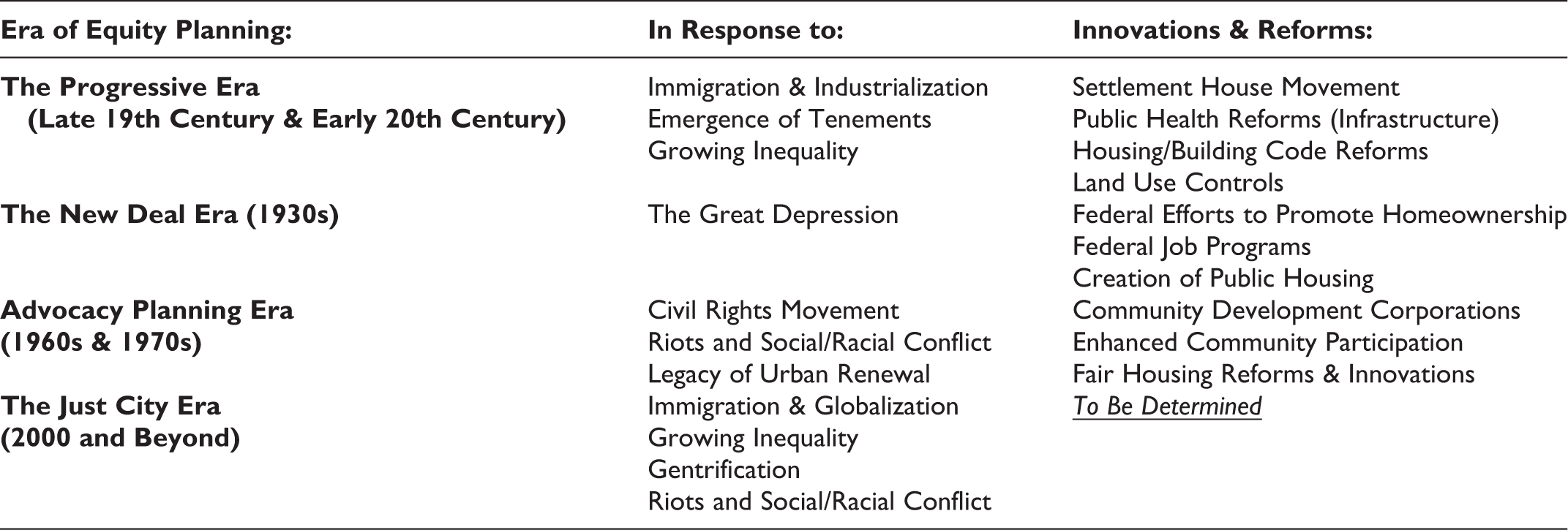
Equity planning’s evolution and the influence of societal factors.
Conclusion: Moving toward Equity and the Just City
I do not pretend to understand the moral universe; the arc is a long one, my eye reaches but little ways; I cannot calculate the curve and complete the figure by the experience of sight, I can divine it by conscience. And from what I see I am sure it bends towards justice.” (Theodore Parker, Abolitionist, in a speech at the Massachusetts State House, January 1858)
The challenges urban planners face in the twenty-first century are at least as daunting as those encountered in the nineteenth and twentieth centuries. Social and economic inequalities are growing, cities are changing in character and complexion, and the nation is in the midst of another significant demographic transition. New models for urban redevelopment (such as New Urbanism) continue to fail to fully address the issues of displacement and economic marginalization. Some neglected suburbs are becoming zones of distress and isolation for marginalized people, while some urban areas are still reeling from the aftershocks of the 2008 housing crisis and a decline in housing support and subsidies. Declining federal support for traditional urban community development has created an environment in which equity planners must learn to collaborate with other stakeholders and activists. It is noteworthy that one of the most well-documented, place-oriented, and people-oriented interventions of the past two decades has been the Harlem Children’s Zone, an initiative led by educational advocates rather than city planners (Erickson 2012; Dobbie, Fryer, and Fryer 2011).
As is the case currently, our society underwent monumental demographic and economic upheavals in the past; and as in the past, these upheavals will generate negative outcomes for the “other” population, whomever the politically disenfranchised “other” population may be. Our cities have “sorted” these populations into isolated areas lacking opportunity, and this has been accomplished in some instances with almost mathematical precision.
Planning must also be cognizant of the complex process of “othering” (specifically more contemporary marginalization of immigrants) and incorporate aspects of intersectionality. Intersectionality places emphasis on how multiple individual identities can impact marginalization, in essence compounding the effects of race, class, and gender on the lived experience (Crenshaw 1995). Our changing demographics and changing society must be reflected in the changes to conceptualizations of equity planning theory.
Despite the challenges, I argue that the planning discipline has unique attributes to support the twenty-first-century Just City. At a time where collaboration skills and a multidisciplinary lens are critical to address systemic challenges, the planning discipline brings both of these tools to the table. The traditional domains of planning, such as transportation, housing, land use, and community development, are still preeminent factors in shaping access to opportunity in our cities. The twenty-first-century Just City requires more than good practice and requires deliberate effort to assure marginalized communities sit at the forefront of envisioning the Just City (Mattila 2002). Planning brings a history of communicative practice, which enables the profession to support robust equitable community engagement. To maximize these assets in supporting the Just City, the profession must bring intentionality toward its social justice agenda; this requires bringing a strong equity lens, a lens that is informed by the field’s long history of equity planning, to theory, practice, public discourse, and the professional development pipeline.
Footnotes
Declaration of Conflicting Interests
The author(s) declared no potential conflicts of interest with respect to the research, authorship, and/or publication of this article.
Funding
The author(s) received no financial support for the research, authorship, and/or publication of this article.