







Abstract
Public interest as the main content and purpose of planning is a fuzzy concept in planning literature. The body of literature on the public interest is so complex and diverse that makes it difficult to define and use the concept. In this study, the various definitions are categorized to achieve a framework of the definition of public interest. In addition to being more comprehensive than previous studies, this categorization identifies the main dimensions of a comprehensive definition of public interest. It provides a suitable context for theorists and professionals to have a clear framework for defining the public interest.
Introduction
Public interest is one of the most challenging concepts in the history of planning theory and practice. It has been the main core of planning thought and the most crucial criterion for the justification and legitimacy of planning action (Heywood 1990). Nevertheless, what constitutes the public interest has always been debated. For some scholars, the public interest, regardless of its definitions and interpretations, is a pillar of public planning and decision-making (N. Taylor 1998; Alexander 2002a, 2010; Campbell and Marshall 2002; Moroni 2004, 2), while some define it as a term that lacks normative and negligible substance (Reade [1997] 2013; Schubert 1960; Pennington 2000). At a glance, the public interest is the primary substance and the goal of planning, which determines the planner’s role in public policy-making (Campbell and Marshall 2002), and at another glance, it is defined as a means of expressing affirmation or acceptance of the public policies (Flathman 1966).
Since the public interest in any sense, at least theoretically (Grant 2005), is the main focus of planning (Alexander 2010), planners cannot act without a specific perception or definition of the public interest (Maidment 2016). The involvement of planning is traditionally justified according to the concept of public interest: “historically, the only common standard in the different forms of planning has been the public interest” (Mazza 1990, 48). However, what the public interest is, how it is defined, or the way it can be understood have received varied answers over time and in different contexts.
This challenging concept allowed the researchers to interpret it based on their own perception and employ their public interest version (Sorauf 1957). These personal versions often define the “process” of achieving the concept or even its “application” instead of defining the nature and content of the public interest. Different readings of the concept make it a floating standard or a superficial concept for instilling legitimacy in public measures.
Any critical assessment of the concept “public interest” must begin with a definition, but which definition? The attributed definitions are a complex, diverse, and inconsistent body of theoretical literature that in many cases even avoids providing a clear definition of the concept; thus, not only do they not respond to the various dimensions of the subject but it is not also possible to generalize them. Different definitions of this concept have made it a fuzzy but inevitable term (Tait 2012, 2016). Žižek states that planners differentiate themselves by sharing some vague terms, such as the public interest, whose meaning is unknown to anyone; everyone refers to them, and what binds them together is ultimately their common ignorance (Žižek 2002). In response to this issue and to obtain a basis for defining the public interest, numerous efforts have been made in the last past decades (Sorauf 1956; Banfield 1959; Held 1970; Howe 1992; Campbell and Marshall 2002; Alexander 2002a). However, defining the public interest based on one of its supporting concepts (e.g., ethics in Howe’s [1992] typology) or the substance and procedure of public interest in the typologies of Campbell and Marshall (2002) and Alexander (2002a), these efforts fail to explain a framework that responds to all the dimensions and approaches of the public interest definition in planning theory and practice. To fill this gap, this study seeks to review and categorize valid definitions of the public interest and present them in the form of a new category of public interest definitions.
To this end, a central question must be answered: what dimensions and categories can be identified in the definition of public interest in the planning literature? Thus, we review various definitions based on their general approach and provide a useful context for explaining a comprehensive framework for defining the public interest in planning theory and practice.
The article is structured as follows. The next part of the article describes the methodology used to review the literature and analyze research resources’ content. The third section presents a new category of definitions of the public interest based on the approaches or the prevailing context and adaptation of this categorization to the planning theory. It is concluded with the argument that there is no single definition of the public interest, and this concept is defined in any context influenced by the prevailing approach. However, presenting a comprehensive definition of the public interest requires a framework that provides a consistent answer to four specific questions: how is the public interest defined, by whom, by what process, and for what use?
Research Methods and Materials
This study uses a systematic review to identify the articles that defined or conceptualized the public interest. A systematic review is an independent study since it tries to understand the existing literature by collecting, interpreting, explaining, and integrating the existing research and expand it by bridging the existing gaps (Rousseau, Manning, and Denyer 2008). This method often involves extracting the second-order concepts from the existing literature body and converting them into third-order constructs. First-order structures relate to the main narratives in the articles reviewed such as the text of interviews to examine a particular topic. The authors’ interpretations of these narratives are second-order structures, and ultimately, our synthesis of second-order structures constitutes third-order structures. This process allows for translating the studies into each other and exploring the comprehensive hypotheses and concepts. For this reason, not all texts can be included in this type of study since the studies must be relevant in fundamental principles and concepts (Mays, Pope, and Popay 2005). As a result, using the articles obtained from the review process, an attempt is made to define the public interest in planning.
In a systematic review, determining the inclusion/exclusion criteria is essential to provide a transparent and documented process (Tranfield, Denyer, and Smart 2003). As an inclusion criterion, the English documents indexed at the Scopus database from 1940 when Rexford Tugwell explored the application of the public interest in modern planning to 2020 were searched based on the key words in the title, abstract, and key words sections. The compiled documents were examined in terms of the relevant title, abstract, and text to the research’s purpose. Finally, those articles were selected that directly explained the concept of public interest, its dimensions and complexities, or indirectly defined this concept by studying the normative substance of plans in different fields. As an output criterion, articles should either explicitly define or explain the concept of public interest or, by examining the normative content of programs, implicitly define what public interest is.
The process of sample selection for this study involved five steps (Figure 1). In the first step, the research key words were selected by examining fifty samples resulting from a preliminary search of “public interest” and “common good” in Google scholar. Then, the most repeated key words of “public interest,” “common good,” and “Legitima*” as the descriptors of planning content were searched in the Scopus database in combination with the words “planning,” “urban planning,” “planning theory,” “planning practice,” and “planning profession” as the descriptors for the study of the concept of public interest. The initial result was 3,060 articles that were reduced to 103 articles over the exclusion process according to the output criteria.

Systematic review process.
In the second stage, through the review of the 103 articles remained in the first stage, the key words of “community interest,” “commonwealth,” “public good,” “local public good,” and “common interest” were added to the search process. A combined search for these key words provided 1,165 additional articles, among which fifteen articles were selected during the exclusion process. Examination of the articles at this stage revealed that except for public good, other key words were much weaker than the main key words of the research in explaining the concept of public interest; thus, namely the key words of commonwealth and common interest were removed from the research process.
In the fourth stage, from the review of fifteen selected articles in the previous stage, the key word of “communal interest” was obtained. The combined search for this key word resulted in a total of two additional articles, among which only one article remained for full-text analysis.
In the fifth step, the search for the key words and authors cited in the Google Scholar database could fill the potential gaps and ensure that all available resources were reviewed, mainly due to Scopus’s limitations in searching for the resources before the 1960s. In this way, sixteen articles were added to this collection using the snowball method. A total of 145 articles were selected for final analysis. Of these, 122 articles were single author, forty-seven articles were theoretical, and the rest were empirical articles. Comparing how the concept of public interest is addressed in theoretical and empirical articles does not show a systematic difference.
We used the qualitative content analysis method with a traditional reading to analyze the articles. Qualitative content analysis is a research method for subjective content interpretation of textual data through the systematic classification, coding, theming, or designing the known patterns. In this approach, classes were directly extracted from the data text (Hsieh and Shannon 2005).
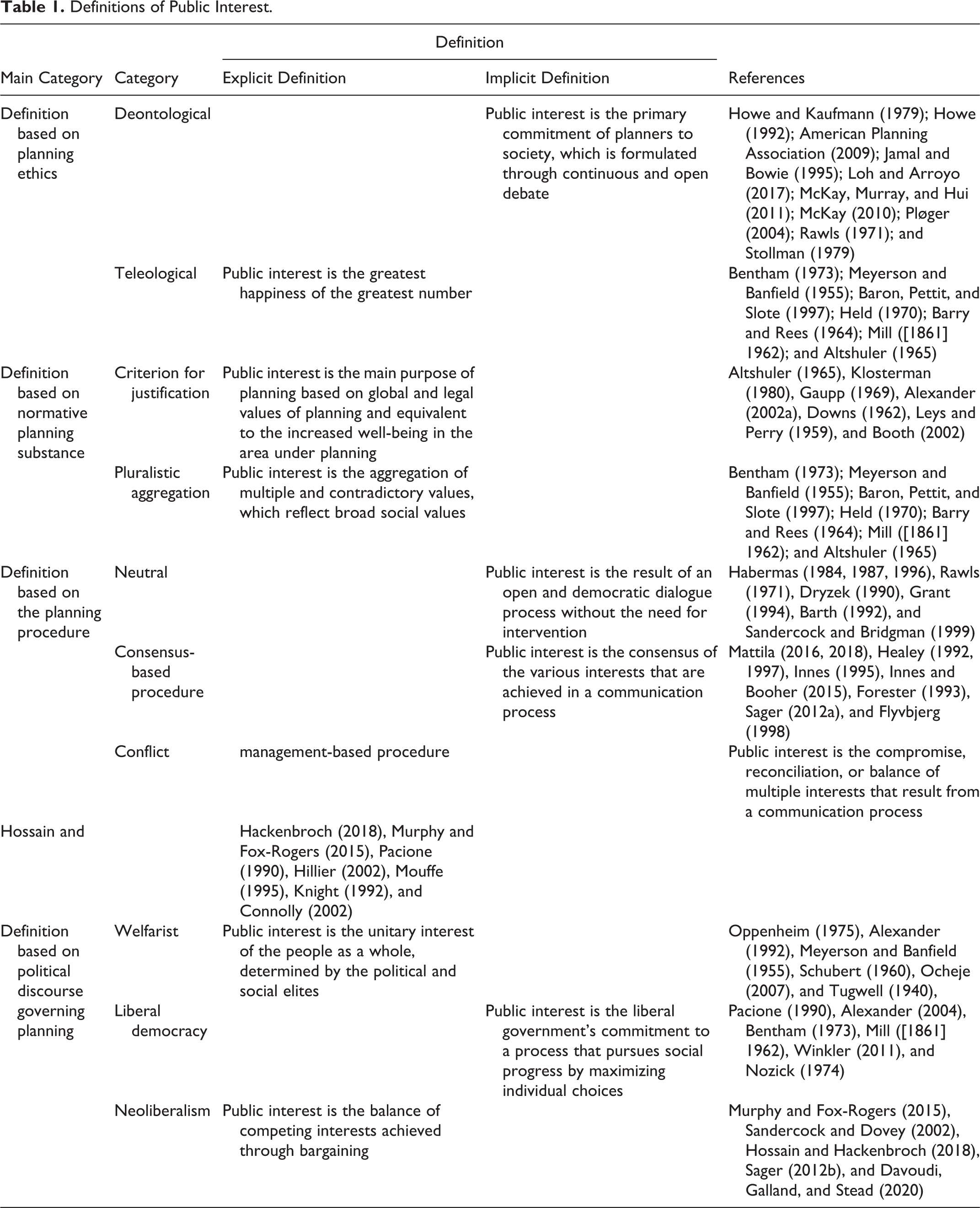
For this study, the different cited definitions of “public interest” and the unique definition provided in each article were extracted and tagged with the conceptual labels in the first stage. The conceptual labels with similar semantic loads were grouped within the categories. The commonalities of these categories formed the main categories as the main types of definitions. For example, Bentham’s (1973, 17–22) definition of the public interest can be labeled “the sum of individual interests,” and the definition of Meyerson and Banfield’s (1955, 324) individualistic public interests can be defined by the conceptual label “the greatest benefit to the majority.” The emphasis of both conceptual labels on “providing the greatest benefit to the greatest number” leads us to place them in a larger category, “teleological ethic.” The same process runs for other definitions. For instance, conceptual labels that collectively refer to the public interest as the moral commitment of planners fall into a larger category called “deontological ethics.” Finally, since both the categories of “teleological ethics” and “deontological ethics” are the types of normative ethics, combining these two results in a new category of definitions based on the planning ethics (Table 1).
Definitions of Public Interest.
Defining Public Interest in the Planning Literature
Any critical evaluation of the idea of public interest must start with a definition but which definition of public interest? The definitions related to this concept, first, are outspread and based on theoretical approaches or different fields of practice, and second, they fail to express all the term’s semantic differences. As a result of qualitative content analysis of research resources, all definitions can be categorized into four different categories (rows in Table 1), indicating differences in the definition approaches. The ones presented in the category are also separable in explicit or implicit definitions (columns of Table 1). Explicit definitions directly address the nature and content of the public interest, and implicit definitions refer to a group of definitions that move to define the concept acquisition procedures and commit to these procedures instead of defining the concept’s content. Many attempts to define the public interest are more of a process of experimentation, exploration, and scrutiny in order to achieve it (Steele 2020) than to provide a complete definition of the concept. In justifying the acceptance of these two sets of definitions, we can refer to the debate of Salet (2019) and Lennon (2017, 2019) in accepting the ethical participation of procedures when seeking the validity of the public interest.
Ethical procedures, either according to Lennon (2017) “shared moral frameworks,” or according to Salet (2019), public norms versus “purposive aspiration” or normative content, show different orientations toward the public interest. Public norms see the public interest as the result of accepting ethical frameworks that determine right and wrong, while purposeful action based on outcome prescribes a specific solution.
Another clarification about the category is the explaining words and terms that are used to refer to public interest. By examining the planning literature, the public interest has not always had its current name. Common good, the legitimacy of planning, the public good, and the communal interest are the most frequently used terms in the planning literature that sometimes are used instead of or refer to the term public interest. Although, all of these terms convey the shared meaning of something, the content of this sharing and how to share it is different. For example, the common good is usually regarded as a “collective and indivisible thing” or society’s interests as a whole and is more closely associated with communist ideals for human well-being, while public interest can be related to the “set of private interests” and, as a result, have a more individual look (Murphy and Fox-Rogers 2015). Dagger (1997) points to the distinction between the use of the word “Good” versus “Interest,” arguing that the user of the word Good versus Interest in the combinations of the “Public good” and “Common good” emphasizes common, conscientiousness, and moral aspects, as opposed to the individual and utilitarian aspects that are added to the term public interest (Alexander, Mazza, and Moroni 2012).
Ignoring differences in productivity (Brown, Msoka, and Dankoco 2015; Klaufus 2018), some sources equate the public interest with the public good and mean something that society has access to. The whole society pays its cost, and its benefit belongs to society (e.g., Hendriks 2009; Bradley 2019; Olsson 2008; van der Molen 2015; Webster 1998). However, it defines public goods as the nonexcludable and nonrivalrous goods. In contrast, public interests can be related to the supply of public goods and the distribution of competitive goods; hence, in cases where the public interest and the public good are used interchangeably, the emphasis is on communal interpretations of the public interest.
Although the common good and the public good both refer to communal interpretations of the public interest, one of the most important conceptual differences between the two can be considered “ownership.” Common good is recognized by local experts as a community-owned property run by local authorities. However, once ownership is transferred to a public institution (e.g., a municipality or a ministry), it is generally regarded as a public good (Šmid Hribar et al. 2018). Common good as a matter in social ownership is more of a normative moral concept than public good as a factual matter and in the ownership of public institutions that community members share in its use.
Another issue about the conceptual distinction of the terms used for the public interest relates to the distinction between communal interest and public interest. Communal interest expresses citizens’ commitments to each other (Winkler 2011) and requires understanding shared destiny and well-being for unitary society members. If it is the public interest, it is defined as both unitary and plural (the sum of individual interests). As a result, by examining words and expressions that refer to the concept of public interest in the planning literature, one can identify the four words “good” versus “interest” and “common” versus “public” that their use indicates the implicit orientation of the concept. The use of the word common emphasizes common social aspects. In contrast, the word public includes individual aspects in addition to common concepts. The word good emphasizes the moral aspect of the concept, while interest refers to utilitarian concepts in addition to moral concepts. As a result, public interest can be considered a comprehensive term for expressing different dimensions and conceptual tensions around the issue.
In this study, according to the given goals to discover the different categories and dimensions of the definition of public interest in examining the resources, minor differences and narrow boundaries between the phrases are omitted. The term public interest is used to explain the concept. Although it is not possible to determine a definite relationship between the use of words and the orientation of the concept, in examining the different types of definitions of public interest, we try to show the compatibility of each of these terms with different types of definitions.
Definitions Based on Planning Ethics
Public interest is fundamentally an ethical concept, and the definition of the substance of public interests depends on the prevailing ethical theory in planning (Pløger 2004). Due to this moral quality of public interest, some people accept the policies that run counter to their interests (Flathman 1966; Held 1970). In planning, the way public interest is defined closely relates to professional ethics’ general topic (Howe 1992). According to the principles of the code of ethics and professional conduct and the American Planning Association (2005), serving the public interest is the primary responsibility of planners. Thus, many planners define public interest as a moral principle. In professional ethics, the main question is about the independence of professional ethics from “ordinary” ethics—that is, whether the specific norms and principles that individuals need to adhere to in their professional role are in line with social (contextual) norms or they need to define distinct norms versus social norms (Goldman 1980). In response to this question, Friedmann (1989) argues that for society to follow planners’ decisions, professionals must follow the same ethical norms. Professional ethics must be accountable for conventional or ordinary ethics (Gewirth 1986; Howe 1992). As a result, the planning’s professional ethics are either consistent with or responsive to ordinary ethics.
A noteworthy point in the ethical definition of public interest is that even if planners act as ethicists, ethical evaluation of their actions is always tricky (Campbell and Marshall 2002). Since, first, the definition of moral values belongs to a particular context, thought, or group and cannot be neutral and generalizable. Second, as planners are often unable to predict ethical values’ probable consequences, their adherence to professional ethics remains theoretical (Pløger 2004). To overcome this problem, we need to know what definition of ethics and public interest prevails in each context and planning system (Alexander 2010). Content analysis of the literature suggests two different ethical frameworks for defining the public interest.
Deontological ethics
In the deontological definition of the public interest, this concept is emphasized as the moral obligation and duty of planners instead of emphasizing the substantive outcomes on the ethics (compliance with values) of planning procedures and commitment to universal ethical principles such as justice and fairness (Alexander 2002a; Wamsley et al. 2016; Campbell and Marshall 2002; Lennon 2019; Mualam and Alterman 2018; Howe 1994). In deontological moral theories, right takes precedence over good (Chambers 1996), so the public interest is defined as a higher moral principle to which the planner is committed to serving, and as a result, good is achieved.
Within this definition, planners traditionally consider themselves advocates of the public interest (Woltjer 2001, 65; American Institute of Certified Planners 2005). Deontology pursues conformity to duty and moral law along with the motivation for obeying the law and claims that any plan and program should benefit all citizens (Pløger 2004; South African Planning Institute 2005; Moore 1978; International City/County Managers Association 1995; Royal town planning institute 2007). Consequently, it considers the public interest to be an objective, unitary, and common nature determined by planners based on public norms in an ethical debate for use in public decision-making. Due to the emphasis on the communal aspects of the concept in deontological definitions, in addition to the term public interest, communal interest and common good can partially explain the definitions of public interest based on deontological ethics.
All deontological ethics-based definitions of public interest, instead of providing a clear definition of the public interest, refer to the public norms obtained in the public interest due to planners’ moral commitment to these norms. Providing the public interest of planners’ moral commitment in an open democratic process is based on justice and fairness to society (McKay, Murray, and Hui 2011), and the normative content of this interest can change depending on the time and context of planning. The public interest in a deontological definition legitimizes the planning process and considers this legitimate process’s outcome fairly.
Recourse to deontological definitions of the public interest can be found in post-1960s planning theory and the transition from value-free planning to value-oriented planning and more specifically in theories of advocacy planning (1965), equity planning (1982), or aid planning (the 1970s) in the UK and later in communicative planning theories.
Teleological ethics
In this category, the concept of public interest is defined according to the values underlying the outcomes of action—here, the outcome of planning actions, regardless of the process and tools of its realization, should benefit the majority of people. This definition specifically relates to utilitarian ideas and maximum profits for the majority (Mill [1861] 1962). In the context of teleological ethics, the public interest is the aggregation of individual interests that increase or reduce individual pleasure (Bentham 1973; Campbell and Marshall 2000, 2002; Howe 1992; Banfield 1959). The public interest in this definition is subjective, pluralistic, and consequentialist, as determined by the government or formal planners in rational decision-making and policy-making.
Held (1984, 143) argues that “The concepts of welfare and public interest, essential for evaluations of political decisions, are probably best understood in [consequentialist] terms.” Consequentialism evaluates “good” before ethics and ethics based on a consequence, by which the decision that brings the greatest benefit to the greatest number is considered moral. In consequentialist definitions, the public interest is a concept that legitimizes the consequence and practice of planning. Baron, Pettit, and Slote (1997) introduce consequentialist theories and utilitarianism as the most relevant ethical theory to planning and policy-making. In this theory, the action’s consequences are more important than the motivation of the decision maker or the inherent nature of an action. The scale of a good public policy is how much it benefits the general public or creates a balance between good and bad. To realize the public interest, it is necessary to know what benefits and costs the people attribute to a given policy and whether the benefits outweigh the costs or not (Bentham 1973, 1948; Held 1970; Meyerson and Banfield 1955). As a result, given the public interest’s individualistic and utilitarian nature in these definitions, the concept is best described as public interest.
In the critique of the consequentialist definition of the public interest, it must be said: this theory assumes that people express their preferences. However, in a situation where a public policy grants a collective interest, it would benefit people not to express their preference, hoping that other people could bear the costs of lobbying for a policy. Then, they would enjoy the benefits of the “free-rider” (Samuelson 1995; Olson 1965; Campbell and Marshall 2002). As a result, the costs and benefits of achieving public interest are not the same for everyone. While utilitarians have sought to reduce the harms of this policy by recruiting the politicians who are sensitive to the democratic values, the rights, and ethics of the society, or by compensating for those got harmed by the policies (Campbell and Marshall 2002), the biggest drawback of the consequentialist definition of public interest is that to achieve the best for the most people generally means to ignore the interests of the minority. Although the legitimacy of the consequence and practice of planning is pursued in some ways in all planning theories, the most apparent manifestation of consequentialist definitions of the public interest in planning theory can be seen in the first half of the twentieth century in the tradition of social reform (Friedmann 1973) and then in the second half of the twentieth century in pragmatic planning theories.
Definitions Based on Normative Planning Substance
When discussing the ontology of the public interest, we must distinguish between the procedural and substantive aspects. A deeper understanding of the public interest requires understanding the concept’s normative substance (Friedmann, Nisbet, and Gans 1973). In the substantive context, the public interest is an acceptable norm for public planning and policy-making (Alexander 1992). Our norms in any planning process must be clarified since, without norm, we take on the risk of a vicious relativism anywhere (Albrechts, Barbanente, and Monno 2019). Planning theory and practice are necessarily based on a specific definition of the public interest. Over the past century, from the beginning of modern planning until today, various theoretical and contextual streams have caused a change in the thought and practice of planning and, consequently, a change in the concept of public interest. These conditions have weakened the public interest position as the normative substance of planning and its denial as a meaningless concept (Moroni 2004, 2018; Lennon 2017).
Before 1950, and under the rational planning paradigm’s domination, the public interest was accepted as a normative fact in planning. However, from the 1950s to the 1970s, pluralists’ attack on the public interest in the critique of rational planning subsequently challenged the public interest as a criterion for justifying rational planning. As a political philosophy, pluralism recognizes diversity in the policy-making body, which enables the peaceful coexistence of different interests. Davidoff’s advocacy planning theory is the most obvious manifestation of the influence of pluralism on planning theory, which emphasizes the reform of institutional structures to enable balanced competition of interests and attention to the interests of minorities. Then, in the 1970s and 1980s, “communicative turn” in planning theory, influenced by Habermas’ (1984) “communicative action” theory, completely changed the orientation toward the concept of public interest. In the communicative action theory, the public interest was reflected not in the normative planning substance but in the participatory procedural justice.
Finally, in the 1980s, influenced by the emergence of neoliberalism in a liberal-individualist context, previous notions of the public interest were rejected by citing a shift in the planner’s role, from the public regulator to the entrepreneur and policy broker (Campbell and Marshall 2002). A neoliberal society embraces a commitment to the public interest but understands it through the charter of economic competition, efficiency, and entrepreneurship. Theoretical turns from the second half of the twentieth century influenced by value pluralism have provided a good space to deny and challenge the concept of public interest: in a pluralistic context, there is no common value on which interests are based. Moroni (2004, 2018), in response to the denial of the concept by pluralists, argues that the definition of the public interest does not require the convergence of all values, but that convergence in “framework-issues” makes it possible to define the public interest. According to Alexander (2002a), the best convergence is achieved on a smaller scale and in communities with limited members.
Content analysis of the study reveals two distinct groups of definitions based on the public interest as a normative substance of planning: One that is “Criteria for evaluating and justifying planning action,” and another one “Pluralistic aggregation of different interests.” The common denominator of these two categories is their being context-based (Healey 1992; Cerquetti et al. 2019; Chettiparamb 2018; David 2019) definition of community values varies at any time and place.
Criteria for evaluating and justifying planning action
In these definitions, the public interest is defined based on the universal and legal values of planning, as the primary goal of planning and the equivalent of increasing prosperity in the planning area. The public interest justifies planning as an activity restricting some private rights (Alexander 2002b, 2007; Moroni 2004). The public interest is a norm for planning and a criterion for evaluating plans, programs, and policies, which helps planners defend their inevitable decisions in logical and empirical contexts (Klosterman 1980; Alexander 2002a). As a result, these definitions of public interest have an objective, unitary, and communal nature defined by the government and formal planners in a rational decision-making process.
In this definition, the public interest must provide an indicator to measure planning action’s success or legitimacy. According to Tait (2011), acting in line with the public interest is an essential feature of the planning profession; thus, the first way is to measure the achievement of social goals and values that define the public interest. Public goals represent the public interest, thus provides a criterion for evaluating and justifying planning policies and actions (Altshuler 1965; Vasu 1979). Alexander (2002a) introduces a threshold benefit criterion for evaluation of plans in terms of their implications for the residents of the area under planning: a program that does not improve the well-being of the residents (or reduces welfare), in case of negligence in the public policy considerations, contradicts the public interest. As a result, in this category of definitions, according to the common and unitary nature of public interest as a criterion for evaluation besides the term of the public interest, the terms common good, public good, and communal interest can also express the concept.
In addition to evaluation, justification and legitimacy of planning action is another criterion by which the public interest is defined. The public interest is a good goal for legal action that legitimizes planning (Alexander 2002b; Campbell and Marshall 2000; Booth 2002; Moroni 2019; Mualam and Alterman 2018). Planning theorists generally see legitimacy as a structure composed of planning norms and values. The public interest is a set of values that justify public action (McAuslan 1980; Campbell and Marshall 2002; Alexander 2002a; Häikiö 2007; Bozeman 2007; Flathman 1966; Z. Taylor 2019; Cuthbert 1991) and express the ability of the public sector to gain public support for public policy (Caulfield and Minnery 1994).
Consequently, no policy is in the public interest if it contradicts the minimal elements of the value structure that defines society, namely the constitution and traditional democratic values and principles (Downs 1962). The planning law has been determining the public interest and how to protect it since 1909 and the birth of the first planning act: Housing, Town Planning, & c. The public interest has always been the main subject of the planning law. The Urban Planning Act of 1947 then defined planning as an evaluative regulatory function (Cullingworth and Nadin 2003), giving people a more significant role in serving the public interest. In the evolution of planning theory, the definition of public interest as a criterion for evaluating and justifying the planning practice maintained its position as the core of planning until the 1990s. Since then, the communicative turn and emphasis on procedural definitions of the public interest have diminished the concept's role as a criterion for evaluating and justifying planning action.
Legitimacy is simultaneously a procedural problem and a substantive problem (Albrechts, Barbanente, and Monno 2019). Klein, Mäntysalo, and Juhola (2016) argue that the support of multiple paradigms for planning procedure removes the ambiguity in the procedural legitimacy of planning (Klein, Mäntysalo, and Juhola 2016, 10). The substantive problem of legitimacy is also solved by measuring the effectiveness and efficiency of measures to achieve the public interest. In this regard, actors’ participation with sources of knowledge and capital enhances the planning system’s capacity to respond to the public interest (Falleth, Hanssen, and Saglie 2010; Hytönen 2016). As a result, the act of planning has legitimacy if it pursues the public interest through a combination of different procedures in a transparent and accountable system.
Pluralistic aggregation of different interests
Defining the public interest as a criterion for evaluating and justifying planning action stem from the assumption that the public interest is associated with increasing all parties’ well-being affected by the program. These definitions have simplified and reduced the scope of the problem to create an applicable criterion. The application of these criteria is limited to relatively small and straightforward plans. However, the more complex plans or projects involving diverse interests or conflicting values require a pluralistic approach for defining the public interest’s content, reflecting the society’s collective or group values. In this definition, the public interest consists of criteria and norms that reflect broad social beliefs and values; and since public interest is embodied in groups that, like all modern voluntary associations, are functionally specific, it acts more as the pluralism factor than the unifying factor of society (Graziano 1996). Consequently, in this definition, public interest has a subjective, individual, and plural nature that planners determine in a technical and bureaucratic process in the form of a pluralistic aggregation of different interests. Pluralistic aggregation is the most direct democratic idea of public interest (Howe 1992). In this view, public interest means protecting the individuals’ freedom in the pursuit of their idea of a good life, and to ensure peaceful coexistence of multiple individuals with different ends (Alexander, Mazza, and Moroni 2012), which guarantees the legitimacy of the planning consequence and action.
The definition of the public interest as the sum of individual interests embraces the idea of Thomas Hobbes, John Locke, David Hume, and Adam Smith that people move in a “state of nature” with self-motivation based on self-interest and constant conflict of interest through “invisible hand” leading to the interaction of individual interests and ultimately organizing them in the service of society. Consequently, the main issue is how to collect individual preferences and determine the public interest, which requires analytical methods to identify and aggregate individual preferences (Howe 1992; Held 1970; Meyerson and Banfield 1955; Campbell and Marshall 2002; Moroni 2006; Alexander 2002b).
The pluralistic aggregation method assumes that anyone who is influenced by an issue or policy expresses his/her preferences rationally and freely or is politically active to solve the individual preferences’ aggregation and determine the public interest. However, from one side, in a situation where a public policy bestows a collective interest, it will be in the best interest not to express a preference in the hope that other people can bear the costs of lobbying for that policy (Olson 2012). On the other, the transaction occurs between those who have the facilities and resources to participate in the political transaction, so in this process, the interests of the deprived and unrepresented people are ignored.
Besides, this definition of the public interest is always criticized in terms of reductionism (equal consideration of all ideals, needs, expectations, and their expression in the form of individual preferences), unidimensionality (transformation of different preferences on a quantitative and measurable scale), equal consideration of preferences (giving equal weight to different preferences), and ignorance of distributive effects (Moroni 2006, Alexander 2002a).
To solve the problem of aggregation of individual preferences, economists have introduced various analytical methods such as cost-benefit analysis (Lichfield 1960, 1964), planning balance sheet analysis (Lichfield 1971), and community impact evaluation (Lichfield 1988, 1994, 1996) that each of them has somehow tried to solve the problem of achieving public interest through pluralism by filling the existing gaps. The definition of public interest based on the pluralistic aggregation of different interests is most closely related to utilitarian ideas in planning theory and its manifestation in the tradition of social reform, incremental planning, and the comprehensive rational planning paradigm. In this definition, the planner is a neutral technician who conducts scientific analysis to increase economic prosperity and productivity as public interest (a goal set by politicians). The application of these definitions can be seen both in decision-making and in evaluating the impact of decisions.
According to recent studies (Maidment 2016; Mattila 2016; Moroni 2019), what should be considered in applying the pluralistic definition of public interest is the issue of scale. At a large scale, which does not allow for pluralistic aggregation of individual/group interests, the public interest is based on unitary and universal definitions and values (such as criteria for evaluation and/or planning law). At the micro-/local scale, where considering the local community’s plural interests is possible, the public interest may include a pluralistic aggregation of different interests.
Definitions Based on the Planning Procedure
In its procedural sense, the public interest is characterized by the political decision-making or planning process. Describing this procedure, which is in favor of the public, reflects the universally accepted standards. In the categories of Alexander (2002a) and Campbell and Marshall (2002) of the public interest, the procedural public interest is called a dialogical approach. The dialogical approach regards the public interest as an interactive process between the stakeholders and the plan’s parties. In this definition, the public interest is the accurate result of political conflict in consensus or compromise with private interests. The definition of public interest based on planning procedure is influenced by the communicative turn in planning theory. There is no essential and fundamental public interest that ultimately puts planning at people’s service (Healey 1997; Hillier 2003). This definition roots in Habermas’ concept of communicative action and legitimize the planning process.
Habermas’s (1996) concept of moral discourse relates to a process of reasoning focused on the overlap of generalizable interests—which has become (by his proponents) a more general theory of the formation of the public will. Habermas’s communicative action is based on the “unavoidable presuppositions” of a debate such as the “ideal speech situation.” In this unrealistic situation, conditions such as “freedom of access, equal rights to participate, trustfulness on the part of participants, and the absence of coercion” are fully realized (Habermas 1993, 56). According to the debate’s presuppositions, competent speakers in Habermas communicative action have a positive attitude toward mutual claims and use linguistic communication to achieve mutual understanding/awareness. They implicitly ignore the speakers’ idiotic tendencies (Habermas 1984, 15–18) and consider the consequence of communication in an “ideal speech situation” as fair.
Another philosophical context of this definition is Rawls’ (1971) theory of justice. This theory assumes that in a society of free and independent individuals, “there are many contradictory and unbelievable perceptions of the good” (Rawls 1982), and creating the right for all citizens to participate in the planning process guarantees the public interest. In this definition, all individuals’ right to participate in an impartial planning procedure is the best way to ensure the public interest. Consequently, in this reading of the public interest, the emphasis is on norms and procedural rules, and the dialogue is recognized as a means to the public interest.
Neutral procedure
In these definitions, under the influence of Habermas’s communicative rationality, the public interest results from an open and democratic process of discourse. Since communication is the “main source of legitimacy” (Sager 2012b), the output of a legitimate communicative process conforms to the public interest. Forester (1998) argues that the public interest is not a description of good or the output of decisions and actions cited in the context of this definition. The public interest, in this definition, is the procedural justice used in policy-making. Habermas’s communicative action theory and the deliberative democracy show that a genuinely democratic process’s primary goal is to identify the common good (Dryzek 2002). Although Habermas has no definite idea of the public interest, he refers to it in other philosophical terms. In the communicative action theory, Habermas’s (1984) view of the public interest is based on the “generalizability of interests,” which can provide a sound basis for coordinating and modifying collective action. Habermas’ communicative action shows that subjective interests are not fixed and predetermined in the planning debate and can evolve logically through discussion (Mattila 2016). Consequently, based on Habermas’s communicative action theory, these definitions presented the public interest in the plural and intersubjective nature, defined by the people’s participation in an open, democratic, and neutral decision-making process.
In opposition to the utilitarian view of the public interest, Habermas (1987) argues that the utilitarian agreement is not endowed with the authority of the public interest, and we cannot claim that it is recognized by the public as a public interest. Habermas’s emphasis is on the generalizability of the debate in which generalized interests can be seen as public interest even stronger than the public interest of utilitarians.
In his critique of Habermas’s definition of the public interest, Bengs (2005a, 2005b), similar to Pacione (2013), argues that the definition of public interest as “the collective interest of all”—results from an open, communicative process—makes the planning limited to the mere communication and devoid of norms. Whereas, in communicative action theory, Habermas argues that the subject of the public interest with the term “generalizability of interests” can provide a reasonable basis for coordinating and modifying collective action. The public interest gained through discussion is quite distinct from individual and sectoral interests (Habermas 1987, 1993). Generalized interests can be considered as public interests in an abstract and context-free way. As a result, it may be possible to moderate this critique of Habermas’ definition of the public interest as “process priority over substance.”
Another critique is the inclusive critique of the flow and outcome of communication. Communicative action, although it seeks to create a cohesive community emphasizing the pursuit of individual will in the communication process, pursues an inclusive individuality (Mattila 2016, 2020). Albrecht (2015), in response to individualism in communicative action, introduces the concept of coproduction. Coproduction forces citizens to engage in problems other than their own. As a result, “sensing together” in which relying on the conflict’s positive aspects contributes to a common interest.
Habermas’s theory, and subsequently the definition of the public interest as the product of a neutral and impartial process, has been the basis of communicative theories in planning and a procedural reading of public interest. Despite criticisms of Habermas’ definition, new researches (Maidment 2016; Tait 2011; Mattila 2016) still demonstrate this definition’s inevitable function on a large scale of planning (where consensus is not possible due to multiplicity of interests).
Consensus-based procedure
Drawing on Habermas’s criticism, these definitions question the possibility of a just outcome from an open and democratic process, equating the public interest with the consensus from the communicative process. One of the reasons for Habermas-based theories’ multiplicity is a novelty of his idea of public interest, which provides an essential viewpoint for the legitimacy of planning (Campbell and Marshall 2002; Moroni 2004; Sager 2012a). Given the multiplicity of interests, communicative planning theories distance from Habermasian ideal speech situation and emphasize the planner’s role as a facilitator of consensus in the public interest. Although communicative planners see the public interest as a contextual matter that belongs to a culturally homogeneous society (Healey 1997), they still argue that public interests can and should be created based on dialogue and reflect society’s diverse and pluralistic interests. The public interest in this definition has a pluralistic and intersubjective meaning. People under the guidance of a planner define that in a consensus-based procedure. Furthermore, since it includes both individualistic and communal concepts, the best term to refer to the concept is the public interest.
In the communicative process, to gain consensus for the common good, the government and, more broadly, the planners should facilitate a logical debate between different stakeholder groups (Forester 1989; Innes 1996; Sager 1994; Healey 1992, 1997). The concept of consensus in this context does not refer to the Habermasian consensus, which is ideally based on undistorted, open, and inclusive processes of dialogue and debate (Mattila 2018). Instead, the consensus is achieved by controlling and directing the dispute to the public interest.
One of the Habermasian definitions of the public interest criticisms is the overoptimism and overemphasis on the communicative procedure and the disregard for the norms and values with which participants enter into dialogue. However, in the consensus-building process, considering what is “good” as a result of planning or what corresponds to the public interest is more important than the procedural concerns to ensure that all participants’ interests are observed in this process (Hopkins 2010; Hanssen 2010).
For communicative planners, institutionalization facilitates the realization of public interests or the generalization of interests by facilitating communication between planners and stakeholders (Healey 1997; Taylor 2019). Thus, communicative planners suggest that governmental and nongovernmental actors involved in the democratic planning process can, through institutionalization and communication with stakeholders, reach a consensus that reflects the public interest.
The definition of public interest based on the consensus-based procedure can be traced to Patsy Healy’s collaborative planning theory. Like Habermas, Healey refers to the public interest and argues that the public interest can and should be created based on dialogue and reflects different and pluralistic interests. In contrast to Habermas’s moral philosophy, based on generalizability, Healey emphasizes contextualism and attention to cultural differences and the diversity of discourse in the communicative process (Healey 1992, 1997), leading to a fairer outcome to the debate. In collaborative planning theory, the public interest is defined as a consensus of concrete interests in a communicative process.
Conflict management-based procedure
Critiques of consensus-based procedure purport that it is practically impossible to reach a consensus in a context of conflicting interests, and what is accepted as consensus is the product of secrecy or the elimination of opposite voices (Mouffe 1995, 2000; Hillier 2002; Flyvbjerg 1998). Accordingly, they argue that public interest is not the result of consensus; instead, groups’ bargaining power (Hossain and Hackenbroch 2018) in a conflict, where all individuals have an equal chance to be heard (Moroni 2018), determines the public interest.
Although the process of communicative planning, at least theoretically, should lead to a consensus on what serves the public interest, it seems unlikely to eliminate, in practice, all areas of conflict that competing groups have for their cities and regions. A consensus-building approach cannot resolve competing views and reflect the complex reality of decision-making (Hopkins 2010). There is no consensus on different interests; instead, what is achieved as public interest is a compromise, agreement, or balance of individual and pluralistic interests made in a conflict management process by the people through the planner’s mediation and bargaining.
According to Mouffe (1995), the “critical question” is not how to reach a rational consensus but to move tendencies toward “democratic plans.” To this end, “differential democracy” is the best political tool to remind that the public sphere is as much a scene of consensus as it is a scene of conflict (Connolly 2002). Prioritizing competition over consensus, democratic differential processes enable the participants to maintain their autonomy and diversity as long as it is compatible with the joint plan (Hillier 2002).
In a pluralistic context, most references are made to define the common good, the balance of different competing interests, and the minimization of development’s adverse effects (Murphy and Fox-Rogers 2015). Since the 1980s, under the influence of neoliberalism, the scholars’ views on the common good have distanced away from the ideals of planning theory, and the planners manage legitimacy by supporting benefit groups (Mattila 2018; Margalit and Kemp 2019). Nevertheless, planning in the neoliberal age is still legitimized by the principles of the common good. The common good resulting from an agonistic and political process is manifested in the concept of public interest by distancing itself from communal concepts and taking individualistic and utilitarian aspects. As a result, in this definition, public interest means balancing the competing interests accepted through compromise and agreement by managing the conflicts by planners in a communicative process.
“Agonistic planning” with a critique of participatory democracy and depoliticization in Habermas’s theory (Bond 2011; Gunder 2003; Hillier 2002, 2003; Pløger 2004, 2018; Gualini 2015) considers “conflict” suitable alternative to “agreement.” In this way, this approach enables the participants in the debate to maintain their autonomy and difference as long as it is compatible with the joint plan (Hillier 2002). In this case, the public interest at best temporarily resolves the dispute (Lennon 2017). What agonist planning suggests rather than consensus is a “contradictory consensus” (Mouffe 2013) that is achieved through compromise, compatibility, or a balance of multiple interests.
Definitions Based on Political Discourse
Planning is recognized as a rational activity that generates public interest in a political context (Yiftachel 1998). Political ideologies in planning act as self-evident and unavoidable principles through legitimacy strategies to justify particular beliefs and values and guide planning discourse through policies and institutions (Davoudi, Galland, and Stead 2020). Identification of “public” or “private” interests is problematic since these terms are covers for political discourse often used to camouflage the interests of political sovereignty (Fox-Rogers, Murphy, and Grist 2011). Each political discourse delineates a distinct professional model that points to different legitimacy sources and outlines the different values and ideas about the public and private sectors’ role in realizing public interest (Tait 2012). Like Flathman (1966), who defines the public interest as the product of individuals and interest groups’ ongoing political activity in the ruling political system, Harmon (1969) considers the public interest as a unique and fluid matter determined by political flows in a dynamic process.
Therefore, there is no specific moral basis for the public interest to emphasize the concept itself in this definition. Instead, this concept is the output of the prevailing political discourse ethics. The public interest depends on a political ethic that governs all individuals in a given realm. The ethics of different political regimes and, consequently, planning regimes determine how the public interest is observed. The planning regime plays a mediating role in the realization and implementation of public policy values. However, it should be noted that political ethics and public ethics are defined in a mutual relationship (Maidment 2016; Moroni 2004). On the one hand, through determining the program’s values and norms, the political discourse governing the society and planning system determines what and how to pursue basic concepts such as justice, equality, and so on (top-down). On the other hand, society’s values define how political action is pursued for realizing the public interest (bottom-up).
The welfarist political discourse
Within the welfarist political discourse framework, there is an objective, unitary, and communal public interest recognized by the elite planner and realized in a centralized planning system. Communal ideas for the public interest focus on issues in which all community members have a common share (Meyerson and Banfield 1955). In this definition, recognizing the public interest, which is best expressed here by the term a common good, requires special knowledge. Those who have attained this knowledge–the planners–are entitled to make policy on behalf of the other (Sager 2012b, 25). Even without considering the people’s opinions, this definition emphasizes the legitimacy of the planner. In this definition, the public interest is determined by the social elites not because of the difficulty of accumulating multiple interests but because of the planning elites’ skill in using scientific and rational frameworks. This approach believes that a communal public interest can be identified through rational processes and criteria for decision-making and evaluation of planning proposals (Alexander 1992).
In continuing socialist ideas, in the early 1920s, with the introduction of social–democratic or welfarist ideas, professional planning was defined as an activity in the “public sector,” which relies on the concept of working for the public interest. The distinction was that, contrary to socialist elitist ideas, the realization of public interest became a political process of judging between divergent interests as the government’s duty to provide welfare (Tait 2012; Pacione 1990). In this discourse, public interest always corresponds to the government’s interests and is often presented as an absolute virtue in the form of state political actions (Ocheje 2007). Moreover, planning as a state power seeks to resolve conflicts between interests by institutionalizing the bureaucratic power relationships and introducing public interest as a meta-ethical presupposition. Such a definition of the public interest came at the height of comprehensive planning and in a context where planners’ ability to identify the public interest and the legitimacy of planning action was rarely questioned.
The liberal democracy political discourse
In the context of liberal democracy, the public interest is constructed as a pluralistic matter in democratic public debates under the supervision and control of an elected government that represents the people’s interests. Campbell and Marshall (2002) have identified two concepts of public interest concerning liberalism. In Bentham’s utilitarianism, it was assumed that only the individual could know his (her) interests and that the only constant test of the consequences of action was the person’s pleasure or pain (s) affected. In response to the ambiguity, considering the individual as the sole source of self-determination may lead to a rejection of the government’s influence in the public interest. Bentham (1781) argues that government action in the field of public choice can be considered by the principle of usefulness if the tendency to increase society’s well-being is more significant than to reduce it. Bentham acknowledges that everyone has both individual and communal interests. However, since most people prefer to pursue their interests over the public interest, the government has to act through rational laws to persuade or force citizens to act in the public interest. Although individual-centered utilitarianism “debate” is considered, it places the government as the reviewer for public choice questions. It is the government that decides what constitutes the greatest happiness (Campbell and Marshall 2002).
The second concept is taken from the ideas of “James Mill,” “David Ricardo,” and “John Stuart Mill” in the reinterpretation of utilitarianism. Mill ([1861] 1962), in his version of utilitarianism, by defining the interest as an objective matter that can be measured, leaves the determination of the public interest to the people’s representatives, who are the representatives of the different interests. With the presence of representatives of different interests and the imposition of restrictions, there is the possibility of adjusting for conflicting interests in a possible political bargaining process (Benn and Peters 2013), and the public interest is defined as a balance of multiple interests.
In both interpretations, the role of government is to maximize individual choice opportunities. Individual freedom leads to the most incredible human well-being in the long run but only insofar as this individual freedom does not harm others. The “free market” is a tool that makes the top choice possible, and the provision of public services should correspond as much as possible to market forces. The government must also protect the social interests and collective goals (Winkler 2011). The policy-making and decision-making process in liberal democratic thinking is shaped and controlled by the government. Under this model, the legitimacy of decisions is based on the idea that planners or elected representatives represent constituencies’ interests (Hendriks 2009). Thus, their actions are in line with the public interest.
Liberal individualism is the moral underpinning of the public interest (Nozick 1974), which emphasizes the procedural aspect of the individual’s right to participate in the planning process. Consequently, in liberal discourse, the public interest with an individual and pluralistic nature is defined as the liberal government’s commitment to social development and the increase of individual choices. In democratic public dialogue, the public interest in the liberal approach is built under the elected government supervision and control as the public interest representative. It pursues the legitimacy of the outcome by establishing a legitimate and ethical participatory process.
The neoliberalism political discourse
Today, the impact of neoliberalism, beyond the economic policy, is visible on urban institutions and urban development processes. Also, the impact of neoliberal ideology has been highlighted not only on government organizations and their activities but also in the concept of public interest (Cheyne 2015). Neoliberals advocate for free-market solutions to most problems (Clarke 2004). In this discourse, government planning is seen as an intrusion and a violation of the voluntary realm of contractual relations between individuals. Nevertheless, through incentives, entrepreneurship, economic freedom, and attracting private-sector investment (Sager 2011), the neoliberal government has a significant role in guiding the capital flows and the private-sector stakeholders. Thus, neoliberal society commits to the public interest but understands and expresses it distinctively. Here, stakeholders in the free-market context are the focal point of the definition of public interest. The planner’s role is to coordinate and facilitate relationships between the competing groups, and the public interest is derived from the balance of competing views (Hendriks 2009; Lennon 2017).
In this context, the planners’ Doxa must inevitably change (Davoudi, Galland, and Stead 2020). This change of identity means maintaining the role of planners as defenders of the public interest. Simultaneously, the concept no longer has its traditional meaning and is “a balance of multiple and competing interests in a market-oriented economy” that ultimately preserves the status quo and hegemony of capital by legitimizing planning action.
The impact of neoliberalism in planning theory is manifested in the form of a scattered set of views, prejudices, theories, and ideas under the umbrella of less planning. Neoliberal planning does not mean not interfering in matters, but in dealing with urban issues, it pursues intervention and adjustment through market mechanisms and distances itself from bureaucratic, centralized, and governmental interventions that reduce individual choices. As a result, the concept is reflected in the term public interest by distancing oneself from communal concepts and prioritizing the individualistic and utilitarian aspects.
In neoliberal discourse, professional planning is within the private sector, and the public interest is best served by politically neutral experts (Tait 2012; Shevellar, Johnson, and Lyons 2015). The situation becomes complicated for the planners when confronted with political conditions in which they have no room to express their expert opinion; this is when political officials and market forces dictate the planning decisions. Under these circumstances, planners cannot support public interest (Penpecioğlu and Taşan-Kok 2016), and working to serve the public interest is not easy. Because under authoritarian policies that make the planning a tool for profit-oriented projects, planners cannot reach a consensus on their definitions of the public interest and the public interest that the market defines.
Discussion
The public interest is the content, the main goal, and traditionally the factor of planning legitimacy (Moroni 2018). As a result, planning theory and practice are necessarily based on a specific reading of the public interest. A review of the literature shows that over the past eighty years—since 1940, when Rexford Tugwell introduced the importance of the concept of public interest in planning—influenced by theoretical, social, and political streams, we have witnessed numerous turns and paradigm shifts in the thinking and practice of planning, as a result of which a change in the concept of public interest as the primary goal and the normative substance of planning is inevitable. So, we are faced with a complex and diverse body of literature on the public interest and distinct definitions of the concept.
In this regard, Howe’s (1994) study shows the conceptual differentiation of public interest in the professionals’ definitions and the effect of diversity, complexity, and incongruity of theory on professionals’ perception. The results of Howe’s in-depth interviews with ninety-six public agency planners show that, although most of them claim to use the concept of public interest in their work, there is no uniformity in their definition. In all definitions, their main task was to serve the public, but it is not surprising that there are different interpretations of how people acquire knowledge of interest or good (Howe 1994, 60). Howe’s study suggests that despite using the same term of public interest, each professional speaks of its version of the public interest, which is probably formed based on professionals’ links with different theoretical and contextual streams.
Therefore, based on a systematic review and qualitative content analysis, this study attempts to review the complex and diverse literature on the definitions of public interest in the theory and practice of planning. This review includes identifying four main categories of public interest definitions: definitions based on planning ethics, definitions based on normative planning substance, definitions based on planning procedure, and definitions based on the political discourse. Each of these categories represents the dominant approach in defining the public interest. An examination of the types of definitions shows that each has a consistent and distinct answer to the four questions: what is the nature of the public interest? Who defines it? By what process is it defined? And what is it used for? (Table 2). The definitions given in the categories are distinct in terms of the nature of the public interest, the person who defines the public interest, the process by which the public interest is defined, and the application of the public interest.
Fundamental Questions in Defining the Public Interest.
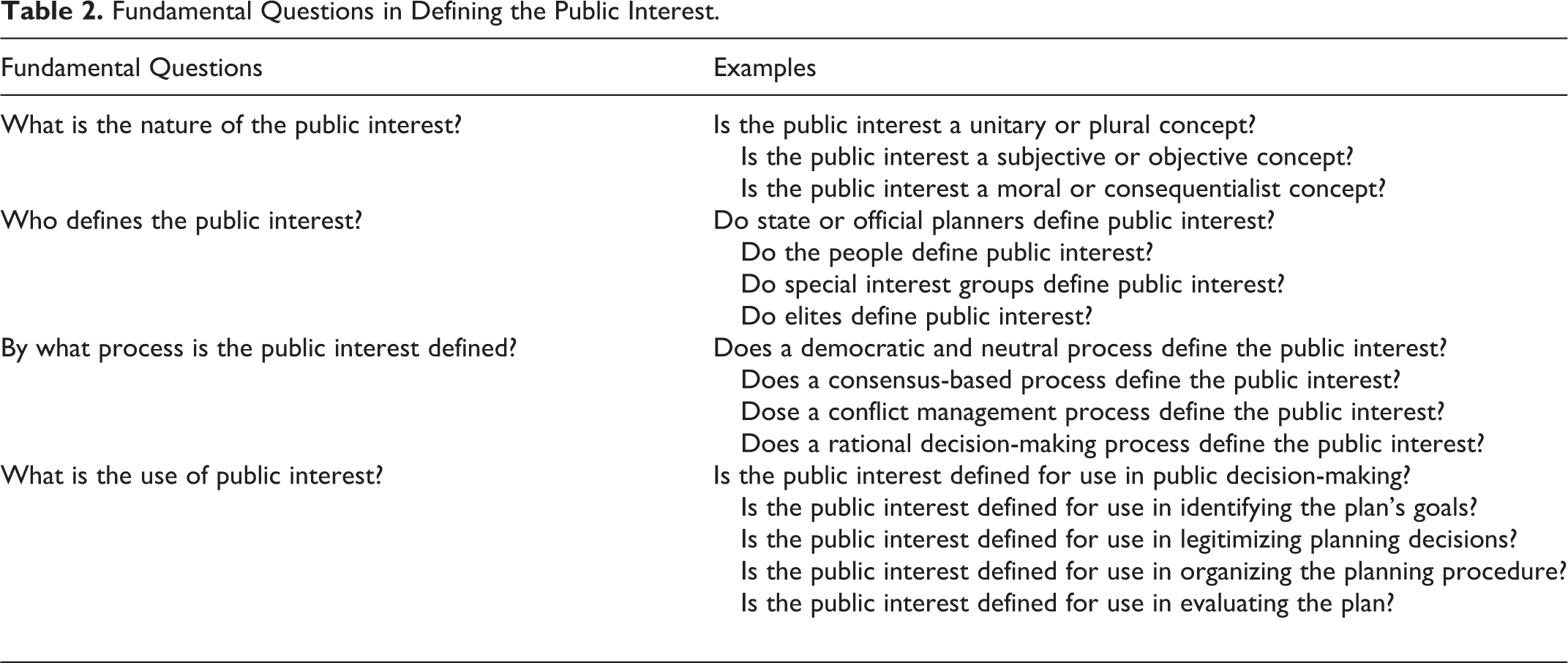
To clarify the application of this framework in preparing a comprehensive definition of the public interest, we briefly provide the answers to these four questions based on the new categorization (Table 1).
The first category of definitions (definitions based on the ethics in planning), by adopting a theoretical approach, defines the public interest according to the ethics governing the theory and practice of planning. In this category, definitions based on deontological ethics consider the public interest to have a unitary, objective, and ethical nature defined by planners based on the public norms in an ethical debate for use in public decision-making. Conversely, teleological ethics consider the concept as a subjective, pluralistic, and consequential nature that the government or formal planners define in a rational decision-making process as a criterion for evaluation or planning goals.
The second category of definitions (definition based on normative planning substance) based on the acceptance of public interest as a substantive norm of planning defines the public interest as a criterion for evaluating and legitimacy of planning action for the concept; here, it has an objective, unitary, and consequentialist nature that the government or formal planners define in a rational decision-making process to legitimize the act of planning. Also, by defining the public interest as the product of a pluralistic aggregation of different interests, it is seen as a subjective, pluralistic, and consequential concept that is defined by all individuals and groups affected by the program in a technical and bureaucratic process for use in decision-making and evaluating the impact of decisions.
The third category of definitions (definitions based on the planning procedure) is based on the theoretical approaches that govern the planning procedure. There are three distinct definitions of procedure-based public interest, all of which deal with the first and second questions. They give the concept of an intersubjective, pluralistic, and moral nature that, given the communicational aspects of the definitions, involves all individuals and stakeholders in defining the public interest. Despite the common opinion in response to the first and second questions, the distinction of definitions here is based on their different orientations in response to the third and fourth questions. In the context of procedure-based definitions, the first category—definitions based on Habermas’s theory of communicative action—defines the public interest as the communicative process’s main goal through a democratic and neutral process. The second set of definitions, based on the critiques of Habermas’ theory, defines the public interest as a goal and a criterion for organizing the planning process through a process of consensus building or mediation by the planner. Finally, the third category, based on criticisms of the consensus-based procedure, sees the public interest as an intersubjective, pluralistic, and moral concept that is defined by all individuals and interest groups with an emphasis on the bargaining role of the planner through conflict management procedure as a goal and a criterion for organizing the planning process.
The fourth category of definitions (definitions based on political discourse) introduces the prevailing political context as an effective factor in defining the public interest. Three definitions of the public interest can be distinguished from the prevailing political theory. In welfarist discourse, the public interest has a unitary, objective, and moral nature that is defined by the social and political elites in a rational and bureaucratic decision-making process, and it is used to legitimize the practice of planning in a centralized planning system. Liberal democratic political discourse believes in the concept of a subjective, pluralistic, and moral nature that is built by people in the democratic public debates under the supervision and control of the elected government as a representative of the public interest, which is also pursued as the government’s commitment to society. Finally, neoliberalism’s discourse sees the public interest as a subjective, pluralistic, and consequentialist concept defined by stakeholders under the free-market mechanism as the main actors in a conflict management process that is mediated by a planner. Although it is defined as the goal of planning, practically, it helps maintain the status quo and consolidate the hegemony of capital.
As a result, the presented category of definitions of the public interest can be a suitable context to explain a comprehensive framework for defining public interest in planning. Although there is no consensus on the definition of the concept in planning theory and practice, by examining the categorization of the public interest definitions, we can say that a definition of public interest is comprehensive and acceptable when it provides a coherent answer to the four basic questions presented. Based on this framework, theorists and professionals can answer these questions (and possibly more questions) to determine the position of their version of the public interest in the theory and practice of planning and have a clear framework for presenting their definition of this concept.
Conclusion
From the beginning, the concept of public interest has been an essential criterion for the justification and legitimacy of planning action and the central core of planning thought (Heywood 1990). Nevertheless, what constitutes the public interest is constantly debated, so it has become an ambiguous but inescapable term (Tait 2012, 2016). Any critical assessment of the concept of the public interest must begin with a definition. But the definitions attributed to the concept of public interest are a complex, diverse, and inconsistent set of theoretical literature that, in many cases, cannot provide a clear definition of the concept. As a result, not only does it not fit the various dimensions of the subject, but the generalization is also impossible. Therefore, theoretical attempts to answer this question have failed to successfully explain a comprehensive framework that responds to all the dimensions and approaches governing the planning theory and practice. To fill this gap and answer the research question, we systematically reviewed the various definitions of public interest and provided a proper context to explain a comprehensive framework for defining the public interest in planning theory and practice.
Although we have tried to formulate the input and output criteria in defining the systematic review process so that all relevant resources are covered, some definitions of public interest may be inevitably omitted due to the scattering of literature on the subject. Furthermore, not all of the extracted definitions directly define the concept and are more of a process of examining to define the procedures for achieving the concept and committing to these procedures. Given that a significant portion of the resources covers these implicit definitions, by accepting these definitions alongside explicit definitions of the concept, this categorization includes four main categories: Definitions based on planning ethics, definitions based on the normative planning substance, definitions based on planning procedure, and definitions based on the political discourse. Definitions given in the categories are differentiated in the nature of the public interest, the person who defines it, the process by which it is defined, and the definition’s application.
In addition to being more comprehensive than previous studies, this categorization recognizes the main dimensions of a comprehensive definition of the public interest and provides an appropriate framework for the theorists and professionals. On the one hand, by connecting to theoretical or contextual approaches, they can determine the position of their version of the public interest in planning theory and practice and, on the other hand, have a clear framework for presenting their definition of this concept. Finally, the proposed categorization can provide a useful framework for sorting out the public interest definitions based on similar answers to the four questions or compare professionals’ definitions of the public interest in different institutional and functional fields. It can also be valuable to examine how peripheral concepts such as power, justice, and institutional structures influence public interest’s definition.
Footnotes
Declaration of Conflicting Interests
The author(s) declared no potential conflicts of interest with respect to the research, authorship, and/or publication of this article.
Funding
The author(s) received no financial support for the research, authorship, and/or publication of this article.
