







Abstract
This work aims to reorganize theoretical and empirical research on smart mobility through the systematic literature review approach. The research goal is to reach an extended and shared definition of smart mobility using the cluster analysis. The article provides a summary of the state of the art that can have broader impacts in determining new angles for approaching research. In particular, the results will be a reference for future quantitative developments for the authors who are working on the construction of a territorial measurement model of the smartness degree, helping them in identifying performance indicators consistent with the definition proposed.
Keywords
Introduction
This research is aimed at the study of the role played by smart mobility in the planning field through a process of literature review in order to propose a new definition of smart mobility. Below, we present a synthetic theoretical framework on the general concept and on the components in which the smart city has been deconstructed with a focus on mobility sector. This framework is important to anticipate the benefits of smart mobility, what are the problems that surround the concept, and why there is necessary to clarify the term and definition, especially in the planning field with reference to sustainability objectives.
Smart city involves the integration of emerging ideas and technologies in order to produce city’s evolution prospects (Song 2005; Kunzmann 2014) and sustainable effects in environmental, economic, and social spheres (Kurushina and Kurushina 2014; Kitchin 2015). In order to explore the concept, Cohen (2015) defined three generations of Smart Cities (Kamolov and Kandalintseva 2020):
– Smart Cities 1.0, as technology-driven cities where technology companies providing solutions and services are the main beneficiaries (Trencher 2019; Garau, Desogus, and Zamperlin 2020).
– Smart Cities 2.0, as technology-enabled managed cities where authorities are increasingly focusing on technological solutions that help to improve the quality of life of the population.
– Smart Cities 3.0, as highly intelligent integrated cities that are characterized by a high degree of interaction between the government and the population and by civil participation in urban processes (Alexopoulos et al. 2019; Szarek-Iwaniuk and Senetra 2020).
Our smart city concept is very close to the third generation because of its focus on “citizen co-creation” that is one of the most important perspective in the mobility sector. The goal that unites similar models of Smart Cities is the desire to improve the well-being conditions of society (Caragliu, Del Bo, and Nijkamp 2011; Ballas 2013) involving civil participation in an integrated research of local problems (Chourabi et al. 2012; Joshi, Saxena, and Godbole 2016; Fernandez-Anez, Fernández-Güell, and Giffinger 2018).
To solve the complexity of the concept, a widespread practice in the literature considers the deconstruction of the smart city (Wolfram 2012; Fontana 2014). In particular, we refer to a study (Anthopoulos 2015) aimed at understanding the smart city concept on the basis of a revision of the main literature on the subject (Giffinger et al. 2007; Chourabi et al. 2012; Desouza and Flanery 2013; Lee, Phaal, and Lee 2013; Neirotti et al. 2014; Piro et al. 2014; Wey and Hsu 2014; Yigitcanlar and Lee 2014). The author leads to the definition of a conceptual framework consisting of application domains. Mobility is one of the fundamental factors among the relevant domains identified. The author highlights how transportation concerns the utilization of the information and communication technology (ICT) for transportation management as well as intelligent transportation products and mobility in general.
According to the literature, smart mobility plans to implement actions and reduce pollution and waste (Bueno-Delgado et al. 2019; Litwin et al. 2019; Yenneti et al. 2019), while increasing transport efficiency (Li et al. 2019). For this reason, smart mobility is deeply connected to the performance of sustainable mobility, contributing to improving the quality of life (Olaverri-Monreal 2016). It is based on the creation of economies of scale on the movement of people and goods (Muratori et al. 2020) and aims to optimize and save time and costs using technology. In particular, a natural impact of the digital revolution concerns the deep transformation of the world of logistics (Mazzarino and Rubini 2019). However, the improvement of transport and the reduction of traffic accidents are some of the current key challenges that planning models try to face.
In summary, the challenges for Smart Sustainable Mobility system are the following:
– action on the mobility demand, to eliminate unnecessary travels and make them easier and more accessible;
– management of mobility flows (Ning et al. 2017), to reduce congestion, downtime, inefficiencies, and risks; and
– innovative infrastructures design, in order to make them more interactive and functional through the use of suitable technologies.
Planning mobility systems means reusing what already exists in a different way in order to have more rational and effective networks with respect to the needs and emergencies of the territory, giving more useful and personalized services to citizens and businesses. Mobility conditions urban and territorial development in terms of production, resources efficiency, job opportunities, new investors, and tourism (Sharida, Hamdan, and Mukhtar 2020). However, if on one side contemporary urban lifestyles and business practices are increasingly dependent on mobility, on the other side, the negative impacts of mobility on natural and social environments are growing dramatically (Bertolini 2012). So, sustainable solutions are required as key elements for modern transportation systems (Jiménez Herrero 2011; Pinna, Masala, and Garau 2017) to mitigate the increasing demands for mobility and the potentially negative environmental, economic, and social impacts (Seuwou, Ubakanma, and Banissi 2020). Mobility cannot be considered smart if it is not sustainable. In fact, smart mobility is an integrated system comprised of several projects and actions all aimed at sustainability in urban development (Pinna, Masala, and Garau 2017). This specification is necessary to clarify that when we will talk about smart mobility below, we will consider the sustainability paradigm as assumed.
The object of our study is the “Smart Sustainable Mobility” system as the synthesis of the concept of smart mobility and the sustainability goals in order to clarify its use and description by reviewing the international literature. In particular, we will explain the methodology used to conduct the systematic literature review (SLR) and the cluster analysis (CA; second section). We will describe the results from the SLR (third section). Based on the application of the CA technique on a group of selected literature, we will propose a shared definition of smart mobility (fourth section) which will be deepened in the discussion (fifth section). Finally, in the conclusion (sixth section), reference will be made to future operational research to be developed starting from data obtained.
Method
We conducted a SLR and a CA according to the process described below in order to analyze the evolution of the concept of smart mobility and highlight current research trends on the topic.
SLR
SLR is a methodology used to find and aggregate all relevant studies about a specific research question or topic of interest (Hamad and Salim 2014). Unlike the revision of the literature for a narrative or descriptive scope, this methodology involves documenting all the procedures undertaken (Ginieis, Sánchez-Rebull, and Campa-Planas 2012). Sharing what is claimed by some authors (Denyer and Neely 2004), this section describes the steps of the methodology used (Anwer and Aftab 2017). They are reported below.
The first step is define research questions. It consists of delimiting research issues and describing the general objective. It is important to formulate the research questions with care to avoid missing relevant studies or collecting a potentially biased result set.
Having identified the general topic, in the second step called find keywords to form query string, we identify the keywords to be used to form the query string. We start from the research questions and focus on terms that define the studies that we want to examine.
The research space to obtain the data is defined in the third step called define research space to get data.
In the fourth step called set criteria to include/exclude papers, we define the practical selection criteria of the documents that are temporal criterion, types of documents, language, and stage of publication.
The fifth step is extract literature using criteria. It aims to extract the literature using the set of inclusion and exclusion criteria of the document collection defined in the previous step.
The next step is access study quality. It concerns the analysis of the quality of the studies conducted.
The seventh step is synthesize required data and involves collecting, organizing, and summarizing the results of the included primary studies. With this objective, we chose the descriptive synthesis by identifying different types of classification of extracted information about the studies. The types of classification are the following:
– geographical, in order to highlight the spatial distribution of studies conducted on the research topic;
– based on the source type, in order to highlight the most common ways of publishing the material produced by the research;
– temporal, in order to highlight the evolution of research in terms of the amount of documents produced; and
– based on subject area, in order to highlight the field of application of the most current lines of research on the topic.
In the last step called document results and outcomes, we further the research by revising the selected literature. The selected literature is a group of publications chosen among those belonging to the wide documents collection described in the previous section. For the analysis, we use the support of the VOSviewer (1.6.14) software, a tool for creating maps of terms, which is particularly useful while working with a large quantity of data (Siderska and Jadaan 2018). In order to investigate current research trends and to answer the second research question regarding the topic of the research, the unit of analysis chosen is the keywords reported in the selected publications. The type of analysis is that of co-occurrence, and the counting method is full counting.
CA
The CA allows for the identification of a minimum number of groups so that the elements belonging to each of them are more similar to each other than those of other groups. The goal is essentially to bring together heterogeneous units—the 105 keywords—in several subsets—the clusters—in the most homogeneous and exhaustive form possible. From a general point of view, CA allows achievement of the following results (Fabbris 1990):
– typological research to identify groups of statistical units with distinctive characteristics that highlight the physiognomy of the observed system;
– the definition of homogeneous classes, within which it can be assumed that the members are mutually surrogate (Green, Frank, and Robinson 1967); and
– the generation of research hypotheses, in fact, in order to carry out a CA, it is not necessary to have any interpretative model in mind.
With regard to the last result, the CA, unlike other multivariate statistical techniques, does not make any “a priori” assumptions on the existing fundamental types that can characterize the collective starting point. It was precisely for this characteristic that we chose this technique. In our research, the exploratory role of the so-called latent structures was decisive in order to infer the most probable partition without external conditioning. CA is a purely empirical classification method, and it is primarily an inductive technique.
Results from SLR
As anticipated, the research issue is the Smart Sustainable Mobility system in order to highlight the current research trend lines related to the concept of smart mobility and subsequently classify them in clusters.
In the first step “define research question,” we structured the question that is as general as possible in order to select all relevant information to measure the stated objectives. The research aims to analyze and evaluate the literature by summarizing the sources and showing the state of current knowledge in relation to the following research questions (RQs):
In the second step “find keywords to form query string,” the keywords identified are “smart mobility,” “smart mobility system,” “smart transport,” “smart transport system,” and “intelligent transportation system.” The query string is created using the Boolean operator “OR.” The resulting query string (QS) is the following:
The query string is applied to the fields article title, abstract, and keywords.
In the third step “define research space to get data,” we plan to access the Scopus database. Although the use of a single source of research may appear to be limiting, as will emerge later, we believe that the selected publications constitute a sufficiently exhaustive starting point in order to distinguish the guidelines within which place future research.
In the fourth step “set criteria to include/exclude papers,” we consider the criteria mentioned in the Method section. The first criterion is temporal and concerns the date of publication. In particular, the document search is limited to publications subsequent to January 1, 2007, the year in which Giffinger proposed the definition of smart city. Furthermore, documents of all types have been included—conference papers, articles, conference reviews, book chapters, reviews, and books—provided they are written in English and at the final stage of publication, thus excluding the articles in press. We chose to only review peer-reviewed scientific published articles in our analysis. While acknowledging the importance of gray literature (reports, working papers, government documents, white papers, and evaluations), they are not included because the standard of quality review and production of this literature can vary considerably. Furthermore, gray literature may be difficult to discover, access, and evaluate because it is produced by organizations outside of the traditional commercial or academic publishing and distribution channels such as Scopus database.
In the fifth step “extract literature using criteria,” applying the illustrated criteria, the Scopus search engine has traced 11,204 records published since 2007.
In the sixth step “access study quality,” we statistically analyzed the keywords indicated by the authors and studied the contents of the abstracts as the only section available for all documents, even for no open-access publications, to evaluate their consistency with our research objective.
In the seventh step “synthesize required data,” for each type of classification of the information on the literature, we describe the relative quantitative data in order to represent the results obtained.
First, we analyze the geographical distribution of research expressed as the number of documents published in the period 2007–2020 by authors affiliated to the specific country/territory. It is clear that the smart mobility topic is particularly widespread in Europe. Germany, United Kingdom, France, and Italy boast the largest number of publications. The topic is also widespread in the Asian (China), American (United States), and African continent (Egypt). The initial analysis on this group of documents showed that the authors follow specific research lines that suit to the particular conditions of urbanization, population density, and degree of computerization of the territories.
Beyond geographical distribution, the most common types of sources are journals (46.29 percent) and conference proceedings (44.16 percent). Indirect conclusions can be drawn from this information. The publication of peer-reviewed research shows reliability. The organization of seminars and conferences, demonstrated by the conference proceedings, instead measures the actuality and attention shown for the topic. In support of this, the distribution of the number of publications per year shows the evident increase of interest in the topic among academics between 2007 and 2019. Compared to the total number of publications, the number of documents published between 2017 and 2019 represents approximately 47 percent of the sample. Figure 1 shows the evolution graph of the number of publications per year.
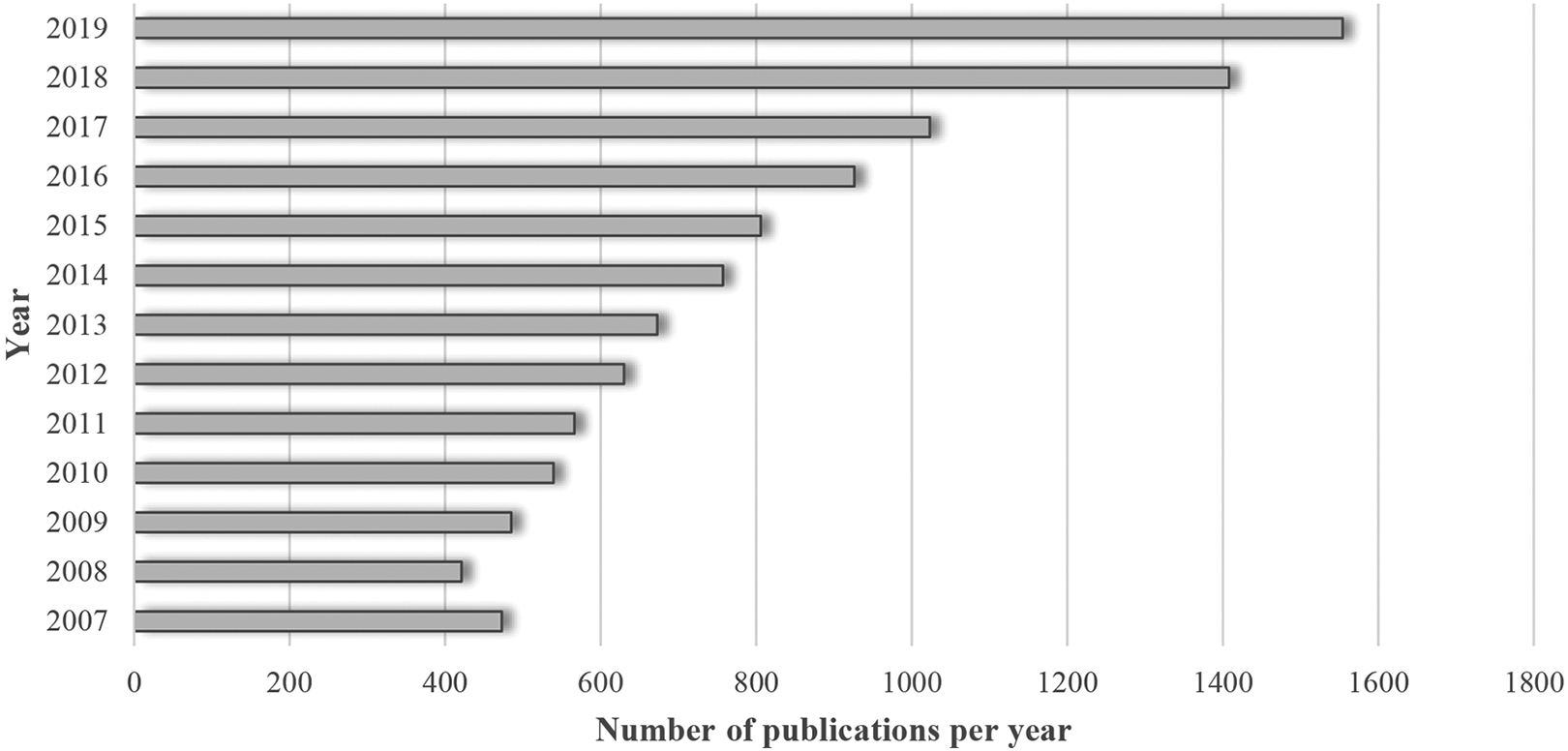
Evolution graph of the distribution of the number of publications per year.
The most popular subjects covered by the publications are computer science, engineering, mathematics, and social sciences. This identification provides a partial answer to the first RQ which is confirmed by examining the contents of the publications. In particular, it is evident that the main research lines pertain to the study of processes that involve interaction with computer data in order to store and communicate digital information (computer science) as well as to deduce theoretical reference models (mathematics) that have strategic importance in the planning, design, and management of mobility systems (engineering). Important cross-disciplinarily issues are the objective of environmental sustainability as well as satisfaction of users’ requests and needs (social science).
8. In the eighth step “document results and outcomes,” we filter the most significant and relevant documents relating to the period after January 1, 2018 (approximately 250 documents). The time frame, although very limited, made it possible to obtain a substantial number of documents while ensuring the analysis of the most current and interesting publications in light of the close correlation with the technological aspects referred to previously.
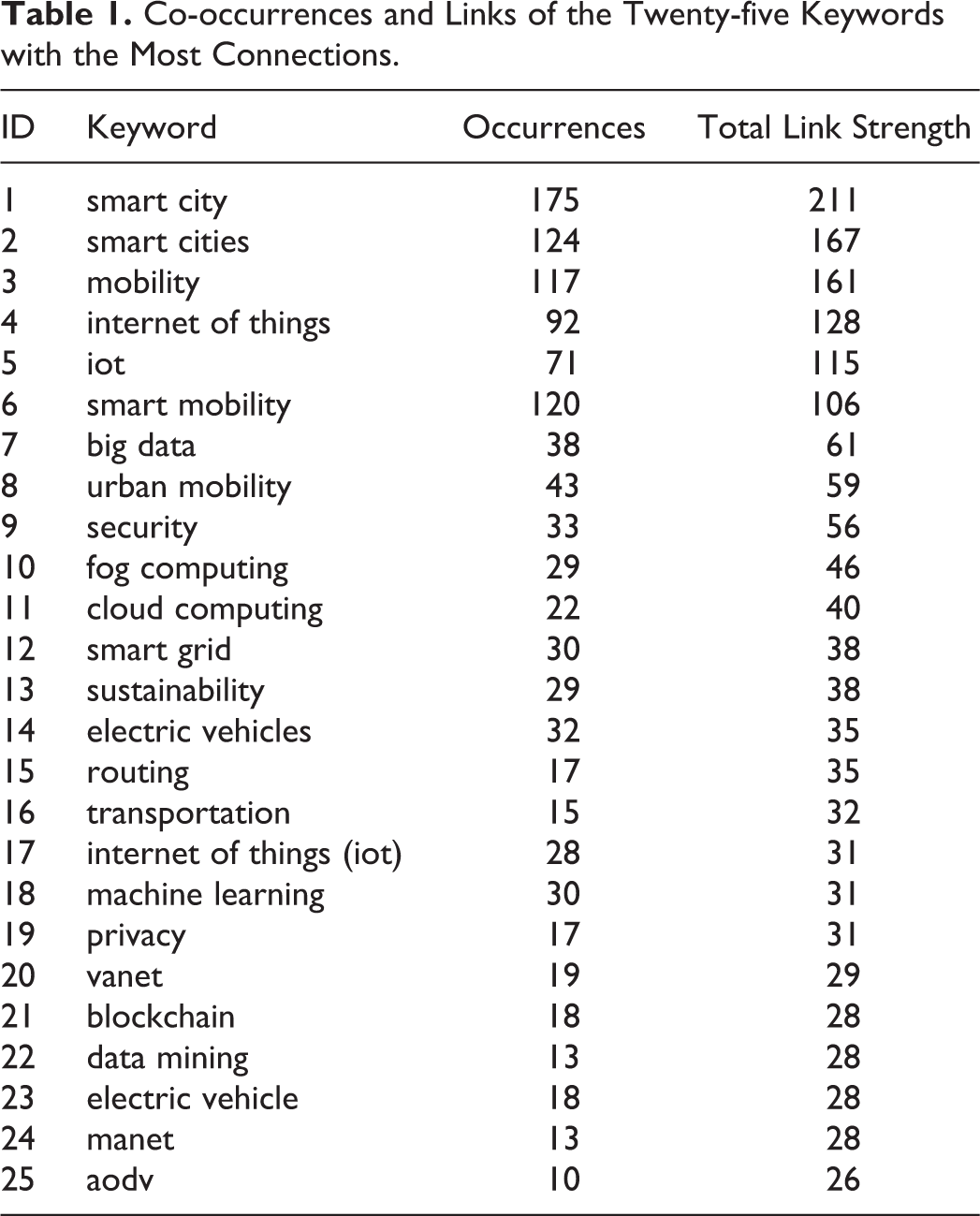
Of the 5,236 keywords, 105 meet the minimum threshold of seven co-occurrences. For each of the selected keywords, the total strength of the co-occurrence links with other keywords was calculated. Finally, we select keywords with the greatest total link strength. Table 1 shows the number of co-occurrences and links of the twenty-five keywords with the most connections.
Co-occurrences and Links of the Twenty-five Keywords with the Most Connections.
Regarding the documentation of the results, we build a conceptual map of terms in order to summarize and schematize the smart mobility topic by building networks between the different concepts emerged. Figure 2 shows the existing relationships between those keywords.
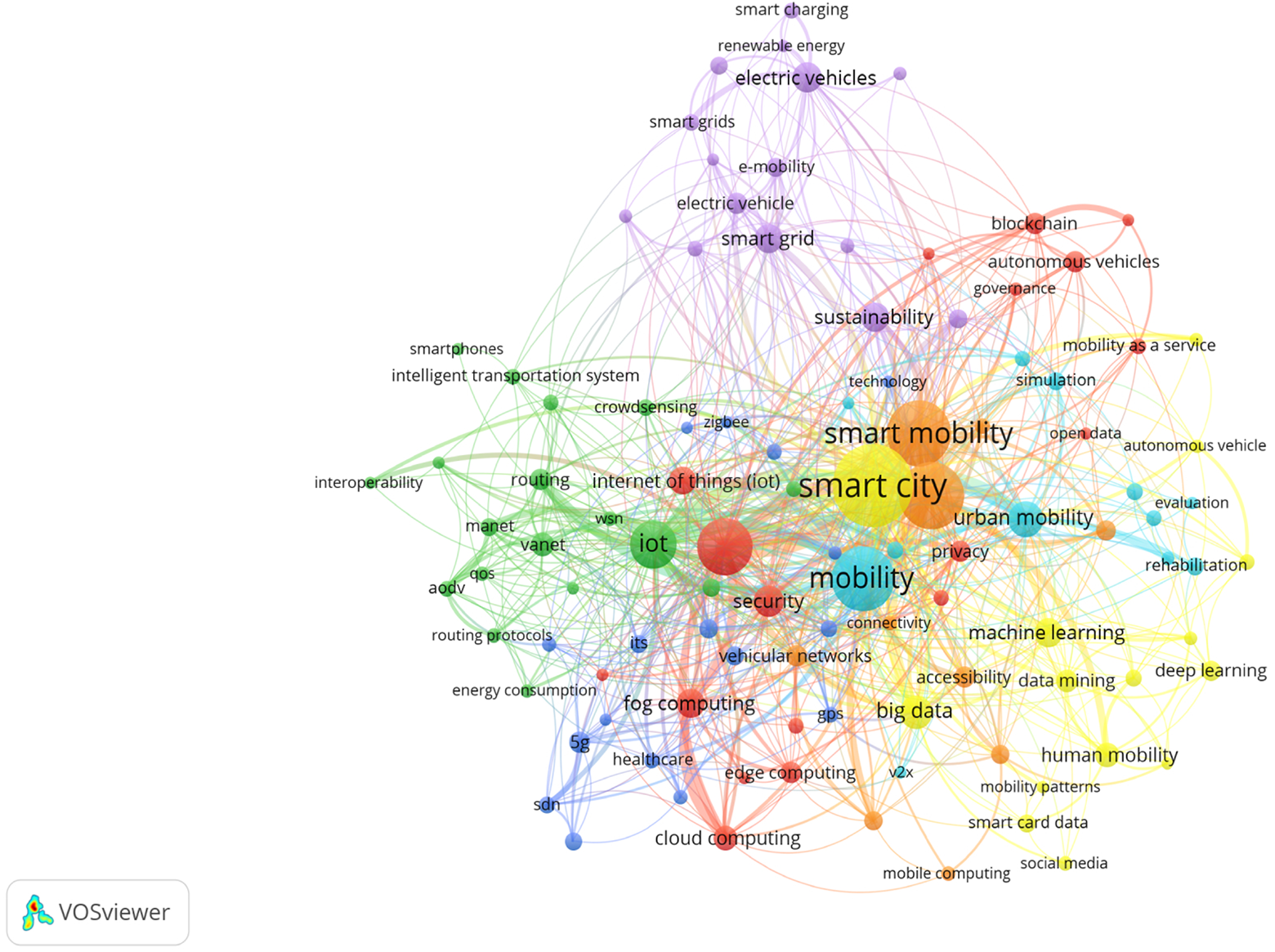
Map of research trends developed using the VOSviewer software and based on co-occurrence of the author’s keywords referring to the selected literature.
In particular, the visualization of data in graphic form makes the information more immediately readable and the presentation of the results synthetic. The nodes in the map coincide with the keywords reported in the analyzed documents, while the connections between the nodes represent their mutual co-occurrence in small groups of publications. The central part of the map includes the most frequently occurring keywords. Also, the size of the nodes representing each of the appearing terms and the font size in which the name of a given node is written correspond to the frequency of co-occurrence of a given term (Gudanowska 2017). As regard the connections, the stronger the connection, the higher the frequency of the co-occurrence.
Results from CA
While analyzing the map, it can be observed that the resulting network is dense and characterized by numerous connections. In light of this complexity and in order to highlight the emerging aspects and their mutual relationships, we apply the CA technique that allows the construction of automatic classification systems (Jardine and Sibson 1971).
The support of the VOSviewer software, in addition to the development of the trend map of the search based on the co-occurrence of the keywords, allows identification of clusters, groups in which the most frequently occurring keywords are found together.
In particular, the seven clusters identified are reported in detail in Table 2. We have labeled each of them with a macro-theme that summarizes emerging issues including the recurring keywords. Recognizing how the technological advancement represents a common topic to the totality of the documents from the reading of the abstracts, the macro-themes focus on more general conceptual aspects in order to reach subsequently a definition of smart mobility as shared as possible.
Although the data shown in Table 2 refer to documents published starting from 2018, we have applied a further selection criterion on the documents with the sole purpose of associating the macro-theme with each cluster. In particular, we deepen the study of publications after January 1, 2019, published in journals classified by the National Agency for the Evaluation of Universities and Research Institutes as scientific or class A for Area 08—civil engineering and architecture—in the period 2018–2020. The application of the criterion is aimed at including the most recent documents and excluding documents from different disciplinary sectors or those that are too far from the urban and landscape planning and design sector. A total of 102 articles published in 30 journals (17 scientific journals and 13 class A journals) were filtered out of the total. We have identified the macro-themes associated with clusters by analyzing the content of the 102 articles and validate them by comparing the opinions of each member of the review team.
Clusters Identified by the Analysis of 105 Keywords that Meet the Minimum Threshold of 7 Co-occurrences by Using the VOSviewer Software Referring to the Selected Literature.
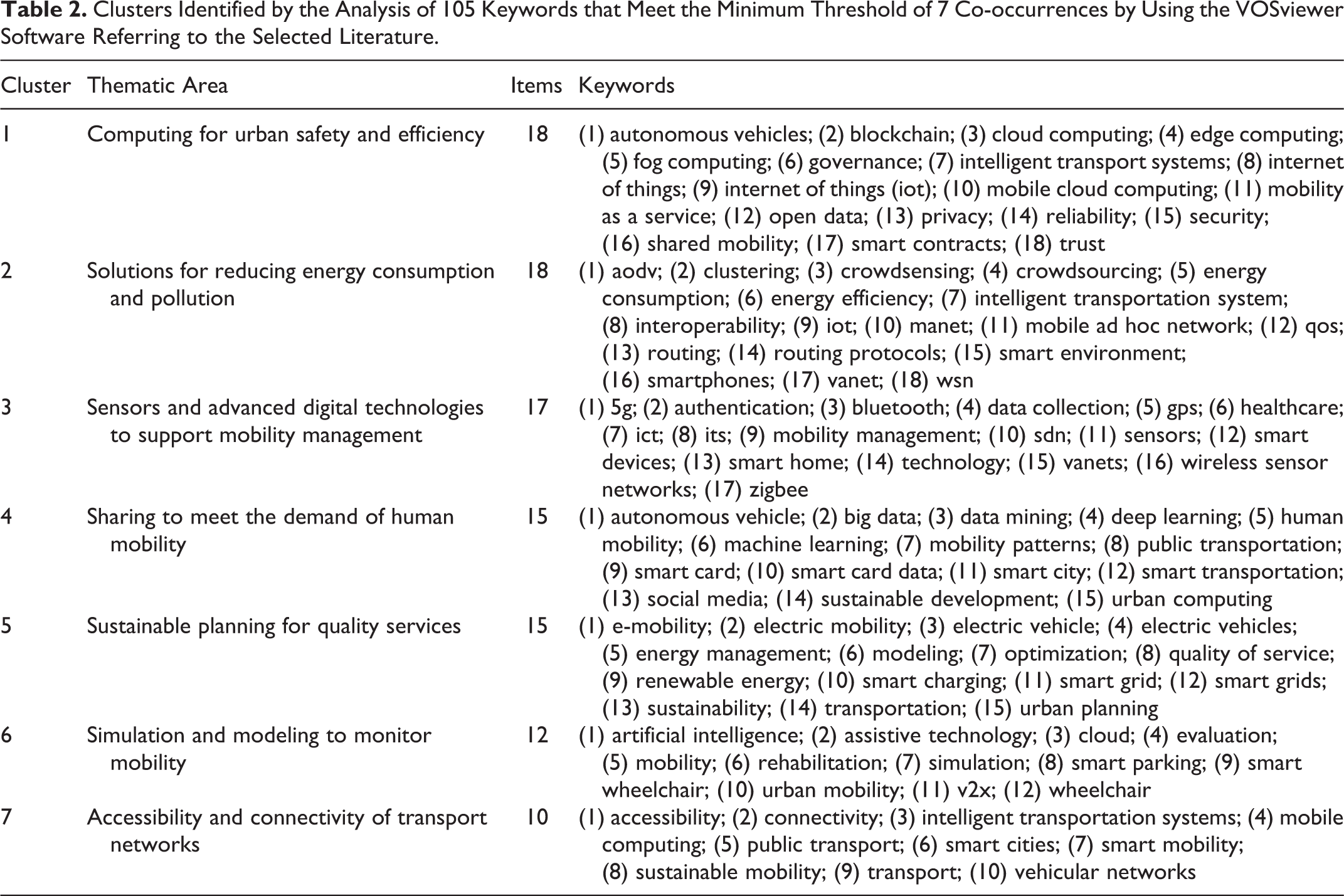
The first cluster computing for urban safety and efficiency highlights how the application of some technologies based on information technology in transport guarantees better levels of safety and efficiency of the overall mobility system. The importance of the cluster is demonstrated by the presence of some terms that characterize it at the center of the occurrence map (Figure 2). Among these, the “internet of things” and “security” are placed respectively in fourth and ninth place among the words with the most connections (Table 1).
According to the literature, numerous studies aim to identify innovative solutions for the improvement of traffic mobility from different points of view. Reference is made, for example, to the study on on-demand mobility services (Faisal et al. 2019; Freudendal-Pedersen, Kesselring, and Servou 2019; Marletto 2019; Pucihar et al. 2019), to the development of systems that can integrate connected vehicle data and traffic sensor information (Yang et al. 2019), and to the use of high-definition smart cameras with wireless communication (Ho et al. 2019) to simultaneously address the need to improve the safety and mobility of urban arteries. These systems aim to reduce the potential accident rate, monitor traffic, and calculate the length of the queues at intersections as a function of time to improve arterial progression.
The second cluster solutions for reducing energy consumption and pollution concerns the strategies aimed at limiting the negative impact of all the modes of transport on the natural environment meaning that “clean” technologies are becoming increasingly important and widespread (Litwin et al. 2019).
The literature explores the potential benefits of low-emission transitions in terms of complementarity, temporality, scale, actors, and responsibilities (Sovacool et al. 2020) and analyzes integrated mobility-energy systems in order to represent and model future mobility systems and their interconnections with other energy systems (Muratori et al. 2020). After more than a century of oil dominance, the rapid technological advancement of alternative fuels, automation, and information technologies is creating new mobility options, business models, and policies at all levels of government (Muratori et al. 2020). Carbon emission control (Contreras and Platania 2019), new approaches to urban air quality assessment (Budde et al. 2019), and interoperability (Sotres García et al. 2019) represent only some of the strategies for developing smart contexts. With this expression, we consider a place where the correspondence between urban environment and ICT is strong (De Santis et al. 2014).
The third cluster sensors and advanced digital technologies to support mobility management refers to the information systems for monitoring and controlling the territory as a prerequisite for strategic planning and sustainable management of local resources. The literature demonstrates how the possibility of obtaining operational data and information can only improve planning processes and in particular traffic management (Lakshmanaprabu et al. 2019). Some research argues that traffic management systems, with the support of 5g and vehicular networks, represent the key to tackling mobility problems (De Souza et al. 2019). Smart sensors and actuators collaborate to collect information (Leung, Braun, and Cuzzocrea 2019; Sobral, Galvão, and Borges 2019) and interact with the user (Fraga-Lamas et al. 2019). Current research lines include the application of Bluetooth sensors (Martínez Plumé et al. 2019), wireless sensor networks (Coluccia and Fascista 2019; Nguyen et al. 2019), and integrated devices (Din et al. 2019) for real-time monitoring of parameters such as noise pollution, carbon dioxide concentration, light intensity (Moreno et al. 2019), and for the interpretation of traffic information (Ali, El-Sappagh, and Kwak 2019).
The fourth cluster sharing to meet the demand of human mobility has a double significance. The idea of sharing is associated both with the “sharing of data and information” and with the “sharing” of transport in the provision of transport services. In both cases, the precondition is the use of information and communication technologies to support the reduction of car dependency. In fact, studies on smart cities suggest putting people at the planning center, by actively engaging citizens in cocreating innovative urban services based on participatory governance processes (Cellina et al. 2020).
As regard the first meaning—the sharing of data and information—some studies describe the creation of collaborative mobility systems that allow vehicles and infrastructures to interconnect and share information to coordinate their actions (Autili et al. 2019). Especially in large cities, the use of smart cards makes it possible to analyze interpersonal and intrapersonal variability in the weekly use of public transit (Deschaintres, Morency, and Trépanier 2019), therefore to infer the mobility models of urban collective transport services (Zhao et al. 2019) and plan more efficient services that are close to citizens’ needs. Supporting mobility through automation processes can make the transport system so efficient as to manage traffic flows and adapt in real time by eliminating or minimizing total movements. The use of autonomous vehicles can offer economic, social, and environmental benefits (Lim and Taeihagh 2019). In particular, autonomous vehicles connected with Vehicle-to-Vehicle communication as basic technology exhibit an energy-saving potential higher than other systems (Ma et al. 2019).
The second meaning of sharing refers to modes of transport. Sharing mobility is one of the many variations of the collaborative economy that has been successful, thanks to the interconnection between web platforms and apps. The sharing systems include different modes of transport in order to promote the potential reduction of emissions. One possibility, probably the most widespread, is suggested by the bike-sharing system, oriented toward the “green behavior trends” with benefits for health and the environment (Cerutti et al. 2019). Other smart mobility services such as car sharing, ride-sharing (Yu and Peng 2019), and carpooling are often promoted as the key to a sustainable transport future; however, they can be associated with different risks such as increased congestion and inequality (Moscholidou and Pangbourne 2019).
The fifth cluster sustainable planning for quality services refers widely to the concept of the smart grid (Hall et al. 2019; Khayrullina, Blinov, and Borzenko 2019; Monteiro et al. 2019; Ryghaug et al. 2019) as a set of information and electricity distribution networks for efficient and sustainable urban mobility planning.
Electric vehicles have an important role in the future energy system (Cooper et al. 2019; Xiang et al. 2019). Their use represents a powerful eco-friendly initiative that, if integrated well with an urban environment, could be a key element of the smart city concept (Aymen and Mahmoudi 2019). However, the increased demand for mobility, and therefore energy, can create constraints on the power network, which can reduce the benefits of electrification as a certain and reliable source. Thus, the rise in the use of electric vehicles needs electric grids to be able to feed the increased energy demand while the current infrastructure supports it (Tayarani et al. 2019). For these reasons, some studies have deepened the electricity balancing process applied to the electric bus grid (Wu et al. 2019). For example, a study (Tu et al. 2019), given the observed heterogeneity of ride-hailing vehicle travel, outlines the importance of individual-level analysis to understand the electrification potential and future benefits of electric vehicles in the era of shared smart transportation.
The sixth cluster simulation and modeling to monitor mobility concerns the simulation and modeling of traffic and transport, which assume a crucial role in planning processes by changing to direct the logistical and settlement choices of the territorial contexts. Mobility of people can be configured as an information-intensive process resulting from a complex set of factors. In particular, simulation analyzes are conducted by processing these data in order to construct assessment scenarios connected to different solutions available for particular demand segments (Del Vecchio et al. 2019). Understanding and modeling urban mobility correctly is a crucial issue for the development of Smart Cities (Mamei et al. 2019). The object of the modeling can be displacements (Mamei et al. 2019), congestion levels (Del Vecchio et al. 2019), and exposure to pollution factors (Trewhela et al. 2019). The type of model varies according to the type of relationship between the variables to be theorized. For example, in the case of predictive models, techniques and statistical algorithms are generally used; the latter are used to extrapolate the trends of the quantities of interest and define reliable forecasts.
The seventh cluster accessibility and connectivity of transport networks refers to aspects that have a decisive impact on the growth and economic competitiveness of the territories. In particular, accessibility can be understood as an offer of a service or as a satisfied demand. In the first case, reference is made to the extension of the network and mileage, in the second to the number of passengers transported per kilometer of service in order to give an idea regarding the ability to meet the transport demand. The connectivity of the territory is expressed by the number of people and by the extent of the areas served in the basin of attraction of the stops and by the connections available between locations. Recognizing the importance of these elements, some studies focus, for example, on the analysis of the territories that suffer from lack of accessibility, depopulation and which are poorly connected (Mazzarino and Rubini 2019), or on the relationship that exists between the values of ownership residential and accessibility indicators (Siripanich, Rashidi, and Moylan 2019) in order to promote and evaluate innovative and efficient transport solutions.
Summarizing the issues emerged, we propose to define the smart mobility as “the result of a planning process (cluster 5) which makes use of technological supports (cluster 3) in the simulation phases (cluster 6), use and monitoring of individual and shared transport systems to ensure safety standards (cluster 1), functionality (clusters 4 and 7) and sustainability (cluster 2).”
Discussion
The article described the SLR process conducted by moving from some research questions reported in third section to reach a new definition of smart mobility reported in fourth section. According to these, the results obtained will be discussed below.
First of all, we consider the first RQ. The SLR has made possible to identify which elements guide the planning of Smart Sustainable Mobility system. The analysis of the scientific literature on trends that characterize smart mobility has highlighted a widespread orientation toward the use of technological solutions in transport planning processes. The global network—the Internet—has changed the urban planning model by convincing traditional planners to look at the urban planning of the city (Aldegheishem 2019). According to Turetken et al. (2019), a domain where digital innovation has great potential is smart mobility. Current technology makes possible the association of smart mobility with a sustainable mobility performance that affects quality of life (Olaverri-Monreal 2016). The new mobility models are, in fact, permeated by the use of digital systems and theoretical modeling with a twofold objective: to help redesign the overall project of the territories through environmentally sustainable solutions and to intercept the needs of citizens in order to implement functional choices in the planning and management of mobility flows. Therefore, to answer the first research question by summarizing what is described in second section, it can be said that the main elements that influence smart transition processes applied to mobility planning are technological innovation, environmental sustainability, and user satisfaction, in addition to the physical characteristics of the infrastructure system.
In light of this, considering the second RQ, we wonder whether it was possible to give a definition of smart mobility that includes these aspects in a more explicit and integrated way than already reported in the literature. This need is recognized in literature (Škorput, Mandžuka, and Schatten 2013; Mandzuka, Gregurić, and Kljaić 2016). Šemanjski, Mandžuka, and Gautama (2018) say “in future researches, special interest is the construction of appropriate taxonomy and associated ontology for smart mobility area.” For this purpose, we conducted an SLR and applied the technique of CA on the selected literature. CA allowed identification of the main research areas in smart mobility. Summarizing the issues emerged, we proposed a new definition of smart mobility in fourth section.
We compare this definition with other studies and can conclude that this is more inclusive and broader sectoral. For example, according to Lombardi et al. (2012), smart mobility refers to “the use of ICT in modern transport technologies to improve urban traffic.” Aspects referring to the preservation of the natural environment in cities are extensively covered in Giffinger et al. (2007), Albino and Dangelico (2012), and Nikitas et al. (2020). They look at transport as a key area that artificial intelligence (AI) can redefine. They think that AI with its deep learning functions and capabilities can be employed as a tool that empowers machines to solve problems that could reform urban landscapes as we have known them for decades now and help with establishing a new era. Another example of a definition of smart mobility that focuses its theory around intelligent transport systems is proposed by Kulesa (2009). It includes factors of urban mobility such as integrating the management of road, tariffs parking, and the forecasting traffic, in order to improve transport and create information services for travelers. Staricco (2013) also states that most of the opportunities of smart mobility are related to technological innovations for managing and organizing trips and traffic and for improving the environmental efficiency of vehicles, but the impacts of these innovations, in particular over the long term, depend on how they are embedded by the users in their daily activities and practices. Fernandez-Sanchez and Fernandez-Heredia (2018) focus on a single topic that is sustainable mobility by bus identifying that strategies and operational or tactical actions are often sponsored through newspapers and websites. Similarly, Shaheen et al. (2015) focus on the shared use of a vehicle, bicycle, or other mode that enables users to gain short-term access to transportation modes on an “as-needed” basis. The term shared mobility includes various forms of car sharing, bike sharing, ride-sharing (carpooling and vanpooling), and on-demand ride services. It can also include alternative transit services, such as paratransit, shuttles, and private transit services, called microtransit, which can supplement fixed-route bus and rail services. "With many new options for mobility emerging, so have the smartphone “apps” that aggregate these options and optimize routes for travelers. […] Shared mobility has had a transformative impact on many global cities by enhancing transportation accessibility, while simultaneously reducing driving and personal vehicle ownership”. Without giving a definition, Porru et al. (2020) highlight on how the deployment of smart mobility solutions within the rural context compare to that within the urban context. As well as this research comparing different projects, intelligent mobility is widely addressed on websites and in gray literature especially local and national newspapers and policy documents that provide communications on local projects and initiatives. Considering taxonomies, Cledou, Estevez, and Barbosa (2018) provide a common vocabulary to discuss and share information about services comprising eight dimensions: type of services, maturity level, users, applied technologies, delivery channels, benefits, beneficiaries, and common functionality in order to guide policy makers by identifying a spectrum of mobility services that can be provided, to whom, what technologies can be used to deliver them, and what is the delivered public value so to justify their implementation. Benevolo, Dameri, and D’auria (2016) analyze the smart mobility initiatives like part of a larger smart city initiative portfolio and investigate about the role of ICT in supporting smart mobility actions, influencing their impact on the citizens’ quality of life and on the public value created for the city as a whole. Ontologies on smart mobility reported in the literature are very specific and focus on topics such as knowledge for collaboration among travelers and the surrounding infrastructure using advanced navigation systems (Syzdykbayev, Hajari, and Karimi 2019) and management of semantic locations and trajectories (Ilarri, Stojanovic, and Ray 2015).
Unlike these studies, our definition, thanks to its derivation process, is interdisciplinary. In fact, the analysis of the literature made reference to a large sample of documents, selected without applying inclusion or exclusion criteria in reference to the subject area to which they belong.
A further element that proves the proposed definition is the methodological choice to define the homogeneous classes without the conditioning of an interpretative model assigned “a priori.” In fact, the generation of research hypotheses is the result of the application of an inductive multivariate statistical analysis technique that is the CA. This allowed us to try to explain the multiple meanings attributed to the concept and the many different approaches in current urban planning literature. Other literature reviews are conditioned by author choices. As an example, Papa and Lauwers (2015) in their work choose to focus only on two main aspects attributed to the concept of smart mobility that are the techno-centric smart mobility and the consumer-centric smart mobility. Fiore, Florea, and Pérez Lechuga (2019) work on smart traffic and on the aspects concerning the gathering, fusion, and transmission of information. Although broad from a conceptual point of view, the use of the described procedure places limits related to the selection of literature, such as the choice of the search space to obtain data, the limitation of documents to those written in English, and the reference time frame. Therefore, especially in the long term, updating and expanding the sample of reference publications will allow further innovative aspects to be included in the proposed definition.
Conclusion and Future Research
The article makes extensive reference to the theoretical and empirical contents of the literature in relation to the concept of smart city and above all of smart mobility. Generally, similar models are applied to big cities and metropolitan areas, in order to analyze the main policies that characterize them and suggest strategies aimed at improving the quality of life of people and the environmental and economic sustainability of the territory. However, the definition of smart mobility that has been reached through the application of the methodology described in the second section and discussed in the previous section appears sufficiently exhaustive compared to the topics addressed for the case studies proposed in the selected literature. With the aim of declining the need to transform the minor urban polarities—particularly widespread in Italy and Europe—it is necessary to focus attention on aspects selected according to local vocations and specificities.
In particular, we are currently conducting a study aimed at defining a model capable of measuring the degree of smartness of rural areas (Francini et al. 2020). The model is structured according to the widespread and internationally recognized approach to “policy axes” and is characterized by a hierarchical structure. The axes coincide with the dimensions identified by Giffinger et al. (2007) as transformation domains for the smart city: economy, environment, governance, living, mobility, and people. Each domain is “represented” by factors, each factor is “qualified” by variables, and each variable is “quantified” by indicators. We want to evolve the smart system by adapting it to territories with dimensional, physical, and vocational characteristics considerably different from those commonly associated with the idea of a smart city by building a new model called Smart Land. Therefore, the reasons that led to the study of the literature described in this article are deduced. The general framework proposed, even analyzing different contexts, represents the starting point for our research quantitative developments.
In particular, in order to define the factors that represent the smart mobility domain, we plan to consider the main elements that, from the analysis of the literature, were influential (second section) for the implementation of the smart transition processes applied to planning mobility, namely, the characteristics of the infrastructure system, technological innovation, environmental sustainability, and user satisfaction. The definition of smart mobility proposed (fifth section) on the basis of the analysis of the selected literature (fourth section) represents, instead, the reference for the identification of the variables that qualify the factors. These must be associated with performance indicators designed specifically for rural areas. The areas being studied are, in fact, portions of territory characterized by a considerable spatial and temporal dispersion with a generally medium-low transport demand. The concept of weak demand refers to both the number of displacements generated by the area and the degree of fragmentation of the residential fabric. In particular, the presence of hamlets and scattered houses tends to reduce the demand for mobility and consequently makes conventional transport systems expensive and inefficient. For example, it may be necessary to adopt more flexible forms of local public transport in order to combine different lines with many stops. These needs should be taken into the process of selecting indicators and for defining the relative performance scales.
In conclusion, the study conducted, in addition to summarizing the theoretical and empirical contents on the specific topic through the approach of the SLR, has allowed to reach an extended and shared definition of the same based on the results of the application of the CA on a selected literature. The importance of the research is condensed into its analytical feature. The result obtained represents a useful reference both from a theoretical and from an operational point of view. Specifically, what emerged could:
– provide foundation of knowledge on topic;
– identify areas of prior studies to prevent duplication;
– identify gaps in research, conflicts in previous studies, and open questions left from other research and generate new original ideas;
– support academics in placing their research within the context of existing literature making a case for why further study is needed; and
– support policy makers and planners in identifying advantages and success factors to be taken into consideration in transforming theoretical concepts into real projects.
In addition, the set of results constitutes the framework for the quantitative development of our method of assessing the degree of smartness for rural areas proposed and aimed at a better management of mobility flows as well as an innovative design of transport infrastructures.
Footnotes
Declaration of Conflicting Interests
The author(s) declared no potential conflicts of interest with respect to the research, authorship, and/or publication of this article.
Funding
The author(s) received no financial support for the research, authorship, and/or publication of this article.
