







Abstract
Using data from the National Longitudinal Transition Study–2, this article examines the relationships among three of Wehmeyer’s components of self-determination (autonomy, empowerment, and self-realization) and subsequent reported access to postsecondary education in transitioning youths receiving Supplemental Security Income benefits. Results of logistic regression methods indicated that higher levels of empowerment and autonomy were associated with a higher likelihood of participation in 2-year and 4-year colleges. No such associations were observed for participation in vocational and technical postsecondary programs. Implications for educators are discussed.
Over the past two decades, federal disability policy has increasingly focused on promoting postsecondary education and self-determination as strategies for improving postschool outcomes among people with disabilities. The Obama administration established ambitious goals for increasing the number of students, including those with disabilities, to have completed at least 1 year of higher education or advanced training beyond high school (Obama, 2009). The National Council on Disability (2003) similarly identified postsecondary education as key to improving employment outcomes and decreasing reliance on disability cash benefit programs such as the Supplemental Security Income (SSI) Program. For eligible persons with disabilities, the SSI program provides cash benefits, work incentives, and linkages to Medicaid and vocational rehabilitation (Social Security Administration [SSA], 2011). Eligibility for SSI is based on an individual’s inability to work or engage in any substantial gainful activity due to physical or mental impairments. In 2005, there were 386,360,000 reported SSI recipients between 13 and 17 years of age. This number grew to 415,546,000 in 2009 (SSA, 2011). From a policy perspective, the population of youth and young adults receiving SSI benefits is of particular importance because while their potential for building work experience and careers may be better than for older beneficiaries, many of these individuals and their families continue to rely on benefits for extended periods of time (Rupp & Scott, 1995) and are reluctant to participate in any work experience. Increased postsecondary education access for young persons with disabilities may therefore be particularly important in leading to higher quality employment outcomes as a preferred alternative to receiving disability cash benefits.
One possible predictor of participation in postsecondary education is self-determination. Self-determination emphasizes the ability of individuals to exert control over their lives through informed choices and decision making; Wehmeyer (2005) has defined self-determined behavior as “volitional actions that enable one to act as the primary causal agent in one’s life and to maintain or improve one’s quality of life” (p. 117). Wehmeyer has identified four components, or essential characteristics, of self-determination: (a) autonomy, (b) self-regulation, (c) psychological empowerment, and (d) self-realization (Shogren et al., 2007; Wehmeyer & Palmer, 2003).
Wehmeyer (1995) offered the following descriptions of these components:
Autonomy is the progression from dependence to self-care and self-direction (Sigafoos, Feinstein, Damond, & Reiss, 1988). It is the development of a sense of personal control over one’s life, the establishment of a personal value system, and the ability to execute behavioral tasks, which are needed in the adult world (Lewis & Taymans, 1992, p. 37).
Self-regulation is as follows:
A complex response system that enables individuals to examine their environments and their repertoires of responses for coping with those environments to make decisions about how to act, to act, to evaluate the desirability of the outcomes of the action, and to revise their plans as necessary. (Whitman, 1990, p. 373)
Empowerment is acting in a manner in which people (a) have control over circumstances that are important to them (internal locus of control), (b) possess the requisite skills to achieve desired outcomes (self-efficacy), and (c) if they choose to apply those skills, the identified outcomes will result (outcome expectations).
Self-realization is a process by which people use a comprehensive, and reasonably accurate, knowledge of themselves and their strengths and limitations to act in such a manner as to capitalize on this knowledge.
The concept of self-determination is embedded in federal policy regarding people with disabilities. The 1992 Amendments to the Rehabilitation Act (the “Act”) described disability as “a natural part of the human experience and in no way diminishes the right of individuals to live independently, enjoy self-determination . . . and pursue meaningful careers” (Rehabilitation Act Amendments of 1992). In addition, the 1998 amendments to the Act underscored informed choices and decisions for persons with disabilities receiving vocational rehabilitation services. For youth with disabilities receiving special education and related services, regulations for the Individuals with Disabilities Education Improvement Act (IDEA) of 2004 also reinforced an emphasis on self-determination in federal policy by defining transition services as a “coordinated set of activities . . . that is based on the individual child’s needs, taking into account the child’s strengths, preferences, and interests.” (Assistance to States for the Education of Children With Disabilities Rule, 2006). Beyond the IDEA statute, model demonstrations funded by the Office of Special Education Programs were important for developing strategies that incorporate self-determination as part of individualized education and transition planning, which were later disseminated through state systems change initiatives (Ward, 2005).
There is limited research that addresses the relationships between self-determination, employment, and postsecondary education. However, Wehmeyer and Palmer (2003) found that youth with disabilities who learned self-determination skills were more often productively engaged after high school, received higher hourly wages, were more likely to live independently and to have a job with a range of benefits, and exhibited more financial independence than those youth who did not demonstrate self-determination. McDonnall & Crudden (2009) found similar relationships between self-determination and employment for youth with visual impairments. These studies did not examine postsecondary education, however. A qualitative study by Compton (2009) focused on SSI participants who were enrolled or had recently graduated from colleges and universities. Students discussed their values, attitudes, and beliefs regarding employment. Reasons for pursuing work included the desire to be challenged and have a purpose in life, the desire to feel useful and independent, and the drive to be part of a community and interact with people—all relevant to self-determination. In addition, work was viewed as a way for the postsecondary students who participated in this study to be free from cash benefit programs such as SSI. Other qualitative studies have similarly suggested that self-determination may positively influence postsecondary education experiences (Getzel & Thoma, 2008; Jameson, 2007).
A quantitative study by Morningstar et al. (2010) examined the relationship between self-determination and high school transition preparation among postsecondary students with disabilities. Students from 4-year universities completed a two-part online survey. The first part assessed psychological empowerment, hope, and locus of control. The second part measured the quality of high school transition preparation as an independent variable. The authors performed correlational analyses and found that the sampled postsecondary students with disabilities exhibited high levels of psychological empowerment, locus of control, and hope, and these were related to specific components of high school transition programs. As a retrospective study, however, self-determination was not examined as a predictor of postsecondary education enrollment. In 2003, the SSA initiated the Youth Transition Demonstration (YTD) projects. Focusing on youth of transition age, SSA is developing and rigorously evaluating promising strategies to help youth with disabilities become as economically self-sufficient as possible as they transition from school to work (Fraker & Rangarajanb, 2009). One of these strategies is the development of youth empowerment, which refers to the acquisition of work-related skills and knowledge necessary for advocating life choices. YTD also addresses youth empowerment, which is critical in the high school context because it provides students with the opportunity to participate in, and make informed choices about, transition planning (Wehmeyer & Palmer, 2003). The YTD projects foster empowerment primarily by engaging youth in an intensive person-centered planning process. This process focuses on education, employment, health care, and independent living. Although evaluation data have not yet been collected, a future composite measure of independence in decision making and daily activities will assess the youth empowerment component with the expectation of improving youths’ sense of self-determination (Fraker & Rangarajan, 2009). Specifically, it is expected that the youth-empowerment and family-support components of the YTD interventions will engender self-confidence and positive attitudes among YTD participants, leading them to have higher expectations for education, employment, and independent living.
The paucity of research related to self-determination and postsecondary education highlights a critical knowledge gap. The purpose of this study is to therefore examine data from the National Longitudinal Transition Study–2 (NLTS2) in relation to receipt of SSI benefits, levels of self-determination, and engagement in postsecondary education. In particular, we examine whether, for students with disabilities who receive SSI benefits, higher degrees of self-determination are associated with participation in postsecondary education.
Method
Data from the NLTS2 were examined for this study. The NLTS2 is a nationally representative study of transitioning students, ages 13 through 17, in 2000 during and after receiving special education and related services under the IDEA. Individualized demographic information were culled from Wave 1 parent interviews in 2000, SSI participation data were collected from Wave 2 parent interviews in 2003, and postsecondary education access information was collected from Wave 3 parent/youth interviews in 2005 (N = 11,272 for all youth with disabilities and n = 1,697 for the subset of SSI participants). In addition, a direct assessment conducted during 2002 and 2004 included questions regarding self-determination for participating youths with disabilities.
The NLTS2 included measures adapted from ARC’ Self-Determination Scale (Wehmeyer & Kelchner, 1995). For this study, responses to self-determination questions were summed to construct continuous scales that reflected three dimensions of self-determination (see Table 1). That is, three sets of responses to questions were added to form different measures of empowerment, autonomy, and self-realization for each transitioning student. However, not all items for the scales were included in the NLTS2 interviews, and the domain of self-regulation was omitted altogether due to study design constraints.
Self-Determination Scale Items for Autonomy, Psychological Empowerment, and Self-Realization
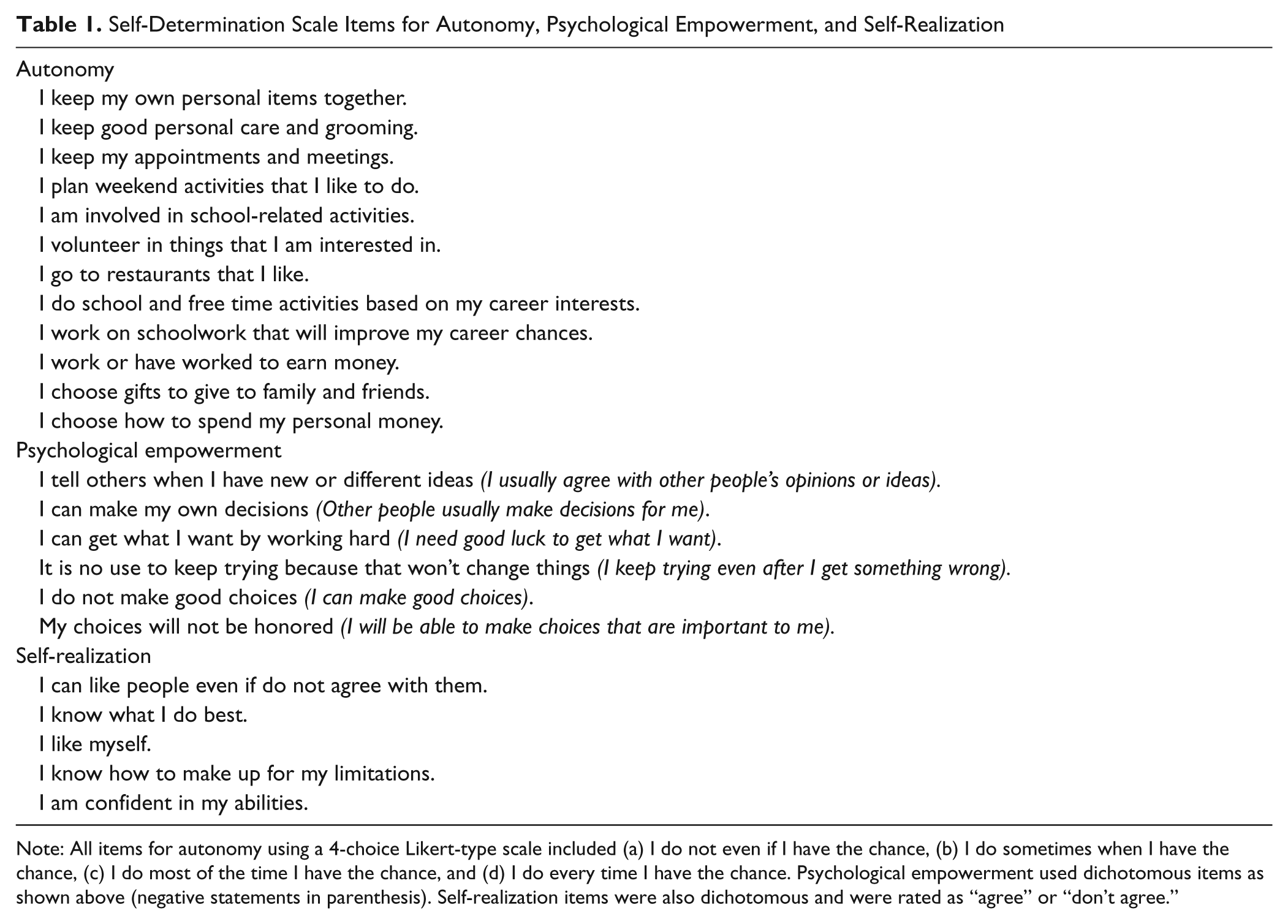
Note: All items for autonomy using a 4-choice Likert-type scale included (a) I do not even if I have the chance, (b) I do sometimes when I have the chance, (c) I do most of the time I have the chance, and (d) I do every time I have the chance. Psychological empowerment used dichotomous items as shown above (negative statements in parenthesis). Self-realization items were also dichotomous and were rated as “agree” or “don’t agree.”
Data Analysis
Descriptive, cross-tabulation, and logistic regression analyses were conducted using PASW Statistics 17.0 (2009). A specialized module was necessary to take into account the NLTS2’s unique, stratified design, and this module was used to generate weighted estimates for both the general population of transitioning IDEA students and for those who received SSI benefits.
Independent variables for the logistic regression models included demographic, education, socioeconomic, disability, and self-determination measures. Dependent variables for these models focused on postsecondary education access with regard to 2-year colleges, vocational or technical schools, and 4-year colleges and universities. Specifically, postsecondary education access was defined based on responses to queries as to whether the student had ever attended any of these institutions since leaving high school or within the past 5 years. Logistic models were thus used to examine the extent to which the independent variables predicted access to postsecondary education using the NLTS2 data.
Pseudo-R measures were produced to evaluate model results as were Wald F estimates and odds ratios (ORs) for explaining results. Multiple comparison adjustments were made using Holm’s sequential Bonferroni procedure (Holm, 1979).
Results
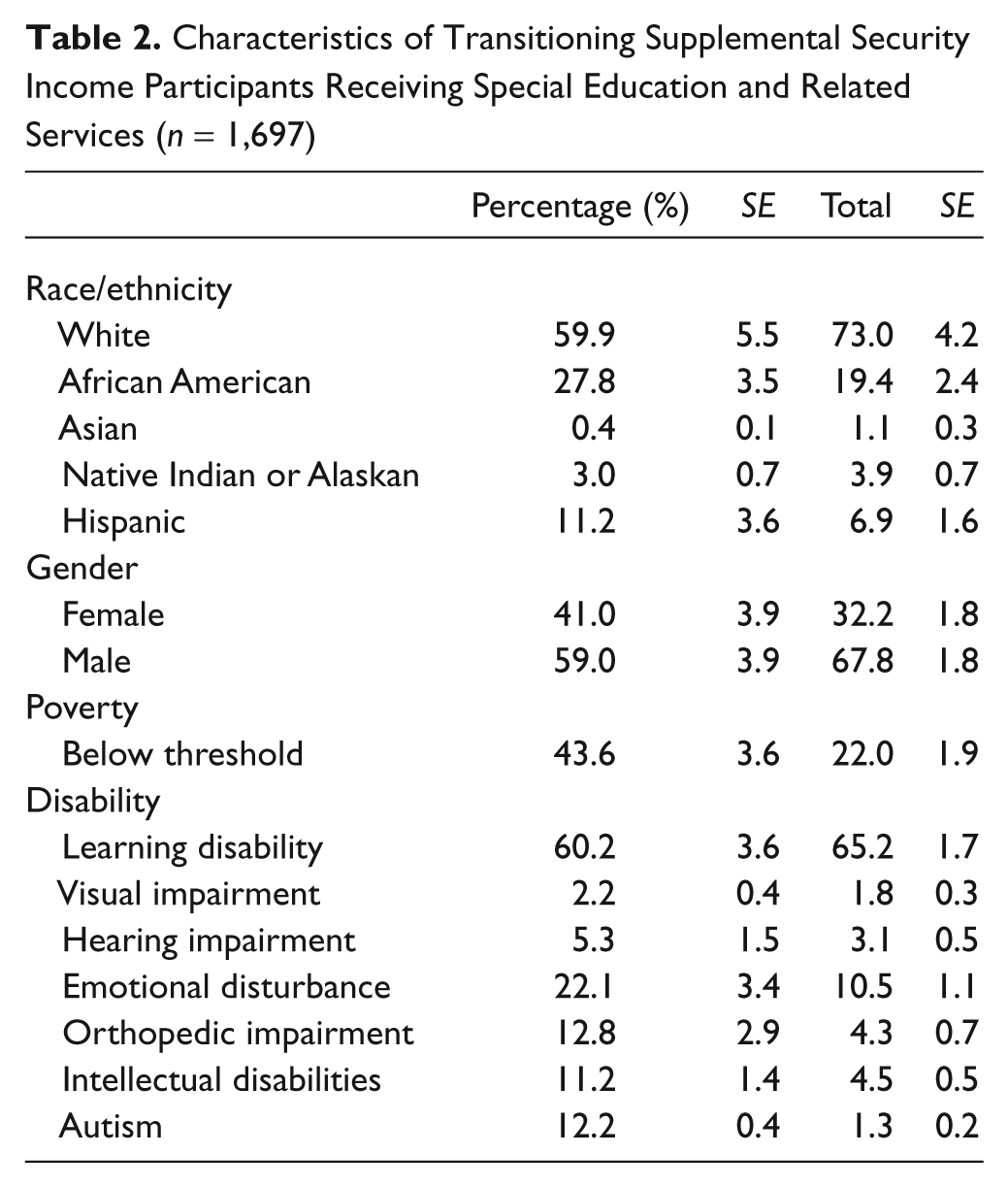
Table 2 shows demographic and disability characteristics of transition-age SSI participants who received special education and related services. Most participants receiving SSI were disproportionally African American, 28% versus 19% of the entire special education population. Yet Whites were nonetheless the largest race group receiving SSI (60%). Males were more likely to receive SSI (59%) than females (41%), yet females were disproportionally represented when compared with the total special education population (41% vs. 32%). Transition-age SSI participants were twice as likely to live in poverty, 44% versus 22% of the population. The majority of SSI participants had learning disabilities (60%) though individuals with emotional disturbance, orthopedic impairments, intellectual disabilities, and autism were more likely to receive SSI when compared with all transition-age special education students. An estimated 219,003 transitioning special education students nationally received SSI benefits. This estimate approximates earlier findings showing that 64% of SSI youth recipients concurrently received IDEA services in 2000 (Wittenburg & Loprest, 2007; Rupp et al. 2006). NLTS2 data further showed that 34% of these youth later attended 2-year colleges, 11.6% attended vocational or technical schools, and 7.4% attended 4-year colleges or universities.
Characteristics of Transitioning Supplemental Security Income Participants Receiving Special Education and Related Services (n = 1,697)
Logistic models of postsecondary access are shown in Table 3. Controlling for other factors, females who received SSI benefits were less likely than males to attend 4-year colleges (OR = .06). African Americans were more than 14 times more likely to enter 2-year colleges and 13 times more likely to go to vocational or technical schools as compared with all other race groups. Odds showed that Hispanic students receiving SSI were 23 times more likely to attend vocational or technical schools than non-Hispanics. Poverty mattered only with regard to access to 2-year colleges; the odds of students above the poverty threshold were 4 times greater than those below poverty when controlling for other model variables. Transition-age SSI students with learning disabilities and visual impairments were less likely to attend vocational or technical schools (OR = .08 and .9, respectively). Students with hearing impairments were 43 times more likely to attend 2-year colleges than other special education students who received SSI. Emotional disturbance among SSI participants decreased the odds of attending 2- and 4-year colleges substantially (OR = .12 and .041, respectively). Students with orthopedic impairments were less likely than other students receiving SSI to attend 2-year colleges, (OR = .14). Statistically significant findings showed that the odds for SSI students with intellectual disabilities were less than for those without intellectual disabilities in terms of attending 2-year colleges and 4-year colleges. Parental education mattered given these models for 2-year colleges only; that is, each level of education achieved by a parent increased the odds of access by 1.5 times.
Logistic Models of Postsecondary Education Access Among Transitioning Supplemental Security Income Participants Who Received Special Education and Related Services (n = 1,697)
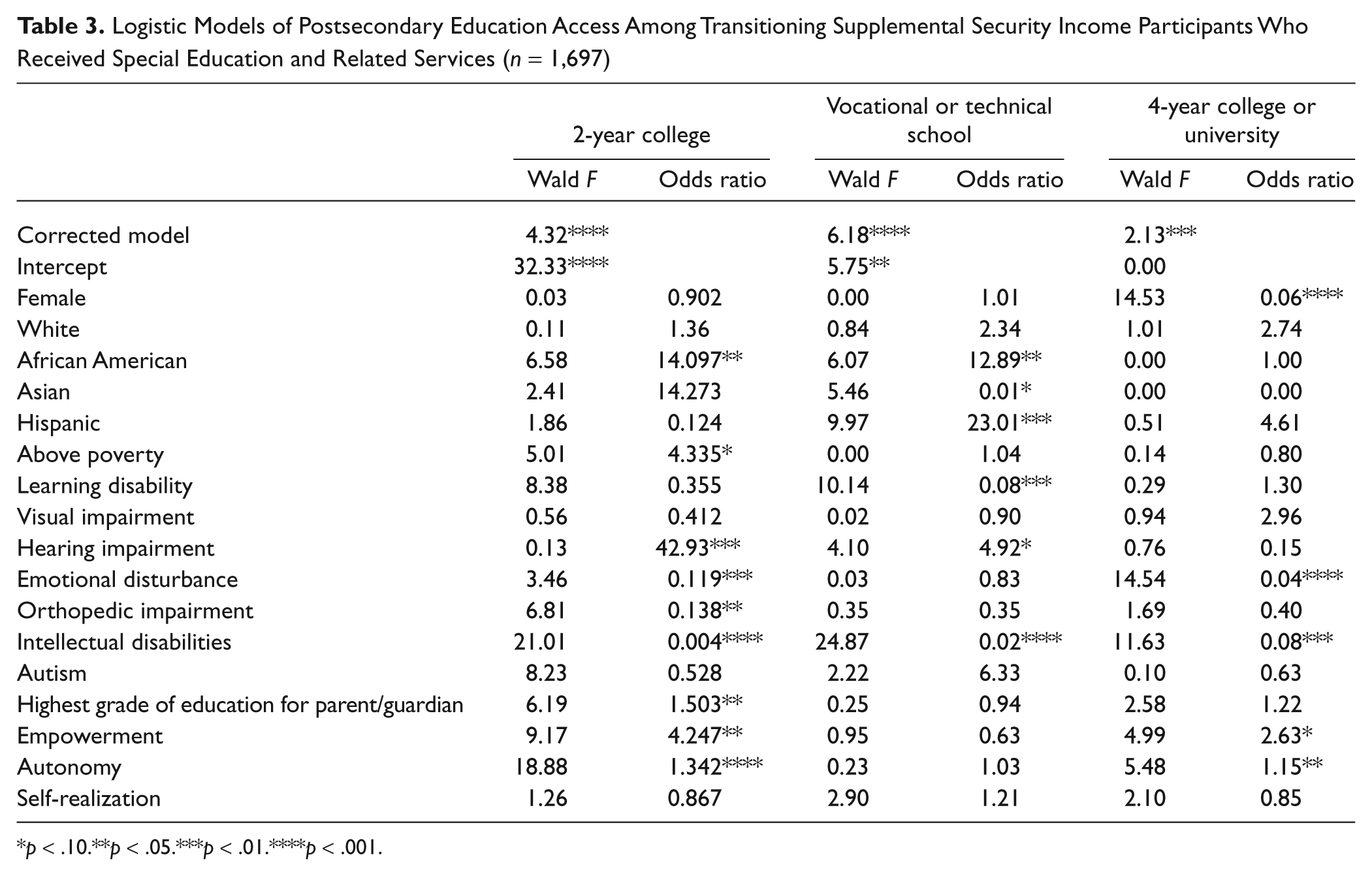
p < .10.**p < .05.***p < .01.****p < .001.
Regarding self-determination factors, empowerment and autonomy were the two salient dimensions most strongly associated with postsecondary attendance. For each one-unit increase in empowerment score, the odds of access increased by 4.25 times for 2-year colleges and 2.63 times for 4-year colleges. Autonomy was also important for 2- and 4-year college attendance, increasing the odds of access for each level by 1.34 and 1.15 times, respectively. Given that there were 12 levels within the autonomy scale and 6 levels for empowerment, relatively modest increases in odds multiplied exponentially based on student responses. Thus, for example, a student whose responses resulted in an empowerment rating of 5 was actually more than 20 times more likely to attend a 2-year college than a student with an empowerment rating of 1. No significant self-determination factors were observed with regard to vocational or technical school access, however. In contrast, scores on the self-realization scale did not predict postsecondary education attendance.
Discussion
The results of this analysis strongly support the hypothesis that higher levels of self-determination would be associated with increased likelihood of participation in postsecondary education in transition-age youth with disabilities who were receiving SSI benefits. Higher levels of empowerment, as well as autonomy, were associated with higher likelihood of participation in both 2-year and 4-year colleges. These results are consistent with the findings of Wehmeyer and Schwartz (1997) and Wehmeyer and Palmer (2003) regarding the positive relationship between self-determination and community participation and independent living, and extend those findings to include participation in postsecondary education. Furthermore, they demonstrate that this relationship can be demonstrated among youth with disabilities receiving SSI benefits—a population that is at risk for poor educational and employment outcomes (Wittenburg & Loprest, 2007).
Interestingly, the self-realization component of self-determination was not related to participation in any of the three types of postsecondary education investigated here. This finding supports the distinction among these three aspects of self-determination, as proposed by Wehmeyer (1995) and reiterated by Shogren et al. (2008) and McDonnall and Crudden (2009). Given that empowerment and autonomy were related to postsecondary educational experiences, but that self-realization was not, suggests that the former two components of self-determination may be particularly critical in young people’s decision making regarding initial access to education after high school. As suggested by Getzel and Thoma (2008), self-awareness may nonetheless be important after students gain entry into colleges and universities as expressing one’s strengths and needs may be critical when requesting services and accommodations. Given the distinction between initial access to postsecondary education and access to services and accommodations once enrolled, our findings suggest that autonomy and empowerment may be two important goals for transition planning. Focusing on these two components of self-determination may thus benefit high school students preparing for postsecondary education and making career choices.
One can see why autonomy and empowerment, both associated with self-determination, would have significant implications for the education of students with disabilities. A characteristic of autonomy is the ability to execute behavioral tasks that are needed in the adult world (Wehmeyer, 1995). However, before one can execute such tasks, one must be aware of the range of possible choices and be empowered to choose and take action in executing the tasks to achieve the desired outcomes or self-selected goals. Thus, achieving autonomy and empowerment is a developmental process that can be facilitated by educators through instruction about the range of possible behavioral tasks and the process of good decision making. Educators can also provide a “safe” environment where students can repeatedly practice their decision-making skills without the fear of failure. Most importantly, many educators have the type of supportive relationships with their students where they can instill “I can do this” attitude in their students, which is key to acting in an autonomous and empowered manner.
Our results demonstrated differences among disability groups in the likelihood of participating in postsecondary education. Individuals with learning disabilities or visual impairment were both less likely than the group as a whole to participate in vocational or technical education. Individuals with emotional disturbance were less likely to attend 2-year and 4-year educational institutions, and students with intellectual disabilities were less likely than other individuals to participate in any of the three types of postsecondary education we examined. The first finding appears consistent with estimates by Newman, Wagner, Cameto, Knokey, and Shaver (2010) showing that students with visual impairments participated in vocational or technical schools less often than 2- or 4-year colleges. Although students with emotional disturbance were less likely to attend college as compared with other disability groups, they have made substantial gains in postsecondary education enrollment over the past 15 years (Newman et al., 2010). Individuals with intellectual disabilities similarly benefit from taking classes, experiencing campus life, and developing career skills among college and university peers (Grigal & Hart, 2010; Weir, Fialka, Timmons, Nord, & Gaylord, 2010/2011).
Finally, we note that several demographic variables were related to the likelihood of participation in postsecondary education. Females were more likely than males to attend 4-year colleges or universities, consistent with general national trends (Peter & Horn, 2005). In addition, youth who were African American were more likely to attend either 2-year college or vocational or technical school. Asian youth were more likely than the group at large to attend 2-year colleges, and Hispanic youth were more likely than the group in general to attend vocational or technical school. Little research on Asian and Hispanic youth with disabilities and postsecondary education currently exists, and these findings may extend the knowledge base and suggest a need for further research focusing on these populations.
Interpretation of the results of this study should be made with several limitations in mind. First, the results are strictly correlational. Studies using longitudinal designs, or self-determination interventions, could provide more definite information about the causal relations between the components of self-determination and participation in postsecondary education—although we note that the time course in which our measures were collected makes it more likely that self-determination affected attendance in 2-year or 4-year institutions, rather than the reverse. Second, the items used to measure self-determination were limited; future studies should make use of all four of Wehmeyer’s (1995) components as well as all of the items in them. Finally, it would probably be informative to use alternative measures of self-determination (e.g., the American Institutes for Research Self-Determination Scale) to ensure that these results are not specific to items from the ARC.
Implications for Research and Practice
These results strongly suggest that for transition-age youth receiving SSI benefits, autonomy and empowerment are positively associated with participation in 2-year and 4-year colleges. Postsecondary education is, in general, associated with improved employment outcomes. In the case of youth receiving SSI benefits, this effect is particularly important. Youth on SSI are less likely to enroll in postsecondary education, compared with the general population (Wittenburg & Loprest, 2007). In addition, Weathers et al. (2007) reported that in a sample of youth with hearing impairments receiving SSI benefits, those who received postsecondary education degrees were more likely to demonstrate long-term benefits of postsecondary education (e.g., less time in the SSI adult program, higher earnings). Such findings demonstrate the importance of postsecondary education for youth who are at risk for poor employment outcomes, particularly for youth receiving SSI benefits. Future research should examine the conditions that positively influence not only postsecondary access such as self-determination but also those factors that encourage retention and degree attainment among SSI participants. In addition, following SSI participants beyond postsecondary education into employment may reveal important clues toward promoting work and increasing personal and financial independence. Other areas of future research may include focusing on subpopulations of students with specific disabilities and potential cultural influences that may impact access and achievement in postsecondary education settings.
Teaching evidence-based, self-determination skills may promote quality postsecondary outcomes for students receiving SSI benefits. Through the disability determination process, youth who receive SSI benefits must demonstrate how their impairment results in marked and severe limitations that justify receiving cash benefits. Demonstrating strengths and expressing needs seems equally important for gaining access to postsecondary education as well as to the supports and services that facilitate success in colleges, universities, and technical schools. Promising curricula and practices include the Student-Directed Transition Planning (Woods, Sylvester, & Martin, 2010) and the Student-Directed Individualized Education Program (Arndt, Konrad, & Test, 2006). Although teaching self-determination skills as part of transition planning may be challenging, developing autonomy, empowerment, and self-awareness may be important for youth receiving SSI benefits interested in reducing their dependence on cash benefits while increasing their personal and financial independence through postsecondary education.
Footnotes
Declaration of Conflicting Interests
The author(s) declared no potential conflicts of interest with respect to the research, authorship, and/or publication of this article.
Funding
The author(s) received no financial support for the research, authorship, and/or publication of this article.