







Abstract
Numerous studies have pointed to the benefits of discussing controversial political issues (CPI) with students in a school setting. Because teachers play a significant role in facilitating discussions on CPI, including determining how they are conducted and influencing their outcomes, it is essential to measure the discussion practices teachers employ when addressing CPI. However, existing tools inadequately measure teachers’ discussion practices in teaching CPI. Thus, our aim was to develop and validate a scale for this purpose. An exploratory factor analysis on a pilot sample of Israeli school teachers (N = 113) identified five factors, and a confirmatory factor analysis on a larger sample (N = 205) demonstrated an adequate fit for this five-factor structure. Methodological benefits of measuring specific discussion practices in teaching CPI and the educational implications for teacher training are discussed.
Introduction
Discussing controversial political issues (CPI) with students in a school setting is essential for developing their coping abilities in dealing with these matters, helping them explore different viewpoints, and exposing them to democratic processes (Gindi & Erlich Ron, 2018; Lin et al., 2016; Tannebaum, 2013). Teachers play a significant role in determining how discussions on these issues are conducted, including the management of such discussions and their outcomes (Wansink et al., 2023). To conduct effective discussions about CPI, teachers should employ discussion practices that would encourage student participation (Coopmans & Kan, 2023), such as open-ended conversations, and at the same time ensure a discussion environment that is both respectful and safe (Coopmans & Kan, 2023; Oulton et al., 2004).
The first step in understanding the discussion practices teachers employ when teaching CPI is to quantitatively measure them. However, a literature search revealed the absence of widely accepted tools for assessing teachers’ discussion practices when teaching CPI. Therefore, our purpose was to develop and validate a means of measuring such practices. The development of the new scale, based on a sample of Israeli school teachers, has both methodological implications and potential educational benefits, potentially contributing to training or intervention programs addressing CPI in the classroom.
CPI in the Classroom
Controversial issues are part and parcel of various aspects of society, including political, economic, and religious matters, about which attitudes are divided and cannot be easily resolved through consensus (Leib, 1998; Meral et al., 2022). This study specifically concentrates on controversial political issues (CPI), including, for example, minority rights, political dilemmas, democratic values, and racism (Bickmore & Parker, 2014; Gindi et al., 2021).
Various studies have found that discussion of social dilemmas, including CPI, have various positive outcomes for students. These include enhanced thinking skills and moral development, increased civic awareness, greater tolerance, autonomy, political engagement, and better preparation for democratic participation (Hess & McAvoy, 2014; Hung, 2020; Parker, 2012; Tannebaum, 2013). Teachers play a significant role in facilitating discussions on CPI, aiming to help students explore different viewpoints and respond respectfully to attitudes different from their own (Hess, 2009; Lin et al., 2016). Although the teaching of CPI is most commonly associated with social studies subjects, educators across all disciplines—including science and literature—encounter, address, and explicitly engage with social issues in their lessons. Therefore, the teaching of CPI is relevant to all teachers (Högström et al., 2025; White et al., 2023). Despite the important role teachers play in facilitating discussions about CPI and their potential positive impact on students, many teachers avoid such topics (Aleksiak et al., 2026; Cohen, 2016). There are various reasons for teachers’ reluctance to discuss CPI, such as education department and school policies, societal norms, and parents’ reactions (Gindi et al., 2021). Another reason for teachers’ reluctance to address controversial political issues (CPI) in the classroom lies in the inherent complexity of facilitating such discussions. This complexity is reflected in the ways students position themselves during political discourse. As McAnulty and Garrett (2022) note, classroom discussions of political issues are often “messy and inconclusive” in both design and enactment. Garrett and Alvey (2021) observe that political life is inextricably linked with non-rational, emotional, and affective dimensions, further complicating classroom engagement with CPI.
The challenge can be even greater when the teacher belongs to a marginalized social group. In such cases, disclosing aspects of their identity may shape students’ expectations, potentially leading them to assume that the teacher holds a particular agenda regarding the issue under discussion (Conrad, 2020). Moreover, teaching CPI often involves risk-taking that can provoke difficult student reactions or trigger external sanctions—risks that many educators may be unwilling to accept. These concerns are especially pronounced in divided societies (Pace, 2019), such as Israel, which serves as the context for the present study focusing on Israeli school teachers.
In Israel, the founding of the state education system involved a process of depoliticization, characterized by emphasizing unity and commonality while avoiding discussion of controversial issues. Over the years, this process has changed, and nowadays the Ministry of Education even encourages discussion about CPI, as long as it occurs within a controlled class political discourse where teachers present all possible opinions about the discussed topics (Erlich Ron & Gindi, 2017). Despite being encouraged to discuss CPI topics, Israeli teachers report that the Ministry of Education does not provide a well-organized practice in dealing with CPI, and that they fear losing control of their classes (Erlich Ron & Gindi, 2022; Gindi et al., 2021).
Teachers’ reluctance to discuss CPI in the classroom can also result from inadequate teaching skills, making it difficult for teachers to handle such subjects (Zembylas & Kambani, 2012). Holding discussions as a tool for teaching CPI in classrooms can be an effective teaching method (Byford et al., 2009) and might help teachers overcome the difficulties associated with teaching CPI.
Discussion Practices in Teaching CPI
In a democratic society, citizens need discussion skills, such as listening, supporting claims with facts, and maintaining respect for human dignity. These skills can enhance public discourse among democratic citizens (Larson, 1997; Larson & Parker, 1996). Classrooms can be regarded as a kind of microcosm of civil society, where students from various social groups, different genders, diverse socio-economic statuses, and varying abilities learn how to participate in discussions with each other on topics of common interest (Larson, 1997).
Successful discussions are those that foster a respectful environment, allowing students to explore their own opinions as well as those of their peers, while emphasizing appropriate norms for social interaction and generating enthusiasm among students for the topic being discussed (Coopmans & Kan, 2023; Lo, 2022; Maurissen et al., 2018; Sætra, 2021). The manner in which class discussions are conducted is very much influenced by teachers’ conceptions regarding classroom discussions (Day & Bryce, 2011; Larson, 1997; Reynolds, 2018).
In Larson’s (1997) qualitative study, six conceptions regarding discussion practices employed in the classroom were identified by school teachers: (a) discussion as recitation in which teachers ask the questions, students respond, and then the teacher evaluates the students’ responses; (b) discussion as teacher-directed conversation in which teachers lead a conversation with students with the aim of helping them understand a topic or an issue; (c) discussion as open-ended conversation in which teachers introduce the topic, but don’t direct it, and students can freely share what they know about the subject; (d) discussion as challenging questions in which teachers ask students questions that may challenge existing conceptions, and in this way develop their thinking skills; (e) discussion as guided transfer of knowledge to the world outside the classroom in which teachers guide the students to generalize facts and ideas they had learned during the lesson to the larger world; and (f) discussion as practice at verbal interaction in which teachers conduct discussions in their classrooms to practice discussion skills with students.
When discussing CPI in the classroom, it is important for teachers to use practices that encourage student participation (Coopmans & Kan, 2023), such as open-ended conversations and challenging questions, and to emphasize the importance of being open to multiple perspectives (Coopmans & Kan, 2023; Oulton et al., 2004). Given the complexity and sensitivity of the subjects, teachers must also ensure a discussion environment that is both respectful and safe, allowing for the presentation of different perspectives (Wansink et al., 2023). Teachers may find it beneficial to design the curriculum and select materials in a way that fosters successful discussions about CPI (Campbell, 2008; Knowles & McCafferty-Wright, 2015; Stoddard et al., 2022) that can provoke positive and inclusive citizenship-learning opportunities (Bickmore & Parker, 2014).
Because the manner in which discussion on these issues should be conducted and its results depend on the discussion practices teachers utilize, it is important to examine which discussion practices teachers employ when addressing CPI. Measuring this will allow researchers and educators to identify and understand common discussion practices, determine their predictors, and grasp their potential outcomes.
However, while a review of the literature did not reveal any specific tools for measuring teachers’ discussion practices when teaching CPI, it did reveal that numerous empirical studies dealing with teaching CPI applied qualitative research designs (e.g. Bickmore & Parker, 2014; Flensner, 2020; Nganga et al., 2020). The literature also showed that quantitative studies in this subject did not employ widely accepted measures. Below we discuss the four most relevant questionnaires for measuring the teaching of controversial issues identified in the literature review.
Guyton and Hoffman’s Teaching of Controversial Issues Survey
This questionnaire consists of 13 items measuring teacher competency and willingness to teach controversial issues (Guyton & Hoffman, 1983). The original version of the questionnaire was modified and utilized in a later study that examined teaching controversial issues (Byford et al., 2009). An example item is: “Students need to study controversial issues.” However, even in its revised form, the questionnaire primarily assesses teachers’ attitudes and beliefs about addressing controversial issues in the classroom, rather than the specific practices, strategies, or discussion methods they use when engaging students in such content. As such, it does not provide insight into how these discussions are actually implemented pedagogically—for example, how teachers facilitate dialogue, or structure classroom discourse around CPI.
Teachers’ Perceptions, Beliefs, and Practices Related to Teaching Controversial Issues in Social Studies Classrooms
This questionnaire, used to assess teachers’ perceptions, beliefs, and practices concerning the teaching of controversial topics, was initially developed for research conducted by Clabough et al. (2011). Utilized in their study alongside interviews, it consists of several sections identifying potential controversial issues, exploring teachers’ comfort levels when addressing controversial topics, examining the recommended stances teachers should adopt when teaching controversial subjects, investigating the variety of teaching methods employed, and assessing the level of support provided by the educational system. An example item is: “As a teacher, I am comfortable with teaching controversial issues.”
While the questionnaire offers valuable insights into teachers’ attitudes and general pedagogical orientations, it was validated in a relatively small-scale study involving 50 social studies teachers. Importantly, it does not include items that directly assess discussion-based instructional practices, such as how teachers structure, facilitate, or manage classroom discussions on CPI. As such, it provides limited information about the actual strategies teachers use in practice when navigating discussions of CPI in the classroom.
Teachers’ Reports of Conducting Class Discussions on the Subject of Jewish–Arab Relations
Gindi and Erlich Ron (2018) examined factors that predict class discussions on topics related to Jewish–Arab relations in Israel and developed a questionnaire for the purpose of their study. The questionnaire includes three indices that measure teachers’ reports of conducting class discussions: (a) the Reported Classroom Discussions Index measures attitudes toward conducting discussions on Jewish–Arab relations in the classroom. Example item: “When a debate on relations between Jews and Arabs in Israel comes up in class, I allow students to express their feelings” (Likert scale). (b) the Endorsed Discussions Index measures the number of practices teachers indicate they perform when discussing Jewish–Arab relations in classrooms. Example item: “When social/political debates on the subject of Arabs and Jews come up in class, I allow different opinions but stop extreme students” (yes/no). (c) the Reported Frequency of Discussions Index measures the number of discussions about Jewish–Arab relations teachers reported holding in their classrooms in the past month. Although issues relating to the Arab minority and Jewish–Arab relations in Israel are highly significant in Israeli society (Gross & Maor, 2018a, 2018b), there are many other CPI topics available for discussion in Israel (e.g. a constitution for the state). However, none of the indexes in the questionnaire include items related to class discussion on CPIs aside from Jewish–Arab relations. As such, the tool does not capture teachers’ discussion practices across a broader range of CPI that are often central to civic and democratic education. Additionally, the Endorsed Discussions Index and the Reported Frequency of Discussions Index focus solely on the quantity of teaching practices employed by teachers, without distinguishing between various types of discussion practices (e.g. open discussions, teacher-led debates). This limits the tool’s ability to capture the pedagogical complexity of classroom discourse on CPI more broadly.
The Teaching of Controversial Issues
Yazıcı and Seçgin (2010) developed a questionnaire that deals with the teaching of controversial issues. The questionnaire, utilized in a more recent study (Ozturk & Kus, 2019), includes items designed to measure teachers’ perceptions, such as the extent to which they consider several specific subjects controversial; the frequency with which they introduce controversial issues in their classrooms; their challenges and objectives when teaching controversial issues; their perceptions of the teaching process for controversial topics; and their positions on teaching controversial issues. An example item is: “I encourage students to express their opinion.”
However, it should be noted that this questionnaire does not examine the actual discussion practices teachers employ when facilitating classroom dialogue on CPI. As such, while it provides valuable insights into teachers’ perceptions and attitudes, it offers a limited understanding of how discussions on CPI are pedagogically enacted in classroom settings. This highlights the need for a tool that directly measures discussion practices related to CPI—an objective that the current study aims to address.
In sum, a review of both contemporary and older studies reveals the absence of a universally accepted questionnaire for assessing the teaching of CPI. Instead, for many studies, questionnaires were developed for the purpose of the specific research objectives. While these questionnaires provide valuable insights into teachers’ attitudes, sense of efficacy, and beliefs about teaching CPI, to the best of our knowledge, none of the existing instruments designed to measure CPI instruction focus specifically on discussion practices related to a range of controversial issues. Given the positive outcomes of employing effective discussion practices in the classrooms, particularly in addressing CPI (Bickmore & Parker, 2014), this study aims to develop and validate a questionnaire to assess the discussion practices employed by teachers when teaching such subjects.
Furthermore, in light of the complex context of Israeli society—comprising various competing groups, such as ethnic and religious communities—multiple agendas emerge (Gindi & Erlich Ron, 2018). The classroom often serves as a microcosm of these agendas, reflecting broader societal tensions. This reality underscores the importance of developing and utilizing the proposed tool not only in Israel but also in other democratic societies characterized by diverse political and social groups. Such societies frequently contend with conflicting agendas and disagreements, which give rise to numerous controversial issues that should be addressed thoughtfully and professionally within educational settings.
Method
The development of the Teacher Discussion Practices Scale of Controversial Political Issues (TDPS-CPI) went through a series of stages: a literature review, expert review, data collection from a pilot sample, exploratory factor analysis (EFA), and reliability testing. Later, data collection was carried out from a larger independent sample, followed by further reliability testing, confirmatory factor analysis (CFA), and correlations to establish structural validity. These steps in developing the scale were guided by the suggestions put forth by Bowen and Guo (2012).
Initial Scale Construction
The first step undertaken in the creation of the TDPS-CPI was a review of existing literature and conceptualizations of discussion practices in teaching CPI. Consequently, in the TDPS-CPI, teachers are presented with a list of CPI. This list was derived from the Committee for the Formulation of State Policy on Coexistence (Solomon & Isawi, 2009). The committee focused on CPI in Israeli society, particularly in the context of education policies, teacher training, and school curricula. The committee defined seven CPI that teacher training should include. Thus, in our study the teachers were asked to choose one of these seven issues (p. 42): definitions of the state, collective rights of minorities, civil identity versus national identity, different narratives for Jewish and Arab citizens, a constitution for the state, implementation of rights in the State of Israel in light of the national divide, and the rights and obligations of Arab citizens. Because four of the seven subjects suggested by the committee deal mostly with issues related to the Arab minority, possibly the most controversial topic in Israel, and because we aimed to include various CPI, teachers also had the option to choose a subject that wasn’t on the list and consider it a controversial political issue.
Then, teachers were presented with several discussion practices for teaching CPI and were asked to indicate the extent to which they use the different discussion practices when discussing in class the subject they selected, on a scale of 1 (not true at all) to 5 (very true). These practices are based on Larson’s (1997) qualitative findings on teachers’ conceptions of classroom discussion, which are explained in detail in the literature review.
The preliminary draft of the scale was reviewed by seven experts, comprising two social sciences teachers, one citizenship teacher, one history teacher, one history supervisor, one science teacher, and one science teacher who is also a university professor. They were asked to provide feedback on the clarity of the instructions, the content of the items, and the appropriateness of the questionnaire for the intended population. Based on their feedback, wording changes for clarity and simplicity were made to eight items, and two questions were added to the questionnaire: one examining how teachers rate their own efficacy and the second examining to what extent they think it is the teachers’ role to conduct discussions about controversial issues.
The next step included exploratory factor analysis (EFA) on all TDPS-CPI items using a sample of 113 teachers to establish structural validity (for complete details, please refer to the Results section). The resulting final version of the TDPS-CPI consisted of 15 items that loaded on 5 factors. Lastly, we collected responses from a larger sample of 205 teachers to further validate the scale. Confirmatory factor analysis (CFA) was performed on the final 15-item version of TDPS-CPI, which yielded a good fit to the five-factor model found in the pilot study.
Study 1
Participants
Participants included 113 teachers (69% female; mean age = 45.94, SD = 11.26), with an average seniority of 15.42 years (SD = 10.04). Of the participating teachers, 19.8% worked in elementary schools, 27.9% in middle schools, 43.2% in high schools, and 9% in non-academic post-secondary education in the Israeli education system. They worked either as subject teachers only (35.1%) or as subject teachers who fulfilled additional functions as well, such as homeroom teacher or subject-area or grade-level coordinator (64.9%). As for the subjects they taught, 49.5% of the participants were social sciences teachers, 28.2% were exact sciences teachers, 16.5% taught languages, 3.9% taught Jewish studies, and 1.9% taught other subjects. As to education, 9% held non-academic higher education certificates, 35.1% bachelor’s degrees, 50.5% master’s degrees, and 5.4% PhDs.
Instrument
TDPS-CPI
In this pilot study, we utilized the original set of 24 items to conduct EFA as outlined in the Results section and Table 1. Subsequently, sub-scales were constructed based on the EFA results. As a result, we prepared a final version of 15 items nested in 5 factors and validated it in Study 2. For additional details, refer to the instrument used in Study 2 and to Table 2.
Items and Factor Loadings for the TDPS-CPI Measure.
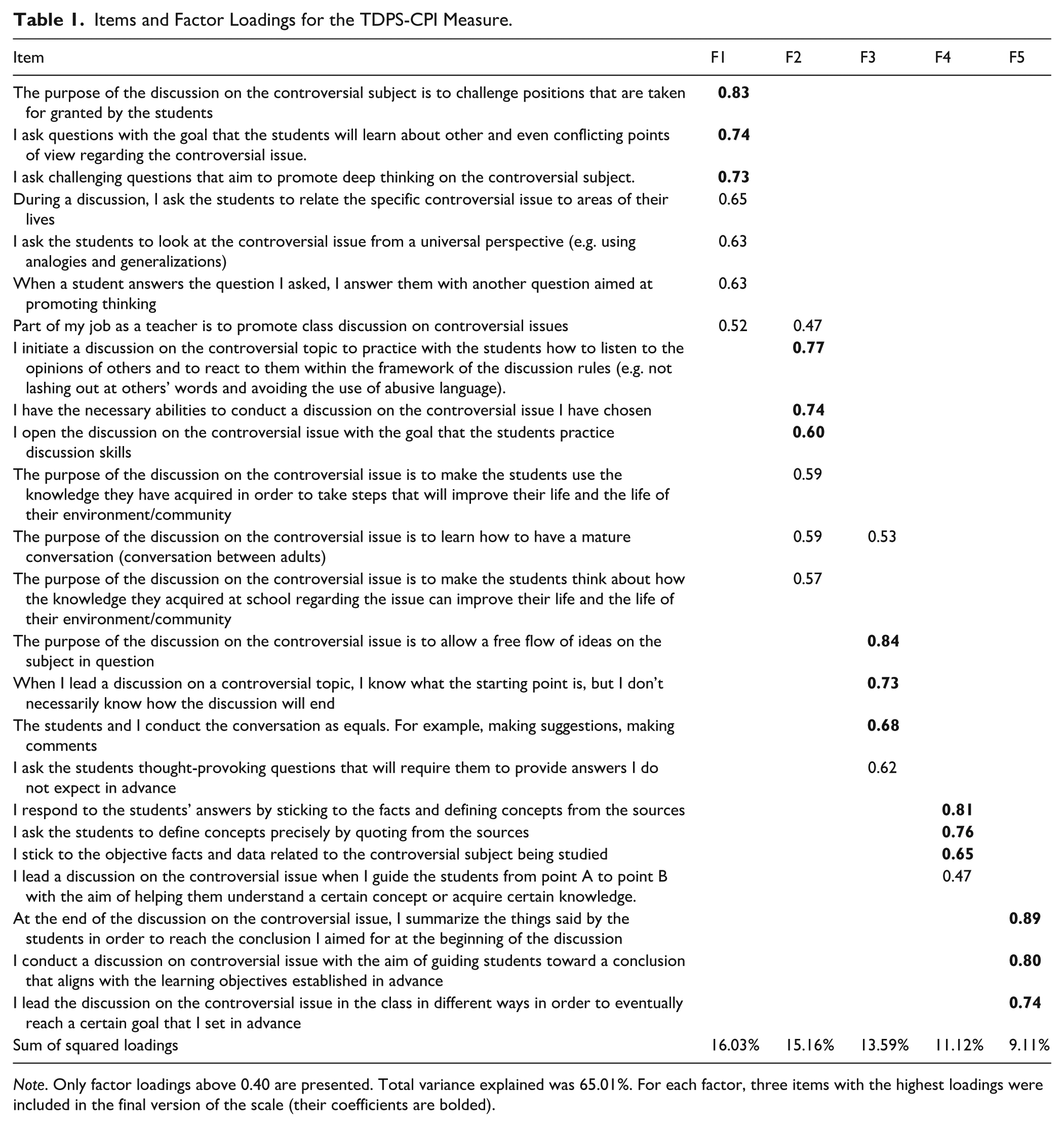
Note. Only factor loadings above 0.40 are presented. Total variance explained was 65.01%. For each factor, three items with the highest loadings were included in the final version of the scale (their coefficients are bolded).
Descriptive Statistics, Reliabilities, and Correlations of All Variables in Study 1.
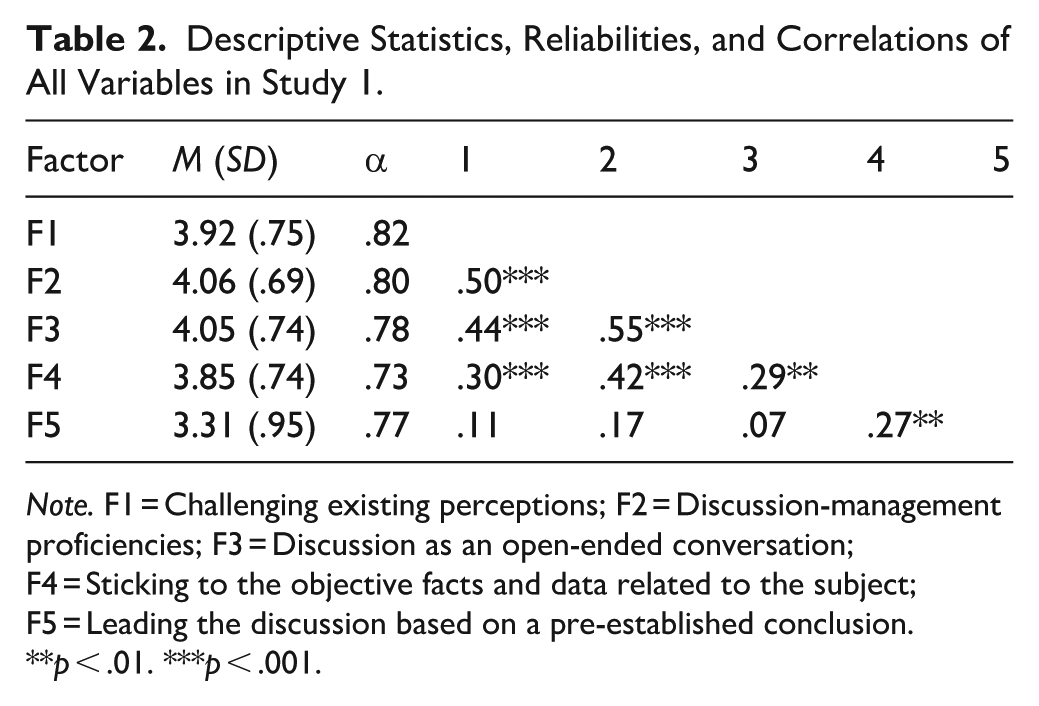
Note. F1 = Challenging existing perceptions; F2 = Discussion-management proficiencies; F3 = Discussion as an open-ended conversation; F4 = Sticking to the objective facts and data related to the subject; F5 = Leading the discussion based on a pre-established conclusion.
p < .01. ***p < .001.
Procedure
Teachers completed the questionnaire online (approximately 7 min). To recruit participants for the study, we employed a survey company, which distributed the questionnaire links to the relevant population. Teachers received points for participating in the study, and these points could be accumulated to earn gift vouchers. The study was approved by the author’s institutional review board.
Statistical Analysis
EFA using Varimax rotation was conducted on all TDPS-CPI items. Information about the reliability of each scale is provided in Table 2. Pearson correlations were conducted to further establish structural validity of the scale. Additionally, a repeated measures ANOVA was conducted to examine whether there are differences in the levels of the TDPS-CPI factors, and a one-way ANOVA was conducted to examine whether differences existed across school levels for the TDPS-CPI factors. All statistical analyses in Study 1 were conducted using SPSS 28.
Results
Based on the EFA analysis, we chose a solution of five factors based on an Eigen value larger than 1 (Meyers et al., 2016). The total explained variance was 65.01%. We selected the top three items with the strongest loadings for each factor, aiming to keep the scale concise and reduce participant fatigue when completing lengthy questionnaires (Clark & Watson, 2016). All loadings were higher than 0.4 and therefore considered high enough (Akpa et al., 2015). Items that loaded highly on another factor were excluded (see Table 1 for full details). The resulting final version of TDPS-CPI comprised 15 items that loaded on 5 factors. The correlation pattern provided support for the structural validity of the measures (Table 2).
The correlation pattern provided support for the structural validity of the measures (Table 2). All correlations were weak or mild, ranging from .07 to .55, supporting the distinction between different factors of the TDPS-CPI. These modest intercorrelations indicate that, although the discussion practices are related, they capture nonredundant aspects of teachers’ approaches to facilitating discussions on CPI.
In addition to the procedure outlined above for scale development, our analyses revealed variations in the levels of the TDPS-CPI factors. Therefore, we aimed to assess whether these differences were significant. To examine this, we conducted a repeated measures ANOVA. The analysis revealed significant differences in levels of different TDPS-CPI factors: F(4,448) = 23.79, p < .001, η2 = .18. Post hoc comparison using Bonferroni’s adjustment showed that level of the factor “Leads the discussion based on a pre-established conclusion” (F5) was significantly lower than the levels of the other factors (p < .001).
Given that teachers’ approaches to teaching CPI can vary across school levels (Karousiou et al., 2025), we examined differences for each TDPS-CPI factor using a one-way ANOVA. No significant differences were found between school levels for any of the TDPS-CPI factors (p > .05).
Discussion Study 1
The purpose of the first study was to construct and validate the TDPS-CPI. Evidence supported the structural validity of the TDPS-CPI. Weak to mild correlations were found between all factors, suggesting meaningful distinctions among the five factors of discussion practices. Furthermore, the mean levels of the factors differed significantly: the level of the fifth factor, “Leads the discussion based on a pre-established conclusion,” was significantly lower than those of the other factors. These findings underscore the importance of measuring distinct aspects of teachers’ discussion practices when teaching CPI. The next step was to further examine the structural validity using a larger sample.
Study 2
Participants
Participants included 205 teachers (68.5% female; mean age = 44.05, SD = 13.97), with an average seniority of 13.33 years (SD = 12.11). Of the participating teachers, 39.7% worked in elementary schools, 18.6% in middle schools, 29.1% in high schools, and 12.6% in non-academic post-secondary education in the Israeli education system. They worked either as subject teachers only (41.0%) or as subject teachers who fulfilled additional functions as well, such as homeroom teacher or subject-area or grade-level coordinator (59.0%). As for the subjects they taught, 40% of the participants were social sciences teachers, 24% were exact sciences teachers, 19.4% taught languages, 8% taught Jewish studies, and 8.6% taught other subjects. As to education, 21.6% had non-academic higher education, 37.7% held bachelor’s degrees, 38.2% held master’s degrees, and 2.5% held PhDs.
Instrument
TDPS-CPI
This scale was built based on the pilot study and contains fifteen items divided into five sub-scales of discussion practices in teaching CPI: Challenging existing perceptions (F1) assesses the extent to which teachers challenge students’ perceptions regarding the controversial topic (e.g. “I ask questions with the goal that the students will learn about other and even conflicting points of view regarding the controversial issue”); discussion-management proficiencies (F2) pertains to teachers’ practice of discussion skills during discussions of controversial topics, as well as their ability to apply and demonstrate these skills (e.g. “I open the discussion on the controversial issue with the goal that the students practice discussion skills”); discussion as an open-ended conversation (F3) assesses the extent to which teachers conduct discussions on controversial topics through open and equal conversation (e.g. “The purpose of the discussion on the controversial issue is to allow a free flow of ideas on the subject in question”); sticking to the objective facts and data related to the subject (F4) refers to the extent to which teachers adhere to facts and reliable sources when discussing a controversial topic (e.g. “I stick to the objective facts and data related to the controversial subject being studied”); and leading the discussion based on a pre-established conclusion (F5) pertains to the discussion on the controversial topic led by the teachers that concludes with drawing pre-planned conclusions (e.g. “I conduct a discussion on the controversial issue with the aim of directing the students to formulate a position that I have thought about in advance”). See Appendix A for the final version of the scale.
Procedure
Details of the procedure were identical to those in Study 1.
Statistical Analysis
CFA using AMOS 20 was conducted to examine the structural validity of the TDPS-CPI subscales within the specific sample. We examined the Comparative Fit Index (CFI) and Incremental Fit Index (IFI) scores, which indicated a very good fit when higher than 0.95 and a sufficiently good fit when over 0.90; a standardized root mean square residual (SRMR) score that should be less than 0.08 (Hu & Bentler, 1999; Marsh et al., 1996); and a root mean square of error of approximation (RMSEA) score that should be less than 0.08 for reasonable fit to the data (Marsh et al., 2010). Information about the reliability of each scale is provided in Table 3. Similar to Study 1, Pearson correlations were calculated to further establish the structural validity of the TDPS-CPI, a repeated-measures ANOVA was performed to examine differences among the TDPS-CPI factors, and a one-way ANOVA was conducted to examine differences in the levels of the TDPS-CPI factors across school levels. Reliabilities, correlations, and the ANOVA analyses were conducted using SPSS (Version 28).
Descriptive Statistics, Reliabilities, and Correlations of All Variables in Study 2.
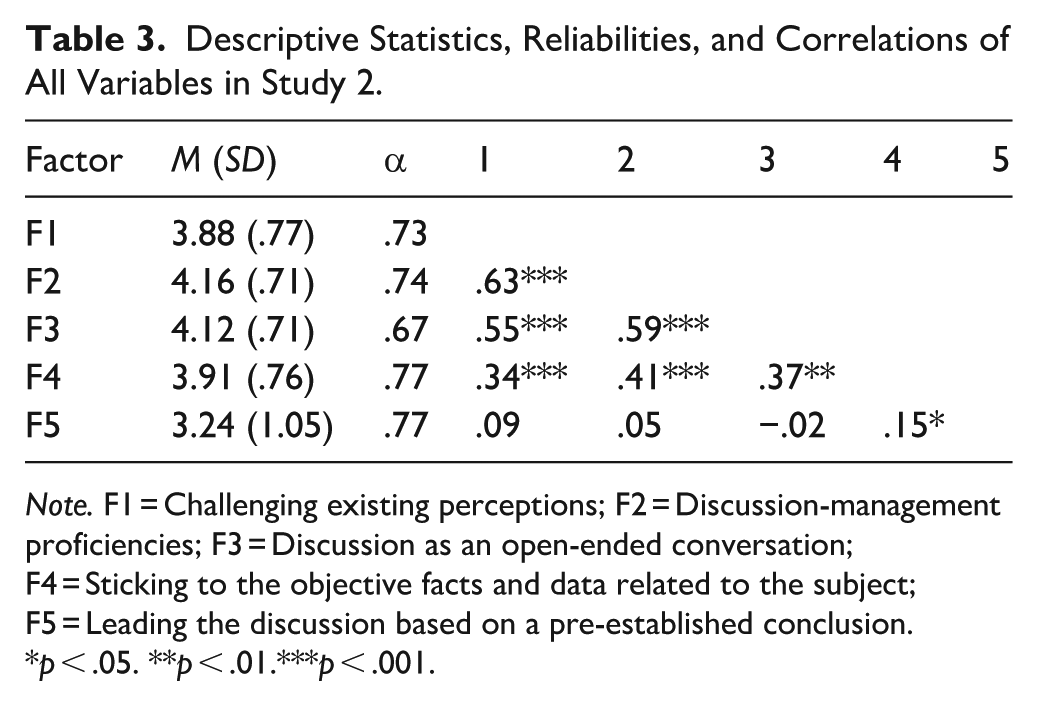
Note. F1 = Challenging existing perceptions; F2 = Discussion-management proficiencies; F3 = Discussion as an open-ended conversation; F4 = Sticking to the objective facts and data related to the subject; F5 = Leading the discussion based on a pre-established conclusion.
p < .05. **p < .01.***p < .001.
Results
CFA supported a five-factor model as an adequate fit to the data (CFI = 0.93, IFI = 0.93, SRMR = 0.07, RMSEA = 0.07). Measurement errors were found to be interconnected within three sets of items, all belonging to the same factor. Additionally, the correlation pattern provided support for the structural validity of the measures. Additionally, the correlation pattern provided support for the structural validity of the measures. Similar to Study 1, all correlations between the five discussion practices were weak or mild, ranging from −.02 to .63, supporting the distinctions between different factors (see Table 3).
In line with the findings of Study 1, our analyses revealed variations in the levels of the TDPS-CPI factors. To test whether these differences were significant, we conducted a repeated measures ANOVA. The analysis revealed significant differences in levels of different TDPS-CPI factors: F(4,816) = 58.36, p < .001, η2 = .22. Post hoc comparison using Bonferroni’s adjustment showed that level of the factor “Leads the discussion based on a pre-established conclusion” (F5) was significantly lower than the levels of the other factors (p < .001). These results were similar to those of Study 1, thus corroborating that the relatively low levels of factor 5, compared to the other factors, were consistently stable across two independent samples. The replication of this pattern across samples strengthens confidence in the robustness of this finding and supports the structural stability of the TDPS-CPI. It should be noted that additional significant differences between factors were found in both samples (Study 1 and Study 2); however, these differences were not consistent across the two samples, and therefore, we did not report them. This decision reflects a conservative analytic approach that prioritizes replicability over sample-specific effects.
Finally, as in Study 1, no significant differences were found between school levels for any of the TDPS-CPI factors (p > .05). This consistency across studies further suggests that the identified discussion practices do not differ by school level, thereby supporting the applicability of the TDPS-CPI across diverse educational levels.
Discussion
The purpose of the current study was to develop and validate a new instrument for measuring teachers’ discussion practices when teaching CPI, given the inadequacy of existing instruments. The development of the scale involved a comprehensive literature review and expert input to encompass various discussion practices related to teaching and adapting them to the context of CPI. The EFA revealed (and the CFA confirmed) five factors to the TDPS-CPI: challenges existing perceptions (F1); discussion-management proficiencies (F2); discussion as an open-ended conversation (F3); sticks to the objective facts and data related to the subject (F4); and leads the discussion based on a pre-established conclusion (F5).
Correlations between TDPS-CPI factors were low to moderate, suggesting that the various discussion practices teachers employ when discussing CPI are distinct, and therefore should be measured using a multi-dimensional scale. This correlation pattern was supported in the two independent samples, which enhances the construct validity of the scale. Furthermore, we found no significant differences in TDPS-CPI factor scores among teachers across different school levels. Although previous research suggests that teachers’ approaches to teaching CPI may vary by school level (Karousiou et al., 2025), our findings indicate that, in terms of specific discussion practices for addressing CPI, these factors remain consistent. In other words, the levels of these practices appear similar among teachers regardless of school stage.
Additionally, we found differences in the levels of the TDPS-CPI. Specifically, teachers reported that they use the discussion practice leads the discussion based on a pre-established conclusion to a lesser extent than the other discussion practices when addressing CPI in classrooms. This finding is intriguing considering that the first four factors of the questionnaire measured discussion practices generally considered effective, particularly on CPI, which could benefit students significantly (Coopmans & Kan, 2023; Larson, 1997). These practices facilitate the development of discussion skills, the exploration of diverse perspectives, adherence to factual information, and the challenging of personal perceptions. All of these processes are grounded in an egalitarian and respectful classroom framework, in which each participant’s voice is valued, dialogue is conducted in a civil manner, and the learning environment supports open yet responsible engagement with controversial political issues.
From a social studies education perspective, these practices are particularly aligned with core disciplinary goals, such as fostering democratic deliberation, critical civic thinking, and the ability to engage with multiple and often conflicting perspectives on public issues. Thus, the identified practices may be especially relevant for social studies teachers, who are expected to facilitate informed and balanced discussions on CPI.
In contrast, the fifth discussion practice reflects the teacher’s own perceptions and positions, thereby limiting the potential for in-depth discussion of the subject. Rather than fostering an open-ended exchange of ideas, this approach prioritizes guiding students toward a predetermined interpretation or position, which may be influenced by the teacher’s convictions, a perceived pedagogical imperative, or external curricular requirements. For social studies teachers in particular, such an approach may limit opportunities for students to further develop independent civic reasoning and to engage in authentic democratic discourse, which are widely recognized as central aims of social studies education, particularly in fostering civic skills and dispositions through classroom dialogue (e.g. Phillips, 2025).
The differences found between the TDPS-CPI suggest that despite teachers’ reluctance in addressing CPI (Aleksiak et al., 2026; Cohen, 2016), when they do engage, they tend to utilize discussion practices that could positively impact students, such as enhancing their critical thinking and preparing them for citizenship in a democratic society (Bekerman & Cohen, 2017; Hung, 2020; Tannebaum, 2013). However, one must approach this finding cautiously, as the use of this instrument is novel and warrants further examination through additional studies involving teachers in Israel and worldwide.
Limitations and Future Directions
The current study has certain limitations. First, the convenience sampling method, relying on volunteers, restricts the generalizability of the findings. Future research should aim to collect data from more representative samples, with an emphasis on obtaining a more random sample for subsequent testing of the instrument. Additionally, it is important to note that this study solely relied on self-report measures, which are potentially susceptible to social desirability bias. To enhance the validation of the scale, future studies could benefit from employing more objective data-collection methods, such as observations of teachers’ discussion practices in lessons dealing with CPI in conjunction with the TDPS-CPI developed in this study.
Furthermore, although Factor 5 demonstrated acceptable psychometric properties, its interpretation warrants caution. Items loading on this factor may be subject to multiple interpretations, as teachers could construe references to “pre-established conclusions” or “goals” as reflecting legitimate instructional objectives (e.g. developing argumentation skills or evaluating sources), rather than guiding students toward a predetermined stance on a controversial issue. Future research should further refine these items to more clearly distinguish between goal-oriented instructional scaffolding and discussion practices that limit openness to multiple perspectives.
Finally, the present study identifies key discussion practices related to CPI. However, it is important to acknowledge that the enactment of these practices is inherently context-dependent. The ways in which teachers implement such strategies may vary across classroom settings, instructional moments, and situational conditions (e.g. time of day, class dynamics, or levels of student engagement). Accordingly, the current measure captures teachers’ reported pedagogical orientations and practices, rather than the context-specific ways in which these practices are enacted. Future research is therefore encouraged to use this scale to examine how discussion practices are implemented across diverse educational contexts. For instance, the scale can be used among social studies teachers to investigate how these practices relate to key disciplinary outcomes, such as civic engagement, democratic participation, and students’ ability to reason about CPI.
Conclusions and Implications
The development of the questionnaire in the present study represents a preliminary attempt to quantitatively assess the discussion practices employed by teachers when teaching CPI. This effort not only provides a methodological approach to measuring these practices, but also has the potential to contribute to the field of education.
From a methodological perspective, the developed tool may aid researchers and educators in understanding common discussion practices concerning CPI, since it would allow for the examination of factors that predict various discussion practices on these issues and their potential outcomes. For instance, it could enable the examination of the predictors of the ineffective discussion practice (leading the discussion based on a pre-established conclusion) and factors that moderate this association. Additionally, the questionnaire is designed to be universal, enabling researchers in different countries to utilize it. They can adapt the questionnaire to address CPIs relevant to their country or geographical area.
In terms of contributing to the field of education, understanding the discussion practices teachers employ when teaching controversial subjects can facilitate the development of further training or intervention programs for dealing with CPI in the classroom. These programs aim to enhance effective discussion practices, such as conducting open conversations (Coopmans & Kan, 2023), and to bolster teachers’ efficacy regarding discussing such subjects in the classroom. Strengthening teachers’ discussion skills regarding CPI may somewhat alleviate their reluctance to teach such subjects. This is particularly important for social studies teachers, as they may frequently encounter CPI in their teaching due to the nature of the subject matter, and targeted training programs and professional development initiatives can enhance their capacity to facilitate open, balanced, and evidence-based discussions on these issues.
However, it should be noted that other factors also influence teachers’ avoidance of teaching CPI, including education department policies and the level of support teachers receive from school administrations (Erlich Ron & Gindi, 2022; Gindi et al., 2021). It is important to acknowledge the array of barriers associated with teaching CPI in order to encourage its inclusion in the curriculum.
Ultimately, strengthening students’ discussion skills through effective practices by teachers on CPI may yield positive outcomes not only for the students themselves (Sætra, 2021; Tannebaum, 2013), but it may potentially make a positive impact beyond school barriers. Students may become agents of change, utilizing the acquired discussion skills, such as respecting differing opinions and fostering respectful discourse among citizens on these issues within a democratic society.
Footnotes
Appendix A
Following are controversial political issues in Israeli society: definitions of the state, collective rights of minorities, civil identity versus national identity, different narratives for Jewish and Arab citizens, a constitution for the state, the implementation of rights in the State of Israel in light of the national divide, and rights and obligations of Arab citizens.
Choose any topic from the topics above (or any other political topic you see as controversial). Please indicate which topic you have chosen ______________________________________
Please indicate the extent to which the following statements are true for you when discussing in class the controversial topic you chose. Rate your answers on a scale of 1 to 5, where 1 means “not true at all” and 5 means “very true.”
Acknowledgements
While preparing this work, the authors utilized ChatGPT-4 to enhance grammar and readability. Following its use, the authors carefully reviewed and refined the content.

Consent to Participate
Informed consent was obtained from all subjects involved in the study.
Funding
The authors received no financial support for the research, authorship, and/or publication of this article.
Declaration of Conflicting Interests
The authors declared no potential conflicts of interest with respect to the research, authorship, and/or publication of this article.
Institutional Review Board Statement
The study was approved by the Ethic Committee of David Yellin College of Education.
Data Availability Statement
The data used in the research cannot be shared with any person because this was not approved by the ethical review board.