






Abstract
This study examines how different teaching methods about democracy are perceived by teachers and students in Dutch secondary vocational education. We evaluated two sets of lessons: one instruction-based (through lectures and assignments) and one experience-based (through simulations). Eight teachers implemented one or both of these sets of lessons, which were evaluated through thirty-one teacher interviews and twenty-seven student group interviews. The evaluations focus on the classroom practices that were used as design principles for the lessons, namely: meaningful embedding, providing multiple perspectives, thinking about solutions from divergent perspectives, and critical reflection on the subject matter. Overall, teachers and students found the lessons efficacious for students’ learning about democracy. Several challenges were also discussed, including how to handle emotions, the risk of students not engaging with perspectives, the risk of premature and one-sided solutions, and students struggling with argumentation.
Introduction
Education is important for supporting and sustaining a democratic culture, as it can stimulate various democratic competences in young people (Barrett, 2020). In many countries, guidelines for civic education have been implemented over the past decades (e.g. Center for Civic Education, 1994; Eurydice, 2017). One component of these guidelines is education for democracy, which is often understood as the deliberate use of educational processes to foster students’ democratic competences for the improvement of (future) society (Sant, 2019). Education for democracy can be approached in various ways, such as by creating an open and safe classroom climate or by integrating democratic subject matter into the civic education curriculum and its subsequent lessons (Campbell, 2019; Geboers et al., 2013). For the latter, various teaching methods can be used, encompassing the overall approach and the activities of a lesson that teachers and students engage in to achieve specific learning goals (Larson, 2016). One possible teaching method is to provide students with information about democracy through teacher-led instruction and assignments (Doyle, 1983; Rosenshine, 2009). Another method is for students to directly experience democracy, such as through simulations (Kolb, 1984; Wright-Maley, 2015). International comparative research shows that in many countries, teachers predominantly use instruction-based methods, whereas simulations 1 are used to a much lesser extent (Schulz et al., 2025). Nevertheless, scholars regard simulations as promising for learning about civic topics (e.g. Baranowski & Weir, 2015).
Both instruction-based and experience-based methods are considered effective for learning about democracy. Much insight has been gained into the effectiveness of these teaching methods through quantitative experimental research (Donbavand & Hoskins, 2021; Teegelbeckers et al., 2023). These studies provide important insights into the relationship between a teaching method and learning outcomes. However, such research designs do not provide clear insights into the elements that contribute to learning in a complex school environment (Wrigley & McCusker, 2019). Qualitative evaluations of teaching methods can offer deeper insights into these elements (Patton, 2014). Yet, teaching methods that specifically focus on teaching democratic subject matter have been subject to limited qualitative evaluation (Fitzgerald et al., 2021). Consequently, scant research examines how teachers and students perceive which elements of these methods contribute to learning about democracy. As a result, there is limited understanding of what happens during a teaching method that supports the development of students’ democratic competences, or of what difficulties arise during its use. Therefore, this study aims to gain a better understanding of the elements within both instruction-based and experience-based teaching methods that contribute to or challenge learning about democracy.
To address our aim, we designed two sets of lessons that we subsequently evaluated through teacher and student interviews. One set of lessons was instruction-based, featuring lectures and workbook assignments. The other was experience-based, using low-intensity simulations designed for regular class time (see Glazier, 2011). The design of both sets of lessons was based on actions and behaviours considered effective for teaching democracy – referred to as classroom practices – which occur across various teaching methods (Teegelbeckers et al., 2025). In the present study, we examined four such practices, namely meaningful embedding of subject matter, providing multiple perspectives, supporting students in thinking about solutions from divergent perspectives, and fostering critical reflection. These practices were implemented in both instruction-based and experience-based methods, and subsequently served as the basis for our evaluation. We investigated how teachers and students perceived these practices to contribute to learning about democracy (i.e. their perceived efficacy), and the dilemmas or difficulties encountered in this process (i.e. their challenges; McKenney et al., 2006; Windschitl, 2002). The main research question guiding this study is: How do teachers and students evaluate instruction-based and experience-based teaching methods, and the classroom practices they are based on, in terms of their perceived efficacy and challenges for learning about democracy?
Theory
Democratic Subject Matter
This study focuses on the teaching of democracy, specifically on models of government and democracy, political institutions, and political-ideological positions. We address teaching about various dilemmas and possibilities related to the organisation of democracy, such as forms of decision-making (e.g. majority rule, compromise, and deliberation) and ways in which citizens can influence politics (e.g. voting in elections and referenda; R. Dahl, 1998; Held, 2006; Lijphart, 2012). With regard to democratic institutions, we focus on teaching about political parties, parliament, local councils, and democratic innovations such as citizens’ assemblies (Andeweg et al., 2020). Moreover, we address political pluralism, referring to the coexistence of various political-ideological positions, such as left-wing, right-wing, progressive, and conservative (Ball et al., 2019). Attention is also given to tensions that may arise between democratic principles, such as the balance between majority rule and the protection of minority interests and individual rights (Levitsky & Ziblatt, 2025; Overeem, 2020).
Teaching Methods
Instruction-based and experience-based teaching methods offer different ways to engage students in the complexities of democratic subject matter. Below, we elaborate on these types of teaching methods and how they can stimulate democratic competences among students.
During the use of instruction-based teaching methods, students are introduced to domain-specific concepts and theories (such as those concerning democracy), which they are expected to understand well in order to appreciate and participate in democracy (Galston, 2001; Hirsch, 2020). Educational experiments have shown that these methods can effectively promote the acquisition of democratic knowledge and other democratic competences, such as political efficacy (e.g. Anson, 2017; Green et al., 2011). When instruction-based teaching methods are used, students learn as they are presented with the subject matter in a structured way and are guided to memorise it (e.g. Rosenshine, 2009). The teacher explains the subject matter or shows videos, and students are expected to apply this information, often by engaging with it in assignments, such as short, well-structured tasks in a workbook (Doyle, 1983; Marx & Walsh, 1988). During these tasks, students can, for example, relate concepts to each other and answer reflective questions (e.g. Marzano, 2007). Students also learn when teachers pose questions during lectures that deepen their understanding of the subject matter (Wilen, 2001). However, while the importance of domain-specific learning through classroom instruction is recognised in the above studies, little qualitative research has been done on instruction-based lessons to teach specifically about democratic subject matter. Although educational experiments show that this teaching method can be effective, exactly how the process by which students learn about democracy works is an open question that we address in this research.
During the use of experience-based teaching methods, students engage in social situations involving complex social issues, actively interacting with their fellow students, which helps them better appreciate democratic coexistence (Lind, 2023; Van der Ploeg, 2016). It is also argued that sensory-motor experiences related to abstract concepts (such as those associated with democracy) make them clearer for students, thereby enhancing their understanding (Lebert & Vilarroya, 2024; Löhr, 2019). The effectiveness of experience-based methods is demonstrated by multiple educational experiments, which show that experiences can stimulate various democratic competences, including democratic knowledge, political efficacy, and the ability to deal with differences (e.g. Levy et al., 2019; Mariani & Glenn, 2014). In general, when using these methods, students learn by experiencing social situations, reflecting on their actions, connecting abstract concepts to their experiences, and applying what they have learned in subsequent social situations (Kolb, 1984). The current study focuses on simulations as experience-based teaching methods. Simulations reflect real life in a miniaturised and structured way, illustrate dynamic social processes, and engage students as active participants (Wright-Maley, 2015). However, insights into teaching through simulations are often formulated broadly for the social studies curriculum, and there is little qualitative research specifically on the perceived efficacy of using simulations to teach democratic subject matter. Even though educational experiments show positive effects on stimulating democratic competences, it is not yet clear from the existing body of research how students actually learn about democracy during a simulation.
Classroom Practices
To better understand the learning process of instruction-based and experience-based methods, this study examines the perceived efficacy of elements within these methods for learning about democracy. Based on previous research with expert teachers, potentially effective classroom practices have been identified (Teegelbeckers et al., 2025). However, it is unclear whether these are also perceived as efficacious by other teachers and students. In this study, we used these practices as design principles for the development of instruction-based and experience-based lessons, which we subsequently evaluated (McKenney et al., 2006). The following practices are the focus of this research:
Meaningful embedding: With this practice, teachers make the subject matter meaningful by connecting it to students’ existing knowledge, showing what something abstract looks like in reality, and having students create a personal connection to the subject matter. In instruction-based teaching, possibilities include linking the subject matter to issues relevant to students’ lives and using concrete examples of abstract concepts (Schmidt, 2021; Smets, 2024). In experience-based teaching, it may include opportunities for students to personally engage with the subject matter through sensory-motor experiences in simulated real-world scenarios (Lebert & Vilarroya, 2024; Wright-Maley, 2015). Additionally, the feelings and emotions that may arise during instruction or simulation processes can help students establish a personal connection with the subject matter being taught and to understand it better (Rosiek, 2003).
Providing multiple perspectives: With this practice, teachers can offer a variety of standpoints on political and democratic issues and highlight the associated arguments and values. In instruction-based teaching, this may involve explaining these perspectives, visualising them in diagrams, discussing them with the class, and integrating them into assignments. In experience-based teaching, it can include integrating these perspectives into the roles that students take on during simulations (e.g. Gehlbach, 2011; Gehlbach et al., 2008; Holmén et al., 2024; Lo & Parker, 2016; Sandahl, 2020).
Thinking about solutions from divergent perspectives: Through this practice, teachers encourage students to explore collective solutions by considering perspectives that are not easily reconcilable. In instruction-based teaching, this has not been widely researched within the context of democracy. However, it may involve students thinking about solutions to political issues in a structured way, such as during workbook assignments (cf. Doyle, 1983; Rosenshine, 2009). In experience-based teaching, it can include collaborative decision-making processes, such as those in a simulation (e.g. Guérin, 2017; Johnson & Johnson, 2016; Wright-Maley, 2015).
Critical reflection on the subject matter: Through this practice, teachers encourage students to analyse and reflect on, for instance, models of democracy and political-ideological positions. Critical reflection is defined in the academic literature in various ways and often has several components (Bermudez, 2015). In this study, we focus on two components. The first is evaluating normative concepts, considering their strengths, limitations, various angles, and potential fallacies. The second is explaining one’s own value judgements, which must be substantiated with arguments (e.g. Rombout, 2024). In instruction-based teaching, this may involve prompting students with critical questions during lectures or within assignments (Wilen, 2001). In experience-based teaching, such reflection can take place during debriefing sessions following simulations, where students examine and interpret their experiences through teacher-led questioning (Crookall, 2023).
While these classroom practices are considered effective for learning about democracy, teaching with them can also be difficult or present dilemmas, which we refer to as challenges (similar to the concept of pedagogical dilemmas; see Windschitl, 2002). Examples of such challenges in the social studies context include balancing emotional engagement with the need for a safe and comfortable classroom climate (Pace, 2019; Sheppard & Levy, 2019), fostering productive conflict around collective solutions (Dack et al., 2016; Hess & McAvoy, 2015; Smith & Stitzlein, 2024), and supporting students in progressing from surface-level understanding to higher-order critical thinking, such as argument evaluation and well-substantiated reasoning (Newmann, 1991; Onosko, 1991). However, relatively little research has been done on these challenges in the context of teaching democratic subject matter through various teaching methods. Therefore, this study also examines these challenges, as well as their relation to the perceived efficacy of classroom practices.
The Present Study
Research Context
For this study, we designed and evaluated two sets of lessons for secondary vocational education 2 (middelbaar beroepsonderwijs; MBO) in the Netherlands. We focus on this track because citizens with this educational background (and similar citizens in other democracies) often participate less in democratic processes and tend to have lower levels of political self-efficacy than more academically educated citizens (Bovens & Wille, 2017; Savage et al., 2021). There is also little research on how to teach democracy to these types of students (see Teegelbeckers et al., 2023). In this track, there is a requirement to teach explicitly about democracy and to stimulate students’ participation in politics and society. This is often done in a course named Citizenship (Den Boer & Leest, 2021). For this requirement, students on this educational track need to learn about representative and direct democracy, and about democratic decision-making at various levels of government. They also need to learn about various perspectives on political issues (Adult and Vocational Education Act, article 17a, third paragraph; Government of the Netherlands, 2023).
Sets of Lessons
Both sets evaluated in this study consist of eight lessons that largely address the same learning goals and subject matter (Appendix A). However, the sets differ in sequence and focus due to the distinct teaching methods. Experiencing democracy through simulations can take more time than providing instruction on it, which limits the number of topics covered in the experience-based lessons compared to the instruction-based ones. Below, we outline each set of lessons, including their learning goals and lesson structure, followed by an overview of how we integrated the classroom practices into each set.
Instruction-based Set of Lessons
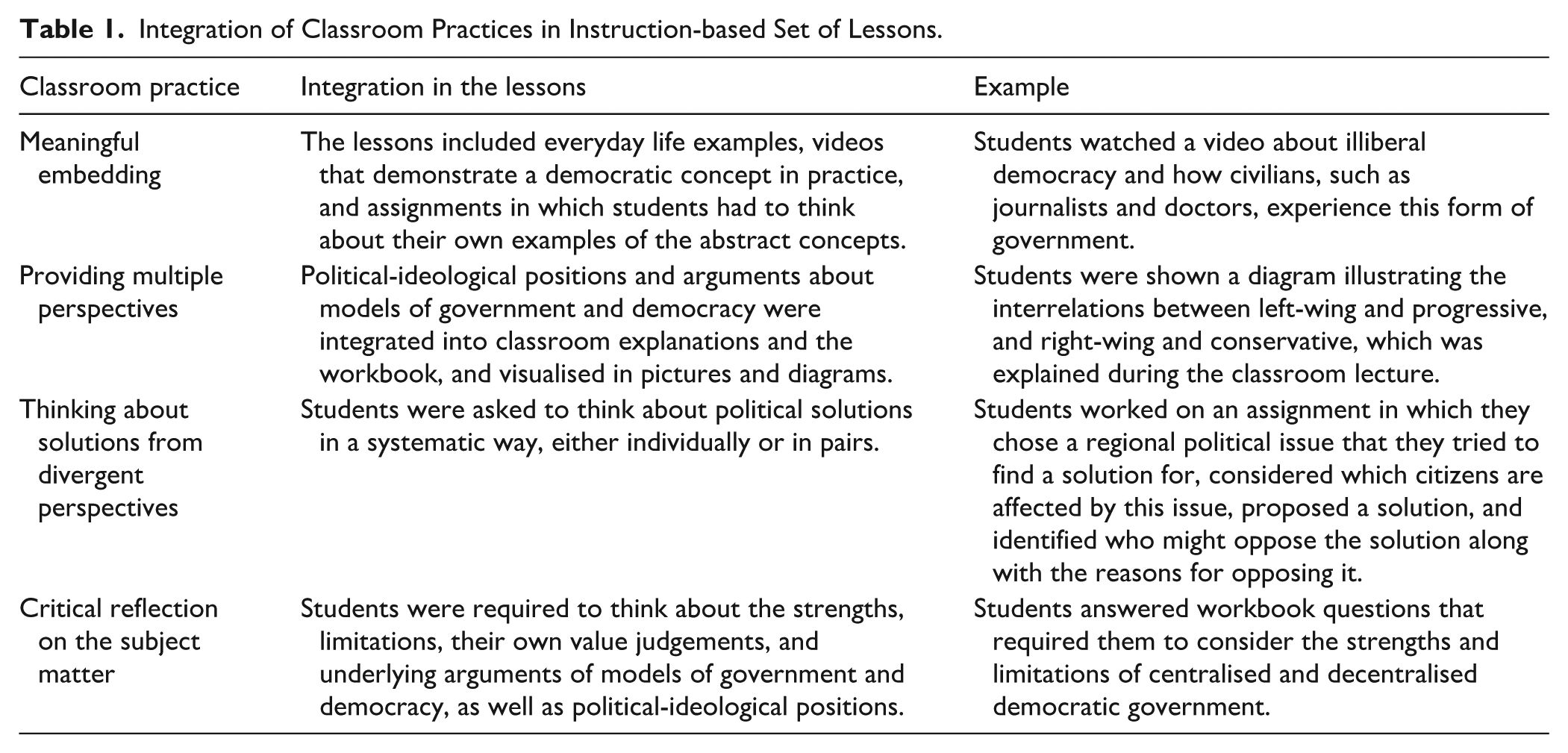
The instruction-based set of lessons had the learning goals of providing students with knowledge about democratic subject matter. Another learning goal was to encourage students to reflect on their own views regarding models of government and democracy, as well as political-ideological positions. The core idea of these lessons is that students listen to information about democracy and then discuss, process, and critically think about this information during short workbook assignments, conducted individually or in pairs. The lessons start with the teacher giving instruction about the subject matter, sometimes showing a video. The teacher also asks questions to check students’ prior knowledge and verify their understanding. Students then complete the workbook assignments, which are debriefed through questioning. The integration of the classroom practices in this set of lessons is described in Table 1.
Integration of Classroom Practices in Instruction-based Set of Lessons.
Experience-based Set of Lessons
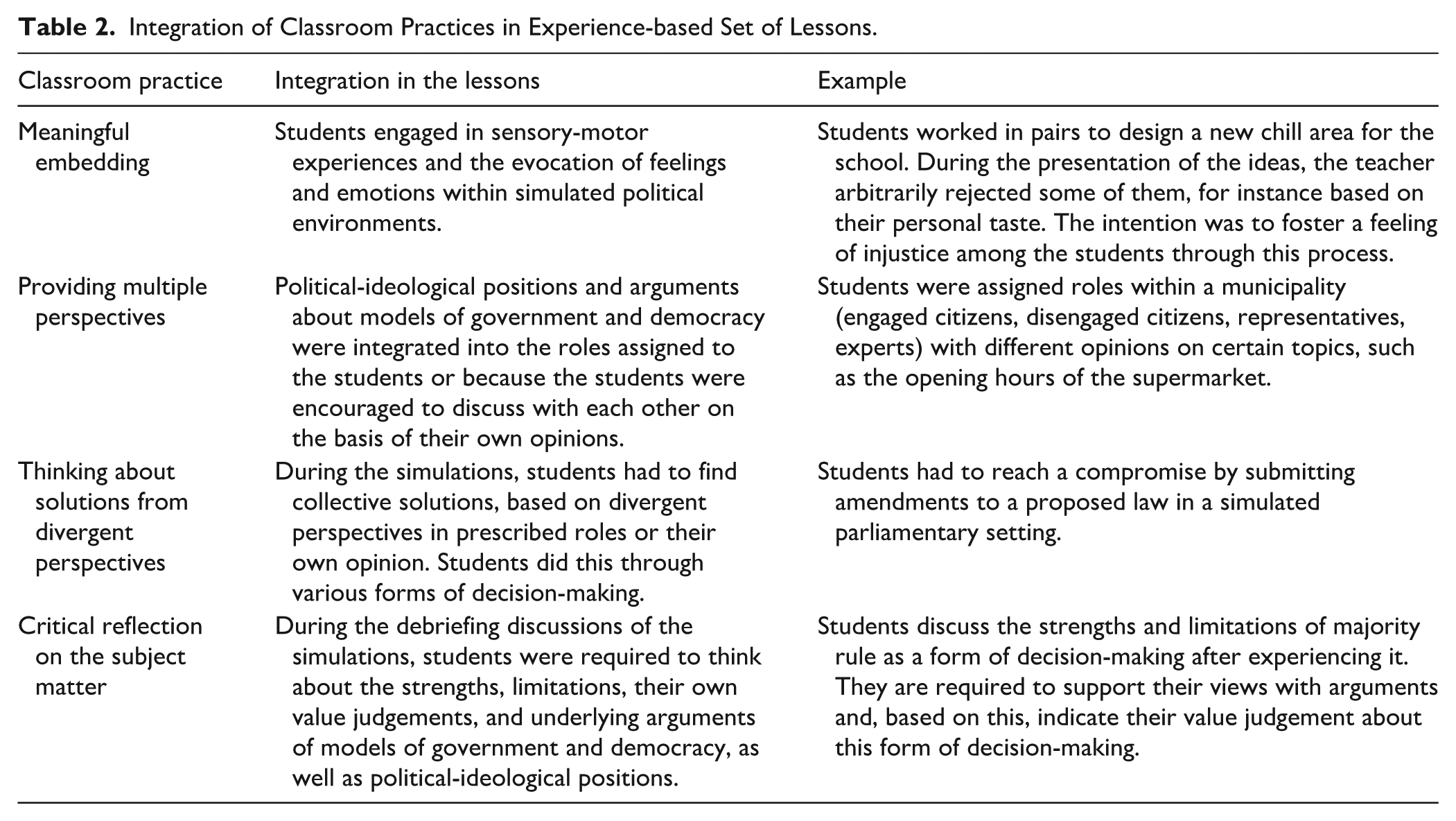
The experience-based set of lessons had the primary learning goal of helping students develop a positive attitude towards collective decision-making. Additionally, these lessons aimed to provide students with knowledge of democracy, foster their understanding of the strengths and limitations of different models of government and democracy, and encourage insight into their personal value judgements about these models. The core idea of these lessons is that students experience different forms of decision-making and then reflect on them. The lessons start with a short explanation of democratic concepts and the decision-making activities. Students then work together, based on roles or their personal beliefs, to decide on a policy issue in a simulated setting (e.g. a parliament). Afterwards, during a debriefing session, students reflect on the type of decision-making they experienced. For example, students reflect on how a particular type of decision affects the different parties involved (such as those in the majority and minority), and they discuss their value judgements on the matter. The integration of the classroom practices in this set of lessons is described in Table 2.
Integration of Classroom Practices in Experience-based Set of Lessons.
Methodology
Participants and Measurements
The sets of lessons were carried out and evaluated in two periods (April to June 2022 and September to November 2022), by eight teachers: three teaching the instruction-based lessons and seven teaching the experience-based ones. Of these, two teachers taught both sets of lessons in different classes and at different times. We included more teachers to teach the experience-based lessons compared to the instruction-based ones because experience-based teaching methods are more demanding for teachers to implement and are not frequently used (Glazier, 2011; Schulz et al., 2025). In contrast, the instruction-based lessons involve teaching methods that are more commonly used, requiring fewer moments of evaluation and thus involving fewer teachers.
The lessons were evaluated through individual teacher interviews and student group interviews (one of which was individual). These evaluations were usually conducted after two or three lessons, typically after Lessons 1–3, Lessons 4–6, and Lessons 7–8 (overview in Appendix B). Interviews were conducted with the active consent of the teachers and students (Ethics commission reference: 2021-CDE-14287). Prior to the interviews, we conducted classroom observations to get a sense of how the lessons were taught and to verify that they were taught as described in the teaching manual. In total, 90 lessons were observed.
Teacher Interviews
Teachers were selected using convenience sampling via the authors’ network. Based on their availability and subsequent consultation, teachers were assigned to a specific set of lessons. The teachers taught in several vocational sectors (healthcare, retail, laboratory, education, and business and administration). All teachers delivered the full set of eight lessons, except one teacher who taught six lessons. Teachers participated in the study with between one and six classes. The average age of the participating teachers was 37, and 5 identified as female. On average, they had 7 years of experience teaching Citizenship classes (min. = 1; max. = 10).
The teacher interviews aimed to understand teachers’ overall impression of the lessons and the specific activities within them, their perceived efficacy of the activities for stimulating students’ understanding of democratic subject matter and fostering other democratic competences, as well as aspects that were challenging or could be improved. For each lesson, a different interview guideline was used, specifically tailored to the activities in that lesson (Appendix C). These interviews were informed by logbook entries completed after each lesson in which teachers rated student learning and identified efficacious elements of the lesson on a 1–5 Likert scale. The interviews focused on understanding the reasons for teachers’ positive, somewhat positive, or non-positive views of specific activities and practices. A total of 29 of these interviews were conducted, with an average duration of about 30 min. Interviews took place at the school immediately after class or online shortly thereafter. Additionally, two follow-up interviews (~30 min each) were conducted with two teachers about the instruction-based lessons: one involved a review of all teaching materials (i.e. a walkthrough), and the other focused on discussing students’ responses to the workbook questions.
Student Group Interviews
A selection of students who had consented to participate was made based on the teacher’s advice or by the researcher, who approached them during class. The aim of the selection was to include a broad range of students in the group interviews. A total of 27 group interviews were conducted, with a total of 58 students (approximately 2–3 students per group). The participating students had an average age of 18 years, and 38 students identified as female.
The interviews explored students’ overall impressions of each lesson, their experiences during the activities, the perceived efficacy of the classroom practices in helping them gain a better understanding of the subject matter and fostering their democratic competences, any changes in their value judgements on the subject matter, and any additional insights they gained. In some interviews, challenges of the lessons were discussed explicitly. For each lesson, a different interview guideline was used (Appendix D). On average, a group interview lasted 20 min. The group interviews were conducted at school either immediately after class or at a scheduled appointment soon after the class.
Data Coding and Analysis
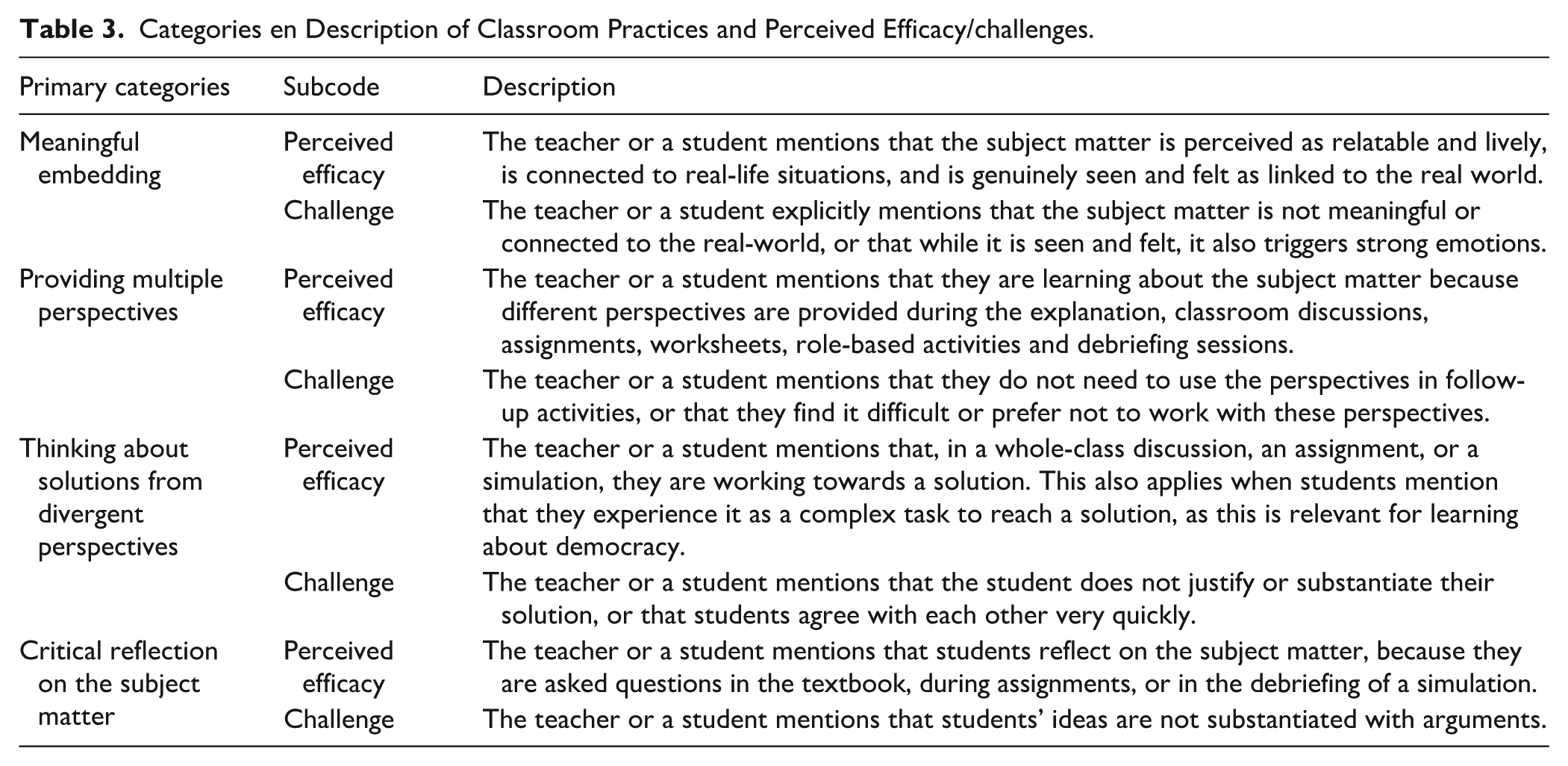
The interviews were transcribed verbatim and then coded using MAXQDA (Rädiker & Kuckartz, 2020). During the coding process, we used the four classroom practices as primary coding categories. We coded elements that contributed to learning through a classroom practice (indicating its perceived efficacy), as well as elements that were difficult or posed a dilemma during a classroom practice (indicating a challenge). For the coding of perceived efficacy, we developed codes in advance based on theory about classroom practices and then examined how these appeared in the data. In contrast, for the coding of challenges, we derived codes from the data itself and subsequently explored how these related to existing theory (see Xu & Zammit, 2020, on hybrid coding). In both approaches, we applied an iterative coding process in which our theoretical insights and data continuously informed and refined one another (Timmermans & Tavory, 2012). We coded text fragments as perceived efficacy or as challenges when they were explicitly indicated by a teacher or student, or when we interpreted them as such. The codes are summarised in Table 3. To make sense of the large number of coded text fragments, we added a short memo to each fragment. In each memo, we briefly described how we interpreted that specific part of the interview.
Categories en Description of Classroom Practices and Perceived Efficacy/challenges.
To ensure the reliability of the classroom practice and efficacy/challenge categories, we established inter-coder agreement using Cohen’s kappa. The first author and an independent coder each coded 40 text segments, resulting in κ = .80 for classroom practices and κ = .84 for efficacy/challenge, indicating substantial to almost perfect agreement. Any disagreements were discussed between the coders. Some text fragments could be coded in multiple ways, particularly those related to meaningful embedding and providing multiple perspectives. To determine whether a fragment could be categorised under one of these classroom practices, we looked for specific elements in the answers of teachers and students that clearly referred to either practice. This approach resulted in full consensus on the coding categories.
Following the coding process, we conducted a thematic analysis both within and across the sets of lessons to explore the evaluations of the classroom practices. This involved comparing data segments, identifying similarities and anomalies, and looking for consistent patterns in the data. We focused on the overall efficacy and challenges related to the classroom practices that were integrated into the sets of lessons, and on the learning outcomes these practices may have facilitated.
Results
In general, teachers and students were enthusiastic about both sets of lessons. The instruction-based lessons were perceived as clear and well-structured, and students appreciated the alternation between lectures and workbook assignments, although the information was sometimes considered dull and overly theoretical. The experience-based lessons were viewed as engaging and enjoyable, but sometimes complex, with simulations occasionally difficult to follow due to their multiple steps. The observations showed that both sets of lessons were consistently carried out as intended. In the following, we describe the perceived efficacy and challenges of the classroom practices that were integrated into the two sets of lessons.
Meaningful Embedding
I think [I learned] also because of that video. It really makes you realise [what lack of freedom means].
Then you get a better picture of how it really works in real life, you know. Because you’ve only read stories and texts. But then you really see it.
By seeing real people and their experiences with (the absence of) democracy, students seemed to better understand this concept.
I felt injustice, and I felt that I couldn’t do anything about it [. . .].
What we experienced in class is nothing compared to a real dictatorship. But you do get a bit of the feeling. [. . .] In [previous] history lessons, you focus very much on the dictator, and not on how the people felt.
Students who experienced injustice during a simulated dictatorship seemed to gain a sense of what life in this form of government might actually feel like, and could therefore understand the concept better.
A challenge with this classroom practice in simulations, mentioned by both teachers and students, was that it could sometimes affect the safety or comfortability of the classroom climate due to the strong emotions it could evoke. About the lesson in which the teacher arbitrarily rejected students’ ideas, both teachers and students mentioned that teachers really needed to be careful, as it could evoke feelings of frustration. One teacher said:
With the first student, I also noticed that when I rejected her idea, she really didn’t like it. Later, the students understood that I was doing it for a specific reason. [. . .] So you really have to be careful with that, that you don’t say anything crazy or personal.
This indicates that a challenge during experience-based lessons lies in teachers carefully managing any arising feelings and emotions; otherwise, the safe classroom environment may be compromised.
Providing Multiple Perspectives
With such a diagram, you can see [left-wing and right-wing] more clearly. And if you think you’re very right-wing, you can see what very right-wing looks like. Then you can make your [political preference] based on that. I think it clarifies things.
Thus, through this instructional approach, the different political-ideological positions can be directly and concretely explained.
A challenge with this classroom practice in the instruction-based lessons is that, although multiple perspectives were introduced, students were minimally encouraged to engage with them during the lessons. An example of this is a lesson in which a word web about a political issue was created with the whole class, with the teacher and students discussing various actors involved. One teacher said:
I wrote the [perspectives] on the whiteboard and then didn’t do much more with it. Perhaps there could have been a useful connection where students had to incorporate [the perspectives] into the [follow-up] assignment.
Students also indicated that merely introducing perspectives felt somewhat limited:
I think a [word web] is a bit superficial. Because I don’t know if you really get that much out of a [word web].
I think you get more results if you start asking people deeper questions [about the perspectives].
This indicates that a risk of merely introducing perspectives through an instruction-based method is that students may not actively engage with them, which can result in a superficial understanding of these perspectives.
I noticed that [students] were able to easily make the connection with what direct democracy is and what representative democracy is. They quickly understood it afterwards, like, ‘Okay, what was my role? And what did we want, and why did we choose that [form of democracy]? And why didn’t we choose representative, or why not direct?’
This teacher suggests that by taking on roles, students came to understand why someone with a certain perspective might prefer to participate in democracy in a particular way. This indicates that role immersion can help students gain a deeper insight into different perspectives on models of democracy.
However, some students found role immersion challenging. One reason they mentioned is that they struggled to come up with arguments for their role if they did not agree with the perspective of that role: “It’s quite difficult if you don’t agree with the [role] yourself, to then, let’s say, come up with [arguments] for that [role].” Another reason students mentioned is that they prefer to engage in discussions based on their personal opinions: “It’s nice that everyone gets a [role card] with an opinion on it, but it’s more enjoyable to express your own opinion.” Thus, role immersion requires significant effort during a simulation lesson.
Thinking About Solutions From Divergent Perspectives
Actually, it’s just difficult to look for a solution. You have to consider whether everything is better for that [other] person as well. So you can’t just think about yourself [. . .].
I never thought about it that way. I just thought: just make a road, or just fix that road.
This indicates that students recognised the divergent perspectives and interests involved in solving an issue. Notably, this way of thinking does not seem obvious to students, as they also seemed to have an oversimplified expectation of the government – that it should “just fix that road.”
A challenge with this classroom practice during instruction was getting students to substantiate and justify a solution based on divergent perspectives, which was not always accomplished. Teachers mentioned that merely thinking about a solution was not enough; rather, substantiating and justifying the choices and perspectives involved could contribute to a deeper understanding. One teacher said:
[The solutions] didn’t necessarily have to be justified, or anything like that. [. . .] Why did they choose that solution? That wasn’t clearly reflected in the answers. [. . .] Do they take into account: Who is involved? Who makes the decisions? Those kinds of things.
Justification is seen as necessary by the teachers to gain better insight into whether the solution truly incorporates multiple perspectives and has been democratically reached. In the workbook assignments, students simply proposed solutions without providing justification.
It was just insightful, that [to reach a compromise] you actually make an [amendment] [. . .] And then, for example, a student comes and immediately says, ‘I disagree with that.’ [. . .] And then you eventually come to a point where you say, ‘I agree with it, but. . .’ and then make a small adjustment [to the proposal]. And then each time a small adjustment. And you still come to an agreement.
By engaging in step by step negotiations, students and teachers mentioned that students saw how arguments and counterarguments shaped solutions. They indicated that this experience helped students better understand how compromises are reached.
A challenge arose when students had to make collective decisions based on their personal opinions rather than assigned roles. In such cases, students often agreed with each other from the outset, which limited their exploration of divergent perspectives. This occurred, for example, during a simulated citizens’ assembly in which students had to make a collective decision on meat taxation. One teacher said:
What we noticed in both classes is that we had to be careful that they all agree too easily, which happens very quickly. [. . .] I tried to address this by advising them beforehand to sit with someone they disagree with, so that there’s diversity in their subgroup. This is indeed important because that’s when all the different arguments truly come to light.
In these cases, learning about democratic decision-making became challenging, as the entire group had already reached unanimous agreement beforehand.
Critical Reflection on the Subject Matter
I think the way the questions [in the workbook] are asked is good. They always say: ‘What do you think about it?’ or ‘What do you think?’ rather than ‘What is it actually?’ It always includes ‘According to you’ or ‘According to you all.’ The book is open [for my opinion], like, you can really say what you truly think.
This indicates that the workbook questions and those during classroom discussion seemed to help students develop their ability to form their personal value judgements about models of government and democracy, as well as political-ideological standpoints.
Another aspect of critical reflection in this study involved students considering the strengths, limitations, and underlying arguments of normative concepts, such as models of democracy. While some students mentioned they found this interesting, both teachers and students noted that providing in-depth responses to related reflection questions was often challenging. For instance, teachers noted that students’ answers were sometimes short and superficial, and students sometimes left questions about limitations on models of democracy unanswered in their workbooks. One student said:
I found strengths [of forms of democracy] easier to find than limitations [. . .] I always find positive thinking easier than negative thinking. [. . .] I had to think of a negative [side of a form of democracy], but then I didn’t really know what to think and how.
Accordingly, teachers and students suggested that in order to make arguments that students do not come up with on their own – such as those concerning limitations of models of democracy – more accessible, it might be better to explain these arguments during a lecture or in the workbook.
[The reflection revolved] around discussing the desirability of [majority rule], and the strengths and limitations. I think that students initially thought, ‘Oh, that’s easy, the majority.’ And they reconsidered that after the discussion. [. . .] At the moment when they weren’t in the majority it was very frustrating [for them]. And some even said: ‘Yes, it takes so much effort and energy to convince people [who are in the majority].’
Thus, critical reflection during debriefing seemed to help students better understand the strengths and limitations, of, in this case, majority rule, along with the impact of decisions on various groups, such as the majority and minority. Experiencing something first-hand, followed by critical reflection during the debriefing, appears to be efficacious for deepening students’ understanding of democratic decision-making, as it allows them to reflect on how various decision-making aspects became apparent through the experience.
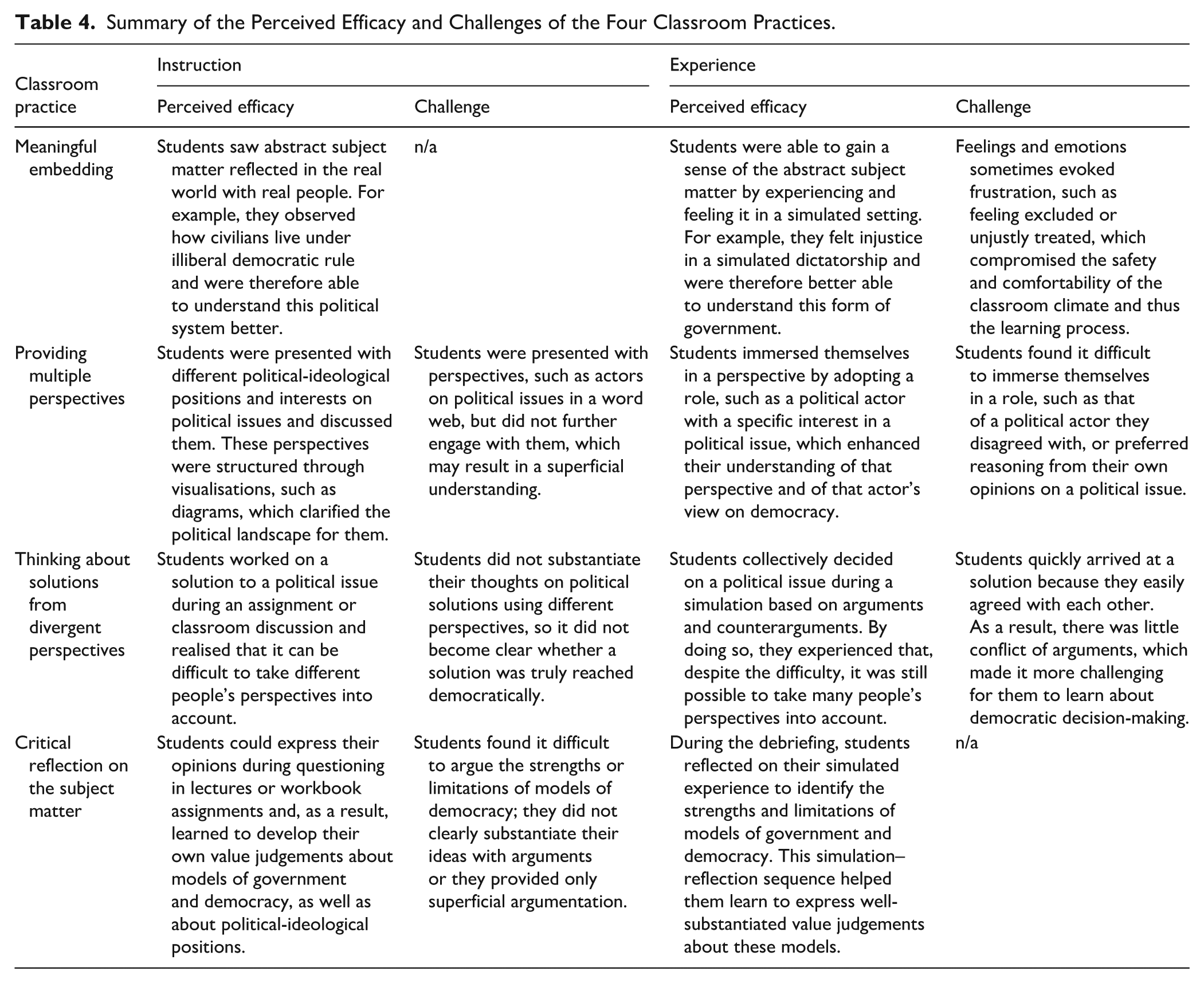
Table 4 summarises the perceived efficacy and challenges of all four examined classroom practices.
Summary of the Perceived Efficacy and Challenges of the Four Classroom Practices.
Conclusion
With this research, we aimed to answer the following research question: How do teachers and students evaluate instruction-based and experience-based teaching methods, and the classroom practices they are based on, in terms of their perceived efficacy and challenges for learning about democracy? We found that both sets of lessons evaluated in this study have the potential to positively impact how students learn about democracy. This is particularly noteworthy for students in secondary vocational education, who often come from lower socio-economic backgrounds and tend to be less politically engaged than their academically educated peers (Bovens & Wille, 2017; Savage et al., 2021). Teachers and students in our study found (a) the lessons meaningful when the subject matter was connected to people’s daily lives or directly experienced by the students themselves; (b) being provided with multiple perspectives helped students better understand the political landscape and the arguments behind different models of democracy; (c) thinking about political solutions from divergent perspectives made them recognise the challenges of democratic decision-making; and (d) critically reflecting on the subject matter helped them articulate and substantiate their value judgements about models of government and democracy, as well as their political-ideological positions. We also found several challenges. In instruction-based lessons, there was little engagement with different perspectives, and political solutions and value judgements were sometimes superficially substantiated. In simulations, strong emotions could arise, some students were unwilling or unable to empathise with a role, and in some cases students reached consensus too quickly.
Discussion
Meaningful Embedding and Dealing With Emotions
One finding of this study is that the lessons were perceived as meaningful, particularly when the abstract concept of democracy was linked to real-life experiences. Democracy is thus not only an abstract and complex concept but also something that can be made concrete for students (Löhr, 2019). In this case, democracy was made concrete because abstract democratic concepts were illustrated through examples and videos (instruction-based) and because these were embedded in sensory-motor experiences (experience-based; Lebert & Vilarroya, 2024; Smets, 2024). According to the teachers and students, the lessons allowed students to see and feel democracy in action, helping them attach meaning to democratic concepts and better understand their practical implications. Also, consistent with Rosiek (2003), meaningful embedding in the evaluated lessons sometimes triggered students’ emotions, which may foster deeper emotional engagement with the subject matter. However, teachers must be aware of the discomfort that emotions may cause, especially when focusing on sensitive topics like dictatorship and exclusion during decision-making.
Making the subject matter meaningful therefore involves a potential dilemma concerning offering an authentic, emotionally engaging experience versus maintaining a comfortable and safe learning environment with fewer emotions. Our results show that an emotionally engaging experience is perceived as efficacious; for example, when students experience injustice in a simulated dictatorship, it evokes genuine emotions and therefore potentially fosters a better understanding of the concept of dictatorship. However, this also entails a risk, because students may experience negative emotions as frustrating, which can compromise the comfortability and safety of the classroom climate (cf. Pace, 2019, on dilemmas surrounding classroom safety). Our results thus indicate that there can be a trade-off for teachers between predominantly comfortable learning experiences with few emotions vis-à-vis experiences that evoke stronger emotions, which may enhance learning but can also trigger emotions so intense that they hinder it (see also Sheppard & Levy, 2019).
Multiple Perspectives, Collective Problem-solving and Stimulating Conflict
The results also indicate that both teachers and students found that providing multiple perspectives – through the use of diagrams or role immersion – helped students develop a clearer overview of these perspectives. To promote a deeper understanding of multiple perspectives, previous studies emphasise the importance of moving beyond the mere presentation of opposing views and actively engaging students in perspective-taking, particularly with perspectives that challenge their own (Gehlbach, 2011; Gehlbach et al., 2008; Lo & Parker, 2016; Sandahl, 2020). The findings of this study suggest that this was successfully achieved through role immersion in the evaluated simulations, where students were required to reason from alternative viewpoints. In contrast, the instruction-based lessons in this study were less successful in this regard, because perspectives were often only explained and not further explored by students.
Another finding is that, according to both teachers and students, students gained insight into democratic decision-making processes by exploring collective solutions to political issues. This was integrated into the lessons through structured sequences of questions in written assignments (instruction-based) and through predefined decision-making procedures embedded in simulations (experience-based). The importance of this for learning aligns with previous research – both on instruction-based and experience-based teaching – which suggests that breaking down complex subject matter, such as decision-making processes and negotiations, and having students practise them step by step helps them understand these concepts better (Rosenshine, 2009; Wright-Maley, 2015). It is noteworthy that both diverse teaching methods can be successfully used to support students in understanding how collective solutions to political issues are developed, indicating that both methods can be valuable for learning about democracy.
Additionally, when learning about collective solutions, it is considered important that students experience sufficient conflict and that they substantiate their solutions from multiple perspectives (Guérin, 2017; Hess & McAvoy, 2015). However, this proved to be a challenge in the instruction-based lessons because students sometimes worked individually and occasionally chose one-sided solutions. Furthermore, the results indicate that finding collective solutions was also challenging during simulations, as students sometimes reached consensus too quickly (similar findings by Dack et al., 2016). This was especially the case in simulations when students reasoned from their own perspective rather than from a prescribed role. Therefore, in both teaching methods, ensuring that students arrive at a solution by considering divergent perspectives remains challenging.
This study also reveals a potential dilemma concerning collective problem-solving based on assigned roles versus problem-solving based on students’ personal perspectives. In the present study, students enjoyed collective problem-solving from their own perspectives, which aligns with research showing that speaking from personal viewpoints is positively related to enjoyment (Graf et al., 2024). However, the findings also show that in simulations where students hold similar opinions – or may be debate- or conflict-avoidant (K. E. Dahl, 2024) – speaking from personal viewpoints may lead to premature consensus and limit engagement with divergent perspectives (see also, e.g. Smith and Stitzlein, 2024, on the “oneness” of opinions). In contrast, our findings also indicate that role-taking in such simulations can foster better understanding of divergent views (see also Lo & Parker, 2016), but students often found role-taking difficult or less enjoyable. This indicates that there can be a trade-off for teachers. On the one hand, there are activities involving role assignment that foster substantial conflict, but these may be more demanding or less enjoyable for students. On the other hand, there are activities in which students speak from their own views, but when these views are quite similar to one another, opportunities to learn about divergent perspectives and the complexities of collective problem-solving may be limited.
Stimulating Critical Reflection
The findings of this study further suggest that, during classroom discussions and reflections, students found it interesting to explore their personal value judgements on models of government and democracy, as well as political-ideological positions. However, higher-order critical thinking – where students, for instance, use arguments to support their ideas – can require significant effort from teachers (Newmann, 1991; Onosko, 1991). One way to foster higher-order thinking is through an experience-reflection sequence, such as in simulations (Crookall, 2023; Kolb, 1984). The efficacy of this approach for learning about democracy is supported by this study’s results. Students directly experienced and observed the strengths and limitations of models of government and democracy in simulations. They were then able to clearly articulate these strengths and limitations during debriefing. In the instruction-based lessons, however, there were instances where students seemed to struggle to express themselves in depth during the workbook assignments, as they sometimes were unable to come up with arguments on their own or provided limited substantiation for their ideas. This may be due to the fact that the type of student involved in this research sometimes finds argumentation – especially in writing – challenging, which indicates the need for more structured attention to academic literacy and critical thinking, possibly supported by additional scaffolding from teachers (e.g. Konstantinidou et al., 2023; López et al., 2023). Thus, promoting higher-order critical reflection among these students through instruction-based lessons requires considerable effort.
Limitations
This qualitative, exploratory study was conducted specifically in secondary vocational education in the Netherlands. As a result, we gained in-depth insights into this educational context, but these are not directly generalisable or transferable. Therefore, further qualitative and quantitative research is needed among other student populations in different educational tracks and national contexts. Also, the researchers’ involvement in lesson design, observations, and interviews may have influenced the results. The researcher asked the participants to be as honest and critical as possible during the interviews and used probing questions that invited criticism, like “what went less well during the teaching method?” or “what do you think could be improved?”; however, participants might still have responded more positively in the presence of the lesson designer during interviews (McKenney et al., 2006). Furthermore, the findings may be influenced by teacher-related factors like personality and teaching style, or by the subject matter covered during the lessons. Although both sets of lessons covered similar subject matter, their emphasis differed. For example, forms of democratic decision-making was a central theme in the experience-based lessons but was only addressed in one of the instruction-based ones. Therefore, differences in the evaluations may reflect variations in subject matter or teacher characteristics, rather than the teaching method alone. For this reason, we are cautious about making direct comparisons between the teaching methods based on our results.
Implications for Teaching Practice
The results of the present study have several practical implications for teachers. Our findings show that teachers can use the different classroom practices integrated into the instruction-based and experience-based teaching methods examined in this study, which may be effective in stimulating democratic competences and values. Therefore, when designing and implementing lessons, teachers elsewhere can adopt the methods and practices used in the present study. Although the teaching methods and classroom practices in our study are tailored to democracy in the Netherlands (see Andeweg et al., 2020), the findings are also relevant to other countries, as the methods and practices are based on studies conducted in various political and cultural contexts. The methods and practices from the present study can thus be adjusted to the political system of the specific country in which a teacher works and to the sociopolitical issues that are salient there. Teachers can make the subject matter meaningful by allowing students to experience democratic decision-making on urgent issues within country-specific institutions, by exposing them to different perspectives on country-specific political issues, by encouraging them to think about solutions from those perspectives, and by prompting them to reflect critically on decision-making processes in that country. In addition, similar to the lessons in the present study, it would be valuable for teachers to compare forms of government and democracy in the country in question with those of other countries.
This study also shows that, in designing and implementing lessons on democracy, there are challenges that teachers should take into account. During simulations, teachers need to be aware of students’ backgrounds and likely emotional responses, and they may use “de-escalation techniques” (Pace, 2019), such as avoiding placing students who might feel angry or offended in uncomfortable roles (e.g. a minority position or an unjust role) and meeting with them one-on-one before or after the lesson. Teachers might also allow for emotional release after the simulation and create space to discuss these emotions during the debriefing (Crookall, 2023). In addition, prior research indicates that teachers need a solid understanding of the subject matter and the skills to ask thought-provoking questions that help students understand it (Wilen, 2001). For the lessons in the present study, this means having a good grasp of fundamental aspects of different forms of government and democracy, their strengths and limitations, and how these are integrated into the assignments and the simulations. Teachers also need to be able to question students’ value judgements through open and follow-up questions, inviting them to respond to one another and asking them to justify their views with arguments, for example by drawing on their simulation experiences.
This study also has implications for teacher education programmes. For instruction-based lessons, such programmes can support preservice teachers by first having them analyse students’ democratic reasoning. Based on this analysis, preservice teachers can develop skills to stimulate their students’ critical thinking, such as which questions to ask, what feedback to provide, and which scaffolds to offer (see, e.g. Klijnstra et al., 2024). For experience-based lessons, teacher training programmes can focus on preservice teachers reflecting in advance on how their students might respond to democracy simulations, for teacher educators to model simulation practices, and for preservice teachers to rehearse simulations themselves (see, e.g. Lampert et al., 2013; Loughran & Berry, 2005). This can help them understand, for example, their students’ emotions or the possible emergence of conflict or consensus, and how to anticipate these reactions.
In conclusion, evaluating the four classroom practices integrated into the lessons provided valuable insights into the mechanisms of instruction- and experience-based teaching for democracy. This study clarified how teachers and students perceive these classroom practices as efficacious for learning about democracy, alongside the challenges involved. Future research could further investigate the actual effectiveness of these methods when incorporating such classroom practices. This could contribute to a better understanding of how to design effective democracy lessons for vocational education students.
Footnotes
Appendix A
Appendix B
Appendix C
Appendix D
Acknowledgements
We thank Tom van der Meer for his input and comments, and Suheda Candan for her coding work.

Funding
The authors received no financial support for the research, authorship, and/or publication of this article.
Declaration of Conflicting Interests
The authors declared no potential conflicts of interest with respect to the research, authorship, and/or publication of this article.