






Abstract
This study examines how genocidal violence reconfigures lived space in the Gaza Strip and explores how Palestinians experience and re-signify places through everyday practices of survival, memory, and resistance. Drawing on debates on genocide, affective geographies, and settler colonialism, the study conceptualizes space as both a target of violence and a site of refusal. Between December 2024 and January 2025, 24 Palestinians living under siege in Gaza participated in a qualitative study. Using WhatsApp, participants shared photographs, videos, voice notes, and written reflections about places of personal, emotional, and symbolic significance. These multimodal materials were analysed through Reflexive Thematic Analysis informed by a psycho-cartographic approach. Four interrelated themes were identified. First, participants described fragile sanctuaries—including rooftops, cafés, courtyards, and the sea—that provided moments of psychological relief and continuity. Second, familiar environments became haunted geographies marked by trauma, bereavement, and destruction. Third, forced displacement generated overcrowding, alienation, and profound disruptions to belonging and identity. Finally, practices of care, study, and remembrance enacted sumud, transforming devastated places into sites of resistance and perseverance. The findings demonstrate that genocide operates not only through the destruction of bodies and infrastructure but also through the reconfiguration of lived space. At the same time, Palestinians actively reclaim and remake space through everyday practices of memory, dignity, care, and collective survival. The study highlights how space functions simultaneously as a target of genocidal violence and as a medium through which people sustain presence, meaning, and agency under ongoing colonial violence.
Introduction
In contexts marked by war, military occupation, and enduring colonial structures, space cannot be seen as a neutral or pre-existing container of human action. It must instead be understood as deeply entangled with power, violence, and survival. This is starkly evident in Gaza, where since October 2023 the population has faced an ongoing genocidal campaign carried out by the State of Israel. Over nearly two years, this campaign has combined relentless bombardment, systemic deprivation, and mass forced displacement (Abuward et al., 2025; Albanese, 2024). Yet this violence is not an isolated episode; it represents the latest stage of a protracted settler-colonial project rooted in decades of occupation, apartheid, and territorial fragmentation imposed by Israeli state policies (Amnesty International, 2022; B’Tselem, 2021; Human Rights Watch, 2021; International Court of Justice, 2024). The spatial dimension of this violence is evident in the targeted destruction of civilian infrastructure—schools, homes, hospitals, archives, and cultural sites—giving rise to neologisms such as scholasticide (the systematic obliteration of educational institutions and the right to education) and domicide (the intentional destruction of dwellings and domestic life). These terms highlight that what is being eradicated is not only the material fabric of the built environment but also the social, symbolic, and affective geographies that sustain collective life and cultural continuity (Ajour, 2025).
Affective geography refers to the understanding of space as emotionally and relationally constituted, shaped through embodied experience, memory, and the circulation of affect rather than solely through material or Cartesian coordinates (Ahmed, 2014; Till, 2005). In this sense, space becomes a living archive of feeling and encounter—produced through the entanglement of bodies, histories, and environments. Against this conceptual backdrop, this article investigates how genocidal violence reshapes lived space in Gaza by examining how Palestinians experience and re-signify places through everyday practices of survival, memory, and resistance. Using a psycho-cartographic approach grounded in affective geography, the study examines participant-generated narratives to illuminate space as both a terrain of violence and a site of sumud, and care.
To situate this investigation within its broader historical and theoretical context, it is necessary to trace how spatial destruction has long functioned as a central strategy of settler-colonial domination in Palestine. This dynamic must be situated within a broader genealogy of settler-colonial strategies that, for decades, have operated through what Sari Hanafi (2012) defines as spacio-cide: the systematic targeting of space, rather than bodies, aimed at rendering Palestinian life unlivable and forcing a so-called “voluntary” transfer of the population. Practices such as large-scale land confiscations, house demolitions, the fragmentation of the West Bank into isolated enclaves, and severe restrictions on mobility were designed to dismantle the spatial, economic, and social infrastructures of Palestinian existence without necessarily resorting to mass killing. The current assault on Gaza, however, marks a historical shift from spacio-cide to genocide. If spacio-cide sought to erase the conditions of Palestinian life indirectly by making space uninhabitable, the present campaign openly targets both people and place. Schools are not only bombed but erased as sites of memory, continuity, and future-making. Homes are not simply damaged but obliterated as structures of intimacy, dignity, and emplacement. Through this escalation, the destruction of space no longer functions merely as a tool of displacement but becomes an extension of genocidal intent—seeking not only to remove Palestinians from the land but also to annihilate the spatial conditions that make Palestinian life imaginable, livable, and narratable (Ajour, 2025; Hanafi, 2023).
Within this framework, space emerges as neither passive nor peripheral but both a central target and an instrument of colonial domination. The ongoing campaign against Gaza operates simultaneously across multiple spatial registers. First, space becomes an explicit object of violence through bombardments, infrastructural demolitions, and systemic blockades that dismantle the material conditions of life (Abuward et al., 2025). Second, it functions as a medium of control: forced evacuations, militarized confinement, and prolonged siege regimes fragment the territory and immobilize its inhabitants. Finally, space operates as a tool of erasure, as the destruction of homes, archives, schools, and cultural sites severs the ties between Palestinians, their memory, and their geography. Taken together, these strategies enact a form of processual genocide—a slow, accumulative project that extends beyond physical annihilation to expel Palestinians from both history and geography, transforming Gaza into a landscape of disappearance (Ajour, 2025; Hanafi, 2023).
Long before the current genocidal campaign in Gaza, Palestinian feminist scholars and social work practitioners had already articulated Palestine as a central concern for feminist social work, insisting that colonial violence must be confronted as both a spatial and professional problem. Writing from within and beyond occupied Palestine, Shalhoub-Kevorkian et al. (2022) contend that the enduring silence of social work—including feminist social work—on Israeli settler colonialism amounts to a form of complicity. By refusing to name occupation, apartheid, and racialized elimination, the profession contributes to the construction of Palestinians as having “no peoplehood” thereby erasing their histories, geographies, and ongoing forms of resistance.
Within this context, the concept of sumud —steadfastness—is understood not simply as resilience or endurance, but as a lived and collective practice through which Palestinians sustain presence, attachment to place, social relations, and everyday life under conditions of ongoing settler-colonial violence (Ryan, 2015). Sumud is enacted through ordinary practices of care, dwelling, remembrance, education, and community-making that resist both material dispossession and symbolic erasure (Giacaman, 2020). Palestinian feminist scholars conceptualize these practices as feminist because they centre relationality, care, social reproduction, and the defence of collective life as forms of political resistance against colonial destruction (Shalhoub-Kevorkian et al., 2022). In this sense, sumud becomes a feminist ethical and political commitment that refuses the separation between professional ethics and collective liberation, calling for a praxis of refusal in which social work, research, and pedagogy actively oppose the affective and material machinery of colonial domination. From this perspective, Palestine is not an “exceptional” case at the margins of social work, but a global feminist issue that exposes how settler-colonial projects reorganize space, reconfigure livability, and produce enduring trauma through dispossession, surveillance, and domicide. Research and social work practice, they contend, must therefore function as acts of refusal: making visible the gendered and racialized operations of spatio-cidal and genocidal violence, centring Palestinian epistemologies of resistance and aligning professional ethics with collective struggles for liberation rather than with the managerial demands of colonial states. The present study builds on and extends this lineage of Palestinian feminist social work by tracing how genocidal violence in Gaza is lived, narrated, and contested through space, and by treating research itself as a situated form of witnessing, solidarity, and refusal in the midst of ongoing annihilation.
In the context of this work, space is approached as a politically saturated, emotionally charged, and historically entangled field of struggle—a medium through which both trauma and resistance are inscribed. Rather than treating space as an abstract, empty container detached from human experience, it is crucial to recognize it as a social product, continuously shaped by power relations, institutional infrastructures, and material practices (Lefebvre, 1991). This perspective reveals how, in Gaza, spatial realities are not merely altered by bombs or borders but actively produced through systemic violence, surveillance, and dispossession (Ajour, 2025; Hanafi, 2012).
Research on genocide and spatial violence reinforces this perspective by demonstrating that mass atrocities extend beyond the physical destruction of bodies to encompass the deliberate reconfiguration of space itself. Across genocidal contexts, violence operates not only through killing but also through the transformation of the material, political, and affective geographies that sustain collective life. However, the mechanisms through which space is reorganized vary across historical and political formations. In Bosnia, territorial reconfiguration and forced displacement were used to dismantle multiethnic coexistence and produce ethnically segregated spaces (Bašić & Delić, 2024). In Rwanda, state infrastructures such as schools and local administrative systems were mobilized as mechanisms of surveillance and extermination, later extending into forms of spatial and political control (Nsabimana, 2023; Purdeková & Mwambari, 2021). In Darfur, violence operated through the intertwined destruction of populations, land, and ecological systems, reinforcing displacement and territorial domination (Flint & De Waal, 2008). The Palestinian case shares with these contexts the reorganization of space as a central dimension of genocidal violence, yet it unfolds through the specific logics of ongoing settler colonialism, including land confiscation, territorial fragmentation, restrictions on movement, and the systematic destruction of homes and civilian infrastructures (Ajour, 2025; Hanafi, 2012). Rather than representing distinct phenomena, these cases illustrate how genocidal projects reshape space through different political and spatial technologies while producing comparable effects: the erosion of community infrastructures, the disruption of social worlds, and the imposition of new geographies of control. Across contexts, genocide emerges as a process that reorders sovereignty through the manipulation of territory and the conditions of inhabitation. It produces political and social cartographies grounded in exclusion, displacement, and enforced belonging, revealing that the governance of land and the governance of life are inseparable dimensions of mass violence.
Understanding space as dynamic and relational further underscores its constitutive role in shaping both collective and individual life. Following Massey's (2005) feminist geography, space is not a fixed container or a neutral backdrop for social interaction, but a process — something that is continuously “in the making”. This means that space is produced through interrelations, emerging from the encounters, negotiations, and co-presences that unfold within it across different temporalities. Massey's relational conception of space aligns with feminist and postcolonial theories that challenge static and hierarchical understandings of social structures. Within this view, space is a site of power and possibility, shaped by the intersections of gender, class, race, and cultural belonging (Ahmed, 2006; hooks, 1990; Rose, 1993). The everyday practices and interactions that occur within educational contexts, for instance, actively contribute to the (re)making of these spaces — transforming them into relational terrains where inclusion, recognition, and resistance are continuously negotiated. In this sense, understanding space as “in the making” highlights not only its social and material fluidity, but also its political and ethical dimension: each encounter carries the potential to reproduce or to challenge existing boundaries, thereby participating in the ongoing transformation of institutions and relationships. Applied to Gaza, this conception unsettles depoliticized views of geography, foregrounding how global systems of inequality materialize in the fragmentation of territory, the constriction of mobility, and the governance of life under siege. Gaza thus appears not as an isolated zone of conflict but as a plural and contested geography, sustained by those who continue to live, mourn, and resist within its bounds (Abuward et al., 2025; Gregory, 2004).
Importantly, approaching Gaza as a lived and contested geography also raises important questions about how such spatial experiences can be documented under conditions of ongoing violence. Research across different genocidal contexts has shown that the affective and spatial consequences of mass violence often unfold through fragmented experiences of displacement, loss, and everyday survival, requiring forms of inquiry capable of engaging with these realities. Studies in post-war Bosnia (Palmberger, 2016) and Rwanda (Purdeková & Mwambari, 2021), for example, highlight the importance of methodologies attuned to the spatial and emotional dimensions of life after mass violence. Similarly, feminist and postcolonial scholars have emphasized the value of multimodal and digitally mediated approaches—including mobile messaging, voice notes, and participant-generated photographs—for capturing embodied and situated experiences when physical access is restricted or unsafe (Dennis et al., 2020). Beyond facilitating remote participation, these approaches can foster forms of dialogue, co-presence, and ethical witnessing, transforming digital communication itself into a medium of care and resistance (Gajjala, 2019).
Study Aims and Design
Grounding on the previous premises, this qualitative study examines how genocidal violence reconfigures lived space in Gaza, focusing on how individuals experience, narrate, and re-signify places through everyday practices of survival, memory, and resistance.
Building on postcolonial and critical geographic perspectives (Gregory, 2004; Said, 1979), the study approaches space as a dynamic and co-produced terrain shaped by lived experience, affective attachments, and ongoing structural violence. Within this framework, spatial practices are situated within broader colonial and geopolitical processes, while also recognizing how individuals actively reclaim and re-signify space through embodied and narrative practices. To capture these dynamics, the study adopts a psycho-cartographic approach (Degen et al., 2023; Foland & Lewicka, 2007), understood as an affective and relational mapping practice that anchors participants’ narratives and emotional inscriptions in space. In dialogue with affective geography, this approach enables an exploration of how space is lived, felt, and reimagined under conditions of ongoing violence. From a decolonial perspective (Mignolo, 2011), these practices counter not only material devastation but also the symbolic erasures that attempt to negate Palestinian existence. Digital ethnographic tools, such as WhatsApp, are employed to document participants’ situated experiences and affective geographies in real time, enabling the collection of multimodal accounts of place under conditions of restricted mobility and surveillance (Dennis et al., 2020; Gajjala, 2019). Within this framework, the study explores how space is inhabited, mourned, and re-envisioned under genocidal conditions, highlighting the everyday spatial practices through which Palestinian civilians sustain presence, meaning, and agency (Casey, 2000; Springgay & Truman, 2018; Tuan, 1977).
Researchers’ Positionality
This research was conducted by a collective of five authors: two Italian scholars—a male associate professor of clinical and community psychology and a female postdoctoral researcher in psychology—both based at the University of Milano-Bicocca; one Lebanese woman pursuing a master's degree in psychology at the University of Bologna; and two Palestinian researchers (one woman and one man), both medical doctors specializing in public mental health, who left Gaza at the beginning of 2024 and were displaced in Cairo when the research began. The Italian and Palestinian members had previously met and collaborated in Gaza, maintaining a long-standing relationship of professional cooperation and friendship that extends beyond this project. This shared history fostered a sense of trust, reciprocity, and ethical accountability throughout the research process.
The composition of the team brought together diverse positionalities—academic resources and theoretical framing, regional knowledge, and the lived experience of war and displacement—allowing the study to resist extractive logics and foreground Palestinian voices. Decisions were made collaboratively, with particular weight given to the perspectives of the Palestinian authors, whose proximity to the realities under study infused the work with urgency and ethical responsibility. In this sense, the project was conceived as a feminist and decolonial practice of knowledge production, aiming not only to analyse but also to refuse the erasure of Palestinian presence and epistemologies—an obligation that extends to the scholarly community at large.
Methods
This methodological approach was shaped by the ethical and practical constraints of conducting research amid ongoing genocidal violence, as well as by feminist and decolonial commitments to relational, reflexive, and participant-centred knowledge production. Rather than treating methods as neutral or purely procedural, this section outlines how methodological choices emerged in response to the research context, the positionalities of the research team, and ongoing ethical responsibilities toward participants. Methodological decisions evolved through continuous reflexive dialogue among team members, particularly informed by the lived experiences, ethical perspectives, and situated knowledge of Palestinian researchers involved in the study.
Participants and Recruitment
Participants were engaged between December 2024 and January 2025, during the intensification of military aggression against the Gaza Strip. Data collection took place in a context of acute precarity: unrelenting bombardments, the decimation of healthcare and civilian infrastructure, mass displacement, and the near-total collapse of humanitarian access. These conditions did not simply complicate logistics—they fundamentally shaped the epistemic and ethical terrain of the study, embedding it within a landscape of both vulnerability and resistance.
The research participants were 24 Palestinian civilians aged 18–25, all residing in Gaza at the time. Approximately 64% identified as women, and all participants had been forcibly displaced from their original homes. All identified as Muslim. While not statistically representative, participants reflected a cross-section of voices situated within the violent spatial reconfigurations produced by war, occupation, and systemic dispossession. A purposive and convenience-based recruitment strategy was adopted, grounded in proximity, relational access, and ethical considerations arising from conducting research during ongoing genocidal violence. Initial participants were contacted directly by Palestinian members of the research team through pre-existing professional, academic, and community relationships developed prior to the study. These relational networks enabled trust-based recruitment in a context marked by insecurity and restricted mobility.
Recruitment was conducted through direct outreach via WhatsApp, which functioned as a vital and widely used communication channel under siege conditions. By direct outreach, we refer to Palestinian members of the research team personally contacting friends, colleagues, fellow researchers, and individuals involved in community initiatives. Following these initial contacts, recruitment expanded organically through snowball sampling, as participants invited others within their social networks to take part in the study. This process enabled the inclusion of individuals across multiple locations within Gaza, including North Gaza, Jabalia, and Rafah—areas deeply affected by displacement and humanitarian crisis. The resulting group of research participants reflects a range of gendered, spatial, and displacement experiences, offering a situated lens on how space is lived, narrated, and reimagined amid violence. Inclusion criteria required participants to be non-combatant Palestinian civilians aged 18–50, residing in Gaza, and willing to share personal reflections on places of emotional or symbolic significance within the Strip. Participants also needed access to WhatsApp to submit visual materials (photographs or videos) alongside written or audio-recorded narratives. Informed consent—negotiated with care and clarity—was obtained under conditions of heightened surveillance and existential uncertainty.
Instruments and Procedures
Given the severe constraints on mobility, safety, and infrastructure, all data were gathered remotely, with WhatsApp serving both as methodological tool and infrastructural lifeline. Far from neutral, WhatsApp functioned as a relational space—an interface of intimacy, urgency, and care—through which participants shared fragments of their spatial worlds under siege. Participants were invited to document sites in Gaza with personal, emotional, or symbolic resonance. These were captured through photographs or short video recordings, often accompanied by commentaries elaborating on their significance. To foster narrative depth, affective engagement, and reflection, participants responded to four open-ended prompts intentionally designed to elicit multilayered narratives of place that move between description, affect, and political testimony.
“Where is this place?” “Why does this place matter to you?” “Describe how you feel and what comes to mind when you’re in that place.” “What is your message to the world?”
The question encouraged participants to locate themselves spatially, articulate attachment and meaning, evoke embodied memories, and assert agency by addressing the world beyond siege. This structure draws on affective and decolonial methodologies (Cunsolo & Ellis, 2018; Springgay & Truman, 2018), which foreground relational inquiry and the ethical act of speaking from lived experience. Responses included voice notes, written reflections, photographs, and videos—shared asynchronously through WhatsApp. This multimodal approach enabled layered storytelling, weaving together affect, memory, place, and resistance. It allowed participants to articulate their lived geographies not only through words but also through visual and embodied testimony, asserting life and meaning even within devastated terrains. Data collection proceeded iteratively until thematic saturation was reached. Rather than imposing a rigid cutoff, the process remained responsive to the rhythms and constraints of participants’ lives, shaped by displacement, trauma, and the constant threat of violence. The resulting corpus reflects not only the emotional geographies of individuals but also a collective cartography of place-making, grief, and refusal in the face of erasure.
Data Processing and Analysis
The analysis integrated thematic and spatial dimensions, allowing participants’ place-based testimonies to emerge without enforcing a linear or chronological framing of displacement. Rather than constructing fixed trajectories or pathologizing movement, the research honored the fluid, fractured, and affectively charged ways participants inhabit and recall space under conditions of protracted violence. To this end, the research team used Polarsteps—a commercial travel-tracking app—reappropriated not to surveil movement but to visually anchor the spatial references articulated in participants’ narratives. These digital maps became interpretive scaffolds: sites where meaning, memory, and spatiality converged.
During data collection, participants were invited—though not required—to geolocate places they found emotionally or symbolically significant. These spatial references emerged organically through multimodal submissions: voice notes, texts, photographs, and videos. Rather than tracing routes of exile or mobility, the aim was to document the affective geographies of participants’ lived worlds—the places where grief settles, resistance is whispered, and memory clings. The dataset was compiled from participants’ multimodal submissions, including written messages, transcriptions of voice notes, and transcriptions of short video recordings. All verbal content was first transcribed in Palestinian Arabic and then translated into English by Arabic-speaking members of the research team, who attended carefully to the linguistic and emotional nuances of the original expressions. The translated transcripts were organized into Word documents, which served as the primary corpus for analysis. Visual materials—such as photographs and videos—were also analysed and then triangulated with the themes emerging from the textual transcripts. This parallel analysis enabled the team to explore the interconnections between verbal, visual, and spatial articulations of experience. The translated excerpts were then embedded as narrative captions within each participant's Polarsteps map, alongside their submitted media, situating language and image in place. These annotated maps functioned as analytical instruments, enabling a multilayered reading of space not simply as backdrop but as co-constructed with story and subjectivity. They facilitated the identification of recurring spatial motifs and emotional topographies, grounding the analysis in both individual experience and collective resonance.
A Reflexive Thematic Analysis (RTA) (Braun & Clarke, 2019) was conducted across the full corpus of translated transcripts. Thematic development was inductive, interpretative, and critically reflexive, acknowledging the research team's positionality and the ethical tensions inherent in representing voices shaped by ongoing colonial violence. This analytic approach was chosen because it aligns with the study's commitment to relational and decolonial inquiry, privileging participants’ meanings and emotions over predefined theoretical coding frames. Reflexive Thematic Analysis enables the researcher to engage deeply with lived experience, affect, and narrative texture, treating interpretation as a co-constructed and ethically responsive act (Braun & Clarke, 2021). Verbal and visual data were analyzed in parallel, allowing for a textured interpretation of how spatial and symbolic meanings were narrated and embodied. Coding was conducted collaboratively through iterative cycles of reflection, dialogue, and self-scrutiny. Rather than striving for consensus or eliminating divergence, the team welcomed interpretive tensions as generative, reflecting the plural and sometimes contested ways that meaning travels through space, memory, and discourse. This integrative analytic process yielded themes that were at once intimate and political, grounded in the particularity of place while resonating across broader narratives of loss, endurance, emplacement, and refusal. In mapping these themes, the analysis surfaces the psycho-spatial grammars through which Palestinian participants continue to articulate presence, belonging, and life in a landscape marked by systemic erasure.
Ethical Considerations
This study adhered to the ethical principles of the American Psychological Association (APA, 2020) and the Declaration of Helsinki. Approval was obtained from the Institutional Review Board of the University of Milano-Bicocca (Protocol No. 0201074). Given the ongoing military aggression and structural violence in Gaza, ethical engagement extended beyond formal compliance, grounding the research in practices of relational accountability and situated care. Participants were fully informed—through accessible language and dialogic processes—about the aims, procedures, and potential emotional implications of the study. Informed consent was explicitly obtained for the sharing of photographs, videos, voice notes, and written reflections. Participants retained autonomy throughout: they could withdraw at any time or withhold content they perceived as distressing or unsafe to share.
WhatsApp was selected not only for accessibility but because it represented an already familiar and routinely used communication tool for participants under conditions of siege. Participation occurred through voluntary and asynchronous exchanges, allowing individuals to respond at moments they perceived as safe. Participants were informed about potential digital risks and retained full control over what materials to share, when to respond, and whether to withdraw. The use of an everyday platform minimized additional exposure while supporting participants’ sense of agency and autonomy. As emerged, ethics in this study was therefore approached not as procedural formality but as an ongoing, adaptive practice—rooted in empathy, reflexivity, and solidarity with those navigating the intersecting wounds of colonization, displacement, and genocidal violence.
Results
Reflexive Thematic Analysis revealed four entangled and relational themes that trace the ways individuals inhabit, contest, and re-signify space under genocidal violence and protracted displacement. These themes do not emerge as bounded categories but as overlapping affective landscapes—shifting constellations of memory, grief, and resistance—that foreground how space is lived, felt, and politicized in the midst of a catastrophe.
Certain places were evoked as precarious sanctuaries: physical, emotional, and psychological refuges carved out in the ruins of everyday life (Theme 1). Often precarious and improvised, these spaces nonetheless bore immense weight—as temporary anchors of safety, intimacy, and emotional coherence in the face of unrelenting assault. Other spatial narratives were saturated with the debris of trauma and mourning (Theme 2). Participants described environments—homes, neighborhoods, coastal areas—not simply as sites of destruction but as haunted geographies where memory and absence combine. Here, space itself bore witness to annihilation, embodying the intimate stream of loss, death, and dispossession. Forced displacement, relentless and recurring, emerged not only as the erosion of physical shelter but as a dismembering of spatial identity (Theme 3). The act of being uprooted disrupted more than geography—it fractured the temporal and relational threads through which people locate themselves in the world. Participants spoke of the exhaustion of impermanence, the psychic erosion of exile, and the emotional violence of being denied continuity, belonging, and the right to dwell. And yet, against this architecture of erasure, place also surfaced as a terrain of persistence (Theme 4). Participants invoked certain spaces—rooftops, cemeteries, alleyways, agricultural plots—not merely as nostalgic sites of memory, but as living grounds of resistance. These were spaces where presence was reclaimed and history inscribed in the face of obliteration. Through acts of narration, remembrance, and care, these places became expressions of refusal: refusals to be unhomed, to be made invisible, to be forgotten. Taken together, these thematics expose the Gaza Strip not simply as a zone of conflict but as a deeply storied, spatially contested terrain in which the political, emotional, and geographic cannot be disentangled. Here, space is not neutral ground but an active participant in the unfolding of violence and the cultivation of resilience—a dense, affective archive of survival, rootedness, and unyielding agency.
Theme 1- Places of Physical, Emotional and Psychological Refuge
Within the relentless landscape of genocide, repeated displacement, and collective loss, participants evoked certain places as vital lifelines—sites of physical, emotional, and psychological refuge that enabled them to endure both external violence and internal fragmentation. These were not merely shelters or functional spaces; they were affective anchors—saturated with memory, meaning, and symbolic force. They held traces of who participants had been before the war, offering fragile continuity amid rupture.
In participants’ testimonies, these places emerged as necessary counterpoints to chaos—spaces that sustained the possibility of presence, relationality, and emotional coherence. Whether a rooftop at sunset, a quiet corner of a once-lively café, the rhythmic pull of the sea, or a bustling market alley momentarily shielded from drones and sirens, these locations offered more than safety. They became temporary sanctuaries where grief could pause, identity could breathe, and emotional life could persist in defiance of erasure. The significance of these spaces lay not in permanence or protection from physical harm but in their capacity to hold the emotional overflow of war—to absorb exhaustion, carry memory, and remind individuals of their ability to feel, connect, and endure. Often modest or transient, these places became intensely charged with meaning, showing how, even amid destruction, inhabiting space remains an act of resistance—a quiet insistence on survival, rootedness, and the irreducible humanity of those who refuse to be unmade. One participant described entering a small café and feeling transported beyond the context of genocide: “When you step inside [the café], you feel like there's no war happening at all. It's so surreal that even the sound of the drones … Disappears inside” (M., 23 years old).
The calm, the green courtyard, and the simple presence of people not visibly burdened by humiliation or displacement became a powerful contrast to the outside world. This sense of psychological escape was echoed by another participant who shared: “Honestly, I feel a great sense of comfort—a comfort where I can hope, where I can take a break and feel like, ‘Oh, no, we are not in a war’” (W., 21 years old). These statements underscore how even temporary moments of relief from constant fear are emotionally life-sustaining.
Refuge was not only about peace—it was also about memory. Many of these places were infused with associations to loved ones who had been lost or separated. The rooftop of a home once filled with family gatherings became a space of profound remembrance: “Our laughter filled the space, our talks were endless, and happiness ran deep within us. I wish those days would return, but that is impossible … But the memories remain in my mind and heart” (W., 20 years old).
These memories, though painful, were not sources of despair. Instead, they affirmed the depth of past connection and helped preserve a sense of continuity with a life that no longer exists. Alongside remembrance, many of these places nurtured a sense of hope. Hope was not expressed abstractly, but embodied through visual connection, physical presence, or daily rituals. One participant, standing near the edge of a region bordering her original place in Rafah, expressed: “As long as I can see her in front of my eyes, then there remains hope to return to it” (W., 21 years old).
Another participant, still grieving her mother's illness and the destruction of a local hospital, expressed how even imagining its reconstruction kept her emotionally anchored: “Just as I was once a witness to this hospital's destruction, I hope to one day witness its restoration, and to work in it as an occupational therapist, for the service of my people” (W., 23 years old).
Many participants also emphasized how these spaces allowed them to reconnect with themselves—not just with loved ones or the past. Reclaiming pre-genocide identity in the midst of war violence was a recurring theme. “This place brought me back to who I used to be … Who had many ambitions in life” (M., 20 years old). Reengaging with daily habits or activities—drawing, walking, studying, observing nature—helped reconstruct a sense of agency and internal coherence. As one person recalled: “There [in the garden], I breathe fresh air, I don’t see tents … It feels like I’ve gone back to life before the war … Like I’m escaping reality and reliving the memories of my life before” (W., 20 years old).
Another described how washing dishes outside her tent became a quiet, meditative moment: “I also tried to relieve myself a bit emotionally while washing dishes by talking to myself … That was the only activity that happened during my day” (W., 21 years old).
Finally, these places functioned as moments of temporary psychological refuge—not as denial, but as necessary interruption. The local market, though surrounded by displacement, still offered a fleeting return to normality: “The market becomes a temporary refuge … Our small window into something that resembles normal life, even if it is temporary” (M., 25 years old). Another person described how even sitting in a once-beloved park, now encircled by tents, gave her the ability to “Escape, to disconnect from reality” (M., 24 years old). These moments, though brief, allowed people to breathe.
Among the most frequently mentioned and emotionally resonant spaces was the sea. Described not only as a physical destination but as a symbolic and sensory sanctuary, the sea held deep emotional value. “The sea is the place that gives me the most security in the shadow of war. It was the only breathing space for the people of Gaza” (W., 24 years old). The sense of continuity and familiarity the sea offered—despite the upheaval on land—allowed participants to reconnect with their past and momentarily release fear. “Whenever I feel upset, I go to the beach, sit on the sand, and listen to the sound of the waves. It's enough to make me feel relaxed” (W., 19 years old). As another participant reflected: “It is the most peaceful feeling in life and the vastness as far as the eye can see—without demolished buildings or sights of death and destruction” (W., 24 years old).
The sea was described as a place of personal reconnection: “By the sea, I feel like myself again. I feel more creative. I can draw, express myself, and think. You forget everything around you, you put on the headphones, play the songs you love, the sea in front of you, you sit and draw, and just enjoy the moment.” (W., 23 years old) (Figure 1).
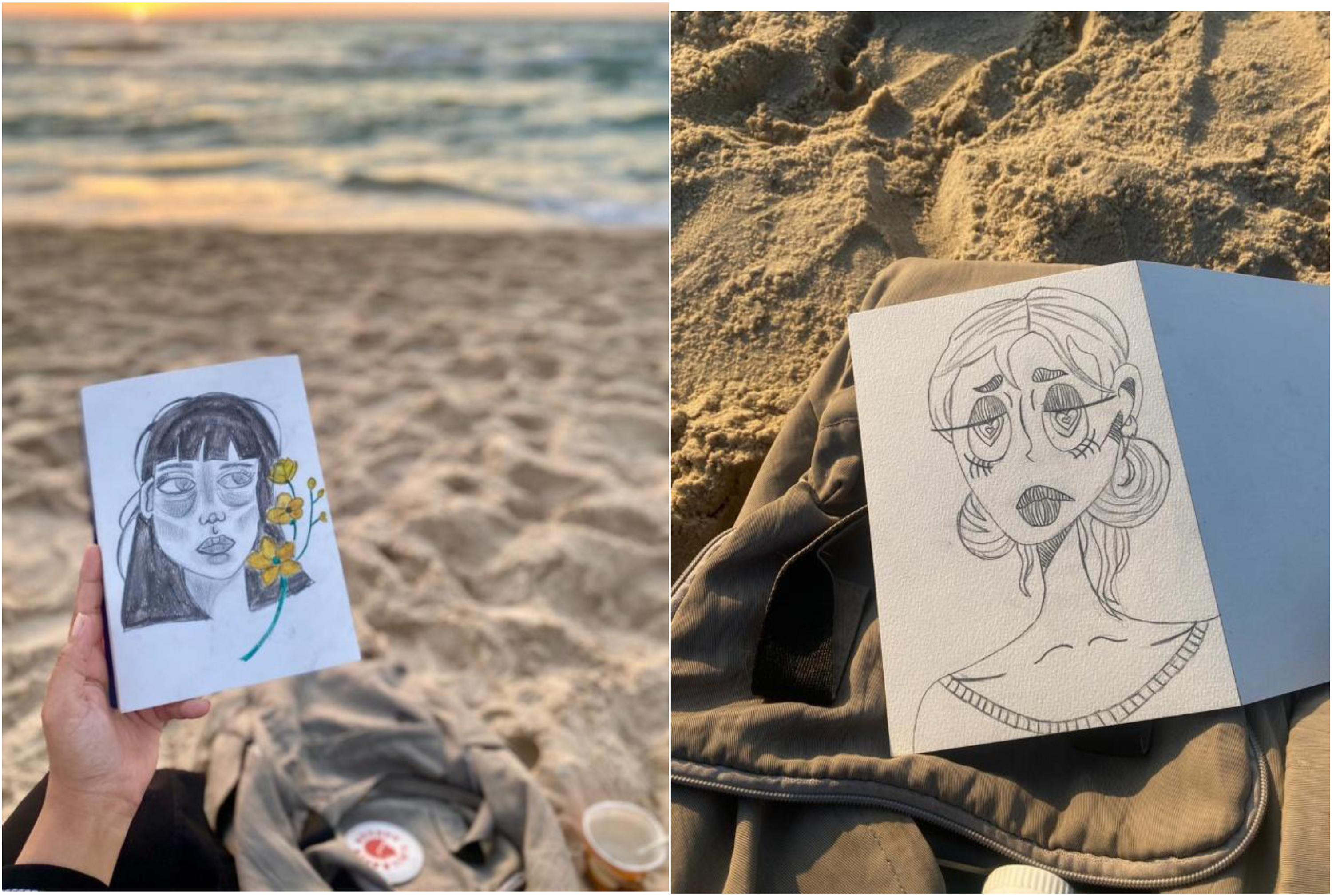
Drawings by the sea as a form of emotional release and self-reconnection, where a participant finds space to create, reflect, and momentarily escape the surrounding reality.
The sea's daily rhythms provided metaphors for psychological resilience: “When the sun rises, it gives me hope that at some point the sun will illuminate the darkness of these days … I like to look at the sunset because it brings me tranquillity and reassurance and I remember that everything has an end” (W., 24 years old). For others, it served as an emotional valve: “I released all my negative energy and left, realizing it was the most needed trip of my life at that moment” (M., 23 years old). Even being alone at the beach became an act of care: “Being alone there, was how I refreshed my soul. I’d stay until 10 PM and then head back home, feeling renewed” (M., 23 years old).
Notably, several participants emphasized how the sea offered relief precisely because it lacked visible reminders of genocidal destruction. The absence of destruction was as psychologically potent as the presence of beauty. “It's one of the very few places still somewhat livable … The air is clean, away from the pollution caused by bombing and destruction” (W., 21 years old). Another noted: “When you look at the sea, you don’t see the destruction … Just the water, the beautiful sunset, and all the negative energy disappears” (W., 19 years old).
When storm damage caused many tents to vanish from the beach, one participant described this sudden emptiness as a quiet form of liberation: “I felt like I was truly displaced to the beach, one that is clean and that could relieve me a bit” (W., 21 years old).
Across all narratives, place emerges as more than geography. It becomes a living vessel for memory, a source of comfort, a spark of hope, and a space of quiet resistance. In a landscape of loss, destruction, and forced fragmentation, these places help individuals hold on—not just to shelter, but to their humanity.
Theme 2- Trauma, Bereavement and Suffering in Space
Emerging across participants’ testimonies was the theme of trauma, bereavement, and suffering inscribed in space. Under conditions of war and genocidal violence, physical places—once ordinary, intimate, or joyful—have been transformed into landscapes of loss, terror, and unresolved grief. Space is not neutral or inert; it becomes an active container of pain, a witness to what has been destroyed, and at times, a haunting presence that refuses to be silenced.
Participants described how once-familiar environments—homes, alleyways, playgrounds, and streets—have become saturated with absence. These are spaces where loved ones died, homes were reduced to rubble, and survival meant constant proximity to death. In this altered geography, even remembering a place carries a visceral charge, summoning not only what was lost but also what endures as haunting: the smells, the silence after an explosion, the empty chair at a family table.
Spatial memory thus becomes both a source of connection and a wound. Places are no longer mere settings for experience—they are infused with aftermath, with the psychic residue of violence. The very ground is marked by rupture, and each return to a familiar site is shadowed by its transformed significance. The emotional geography that emerges is one of coexisting temporalities: the past embedded in the present, and the weight of memory pressing into each step.
In this context, space becomes an archive of suffering—where trauma is not abstract but located, situated, and intimately tied to the materiality of place. These geographies of bereavement are not static; they continue to shift with each new loss and repeated displacement. Yet in being narrated, mapped, and remembered, they also become testimonies—fragments of a collective memory that refuses erasure and challenges the dehumanizing flattening of life into statistics. One participant noted how: “Everyone here is suffering in silence. No one is paying attention to this massacre and genocide we are living through and enduring without being guilty of anything” (W., 23 years old).
In walking through a market, another recounted being overwhelmed by contrasts—abundance and inaccessibility, presence and deprivation: “As long as I walk, I feel a sense of sorrow. When I see, for example, someone buying something that I can’t afford … You feel a deep sense of sorrow. My life before was different—never in my life was I deprived of anything, I used to buy whatever I wanted. But now … Survival is the goal. Everything we manage to get comes with difficulty, sorrow, and suffering” (W., 23 years old).
These places are laden with the visible signs of collective hardship: scarcity, inflated prices, and desperation. Sorrow was also evoked by the sight of others’ suffering—children begging for food, families unable to afford bread. Even the sea, once a beloved space, became ambiguous. While for some it remained a breathing space, for others it evoked the contrast between what was and what is.
As one participant shared: “Sometimes, I feel sorrow for myself” (W., 25 years old). Another said: “Now … The sea tells a different story, a story of pain and sorrow. For an entire year, I avoided going to it. Not because it was no longer beautiful, but because the people I would have loved sharing those moments with were no longer here” (W., 20 years old).
Experiences of trauma were frequently tied to displacement and acts of violence, often witnessed from or within specific places. Homes, hospitals, and even roads became sites of existential threat. The memories anchored in these locations often involved the proximity of death, forced flight, and physical destruction. One participant recalled: “We saw and lived death in the most horrifying ways … The road was extremely uneven … But God's mercy was greater. I managed to reach a place where people were gathered and, still holding onto my mother's wheelchair, I called my father to tell him that, against all odds, we were still alive” (W., 23 years old).
Such trauma is not contained to a moment but reshapes one's relation to place entirely. Familiar spaces like hospitals or schools were either destroyed or turned into battle zones. One participant expressed the emotional toll of this transformation vividly: “Every time I pass by the hospital, I feel a deep sense of sorrow and bitterness [kaher, قهر]. It reminds me of how much the world has wronged and abandoned us, how no one moved to protect even a hospital. Israel has also shattered every limit and every human right—now, no hospital, no school, no place of worship is beyond the reach of the Zionist machine of destruction” (M., 25 years old) (Figure 2).
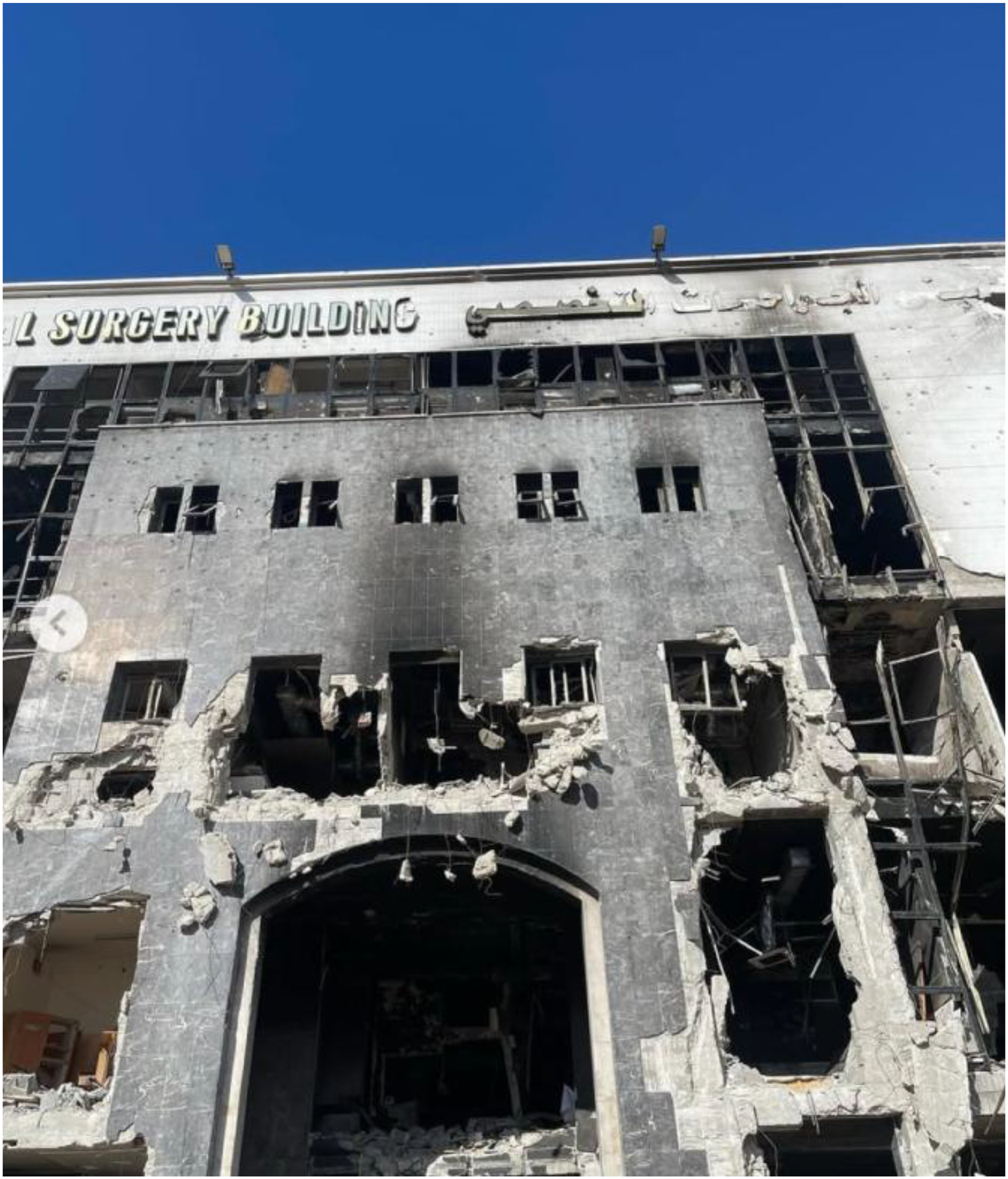
Al-Shifa Hospital in Gaza City: Its destruction symbolizes collective abandonment and the violation of sacred spaces. For one participant, the ruins evoke profound sorrow and the collapse of all protective boundaries amid ongoing violence.
The feeling of loss extended beyond death to include lost futures, lost homes, and disrupted identities. Places that once held dreams or routines now symbolize everything that has been taken. “Benz & Benz was the place where I bought my notebooks, pens, and my colours. Now … I just feel a sense of loss. Even the simplest things in my day have lost their flavour and meaning” (W., 21).
Others expressed this sense of rupture through places that were once vibrant with family life, now tied to grief. “The rooftop of this house, to me, is both a source of hope for return and a source of a lot of pain—it reminds me of my lost, martyred family” (W., 20 years old).
For some, places became bridges between worlds—between the living and the deceased. These locations allowed for spiritual intimacy and connection beyond physical absence. One participant shared: “I gaze at the sky and speak to my souls—my martyred family. I talk to them every evening while sitting on the roof of this house … I speak, fully certain that my words will reach them” (W., 20 years old).
Places also underwent emotional shifts. What once was comforting became a site of pain, or paradoxically, both. The sea, for example, which previously offered comfort and routine, became estranged: “Even though the sea is still the sea, I’ve started to unconsciously hate it. Oh God, let the sea be sea again” (M., 23 years old). The transformation of place reflects the emotional disorientation of the genocide.
Overall, these accounts demonstrate that places are not passive backdrops but active participants in the experience of trauma and mourning. Each site carries layered meanings—pain, memory, longing, and resilience. Through their stories, participants reveal a geography of suffering where every road, shoreline, rooftop, and ruined building tells a story of what was lost and what continues to endure.
Theme 3- Psychological Burden of Forced Displacement
The theme of the psychological burden of forced displacement highlights that dislocation extends far beyond physical movement. While the body moves, the mind and heart remain anchored to places of origin, and new locations are rarely internalized as “home”.
Forced displacement becomes a persistent psychological condition, renewed daily by the absence of choice, the loss of privacy, overcrowding, the fragmentation of familial and social bonds, and a chronic sense of alienation and impermanence. Many participants described never truly choosing where they ended up. This is not a matter of resettlement, but of being pushed—forced to occupy available spaces, often for logistical reasons. As one participant recalled, “There is no such thing as choice. Fate brought us here” (W., 21 years old), while another echoed, “We were forced to leave our home under shelling, without knowing where to go” (W., 25 years old). These accounts reflect how agency is stripped from individuals in such moments, deepening the sense of powerlessness.
Yet, even in displacement, the attachment to places of origin remains strong. People speak of maintaining a visual and emotional link to the homes they left behind. For one, the proximity to Rafah and her home provided solace: “It's like I can see it from here, and that makes me feel maybe one day we’ll return” (W., 21 years old). This longing was similarly captured in another testimony, “As soon as my eyes fall on the distant houses, I feel like my heart wants to fly there and embrace my loved ones” (W., 20 years old).
The inability to physically return is compounded by the inadequacy of new spaces. The daily realities of overcrowding and exhaustion strip displaced persons of comfort and dignity. “I lived in so many displacement locations, crowded with people, exhaustion, and noise” (W., 24 years old), and “We struggle with overcrowding in a limited geographic space and the difficult circumstances that have been imposed on us” (W., 23 years old). Even places once associated with calm, like the coastline, have become saturated: “Some displaced people now sleep directly on the sand” (M., 23 years old). Schools too are affected: “We sit on the ground in a small, crowded tent full of girls my age” (W., 18 years old).
Such circumstances create a precarious existence where even the most basic needs are difficult to fulfill. A vivid account describes the despair upon reaching a shelter: “We arrived at the Rimal Clinic where there were already so many displaced people. We looked for a place to stay, but there was none. We ended up sitting in the hallway. Imagine arriving exhausted, after running under bombing, barely escaping death, and finding no place to settle” (W., 25 years old).
In this context, any form of privacy becomes profoundly valuable. As one participant noted, “It's very quiet, and that gives you a bit of privacy—something we’ve been very deprived of in this war” (W., 21 years old). When finally achieving personal space, the emotional weight is immense: “I lived in so many displacement locations, crowded with people, exhaustion, and noise. When I finally got my own tent, I felt like I owned the whole world. My life, me, my daughters, and my husband, within a piece of fabric surrounding a space that I now consider my home, my refuge. When seeing my tent after a long, tiring day of chasing after aid packages and food, I feel comfort, finally, I’ve reached my home.” (W., 24 years old) (Figure 3).
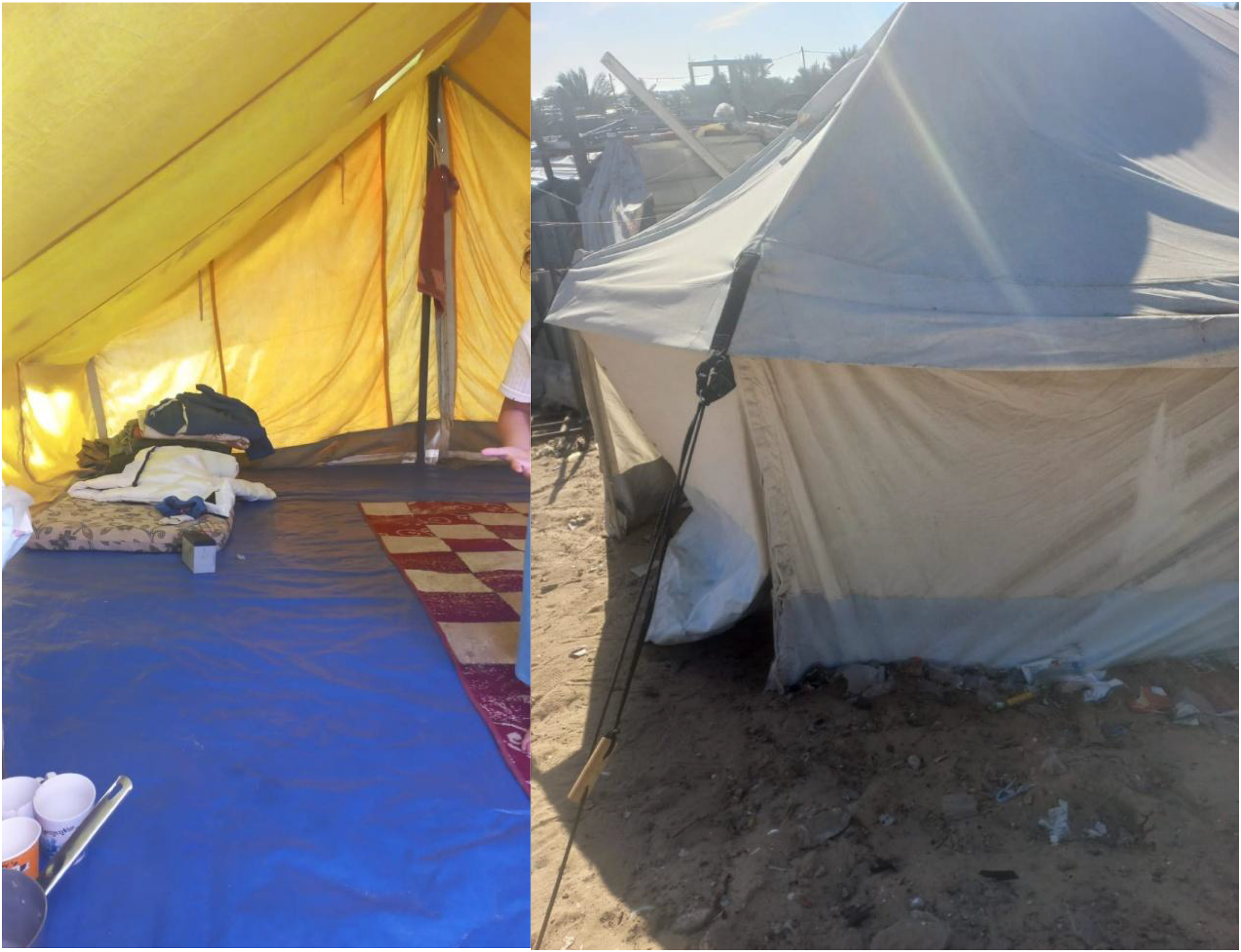
A tent as refuge: This modest shelter became a home, providing a sense of ownership, privacy, and emotional relief amid the exhaustion of displacement.
However, the burden of displacement is not only physical; it extends deeply into emotional and social realms. Forced separation from loved ones results in aching loneliness. One participant described their psychological state after being displaced alone: “After days and nights spent alone in gherba, in places where I knew no one … I finally found a place that reminds me of the dearest people and places to my heart” (W., 20 years old). The sea, once a place of collective joy, has become a symbol of solitude: “The sea in northern Gaza once meant companionship and family to me. It was the voice of life that drowned out everything else […]. But now … The sea tells a different story, a story of pain and sorrow […]. I saw it again during another displacement, and a tape of memories played before my eyes. The sea, which once meant life to me, now means going into the unknown that I see in displacement. And every time I see it, I feel like I am losing a piece of myself.” (W., 20 years old).
Moreover, isolation is compounded by the disruption of communication, as one participant recounted: “We had no internet, no communication. […] We couldn’t know if our loved ones were alive, and they couldn’t know about us either” (W., 25 years old).
Ultimately, forced displacement manifests as a displacing condition on multiple levels: it de-territorializes individuals from their places, uproots their relationships, compresses their vital space, and emotionally and physically isolates them from every form of support. Even when surrounded by others, one often finds oneself in the loneliness of trauma.
Theme 4 -Places of Rootedness and Perseverance Amidst Genocide
Amidst the devastation of genocide, certain places continue to hold deep emotional and symbolic meaning for Palestinians as sites of rootedness, resistance, and perseverance. These places are not merely physical locations—they represent a determined stance against uprooting, a refusal to surrender to erasure, and a testament to the continuity of life in the face of ongoing displacement and destruction.
For many, choosing to remain in a dangerous place is not simply an act of survival but one of profound resistance. One participant explained, “We chose to stay here even though it's considered a very peripheral area … But we chose to stay here because this place means a lot to us. We met people here who embraced us for a long time and are still embracing us” (W., 21 years old). Despite the threat of imminent invasion, the sense of belonging outweighed fear: “We have already experienced more than once, ground invasion into nearby regions, and despite that, we chose to stay” (W., 21 years old). Remaining in the North of Gaza, despite limited access to basic goods and constant bombardment, is itself an act of perseverance: “The feeling I have in these places is the same as every Gazan who has remained and persevered in the north and has been exposed to all this suffering” (W., 23 years old). Similarly, the memory of resistance is tinged with complex emotions: “When I saw it was bombed, I felt deep sorrow … Maybe it was the adrenaline, or maybe it was the sense of responsibility and selflessness that we had” (M., 25 years old).
Perseverance takes root in daily routines, shaped by hardship but imbued with meaning. As another noted: “We’ve reverted to using primitive methods for everything—transportation, baking bread … Everyone here is fighting in order to remain” (W., 23 years old). Even repeated displacement did not erode the spirit of Sumud: “I was displaced so many times during the war, especially since I persevered in the north, in Gaza City” (W., 25 years old). This rootedness is also expressed through places where people reclaim fragments of normalcy. One such site is a shared workspace with electricity and internet. As one participant described: “The place is called [name of the place], it's a space where freelancers gather, and it has electricity and free internet. It is located in Deir al-Balah and was opened in May when we were displaced from Rafah […]. This place brought me back to who I used to be A., who had many ambitions in life […]. But the war had a different plan, it left me spending eight months just filling water, standing in bread lines, and living day by day in fear, tiredness, exhaustion, and witnessing death […]. But, Alhamdulillah, after those months, I joined the [name of the place] team, and now I go there daily from 8 AM to 4 PM […]. When I step into [name of the place], it feels like I can breathe again […]. Being here reminds me of when I used to sit at my desk at home, with a cup of coffee, studying and learning […].” (M., 20 years old) (Figure 4).
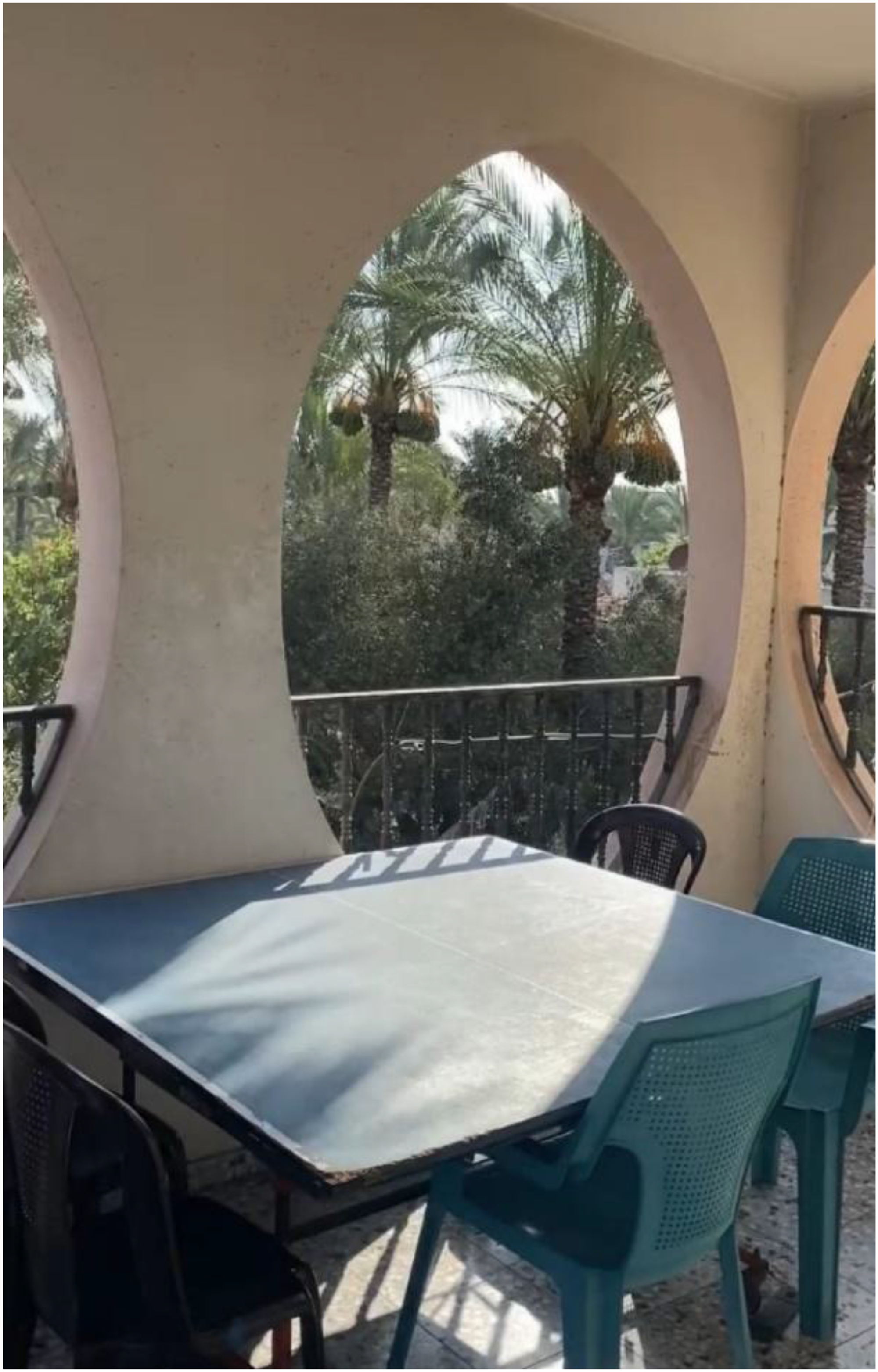
A shared workspace: For a participant, this space provided continuity and renewed purpose, restoring ambition, routine, and personal identity after months of displacement and despair.
This act of continuing to learn, study, and work is not only about productivity—it is about holding onto dignity and continuity. Others found this perseverance in education: “We finally went back to studying so we can graduate and that's my dream” (W.,18 years old), or in temporary markets that allowed them “a small window into something that resembles normal life” (M., 25 years old).
Places of caregiving, too, are transformed into sites of moral endurance. One doctor shared: “Being in this place specifically gives me a sense of accomplishment … Every patient I treat, every moment I see them improve … Despite everything in this war that is meant to destroy humanity, I am still achieving success” (w., 25 years old)
At the core of these experiences lies not only a determination to survive but to remain emotionally and physically anchored to the land. Nature itself offers a powerful sense of permanence. The sea, particularly, becomes a symbol of enduring rootedness. “No matter where I’m displaced, it will always be there, and I’ll always be able to visit it” (W., 23 years old). In the words of another participant: “No person should be deprived from seeing the sea and sitting next to it … For there to be no obstacles … And for its sand to remain clean enough to walk on in comfort” (W., 24 years old).
For some, the sea also reflects a sorrowful continuity, a mirror of their loss: “Every time I see it, I feel like I am losing a piece of myself. But it remains there—a silent witness to my story, to all our stories” (W., 20 years old).
Even unexpected signs of natural resilience serve as anchors of hope. One recalled, “I thought all of Gaza was nothing but ruins … I was shocked when I went back to the municipal park and saw it was still green” (M., 24 years old). Amid rubble and displacement, the sky, the trees, the sea continue to stand—and so do those who refuse to be erased.
Ultimately, places of rootedness and perseverance are not immune to suffering—but they become vital spaces where meaning is rebuilt, where connection is preserved, and where the will to endure is continuously renewed.
Discussion
This study investigates how individuals experience, transform, and imbue meaning into space under the extreme conditions of genocide, forced displacement, and collective trauma in the ongoing Genocide in the Gaza Strip (Abuward et al., 2025; Albanese, 2024). The testimonies of displaced Palestinians demonstrate that space is never a neutral backdrop; rather, it emerges as a dynamic and contested terrain where trauma, memory, affect, and resistance converge. In the participants’ narratives, four interrelated thematic dimensions were identified: spaces as emotional refuges, trauma and bereavement inscribed in place, the psychological burden of forced displacement, and places of rootedness and perseverance amidst genocide. Together, these themes illuminate how spatial experience becomes intimately tied to both the emotional and existential survival of those navigating profound precarity.
Participants described how ordinary places—cafés, rooftops, courtyards, or even the repetitive acts of daily life such as washing dishes—became more than physical shelters. These sites functioned as affective sanctuaries, temporarily buffering individuals from the chaos of war and enabling fleeting reconnections with their sense of self. Such accounts resonate with theories of affective geography (Ahmed, 2014; Till, 2005), which understand space as constituted not only through physical coordinates but also through emotion, memory, and embodied experience. In this sense, these fragile sanctuaries retained traces of pre-genocide identities and offered participants a means of continuity, however precarious. Their very ordinariness rendered them radical: modest anchors of humanity in contexts where dehumanization was the dominant force.
The sea, in particular, emerged as a recurring symbolic space. Participants spoke of the vastness of the horizon and the rhythmic soundscape of waves as therapeutic, providing both release from fear and reconnection to being. Here, natural elements acted as infrastructures of endurance, echoing sensory geography research (Anderson, 2014; Ingold, 2022) on how landscapes can hold and sustain emotional life. The sea thus became not merely an environmental feature but an existential companion—simultaneously estranged by grief and essential for grounding.
Yet the same spaces that provided relief were also suffused with sorrow. Homes, streets, and neighborhoods were described as haunted by absence and destruction. The once-familiar environments were re-inscribed as landscapes of mourning, their materiality saturated with loss. This phenomenon aligns with Gordon's (2008) notion of “haunted geographies,” where place itself becomes an active participant in remembering trauma. For participants, memory was not abstract but embedded in sensorial detail: the smell of a destroyed kitchen, the sight of an empty chair, the silence after an explosion. Trauma here collapses temporalities, layering past and present into a geography of grief. As Scarry (1985) observed, places can extend the injured body, bearing the scars of what was once whole.
Forced displacement emerged in participants’ testimonies not only as the exhaustion of fleeing bombardments but as an enduring condition of deterritorialization. It encompassed psychological fragmentation, social rupture, and the systematic denial of agency. Overcrowded shelters, shared tents, and improvised encampments stripped away privacy, intimacy, and dignity. These accounts resonate with Fullilove's (2016) concept of root shock, whereby the violent tearing away from place inflicts deep psychosocial wounds. Importantly, displacement was not experienced as a discrete event but as a chronic, iterative violence—a repeated unmooring from belonging. Despite this, longing for original homes persisted as a vital thread of hope and identity. Visualizing a return or recalling the contours of lost neighbourhoods sustained a sense of place identity (Proshansky et al., 1983), even in absence. The sea, ever-present yet unreachable, evoked past lives and daily rhythms—at once a reminder of belonging and a marker of loss. Such ambivalence encapsulated how memory tethered people to place, even as exile redefined it. Yet the emotional isolation of displacement was palpable, compounded by severed communication networks and fractured kinship ties.
Amidst this devastation, certain places retained their emotional gravity as sites of rootedness and resistance. As some people declared, choosing to remain in high-risk zones was framed not merely as survival but as a deliberate assertion of presence. This reflects the Palestinian concept of Sumud—steadfastness as an existential and political stance (Nassar, 2006). Participants narrated practices such as cultivating gardens, sustaining teaching and learning in makeshift environments, and reinhabiting bombed-out hospitals as acts of dignity reclamation. In Lefebvre's (1991) terms, space here is not only shaped by violence but actively produced through action. Daily continuities—baking bread, sitting in a courtyard, caring for others—became insurgent practices of survival-as-resistance.
Beyond a political stance, sumud also emerges in participants’ narratives as an everyday philosophy of living within conditions structured by ongoing violence (Ryan, 2015). Rather than representing resilience as an individual psychological trait, sumud reflects a relational and collective orientation toward survival grounded in continuity, care, and attachment to place (Giacaman, 2020). Acts such as maintaining routines, sustaining education, caring for others, or remaining physically present in threatened environments embody forms of hope that are enacted through daily spatial practices rather than articulated abstractly. In this sense, sumud can be understood as a situated form of resistance—one rooted not in adaptation to adversity alone, but in the ethical insistence on remaining, inhabiting, and imagining life within spaces targeted for erasure (Giacaman, 2020; Ryan, 2015). This perspective shifts resilience from an individualized coping framework toward a socio-spatial and political process through which survival itself becomes a form of resistance.
Read through a feminist and decolonial lens, these spatial practices emerge not only as strategies of endurance but also as epistemic sites where power, embodiment, and relational care become legible. The framework adopted in this study is feminist not only in its political commitments but in its epistemological orientation. Rather than treating trauma as an individualized psychological condition detached from structures of power, a feminist spatial lens foregrounds relationality, embodiment, and situated knowledge. By centring lived experience, affect, and everyday practices of care and endurance, the analysis attends to how colonial violence reorganizes life through space, memory, and attachment. Feminist theory here functions not as an external interpretive layer but as a methodological and analytical orientation shaping what becomes visible, whose knowledge is recognized, and how research remains accountable to those living under conditions of ongoing violence.
This feminist spatial orientation resonates strongly with Palestinian feminist scholarship. Within these frameworks, what Shalhoub-Kevorkian (2024) defines as اشلاء ashlaaʾ—literally “dismembering bodies”—resonates as both description and defiance. The concept captures not only the corporeal violence of genocide, in which flesh and community are torn apart, but also the symbolic dismemberment of geographies rendered uninhabitable. In this sense, the fragmentation of bodies mirrors the devastation of space: both are targeted in the attempt to annihilate a people. Yet, as Shalhoub-Kevorkian (2024) underscores, Palestinians in Gaza also embody refusal—the ongoing labour of reknitting life amid extreme rupture. Broken bodies insist on livability, and shattered landscapes become grounds for reclamation, presence, and relational care. Through rebuilding, dwelling, and remembering, ruins are transformed into sites of rootedness, where the struggle for survival is inseparable from the struggle for space. Resistance, then, is neither abstract nor disembodied but profoundly spatial and corporeal: the refusal to accept dismemberment affirms the continuity of body and land, community and territory. Against colonial necrophilia, the very act of inhabiting and reinhabiting devastated places becomes an assertion of life against erasure (Shalhoub-Kevorkian, 2024).
These findings contribute to the situated framework outlined in the aims of this study, showing how individuals actively remake and re-signify environments under extreme structural and symbolic violence, transforming spaces of destruction into affective sites of survival, memory, and resistance. Taken together, they highlight how space, under ongoing genocidal conditions, is neither passive nor inert. It becomes an active participant in survival, memory, and resistance. Refuge must therefore be rethought not only as physical safety but as symbolic, emotional, and relational. In places of profound destruction, individuals create meaning, sustain identity, and enact defiance—quiet but radical gestures that assert humanity against annihilation. The geographies mapped by participants are not merely topographies of suffering but testimonies to endurance and the persistence of life amidst collapse.
Limitations and Future Directions
This study must be understood in light of several contextual and methodological limitations arising from conducting research amid ongoing genocidal violence. Data collection unfolded under conditions of extreme precarity, including forced displacement, disrupted infrastructure, restricted mobility, and intermittent access to communication technologies. These circumstances shaped not only logistical possibilities but also the forms of participation available, privileging asynchronous and digitally mediated engagement. While WhatsApp enabled continuity of contact and participant agency under siege conditions, the reliance on a single digital platform may have influenced the pace, depth, and modality of narrative expression.
Furthermore, the study does not aim for statistical representativeness. The research participants reflect situated experiences shaped by relational access and trust-based recruitment rather than demographic proportionality. As such, the findings should be understood as analytically and ethically grounded insights into lived spatial experience rather than generalizable claims about the broader population of Gaza. At the same time, the constraints of ongoing violence limited opportunities for prolonged engagement or follow-up dialogue that might have further deepened interpretive exploration.
While the study is grounded in feminist and decolonial commitments, it was not designed as a comparative gender analysis. The primary analytic focus centred on psycho-spatial experiences of life under genocidal conditions rather than on systematically disaggregating narratives by gender. Nevertheless, we recognize that gendered subject positions inevitably shape how space, care, vulnerability, and resistance are lived and narrated. The extreme conditions under which data were generated—marked by insecurity, displacement, and uneven communicative access—limited the possibility of conducting sustained gender-differentiated analysis without risking overinterpretation of partial patterns. Rather than imposing analytic distinctions not fully supported by the data, we approached participants’ testimonies relationally, while acknowledging that future research could more explicitly examine how gender intersects with colonial violence, spatial dispossession, and practices of sumud. This absence should therefore be understood not as a dismissal of gendered analysis, but as a methodological boundary shaped by ethical and contextual constraints.
Future research may build on these findings by exploring longitudinal and gender-attuned analyses of psycho-spatial experience, as well as by examining how digital and multimodal methodologies can continue to support ethically grounded research in contexts where physical access remains impossible. Expanding collaborative, locally grounded research partnerships will remain essential for sustaining forms of knowledge production that resist epistemic erasure while remaining accountable to the communities whose lives and stories they seek to honour.
Moreover, future work could more explicitly engage with scholarship on historical trauma (Evans-Campbell, 2008), particularly in examining how collective wounds and memories are transmitted not only through bodies and kinship networks, but also through the destruction, reinhabitation, and affective remembering of space.
Implications for Social Work
The findings of this study carry important implications for social work practice, particularly for those working with Palestinian refugees and survivors of genocidal violence. Participants’ narratives show that, under conditions of bombardment, displacement, and enclosure, space is not a neutral backdrop but a central dimension through which trauma, loss, care, and resistance are experienced. Emotional survival is tied to the places people inhabit, remember, and are forced to abandon. Supporting mental health and wellbeing therefore requires attention not only to individual distress but also to the spatial conditions shaping it. Clinical practice must engage with how people create temporary refuges, navigate landscapes marked by bereavement, and maintain attachments to homes, neighbourhoods, cemeteries, workplaces, and coastlines that hold the textures of life before and during genocide. Attending to these spatialised experiences further invites social workers to consider how their practice might help defend, reclaim, and reimagine the places that make Palestinian life possible—from tents and improvised workspaces to destroyed hospitals, cemeteries, and seafronts. In this sense, social work becomes a form of situated engagement: grounded in the everyday geographies of those who continue to live and mourn under extreme precarity and oriented toward challenging the colonial and carceral structures that produce such vulnerability.
These accounts also resonate with long-standing insights from Palestinian feminist social work, which emphasises that neutrality in the face of structural violence is neither possible nor ethical. As Shalhoub-Kevorkian et al. (2022) argue, avoiding terms such as settler colonialism, occupation, or apartheid contributes to epistemic erasure and undermines the possibility of meaningful support. For social workers, this has direct relevance for advocacy, particularly in relation to their own governments’ political and military alliances with Israel. Engaging ethically with Palestinian clients thus requires not only recognising the psychological impact of displacement and bombardment but also acknowledging the broader systems that enable such violence. This includes naming genocide, situating current events within a long history of spacio-cidal policies, and understanding practices such as sumud and refusal as spatial strategies through which Palestinians continue to inhabit and reinhabit places rendered precarious.
Recent debates within the field further reinforce these responsibilities. The Affilia Editorial Board (Diaz et al., 2025) has highlighted how institutional silences—including fear, academic repression, and the conflation of anti-Zionism with antisemitism—have constrained social work responses to the destruction of Palestinian life. Their statement situates Palestine within broader feminist concerns related to state violence, reproductive justice, climate justice, anti-racism, and carcerality, underscoring that the profession's ethical commitments extend beyond individual interventions to challenging the structures that make genocidal violence possible. This also asks social workers to reflect on how their institutional affiliations, funding sources, and professional partnerships are embedded within global power relations.
Finally, the study's use of participant-generated digital materials, collected remotely during an ongoing genocide, underscores the need for research practices grounded in decolonial and abolitionist ethics. As Shalhoub-Kevorkian and Otman (2025) argue, responding to genocidal conditions requires attentive listening to communities living under colonial power and sustained awareness of the ways academic institutions themselves participate in systems of domination. Such an approach calls for methods that do not reproduce extractive or depoliticised forms of knowledge production but instead remain accountable to the structural conditions shaping participants’ lives and to the broader struggles for justice in which their narratives are embedded.
Conclusion
This study has shown that in Gaza, under the ongoing conditions of genocide, forced displacement, and systemic erasure by the Israeli State, space emerges not as a neutral backdrop but as a central terrain of struggle, memory, and survival. The testimonies of displaced Palestinians reveal how places—whether destroyed, reinhabited, or symbolically reimagined—carry the traces of both devastation and endurance. Far from passive, space actively shapes the emotional, existential, and political lives of those subjected to extreme colonial violence.
By attending to the affective geographies of Gaza, this research demonstrates how ordinary sites—a rooftop, a courtyard, a tent, the sea—are transformed into precarious sanctuaries, haunted landscapes, and defiant grounds of rootedness. These spaces embody the paradox of Palestinian existence under siege: at once fractured by violence, yet continuously reknit through acts of presence, memory, and care. In this sense, spatial practices themselves become forms of refusal—quiet but radical assertions of life against necrophilic logics of erasure.
Theoretically, these findings extend debates in affective and critical geographies by showing how extreme violence materializes in and through space, not only as destruction but also as the production of new geographies of mourning, endurance, and hope. Ethically and politically, they call for recognition of Palestinian spatial practices not merely as survival tactics but as profound acts of resistance that safeguard humanity amid annihilation.
Ultimately, to study space in Gaza is to confront both the brutality of genocidal violence and the irreducible persistence of life. Even as homes, schools, and streets are reduced to ruins, people continue to inhabit, imagine, and remake their environments in ways that defy disappearance. The geography that emerges is therefore not only one of loss but also of presence—a cartography of refusal, of resistance to the erasure of Palestinian existence. As Shalhoub-Kevorkian (2024) emphasizes through the notion of اشلاء ashlaaʾ, the violence of dismemberment is met with the determination to reknit life, to refuse erasure even amid fragmentation.
In affirming this refusal, the scholarly community bears an ethical responsibility: to resist the ontological and epistemological erasure of Palestinian lives and practices (Shalhoub-Kevorkian et al., 2025). As Palestinians themselves teach, refusal is not only survival but an insistence on presence, dignity, and futurity. To engage with Gaza is therefore not merely to document devastation and endurance but to actively stand against the reproduction of colonial silencing within knowledge production itself (Veronese & Kagee, 2025).
Footnotes

Ethical Approval and Informed Consent
Ethical approval was obtained from from the Institutional Review Board of the University of Milano-Bicocca (Protocol No. 0201074). Informed consent was obtained from all participants prior to their inclusion in the study.
Funding
The authors received no financial support for the research, authorship, and/or publication of this article.
Declaration of Conflicting Interests
The authors declared no potential conflicts of interest with respect to the research, authorship, and/or publication of this article.
Data Availability Statement
The data that support the findings of this study are available from the corresponding author upon reasonable request.