







Abstract
This study uses an ecological systems theory to understand bullying behavior. Emphasis is given to overcome limitations found in the literature, such as very little empirical research on functions of parental involvement and the impacts of school climate on bullying as an outcome variable. Two functions of parental involvement investigated are (a) bridging the negative experiences within the family with bullying behaviors at schools, and (b) influencing school climate. Bullying behaviors were measured by a modified Korean version of Olweus’ bully/victim questionnaire (reliability range: .78-.84) from 1,238 randomly selected Korean middle school students in 2007. Findings from structural equation modeling (SEM) analyses showed that (a) individual traits are one of the most important influence on bullying, (b) negative experiences in the family do not have direct influence on bullying behaviors at school, (c) parental involvement influences school climate, and (d) positive school climate was negatively related to bullying behaviors.
Introduction
School ecology became one of the common approaches to the understanding of children’s problem behaviors in school environments during the recent decades. Scholars have recognized the theoretical and empirical importance of an ecological approach to bullying (Espelage & Swearer, 2004; Morrison, 2001; Olweus, 1978; Swearer & Doll, 2001). Studies of bullying that are documented in literature, however, have lacked theoretical and empirical testing of an ecological framework. A relatively small number of studies have focused on bullying as an outcome variable within an ecological approach (e.g., Kasen, Berenson, Cohen, & Johnson, 2004; Lee, 2009, 2011).
Due to the lack of theoretical framework, there has been difficulty understanding the functions of, and interrelationships among, particular factors relevant to bullying within an ecological context, especially within different cultural settings. Prior studies made a significant contribution to the literature on bullying by identifying factors that might increase bullying behaviors, such as impulsivity, anger, authoritarian parenting, peer pressure (e.g., Batsche & Knoff, 1994; Bentley & Li, 1995; Bosworth, Espelage, & Simon, 1999; Kasen et al., 2004; Rigby, 2004). These studies, however, investigated individual or incident level variables as independent factors, which have been taken out of complex ecological context (Morrison, 2001).
As a part of the first nationally representative study on school ecology and bullying in South Korea, this study aims to address these aforementioned limitations by identifying a structure of influences from different aspects of children’s lives to their bullying behaviors. Specifically, this study uses an ecological systems theory suggested by Bronfenbrenner (1979) as a theoretical framework to develop an ecological model of bullying, encompassing factors previously found to be relevant to bullying. The factors included are individual traits, negative experiences in the family, parental involvement, and school climate. This study uses structural equation modeling (SEM) to identify a best-fitting structure of influences among those individual and contextual factors and to compare it with traditional approach (i.e., ordinary least squares [OLS] regression) to bullying. Special emphasis is given to investigation of the functions of parental involvement as well as the effects of school climate on bullying behavior.
Literature Review
Ecology, Ecological Systems Theory and Bullying
The importance of the effects of individual traits as well as the effects of the school environment on aggressive behaviors has been previously recognized by scholars (Fagan & Wilkinson, 1998). In terms of bullying, several scholars have suggested the importance of an ecological approach to bullying phenomenon. For example, Cairns and Cairns (1991) argued that bullying should be understood as a continuum of children’s developmental processes, and that the developmental approach requires an ecological perspective. Others argued that ecological approach is necessary to understand complex contexts affecting bullying behaviors within school environments (Espelage, Holt, & Henkel, 2003; Espelage & Swearer, 2004; Morrison, 2001; Sexton-Radek, 2005). To guide the current empirical investigation of ecological factors, this study borrows Bronfenbrenner’s (1979) ecological systems theory to understand a structure of etiological factors.
Ecological systems theory contains five important components: (a) individual, (b) microsystem, (c) mesosystem, (d) exosystem, and (e) macrosystem. Among those, three components relevant to the current study are individual, microsystem, and mesosystem. Children, according to the theory (Bronfenbrenner, 1979, 1989), are viewed as developmental entities that interact with their ecological environments. This view of individuals indicates that personal traits maintain their influence on behaviors as well as interact with contexts to affect ones’ behaviors. Microsystem refers to a pattern of activities, roles, and interpersonal relations experienced by individuals. According to Bronfenbrenner (1979; 1989), an individual’s experience in face-to-face interaction is the most critical in a microsystem. Mesosystem refers to “the interrelations among two or more settings in which the developing person actively participates (such as, for a child, the relations among home, school, and neighborhood peer group; for an adult, among family, work, and social life)” (Bronfenbrenner, 1979, p. 25). In other words, the mesosystem functions as a bridge between two or more microsystems.
According to the theory, each of these components of an ecological system affects individuals’ behavior and interacts with other systems at different layers (Bronfenbrenner, 1979). This suggests that all of the systems at the different layers not only generate independent influence on the individual’s behavior, but also produce joint influence on the individual. Regarding bullying, ecological systems theory provides two practical benefits. It provides (a) the possibility of empirically testing functions of parental involvement, and (b) the possibility of empirically testing school climate as an ecological context of bullying. Specifically, this theory allows viewing parental involvement as a mesosystem, which bridges experiences in the family with children’s experiences at schools. In addition, with this theory, school climate is viewed as another microsystem in which children interact with other microsystems, such as family setting.
Children and their individual traits
Bronfenbrenner (1979) suggested that a child should be viewed as a developmental entity, interacting with their ecological surroundings, and suggested that children are influenced by the surroundings and vice versa. Thus, individual traits play a significant role in the ecological model. Among others, those identified having positive relationship with bullying behavior include dominance, impulsivity, attitude toward aggression, and fun-seeking tendency (Bentley & Li, 1995; Bosworth et al., 1999; Boulton, Trueman, & Flemington, 2002; Lee, 2010, 2000). In addition, Asian scholars argue that bullying is a fun- seeking behavior. For example, Naito and Gielen (2005) argued that bullies misinterpreted bullying behaviors as normal and acceptable forms of joking and kidding, and that this misinterpretation was precipitated and reinforced by ambiguously interpreted school norms among students. Lee (2010) empirically found that fun-seeking tendency was one of the most important personal characteristics for all different types of bullying behaviors (see also, Rigby, 2004; Seo & Han, 2004).
Family interaction as a microsystem
To Bronfenbrenner (1979), the most critical notion in the microsystem is experience in face-to-face interaction through activities and roles within relationships with family, peers, and teachers. Especially, experiences within the family were well known to produce significant influence on individual behaviors. Regarding bullying, traditional studies found that negative family interactions had a strong positive relationship with bullying behavior. Such negative family interaction includes authoritarian parenting, experience and witness of domestic abuse, parental attitude toward bullying and toward education (Baldry, 2003; Christie-Mizell, 2003; Shields & Cicchetti, 2001).
Baldry (2003) found that exposure to parental violence and child abuse was a significant predictor of bullying behaviors. Others found that authoritarian parenting (e.g., using physical discipline, hostile and rejecting parenting, and a permissive attitude toward bullying) significantly influences bullying behaviors (Baldry & Farrington, 2005; Christie-Mizell, 2003; Espelage & Swearer, 2003; Shields & Cicchetti, 2001). In addition, Korean researchers found that parents’ emphasis on the importance of education had a significant influence on preventing bullying behaviors (Lee & Kim, 2000; Shin, 2000).
School climate as a microsystem
School climate is typically defined as the total environmental quality (Anderson, 1982), which includes ecology, milieu, social system and culture (Tagiuri, 1968). Within a school setting, ecological players, such as children, their friends and teachers, interact and communicate with others (see also a concentric circle of school ecology in Espelage & Swearer, 2004). Such interactions and communication should convey the influence of one system to another in formation of children’s behavior (Bronfenbrenner, 1989).
Studies found school climate a significant influence on children’s delinquency and misconduct (Gottfredson, 1986; Gottfredson, Gottfredson, Payne, & Gottfredson, 2005), and bullying behavior (Kasen et al., 2004; Naito & Gielen, 2005; Unnever & Cornell, 2005). Specifically, scholars argued that bullying behaviors could be influenced by school contexts, such as cooperative setting (Menesini, Melan, & Pignatti, 2000), moral atmosphere (Naito & Gielen, 2005; Tai, 2001), and school policy, rules, and programs (Espelage & Swearer, 2003; Rigby, 1996; Swearer & Doll, 2001).
Parental involvement as a mesosystem
A major function of a mesosystem is to bridge one microsystem with another in an ecological context (Bronfenbrenner, 1979). Thus, a mesosystem consists of interpersonal connections and interactions among participants, such as children, parents, friends, and teachers. Children, for example, become a primary link between family and school once a setting transition occurs (Bronfenbrenner, 1979). As a primary link, individual traits, which have been shaped from experiences in the family, will convey the influence of experiences in the family on behaviors to schools. In addition, a supplementary dual link is developed, “when Mary’s mother attends a PTA meeting, her teacher pays a visit to the home, or Mary brings home a classmate to play” (Bronfenbrenner, 1979, p. 210).
In this study, parental connections and interactions with other participants, such as parental communication with teachers and peers and involvement in school boards, are referred to as parental involvement, and it is expected to convey the influence of parents and their attitudes on children’s behavior to schools. Through these interactions, effects of family interaction will be transmitted to another system, which is in this case, schools (Bronfenbrenner, 1989). In regards to bullying, previous studies found a significant relationship between parental involvement and children’s behaviors in schools. For example, Flouri and Buchanan (2003) found that low levels of parental involvement were significantly positively related to bullying behaviors. Others argue that parental interconnections with peers prevent bullying behaviors among their own children (Sullivan, Cleary, & Sullivan, 2004). In Korean culture, however, frequent parental visits to school may be perceived to infringe educational independence among teachers (Sung, 2009). Typically, parents did not frequently visit their children’s school unless their visits were requested by teachers for the children’s misbehaviors (e.g., bullying) in schools (Lee & Kim, 2000). Thus, it may be possible to expect that parental involvement would have a positive relationship with bullying behavior in South Korean school context.
Hypothesized Ecological Model of Bullying in SEM
Compared with traditional studies of bullying, there are two major benefits using ecological model. First, prior studies of bullying, which used OLS regressions (e.g., Gladstone, Parker, & Malhi, 2006; Unnever & Cornell, 2003), could not examine complex mechanisms (i.e., paths) of influence among independent variables, such as individual traits, relationship with others, and school climates. In contrast, ecological model using SEM could examine path mechanism among exogenous factors (equivalent to independent variables in OLS). For example, typical OLS regression study suggested that there was a significant correlation between experiences in the family (e.g., domestic abuse) and delinquency in school. The result is interpreted based on an assumption that children learn the abusive behavior from parents at home, and they abuse other students in school. In contrast, ecological model assumes that behaving what they learned from parents at schools could be mediated by children’s individual traits, and empirical tests relationships (i.e., paths) between parenting and traits, between parenting and behaviors, and between traits and behaviors to investigate direct and indirect path mechanisms among the independent variables.
Second, traditional studies of school climate using OLS could not address interconnectedness between individual characteristics and ecological environments. One of the reasons for the limitation stems from difference in levels of measurement (i.e., ecological fallacy, correlating measures of individual traits with measures of environmental factors). By contrast, as ecological systems theory emphasizes how individuals perceive environments (Bronfenbrenner, 1989) so that environmental factors are measured at individual level (i.e., perception), correlations between them are possible within ecological model. This allows developing a model containing individual and environmental factors simultaneously.
Having said the advantages, hypotheses tested in this study are listed here (see Figure 2 for SEM model). First, Bronfenbrenner (1979) suggested that, as a center of their world, children interact with their ecological surroundings, suggesting that children are influenced by their surroundings and vice versa. Individual traits, thus, have significant influence on bullying behavior. Thus, it is hypothesized that dominance, impulsivity, attitude toward aggression, and fun-seeking tendency are positively related to bullying behavior.
Second, this study hypothesizes that no direct relationship exists between family interaction and bullying, but that the family interaction has indirect effects through individual traits and parental involvement in schools. Traditional studies of bullying suggested that a direct positive correlation exist between experiences at home and bullying behavior in schools. When the physical location is considered, however, it becomes difficult to maintain the direct relationship between two factors (i.e., home and school). It is logical to think that the effect of experience within the family is not readily transmittable to the school unless there is an active conveyer between the family and school. Between the home and school, children (i.e., “primary link”) and parents (i.e., “supplementary link”), as active conveyers, will mediate the effects of experiences in the family. Without their involvement, there would be no linkage between family and school. Consequently, this study hypothesizes that there will be no direct relationship between family interactions and bullying, but that there will be indirect relationship between them. 1
As one of the mediating factors, the individual traits are expected to mediate effects of experiences in the family on bullying behavior at schools. For instance, not all children who experienced domestic abuse would conduct abusive behaviors in schools. Some will learn the abusive behaviors and carry out them to other students, but others would not. According to the ecological systems theory, this hypothesis concerns itself with the role of the primary link that children play between home and school. As they are the active participants in these two different microsystems, they will convey (i.e., mediate) influence of experiences at home to the school environments.
Fourth, as Bronfenbrenner (1979) suggested that there are interactions between a developing person and other systems, it is hypothesized that individual traits influence parental involvement. This hypothesis will help to test a positive relationship between parental involvement and bullying behaviors at schools. In other words, it is possible that parents of bullies are more likely to contact teachers at schools than other parents in response to the bullying behaviors. By investigating the influence (i.e., a path in SEM) from individual traits to bullying through parental involvement, it may be possible to understand the mesosystem function of parental involvement.
Fifth, this study hypothesizes and tests two functions of parental involvement. Parental involvement (i.e., parental communication with teachers and peers and involvement in school boards) will (a) bridge influence of family interaction with bullying behaviors at schools and (b) affect school climate. Prior studies argued that parental concerns and requests influenced school environment. For instance, academic standards and general image of school, as examples of school climates (Gottfredson, 1986), could be shaped by parental involvement with school boards. As mentioned previously, other studies on bullying suggested the importance of active parental participation within school activities (e.g., Flouri & Buchanan, 2003; Jeynes, 2008; Rigby, 1996; Sullivan et al., 2004). Also, it is worth noting that the relationship between parental involvement and bullying behavior could be conditional to the quality of family interaction. As it mediates the effect of family interaction to school environments, parental involvement might be positively related to bullying when there is a negative relationship between negative family interaction and parental involvement.
Finally, based on previous findings, this study hypothesizes that positive (e.g., cohesive, constructive, cooperative, moral, and law abiding) school climate is negatively related to bullying behavior at schools. Although abundant research focused on school climate and its impact on children’s misconducts (e.g., Astor, Benbenishty, Zeira, & Vinokur, 2002; Gottfredson et al., 2005), a relatively small number of studies have focused on bullying as an outcome variable within school climate (e.g., Kasen et al., 2004; Lee, 2007, 2009, 2011). To add literature, this study tests negative relationship between positive school climate (i.e., cohesion, moral atmosphere, and effectiveness of bullying policies) and bullying behavior.
In the hypothesized model (see Figure 2), the opposite direction of influence (from bullying behaviors to individual traits, parental involvement, or school climate) is not hypothesized in this study due to the temporal order between them. To test these influences, one needs to collect longitudinal data. For example, individual traits influence school climate first, then they will be influenced by school climate. Children may participate in an event that would alter school climate, but their attitude toward school climate will only be changed when they experience the event at schools. The same logic applies to other microsystems and mesosystem variables.
Method
Sampling Design
The data for this study were collected through a cross-sectional, self-evaluative anonymous survey. In addition to the time and resource constraints, a cross-sectional survey is somewhat more effective and efficient in measuring some ecological variables, such as perceived school climate. Although a developmental approach to bullying is more consistent with a longitudinal design, a cross-sectional approach is a good tool to measure ecological contexts which are not readily changing over time (see Duncan & Kalton, 1987). As school climate (such as academic standard and general image of school, cooperative climate, cohesion, moral atmosphere, and policies) is not rapidly changing, variation in context is best achieved by sampling different contexts rather than the same context over time.
As the earliest prototype of self-reported delinquency scales by Short and Nye (1957), studies in criminology have validated self-evaluative anonymous measures of delinquency. More relevant to bullying, bullying studies found anonymous self-reporting measures are more reliable and valid (Ahmad & Smith, 1990; Chan, Myron, & Crawshaw, 2005). Although triangulation generally produces more valid data, referral of bullies (especially from teachers) in bullying study would produce a significant threat to validity for some social settings. For instance, Naito and Gielen (2005) found that teacher evaluation of bullying in Japan was invalid, because teachers tended to underreport bullying incidents to protect their reputation and their jobs. They suggested that the Asian culture, which emphasizes the importance of dignity and reputation, might influence teacher reports on bullying. In addition, school records of bullying behaviors are also considered to be an invalid measure. In South Korea, bullying incidents were often resolved unofficially, leaving no trace on behalf of the future of bullies and victims (Lee & Kaok, 2000). Unless there are incidents resulting in serious violation of criminal laws, bullying incidents are often unrecorded in Koran school environments. Thus, this study used self-reported bullying survey.
Sampling, Data Collection and Preparation Procedures
The data were collected from 1,238 South Korean middle school students selected through a multistage cluster sampling to ensure a random sampling. This study first obtained the list of 232 South Korean governmental districts, which are the same as the school districts. This study then subdivided the school districts into three groups; districts with high, medium, and low levels of social disorganization. The level of social disorganization was calculated based on the sizes, total populations, mobility, and density indexes of each district, which were annually reported by the South Korean National Statistics Bureau. From the first stage sampling frame (i.e., three groups of school districts), this study randomly selected two school districts from each group. From the secondary sampling frame of school lists within the six districts, this study randomly selected one school from each district. These steps produced six middle schools. From each school, two classes from three grades (seventh, eighth, and ninth grades) were again randomly selected, resulting in 36 classes. All students (n = 1,350) in the 36 classes were included for data collection. After obtaining consent from parents, 1,238 students responded to the survey (response rate = 92%).
As structural equation modeling requires that all missing information be treated before analyses, this study first carried out a simple outlier test, skewness test, and kurtosis test (see Table 1), and found no serious issue of normality. This study then checked any patterns of incomplete data using subgroup comparisons (sex, regions, grade, family SES and academic achievement). The results indicated that there was no systematic pattern of missing data across different subgroups, indicating that patterns of missing data were not related to sample characteristics. As the data set showed simple monotone missing data patterns, this study used a multiple imputation method using the EM (Expected Maximization) algorithm in LISREL 8.8 software for maximum level of data retention. The results from the multiple imputation showed that the convergence was achieved after six iterations, and the percentage of the missing values was 0.76, meaning that only 0.76% of the total data were missing. For further SEM analysis, this study used AMOS 5.0.
General Characteristics of the Sample: Univariate Analysis of First-Level Scales
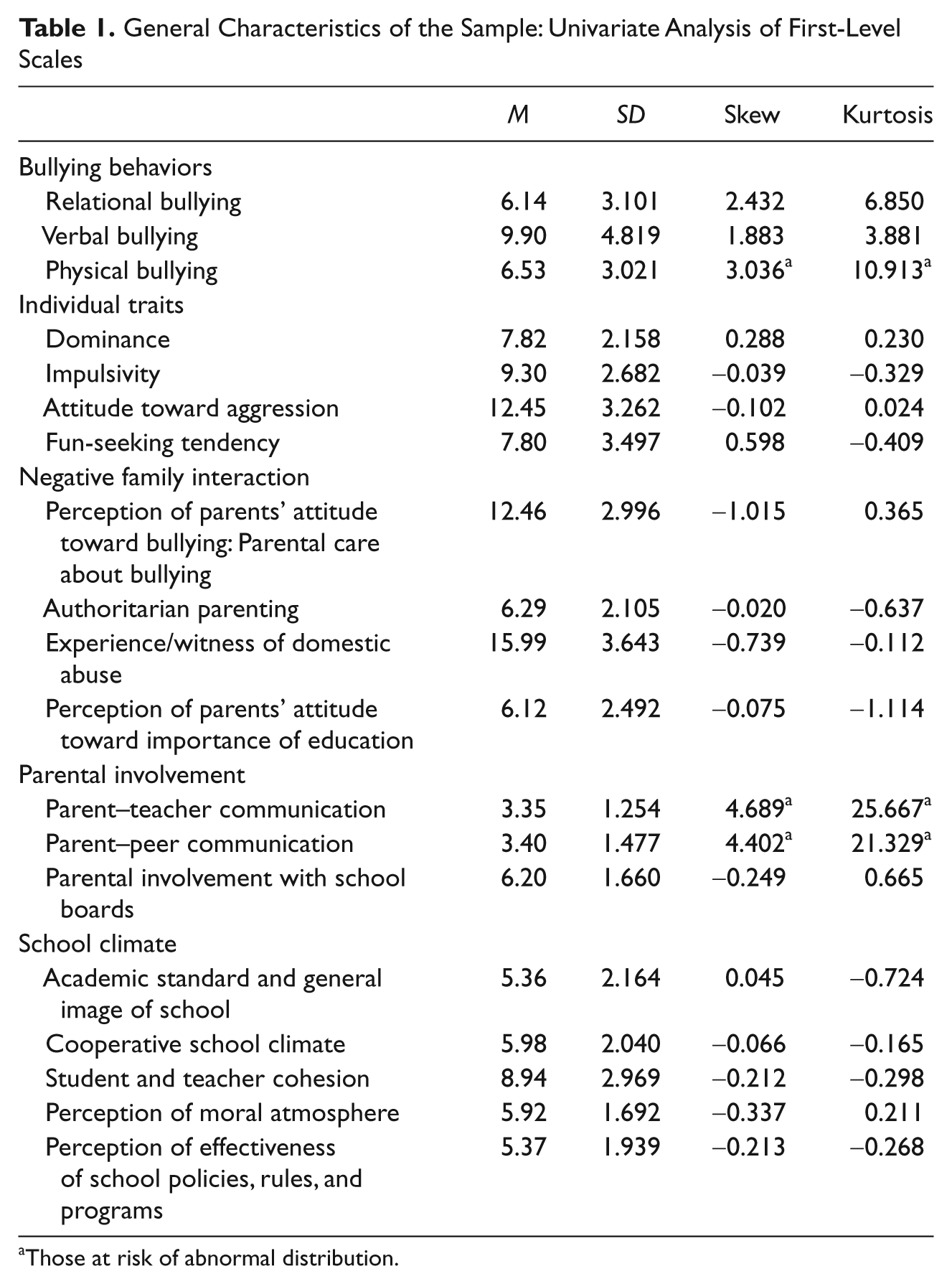
Those at risk of abnormal distribution.
Measurement
It is important to mention that all items in the survey used for this study were measured at the individual level. According to Bronfenbrenner (1979), the effects of ecological surroundings are perceived psychological outcomes rather than actual properties of the surroundings. Thus, all items for each system asked children about their perceptions, ideas, and attitude toward their parents, teachers, and school climates. In addition, measures developed in the current study were pretested and modified based on feedback from a focus group of 20 Korean middle school students.
Bullying behaviors (endogenous variable)
This study used a modified version of the Olweus’ bullying/victim questionnaire. The modified one measured bullying behavior in three dimensions: relational, verbal, and physical bullying. Relational bullying was measured by four items about rumors, isolation, and ignorance (Reliability = .84). Isolation referred to purposely leaving a classmate out of things (e.g., conversation), and ignorance referred to not responding to questions, conversations or requests from a classmate. Verbal bullying was measured by six items on teasing, taunting, calling someone names, sexual comments, and comments on physical defects (Reliability = .81). Physical bullying was measured by five items on kicking, hitting, harming, pushing, and breaking bones (Reliability = .78). The possible responses for the three scales were never, one or two times, three times, four times, or more (coded into 1 through 5), meaning that the higher scores indicate the more bullying behaviors.
Individual traits
Individual traits were measured by four scales. First, dominance and impulsivity were measured by a modified version of the Standardized Personality Evaluation Test (Lee, Byun, & Jin, 1969). Attitude toward aggression was measured by a modified version of the Beliefs Supportive of Violence Scale from the Houston Community Project Scale (Dahlberg, Toal, & Behrens, 1998). This modified version was developed by Bosworth et al. (1999, reliability = .71). Fun-seeking tendency items were developed for this study, and they are (a) “Did you do these things [bullying behaviors] to another person for fun?” (b) “My friends enjoy it, because they think I am having fun with them,” (c) “It is fun to watch [victims] go through these things,” and (d) “There is nothing wrong with these things because they are just for fun.” For the individual trait scales, the response categories were disagree, somewhat disagree, neutral, mostly agree, and agree, ranging from 1 through 5.
Family interactions
Family interactions were indicated by parental attitude toward bullying, authoritarian parenting, experience of domestic abuse, and parental emphasis on education. Parents’ attitude toward bullying in schools was measured by six agree–disagree items, for instance, “I think my parents do not like me teasing other students” and “I think my parents do not like me making fun of other students.” Authoritarian parenting was measured by two items: “My parents use physical discipline for punishments” and “I think my parents want to have control over almost every aspects of my life.” Domestic abuse was measured by three items, for instance, “I saw my father hit my mother at home.” Parental emphasis on education was measured by two items: “I think my parents emphasize educational achievement too much so that I feel too much pressure” and “I think my parents believe that academic success is the most important thing in my life.” The variables had five responses categories: disagree, somewhat disagree, neutral, mostly agree, and agree, ranging from 1 through 5.
School climate
The school climate variable consists of five subcategories derived from a previous study (Orpinas & Horne, 2006): perceived academic standard and general image of school, cooperative school climate, student and teacher cohesion, moral atmosphere and effectiveness of school policies, rules, and programs. Academic standard and general image of school were measured by two items: “I think my school set academic standards very high so that I should feel proud of it” and “I am proud of being a part of my school.” Cooperative school climate was measured by two items: “In my school, winning is the most important goals” and “In my school, academic success is more valued than good friendships.” Student and teacher cohesion was measured by three items, for instance, “Teachers and students in my school work very closely to make our school better.” Perception of moral atmosphere was measured by three items, such as “In my school, wrong doings are punished appropriately,” and effectiveness of school response toward bullying was measured by three items, for example, “In think my school’s antibullying efforts are useless and not helpful for prevention of bullying.” All variables had five responses categories: disagree, somewhat disagree, neutral, mostly agree, and agree, ranging from 1 through 5.
Parental involvement
From the ecological standpoint, it is necessary for parental involvement to measure parental communication with teachers and peers and involvement in school boards, which are functions of a mesosystem. Prior empirical studies on parental involvement, however, measured relationships between parents and children, instead of parents and schools, such as time spent with parents, talking about worries, talking about school work, and helping plan for the future (Flouri & Buchanan, 2003; Harris & Petrie, 2003; Sullivan et al., 2004). These are other forms of measures about experiences in family, which is a microsystem, and could not be used as measures of a mesosystem.
Parental involvement was measured by two scales. Parental communication with teachers scale was indicated by three items, for example, “How often in this school year did your parents and teachers talk to each other to share information about students teasing others?” Very similar questions were asked of students to measure parental communication with peers. Parental involvement with the school board was measured by two items: “I think my school gets a lot of parental involvement in school affairs” and “I think my parents have a say in decision making of school policies, rules, and programs.” All variables had five responses categories: disagree, somewhat disagree, neutral, mostly agree, and agree, ranging from 1 through 5.
Findings
Univariate Analyses
There were 716 male students (57.8%) and 522 female students (42.2%) in the sample. Although there is one non-coed male school, the sex ratio is similar to that for the Korean population age between 10 and 19 (male vs. female ratio = 113:100). The age ranged 13 to 16. Most of the students reported that they perceived their family’s socioeconomic status (SES) level belonging to different levels of the middle class, which is a typical response pattern. 2 Table 1 shows the results of a univariate analysis of the first-level scales. The scales were developed based on the results of the first-order factor analysis and the reliability tests. As mentioned in the previous section, the variables were normally distributed around means, except parental involvement (see Skewness and Kurtosis test results in Table 1). However, all the standard deviations indicate no significant issue on their normality of distribution. The mean relational bullying is 6.14 and the mean physical bullying is 6.53. Compared to that, the average score in verbal bullying is higher (9.90). This result is consistent with the previous bullying studies suggesting higher levels of verbal bullying than other types of bullying behaviors (e.g., Salmivalli, Kaukiainen, & Lagerspetz, 2000). Interestingly, the mean scores of parent–teacher and parent–peer communication are very low, supporting the cultural tendency that Korean parents do not frequently talk to teachers and friends of their children.
Confirmatory Factor Analysis (CFA) and Correlations
To construct latent factors, the second-order CFA was performed for each variable. First, values for each item were added into corresponding latent factors in the first-order CFA. Second, the latent factors were combined into the ecological variables. Although some scales from the first-order CFA had low levels of reliability scores, the second-order CFA would produce more reliable factors. The results of the second-order CFA are presented in Table 2.
Confirmatory Factor Analysis Results: Second-Level Scales
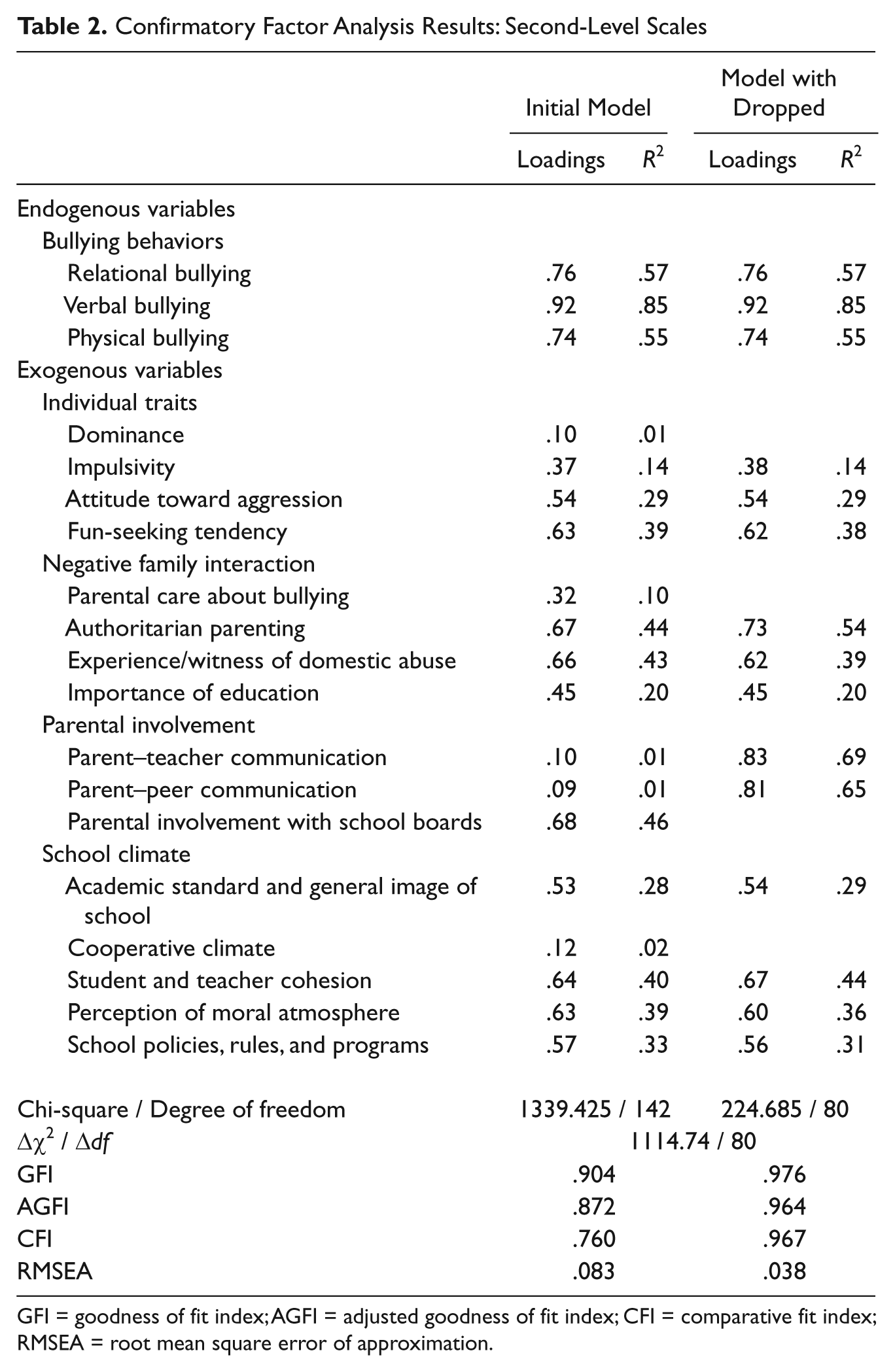
GFI = goodness of fit index; AGFI = adjusted goodness of fit index; CFI = comparative fit index; RMSEA = root mean square error of approximation.
An initial CFA model identified several items which had low factor loadings, such as dominance, parental care about bullying, parent–teacher communication, parent–peer communication, and cooperative climate. Those factors were excluded in the subsequent CFA model, except parents’ communication with teacher and peer. As parental involvement with school boards seemed to be measuring a drastically different aspect of parental involvement, this study excluded this item instead. A subsequent CFA was conducted, and the second CFA model had greater squared multiple correlation coefficients (R2) for family interaction, parental involvement, and school climate. Although chi-square suggested that the model was still significant, meaning that the null hypothesis of good model fit should be rejected, the model improved significantly, and the fit indexes were in acceptable ranges (goodness of fit index [GFI] = .976, adjusted goodness of fit index [AGFI] = .964, comparative fit index [CFI] = .967, root mean square error of approximation [RMSEA] = .038). Thus, this study used the measurement model developed from the revised CFA model for SEM.
Table 3 shows the results of bivariate correlations. The results indicate that factors are moderately, sometimes weakly, correlated to each other, except several variables. Among those exceptional cases, relationships deserving careful investigation include relationships between three types of bullying behaviors (.700, .552, and .684 at p < .001), and parent–teacher communication and parent–peer communication (.668 at p < .001). Although correlations among those factors were strong, this study did not find a multicollinearity issue from the tolerance and VIF tests (range of tolerance scores = .56-.74, range of VIF scores = 1.35-1.79 for the relationships with strong correlations).
Bivariate Correlations
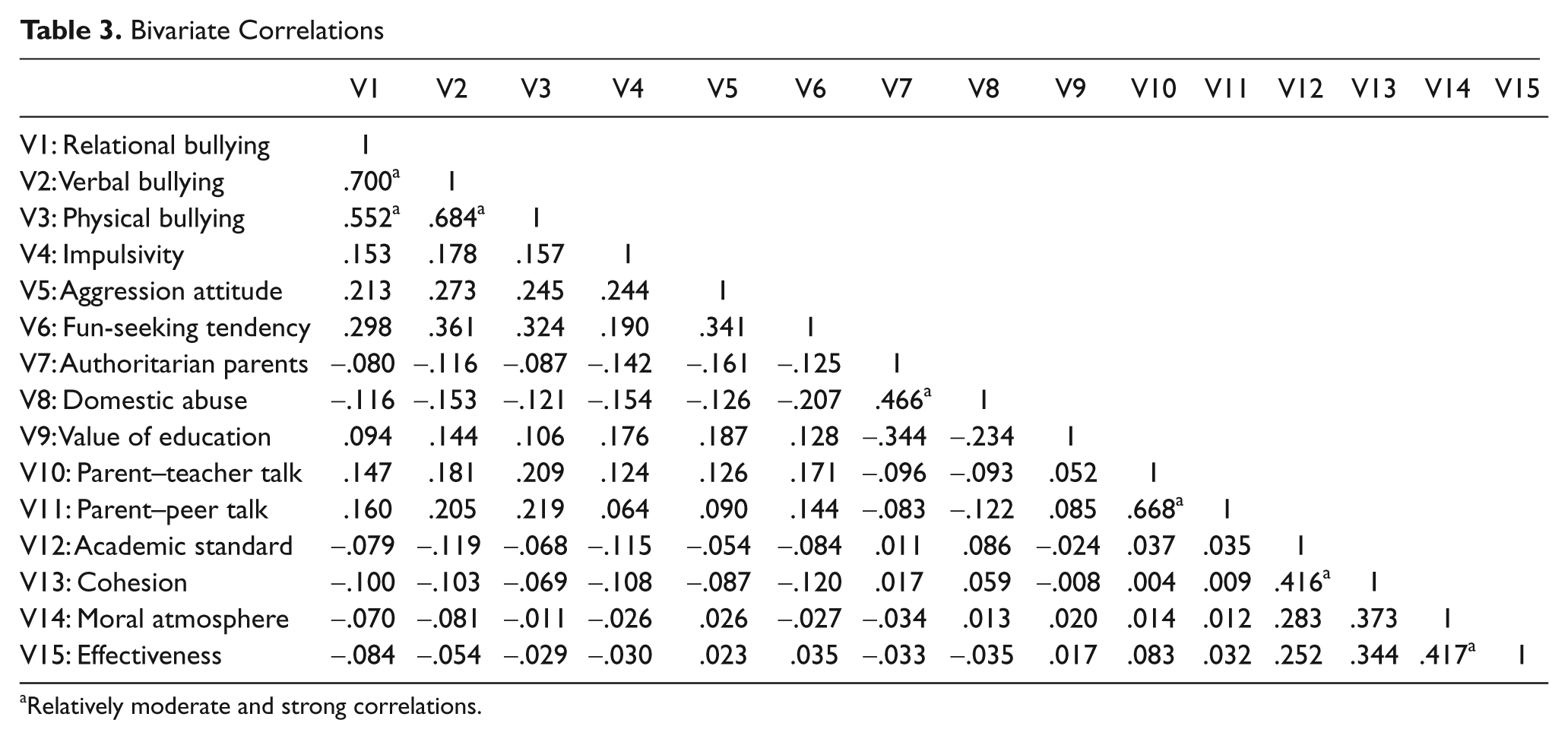
Relatively moderate and strong correlations.
Structural Equation Modeling (SEM)
Traditional model of bullying (MT)
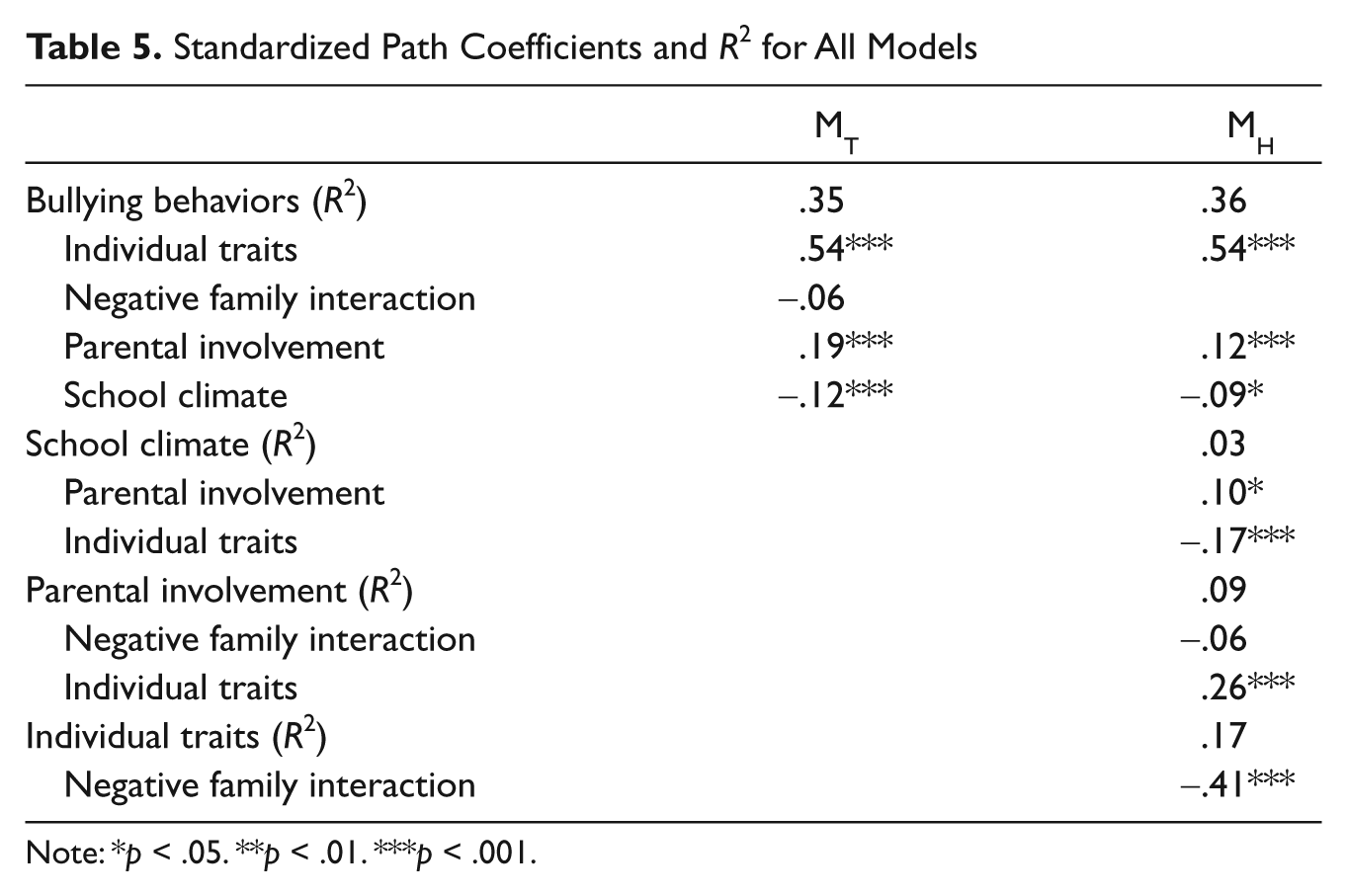
The model fit summary for this traditional model (OLS regression in SEM) is presented in Table 4 and Figure 1, in the row headed “MT Traditional bulling model.” As the chi-square (χ2) value equals 371.486 at degree of freedom (df) of 86, the null hypothesis that the model fits the data should be rejected. The values of the fit indexes, especially GFI (.960), AGFI (.944), and CFI (.934), are in the acceptable range, but the RMSEA (.052) value is greater than the usual threshold for the good-fit range (.50). Table 5 shows that this traditional model explains 35% of variation in bullying behavior (the squared multiple correlations, R2 = .35). Among the factors, individual traits have the strongest influence on bullying (the standardized regression weights, β = .53). In this traditional model, as the current study hypothesized, the path between family interaction and bullying behavior is insignificant, meaning that experiences within the family do not directly influence bullying behaviors in schools. This finding directly contradicts previous findings about the relationship (Baldry, 2003; Christie-Mizell, 2003; Shields & Cicchetti, 2001).
Model Fit Summary for All Models (n = 1,238)
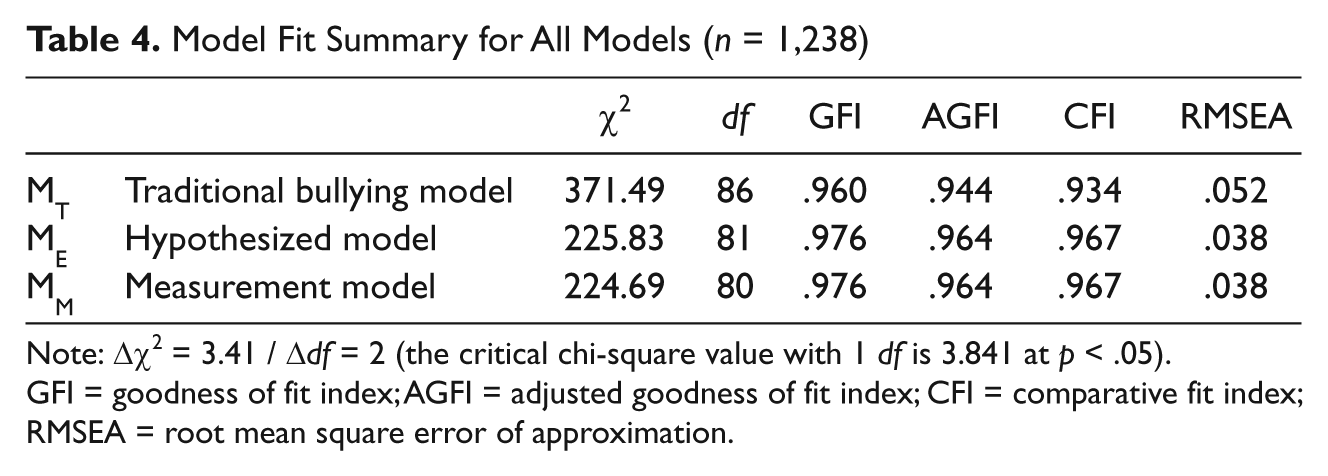
Note: Δχ2 = 3.41 / Δdf = 2 (the critical chi-square value with 1 df is 3.841 at p < .05).
GFI = goodness of fit index; AGFI = adjusted goodness of fit index; CFI = comparative fit index; RMSEA = root mean square error of approximation.
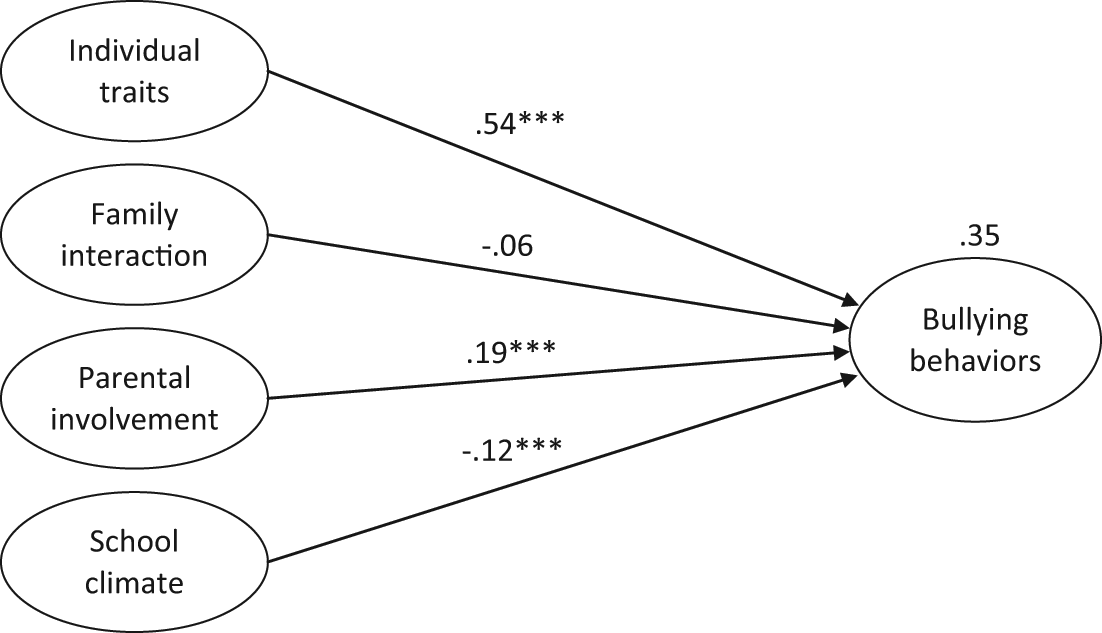
Traditional model of bullying
Standardized Path Coefficients and R2 for All Models
Note: *p < .05. **p < .01. ***p < .001.
Hypothesized ecological model (ME)
Figure 2 represents the hypothesized ecological model of bullying. The model fit summary for this model is presented in Table 5, in the row headed “ME Hypothesized model.” The results of the modeling show that the null hypothesis of good fitting model should be rejected (χ2 = 225.83, df = 81). However, the fit indexes showed that the model is fitting well to the data (GFI = .976, AGFI = .964, CFI = .967, RMSEA = .038). The strongest path in this model is still between individual traits and bullying behaviors (β = .54, see Table 5 also). The path between individual traits and family interaction is the second strongest path (β = –.41). Individual traits also significantly positively influence parental involvement (β = .26), and significantly negatively influence school climate (β = –.17). Family interaction explains 17% of the variance in individual traits (R2 = .17), but it does not significantly influence parental involvement (β = –.06). As congruent with the previous findings, this study also found that parental involvement significantly influenced bullying behaviors (β = .12) as well as school climate (β = .10) in the South Korean context. The revised model predicted 36% of variance in bullying behaviors (R2 = .36). Finally, as congruent with the previous studies, positive school climate was significantly negatively related to bullying behavior (β = –.09).
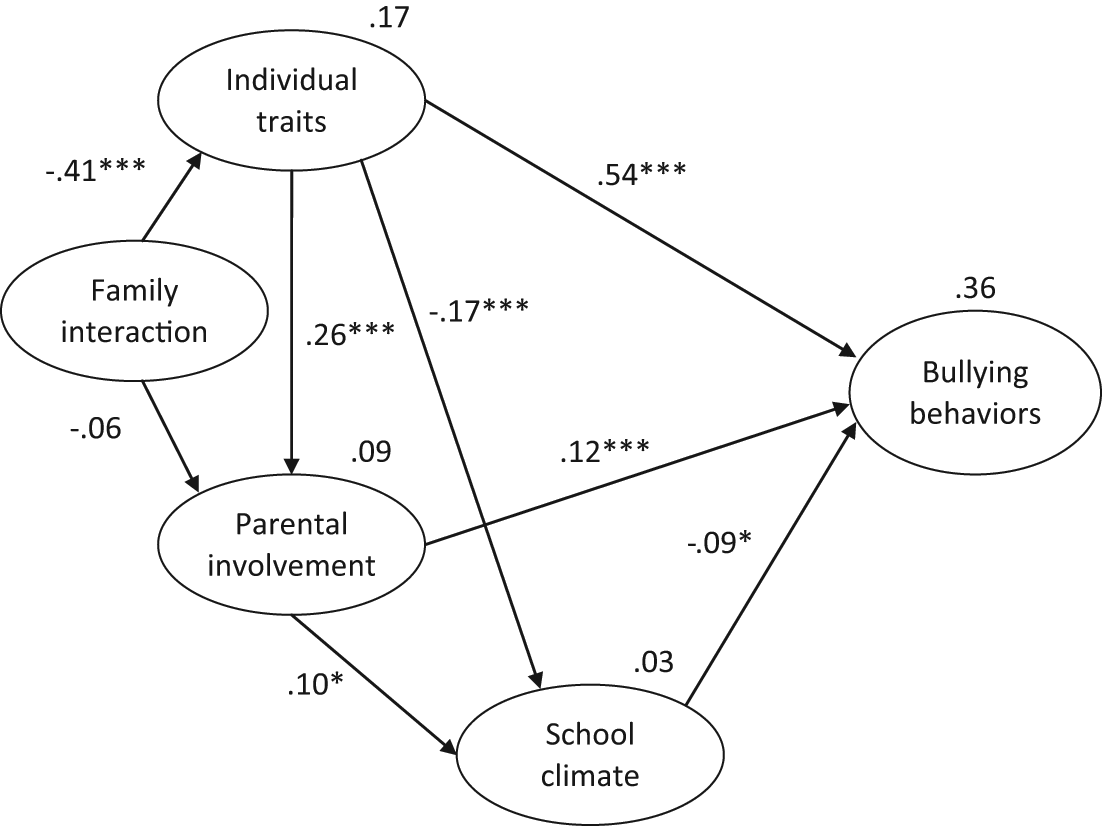
Hypothesized ecological model
The nomological validity of the hypothesized model was tested by comparing chi-squares from both the hypothesized and measurement models. The Δχ2 between the two models is 1.14 at df equals 1. This is insignificant at p < .05, indicating that the hypothesized ecological model is valid in accounting for the observed relationships between the latent constructs (see Anderson & Gerbing, 1988).
Discussion and Limitations
Summary of Findings and Discussion
There have been unaddressed limitations in the previous studies of bullying. Such limitations include shortage in theoretical and empirical investigation of bullying phenomenon. Specifically, there have been few empirical studies on the functions of parental involvement and the impact of school climate on bullying behavior as an outcome variable. In addition, the traditional OLS regression approach to bullying did not adequately address a complex structure of multilevel factors of bullying behaviors. Consequently, understanding of bullying within an ecological context has been greatly limited. To address these limitations, this study borrowed an ecological system, and empirically, but partially, tested the theory in bullying situations. The results from this investigation produced several unique and interesting findings.
First, this study found that individual traits have the most important influence on bullying behaviors. As in previous studies, this study confirmed that the effects of psychological and psychosocial traits of children on bullying were tremendous and enduring, and that individual traits were by far the most and strongest factors for bullying behaviors among Korean middle school students (see also, Lee, 2011, for similar findings from analyses of US data). This finding suggests that ecological model including individual traits and contextual factors could be consistent with current criminological approaches to delinquency and crime, such as latent trait life-course theory (e.g., Colvin, 2000).
Second, unlike previous studies, this study found that there was no direct relationship between family interaction and bullying behavior at school (see both Traditional and Hypothesized models). The previous studies on bullying suggested that experiences in the family had direct impact on children’s behaviors in schools. Without adequate theory for the transmission of influence from family to school, the conclusion drawn from the previous findings would be misleading. For example, social learning theory typically postulates that children who learned deviant norms and behaviors in the family would be more likely to carry out similar behaviors in schools (i.e., direct correlations between family experience and school violence, see for example, Matsueda & Heimer, 1987; Stevens, Bourdeaudhuij, & Oost, 2002). This study, however, found that the effect of experiences in the family was mediated by individual traits. This indirect relationship indicates that the effect of experience within the family is not readily transmittable unless there are active conveyers, which are children and parents, between the family and school. This finding is consistent with findings from studies examined effects of strain from family experience on delinquency, conditioned by other factors, such as self-control (Agnew, Brezina, Wright, & Cullen, 2002).
Third, this study found an unexpected result regarding the effects of family interactions on individual traits. The result showed that family interactions is negatively related to the individual traits, indicating that negative experiences in the family (e.g., authoritarian parenting, witnessing domestic abuse, etc.) would decrease the negative individual traits (see Figure 2). In an attempt to find alternatives, an opposite direction (a path from individual traits to family interaction) had been investigated. This attempt, however, produced an identical outcome (β = –.41). When bidirectional paths were employed between these two variables, the results were insignificant. Omission of the family interaction variable from the ecological model resulted in a serious reduction in the explained variance of bullying behavior. Further study is recommended to find possible reasons for the negative relationship.
Fourth, the results suggested that individual traits were positively related to parental involvement, indicating that negative individual traits would increase parental communications with teachers and peers in schools. In addition, parental involvement was significantly positively related to bullying behavior in this investigation. Overall, it could be articulated that the more negative individual traits children have, the more bullying behaviors they commit, and the more their parents would contact teachers and friends at schools.
Fifth, the bridge function of parental involvement was not observed in this investigation. The result suggests that parental involvement does not bridge influence of negative experience in the family with bullying behaviors at schools, and that parents as active conveyers do not play a role of the supplementary link between home and school in South Korea.
Sixth, this study empirically tested and found that positive school climate is negatively related to bullying behavior. As noted in several works (Gottfredson, 1986, 2001; Gottfredson et al., 2005), the current study confirmed the effects of school climate on delinquency. Particularly, using bullying behavior as an outcome variable, this study added empirical evidence to support the effects of school climate on bullying behavior in the Korean school context.
Finally, this study found that parental involvement had direct influence on bullying behavior as well as school climate. Using the ecological model, this study found that parental involvement would maintain direct influence on bullying as well as indirect influence on bullying behavior through school climate. In other words, these findings are consistent with the traditional assumption that parental involvement with teachers, peers, and school boards would influence formation of more positive and academic environments in schools, resulting in reduced bullying behaviors within schools.
Implications of Findings and Conclusions
Based on the findings, the current study suggests several academic and policy implications. First, as the findings show, an ecological perspective could be well cooperated with criminological theories, providing a firm theoretical framework for theory integration. Specifically, this study found that individual traits are important in shaping one’s behaviors at school and that the traits could interact with other contextual factors. These findings are consistent with findings from criminological studies (e.g., Moffitt, Lynam, & Silva, 1994). As an ecological perspective includes multiple levels of factors, criminological theories using different levels of factors could be combined within the ecological framework.
Second, as individual traits are important influence for bullying, it is suggested that early identification of personal tendency for bullying is necessary. An identical result about importance of individual traits in bullying phenomenon was observed in a study examining US data (Lee, 2011). Across different social contexts, it seems that individual traits play an important role in shaping one’s behavior, particularly bullying behavior. Thus, early evaluation of individual tendency for bullying behaviors may provide important information to intervene the relationship between individual tendency and ecological contexts.
Third, as parental involvement enhance positive school climate, it is suggested that school authority facilitate parental involvement in school regarding bullying behaviors. Instead of encouraging reactive parental involvement, it is important that parents proactively involve with school activities, such as parents-teachers conference and parents–peers communications. These involvement activities may enhance positive and corporative school climate, which will results in decrease in bullying behaviors at schools.
However, caution should be practiced in interpretation of the findings (positive relationships among parental involvement, school climate, and bullying behavior) due to two possible reasons. First, there is dramatic difference in the Korean cultural setting from other Western countries. For example, due to the high levels of social attention to the corruptive relationship between teachers and parents in South Korea, it has been an unwritten rule for parents to stay away from school policy (Sung, 2009). Thus, as described previously, parents in South Korea may only react to bullying incidents rather than proact against it. Second, it is also possible that this positive relationship could have occurred because of the cross-sectional research design. Thus, it is recommended that future study use temporal data to evaluate causal order in this relationship.
It should be noted that there are several limitations in the current study. First, there are factors that have low levels of reliability at the first-order factor analysis. Although the second-order factor analysis developed the final factors with higher reliability and items with low factor loadings were excluded through two steps of factor analysis, readers are advised to pay attention to low levels of reliability of those factors. Second, the current study tested only a part of the ecological systems theory. Instead of testing entire ecological systems theory, emphasis was given in this study to focus on functions of parental involvement and school climate. Third, the current study used cross-sectional data. As the ecological perspective can be more adequately investigated with longitudinal data, and as analysis of temporal data might reveal causal order between parental involvement and bullying in schools, it is recommended that future ecological studies of bullying use longitudinal research design.
Footnotes
Declaration of Conflicting Interests
The authors declared no potential conflicts of interest with respect to the research, authorship, and/or publication of this article.
Funding
The authors disclosed receipt of the financial support for the research, authorship, and/or publication of this article:
The current study is funded by the 2012 Hannam University Research Fund.