






Abstract
Researchers in this study examined the attitudes toward domestic violence, the victim, and her perpetrator. A total of 194 participants were randomly assigned to one of 4 hypothetical scenarios to evaluate how observers’ perceptions were influenced by their own sex and myths about domestic violence, by the victim’s decision to return to the abusive relationship, and by the relationship status of the victim (dating or married to the perpetrator). Results demonstrated significant main effects of participant’s sex, domestic violence myths, and of the victim’s relationship status and decision to return. That is, participants blamed the victim who reportedly returned to her abuser more than the victim about whom there is no such information. Further, participants with greater domestic violence myths tended to blame the victim more than those with less myths, and male participants blamed the victim and minimized the incident more than female participants. Implications, limitations of the study, and future research are discussed.
Domestic violence is highly prevalent in the United States. Statistics show that between 8% and 12% of women (about 1 million) are battered by their intimate partner each year (Bornstein, 2006; Samuelson & Campbell, 2005), and this number may actually be much higher (as many as 4 million) due to underreporting (Browne, 1993). Browne (2003) also suggested that between one fifth and one third of all women will be victims of domestic violence sometime during their adulthood. Despite such prevalence, it is quite difficult to define domestic violence due to the lack of agreement about the basic features of domestic violence (Dobash & Dobash, 1992). However, for the purpose of this study, we employed the definition of Schechter and Ganley (1995), which states that “domestic violence is a pattern of assaultive and coercive behaviors including physical, sexual, and psychological attacks” (p. 15).
Of the large number of women who are victims of domestic violence, a majority experiences difficulties when deciding to leave the violent relationship and may temporarily, but unsuccessfully, leave their partner many times before fully severing ties (Sullivan, Basta, Tan, & Davidson, 1992). Okun (1986) reported that the average woman will make five attempts to leave her abuser before successfully ending the relationship. Similarly, Peled, Eisikovits, Enosh, and Winstok (2000) noted that 50% to 60% of battered women returned to live with their abuser after being discharged from a shelter.
Although many women are motivated to leave their abusive relationships, a myriad of factors stand in their way, making the decision to return to abusers more likely. For example, Johnson (1992) theorized that the decision to return to an abusive relationship is guided by the perception that the rewards of the relationship outweigh the costs of separation. Specifically, Johnson found that a woman is likely to return to an abuser when she is unemployed, her combined family income is high, or when she has negative perceptions of herself. Similarly, Anderson et al. (2003) found that reasons for returning included lack of financial resources, inadequate help from police or from other formal support systems, and lack of a place to go. In addition to these factors, Martin et al. (2000) recognized that difficulties in relocation, legal issues, sharing child custody, termination of the emotional connection with the abuser, and disrupted social networks placed the victim at higher risk of returning to the relationship.
Although victims of domestic violence may often underestimate the severity of these difficulties, as shown by Okun’s (1986) reports of the several attempts a victim makes to leave the relationship, outsiders’ perceptions of why women don’t leave abusive relationships are even more simplistic. This lack of understanding may lead to others’ negative attitudes toward victims, further decreasing the chance that a victim who returns will leave once and for all. Indeed, Goodkind, Gillum, Bybee, and Sullivan (2003) found that negative responses from victims’ families and friends were related to lower quality of life for victims, which may encourage a return to the abusive relationship. Patzel (2006) also reported that fear of being alone and a lack of support from family and friends reduced a woman’s ability to leave the relationship. Furthermore, Chang et al. (2010) found that one of the most important factors that led women to successfully leave their abusers was the realization that they had access to resources and support from others. Therefore, the purpose of this study is to investigate others’ attitudes toward a domestic violence incident and its victim and perpetrator—and how those views are influenced by the victim’s decision to return to her abuser, by the relationship status of the victim and abuser, and by the respondent’s sex and his or her adherence to domestic violence myths. In addition to victim blame attribution, respondents’ level of minimization of the incident and exoneration of the abuser were also examined, as both attitudes are forms of victim blame attribution.
Domestic Violence Myths and the Decision to Return
A substantial amount of empirical research has reported on various factors that may contribute to negative attitudes toward the victims of domestic violence. For instance, Capezza and Arriaga (2008) found that, when compared to a traditional woman (e.g., housewife), participants blamed the victim more if she was a nontraditional woman or if she reacted negatively to the abuse. Victims were also blamed more if they were verbally aggressive prior to the incident (Witte, Schroeder, & Lohr, 2006) or somehow provoked their partner (Esqueda & Harrison, 2005). Similarly, we believe some of these negative attitudes toward domestic violence victims may come from the erroneous ideas that victims are primarily battered due to their desire for abuse or due to their own behavior. Saul (1972) suggested that some people believe women are responsible for their own abusive relationships and have an unconscious desire to be abused. Other research has proposed that some believe women are masochistic and want to be beaten (Walker, 1979), that women are willing to remain in the relationship (Ferraro, 1989), and that women have done something to deserve the violence (Buzawa & Buzawa, 1993). Peters (2008) called such beliefs “domestic violence myths” and conceptualized them as “stereotypical beliefs about domestic violence that are generally false but are widely and persistently held, and which serve to minimize, deny, or justify physical aggression against intimate partners” (p. 6). Indeed, he found that people who subscribe to these myths generally hold the victim responsible for the abuse, excuse the perpetrator, and minimize the seriousness of the abuse more than those who adhere less to these myths.
Some of these myths purport that a battered woman can, if she wants, swiftly and successfully end a violent relationship by simply leaving her abuser. In fact, Worden and Carlson (2005) found that 23% of participants they surveyed believed that women secretly wanted to be abused and that 63% thought that women could leave the relationship if they really wanted to. However, as previously mentioned, the reality that victims face is far more complicated than what others perceive it to be. If individuals believe that victims of domestic violence can escape the situation whenever they wish or can resolve the situation by simply leaving, they are likely to perceive those victims who return to their abuser more harshly. Therefore, we hypothesized that others would blame the victim, minimize the seriousness of the abuse, and excuse the perpetrator more in a scenario where the victim decides to return to her abuser than in a scenario where the victim’s decision to return is not known. Furthermore, we hypothesized that individuals who more strongly subscribe to domestic violence myths would blame the victim, minimize the violence, and/or excuse the perpetrator more than individuals who subscribe less to such myths.
Relationship to Abuser
In addition to the effect of domestic violence myths on others’ perceptions of domestic violence, we also examined another factor that may influence such perceptions: the type of relationship between the victim and the perpetrator. Several researchers have examined whether the relationship between the victim and the perpetrator influences perceptions of domestic violence. Willis, Hallinan, and Melby (1996) found that participants were more likely to excuse the perpetrator when he was a married man than when the perpetrator and victim were acquaintances, in part because a married man involved in domestic violence may be viewed as exercising familial discipline. In addition, Langhinrichsen-Rohling, Shlien-Dellinger, Huss, and Kramer (2004) found that participants rated married victims as more likely to be psychologically damaged by domestic violence than acquaintance victims. Participants may have assumed that the marital violence was ongoing and frequent as opposed to the acquaintance violence that appeared to be happening for the first time. However, both of these studies failed to include scenarios depicting couples in dating relationships.
One factor that may influence perceptions of the domestic violence victim is one’s view of the level of commitment in the relationship. In particular, people may consider dating couples as less committed in comparison to married couples. Indeed, research shows actual commitment differences in these types of relationships, with people in dating relationships generally demonstrating less commitment to each other than people in marital relationships (Kurdek, 1995), perhaps because there are more alternatives when trying to leave (Le & Agnew, 2003). As such, a victim in a dating relationship might be blamed more than a victim in a marital relationship because the dating victim is seen as less invested in the relationship and as having more opportunities to leave her abuser than the married victim. Together, these differences in perception of commitment may have important implications for how abuse victims are perceived. Accordingly, we hypothesized that the victim in a dating relationship would be blamed more than the victim in a marital relationship.
Sex of Participants
Previous studies have found that participants’ sex is related to attitudes toward domestic violence (e.g., Harris & Cook, 1994; Yamawaki, Ostenson, & Brown, 2009). The consistent underlying pattern in these findings is that men assigned more blame to the victim (Bryant & Spencer, 2003), greater minimization of the violent incident, and more exoneration of the perpetrator than did women (Yamawaki et al., 2009). Therefore, we hypothesized that male participants would tend to blame the victim, minimize the seriousness of the assault, and excuse the perpetrator of domestic violence more than female participants did.
The Present Study
In sum, the purpose of this study was fourfold because it (a) investigated the role of the victim’s decision to stay with her abuser, (b) examined the effects of myths of domestic violence, (c) tested the relationship between the victim and her abuser, and (d) examined the participant’s sex on others’ attitudes toward a domestic violence incident, its victim, and her abuser. To date, we are unaware of any studies that investigate the role of a victim’s decision to stay with her abuser and domestic violence myths on victim blame attribution. Given that numerous unsuccessful attempts of leaving the abusive relationship are reported and that others’ support is crucial for victims’ stay/leave decision making, a key subject that this study finds worthy of further investigation.
Hypotheses
In summary, the hypotheses of this study are as follows.
Hypothesis 1: Respondents would blame the victim, minimize the seriousness of the abuse, and excuse the perpetrator more in a scenario where the victim decides to return to her abuser than in a scenario where the victim’s decision to return is not known.
Hypothesis 2: Respondents would blame the victim and minimize the seriousness of the assault in the dating scenario more than in the marital scenario, while they would excuse the abuser in the marital scenario more than in a dating relationship.
Hypothesis 3: Male respondents would blame the victim, minimize the seriousness of the assault, and excuse the abuser more than female participants would.
Hypothesis 4: Individuals who more strongly subscribe to domestic violence myths would blame the victim, minimize the violence, and/or excuse the perpetrator more than individuals who subscribe less to such myths.
In addition to the above hypotheses, we also explored the moderating roles of domestic violence myths, the decision to return to the abuser, and the relationship between the victim and her abuser on the dependent variables.
Method
Participants
A total of 194 undergraduate students (men = 77, women = 117) were recruited from psychology courses and participated in exchange for course extra credit. The average age of the participants was 21.9 years (range = 18-57), and their marital status was reported as single (88%), married (10%), and divorced (2%). Ethnicity of the participants was reported as being Caucasian (90%), Asian/Pacific Islander (5%), Hispanic/Latino (3%), Black (1% ), and “Other” (1% ). This study was approved by Brigham Young University’s Institutional Review Board (IRB), and all participants were treated in accordance with the ethical guidelines of the American Psychological Association. Confidentiality and anonymity were maintained.
Procedure
The questionnaire and scenario were administered electronically through a Qualtrics web-based survey (Qualtrics.com). After informed consent was obtained, the research procedure was introduced using a standardized script. All participants were asked to read a scenario involving a relationship conflict that included a violent physical interaction between a man and a woman and a description of how the individuals in the scenario dealt with that conflict. Approximately equal numbers of participants were randomly assigned to each of the four scenarios. After they read the assigned scenario, the participants completed the Domestic Violence Minimization Scale, the Victim Blame Attribution Scale (VBAS), the Perpetrator Excuse Scale (PES), the Domestic Violence Myth Scale (DVMS), and a demographic survey.
Scenarios
Four domestic violence scenarios were developed and used in this study, each depicting a situation in which a domestic violence incident was reported to the police by a neighbor. The police officer observed some physical injuries on the victim (Marci), so the victim accepted medical attention and was taken to a local domestic violence shelter. The perpetrator (Steve) was arrested. The scenarios differed in two aspects: (1) relationship of the couple (married vs. dating), and (2) information about whether the victim dropped all charges against her perpetrator and returned to him (information about return vs. no information about return). The scenario is provided below, with items in brackets indicating the variables that differed in each scenario:
A police officer responded to an incident of domestic violence reported by a neighbor. Upon arrival, a woman named Marci reported that she had been assaulted by her [husband/boyfriend], Steve. The officer learned that Marci and Steve had been [married/dating] for 4 years. Marci stated that an argument over having lunch with her friend had instigated the assault. Steve allegedly pushed Marci to the floor and struck her repeatedly in the face. The officer observed that Marci had a swollen eye and a bruised forehead, and medical attention was offered to and accepted by Marci. The officer also observed that Steve and Marci were very angry and calling each other names. The officer arrested Steve, and Marci was taken to a local domestic violence shelter. [The next morning, Marci decided to return home to Steve and dropped all charges.]
Measures
The Minimization Scale (MS; Yamawaki et al., 2009)
The MS is designed to measure the degree to which respondents minimize the seriousness of domestic violence, and it is comprised of four items. The items on this measure assess respondents’ perceptions of the seriousness of the domestic violence incident by investigating the victim’s psychological and physical health being at risk, the incident being a violation of her rights, and the incident being simply a quarrel between a couple. Participants respond to items on a 7-point Likert-type scale ranging from 1 (strongly agree) to 7 (strongly disagree). The last item was reverse scored, and each item was summed to create a total score, with higher scores indicating greater minimization of the domestic violence incident. Yamawaki et al. reported an internal consistency of .82 for the measure, and the Cronbach’s alpha for the present study was .78.
Victim Blame Attribution Scale (VBAS; Yamawaki et al., 2009)
The VBAS consists of five items that assess perceptions of the victim’s responsibility for the situation, the victim’s desire for the assault and unconscious desire to be in an abusive relationship, the victim’s provocation of the incident, and blaming of the victim. For the purpose of this study, the scale was slightly modified from the scale in Yamawaki et al. These items were scored on a 7-point Likert-type scale ranging from 1 (strongly agree) to 7 (strongly disagree). All items were reverse scored and summed, with higher scores showing the endorsement of greater victim blame attribution. Yamawaki et al. reported an internal consistency of .82 for this measure, and the Cronbach’s alpha for the present sample was .85.
Perpetrator Excuse Scale (PES; Yamawaki et al., 2009)
The PES was used in the present study and includes three items that examine the respondent’s agreement with the perpetrator’s level of responsibility for the domestic violence incident, the perpetrator’s level of fault, and how wrong the perpetrator was for hitting his partner. Each item was again scored on a 7-point Likert-type scale that ranged from 1 (strongly agree) to 7 (strongly disagree). All items were summed, with higher scores corresponding to the respondent’s tendency to excuse the perpetrator more. In the present study the Cronbach’s alpha of this scale was .72.
Domestic Violence Myth Scale (DVMS; Yamawaki, 2011)
The DVMS was developed by Yamawaki (2011) and is designed to measure the degree to which respondents believe in myths about domestic violence. Yamawaki identified five subscales for myths of domestic violence: myth of socioeconomic status, characteristics of victim, victim’s desire to stay with perpetrator, minority home, and exonerating perpetrator. Since our purpose was to investigate the role of the victim’s decision to return to her perpetrator, the Myth of Victim’s Desire to Stay With Perpetrator subscale was used and called the DVMS in this study. The DVMS consists of five items, which included (a) “Domestic violence is easily resolved when the victim leaves the situation”; (b) “Victims of domestic violence can leave the situation whenever they want to”; (c) “If a domestic violence victim has financial resources, she can leave”; (d) “If a woman doesn’t like it, she can leave”; and (e) “Any healthy woman can successfully leave her abuser if she really wants to.” These items were scored on a 7-point Likert-type scale ranging from 1 (strongly agree) to 7 (strongly disagree). These five items were all reverse scored and then combined to form a measure of respondents’ endorsement of the myths of domestic violence. Higher scores on this scale reflect the strength of the participant’s inclination to endorse domestic violence myths. The internal consistency of this measure in the current study was .84.
Results
All measurements were centered prior to the analyses according to the recommendation by Jaccard, Turrisi, and Wan (1990).
The Effects of Relationship Status, Returning to Perpetrator, and Participant’s Sex on Minimization, Victim Blame Attribution, and Exonerating Perpetrator
To investigate the role of the decision of the victim to return to her abuser (Hypothesis 1), the victim–abuser relationship (Hypothesis 2), and participant’s sex (Hypothesis 3) on minimization, blaming victim, and excusing abuser, a 2 (dating vs. married) x 2 (decision to return vs. no information) x 2 (male vs. female respondent) MANOVA (multivariate analysis of variance) was performed on the MS, the VBAS, and the PES. In line with the hypotheses, the main effects of relationship status, Wilk’s Λ = .95, F(3, 184) = 3.15, p < .05, r = .05; decision to return, Wilk’s Λ = .82, F(3, 184) = 13.59, p < .0001; and participant’s sex, Wilk’s Λ = .89, F(3, 184) = 6.39, p < .0001 were found. There was no interaction effect found in this analysis. The results of the follow-up ANOVA (analysis of variance) are organized based on the dependent variables.
Minimization
No effects of the victim’s decision to return to her abuser (Hypothesis 1) and relationship (Hypothesis 2) on minimization were found. However, Hypothesis 3 was supported in that male participants tended to minimize the seriousness of the assault (M = 8.81, SD = 3.79) more than female participants did (M = 7.51, SD = 2.70), F(1, 186) = 7.09, p < .01.
Victim blame attribution
A follow-up univariate test indicated that participants tended to blame the victim who returned to her abuser (M = 18.09, SD = 7.12) more than the victim whose decision was not mentioned (M = 13.99, SD = 4.75), F(1, 186) = 36.62, p < .001, and blame the victim in the dating scenario (M = 17.17, SD = 6.62) more than in the married scenario (M = 14.76, SD = 6.16), F(1, 186) = 6.05, p < .05. Furthermore, the results of the tests indicated that male participants tended to blame the victim (M = 17.64, SD = 6.22) more than female participants did (M = 14.81, SD = 6.16), F(1, 186) = 16.61, p < .001. Therefore, all three hypotheses were supported on victim blame attribution.
Excusing the perpetrator
No effects of the respondents’ sex, the victim’s decision to return to her abuser, and relationship status on excusing the perpetrator were found. Therefore, all three hypotheses were not supported on excusing the perpetrator.
The Moderating Effect of Domestic Violence Myths, Relationship Status, and Returning to Perpetrator
To test Hypothesis 4, hierarchical regression analyses were performed to examine the impact of domestic violence myths, victim–abuser relationship, victim’s decision to return to her abuser, and participant’s sex on the minimization of the incident, victim blame attribution, and excusing the perpetrator. In each analysis, all selected moderators were entered in the first model, and the interaction terms (Myths × Relationship, Myth × Decision to Return, and Myth × Sex of Participant) were entered in the second model. The results of these analyses were summarized in Table 1.
Regression Analyses of the Effects of Predictors on Minimization, Victim Blame, and Excusing Perpetrator
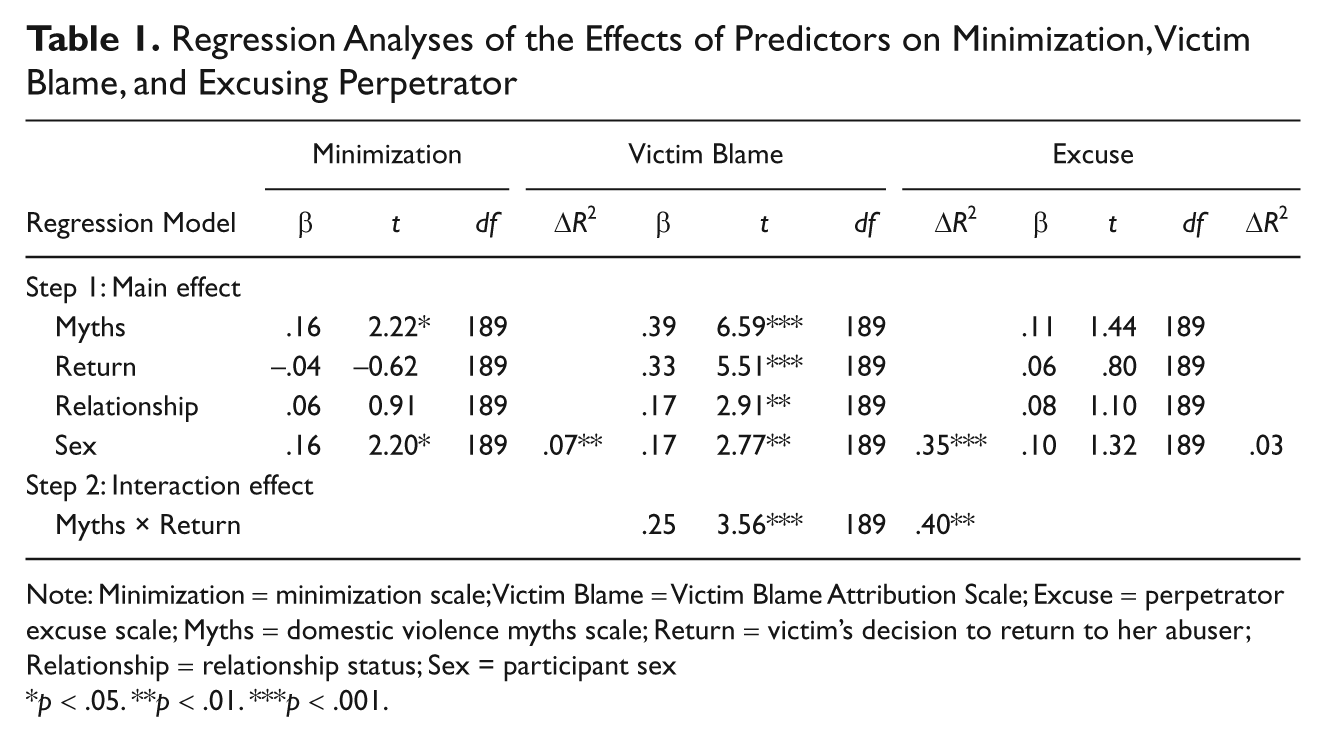
Note: Minimization = minimization scale; Victim Blame = Victim Blame Attribution Scale; Excuse = perpetrator excuse scale; Myths = domestic violence myths scale; Return = victim’s decision to return to her abuser; Relationship = relationship status; Sex = participant sex
p < .05. **p < .01. ***p < .001.
Minimization
As predicted, significant main effects for domestic violence myths and participant’s sex were found. The results demonstrated that male participants and individuals who more strongly endorsed domestic violence myths tended to minimize the incident of domestic violence, more than female participants and individuals who endorsed the myths less. The decision to return and the victim–abuser relationship were found to be nonsignificant when interacting with the minimization variable. No significant interaction effect was obtained from this analysis.
Victim blame attribution
In line with Hypothesis 4, the main effects of domestic violence myths, decision to return, victim–abuser relationship, and participant’s sex were found. To test the interaction effects, all two-way interaction terms that were used for minimization were entered in the second model. The results revealed a significant Myths × Decision to Return interaction effect. To examine the patterns of the interaction effect, a simple effects analysis was performed. This analysis showed a different relational pattern between dating and marital relationship regarding the domestic violence myths measured on the VBAS. Thus, Hypothesis 4 was supported as domestic violence myths were a significant predictor for victim blame attribution for both relationship types. However, the effect of domestic violence myths was greater in the scenario where the victim decided to return to her abuser than in the scenario with no such information.
Excusing the perpetrator
The results indicated no significant main effects of the domestic violence myths, decision to return, victim–abuser relationship, or participant’s sex. Therefore, Hypothesis 4 was not supported.
Discussion
Social support is one of the crucial factors that help a domestic violence victim to leave her abuser. Consequently, the purposes of this study were to investigate the roles of the victim’s decision to stay with her abuser, myths of domestic violence, the relationship between the victim and her abuser, and the participant’s sex on others’ attitudes toward a domestic violence incident, the victim, and her abuser. In line with our hypotheses, we found that the observer’s own domestic violence myths, the relationship status of the victim and abuser, and the observer’s sex all showed effects for observer attitudes toward the victim and incidents. These findings may increase understanding of the complex factors that contribute to perceptions about domestic violence.
As expected, the participants whose scenario stated that the victim returned to her abuser blamed the victim more than did the participants who had no information about the victim’s returning. This finding suggests that when individuals observe a victim of domestic violence returning to her abuser, they tend to blame her more. Previous research attests that victims tend to be revictimized by others’ negative attitudes toward them, known as secondary victimization, and such negative attitudes reinforce the victim’s self-blaming, making it extremely difficult to recover from the assault (Coates, Wortman, & Abbey, 1979). Others’ negative attitudes not only discourage victims from seeking help to leave their abusers but may also actually encourage victims to return to their abusers by reducing their ability to recover from the assault, leading them to deal with the abuse on their own. Indeed, others’ negative attitudes toward victims may contribute to the vicious cycle of domestic violence, and, as Okun (1986) suggested, may lengthen the process of leaving the abuser.
The results of the present study show strong evidence that adherence to domestic violence myths influences others’ negative attitudes toward victims of domestic violence. That is, others tended to perceive the victim who decides to return to her abuser as being responsible for and inciting the abuse and as having an unconscious desire to be abused, thus leading them to blame her. Pavlou and Knowles (2001) similarly indicated that victims were more likely to be blamed by others if they were seen as provoking the domestic violence. Specifically, we found that the effect of domestic violence myths was greater in the scenario where the victim decided to return to her abuser than in the scenario with no such information. This interaction highlights the importance of both cognitive variables of the observer (domestic violence myths) and situational factors (returning to abuser) in the assessment of victim blame attribution. Indeed, cognitive researchers have shown that attitudes and beliefs are not activated in the absence of situational or social cues (Higgins, 1996).
There are several implications from these findings. For instance, psychoeducational workshops could ameliorate domestic violence myths and at the same time educate individuals on the barriers that prevent a woman from successfully leaving the relationship. This may help communities recognize the constant support needed by victims in order to successfully leave. Furthermore, given that many other situational factors may influence observers’ cognitive evaluations of domestic violence, researchers should further investigate the attitudes toward domestic violence in various situations.
This study was the first to examine the role of victim–perpetrator relationship status on others’ attitudes toward domestic violence, particularly comparing dating and married relationship status between the victim and her abuser. As predicted, the results showed that participants tended to blame the victim in a dating relationship more than the victim in a married relationship. Our assumption for this finding was that participants may see the victim in a dating relationship as having more alternatives to turn to and, therefore, as having more opportunities to leave the relationship in comparison to a married victim. Avery-Leaf, Cascardi, O’Leary, and Cano (1997) found that approximately 1 in 4 individuals in their sample had experienced physical and sexual violence in dating relationships. Given that there is such a notable prevalence of domestic violence in dating relationships and that victims are likely to engage in risky behaviors that affect their health, such as substance abuse, unhealthy weight control, unprotected sex, and increased suicidality (Silverman, Raj, Mucci, & Hathaway, 2001), special attention should be given to those who decide to return to their abusers in dating relationships. Why the victims of dating violence stay with their abusers has not been extensively explored. However, the assumption that dating victims have more alternatives than married victims do may be an overly simplistic myth.
Effects of the sex of participants were also found to be significant. Male participants were shown to blame the victims and minimize the seriousness of the assault more than female participants did. These findings are consistent with previous studies. Feather (1996) found that female participants tended to see intimate partner violence as more serious than male participants did. However, several studies have shown results inconsistent with the present study by attesting little or no sex difference (e.g., Capezza & Arriaga, 2008). Such discrepancy can be explained by gender-role traditionality. In a rape perception study, Yamawaki (2011) found that more than the participants’ sex, the level of gender-role traditionality predicted the differing patterns between men’s and women’s negative attitudes toward rape and rape victims. She concluded that because men tend to endorse more gender-role traditionality than women do, men tend to blame victims more. Future research on attitudes toward domestic violence is needed to investigate such claims. Based on this study, we recommend efforts to educate men about intimate partner violence, especially considering the number of men involved in incidents of domestic violence as police officers, judges, therapists, and perpetrators.
Although we investigated the participants’ attitudes toward excusing the perpetrator, the victim’s decision to return to her abuser, domestic violence myths, relationship status, and participants’ sex did not influence such views. Some studies showed that certain personality traits, such as holding traditional gender roles, and cultural influences on participants were associated with excusing domestic violence perpetrators (Sakalh, 2001; Yamawaki et al., 2009). However, those studies were based on cross-cultural data, and the scenarios they used were not the same for this study. Therefore, further investigation is necessary to replicate this result.
Some limitations should be noted in interpreting the results of this study, in particular those related to generalizability. It is rather complicated to generalize these results to real-world domestic violence situations. First, participants of this study were all college students. Moreover, the domestic violence cases were examined as hypothetical scenarios. Therefore, future research should focus on replicating the findings of this study in more applied settings. For example, researchers could observe a sample from the general population in real domestic violence cases. Studies in applied settings would serve to improve the generalizability of the findings of this study. Furthermore, this study did not distinguish between the different forms of domestic violence (i.e., battering, situational couple violence, etc.); future study should investigate such factors.
Conclusion
Fugate, Landis, Riordan, Naureckas, and Engel (2005) found that informal helpers, such as family and friends, were the largest source of support for abused women in their study and that such support would greatly enhance victims’ ability to evaluate their situations and to decide the types of assistance they need. However, the results of this study indicated that others may judge or criticize them by minimizing the seriousness of assault or by blaming them for not leaving the abusive relationship. The findings also showed that domestic violence myths play a crucial role in others’ negative attitudes toward domestic violence. Given that one in every four women in the United States will be assaulted at some point in their lives (Jasinski, 2004), efforts in ongoing public education to ameliorate such domestic violence myths are indispensable so that informal helpers can be valuable resources for abused women.
Footnotes
Declaration of Conflicting Interests
The author(s) declared no potential conflicts of interest with respect to the research, authorship, and/or publication of this article.
Funding
The author(s) received no financial support for the research, authorship, and/or publication of this article.