






Abstract
Research examining the impact of self-protective behaviors on outcomes in nonsexual assaults involving intimates has focused solely on one mainstream sample (National Crime Victimization Survey) in which violence is a relatively rare event. Using the Women’s Experience of Violence (WEV) project which collects data from a sample of incarcerated women, we explored the phenomenon of self-protective behaviors to assess whether their use impacts the probability and severity of subsequent injury during a domestic violence incident. In addition to utilizing a unique sample, we considered an alternative operationalization of self-protective behaviors that separates physical and verbal responses to include whether the behavior involved an element of force. Results suggest some similarities between a mainstream sample and our marginalized sample. Namely, the frequency in which they utilize countermeasures and the effect of “fighting back” appear to be consistent with previous research. However, the more nuanced categorization of self-protective behaviors demonstrates the importance of considering whether the strategy was forceful when examining women’s responses to violence.
Introduction
Self-protective behaviors are measures victims take that are aimed at avoiding victimization, preventing the completion of a criminal act, or avoiding injury during an assaultive incident. Studies have found that victims employ a variety of countermeasures in incidents of violence and the frequency in which they are used varies as a function of the type of victimization (Hindelang, 1976). Although victim behavior can be conceptualized in a number of unique ways and across different levels of analysis (Bronfenbrenner, 1979; Goodman, Dutton, Vankos, & Weinfurt, 2005), the criminological literature typically treats these behaviors as rational strategies, as opposed to random responses (see Guerette & Santana, 2010; Tark & Kleck, 2004, for discussion). The body of this research draws from Rational Choice/Routine Activities theory (Clarke & Cornish, 1985; Cohen & Felson, 1979), however researchers note that relatively little is known about how guardianship (any person or thing that discourages crime from occurring) operates at the individual level compared with other levels (Tewksbury & Mustaine, 2003).
Typically, notions of individual level guardianship refer to (a) individual characteristics such as age, race, gender, or class (Tewksbury & Mustaine, 2003) that predict whether someone is apt to carry a weapon for protection, call a cab instead of walking home alone, or socialize in bar filled with motivated offenders or (b) interpersonal control defined as “the degree to which individuals and objects in a bounded locale can be observed and impeded from experiencing criminal acts because they are proximate and exposed to agents of formal control, agents of informal control, and nonhuman protection devices” (Wilcox, Land, & Hunt, 2003 p. 62 ). A different (yet theoretically consistent) way of thinking about self-protective behaviors is to consider it as a form of victim initiated situational crime prevention (Guerette & Santana, 2010) or, alternatively, as a form of self-help (Black, 1983). Our interest is self-protective behaviors is more consistent with the latter forms of guardianship, but in a specific context, that is, when victimization (or its threat) is in progress.
Taking this theoretical framework as a basis for understanding victim strategies of resistance during the victimization event, self-protective behaviors are particularly interesting when the assault involves an intimate partner. Compared with more “traditional crime,” the unique nature of domestic violence makes prevention through environmental manipulations difficult. The targeting strategy of the domestic offender is deliberate, not opportunistic. Therefore, “target initiated exposure reduction” is unlikely to prevent victimization (Dugan & Apel, 2005). In addition, because domestic violence often occurs in the home, crime control methods that increase capable guardians (e.g., neighborhood watch) may be less effective.
Very little empirical research has examined whether self-protective behaviors are effective in nonsexual domestic violence situations. In addition, research has yet to examine victim resistance in a nonmainstream sample where the willingness to utilize these behaviors and the effectiveness of these strategies may differ. To this end, the purpose of the current study is to examine the effects of self-protective behaviors in an extremely high risk sample that is normally excluded from nationally representative surveys, incarcerated women. In addition, our operationalization of self-protective behaviors differs from previous studies of nonsexual assault. Specifically, we separate responses that pose a threat to the offender from ones that are aimed at escaping the situation or appeasing the assailant.
Self-Protective Behaviors and Domestic Violence
Victims of domestic violence are not passive recipients of abuse. Rather they have agency and develop strategies to physically and emotionally cope with victimization (Lempert, 1996). These women may utilize a variety of strategies to end the violence or the relationship. Goodman and colleagues (2005, 2003) outline these tactics with their Intimate Partner Violence Strategies Index. Some of these strategies are formal help-seeking measures such as contacting a domestic violence shelter or obtaining legal assistance. However, other strategies are used within the relationship, such as attempting to placate the offender or actively resisting. These “private” or “personal” strategies (Bowker, 1983, 1986; Goodman et al., 2003) are also known as self-protective behaviors.
There is a fairly rich body of literature examining the role of self-protective behaviors in sexual assault. Many of these studies have focused on whether the use and type of self-protective behavior is associated with the completion of the sexual assault and/or injuries resulting from the victimization (see Ullman, 1997, 2007, for a review of the literature). In contrast, only a handful of studies have focused on nonsexual assaults (Bachman & Carmody, 1994; Bachman, Saltzman, Thompson, & Carmody, 2002; Lizotte, 1986; Skogan & Block, 1983; Tark & Kleck, 2004; Thompson, Simon, Saltzman, & Mercy, 1999) and all of these have used a nationally representative sample.
Although all previous studies examining nonsexual assault have used the NCVS, drawing firm conclusions from the results is difficult because the operationalization of self-protective behaviors and the populations included differ. The NCVS includes 16 individual variables under the topic of self-protective behaviors. These strategies range from attacking the offender with a weapon to pleading with the offender. Thompson and colleagues (1999) found that self-protective behaviors, measured as a unidimensional construct, were associated with a decrease in the probability of injury for female victims. Lizotte (1986) separated the concept of self-protective behaviors to include an element of force and found that physically “fighting back” was associated with an increase in the probability of injury for both male and female victims. Skogan and Block (1983) also included the element of force in their analysis, but expanded their definition of self-protective behaviors to include verbal strategies (e.g., reasoning with the offender or threatening the offender). Through an analysis of assaults involving strangers, they found that forceful behaviors were associated with an increase in the assault being completed as well as the likelihood of injury whereas nonforceful behaviors were associated with preventing completion and avoiding injury. Bachman and Carmody (1994) took a similar approach to Skogan and Block (1983) and also examined verbal strategies of resistance. For female victims assaulted by strangers, they found that neither physical nor verbal strategies were associated with injury or injury severity. However, with the exception of Thompson and colleagues (1999), none of these studies were able to examine the possible temporal ordering between the behavior of the victim and when the outcome occurred, therefore, the victim’s action may have been in response to the assault or injury.
Bachman and colleagues (2002) also measured self-protective behaviors in nonsexual assaults using two categories, physical and verbal, however, unlike the previous studies, they included a nuanced categorization of the relational distance between the victim and offender and were able to ascertain the proper temporal sequencing between the self-protective behavior and injury. For all relational distance categories they found that verbal strategies were associated with a lower probability of injury. Tark and Kleck (2004) took a different approach to measuring countermeasures and assessed the impact of 16 individual behaviors. They concluded that there was not a clear pattern as to the types of behaviors that impact injury in physical assault.
However, the conclusions of these studies may not hold when the offender and victim are intimates. As reviewed above, the deliberateness of the targeting strategy coupled with the private nature of domestic violence make examining the actions that victims take within these situations particularly pertinent as they may be the only crime control methods available. In addition, because domestic violence occurs between two people who may be in an ongoing relationship, self-protective behaviors may be favored over public help-seeking strategies that threaten to end the relationship. Lempert (1996) suggests that women are unlikely to turn to formal help-seeking sources in the beginning of an abusive relationship and instead favor strategies that hide the abuse. As a result, intimates may be more likely to use countermeasures against their assailants. Indeed, Bachman and Carmody (1994) found that 78% of the incidents involving intimates featured self-protective behaviors compared to 69% of those involving strangers.
Of the six studies that have examined nonsexual assault, four of these have examined how the relationship between the victim and offender may moderate the effectiveness of self-protective behaviors (Bachman & Carmody, 1994; Bachman et al., 2002; Tark & Kleck, 2004; Thompson et al., 1999). Thompson and colleagues (1999) and Tark and Kleck (2004) included interaction terms in their analyses to examine any differential impact due to relational distance, but neither of these studies found a significant effect. On the other hand, Bachman and Carmody (1994) and Bachman and colleagues (2002) estimated separate models and found that the effects of self-protective behaviors differ when the offender and victim are intimates. For intimates, both physical and verbal strategies increased the risk of injury; however, neither of these self-protective behavior strategies were significant for strangers (Bachman & Carmody, 1994). Bachman and colleagues (2002) also found that physical self-protective behaviors also increased the probability of injury for intimates, however, this effect was not observed for any other relational distance category. In addition, they found that verbal resistance was associated with a decrease in injury regardless of relational distance.
Although the current study cannot reconcile the disparate findings of the previous studies, we do offer a different unique insight into the impact of self-protective behaviors in domestic violence situations. Although informative and well suited for examining self-protective behaviors, the NCVS excludes incarcerated populations who may differ with respect to their willingness to use and the effectiveness of self-protective behaviors.
Incarcerated Women
Richie (1996) found that women who are criminal offenders may experience more frequent and more severe violence than their nonincarcerated counterparts. In addition to frequency, the predictors of violence may also differ between these groups. Dugan and Castro (2006) compared the NCVS with this current study’s sample and found that these women differed with regard to the amount of violence they experience, the predictors of violence, and their responses to victimization. In particular, standard routine activities factors predicted victimization well in the NCVS sample, but not in the sample of incarcerated women. In fact, of the predictors included in their analysis, only going out every night was a significant predictor of victimization for both groups. In addition to predictors of victimization, help seeking behaviors differed between the two samples. The sample of incarcerated women were less likely to call the police and more likely to “take the matter into their own hands” (Dugan & Castro, 2006). This suggests that women with criminal histories may be more willing to use violence against their assailants. However, the extent to which these behaviors are effective violence reduction strategies remains unknown.
In sum, previous research regarding the effectiveness of self-protective behaviors in nonsexual domestic violence incidents has been sparse. In addition, all previous studies examining nonsexual physical assault have utilized a nationally representative sample. Although extremely informative, the results of victimization studies done on a mainstream population of women may not be generalizable to female offenders. Research suggests that incarcerated women may be more prone to experience violence and more willing to respond to violence in kind which makes examining the effectiveness of resistance for these women especially important. This study is the first to explore the role of self-protective behaviors in nonsexual assault for an extremely vulnerable population of women.
Hypotheses
Guided by theory and related criminological research, self-protective behaviors during the victimization incident should serve as a protective factor against victim injury. Using RAT terminology, strategies of resistance that include an element of force may prevent injury by decreasing the vulnerability of the intimate partner as a target for aggression. If the motivation for intimate partner violence is control, as feminist scholars suggest, the victim may also stop the attack by assuaging or pleading with the offender (see Johnson & Ferraro, 2000, for discussion). In addition to target suitability, strategies in which the victim flees may increase the probability that capable guardians intervene.
However, drawing from the most relevant empirical research and a feminist perspective, some of these behaviors would be expected to exacerbate the emotionally charged situation and thus lead to an increase in injury. Victims who “fight back” physically or verbally may invoke even more anger from the offender and thus increase the severity of the attack. For this reason, Bowker (1986) strongly warns against using counterviolence, citing that most women found it unhelpful or dangerous. This reasoning also applies to behaviors in which the victim tries to remove herself from the situation. Resistance may be seen as defiance and cause the offender to escalate the severity of the attack. Therefore, although we expect self-protective behaviors to impact the probability of sustaining injury, the theoretical direction of this relationship is unclear.
Method
Sample
This research sample was drawn from an existing data set from a previous National Consortium of Violence Research funded project. The Women’s Experience with Violence (WEV) project sought to understand the entire realm of women’s violence including victimization and perpetration. The original project collected data from the Baltimore City Detention Center in Maryland as well as two additional sites, Minneapolis, Minnesota and Toronto, Ontario. 1 For this analysis, only the Baltimore data was used. At the Baltimore site, participants included 351 women (98% response rate) who were paid 15 dollars each for their participation. Out of the 351 women at the Baltimore City Detention Center, 199 (57%) experienced domestic violence at least once within the reference period (36 months prior to current incarceration) resulting in a total of 487 incidents of intimate partner assault. Table 1 displays the descriptive statistics for the sample of domestic violence victims. 2
Sample Characteristics (n = 199)
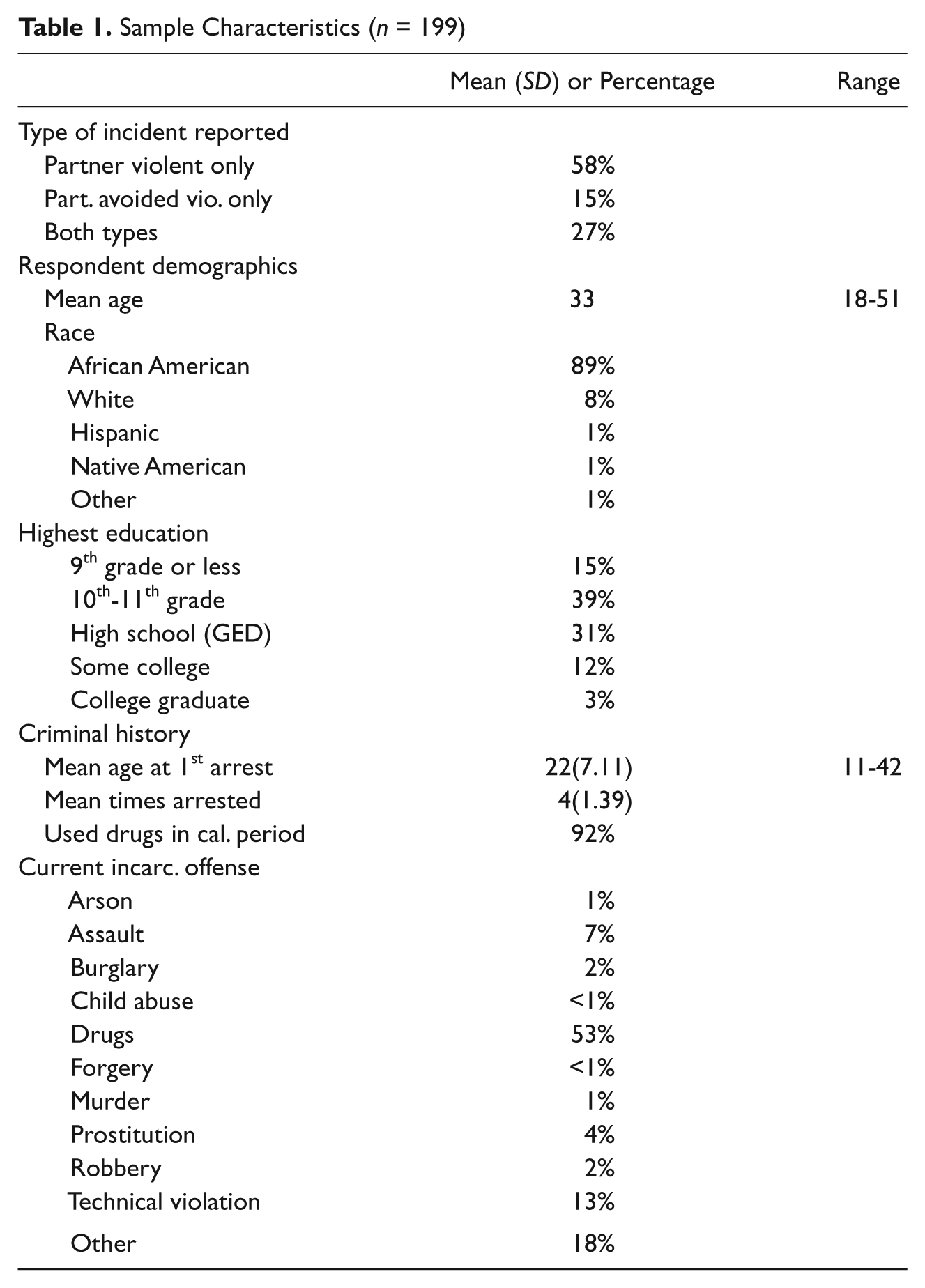
The average age of these women was 33 years old and the majority of respondents were African American (89%). Most did not graduate high school (54%) and less than 4% graduated college. Turning to their criminal histories, the women were first arrested at approximately 22 years of age; however, the age range at first arrest is substantial (11-42). Like most prisoner samples, these women tend to be reoffenders, arrested an average of 4 times prior to the current period of incarceration, and the majority were serving time for a drug related offense (53%). 3
These women were interviewed personally in one or two sessions about their experiences with violence that occurred during the 36 months prior to their incarceration. Quantitative information regarding the situational characteristics, self-protective behaviors utilized, and outcome (i.e., injury) was collected for up to 8 reported incidents of violence per type (see below). In addition to this information, a detailed narrative accompanied each self-reported victimization incident. Respondents were instructed to describe what happened in their own words. Narratives were designed to provide discursive accounts of each incident. Interviewers were instructed to make certain that not only were the basic elements of the incident (i.e., who, what, when, where, why) contained in the narratives, but also detailed aspects, interpretations, and understanding of the incident from the respondent’s point of view. Thus, the interviewer was active in questioning the respondent, often probing for more information and detail surrounding the incident (e.g., “and then what happened”).
Participants provided detailed quantitative and qualitative information describing each incident of partner avoided and completed violence. 4 The avoided violent incidents capture situations where the respondent thought that violence was imminent (e.g., the offender threatens the respondent or initiates an attack), but the assault was not completed. These are akin to the threatened and attempted assaults in the NCVS and have been included in all previous studies of nonsexual physical assault. These are important to include because restricting analysis to completed incidents may bias the results towards the conclusion that self-protective behaviors are detrimental when they may actually prevent the incident from occurring. Out of the 487 reported incidents, the majority were classified as completed (78%). Also similar to the NCVS, the WEV data set features both series and unique incidents. Series incidents are ones that happen so frequently that the respondent cannot distinguish between them. These were excluded from analysis because assessing the temporal sequencing of the event and coding the control variables was not possible.
Self-Protective Behaviors: Independent Variable
Similar to the NCVS, the WEV data set includes information regarding a number of strategies that a victim may employ during an assault and this information can be used to operationalize self-protective behaviors in a variety of ways. Instead of choosing an operationalization from the nonsexual physical assault literature, we instead draw from the most methodologically sound sexual assault research and define self-protective behaviors using four categories which enables us to distinguish between qualitatively different responses to violence (see Ullman, 1997, for a review and critique of the operationalization of self-protective behaviors in sexual assault). These include nonforceful verbal resistance (pleading, crying, or trying to assuage the offender); nonforceful physical resistance (fleeing or hiding); forceful verbal resistance (screaming or yelling in order to attract attention or scare offender); and forceful physical resistance (wrestling, struggling, pushing, striking, biting, and using a weapon). 5 Forceful behaviors are used to threaten (verbal) or disable (physical) the offender. These behaviors keep the victim engaged in the conflict. In contrast, nonforceful behaviors are ones that do not pose a challenge to the offender. These strategies are utilized in the hopes of escaping the situation, either by physically removing herself or diffusing the conflict. If compliance is the motivation for violence, distinguishing between forceful and nonforceful countermeasures is particularly important for understanding the effectiveness of these strategies for women.
Injury: Dependent Variable
Similar to studies utilizing the NCVS, for the purposes of this study, injury is based on the victims’ self-reports. Injury is first measured as a dichotomous variable reflecting whether any injury was sustained. To examine injury severity, we disaggregated injury into three mutually exclusive categories for subsequent analysis. These categories include no injuries; minor (scratches, bruises, black eyes, minor swelling); and moderate/serious (knocked unconscious, broken teeth, knife wounds, gun wounds, internal injuries). Moderate and severe injuries can be broadly conceptualized as injuries that may require medical assistance. The majority of the incidents featured no injury (68.58%) and relatively few incidents featured moderate or severe injuries (6.78%).
Demographic, Situational, and Sample Specific Controls
Table 2 displays the frequencies of all included control variables. The majority of the offenders were male, over the age of 30, and non-White. The situational characteristics include location (public or private), alcohol and drugs (both the offender and the victim), offender weapon, bystanders, whether the victim has children, time of day (day or night), and sexual assault. 6 The majority of these incidents occurred in a private location at night and only 8.8% of the incidents featured bystanders. Substance use was fairly prevalent in this sample with over half of the incidents featuring either the victim or offender using drugs or alcohol.
Distribution of Control Variables (n = 487)
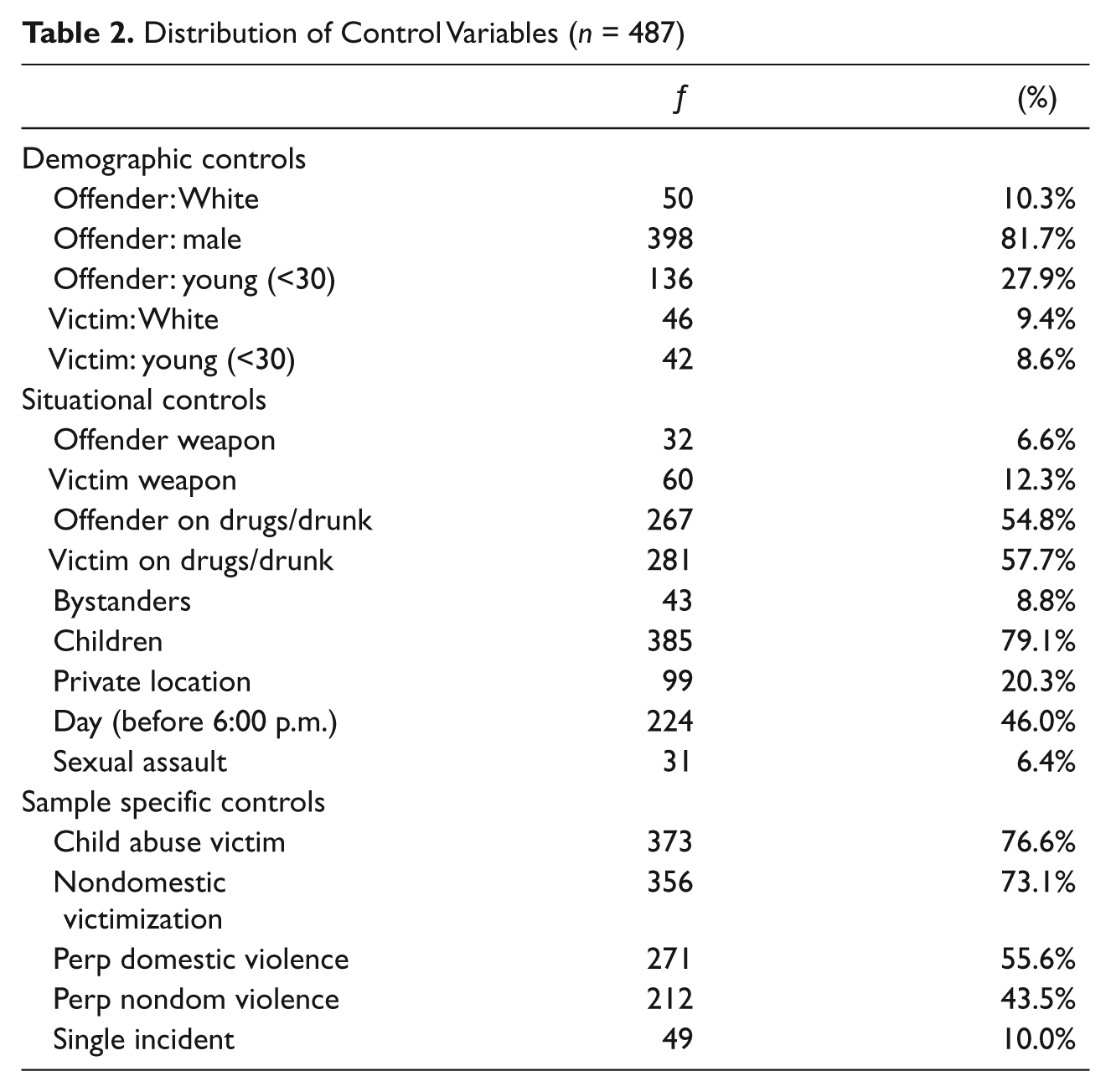
Because of the uniqueness of the sample, other relevant controls were included; the respondent’s history of violence (both frequent childhood and adult nondomestic violence), the respondent’s perpetration of violence (both domestic and nondomestic), and a final measure indicating whether the woman had multiple reported incidents within the reference period. Unsurprisingly, these respondents represent a population that is at a high risk of violence. The majority of these women were victims of violence as children (77%) and also victims of nondomestic violence as adults (73%). In addition, they also perpetrate violence. Approximately 56% reported domestic offending and 43% reported using violence in nondomestic situations.
Analytic Strategy
As noted above, one methodological problem that has plagued this line of research is ascertaining the appropriate temporal ordering between the self-protective behavior and injury. To address this limitation, after the redesign in 1992, the NCVS added questions which asked respondents whether the self-protective behavior came before, during, or after the injury (or any combination of these sequences). This results in seven possible temporal sequences between self-protective behaviors and injury. Using this information, Bachman and colleagues (2002) coded behaviors that occurred only after injury was sustained as no self-protective behaviors. 7
However, the WEV data does not include questions of this nature and therefore we utilize a different method. As Fisher, Daigle, Cullen, and Santana (2007) suggest, qualitative interviews may aid in reconstructing events. This data set contains very rich and detailed narratives describing each violent incident (for an example of the use of these narratives in another research context see Griffiths, Gartner, & Yule, 2011). As mentioned above, the purpose of these narratives was to provide a detailed sequence of events in each incident. The interviewer asked the respondents to provide information on how the event began and the actions in sequence of both the offender and herself up until the end of the assault. To this end, similar to the coding strategy of Bachman and colleagues (2002), any incidents in which self-protective behaviors were utilized after injury was already sustained were coded as no self-protective behavior taken. The following is an excerpt from a narrative in which the self-protective behavior clearly came after the initial injury.
I thought I was pregnant and I told him. We were at house—it was evening—and we were both on drugs. We started arguing. He said he didn’t want it. He kept saying it and he started slapping and stuff. He slapped me in the face and he hit me in the stomach. It lasted for 30 minutes—it stopped when I ran to the bathroom and locked the door.
Conversely, the following is an example of a narrative in which the self-protective behavior was taken prior to an injury occurring:
I stayed out all night over my girlfriend’s house. He thought I was with a guy and I wasn’t. And we started fightin’ when I came in the house because I had been out all night. He pushed me and I pushed him back, then he grabbed me and hit me . . .
There were some incidents in which the temporal sequence was ambiguous. All incidents in which the sequence of events was ambiguous were omitted from all analyses (n = 12).
Two logistic regressions were used to ascertain the impact of self-protective behaviors on the overall probability of sustaining injury. In addition, in order to examine the impact of our temporal ordering adjustments, the initial model measured the effects of self-protective behaviors used at any point during the attack. Conversely, the second logistic regression utilized the qualitative narratives to correct for any measurement bias associated with temporal sequencing.
With regard to severity, injury can be thought of as a latent variable that ranges from no injury to death, but measured in this study at two thresholds along this continuum (minor and moderate/severe). However, it is also possible that injury is not linear and is instead more aptly measured as a categorical outcome. In addition, the impact of self-protective behaviors on injury may not be uniform. Indeed, the dependent variable failed to meet the assumption of parallel forms as tested by a Likelihood-Ratio test (Long, 1997). Therefore, although it sacrifices efficiency, multinomial logistic regression was chosen over ordinal logistic regression.
Considering that each woman may report multiple incidents of domestic violence within the reference period, these incidents are inherently dependent on one another. Therefore, we account for nesting of the 487 incidents within the 199 respondents by adjusting the standard errors using the—cluster—subcommand in Stata (Long & Freese, 2006). This command inflates the standard errors of the estimates to account for the dependency within incidents.
Results
Approximately 80% of the incidents featured some form of self-protective behavior. The most frequent self-protective behavior featured in these incidents was forceful verbal (55%). Conversely, the least frequent strategy used was nonforceful verbal with only 13.8% of the incidents featuring this type of behavior.
Turning toward the multivariate results, Table 3 displays the results of the logistic regressions. As shown, regardless of temporal sequencing, forceful physical self-protective behaviors increased the probability of injury. However, these two models differed with regard to forceful verbal behaviors which was a significant protective factor against injury in the adjusted model (β = −.628, p < .01) but insignificant in the unadjusted model. Nonforceful verbal self protective behaviors also decreased the odds of injury in the adjusted model (β = −1.034, p < .05) by approximately 65%. Nonforceful physical behaviors were not significantly associated with injury in either model. In addition, two control variables were significant. The offender drinking or on drugs (β = .571), and the offender having a weapon during the attack (β = .829) increased the probability of the victim being injured (p < .05).
Self-Protective Behaviors on the Probability of Injury
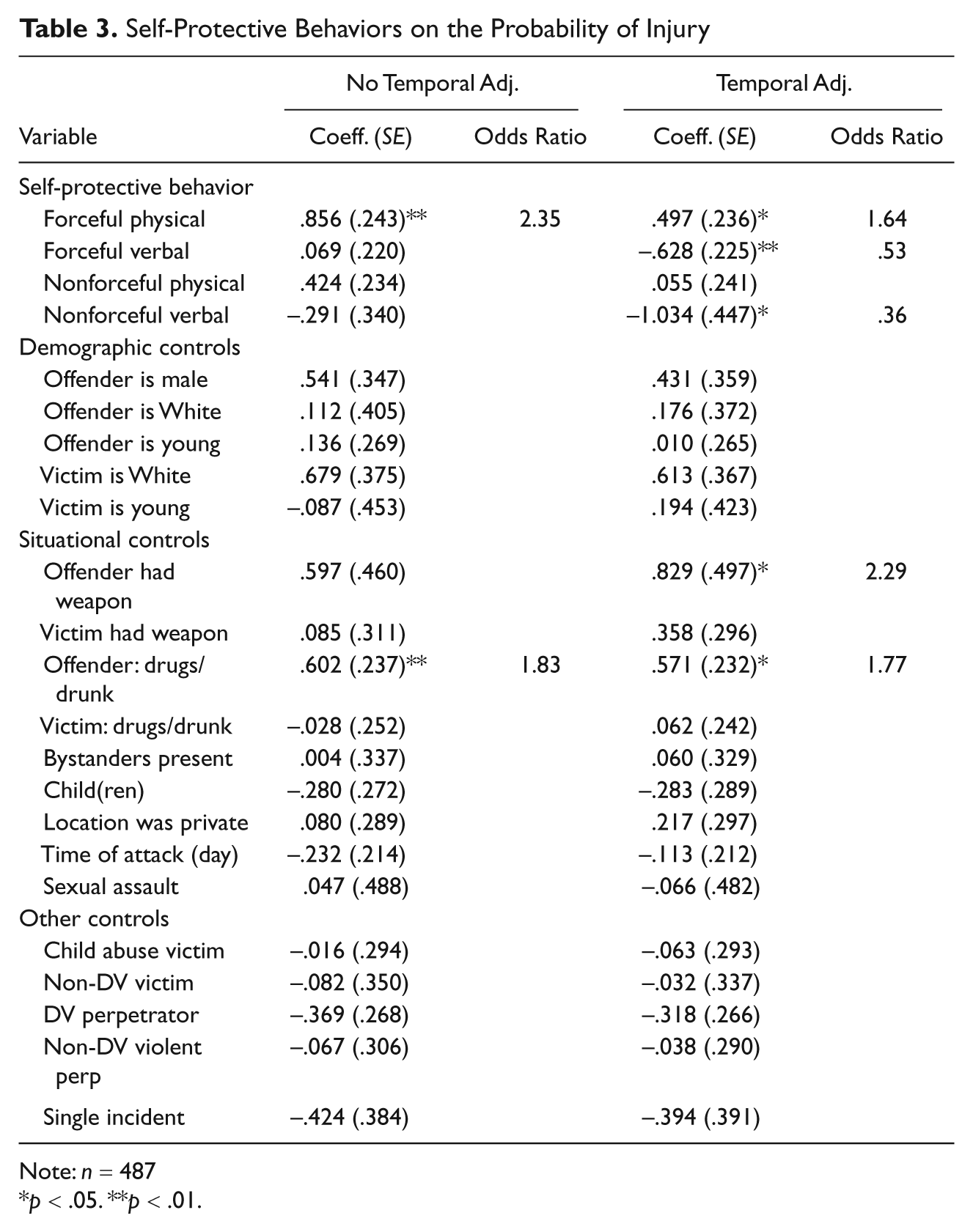
Note: n = 487
p < .05. **p < .01.
As shown in Table 4, forceful physical behaviors increased the probability of sustaining minor injuries compared to none, but did not increase the likelihood of moderate/severe injuries. A similar pattern was found for nonforceful behaviors which decreased the odds of sustaining minor injuries (β = −1.190, p < .05) by a factor of .30. Forceful verbal behaviors decreased the probability of sustaining both minor (β = −.538, p < .05) and moderate/severe injuries (β = −.973, p < .01) when compared to no injuries, but was unable to distinguish between moderate/severe and minor injuries. Specifically, forceful verbal self-protective behaviors decreased the odds of sustaining moderate/severe injuries compared to no injuries by 42%.
Self-Protective Behaviors on the Severity of Injury (Model 3)
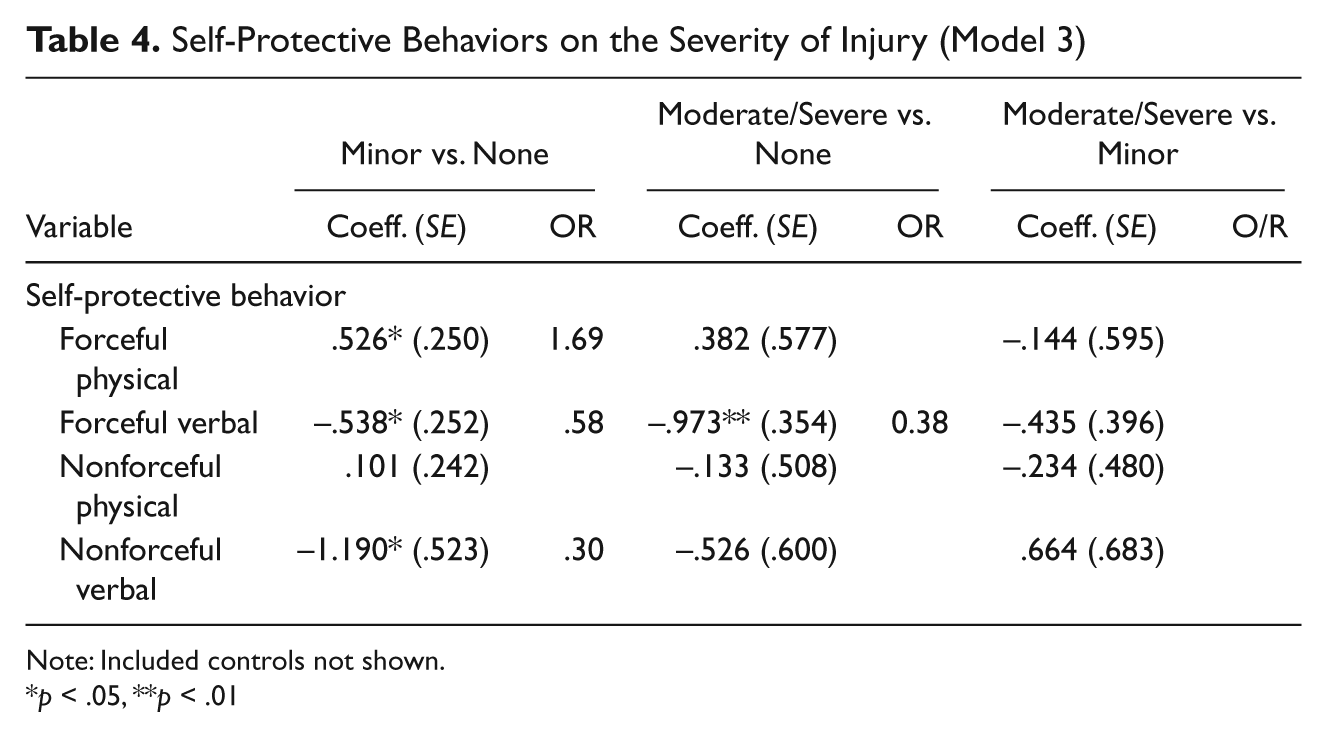
Note: Included controls not shown.
p < .05, **p < .01
Discussion
Interestingly, the frequency at which our sample utilized self-protective behaviors is comparable to the frequency found in studies utilizing the NCVS to study these behaviors between intimates (e.g., 78% in Bachman & Carmody, 1994). Along with the frequency of using countermeasures, the effectiveness of these strategies, namely “fighting back” was similar between this sample and the NCVS (Bachman & Carmody, 1994; Bachman et al., 2002). Therefore, it appears that there are overarching similarities between this very high risk sample and the general population.
One contribution of this study was disaggregating the categories of resistance used in other studies to distinguish between forceful and nonforceful strategies. Doing so revealed that verbal strategies, both forceful and nonforceful, serve as protective factors against injury. In the context of domestic violence, it is interesting that forceful physical behaviors led to an increase in injury, but forceful verbal behaviors served as a protective factor. Ostensibly, if the offender is attempting to establish control in the relationship, both of these strategies may be viewed as defiance. However, it may also be the case that forceful verbal behaviors simply do not pose a challenge to an offender’s dominance within the relationship and therefore do not lead to escalation within the conflict. Alternatively, forceful physical behaviors may exacerbate the situation in ways other than operating on the offender’s motivation. For example, Carmody and Williams (1987) found that abusive men expect violent retaliation from their wives (compared to nonabusive men). This expectation may create an environment where any initial resistance by the victim is met with considerable counterforce. Future research should more thoroughly explore how offenders in these situations perceive these different self-protective actions.
Another explanation that may aid in the understanding of the differences in effectiveness of self-protective behaviors is the notion of parity (Fisher et al., 2007; Griffin & Griffin, 1981; Siegel, Sorenson, Golding, Burnam, & Stein, 1989; Ullman & Knight, 1993). According to the parity thesis, the most successful behaviors will be ones that mimic the force or behavior of the actual attack. Previous research has cited parity as a decision making strategy for women in sexual assaults (Fisher et al., 2007; Siegel et al., 1989) and that those self-protective behaviors that were in line with the offender’s attacks were more effective.
Limitations
Recall in studies utilizing a retrospective account of events can be called into question. Ideally, one would obtain detailed information regarding a victimization immediately after its occurrence. This concern is not unique to this study. For example, the NCVS utilizes a 6-month reference period. However, considering that this sample consists of incarcerated women at a high risk of violence and drug abuse, the self-report accuracy may be called further called into question. Morris and Slocum (2010) explored the accuracy of this particular sample’s ability to recall events by contrasting their recall with official criminal justice records. Findings show an ability to recall the prevalence and frequency of arrest comparable to previous studies involving other offender samples. 8 Although the women were less accurate with regards to the placement of events on the event calendar, the spacing of events is not a particularly relevant consideration for this study.
Another concern regarding recall is the omission of series incidents from our analyses. The responses to and the effectiveness of self-protective behaviors may be different in series incidents compared to unique incidents. For example, victims who are frequently victimized by the same offender may begin to recognize signs that the violence is about to occur and thus may be able to react earlier. Also, the inability of the respondents to recall the specific details of these incidents may be related to the variables of interest. For example, respondents may be more likely to recall the details of incidents that featured severe injury. Therefore, these categories of injury may be disproportionately affected by the exclusion of series victimizations. This is not a unique limitation as the NCVS also features series incidents that, by necessity, are excluded from many analyses. Unfortunately, this limitation is not easily remedied and therefore these results might not be generalizable to situations in which there is an ongoing violent relationship.
Using the qualitative narratives, we were able to separate those incidents in which initial injury occurred before the self-protective behavior from those in which injury occurs as a response to that behavior. However, this strategy is far from perfect. We were unable to ascertain the impact of a self-protective behavior utilized after injury. In other words, violent interactions are dynamic events. Even though a woman used a self-protective behavior after sustaining an injury, she may have thwarted an additional or subsequent attack. Our data do not capture this possibility and thus our analysis is subject to a different type of measurement bias. However, our study is not the only one to have this limitation (see Bachman et al., 2002, for further discussion). The strength of this research rests with our ability to unravel the impact of self-protective behaviors on initial injury and there is still much to be gained using this methodology.
Finally, this study cannot examine death as a consequence of self-protective strategies. This limitation may be very important in that some self-protective behaviors may escalate violence to the point of death. Although death as an outcome is extremely relevant when considering the impact of actions on women’s health, it is impossible to study death as a dependent variable using these data.
Conclusions
Previous research on how victims respond to victimization by intimate partners has utilized one sample: The National Crime Victimization Survey. Extending this research, we examined the effects of self-protective behaviors on injury for a group of high-risk women. Our findings suggest that there are some similarities between this sample and the general population. With regard to frequency of resistance, we found that they utilize self-protective behaviors at a rate comparable to previous research. In addition, fighting back against a domestic offender is detrimental to a woman’s health. However, using a more nuanced categorization of self-protective behaviors than previous research, we discovered that verbal strategies (both forceful and nonforceful) served as protective factors against injury.
We examined the impact of these countermeasures on a woman’s health in the immediate incident. This project is part of a larger body of literature that acknowledges the role of victim agency in shaping the victimization experience of women in violent relationships. In order to understand the full range of strategies women use to end violence, future research should explore the relationship between the use of these strategies within an incident and the use of formal and informal help-seeking sources.
Footnotes
Authors’ Note
The dataset for this project was originally funded (for other purposes) by an NCOVR grant to Sally S. Simpson.
Declaration of Conflicting Interests
The author(s) declared no potential conflicts of interest with respect to the research, authorship, and/or publication of this article.
Funding
The author(s) received no financial support for the research, authorship, and/or publication of this article.