







Abstract
Underreporting of intimate partner aggression is an important issue in the interpretation of self-reports of such aggression, especially by males. However, both males and females are less likely to report negative behaviors about themselves than about their partners. With 863 adolescents from Madrid, social desirability had a small but significant association with reports of dating aggression, but covariance corrections for social desirability did not alter the conclusions about such aggression. Using uncorrected or corrected means for social desirability, males engage in more sexual aggression against their partners and females engage in more psychological and physical aggression. Maximal dyadic reports based on reports by either self or partner significantly increased the rates of aggression, although conclusions about perpetration and victimization did not differ with this correction. Rates of aggression dropped roughly half when corrected for aggression in a joking context, but more females still reported engaging in physical aggression against their partners. The corrections one wishes to use depend upon the sample under study—i.e., adolescent versus adult populations—and one’s research or clinical question, but the use of social desirability controls seems ill-founded. Finally, there is a need for in-depth interviews with both partners in dating relationships to determine more about the contextual factors associated with dating aggression and to assist in knowing what correction factors seem most valid.
The issue of underreporting acts of aggression against an intimate partner has been the subject of intermittent discussion for more than two decades, and the concern about underreporting often is associated with the self-reports of physical aggression against a partner being lower for males than females in community and representative samples (e.g., Arias & Beach, 1987; Bell & Naugle, 2007; Heyman & Schlee, 1997; Schafer, Caetano, & Clark, 2002). There are a number of theoretical or methodological stances that have been taken regarding possible reasons for underreporting of partner aggression, for males and females, but especially by males. For example, one methodological stance is that underreporting is affected by a social desirability response set to be controlled statistically for males and females (e.g., Sugarman & Hotaling, 1997). A second but different methodological stance is that males and females underreport their aggressive behavior for a variety of related reasons including intentional underreporting and egocentric bias in which one reports fewer negative behaviors of oneself than of a partner (Christensen, Sullaway, & King, 1983). Given this intentional underreporting and egocentric bias, investigators have used maximal dyadic reports of aggression in which an aggressive behavior reported by either partner is recorded as aggressive (Szinovak & Egley, 1995). A third perspective that has received little attention in adults, but some attention in teenagers, is the possibility that certain behaviors that are reported initially as aggressive on a self-report assessment like the Conflict Tactics Scale (CTS, such as some slaps and shoves), are not later interpreted as aggressive when respondents are questioned about the nature of the aggression and they describe their behavior to have been joking and not a serious act of aggression (Foshee, Bauman, Linder, Rice, & Wilcher, 2007). The first two methodological stances would lead one to try to have some correction on self-reports of aggressive behavior such that the actual estimate of aggressive behavior would be higher than the self-reported rate of aggression. The third stance would lead to a correction that would lead to an estimate that is lower than the self-reported prevalence rates.
Based on an early meta-analysis of social desirability and reports of intimate partner aggression, social desirability response sets in adults have a small negative correlation with reports of aggression against a partner (Sugarman & Hotaling, 1997). The studies in the meta-analysis assessed social desirability in college students and in married couples. However, as far as we know, the association of social desirability and reports of aggression have not been examined in teenagers, and one goal of this study was to address this matter in a population of males and females ranging in age from 14 to 17 years. As teens get older they might have a tendency to have stronger social desirability response sets, and thus social desirability was examined across the four ages assessed, namely 14, 15, 16, and 17 years.
One’s theoretical conceptualization of social desirability can influence how one might cope with a possible social desirability bias. Murstein and Beck (1972) argued that social desirability is a personality style or trait reflecting a need for approval when they discussed how one might interpret the association of social desirability and reports of marital satisfaction. They believed that individuals who desire to act in a socially approved manner are more likely to have satisfactory marriages than those who do not desire to act in socially approved ways. And, in borrowing from Murstein and Beck (1972), we argued that those individuals who behave in a socially approved manner would be less likely to engage in physical aggression against a partner (Riggs, Murphy, & O’Leary, 1989). Consequently, one could further argue that it is not prudent to correct for social desirability as if it is a response set that leads to underreporting. Rather, such a correction might eliminate a small amount of important correlated variance.
Alternatively, if one believes that social desirability is a response set that should be controlled, one could use social desirability as a covariate in analyses of reports of partner aggression. That approach will be used with the data herein to address if reports of partner aggression differ when controlling for social desirability. We believe that there will be a small but significant negative correlation between social desirability and reports of partner aggression, but that the correction for social desirability it will not lead to any major differences in the overall conclusions one reaches about reports of partner aggression.
A second methodological stance regarding the need to correct for underreporting of partner aggression involves the use of correction formulae based on the position that if physical aggression is reported by either the male or the female in the form of perpetration or victimization, the behavior will be counted as aggressive. Several studies have addressed the issue of reports of negative behaviors other than partner aggression. Such research places the issue of lower self-reports of partner aggression within the broader context of egocentric bias or a response style that involves underreporting of all kinds of negative behaviors of one’s self (Christensen et al., 1983; O’Leary & Williams 2006; Riggs et al., 1989). And, as Riggs et al. (1989) showed, individuals seem more likely to report their partners negative non-aggressive behaviors than their own. The conceptualization that individuals intentionally underreport their aggression has led to correction formulae that provide ratios of partner victimization to maximal reports of aggression based on reports by either self or partner in a manner following that of Szinovak and Egley (1995), Heyman and Schlee (1997), and O’Leary and Williams (2006). Such correction formulae use couple data, and in young married couples the correction formulae are based on the position that males underreport physical aggression more than females. Given this position, the correction formulae suggest that self-reported prevalence rates in young married couples should be multiplied by 1.5 for men and 1.3 for women (Heyman & Schlee, 1997; O’Leary & Williams, 2006). In college student couples ages 18-24 years (Schnurr, Lohman, & Kaura, 2010), correction rates for males and females were 1.5 and 1.4, respectively (B. Lohman, personal communication, September 22, 2011). For example, using the latter correction rates, if the prevalence of self-reported physical aggression against a partner were 25% for males and 30% for females, the corrected prevalence rates for males and females would be 37.5% and 42%.
A third methodological stance regarding the need to correct for reports of partner aggression is that partner aggression is sometimes aggression of a joking nature and that the aggression is not in the context of anger or any intent to harm or hurt the partner. This methodological issue has been examined in the context of teenage aggression by several groups (Foshee et al., 2007; Fritz, 2005; Jouriles, Garrido, Rosenfield, & McDonald, 2009; Muñoz-Rivas, Graña, O’Leary, & González, 2007). However, the need to correct prevalence rates of self-reported intimate partner violence for aggression that occurred in the context of joking is a relatively little-studied phenomenon in the intimate partner violence field. With high school students of approximately 17 years of age, Foshee et al. (2007) found that 38% of males and 29% of females indicated that their aggression occurred in a joking context. Also with high school students from 9th to 12th grade (n = 125), Jouriles et al. (2009) found that 27% of the aggression occurred in a joking context. With college students who reported physical aggression against their partner, Fritz (2005) found that 15.2% of male reports of physical aggression against their partner were in a joking only context as were 11.1% of the female reports of such. Furthermore, Fritz (2005) found that 15.4% of the male reports of physical aggression victimization and 12.0% of the female reports of victimization were in a joking context. As reflected in the research carried out by González-Mendez and Hernández-Cabrera (2009), the fact that aggression may occur in a joking context does not lead to the conclusion that the acts of aggression did not occur or were not important. However, if aggression occurs in a significant percentage of the cases in a joking context, the interpretation of the aggression may differ. We would expect that aggression that occurs in a joking context would diminish with age, and the data from adolescents and college students above suggests that this hypothesis is correct though González-Méndez and Hernández-Cabrera (2009) did not find a decrease of aggression in a joking context from adolescence to college age students.
Considering the above, the present study had the following aims: (a) to assess the associations of social desirability with various aspects of partner aggression, namely, physical, psychological, and sexual aggression; (b) to determine whether social desirability would be higher for females than males; (c) to evaluate whether social desirability would show an increase across the four ages examined herein, namely, 14, 15, 16, and 17 years; (d) to assess the association of social desirability and relationship satisfaction; and (e) to evaluate corrections for social desirability, corrections for maximal dyadic reports of self and partner, and corrections for joking.
Method
Participants
The initial sample was composed of 1,223 adolescents of both sexes (53.5% females) between the ages of 13 and 18 years old. As a function of the study goals, the following inclusion criteria were used: (a) having had or presently having a heterosexual dating relationship, and (b) being between 14 and 17 years old. The first criterion was proposed to include only participants who were able to complete the behavioral measures of dating aggression, and the second criterion was proposed because there were not sufficient numbers of 13 year old participants (n = 7; 0.6%) or 18 year old participants (n = 3; 0.2%) to allow examination across such ages. Furthermore, because only 1.1% (n = 13) of the sample described themselves as homosexual or bisexual, the later analyses were conducted using only heterosexual respondents. After excluding the participants who did not meet the mentioned criteria for the study, the final sample comprised a total of 863 high school students (54.3% females), ranging in age from 14 to 17 years (M = 15.04, SD = 0.91). Regarding ethnicity, 74.1% of the participants were Spanish, 18.4% Latino Americans, and the remaining 7.5% were mostly from Middle East Europe and North Africa countries. Males reported a higher number of dating relationships (M = 3.63) than females (M = 2.96), t(742) = 4.20, p < .001, but females reported longer relationships (7.20 months) than males (4.89 months), t(830) = 4.97, p < .001. Moreover, 43.5% of females versus 26.4% of males reported being presently in a relationship, χ2(1) = 27.28, p < .001.
Procedure
Participants came from nine high schools of different areas of the Community of Madrid (Spain), and all of them were enrolled in 3rd and 4th course of compulsory secondary education. High schools were selected on the basis of ethnic and socioeconomic diversity and interest in the research project. Of those schools selected, we explained the goals and procedure of the study to the school administration as well as the Association of Students’ Parents, and the research study was approved by school board ethics committees. Once permission was obtained, students completed the questionnaires in a group format, with boys and girls together, within their normal classroom schedule. The session lasted approximately 50 min. Surveys were administered by research team’s members and trained graduate research assistants. The adolescents were informed of the anonymous and voluntary nature of the questionnaire, and they were given the opportunity to discuss any questions with the researcher in charge of the classroom assessment.
Measures
Demographic variables and dating behaviors
Questions were included about sex, age, nationality, and sexual orientation. Likewise, information was collected about dating history and present relationship status: age at the first relationship, number of dating partners, duration of the longest relationship, and being or not presently in a relationship. Respondents who were in a relationship at the time of the study were also asked to indicate the length and seriousness of the present relationship, partner’s age, frequency of contact and prediction for future status.
The modified Conflict Tactics Scale (M-CTS; Neidig, 1986)
The M-CTS is a modified version of the Conflict Tactics Scale (CTS; Straus, 1979) and it has been adapted and validated in a sample of adolescents (Cascardi, Avery-Leaf, O’Leary, & Slep, 1999), supporting its use to assess dating aggression among high school students. Furthermore, the M-CTS has been also validated in a Spanish sample of youths and adolescents (Muñoz-Rivas, Andreu, Graña, O’Leary, & González, 2007). This scale is composed of 18 bidirectional items (perpetration/victimization) with a 5-point rating scale (1 = never, 2 = rarely, 3 = sometimes, 4 = often, 5 = very often) that measure an individual’s means of resolving conflict during the course of a disagreement with his or her partner. For the present study, we used the subscale of physical aggression (9 items; e.g., “Have you slapped your boyfriend/girlfriend?,” “Has your boyfriend/girlfriend slapped you?”) and verbal aggression (6 items; e.g., “Have you insulted or sworn at your boyfriend/girlfriend?,” “Has your boyfriend/girlfriend insulted or sworn at you?”). Responses to the nine bidirectional items of the physical aggression subscale were summed and divided by nine to create the mean global scores of physical aggression perpetration and physical aggression victimization. The same procedure was carried out with the six bidirectional items of verbal aggression to create the mean global scores of psychological aggression perpetration and psychological aggression victimization.
Sexual Dating Aggression Scale (Muñoz-Rivas, Graña, O’Leary, & González, 2009)
A 5-item scale with a 5-point response format (1 = never, 2 = rarely, 3 = sometimes, 4 = often, 5 = very often) was used to measure the presence of the most common sexually aggressive behaviors, especially those referring to pressure and coercion to engage in nonconsensual sexual relations (e.g., “Have you threatened your boyfriend/girlfriend to break up if he/she refuses to engage in sexual relations?,” “Has your boyfriend/girlfriend threatened you to break up if you refuse to engage in sexual relations?”). It was composed of 5 bidirectional items (perpetration/victimization) with a 5-point rating scale (1 = never, 2 = rarely, 3 = sometimes, 4 = often, 5 = very often). Responses to the 5 bidirectional items of this scale were summed and divided by five to create the mean global scores of sexual aggression perpetration and sexual aggression victimization.
Marlowe-Crowne Social Desirability Scale: Short Form C (M-C SDS Form C; Reynolds, 1982)
A 13-item short form of the Marlowe-Crowne Social Desirability Scale (M-C SDS; Crowne & Marlowe, 1960) was used to assess the tendency of participants to respond in a socially acceptable way. The M-C SDS is a widely used self-report measure in research about social desirability or studies which need to control for this variable, and it was validated in Spanish by Ferrando and Chico (2000). The short form C of the M-C SDS was developed and validated by Reynolds (1982) and it consists of 13 items with a true-false dichotomous response format. Some of them were direct items (e.g., “I am always willing to admit it when I make a mistake”) and others were inverse items (e.g., “There have been times when I felt like rebelling against people in authority even though I knew they were right”). For this study, it was used a response format with four Likert-type alternatives on which participants rated their degree of agreement with each statement (1 = strongly agree, 2 = somewhat agree, 3 = somewhat disagree, 4 = strongly disagree). The sum of all the items, after reversing the inverse ones, was the global score of the scale. This latter score was divided by 13 to create the mean global score of social desirability.
Assessment of joking in the context of physical aggression
Following the completion of the M-CTS, students were asked to indicate the context in which the physical aggression occurred by checking boxes with reasons that applied to them. More specifically, regarding the question of interest in this study, among other things, they were asked to indicate whether the physical aggression (perpetration or victimization) occurred in a joking only context or a joking plus anger context.
Relationship satisfaction
Relationship satisfaction was assessed with one item which asked participants to rate their level of satisfaction with their present partner on a scale from 1 to 10. Higher scores indicated greater satisfaction.
Statistical Analyses
Several statistical analyses were performed with the data of the study using the statistical package SPSS v.19. First, prevalence was calculated for males and females independently, and the differences between perpetration and victimization were contrasted using the chi-square statistic. Dichotomous variables for perpetration and victimization of the three different types of aggression were created to calculate percentages. For each type of aggression, participants were coded as 0 (= not aggressive/not victim) if they reported having never committed/sustained any act of aggression, and as 1 (= aggressive/victim) if they reported perpetrating/sustaining at least one act of aggression. Second, an independent means t-test was used to compare scores on social desirability for females and males, and analysis of variance were used to compare scores on social desirability across age. Thirdly, Pearson correlations between social desirability and partner aggression were obtained for the continuous variables and point-biserial correlations were obtained for the dichotomous variables. Fourthly, we computed Pearson correlations between social desirability and relationship satisfaction. Fifthly, covariance analyses were used to correct for social desirability to obtain adjusted means. Lastly, maximal dyadic reports of partner aggression and corrections for joking reports of aggression were calculated as described in the introduction section.
Results
Self and Partner Reports of Aggression
The results of self and partner reports of aggression showed that females were significantly more physically aggressive than males. Specifically, 42.2% of the females reported that they engaged in physical aggression against their partner, whereas they reported that only 32.9% of their male partners engaged in physical aggression against them, χ2(1) = 8.33, p < .01. In contrast, males reported almost identical rates of physical aggression perpetration (28.4%) and victimization (29.8%), without significant differences. Regarding sexual aggression, females were significantly more victimized than males because they reported that 10.0% of their male partners engaged in sexual aggression against them, whereas only 2.8% of the females reported that they engaged in sexual aggression against their partner, χ2(1) = 19.70, p < .001. In contrast, males reported closer rates of sexual perpetration (10.6%) and victimization (7.8%), without significant differences. Finally, reports of psychological aggression were around the same level for females and males, with almost all females and males reporting some act of psychological aggression (94.2% of females and 90.0% of males for perpetration reports, and 91.5% of females and 91.8% of males for victimization reports).
Social Desirability across Sex and Age
The mean score on social desirability ratings was 2.75 (SD = 0.38) for females and 2.69 (SD = 0.38) for males. Social desirability ratings of females were significantly higher than those of males, t(861) = 2.56, p < .05. As displayed in Figure 1, mean scores of social desirability are quite similar for the four age groups analyzed, and results of the factorial ANOVA did not show a significant effect either for age or the interaction between age and sex. Consistent with the t test, the effect of sex was significant, F(1, 855) = 4.84, p < .05. Analysis of variance with polynomial contrasts did not show any significant age trend for either females or males.
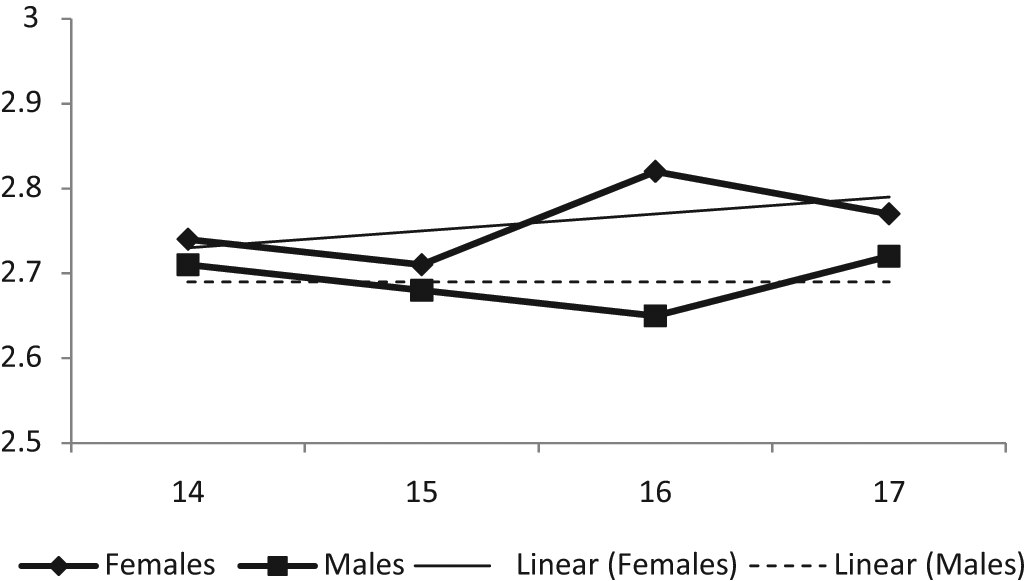
Trends in social desirability by age for females (n = 469) and males (n = 394)
Association between Social Desirability and Dating Aggression
As reflected in Table 1, there were significant negative correlations of social desirability with reports of both perpetration and victimization when those reports were treated as continuous variables. In fact, four of the six possible correlations were significant for females, and five of the six possible correlations were significant for males. For females, there were significant associations of social desirability with reports of both perpetration and victimization of physical and psychological aggression, but the correlation with sexual aggression was not significant. For males, social desirability was not significantly correlated for perpetration of physical aggression. However, there were significant associations of social desirability with reports of both perpetration and victimization of psychological and sexual aggression, and with victimization of physical aggression. In general, the correlations of social desirability with aggression as dichotomous variables were less than those with continuous variables. More specifically, for both females and males, there were no significant correlations of social desirability with reports of psychological aggression. This lack of significance is not surprising as the base rate of perpetration of psychological aggression in females was 94% and for males 90%. For females, the correlations of social desirability and physical aggression for both perpetration and victimization of physical aggression were significant, but they were not significant for reports of perpetration and victimization of sexual aggression. For males, social desirability was correlated with reports of perpetration of sexual aggression.
Correlations Between Social Desirability and Dating Aggression (N = 863)
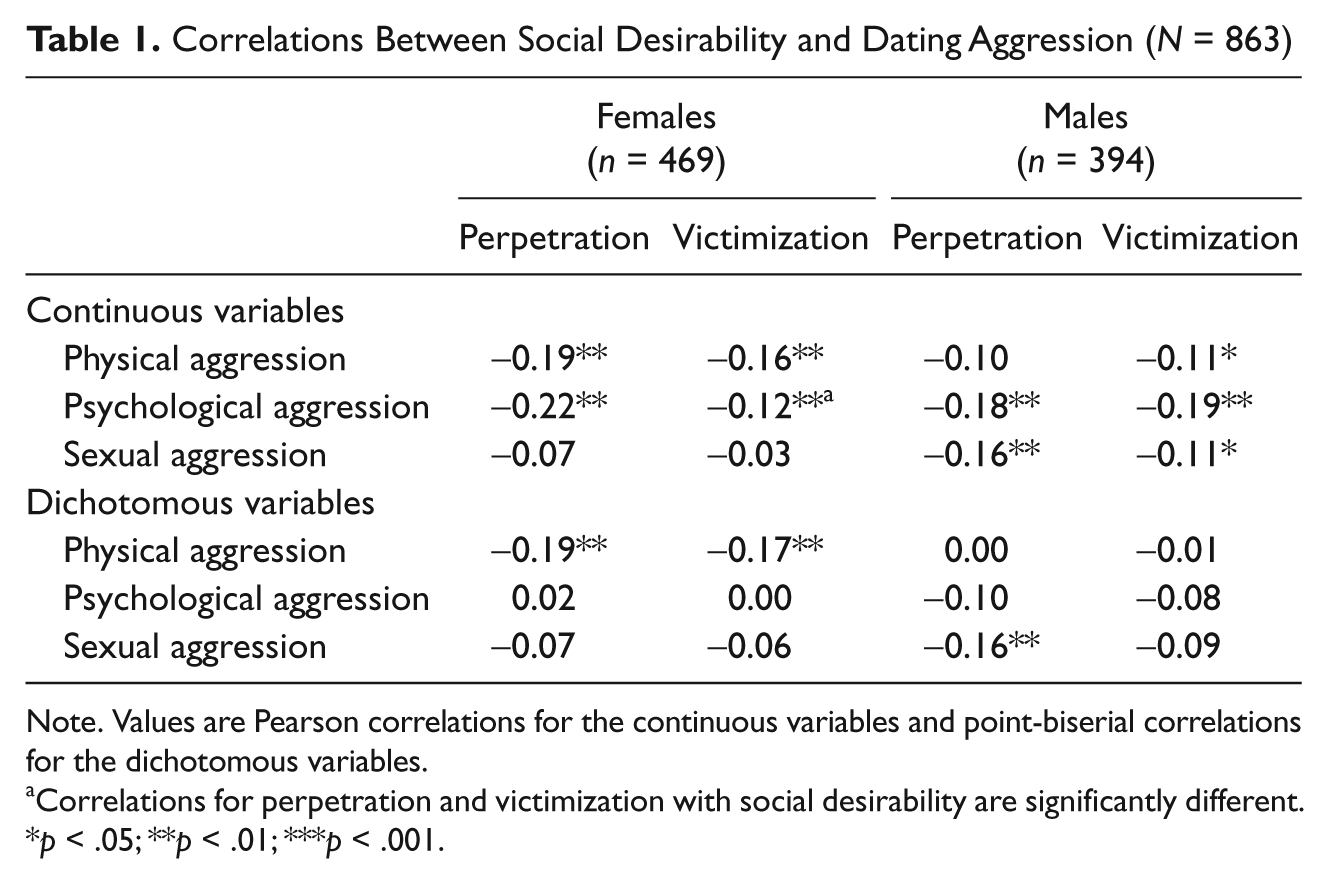
Note. Values are Pearson correlations for the continuous variables and point-biserial correlations for the dichotomous variables.
Correlations for perpetration and victimization with social desirability are significantly different.
p < .05; **p < .01; ***p < .001.
Association between Social Desirability and Relationship Satisfaction
Using the full dating sample, there was a significant positive correlation between social desirability and relationship satisfaction (r = .13, p < .05). When divided by sex, the correlation was significant for the females (r = .17, p < .05), but not for the males (r = .06, p = .527).
Correction Approaches for Self-reports of Aggression
Social Desirability Controls
Analysis of variance for physical, psychological and sexual aggression by sex, with and without social desirability as a covariant, are presented in Table 2. Although within gender comparisons of perpetration and victimization would also be interesting, we do not present those results because we do not have independent measures of social desirability for perpetration and victimization of partner aggression. As seen in Table 2 (far right), there are significant effects of social desirability that are seen on the evaluation of male/female differences in reports of perpetration of psychological, physical and sexual aggression. However, if one uses social desirability as a correction factor for self-reports of aggression, there are no differences in the conclusions one reaches based on the unadjusted or the adjusted means. The absence of differences is based in large part on the fact that the association of social desirability and partner aggression is significant but quite small.
Analysis of Variance for Physical, Psychological and Sexual Aggression by Sex With and Without Social Desirability as a Covariable (N = 863)
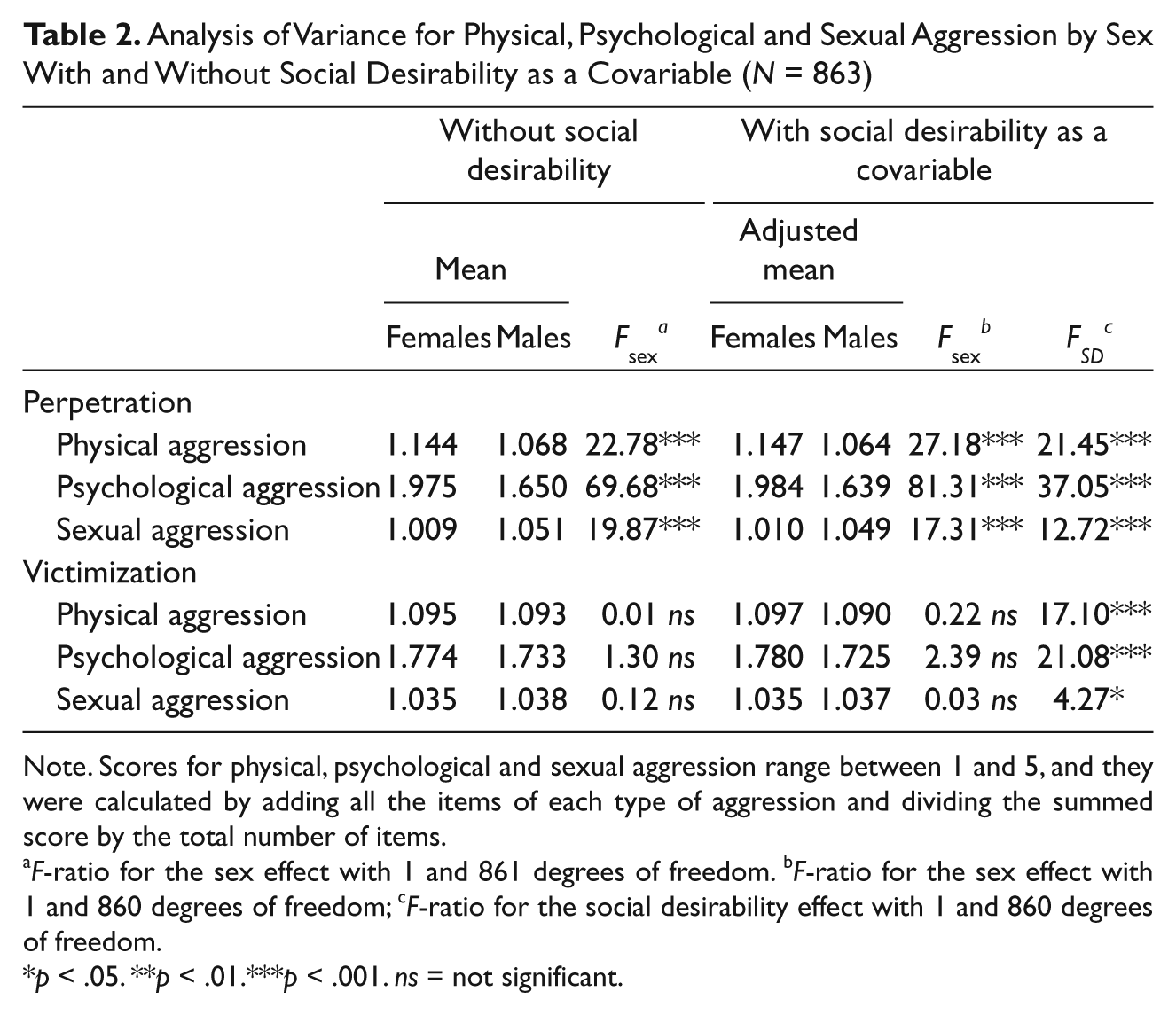
Note. Scores for physical, psychological and sexual aggression range between 1 and 5, and they were calculated by adding all the items of each type of aggression and dividing the summed score by the total number of items.
F-ratio for the sex effect with 1 and 861 degrees of freedom. bF-ratio for the sex effect with 1 and 860 degrees of freedom; cF-ratio for the social desirability effect with 1 and 860 degrees of freedom.
p < .05. **p < .01.***p < .001. ns = not significant.
Corrections for Maximal Dyadic Reports of Aggression
If one uses the correction factors suggested by Heyman and Schlee (1997) and O’Leary & Williams with young married adults (2006), the percentage of males and females who may have engaged in physical aggression against their partner in this sample of teenagers would be 42.6% for males (28.4% × 1.50) and 54.9% for females (42.2% × 1.30), χ2(1) = 12.7; p < .001. Using a correction factor of 1.47 for males and 1.44 for females based on data provided from a study by Schnurr et al. (2010) with late adolescents and young adults in dating relationships (personal communication, B. Lohman, September 23, 2011), the corrected prevalence rates would be 41.7% for males (28.4% x 1.47) and 60.8% for females (42.2% × 1.44; see Table 3). These correction factors are based on the view that males and females underreport negative aspects of their own behavior, and thus these corrections are made for both sexes. Regarding victimization, and based on the same data of Schnurr et al. (2010), higher correction factors of 1.56 and 1.62 were found for males and females, respectively. The corrected prevalence rates for physical victimization would be 46.5% for males (29.8% × 1.56) and 53.3% for females (32.9% × 1.62).
Comparisons of Not Corrected, Maximal Dyad and Joking Corrected Prevalence of Dating Physical Aggression Perpetration and Victimization (N = 863)
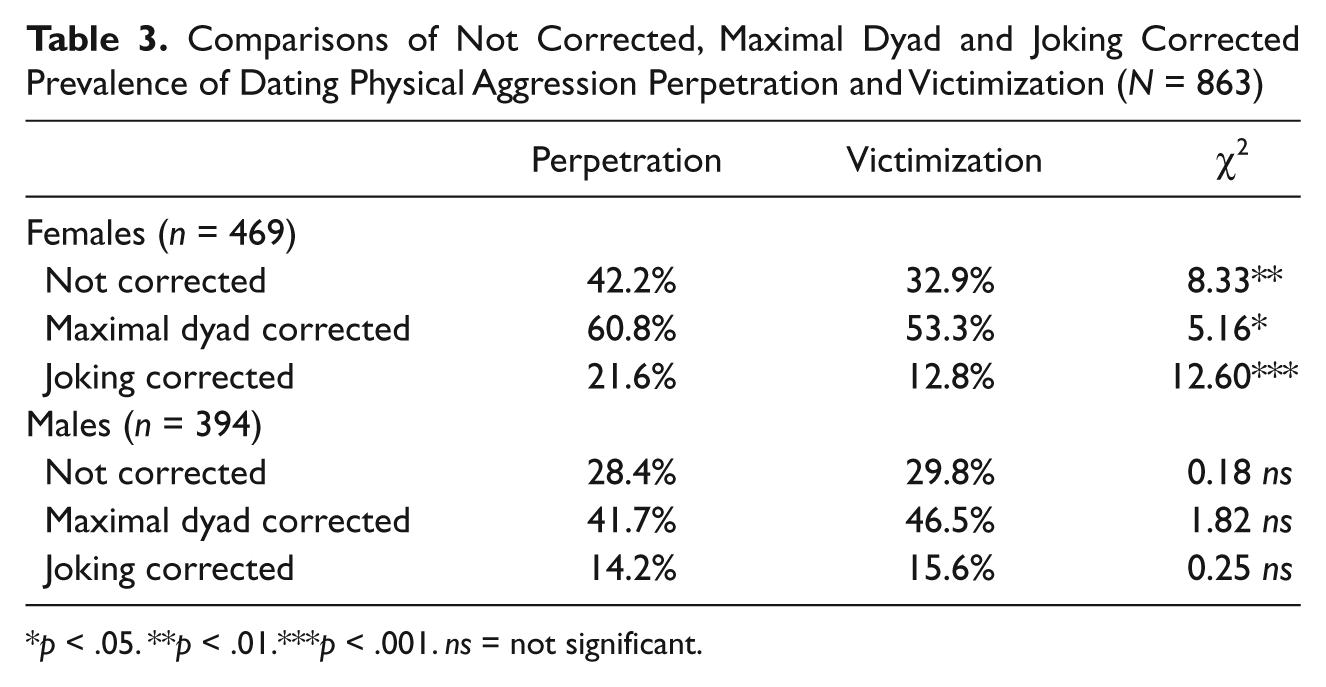
p < .05. **p < .01.***p < .001. ns = not significant.
Corrections for Joking Reports of Aggression
In an attempt to examine the prevalence of physical aggression against a partner that does not occur in the context of an argument, respondents were asked to describe various reasons for perpetration and victimization of physical aggression against a partner. For females, they reported that 48.8% of the incidents of their perpetration of physical aggression were joking only and 61.2% of the incidents in which they were victimized the context was joking. For males, they reported that 50.0% of the incidents of their perpetration of physical aggression were joking only and 47.6% of the incidents in which they were victimized the context was joking. As shown in Table 3, if one corrects for the joking only in the self-reported prevalence rates of perpetration and victimization, females continue having significantly higher rates of perpetration (21.6%) than victimization (12.8%), χ2(1) = 12.6, p < .001; and males continue having similar rates of perpetration (14.2%) than victimization (15.6%).
Discussion
The issue of underreporting of physical aggression against an intimate partner is one that has been addressed periodically (e.g., Heyman & Schlee, 1997; Riggs et al., 1989; Sugarman & Hotaling, 1997), but what should be done because of the underreporting is not clear. One possibility is to assess for social desirability and then correct for social desirability through some statistical means such as covariance. As Murstein and Beck (1972) argued more than two decades ago, when discussing social desirability and marital satisfaction, individuals who have a socially desirable response set are likely to behave in ways that are positive in a marriage, and corrections for such would remove valid variance in marital satisfaction. Like Murstein and Beck (1972), our position has been that corrections for social desirability to obtain adjusted means of intimate partner aggression are ill-advised because a social desirability style functions like a trait of engaging in socially desirable behavior both with one’s partner and with others, and such individuals with higher social desirability scores would be less likely to engage in aggression against a partner (Riggs et al., 1989). In fact, even in this sample of teenagers, social desirability was associated with higher relationship satisfaction for females, though not for males. Moreover, if the correlation of social desirability and intimate partner physical aggression is approximately –.18 as found in the Sugarman and Hotaling (1997) meta-analysis, or –.19 for females and –.10 for males herein, the covariance correction for social desirability has little or no effect on partner aggression reports. However, statistically corrected means for social desirability rarely have been reported, and thus the present study empirically addressed the social issue in a large sample of teenagers in Spain.
Most of the correlations of social desirability and self-reports of intimate partner aggression treated as continuous variables were low (mostly between –.10 and –.20) but significant, with exception of sexual aggression perpetration and victimization for females and physical aggression perpetration for males. In general, the correlations of social desirability with aggression as dichotomous variables were less than those with continuous variables. These results are consistent with those of Riggs et al. (1989), which implies that continuous scores of aggression are more influenced by response bias than are dichotomous scores. When the differences between self-reports of aggression for males and females were examined with covariance corrections for social desirability on adjusted means, there were no differences in the conclusions one would reach if such adjustments had not been made. That is, females reported that they engaged in physical and psychological aggression against their intimate partners more often than males, whereas males reported that they engaged in sexual aggression against their intimate partners more often than females.
In contrast to our expectations, there was no significant increasing trend of social desirability by age for males or females. Although visual inspection of the data showed that the mean level of social desirability was numerically highest at age 16 for females and 17 for males, by age 14 it appears that the social desirability response style seems reasonably stable in this sample of Spanish teenagers. It is possible that social desirability ratings would be lower at ages younger than 14, but that is unclear. Regarding sex differences, social desirability ratings of females were significantly higher than those of males in the sample herein with high school students. These results are consistent with those obtained by Bell and Naugle (2007) with university students, although contrary to those of Follingstad, Wright, Lloyd, and Sebastian (1991) who found no sex differences for social desirability scores in a sample of college students.
Depending upon one’s interest in the area of intimate partner aggression, the controls for maximal dyadic reports of aggression in teenagers may overcorrect for presumed underreporting of physical aggression in that we know that a significant percentage of aggression occurs in the context of joking. It is not the case that physical aggression did not occur when occurring in a joking context, and based on the research of González-Méndez and Hernández-Cabrera (2009) even simulated play and anger predicts physical aggression victimization. However, the extent of fear and injury may be different if the aggression occurs only in a joking context. In any case, the need to evaluate contextual factors of physical aggression is important, and it may be even more important in teens than in married adults where aggression in a joking context seems minimal.
A limitation of the present study is that reports of aggression came from only one member of the partner. Studies with adolescent dating couples, and detailed interviews about the context of the aggression as seen by both the male and the female, could improve our knowledge about interpretation of the self-reported acts of aggression on assessment measures like the modified CTS. Another limitation is related to the generalizability of the results. All the participants were attending high school at the time of the study, and we do not know whether the findings are generalizable to those adolescents who drop out of school, as well as to adolescents from other cultural contexts. This sample of teenagers came from Madrid, and it is unclear if the maximum dyad ratio obtained in U.S. samples would be similar in Madrid and in Spain, although the social desirability correlations with physical aggression in this sample from Madrid were remarkably similar to those in the United States. Furthermore, the percent of instances in which aggression was reported in a joking only context in the sample of students from Madrid was almost double the percentages of joking found in the United States by Foshee et al. (2007) and Jouriles et al. (2009). This matter clearly deserves replication both in the United States and in Spain. Finally, in this sample of teenagers, there were no differences in the prevalence of aggression between participants reporting on an ongoing relationship and participants reporting on an ended relationship. However, some studies with samples of adults and university students have found that reports of intimate partner violence are higher when participants report on former partners than when they report on present partners (Coker et al., 2007; Polichnowski, 2008). Future research has to clarify whether this variable might influence self-reports of partner aggression.
In summary, the type of corrections one wishes to use seems to depend upon one’s research or clinical question. In teens, corrections for underreporting via maximal dyad reports lead to the highest rates of physical aggression and the corrections for joking lead to the lowest rates of physical aggression. As documented herein, the corrections for underreporting via maximal dyadic corrections seem remarkably similar across teens and young adults. We have no data on joking in the context of physical aggression against an intimate partner in marriage, but our interview data with couples suggest that physical aggression in a joking context in marriage and in long term adult relationships is infrequent. The use of social desirability as a correction for underreporting seems ill-founded as it seems logical that individuals who respond in a socially desirable manner would be less likely to hit their partner, and that social desirability corrections may remove valid variance from the dependent measures of aggression.
In future research, it seems important to initially use self-report data on the percentages of males and females who engage in various forms of aggression against a partner followed by in-depth interviews of both partners about the context of the aggression (e.g., joking only or in anger). Such triangulation on the reports of aggression might suggest that corrections for joking occur first and that only aggression in the form of anger or attempt to overpower someone would be seen as aggression to be targeted in prevention and intervention programs. For example, in the present study if one first corrected for physical aggression in a joking context for males, the uncorrected rate of aggression would be reduced from 28.4% to 14.2%. However, one then might apply the maximum dyad correction of 1.47 (Schnurr et al., 2010) to the 14.2% for a corrected rate of male perpetration of 20.9%. The use of in-depth interviews of both partners in a dating relationship would allow one to determine how well the various correction factors would relate to some rate of partner aggression obtained from interviews with the partners.
Footnotes
Declaration of Conflicting Interests
The authors declared no potential conflicts of interest with respect to the research, authorship, and/or publication of this article.
Funding
The authors disclosed receipt of the following financial support for the research, authorship, and/or publication of this article: This study was supported by a grant from the Spanish Institute of Women, Department of Social Welfare of Spain [research project number 140/06].