







Abstract
Retribution and restoration have been cited as two goals of sentencing for victims. Furthermore, there is a perspective that acknowledges the overlap of these two aims, seeking to obtain restoration through retribution. Achieving these goals may have implications for the victim’s psychological well-being. The current study examines 101 victims of serious crime and how different outcomes may impact their perceptions of psychological well-being. Incarceration, community service, compensation from the offender, and compensation from the state, in addition to acquittals, are included as predictors of the dependent variable. After reviewing the literature on retributive and restorative sentencing, also making a distinction between compensation from the offender and compensation from the state, hierarchical regression analysis finds that compensation from the offender is the only sentencing option significantly associated with psychological effects.
Introduction
Satisfaction with sentencing and perceptions that the sentence is fair are undoubtedly important aspects of overall victim satisfaction with justice (Erez, 1992; Erez, Roeger, & Morgan, 1997). Favorable sentencing outcomes can also have implications on other aspects of victim well-being. Secondary victimization has been defined as those negative reactions by society toward the victim that are in response to the primary victimization (Montada, 1994). Orth’s (2002) research examines the effects of both the procedure and the legal outcome on psychological well-being, concluding that both elements are associated with such psychological changes. Therefore, rather than looking at forms of secondary victimization as suggested by victimologists in terms of reactions by legal authorities (e.g., victim blame, minimization of the harm), secondary victimization here will refer to psychological effects of contact with criminal justice.
With regard to the legal outcome, victim preferences may vary. Two prominent, yet sometimes competing themes resonating in the victimological literature on sentencing are that victims desire (1) retribution and (2) restoration. From a retributive perspective, the offender must be punished in proportion to the harm he or she caused (Carlsmith, Darley, & Robinson, 2002). Punishment acts to reinforce rules that have been broken and reaffirm a moral balance between the wrongdoer and the wronged. From a restorative perspective, responding to the needs of the victim is a more prominent goal (Johnstone, 2006; Strang, 2002). Restorative justice aims to meet victim needs, prevent reoffending through the reintegration of offenders, help offenders assume responsibility, and create a community that welcomes the rehabilitation of offenders (Marshall, 2003). Another viewpoint argues that retributive punishment may lead to restoration (Duff, 2003a). This perspective contradicts the idea that a legal outcome should be either one or the other and attempts to integrate the two possibilities. Punishment is one means of attaining both these goals. Whether in the form of community service, compensation from the offender, or incarceration, victims may be satisfied when they feel justice has been obtained.
This article will investigate different legal outcomes and how they may impact perceptions of psychological well-being. Legal outcomes included in this study are incarceration, compensation, community service, and acquittals. The previously devised concept of Orth (2002) will be used to investigate the psychological effects of contact with criminal proceedings on 101 victims of serious crime in the Netherlands. Each outcome will be included in a model predicting psychological effects of criminal proceedings. Furthermore, a distinction will be made between compensation from the state and compensation from the offender. Before turning to the empirical analysis, the article will discuss psychological well-being, in addition to the existing theoretical notions of punishment, including an overview of research already conducted in the area of sentencing preferences.
Psychological Effects of Contact With Criminal Justice
It has become well-known that victims who come into contact with the criminal justice system risk experiencing negative reactions from legal authorities, often referred to as secondary victimization (Campbell & Raja, 1999; Montada, 1994; Orth 2002; Williams, 1984). Negative behaviors may occur at all stages of the legal process, including the police investigation, the trial phase (e.g., through insensitive questioning during cross-examination), or through an unfavorable legal outcome for the victim such as an acquittal or lenient sentencing. As a result, the legal system may negatively impact the psychological well-being of the victim. Orth (2002) recognized the potential negative effects of the justice system, both in terms of the procedure and the outcome, on the psychological well-being of the victim. He asserted that where proceedings caused psychological harm to victims, secondary victimization has occurred. This psychological harm is more than simply the disappointment that occurs when a negative court verdict is rendered. Not only should concepts such as posttraumatic stress disorder and depression be investigated, but also other negative psychological changes. More specifically, Orth provided five forms of emotional harm in his measure: victim’s self-esteem, belief in a just world, trust in the legal system, ability to cope, and faith in the future.
Often, negative experiences with criminal justice have focused on procedural aspects, that is, the proceedings leading up to the legal outcome (namely the investigation and trial stages). Such negative perceptions result from, for example, being put on the “sidelines” while desiring more control (Herman, 2003); inappropriate questioning, blaming, and accusations by the defense counsel (Matoesian, 1993); violations of privacy (Holmstrom & Burgess, 1991; confronting the offender (Herman, 2003); or being told one’s case is not serious enough for prosecution (Campbell et al., 1999). In addition to these procedural aspects, the legal outcome of the case may be associated with negative psychological effects.
Orth indeed examined both procedural variables (interactional justice, procedural justice, psychological stress) and outcome predictor variables (outcome severity and outcome satisfaction). The findings indicated that dissatisfaction with the outcome was significantly associated with more negative psychological effects, though there was no significant association with punishment severity. The goal of this previous research, however, was not to distinguish among sentencing options. The following section will focus on the existing literature on punishment theories before linking different punishment options to victim well-being.
Sentencing Literature
Theoretical Notions of Punishment
Though the literature and research on punishment aims are abundant, three themes commonly dominated in the past. First, the just deserts model asserts that a sanction is needed to restore the balance that has been disrupted by the criminal act. Punishment should be imposed in proportion to the pain that was caused (Carlsmith et al., 2002; Vidmar & Miller, 1980). Second, the aims of the deterrence rationale focus on preventing offenders from committing crimes in the future (Carlsmith et al., 2002; Friendship, Mann, & Beech, 2003). A third common punishment strategy that may be distinguished from deterrence is rehabilitation, where the offender may change through treatment or corrective measures to prevent him or her from reoffending (Hogarth, 1971).
While prison has primarily been deemed a retributive sanction, and offender treatment programs have been used in an attempt to rehabilitate and deter the offender, restorative sentences have also emerged more recently as a means of responding to the needs of victims (Roberts & Stalans, 2004). The dichotomy of such contrasting responses may be referred to as restorative and punitive models of sentencing, where the former includes sentences such as compensation and community service while the latter most often refers to incarceration. While sanctions also aim to have deterrent and sometimes rehabilitative effects, the focus here is on restorative versus retributive sanctioning.
Restorative models focus on the well-being of the victim (Strang, 2002; Zehr, 1990) rather than imposing sentences proportional to the crime. Restorative sanctions aim to be constructive by requiring the offender to do something for the victim or the community. Punitive models, however, are often mere infliction of suffering on the offender. The offender deserves to be punished because he or she violated accepted rules, disrupting the moral balance that existed previously (Vidmar & Miller, 1980; Wenzel, Okimoto, Feather, & Platow, 2010). Such thinking is central to our notion of justice and in some societies, most notably in the United States, it is pervasive in the criminal justice system. In addition to punishing the offender, another goal of retributive sentencing is to communicate to members within the community that such wrongdoing is not tolerated and that community values have been violated (Vidmar & Miller, 1980). Moral reactions are often more common when responding to transgressions, thus insisting that offenders receive their “just deserts” (Gromet & Darley, 2009). Moreover, there is a perspective that considers the overlap of these notions, “restoration through retribution” (Duff, 2003a). Many theorists argue for either “restorative” or “retributive” paradigms, demanding a choice between the two options. Restoration through retribution, however, argues that criminal punishment should aim to restore while restorative justice should aim to impose punishment.
Sentencing Options
These theories translate into three types of sanctions and one outcome possibility independent from the offender: community service, compensation from the state, compensation from the offender, and incarceration. The first three are mostly linked to restorative outcomes. Community service may be viewed as another means of restoration, as it could help rehabilitate the offender (particularly in comparison to incarceration) or may help in restoring the community. By imposing restorative sentences on the offender such as compensation or community service, the offender remains in the community and restoration is more feasible.
Compensation may be provided after harm has been caused that cannot be undone. Such a payment may balance out the harm due to an equivalent gain (Wenzel et al., 2010). Compensation may be viewed as giving back to the victim what was lost, at least to the extent that harm can be restored, providing a symbolic gesture recognizing the victim’s suffering (Shapland, 1984). Furthermore, there may be a perceived difference among compensation by the state and compensation by the offender. Particularly by imposing compensation orders on the offender, the victim may perceive such a sentence as recognition of the harm (Shapland, 1984). It has also been argued that compensation from the state is insufficient in addressing the moral wrongs that have been caused (Tyler & Thorisdottir, 2003), resulting in less of an association with satisfaction or perceptions of justice. Offender compensation provides a means of “punitive restitution” where the court demands compensation to the victim by the offender (Johnstone, 2006).
A retributive sanction (i.e., incarceration) may still be desired by some, especially when restitution is considered insufficient. There may also be a restorative element in acknowledging the harm when punishment such as imprisonment contributes to the well-being of the victim (Duff, 2003b). A retributive punishment, in fact, has been argued to be the only way to bring about restoration. Such a punishment does not necessarily have to be highly punitive; rather it must communicate that the harm has been recognized. Furthermore, these four outcomes—the focus of the current analysis—do not encompass all possible outcomes. For example, evidence suggests that where immoral harm occurs, compensation is insufficient and rather an apology is necessary for restoration of the moral balance and to address moral accountability (Tyler & Thorisdottir, 2003).
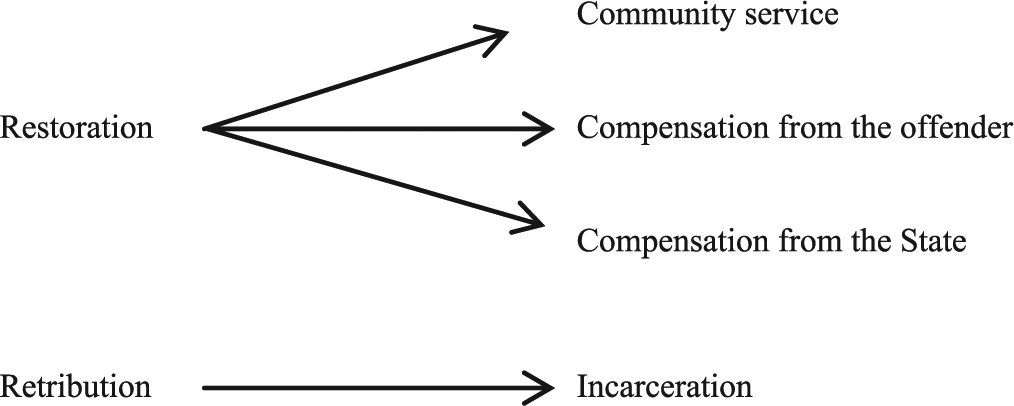
Outcomes as restoration or retribution
Numerous studies have already examined and compared preferences for retributive and restorative sanctions, though this research tends to focus on the general population rather than specifically analyzing crime victims (Ruback, Cares, & Hoskins, 2008; Shapland, 1984). Many studies support the notion that when people know about all sentencing possibilities, they are likely to opt for compensation or community service (Bae, 1992; Doble, 1998; Doob, Sprott, Marinos, & Varma, 1998; Wright, 1989). In fact, research has shown that preferences for capital punishment can decrease when compensation as a punishment has been utilized (McGarrell & Sandys, 1996). Furthermore, Boers and Sessar (1989) found that among a group of lay respondents, the majority favored sentencing outcomes that were entirely or partially restitution based. Research more generally indicates that victims and lay persons tend to be less punitive than is suggested by harsh sentencing laws and procedures (Cullen, Fisher, & Applegate, 2000; Roberts, 2003). Research that has examined victims specifically, however, indicates that being a victim of violent and sexual assaults leads to less support of extremely punitive justice when compared to those who have not experienced such victimizations (Sprott & Doob, 1997). Restitution has been found to lead to positive justice evaluations by victims of crime. Finally, there is the possibility that victims have multiple goals simultaneously when responding to wrongdoing (Gromet & Darley, 2009). Not only retributive outcomes such as prison, but also restorative outcomes such as restitution and community service were found to be desired by participants.
While the evidence above provides (mixed) support for punishment preferences, fewer studies examine the relationship between sentencing and psychological well-being. Some research does exist, however; for example, research on victims of serious crime found that punishment severity does not satisfy long-term feelings of revenge (Orth, 2004). This study also examined compensation, concluding that such a legal outcome is in fact significantly associated with feelings of revenge. As noted, Orth (2002) also examined this area, finding that dissatisfaction with the outcome predicted psychological well-being, though there was no association with punishment severity.
Punishment in terms of sentencing options may also be translated into punishment severity. Consequently, it is likely that certain punishments do result in positive negative effects while others may not. As a result of the wrong committed by the offender, victims hold expectations that justice will be done, often through judicial dispositions. Retribution (incarceration) and restoration (compensation, community service) may have implications for psychological effects. First, incarceration in terms of retribution may reequilibrate power imbalances, thereby restoring self-esteem (McCullough, Bellah, Kilpatrick, & Johnson, 2001). Incarceration may be one means of meting out punishment in proportion to the severity of the crime, dealing with the moral outrage that results from the offense (Carlsmith et al., 2002). Second, restoration focuses on the harm that has been done to the victim. Compensation is one means of recognizing this harm, thereby preventing negative psychological consequences by criminal proceedings.
In general, there is not much research that examines psychological effects by criminal proceedings with regard to punishment, though as Orth’s (2002) study illustrates, this focus has been explored. The current study will attempt to confirm the previous findings of Orth; favorable outcomes are predictive of less negative psychological effects, while the severity of the punishment is not significantly associated with the dependent variable. Rather than looking at outcome satisfaction and punishment severity more generally, however, this investigation will examine three sentencing options: (1) incarceration, (2) compensation by the offender, (3) community service, in addition to (4) compensation by the State, and (5) an acquittal. Hierarchical regression analysis will test the significant effect of these five variables on psychological effects, using a sample of victims of serious crime whose cases have been prosecuted. In addition to examining types of outcomes on psychological effects, this study distinguishes between the two different forms of compensation, a distinction that is found to a lesser extent in the victimological literature.
Method
Data Collection
The questionnaire is part of a larger research project examining a much wider range of variables, including several procedural and outcome variables (i.e., perceptions of voice, accuracy, information and respect; Gramatikov, Barendrecht, Laxminarayan, Verdonschot, Klaming, & Zeeland, 2010). In the current study, victims are measured on their case outcomes and perceived psychological effects. Moreover, other variables that may influence this relationship were measured, such as demographics and the overall perception of the procedure in terms of satisfaction.
Victims were approached with the assistance of the Compensation Fund for Victims of Violent Crime. The Fund targets victims of serious crimes, assisting individuals who experienced threat with bodily injury, assault, stalking, sexual violence, kidnapping, and/or (armed) robbery. To qualify for compensation from the Fund, in addition to suffering serious injury, the damage may not have been compensated elsewhere. The crime must have occurred in the Netherlands and in most cases, within the last 3 years. Contact details were provided by the Fund. Victims were eligible regardless of the outcome of their compensation claim. The procedure at the Compensation Fund needed to be completed to qualify for participation. Moreover, the victim must have completed the form themselves, rather than authorizing someone else to make the claim. A file was compiled of those victims who made claims in the previous 2 years, from which a sample was selected. Questionnaires were mailed to participants’ homes and they were able to either return completed surveys via mail or use an online link. To qualify for inclusion, all cases must have proceeded to trial, and resulted in either a prison sentence, community service, compensation from the offender, or an acquittal. Victims were also only included in the sample if they suffered serious victimizations. These include burglary, robbery, assault, domestic violence, and sexual assault. Data were collected between March 2011 and October 2011. 1
Sentencing Measures
As noted, victims may have received one of the outcomes, or a combination of them. Victims were asked to indicate the outcome of their legal case. For each of the five outcomes, dichotomous variables were computed (0 = no incarceration, 1 = incarceration; 0 = no compensation from offender, 1 = compensation from offender; 0 = no compensation from the state, 1 = compensation from the state; 0 = no community service, 1 = community service; 0 = no acquittal, 1 = acquittal). Therefore, the N value of total received outcomes is greater than the entire sample, due to victims who received more than one outcome.
Psychological Effects
The dependent variable was psychological effects of criminal proceedings, previously conceptualized as subjective effects causing secondary victimization by Orth (2002). Five items were used to indicate psychological changes that resulted from criminal proceedings. The items included, “What consequences did the criminal proceedings have on your ability to cope with the crime?”; “What consequences did the criminal proceedings have on your self-esteem?”; “What consequences did the criminal proceedings have on how optimistically you view the future?”; “What consequences did the criminal proceedings have on your trust in the legal system?”; “What consequences did the criminal proceedings have on your faith in a just world?” Answers were given on a 5-point scale (1 = very negative, 5 = very positive; Cronbach’s α for the current study was 0.90, indicating good reliability; Murphy & Davidshofer, 2001). Orth’s (2002) original measure was found to have a Cronbach’s α of 0.87.
Covariates
Five covariates were includes in the analysis. First, gender was measured using a dichotomous variable (0 = male, 1 = female). Second, age was measured in years. Third, for employment status, victims were asked if they were currently employed (0 = no, 1 = yes). Fourth, victims of sexual assault were distinguished from victims of nonsexual assault (0 = non-sexual assault, 1 = sexual assault). Fifth, a variable was included to measure overall perceptions with the procedure. While the legal outcome is undoubtedly important to victims, research consistently illustrates the importance of the actual procedure in justice evaluations, including perceptions of voice and respect received from legal authorities (Shapland, Willmore, & Duff, 1985; Wemmers et al., 1995). Moreover, aspects of the procedure were associated with psychological effects in Orth’s (2002) study. Clearly linked to the construct of the process’s effect on well-being,procedural satisfaction is still important to include to control for the possibility that more positive outcomes are linked with positive perceptions of the procedure. In essence, this measure is likely to reflect perceptions of, for example, having a voice, being treated with respect, or being given information regarding the procedure, and is conceptually different from the dependent variable. Victims were asked, “to what extent were you satisfied with the procedure?” (1 = not at all/very small extent, 5 = very large extent).
Analytic Plan
Means and standard deviations or frequencies for each of the variables are reported to describe the sample. Then, independent samples t-tests and χ2-tests are used to examine the relationships among the variables. Using bivariate analyses, differences among the different outcomes will also be investigated in terms of the independent variables and psychological effects. Hierarchical multiple regression analysis is then conducted to test if the association between psychological effects and the five outcomes would still reach significance after adjusting for gender, age, employment, type of offense, and procedural satisfaction. The α level was set at 0.05 in all analyses.
Results
The descriptives are presented in Table 1. Just over half (53.5%) of the sample comprised females. The mean age was 41.50 years (SD = 15.78). Furthermore, 60.4% of the victims were employed at the time of the survey. The majority of respondents (87.1%) were not victims of sexual crimes. The mean score for procedural satisfaction was 3.22 (SD = 1.33), indicating a moderate to large extent. Finally, the mean score of psychological effects of the proceedings was 2.63 (SD = 0.95), indicating a negative to neutral effect of the legal process on the victim.
Means and Standard Deviations or Frequencies of Variables Categorized by Outcomes
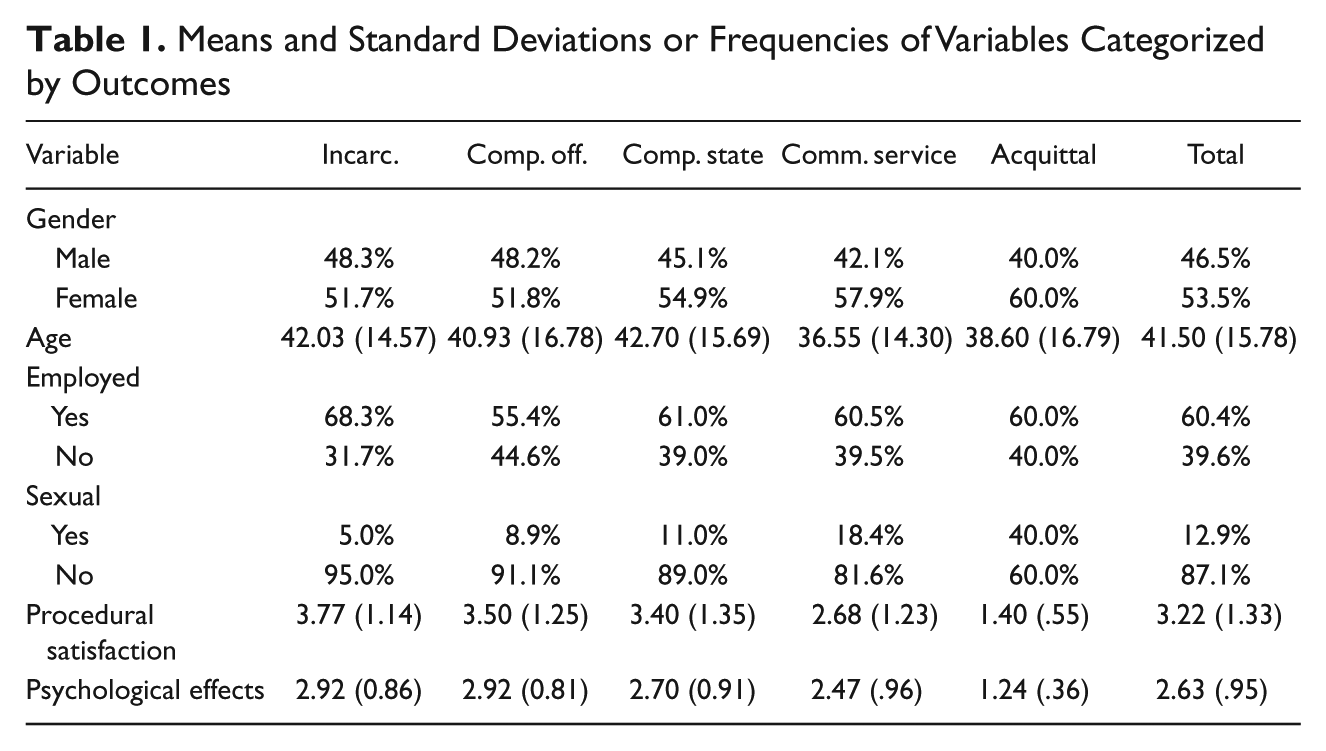
Preliminary bivariate analyses were conducted among the independent variables and between the independent and dependent variables, using correlation analysis, independent samples t-tests and χ2-tests as appropriate. First, associations among the independent variables were examined. Men (46.8%) were less likely to be employed than women (72.2%), p < .05 and less likely to be the victim of sexual assault than women (4.3% vs. 20.4%), p < .05. There were no differences between gender and age, p = .76, and gender and satisfaction with the process, p = .63. There were no differences between employment status and type of offense, p = .83; employment status and age, p = .55; and employment status and satisfaction with the process, p = .18. Furthermore, there was no association between type of offense and satisfaction with the procedure, though the relationship did reach statistical significance, p = .08.
Because of the possibility of multiple outcomes, χ2-tests were used to examine the relationships between these variables. Community service was significantly associated with incarceration, X2 (1, n = 101) = 21.46, p < .001, ϕ = 0.48, but not with compensation from the offender, p = .99, or compensation from the state, p = .22. Incarceration was significantly associated with compensation from the state, X2 (1, n = 101) = 6.16, p < .05, ϕ = 0.27, though not significantly associated with compensation from the offender, p = .19. Compensation from the offender was not significantly related to compensation from the state, p = .12.
Bivariate relationships were also tested with regard to psychological effects, the control variables, and the predictor sentencing variables. With regard to the possible outcomes, satisfaction with the procedure was strongly correlated with psychological effects, r(101) = .57, p < .001. There were no differences between gender and psychological effects, p = .26; age and psychological effects, p = .20; employment status and psychological effects, p = .47; and type of offense and psychological effects, p = .51.
Hierarchical multiple regression was then conducted to examine the independent effects of each of the outcomes on the dependent variable. In the first step, the covariates were entered: gender, age, employment, type of crime (sexual vs. nonsexual) and satisfaction with the procedure. After the first step, the model was statistically significant, F(5, 95) = 11.21, p < .001. Of the control variables, satisfaction with the procedure (β = 0.59, p < .001) was the only significant predictor of psychological effects. In the second step, the five possible legal outcomes were entered into the model. Again the overall model was significant, F(10, 90) = 7.28. Of the legal outcome predictors, only receiving compensation from the offender was significantly associated with psychological effects (β = 0.20, p < .05). The results are displayed in Table 2.
Hierarchical Multiple Regression Analysis Predicting Psychological Effects
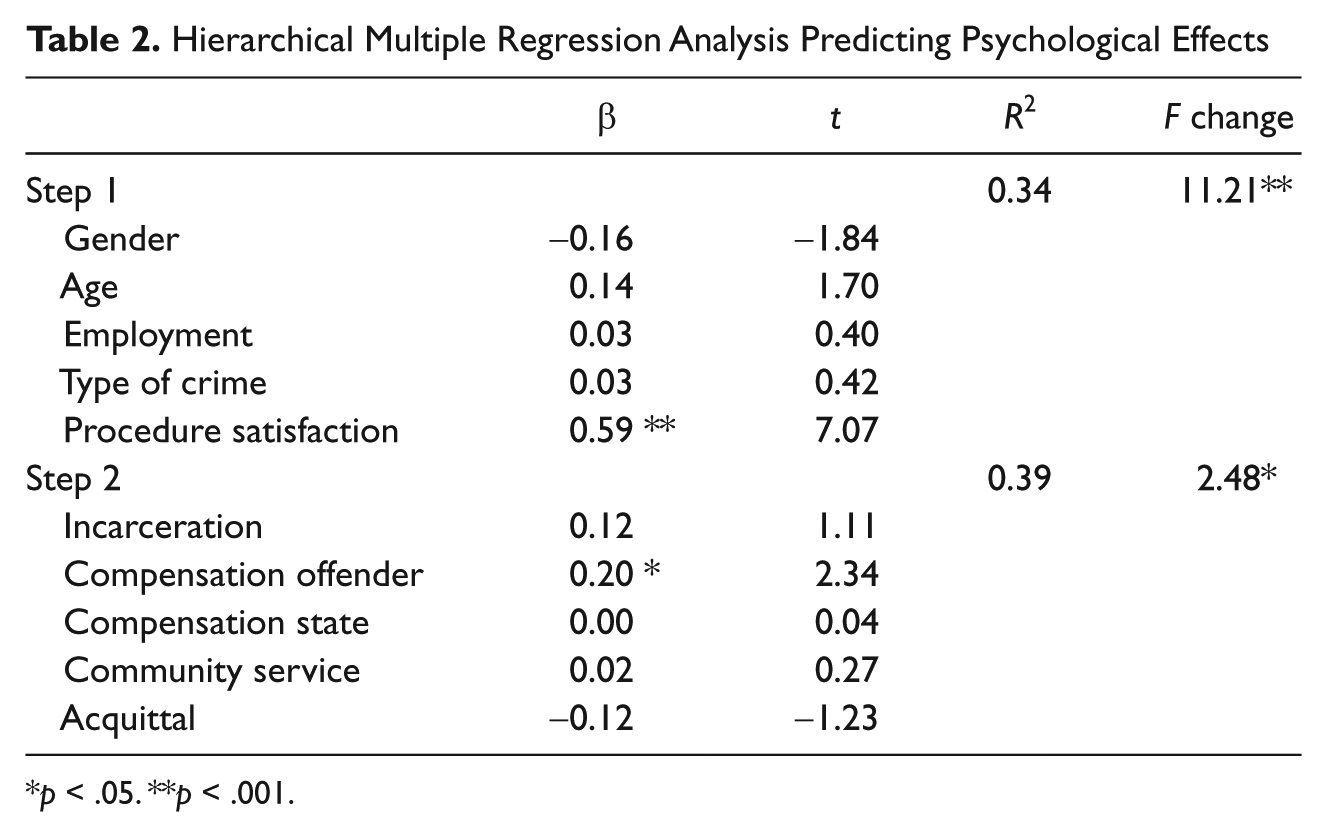
p < .05. **p < .001.
Discussion
The present study explored the effects of incarceration, community service, compensation from the offender, compensation from the State and an acquittal on psychological effects, defined as psychological changes in response to the legal process. While all predictor variables were in the expected direction (incarceration, community service, compensation from the offender and compensation from the state were positively associated with psychological effects, while an acquittal was negatively associated with psychological effects), only compensation from the offender indicated a significant relationship. Furthermore, satisfaction with the procedure was a significant predictor of psychological effects.
The study examined a previously defined concept of Orth (2002) that conceptualized changes in psychological effects as the impact of legal proceedings on one’s ability to cope, self-esteem, optimism about the future, trust in the legal system, and faith in a just world. This previous research was interested in the effects of the process, psychological stress, and the outcome of the legal process. While Orth did include this outcome element, there was no distinction between types of sentencing. The current analysis examined the effect of these variables on the dependent variable, adding to the understanding of the psychological effects of contact with the criminal justice system (to the author’s knowledge, this scale has not been used in other studies examining victims of serious crime). Furthermore, while much research exists on the topic of sentencing options (e.g., in terms of perceptions of prison and compensation), most do not focus specifically on the perceptions of victims. Those studies that do focus on actual victims, moreover, do not examine psychological effects leading to secondary victimization.
The main finding of the research question was that compensation from the offender was the only sentencing option significantly associated with the dependent variable. Previous research has also illustrated the desire for compensation (Ruback et al., 2008; Shapland, 1984). Compensation helps achieve the restorative goal of addressing the harm that was caused to the victim. The actual sum of money may not be important to the victim; rather, such an award conveys acknowledgment of the suffering and position of the victim (Shapland, 1984). Compensation has been perceived as “society’s judgment on them as victims” (Shapland, 1984, p. 145).
The findings would further suggest that there is an intrinsic difference between state and offender compensation. Victims who make use of the compensation claim in the Dutch criminal justice system, and therefore are eligible for compensation from the offender, may undergo different experiences. As the result of such a right, victims are considered parties to the case, which could have implications on psychological well-being. More likely, however, is the notion that compensation from the state and compensation from the offender provide symbolically different messages to the victim. As noted above, compensation represents payment in proportion to the pain and suffering caused by the offender (Shapland, 1984). Psychological research, however, would suggest that there is a greater need for individuals to feel “justice has been done” (Tyler & Thorisdottir, 2003). Compensation as a sentence suggests that the legal system takes the victim and his or her suffering seriously. Moreover, when compensation is perceived as a sentence, it is more likely to address the immoral dimension of crime, holding the offender accountable. Compensation from the offender, then, may more accurately convey the message of suffering by the victim to the offender in addition to the larger society. Furthermore, there may be a structural difference leading to the finding that compensation by the state is not associated with changes in psychological well-being, while compensation from the offender is related. In the Netherlands, victims of crime may complete compensation claims that are subsequently included in their file and read by the judge. These claims illustrate the damage that has been done to the victims, more or less from their perspective. Consequently, there may be more recognition felt by the victim, which may result in less negative psychological effects.
Incarceration and community service were not significantly associated with psychological well-being. Incarceration has been noted as a widely used sentence conveying perceptions of retribution, most closely resembling “an eye for an eye.” Compensation from the offender, however, may also be seen as retributive, as it has been referred to as “punitive restitution” (Johnstone, 2006). Such a punishment may also be perceived as retaining elements within the punishment paradigm. This line of thinking would coincide with the concept of “restoration through retribution” (Duff, 2003a). Compensation from the offender may reflect a criminal punishment aiming at restoration.
While exploring the relationship between outcomes and psychoeffects of criminal proceedings was valuable, there were drawbacks to the current study. One main limitation was the small sample size. With a sample of only 101 victims, there may be a loss of statistical power, which will have repercussions on the generalizability of the findings. Moreover, we cannot make causal inferences due to the cross-sectional design of the survey. For this reason, it is difficult to definitively conclude that the outcomes were not influenced by some other covariate. For example, victims who complete a compensation claim and are thereby more likely to receive compensation from the offender may have different experiences due to their status as a party in proceedings. The overall perception of the process, however, was included as a covariate (i.e., satisfaction with the procedure), which may control for some of the variance. Self-report measures were also used, which may be less reliable when compared to interview methods. Finally, the measure for subjective psychological effects was previously constructed by Orth (2002). Though the reliability coefficients were comparable in the previous and current studies, other research has not made use of this measure. Such a construct should be given further attention in additional research. For example, though the measure essentially captures psychological consequences of contact with the criminal procedure, it does not include mental health symptoms in terms of fear or anxiety. Keeping in mind the abundance of research indicating the harmful effect of criminal proceedings on victim well-being, it would also be interesting to further look at the relationship between the verdict and psychological consequences such as anxiety or fear (e.g., and their association with incarceration or an acquittal).
Though these weaknesses exist, the findings of the study have important implications for research, examining the legal preferences of victims of crime. Rather than examining satisfaction, this research analyzed psychological effects of criminal proceedings, further supporting the view that experiences with the criminal justice system could have negative implications for the victim’s well-being. At the same time, the means for the victims as reported on subjective effects still ranged between neutral and a negative effect, suggesting that more is still required. In addition, the findings add to the body of knowledge of the restoration versus retribution debate, using empirical findings to conclude that there may be a benefit in obtaining restoration through retribution. Further research could examine only victims who applied for compensation, comparing their (granted) claim with compensation from the state. Moreover, while this research examined a sample of victims of serious crimes, there may be differences among victims that cause them to desire varying sentencing outcomes. Research therefore could explore these moderating variables to better understand under what conditions sentencing may be associated with the psychological well-being of the victim.
Footnotes
Declaration of Conflicting Interests
The author declared no potential conflicts of interest with respect to the research, authorship, and/or publication of this article.
Funding
The author received no financial support for the research, authorship, and/or publication of this article.