







Abstract
This article draws on general strain theory (GST) to develop and test a model of the childhood abuse–crime relationship. Using data from the National Longitudinal Study of Adolescent Health (Add Health),1 we find that early childhood physical and sexual abuse are robust predictors of offending in adolescence, for the full sample and in equations disaggregated by gender. GST is partially supported in that the effects of childhood physical abuse on offending for both females and males are mediated by an index of depression symptoms, whereas the effect of sexual abuse among females appears to be mediated largely by closeness to mother. The effect of childhood sexual abuse among males, however, is more robust than among females and it persists despite controls for low self-control, ties to delinquent peers, school attachment, and closeness to mother. Theoretical implications of the findings are discussed.
Literature shows that childhood physical and sexual victimization impact subsequent behavior and functioning, including the likelihood of depression (Gomes-Schwartz, Horowitz, & Sauzier, 1985; Mannarino, Cohen, & Oregon, 1989), delinquency and violence (Agnew, 2002; Baron, 2004; Gormon-Smith & Tolan, 1998; Hay & Evans, 2006; Margolin & Gordis, 2000; Scarpa, 2001), and substance use (Brems, Johnson, Neal, & Freemon, 2004; Davis, Combs-Lane, & Jackson, 2002; Gutierres & Van Puymbroeck, 2006; Linares, 2004; Lo & Cheng, 2007; Neff & Waite, 2007). Yet few studies in criminology have looked specifically at the effects of physical and sexual abuse at the hands of parents and other adult caregivers on criminal behavior. This literature has instead focused on more general types of victimization (Kaufman, 2009) or other types of childhood-specific victimization such as bullying (Hay & Meldrum, 2010).
The dearth of studies focusing on childhood abuse in the criminology literature is surprising, given that there is a large literature in the disciplines of public health and psychology that looks specifically at childhood abuse and its negative consequences. The considerable emphasis on the consequences of childhood physical and sexual abuse in public health and psychology, however, has been limited in several respects. First, samples tend to be small, often drawn from incarcerated populations, substance abuse treatment facilities, or battered women’s shelters (Wilson, Stover, & Berkowitz, 2009). Second, these studies often lack a theoretical framework to explain why childhood physical and sexual victimization should be consequential for subsequent involvement in crime. Third, these studies fail to control for relevant variables derived from criminological theory that might mediate or moderate the abuse-criminal behavior relationship.
This article draws on General Strain Theory (GST) as an explanatory framework to understand the importance of childhood abuse for later criminal involvement (Agnew, 2001, 2006). The theory argues that various types of negative relations and interactions with others (strains) lead to negative emotions that require some type of coping response (Agnew, 1992). The type of coping individuals engage in is more likely to be deviant when strains are severe, seen as unjust, and are linked with negative emotions such as depression (Agnew, 2001; Kilpatrick, Saunders, Veronen, Best, & Von, 1987; Miller, Cohen, & Wiersema, 1996; Resick, 1987). In many cases, childhood physical and sexual abuse meets all these criteria and thus may be particularly consequential for emotional states and behavior. In addition, childhood victimization experiences may be very traumatic with lasting consequences that may be confounded with other predictors of criminal behavior, such as low self-control or pressure from delinquent peers.
We present analysis disaggregated by gender of the effect of a retrospective account of childhood physical and sexual abuse in early childhood (before the sixth grade) on self-reported criminal involvement in adolescence using the National Longitudinal Study of Adolescent Health (Add Health). We test hypotheses derived from GST, namely, whether direct effects of childhood abuse (strains) on criminal behavior are mediated by depression and whether strain effects are robust in the presence of theoretically important control variables. Before presenting the analysis we discuss prior research and the theoretical framework in more detail.
Prior Research and Theoretical Framework
Empirical Literature on Child Abuse and Criminal Behavior
Reviews of the literature in public health and psychology on childhood abuse show that experiencing physical abuse in childhood is related to rough play with peers in adolescence, higher peer ratings of aggression, more disciplinary problems at school, earlier onset of violence, and increased dating violence in adolescence (Macmillan, 2001; Margolin & Gordis, 2000). Childhood sexual abuse has been an area of particular focus in feminist writing, especially its consequences for later criminal careers (Arnold et al., 2003; Dembo, Schmeidler, & Childs, 2007; Jarvis, Copeland, & Walton, 1998; Owen, 1998; Shaw, 1991).
In a study of women in a clinical setting, Arnold et al. (2003) found that compared to women with no reported history of childhood sexual abuse, women with these histories had significantly higher levels of depression, aggression, and both alcohol and drug abuse. Previously abused women were also more likely to have a felony arrest on their record than nonabused women (Arnold et al., 2003). A cross-sectional study of South Australian adolescents by Bergen, Martin, Richardson, Allison, and Roeger (2004) found that childhood sexual abuse was significantly and positively associated with antisocial behavior and substance abuse, with the effects being similar for both females and males. Among a sample of women in drug and alcohol treatment centers, Jarvis et al. (1998) found that while victims of childhood sexual abuse did not report more severe dependence on drugs or alcohol, they did report an earlier age of the onset of the use of alcohol and inhalants. Similarly, Ompad et al. (2005) found that childhood sexual abuse was related to earlier initiation of injection drug use in a sample of both females and males.
The criminal justice literature includes many studies that show how consequential childhood abuse has been in the lives of incarcerated individuals. Dembo, Williams, and Schmeidler (1993) found that many individuals entering the juvenile justice system in Florida, especially females, had a history of experiencing childhood sexual abuse. Other studies have shown that a large percentage of incarcerated women report past instances of childhood sexual abuse. Margaret Shaw’s (1991) study of women convicted of both violent and nonviolent offenses in Canadian prisons found that 53% reported being the victims of sexual abuse at some point in their lives. Barbara Owen (1998) conducted a study made up of 300 face-to-face interviews with women in the Central California Women’s Facility, the largest women’s prison in the world. The women in Owen’s (1998) study reported various types of physical and sexual abuse during childhood, with about 40% of respondents reporting ongoing sexual abuse both before and after age 18.
General Strain Theory
The empirical literature on childhood abuse in public health/psychology reviewed above has generally not provided a viable theoretical explanation for why childhood abuse should influence later criminal behavior. GST was proposed by Robert Agnew (1992) as an individual level, social psychological explanation of crime and delinquency. The theory is an expansion of traditional strain theories, which primarily focus on an individual’s inability to achieve economic and class-based status goals and the resulting stress this causes (see Cloward & Ohlin, 1960; Cohen, 1955; Merton, 1938). Agnew added to the threatened or actual experience of not achieving highly valued goals two other types of strain likely to lead to deviant coping: the loss of valued persons or objects and the presentation of noxious stimuli (e.g., childhood abuse). The focus on the loss of valued persons or property and the presentation of noxious stimuli as important strains comes from the literature on stress (Mirowsky & Ross, 2003; Pearlin, 1989). Research in the GST literature has suggested that strains that are high in magnitude, seen as unjust and undeserved, occur in settings with low social control, and that incentivize crime are more likely to lead to crime (Agnew, 2001). Childhood abuse at the hands of parents and other adult caregivers may in many cases meet all of these criteria, and thus these experiences may be particularly criminogenic.
According to Agnew, experiences of strain are important because they lead to the development of negative emotions, such as anger, depression, fear, and anxiety. Individuals have many different ways to cope with these negative emotions, and the likelihood that they cope through deviant methods is influenced by the kinds of coping mechanisms available to them and numerous variables drawn from other theories of crime (social control, social learning, and self-control theory). For example, the individual who associates with many delinquent peers may be more likely to engage in deviant coping, while an individual who is firmly attached to their family and school may be less likely to do so. Similarly, respondents with low self-control may be less able to effectively cope with significant strains and more inclined to respond in a delinquent manner.
GST also argues that females and males may experience the strain-negative emotions-crime process differently, and respond to strain in different ways (Broidy & Agnew, 1997). In addition, prior research shows that the abuse experiences of females and males differ greatly, with physical abuse being more of a male phenomenon and sexual abuse being more prevalent among females (Belknap, 2007; Chesney-Lind & Pasko, 2004; Finkelhor & Baron, 1986; Heger, Ticson, Velasquez, & Bernier, 2002; Putnam, 2003). That males are so much more likely to experience physical childhood abuse, often through exposure to harsh physical disciplinary practices, may be part of the explanation for the greater offending rates of males than females. Prior research shows that harsh physical punishment is a much more common form of child abuse than is sexual abuse, and it is a consistent predictor of delinquency and antisocial behaviors (Hay, 2003; Laub & Sampson, 1988). Accordingly, we present separate equations for females and males to assess gender differences in the effects of these particular strains on self-reported criminal behavior.
The Current Study
We seek to build on the childhood abuse-crime literature by expanding it in several ways. First, unlike many previous studies focusing on incarcerated or institutionalized samples, we utilize a nationally representative sample drawn from the National Longitudinal Study of Adolescent Health. Many previous studies have selected on the dependent variable by drawing convenience samples from prisons, jails, and substance abuse treatment facilities. Second, we apply GST, a theoretical framework that specifies the mechanisms through which experiences of abuse during childhood affect later offending. Unfortunately, few studies in the criminological literature have looked specifically at the impact of childhood physical and sexual abuse on criminal behavior, and although GST has received a fair amount of empirical support (see Akers & Sellers, 2009), its application to early childhood physical/sexual abuse and crime has received little attention.
Indeed, the literature on childhood abuse outside of criminology has generally failed to provide a succinct theoretical explanation for why childhood abuse should influence criminal behavior, while the criminological literature on GST has not often identified childhood abuse specifically as important for offending. Various other strains in childhood have been more often explored (bullying, discrimination, etc.) and childhood abuse, when accounted for, is often included in global measures of strain rather than as a strain that deserves attention as particularly important on its own. Finally, we control for variables from other criminological theories shown to be predictive of crime as a means to assess the relative effects of childhood abuse in shaping criminal outcomes.
We draw on GST to derive specific hypotheses about the relationship between childhood abuse and criminal behavior. Hypothesis 1 predicts that the experience of childhood physical and sexual abuse will increase the likelihood of self-reported criminal involvement in adolescence among both females and males. Hypothesis 2 predicts that experiences of childhood physical and sexual abuse will increase symptoms of depression, which will in turn partly mediate the effects of childhood abuse on criminal behavior (this may apply more to females). Finally, Hypothesis 3 predicts that the remaining direct effects of childhood abuse on criminal offending will persist when controlling for variables from other theories of crime (i.e., self-control, delinquent peer affiliation, school bonding, and closeness to mother).
Data and Method
Sample
We draw on data from the first three waves of the National Longitudinal Study of Adolescent Health (Add Health). Add Health is a nationally representative sample of American adolescents who were first recruited during the 1994-1995 school year while they were in Grades 7 to 12 (Harris et al., 2003; Udry, 1998). Add Health obtained a nationally representative sample of adolescents by utilizing a multistage stratified sampling process to select 80 high schools and 52 middle and junior high schools for inclusion in the study. More than 90,000 students completed in-school self-report surveys, and of this group a subsample was randomly chosen for the Wave I in-home component of Add Health. In total, 20,745 adolescents and 17,700 of their primary caregivers participated in the Wave I in-home component (Harris et al., 2003). The second wave of data was collected approximately 1 to 2 years after the first wave, while Wave III data was collected during 2001-2002 when respondents were between 18 and 26 years old. We restrict the analysis to cases with complete data across the three waves, resulting in a sample size of 9,002 (4,836 females and 4,166 males). Table 1 presents descriptive statistics for variables, for the full sample and separately for females and males.
Descriptive Statistics.
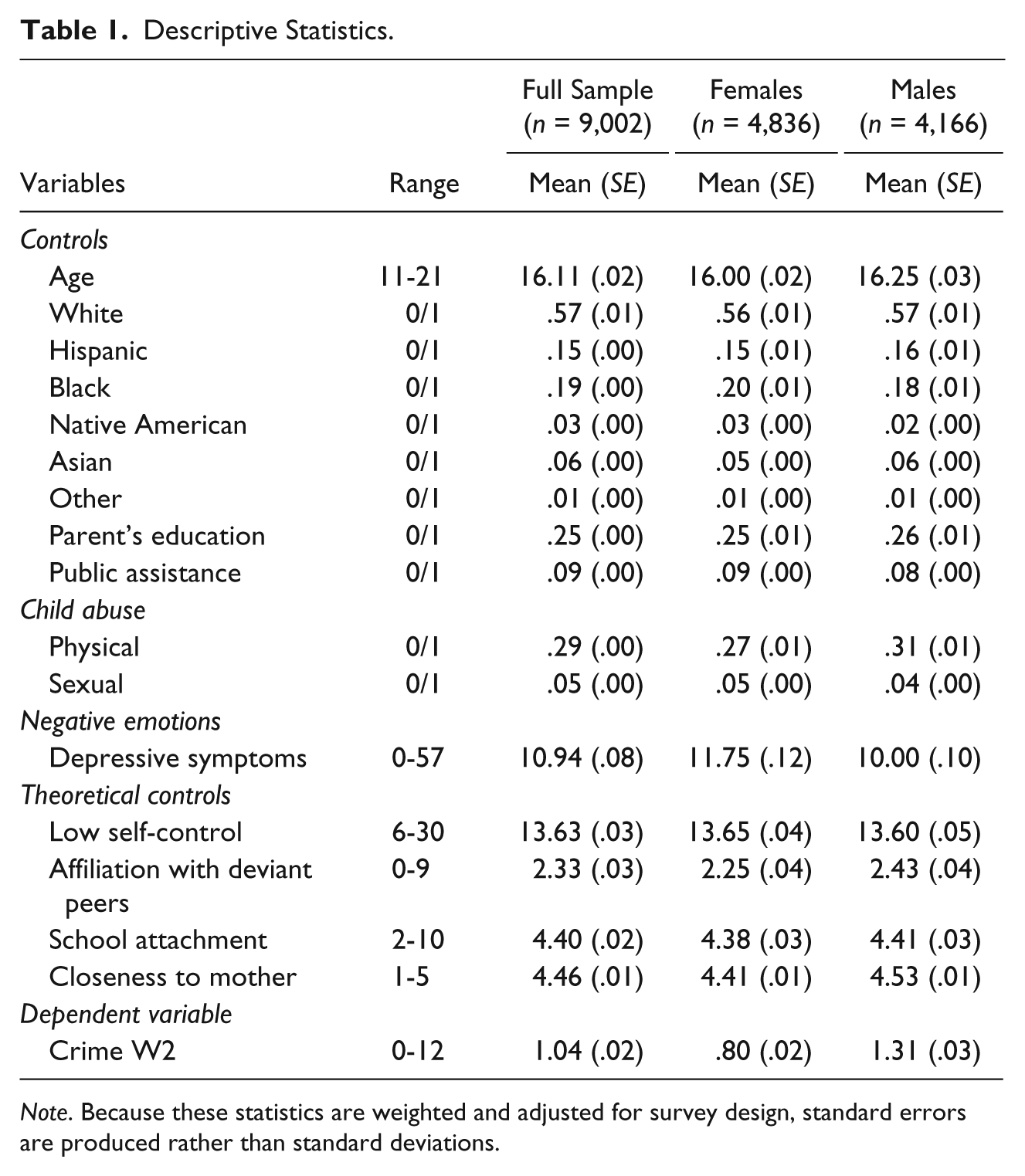
Note. Because these statistics are weighted and adjusted for survey design, standard errors are produced rather than standard deviations.
Measures
Criminal behavior
The dependent variable consists of 12 items drawn from Wave II that asked respondents about various criminal activities they have engaged in during the year prior to being interviewed. These items are a mixture of property and violent offending, and one item asked about drug selling. Property offending measures included asking respondents how often they painted graffiti, damaged property, stole cars, shoplifted, stole items worth more or less than US$50, or burglarized buildings. Violence measures included asking how often respondents used or threatened to use a weapon on someone, took part in a group fight, pulled a knife or gun on someone, or shot or stabbed someone. Inspection of the distributions for each item revealed extensive skew, with relatively few respondents reporting frequent involvement. We thus recoded the 12 items into binary measures of whether the respondent reported engaging in these behaviors in the past year (1 = yes), and summed them into a measure of criminal behavior that emphasizes the prevalence of offending (α = .77 for the full sample). Consistent with available data, males evidence a significantly higher likelihood of offending compared to females (t = −14.1; p < .01) although most respondents report low levels of involvement (see Table 1).
GST measures
Wave III of the Add Health includes retrospective accounts of physical and sexual abuse. Respondents were asked how often they experienced certain types of abuse and neglect at the hands of their parents or other adult caregivers before starting the sixth grade. The physical abuse item specifically asks about being slapped, hit, or kicked, while the sexual abuse item asks about being touched in a sexual way, being forced to touch a parent or adult caregiver in a sexual way, or being forced into sexual relations by a parent or adult caregiver. Possible responses range from 0 to 5, indicating never, once, twice, 3 to 5 times, 6 to 10 times, and more than 10 times. The vast majority of respondents report no experiences of childhood physical or sexual abuse, and thus we recoded each item to a binary response (1 = experienced childhood abuse). Table 1 reveals that 29% of the full sample report early childhood physical abuse, whereas only 5% report sexual victimization, with similar percentages evident for female and males.
As discussed above, GST predicts that strain effects on crime may partly operate through negative emotions, including depressive symptoms. To assess this possibility, we measure depressive symptoms with 19 items from the CES-D depression scale, administered during Wave I interviews (range 0 to 57; α = .86 for the full sample). This scale includes items that ask about feelings of loneliness, fear, sadness, fearfulness, and depression in the week before being interviewed, with possible responses ranging from 0 (never or rarely) to 3 (most of the time or all of the time). The use of depressive symptoms as a potential mediator is consistent with recent theorizing and research on GST (Brezina, 1996; Broidy, 2001; Jang & Johnson, 2003; Kaufman, 2009). Consistent with prior work, Table 1 shows that females evidence a significantly higher mean on the depression scale compared to their male counterparts (t = 11.2; p < .01).
Control variables
We include four measures from Wave I that represent other important theories of crime: social control (Hirschi, 1969), social learning (Akers, 1985), and self-control theory (Gottfredson & Hirschi, 1990). We introduce these variables as a means to assess whether direct effects of childhood abuse on adolescent offending persist in the presence of these controls. Self-control comprises six items that ask respondents about how they approach problem solving, including whether they research problems or go with their “gut feeling,” explore different approaches to solve a problem, engage in rational decision making, and evaluate their solutions after implementing them. Responses for these items range from strongly agree (1) to strongly disagree (5). We summed the six items to produce an additive low self-control scale (range = 6 to 30; α = .61), with higher values indicating lower self-control. There do not appear to be substantial gender differences in reported levels of self-control (see Table 1).
Social learning theory is represented by a measure of affiliations with substance using peers. Affiliation with substance using peers is an important learning source in the criminological literature, as these peers act as both models of deviant behavior and powerful reinforcement for deviant attitudes (Akers 1985). This additive scale combines three questions that ask how many of the respondent’s three best friends smoke at least one cigarette a day, drink alcohol at least once a month, or smoke marijuana at least once a month (range = 0 to 9; α = .76). While this measure is limited in that it only records peer substance use, these kinds of behaviors correlate highly with more general deviant behavior (Kaufman, 2009). Two measures represent social control theory, school attachment, and closeness to mother. School attachment combines two items that ask respondents if they feel close to people at their school and if they feel a part of their school, with response sets ranging from strongly agree to strongly disagree (α = .74 for the full sample). Closeness to mother is based on an item that asks respondents how close they feel to their mother, ranging from not at all close (1) to very close (5).
We also include several general controls in all analyses, which include age, dummy variables for Hispanic, non-Hispanic Black, Native American, Asian, and Other (with non-Hispanic White as the reference category), parent’s education (1 = 4-year degree or more), and parent receiving public assistance (1 = yes). Previous research has shown that these measures are correlated with involvement in crime (Bellair & McNulty, 2005). About 57% of the sample is non-Hispanic White, 15% Hispanic, 19% non-Hispanic Black, with the remainder comprising Native American (3%), Asian (6%), and members of other racial/ethnic groups (1%). About 25% of parents have college educations, whereas 9% report receiving public assistance (similar for females and males; see Table 1).
Analytic Strategy
We test hypotheses derived from GST using Negative Binomial (NB) regression techniques, and present equations for the full sample and separate models for females and males. The models test whether child abuse has direct effects on self-reported criminal behavior (Hypothesis 1), whether this relationship is partly mediated by scores on the depression scale (Hypothesis 2), 2 and whether remaining direct effects of abuse persist when other well-known predictors of crime are controlled (Hypothesis 3). We utilize NB regression techniques based on the fact that the dependent variable is highly skewed, violating the assumption of normality required for OLS regression (Gardner, Mulvey, & Shaw, 1995). We utilize the appropriate weight, cluster, and strata variables in all analyses to account for the complex Add Health survey design. Tests using Variance Inflation Factors (VIFs) showed that multicollinearity was not a problem in any of the equations.
Results
Table 2 displays the results of NB regressions of self-reported criminal behavior on the control, childhood abuse, and depression variables for the full sample. Model 1 establishes that physical (.19; p < .01) and sexual (.29; p < .01) abuse in childhood has significant and positive effects on criminal behavior, supporting Hypothesis 1. Among the control variables, males and Hispanics report higher levels of criminal behavior, while involvement tends to decline with age. Model 2 adds the depression scale to the equation, which has the expected positive effect on criminal involvement (.04; p < .01). Incorporating depressive symptoms, however, appears to only minimally mediate the effects of physical abuse on crime (reducing the coefficient by about 21%), and does not mediate the effects of sexual abuse. Both effects remain highly significant (inconsistent with Hypothesis 2). The results in Model 3 show that the experience of childhood physical and sexual abuse is a robust predictor of criminality, despite controls for low self-control and deviant peers, both of which have significant and positive effects on self-reported criminal behavior. School attachment and closeness to mother do not have net effects on crime.
Crime Regressed on Childhood Abuse, Depressive Symptoms, and Controls.
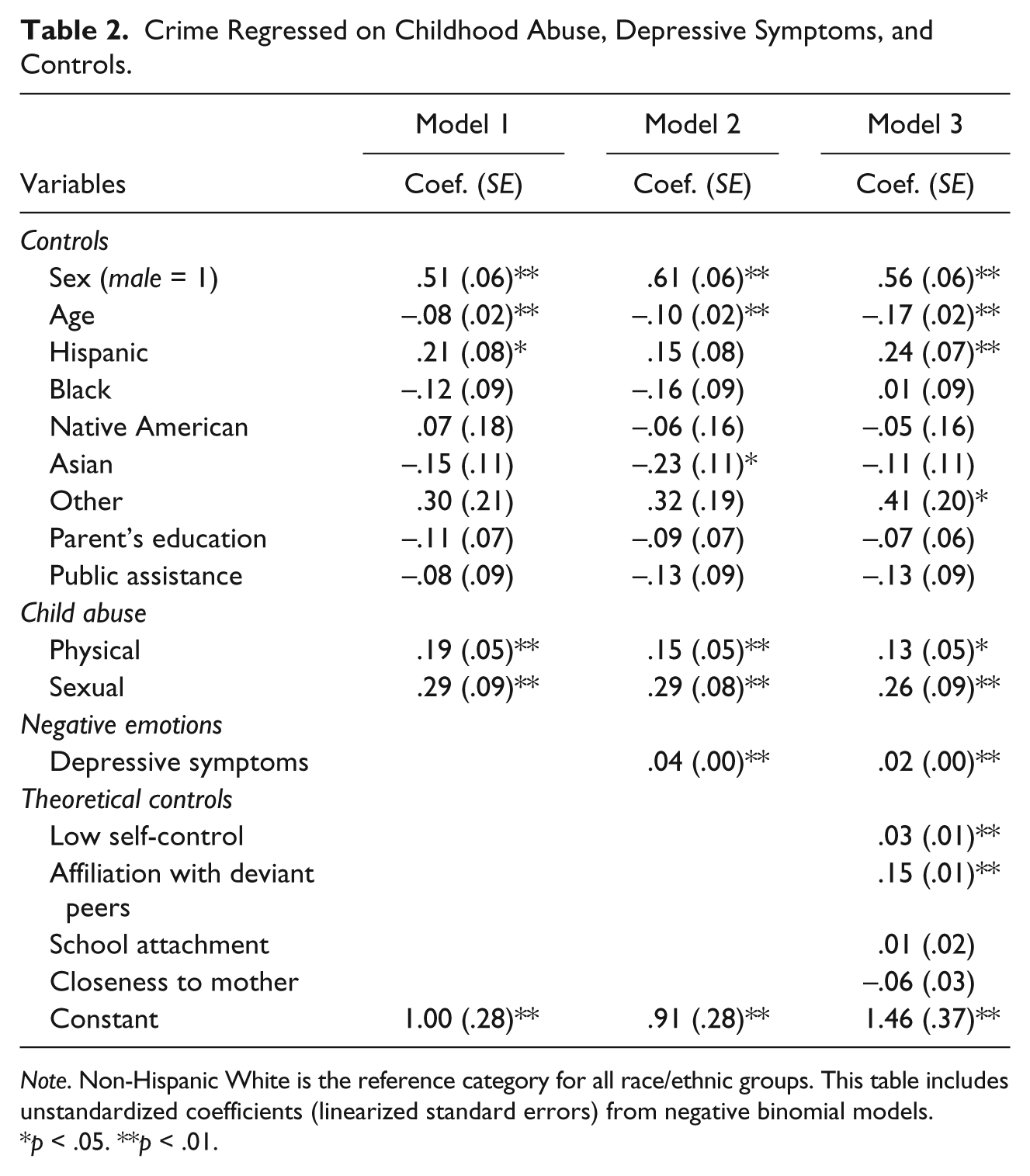
Note. Non-Hispanic White is the reference category for all race/ethnic groups. This table includes unstandardized coefficients (linearized standard errors) from negative binomial models.
p < .05. **p < .01.
Table 3 presents the results disaggregated by gender. Model 1 shows that the experience of childhood physical and sexual abuse has the expected effect on self-reported crime among both females and males although, somewhat unexpectedly, the sexual abuse effect is more pronounced among males. Model 2 introduces the depression scale, which has the expected positive effect on crime and reduces the physical abuse effect among both females and males to insignificance (providing support for Hypothesis 2). The sexual abuse effect on self-reported criminal involvement, however, remains highly significant for both genders.
Crime Regressed on Childhood Abuse, Depressive Symptoms, and Controls, Split by Gender.
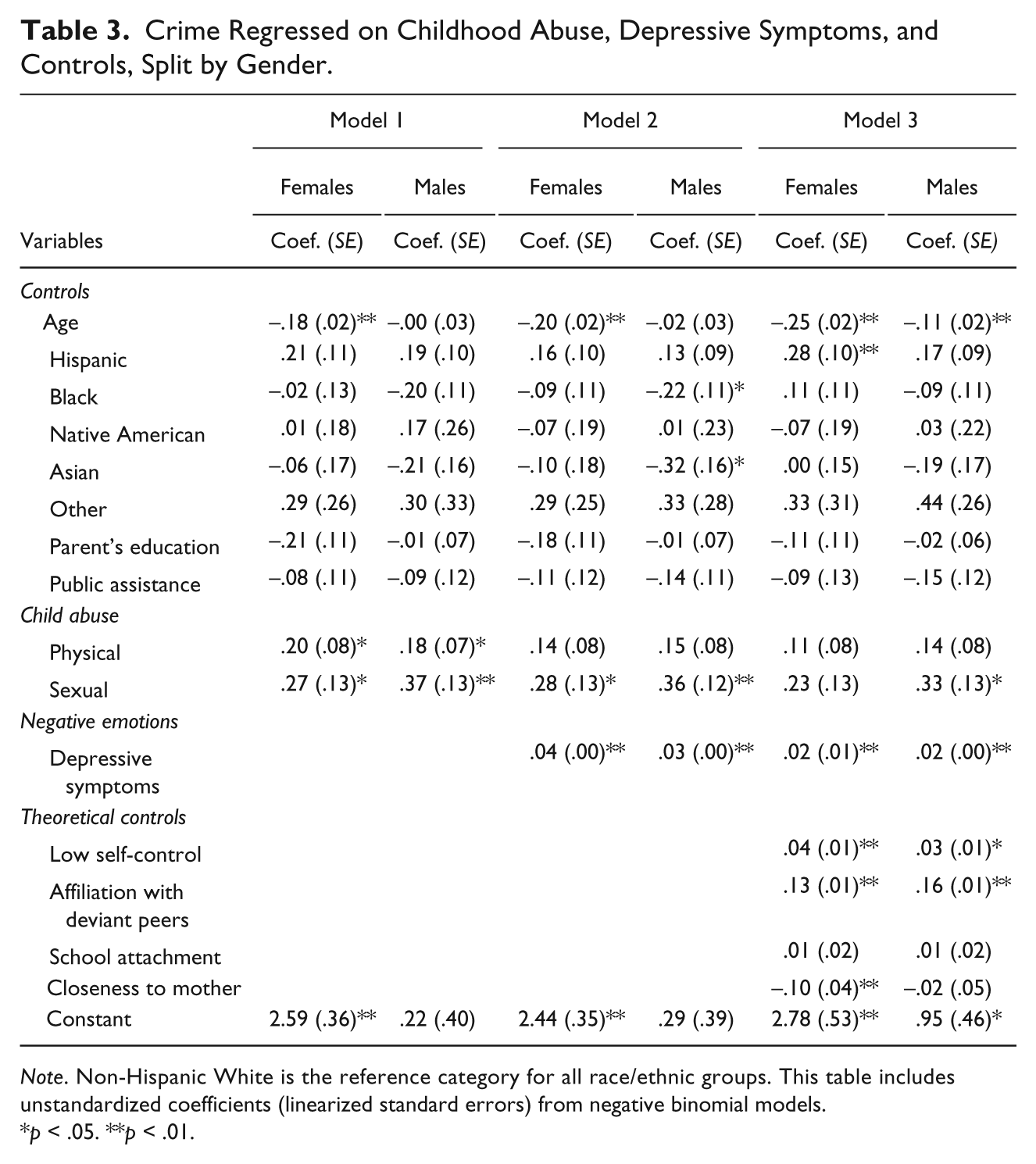
Note. Non-Hispanic White is the reference category for all race/ethnic groups. This table includes unstandardized coefficients (linearized standard errors) from negative binomial models.
p < .05. **p < .01.
The final model in Table 3 adds the theoretical controls. Among females, the addition of these predictors reduces the magnitude of the sexual abuse coefficient to insignificance, primarily as a function of closeness to mother. Among males, the sexual abuse effect has been reduced somewhat, but remains significant at the .05 level. Among both females and males, low self-control and affiliations with substance using peers increase criminal involvement, whereas closeness to mother reduces involvement only among females.
Discussion and Conclusion
This article examines the effects of childhood physical and sexual abuse on criminal offending using a nationally representative sample drawn from the Add Health data, and GST as a theoretical framework for understanding why these experiences are consequential for offending. The first hypothesis that experiences of childhood physical and sexual abuse will affect later criminal behavior is supported by the data. Childhood abuse (physical and sexual) significantly increases self-reported offending in adolescence among both females and males. Somewhat unexpectedly, however, the sexual abuse effect on adolescent offending is more pronounced among males. Nevertheless, these results support the assertion that childhood abuse is an important factor in criminal offending, among both females and males.
Hypothesis 2, that scores on the depression scale would partly mediate the effects of childhood abuse on criminal offending, is partially supported. The effects of childhood physical abuse on offending for both females and males appear to be mediated by depressive symptoms, which in turn have the expected positive effect on offending. Depression scores, however, do not mediate the direct effects of sexual abuse on self-reported involvement in crime. The third hypothesis tested the potential of other predictors of crime to account for the childhood abuse–crime relationship. Low self-control and affiliation with substance using peers evidence the theoretically expected effects on adolescent offending among both females and males; closeness to mother appears to reduce involvement only for females (school attachment does not have a net effect). Controlling for these predictors reduces the direct sexual abuse effect among females to insignificance (primarily accounted for by closeness to mother), whereas the effect among males is reduced only slightly and remains statistically significant at the .05 level.
The results provide evidence of the importance of childhood abuse for adolescent offending, with the effects of childhood abuse largely working through depressive symptoms (in the case of physical abuse among both genders) and low self-control, affiliation with deviant peers, and closeness to mother (in the case of sexual abuse among females). 3 Only the effect of childhood sexual abuse on offending among males retains significance in the final equation (Table 3, Model 3). Thus the analysis provides partial support for the strain-depression-crime link proposed by GST (see Gomes-Schwartz et al., 1985; Mannarino et al., 1989) although predictors derived from other criminological theories also appear to play a role. Indeed, strains as serious as childhood physical and sexual abuse may shape offending through multiple pathways beyond negative emotions such as depression (see Simons & Burt, 2011).
The results for females in particular point to the possibility that a number of detrimental outcomes (e.g., low self-control) may be relevant for explaining the abuse-offending relationship. Future research should examine how abuse affects other important criminogenic variables beyond depression, such as social bonds, self-control, and deviant affiliations that in turn shape later offending. A key implication of this study is that more work is needed to understand the gendered pathways by which physical and sexual child abuse influence negative emotions and criminal offending. Findings in the current study show childhood sexual abuse to be a more robust predictor of criminal offending among males than females, while prior research suggests the opposite (Belknap, 2007; Chesney-Lind & Pasko, 2004; Putnam, 2003). While the sexual abuse of girls in childhood may be more prevalent, it may be the case that childhood sexual abuse is more consequential for males in terms of later criminal behavior. In-depth qualitative interviews with current and former offenders who have been the victim of childhood sexual abuse may help uncover the gendered mechanisms that connect sexual abuse with offending. This type of research could result in new, testable hypotheses about the differential pathways through which abuse influences offending among males and females.
While this research makes important contributions, a few limitations should be noted. Our measures of childhood physical and sexual abuse lack specificity, in that there is no identification of specific abusers and their relationship to the respondent, and there is no time frame identified for when abuse first occurred and whether it continued or if it was isolated in a short time frame. Who individuals are abused by, the timing of first occurrence, and how long a span of time these experiences cover could be important factors in determining how these abuse experiences shape negative emotions and criminal offending. Future research would benefit from more specificity in items measuring experiences of childhood abuse. Our measure of negative emotions (i.e., depression scores) is somewhat limited in that it does not capture other emotions (particularly anger) that may be relevant to the offending process. In addition, while our measure of depressive symptoms includes items tapping emotions like fear, anxiety, and guilt, these emotions could be particularly important in the strain-offending process on their own. These other emotions, as well as anger, could perhaps use a more full examination in future tests of GST as applied to the childhood abuse–crime relationship.
In conclusion, this study provides evidence that experiences of childhood abuse serve as an important strain that increases the likelihood of involvement in criminal offending. This process appears to differ somewhat by gender in that we are unable to account for the direct effect of sexual abuse on crime among males (which is more pronounced among males). Future research should further specify the potentially unique pathways toward offending that childhood physical and sexual abuse entail among males and females. Our findings generally support the utility of GST as an explanation of the link between childhood abuse and offending, but additional tests of mediating linkages that operate through a variety of measured negative emotions and other predictors of offending would provide further insight into the processes through which childhood abuse has its effects on adolescent outcomes.
Footnotes
Declaration of Conflicting Interests
The author(s) declared no potential conflicts of interest with respect to the research, authorship, and/or publication of this article.
Funding
The author(s) received no financial support for the research, authorship, and/or publication of this article.