







Abstract
This article aims to examine the intervention approach of the police in handling domestic violence and the reasons behind the inactive response of police to domestic violence situations in Hong Kong. The study adopted a qualitative approach to data collection that included 20 in-depth interviews to survivors and 2 interviews to police officers. Findings of this study show that the police are likely to adopt a non-intervention or mediation approach rather than arrest approach because of their distrust of abused women. The police have different reactions in responding to domestic violence issues namely (1) stereotyping the victims, (2) cynical interpretation of women’s motivation in reporting, and (3) disbelieve the problem is solvable. All these reactions are associated with the trust of the police that hold on domestic violence issues stems from the dominant patriarchy ideology. The beliefs of police are shaped by the male-dominated police occupational culture, which is characterized by sexism and suspicion. Such beliefs coupled with traditional family values and the dependency discourses prevalent in society have concealed the truth and reality of domestic violence.
Introduction
In 2004, a family tragedy in Tin Shui Wai 1 provoked strong criticism of police attitudes toward abused women and procedures in handling domestic violence cases. Kam Shuk-ying, a new immigrant, and her two daughters were killed by her husband. It has been suggested that women’s silence increases men’s violence against women. However, Kam had sought help from the police prior to the tragedy. On the day that she was killed, she had reported to the police that she was in danger, and had stayed in the police station for more than 2 hr to ask for protection. However, the duty officer in the police station turned her away without taking any action to protect her. Even worse, no record of her complaint was found in the police file. Why did the police not treat the case seriously and take further action, such as sending Kam to a refuge center for safety, or give a warning to or even arrest the perpetrator to stop the violent behavior? Was it simply laziness? Or was it because the officer doubted the victim based on his beliefs concerning domestic violence?
Credibility is socially constructed and historically and culturally specific. Our knowledge of the world is not a direct perception of reality but rather is fabricated through the daily interactions among people in the course of social life (Burr, 2003). Throughout the history of patriarchy, men’s words have been considered important, objective, and right, whereas women’s words have counted for little. Issues of belief and credibility are exacerbated by the response of the criminal justice system to violence against women. Victims of such crimes as rape or domestic violence are vulnerable because these offences usually involve no witnesses apart from the key parties involved, and their prosecution depends on the word of the woman against that of the man (Jordan, 2004; Scutt, 1997).
One could argue that the police do not deliberately ignore the needs of domestic violence victims but rather have inadequate knowledge in handling such cases; therefore, clear procedural guidelines should help to improve how police handle domestic violence situations. This article aims to examine the intervention approach of the police in handling domestic violence and the reasons behind the inactive response of police to domestic violence situations in Hong Kong. The discussion is based on the qualitative data of a research study conducted between 2006 and 2008. Discussion in this article might help us identify the root problem of policing domestic violence in Hong Kong.
Beliefs Matter: The Approaches to Handling Domestic Violence Cases
As pointed out by the Council of Europe (2006), the purpose of legal measures is to provide a safety period for victims and allow them to gain access to legal and practical solutions for their situation.
Sherman and Berk (1983) reported that police officers in Minneapolis generally used three disparate approaches to deal with domestic violence situations. The first was a non-intervention approach, because they believed that the problem was basically unsolvable. Second, the police used a mediation approach, which they thought was the approach least likely to provoke further violence by getting at the underlying cause of the violence and avoiding the negative labeling denoted by them when they took on their law enforcement role. Third, they made arrests, which the police believed had the effect of deterring violent acts.
Studies showed that the inaction of the police in handling domestic violence cases is influenced by the traditional view on domestic violence. The unwillingness of the police to take action is affected by private attitudes and sex role stereotypes (Browne, 1995; Dobash & Dobash, 1980; Edwards, 1987; Whetstone, 2001). As a result of treating domestic violence as a private family matter, the police are likely to take a passive approach to such cases, as shown by the great reluctance to record domestic violence as a crime (Edwards, 1986). Stokoe’s study (2010) discovered that denials of violence toward women are prevalent within police interrogations. Police are often apathetic to the victims and address their problems inadequately (Dobash & Dobash, 1992), thus discouraging arrest and promoting counseling (Martin, 1997). Adopting a “mediation” approach to law enforcement aims to preserve the “family as a unit” (Burton, 2008).
Furthermore, a study in the United Kingdom specified that the organization is important in shaping the responses of the police in determining the extent to which forces can provide an efficient and effective service in dealing with domestic violence (Plotnikoff & Woolfson, 1998). Issues such as the lack of a standard model for the domestic violence officers among forces, lack of accountability, poor monitoring system, and inadequate training and support, which marginalize and undervalue police officers, are factors perceived by police in adopting the “hands-off” approach.
In recent years, the pro-arrest approach is widely believed as an effective measure to protect women from violence as criminalization serves a symbolic purpose indicating the moral unacceptability of domestic violence (Edwards, 1989; Stark, 1993). And this approach enables state intervention to treat the perpetrator, thereby reducing the risk of further offending in a constructive way (Cho & Wilke, 2010; Dobash, Dobash, Cavanagh, & Kewis, 1996; Hoyle & Sanders, 2000). Police officers who resolved the largest proportion of domestic violence incidents through arrests are more likely to perceive that domestic violence arrests are rewarded by their agency, operated under a departmental mandatory arrest policy, and performed after receiving specialized training in domestic violence investigations (Johnson, 2010).
However, some studies refute the claim that police inaction in handling domestic violence cases is simply an operational matter. The belief and credibility issues are very often reflected in the response of police to domestic violence cases (Lila, Gracia, & Garcia, 2010; Naffine, 1990). As Weber and Carter (2003) argued, “Trust does not exist outside of the real or imagined presence of the other, and as such, is inherently a social phenomenon” (p. 19). Research studies showed that the criminal justice system is inherently masculinist and patriarchal. As Lila et al. (2010) point out, sexism is one of the factors that influences the attitudes of police in intervention. Jordan (2004) argues that reporting abuse is no less than women’s words against those of men, which breaks the rules that patriarchy created. In the history of patriarchy, men’s speech has been regarded as rational, objective, and right, whereas women’s speech has traditionally been ignored or considered worthless, especially by the criminal justice system. Taylor (2004) revealed that the dominant discourse is to construct women as insane or morally unfit to discredit the victims and ultimately disqualify their experiences concerning men’s violence. Research studies showed that the beliefs of the police are shaped by the male-dominated police occupational culture, which is characterized by sexism and suspicion.
Taking a social constructionist and a feminist perspective in this article, I attempt to account for variations in police response through the examination of discourses on the cultural myths, gender stereotypes, and perceptions of victims. The integration of social constructionism in understanding social responses focuses on how people interact with one another and construct a reality through language and knowledge (Gergen, 2001). A feminist perspective addresses the roles of gender in domestic violence perpetration and victimization (Melton & Sillito, 2011) and adds salient factors into research (DeKeseredy & Dragiewicz, 2007).
Policing Domestic Violence in Hong Kong
Women abused by their male intimate partners have become a serious problem in the Hong Kong society. Data from the Social Welfare Department (SWD) show that spousal abuse cases increased rapidly in a 10-year period, from 1,679 cases in 1999 to 6,483 cases in 2008. Among these cases, more than 80% of victims were female (SWD, 2008), which shows that domestic violence is clearly a gender issue. However, official data show that the police in Hong Kong have taken an inactive approach in handling domestic violence cases. According to the statistics provided by the Hong Kong Police Force, the number of reported domestic violence cases handled by the police in 2005 was 2,628 with 1,159 involving arrests. Among the arrested perpetrators, only 234 were prosecuted and only 118 were convicted (The Civic Party, 2006).
Research conducted in Hong Kong shows that police officers tend to deny the phenomenon of wife abuse and as a result do not prosecute abusers (Y. C. Chan, 1997). Tang (2004) finds that among different professionals, police officers are the least likely to hold abusers responsible for their abusive behavior. It is not unusual for police officers to endorse common wife abuse myths such as “wife abuse is a private matter and men should not be arrested if they only hit their wives” or “a man is entitled to have sex with his wife whenever he wants it” (Tam & Tang, 2005). The police tend to see making arrests in cases of domestic violence as low priority and not their “real” work, and the legal system continues to treat battering as an individual problem rather than criminal behavior or to discourage abused women from suing their partners (Hong Kong Women’s Coalition on Equal Opportunities, 2006). The new measures introduced in November 2006 by the Hong Kong Police Force following the Tin Shui Wai family tragedy are as follows. First, a risk assessment tool and quick reference guide were developed to assist police officers to identify risk factors when they deal with domestic violence cases. Second, to enhance documentation, all relevant information is now input into the Central Domestic Violence Database (CDVD). Repeated cases occurring within 12 months are brought to the attention of the Divisional/District supervisory officers for more intensive monitoring. Third, a three-tiered structure has been established to provide a graded response to investigating domestic violence reports by units at different levels. Designated Domestic Violence Investigation Units (DV Units) comprising specially trained officers have been formed to investigate serious domestic violence cases. Repeated miscellaneous (non-crime) cases are taken up by the Divisional Crime Investigation team to aid the early identification and management of risk factors. In addition, the “One Family One Team” approach has been adopted to provide better coordination among different investigation units and collaboration with social welfare units (Hong Kong Police, 2007).
These measures are modeled after the “repeat victimization” approach to policing domestic violence in the United Kingdom. This approach aims at proactively responding to perpetrators and protecting those who are victimized. It is believed that achieving immediate and long-term safety for those who are victimized requires effective responses to perpetrators. This approach was first used for crime reduction in the United Kingdom in 1986 in connection with a burglary project in Kirkholt (Pease, 1998). In 1988, it was adopted in West Yorkshire as a pilot project on policing violence against women. Hanmer and Griffiths (2000) enumerate the benefits of the repeat victimization approach to dealing with domestic violence: It concentrates resources on the high crime areas; targets prolific offenders; focuses on victims at greater risk of repeat victimization; fuses the historically separate role of victim support and crime prevention; improves information gathering; [and] increases consistency in service delivery. (p. 324)
The model in West Yorkshire has been found to be effective in demotivating men and curtailing their willingness to continue to abuse their partners with the implementation of a graded police response system.
Method of the Study
To capture the complexities of the experience of survivors in reporting to the police and their feelings about how the police handled the situation, we conducted in-depth interviews with 20 survivors. All the respondents were referred by different kinds of organizations such as survivor’s self-help group, shelters for battered women, crisis center, and community center. To reflect the diverse experiences of abused women in reporting, the respondents were selected according to their ethnicities and socio-economic backgrounds. Among the 20 respondents, 9 were local women, 10 had emigrated from mainland China, and 1 was from Indonesia. Among the 11 immigrant women, 4 had resided in Hong Kong for more than 7 years and 7 were new arrivals. 2 The ages of the women ranged from 23 years to 50 years, and all of them had one to two children. Of the 20 survivors, 13 were full-time housewives and the rest either worked full-time or part time. As most of the respondents came from low-income families, each of them was given HK$100 for traveling expenses. The interviews were guided by semistructured questions to capture the views of the participants objectively. Each interview lasted from 1.5 to 2 hr. 3
To include the voices of police in this study, we also interviewed two frontline police officers, one female and one male. They were chosen by the available sampling method. The two police officers, whom I met in a domestic violence seminar, appeared to be interested in domestic violence issues and were willing to accept the invitation for interviews. The interviews aimed to explore their attitudes about domestic violence and the women who made abuse complaints. The research data are for identifying the problems in existing practices and to reflect the gender sensitivities of these frontline professionals in dealing with domestic violence issues. The two police were interviewed in the study, a sergeant and a patrol officer. The sergeant is a female officer who has more than 10 years of experience in handling domestic violence cases, while the patrol officer is a man who has been with the police force for about 8 years. Both of them are very experienced in handling domestic violence situations. Similar to the interviews with abused women, the interviews to the police were also guided by semistructured questions. Each interview lasted for about 2 hr.
All the interviews were taped and transcribed for systematic analysis. For the data analysis, open codes were developed within each transcript to capture key thematic content in the narration of the participants and interpreted the evidence. A discursive analytical approach was used to explore the various aspects of police response in law enforcement processes. Analyzing the discursive content involves investigating the language concerning experiences, power dynamics, and social positing within those discourses. This approach to qualitative data analysis is consistent with the social constructionist framework. Pseudonyms were used throughout the article. As the sample size is small, I cannot generalize from their experiences to the wider police community in Hong Kong, but their reflections in many ways have precipitated a critical questioning of police practice in Hong Kong.
Experiences of Abused Women in Reporting
Narrative accounts of the survivors taken from the in-depth interviews help to illustrate the police response to domestic violence cases. Among the 20 survivors of domestic violence interviewed in this study, only 14 reported to the police that they had been abused. The other six did not report to the police for the following reasons. First, because of their children, they did not want the case made known in public; second, they did not want their husband’s job to be affected; and third, they did not want their family situation to be known by neighbors. These are the barriers to reporting that was mentioned by the abused women in the interviews.
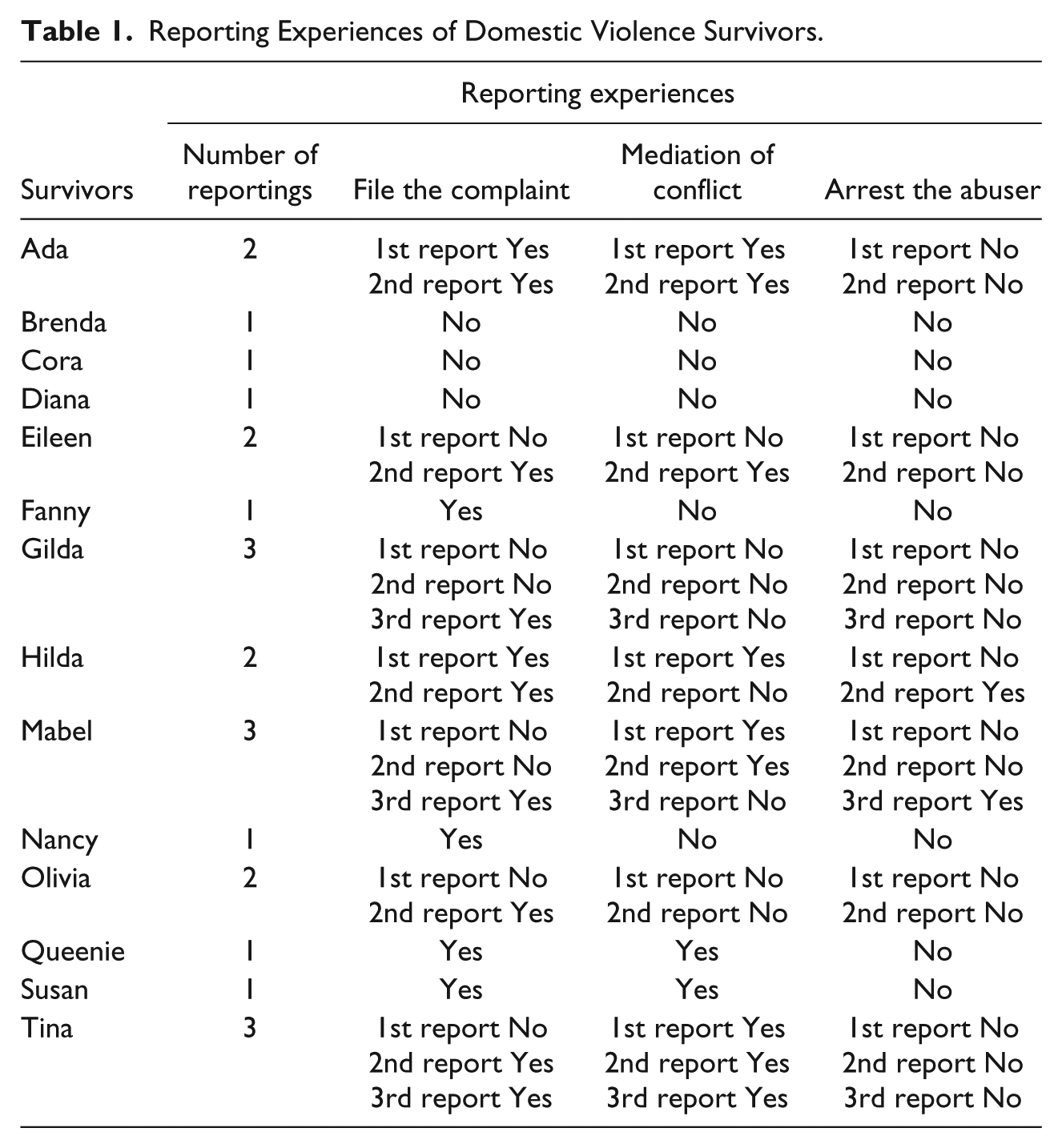
This article has no intention to evaluate the new police measures that have been put into practice after 2006; however, to highlight the different experiences of abused women in reporting before and after 2006 helps to situate the discussion in the Hong Kong context. Among the 14 women who reported to the police, 7 reported before November 2006, 5 reported after November 2006, and 2 reported before and after November 2006. Among the nine women who reported to the police before November 2006, nearly all of them found that their complaint was not taken seriously, especially in their first reporting. For some, their complaint was filed only in the second or third reporting attempt. Four survivors reported that the police attempted to mediate the relationship between them and their abusers. The arrest rate was low. Only one perpetrator was arrested, following the second reporting of a complainant. These findings indicate that respondents commonly encountered police adopting the non-intervention and mediation approaches in handling domestic violence cases.
However, the situation appeared to change slightly after the new measures were put into practice. Among the seven complaints reported after November 2006, nearly all were filed. However, intervention remained minimal. Some of the police still attempted to mediate the relationship between the abusers and victims, and three of the survivors complained about this in the study. The arrest rate was low, as expected: In only one case was the abuser arrested and charged by the police. The reporting experiences of the abused women in this study are summarized in Table 1.
Reporting Experiences of Domestic Violence Survivors.
Non-Intervention Approach
The abused women in our sample who reported domestic violence to the police before November 2006 were likely to get negative feedback. These women found that the police who handled their cases tended to overlook the seriousness of the situation, found excuses for the abusers, denied the sadistic behavior of the perpetrators, and refused to file the complaints of the victims. For example, Tina reported that she had been beaten up by her husband and that her arms were full of bruises. However, the police told her that she had received only minor injuries and refused to file her complaint. She said, [The police said] it’s not serious at all: “See, no bleeding. Maybe I can just give him a warning, but I will not file your complaint.” (Tina)
Brenda was harassed by her ex-husband after their separation. When she complained to the police, they turned her away without taking action. Brenda reported, The police officer told me that it was difficult for him to file the complaint. He said that my husband only said something that I felt was threatening, but in fact he didn’t take any action . . . At least he didn’t use a weapon. (Brenda)
Denying the seriousness of violent behavior is one of the strategies used by police to handle domestic violence, and results in little intervention.
Mediation Approach
Imposing moral pressure on victims is one of the strategies that police are likely to adopt in handling cases of domestic abuse in this study. Respondents reported that the police did not give advice on legal procedures such as suing the perpetrator; instead, they might have exerted pressure on the abused woman, persuading her not to lay charges, and tried to mediate the conflict between the couple. For example, Gilda and Mable were threatened by their husbands; however, the police proposed to mediate their conflicts, which made the women very frustrated and angry. Queenie was asked to give up charging her husband for the sake of her children. She said, The police officer gave me a call to ask if I would be filing assault charges against my husband. He asked if I would show up in court to give evidence. I couldn’t make up my mind and asked his opinion. He said, “Some people are not very kind to their husband. They show up in court with the purpose of sending their husband to jail. However, some people may drop the charge for the benefit of their children . . . Children may be stigmatized if the case is known by teachers and schoolmates. So, if you want to be cruel to him, you can go ahead and sue your husband, but if you want to forgive him, you can drop the charge—it’s your decision.” (Queenie)
As reported by the abused women in this study, the use of words such as “kind,” “cruel,” and “forgive” are the common discursive practices of police in handling domestic violence cases. These words suggest a moral judgment and have a very powerful influence on the decision of women. We found that police attitudes and roles changed little after the implementation of the new measures. The only difference was that the police became more skilful in mediating. For example, after Tina was beaten by her husband, she reported it to the police and asked them to charge her husband. The police tried to persuade her to give up the idea in an indirect way. Tina recalled, [The police] said, “If you bring charges against your husband, that means the case is very serious. We then have to keep a record of it. You therefore have to show up in the court, and the decision is the judge’s” . . . Later he turned to my child and asked him if he wanted his parents to exacerbate the case. If the parents are going to separate, he needs to decide who he wants to live with . . . After hearing the “advice” of the police, my son immediately begged me to drop the charge. (Tina)
In general, police work involves investigating allegations and gathering evidence for prosecution as well as arresting law breakers. However, police work also involves making moral judgments and expressing suspicion in cases of domestic violence. This led police to take a different role in handling such cases, for example, as a mediator or counselor, or even to persuade victims not to provide evidence. All of these practices are inconsistent with the role of police.
Arrest Approach
Findings of this study show that the policy in Hong Kong in dealing with domestic violence is not to make an arrest. In this study, only Hilda’s and Mabel’s husbands were arrested by the police. In Mabel’s case, following her first reporting, soon after Mabel was discharged from hospital, the police told her that they had closed the file and that her husband was back home. Even though she insisted that the police arrest her husband, they refused to do so. In the second reporting, Mabel received a similar response from the police, who said that they could do nothing for her. The next day, Mabel reported to the police again but that time she was accompanied by a worker from a survivors’ group. She recalled her experience: Again, the duty officer refused to take any action . . . Later, the inspector came out, a higher ranking one. He immediately recognized the staff, and then invited us to go into a reporting room, saying: “Okay, okay, I will charge him.” (Mabel: 52)
The finding shows that the police officers made an arrest because of the following reasons: first, the abuse had been reported to the police three times; second, the victims were seriously injured by their husbands; and third, social workers from a refugee center and survivors’ group had intervened in the respective case.
The abused women in this study who had reported to the police expressed deep disappointment and frustration about the performance of the police. To be fair, the police showed some improvement in handling complaints from domestic violence victims after the new guidelines were put into practice. For example, when Hilda asked for help from the police, they immediately recorded her complaint and sent her to a shelter. Ada reported to the police twice between November and December in 2006, and her case was later followed up by the “one family one team” unit.
Although we found a slight improvement in police work after November 2006, some police officers still hesitated to intervene or take further action to charge abusers. Under the new operational guidelines, police have less discretion in deciding on arrest and prosecution. If there is enough evidence to support prosecution, then police are to take prompt action to arrest and charge abusers. Why are the police still reluctant to do so? This begs the question: what is the root problem for such “reactive” or “inactive” attitudes in domestic violence situations? Is it a matter of knowledge or a matter of the trust that the police have, or do not have, in the victims? The findings from the interviews with two front-line police provide some hints in answering these questions.
The Police Experience of Handling Domestic Violence Cases
As mentioned, the new measures laid down after November 2006 has given clearer guidelines for practice and to some extent has given the police officers more confidence in law enforcement. However, the findings of this study suggest that the knowledge of the police of procedures is not the crucial factor leading to their inactive response to domestic violence situations; rather, their perception of the credibility of the victims is what matters. A research study showed that female officers are more likely to provide support to victims of domestic violence than male officers (Sun, 2007). In the present study, one female and one male police officer were interviewed. However, no explicit differences in the response between the two officers were found. In the interviews, the two police officers expressed their perceptions on the abused women who reported to the police.
Stereotyping of Victims
This study shows that the police were not entirely indifferent to the plight of abused women; however, the views of the police were paradoxical. Although they showed sympathy to these women, they suggested that most of the abused women they encountered were new immigrants, social security benefits recipients, and women with unrealistic expectations, which implied that these people were responsible for their own abuse. The two police officers discussed their impressions of abused women in the interviews: Some of them have really suffered a lot, but some of them have asked for it. Even though they are advised to leave their husband, they are too caught up in the relationship. (Patrol officer) The women who come from mainland China have expected too much from their life in Hong Kong. They may think that they can live in a one-thousand-square-foot flat, but as a matter of fact, they can only live in a very small housing unit. Life in Hong Kong is totally different from what they expected. (Sergeant)
Cynical Interpretation of Women’s Motivation in Reporting Abuse
The officers also expressed distrust of the abused women, especially those who came from mainland China. They were cynical about the women’s motivation in asking for help from the police.
After moving from the Mainland to Hong Kong, they [the abused women] don’t fulfill the wife’s duty, taking care of their old husband . . . Instead, they ask if there is any possibility to get a separate tenantship if they report to the police. That is the reason behind the frequent reporting to the police. They intend to use this track record to ask for a bigger house or be relocated to another housing unit. (Sergeant) I asked some women if they have too great a burden (having children), but they said to me that this is the only way that they can get social security benefits. (Patrol officer)
Disbelief That the Problem Is Solvable
The two police officers shared the view that domestic violence was a very complicated and tedious issue, and that their intervention was simply a waste of public money and does little to solve the problem. Their views echo the findings of Sherman and Berk (1983) that some police believe that offenders will not be punished by the courts and that the problems are basically unsolvable.
If you allow so many mainland people to come here, those people have very low earning ability . . . Even if you spend resources on those people, there won’t be much change. I think it is useless. (Patrol officer) I think that this is a very common issue. If I charge the husband, that will waste our time . . . [and] public money if it has to go through the courts. (Sergeant)
Too often, frontline police view fighting and quarrelling between couples as family business and therefore trivial. The two police officers thought that dealing with such minor family disputes was not their job, and pointless. The sergeant complained: I’d rather handle robbery cases. That is our mission and duty. (Sergeant)
Theorizing the Police Response to Domestic Violence
Lies and truths are relative, and constructions of knowledge. Postmodernists argue that there is no such thing as “objective reality,” or seeing something as it really is, because human “knowing” is shaped by cultural, societal, and psychic forces (Den Bergh, 1995; Williams, 1996). The findings of this research suggest that there is no single factor underlying the police response to women complainants. A combination of factors directs police interaction with abused women in a particular social context, which tends to reproduce existing power and gender relations. As Weber and Carter (2003) argued, trust is an interactional process embedded in a social and power structure. A woman’s word is not trusted not only because of the way she speaks or what she says but also as a result of the interaction of social factors such as the police occupational culture, traditional family values, and the discourse of welfare dependency.
Police Occupational Culture
The police–complainant relationship is paradoxical. The police are part of the legal system, and are concerned with evidence and practical realities and considerations. They are suspicious by training. A police investigation requires that certain procedures be adhered to, and demands clarity and consistency of those giving evidence. Jordan (2004) notes that a police investigation includes evidential concerns and legal considerations that together produce “a suspicious, evidence and offender-oriented mindset” (p. 243). At the same time, women are traditionally believed to be untrustworthy, vengeful, and deceitful, whereas men are believed to be rational, logical, and reasonable. Such beliefs are shaped by a social environment characterized by gender stereotyping of women. Scutt (1997) argues that men’s credibility depends on the continued perception of women’s lack of credibility. The police occupational culture coupled with gender bias against women leads police to be skeptical of women’s complaints. For example, the patrol officer in this study asked why women did not leave abusive relationships. To stay in an abusive relationship seemed irrational to him, and he came to the conclusion that the women “asked for it [the abuse].” These myths facilitate the making of individual judgments that are often based on stereotypes. The belief that women are untrustworthy provides the police with a rationale for non-intervention.
Traditional Family Values
The police force is a male-dominated organization that not only maintains social order but also enforces the dominant culture of the society. In the history of patriarchy, the police as part of the criminal justice system continue to play a role in regulating sexual relations and maintaining men’s social dominance. Hatty (1989) points out that the police conceptualize any departures from the accepted standards of mothering and housekeeping as contributory factors toward violence.
In a Chinese society such as Hong Kong, some men are still reluctant to get a divorce because doing so could damage their patriarchal identity, and some women refuse to divorce their husbands because they believe that a “complete” family is always better than a “broken” one (Wong, 2004). Influenced by culture, the police take such “truths” for granted. The sergeant suggested in the interview that the responsibilities of a dutiful wife include taking on the role of carer in the family. Abused women accusing their husbands of wrongdoing challenges gender roles and relations within the family. It is not surprising that police officers are reluctant to take action, given that they play a role in maintaining patriarchal family values. Once a woman breaks the “rule of silence,” she risks being blamed for what happened or disbelieved (Jordan, 2004; Taslitz, 1999).
Welfare Dependency Discourse
According to the 2006 census data (Census and Statistics Department, 2006, p. 6), because of the influx into Hong Kong of large numbers of women from mainland China in recent years, the proportion of new immigrant lone mothers (those having resided in Hong Kong for less than 7 years) has increased rapidly since 1996, from 5.4% to 10.2%. Research shows that these mothers face more problems and have fewer resources to solve those problems (K. W. Chan & Chan, 2006; Leung, 1998).
Lone mothers are portrayed by the mass media not only as a social problem but also as defrauding the system. For examples, a study revealed that Ming Pao, one of the popular newspapers in Hong Kong, used a whole page to explore lone parent social security benefit fraud. It was reported that a number of couples divorce simply to claim more benefits from the Comprehensive Social Security Assistance (CSSA) Scheme (K. W. Chan & Chan, 2006). The discourse of welfare dependency perpetuates the belief that lone mothers lie, especially those who had emigrated from mainland China. With the benefit fraud discourse circulating in the society, it is not surprising that the police were suspicious of the women who reported that they are being abused by their husbands. According to the two police officers, the new immigrant women were a “burden on society” with “low earning ability,” and “unreliable.” These stereotypes of immigrant women reinforce the belief that some immigrant women make frequent reports simply to gain access to public housing or social security benefits. The present study shows that gender and ethnicity are the two interlocking factors that influence police response in domestic violence issues. Edwards (1989) states that the decisions of individual officers in cases of domestic assault are affected by class and race stereotypes of the victims and offenders, and police may be less willing to protect women whom they perceive as precipitative and less deserving.
Conclusion
The interviews in this study reveal that police responses in handling domestic violence cases impact the experiences of survivors regarding such violence. Survivors, particularly those newly emigrated from mainland China, reported that they felt helpless and discriminated during the reporting processes. An ineffective police response causes prolonged suffering, threats, and isolation to domestic violence survivors.
Findings of this study show that the police in Hong Kong are reluctant to respond to domestic violence cases. They are likely to adopt a non-intervention or mediation approach rather than the arrest approach because of their distrust of abused women. This study also reveals three common reactions of police to domestic violence situations: (1) stereotyping of the victims, (2) cynical interpretation of the women’s motivation in reporting abuse, and (3) disbelief that the problem is solvable. These reactions, however, are socially constructed that linked to the embedded values and beliefs held by police on domestic violence issues. The perceived credibility of the victims and the nature of the domestic violence, not the knowledge of the police in handling procedures, lead to the inactive response of police concerning domestic violence situations. Policing domestic violence is basically a trust issue that stems from the dominant patriarchy ideology. The belief that a woman’s word is not to be trusted has a silencing effect on domestic violence victims.
In this article, I make no attempt to suggest that the arrest of perpetrators is an effective strategy to end violence against women. It is only a temporary measure to stop violent acts and just one part of a broader criminal justice response. A more effective intervention strategy might include prosecution, probation, comprehensive services for victims, and coordinated community services (Bowman, 1992; Gondolf, 2002). Stanko (1989) states, “Police action cannot by itself stem the tide of violence against women. It can, however, stop perpetuating and reproducing it” (p. 67). To increase the effectiveness of policing domestic violence, it is important to challenge the male-dominated police culture and patriarchal family values, and at the same time to emphasize that the use of violence against women is a violation of basic human rights (Gregory & Lees, 1999). All these problems reflect a need for the training of police officers not only in assessment techniques but also in holistic thinking across several issues such as gender, ethnicity, and human rights in law enforcement processes.
The limitations of this study are also evident in most qualitative studies. The discussion in this paper relies on small samples, which produce non-generalizable results. Furthermore, research data on policing domestic violence in Hong Kong after 2006 are very limited. A full examination of the effectiveness of new police measures in handling domestic violence cases after 2006 will facilitate a more reliable and valid knowledge base for assessment and intervention in the future.
Footnotes
Declaration of Conflicting Interests
The author(s) declared no potential conflicts of interest with respect to the research, authorship, and/or publication of this article.
Funding
The author(s) disclosed receipt of the following financial support for the research, authorship, and/or publication of this article: The research was substantially supported by grants from the Central Policy Unit of the Government of the Hong Kong Special Administrative Region and the Research Grants Council of the Hong Kong Special Administrative Region (Project No. CityU 1003-PPR-2) and partially supported by a top-up grant from the City University of Hong Kong.