







Abstract
This study has examined the effects that young adults’ experience of dating-violence victimization can have on their manifestation of posttraumatic stress disorder (PTSD) symptoms. This study has also examined the possible roles that cultural beliefs can play in dating-violence experience, coping choices, and PTSD symptoms. This study has used self-reporting measures to collect data from a nationally stratified random sample of 1,018 college students in Taiwan. Results demonstrate that college students who had experienced dating-violence victimization reported higher levels of PTSD symptoms than those who had not. The results reveal that psychological-violence victimization and cultural beliefs have direct and indirect effects on PTSD symptoms via the mediation of young adults’ use of emotion-focused coping strategies. Greater frequencies of psychological-violence victimization were associated with a greater use of emotion-focused coping, which was in turn associated with increases in PTSD symptoms. This study illustrates that traditional Chinese beliefs have played significant roles in exacerbating the risk for dating violence and PTSD, and in shaping victims’ coping choices with dating violence.
Keywords
Introduction
Dating violence 1 in Taiwan remains a rarely discussed yet pervasive problem. Recent national studies conducted in Taiwan have shown that between approximately 58% and 66% of college students had experienced some form of dating violence, including physical, psychological, and sexual violence (Hsiu & Sun, 2003). Another national study using a sample of 2,178 college students showed that 24.7% of these respondents had experienced sexual abuse (ranging from obscene language to unwanted intercourse; Chen, 1996). In a ranking of 32 countries regarding college students’ physical-assault rates toward their dating partners (Straus, 2007), Taiwan ranked Number 6 (35.8%; median = 29.8%), signaling the relatively high prevalence of dating violence in Taiwan.
The prevalence, predictors, and consequences of physical-dating violence have been well-documented in Western research ever since the first pioneering study of Makepeace in 1981 (Lewis & Fremouw, 2001). Researchers have documented that physical and sexual dating-violence victimization is damaging to the victims’ physical, mental, and sexual health and social functioning (e.g., Banyard & Cross, 2008; Lewis & Fremouw, 2001; Silverman, Raj, Mucci, Lorelei, & Hathaway, 2001; Wolitzky-Taylor et al., 2008). Posttraumatic stress disorder (PTSD) is one of the most prevalent and documented mental-health consequences of intimate partner violence 2 (IPV) in the West (Chan, Tiwari, Fong, & Ho, 2010). Literature has measured the mean prevalence of PTSD at 63.8% in battered-women populations, compared with lifetime-prevalence estimates of 1.3% to 12.3% for general populations of women (Golding, 1999). PTSD is a psychiatric condition that can follow one’s experience of a traumatic incident, and the condition’s symptoms tend to cluster on three dimensions: persistent reexperiencing of the trauma, persistent avoidance of stimuli associated with the trauma, and persistent increased arousal (American Psychiatric Association, 1994). Levels of PTSD symptoms have been associated with characteristics of IPV (e.g., the extent, severity, and the number of types of violence) and with how victims—whether adolescents or adults—handle IPV (Dutton, 2009; Jones, Hughes, & Unterstaller, 2001). When experienced singly or in combination with one another, all types of IPV (e.g., physical, psychological, and sexual violence) have been found to be associated with PTSD (Basile, Arias, Desai, & Thompson, 2004). Some studies have demonstrated that psychological abuse has at least as strong a relationship to PTSD as physical abuse does among help-seeking women (Arias & Pape, 1999; Mechanic, Weaver, & Resick, 2008).
Previous studies have suggested that the effects of IPV on women’s psychological distress are entirely direct or indirect, via the mediating variables of passive coping strategies among help-seeking women (Lee, Pomeroy, & Bohman, 2007). Coping strategies refer to cognitive and behavioral efforts used to manage internal or external stressors that exceed one’s existing resources (Lazarus & Folkman, 1984). Coping is a predictor of PTSD symptoms and a mediator between IPV and PTSD symptoms. Greater use of emotion-focused coping strategies (i.e., so-called avoidant or passive coping) has been found to predict greater PTSD symptoms among help-seeking women (Arias & Pape, 1999; Krause, Kaltman, Goodman, & Dutton, 2008). Research has also indicated that increasing frequency of violence is associated with a greater use of avoidant coping, which is associated with a greater severity of PTSD symptoms among help-seeking women (Lee et al., 2007).
Although PTSD is extensively documented in Western literature, the experience of Asian populations has been understudied (Chan et al., 2010). Few studies have demonstrated a link between PTSD and IPV among Chinese women, and these studies have used convenience or small samples (Chan et al., 2010). No research has been conducted in Chinese societies regarding coping and PTSD among dating-violence victims from the cultural-belief perspective. Cultural beliefs may influence IPV victims’ perceptions and interpretations of trauma, symptom expression, and coping choices (Chan et al., 2010; Yick, Shibusawa, & Agbayani-Siewert, 2003). For example, a qualitative study of 11 battered women in Hong Kong revealed that the battered women had used fate as an explanation for their failed relationships and endurance as a coping mechanism (Tiwari, Wong, & Ip, 2001). Traditional Chinese cultural beliefs rooted in rigid gender norms, such as obedience, collective interest, and self-reliance, may deter dating-violence victims from seeking help (Shen, 2011). A prior study conducted in Taiwan, Hong Kong, and Shanghai disclosed that traditional gender-role beliefs could influence male adolescents’ attitudes justifying boy-on-girl violence and actual violent behaviors in their intimate relationships (Shen, Chin, & Gao, 2012). In general, understanding dating violence and PTSD from the cultural-belief perspective can facilitate important developments in interventions for dating-violence victims in culturally diverse populations. The aim of the current study is thus to fill this knowledge gap by using a nationally representative sample to examine potential pathways linking cultural beliefs, dating violence, coping strategies, and PTSD symptoms. Specifically, this study has tested three research hypotheses based on previous studies:
Method
The research design of this study is cross-sectional and correlational. The National Science Council of Taiwan approved and funded this research.
Research Participants
This study used self-reporting measures to collect data from a national stratified sample of 1,018 college students with dating experiences in Taiwan. The pilot study was conducted in the winter of 2007 with 129 college students in three different college departments, and the formal data collection was conducted from May to June 2007. The formal random sample was first stratified by universities, second stratified by colleges, and third stratified by departments. This study randomly selected 43 departments across the nation to recruit students and obtained informed consent from departmental directors, course instructors, and students. A total of 28 departments in 19 universities agreed to participate in this study, while 15 departments refused to participate. The departmental participation rate was 65.1%. A total of 1,456 students in participating departments were contacted, and, of these students, 1,141 completed the questionnaire. The individual participation rate was around 78.4%. Of the 1,141 questionnaires, 123 were invalid and excluded from the analyses (owing mostly to these students’ lack of dating experience), so that the valid sample size was 1,018.
The analytical sample consisted of 416 unmarried males (40.9%) and 602 unmarried females (59.1%). The mean age of the participants was 21 years with a range between 16 and 30 years (SD = 1.7). Participants had diverse college majors, including business (32.5%), the humanities (18.4%), the social sciences (10.8%), engineering (10.3%), arts and design (10.3%), technology (5.1%), and others (e.g., medicine, education, the natural sciences). Of all the participants, 62% were currently in a dating relationship that had lasted for more than 1 month, whereas the remaining 38% had had dating experiences for more than 1 month at some point in the past but not currently. The mean age at which the students had begun dating was 18 years. The average length of the intimate relationships was 17 months.
Data-Collection Procedure
Department directors, students, and required class instructors targeted for data collection gave informed consent regarding participation in this study, and the scheduled date and class for data collection were advertised in advance. Trained research assistants explained the research purpose and procedures to students, emphasizing the voluntary and anonymous nature of the study prior to group questionnaire administration. Research assistants also informed students of their rights to refuse or discontinue participation at any time. Self-reporting questionnaires were then distributed and data were collected from consenting students via the paper-and-pen method in group sessions scheduled for periods during or outside regular class hours (depending on instructors’ preferences). Questionnaire administration ranged from 15 to 40 min in length. Participants were compensated for their time with a gift (a highlighter with “post-it” labels).
Measures
Measures included in the questionnaires provided information about demographics and family background, experiences with dating violence, the Chinese Traditional Beliefs Scale, the Coping Strategies Scale, and the Posttraumatic Stress Response Index. The questionnaire contained other scales that were not analyzed in this paper.
Before the pilot study got underway, the questionnaire was sent to three Taiwanese clinical experts and scholars in the IPV field so that they could examine the scales’ content validity and cultural relevance. Some scale items were modified or added according to experts’ and scholars’ suggestions. After the pilot study, some measures were modified again on the basis of internal consistency reliability and factor analysis results from the pilot study. Psychometrics of these measures was examined again after formal data were collected.
Dating Violence Scale
The Dating Violence Scale was developed by the Shen, Chiu, & Gao (2012) on the basis of related instruments (Huang & Wang, 2005; O’Keefe, 1998; Straus, 1979; Straus, Hamby, Boney-McCoy, & Sugarman, 1996). It contains 35 pairs of items measuring perpetration and victimization relative to three subscales: the physical-violence subscale (11 items), the psychological-violence subscale (18 items), and the sexual-violence subscale (6 items). Examples of items are “My partner scared me on purpose” (psychological violence), “My partner kicked, bit, or hit me with a fist” (physical violence), and “My partner used threats to make me have sex” (sexual violence).
Participants used a 7-point Likert scale (from 0 = never to 6 = 20 times or more) to rate the frequency with which they experienced each violent act, either as a perpetrator or as a victim with their current or previous dating partner at some point in the preceding year. Participants were categorized as experiencing dating violence if they had reported that either they themselves or their partners had used one or more violent acts against the other on one or more occasions while they were dating. The Cronbach’s alpha of the total scale for the current sample is .89 for perpetration and victimization items, showing good internal consistency reliability. In a previous study, the author applied the Dating Violence Scale (short version; 30 items) to 3,138 Chinese adolescents, and the scale exhibited good internal consistency reliability (Cronbach’s alpha = .82 for perpetration items and .81 for victimization items; Shen, Chin, & Gao, 2012).
In addition to identifying the occurrence of dating violence, this study focuses on the frequency of violence. This study has calculated the three subscales’ mean scores by adding the midpoints of each participant’s responses in the scales’ response categories and then by dividing this sum by the number of items in each subscale. The subscale mean scores were used in statistical analyses and represent the average number of incidents of violent acts experienced by a participant (either as a perpetrator or a victim) for the past year. The midpoints are the same as the response-category numbers for Categories 0, 1, and 2. For Category 3 (3-5 times), the midpoint is 4; for Category 4 (6-10 times), it is 8; for Category 5 (11-20 times), it is 15; and for Category 6 (more than 20 times), it is 25 (as suggested by Straus et al., 1996).
Coping Strategies Scale
The Coping Strategies Scale was developed by the author on the basis of previous studies (Shen, 2011; Goodman, Dutton, Weinfurt, & Cook, 2003; Yoshihama, 2002). Items were generated from two sources: (a) a review of the literature on coping strategies in intimate violent relationships and (b) in-depth interviews with dating-violence victims in Taiwan. Drawing on these sources of information, the author developed a list of 20 items. The participant who had experienced dating violence as a victim was asked to identify which, if any, of the 20 specific coping strategies he or she had used in dealing with the violence perpetrated by a current or previous partner (yes or no questions). On the basis of the principal component analyses, those 20 items were grouped into five factors that explained 52.1% of the total variance and were named by the author as the problem-focused factor (4 items), the emotion-focused factor (7 items), the safety-planning factor (4 items), the formal-help-seeking factor (3 items), and the informal-help-seeking factor (2 items).
To calculate the “percentage scores” of participants’ coping-strategy responses, the author divided the total number of “yes” responses in each set of coping-strategy items by the set’s total number of items. For example, if a participant reported “yes” to four of the seven emotion-focused coping-strategy sets, the percentage score of this type of coping strategy would be 57%. Higher percentage scores reflect greater use of a specific type of coping strategy.
Posttraumatic Stress Response Index (PTSRI)
This study used the 47-item PTSRI to measure participants’ trauma-related symptoms during the past month (Chen, Hung, Lin, & Tseng, 2002). The PTSRI consists of four factors: the posttraumatic anxiety syndrome factor (hyperarousal/intrusion and helplessness/rumination), the posttraumatic psychosomatic syndrome factor, the avoidance/numbness factor, and the maladaptive coping factor. Participants were instructed to recall the most severe violent conflicts with intimate partners and then to use a 4-point Likert scale (from 0 = none of the time to 3 = most of the time) to rate each symptom/item during the past month. Sample questions for each factor are “Upsetting thoughts of what happened come into my mind repeatedly” (intrusion), “I feel fatigued easily” (psychosomatic syndrome), and “I try to avoid some thoughts” (avoidance). The PTSRI’s total score is the combination of all 42 items. The author did not include five items from the maladaptive coping factor in the total score because some of those five items (e.g., using drugs) were similar to the Coping Strategies Scale items. Higher scores reflect greater posttraumatic-symptom severity. The PTSRI’s total score demonstrates strong internal consistency reliability in the current study (Cronbach’s alpha = .97). Researchers have applied the PTSRI to adult earthquake survivors in Taiwan, and the index has exhibited good internal consistency reliability (Cronbach’s alpha = .96; S. H. Chen et al., 2002).
Chinese Traditional Beliefs Scale
The current study used the Chinese Traditional Beliefs Scale (Yang & Wang, 1994) to assess the degree of participants’ identification with Chinese traditional beliefs. The original scale contains 36 items in six factors. The current study’s version of the scale uses only 12 items in two factors (Fate and Gender Role) relating to the research purposes herein. Sample questions about fate and gender roles are “Many things in life are determined by fate. If it is meant to happen, it will happen” and “A woman’s career is in her family. Married women should not work outside the home.” Responses were categorized on the basis of a 5-point scale (from 1 = strongly disagree to 5 = strongly agree). The scale’s total score is the combination of all 12 items. Higher scores reflect a higher degree of Chinese traditional belief identification in fatalism and traditional gender roles. The internal consistency reliability of the total scale in the current study was good (Cronbach’s alpha = .79). The Chinese Traditional Beliefs Scale was used in another study involving a sample of Taiwanese college students and has shown good internal consistency reliability (Cronbach’s alpha = .73; Shen, 2009).
Control measures
Previous studies have shown that female gender and childhood-trauma history are significant predictors of PTSD symptoms (Shen, 2009; Coker, Weston, Creson, Justice, & Blakeney, 2005). Therefore, three additional covariates were used as control variables in the current study’s hierarchical regression analyses: sex (1 = males; 2 = females), childhood-physical-maltreatment experience (two items), and childhood-exposure-to-family-violence experience (two items). Two items for measuring childhood-physical-maltreatment experiences were “Before I was 12 years old, I was spanked on my bottom or hit by my parents very often” and “When I was an adolescent, I was beaten up by my parents.” Item responses were categorized on the basis of a 4-point Likert scale (1 = strongly disagree; 4 = strongly agree). The total score of the childhood-physical-maltreatment variable is the combination of these two items’ responses. Two items for measuring childhood-exposure-to-family-violence experiences were “When I was a child, I saw my parents hit or kick each other” and “When I was a child, I saw an adult (not my parents) push, shove, slap, or throw something at someone in my family.” Item responses were categorized on the basis of a 4-point Likert scale (1 = strongly disagree; 4 = strongly agree). The total score of the childhood-exposure-to-family-violence variable is the combination of these two items’ responses.
Statistical Analyses
This study conducted hierarchical multiple regression and path analyses to examine the relationships between cultural beliefs, dating-violence victimization, coping, and PTSD. The dependent variable for multivariate analyses was PTSD symptoms. First, hierarchical regression analyses served to clarify the relative importance of each independent variable in PTSD-symptom prediction. Second, the hierarchical regression findings served as the basis for path analyses testing the hypotheses regarding possible significant pathways. Direct and indirect effects of the significant independent variables on the dependent variable were calculated in path analyses. A direct effect is the regression weight (beta) of an independent variable on a dependent variable. An indirect effect is given by the product of the respective path coefficients.
To analyze data, this study used the SPSS 16.0.1 for Windows software. Using the pair-wise method, this software excluded some cases from the data analyses when missing values existed in certain variables, resulting in different total case numbers in different statistical analyses. For hierarchical regression analyses, variance inflation factors (VIFs) were examined. For most variables in the current study, the VIFs did not exceed 1.5, indicating that multicollinearity is not a problem between the independent variables. The VIFs of psychological violence and physical violence are, both, 1.9 in the regression model.
Results
Prevalence of Dating Violence
Research results show that 59% (n = 601) of the participating Taiwanese college students with dating experience had experienced some form of dating-violence victimization (59.9% for males; 58.2% for females). Broken down into subcategories, this violence was physical (18.6%), psychological (55.5%), and sexual (7.6%). Of the participants who had experienced dating-violence victimization (n = 601), 64% had experienced only one type of dating-violence victimization, 27% had experienced two types, and 9% had experienced all three types (i.e., physical, psychological, and sexual violence). Of all the participating college students, 62.4% admitted to having been responsible for dating-violence perpetration (60.1% for males; 63.7% for females), and of these individuals, 24.3% admitted to physical violence, 60.6% admitted to psychological violence, and 6.7% admitted to sexual violence.
Types of Coping Strategies Used
College students in this study had used a wide range of coping strategies to deal with dating-violence victimization, and these students often used multiple strategies. The average mean of coping strategies used was 5.6. The most common strategies reported by the participants were (Table 1) confronting the partner (69.4%), focusing on positive aspects of a partner or a relationship (55.9%), seeking help from friends (45.9%), enduring (40.8%), and breaking up with the partner (36.6%). The least-used coping strategies were seeking help from professionals (2.8%), seeking help from the police or the legal system (3%), seeking help from teachers or school counselors (5.2%), and using alcohol or drugs (6.5%). Research results show that the participating college students were more likely to rely on themselves or friends when dealing with dating violence, and less likely to seek formal help.
Factor Validity of Coping Strategies Scale (n = 601).
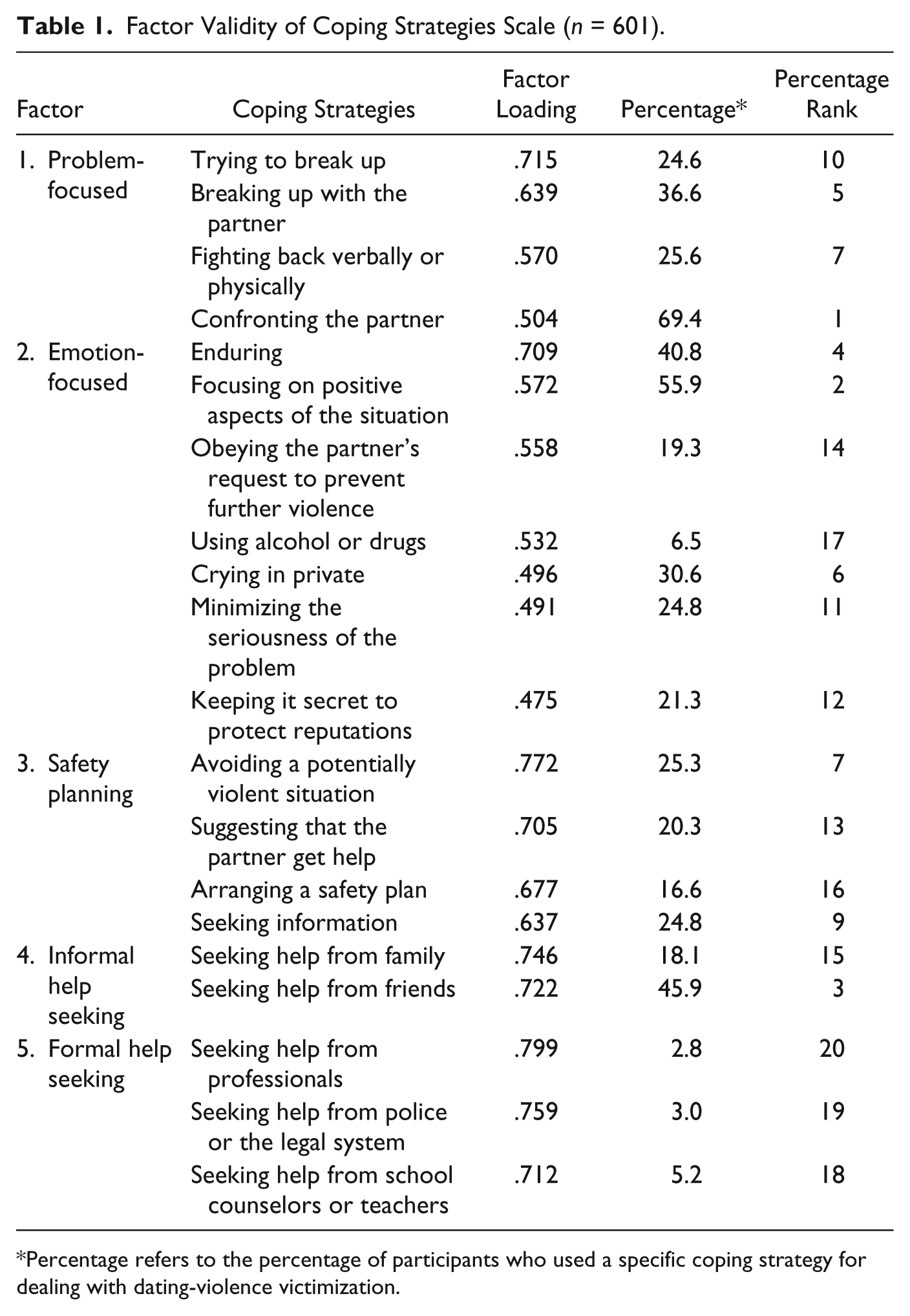
Percentage refers to the percentage of participants who used a specific coping strategy for dealing with dating-violence victimization.
Dating Violence and PTSD
This study conducted an independent sample t-test to examine whether participants who had experienced dating-violence victimization reported higher levels of PTSD symptoms. Results show that participants who had experienced dating-violence victimization reported higher scores of PTSD symptoms than those who had not experienced dating-violence victimization (m = 32.6 vs. 21.9; t = 6.5, df = 893, p = .000).
Predictors of PTSD
Before testing the regression model, this study conducted initial Pearson’s correlation analyses to examine the interplay of Chinese traditional beliefs, dating-violence victimization, ways of coping, PTSD symptoms, and covariates (Table 2). Results show that PTSD symptoms were associated with Chinese traditional beliefs, psychological- and physical-violence victimization (sexual violence was nonsignificant), the number of types of violence experienced, coping strategies (except the seeking-formal-help category), and covariates (gender and childhood-violence experiences).
Correlations Among PTSD, Cultural Beliefs, Dating Violence, and Coping (n = 1018).
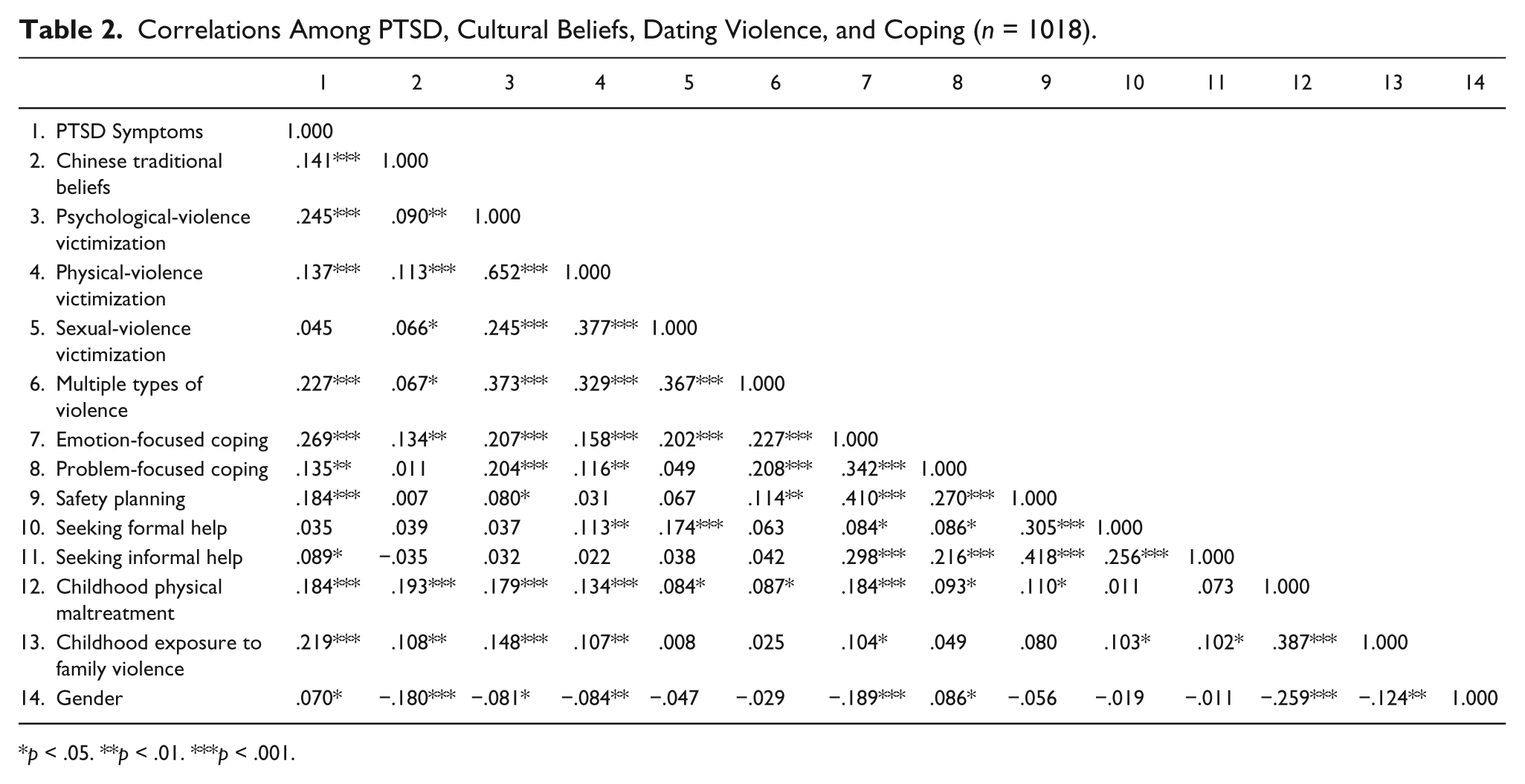
p < .05. **p < .01. ***p < .001.
The hierarchical multiple regression analyses examined whether violence victimization, coping strategies, and cultural beliefs were significant contributors to PTSD symptoms (M = 27; SD = 25), after covariates were controlled for (Table 3). Control variables were entered into the regression model as the first step (i.e., Model 1). Violence-victimization variables (i.e., psychological, physical, and sexual violence) and the number of types of violence experienced were entered as the second step (Model 2). Coping-strategies variables (i.e., problem-solving focused, emotion focused, safety planning, formal help seeking, and informal help seeking) were entered as the third step (Model 3). Chinese traditional beliefs were entered as the fourth step (Model 4).
Results of Hierarchical Multiple Regressions in Predicting PTSD Symptoms (n = 1018).
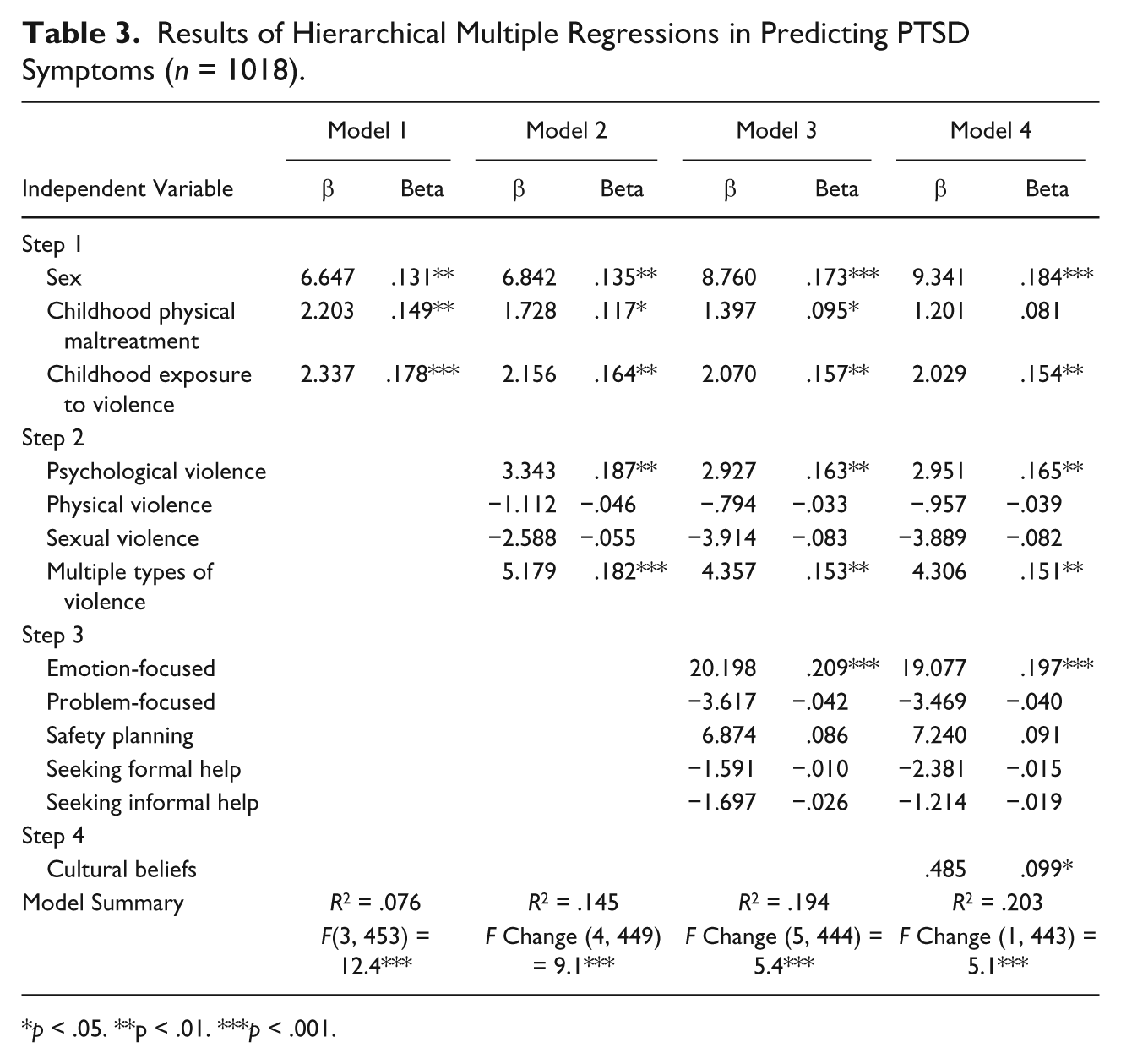
p < .05. **p < .01. ***p < .001.
The results show that PTSD symptoms were significantly associated with the frequency of psychological-violence victimization and with the number of types of violence experienced, after covariates were controlled for (Model 2). Participants who experienced more psychological victimization and more types of dating violence reported higher levels of PTSD symptoms. PTSD symptoms were not associated with physical- or sexual-violence victimization in the multivariate model at the .05 level. Therefore, Hypothesis 1 was partially supported, showing that there was a significant relationship between the PTSD symptoms and the psychological-violence victimization experiences.
Because psychological violence was correlated with physical and sexual violence in the bivariate model (r = .652 and r = .245, respectively; Table 2), this study conducted further hierarchical regression analysis to examine the unique contribution of psychological violence to the prediction of PTSD symptoms. This study entered the two variables of physical and sexual violence into the model as the first step and, then, entered the variable of psychological violence into the model as the second step. Results indicate that psychological-violence victimization contributed uniquely to the prediction of PSTD symptoms, after physical- and sexual-violence victimization were controlled for, R2 change = .04, F Change (1, 967) = 43.6, p < .001.
The results also show that coping strategies had a significant effect on PTSD symptoms, after violence variables and covariates were controlled for (Model 3). The use of emotion-focused coping strategies was a significant predictor of PTSD symptoms. In other words, the more emotion-focused coping strategies participants used, the more likely these participants were to report PTSD symptoms. Other types of coping strategies (i.e., problem-focused, safety planning, and formal and informal help seeking) were not significantly associated with PTSD symptoms at the .05 level. Therefore, Hypothesis 2 was partially supported, showing that there was a significant relationship between the PTSD symptoms and the use of emotion-focused coping strategies.
Chinese traditional beliefs contributed significantly to PTSD symptoms over and above violence variables, coping variables, and covariates, Model 4: F Change (1, 443) = 5.1, p < .001. Higher levels of identification with Chinese traditional beliefs increased PTSD symptoms. The fourth model was significant, revealing that Chinese traditional beliefs and other variables together predicted a 20.3% variance in PTSD symptoms, R2 = .203, F(13, 443) = 8.7, p < .001. Among the covariates, female gender and childhood exposure to family violence were predictors of PTSD symptoms.
Path Analyses
Using the multiple regression findings of significant predictors of PTSD symptoms, this study conducted path analyses to further test the possible paths among Chinese traditional beliefs, psychological-violence victimization, emotion-focused coping strategies, and PTSD symptoms. Path analyses (Figure 1) reveal that cultural beliefs had significant direct and indirect effects on PTSD symptoms (total effect = .165). Chinese traditional beliefs were positively associated with the use of emotion-focused coping strategies, which was in turn associated with increased PTSD symptoms. Another significant path is that Chinese traditional beliefs predicted psychological-violence victimization, which was in turn positively associated with emotion-focused coping strategies and PTSD symptoms. Path-analysis results support the hypothesis that cultural beliefs influence PTSD symptoms through the mediation of psychological violence and emotion-focused coping strategies.
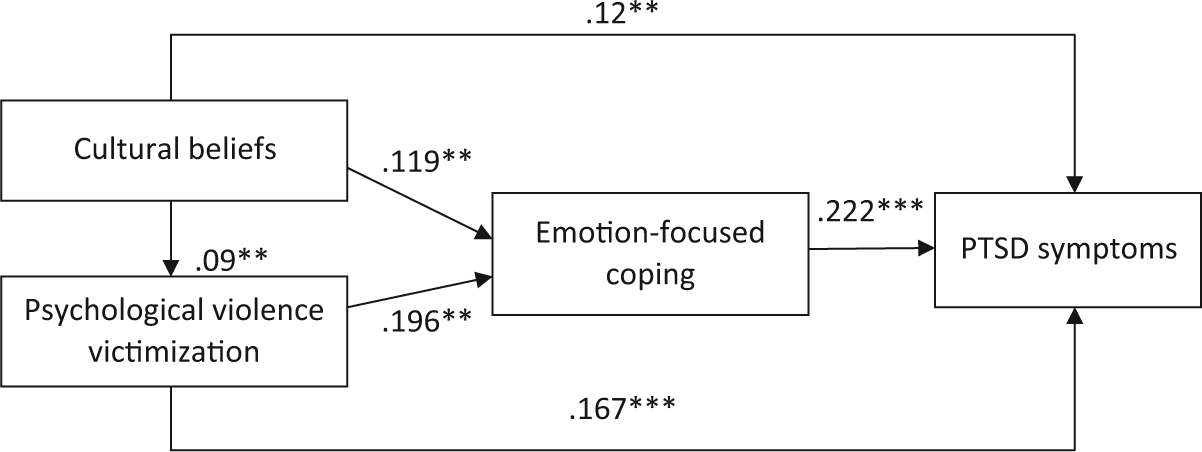
Path analyses: Indirect effects of cultural beliefs on PTSD symptoms.
Psychological-violence victimization also had significant direct and indirect effects on PTSD symptoms (total effect = .211). Emotion-focused coping strategies mediated the relationship between psychological-violence victimization and PTSD symptoms.
Discussion
This study’s findings demonstrate that cultural beliefs, psychological-violence victimization, the number of types of violence experienced, and emotion-focused coping strategies were significant predictors of PTSD symptoms, after gender and childhood-violence experiences were controlled for. College students who subscribed to Chinese traditional beliefs, who experienced elevated levels of psychological-violence victimization, who experienced multiple types of violence, and who used elevated levels of emotion-focused coping strategies reported higher levels of PTSD symptoms. Moreover, college students who had experienced dating-violence victimization reported higher levels of PTSD symptoms than those who had not.
This study’s findings reveal that cultural beliefs and psychological-violence victimization had significant direct and indirect effects on participating college students’ PTSD symptoms via the mediation of the college students’ use of emotion-focused coping strategies. In terms of the direct effect of psychological-violence victimization on PTSD symptoms, this study shows that the most prevalent type of dating violence experienced by the participating Taiwanese college students was psychological violence (victimization: 55.5%; perpetration: 60.6%). In the same vein, the current study suggests that psychological-violence victimization was a significant predictor of PSTD symptoms over and above physical- and sexual-violence victimization. This study demonstrates the severe effects that psychological aggression can have on its victims’ mental health, suggesting that psychological victimization is more damaging than physical victimization in community couples. Previous studies found evidence that psychological violence can cause intense fear, guilt, and damage to self-esteem, all of which can have longer-lasting effects than physical injury (Midlarsky, Venkataramani-Kothari, & Plante, 2006). This finding corroborates prior research showing the significant and unique effects of psychological-violence victimization on PTSD symptoms (Basile et al., 2004; Mechanic et al., 2008). As to indirect effects, path analyses in the current study show that the more psychological-violence victimization the participating college students experienced the more likely they were to use emotion-focused coping strategies, a phenomenon that seemed to lead, in turn, to increased levels of PTSD symptoms among these victims. These findings are consistent with previous research findings indicating that coping mediates the effects of IPV on victims’ psychological health (Lee et al., 2007). To date, relatively little is known about how psychological-violence victimization influences young adults’ coping efforts. Qualitative studies conducted in Taiwan with female young adults have uncovered evidence that female victims choose to endure violence because they interpret psychological violence (e.g., controlling behaviors) as a sign of care and love, or they do not recognize psychological violence as a type of dating violence, or a partner threatens them not to tell anyone else (Shen, 2011; Yang & Chao, 2011). A national quantitative study conducted in Taiwan with college students (n = 666) found that 49% of participating college students with dating experiences did not consider partners’ controlling and stalking behaviors to be violent behaviors (Keng, 2011). Interpreting the violence to be less negative than it actually is (i.e., downplaying the violence) may make stopping the violence seem less urgent to victims, thus rendering these victims more likely to endure additional psychological violence, which further weakens the victims’ ability to leave (Arriaga & Capezza, 2005).
In contrast to some prior research (e.g., Basile et al., 2004), physical- and sexual-violence victimization were not predictive of PTSD symptoms in the current study. In correlation analyses herein, physical-violence victimization was significantly correlated with PTSD symptoms. However, in the regression analyses, physical-violence victimization became a nonsignificant predictor, probably because other variables (e.g., psychological violence) were greater predictors of PTSD symptoms than physical-violence victimization. Previous studies also found evidence suggesting that physical violence becomes a nonsignificant predictor of PTSD symptoms when psychological violence is entered into multivariate predictions (Arias & Pape, 1999; Mechanic et al., 2008). Future studies need to clarify the relationship between all types of dating violence and PTSD symptoms. It is worth noting that victims’ efforts to seek formal help were significantly associated with physical-violence victimization (r = .113, p = .005) and sexual-violence victimization (r = .174, p = .000), and that seeking formal help was the only coping category not related to PTSD symptoms in the correlation analyses (r = .035; p = .39). The results suggest that, at least in this study’s sample, the more physical- and sexual-violence victimization the participating college students experienced the more likely they were to seek formal help.
The results also indicate that, in this study’s sample, the Chinese-traditional-beliefs variable added significant PTSD-symptom variance beyond that explained by covariates, violence, and coping variables. Participating college students who identified with Chinese traditional beliefs concerning fatalism and gender roles exhibited greater PTSD symptoms than did those who did not identify with such beliefs. This finding suggests that cultural factors play an integral role in young adults’ expression of PTSD symptoms. The finding of the direct effect of cultural beliefs on PTSD symptoms is consistent with prior research findings indicating that college students’ subscription to Chinese traditional beliefs is a risk factor for PTSD symptoms among the students (Shen, 2009; Kearney, Wechsler, Kaur, & Lemos-Miller, 2010). Regarding indirect effects, path analyses in the current study show that the participating college students’ subscription to Chinese traditional beliefs increased the likelihood that the students would adopt emotion-focused coping strategies, in turn, leading to greater levels of PTSD symptoms among the students. Another significant path is that, among the participating college students, higher identification with Chinese traditional beliefs was associated with increased levels of psychological-violence victimization, which was, in turn, associated with increased adoption of emotion-focused coping strategies and increased PTSD symptoms. These unique findings illustrate the significant paths corresponding to the effects of culture on violence victimization, coping, and PTSD symptoms and support the notion that cultural beliefs may influence victims’ experience of violence victimization, symptom expression, and coping choices (Chan et al., 2010).
Emotion-focused coping strategies emerged as the most significant predictor of PTSD symptoms in the current study. College students who used more emotion-focused coping strategies reported greater PTSD symptoms. This association is consistent with previous research revealing that greater use of emotion-focused coping strategies had direct effects on PTSD symptoms among women staying at a shelter (Arias & Pape, 1999). Owing to the current study’s cross-sectional research design, it remains inconclusive as to whether emotion-focused coping strategies affect PTSD symptoms. It is possible that severe violence causes PTSD symptoms and use of emotion-focused coping strategies (Arriaga & Capezza, 2005) or that the presence of symptoms from the avoidance cluster of PTSD criteria lead victims to engage in coping behaviors that are typically considered maladaptive (Waldrop & Resick, 2004). Longitudinal data is needed to determine the causality of this association.
Moreover, results show that college students in Taiwan tend to rely on themselves or friends to deal with dating violence and are unlikely to seek formal help. This finding is consistent with previous research showing that most Chinese people are reluctant to seek help and do not seek any help for emotional distress (Ho, 1990; Kung, 2003). Cross-cultural studies have revealed that Chinese people, in general, exhibit a significant inclination for using emotion-focused coping, which is generally labeled “passive” coping in Western literature. Chinese way of “passive” coping may be related to Eastern philosophical teachings and cultural beliefs emphasizing the importance of managing stress and emotional distress by changing one’s inner thoughts instead of changing the environment (Cheng, Lo, & Chio, 2010). For dating-violence victims, cultural barriers to seeking help include (a) a self-reliant culture, (b) personal and family shame, (c) secretive- and sexual-dating relationships, (d) fear of negative reactions from others, (e) unfamiliarity with available resources, and (f) re-victimization in seeking help (Shen, 2011).
Among the covariates, gender and childhood family-violence exposure were significant predictors of PTSD symptoms in the current study. Female college students reported greater PTSD symptoms than male students did in the sample population. This finding is consistent with previous research showing the gender differences in PTSD symptoms (Coker et al., 2005). The current study also presents evidence that childhood family-violence exposure has long-term detrimental effects on adults’ psychological health.
Factors examined in this study explain 20% of the PTSD variance. Several reasons may explain the unexplained variance. First, many factors are associated with PTSD symptoms (natural disasters being one such factor), and dating-violence victimization and coping strategies are just some among many important predictive variables. Second, not all dating-violence victims exhibit PTSD symptoms. Other risks or protective factors (e.g., social support) may hinder or buffer the effects of dating violence.
This study’s research results serve as evidence that dating violence is highly prevalent among Taiwanese college students who have had dating experiences: More than half of the participating college students (62.4%) reported that they had perpetrated dating violence, and more than half of the participating college students (59%) reported that they had experienced victimization (in the forms of psychological, physical, and sexual violence) perpetrated by their dating partners. The current study’s finding of a high prevalence of dating violence among college students is consistent with previous Taiwanese studies and suggests that aggression is very common in dating relationships (e.g., Hsiu & Sun, 2003). The high prevalence of dating violence in Taiwan may reflect Chinese communities’ widely held belief, for example, that male-perpetrated physical violence against a female partner is normal and acceptable (Tang, Wong, & Cheung, 2002) or that partners interpret violence as a sign of love and therefore choose to endure violence (Shen, 2011; Yang & Chao, 2011).
Implications
These research results have important implications for practice. First, education and mental health professionals can educate college students on the detrimental effects of dating violence and on relatively healthy ways of coping with such violence. For example, students can learn that experiencing psychological violence itself is damaging to victims’ psychological health and that emotion-focused coping is a risk factor that increases vulnerability to traumatic responses following dating violence. Reducing violence victimization and the use of emotion-focused coping may assist in breaking a cycle of unhealthy coping and psychological distress. Skill training in alternative coping and problem solving is also needed. Second, mental health professionals can help victims to explore the role that cultural beliefs may play in shaping victims’ coping choices and accentuating the victims’ psychological suffering. Cultural beliefs such as fatalism and rigid gender roles may result in pessimism and prevent victims from taking action. Traditional Chinese generally believe in fatalism to account for life’s misfortunes. The individual victim of an unfortunate destiny has no control and can therefore only endure and follow a tragic destiny. This pessimistic view of life might hinder victims’ motivation and efforts to actively cope with the detrimental effects of dating violence or to seek help. Mental health professionals need to empower and motivate students, in particular, so that the students—rather than attribute violence to external forces (e.g., fate) or to themselves (self-blame)—can actively cope with violent relationships. Last, students, although unlikely to seek help directly from professionals, do talk to their friends. Thus, more publicly disseminated education about violence across different kinds of relationships is needed so that when dating-violence victims open up to friends about violence, these friends will be more likely to listen sympathetically and to respond appropriately.
PTSD is not just a mental-health reaction following trauma but also a major pathway in the relationship between violence victimization and negative health outcomes (Dutton et al., 2006). Therefore, interventions designed to reduce PTSD symptoms may have wide-ranging positive effects for preventing or reducing other adverse outcomes of IPV, such as decreasing depression and anxiety while improving social function (Dutton, 2009).
Limitations
There are several limitations to this study. First, using retrospective self-reporting measures to collect data from college students might generate limitations such as recall errors, intentionally false responses, and memory inaccessibility for traumatic abuse.
Second, using a college sample may limit present results’ generalizability to the larger Taiwanese young-adult population or other populations of potential dating-violence victims owing to the sample’s limited variation in age, education, and, perhaps, socioeconomic status. For example, the present findings may not generalize to individuals who have not attended colleges or who have already graduated from colleges. Nevertheless, the present findings’ applicability to the Taiwan college-student population can be assumed to a certain degree because this study used a national probability sample with a large sample size.
Third, the results of this study should be interpreted with caution because of the cross-sectional research design and the single-source data collection. It cannot be determined whether the causality flow is exclusively from increasing violence to increased use of coping strategies. It may be that the use of certain strategies (e.g., fighting back) actually triggers increased violence.
This study has many strong points and significant contributions despite these limitations. The survey-response rate was high, and the nationally representative sample came from the general population, increasing the generalizability of the study’s results. Moreover, this study examined not only physical violence but also psychological and sexual violence among a previously unstudied population, and this widened scope strengthens our understanding of dating violence across cultures. Finally, this study examined the understudied effects of culture on dating-violence experiences, coping choices, and PTSD symptoms. Potential pathways among these variables were also explored.
Conclusion
The present research findings add to the growing knowledge on dating violence by extending research to the understudied populations of Taiwanese college students. Research results of this study reveal the high prevalence and damaging effects of dating violence on victims’ psychological health. Moreover, this study demonstrates the important role that cultural beliefs may play in exacerbating the risk for dating violence and PTSD, and in shaping victims’ coping choices with dating violence. Although dating violence is a pervasive problem in Taiwan, college students tend to rely on themselves to tackle dating violence and are unlikely to seek formal help. Hence, dating violence in Taiwan is almost invisible and rarely discussed in public and in academia. Findings of this study highlight the need for culturally sensitive prevention and interventions to advocate healthy and nonviolent relationships, and to effectively assist victims of dating violence.
Footnotes
Acknowledgements
The authors would like to thank all the universities and all the students participating in this study, as well as the reviewers for their valuable comments.
Declaration of Conflicting Interests
The author(s) declared no potential conflicts of interest with respect to the research, authorship, and/or publication of this article.
Funding
The author(s) disclosed receipt of the following financial support for the research, authorship, and/or publication of this article: This study was funded by the National Science Council of Taiwan (NSC 95-2412-H-002-005).