







Abstract
Despite its pervasive and detrimental nature, sibling violence (SV) remains marginalized as a harmless and inconsequential form of familial aggression. The present study investigates the extent to which perceptions of SV differ from those of other types of interpersonal violence. A total of 605 respondents (197 males, 408 females) read one of four hypothetical physical assault scenarios that varied according to perpetrator–victim relationship type (i.e., sibling vs. dating partner vs. peer vs. stranger) before completing a series of 24 attribution items. Respondents also reported on their own experiences of interpersonal violence during childhood. Exploratory factor analysis reduced 23 attribution items to three internally reliable factors reflecting perceived assault severity, victim culpability, and victim resistance ratings. A 4 × 2 MANCOVA—controlling for respondent age—revealed several significant effects. Overall, males deemed the assault less severe and the victim more culpable than did females. In addition, the sibling assault was deemed less severe compared to assault on either a dating partner or a stranger, with the victim of SV rated just as culpable as the victim of dating, peer, or stranger-perpetrated violence. Finally, respondents with more (frequent) experiences of childhood SV victimization perceived the hypothetical SV assault as being less severe, and victim more culpable, than respondents with no SV victimization. Results are discussed in the context of SV normalization. Methodological limitations and applications for current findings are also outlined.
Despite a generalized intolerance of abuse, there still appears to be a hierarchy of acceptance for different types of family violence. At present, experiences of sibling violence (SV) are often minimized despite evidence for its detrimental impact on victims (Button & Gealt, 2010; Caspi, 2012; Wiehe, 1997).
The Prevalence of SV
SV is widespread; available figures indicate high prevalence rates for varying types and degrees of physical violence committed against siblings. For instance, Mackey, Fromuth, and Kelly (2010) found 82% of people reported minor acts of SV victimization, whereas Reese-Weber (2008) found 54% had experienced SV that resulted in physical injury. SV is neither gender exclusive (Morrill & Bachman, 2013), culturally bound (Rapoza, Cook, Zaveri, & Malley-Morrison, 2010), nor age-specific; its occurrence is reported among preschoolers (e.g., Friedrich, Becker, Rothschild, & Banaschak, 2013), school children (e.g., Duncan, 1999), and both college (e.g., Kettrey & Emery, 2006) and university students (e.g., Relva, Fernandes, & Mota, 2013). These prevalence rates suggest physical SV is pervasive throughout childhood and that its frequency diminishes with age. This tempering is further illustrated by SV victimization reports as high as 88% for boys and 94% for girls, with a mean age of 12 years (Roscoe, Goodwin, & Kennedy, 1987), whereas respective figures for adolescents are 66% for males and 64% for females with a mean age of 17 years (Goodwin & Roscoe, 1990). In contrast, over a third of the physical SV assaults reported in the Federal Bureau of Investigation’s (FBI) National Incident-Based Reporting System (NIBRS) were perpetrated by older sibling offenders (37.6%; n = 12,422) against older sibling victims (31.7%; n = 10,467) aged 18 to 21 years. This young adult group represented the second highest age category for both SV offender and victim reports, with the majority of victims (42.5%) and perpetrators (49.8%) falling into the 14 to 17 age category (Krienert & Walsh, 2011). It is noteworthy that physical SV is also reported by emerging adults aged approximately 18 years in psychological studies (Button & Gealt, 2010; Reese-Weber, 2008). Despite these findings, existing academic literature exploring young adults’ experiences and perceptions of SV is scant and remains an important avenue for research.
The importance of SV of research is reinforced by reports of detrimental psycho-behavioral consequences for its victims. These include a preponderance for delinquency and anti-social behavior (Duncan, 1999), substance and alcohol misuse (Button & Gealt, 2010), low self-esteem and anxiety (Graham-Bermann, Cutler, Litzenberger, & Schwartz, 1994), depression (Stocker, Burwell, & Briggs, 2002), eating disorders (Wiehe, 1997), and trauma symptomology (Finkelhor, Turner, & Ormrod, 2006). Physical injuries inflicted by siblings range from minor cuts and bruises as a result of hitting, biting, slapping, and punching (Straus & Gelles, 1990) to burns, puncture wounds, and broken limbs resulting from life-threatening assaults (Khan & Cooke, 2008). Weapons used include pillows, hangers, knives, broken glass, scissors, razor blades, and guns (Kiselica & Morrill-Richards, 2007) in the attempt to smother, choke, stab, and/or shoot siblings (Wiehe, 1997). As such, it is easy to see why SV is being recognized within the aggression literature as a prevalent and harmful form of interfamilial violence.
Perhaps unsurprisingly, aggression research also identifies SV as being especially prevalent among “at risk” populations such as children in foster care (Pinel-Jacquemin, Cheron, Favart, Dayan, & Scelles, 2013) and young offender institutions (Khan & Cooke, 2008, 2013). Research has linked SV perpetration with other types of interpersonal violence such as co-occurring and reciprocated mother–daughters violence (Hendy, Burns, Can, & Scherer, 2011), and perpetration of spousal/dating violence (e.g., Noland, Liller, McDermott, Coulter, & Seraphine, 2004; Rothman, Johnson, Azrael, Hall, & Weinberg, 2010) and peer bullying (e.g., Duncan, 1999). It seems at odds with this evidence that siblinghood has not readily been perceived as a situation in which violence could be frequent, severe, injurious, or ongoing, irrespective of siblings’ age or their involvement in delinquency.
The Normalization of SV
Yet despite these trends, SV is widely tolerated and commonly thought to be symptomatic of most, if not all, sibling relationships (Caspi, 2012). This normalization—hence minimization—of SV may result from its pervasiveness and/or the misperception that physical conflict resolution is, for children at least, character building (Dunn & Kendrick, 1982). Consequently, parents are not always motivated to intervene when SV occurs. Such parental inaction is likely to vicariously reinforce its personal, familial, and social acceptability (Hoffman & Edwards, 2004; Kiselica & Morrill-Richards, 2007). Similarly, the language often used to describe SV (e.g., as “rivalry” and “horseplay”) reflects further minimization of violence into minor altercations with seemingly little impact on victims (Phillips, Phillips, Grupp, & Trigg, 2009). As such, siblings who report SV victimization are more likely to be blamed either for provoking their assailant and/or for not defending themselves properly (Caffaro & Conn-Caffaro, 1998). To this end, as SV is not only accepted but also expected, it tends to be normalized by family members (Caffaro & Conn-Caffaro, 2005) as well as health professionals (Omer, Schorr-Sapir, & Weinblatt, 2008) and even SV victims themselves (Kettrey & Emery, 2006).
Impact of Gender and Personal Experience of Victimization on Victim Blame
Extant research in other areas of interpersonal violence, such as the abuse of intimate partners, suggests victims are attributed at least some blame for their own assaults (Bryant & Spencer, 2003); this is one explanation for the widespread condoning of violence in intimate relationships (Simon et al., 2001). Interestingly, victim blaming is strongly influenced by respondent (observer) gender, with females typically less approving of violence in general (Locke & Richman, 1999), more blaming of male perpetrators (Witte, Schroeder, & Lohr, 2006), and more disapproving of men who use physical violence against women (Feld & Felson, 2008). That said, some studies report no gender differences in the blaming of domestic violence victims (e.g., Beyers, Leonard, Mays, & Rosén, 2000) or female-to-male perpetrated violence (Rhatigan, Stewart, & Moore, 2011).
The extent of victim blaming might also be influenced by respondents’ personal history of violence (Rhatigan et al., 2011). For example, those exposed to violence during childhood tend to be more accepting of violent behavior (Lichter & McCloskey, 2004; Ponce, Williams, & Allen, 2004) and deem victims more blameworthy in adulthood than those without such exposure (Reitzel-Jaffe & Wolfe, 2001). The current study examines similar possibilities within the context of SV.
The Victim–Perpetrator Relationship
Differences in victim–perpetrator relationship also impact on lay perceptions of interpersonal violence, including that between siblings. Indeed, this may be a key factor in why sibling-on-sibling violence is deemed comparatively harmless (Phillips et al., 2009). In one of only three studies within this field of research, Harris (1991) presented hypothetical scenarios depicting violence committed against either a sibling, friend, stranger, or spouse with, in addition, both perpetrator and victim gender varied across conditions. Both characters were described as being above 21 years of age. Overall, female respondents were less accepting of SV and tended to judge violence committed against a friend less positively than their male counterparts. In addition, females approved less of violence committed against a female victim (across all victim–perpetrator relationships), whereas males were equally approving of violence regardless of victim gender.
Using a similar methodology, Hardy, Beers, Burgess, and Taylor (2010) presented four hypothetical SV scenarios depicting either male-on-female, female-on-male, male-on-male, or female-on-female SV. Here the perpetrator and victim were aged 12 and 9 years respectively. Respondents’ personal experiences of SV were also examined. Hardy and colleagues also found females to be less accepting of SV. Moreover, while females’ approval of SV was associated with more frequent personal experiences of SV perpetration, males’ approval ratings correlated positively with their own experiences of SV victimization. The latter seems counterintuitive.
Finally, Reese-Weber (2008) had respondents watch a short video clip in which a 15-year-old adolescent physically attacks either a sibling or dating partner. Differences across perpetrator and victim genders (cf. Hardy et al., 2010) were also examined. As expected, female respondents reported lower acceptance of both types of violence than males. In contrast, there was no gender difference in perceptions of dating violence being less acceptable than SV.
Current Study Aims and Hypotheses
As these studies demonstrate, research examining lay perceptions of SV remains limited and somewhat fragmented (Finkelhor, Ormrod, Turner, & Hamby, 2005). With this in mind, the current study combines prevailing theories and vignettes methodologies (cf. domestic violence research) to explore attributions of blame in a hypothetical case of adult, male-to-female assault (cf. Harris, 1991) in which the victim–perpetrator relationship is experimentally manipulated to reflect assault by either the victim’s brother, her dating partner (cf. Reese-Weber, 2008), a peer (specifically, a university classmate), or a stranger. Respondent gender differences are also explored. A second aim was to investigate whether attributions toward (a depicted case of) SV are associated with past personal experience of SV (cf. Hardy et al., 2010).
Several hypotheses are advanced. First, male respondents will assign more victim blame, less perpetrator blame, and perceive physical assault (regardless of type) as being less severe than will females. Second, (all) respondents will attribute more blame to the victim of SV than to the victim of any other violence type. By extension, respondents will also ascribe less perpetrator blame and lower severity attributions to the SV condition. These minimizing judgments should be more pronounced among men. Finally, respondents with a personal history of SV victimization will attribute more blame to the (depicted) SV victim, less blame to the SV perpetrator, and will deem the sibling assault to be less severe than respondents with no such history. This too should be more pronounced in male respondents.
Method
Respondents
A total of 640 volunteer participants were recruited via classes and public areas within a large University in the North West of England. Of these, 605 usable questionnaires were returned, a response rate of 94.5%. Respondent were aged from 17 to 59 years (M = 22.4 years, SD = 6.2 years), with the majority being female (67.6%), of Caucasian (78.0%) ethnicity, and students (75.5%), and with around a fifth of them having at least an undergraduate degree (19.2%). Just under half the sample were single (45.6%), with a third dating (34.2%), and the remainder either married (6.8%), co-habiting (10.9%), divorced (2.0%), or widowed (0.5%). No other demographic measures were taken.
Design
The study employed a 4 victim–perpetrator relationship type (dating vs. sibling vs. peer vs. stranger) × 2 respondent gender (male vs. female) between-subjects design. Dependent variables (DVs) were three factors derived from 24 items assessing attributions of victim blame, perpetrator blame, and perceived assault severity. Respondents were randomly allocated to one of the four scenario conditions. All aspects of the study complied with institutional and British Psychological Society (BPS) ethical guidelines.
Materials
Questionnaire booklets were created for current purposes and comprised a brief, a hypothetical assault scenario, an attributions questionnaire, an experience of interpersonal violence questionnaire, a standard demographics questionnaire, and a detachable debrief.
Scenarios
Scenarios were approximately 240 words long and outlined a hypothetical case in which a 21-year-old, female university student (“Karen”) was physically assaulted by a 20-year-old male perpetrator (“David”) while alone at a mutual friend’s house. The assault took place in the lounge (after the host had left to answer the telephone) following a dispute over which TV channel to watch and started with the (female) victim grabbing the TV remote control unit from a coffee table and the (male) perpetrator grabbing it back. This led to a physical assault in which the victim was slapped with the remote control, pushed onto the floor, and forcibly held down on the floor by the perpetrator using his feet. By the time the host re-entered the lounge, the two protagonists had returned to sitting on the sofa and watching TV albeit with the victim upset with, and refusing to speak to, the perpetrator with the host described as being oblivious to the earlier conflict. Four versions described the perpetrator as being either the victim’s brother, boyfriend, peer (i.e., university classmate), or stranger (i.e., another house guest whom the victim had never met until the start of that evening). The names, ages, and genders of all characters were deemed appropriate for current purposes. All other text remained constant 1 (see Appendix A).
Attributions
Each scenario was followed by 24 newly generated attribution items assessing perceptions of victim blame (e.g., “What happened in front of the TV was Karen’s fault”), perpetrator blame (e.g., “David is to blame for Karen’s refusal to speak to him”), assault severity (e.g., “Karen’s life will be negatively affected by what happened with David”), and assault spontaneity (e.g., “David acted spontaneously in response to Karen’s behavior”). Victim blame and assault severity items were adapted from previous research on child and adolescent sexual assault attributions (e.g., Davies, Austen, & Rogers, 2011; Rogers & Davies, 2007), with the remainder generated for current purposes (see Appendix B). All attribution items were rated on a 7-point Likert-type scale from 1 (strongly disagree) to 7 (strongly agree). In line with previous assault attribution research, these items were subjected to principal components analysis (PCA; see below). At least three factors—reflecting Victim Blame, Perpetrator Blame, and Assault Severity subscales—were anticipated.
Personal Experiences of Interpersonal Violence Questionnaire (PEIVQ)
The PEIVQ was created specifically for current purposes to assess the number of times respondents had been subjected to interpersonal violence (defined as being pushed, slapped, hit, punched, beaten, or in some other way physically hurt by others) during childhood (both inside and beyond the family home). In each case, respondents were asked to write the number of such experiences as perpetrated by (a) their boyfriend/girlfriend, (b) their sibling(s), (c) a similarly aged peer, (d) a similarly aged stranger, (e) a parental figure, (f) another elder, and finally (g) some “other” person. In the last two categories, respondents were asked to state who this person was. Finally, respondents were also asked to indicate with a cross (X) all relationship types they had no experience of. A worked example was included at the start of the PEIVQ.
Procedure
Questionnaire packs were distributed at the start of lectures or within public areas of the main university campus. Completed questionnaires were returned via a secure box (located at the front of the lecture hall) else via the university’s internal post system. No incentives were offered for participation with respondents encouraged to work as honestly as possible without conferring.
Results
All attribution items were (re)coded so that high scores represented a pro-victim/anti-perpetrator/more serious stance.
PCA on Attribution Items
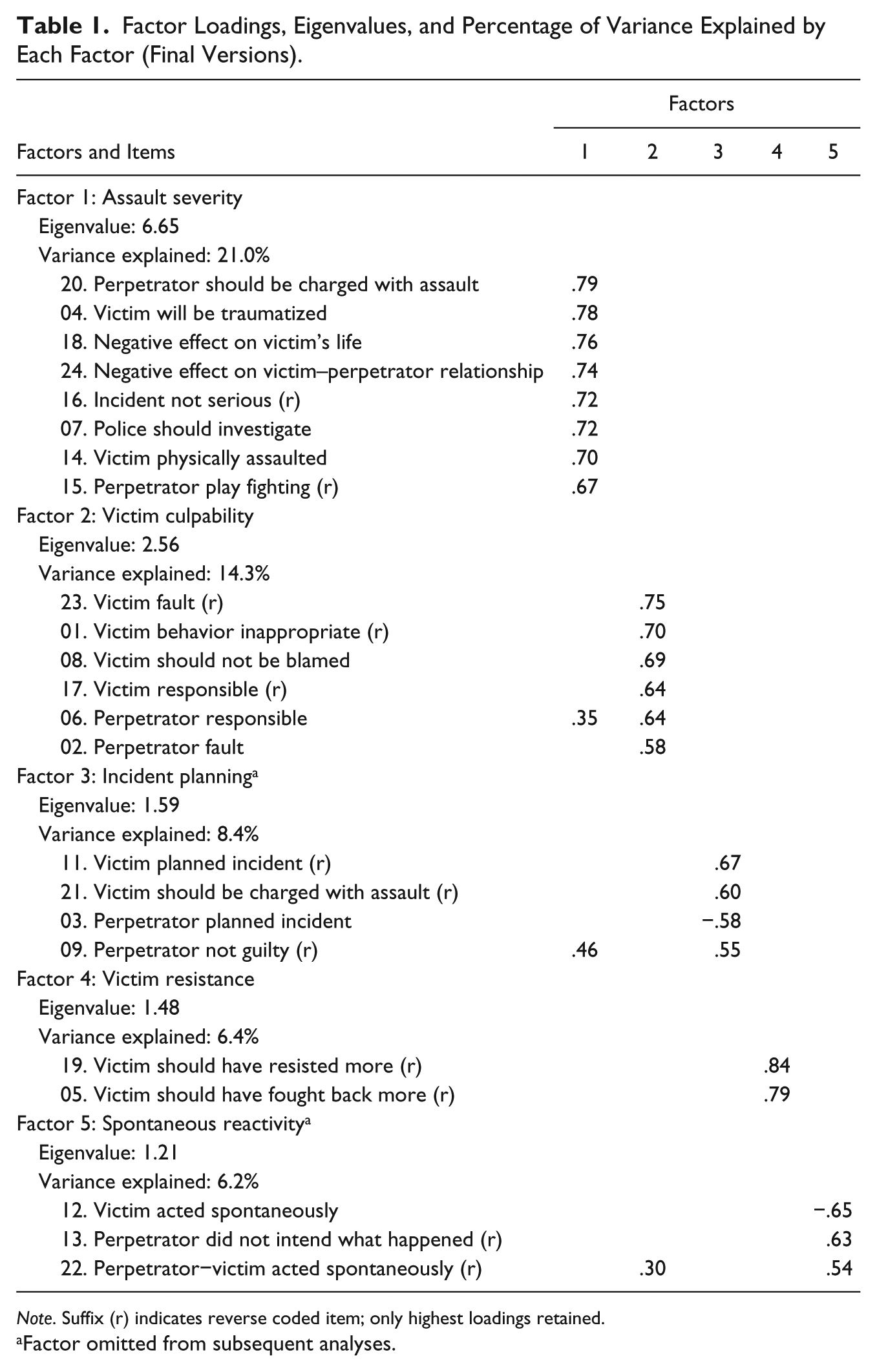
To determine the existence of Anticipated Attribution subscales (cf. Rogers & Davies, 2007), a PCA with varimax rotation was performed on the 24 (re)coded DVs with factors extracted according to Kaiser’s criterion (i.e., those with eigenvalues greater than 1.0). A total of five factors were extracted, which together explained 56.5% of total attribution variance (see Table 1).
Factor Loadings, Eigenvalues, and Percentage of Variance Explained by Each Factor (Final Versions).
Note. Suffix (r) indicates reverse coded item; only highest loadings retained.
Factor omitted from subsequent analyses.
As Table 1 shows, eight items relating to event seriousness, event consequences, victim traumatization, and the need for police action loaded onto Factor 1. This factor, which was named “assault severity,” had a very high internal reliability (α = .90). A further six items, 2 relating primarily to victim fault, responsibility, blame, and appropriateness of behavior loaded on to Factor 2, and thus was named “victim culpability.” This factor also had good internal reliability (α = .81). Similarly, four items reflecting assault planning, whether the victim should be charged for assault, and perpetrator innocence loaded on to Factor 3. Factor 3 had very poor internal reliability (α = .25) that could not be improved to a satisfactory level through item deletion. Factor 3, tentatively named “incident planning,” was therefore dropped. Two items, both relating to the victim’s need to resist her assailant, loaded on to Factor 4 and had a moderate, but nonetheless acceptable, level of internal reliability (α = .60). This factor was subsequently named “victim resistance.” Finally, three items associated with intended versus spontaneous behaviors loaded on to Factor 5 and was tentatively named “spontaneous reactivity.” However, Factor 5 had very low reliability (α = .12) that could not be improved through item deletion and, as such, was also dropped. The three retained factors (Factors 1, 2, and 4) were computed as the mean of relevant factor items (cf. Table 1) and subjected to further analyses.
Preliminary Factor Screening
Boxplots revealed 14 outliers across the three retained factors (all for F2 victim culpability and F3 victim resistance). Further inspection revealed that only one case displayed systematic attributional biases across more than a single factor with this case removed from the data set (final n = 604). While Kolgomorov–Smirnov tests revealed all three factors deviated from normality (KSF1 = .04; p = .015; KSF2 = .05; p = .003; KSF4 = .10; all ps < .001), an inspection of histograms revealed data were suitable for parametric testing. No evidence of factor multicollinearity was found (all rs < .50).
Factor ratings did not differ significantly across respondents’ (White vs. non-White) ethnicity or their (student vs. non-student) occupational status. Nor were factors’ scores associated with respondents’ general qualification level or relationship status. 3 In contrast, one factor—victim resistance—did correlate significantly with respondent age (r = .11; p = .007; n = 604), with younger respondents believing the victim should have resisted more than older respondents. Future analyses will control for this age covariate.
MANCOVA
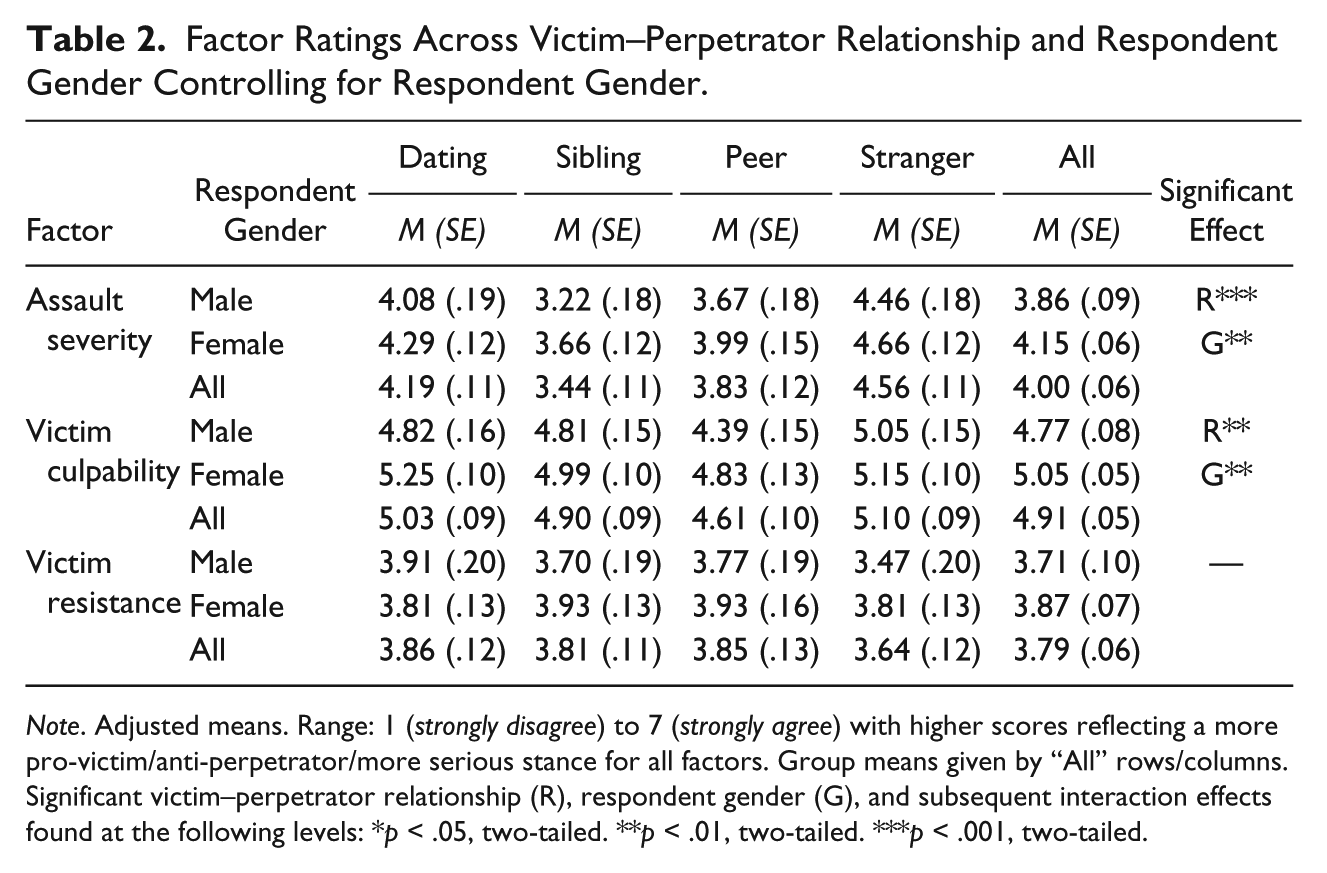
A four victim–perpetrator relationship type × 2 respondent gender between-subjects MANCOVA—controlling for respondent age—was performed across the three retained factors. Adjusted means and standard deviations are presented in Table 2.
Factor Ratings Across Victim–Perpetrator Relationship and Respondent Gender Controlling for Respondent Gender.
Note. Adjusted means. Range: 1 (strongly disagree) to 7 (strongly agree) with higher scores reflecting a more pro-victim/anti-perpetrator/more serious stance for all factors. Group means given by “All” rows/columns.
Significant victim–perpetrator relationship (R), respondent gender (G), and subsequent interaction effects found at the following levels: *p < .05, two-tailed. **p < .01, two-tailed. ***p < .001, two-tailed.
Overall, respondent age was a significant multivariate covariate, Wilks’s Lambda = .88; F(3, 593) = 3.33; p = .019; η2 = .02, with older respondents making more pro-victim/severity attributions than their younger counterparts. A significant multivariate main effect was also found for victim–perpetrator relationship type, Wilks’s Lambda = .88; F(9, 1443.4) = 8.42; p < .001; η2 = .04, with respondents assigning more pro-victim/severity attributions to the dating and stranger conditions compared to the sibling and peer conditions. Finally, significant multivariate respondent gender effect was found, Wilks’s Lambda = .98; F(3, 593.0) = 4.28; p = .005; η2 = .02, with females assigning more pro-victim/severity attributions generally across all conditions (see Table 2). No multivariate interaction effects were found.
Subsequent post hoc univariate ANCOVA revealed four significant effects. First, a significant respondent gender effect was found for assault severity, F(1, 595) = 7.01; p = .008; partial η2 = .01, with males judging the incident less severe than females. Second, a similar respondent gender effect was also found for victim culpability, F(1, 595) = 9.14; p = .003; partial η2 = .02, ratings with males judging the victim more culpable than females. Third, a significant victim–perpetrator relationship effect was found for assault severity, F(1, 595) = 19.65; p < .001; partial η2 = .09. Post hoc pairwise comparisons (with Bonferroni adjustment) across the four relationship types confirmed respondents judged the assault more severe if it was perpetrated by (a) the victim’s dating partner as opposed to her sibling (p < .001), (b) a stranger as opposed to the victim’s sibling (p < .001), and (c) a stranger as opposed a peer (classmate) of the victim (p < .001). Finally, a similar victim–perpetrator relationship effect was also found for victim culpability, F(1, 595) = 5.02; p = .002; partial η2 = 02. Corresponding post hoc comparisons confirmed the victim was deemed more culpable for her own assault if the perpetrator was a peer (classmate) as opposed to either (a) her dating partner (p = .012) or (b) a stranger (p = .002). Contrary to expectations, the victim was deemed just as culpable for her own assault if this was perpetrated by her sibling (i.e., she was a victim of SV) compared with that by a dating partner, peer, or stranger. No other significant (main or interaction) effects were found.
Respondents’ Personal Experiences of Interpersonal Violence
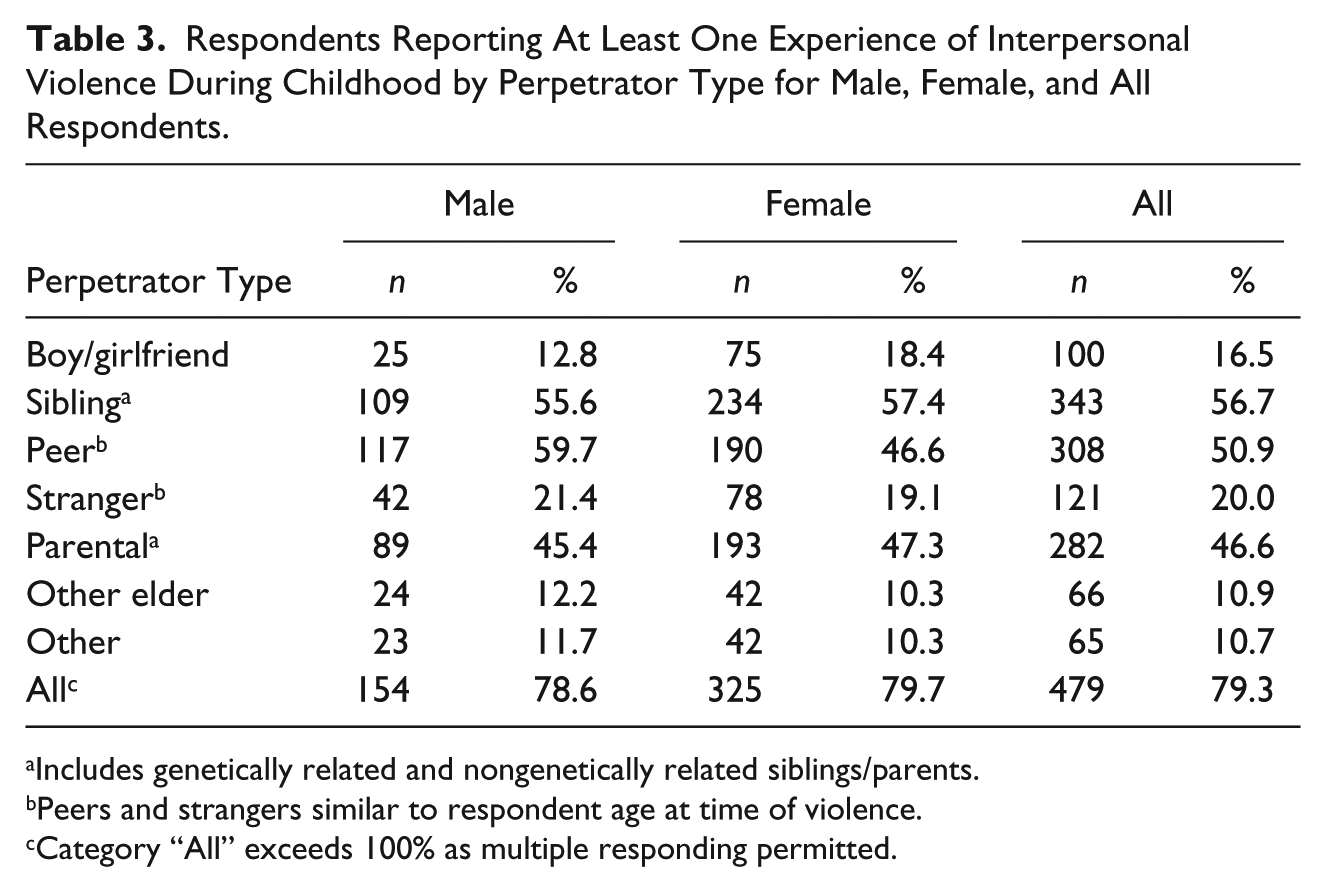
Frequency data for each PEIVQ category were examined. As Table 3 shows, over three quarters of the sample claimed to have experienced at least one episode of interpersonal violence against them as a child, with over half claiming victimization by a sibling. A similar proportion claimed to have experienced parental and/or peer violence during childhood with around a fifth also reporting at least one episode of childhood violence perpetrated by a boyfriend/girlfriend or by a stranger. A tenth of the sample said they had suffered childhood violence at the hands of another (older) person.
Respondents Reporting At Least One Experience of Interpersonal Violence During Childhood by Perpetrator Type for Male, Female, and All Respondents.
Includes genetically related and nongenetically related siblings/parents.
Peers and strangers similar to respondent age at time of violence.
Category “All” exceeds 100% as multiple responding permitted.
Generally, PEIVQ frequencies were similar for male and female respondents although, noticeably, more females reported experiencing childhood violence perpetrated by a boyfriend/girlfriend or a peer (see Table 3). Frequency data for each PEIVQ category represent any act of violence in which respondents had been pushed, slapped, hit, punched, beaten, or in some other way physically hurt by others when aged younger than 16 years; this showed repeated violence at the hands of siblings during childhood was more frequently reported by both male and female respondents. That said, no one reported more than eight incidents of SV.
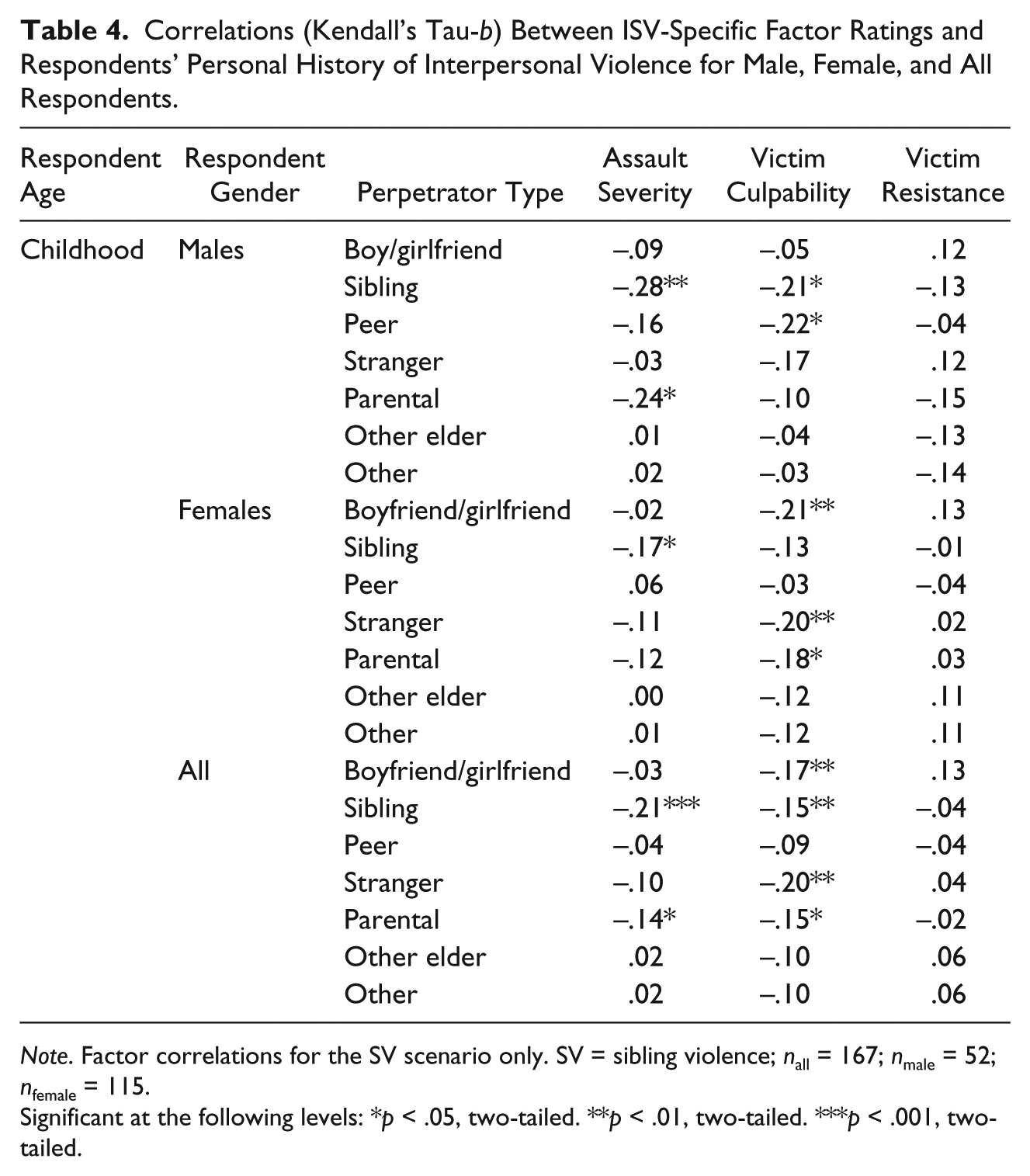
The relationship between PEIVQ ratings and attributions relating specifically to SV (i.e., just the depicted SV scenario) was examined via a series of correlation analyses. These data are presented in Table 4.
Correlations (Kendall’s Tau-b) Between ISV-Specific Factor Ratings and Respondents’ Personal History of Interpersonal Violence for Male, Female, and All Respondents.
Note. Factor correlations for the SV scenario only. SV = sibling violence; nall = 167; nmale = 52; nfemale = 115.
Significant at the following levels: *p < .05, two-tailed. **p < .01, two-tailed. ***p < .001, two-tailed.
Attributions relating to SV
As Table 4 shows, (all) respondents who experienced more frequent SV in childhood judged the depicted SV scenario to be less severe than those who reported less frequent SV experiences. This was true for both male and female respondents separately. Most other types of personal violence experience were unrelated to assault severity attributions. That said, respondents—especially males—who reported more parent-inflicted childhood violence, rated the depicted SV as less severe than those without these personal experiences.
As predicted, respondents who experienced more SV in their own childhoods deemed the depicted SV victim more culpable for her own abuse than those who suffered less childhood SV. Again, this was primarily true of males. In addition, respondents reporting more childhood experiences of boyfriend/girlfriend, stranger, or parental violence also viewed the depicted SV victim as being more culpable. This was mainly true of female respondents, with similar trends found for male survivors of peer-perpetrated childhood violence. Finally, personal experiences of interpersonal violence were unrelated to attributions of SV victim resistance. This was true for all types of violence including SV experienced by male and female respondents.
Discussion
The present study examines the impact respondents’ gender and personal experience of interpersonal violence in childhood had on their perceptions of a hypothetical scenario in which a 21-year-old female victim was physically assaulted by a 20-year-old male who was either her brother, her dating partner, a peer, or a male stranger. Having controlled for respondent age, several interesting findings emerged.
First, males deemed the depicted assault to be less serious and the victim more culpable for her assault than did females. This was true regardless of who perpetrated the violence. These gender differences are consistent with previous trends in (lay) perceptions of SV (Hardy et al., 2010; Harris, 1991; Reese-Weber, 2008) as well as those relating to other types of interpersonal conflict such as adult rape (Pollard, 1992), child sexual abuse (e.g., Davies, Rogers, & Hood, 2009), and domestic violence (Locke & Richman, 1999) in which women are generally more supportive of victimized individuals.
Second, the nature of the victim–perpetrator relationship had a significant impact on attributions of both assault severity and victim culpability. Specifically, physical assault by the victim’s brother was deemed less severe than identical assault by either her dating partner or a male stranger. This is consistent with the widespread normalization of SV (Mackey et al., 2010; Reese-Weber, 2008). This finding is of particular interest given the general expectation for older siblings to engage less in physical SV. As a consequence, the physical aggression portrayed in the scenario could have been viewed as more serious and less acceptable, with less blame ascribed to the female victim. But, while the victim was blamed more for her own assault if perpetrated by a peer (vs. either her dating partner or a stranger), the victim of SV was deemed just as blameworthy regardless of who aggressed. This is contrary to the SV normalization hypothesis (cf. Caffaro & Conn-Caffaro, 2005).
Third, all respondents who had personally experienced SV victimization perceived the hypothetical SV assault as being less severe, and victim more culpable, than respondents with no prior exposure to SV during their childhood. Such attributions are an implied consequence of SV normalization in the “real world.” As predicted (cf. Hardy et al., 2010), this normalization of SV was more prominent in male respondents.
Implications of Key Findings
Current findings suggest personal SV victimization in one’s own childhood may bias lay perceptions of victim culpability and assault severity in (a depicted case of) SV. To this end, childhood experiences of SV may be a mediating factor for peoples’ minimization of adulthood SV. Coupled with the high rate of SV (56.6%) reported by the respondents in this study, this could reflect a normalization of physical SV that is symptomatic of a cyclical relationship between child abuse and acceptance of interpersonal violence within later (e.g., adult) intimate relationships (e.g., Lichter & McCloskey, 2004; Ponce et al., 2004). Siblinghood also appears to represent an offender–victim relationship in which violence is perceived to be less serious and the victim more blameworthy compared to other non-familial dyadic relationships. In addition, this seems to be the case irrespective of observers’ gender.
Applied Value: Implications for Social Policy and Practice Settings
Current findings suggest more effort must be made to understand how SV is perceived by heath, welfare, and education professionals, whose role it is to identify and raise awareness of harmful behaviors. The significance of this need is highlighted by previous findings in which domestic violence victims are blamed not only by laypersons (e.g., students; Bryant & Spencer, 2003) but also by the police (DeJong, Burgess-Proctor, & Elis, 2008), social workers (Maynard, 1985), health care staff (Kim & Motsei, 2002), and victim support volunteers (Thapar-Björkert & Morgan, 2010). Recognizing SV as having psychologically detrimental and potentially injurious consequences could represent the first step toward improved relevant screening and prevention schemes (Carlson & Worden, 2005). Such recognition would enable welfare workers to target and manage persistent offenders and aid victim recovery more effectively (Fox & Cook, 2011). Ultimately, it could reduce the widespread tolerance and subsequent normalization of SV guiding caregivers toward the use of more constructive means of familial conflict resolution (Omer et al., 2008; Phillips et al., 2009).
Methodological Limitations and Future Directions
While a strength of the present study is its use of a relatively large sample size, several methodological limitations are worthy of note. First, current inferences are restricted by the use of a convenience sample consisting primarily of university students. Although this hinders the ability to generalize results to a wider population, the large sample size plus partialling out for respondent age encourages confidence in our findings. In addition, although a response rate of 94.5% at first glance seems high, it is comparable with other studies employing similar methodology (e.g., Rogers & Davies, 2007).
Second, the present study focused solely on a male-to-female physical assault and thus, in the SV condition, on a brother-to-sister violence. Due to the complex nature of sibling abuse, future studies ought to investigate female-to-male and same-sex SV, within the context of both genetically related and blended families.
A third limitation is that the depicted victim and perpetrator were both young adults, specifically university students in their early 20s. While SV can occur in all life stages (e.g., Friedrich et al., 2013; Hardy et al., 2010), it seems likely that lay perceptions of SV will differ according the age of, hence age gap between, the relevant parties. This provides scope for future investigations to expand upon the present design by employing vignettes that depict younger sibling dyads (where there is an increased expectation for physical violence to occur) as well as child versus adolescent versus adult siblings. Finally, we encourage future studies to utilize a more encompassing measure such as a modified Conflict Tactics Scale (CTS; Straus, 1979) so as to gauge both the frequency and severity of respondents’ sibling violence experiences. Associations between personal experiences of SV (in terms of intensity) and attitudes toward victims would be enhanced by employing measures that differentiate milder (and perhaps, more normative) acts from more serious (thus, more detrimental) victimization. Likewise, recording frequencies across a range of specific SV experiences (i.e., pushed, slapped, hit, punched, or beaten by a sibling) would provide richer data. It would also be imprudent to overlook social desirability and memory biases (e.g., Wilson & Fromuth, 1997), as these are likely to influence the accurate recall of personal experiences of violence, especially those occurring in childhood.
By its very nature, siblinghood is a precarious and complex domain, in which brothers and sisters develop psychosocially both as individuals and as members of their wider community. The uninhibited and emotionally charged interactions that characterize sibling relationships are well documented in the developmental literature, with the violent and harmful acts perpetrated by siblings increasingly noted in aggression research. It is hoped the present investigation goes some way to explaining the apparent paradox of why people routinely minimize this widespread and abusive form of interpersonal violence.
Footnotes
Appendix A
Appendix B
Declaration of Conflicting Interests
The author(s) declared no potential conflicts of interest with respect to the research, authorship, and/or publication of this article.
Funding
The author(s) received no financial support for the research, authorship, and/or publication of this article.