







Abstract
The high prevalence of rape and sexual trauma symptomatology among women involved in street-based sex trades is well-established. Because prior research has lacked appropriate, non-sex trade involved comparison groups, it is unknown whether differences exist among similarly situated women who do and do not trade sex. This article explores experiences of childhood and adult rape and symptomatology of sexual abuse trauma among a community-based sample of 322 women who use methamphetamine in San Francisco, California, 61% of whom were involved in the sex trade. Study participants were recruited via respondent-driven sampling and eligible if they were cisgender women, aged 18 or older, current methamphetamine users, and sexually active with at least one cisgender man in the past 6 months. The dependent variable was sexual abuse trauma symptomatology, as measured by the Sexual Abuse Trauma Index (SATI) subscale of the Trauma Symptom Checklist–40 (TSC-40), and the explanatory variable was sex trade involvement. Potential covariates were age, current homelessness, methamphetamine dependence, and experiences of childhood and adult rape. Sixty-one percent of participants had a SATI subscale score suggestive of sexual abuse trauma. The overall prevalence of rape in childhood and adulthood was 52% and 73%, respectively. In bivariate analysis, sex trade involvement and all of the potential covariates except for homelessness and age were associated with a SATI score suggestive of sexual abuse trauma. In multivariate models controlling for significant covariates, there was no longer a statistically significant association between sex trade involvement or childhood rape and an elevated SATI score. Elevated levels of psychological dependence on methamphetamine and experiences of rape as an adult were still associated with a high SATI score. These findings highlight that urban poor women, regardless of sex trade involvement, suffer high levels of rape and related trauma symptomatology.
Introduction
Much attention has been given to the prevalence of rape 1 and symptomatology of sexual trauma among women involved in street-based sex trades. 2 Between 44% and 84% were raped as children (Farley, Baral, Kiremire, & Sezgin, 1998; Farley et al., 2004; Surratt, Inciardi, Kurtz, & Kiley, 2004; Valera, Sawyer, & Schiraldi, 2001), and between 22% and 76% have been raped while trading sex as adults (Church, Henderson, Barnard, & Hart, 2001; Farley et al., 1998; Farley et al., 2004; Surratt et al., 2004; Valera et al., 2001). These percentages are noticeably higher than the 8% prevalence of childhood rape and 15% prevalence of adult rape found in the National Violence Against Women (NVAW) Survey, a household telephone survey (Tjaden & Thoennes, 2000). In one of the most oft-cited works about involvement in the sex trade and trauma, 68% of a sample of 130 adults in San Francisco involved in street-based sex trades met the criteria for post-traumatic stress disorder (Farley et al., 1998; Farley et al., 2004). Acknowledging it as a limitation, the authors of these studies stated that future research needs to include non-sex trade involved comparison groups.
Without appropriate comparison groups, it is unclear whether the high prevalence of childhood and adult rape among women involved in the street-based sex trade is also found among women with similar life experiences but who are uninvolved in the street-based sex trade. Although a large body of research exists on sexual trauma among women who trade sex, most of it suffers epidemiologically from not having adequate comparison groups. The population of women who trade sex is diverse and their experiences depend largely upon the context and location of their sex trades (Bernstein, 2007; Harcourt & Donovan, 2005; Sanders, O’Neill, & Pitcher, 2009). Although women involved in street-based sex trades are particularly vulnerable to rape and other forms of violence (Bourgois & Dunlap, 1993; Cohan et al., 2006; Cooper, Kennedy, & Yuille, 2001; J. Miller, 1995; Romero-Daza, Weeks, & Singer, 1998-1999; Shannon et al., 2008; Surratt et al., 2004; Weitzer, 1999), the same is not true for women who work in other contexts. For example, among women who work in the legal brothel system in Nevada, it is rare that they experience rape or other forms of violence (Albert, 2001; Brents & Hausbeck, 2005). This difference in experiences is attributed to the group dynamics of brothels where clients are not anonymous and other people are on the premises who can intervene if a client is problematic. It is also because, as a legal business, brothels can rely on law enforcement for support (Brents & Hausbeck, 2005). This heterogeneity within the sex industry makes it difficult to find appropriate comparison groups. The majority of the extant research about women in the United States who trade sex focuses on the subpopulation engaged in street-based sex trades, but the vast majority of these studies lack comparison groups. It is therefore unclear whether the findings are unique to the sample of women who are engaged in street-based sex trades or if they are also applicable to similarly situated women.
Those studies that have utilized comparison groups or case-control methodology report inconsistent findings about the association between rape and sex trade involvement. Nadon, Koverola, and Schludermann’s (1998) comparison study of sex trade and non-sex trade involved female adolescents aged 15 to 17 did not find a significant difference in the prevalence of rape between the two groups. Both groups of adolescents in their study were recruited from areas known for prostitution, work training programs, treatment centers and detention facilities. But other research has found an association. Data from two community-based human immunodeficiency virus (HIV) prevention trials conducted in St. Louis indicated that among women recruited through street outreach, local agencies, and peer referrals, those who trade sex were more likely to have experienced rape as children compared with women uninvolved in the sex trade (Vaddiparti et al., 2006). In a cross-sectional comparison study, women recruited through street outreach who used drugs and traded sex in New York City were more likely to be raped in the past year than their non-sex trade counterparts (el-Bassel et al., 1997). The Young Women Survey, a prospective cohort study of women recruited through a one-stage cluster methodology of street blocks where the median household income was below the 10th percentile, found that those who were raped as children had almost three times greater odds of subsequent sex trade involvement (Molitor, Ruiz, Klausner, & McFarland, 2000).
Findings from a case-control study conducted in New Zealand highlight how experiences of rape may not necessarily be indicative of psychiatric symptomatology. Romans, Potter, Martin, and Herbison (2001) found that even though women who traded sex (n = 29) were more likely as adults to have experienced physical abuse and rape than the control group (n = 680), no difference was found in their psychiatric symptomatology. This study is an important contribution to the literature, and yet based on the small number of sex trade involved women in the sample and the majority working for massage parlors and escort agencies, it may not offer much insight into the experiences of women engaged in street-based sex trades.
This article explores the association between street-based sex trade involvement, experiences of childhood and adult rape, and symptomatology of sexual abuse trauma among a community-based sample of women who use drugs in San Francisco, California. Our goal was to explore whether women involved in the sex trade were more likely than uninvolved women to have (a) experienced rape as a child, (b) experienced rape as an adult, and (c) have symptomatology of sexual abuse trauma. Because this sample was comprised of urban poor women who use drugs, whether or not they traded sex, they are all “embedded in the same violent social spaces where street violence and other subcultures of violence exist” (Surratt et al., 2004). Based on this understanding of their lived experiences, one in which their homelessness (Davis, 2000; Wenzel, Leake, & Gelberg, 2001) and drug use (Baseman, Ross, & Williams, 1999; Bourgois & Dunlap, 1993; Davis, 2000; Gilbert, El-Bassel, Rajah, Foleno, & Frye, 2001) expose them to violence, we hypothesized that after controlling for other factors important in the lives of these women, the odds of symptomatology of sexual abuse trauma would be similar among women who do and do not trade sex.
Method
Procedures
From 2007 to 2009, we enrolled 322 women who used methamphetamine in San Francisco, California, using procedures reported previously (Lorvick et al., 2012). Briefly, participants were recruited via respondent-driven sampling (RDS; Heckathorn, 1997). RDS is a form of chain-referral sampling where a group of initial recruits (or “seeds”) are identified by the research team. These initial seeds are enrolled in the study, interviewed, and then given coupons to recruit other eligible participants. For this study, the seeds were compensated with US$10 to US$20 for each eligible referral (the incentive was increased midway through the study to improve recruitment).
Eligibility criteria included being a cisgender woman, having used methamphetamine for the past 30 days, aged 18 or older, sexually active with at least one cisgender man in the past 6 months, and referred by another participant (except for initial recruits). We assessed participants’ eligibility through a screening process designed to mask eligibility criteria. Trained interviewers administered a computer-assisted personal interview (Blaise, Westat Inc.) in a centrally located, community-based field site. All participants provided informed consent. We compensated women with US$40 for participating in the interview.
The study was approved by the Institutional Review Board at RTI International. As an added layer of protection for participants, we obtained a Federal Certificate of Confidentiality from the National Institutes of Health.
Measures
The dependent variable was sexual abuse trauma symptoms as measured by the Sexual Abuse Trauma Index (SATI) subscale of the Trauma Symptom Checklist–40 (TSC-40; Briere & Runtz, 1993). The TSC-40 is a well-validated instrument that was designed to assess symptomatology in adults associated with childhood or adult traumatic experiences (Elliott & Briere, 1992; Gold, Milan, Mayall & Johnson, 1994; Zlotnick et al., 1996).
The SATI subscale includes seven items to assess how often respondents have experienced the following in the past 2 months: sexual problems, “flashbacks,” nightmares, fear of men, memory problems, bad thoughts or feelings during sex, and feeling that things are “unreal.” The items are scored on a 4-point scale (0 = never to 3 = often), which are summed for an overall score, with the range of scores for the scale being from 0 to 21. Higher scores indicate increased symptomatology.
Because the developers of the TSC-40 did not identify a cut point suggestive of sexual abuse trauma symptomatology, we reviewed the literature to identify an appropriate “cut point.” Whiffen, Benazon, and Bradshaw (1997) found a mean score of 10.4 on the SATI subscale of the TSC-40 among women who experienced childhood sexual abuse compared with a mean score of 5.4 among women without a childhood sexual abuse history. In their study of female undergraduates, Gold et al. (1994) found a mean SATI score of 9.9 among those who experienced abuse only as a child, 10.7 among those who experienced abuse only as an adult, and 11.8 among those who experienced abuse both as a child and as an adult. In their 1996 study of female inpatients of a psychiatric unit, Zlotnick and colleagues (1996) found that the mean SATI score was 12.4 among those who experienced abuse compared with 7.3 among those who had not experienced abuse. Based on this review of the literature, we considered a score ≥10 as suggestive of sexual abuse trauma.
The main explanatory variable was sex trade involvement. To assess sex trade involvement, we asked women a series of yes or no questions to determine whether they received money, drugs, food, a place to stay, clothing, or something else in exchange for sex in the past 6 months. Women who said “yes” to any of these questions were considered sex trade involved.
The potential covariates were age, current homelessness, methamphetamine dependence, and experiences of childhood and adult rape. We report age as a categorical variable: 18 to 29, 30 to 39, 40 to 49, and ≥50 years old. To measure homelessness, we asked women whether they currently considered themselves homeless. We utilized the five-item Severity of Dependence scale (Gossop et al., 1995) to assess past year psychological dependence on methamphetamine. Each item is scored on a 4-point scale (ranging from 0 to 3), and the total score is a sum of the items (0 to 15). Higher total scores are indicative of higher levels of dependence. After looking at the distribution of responses, we grouped the scores into three categories: low (0 to 4), medium (5 to 10), and high (11 to 15). To evaluate experiences of childhood rape, we asked participants if as a child (<18 years of age), they were ever forced to have sex by an adult or older child. To assess adult experiences of rape, we asked women if as an adult (aged 18 or older), they ever had unwanted sexual experiences. Prior to being asked this question, all women were read the following prompt:
Unwanted sexual experiences include rape or being made to do sexual things you didn’t want to. It includes times when you were unable to consent, like if you were drunk, high, or asleep, or were scared you would be hurt if you refused.
Statistical Analyses
We conducted bivariate analysis to assess the association between the explanatory variable, potential covariates, and the outcome variable. We used the Pearson chi-square statistic to examine the bivariate associations, with p < .10 to determine significance. We also used the Pearson correlation statistic to examine correlation between the explanatory variable and the potential covariates. None of the correlations exceeded what would be interpreted as a weak relationship (−.3, .3).
Next, we constructed a multivariate logistic regression model. The multivariate model included the explanatory variable, any confounding variables that remained significant at the p < .10 level in bivariate analyses, and the outcome variable. To examine whether sex trade involvement and the remaining potential covariates interacted with each other, we created a model with all possible interaction terms and then one by one dropped terms for which the coefficients did not have significant p values at p < .05. Because we found that sex trade involvement did not interact with the covariates, the final multivariate model did not include interaction terms. To determine which model most adequately fit the data, the one with or without the interaction terms, we conducted a likelihood ratio test comparing the two models.
All statistical analyses were performed using Stata Version 12 (StataCorp, 2011).
Results
Approximately half of the sample was African American, and over half were aged 40 or older (see Table 1). Fifty-seven percent of the women reported being homeless. Almost three quarters had moderate to high levels of psychological dependence on methamphetamine. Although this study focused on women who used methamphetamine, the sample was largely comprised of polydrug users. For example, 62% reported crack cocaine use in the past 30 days.
Sample Characteristics of Women Who Use Methamphetamine in San Francisco (N = 322).

The median SATI score was 11 (interquartile range = 8, 15). Sixty-one percent of the women had a score ≥10 on the SATI subscale, our predetermined cut point for sexual abuse trauma. The overall prevalence of rape in childhood was 52%. Seventy-three percent of this sample experienced rape as adults.
In bivariate analysis at the p < .10 level, the association between sex trade involvement and rape as a child was not statistically significant. Fifty-eight percent of women involved in sex trade reported being raped as a child, as opposed to 43% of women uninvolved in the sex trade (odds ratio [OR] = 1.1; 90% confidence interval [CI] = [0.9, 1.3]). The association of adult rape with sex trade was statistically significant, with 77% of women involved in trading sex reporting having been raped as compared with 67% of women who did not report being involved in trading sex (OR = 1.2, 90% CI = [1.0, 1.5]).
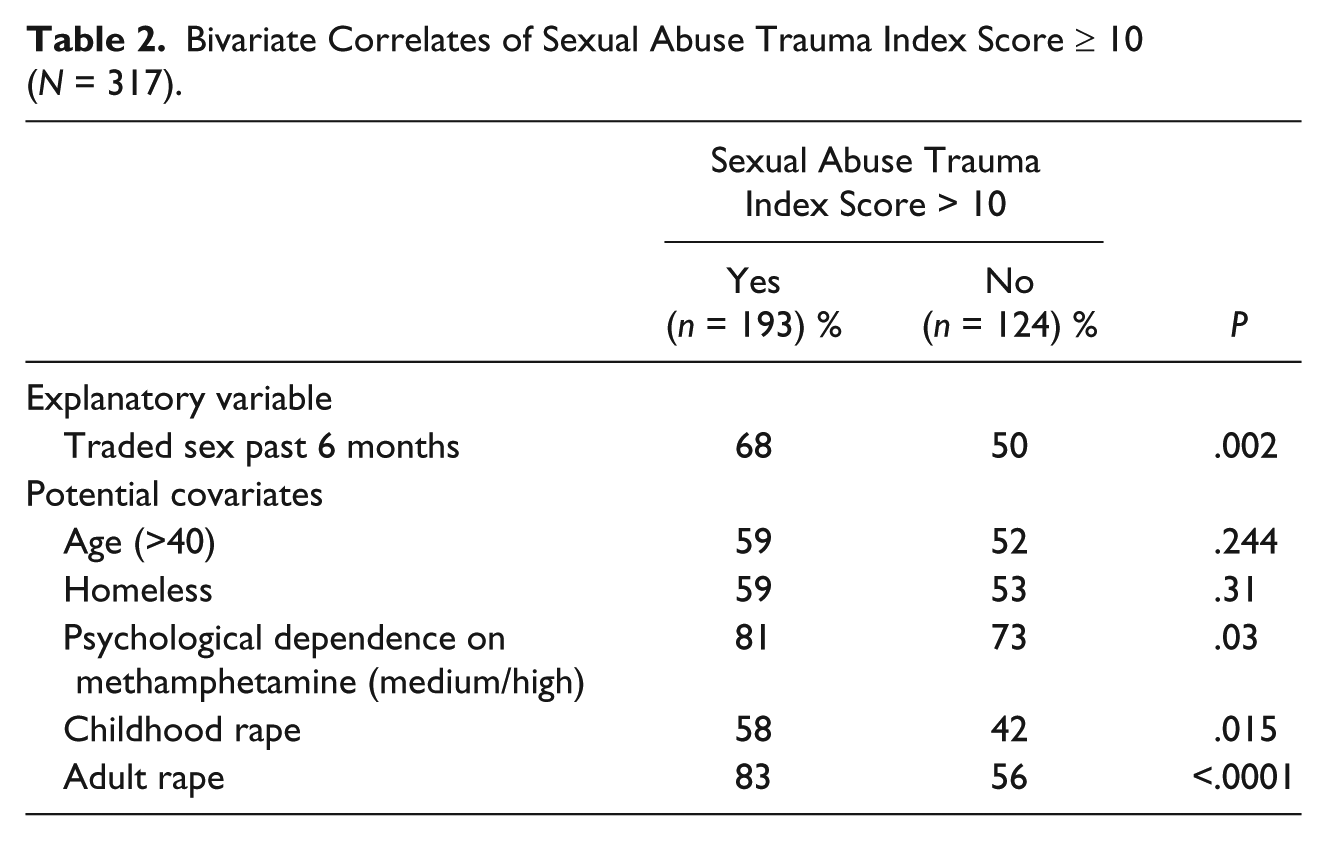
Table 2 shows the results from bivariate analyses examining the relationship between the explanatory variable, potential covariates, and the outcome variable. Sex trade involvement and all of the potential covariates except for homelessness and age were associated with a SATI score indicative of symptomatology of sexual abuse trauma.
Bivariate Correlates of Sexual Abuse Trauma Index Score ≥ 10 (N = 317).
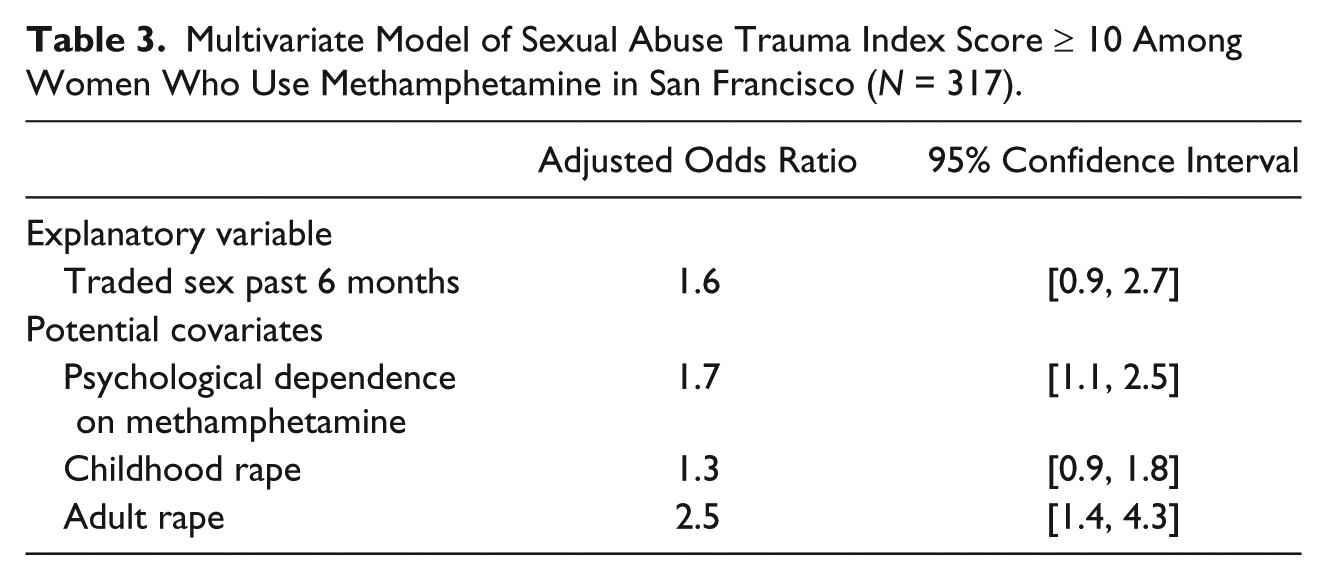
The association between sex trade involvement and sexual trauma symptomatology was not statistically significant in the multivariate model that controlled for covariates (Table 3). Elevated levels of psychological dependence on methamphetamine (Adjusted OR = 1.7, 95% CI = [1.1, 2.5]) and experiences of rape as an adult (Adjusted OR = 2.5, 95% CI = [1.4, 4.3]) were positively associated with symptomatology of sexual trauma. No statistically significant association was found between experiences of childhood rape and symptomatology of sexual abuse trauma.
Multivariate Model of Sexual Abuse Trauma Index Score ≥ 10 Among Women Who Use Methamphetamine in San Francisco (N = 317).
Comparison of the two multivariate models with and without the interaction terms indicates that the model without the interaction terms better fit the data (Likelihhod Ratio χ2(4)—2.04, p = .7).
Conclusion
Much of the prior research on the relationship between sex trade involvement and sexual abuse trauma has been hampered by a lack of rigorous comparison groups (Shaver, 2005; Vanwesenbeeck, 2001; Wahab & Sloan, 2004; Weitzer, 2010). The importance of including comparison groups in research focused on individuals involved in the sex trade cannot be overemphasized. Our hypothesis that the odds of symptomatology of sexual abuse trauma would be similar among women who do and do not trade sex was supported in our study, which included an appropriate comparison group. Although in bivariate analyses, women who traded sex had statistically significant greater odds of being raped as an adult, once we controlled for covariates in multivariate analysis, we found that they did not have higher odds than women uninvolved in the sex trade to have a high SATI score. It was not sex trade involvement per se that was associated with sexual abuse symptomatology; rather, it was the psychological dependence on methamphetamine and experiences of rape as adults. Similar to what Cooper et al. (2001) suggested in their work, it may be that women who trade sex have developed specific coping strategies when they are raped, or that they may not view it as an assault but an occupational hazard.
In environments where trading sex is criminalized, such as San Francisco, the occupational hazards of abuse and harassment by police and clients are prevalent, especially among women of color engaged in street-based trades (Alexander, 1998; Lerum, Saunders, Barlin, Wahab & Swift, 2011; Lewis, Maticka-Tyndale, Shaver & Schramm, 2005). The connection between street-level sex trade involvement, drug use, and violence among women in locations where sex work is criminalized is well-established (Alexander, 1998; Bernstein, 2007; Cohan et al., 2006; Dalla, Xia, & Kennedy, 2003; Lerum, 2011; Lewis, 2005; Lutnick, 2007; Lutnick & Cohan, 2009; Pyett & Warr, 1997; Shannon, 2008; Surratt et al., 2004). In response to police presence, regular sex trade clients disappear and women move to more isolated areas to avoid arrest (Alexander, 1998; Shannon, 2008) limiting their ability for self-protection. Among this sample of women, those with sex trade involvement reported that it was clients who most frequently raped them (Lorvick et al., 2014). Because it is rare that women who trade sex feel that they can seek legal help when they are victims of violence, or if they do that they will be afforded the same legal protections as other citizens (Lutnick & Cohan, 2009; Norton-Hawk, 2001), advocacy is needed to promote safer work environments and policy reform that addresses the increased vulnerability of women engaged in street-based sex trades.
Regardless of sex trade involvement, the percentages of women who experienced rape in childhood and adulthood were noticeably higher than the national averages. Consistent with this finding, almost two thirds of the sample had a SATI score indicative of sexual abuse trauma symptomatology. The association between psychological dependence on methamphetamine and an elevated SATI score suggests that programs and interventions are needed that address the everyday violence experienced by women who live in urban settings and use drugs. Other research notes that substance abuse is a frequent outcome of rape (Robin, Chester, Rasmussen, Jaranson, & Goldman, 1997; Simoni, Sehgal, & Walters, 2004; Wilsnack, Vogeltanz, Klassen, & Harris, 1997). Indeed the psychological consequences of rape may result in substance use being a potential coping mechanism for trauma (Hawkins, 1992; Kilpatrick, Acierno, Resnick, Saunders, & Best, 1997; M. Miller, 1999; Zweig, Barber, & Eccles, 1997). Drug-induced vulnerability among women may pose an elevated risk of rape (M. Miller, 1999). Continued efforts are warranted to increase women’s access to a diversity of detoxification and drug treatment programs. Likewise, future research is needed that examines resiliency and coping mechanisms among this group of women.
Several potential limitations need to be considered when interpreting the data from this study. First, we relied on self-reported data, which is subject to biases associated with misclassification due to poor recall or social desirability. However, Darke’s (1998) critical review of the literature on the reliability and validity of self-reported data from drug users showed that these data are reliable and valid. Second, because our study was cross-sectional, we cannot infer causality from our statistical associations. Although the study used RDS to recruit a representative sample of women who use methamphetamine in San Francisco, we did not use RDS weights in our analyses. Other research has cast doubt upon the representativeness of RDS samples (Burt, Hagan, Sabin, & Thiede, 2010; Kral et al., 2010; Ruan et al., 2009) and the employment of RDS-weighted estimates in multivariate analysis (Burt, Thiede, & Hagan, 2009; Ober, Shoptaw, Wang, Gorbach, & Weiss, 2009). Because this is a non-probability-based sample, we cannot know whether the findings apply generally to women who use methamphetamine. Similarly, the women in this research who traded sex may not be representative of other women involved in sex trades, such as women who work for agencies or women who are not using drugs. Finally, because the larger study was not focused specifically on sex trade involvement, important aspects of these women’s experiences were not explored. Future analyses would benefit from asking women additional questions about their sex trade involvement such as the types of services they may access, experiences with law enforcement officials, and strategies for self-care and harm reduction.
The findings from our research highlight the unfortunate reality that urban, poor women suffer high levels of rape and sexual abuse trauma symptoms, regardless of whether or not they are involved in trading sex. Although trauma-focused services are warranted for this group of women, to only focus on their experiences of sexual trauma ignores the everyday violence in which they are embedded and the ways in which drug dependency may push them into more dangerous conditions. Environmental and structural interventions are needed that support safer environments.
Footnotes
Acknowledgements
We thank the women who participated in this study and the following individuals for their contributions: Michèle Thorsen, Jeffrey Klausner, and Wendee Wechsberg.
Declaration of Conflicting Interests
The author(s) declared no potential conflicts of interest with respect to the research, authorship, and/or publication of this article.
Funding
The author(s) disclosed receipt of the following financial support for the research, authorship, and/or publication of this article: Funding for this study was provided by the National Institute on Drug Abuse (Grant R01 DA021100).
Notes
Author Biographies
