







Abstract
The present study examines the influence of prior relationship on perceptions of relational stalking in the context of both opposite- and same-sex scenarios using community samples from Australia, the United States, and the United Kingdom. The study used a quasi-experimental 3 × 2 × 2 × 2 × 3 (prior relationship × perpetrator sex × target sex × participant sex × country) independent measures design. Participants comprised 2,160 members of the community, each receiving 1 of 12 versions of a hypothetical scenario and responding to scale items concerning the situation described. The findings support previous research, with scenarios involving a stranger (rather than an acquaintance or ex-partner), and scenarios involving a male perpetrator and a female target, being considered the most serious. The findings further indicate that female observers identify more closely with the role of the victim and male observers identify more closely with the role of the perpetrator, regardless of victim and perpetrator sex, and that differences in the findings across the three countries may be affected by location to a small but significant degree.
Stalking is commonly perceived to be a gendered crime, predominantly perpetrated by men against women (Pathé, Mullen, & Purcell, 2000). However, this perception hides other victims of stalking. A survey of 872 self-defined victims revealed that 76% of situations involved men stalking women, 11% involved women stalking women, 8% involved women stalking men, and 5% involved men stalking men (Sheridan, North, & Scott, in press). Furthermore, the nature of stalking and its impact on the victim was found to be very similar irrespective of the sex of the perpetrator or victim. Comparable findings have been demonstrated using clinical and forensic case materials, with victims of same-sex and/or female-perpetrated stalking reporting similar levels of violence, disruption, and distress to victims of opposite-sex and/or male-perpetrated stalking (Meloy & Boyd, 2003; Pathé et al., 2000; Purcell, Pathé, & Mullen, 2001; Strand & McEwan, 2011, 2012). Anecdotal evidence, however, suggests that victims of same-sex and/or female-perpetrated stalking are not taken seriously by victim support agencies or the police (Pathé et al., 2000; Purcell et al., 2001). Indeed, a cursory and nonscientific examination of the main English-speaking websites that offer advice and support to stalking victims are often female-oriented, featuring stories of female vulnerability and directing victims to a variety of women’s services. It is possible, therefore, that perceptions of stalking as a gendered crime prevent “nonprototypical” victims from gaining adequate support and intervention.
The present study examines the influence of prior relationship, perpetrator sex, target sex, and participant sex on perceptions of relational stalking in Australia, the United States, and the United Kingdom. A body of research has investigated the influence of prior relationship on perceptions of relational stalking and found that behavior is generally considered to be more serious when the perpetrator and target are portrayed as strangers rather than ex-partners. For example, a study with an Australian community sample found that behavior is more likely to be perceived as fear invoking when perpetrated by a stranger rather than an ex-partner (Hills & Taplin, 1998). Similarly, research with U.S. and UK student samples has found that behavior is more likely to be perceived as stalking, as requiring intervention, and as causing the target alarm and fear of violence when perpetrated by a stranger rather than an ex-partner (Cass, 2011; Phillips, Quirk, Rosenfeld, & O’Connor, 2004; Scott, Lloyd, & Gavin, 2010; Scott, Rajakaruna, & Sheridan, 2014; Scott & Sheridan, 2011; Sheridan, Gillett, Davies, Blaauw, & Patel, 2003). Although research with Australian community (Dennison & Thomson, 2000) and U.S. student samples (Kinkade, Burns, & Fuentes, 2005) did not find that prior relationship influenced perceptions of stalking, these findings are likely to be the result of methodological differences. Dennison and Thomson (2000) observed ceiling effects, and Kinkade et al. (2005) did not appear to include a clearly defined stranger condition.
The finding that behavior is often perceived to be more serious when perpetrated by a stranger rather than an ex-partner is concerning when compared with the reality of stalking victimization. National crime survey estimates suggest that about two thirds of victims know the perpetrator in some capacity prior to being stalked (Australian Bureau of Statistics, 2006; Baum, Catalano, Rand, & Rose, 2009; Finney, 2006), and applied research has found that ex-partner stalkers are often more persistent and dangerous than stranger stalkers (e.g., James & Farnham, 2003; McEwan, Mullen, & MacKenzie, 2009; McEwan, Mullen, MacKenzie, & Ogloff, 2009; Rosenfeld & Lewis, 2005). It is important to acknowledge, however, that national crime surveys report composite findings for opposite- and same-sex stalking victimization, and that same-sex victims are less likely to have had a prior relationship with a stalker (see, for example, Pathé et al., 2000; Strand & McEwan, 2011).
With regard to perpetrator and target sex, the majority of research has investigated their influence in the context of opposite-sex scenarios. Collectively, this research has found that perpetrator–target sex does not influence perceptions of whether the perpetrator’s behavior constitutes stalking (Cass, 2011; Kinkade et al., 2005; Phillips et al., 2004; Sheridan et al., 2003), but does influence perceptions of the seriousness of the perpetrator’s behavior and its likely impact on the target. For example, research with U.S. and UK student samples found that the perpetrator’s behavior is more likely to be considered serious, to result in physical injury, and to require intervention when the perpetrator is portrayed as a man rather than a woman (Phillips et al., 2004; Sheridan et al., 2003). Female targets of male perpetrators are also perceived to experience more worry and fear and to be less able to defend themselves than male targets of female perpetrators. A study with a UK community sample found that the perceived criminality of behavior and its impact on the target are greater when the perpetrator is a man and the target is a woman (Sheridan & Scott, 2010). Finally, research with Canadian and U.S. student samples found that concern for the target (Finnegan & Timmons Fritz, 2012) and the perceived likelihood of a police investigation, arrest, and prosecution (Cass & Rosay, 2012) are higher when the perpetrator is portrayed as a man rather than a woman.
Only two studies to date have investigated the influence of perpetrator and target sex in the context of opposite- and same-sex scenarios. The first examined the influence of perpetrator and target sex on perceptions of relational stalking with a UK student sample (Scott & Tse, 2011). The second examined the influence of prototypical (i.e., male perpetrator–female target) and nonprototypical (i.e., female perpetrator–male target, male perpetrator–male target, female perpetrator–female target) stalking cases on verdict decisions and perceptions of the perpetrator and target (Dunlap, Hodell, Golding, & Wasarhaley, 2012). Scott and Tse (2011) found that behavior is more likely to be perceived as requiring intervention when a man rather than a woman perpetrated the behavior. The target is also perceived to experience more alarm and fear of violence when the perpetrator is a man. Dunlap et al. (2012) found that male participants provided less guilty verdicts, lower guilt ratings, and less negative perpetrator perceptions in response to prototypical compared with nonprototypical stalking cases. Female participants, by comparison, provided more positive target perceptions in response to prototypical compared with nonprototypical stalking cases.
Authors attempting to understand the influence of perpetrator and target sex on perceptions of stalking have drawn attention to the role of gendered norms and expectations (e.g., Cass & Rosay, 2012; Finnegan & Timmons Fritz, 2012). As such, male perpetrators are perceived to be more dangerous and aggressive than female perpetrators, and male targets are perceived to be better able to defend themselves than female targets. However, it is possible that these perceptions will change in the context of same-sex scenarios in which a man is pursuing a man or a woman is pursuing a woman (Cass & Rosay, 2012).
With regard to participant sex, the majority of research has investigated its influence in the context of opposite-sex scenarios. This research has produced inconsistent findings. For example, research with Australian community and U.S. student samples has found participant sex does not influence perceptions of whether behavior constitutes stalking or should be illegal (Cass, 2011; Dennison, 2007; Kinkade et al., 2005; Phillips et al., 2004, Experiment 1), or perceptions of the most appropriate criminal justice responses (Cass & Rosay, 2012). However, other research with Australian community and Canadian and U.S. student samples has found that female participants are more likely than male participants to believe behavior constitutes stalking (Dennison & Thomson, 2002; Finnegan & Timmons Fritz, 2012; Phillips et al., 2004, Experiment 2). In addition, Dennison and Thomson (2002) found that female participants are more likely to believe the perpetrator intended to cause the target fear and harm, while Finnegan and Timmons Fritz (2012) found that female participants are more likely to express concern for the target and recommend that the target seek support.
This pattern of findings was replicated by Dunlap et al. (2012), who found that women are more likely than men to provide guilty verdicts and to believe behavior will cause the target distress. Similarly, a survey with a U.S. student sample found that women are more likely than men to believe stalking is harmful to the victim (Lambert, Smith, Geistman, Cluse-Tolar, & Jiang, 2013). A possible explanation for the finding that women are more likely to perceive the perpetrator’s behavior to be serious and impact on the target than men is that women are more often victims of intimate aggression. As such, women identify more with a female target than men, and men identify more with a male perpetrator than women (Dunlap et al., 2012; Sinclair, 2012). However, given that most previous research has investigated the influence of participant sex on perceptions of relational stalking in the context of opposite-sex scenarios, it is unclear whether men and women identify more strongly with the prototypical roles of the perpetrator and target, or the respective sexes of the perpetrator and target (Sinclair, 2012).
Although a growing body of research has examined the influence of prior relationship, perpetrator–target sex, and participant sex on perceptions of stalking, very little research has focused on perceptions of stalking in the context of same-sex scenarios. Similarly, little research has examined whether contrasting findings relate more to cross-national or methodological differences. The present study therefore extends the existing literature by examining the influence of these extralegal factors in the context of both opposite- and same-sex stalking scenarios using community samples from Australia, the United States, and the United Kingdom. Specifically, the study examines the influence of prior relationship, perpetrator sex, target sex, participant sex, and country on the extent to which the perpetrator’s behavior is perceived to (a) constitute stalking, (b) necessitate police intervention, (c) necessitate a criminal conviction, (d) cause the target alarm or personal distress, and (e) cause the target fear of violence.
Method
Design
The study employed a quasi-experimental 3 × 2 × 2 × 2 × 3 (prior relationship × perpetrator sex × target sex × participant sex × country) independent measures design. Prior relationship was manipulated so that the perpetrator and target were portrayed as strangers, acquaintances, or ex-partners. Perpetrator and target sex were manipulated so that the scenarios described the behavior of a man or woman seeking the attention of another man or woman. With regard to participant sex and country, samples comprised men and women from Australia, the United States, and the United Kingdom.
Participants
The total sample comprised 2,160 members of the community from Australia, the United States, and the United Kingdom, representing 720 participants (360 men and 360 women) from each country. Participants from Australia resided in the state of Victoria, participants from the United States resided in the state of New York, and participants from the United Kingdom resided in England. The majority of participants identified themselves as heterosexual: 90% in Australia, 91% in the United States, and 94% in the United Kingdom. Participant ages ranged from 18 to 60 across the three countries. In Australia, the mean age was 38.96 years (SD = 11.72); in the United States, the mean age was 40.68 years (SD = 11.68); and in the United Kingdom, the mean age was 38.54 years (SD = 11.25).
Materials
Participants completed an online questionnaire that included 1 of 12 versions of a scenario, five scale items concerning perceptions of relational stalking, and three questions relating to participants’ demographic information (sex, sexuality, and age). An example scenario for the “stranger male perpetrator–male target” condition is provided below:
Michael and James first met when Michael renewed the lease on his apartment at the estate agents where James works. As Michael was leaving the office James asked him out on a date. Michael thanked him for the offer, but politely declined. During the two months that followed, James sent Michael more than 30 text messages asking why he was not interested in him. James also approached Michael several times on his way to work and telephoned him at home. Michael asked James not to call him, but he still called frequently. When Michael screened his calls James left messages expressing his interest in a relationship. Most recently, James approached Michael while he was walking his dog in the local park. James asked Michael to change his mind on the grounds that they could be good together.
Prior relationship was manipulated so that Michael and James either met when Michael renewed the lease on his apartment at the estate agents where James works (stranger condition), had worked together at the same estate agents office for 6 months (acquaintance condition), or had worked at the same estate agent’s office and been romantically involved for 6 months (ex-partner condition). Perpetrator and target sex were manipulated so that James or Lauren was seeking the attention of Michael or Sarah. Finally, participants in the same-sex conditions were told that both James and Michael identified themselves as gay or that both Lauren and Sarah identified themselves as lesbian.
The five scale items were measured on 11-point Likert-type scales. Items 1, 2, and 3 ranged from definitely not to definitely and Items 4 and 5 ranged from not at all to extremely:
To what extent do you consider James’s (the perpetrator’s) behavior to constitute stalking?
Do you think James’s (the perpetrator’s) behavior will cause Michael (the target) alarm or personal distress?
Do you think James’s (the perpetrator’s) behavior will cause Michael (the target) to fear that he will use violence against her?
To what extent does James’s (the perpetrator’s) behavior necessitate police intervention?
To what extent is a criminal conviction necessary for the resolution of this situation?
Procedure
Research Now (www.researchnow.com.au) distributed invitation emails to representative samples of panel members from the State of Victoria, the State of New York, and England. Interested panel members read an informed consent form before being randomly presented with 1 of 12 versions of an online questionnaire, which took approximately 15 minutes to complete. On completion of the questionnaire, participants were directed to a debrief page. Data were collected during a 2-week period, with the data collection process ceasing as soon as there were 30 “completes” for each experimental condition. All participants received the equivalent of Aus$1 for taking part in the study, which was conducted in accordance with the requirements of the National Statement on Ethical Conduct in Human Research, the American Psychological Association, and the British Psychological Society.
Results
A 3 × 2 × 2 × 2 × 3 MANOVA was performed to determine the influence of prior relationship, perpetrator sex, target sex, participant sex, and country on the combined scale items. The analysis revealed five significant main effects for prior relationship, F(10, 4168) = 18.65, p < .001, η2 = .04; perpetrator sex, F(5, 2084) = 15.15, p < .001, η2 = .04; target sex, F(5, 2084) = 11.33, p < .001, η2 = .03; participant sex, F(5, 2084) = 8.25, p < .001, η2 = .02; and country, F(10, 4168) = 12.74, p < .001, η2 = .03. There were no significant interaction effects. Univariate ANOVAs utilizing Bonferroni corrected alpha values of .01 were performed on the individual scale items. The F ratios, significance values, means, and standard deviations are displayed in Tables 1 and 2.
Multivariate and Univariate Analyses of Variance F Ratios for the Five Scale Items by Prior Relationship, Perpetrator Sex, Target Sex, Participant Sex, and Country.
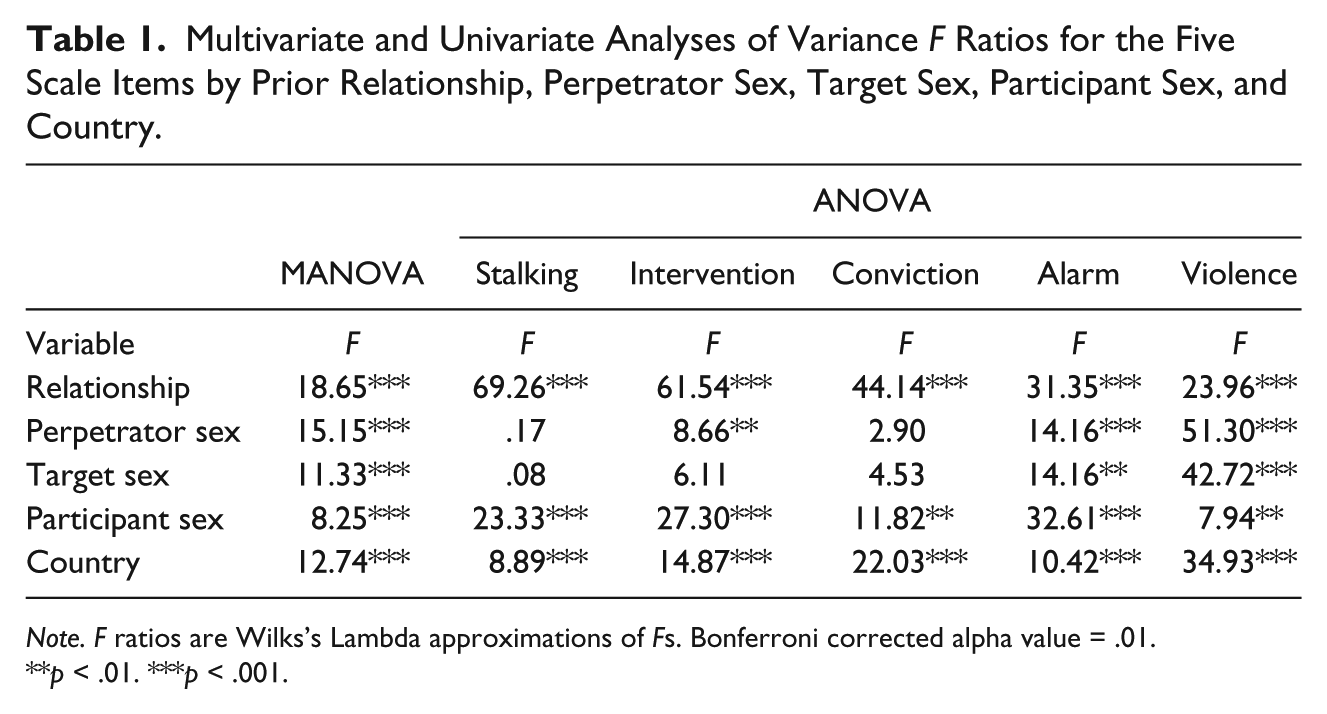
Note. F ratios are Wilks’s Lambda approximations of Fs. Bonferroni corrected alpha value = .01.
p < .01. ***p < .001.
Means and Standard Deviations for the Five Scale Items as a Function of Prior Relationship, Perpetrator Sex, Target Sex, Participant Sex, and Country.
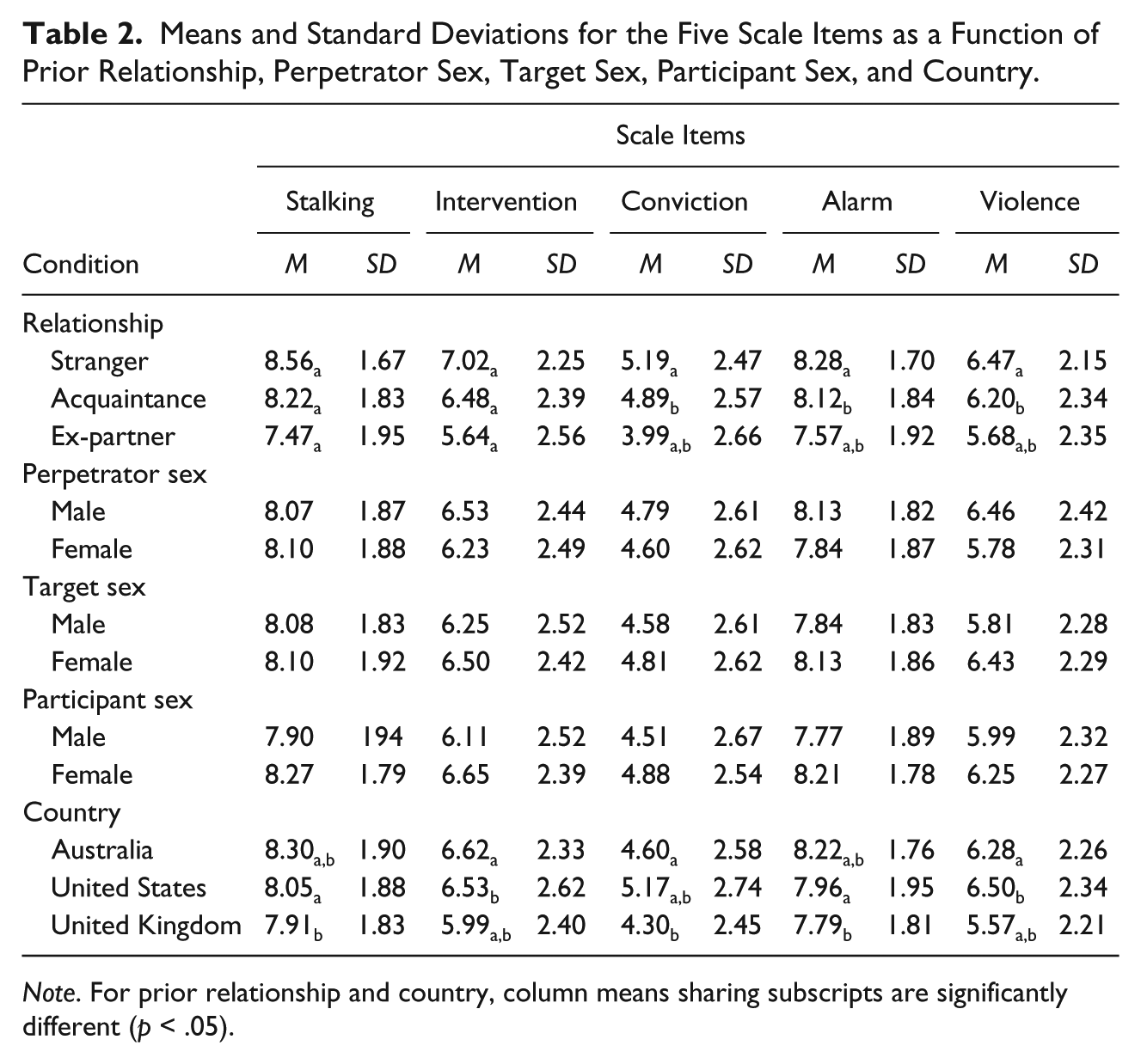
Note. For prior relationship and country, column means sharing subscripts are significantly different (p < .05).
Prior relationship influenced whether the perpetrator’s behavior was perceived to constitute stalking, F(2, 2088) = 69.26, p < .001, η2 = .06; necessitate police intervention, F(2, 2088) = 61.54, p < .001, η2 = .06; and necessitate a criminal conviction, F(2, 2088) = 44.14, p < .001, η2 = .04. It also influenced perceptions of whether the target would experience alarm or personal distress, F(2, 2088) = 31.35, p < .001, η2 = .03, and fear of violence F(2, 2088) = 23.96, p < .001, η2 = .02. Post hoc analyses revealed significant differences across all three prior relationship conditions for the stalking and intervention scale items (all p ≤ .001). The perpetrator’s behavior was perceived to constitute stalking and necessitate police intervention to the greatest extent in the stranger condition, followed by the acquaintance condition and then by the ex-partner condition. The perpetrator’s behavior was also perceived to necessitate a criminal conviction to a greater extent when the perpetrator was portrayed as a stranger or an acquaintance compared with an ex-partner (both p < .001). Finally, the target was perceived to experience more alarm or personal distress and fear of violence when the perpetrator was portrayed as a stranger or an acquaintance compared with an ex-partner (all p < .001).
Perpetrator sex influenced whether the perpetrator’s behavior was perceived to necessitate police intervention, F(1, 2088) = 8.66, p = .003, Cohen’s d = .12, and perceptions of whether the target would experience alarm or personal distress, F(1, 2088) = 14.16, p < .001, Cohen’s d = .16, and fear of violence, F(1, 2088) = 51.30, p < .001, Cohen’s d = .28. Police intervention was perceived to be more necessary when the perpetrator was portrayed as a man rather than a woman. The target was also perceived to experience more alarm or personal distress and fear of violence when the perpetrator was portrayed as a man rather than a woman.
Target sex influenced perceptions of whether the target would experience alarm or personal distress, F(1, 2088) = 14.16, p < .001, Cohen’s d = .16, and fear of violence, F(1, 2088) = 42.72, p < .001, Cohen’s d = .27. The target was perceived to experience more alarm or personal distress and fear of violence when portrayed as a woman rather than a man.
Participant sex influenced whether the perpetrator’s behavior was perceived to constitute stalking, F(1, 2088) = 23.33, p < .001, Cohen’s d = .20; necessitate police intervention, F(1, 2088) = 27.30, p = .001, Cohen’s d = .22; and necessitate a criminal conviction, F(2, 2088) = 11.82, p = .001, Cohen’s d = .14. It also influenced perceptions of whether the target would experience alarm or personal distress, F(1, 2088) = 32.61, p < .001, Cohen’s d = .24, and fear of violence F(1, 2088) = 7.94, p = .005, Cohen’s d = .11. Female participants believed the perpetrator’s behavior constituted stalking, and necessitated police intervention and a criminal conviction more than male participants. Female participants also believed the target would experience more alarm or personal distress and fear of violence than male participants.
Country influenced whether the perpetrator’s behavior was perceived to constitute stalking, F(2, 2088) = 8.89, p < .001, η2 = .01; necessitate police intervention, F(2, 2088) = 14.87, p < .001, η2 = .01; and necessitate a criminal conviction, F(2, 2088) = 22.03, p < .001, η2 = .02. It also influenced perceptions of whether the target would experience alarm or personal distress, F(2, 2088) = 10.42, p < .001, η2 = .01, and fear of violence F(2, 2088) = 34.93, p < .001, η2 = .03. Post hoc analyses revealed that participants from Australia perceived the perpetrator’s behavior to constitute stalking to a greater extent than participants from the United States and the United Kingdom (p = .022 and p < .001, respectively). Participants from Australia were also more likely to believe the target would experience alarm or personal distress than participants from the United States and the United Kingdom (p = .018 and p < .001, respectively). With regard to police intervention and fear of violence, participants from Australia and the United States were more likely to believe the perpetrator’s behavior necessitated police intervention, and that the target would experience fear of violence than participants from the United Kingdom (all p < .001). Finally, participants from the United States were more likely to believe the perpetrator’s behavior necessitated a criminal conviction than participants from Australia and the United Kingdom (both p < .001).
Discussion
The present study confirmed aspects of and extended the existing literature by examining the influence of prior relationship, perpetrator sex, target sex, participant sex, and country on perceptions of relational stalking. The findings were consistent with the majority of previous research and the common misperception that the behavior of stranger stalkers is more serious than the behavior of ex-partner stalkers (Cass, 2011; Hills & Taplin, 1998; Phillips et al., 2004; Scott et al., 2010; Scott et al., 2014; Scott & Sheridan, 2011; Sheridan et al., 2003). The findings suggest that the more intimate the relationship between the perpetrator and the target, the less likely stalking victimization will be recognized as such, highlighting the need for education on this issue and further confirming that prior relational biases are applied in stalking cases. These biases are currently best explained by victim blame attribution heuristics and belief in a just world (see, for example, Sheridan et al., 2003).
Participants were more likely to believe the perpetrator’s behavior required intervention and would cause the target alarm and fear of violence when the perpetrator was portrayed as a man rather than a woman. With regard to target sex, participants were more likely to believe a female target would experience alarm and fear of violence than a male target. Again, these findings are consistent with previous research that has identified that stalking behavior is viewed more seriously when perpetrated by a man rather than a woman (Cass, 2011; Cass & Rosay, 2012; Finnegan & Timmons Fritz, 2012; Kinkade et al., 2005; Phillips et al., 2004; Sheridan et al., 2003; Sheridan & Scott, 2010). Given the consistency of these findings, it is important that an agenda is developed to redress the issue of bias in which female stalkers are perceived to be less dangerous and aggressive, and male victims are less likely to be recognized as such. Otherwise, victims (especially male victims) of female stalkers will underestimate the risk and fail to protect themselves when confronted with stalking behavior. In addition, the lack of a significant interaction between perpetrator and target sex on perceptions of relational stalking suggests that the influence of perpetrator and target sex does not change in the context of same- as opposed to opposite-sex scenarios. Further research is required to explore the role of gendered norms and expectations in same-sex stalking cases, and to understand why perceptions do not differ in contexts where a man or a woman is seeking the attention of another person of the same sex.
Female participants were more likely to believe the perpetrator’s behavior constituted stalking and required intervention than male participants. Female participants were also more likely to believe the target would experience alarm and fear of violence than male participants. Although the findings of previous research have been mixed, the present findings are consistent with research that suggests women are more likely to perceive the perpetrator’s behavior to be serious and to impact on the target than men (Dennison & Thomson, 2002; Dunlap et al., 20120; Finnegan & Timmons Fritz, 2012; Lambert et al., 2013; Phillips et al., 2004, Experiment 1). The most simple explanation for this finding is offered by defensive attribution theory (see, for example, Elkins, Philips, & Konopaske, 2002), which states that when people observe a threatening situation that could possibly affect them personally at some future time, they identify with targets that they judge to be similar to themselves. The findings also indicate that men identify more closely with the role of the perpetrator, whereas women identify more closely with the role of the victim, irrespective of the sex of the perpetrator and victim. As Sinclair (2012) pointed out, “attributions play an important role when making judgments in legal cases” (p. 379). Further research is required therefore to examine the extent to which jurors’ decision making is influenced by these attributions, and to understand why men and women identify with the “role” rather than the “sex” of the perpetrator and victim. Furthermore, these findings have implications for educational campaigns and suggest they should focus more on promoting the reality that perpetrators and their victims are a heterogeneous group (rather than, for instance, that both sexes are vulnerable to being stalked).
Overall, participants from Australia and the United States perceived the stalking scenarios to be more serious than participants from the United Kingdom. Participants from Australia were more likely to believe the perpetrator’s behavior constituted stalking and that the target would experience alarm than participants from the United States and the United Kingdom. Participants from Australia and the United States were more likely to believe the perpetrator’s behavior required intervention and that the target would experience fear of violence than participants from the United Kingdom. Finally, participants from the United States were more likely to believe the perpetrator’s behavior necessitated a criminal conviction than participants from Australia and the United Kingdom. The pattern of findings is consistent with those of Scott et al. (2010) who found that participants from Australia perceived the perpetrator’s behavior to be more serious than participants from the United Kingdom.
Although the underlying reasons for the cross-national differences between Australia, the United States, and the United Kingdom are beyond the remit of the present study, it is important to acknowledge that all differences are small and that the pattern of findings is consistent across countries for the influence of prior relationship, perpetrator sex, target sex, and participant sex on perceptions of relational stalking. A multitude of factors may have contributed to the apparent cross-national differences (e.g., media coverage of stalking cases, definitional differences, understandings of stalking legislation, and norms regarding “normal” courtship behavior), and further research is necessary to determine the applicability of these and other relevant factors. The relative contributions of culture, prior relationship, and sex should be examined within a single study. It may be argued that the three cultures examined in the present study are not disparate in a technologically globalized world, all being predominantly Caucasian, English-speaking, first world nations. Further research within more diverse cultures is necessary therefore to assess the generalizability of the biases reported here, which may in turn allow an examination of whether perceptions of relational stalking have an evolutionary basis.
It is important to acknowledge that many of the effect sizes in the present study are small, particularly in relation to perpetrator and target sex. It is likely that the small effect sizes are partially a reflection of the scenarios used. The perpetrator’s behavior was nonthreatening and motivated by a desire to establish or reestablish a relationship with the target. There would be value in examining whether the pattern of findings and associated effect sizes differ when the perpetrator’s behavior is threatening and not romantically motivated. It is possible that the role of gendered norms and expectations will be greater in the context of more threatening stalking scenarios. Further research is also necessary to examine the influence of perpetrator and target sex on perceptions of nonrelational stalking. As Strand and McEwan (2011) pointed out, same-sex victims are less likely to have had a prior relationship with a stalker than opposite-sex victims. Finally, it is important to acknowledge that the sample was limited to the use of panel members originally recruited by Research Now for market research purposes. The representativeness of the samples is therefore unknown and likely affected by self-selection bias. Further research is required to determine the robustness of these findings when alternative recruitment methods are used.
The present study examined the influence of prior relationship, perpetrator sex, target sex, and participant sex on perceptions of relational stalking in Australia, the United States, and the United Kingdom. The findings will aid researchers who are attempting to delineate the findings of previous research collected from within one of these three countries. Consistent with the existing literature, perpetrator behavior was perceived to be more serious when the perpetrator and target were portrayed as strangers rather than acquaintances or ex-partners, and the perpetrator was a man and/or the target was a woman. Female participants were also more likely to believe the perpetrator’s behavior was serious than male participants. A more novel finding is that perceptions of relational stalking did not differ significantly across same- and opposite-sex scenarios, with men tending to identify with the role of the perpetrator and women tending to identify with the role of the victim, regardless of the sex of the perpetrator and victim. Strategies for breaking down these automatic biases in which men are less likely to be recognized as victims of stalking need to be developed to encourage men to self-identify as victims. In this regard, the stalking literature could learn from the branch of literature on domestic abuse concerning men’s acceptance of victimhood.
Footnotes
Declaration of Conflicting Interests
The author(s) declared no potential conflicts of interest with respect to the research, authorship, and/or publication of this article.
Funding
The author(s) received no financial support for the research, authorship, and/or publication of this article.