






Abstract
Based on a study of 681 German police officers who were violently assaulted we analyze first general pre-, peri- and post-traumatic risk factors (e.g. trauma severity, psychological adjustment, social support) of post-traumatic stress symptoms, second police-specific factors (e.g. colleague support) and third differences in the impact of these factors comparing male and female officers. Using regression analysis we show that risk factors that were found to be important for the general population partly hold for the special group of victimized police officers. Regarding police-specific factors regular preparatory and follow-up sessions reduce post-traumatic stress symptoms, while facing legal action following the assault increases it. The findings also reveal that three factors are significantly more strongly correlated with post-traumatic stress symptoms for female compared to male officers.
Introduction
Police officers run a high risk of experiencing traumatic situations (Skogstad et al., 2013). These situations can be categorized into depressing and violent incidents (Carlier, Lamberts, & Gersons, 1997). While other high-risk groups (e.g., firefighters) are especially confronted with depressing incidents (e.g., seriously injured people), police officers also have to face violent incidents. These are situations in which individuals experience victimization themselves. In a study by Weiss et al. (2010), for example, 15.9% of all police officers reported having been seriously assaulted on duty at least once. Thus, it seems necessary to study the consequences of violent victimization within the group of police officers. One common reaction following such events is the Post-Traumatic Stress Disorder (PTSD; American Psychiatric Association [APA], 2013; Green, 2004).
To date, studies explaining PTSD in police officers are still rare. The few existing studies focus on a concrete catastrophe (Bowler et al., 2010; Marmar, Weiss, Metzler, Ronfeldt, & Foreman, 1996) or a non-violent incident (e.g., Brunet et al., 2001; Weiss et al., 2010). Yet, no study exists that analyses risk and protective factors of post-traumatic stress symptoms 1 in police officers following a violent assault.
As police officers clearly differ from other occupational groups in several aspects (e.g., Paton & Smith, 1999), not only should the commonly considered influencing factors of post-traumatic stress symptoms be taken into account, but also police-specific factors such as preparatory and follow-up sessions and the strong social cohesion between policing staff. To date, little effort has been shown to identify such factors.
A further lack of research on post-traumatic stress symptoms in police officers concerns the question of gender-specific influencing factors. While research in the general population found some factors to be stronger associated with PTSD in females than males (e.g., Ahern et al., 2004; Andrews, Brewin, & Rose, 2003), only few studies addressed this issue within the field of the police force (e.g., Andrew et al., 2008).
Taken the aforementioned into account, our study has three aims: First, we aim to analyze whether generally considered risk and protective factors of post-traumatic stress symptoms following a violent attack also help to explain these symptoms in police officers. Second, we aim to test different police-specific factors which may also influence post-traumatic stress symptoms. Third, we aim to analyze the considered factors for female and male officers separately. This is an explorative question in nature because nearly nothing is known about gender-specific risk and protective factors of stress symptoms within the field of the police force.
Findings on General and Police-Specific Risk and Protective Factors of PTSD
PTSD can generally be characterized by four symptom clusters (APA, 2013): intrusion (e.g., traumatic nightmares), avoidance of distressing trauma-related stimuli (e.g., trauma-related thoughts), negative alterations in cognitions and mood (e.g., inability to recall key features of the traumatic event), and alterations in arousal and reactivity (e.g., problems in concentration). Differences in the prevalence of PTSD between individuals following a traumatic event can be explained by protective and risk factors, which are usually divided into pre-, peri-, and post-traumatic factors (e.g., Becker-Nehring, Witschen, & Bengel, 2012; Brewin, Andrews, & Valentine, 2000; Maes, Delmeire, Mylle, & Altamura, 2001). Regarding the first and second aims of our analysis, we will differentiate within these factors between general and police-specific factors; hypotheses are formulated only for police-specific factors.
Pre-Traumatic Factors
Socio-demographic and psychosocial variables are discussed as pre-traumatic influencing factors of PTSD, for example, by Breslau, Glenn, Andreski, Peterson, and Schultz (1997). Among others, differences in gender and age have been investigated. In a number of studies, a consistent gender effect is shown: Women are more at risk of developing PTSD than men (e.g., Breslau et al., 1997; Brewin et al., 2000; Maes et al., 2001). In contrast, findings on age are not consistent. There are studies indicating that younger people are especially at risk (e.g., Breslau et al., 1997; Brewin et al., 2000), whereas others are showing higher prevalence of PTSD in older age groups (e.g., Kleim, Ehlers, & Gucksman, 2007; Maercker, Forstmeier, Wagner, Glaesmer, & Brähler, 2008).
As far as psychosocial variables are concerned, prior trauma as well as a poor previous psychological adjustment were proven to be risk factors for post-traumatic stress symptoms (e.g., Breslau et al., 1997; Brewin et al., 2000; Maes et al., 2001; Ozer, Best, Lipsey, & Weiss, 2003).
Pre-traumatic factors: Findings on police officers and hypothesis on police-specific factors
The mentioned pre-traumatic factors are also found for police officers (e.g., Carlier et al., 1997; Marmar et al., 2006; Marmar et al., 1996; Meffert et al., 2008; Prati & Pietrantoni, 2010; Teegen, Domnick, & Heerdegen, 1997). One exception is gender: Female police officers do not have a higher prevalence in PTSD than their male colleagues (e.g., Andrew et al., 2008; Meffert et al., 2008). Thus, prior trauma and poor psychological adjustment before the assault should also increase post-traumatic stress symptoms in a sample of police officers, whereas gender and age should not correlate with these symptoms.
Focusing on police-specific risk and protective factors, it can be stated that officers differ from most other occupational groups in being trained and prepared for violent attacks. Special job resources are important for sensitizing the officers to the dangers and for helping them to cope with assaults. One measure for this are regular preparatory and follow-up sessions regarding special operations. It can be assumed that such sessions do not only reduce feelings of unexpectedness of attacks but also increase police officers’ perceptions of control and competence, which are considered to be essential for overcoming critical incidents (Ehlers & Clark, 2000; Teegen, 2003). Although preparation for a critical event is considered to have a protective effect (e.g., Alexander, 1993), hardly any study has proven this assumption empirically. Only Marmar et al. (1996) have shown that rescue workers with higher distress in the aftermath of a traumatic event reported fewer preparation for the incident compared with less stressed responders. Hypothesis 1 supposes that officers with regular preparatory and follow-up sessions in the workplace show fewer post-traumatic stress symptoms following an assault.
Peri-Traumatic Factors
Trauma severity as well as initial reactions of the person during or immediately after the traumatic event are relevant peri-traumatic influencing factors for PTSD, as existing studies have shown (e.g., Brewin et al., 2000; Maercker, Beauducel, & Schützwohl, 2000; Ozer et al., 2003). With regard to trauma severity, a stress increasing effect of physical injuries (cf. e.g., Hembree, Street, Riggs, & Foa, 2004; Stein, Walker, & Forde, 2000), duration of hospitalization (Becker-Nehring et al., 2012; Maes et al., 2001), or the number of work-loss days (Breslau, Lucia, & Davis, 2004) were found. A further indicator for trauma severity is the use of a weapon. However, existing studies mostly did not analyze this indicator, although it should be relevant, especially in cases of interpersonal violence. Evidence for this is provided by the retrospective study of Halligan, Michael, Clark, and Ehlers (2003): People with PTSD had been confronted with weapons more than twice as often as people without PTSD.
In the case of initial reactions, individuals displaying intensely negative emotional responses including, for example, fear, helplessness, guilt, or shame during or immediately after the trauma reported higher levels in PTSD symptoms (Becker-Nehring et al., 2012; Maercker et al., 2000; Ozer et al., 2003).
Peri-traumatic factors: Findings on police officers and hypotheses on police-specific factors
These peri-traumatic factors could be likewise confirmed for police officers (e.g., Carlier et al., 1997; see other references above). Thus, trauma severity and negative emotional reactions should also increase post-traumatic stress symptoms in a sample of police officers.
Again focusing on police-specific factors, officers differ from other occupational groups in regard to their strong feeling of responsibility for their colleagues. Not only one’s own physical integrity but also the integrity of the colleague may be at risk if officers behave in a wrong way. Thus, relying on their partner is essential during critical incidents. This mutual dependency also promotes a special emotional attachment, which is expressed by the fact that police officers view themselves as a community of solidarity (Behr, 2008, p. 210). Therefore, it is plausible that a serious injury or even the death of a colleague is an extremely stressful experience (Klemisch, Kepplinger, & Muthny, 2005; Violanti & Aron, 1995). Accordingly, Hypothesis 2 assumes that violent assaults are associated with stronger post-traumatic stress symptoms when colleagues have been attacked during the assault.
Not only a strong identification with one’s colleagues, but also with the job as a whole is distinctive for police officers. As soon as they enter the police force, officers’ undergo a strong occupational socialization process, which results in a changed self-concept (e.g., Fielding, 1986; Stradling, Crowe, & Tuohy, 1993). According to the social identity theory (e.g., Tajfel, 1982), the self-concept of people includes social identities. The professional identity can be understood as a specific form of the social identity. People generally strive to maintain not only a positive personal identity, but also a positive social identity. A shattering of the social identity requires processes of adaptation, to re-establish the threatened identity. Applied to the present study, an assault which aims to damage a police officers’ professional identity should be experienced as an especially serious one. Not only the personal identity, but also the social identity as a police officer is shattered, which may be experienced as a “double victimization.” Hypothesis 3 supposes that assaults which shatter the professional identity of police officers are associated with stronger post-traumatic stress symptoms.
Another feature of the police occupation is the permission to use weapons against others. During their training, police officers learn to use weapons such as batons or firearms. However, they cannot be prepared for the emotional stress in cases they seriously injure or even kill someone. Accordingly, the use of guns leads to negative emotional reactions such as feelings of guilt, fear, or grief (cf. here post-shooting reactions, Hallenberger, 2003; Klinger, 2001). However, less serious actions such as the use of physical force against others can also be a stressful experience (e.g., Klemisch et al., 2005; Violanti & Aron, 1995). Hypothesis 4 assumes that police officers who have used weapons during an assault show stronger post-traumatic stress symptoms than those who have not.
Post-Traumatic Factors
The level of social support (Becker-Nehring et al., 2012; Brewin et al., 2000; Ozer et al., 2003) belongs to one of the most important post-traumatic factors. A lack of social support has shown to increase the risk of PTSD, whereas available support has a protective influence.
Post-traumatic factors: Findings on police officers and hypotheses on police-specific factors
In addition, studies have proven social support by colleagues to be a protective factor toward post-traumatic stress among police officers (e.g., Carlier et al., 1997; see other references above). Thus, social support should decrease post-traumatic stress symptoms in our sample as well.
Furthermore, a distinguishing feature of the police in comparison with other occupational groups is its strong community. This is reflected in the language used by officers, who categorize their social environment as “us” versus “them” (Waddington, 1999, p. 287) or “friend” versus “foe” (Violanti, 1999, p. 93). Thus, colleagues should be of particular importance to the officer, who experiences a traumatic event, as, for example, Teegen et al. (1997) have shown. According to this study, cohesiveness between police officers as well as the feeling that one can rely on his or her colleagues both during and also after extremely stressful situations are perceived as helpful coping strategies. Although social support by colleagues is considered as a relevant resource (e.g., Paton, 2006; Skogstad et al., 2013), there are nearly no studies on this subject. Usually, a general measure of social support is used, that does not permit differentiation between work-related and private support (e.g., Prati & Pietrantoni, 2010; Schneider & Latscha, 2010). One exception is a study conducted by Stephens and Long (2000), reporting a protective effect of collegial support on post-traumatic stress. In accordance with the aforementioned, Hypothesis 5 states, that police officers receiving support from their colleagues following an assault will show less severe post-traumatic stress symptoms than those who have not received support.
In contrast to other occupational groups, police officers expect having to justify their actions officially. In a study by Ellrich and Baier (2016), 2 out of 10 victimized officers were made responsible for their behavior in form of charges or disciplinary proceedings. The allegation that they behaved inappropriately in the given situation can lead to a reversal of the role of victim and offender. This may constitute a subsequent or secondary victimization (Montada, 1986). Secondary victimization is often felt by victims to be an additional source of stress consequently leading to psychological complaints, thus fostering post-traumatic stress symptoms (e.g., Campbell et al., 1999; Orth, 2002). Hence, Hypothesis 6 assumes that police officers who have to face legal charges after their victimization show stronger post-traumatic stress symptoms.
Gender-Specific Factors
The third aim of the study is to identify gender-specific influencing factors of post-traumatic stress symptoms in a sample of police officers. Several empirical findings on the general population underline the need for this (for an overview, see for example, Christiansen & Elklit, 2012). Andrews et al. (2003), for example, report that social support and negative reactions from one's social environment predict post-traumatic stress in females to a higher degree than in males. Women seem to react more sensitively to positive and negative reactions from their social network. A greater involvement of women in human relationships (Kessler & McLeod, 1984) might be an explanation for such findings.
Although female and male police officers do not differ in PTSD rates (e.g., Meffert et al., 2008), gender-specific influence factors of post-traumatic stress symptoms may exist. However, little attention is given to this topic although the knowledge of such factors may promote the development of effective prevention and treatment strategies (cf. Bowler et al., 2010). A study by Bowler et al. (2010) on PTSD in police officers 2 to 3 years after the attacks on the World Trade Center reported that witnessing injured or dead people constitutes a risk factor for female but not for male police officers. In contrast, having been inside the Twin Towers or other collapsed buildings had an impact on PTSD especially in male police officers. A possible explanation for the differences could be the more pronounced caring orientation (e.g., Gilligan, 1982) and greater empathy of women (e.g., Mestre, Samper, Frias, & Tur, 2009). This may lead female officers to being more emotionally affected when witnessing other people getting hurt. For men, on the other hand, it seems that a threat to their own life is of greater significance. As only little is known on the topic of gender-specific influencing factors of stress symptoms, no specific hypothesis will be formulated here. The research question is, whether influencing factors of post-traumatic stress differ between male and female officers in a significant way.
Method
Sample
Data were obtained from a representative online survey conducted by the Criminological Research Institute of Lower Saxony in January 2010, in cooperation with 10 German federal states (Ellrich, Baier, & Pfeiffer, 2012). All police officers from these states were asked to take part in this survey, which focused on serious physical assaults against their person between the years 2005 and 2009, resulting in at least 1 day of work-loss. As a survey including all police officers was planned, no sampling was necessary. The officers were informed about the survey through official channels (via email) several times (including a reminder). No incentives were used. A total of 20,938 officers took part, representing a response rate of 25.1% (base population: 83.550 police officers). Compared with the base population, female officers and younger officers were slightly overrepresented in the study sample (for details, see Ellrich et al., 2012).
A subsample of 681 police officers were selected for the analyses presented here. All of them reported having been assaulted in the year before the survey (2009) and answered detailed questions about post-traumatic stress symptoms. By limiting the data to incidents in 2009, possible distortions of memory were supposed to be kept to a minimum.
Measures
To measure post-traumatic stress symptoms, the German translation of the Post-traumatic Symptom Scale (PTSS-10; Raphael, Lundin, & Weiseath, 1989) by Schüffel and Schade (cf. Schwab, 2006) was used. The questionnaire consisted of 10 items, which asked about suffering from typical trauma symptoms such as sleeping problems, mood swings, or jumpiness. Respondents rated each item with respect to a 4-weeks interval after the assault (see APA, 2013; Feeny, Zoellner, & Foa, 2000) using a 7-point scale from 0 “never” to 6 “always” with an internal consistency of α = .91. A mean scale was formed with higher means indicating stronger post-traumatic stress. The PTSS-10 has shown in the past to be an economical screening instrument with good internal consistency and construct validity (cf. Schüffel, Schade, & Schunk, 1997).
Regarding pre-traumatic factors, four general and one police-specific factor were assessed. Sex and age were measured as two general risk factors. Regarding age, three age groups were divided for the analyses (under 30 years, 30 to under 50 years, and 50 years and older). The third general factor refers to a previous trauma. It was asked whether the officers had been a victim of violence within the last 5 years prior to the 2009 assault which resulted in at least 1 day of work-loss. The fourth general pre-traumatic factor referred to police officers’ psychological adjustment prior to the assault. The officers rated how good their psychological condition was, influenced by stress or other psychological strain, before the attack. A five-point Likert-type scale (1 “very bad” to 5 “very good”) was used to answer this question with high scores indicating a better psychological state.
Regular preparatory and follow-up sessions as a police-specific pre-traumatic factor were measured via two questions adapted from Ohlemacher, Rüger, Schacht, and Feldkötter (2003). The officers stated how often follow-up sessions after special operations (a) were initiated by their superior during working hours and (b) took place informally during the working hours prior to the assault. Both items were rated on a 4-point scale ranging from 1 “not at all” to 4 “regularly.” Out of the two items, we first computed a maximum scale that was then dichotomized: Values lower than three indicated irregular preparatory and follow-up sessions, whereas values from three to four meant regular preparatory and follow-up sessions.
With reference to general peri-traumatic trauma severity factors, three indicators were considered. First, it was asked whether the offender had used weapons (no vs. yes; e.g., a knife). Second, an item in the questionnaire asked whether the assault was initiated by an (attempted) ambush. Being ambushed should be more serious as it may be experienced as a loss of control, which is proven to be a relevant risk factor for post-traumatic stress symptoms (Ehlers & Clark, 2000; Maes et al., 2001). Third, the length of days of work-loss due to sickness was measured. In the analysis, a distinction was made between assaults with 1 to 6 days and those with at least 7 days.
To measure negative emotional reactions during the trauma, officers’ perception of the attack as a premediated act to injure him or her was assessed (answers were “yes” or “no”). Furthermore, the officers were supposed to report whether they had made mistakes that consequently caused the assault. This question could also be confirmed or denied. According to Norris (1992), feelings of responsibility for the traumatic event due to an inappropriate behavior can be seen as a source of post-traumatic stress symptoms.
To measure peri-traumatic police-specific factors, it was asked whether colleagues were targets of the same aggressor. In addition, officers were supposed to report whether they used weapons against the offender (batons, riot agents, and/or firearms). A third variable captured the shattering of police officers’ professional identity: Based on a study by Johnson (2011), it was asked whether the attack had been motivated by feelings of animosity toward the police force or the state. The officers could answer all these questions with “yes” or “no.”
Social support as a post-traumatic factor is conceptualized as a general as well as a police-specific factor. Support from family and friends (private support) as a general factor was measured by asking the officers if they received support from their partner, friends, and/or other family members after the assault. If participants confirmed the questions at least for one reference group, private support was declared existent. Due to the explicit request for support, it is a highly valid measure, even though it allows no differentiation between various dimensions of support (e.g., emotional or material support). As other studies measured support in a similar way (e.g., Meffert et al., 2008; Wohlfarth, Winkel, & van den Brink, 2002), such an operationalization seems justified.
Support by police officers’ colleagues as a police-specific factor was measured by the same question in reference to the colleagues. The second police-specific post-traumatic factor, the legal consequence following the assault, was operationalized via an index variable. Based on Ohlemacher et al. (2003), the officers were supposed to report whether (a) a complaint had been filed, (b) an offense had been reported, (c) disciplinary proceedings or (d) preliminary proceedings had been conducted, and/or (e) a charge had been brought up against them as a consequence of the attack. Legal consequences existed when one of the aspects was affirmed.
Results
Descriptive Findings
Descriptive statistics of the variables are displayed in Table 1. For the total of 681 police officers surveyed, the mean of the PTSS-10 scale was 0.86 (SD = 1.08). A total of 15.3% of all officers were female. More than two thirds were between 30 and 50 years old. Moreover, around every third officer reported having been a victim of an assault prior to the analyzed assault. The psychological condition of the officers was quite satisfying with a mean of 4.12 (SD = 0.82). Slightly more than half of the officers (56.6%) indicated that they have had regular preparatory and follow-up sessions in the workplace.
Descriptive Statistics of Analyzed Variables.
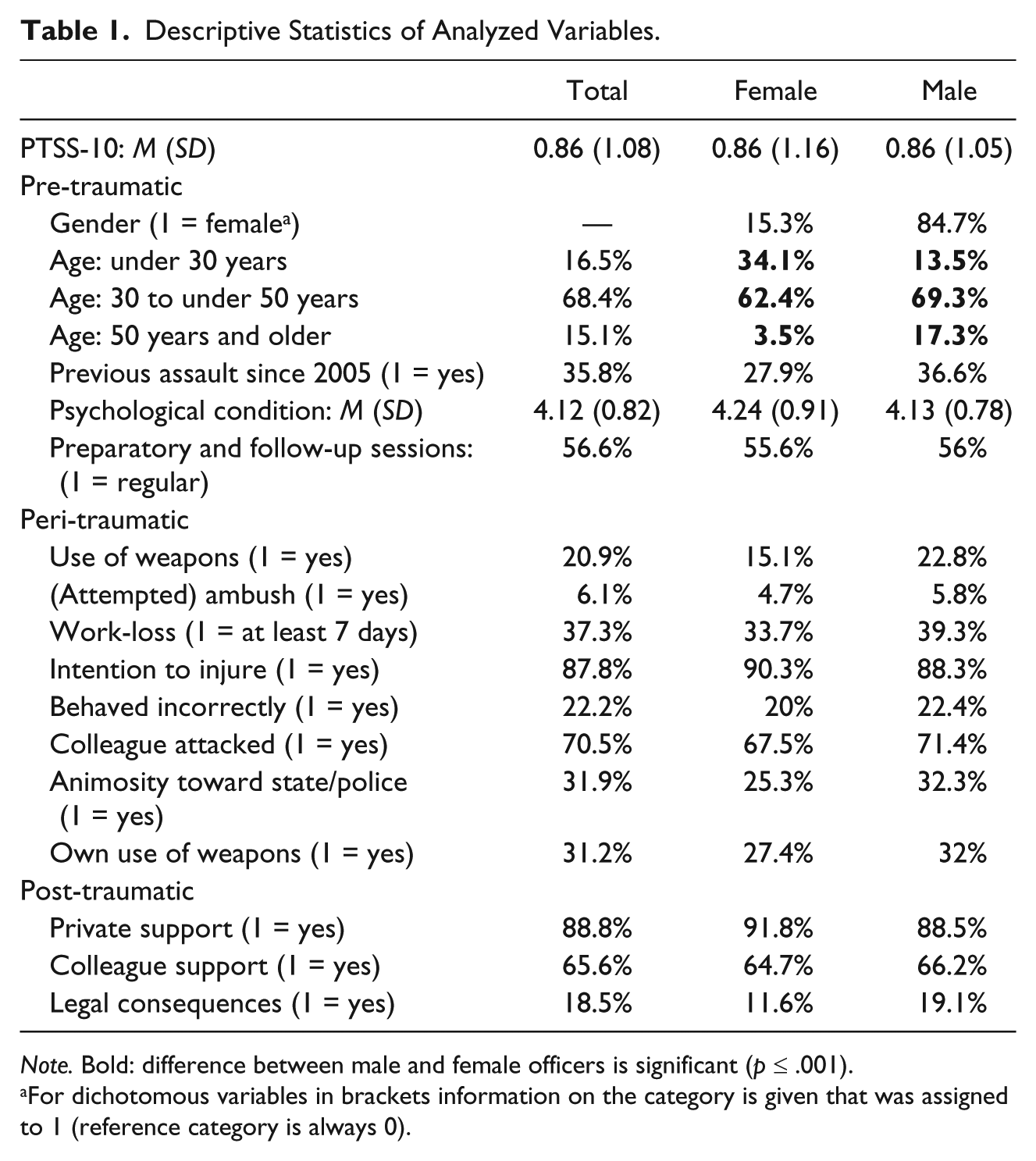
Note. Bold: difference between male and female officers is significant (p ≤ .001).
For dichotomous variables in brackets information on the category is given that was assigned to 1 (reference category is always 0).
Regarding peri-traumatic factors, weapons were used against the officer in about every fifth assault (20.9%), whereas assaults from an (attempted) ambush occurred in 6.1% of all cases. Somewhat more than one third of all officers (37.3%) reported a work-loss of at least 7 days. Furthermore, the majority of the officers assumed that the offender injured them intentionally (87.8%). The question whether they behaved incorrectly was affirmed by about every fifth officer (22.2%). In 7 of 10 cases (70.5%), colleagues were also attacked during the assault. A total of 31.9% of all officers reported animosity toward the police as a motive for the attack. The officers used weapons in 31.2% of all cases.
Almost 9 out of 10 officers (88.8%) received support from their partner, family, or friends following the assault. In contrast, support from colleagues was experienced less often (65.6%). About every fifth victimized officer had to face charges for his or her behavior after the assault.
Table 1 additionally shows descriptive findings for both sexes separately. Male and female police officers were affected by post-traumatic stress symptoms following an assault to the same degree (M of both = 0.86). With the exception of age, no significant differences between male and female officers were found. Female police officers were on average younger than their male colleagues (under 30 years old: 34.1% vs. 13.5%). This finding did not come as a surprise considering that an active promotion of females to the German Police Force has only been initiated during the past two decades.
Bivariate Analyses
One problem of the data set is the unexpectedly high number of missing values. Only 3 of the 17 variables had no missing values (PTSS-10, previous assault, work-loss). The proportion of missing values varied between the variables and reached 19.5% at the maximum (intention to injure). To solve that problem, a multiple imputation strategy was carried out. Using Mplus 6.11 (Muthén & Muthén, 2010), missing values were imputed via Bayesian estimation. This was done 20 times, meaning that 20 new data sets with imputed values were calculated (for categorical variables integer values were imputed). For the bivariate and multivariate analyses, parameter estimates were averaged over the 20 sets of analyses (Muthén & Muthén, 2010, p. 349).
Results of bivariate analyses using Mplus did not show all factors to be significantly correlated with post-traumatic stress symptoms. As most variables are dichotomous, a weighted least square estimator ( weighted least squares means and variance adjusted [WLSMV]) was used that calculated point biserial correlation coefficients for the corresponding correlations. Regarding general pre-traumatic factors, the demographical features sex and age were not significant (see Table 2). In contrast, previous experiences of assaults increased symptoms; whereas post-traumatic stress decreased the better the police officers’ psychological condition had been prior to the incident. The police-specific pre-traumatic factor was significantly correlated to post-traumatic stress: Officers suffered less post-traumatic stress if regular preparatory and follow-up sessions were held in their workplace; Hypothesis 1 was supported.
Correlations Between Post-Traumatic Stress and Pre-, Peri-, and Post-Traumatic Factors (n = 681, Estimator: WLSMV, Standardized Coefficients Are Shown).

p ≤ .05. **p ≤ .01. ***p ≤ .001.
Except for incorrect behavior and confrontation with weapons, all general peri-traumatic factors proved to be significantly correlated with post-traumatic stress. Officers reported higher symptom levels if the assault was executed out of an (attempted) ambush, if they had suffered from work-loss over a longer period of time, and if the assault was carried out with the intention of injury. Thus, two variables measuring trauma severity (ambush, sick leave days) as well as one variable measuring emotional reactions (intention of the offender) showed significant correlations with stress symptoms. With regard to the police-specific peri-traumatic factors, animosity was the only variable which increased the risk of post-traumatic stress symptoms, hence supporting Hypothesis 3. Neither an attack on colleagues (Hypothesis 2) nor one’s own use of weapons (Hypothesis 4) increased post-traumatic stress symptoms.
Considering the general post-traumatic factor of private support, no significant effect was found. The same was true for the police-specific post-traumatic factor of colleague support. Therefore, Hypothesis 5 had to be rejected. In contrast, results of the second police-specific factor were in line with Hypothesis 6: Facing legal consequences after the assault increased stress symptoms significantly.
Overall, the correlation coefficients tended to be small. Only in the cases of psychological condition (−.32), (attempted) ambush (.22), and intention to injure (.45), moderate correlations were found.
Multivariate Analyses
To consider the influence of all factors simultaneously, a regression analysis was carried out once again using Mplus and a robust estimator (maximum likelihood robust [MLR]). As mentioned previously, missing values were imputed. The results are presented in Table 3.
Linear Regression Model Predicting Post-Traumatic Stress (n = 681, Estimator: MLR).

p ≤ .05. **p ≤ .01. ***p ≤ .001.
Significant effects remained for six variables. A good psychological condition as well as regular preparatory and follow-up sessions reduced post-traumatic stress, whereas an (attempted) ambush, a longer work-loss, the intention to injure, and the confrontation with legal consequences had a symptom increasing effect. Compared with the results of the bivariate analysis, a notable drop of the effect for the following variables can be stated: previous assault, use of weapons, and animosity toward police or state. In the multivariate model, only Hypotheses 1 and 6 were supported, Hypothesis 3 was not. In the bivariate analyses, a significant effect of the corresponding variable (animosity) was found, so it can be concluded that this effect was mediated by other variables within the model.
Possible mediators of the animosity variable were examined in more detail. Using Mplus, a mediation analysis was carried out (see Geiser, 2010, p. 83; see Table 4). Confidence intervals (CIs) of the indirect effects regarding animosity were estimated via bias-corrected bootstrapping. The number of bootstrap samples was set at 10,000. Only factors were tested as mediators, which showed significant effects in the multivariate regression analysis. 2
Results of a Mediation Analysis (n = 653, Estimator: ML, Standardized Coefficients Are Shown).
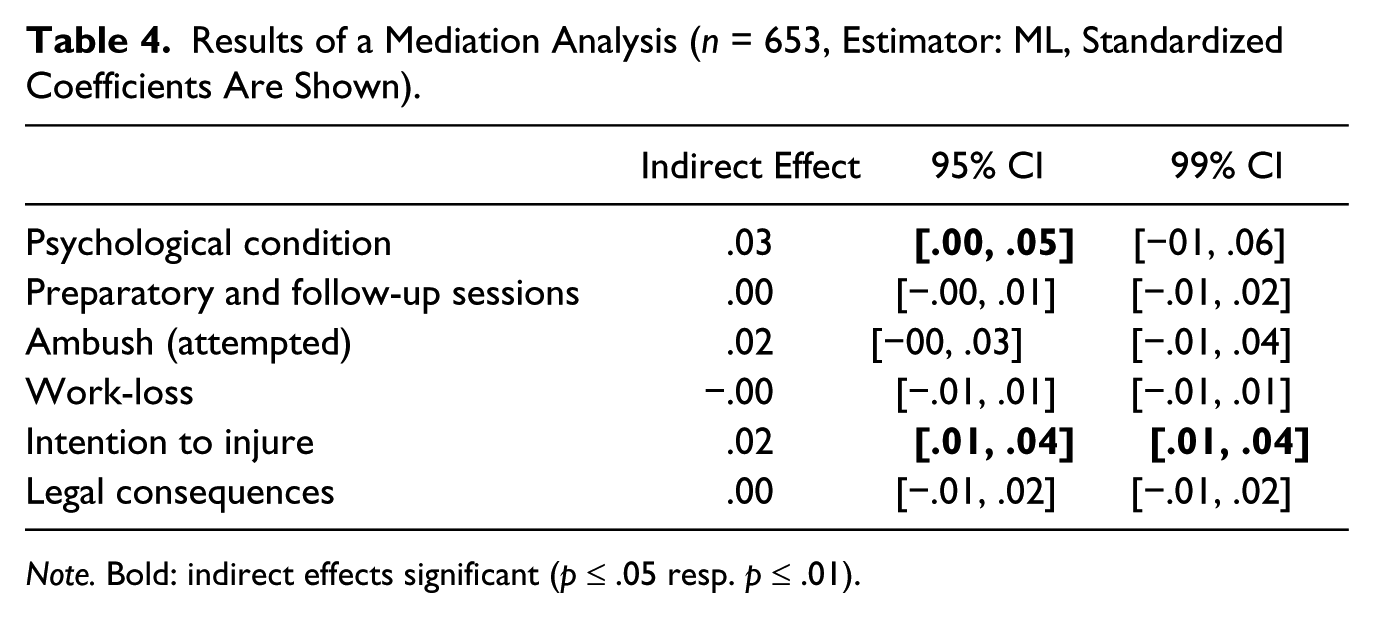
Note. Bold: indirect effects significant (p ≤ .05 resp. p ≤ .01).
Regarding the first variable in Table 4, the psychological condition, the average indirect effect of animosity was estimated at .03. This can be calculated in the following way: The correlation between psychological condition and post-traumatic stress was −.32 (see Table 2). The correlation between animosity and psychological condition was −.09 (not shown). Multiplying both correlations results in an indirect effect of .03. In 95% of the 10,000 bootstrap samples, the effect was estimated between .00 and .05. Thus, it can be concluded that there was a significant mediation effect of psychological condition at least at p < .05. The 99% CI included indirect effects below 0. Consequently, the mediation effect was not significant at p < .01 (see Geiser, 2010, p. 83). Because of the medium size of the sample, p < .05 significance level seemed appropriate for testing. Considering this, besides the psychological condition, only the intention for injury worked as a mediator. The general factors of psychological condition (psychological adjustment) and intention to injure (emotional reactions) mediated the effect of the police-specific factors of animosity toward police or state on post-traumatic stress symptoms.
To answer the research question on gender-specific pre-, peri-, and post-traumatic influencing factors, regression analyses were conducted for male and female officers separately. The results are presented in Table 5. The significance of the difference in the unstandardized regression coefficients were tested with a z-test using the formula of Paternoster, Brame, Mazerolle, and Piquero (1998, p. 862). As one out of five respondents provided no information regarding his or her sex, the number of cases decreased to 86 for female and 476 for male participants. Thus, the identification of significant effects was more difficult. Hence, the 10% significance level was reported additionally.
Linear Regression Model of Pre-, Peri-, and Post-Traumatic Factors Predicting Post-Traumatic Stress for Female and Male Police Officers (Estimator: MLR).
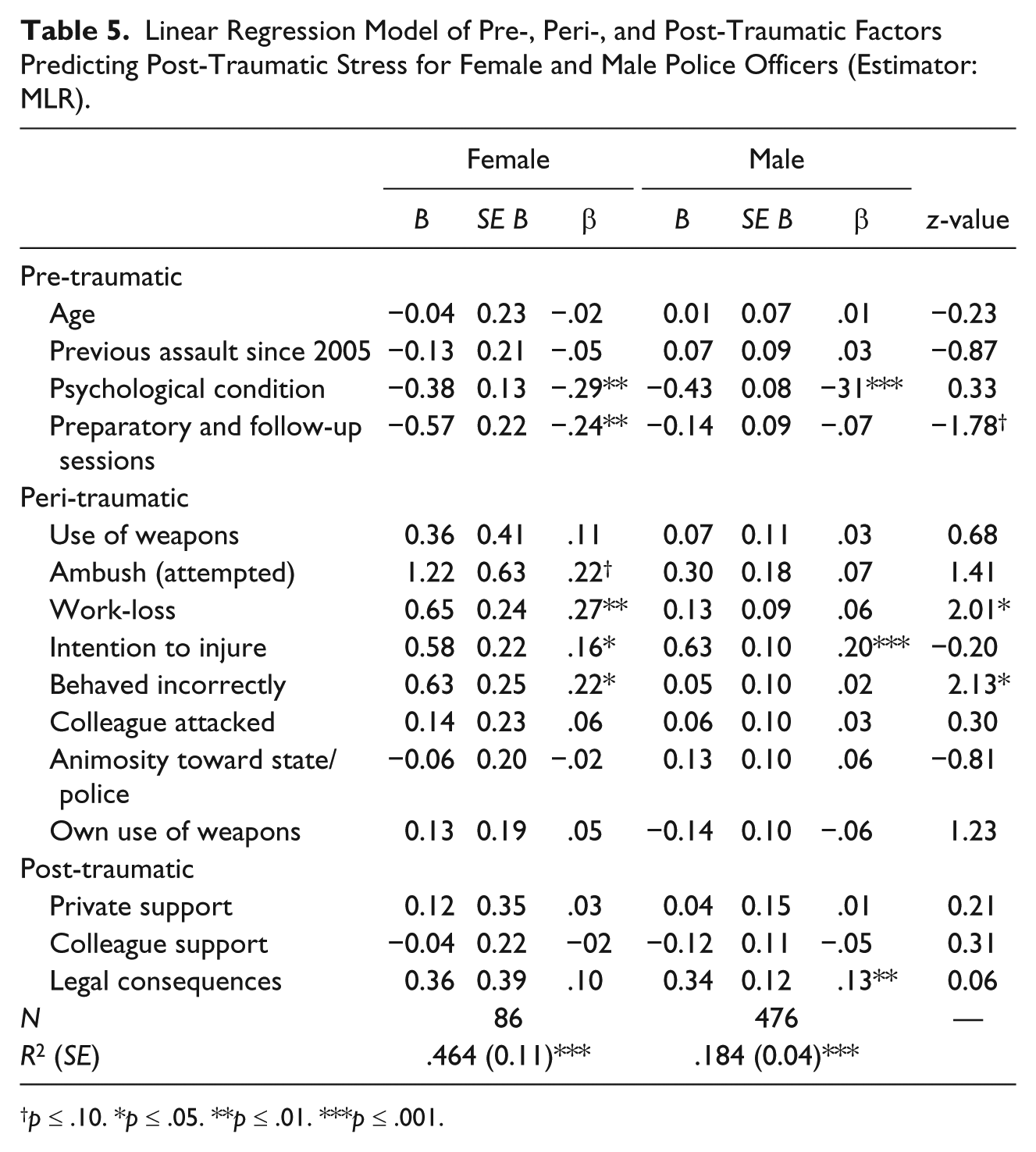
p ≤ .10. *p ≤ .05. **p ≤ .01. ***p ≤ .001.
On the one hand, findings showed some factors to be relevant in predicting post-traumatic stress regardless of the police officers’ sex. A good psychological condition had a symptom-reducing effect and the intention to injure a symptom-enhancing effect for males as well as females. On the other hand, significant differences were found for three factors. First, incorrect behavior clearly increased post-traumatic stress for female police officers, while this variable was no significant influencing factor in the male sample. Second, symptoms increased for female police officers when they were unfit for duty for at least 7 days, whereas the length of work-loss did not prove to be a significant predictor for post-traumatic stress in male police officers. Analogous, regular preparatory, and follow-up sessions only reduced post-traumatic symptoms in female officers, but not in male officers.
Looking at the explained variances of the models, a clear gender difference can be seen as well: A higher share of variance of post-traumatic stress symptoms were explained for female officers with 46.4% than for male officers with 18.4%.
Discussion
Based on a sample of 681 German police officers, who had been victims of a serious violent assault in 2009, the present study aimed at providing answers to three research questions: The first question posed was, whether factors known as risk or protective factors of post-traumatic stress symptoms in the general population were also relevant to the special group of victimized police officers. The second question asked for the existence of police-specific influencing factors for these symptoms. Finally, the question was raised, whether post-traumatic stress symptoms may have different influencing factors in male and female officers.
First discussing the findings on general factors, results of previous studies were confirmed only partly in our sample of police officers. A good psychological adjustment protected against post-traumatic stress. In addition, the more severe the trauma was (operationalized as ambush or days of work-loss) and the more initial reactions the officers showed (intention to injure), the stronger the stress symptoms were. These findings have practical implications. For instance, special attention could be paid to primary prevention (see also Huddleston, Paton, & Stephens, 2006) in a way that stress-protective features would be promoted more intensively. With that, psychological strain on the officers may be reduced, which in turn would help them to cope with violent assaults.
We did not expect to find correlations between demographic factors such as gender or age and post-traumatic stress (e.g., Marmar et al., 2006; Meffert et al., 2008). The results were in line with this assumption. In contrast, private social support did not reduce stress symptoms as it was expected. One reason for the missing effect could be the small variance of the variable. Almost 9 out of 10 officers reported social support by friends, family, and/or their partner. If nearly all police officers received support, it cannot be explained why reactions to the trauma vary between persons. A more differentiated measure of social support may lead to other results. Studies, for example, suggest that stress-reducing effects result rather from the perceived support than the received support (e.g., Kaniasty & Norris, 1992). This differentiation could not be tested here, as no corresponding instrument could be used.
If one compares the influences of the general factors on the basis of the multivariate model, it can be concluded that psychological adjustment and perceived intention to injure (emotional reactions) showed the strongest influence on post-traumatic stress symptoms. Trauma severity, on the other hand, had a lower predictive value. This is likewise confirmed by other studies (e.g., Becker-Nehring et al., 2012; Halligan et al., 2003; Maercker et al., 2000).
Regarding the second aim of our study, the test of police-specific factors, three out of six hypotheses were supported. First, we confirmed that regular preparatory and follow-up sessions were a protective factor (Hypothesis 1). Thus, establishing a regular culture of preparatory and follow-up sessions in the workplace seems to be an important primary preventive measure. Second, facing legal consequences in the aftermath of the assault had been found to be a risk factor for post-traumatic stress (Hypothesis 6). Facing such consequences may constitute a secondary victimization, which is known to increase psychological complaints (e.g., Campbell et al., 1999; Orth, 2002). However, other stress factors such as the officer’s fear of losing his job in the case of a conviction, may also play a role here. For the future, these findings do not mean that complaints should not be pursued to protect police officers from traumatic stress. Instead, studies are necessary for creating effective means to be able to support officers during such investigations.
Third, it was confirmed in the bivariate analyses that attacks that were experienced as motivated by animosity toward the police or state were associated with stronger post-traumatic stress (Hypothesis 3); in the multivariate analysis, this effect was no longer significant. An additionally conducted mediation analysis revealed that the influence of animosity is established via two factors: psychological adjustment and initial reactions. The interpretation of that finding may be that officers who affirmed animosity were not more likely to experience assaults by hostile offenders but tended to impute such a motive more often to offenders. Studies show, that as a result of occupational stress, officers tend to develop cynical and negative attitudes toward the general public which can, among other things, result in a more frequent use of force or victimization (e.g., Kop & Euwema, 2001).
Three hypotheses about police-specific influencing factors of post-traumatic stress symptoms, namely, Hypotheses 2, 4, and 5, were not confirmed in the analyses. We would like to discuss possible reasons for that in more detail subsequently. Results provide no evidence for the assumption that officers will show higher levels of post-traumatic stress when a colleague was attacked during the same incident (Hypothesis 2). Perhaps, not the attack itself but an injury of the colleague following the assault is more relevant for stress symptoms (e.g., Klemisch et al., 2005; Violanti & Aron, 1995; Weiss et al., 2010). Moreover, it may be important to the officer to what extent he or she blames himself or herself for the attack on his or her colleague (cf., for example, Weiss et al., 2010). Whether the colleague was injured or whether the officer blamed himself or herself for the attack on the colleague could not be tested in our study because there were no suitable indicators in the questionnaire.
Hypothesis 4 on an officer’s own use of weapons as a police-specific risk factor was likewise not supported. Maybe it is not the use of a weapon, but again the extent of the injury suffered by the offender, which is relevant for stress symptoms. In addition, the use of weapons might be judged as necessary, if one is in acute danger. Hence, officers who used weapons have a kind of neutralization technique, legitimizing the usage.
Based on studies conducted by Teegen et al. (1997) and Stephens and Long (2000) collegial support was assumed to be a police-specific resource, thus reducing post-traumatic stress symptoms (Hypothesis 5). Nonetheless, empirical evidence did not confirm this assumption. As already discussed in the case of private social support, a more differentiated instrument may have led to other results.
Regarding the third aim of our study, the analysis of gender-specific risk and protective factors of post-traumatic stress symptoms, we revealed three significant findings. First, the perception of one’s own incorrect behavior was associated with higher post-traumatic stress levels only in female officers. Blaming oneself because of mistakes may lead to negative emotional reactions such as guilt, self-doubt, or reduced self-esteem especially in female police officers. This may be explained by the fact that for a long time female officers were not considered to behave competent, especially in dangerous or violent situations (for an overview, cf. Rabe-Hemp & Schuck, 2007). Perhaps it might be that female officers still feel pressure to prove themselves, to be accepted by their male police colleagues (Brown & Carlson, 1993), with the result that they react more sensitively to their own mistakes.
Second, days of work-loss as an indicator of trauma severity was found to be a stronger predictor for post-traumatic stress in female police officers. Female officers reported more symptoms, when they suffered from work-loss for at least 7 days following the assault. Breslau and Anthony (2007) also report a stronger association between previous violent traumas and PTSD in women. One explanation could be that experiencing violence in the form of fighting, scraping, and scuffling is more part of the socialization process of boys not of girls (cf. Baier & Rabold, 2016). This may lead to stronger psychological or physiological reactions in woman, when they are confronted with violence (e.g., Bradley, Codispoti, Sabatinelli, & Lang, 2001; Domes et al., 2010).
Third, a culture of preparatory and follow-up sessions in the workplace reduced post-traumatic stress in female, not in male officers. Experiences of solidarity and communication with supervisors and colleagues associated with such sessions may be more helpful for female officers because relations with others are more important for a women’s identity, well-being, and several other psychological variables.
The three above-mentioned findings underline that studies on police-specific influencing factors on post-traumatic stress symptoms as well as on other phenomena are an important and eventually practical relevant task for the future. A comparison of the explained variances of the male and female model supports this conclusion: The analyzed factors were more suitable for predicting post-traumatic stress in female officers than in male officers. Other studies on the general population also found stronger associations between predictors and PTSD in women (e.g., Andrews et al., 2003). Likewise, Christiansen and Elklit (2012) stated that more knowledge is available on risk factors of PTSD in women. As the majority of the police force is male, a closer analysis of male-specific influence factors is necessary.
Finally, some limitations of the study have to be mentioned. First, because of the cross-sectional design only correlations could be analyzed. The question of causality has to be answered by future longitudinal studies. Furthermore, disadvantages that are associated with a retrospective survey should be taken into account when interpreting the results. Officers, for example, who report higher post-traumatic stress may also more often presume retrospectively that the offender acted with an intention to injure. In addition, the measurement of various factors can be improved. This applies to, as already mentioned, the measures of social support. However, this is true for the dependent variable as well: Post-traumatic stress symptoms were rated for a period of 4 weeks after the assault. There is no information to what extent the officers are currently suffering from the attack. Finally, attention should be given to the sample itself. On the one hand, only victims of serious violent attacks were surveyed, which means that the generalizability of the findings for police officers with other traumatic events is limited. On the other hand, only police officers, who were fit for duty at the time of the survey were able to take part. As people with more pronounced post-traumatic stress symptoms are more often absent from work (e.g., Breslau et al., 2004), officers who are greatly stressed are underrepresented in the sample.
Footnotes
Declaration of Conflicting Interests
The author(s) declared no potential conflicts of interest with respect to the research, authorship, and/or publication of this article.
Funding
The author(s) received no financial support for the research, authorship, and/or publication of this article.