







Abstract
This article presents a profile of intimate partner homicides (IPH) committed within London incorporating a gendered comparison of the perpetrators’ relationships. Data was sourced from the original police files for offenses committed in the capital between 1998 and 2009 (N = 207; 173 male and 34 female perpetrators). In common with other international descriptive studies, the results indicate comparative differences between partners according to perpetrator gender in terms of age profiles, employment status, experience of mental health issues, intoxication at time of killing, and possession of criminal convictions. Gender-based IPH descriptive studies have tended to focus on a collation of either victim or perpetrator or relationship characteristics, often in isolation from one another. Assessments of how parties interact within fatal relationships are invariably absent, and yet, it is the relationship that forms the backdrop against which the fatal acts are perpetrated. This study, therefore, not only provides an insight into the profile of IPH committed within London where none had previously existed but also demonstrates the advantages of incorporating relationship concordance measures. The inclusion of such measures when researching IPH assists homicide investigators in understanding the dynamics taking place within the cohort of fatal relationships they police. It also provides researchers a useful platform to enhance understanding of this crucial aspect, for it is the relationship itself which is what defines IPH and distinguishes as a unique subset of homicide.
Keywords
Introduction
According to the most recent population census, in 2011 London had a resident population of 8.174 million people (Office for National Statistics, 2011). The capital’s murder rate stands at less than 2 per 100,000 of the population. This is lower than Paris or Copenhagen but higher than Rome and Madrid (European Commission, 2010). As within many European capital cities, London has seen a welcome and sustained decline in the homicide rate. During the 6 years ending in April 2014, homicide victim numbers fell from 147 to 98. However, such decreases have not been uniformly experienced across all categories of London homicides. London’s intimate partner homicide (IPH) total has remained consistent, averaging 18 homicides per year. London’s overall homicide decline, against the concurrent IPH stability, increased the percentage contribution of IPH to the homicide total in the capital from 12% to 20% between 2008 and 2014.
London itself represents 14% of the total population of England and Wales, and its IPH stability is at odds with the national trend. The total homicide count reduced from 640 to 551 over the same 5-year period (14% reduction), and IPH numbers experienced a proportionally greater decline, from 135 to 92 (32% reduction; Office for National Statistics, 2014). The London trend may differ from those experienced nationally due to the capital experiencing the highest population increases in the United Kingdom, immigration of new and diverse communities, and higher crime levels than elsewhere in England and Wales (Watts, 2013).
The Home Office, through the Homicide Index, captures measures of the number of homicides committed within the United Kingdom and publishes national homicide statistics within the “Annual Crime Report of England and Wales.” This report catalogues victim gender and relative association to perpetrators. However, at a national level, there is limited granularity in these official data to formulate a national profile of IPH or furnish an understanding as to the exact nature of the offenses taking place. Prior to this study, there had been no in-depth research examining London’s IPH profile by the Metropolitan Police Service itself (the body charged with the criminal investigation of such homicides), governmental bodies, or academic institutions. There had been no collation of the detailed information that was available to examine this cohort of fatal relationships and the dynamics that existed between the victim and perpetrator.
Many descriptive IPH studies have presented data analysis of either the victim, suspect, or offense characteristics (Aldridge & Browne, 2003; Brookman, 2005; Campbell, Glass, Sharps, Laughon, & Bloom, 2007; Garcia, Soria, & Hurwitz, 2007). What has been noticeably absent in policing and academic research of IPH is an integration of the dynamics of couples’ relationships within the more usual victim/perpetrator/offense IPH-typology-focused approaches. As noted by Standish (2012), The shortcomings of the traditional perspectives on domestic violence (DV), is that they have tended to treat the violence as a problem belonging to the individual rather than the couple. The dynamics of the couple relationship are not taken into account regarding the development and perpetuation of the violence. (p. 3)
It is precisely the dynamics of how the partners combine that is the backdrop against which fatal violence is enacted. Research of IPH gains a greater richness when information regarding how victim and suspect characteristics concord with one another is included. Incorporating such data allows police and social-care agencies to identify patterns and trends in fatal relationships within their jurisdictions. Practitioners can better relate to the phenomena they investigate. Establishing and identifying trends, given the instability and diversity of populations within policing areas, may assist in devising locally based preventive tactics and risk assessment tools. For instance, should there be a rise in alcohol-related IPHs where both partners were known to have abuse issues, then reviews of the appropriateness of service provision can be commissioned. The same would be true where both partners had previous contact with criminal justice agencies. Reviews of post conviction intervention opportunities could be sought as a homicide prevention strategy.
This descriptive study addressed this issue by including an assessment of the perpetrators’ relationship and how variables concord with that of their partner and eventual victim within the overall examination of victim, perpetrator, and general relationship variables. This article is sectioned as follows: a summary of non-London based IPH profiles, an explanation of the data set compilation, presentation of the victim−perpetrator relationship variables and couple concordance findings, and a discussion of these results. The limitations of the research are reviewed, and finally, a consideration of how such data can be used in future research and the policing of domestic abuse and investigation of IPH are presented.
Background: IPH Victim−Suspect Relationship Profiles
Due to the significant impact of DV both for the individual and society in terms of health, social welfare, and criminal justice provision (van Wormer & Roberts, 2009), a number of useful meta-analyses profiling the characteristics of IPH have been conducted (Aldridge & Browne, 2003; Campbell et al., 2007; Dawson, Bunge, & Balde, 2009; Dawson & Gartner, 1998; Garcia et al., 2007). When such descriptive IPH studies are distilled through the lens of victim or perpetrator gender, a comprehensive and relatively consistent profile of demographic and relationship characteristics emerge. Key trends are summarized below.
Victim and Perpetrator Characteristics
Gender
In terms of perpetration, men commit approximately 79% and women 21% of IPHs within England and Wales (Brookman, 2005). In the United States, the proportions have been recorded at 71% and 29%, respectively (Jensen, 2001).
Age
In a comprehensive review of IPH research, Garcia et al. (2007) established that the average age range for female IPH victims is 30 to 40 years, whereas it is 40 to 50 years for men. However, both men and women are at greatest risk of IPH between 20 and 29 years. The average age for male perpetrators was 34 years (Moracco, Runyan, & Butts, 2003). Weizmann-Henelius et al. (2012) established that there was no significant difference in the mean age of male (38 years) and female (40 years) IPH offenders. Age disparity between partners is a key feature within spousal homicides. A disparity of 10 years or more is a risk factor for both men and women (Aldridge & Browne, 2003; Shackelford, 2001; Wilson & Daly, 1992).
Ethnic origin
African American ethnic groups experience both proportionately higher levels of IPHs and higher sex ratio of killing rates when compared with other groups (Moracco et al., 2003; Titterington & Harper, 2005; Websdale, 1999; Wilson & Daly, 1992). According to Riedel and Best (1998), 90% of victims killed by African American women are their husbands, partners, or boyfriends. The influence of ethnic origin over IPH is difficult to assess as the majority of research has been conducted within U.S. metropolitan areas that have racial profiles very specific to those locations. Cross-comparisons and interpretation are therefore limited. Any interpretation of the disproportionate over-representation of African Americans must also be set within the context of the social, cultural, economic, and political position of this group within American history rather than any ethnic determinism toward intimate partner violence, which these figures might tend to suggest.
Alcohol and drug use
There is a significant association between alcohol and drug use and DV. Garcia et al. (2007) established that alcohol was an issue in 73.3% of IPHs where both partners have chronic alcohol dependency issues. Perpetrator alcohol use was associated with 45% of female IPHs by Moracco et al. (2003). However, Campbell et al. (2007) identified that while male chronic alcohol abusers are more likely to be victims than perpetrators, female alcoholics are less likely than their male counterparts to be either victims or perpetrators.
When associated with alcohol, illicit drug use is also a significant factor associated with male perpetration. In a 11-city U.S. study, 70% of male perpetrators had been using both alcohol and/or drugs at the time of killing their partner (Campbell et al., 2007). These results are repeated in another 10-city study where two thirds of the perpetrators of attempted or actual DV homicide admitted to taking a combination of alcohol and/or drugs prior to the incident, whereas one quarter of the victims had abused alcohol or drugs prior to their deaths (Sharps, Campbell, Campbell, Gary, & Webster, 2003).
Mental illness
A U.S.-based research suggests that between 13% and 27.5% of perpetrators of IPH have a history of mental illness (Campbell et al., 2007). Dutton and Kerry (1999) have identified particular mental health conditions and personality types that appear to be associated with particular forms of partner killing. Over-controlled and dependent personality types possessing an inability to express rage are most commonly associated with partner and particularly estrangement killings. Those with antisocial personality disorders were more inclined toward instrumental killings for gain. Hypersensitive, passive or aggressive, depressive, and paranoid personality types are all associated with IPH perpetrators (Aldridge & Browne, 2003). In measuring mental health and domestic homicide in the United Kingdom, Oram, Flynn, Shaw, Appleby, and Howard (2013) recorded that 20% of IPH perpetrators suffered from mental illness compared with 10% of non-IPH perpetrators. There has been limited research regarding the victim’s mental health, which suggests that 29% of female victims of attempted or actual murder had a prior mental health issue (Campbell et al., 2007).
Previous criminal convictions
Previous criminality has been recognized as a significant factor in IPH (Eriksson & Mazerolle, 2013; Felson & Messner, 2000). Its potential influence is explained through the operation of low impulse control, peer delinquency, subculture, and general strain theory.
Relationship Characteristics
Marital status
There are mixed research findings as to the influence that type of union has on IPH. Cohabitating, non-legalized, and “common law” unions had been identified as a major risk factor with legal marriage appearing as a protective factor. Research into Canadian DV homicides between 1974 and 1990 established that cohabiting women were 8.4 times more likely to be killed by their partners than married women. Within this study, cohabiting men were 15 times more likely than their legally married counterparts to be killed by their partners (Wilson, Daly, & Wright, 1993). The trend toward a greater risk of homicide within cohabiting relationships was also replicated in both the United States and Australia (Shackelford, 2001; Shackelford & Mouzos, 2005). The elevated risk levels of cohabiting couples appears to be due to partners being younger, less economically and emotionally secure, and childless, all of which act as stressors with the relationship (Aldridge & Browne, 2003). However, research conducted since 2005 suggests an increasing trend toward equalization of risk rate between the union types in the United States and Canada. Societal attitudes have changed, leading toward an increased acceptance and practice of cohabitation (James & Daly, 2012).
Estrangement and separation
In a cross-national study of the United States, Australia, Canada, and the United Kingdom, physical and legal separation were found to be a significant risk factor within the first 1 to 3 months of estrangement (Browne, Williams, & Dutton, 1999; Wilson & Daly, 1993). The “if I cannot have you no one will” murders are primarily centered on female victims. In the previously cited review of 310 murders in 11 U.S. cities, Campbell et al. (2007) found that 55% of female DV homicide victims were separated from their partners when they were killed. A similar trend was established in research from Australia where 45% of female domestic homicide victims had left, or were in the process of leaving, their partners (Aldridge & Browne, 2003). The same levels of risk do not appear to be in operation in male victimization where only 3% of men were found to have left the relationship (Wilson & Daly, 1993).
Although estrangement has been identified as a significant risk factor associated with DV homicide, the exact impact of separation has been difficult to quantify. There are mixed research findings, but some suggest approximately 70% of IPHs were actually within “intact” unions (Campbell et al., 2007). However, the process of separation is often long and drawn out and many relationships would be classified as still intact when in fact partners are living estranged lives. Thus, generalization around definitive intact/separated relationship states is an ambiguous categorization. The importance of this issue is not the categorization of whether a relationship is intact or not but an understanding of the dynamics, process, and ability of partners to accept estrangement.
DV history
A history of relationship violence has been identified as a significant factor with the chronology of IPH. Campbell et al. (2007) suggested that a history of domestic abuse against female partners is a significant characteristic in 75% of all DV homicides, regardless of the actual gender of the eventual victim. In a review of 293 female intimate partner killings recorded in North Carolina between 1991 and 1993, 66.9% had documented histories of precursor DV, 36% had had contact with law enforcement in the 12 months prior to their deaths, and 9% of female victims had obtained non-contact protective orders (Moracco et al., 2003).
Parental status
Approximately 8% of IPHs are witnessed by the couples’ children (Lee, 2010). Stepchildren present a substantial risk factor of lethal violence for their mother. From a Canadian study, women with children sired by a previous rather than their current partner were 12.7 times more likely to be killed than those who had biological children with their partner (Daly, Wiseman, & Wilson, 1997). The same trend was replicated by research conducted in the United States (Brewer & Paulsen, 1999; Miner, Shackelford, Block, Starratt, & Weekes-Shackelford, 2012). In addition, pregnancy has been identified as a significant risk factor in domestic homicide, particularly if domestic abuse is present within the relationship (Campbell et al., 2007).
Current Study—Data and Method
For the purposes of this research, IPH is defined as the murder or manslaughter of a person perpetrated by a current or previous spouse, common-law partner, girl/boyfriend, or any person of the opposite sex with whom he or she has had a romantic or intimate heterosexual relationship, wherein there has been a criminal justice outcome in terms of conviction at a Crown Court or Coroner’s Court ruling. IPHs within same-sex relationships were excluded from this research, as there were too few (6) for any meaningful statistical analysis to be conducted.
Time parameters were set to fall between the financial years of April 1, 1998, and March 31, 2009, in order that all cases would have been subject to the Criminal, Appeal, or Coronial Court processes. (This included all cases that had judicial ruling of either homicide/suicide, murder, manslaughter, and not guilty by reason of insanity.) Of the 233 initial allegations of IPHs recorded by the Metropolitan Police Service between April 1998 and March 2009, 26 cases were investigated and found either not to be a criminal offense or the perpetrator was found not guilty at trial. Overall, 207 IPH relationships fell within the research parameters (173 female victim/male perpetrator and 34 male victim/female perpetrator).
The original computer and paper-based files of these 207 homicide investigations conducted by the Metropolitan Police Service were reviewed and coded and used to populate the research data set. The materials contained within these files included crime scene photographs, perpetrator interviews, witness statements, post mortem reports, and trial transcripts.
The following sets of variables were measured for each of the four categories within the data set: Victim—gender, age, ethnicity, employment, socio-economic code, post mortem intoxication levels, presence of mental health issues, and previous adult criminal conviction. Perpetrator—gender, age, ethnicity, employment, socio-economic code, presence of mental health issues, presence of additional victim or perpetrator in the commission of the offense, and presence and nature of a previous conviction. In terms of relationship measures, these was considered by perpetrator gender, and the following variables were established: status, cohabitation, length of relationship, presence of children, and antecedent relationship violence. Previous relationship violence was coded according to whether there had been previous official reports or information provided by witnesses or third parties identified during the police investigation. Uniquely, building in the importance of the relationship into the IPH profile, the levels of concordance of these same variables within the perpetrator−victim relationship were measured. Non-parametric test results have been included to allow for an appreciation of the statistical significance levels of the measured variables according to gender.
Victim and Perpetrator Characteristics
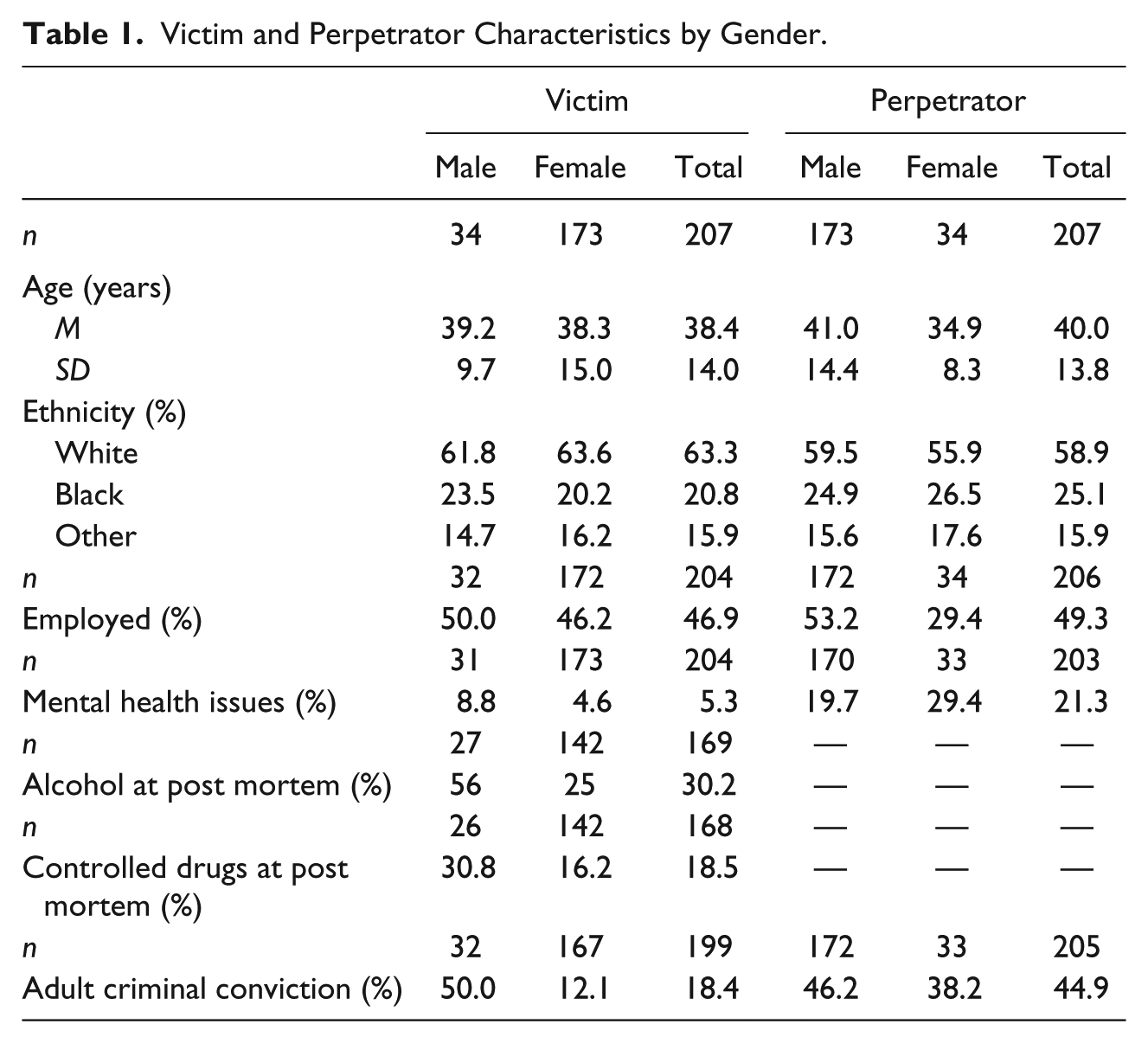
Full results are presented in Table 1.
Victim and Perpetrator Characteristics by Gender.
Gender
Of the 207 heterosexual IPHs considered, men perpetrated 84%. The total data set comprised of 173 female victims killed by male perpetrators and 34 male victims killed by female perpetrators.
Age
Male victims were aged between 26 and 67 years (M = 39 years; SD = 9.7 years). Although there was a similar average age of 38 years for the female victims within the data set, there was more variation in age, ranging from 15 to 98 years (M = 38 years; SD = 14.9 years). There were four cases (2.3%) where the female victim was aged 18 years or below. There were no instances of male teenage victims. In 7% of homicides within the data set, either the victim or perpetrator was aged 20 or below. A Mann−Whitney test concluded that age distribution was the same across both male and female victim cohorts (p > .05).
Female perpetrators were aged between 18 and 53 years (M = 35 years; SD = 8.3 years). There was a broader variation in the age of male perpetrators, who ranged from 16 to 94 years (M = 41 years; SD = 14.4 years). A Mann−Whitney test indicated that there was a statistically significant difference in the age distribution between the gender profiles (p < .05). This is the result of the contribution of a cohort of male perpetrators aged 55 and above that is not reflected within the female perpetrator pool. Of those homicides committed by men aged 55 and above, 20% related to what is commonly described as “mercy killings” where partners suffering from painful or terminal illness are killed by their spouses.
Ethnic origin
In total, the victim ethnic profile measured 63% White, 21% Black, and 16% Other (Asian, Oriental, or Arabic). There is a similar distribution pattern across both genders. Of the male victims, 62% were White, 23% were Black, and 15% were classified as Other. Of the female victims, 64% were White, 20% were Black, and 16% were classified as Other. The total ethnic origin perpetrator profile equates to 59% White, 25% Black, and 16% Other. Of the female perpetrators, 56% were White, 26% Black, and 18% Other. There is a broadly similar distribution of ethnic origins across the male perpetrator pool at 59% White, 25% Black, and 16% Other. In 2006, a comparable point within the research parameters, 67.57% of London’s population were White, 19% were classified as Other, and 13.5% were of Black African/Caribbean origin (Greater London Authority, 2010). When compared with London’s general ethnic make-up, there was a disproportionate representation of people of Black ethnic origin as both victims (21%) and perpetrators (25%).
Drug and alcohol use
In total, 25% of victims were above the drink-drive limit (post mortem toxicology detected levels of 32 mg of alcohol per 100 mL of blood, which is the U.K. legal threshold drink-drive level). The toxicological results indicate an unequal gender distribution in alcohol presence and level at the time of death. More than half of the male victims (52%) were above the drink-drive limit at the time of death, recording levels of more than 32 mg per 100 mL blood. This percentage was halved within the female victim cohort, where 22.5% had post mortem blood alcohol levels above 32 mg. There was a significant association between the victims’ gender and the presence of alcohol at the time of death, χ2(1) = 9.84, p < .01, emphasizing the higher levels of intoxicated male victims.
There was also a difference by sex in the recorded levels of alcohol intoxication. Female victims displayed a range of 40 mg to 476 mg per 100 mL of blood. The male victims had a higher initial threshold level, and thus were more intoxicated when killed compared with the female cohort, with levels ranging from 104 mg to 422 mg per 100 mL of blood.
When compared with alcohol use, there were lower rates of substance abuse among the victim cohort with 15% having evidence of controlled drug use. There was an uneven but non-significant distribution of the presence of drugs between the gender profiles. With samples primarily attributed to cannabis and cocaine use, 31% of males tested positive for the presence of controlled drugs. In relation to female victims, 16% indicated positively for the presence of drugs showing a mixed usage pattern (cannabis, heroin, amphetamine, and cocaine) across the cohort. Combined drug and alcohol usage was more prevalent in the female victim group (N = 10) than the males (N = 4).
There are only 15% cases where perpetrators were arrested within hours of the offense and the necessary blood/urine samples taken and the results available in the research material. Of those, a greater percentage of females (33%) than males (13%) were above the drink-drive limit at the time of committing the offense. Of the 23 male perpetrators, their alcohol levels ranged from 45 mg to 376 mg per 100 mL of blood. Ranges were considerably higher in relation to the 8 female perpetrators whose levels ranged from 110 mg to 288 mg per 100 mL of blood. There is a similarity in the percentages of controlled drug use among perpetrators. Where drug toxicology data are available, 21% male perpetrators and 29% female perpetrators indicated positively in their arrest samples. In opposition to the victim profile, female suspect use related to cannabis and cocaine. Male perpetrators showed a mixed-use profile of heroin, methadone, cocaine, Khat, and diazepam. In all, 15% of female perpetrators and 6% of male perpetrators tested positively for the presence of both illegal drugs and alcohol.
Mental health issues
When considered by victim total, 5% suffered from mental illness issues. As indicated in Table 1, there is a numerical (but non-significant) disparity in the presence of mental health issues by the victim gender. Rates displayed by male victims were almost double that of female victims at 8.8% and 4.7%, respectively. Again, it is the presence or absence rather than any specific detail that has been considered in relation to mental health. Total recorded levels at 21% were higher within the perpetrator rather than victim pool. When considered by gender, 20% of male and 30% of female perpetrators were found to have recorded mental health issues. Although exact figures are difficult to ascertain, it is believed that 1 in 6 people experience mental health difficulties at any one time (Greater London Authority, 2014), so the levels of IPH victim mental health fall below the estimated average.
Possession of adult criminal conviction
There appears to be a significant association between previous criminal history and IPH with 53% of male and 13% of female victims and 46% of male and 38% of female perpetrators possessing adult criminal convictions. These totals exceeded the national average of 33% and 9% for males and females, respectively (Ministry of Justice, 2010). Male victim criminal antecedence was a highly significant variable associated with male victim status, χ2 (1) = 28.52, p < .0001. The level of recorded criminal convictions within the female perpetrator cohort at 39%, although not statistically associated with perpetrator gender, far exceeds the national average for women within the overall population.
Employment and socio-economic classification (SEC)
Of the male victims, 51.5% were employed, 48.5% were either unemployed or retired. For the female victims, 53.2% were either unemployed/housewife or retired compared with 46.8% who were employed.
SEC was established through measuring economic status and profession against the Office for National Statistics SEC grading (Office for National Statistics, 2010). Occupations were given a score of between 1 and 8 depending on whether they fell in managerial, professional, technical, manual, or service grading. Of the total victim population, 45% received an SEC code. The majority, 65% were classified as being within semi/routine employment, 27% as intermediate or lower managerial, and 4% within the higher professional bracket. The classification of socio-economic status indicates a degree of variance between male and female victims. There was a higher percentage (18%:12%) of female to male victims falling into the professional/managerial categories. There were no female victims employed within lower supervisory technical professions while this accounts for 18% of the employment of male victims. The remaining SEC categories were evenly distributed across victim gender.
In total, 49% of perpetrators were employed. There were more women than men unemployed at the time of committing the offense. Data indicated that 71% of the female perpetrators and 46.5% of male perpetrators were classified as unemployed/housewife/retired. There is a statistically significant relationship between suspect gender and employment, χ2(1) = 6.58, p < .01; V = 0.179. Greater numbers of male perpetrators than expected were employed. There was more than the expected frequency of females in the unemployed bracket.
When considered by total, there is a similar SEC distribution among the perpetrators as compared with the victim cohort with 61% coded as semi/routine, 17% intermediate or lower managerial, and 6% within the higher managerial/professional bracket. Reflecting the female victim data, there were a higher proportion of female perpetrators within the upper SEC classifications, with 18% classed as managers/professionals as opposed to 10% of male perpetrators within that category. However, although in percentage terms this appears significant, limited interpretation can be applied due to the small numbers within the data sample. There were no female perpetrators in the small employer or technical categories, whereas this made up 17% of employed male perpetrators. For both genders, the majority were employed within the semi/routine category.
Relationship Characteristics
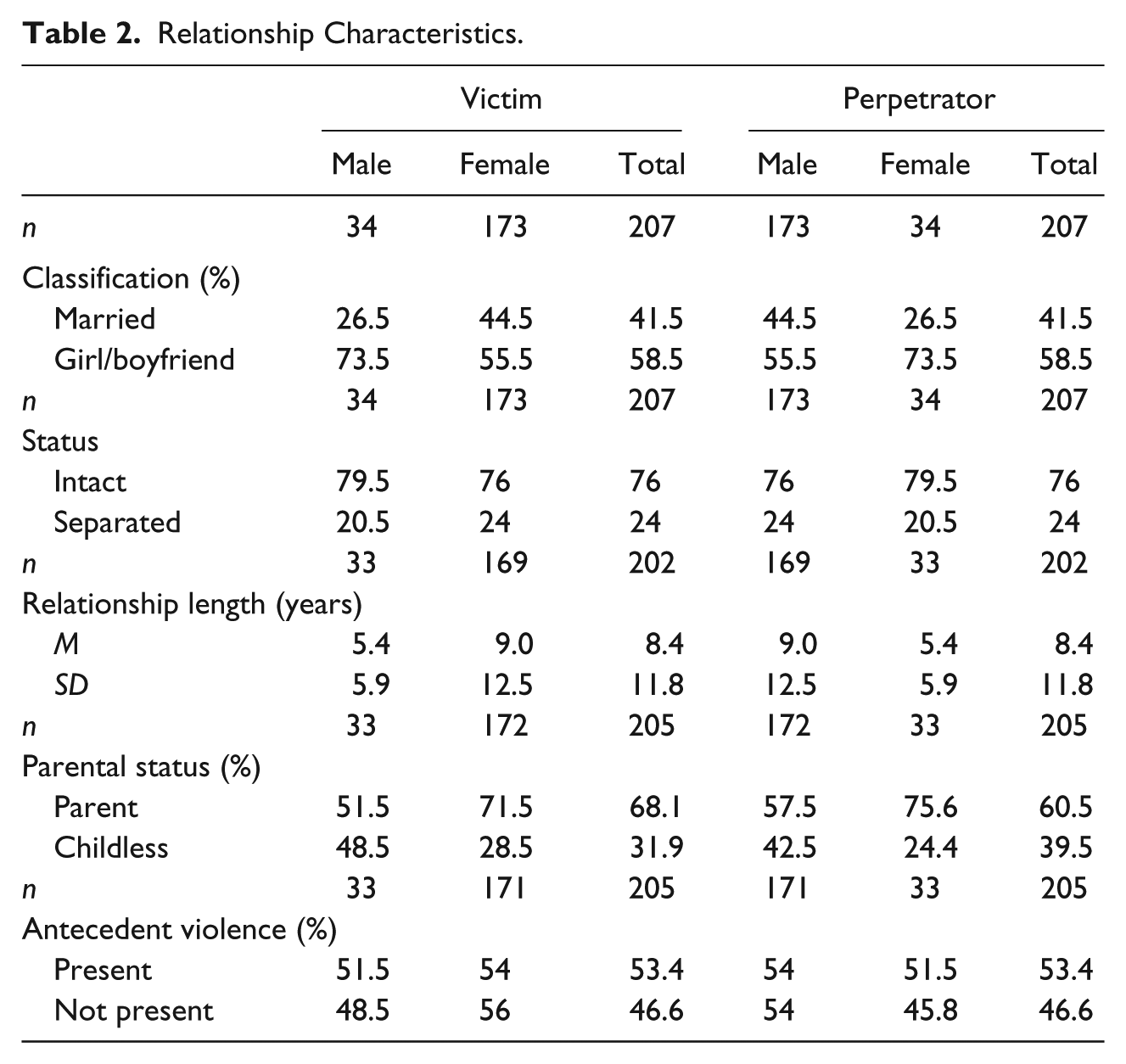
Relationship classification, status, length, presence of children, and antecedent abuse were coded according to perpetrator gender. Full results are presented in Table 2.
Relationship Characteristics.
Relationship classification and status
Legalized marriages appeared to be a protective factor with 60% of the murders taking place within non-legalized girl/boyfriend relationships. Women were more likely to kill their boyfriends rather than their husbands, χ2(1) = 3.8, p < .05.
There was a matched distribution across perpetrator gender in terms of whether the couples were together or had separated at the time of the offense. In total, couples were more likely to be together (76%) rather than actually separated (24%) when the offense occurred.
In total, 39% of all IPHs took place in relationships of below 3 years in length. The majority of relationships (70%) had been together 10 years or less when the homicide took place. When considered by gender, male perpetrators had a greater variance in their relationship span, the shortest relationship length prior to death being 2 weeks and the longest being 50 years and above. The female perpetrator cohort had a narrower relationship length variation, 3 months to 20 years. A Mann−Whitney test, however, concluded that there was no statistical association in terms of perpetrator gender and relationship length (p > .1).
Parental status
Poignantly, 78% of homicides related to relationships that had children associated with them. This indicates the devastating social tragedy such murders present, as children lose both their parents as either the perpetrator or victim. There were significant perpetrator gender associations in relation to whether stepchildren were associated with the relationship. Children sired outside the signature relationship, particularly to women, are a key variable associated with perpetrator gender. More than half of the women killed within London between 1998 and 2009 had children born to fathers outside the signature relationship.
Antecedent relationship abuse
Of significant note, 47% of homicides took place in relationships with no recorded precursor abuse or violence according to the police investigation of the death. Thus, a significant proportion of relationships had no potential warning indicators.
Comparative Relationship Concordance
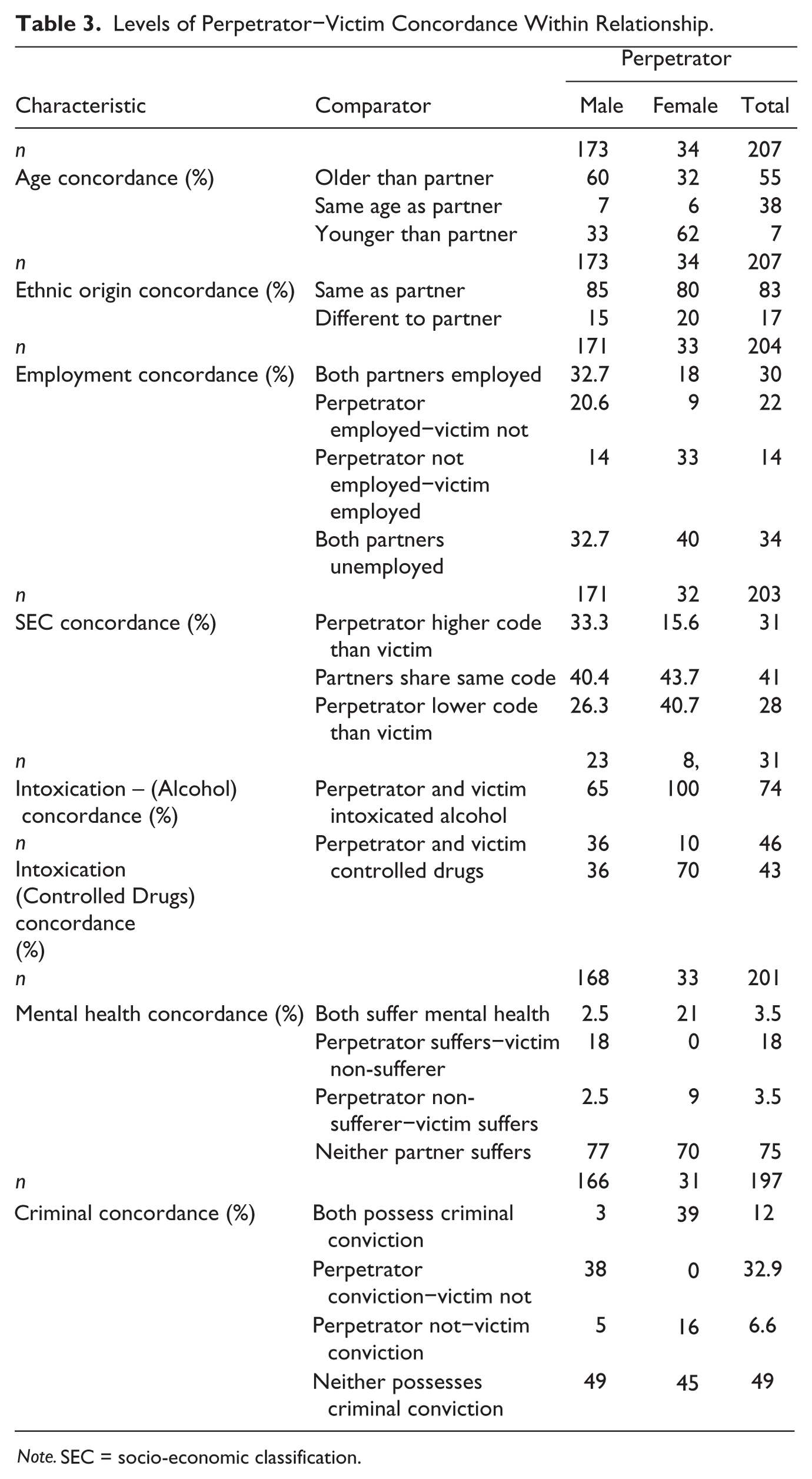
Thus far the characteristics of victims and perpetrators have been considered in isolation, however the profile is enhanced when how they combined, as a couple within their relationships is included. These additional data provide a contextualization of key relationship dynamics within which IPH takes place. Full results can be found in Table 3.
Levels of Perpetrator−Victim Concordance Within Relationship.
Note. SEC = socio-economic classification.
Age difference
When viewed by percentage distribution, 62% of female perpetrators were younger than the men they killed, 32% older, and 6% of the same age. The ratios are reversed when considering male perpetrators; 59.5% were older than their victim, 33.5% younger, and 7% of the same age. Female perpetrators were generally younger than the male partners they killed (M = 4 years younger; SD = 10 years; variance = 47 years younger-10 years older). Male perpetrators were marginally older than their female victims (M = 3 years; SD = 8 years; variance = 21 years younger-32 years older). Mann−Whitney test results indicated that there was a statistically significant difference in distribution (p = .001).
Ethnic origin
Seventeen percent of the total data set related to relationships, where couples were of differing ethnic origins. There is a minor quantitative gender difference in the distribution of such relationships with 20% of male victims but 15% of female victims being killed by a partner of a different ethnic origin. Of the mixed ethnicity relationships, the most common combination (32%) were Black male perpetrators in relationship with White female victims.
Employment status
More than half (56%) of female perpetrators matched the status of their partner. The remaining cases were equally divided between those couples where the female was employed but her partner was not and vice versa. There was a similar pattern when considering the male perpetrators’ employment status in relation to that of their partner. Here, 58.3% men had the same status where either both were employed or unemployed. In 25% of cases the male was employed and the victim was not, whereas 17% of female victim were employed and the perpetrator was not.
SEC
The degree of disparity between the respective SEC classifications was considered. In relation to female perpetrators, 15% were of a higher grading, 41% of the same, and 38% of a lower grading than their victims. In the case of male perpetrators, they were generally of a higher classification, with 31% of higher status, 26% of lower, and 40% the same grading.
Intoxication at the time of use of lethal violence
Of the 13% of perpetrators who were arrested as soon as, or shortly after, they had killed, intoxicated female perpetrators showed 100% concordance as both suspect and victim were recorded as being above the drink-drive limit. There was a 70% concordance in relation to female perpetrated killings with both her and her victims having positive toxicology results for the presence of controlled drugs. Male perpetrators’ concordance with their victims’ level of intoxication were not so closely aligned, with 65% both partners above the drink-drive limit and 36% both partners had used controlled drugs at the time of the killing.
Mental health issues
There was some gendered discrepancy in the presence of mental health issues within the couples. In 20% of cases, female perpetrators suffered from mental health issues, whereas this appeared absent for her male partner. There were no cases where the male suffered mental health issues and the female perpetrator did not. In relation to male perpetrators, 5% suffered from mental health issues and their female victims gave no indication of any issue. In 2% of cases, the female partner had mental health issues as opposed to the male perpetrator.
Previous adult convictions
In the case of the female perpetrators, there was a balance between those relationships where either both partners did or did not have an offending history (35% and 41%, respectively). In 15% of cases, the male victim had an offending history but not his partner. There were no examples of cases where the female perpetrator had a previous conviction but her partner did not. This balance was not reflected in the male perpetrator relationships. Although similar to the female perpetrator cases in terms of neither partner having a conviction (50%), there were fewer cases where both had convictions (7%). In 5% of cases, the female victim had a conviction only, and in 38%, the male perpetrator had a conviction only.
Discussion
The London data findings in summary show both male and female IPH victims tended to be White, unemployed, aged in their late 30s, parents, and in a cohabiting stable relationship. A quarter of victims were intoxicated at levels exceeding the drink-drive limit at the time of their death. In total, 47% of victims were employed and 5% suffered from a mental health issue, while 18% had previous adult convictions. Perpetrators again were also more likely to be White, unemployed, aged above 35 years, and parents in cohabiting stable relationships. Mental health issues affected 21% of perpetrators, whereas 44% of all perpetrators had a previous adult criminal conviction recorded against them. Marriage appeared to be a protective factor with 60% of the murders taking place within girl/boyfriend relationships. Of significant note, 47% of homicides took place in relationships with no recorded precursor abuse or violence. This profile, highlighting the relevance of age, employment, antecedent criminality, previous DV history, relationship state, and levels of intoxication, is broadly consistent with those characteristics and dynamics noted within other studies (Bourget & Gagné, 2012; Campbell et al., 2007).
What this study has, however, highlighted is the value in incorporating measures of relationship concordance between perpetrators and victims within IPH profiles. Through examining variable concordance between the couple, the differences in the dynamics within the relationships of male and female perpetrators come to light. Although age difference (Aldridge & Browne, 2003; Shackelford, 2001; Wilson & Daly, 1992), employment levels, and socio-economic status (Reckdenwald & Parker, 2010, 2011; Vieraitis, Kovandzic, & Britto, 2008) have previously been recognized as significant dynamics within IPH relationships, the concordance levels of mental health, intoxication at time of lethal assault, previous criminality, and antecedent relationship violence findings had not previously been appreciated or explored within London’s IPH profile specifically or IPH more generally. These elements are worthy of further consideration.
The levels of matched intoxication for female perpetrators and their male victims are highly indicative of the correlational effect that alcohol can have with the use of serious violence. Drunken men were more easily killed because they were less able to defend themselves or perceive a threat to their safety. Their actions, stimulated through intoxication, thus precipitated either fear or a self-defensive reaction in their partner that ultimately led to their death, a form of victim precipitation. Alcohol may also cause intoxicated couples to be more aggressive, argumentative, or threatening due to their level of intoxication (O’Leary & Schumacher, 2003). The fact that all female perpetrators who tested above the drink-drive limit killed men who were also intoxicated is of significance to the etiology of fatal relationship violence. However, these results do have to be viewed with caution due to the methodological issues in determining perpetrator alcohol use because only 33% of females and 13% of men were arrested shortly following the offense, enabling the toxicological analysis required to take place. These percentage concordance levels may well be altered had all perpetrators been arrested and tested following the killing. Therefore, although substance abuse has been identified as a significant issue, establishing whether intoxication is causal or simply coincidental within domestic homicide remains subject to continued research (Ali & Naylor, 2013; Kuhns, Exum, Clodfelter, & Bottia, 2014).
Above average levels of adult criminality, particularly in terms of perpetrators both individually as well as in concordance with their partners, suggests the potential influences of peer/partner pressure and general strain theory (Eriksson & Mazerolle, 2013). It also highlights a disregard for socio-cultural standards and norms, which may well extend further into a disregard or deviance with regard to traditional “relationship behaviors.” From an identification and prevention strand, given that many of these couples are known to criminal justice agencies, opportunities may be thus available for early stage holistic intervention.
Again, with mental health, there is a gendered difference within relationships. A higher percentage of female perpetrators than male are in relationships where both partners suffer from mental health issues. This is especially significant, given there are higher recorded levels of mental illness within IPH perpetrators when compared with non-IPH perpetrators (Oram et al., 2013). Again, such information regarding the significance concordance of such variables within IPH relationship dynamics aids in risk planning and intervention strategies.
Antecedent relationship violence has been recognized as an elevated risk factor of and a context for IPH. Victims are at greater risk of lethal violence if abuse upscales and perpetrators are at increased risk from pre-emptive or defensive retaliation (Aldridge & Browne, 2003; Campbell et al., 2007; Campbell, Webster, & Glass, 2009; Campbell et al., 2003; Miethe & Regoeczi, 2004; Moracco et al., 2003; Websdale, 1999). The London findings do not fully support this position. There was little indication that antecedent abuse history was associated with either male or female perpetration. Although previous abusive history may have a critical role within the homicide chronology, only 52% of the London cases had any recorded history of conflict identified during the police homicide investigation. Thus, this research, while not necessarily at odds with previous studies, does suggest that there are other influences that lead to IPH that are not set with antecedent history. Not all relationship abuse results in lethal violence. Research has indicated that the majority (94%) of perpetrators of minor DV do not resort to more severe or lethal levels (Johnson, 1995). The IPH studies of Bourget and Gagné (2012), Gregory (2012), and Weizmann-Henelius et al. (2012) all corroborate the London findings with the percentage of their IPH populations reporting no previous DV history recorded at 69%, 66.5%, and 33%, respectively.
Age disparity between partners has been identified as a risk factor of IPH. The more extreme the age difference within the relationship (particularly of a magnitude of 10 years and above), the greater age acts as a risk factor for IPH. This is primarily due to issues of power and control between partners (Aldridge & Browne, 2003; Breitman, Shackelford, & Block, 2004; Shackelford, 2001; Wilson & Daly, 1992). There was a statistically significant difference in couple’s age differences according to perpetrator gender, with men generally being older and females being younger than the partners they killed. However, this relationship age difference is similar to that displayed in non-fatal heterosexual relationships. According to Facebook research within the general heterosexual population, 67% of men are older than their partners. The average age difference is 2.3 years (Lyons, 2014). Thus, the London IPH cohort is actually markedly similar to that of the general population.
Conclusion—Policing Domestic Abuse
Conducting any research using real world data is often problematical because unlike laboratory research, it does not necessarily lend itself to scientific expectations or statistical assumptions. The idiosyncrasies of such data while conducting homicide research can be particularly problematic and has been commented on by a number of researchers. Issues vary from access to comprehensive data sources to a dependence on the accuracy and opinions of the legal and state services in their compilation (Campbell et al., 2007; Cazenave & Zahn, 1992; Gregory, 2012; McCall & Nieuwbeerta, 2007; Stöckl et al., 2013; Websdale, 1999).
There are a number of similar limitations, which must caveat the findings of this research. First, the data are only as accurate and authentic as that which were recorded by the investigating teams completing the files. There is, however, some reassurance in their accuracy as the cases that were chosen had all been through the rigors of judicial processes where much of the detail would have been inspected and confirmed before it was put before the court. The second and more frustrating limitation was the lack of completeness and consistency in the recording of all the variables for all the cases within the data set. For instance, although there were some variables, such as diagnosed mental health conditions and the specific nature of victims’ previous convictions, which would have provided a useful insight into the IPH profile, these variables were either not recorded consistently or not obtained during the course of a particular investigation and therefore had to be excluded from those variables measured. Similarly, given intoxication may potentially be correlated with the commission of IPH, measures of perpetrator toxicology would have added real value to the research. However, given that perpetrators are sometimes only identified, arrested, and samples taken some considerable time after committing the offense, these measures being so dependent on the circumstances of each case could not be routinely measured. Intoxication data were only actually available for 17% of the perpetrator cohort. Given these limitations, the extracted and coded variables used were those that had the most consistent and accurate levels of information across all case files. They were also selected as being those that would provide the most use to practitioners and researchers. Where minor elements were missing, this has been noted and analysis adjusted accordingly.
The British Crime Survey estimated that more than 1.2 million women and 700,000 men suffered domestic abuse within the United Kingdom in the year 2011-2012. Less than 100 relationships resulted in IPH (Office for National Statistics, 2013). London’s Metropolitan Police Service received 120,000 domestic abuse–related calls, of those incidents, only 22 related to partner killings. Although not negating the devastating impact each of the deaths has for the families concerned, out of the total number of domestic abuse call the number which result on homicide is very small. However, what this study has highlighted is that through utilizing original source material, a rich and granular profile of IPH appears. Building from that, using the material to build couples’ characteristic concordance within the profile, allows a deeper understanding of relationship dynamics.
This first detailed profile of London’s IPH offenses adds to those already produced for cities within North America, Western Europe, Australia, and New Zealand. It reinforces the key variables of gender, age, relationship status, stepchildren, intoxication, mental health, and criminal and abusive relationship antecedence as factors that define IPH as a particular subset of homicide.
Despite significant oversight and resource investment, there has been no sustained reduction in IPH within London. Police Services maintain a largely unexploited collection of data in relation to domestic abuse and IPH, which could be used to furnish in-depth longitudinal analysis to gain an enhanced appreciation of IPH and DV relationship dynamics and risk factors. The inclusion of measures of couples’ concordance while researching IPH allows for an enhanced understanding of dynamics within fatal relationships. Recognition of such factors such as gender-based differences in mental health, criminal offending history, and alcohol usage assists in developing gender-specific rather than gender-neutral risk assessment and prevention plans. Often risk assessment tools have been focused on data relating to the offender or victim per se (Campbell et al., 2009; Eke, Hilton, Harris, Rice, & Houghton, 2011). Utilizing information regarding couples’ concordance may strengthen the evidence base from which prevention and assessment tools are devised. In addition, creating enhanced profiles through the inclusion of concordance variables, allows investigators to recognize changes, track and map, and begin to understand changes to homicide profiles in the changing and diverse populations the police. The analysis of such real world data, as evidenced through that from London, despite its failure to conform to certain statistical parameters, provides an invaluable real world evidence base from which to devise tactics for both the investigation and prevention of domestic abuse. It is recommended that other Police Services consider this relationship-based approach in mapping IPH to use as a base line for developing a strategic intelligence profile of IPH within their jurisdictions.
Footnotes
Acknowledgements
The author would like to thank the Metropolitan Police Service for granting access to the original case data from which this research was completed.
Author’s Note
The views represented in the study are the author’s own and do not represent those of the Metropolitan Police Service.
Declaration of Conflicting Interests
The author(s) declared no potential conflicts of interest with respect to the research, authorship, and/or publication of this article.
Funding
The author(s) disclosed receipt of the following financial support for the research, authorship, and/or publication of this article: This research was partly funded by the National Police Improvement Agency (P009984).