







Abstract
Mindfulness gained increased attention as it relates to aggressive behavior, including dating violence. However, no known studies examined how the combined influences of dispositional mindfulness and perceived partner infidelity, a well-documented correlate of dating violence, relate to women’s dating violence perpetration. Using a sample of college women (N = 203), we examined the relationship between perceived partner infidelity and physical dating violence perpetration at varying levels of dispositional mindfulness, controlling for the influence of alcohol use. Results indicated perceived partner infidelity and dating violence perpetration were positively related for women with low and mean dispositional mindfulness, but not for women with high dispositional mindfulness. These results further support the applicability of mindfulness theory in the context of dating violence. Implications of the present findings provide preliminary support for mindfulness intervention in relationships characterized by infidelity concerns.
Physical dating violence (e.g., grabbing, pushing, slapping, hitting, beating up, or choking) committed against one’s intimate partner is a prevalent problem throughout U.S. college campuses. An estimated 20% to 45% of college students experienced at least one act of physical aggression within a romantic relationship each year (Luthra & Gidycz, 2006; Shorey, Cornelius, & Bell, 2008). Although men perpetrate more severe physical dating violence, with women sustaining more severe physical injuries, women endorse perpetrating physical dating violence more often than do men (Langhinrichsen-Rohling, Misra, Selwyn, & Rohling, 2012). College students’ dating violence is more often characterized by bidirectional or female-only perpetration relative to male-to-female unidirectional perpetration (Orcutt, Garcia, & Pickett, 2005; Langhinrichsen-Rohling et al., 2012; Luthra & Gidycz, 2006). Despite the prevalence of female-perpetrated dating violence, existing literature primarily focused on men’s violence toward women (Barber, 2008; Drijber, Reijnders, & Ceelen, 2013).
Understanding risk and protective factors for female-perpetrated dating violence is essential for conceptualizing ways to reduce risk for victimized men. College men who are victimized by dating violence endorsed a variety of negative experiences including posttraumatic stress disorder, depression, anxiety, somatic complaints, substance use, and self-injury (Kaura & Lohman, 2007; Levesque, Lafontaine, Bureau, Cloutier, & Dandurand, 2010; Shorey, Rhatigan, Fite, & Stuart, 2011). Furthermore, intervention efforts are largely based on male-to-female perpetration theories, which may contribute to their poor efficacy when applied to women (Straus, 2011). Further research on malleable, adaptive skills relevant to women’s perpetration of dating violence would improve efforts to intervene with this prevalent social problem (Murphy & Meis, 2008; Shorey et al., 2012). The current study sought to explore this gap in the literature by examining dispositional mindfulness as a moderator of the relationship between perceived partner infidelity, a well-known correlate of dating violence, and college women’s dating violence perpetration.
Mindfulness and Aggression
Mindfulness is conceptualized as purposefully bringing one’s attention to the internal and external present-moment experiences in a non-judgmental way, oftentimes by means of meditation (Baer, 2003). When distressing cognitions, emotions, or physiological experiences arise, individuals are instructed to non-judgmentally approach the experience with curiosity and acceptance such that attention is self-regulated (Hayes & Feldman, 2004). With mindfulness, individuals gain distance from emotional experiences, which is believed to prevent avoidance of and over-engagement with emotions (Bowlin & Baer, 2012; Hayes & Feldman, 2004). In contrast to this multifaceted model of mindfulness described by Baer (2003), Brown and Ryan (2003) suggested individuals differ in their propensity to be attentive to internal and external events (i.e., dispositional mindfulness). These researchers assert that dispositional mindfulness is foundational for the development of other mindfulness practices (e.g., non-judgment and acting with awareness; Baer et al., 2008; Brown & Ryan, 2003). By bringing one’s attention to present-moment experiences, dispositional mindfulness is believed to reduce rumination and one’s attachment to thoughts, thereby facilitating emotion regulation as opposed to habitual reactivity to emotion-laden stimuli (Brown, Ryan, & Creswell, 2007). In support of this theoretical model, Kiken and Shook (2012) discovered dispositional mindfulness reduces emotional distress, in part, by facilitating less negatively biased cognition. Given such benefits, it is not surprising dispositional mindfulness gained increased attention as a possible buffer for aggressive behavior (Fix & Fix, 2013).
Research suggested mindfulness protects against physical aggression by means of greater self-control, increased emotion regulation, decreased rumination, and fewer reactive impulses toward oneself and others (Borders, Earleywine, & Jajodia, 2010; Bowlin & Baer, 2012; Shorey, Seavey, Quinn, & Cornelius, 2014). Borders et al. (2010) and Heppner et al. (2008) found greater self-reported dispositional mindfulness related to decreased hostility and aggression within undergraduate populations. Heppner and colleagues (2008) then induced state mindfulness which resulted in decreased aggression following rejection. Despite the apparent benefits of mindfulness demonstrated in these studies, the role of dispositional mindfulness and violence within the context of a romantic relationship was not examined. Researchers have only recently begun to explore the relationship between dispositional mindfulness and aggression in intimate relationships (e.g., Shorey et al., 2012). Within romantic relationships, dispositional mindfulness related to increased relationship satisfaction and communication following conflict (Barnes, Brown, Krusemark, Campbell, & Rogge, 2007; Kozlowski, 2013). Qualitative data obtained from individuals in romantic relationships who underwent mindfulness-based training revealed mindfulness was related to improved abilities to be present with, as opposed to avoid, internal and external triggers for conflict, increased empathy and perspective-taking, and fewer frustration-driven habitual responses (Bihari & Mullan, 2014). Shorey and colleagues (2014) demonstrated dispositional mindfulness negatively related to undergraduate women’s partner-directed psychological and physical aggression. Thus, it is well-established that dispositional mindfulness is inversely related to aggression. However, no known study has examined dispositional mindfulness as a moderator of the relationship between perceived partner infidelity and physical aggression perpetration.
Perceived Infidelity and Dating Violence
Perceived partner infidelity, or suspicion that a partner was emotionally and/or sexually unfaithful during a romantic relationship, is a well-documented precipitating factor of dating violence (Babcock, Costa, Green, & Eckhardt, 2004; Follingstad, Bradley, Laughlin, & Burke, 1999; Haden & Hojjat, 2006; Kaighobadi, Shackelford, & Goetz, 2009). Researchers speculate violence toward a partner in response to infidelity functions to deter a partner from future extra-dyadic involvement (Buss, 2002). Although evolutionary theory posits violence in response to perceived infidelity is primarily perpetrated by men (Buss, 2002), empirical research suggests otherwise (DeSteno, Bartlett, Braverman, & Salovey, 2002; Kato, 2014). Kruttschnitt and Carbone-Lopez (2006) revealed that incarcerated women’s perception of a partner’s infidelity was the second-most identified motivation for perpetrating intimate partner violence. Within college populations, women and men endorsed similar emotional and behavioral responses, including physical aggression, in response to a partner’s infidelity (Haden & Hojjat, 2006; Luci, Foss, & Galloway, 1993). Furthermore, college students encounter abundant opportunities to become suspicious of and ruminate about a partner’s extra-dyadic involvement, which increases the likelihood of dating violence (Brem, Spiller, & Vandehey, 2015; Elphinston & Noller, 2011; Tokunaga, 2011). Understanding protective factors that interrupt this process will inform interventions for college women.
Dispositional mindfulness may be an important factor that protects against dating violence in the context of perceived partner infidelity. Based on mindfulness theory, a woman who is able to appropriately attend to emotions without getting caught up in them, avoiding them, or automatically reacting to them should be less likely to display aggression toward a partner. Furthermore, we should observe the protective function of dispositional mindfulness even in the context of emotion-laden situations, such as suspected infidelity.
Purpose and Hypotheses
Despite the efficacy of mindfulness-based interventions in various populations, the potential protective effect of dispositional mindfulness for college women who perceive a partner to be unfaithful is unknown. The present study sought to explore this gap in the literature by examining the cross-sectional relation between perceived partner infidelity and female-perpetrated dating violence at varying levels of dispositional mindfulness. We sought to examine these relations while controlling for the influence of alcohol use, as alcohol use is a well-established correlate for women’s dating violence perpetration, suspicion of infidelity, and efforts to escape awareness of present-moment, emotion-laden stimuli (Levin et al., 2012; Nemeth, Bonomi, Lee, & Ludwin, 2012; Shorey, Stuart, & Cornelius, 2011; Stappenbeck & Fromme, 2010).
We hypothesized dispositional mindfulness would moderate the relationship between perceived partner infidelity and physical assault such that perceived partner infidelity and physical assault perpetration would be positively related among women low in dispositional mindfulness. In contrast, we hypothesized that perceived partner infidelity and physical assault would not be related among women high in dispositional mindfulness.
Method
Participants
Only women who were 18 years old or above and in a romantic relationship for at least 1 month were eligible for the study. Two hundred and three undergraduate women enrolled in introductory psychology courses at a large, southeastern university completed an online battery of questionnaires for the present study. Participants’ ages ranged from 18 to 42 years (M = 19.16, SD = 2.22). The sample was primarily Non-Hispanic Caucasian (84.7%), followed by African American (9.2%), Asian American (4.8%), Hispanic/Latino (2.6%), Indian/Middle Eastern (.9%), Pacific Islander (.9%), and Native American (.4%). The majority of the sample identified as heterosexual (97.8%), followed by bisexual (1.7%), and lesbian (.4%). The mean relationship length was 11.98 months (SD = 13.68).
Measures
Physical assault
Participants completed the perpetration items of the Physical Assault Subscale of the Revised Conflict Tactics Scales (CTS2; Straus, Hamby, Boney-McCoy, & Sugarman, 1996; Straus, Hamby, & Warren, 2003) to assess partner-directed physical assault within the past year. Responses to the 12 items (e.g., “I pushed or shoved my partner”) range from 0 (this never happened) to 6 (more than 20 times). Total physical assault scores were calculated by adding the midpoint for each item response (e.g., a “4” for the response “3-5 times”), with higher scores representing more frequent physical assault perpetration. Previous studies indicated the Physical Assault Subscale of the CTS2 has adequate internal consistency (Straus et al., 1996). The Physical Assault Subscale demonstrated adequate reliability in the present study (α = .83).
Mindfulness
The Mindful Attention Awareness Scale (MAAS; Brown & Ryan, 2003) is a 15-item, self-report measure of dispositional mindfulness. Participants indicated the extent to which they experience 15 statements (e.g., “I find myself preoccupied with the future or the past”) with responses ranging from 1 (almost always) to 6 (almost never). Scores are summed and divided by the total number of items, with higher scores corresponding to higher levels of trait mindfulness. Existing literature supports the use of the MAAS in assessing mindfulness in undergraduate students and indicates the MAAS has adequate internal consistency (α = .82; Brown & Ryan, 2003). In the present study, the MAAS demonstrated good internal consistency (α = .93).
Perceived partner infidelity
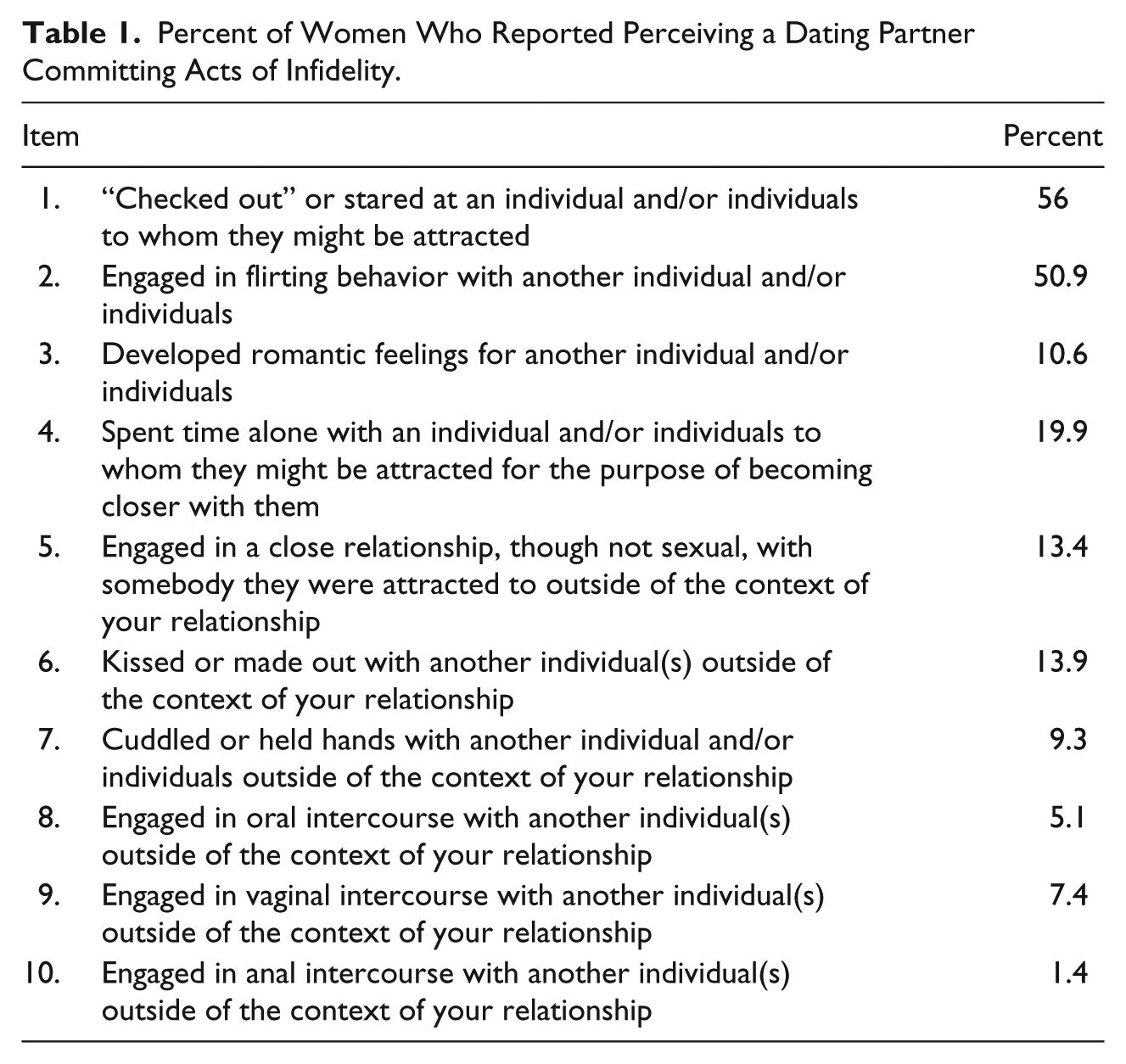
Ten items (see Table 1) were developed for this study to assess the extent to which women believed their partners engaged in infidelity during the course of their romantic relationship. Items were developed on the basis of existing literature examining jealousy-inducing situations within a romantic relationship (Brainerd, Hunter, Moore, & Thompson, 1996; S. M. Murphy, Vallacher, Shackelford, Bjorklund, & Yunger, 2006; Neal & Lemay, 2014). Infidelity acts ranged from less sexually explicit behaviors (e.g., “checked out or stared at an individual and/or individuals to whom they might be attracted”) to more sexually explicit acts (e.g., “engaged in anal intercourse with another individual(s) outside of the context of your relationship”). Response options were 0 (no) or 1 (yes). Items endorsed as happening were summed such that higher scores correspond to a greater number of perceived infidelity behaviors. The internal consistency coefficient (α = .81) indicated the 10 items demonstrated adequate internal consistency.
Percent of Women Who Reported Perceiving a Dating Partner Committing Acts of Infidelity.
Alcohol use
The Alcohol Use Disorders Identification Test (AUDIT; Saunders, Asaland, Babor, de la Fuente, & Grant, 1993) is a self-report measure used to assess women’s alcohol use in the year prior to participation in the present study. The AUDIT consists of 10 items, which examine the intensity and frequency of alcohol use, symptoms of alcohol tolerance and dependence, and negative consequences of alcohol use. The AUDIT demonstrated good reliability across multiple populations, including college students (Babor, Higgins-Biddle, Saunders, & Monteiro, 2001; Shorey et al., 2014). The AUDIT demonstrated adequate reliability in the present study (α = .82).
Procedure
The institutional review board of the last author approved the procedures for the study. Participants provided informed consent to participate in the study on a secure, online survey system prior to completing the questionnaires. Women were recruited from introductory psychology courses and participated to fulfill partial course requirements. Participants received credit for their participation and were provided with a list of referral sources following completion of the study.
Data Analytic Strategy
We conducted a hierarchical multiple regression using Hayes and Matthes’ (2009) macro to test the interaction between perceived partner infidelity and dispositional mindfulness predicting physical assault while controlling for alcohol use, a known correlate of both suspicion of infidelity and physical assault (Nemeth et al., 2012; Shorey et al., 2014). The Physical Assault Subscale was log-transformed prior to analyses due to positive skew and kurtosis. Physical Assault Subscale scores were entered as the criterion variable, perceived partner infidelity as the focal predictor, and mindfulness as the moderating variable. Alcohol use was entered as a covariate. All variables were mean centered to reduce multicollinearity (Cohen, Cohen, West, & Aiken, 2003). To explicate the interaction, we tested the relationship between partner-directed physical assault and perceived partner infidelity at high (+1 SD), mean, and low (−1 SD) levels of dispositional mindfulness.
Results
Descriptive Analyses
Means, standard deviations, and correlations between the variables are displayed in Table 2. Bivariate correlations revealed women’s perceived partner infidelity positively related to alcohol use and physical assault perpetration. Dispositional mindfulness was negatively related to alcohol use and physical assault. A majority of the sample believed their partner “checked out” (56%) or flirted with (50.9%) another individual to whom they were attracted. Least-endorsed suspicions included believing a partner engaged in oral intercourse (5.1%) and anal intercourse (1.4%) with someone else (see Table 1). Results indicated the overall prevalence of physical assault in the current study was 25.9%.
Means, Standard Deviations, and Correlations Between Variables.
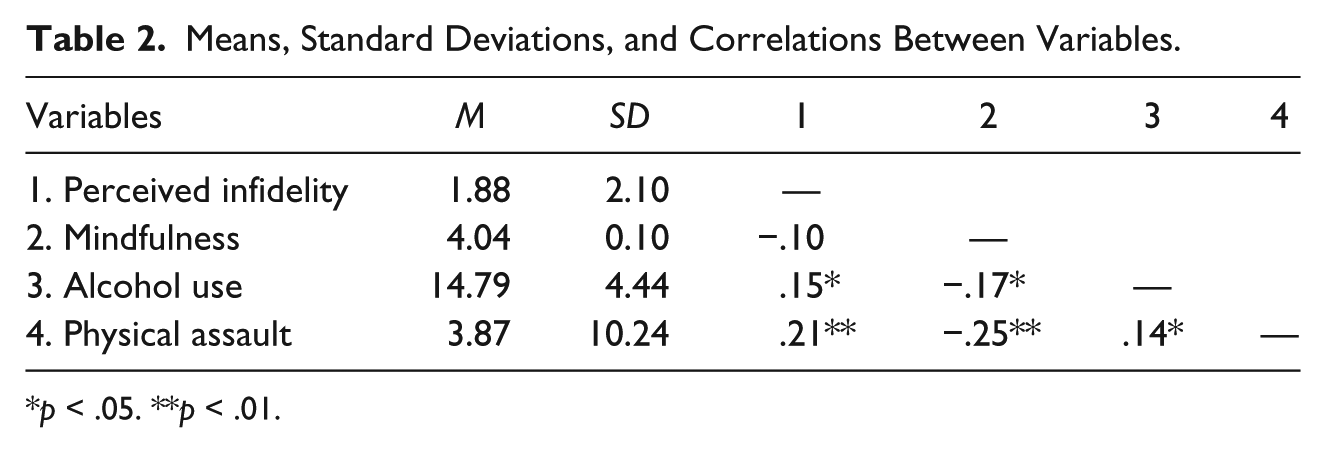
p < .05. **p < .01.
Moderation Analyses
Table 3 displays regression results. Our hypothesis was supported. Controlling for alcohol use, there was a significant main effect for perceived partner infidelity such that higher levels of perceived partner infidelity related to increased physical assault perpetration. There was a significant main effect for dispositional mindfulness such that lower levels of dispositional mindfulness related to increased physical assault perpetration controlling for the effects of alcohol use. Results of a two-way interaction between dispositional mindfulness and perceived partner infidelity controlling for alcohol use revealed the overall model fit was significant. The addition of the interaction term contributed to a significant increase in R2. Explication of this interaction evidenced a positive association between perceived partner infidelity and physical assault perpetration for women who endorsed low (B = 2.37, p < .001) and mean (B = .96, p = .004) levels of dispositional mindfulness. The relation between perceived partner infidelity and physical assault perpetration was not significant for individuals endorsing high levels of dispositional mindfulness (B = −.44, p = .36). Figure 1 displays a visual depiction of the interaction.
Hierarchical Regression Analyses Predicting Women’s Physical Assault Perpetration in Romantic Relationships (n = 203).
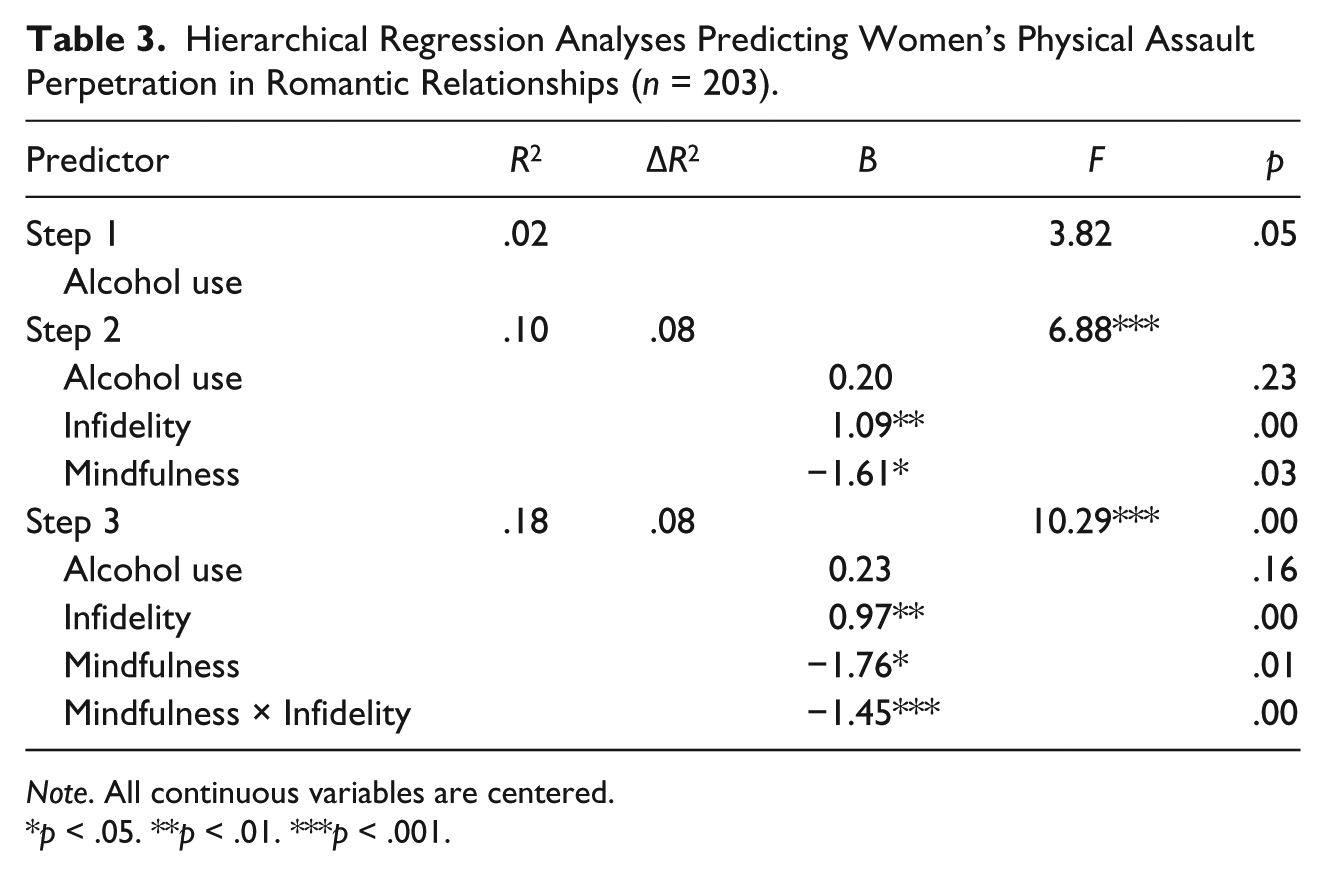
Note. All continuous variables are centered.
p < .05. **p < .01. ***p < .001.
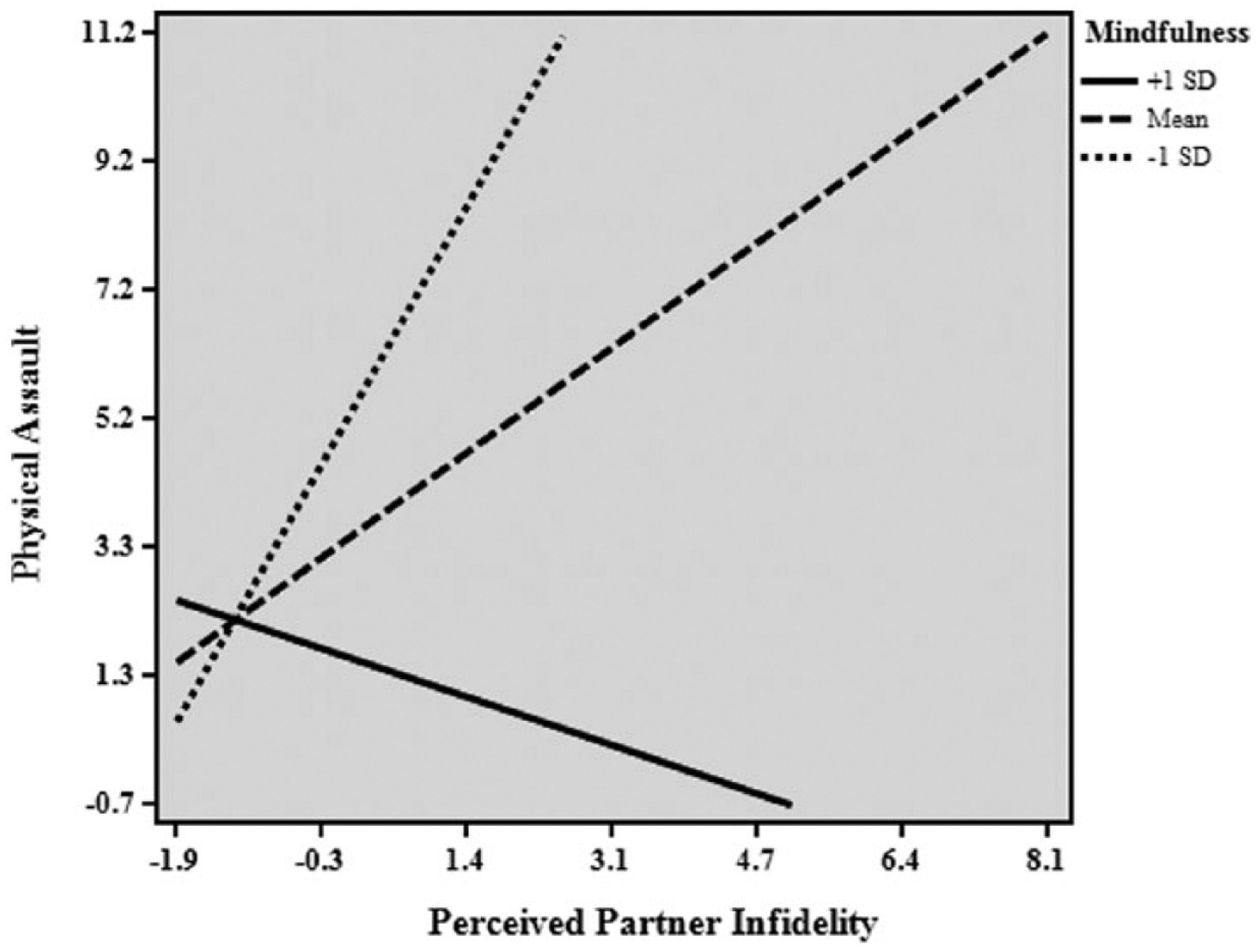
Perceived partner infidelity is positively related to physical assault at low and mean levels of dispositional mindfulness.
To further characterize the nature of this interaction, we used the Johnson–Neymann (J-N; Johnson & Neymann, 1936) technique following the suggested procedures by Hayes and Matthes (2009). This technique allowed us to directly identify the exact level of dispositional mindfulness at which perceived partner infidelity demonstrated significant associations with physical assault perpetration (i.e., the regions of significance of the simple effects of dispositional mindfulness). This technique is accomplished by finding the value of dispositional mindfulness for which the ratio of the conditional effect to its standard error is equal to the critical t score. Results indicated perceived partner infidelity was significantly associated with increased likelihood of physical assault perpetration among women who reported total dispositional mindfulness scores greater than .40 SDs more negative than the mean, b = .67, SE = .34, t = 1.97, p = .05, but was unrelated to physical assault perpetration at higher levels of dispositional mindfulness. In other words, women who endorsed lower levels of dispositional mindfulness were more likely to endorse both infidelity concerns and physical assault perpetration relative to women who endorsed higher levels of dispositional mindfulness.
Discussion
Researchers only recently began to explore the role of mindfulness in populations affected by relationship aggression (Shorey et al., 2014). However, these studies did not consider dispositional mindfulness in the context of perceived partner infidelity, a known correlate of dating violence. Furthermore, limited data are available to demonstrate the protective utility of dispositional mindfulness for college women’s romantic relationships.
The present study examined the role of dispositional mindfulness in the context of perceived partner infidelity among college women, an understudied population at increased risk for dating violence. Consistent with our hypothesis, perceived partner infidelity was not related to partner-directed physical assault for women who endorsed higher levels of dispositional mindfulness. For women who endorsed low and average levels of dispositional mindfulness, perceived partner infidelity related to increased physical assault toward a partner. Results of the present study suggest mindful college women are less likely to be physically aggressive in romantic relationships even when concerns of infidelity are present.
This finding that dispositional mindfulness attenuated the impact of perceived partner infidelity on partner-directed physical assault is consistent with existing literature. Specifically, rumination, or getting caught up in one’s own thoughts, is believed to account for the link between perceived partner infidelity and relationship aggression (Elphinston, Feeney, Noller, Connor, & Fitzgerald, 2013). Because individuals who get caught up in their thoughts may allow their thoughts to influence their behaviors (Bartolo, Peled, & Moretti, 2009), it is conceivable that individuals who are better able to gain distance from their cognitions may choose more adaptive behavioral responses. Specific to infidelity, jealousy-related cognitions involve rumination about distrust, the need to engage in partner surveillance, and desire to control a partner, all of which are linked to physical dating violence (Carson & Cupach, 2000). Results of the present study provide direction for future research to determine whether dispositional mindfulness allows women to gain distance from these cognitions, which may interrupt the progression of suspicion of infidelity to physical dating violence.
Results of the present study are consistent with previous research supporting dispositional mindfulness as a buffer to interpersonal aggression (Borders et al., 2010; Heppner et al., 2008; Shorey et al., 2014). However, this is the only known study to consider the role of dispositional mindfulness for college women in the context of infidelity concerns. Because individuals with high dispositional mindfulness are better able to attend to emotional experiences, put their experiences into words, take a non-judgmental stance, and consciously respond to emotion-provoking situations (Bihari & Mullan, 2014; Bowlin & Baer, 2012), individuals who are low in dispositional mindfulness would be less able to appropriately communicate concerns with a partner in the context of conflict. Such individuals may have a limited repertoire of appropriate responses, criticize a partner’s behavior, act impulsively, and lack awareness of infidelity-related emotions (e.g., anger, fear, sadness, guilt, frustration, insecurity, and jealousy; Bevan, 2006). Indeed, the ability to interpret and label emotional experiences may inform the behavioral response an individual chooses (Brown & Ryan, 2003). In support of this notion, couples trained in mindfulness reported increased communication following conflict (Barnes et al., 2007). Furthermore, higher levels of dispositional mindfulness may translate into more adaptive anger management skills should conflict arise in a relationship (Shorey et al., 2014). Overall, our results support the applicability of mindfulness theory to college-aged populations, more specifically, college women.
Clinical Implications
Bidirectional correlations support a link between perceived partner infidelity and dating violence perpetration by college women. University clinicians should assess for the presence of dating violence when college women express infidelity concerns within romantic relationships. The present findings provide preliminary support for considering mindfulness as an intervention for romantic relationships where infidelity concerns are present. For example, clinicians may consider helping women achieve above-average levels of internal and external awareness to reduce the likelihood of violence occurring when suspicion of infidelity arises. It should be noted that no study examined a comprehensive, mindfulness-based intervention for dating violence. As opportunities to become suspicious of a partner’s fidelity become more abundant with the use of technology (e.g., social networking sites, smartphones, etc.; Brem et al., 2015; Elphinston & Noller, 2011; Tokunaga, 2011), intervention efforts will benefit from continued exploration of ways to intervene with the infidelity-dating violence relationship. Furthermore, because research supports a link between women’s dating violence perpetration and victimization (Langhinrichsen-Rohling et al., 2012), dispositional mindfulness may moderate women’s risk for victimization. Future studies should consider the clinical utility of dispositional mindfulness as it relates to women’s experience of dating violence victimization.
Limitations
The present study has limitations which future research should address. First, the present study was of cross-sectional design; the temporal relationships between the variables are unknown. Future longitudinal studies should examine whether mindfulness reduces various forms of violence, including psychological aggression, in relationships characterized by infidelity. Second, we did not assess the frequency of a partner’s infidelity, or if participants believed their partners would be unfaithful in the future, which may influence the relationships among the variables. Similarly, participants were not asked to indicate relationship expectations (e.g., if they understood their relationship as monogamous, casual, or open), which may have implications for perceptions of partner infidelity. Future research should consider a more multifaceted approach to measuring both partner infidelity and relationship status in dating college students. Existing theory suggests jealousy-related distress and rumination follow suspicion of infidelity, which likely contributes to the likelihood of dating violence (Carson & Cupach, 2000; Kaighobadi et al., 2009). The present study did not assess if distress or rumination accompanied perceived infidelity, and therefore the mechanism by which dispositional mindfulness interrupts the relationship between perceived partner infidelity and dating violence is unknown. Additional research is needed to assess when, if, and for whom rumination follows suspicion of partner infidelity, as well as how dating violence and dispositional mindfulness relate to women’s relationship distress. Moreover, the present sample was relatively small, which likely reduced statistical power. Future studies should investigate the relationships among these variables using a larger, more representative sample and explore potential gender differences. Finally, the present study conceptualized dispositional mindfulness as a unitary construct whereas others recommend the need for a multifaceted construct (Baer, 2003). Future investigations should determine if similar results are obtained with alternative mindfulness models using methods of assessment beyond self-report.
Conclusion
Despite the limitations, results of the present study provide insight into the relations between perceived partner infidelity, dispositional mindfulness, and physical dating violence among college women. Our findings contribute to the dating violence literature by considering moderators which may decrease the co-occurrence of physical dating violence and suspicion of infidelity among college students. The present study provides preliminary evidence for considering mindfulness-based interventions for this population.
Footnotes
Declaration of Conflicting Interests
The author(s) declared no potential conflicts of interest with respect to the research, authorship, and/or publication of this article.
Funding
The author(s) disclosed receipt of the following financial support for the research, authorship, and/or publication of this article: This work was supported, in part, by Grant K24AA019707 from the National Institute on Alcohol Abuse and Alcoholism (NIAAA) awarded to the last author. The content is solely the responsibility of the authors and does not necessarily represent the official views of the NIAAA or the National Institutes of Health.