







Abstract
Although many North Korean (NK) refugee women are victims of domestic violence (DV) in North Korea, face sexual exploitation during migration, and remain at risk of DV while adapting to life in South Korea, there is no empirical evidence about risk factors for DV in this population. To fill this gap, this study examined whether gender role beliefs, child abuse history, and sociocultural adaptation were associated with past-year physical, emotional, sexual, and economic abuse, and whether they were associated with multiple forms of abuse. We also explored whether these associations were similar or different across different types of DV among NK refugee women. A sample of 180 ever-married NK refugee women in South Korea from the 2010 National Survey on Family Violence was used for analysis. Physical abuse was associated with more traditional gender role beliefs; emotional abuse and multiple forms of abuse were associated with lower levels of sociocultural adaptation; and sexual and economic abuse were associated with an increased likelihood of childhood abuse and poor sociocultural adaptation. Our study findings underscore the importance of assisting NK refugee women to be better adapted to the new culture in a practical way, because better sociocultural adaptation might protect them from experiencing various types of abuse. At the same time, findings of this study highlight the need for empowering NK refugee women who report physical abuse by educating their rights and altering their traditional beliefs of gender roles, and screening of childhood abuse and providing culturally sensitive psychotherapy to those who report sexual or economic abuse. Moreover, we suggest future studies to examine correlates of different forms of abuse separately because they can inform culturally tailored interventions for abused NK refugee women. To prevent further victimization, educational programs should be provided to NK refugee women at an early stage of resettlement in South Korea.
Keywords
Introduction
Domestic violence (DV) is a significant public health issue that occurs globally (World Health Organization [WHO], 2013). (For the purpose of this study, DV refers to male-to-female violence and partner refers to a husband or cohabiting male partner.) Almost one third (30%) of all women worldwide have experienced physical abuse, sexual abuse, or both, and abused women have reported elevated rates of physical, mental, and reproductive health problems and impaired social functioning (WHO, 2013). Immigrant and refugee women are at particularly increased risk of DV victimization due to their previous experiences of violence in their home country and/or during migration, changes in gender roles upon resettlement, and many other challenges they face while adapting to a new host society (Bhuyan, Mell, Senturia, Sullivan, & Shiu-Thornton, 2005; Y. S. Lee & Hadeed, 2009; Raj & Silverman, 2002; Shiu-Thornton, Senturia, & Sullivan, 2005).
Similarly, North Korean (NK) refugee women who have migrated to South Korea are at high risk of DV during adaptation to the new society (Choo, 2006). Approximately 70% of NK women are estimated to be routinely abused by their husbands in North Korea (H. K. Kim, 2011), which is an internationally isolated country with institutionalized violence (H. Y. Lee & Gerber, 2009), prevailing patriarchal norms (Ministry of Gender Equality and Family [MOGEF], 2010), and no legal sanctions against DV (Jung & Dalton, 2006). During migration, because NK women can be easily manipulated due to their illegal status in intermediary countries such as China, roughly 80% to 90% of them are kidnapped or forced into marriages with Chinese men, prostitution, or sexual slavery (Davis, 2006). After resettlement in South Korea, NK refugee women report rates of DV that are 2 to 4 times higher than their South Korean counterparts, depending on the type of abuse (MOGEF, 2010). However, to date, fairly little is known about what contributes to any type of DV among NK refugee women. Examination of DV issues has been overshadowed by research on the economic and adaptation problems of NK refugee individuals rather than problems of families (K. Y. Lee & Sung, 2001), because NK refugees have generally migrated alone until recently (Cho & Jeon, 2005). The limited knowledge on this topic has been largely based on small qualitative studies or testimonials, which have limited generalizability of findings (K. Y. Lee & Sung, 2001).
Studies have found that immigrant and refugee women with traditional gender role beliefs view DV as normal and acceptable to marital relationships and that it is a wife’s responsibility to maintain harmony in the family, increasing her risk of being abused over time (Raj & Silverman, 2002; Song, 1996). Particularly, a review of DV among Asian immigrant communities indicated that patriarchal beliefs were consistently associated with increased DV (Y. S. Lee & Hadeed, 2009). However, other studies found that immigrant women’s traditional gender role beliefs were associated with less DV (Firestone, Harris, & Vega, 2003), because DV can be intensified due to changes in gender roles and power dynamics after resettlement in a host country (Yick, 2001). Gender role reversals are created after migration by increased participation of refugee women in the workforce and declining social status of their husbands (Menjívar & Salcido, 2002), which often threatens the man’s dominance and might lead him to use abusive tactics to reestablish dominance over his wife (Yick, 2001).
In North Korea, strong patriarchal beliefs are embedded in the nation’s political system (Jung & Dalton, 2006). For example, NK women are often forced into sexual exploitation by governmental officials in North Korea (J. S. Park, 2012). In addition, torture is commonly used as a means of control to maintain the nation’s regime when politically necessary (H. Y. Lee & Gerber, 2009), and, in case of NK women, it often involves rape or other forms of sexual abuse by authorities (Jung & Dalton, 2006). In the domestic sphere, a wife is considered to be a subordinate of her husband, who is viewed as the man of the house (Choo, 2006; H. S. Park, 2003). A wife is expected to obey her husband and sacrifice for the family, where such roles and status of wives have been defined and dictated by political leaders at the national level in North Korea (Jung & Dalton, 2006; H. S. Park, 2003). However, when NK refugee women resettle in South Korea, they tend to gain some voice in the household because they generally adapt to the new society faster than their husbands, mostly through increased economic involvement (K. Y. Lee & Sung, 2001). As a result, NK refugee women’s traditional attitudes toward gender roles might gradually change to become more egalitarian (Cho & Jeon, 2005), which may be associated with fewer experiences of DV victimization.
Many studies have found that experiencing abuse and maltreatment during childhood in an environment in which the use of violence to resolve conflicts is acceptable is associated with greater tolerance of victimization as an adult (Jennings, Park, Tomsich, Gover, & Akers, 2011; E. Lee, 2007; Whitfield, Anda, Dube, & Felitti, 2003). NK refugees also report being victims of child abuse at more than twice the rate of their South Korean counterparts (MOGEF, 2010). Such a high prevalence of child abuse among NKs can be explained by the fact that widespread violence at the societal level in North Korea is likely to contribute to additional violence at the family level (Bui & Morash, 1999; Catani, Jacob, Schauer, Kohila, & Neuner, 2008). In addition, harsh parenting might be legitimized because corporal punishment of children is common in North Korea (J. Y. Kim, Choi, & Chae, 2012). Moreover, to survive famine, families in North Korea often sell their daughters to traffickers in China (Davis, 2006) or, in extreme cases, abandon their children on the streets (H. S. Park, 2003), presumably their daughters rather than sons due to the strong preference for sons (Jung & Dalton, 2006). However, no empirical study has examined the effect of child abuse or maltreatment history on DV victimization in this population to date.
Finally, refugees and immigrants face multiple challenges during adaptation to a host country (Menjívar & Salcido, 2002; Raj & Silverman, 2002), and stressors that emerge during this process might increase the likelihood of DV (Bhuyan et al., 2005; Firestone et al., 2003). Low adaptation levels may limit a migrant woman’s language acquisition, education, and occupational opportunities and reduce her access to social capital and social networks, which may increase her dependency on her husband, who in turn may exert more control over his wife (Harris, Firestone, & Vega, 2005; C. Kim & Sung, 2016). In contrast, better adapted migrant women are more likely to be independent, have a better understanding of the mainstream culture and laws, and use resources to fight for their safety (Bui, 2003). Previous research found that high levels of adaptation among migrant women predicted less victimization, presumably due to the fact that women begin to learn about their new rights and feel secure because of the presence of legal sanctions against DV in the host country, which could weaken abusive behaviors of their partners (C. Kim & Sung, 2016). In contrast, other researchers found that women’s high level of adaptation was associated with increased victimization (Firestone et al., 2003; Garcia, Hurwitz, & Kraus, 2005). Mixed findings from these studies may be due to methodological differences, group differences, or differences in the host cultures.
NK refugee women who migrate to South Korea encounter a society with fairly different social and cultural values and attitudes compared with their country of origin (K. Park, Cho, & Yoon, 2009). Although both countries use the same language, more than 60 years of separation has created a wide linguistic gap (K. Park et al., 2009). As a result, the majority of NK refugee women face language barriers on a daily basis (Min, 2008). This wide cultural distance between the two countries and trauma experienced before and during migration might lead to low adaptation and high levels of stress among these women (Chung & Seo, 2007). In addition, because they generally struggle with experiences of discrimination by South Koreans (Min, 2008), such experiences might discourage abused NK refugee women from seeking professional help because of the fear of being discriminated against by South Korean police or DV service providers, which will allow the abuse to perpetuate over time. Thus, stressful events in the process of adaptation to a new cultural context might intensify DV victimization among NK refugee women.
Empirical evidence is greatly lacking in the DV literature on refugee women in general and NK refugee women in particular as to the role of gender role beliefs, history of child abuse, and sociocultural adaptation on DV. To fill this research gap, the current study explored two research questions:
Four types of DV—physical, emotional, sexual, and economic abuse—have been documented in the DV literature (Adams, Sullivan, Bybee, & Greeson, 2008; Ganley, 1996); however, little is known why some women experience particular types of abuse while others do not. If different types of abuse are found to have different patterns of correlates, this study can inform the design of effective prevention and intervention by the type of abuse. To our knowledge, this is the first empirical study that examined correlates of DV victimization among NK refugee women.
Method
Participants
A sample of NK refugees living in South Korea was recruited during a 3-month period (August-October 2010) for the 2010 National Survey on Family Violence. This survey is administered to South Koreans by MOGEF (2010) once every 3 years; a sample of NK refugees was included in the 2010 survey for the first time to examine DV, mental health, adaptation, and other social issues in this population. To be eligible to participate, NK refugees had to be 19 years old or older and married, cohabiting with a partner, divorced, separated, or bereaved within a year of the date of data collection. For the purpose of this study, we only used female participants for the analyses. Among 200 female participants, two individuals who did not respond to any of the DV questions were excluded. The analytic sample size of this study was further reduced to 180 following pairwise deletion.
Procedures
Snowball sampling was adopted for data collection; NK refugee recruiters initially contacted some participants (i.e., seeds), who in turn introduced others to the researchers. When NK recruiters reached out to seed persons in metropolises nationwide, only those who lived in four metropolises (Seoul, Incheon, Gwangju, and Busan) agreed to participate. These seed persons introduced more individuals who resided within the same city to the recruiters. Only one ever-married adult per household was recruited. Trained NK refugee recruiters were involved in the data collection process not only for sampling reasons but also to ensure that the language used in the survey was culturally appropriate and to build trust with respondents during interviews. A researcher and an NK refugee recruiter visited each household (MOGEF, 2010). After the interviewers explained the purpose and content of the study, questionnaires were administered to those who consented to participate. Each participant received a gift equivalent to 30,000 Korean won (approximately US$30) as compensation for their time and efforts.
Measures
DV
Dependent variables in this study included past-year victimization of four types of DV. Physical, emotional, and sexual abuse were measured by a culturally modified version of the Revised Conflict Tactics Scale (CTS2; Straus, Hamby, Boney-McCoy, & Sugarman, 1996), which measures how often partners engaged in DV with each other during the previous year. An instrument to measure economic abuse was inserted into this scale. Respondents were asked to describe their behavior and that of their partner. For the purpose of this study, behaviors of participants’ partners were examined. Physical abuse was assessed by seven items measuring how often a certain behavior occurred during the previous year, such as “My partner threw something at me,” “My partner choked me,” and “My partner used a knife or weapon (the original scale stated ‘gun,’ but it is rare to possess guns in households in South Korea) to threaten or hurt me.” Emotional abuse was measured by three items: “My partner insulted or swore at me,” “My partner threatened to hit me,” and “My partner destroyed something that belongs to me.” Sexual abuse was measured by two items: “My partner forced me to have sex against my will” and “My partner forced me to have sex in a form (the original scale stated ‘oral or anal sex,’ but these expressions are considered too explicit in South Korean culture) against my will.” Economic abuse was measured by three items referring to the same time period: “My partner deprived me of money to buy necessities,” “My partner disposed of property without my consent,” and “My partner took full control of income and expenses.” Each type of abuse was dichotomized to indicate past-year victimization; 1 indicated one or more experiences, and 0 indicated no experience during the previous year. In addition, because many participants experienced two or more types of DV, we created a dichotomous variable indicating victimization of multiple forms of abuse; 1 indicated at least one experience of two or more types of abuse (two types, three types, or four types in the past year), and 0 indicated no experience or experience of only one type of abuse during the previous year. Cross-cultural reliability and construct validity of the CTS2 scale have been reported for various nations including South Korea (Straus, 2004). Cronbach’s alpha for the study sample was .93.
Gender role beliefs
The Attitudes Toward Women Scale (Spence & Helmreich, 1978) was modified by J. Y. Kim and Choi (2005) to be appropriate for South Koreans. This seven-item instrument has been shown to have high reliability and validity in the Korean language (J. Y. Kim & Choi, 2005). Items include “It is mostly a man’s role to conduct important tasks of society,” “Men should lead sexual intercourse,” “Women should do the housework,” and “Men should have greater authority than women in making important decisions for their children.” Items were scored on a 4-point scale ranging from 1 (strongly disagree) to 4 (strongly agree), with higher scores indicating more traditional gender role beliefs. Average scores were calculated for the analyses. Cronbach’s alpha for the study sample was .89.
History of child abuse
Experience of child abuse was assessed using a retrospective self-report measure of childhood abuse (physical and emotional) and neglect by one or both parents before age 18. The six items included “I was sworn at or called by harsh words”; “I was beaten up or injured by a golf club, stick, or knife, etc.”; and “I was abandoned for meals or was not taken to the hospital when I was sick.” Response options were yes or no. Cronbach’s alpha for the study sample was .86. For the purpose of the analysis, this instrument was dichotomized to indicate any experience (coded as 1) or no experience (coded as 0) of child abuse.
Sociocultural adaptation
The Sociocultural Adaptation to South Korean Society Scale developed by Jang and Kim (2000) was used to measure NK refugees’ social adaptation, cultural adaptation, interpersonal adaptation, and sense of belongingness in South Korea. The 10 items included “I cannot adjust/adapt to South Korean culture,” “I have difficulty in understanding the unfamiliar language (e.g., Chinese characters or English-adopted words) used in South Korea,” “I sometimes avoid contact with other people due to fears about them,” and “People are prejudiced against me.” Because items were rated on a 5-point Likert-type scale ranging from 1 (almost never) to 5 (almost always), scores were reverse coded so that higher scores indicated better adaptation to South Korean society. Average scores were calculated for the analyses. Cronbach’s alpha for the study sample was .90.
Demographic control variables
Age of respondents was measured in years. Marital status was measured by self-report of whether the respondent was married; cohabiting with partner; or separated, divorced, or bereaved. Respondents reported their average monthly household income after taxes during the previous year in seven categories (when converted 1,000 Korean won into 1 U.S. dollar): no income, more than US$0 but less than US$1,000, US$1,000 to US$1,999, US$2,000 to US$2,999, US$3,000 to US$3,999, US$4,000 to US$4,999, and US$5,000 and above. A dichotomous variable indicating low household income (1 = under US$1,000, 0 = US$1,000 and above) was created for the analysis, because almost half (56.1%) of the respondents reported having a monthly household income of less than US$1,000. These variables were controlled for in the final models because previous research has found that they have significant associations with DV (Abramsky et al., 2011).
Statistical Analyses
Descriptive statistics were calculated to compare respondents’ characteristics by past-year victimization. Preliminary sensitivity analyses were conducted to examine whether there were any biases following pairwise deletion (10.0%) of the data; however, no systematic bias was detected. Four separate multivariable logistic regressions were performed to examine whether gender role beliefs, child abuse history, and sociocultural adaptation were associated with victimization of physical, emotional, sexual, and economic abuse, while controlling for age, marital status, and household income. In addition, because a number of respondents experienced two or more types of abuse, we conducted an additional multivariable logistic regression to examine whether the three independent variables were associated with multiple forms of abuse. As migrant women become more adapted to a relatively egalitarian host country compared with their home country, their traditional gender role beliefs might become less traditional (Firestone et al., 2003); however, a study found that the influence of gender role beliefs on DV victimization was independent to adaptation levels of Latinas in California (Harris et al., 2005). Moreover, because only a few studies (Firestone et al., 2003; Harris et al., 2005) have examined levels of adaptation and gender role beliefs simultaneously among migrant women, there is limited empirical support to argue an interaction between sociocultural adaptation and gender role beliefs on DV victimization. Thus, we examined sociocultural adaptation and gender role beliefs as independent variables (without any interaction effect) in our models. All analyses were conducted in Stata 12.0.
Results
Respondents’ mean age was 39.8 years (range = 24-69 years), the majority (66.1%) of the sample was married, and 56.1% of the sample reported having a monthly household income less than US$1,000. More than half (57.8%) of the respondents had at least one experience of childhood abuse. During the previous year, 38.9% of the sample was physically abused, 60.0% was emotionally abused, 25.6% was sexually abused, 31.7% was economically abused, and 43.9% had experienced two or more types of abuse. Among respondents who experienced multiple types of abuse, co-occurrences of physical and emotional abuse (35.0%), emotional and economic abuse (30.6%), and physical and economic abuse (26.1%) were most prevalent.
Table 1 presents the univariable findings regarding demographic and other characteristics by past-year victimization. Respondents who reported physical abuse were more likely to be separated, divorced, or bereaved than those who reported no abuse. Respondents who were physically or emotionally abused had significantly more traditional gender role beliefs, an increased likelihood of childhood abuse, and lower levels of sociocultural adaptation than those who were not. In case of sexual and economic abuse, respondents who reported past-year victimization were more likely to report a history of childhood abuse and lower levels of sociocultural adaptation than those who did not. Low-income respondents and those who had lower levels of sociocultural adaptation were more likely to experience two or more forms of abuse than those who did not.
Univariable Comparison of Descriptive Statistics by Past-Year Victimization (N = 180).
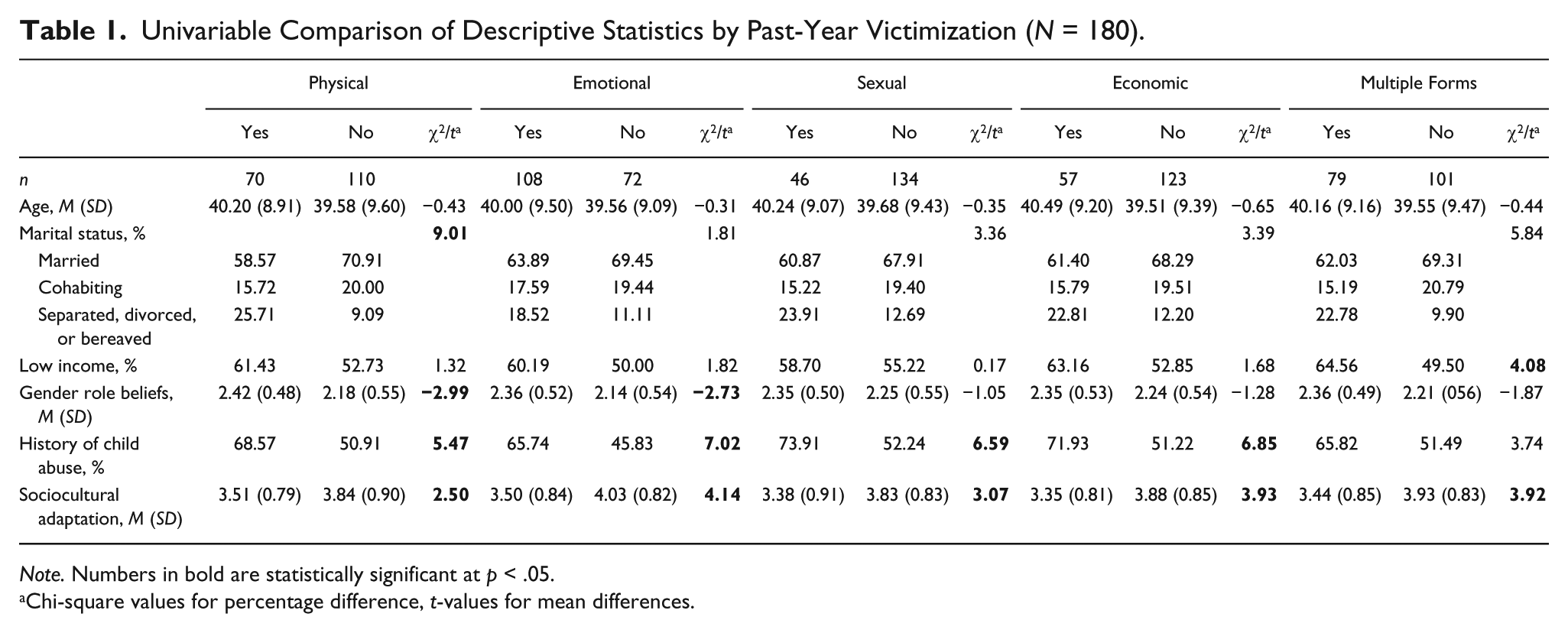
Note. Numbers in bold are statistically significant at p < .05.
Chi-square values for percentage difference, t-values for mean differences.
Results of the five multivariable logistic regression analyses presented in Table 2 show that a one-unit increase in sociocultural adaptation significantly decreased the odds of experiencing emotional (odds ratio [OR] = 0.50, 95% confidence interval [CI] = [0.33, 0.75]), sexual (OR = 0.57, 95% CI = [0.38, 0.87]), and economic (OR = 0.50, 95% CI = [0.33, 0.75]) abuse, and two or more types of abuse (OR = 0.51, 95% CI = [0.34, 0.75]) among respondents. Although it was not statistically significant at the .05 level, sociocultural adaptation had a marginally negative association with physical abuse (OR = 0.68, p = .05). A one-unit increase in gender role beliefs doubled the odds of experiencing physical abuse (OR = 2.10, 95% CI = [1.09, 4.03]), and being separated, divorced, or bereaved was associated with an increased likelihood of experiencing physical abuse (OR = 3.74, 95% CI = [1.42, 9.83]) compared with being married. Having a history of child abuse increased the odds of experiencing sexual (OR = 2.39, 95% CI = [1.07, 5.36]) and economic (OR = 2.28, 95% CI = [1.07, 4.86]) abuse.
Multivariable Logistic Regression Analyses of Past-Year Victimization (N = 180).
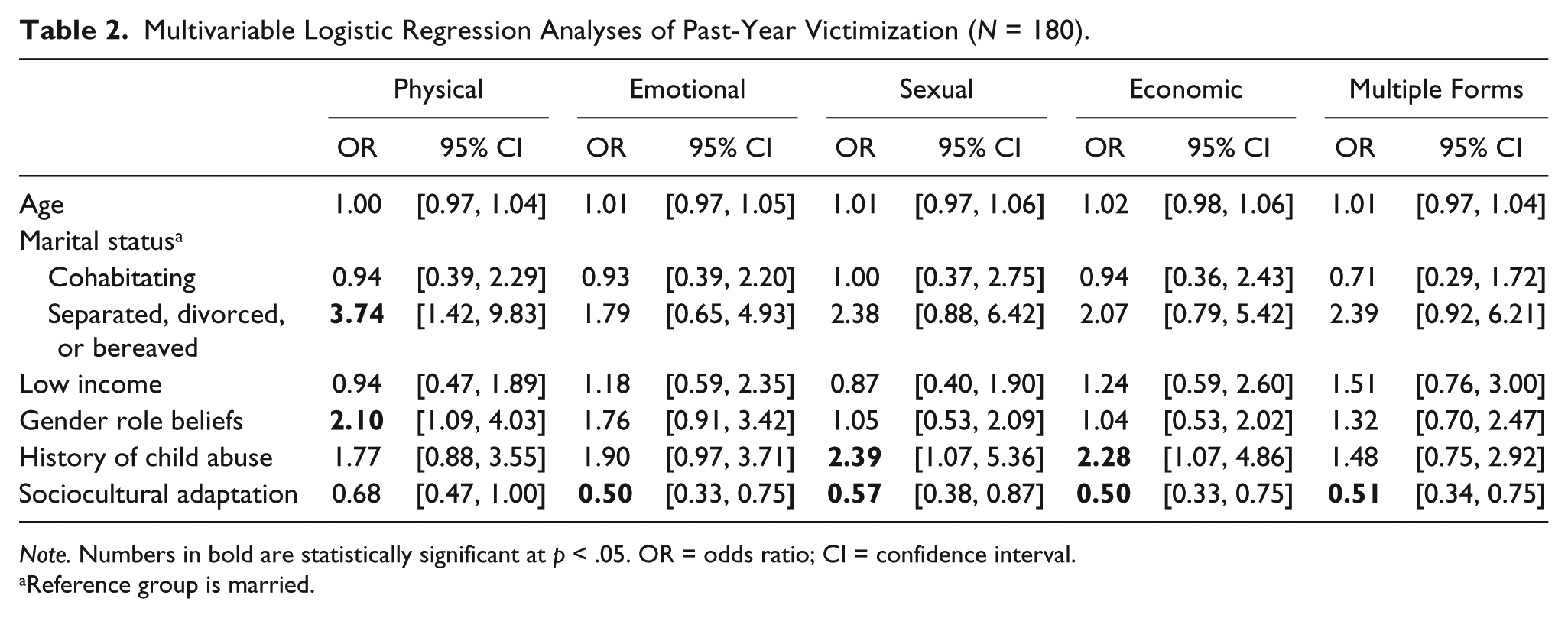
Note. Numbers in bold are statistically significant at p < .05. OR = odds ratio; CI = confidence interval.
Reference group is married.
Discussion
The current study examined the associations of gender role beliefs, child abuse history, sociocultural adaptation, and four different types of past-year DV and two or more types of DV among NK refugee women living in South Korea. It also explored whether these associations were similar or different across different types of DV. This study revealed that gender role beliefs, child abuse history, and sociocultural adaptation were associated with DV; child abuse history and sociocultural adaptation were commonly associated with more than one type of abuse (sexual and economic abuse for both correlates; emotional abuse and multiple forms of abuse for sociocultural adaptation) whereas gender role beliefs was associated with only one form of abuse (physical abuse). In addition to providing empirical evidence of the correlates of DV victimization among NK refugee women, the findings of this study extend previous literature by examining risk and protective factors of different forms of abuse separately. These findings can inform the development of tailored interventions for victims who experience different types of DV, which will be discussed in detail at the end of this section.
The current study found that better adaptation to the new social and cultural environment was a protective factor for all types of abuse among NK refugee women, with the exception of the marginal effect of sociocultural adaptation on physical abuse. It is plausible that recognition of abuse and assertiveness to fight for their rights and safety increased the more these women adapted to South Korean society (Bui, 2003), in which laws against DV exist (Jennings et al., 2011). In particular, such increased awareness might have helped these women identify emotional and economic abuse and marital rape, which are more difficult to detect than physical abuse, as abusive acts. In addition, although they are generally discriminated against by South Koreans (Min, 2008), NK refugee women who are better adapted to the new culture might have gained more confidence in interacting with South Koreans and sought legal assistance for DV. The association between better adaptation and lower likelihood of abuse found in this study is consistent with previous studies (C. Kim & Sung, 2016). However, findings of this study were inconsistent with other studies that found highly acculturated Hispanic women in the United States were more likely to report DV victimization (Firestone et al., 2003; Garcia et al., 2005). This discrepancy might be due not to an actual increase in DV but rather to Hispanic women’s increased realization of existing abuse that they had not acknowledged before they became familiar with U.S. culture.
With respect to correlates of physical abuse, this study found that NK refugee women who held traditional gender role beliefs were more likely to experience physical abuse. This finding is consistent with previous studies on Korean American women, which found that holding more patriarchal values was a risk factor for experiencing DV (Song, 1996). Moreover, it was consistent with previous research linking patriarchal norms with physical violence more than any other form of abuse (Raj & Silverman, 2002; Yick, 2001). NK refugee women who hold traditional gender role beliefs are more likely to view physical violence as a normal part of marital relationships and passively accept it (Raj & Silverman, 2002) as they did in North Korea, which will allow the physical abuse to perpetuate or escalate over time. In addition, separated, divorced, or bereaved women were more likely to report physical abuse than married women. A post hoc analysis revealed that this finding was resulted by divorced and bereaved women, which might indicate that divorce was a strategy for reducing DV or that divorced or bereaved women who had nonmarital partners were more likely to experience physical abuse. However, this finding warrants cautious interpretation because the number of women who were divorced or bereaved only constituted 10.6% (n = 19) of the study sample.
Having a history of child abuse was a risk factor for sexual and economic abuse in adulthood among NK refugee women. The positive association of childhood abuse and future DV victimization found in this study is consistent with previous literature (Jennings et al., 2011; E. Lee, 2007; Whitfield et al., 2003). In particular, the literature has shown that girls who were abused or maltreated are at an elevated risk of engaging in risky sexual behaviors during adolescence and adulthood, such as earlier onset of sexual activity, sex trading, having more sexual partners, and so forth (Gilbert et al., 2009). Hence, it is likely that NK refugee women who were abused during childhood became more tolerant of sexually abusive partners in adulthood than those who were not. With respect to the association between childhood abuse and economic abuse in adulthood, this might be attributed to the fact that NK refugee women who were maltreated during childhood in North Korea most likely had been deprived of basic rights regarding money, food, or goods in an abusive family during the nationwide famine. Thus, maltreated NK girls might have grown up with limited opportunities and ability to claim their right to control finances, especially when their partners are abusive. However, this interpretation requires caution because it is an assumption due to the dearth of DV research that has examined economic abuse in relation to child abuse history in general and among NK refugee women in particular.
Sociocultural adaptation was the only significant correlate for NK refugee women who experienced multiple forms of abuse during the previous year. NK refugee women who are socially isolated from the mainstream society due to poor adaptation might particularly rely on their partners or ethnic communities for social and emotional support (Shiu-Thornton et al., 2005), which might encourage victims to accept the abuse and stay silent (Bhuyan et al., 2005). Hence, the DV they experience might persist and grow into multiple types of abuse. Although we did not take into account for the severity of abuse in this study, a previous study found a similar finding that low levels of acculturation was associated with experiencing more severe DV, but not with physical or sexual abuse alone, among South Asian immigrant women in the United States (Raj & Silverman, 2003). Previous studies have indicated that female victims who were subject to more than one type of DV exhibited significantly more serious mental health problems than those who experienced physical abuse alone (J. Y. Kim, Park, & Emery, 2009), which stresses the importance of examining multiple forms of abuse. However, if we examined the correlates of multiple forms of abuse but not different types of abuse separately, we could have overlooked the other important factors (i.e., gender role beliefs and childhood abuse) associated with DV victimization among the study sample.
This study found that NK refugee women experienced DV at much higher rates than their South Korean counterparts. Compared with a nationally representative sample of ever-married South Korean women (MOGEF, 2010), NK refugee women reported 2.5 times the rate of physical abuse among South Korean women (38.9% vs. 15.3%), almost twice the rate of emotional abuse (60.0% vs. 33.6%), nearly 3 times the rate of sexual abuse (25.6% vs. 9.3%), and more than 4 times the rate of economic abuse (31.7% vs. 7.6%) during the previous year. It is meaningful that this study contributed to DV literature by exploring emotional and economic abuse, which have received less attention in previous studies than physical and sexual abuse (Adams et al., 2008; Meekers, Pallin, & Hutchinson, 2013). Emotional and economic abuse might be less visible than physical or sexual abuse because they do not involve direct physical contact with the perpetrator (Ganley, 1996). Nevertheless, emotional and economic abuse involve coercive tactics to achieve control over victims, resulting in severe consequences for victims (Ganley, 1996). It is particularly important to examine economic abuse among refugee and immigrant women because they generally face economic hardships upon resettlement, and thus, an abusive husband might control finances to make his wife economically dependent on him (Raj & Silverman, 2002), preventing her from leaving the abusive relationship (Bui & Morash, 1999). Thus, future studies should consider including emotional and economic abuse.
Findings of this study have important implications for policy makers and practitioners. First, our study findings highlight the importance of assisting NK refugee women to be better integrated to South Korean society in a practical and fundamental way, because better sociocultural adaptation might protect them from experiencing various types of abuse. The provision of long-term trainings in language, financial management, and job skills can promote their confidence and independence in the new society through increased economic power (Bui & Morash, 1999) and interpersonal relationships with mainstream people (K. Park et al., 2009). In addition, to prevent further DV victimization, educational programs could be developed and provided to NK refugee women at an early stage of their resettlement in South Korea. It is necessary to empower NK refugee women by educating them that they are not subordinates of their husbands and that DV cannot be justified under any circumstances. Programs that can increase their awareness of DV, such as different types of DV, common signs of abusive behaviors, consequences for victims, and legal protections and available services for victims and their children (Raj & Silverman, 2002), are needed. In addition, sex education to help NK refugee women distinguish between marital rape and mutually agreed-upon intercourse should also be provided. Furthermore, screening of childhood abuse and provision of culturally sensitive psychotherapy to these women are essential.
Second, culturally tailored interventions should be provided to meet the specific needs of abused NK refugee women. Using a one-model-fits-all approach may not be appropriate for assisting these women because interventions need to take into account the cultural context of the population. Specifically, practitioners could potentially help victims by putting more emphasis on altering traditional gender role beliefs for clients whose major complaints involve physical abuse; assisting in adaptation to the new culture for those who are largely affected by emotional abuse or multiple forms of abuse; and providing therapy to heal wounds from childhood and offering resources for better adaptation for those who report sexual or economic abuse. Third, not only practitioners but also criminal justice officials should receive cultural competence training to prevent revictimization (Menjívar & Salcido, 2002). Last, funding at the governmental and local levels should be allocated to make these efforts possible. Findings of this study are expected to serve as a foundation for the actions of practitioners, researchers, policy makers, and the government to prevent DV victimization among NK refugee women who live in South Korea.
Limitations of this study include the cross-sectional nature of the data, which did not allow inferences of causality between the correlates and DV, with the exclusion of child abuse history and DV. For instance, better sociocultural adaptation might have decreased the risk of DV, whereas healthy martial relationships might have enabled NK refugee women to adapt better to the host society. Hence, future research should seek to identify predictors of DV among victims using longitudinal data. In addition, the sample might be biased, and thus, generalization might be limited due to the use of a snowball sampling strategy. However, snowball sampling is the most common and feasible sampling strategy to collect data from NK refugee participants (H. Y. Lee & Gerber, 2009) for two reasons. First, members of this population are difficult to reach because lists of information on NK refugees living in South Korea are strictly confidential for security purposes (S. K. Lee & Nam, 2014). Second, it is difficult to reach out to NK refugees or collect meaningful information from them due to a unique deep-rooted suspicion toward others that they developed in North Korea (Min, 2008). Hence, they are generally reluctant to reveal their identity or experiences with South Koreans (Chung & Seo, 2007) due to fear of security issues and the possibility of being placed under surveillance by the South Korean government (Min, 2008). In this sense, random sampling is inherently impractical for this population. However, we suggest future researchers to use a respondent-driven sampling strategy, which could minimize recruitment bias (Heckathorn, 1997).
Another limitation is that self-reports of DV might be subject to reporting bias caused by recall issues, making it difficult to assess actual frequencies of DV experiences during the previous year. To reduce potential bias, this study dichotomized all DV variables to indicate any or no experience of DV as outcomes, rather than using frequencies of DV. Last, there were four limitations related to the data used in this study and the unique characteristics of NK refugee women. First, the child abuse history scale and the subscale of economic abuse have no evidence of standardization. Nonetheless, items for each scale appear to encompass the original constructs appropriately. In particular, because no standardized measure of economic abuse exists to date (Adams et al., 2008), one should be developed. Second, the marital status variable might not be completely reliable because many NK refugee women have complex forms of marital relationships (Jung & Dalton, 2006); thus, results regarding this variable should be interpreted cautiously. For example, unwanted dual marriages often occur when a married NK woman escapes North Korea alone and remarries another man during or after migration, but her first husband arrives in South Korea later (Cho & Jeon, 2005). Third, the data did not allow examination of the nature and context of abuse (e.g., the setting in which DV occurred, how victims responded to DV, etc.); hence, interpretation and generalization of these findings require caution. Qualitative data might supplement these shortcomings in future research. Fourth, several risk and protective factors that previous studies found to be associated with DV victimization (Abramsky et al., 2011) could not be controlled for in this study because of the small sample size, large numbers of missing responses, or absence in the data. For example, the small variation in education levels of participants and large numbers of missing responses in alcohol use and length of relationship precluded the authors from including them in the analysis. Particularly, we could not include the length of stay in South Korea as a control variable due to a high rate of missing responses; however, a post hoc analysis revealed that the inclusion of this variable did not significantly change our results. Other demographic control variables, such as when NK refugee women escaped from North Korea and specific information on their husbands were not available in our data, but should be considered in future research.
Conclusion
Despite these limitations, the current study provides empirical evidence of risk and protective factors of DV among NK refugee women. In addition, this study contributes to the DV literature by investigating correlates of different types of abuse, and findings can inform the design of effective prevention programs and interventions for DV victims. These efforts might be helpful for victims who experience only one form of abuse and those who experience more than one type of abuse because each victim might be relatively more affected by a particular type of abuse than co-occurring forms of abuse. If practitioners do not screen for different types of abuse or do not identify the primary type of abuse that has most affected the victim, they might not capture the root of the client’s abuse or understand why the client responded to abuse in a particular way, which might result in less effective interventions. Thus, both researchers and practitioners should attempt to examine all types of DV and provide interventions tailored to each victim’s needs.
Footnotes
Acknowledgements
We would like to greatly appreciate Drs. Iris Chi, Eric Rice, Alice Cepeda, and Roberto Suro for their constructive feedback and comments on this article.
Declaration of Conflicting Interests
The author(s) declared no potential conflicts of interest with respect to the research, authorship, and/or publication of this article.
Funding
The author(s) disclosed receipt of the following financial support for the research, authorship, and/or publication of this article: Dr. Hee Jin Kim was supported by the National Research Foundation of Korea Grant funded by the South Korean Government (NRF-2013S1A3A2042790).