







Abstract
The widespread epidemic of emerging abuse in Emergency Departments (ED) toward residents generates negative effects on the residents’ health and welfare. The purpose of this study was to determine and highlight the high prevalence of abuse and harassment toward Emergency residents. In 2011, a multi-institutional, cross-sectional study was conducted at seven Emergency Residencies of central hospitals in Iran. Residents were asked about their age, marital status, postgraduate year (PGY) levels, and work experiences before residency. Prevalence of abuse in four categories was evaluated: verbal abuse; verbal and physical threat; physical assault and sexual harassment; and by whom. The data were analyzed by SPSS version 17.0 (SPSS, Inc., Chicago, IL, USA). Two hundred fifteen of the 296 residents (73%) completed the survey. The prevalence of any type of abuse experienced was 89%; 43% of residents experienced verbal and physical threats, 10% physical assault, and 31% sexual harassment. Verbal abuse and verbal and physical threats without the use of weapons were higher in men in comparison with women (p< .04). Women were more likely than men to encounter sexual harassment (31% vs. 7%, p< .01). Among the sexual harassment categories, sexual jokes (51%) were the most prevalent between residents. Junior residents (PGY-1) were more likely to experience abuse than senior residents (PGY-2 and PGY-3; p< .01). Patients and their companions were the main agents of abusive behaviors. Abuse and harassment during residency in ED are highly prevalent. Educational programs and effective preventive measures against this mistreatment are urgently required.
Introduction
Residency training in Emergency Departments (ED) is a difficult period of life. Abuse or harassment as a recurring concern during residency has negative impacts on the emotional state, ability, and satisfaction of Residents in the ED resulting in possible mistreatment of patients (Fernandes et al., 1999; Levin, Hewitt, & Misner, 1998; Mahoney, 1991; Moscarello, Margittai, & Rossi, 1994; Rees & Lehane, 1996).
Studies from Western nations such as the United States and Canada far exceed the few Asian studies regarding this issue (Nagata-Kobayashi, Maeno, Yoshizu, & Shimbo, 2009). Supplementary information is required from non-Western countries for a better understanding of abuse and ultimately the development of an international solution.
Numerous studies have reported the prevalence of differing forms of abuse such as verbal abuse, physical threat, physical assault, and sexual harassment (Silver, 1982). Due to lack of sufficient formal and informal instruction to manage the problem, residents are seldom reporting occurrences of abuse and harassment (Fernandes et al., 2002).
Considering the lack of studies concerning abusive incidents in ED of Iran, this study seeks to estimate the overall incidents of abuse and harassment experienced by residents working in ED located in Iran. To gain a better understanding of the extent of abuse and harassment faced by residents in the workplace, a sample of ED residents were surveyed regarding their personal experiences. It is hoped that this study will result in educational programs that will enable ED residents and personnel to handle and manage mistreatment more appropriately.
Method
A multi-institutional, cross-sectional survey study was conducted to assess residents’ experiences of abuse and harassment during residency in Iranian ED. This study was done at seven central university hospitals in the four metropolis of Iran—Tehran, Mashhad, Ahwaz, and Tabriz—from February 2011 to May 2011. The centers were selected based on the residency training programs in Iran. The questionnaires were distributed to the residents by members of the research team with stamped envelopes including completion instructions and the importance of proper conduction. All responses were to be kept strictly anonymous and confidential with completion of the surveys being voluntary. In developing the questionnaire, terms residents, emergency medicine, abuse, and harassment were used in a MEDLINE search to collect questions from previous studies and articles published from 1966 to January 2011.
To validate the current questionnaire, a pilot study was done among 40 residents at ShahidBeheshtiUniversity. Data were collected regarding the respondents’ sex, age, marital status, and postgraduate year (PGY) level. Residents were asked about their experiences of abuse to collect information on the prevalence of four categories of abuse or harassment (verbal abuse, verbal and physical threat, physical assault, and sexual harassment).
In the sections pertaining to verbal abuse, verbal and physical threats, and physical assault, the respondents were asked to specify the number of times they were abused (the numbers were limited to 99 for each source of abuse). In the case of residents responding yes to any of the four question, they were asked to identify the inflictor of the abuse or harassment: patients and their companions, senior residents, chief resident, same-level residents, junior residents, interns, residents of other majors, ED attending, attending of other services, ED personnel, personnel of other departments, and supervisors. Residents could identify more than one source. In the section regarding physical assault, the participants were asked to clarify whether the assault was made with the assist of a weapon. Regarding sexual harassment, the participants were asked about seven types of sexual harassment behaviors: sexual insults, demanding sexual attention, ridicule, sexual jokes, staring, physical contact, and/or sexual contact.
The primary result of the study regarded the proportion of residents who experienced abuse and harassment during their residency. Secondary results included experiences with abuse and harassment as stratified by age, sex, and PGY level.
Statistical Analysis
Statistical analyses were done by using the program SSPS version 17.0 (SPSS, Inc., Chicago, IL, USA). Continuous variables were expressed as means and standard deviations. Categorical variables were reported as percentages. Student’s t test was used for comparing continuous variables. Responses of residents of differing genders and levels of training were compared using a two-sided chi-square. P values less than .05 were considered statistically significant.
Ethical Consideration
The study followed the principles of the declaration of Helsinki and was approved by the Medical Ethics Review Board of Shahid Beheshti University of Medical Sciences. Written informed consent was obtained from the volunteers regarding confidentiality and anonymity of data collected, also details and the purpose of the study were disclosed.
Results
There were 215 of 296 residents who completed the surveys. Most of them were men (74% men, 21% women). The majority of respondents were married (66.51%). Four percent of questionnaires were left unanswered in the sex category. The mean age of residents was 34 years (SD = 5.5).
The vast majority of Emergency Medicine (EM) Residents (89%, n = 190) experienced some type of abuse or harassment during residency. Sixty-seven percent (n = 144) of residents experienced verbal abuse, 43% (n = 92) reported verbal and physical threats, 10% (n = 22) reported physical assault, and 31% (n = 28) experienced sexual harassment.
Significant correlation was found between incidence of verbal abuse and physical threats (p< .01), verbal abuse and sexual harassment (p< .001), and finally verbal and physical threats and sexual harassment (p< .01).
Senior residents (during that one year as a PGY-2 or PGY-3) were statistically less likely than junior residents (PGY-1) to have experienced verbal abuse (57% vs. 88%; p< .01), verbal and physical threats (33% vs.62%; p< .01), physical assaults (8% vs. 15%; p< .01), and sexual harassment (16% vs. 30%; p< .01).
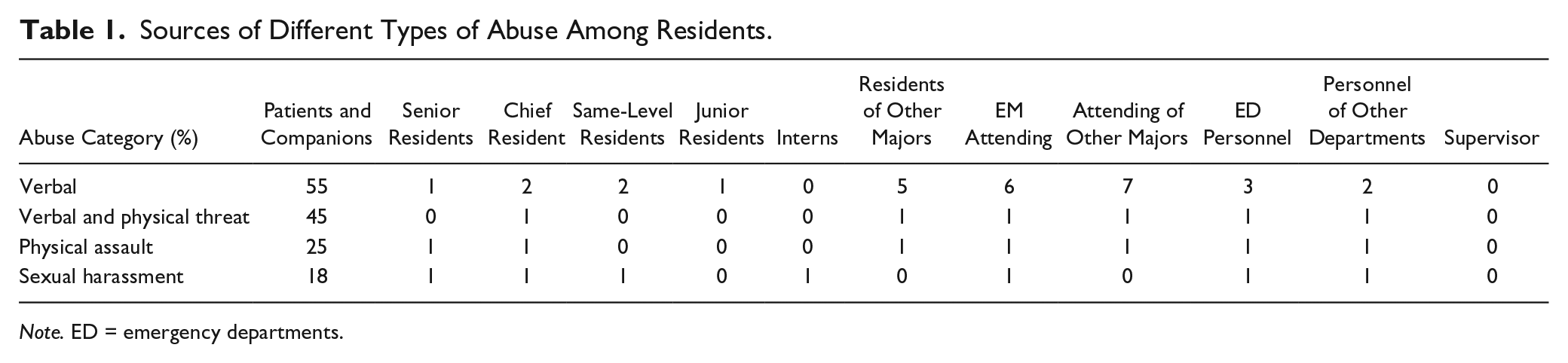
Patients and their companions were the offenders in most of cases (Table 1). Fifty-five percent (n = 118) of residents reported verbal abuse from patients, 45% (n = 96) reported verbal and physical threats from patients, 25% (n = 53) reported physical assaults from patients, and 18% (n = 39) reported sexual harassment from patients.
Sources of Different Types of Abuse Among Residents.
Note. ED = emergency departments.
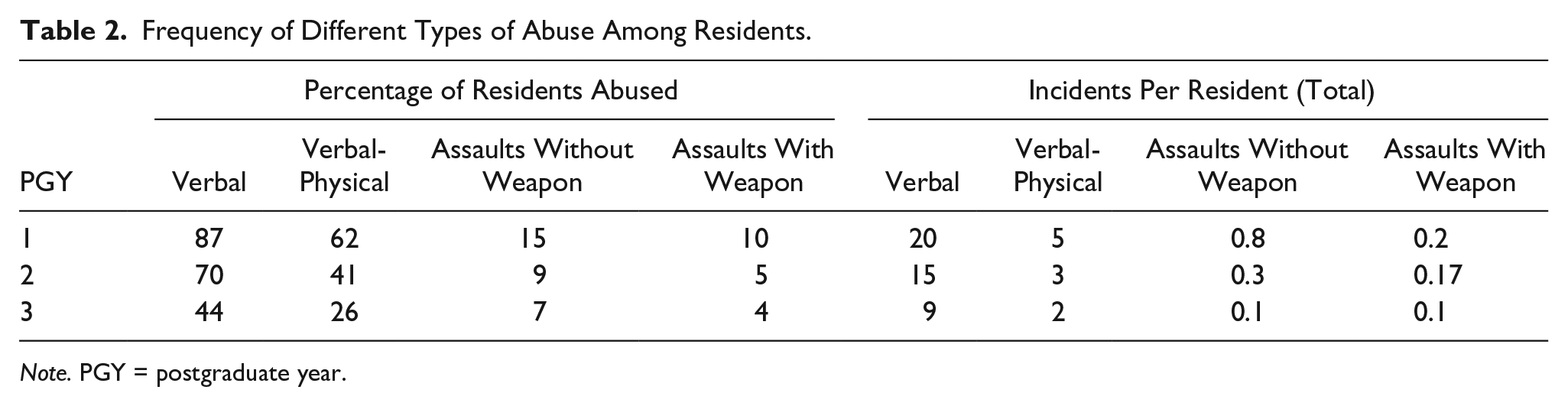
A total of 102 physical attacks without the use of weapons were reported. The attacks affected 16% of residents. Thirty-five incidents of physical attacks using weapons were reported by 7% of participants (n = 15). Thirty of these were reported during the first year of residency. Two participants reported being attacked by the chief resident and another by a senior resident during their first year (Table 2).
Frequency of Different Types of Abuse Among Residents.
Note. PGY = postgraduate year.
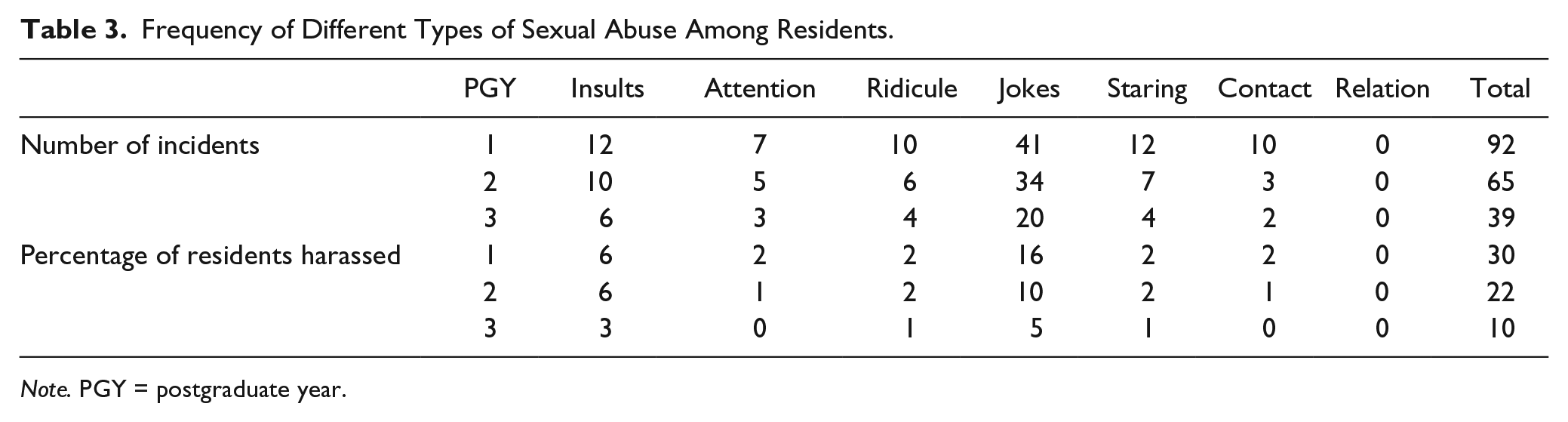
Regarding sexual harassment, 196 incidents were reported by 31% of participants, with an average of more than one incident per participant. Among seven categories of sexual harassment, sexual jokes (51%) were the most prevalent followed by sexual insults (18%), staring (13%), ridicule (12%), demanding attention (7%), physical contact (2%), and sexual contact (0%; Table 3).
Frequency of Different Types of Sexual Abuse Among Residents.
Note. PGY = postgraduate year.
Discussion
In this study, the prevalence of abuse and harassment among ED Residents in Iran was tested. This study indicated high prevalence of abuse and harassment in Iran similar to other countries which have been studied in past years (Baldwin, Daugherty, & Eckenfels, 1991; Daugherty, Baldwin, & Rowley, 1998). Most of the ED residents (89%) reported experiencing some type of abuse and harassment during their clinical training. Verbal abuse was the most frequent type of abuse, as reported in previous studies (Li et al., 2010; Mahoney, 1991; Moscarello et al., 1994). This global tendency toward verbal abuse indicates that orally is the easiest form of annoying or hurting others.
Verbal and physical threat was the second most frequently reported form of mistreatment among residents with its prevalence being similar to previous studies from Western countries (19.6%-40.0%; Cook et al., 1996; Daugherty et al., 1998; vanIneveld, Cook, Kane, & King, 1996). The offenders were, again, similar to those reported in countries as Chile and Canada (Maida et al., 2003; vanIneveld et al., 1996).
ED, as a crowded area with high demand for service by patients, are related to high occurrences of abusive behavior toward and among ED residents (Behnam, Tillotson, Davis, &Hobbs, 2011; Li et al., 2010). Patients and especially their companions were the main sources of abuse in our study.
Junior residents were more likely than senior residents to be abused. Sexual harassment results were also similar to previous studies in Asia and the United States (Li et al., 2010; Nagata-Kobayashi et al., 2009). Younger female residents especially during the first and second PGYs were found to be at greater risk for sexual harassment. Educational programs for the public may be the reasonable and effective way of raising awareness of sexual harassment.
In this study, residents with less work experience were more likely to encounter abuse during their residency; hence, educational programs are vital for prevention of mistreatment.
Limitations
This study had some limitations. It was a voluntary survey and hence susceptible to cause bias. Respondents may have been more likely to experience and report mistreatment compared with non-respondents. The sample of the study was not large, and so, small deviations in the data were not visible. In our study, completion of survey was voluntary and anonymous, without any financial reward or reminders of completion. It appears as though Residents who did not answer the survey may have been abused but the cause of it is unclear. However, as we did not consider differing shifts and work hours and the effect of this on the intensity of their abuse and the number of times they were abused, some uncertainty of reported detail about abuse incidences remains.
Conclusion
Our findings suggest that abuse and harassment during residency as a global problem is a common event in the lives of EM residents. Unfortunately, the study suggests that most ED residents are unaware of the abuse problem and how to deal with it. It is vital that residents are educated and assisted with resolving and dealing with these mistreatments.
Footnotes
Acknowledgements
The authors thank Emergency Departments of seven central university hospitals in the four metropolis of Iran—Tehran, Mashhad, Ahwaz, and Tabriz—for technical assistance. The authors also gratefully acknowledge the cooperation of the participating residents, without whom this investigation would not have been possible.
Declaration of Conflicting Interests
The author(s) declared no potential conflicts of interest with respect to the research, authorship, and/or publication of this article.
Funding
The author(s) disclosed receipt of the following financial support for the research, authorship, and/or publication of this article: This work is approved and financially supported by Shahid Beheshti University of Medical Sciences.