







Abstract
The aim of this study was to explore the relationship between possible violence suffered by female sex workers in their intimate relationships, with their affects, coping strategies, and emotional regulation to overcome such violence and improve their well-being. Structured personal interviews were carried out with female sex workers in three different settings: street, club, and flats. The sample was composed of 137 Spanish female sex workers (85.4% are foreign and 20% Spanish-born sex workers). High levels of tension and problems with their partners were linked to an affective imbalance and poor well-being. Positive affectivity determined the use of adaptive strategies, whereas negative affectivity predicted dysfunctional strategies. Three different path analyses and theoretical support concluded that self-control was the only strategy related to improve well-being in female sex workers who reported lower potential tension and difficulty in their intimate relationships. In contrast, inhibition was associated with an increase on distress levels when negative affectivity predominated and sex workers had reported potential tension and difficulty situations with their partners. It was a cross-sectional study, and thus we cannot infer causality or direction from the observed associations. Given these findings, violence prevention strategies in the intimate relationships should be prioritized in the prostitution context.
Introduction
Sex trafficking and prostitution are a form of commercial sexual exploitation which involves the victimization of women and both of them are considered a public health hazard and a form of discrimination (Wilson & Butler, 2013). Sex trafficking requires that victims were recruited, transported, transferred, kept, or receipted for the purpose of exploitation. Relative to prostitution, sexual exploitation is noted as the most commonly identified form of human trafficking (Wilson & Butler, 2013). Sex trafficking represents an attack on life and health and involves the control of the person’s economy, as well as a threat to general social well-being (Betzer, Köhler, & Schlemm, 2015). Comparing with sex trafficking, prostitution is defined as a practice of engaging in sex acts in exchange for money (U.S. Department of State, 2013). In Spain, there is a lack of legislation to protect prostituted women whose human rights are violated and to highlight the violence against women, which is implicit in this form of violence. Prostitution itself is not directly addressed in the Criminal Code of Spain, but sexual exploitation such as pimping is illegal (through Article 318; Ballester, Salmeron, Gil, & Gómez, 2012). The only applicable law to protect sex workers who suffer violence from their partners is the Organic Law 1/2004 of integral protection measures against gender violence included protection and assistance to victims. This law protects them because of their gender and not because of being sex workers. This special jurisdiction was created with the aim of eradicating the inflicted violence toward women by the simple fact of being one, and that is a manifestation of discrimination, inequality, and power of men over women in the context of relationships. Also, it makes reference to the importance of a social intolerance and legal condemnation of the people who benefit from the sexual exploitation of women (Gutierrez & Delgado, 2015).
Reports of the EMUME (i.e. specialized unit of gender violence) team of the Guardia Civil (a Spanish Police Corp) indicated that there were between 200,000 and 400,000 female sex workers in Spain, almost 80% are foreign, in more than 3,000 establishments where prostitution is practiced. Approximately 90% of those involved in prostitution work under the control of organized networks operating nationwide (sex trafficking) and 96.85% were foreign (Observatorio Estatal de Violencia sobre la Mujer [IMIO], 2015). The rate of women who operate in the clubs is 80% in front of 20% who work in the streets. However, the indices are variable, and the ratio of sex workers who are operating in the streets is likely to be higher than the official reports (González & Tirado, 2006). Even though in Spain there is not any specific register of sex workers, 126,742 women have declared that they suffer violence from their partners in 2014 (IMIO, 2015).
Researchers in the field of social exclusion assert that there is a link between criminalization and the increased likelihood of suffering physical and sexual violence (Zeglin, 2014). Specifically, the death toll related to female prostitution is 40 times higher than the national average (in the United States), which suggests that it is not likely to find any other occupation or lifestyle that exposes women to violence in the way commercial sexual exploitation does (Wilson & Butler, 2013). The female sex workers who suffer violence from their clients are also frequently victims of intimate partner violence (IPV; Shannon et al., 2009). It is not unusual for the procurers who maintain or have maintained a relationship with the women to be their own relatives, neighbors, friends, or acquaintances rather than strangers (Vindhya & Dev, 2011). Indeed, the pseudo-family structure created by the procurers provides an ilusion of better life, stability of employment or even the possibility of getting married (Katsulis, Durfee, Lopez, & Robillard, 2015) which in turn icreases the likelihood of engaging in prostitution. Seduction and promises of a stable relationship are used to gain sufficient control over many women, who are then kept away from family support or professional help (Vindhya & Dev, 2011). For example, a study of 1,022 female sex workers found a higher frequency of violence perpetrated by stable intimate partners rather than by clients, and also a connection to more harmful effects on the health and well-being of the female sex workers (Hong, Zhang, Li, Liu, & Zhou, 2013).
Some studies showed that the control and violence to which many female sex workers are subjected to by their partners have serious emotional and affective consequences (Tsutsumi, Izutsu, Poudyal, Kato, & Marui, 2008). Emotions also determine the type of response and in many cases mean the loss of resources and strengths necessary to overcome abusive situations (Smith, Grov, Seal, & McCall, 2012). This might be related to what traditional models rely on, where coping strategies are considered to be a response to the emotions and affects with the purpose of reducing or activating tension (Stein, Leventhal, & Trabasso, 1990). Therefore, emotional states influence the strategies people adopt to deal with violent situations (Katsulis et al., 2015; Smith et al., 2012).
In this way, Fredrickson’s (2001) Broaden-and-Build theory suggests that positive affectivity allows the expansion of an individual’s repertoire of responses and helps to build lasting personal resources. Khosla and Hangal (2004) found that people who experienced more positive emotions used more adaptive coping strategies when facing stressful situations. Regarding negative emotions, researchers suggest that women victims of gender violence reach a state of helplessness in their relationships (Reid & Piquero, 2013). When women realize that a situation is not under their control, they will feel fear, sadness, and lack of motivation, and also they will have several difficulties in believing that they will be able to control it in the future (Wilson & Butler, 2013). Additional research on hopelessness feelings in battered women has found a relationship between dysphoric symptoms, feelings of hopelessness, and poor problem-solving skills (Clements & Sawhney, 2000), and, what is more, negative emotions interfere with decision-making processes (Amor, Bohórquez, & Echeburúa, 2006). Similarly, Fisher and Fisher (2000) suggested that negative emotions predict a lack of motivation or readiness to carry out adaptive behavior changes.
Under these conditions of partner violence, female sex workers attempt to survive by using different strategies. It has been proven that when dealing with gender violence, coping strategies can have a positive or negative influence on well-being (Puente, Ubillos, Mínguez, & Páez, 2014). Two meta-analyses found that confrontation has negative effects in cases where the individual did not have the situation under control (Campos, Iraurgui, Páez, & Velasco, 2004; Penley, Tomaka, & Wiebe, 2002). Emotional inhibition is also associated with distress (Aldao, Nolen-Hoeksema, & Schweizer, 2010) in the case of female sex workers who tend to emotionally distance themselves and inhibit their feelings. In contrast, although inhibition has been associated with some adaptive functions, such as reducing aggressive behavior (Gross & Levenson, 1997), many authors recognize that this type of coping can induce discomfort, drain cognitive resources, or reduce social support (Gross & John, 2003). Furthermore, affective venting also results in a reduction of well-being, probably because it destroys support networks and produces emotional contagion. All of these are considered to be nonadaptive coping strategies because they involve attempts to find solutions which have only limited chances of success. However, venting may be considered an ambivalent strategy and can produce functional results in negative situations, because it could increase the likelihood of active support for a change (Campos et al., 2004).
In contrast, the controlled expression of emotions is a strategy, which has a slightly positive overall effect because it helps to comfort the user and improve their well-being (Páez, Basabe, Bosco, Campos, & Ubillos, 2011). Emotional self-control can help the individual concentrate on finding solutions, partly facilitating the search for instrumental and informational support. As it prevents the verbal communication of emotions, it limits the search for emotional support, the development of intimate bonds, and can be linked to feelings of acceptance. In the case of female sex workers, self-control becomes adaptive when they are subjected to a high degree of control (survival conditions). One study found that women in captivity and subjected to violence use self-control as a way of avoiding conflicts (Tsutsumi et al., 2008). Some studies confirmed that other strategies, such as self-reward and gratitude, are associated with well-being and produce personal and interpersonal benefits (Larsen & Prizmic, 2004). In general, such results are in line with those found in other meta-analyses (Penley et al., 2002).
Consequently, coping strategies play a mediating role between emotional states and psychological well-being (Stein et al., 1990). In other words, in situations of positive affectivity, individuals may feel better psychologically when they use adaptive strategies to deal with stressful situations. Conversely, in situations of negative affectivity, distress may increase if the strategies adopted to tackle stressful situations are nonadaptive. Also, previous studies with female sex workers and their partners found that intimate relationships provided a sense of safety and well-being that counteracts stress and anxiety (Poortinga, 2006). Nevertheless, other studies showed that the exclusion context which sex workers are involved in may have an influence in their relationship and create more tension and difficulties, having a negative impact on well-being and women’s emotional health (Jackson et al., 2009).
Research shows that women who participate in the sex industry have historically been excluded from the society and also from the studies with IPV (Lutnick et al., 2015). Spain does not use formal procedures for identifying victims of gender violence among vulnerable groups, such as women in prostitution (Ballester et al., 2012). In general, there is a lack of literature about the prostitution, and specifically, studies which link emotional components to ways of coping with gender violence have not been found (Etxebarria & Apodaca, 2008). Given the lack of international investigation, the data represented in this study could reflect the experiences of potential IPV in the sex work. Also, it could contribute to generate knowledge on the role of the emotions and the effectiveness of the coping strategies and their impact on well-being to foreign- and native-born sex workers when they try to solve violent situations with their partners.
Taking the above into account, this study proposes to (a) analyze the link between indicators of IPV in sex workers and psychological variables (well-being, emotion, and coping styles), (b) examine the association between coping strategies of violence used by sex workers with affectivity and well-being, and (c) test a hypothetical model to probe the effectiveness of coping strategies used by sex workers to cope with IPV. For this purpose, the hypothetical model aims to (i) study the relationship between the potential indicators of IPV with emotional affect and how both of them predict well-being, (ii) also examine the reciprocal relationship between affect and well-being, and (iii) investigate the influence of emotions on the ways in which female sex workers cope with IPV situations, and the impact these have on their well-being.
Related to those objectives, the following hypotheses are predicted:
In brief, it is expected that indicators of IPV will affect negatively on the emotional states of female sex workers, and the ways of dealing with interpersonal violence will differ according to the valence of emotions. Finally, emotions, coping strategies, and violence will also be predictors of the well-being.
Method
Sample
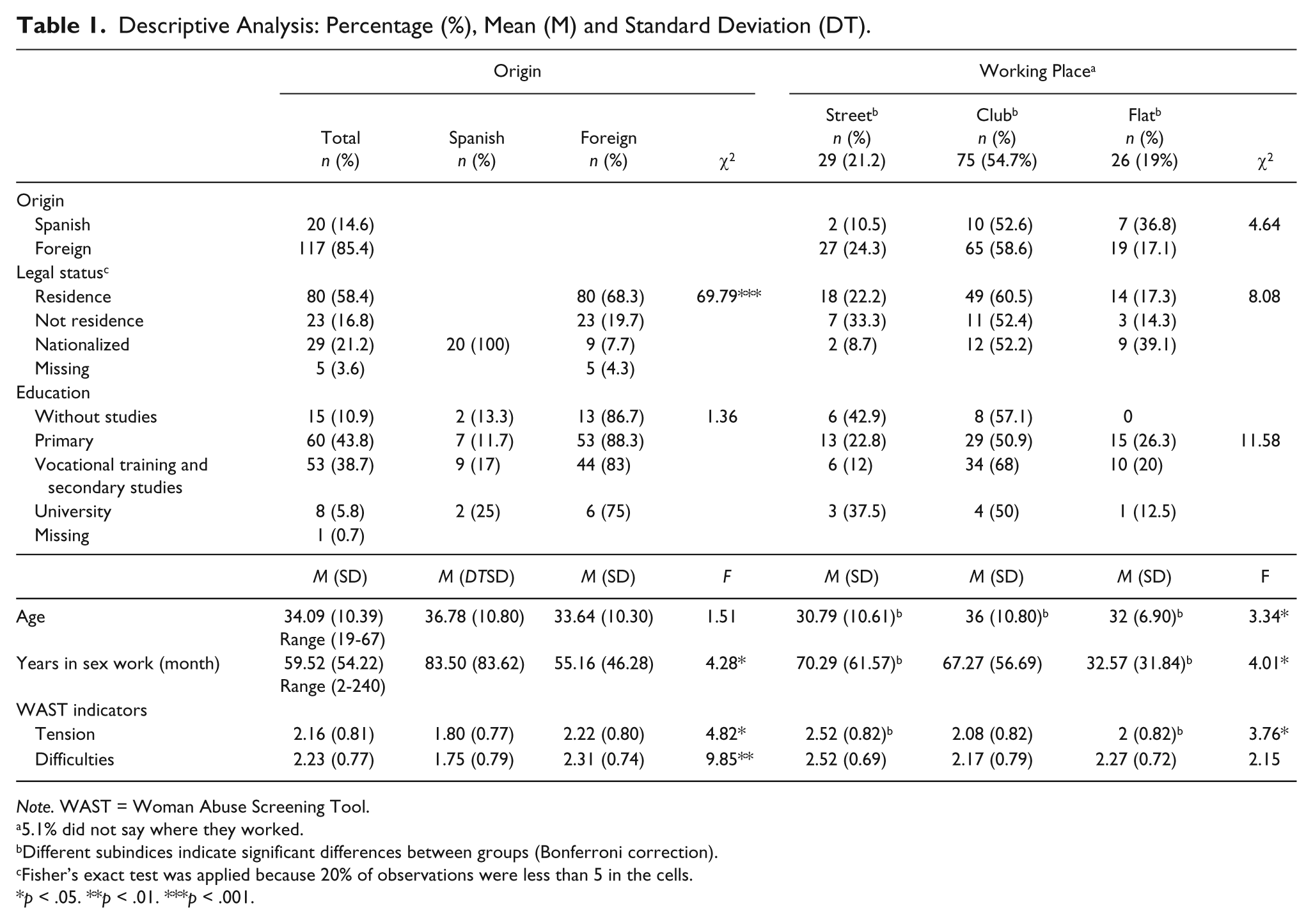
The sample was made up of 137 female sex workers from Spain. The foreign female sex workers came from different Latin American countries (n = 68, 49.6%; Argentina, Brazil, Colombia, Ecuador, Paraguay, Dominican Republic, and Venezuela), Eastern Europe (n = 42, 30.7%; Slovakia, Romania, Russia, and Serbia), and Africa (n = 7, 5.1%; Nigeria). Table 1 describes the main sample characteristics. In terms of time, the native sex workers spent more time working in prostitution than foreign sex workers. Also, sex workers who were working in the streets spent more time than the women who were in the flats. Finally, sex workers operating in the clubs were significantly older than those working in flats and on the streets.
Descriptive Analysis: Percentage (%), Mean (M) and Standard Deviation (DT).
Note. WAST = Woman Abuse Screening Tool.
5.1% did not say where they worked.
Different subindices indicate significant differences between groups (Bonferroni correction).
Fisher’s exact test was applied because 20% of observations were less than 5 in the cells.
p < .05. **p < .01. ***p < .001.
Although every woman had had an intimate relationship in the previous year, 59 of them were currently in an intimate partner relationship. In 58.1% of these cases, the relationship was or had been tense, both with current and previous partners, and 56.2% had, or had had problems in resolving problems with their partners. Foreign sex workers showed more indices of tension and difficulties than native sex workers. Sex workers who used streets reported higher levels of tension in their intimate relationships in contrast to women who were located in the flats (see Table 1).
The coping strategies most commonly used by female sex workers in situations of interpersonal violence were self-reward (M = 4.29, SD = 1.20) and self-control (M = 3.70, SD = 1.63). Conversely, the least used were confrontation (M = 2.29, SD = 1.56) and controlled expression of emotion (M = 2.12, SD = 1.26). There were not significant differences in the use of different coping strategies between foreign- and native-born sex workers.
Instruments
Woman Abuse Screening Tool (WAST)
WAST (Brown, Lent, Brett, Sas, & Pederson, 1996, adapted by Brown, Lent, Schmidt, & Sas, 2000; Fogarty & Brown, 2002; Plazaola-Castaño, Ruiz-Pérez, & Hernández-Torres, 2008) is a screening tool to detect probable cases of violence against women in their relationships during the previous year. It is made up of two items (e.g., In general, how would you describe your relationship? and Do you and your partner work out arguments with . . . ?). Responses vary on a scale from 1 = a lot of tension—great difficulty to 3 = no tension—no difficulty. The first Spanish version with seven items was validated by Fogarty and Brown (2002) with Spanish-speaking women from a community health center and a battered women’s shelter in the United States. The Spanish validation showed a 94% of specificity and a sensitivity of 89% with a Cronbach’s alpha of .91. Also, women evaluated each item in terms of convenience and pertinence to create the WAST short version scale. Then the Spanish short version of the WAST was validated by Plazaola-Castaño et al. (2008) with a Spanish sample of 390 women between 18 and 70 years old. The sensitivity of the short Spanish version was 91.4%, the specificity was 76.2%, the positive predictive value was 40.2%, and the negative predictive value was 98.1%. In both versions, the WAST scale showed good statistical properties. This instrument has been backed by World Health Organization in Spain (Wilson & Jungner, 1969), and the internal consistency of the scale in this study was .83. In addition, the WAST short version has been considered more appropriate in situations where women may not want to directly talk about the abuse and could be concerned with confidentiality (Plazaola-Castaño et al., 2008).
Measure of Affect Regulation Styles (MARS)
MARS (Larsen & Prizmic, 2004) measures the intensity of an emotional experience over the previous year and to what extent a series of strategies were used to deal with it. It focuses on the last intimate violent situation suffered by the woman with her partner. A reduced version was used with 13 items relating to coping and regulation of emotional response from the original scale (Páez, Martínez-Sánchez, Sevillano, Mendiburo, & Campos, 2012), with a range of responses from 0 (not much) to 6 (a lot). The included dimensions were as follows: confrontation (two items), controlled expression (two items), inhibition (three items), venting (two items), self-control (two items), and self-reward/gratitude (two items). The reliability was between α = .56 and .83. However, according to Pallant (2001), the coefficients under .70 but over .50 could be considered acceptable.
Pemberton Happiness Index
Pemberton Happiness Index (adapted by Hervás & Vázquez, 2013) is a quick measure of general well-being, which refers to the previous year. In this study, the 11 items linked to subjective well-being were used. The range of responses was from 0 = totally disagree to 10 = totally agree. The reliability of the scale was α = .74.
Positive–Negative Affectivity
Positive–Negative Affectivity (Bradburn, 1969, adapted by Echebarría & Páez, 1989) instrument was used to measure the affective balance of the subjects over the previous year. It consists of 18 items distributed on a scale of 1 (not much or never) to 4 (almost always). It is made up of two subscales: nine items relating to positive affect (α = .80) and nine items to negative affect (α = .84). It also provides global information about the balance of affect. The reliability of the scale was α = .80.
In addition, data about age, nationality, educational level, place of residence, place of work, and legal status were also collected.
Procedure
Structured personal interviews were carried out with female sex workers in three different places in Spain, using an intentional sample. For data collection, three experts (two psychologists and one social educator) were instructed in administering the questionnaires and worked in direct contact with the female sex workers in multidisciplinary IGENUS (Spanish Foundation) teams (an organization who works with women under social exclusion risk). The experts had established a work route during the week, and they went to flats, clubs, and streets where sex workers often were located. After the experts informed about the research, the participation was voluntary. The interviews took around 15 min. The ethical principles of the Declaration of Helsinki on research involving human subjects were respected. The interviews were anonymous and carried out under informed consent. The data were solely used for the research purposes.
The interview was applied while female sex workers were in the streets or clubs and due to this, the questionnaire had to be adapted to their functional setting. Although there are other instruments for the detection of violence which are validated and applied internationally, in this case we selected questionnaires allowing a quick and easy application. This was due to the impossibility of applying long questionnaires in these situations.
Statistical Analysis
The following analyses were carried out: (a) ANOVA, to check for variation in the measurements obtained in psychological characteristics (well-being, affectivity, and coping strategies) of the female sex workers regarding the existence or not of possible partner violence (Hypothesis 1); (b) correlation analysis, to investigate the relationships of different psychological variables, such as well-being and affectivity with coping strategies (Hypothesis 2); and (c) three path models were tested, to examine the predictors of well-being and affectivity, and their relationship to coping and suffered violence by female sex workers. Furthermore, we examined the indirect effects of possible violence on well-being through affects and adaptive and maladaptive coping strategies (Hypotheses 3.1, 3.2, and 3.3), following the criteria proposed by Hayes and Matthes (2009). Statistical analyses were conducted using SPSS 21 and Mplus 7.11.
Results
The Relationship of IPV and Psychological Variables
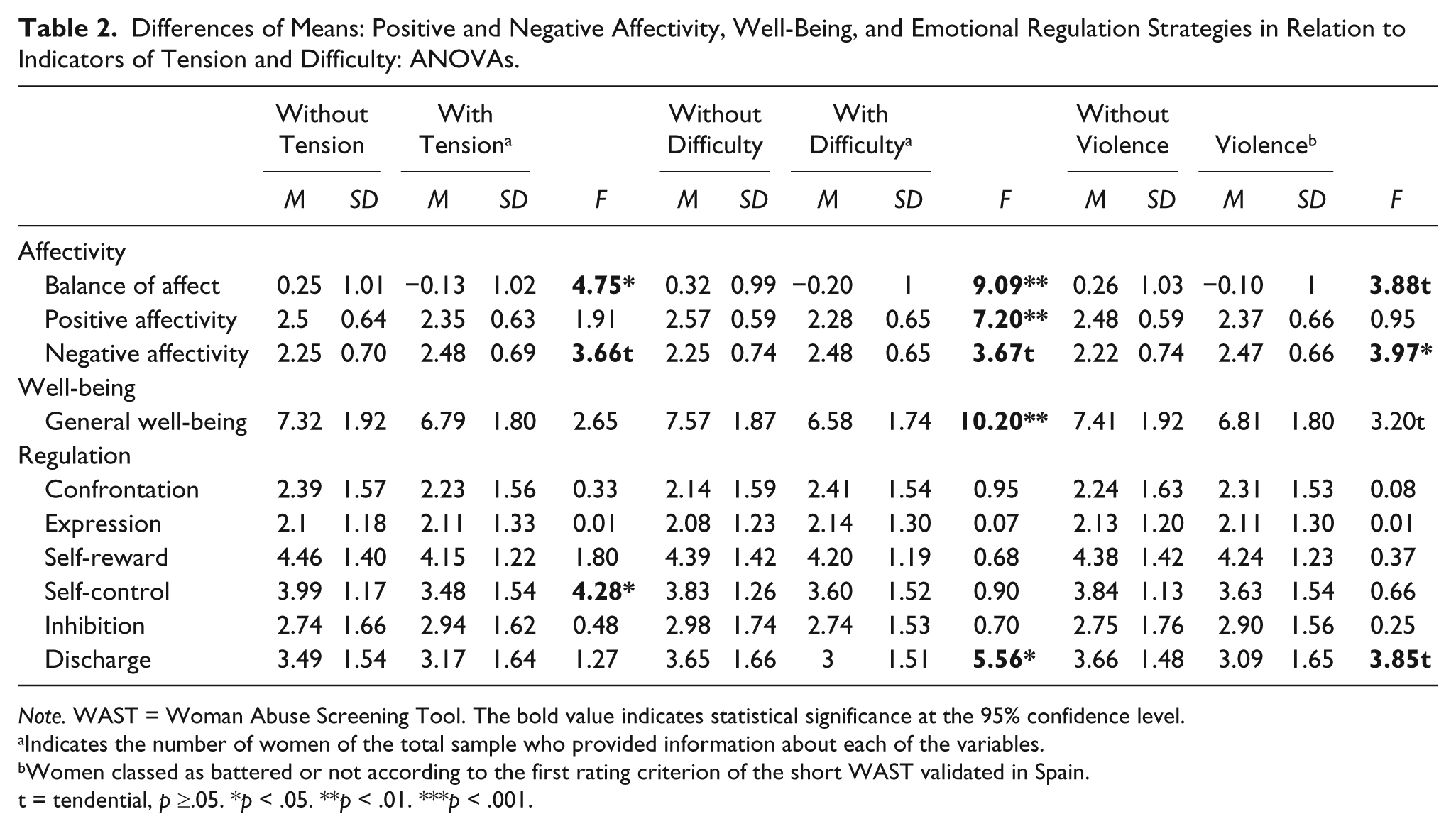
A contrast of means was carried out on the indicators of violence (tension and difficulty) for each of the psychological variables analyzed (affectivity, well-being, and coping; see Table 2). Female sex workers who claim to have been possible victims of violence presented more negative affectivity, and a tendential worse balance of affect, lower levels of general well-being, and a less use of venting.
Differences of Means: Positive and Negative Affectivity, Well-Being, and Emotional Regulation Strategies in Relation to Indicators of Tension and Difficulty: ANOVAs.
Note. WAST = Woman Abuse Screening Tool. The bold value indicates statistical significance at the 95% confidence level.
Indicates the number of women of the total sample who provided information about each of the variables.
Women classed as battered or not according to the first rating criterion of the short WAST validated in Spain.
t = tendential, p ≥.05. *p < .05. **p < .01. ***p < .001.
To establish the causes of these differences, each indicator was analyzed separately. It was discovered that the female sex workers who had reported lower levels of tension in the relationships with their partners had a better balance of affect and perceived better self-control. Moreover, women who had less difficulty in dealing with problems in their relationships used venting more often as a way of coping, displayed more positive affectivity, a better balance of affect and greater well-being. In addition, female sex workers who reported greater tension and more difficulties in dealing with problems in their relationships tended to show more negative affectivity.
Correlations Between Affectivity and Well-Being With Different Coping Strategies
There was a positive and significant correlation between strategies such as confrontation, r(132) = .28, p = .001 and inhibition, r(132) = .28, p = .001, with negative affectivity. Controlled expression, r(132) = .20, p = .020, and the use of self-reward, r(131) = .40, p = .001, also correlated positively and significantly with positive affectivity. The balance of affect correlated positively only with self-reward, r(131) = .23, p = .008.
Functional strategies such as self-control, controlled expression of emotion, and the use of self-reward correlated positively and significantly with well-being: r(132) = .24, p = 006; r(132) = .22, p =.012; and r(131) = .37, p = .001, respectively. Confrontation, r(132) = .28, p < .001, and inhibition, r(132) = .28, p < .001, were shown to be dysfunctional, due to they were associated with more distress among these workers.
Path Analysis: The Relationship Between Violence and the Affectivity, Coping, and Well-Being Related Variables
The path analysis results revealed a good fit for the model, χ2(45, N = 137) = 208.074, p < .001; comparative fit index (CFI) = 0.97; Tucker–Lewis index (TLI) = 0.92; root mean square error of approximation (RMSEA) = 0.048; and 90% confidence interval (CI) = [.00, .09]. Also, taking origin and location of work as control variables in the path analysis, the results also showed a good fit, χ2(66, N = 137) = 235.38, p < .001; CFI = 0.97; TLI = 0.90; RMSEA = 0.03; and 90% CI = [.00, .09]. High levels of tension and difficulties in intimate partner relationships predicted higher negative and lower positive affectivity. At the same time, in this context of tension and difficulty, it is affectivity which determined the use of coping strategies. Positive affectivity promoted the use of functional strategies, whereas its negative counterpart led to more nonadaptive or dysfunctional strategies. First, positive affectivity predicted the use of strategies such as the search for self-reward, controlled expression, and emotional self-control. Second, negative affectivity explained the variance in the use of dysfunctional or nonadaptive strategies, such as inhibition or confrontation. In addition, affectivity did not determine the use of coping strategies with different valence. Nevertheless, the use of venting was determined by both positive and negative affectivity (but only tendentially). Self-control was the only coping strategy capable of predicting greater well-being in interpersonal violence situations when sex workers perceived less positive affectivity. In such cases, neither self-reward nor controlled expression produced an increase in well-being. In contrast, the only strategy which predicted distress in intimate partner conflict situations under negative affectivity was inhibition. Venting and confrontation when facing violent situations did not predict an improvement in well-being for female sex workers. Finally, while positive affectivity was linked to greater well-being, negative affectivity was connected with greater distress and at the same time violence was linked with a negative impact on well-being (see Figure 1).
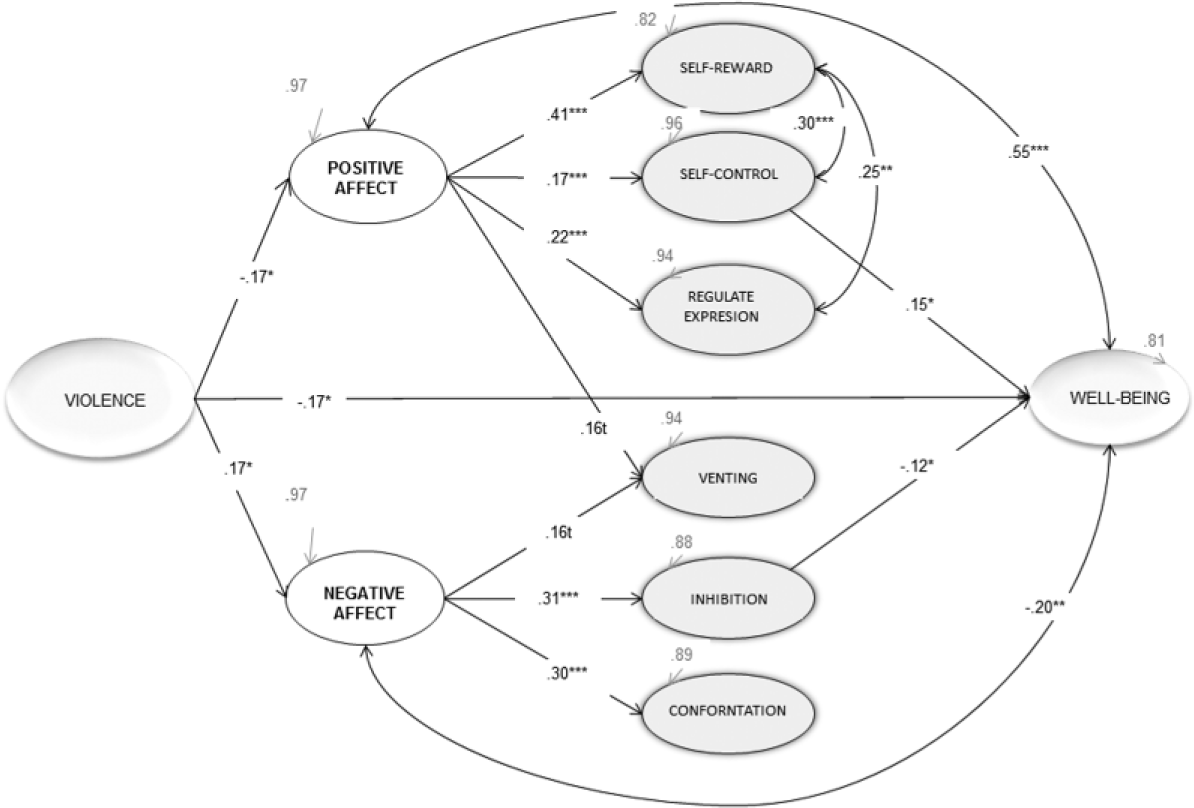
Path analysis of how WEPs (Women Engage in Prostitution) cope with violence (N = 137).
Two alternative models were tested. The first, coping strategies were considered predictors of positive and negative affect. Although the model fit was good, χ2(45, N = 137) = 209.562, p ≤ .001; CFI = 0.97; TLI = 0.89; RMSEA = 0.055 (90% CI = [.00, .119]), the violence indicator did not have a direct effect on coping strategies. The alternative model included well-being as a predictor to coping and affect strategies; however, the model fit was not adequate, χ2(66, N = 137) = 235.380, p ≤ .001; CFI = 0.76; TLI = 0.58; RMSEA = 0.09 (90% CI = [.61, .117]). Sequential indirect effect confirmed the violence effect on well-being via positive affect and coping strategies (total effect: β = −.19, SE = .082, estimate/SE = −2.29, p = .022). Specifically, positive affect and self-control were mediators between the indicators of violence and well-being (total effect: β = −.12, SE = .052, estimate/SE = −2.23, p = .026).
Discussion and Conclusion
Possible cases of interpersonal violence in the lives of female sex workers have been studied in other contexts, but the research has not been exhaustive (Shannon et al., 2009). Our study represents one approximation of how sex workers frequently have to regulate their emotions, especially negative ones, to function in life.
The findings of this study have implications for emotional regulation. According to the dynamic model of emotions (Gross & John, 2002; Larsen & Prizmic, 2004), often, potential violence situations do not allow for free expression of negative emotions (Páez et al., 2011). How sex workers deal with them has implications for a wide range of domains, including their well-being (Mauss, Cook, & Gross, 2007). Like in other studies (Mauss et al., 2007), the bivariate results showed that women who expressed their emotions in a controlled manner and seek self-rewards perceived a greater degree of positive affectivity. These strategies involve active attempts to influence one’s feelings and express emotions at a suitable time and place (Páez et al., 2011). Only self-rewarding was associated with affect balance. Even in moments of high stress or after suffering a particularly negative event, self-reward may help to cushion the negative impact (Larsen & Prizmic, 2004) because it could help the individual concentrate on finding solutions and it does not damage the social network.
On the contrary, women who used confrontation as a form of dealing with conflict and suppress their emotions presented greater negative affectivity and distress. According to this, direct or indirect verbal confrontation is not functional because it could be associated with greater intensity, displeasure, and less control. In the same way, inhibition can have negative effects by hindering people seeking support and it exhausts their cognitive resources (Gross & John, 2003).
However, as it occurs in other contexts (Gross & John, 2003) in prostitution framework, sex worker emotions tend to be matched to a given negative situation and they normally try to regulate their emotional responses so that they achieve their goals in a better way. In this context, emotional impulses, especially potentially destructive ones, regularly present us with the question of how we ought to respond to them: Should we openly express them or attempt to control them?
The path analysis allowed us to understand the relationship between these variables in the case of female sex workers who are possible victims of violence. In this study, indices of difficulty and tension predicted greater negative affectivity, reduced positive affectivity, and poorer well-being. In other words, women who presented indicators of IPV felt fear, sadness, anger, and lack of energy and of motivation to carry out day-to-day tasks. These results were supported by the bivariate analysis and in growing literature on the negative emotional impact of gender-based violence on sex workers and their capacity to effectively face difficulties and protect themselves (Shannon et al., 2009). In fact, it confirmed in general that while positive affectivity predicted the use of functional strategies, negative affectivity predicts dysfunctional ones. In line with this, there is ample evidence that information is often processed in a mood-congruent manner. Building upon congruency hypothesis and the Bowers network theory, by focusing on affects of certain valence, sex workers use the congruent strategies with their mood for facing violent situations because their judgments are congruent with their mood state (Bower, 1981; Voelkle, Ebner, Lindenberger, & Riediger, 2014). In this way, an incremental negative affect would probably be related to confrontation and inhibition with sex workers particularly if the context response is inactive and nonconstructive (Larsen & Prizmic, 2008), as often happen with sex workers who suffer potential IPV. Previous studies concluded that with IPV, emotions such as fear may be imposed by a situation of generalized insecurity and exacerbate people’s feeling of isolation, promoting inhibition, and reducing opportunities for an individual’s emotional response (Beristain, Páez, & González, 2000). In contrast, when sex workers use positive emotions (promoted by favorable context and intimate high-quality relationships) for guiding their behavior in negative specific situations (last situation with IPV), they will be able to obtain a functional outcome, through the use of adaptive strategies, because a desired positive emotion is being intensified (Aldao et al., 2010).
However, venting turned out to be an ambivalent strategy, because it tended to relate to positive and negative emotions. In accord with this, in a context where sex workers reported tension and difficulties with their partners, venting could be perceived as dysfunctional for coping negative specific events, because it refreshes the negative event and escalates conflict rather than reinforcing conflict resolution (Puente et al., 2014). In contrast, positive affect could be related to more venting as a response to emotional stress provided that sex workers perceive to be in a favorable situation, where they are cared for, understood, and valued by their partners (Larsen & Prizmic, 2008). These results are supported by previous analysis where less difficulty with sex worker’s partners was related to more use of venting.
A reasonable conclusion from these is that women make use of coping strategies through a transactional process with their environment, which works as a source of feedback (Moos & Holahan, 2003). In this process, emotions function as mediators between violence indicators and the use of coping strategies; hence, feelings generated within the partner relationship represent a source of information or a behavioral cue. They guide our actions, provide communicative resources, organize the way we deal with the world around us, and harmonize our social interactions (Gross & John, 2002). Therefore, results suggest that the activation produced by certain emotions influences the type of response adopted by female sex workers confronting a violent situation with their partners, and these coping strategies in turn affect women’s level of well-being. In addition, these results may help us to understand the association’s direction between less levels of tension in intimate relationships with high self-control. The general context where sex workers perceive lower levels of tension with their partners could precede and have an influence in the strategy through which sex workers face the last IPV episode. This relation will be mediated by emerged emotions given that sex workers make use of affect regulation strategies with the purpose of control of the already underway negative emotions and thereby avoiding new violent situations with their partners (Puente et al., 2014).
These results were supported by the alternative path analysis, which have demonstrated that potential indicators of IPV did not predict directly the use of regulation strategies for facing the situation. However, affect regulation strategies were predicted by the emerged emotions. According to this model, sex workers used response-focused strategies, and emotion regulation occurs after emotion response tendencies have been triggered by a favorable or unfavorable general context (Mauss et al., 2007). But also this model would imply that sex workers could not be merely passive conduits of emotional responses to potential violence and specifically outline processes by which they influence thought coping strategies in the onset, offset, magnitude, duration, intensity, or quality of an emotional experience (Gross & Thompson, 2007) to mitigate the negative impact of violence. This is in line with studies of battered women, which confirm that feelings predict and motivate behavioral change (Puente et al., 2014).
Furthermore, previous studies showed that self-control improves well-being in female sex workers and confirms its adaptive profile. This conceptualization is supported by emotional regulation theories and suggests that self-control had positive outcomes, because it facilitates their desired behavior tendencies (de Ridder, Lensvelt-Mulders, Finkenauer, Stok, & Baumeister, 2012). Also, the alternative path analysis was consistent with these predictions. This process would help to comprehend the survival behavior adopted by female sex workers and has important implications for their psychological well-being. In this regard, the study confirms that to solve an interpersonal conflict situation in which positive affectivity predominates, the only strategy capable of predicting a rise in the level of well-being of female sex workers was self-control (adaptive). Self-control should be effective in decreasing the behavioral expression of emotion related to IPV (Oselin & Blasyak, 2013) but also might have unintended side effects because it is not helpful in reducing the negative emotional experience (Gross & Thompson, 2007). In addition, sex workers required to effectively manage emotion response continually, and these efforts may consume cognitive resources that could otherwise be used for optimal performance in the social contexts in which emotions arise. In addition, previous research suggests that female sex workers may feel unprotected in a broader context of violence (isolation and being controlled (Katsulis et al., 2015). In such situations, female sex workers are aware of the danger, and in the absence of security, they develop survival strategies based on their own control of the situation with the purpose of protecting themselves and improving their well-being (Oselin & Blasyak, 2013; Tsutsumi et al., 2008). In a similar vein, the use of self-control in front of other strategies is based on the evaluation where sex workers carry out about the risk (in terms of well-being) to express their emotions in the context of prostitution (they choose the best emotional regulatory option). On the contrary, where negative affectivity dominates, inhibition was not adaptive due to the decrease it caused in levels of well-being. Other studies with sex workers have shown that inhibition is used as a strategy of emotional distancing which in the long term generates distress in women (Katsulis et al., 2015).
The main sociodemographic characteristics in this study were similar to official data and with other research that used convenience sex workers samples (Ballester, 2012; González & Tirado, 2006). A large percentage of sex workers were from foreign countries, and it is likely that they could be victims of additional methods of control by an intimate partner. In fact, the foreign sex workers declared more levels of tension and difficulties in their relationships than the native sex workers. In this sense, aggressors may be able to reinforce their control of the women’s physical world and promote the women’s captivity and isolation (Wilson & Butler, 2013). These experiences are intensified by the lack of family support, language, norms, and laws of the new country. Also, involvement in the sex trade and/or migration to another country without proper documents can make victims fear incarceration, punishment, and deportation. These fears can be used of taking advantage of as a means to increase compliance, and they can also impede victims from identifying themselves as maltreated and seeking help (Wilson & Butler, 2013). In addition, these data might be related with sex trafficking. Nations reported that two thirds of the trafficking victims detected globally are women, and 79% of the victims are trafficked for the purpose of sexual exploitation (Gutierrez & Delgado, 2015). Spain is a destination, source, and transit country for women, and children subjected to sex trafficking. In fact, main findings about region of origin of sex workers in this study coincide with the international official data about sex trafficking and sexual exploitation in Spain, mostly from Central and South America (i.e., Paraguay, Brazil, Colombia, and Ecuador), East of Europe (i.e., Romania and Russia), and Sub-Saharan Africa (Nigeria; U.S. Department of State, 2013).
In terms of the limitations of the research, the cross-sectional nature of this study provides weak evidence of causal association between variables. In fact, this study measured the difficulties experienced by sex workers for a specific period; it did not examine their long-term circumstances. It must be stated that the data obtained should be treated with caution, given the difficulties of reaching female sex workers to obtain their collaboration (Weitzer, 2009). Due to, interviews were completed in areas in wich prostitution is practiced, some participants were reluctant to share personal information about their lives (i.e., age, legal status). Also, we do not have information about the influence of external factors and women’s experiences in a prostitution context. The sex industry is variable, not constant, and the information of context could be interesting to understand the causes of violence as well as the use of regulation strategies with female sex workers. Although the WAST is extensively used and shows good psychometric properties, it only detects possible cases of violence against women. A further limitation is linked to the generalization of results, as the samples are not random due to the fact that the parameters of the sex workers’ population are not known (Shannon et al., 2009).
Referring to future research collecting data over multiple times will help answer whether sex workers who habitually use a particular strategy are any more likely to use it during a single emotional episode, or whether someone who can use emotional regulation very successfully at one point in time is more likely to use it successfully in general. Often, women could be adopting self-control strategies for protecting themselves from violent situations with their partners and to generate well-being. This strategy could be effective in context associated with the stigma, control, isolation, and invisibility as a survival resource, but in a long term it may generate distress and discomfort because it may have a cognitive and emotional cost (Mauss et al., 2007). In this sense, it would be interesting if the interventions were designed to provide positive affects with additional tools and resources so that they are better prepared to manage potentially violent situations and actively protect themselves from violence. Finally, inhibition and self-control strategies do not imply the expression of emotions to others. Training sex workers in the use of effective coping strategies would allow the recovering of their ability to express emotions and necessities and they will possibly feel able to explore the alternatives available to them.
Despite these limitations, our data underline the urgent need to reduce the prevalence of IPV. Other relevant result is related with the emotion regulatory processes and the effectiveness of coping strategies in the prostitution context. Also, findings regard the relative efficacy of emotion regulation strategies such as suppression and self-control, on well-being. Both strategies inhibit potential emotional responses, involving the no-manifestation of emotions and have an impact in the sex workers’ well-being. Finally, this work also highlights the percentage of foreign sex workers and their possible association with the violation of human rights and sex trafficking. Prostitution, well-being, basic health, and human rights deserve to be the subject of concerted attention at local, national, and international levels.
Footnotes
Declaration of Conflicting Interests
The author(s) declared no potential conflicts of interest with respect to the research, authorship, and/or publication of this article.
Funding
The author(s) disclosed receipt of the following financial support for the research, authorship, and/or publication of this article: This work was supported by the Spanish Ministry of Science and Innovation (PSI2011-26315), the University of the Basque Country (Grant IT-666-13 and Grant UFI 11/04), and Research Personnel Education and Training Program scholarship granted by University of Basque Country to Alicia Puente (PRE_UPV/EHU 2011-17-18).