







Abstract
Drawing on interviews with and observations of boys enrolled in a bystander violence prevention program at a juvenile detention center, this article provides a sociological case study on how the boys’ biographies and violent lived experiences shaped their engagement with the program. Previous research on bystander prevention programs has typically focused on men enrolled in college who do not have the same kinds of violent histories as the boys in this study do. This article builds upon prior research on prevention programs by demonstrating how at-risk youth participants understand and access the program. We offer suggestions for tailoring bystander prevention programs to more adequately address the specific needs of these populations.
The Centers for Disease Control and Prevention (CDC) acknowledges that teen dating violence is a public health problem. Indeed, nearly one out of 10 high school students report experiencing physical violence within the context of a dating relationship in the past year (Black et al., 2011), and nearly one quarter of adult women and 15% of adult men report that they first experienced rape, physical violence, or stalking by an intimate partner as a youth (CDC, 2016). To be sure, at a young age, youth begin to amass the skills to foster unhealthy relationships, and these skills are partially grounded in contemporary youth dating culture and gender norms (Johnson et al., 2005; Noonan & Charles, 2009). Furthermore, youth who experience violence increase their risk of encountering a number of negative social and health consequences; for example, among other things, these teens are more likely to binge drink, participate in sexual activity, attempt suicide, use illegal substances, and experience problematic mental health conditions (Banyard, Williams, & Siegel, 2001; Black, Noonan, Legg, Eaton, & Breiding, 2006; Silverman, Rai, Mucci, & Hathaway, 2001).
Because youth dating violence is common and there are clear links between experiencing violence and negative outcomes, it is critical to address and prevent these problems. Over the past decade, individuals have developed and implemented a variety of sexual assault and gender violence prevention programs often aimed at high school or college students. From media campaigns to healthy relationship curriculums, these programs take a variety of theoretical approaches. More recent empirical literature, however, provides compelling evidence that bystander programming, in particular, seems to be a promising approach (Banyard, Moynihan, & Crossman, 2009; Banyard, Moynihan, & Plante, 2007; Coker et al., 2011; Katz, Heisterkamp, & Fleming, 2011).
Although there is a growing body of literature on sexual assault and teen dating violence prevention programming, little research exists on the implementation of this programming with high-risk populations (Antle, Sullivan, Dryden, Karam, & Barbee, 2011). In addition, despite a large body of literature on the implementation of bystander programming with college-aged students, researchers have been less likely to examine the results of implementation with high-school-aged youth (for an important exception, see Katz et al., 2011). High-risk, high-school-aged youth, such as those serving time in a juvenile detention center, are even more likely to experience violence in their homes and community, making them an important population to implement bystander programming with. One study done on youth in juvenile detention centers in Spain showed high rates of exposure to and/or experience with violence: criminal offense against them (93.1%), exposure to community violence (95.0%), and peer victimization (86.1%). Males were even more frequently exposed to this type of violence in their lifetime than females (Pereda, Abad, & Guilera, 2017). This article is an attempt to shed light on these gaps in the literature by exploring the implementation of a healthy relationships bystander program with a case study of one small cohort of high-school-aged boys in a juvenile facility. More specifically, drawing on ethnographic data with a small group of male juvenile offenders, the goal of this exploratory research is to introduce the potential, as well as highlight some problems, of implementing this type of programming with this population of youth. A central goal of the data we present is to provide a starting point for additional research on the topic of bystander education with at-risk youth. In addition, because very few studies on youth corrections examine the role gender plays in treatment programming (Abrams, Anderson-Nathe, & Aguilar, 2008), in our analysis we pay particular attention to the way the boys’ gender identities intersect with the implementation of the program.
Considering Masculinities in Correctional Contexts
Dating violence and sexual assault prevention programming are typically carried out within the institutional context of the school system or, occasionally, via community organizations. Schools are central to boy’s socialization into their gender identities and, thus, are also sites where gender performances are constructed and policed (Adler, Kless, & Adler, 1992; Eder, Evans, & Parker, 1995; Pascoe, 2011). However, examinations of men’s prisons and boys’ juvenile facilities indicate that the enactment of hegemonic masculinity plays an even more central role in the lives of those incarcerated there (de Viggiani, 2012; Goffman, 1961; Irwin, 1970; Sykes, 1958; Toch, 1998). Hegemonic masculinity is distinguished from other masculinities, especially subordinated masculinities, as the dominant and idealized form of masculinity. While only a minority of men might enact it, it is held up as the model against which men are expected to measure themselves (Connell & Messerschmidt, 2005). Prior research in criminology has shown how particular patterns of aggression are linked to hegemonic masculinity and how the concept of hegemonic masculinity helps to theorize the relationship among differing masculinities and a variety of crimes (Messerschmidt, 1993; Totten, 2003). Indeed, for incarcerated men and boys, the institutional and cultural context of the institution, as well as the masculine biographies of the individuals housed there (Goodey, 1997), can create a more extreme culture rooted in traits associated with hegemonic masculinity (Connell, 1987; Messerschmidt, 1993).
For instance, young men involved in the juvenile justice system often experience a socialization process that emphasizes toughness, aggression, and criminal behavior (Anderson, 1999; Majors & Billson, 1992; Messerschmidt, 1993). In punitive settings, the messages of these lessons are re-affirmed and reenacted. For example, research on men’s prisons indicates the presence of a “prison code” where individuals must prove they are tough and capable while concealing vulnerability to avoid victimization (de Viggiani, 2012; Jewkes, 2005; Toch, 1998).
Less research examines the extent to which masculinities intersect boys’ juvenile facilities; however, existing studies do indicate that they reflect similar patterns. For example, Cesaroni and Alvi (2010) report that the incarcerated boys in their study were well aware of the importance of publicly standing up for themselves, withholding emotion, and being “manly” in their interactions with others. Abrams and colleagues (2008) account for these kinds of performances by pointing to an institutional context that reinforces them; they found that staff regularly reinforced hegemonic masculinity by disparaging juveniles, subordinating female employees, and adhering to and enforcing sexist ideals of feminine beauty and behavior, among other things.
Being aware of the likely investment of the residents in an “appropriate” display of hegemonic masculinity as well as the presence of their own masculine biographies is important when examining the implementation of a dating violence prevention program. Dating violence and sexual assault prevention programs often explore how adherence to traditional notions of masculinity supports a culture of violence. However, very few (Abrams et al., 2008, as an exception) have explored the way gender identities facilitate or disrupt correctional programming; hence, an important focus of the current research is to consider these dynamics.
Method
This case study is based on data collected from one small cohort of young men incarcerated in a juvenile facility enrolled in the program described below. Because the research we present here is based on a one-time opportunity data collection effort (in other words, additional data collection was not possible), we drew on multiple methods to examine the program’s implementation to gain a deep understanding of the program. In this section, we describe how we utilized focus group interviews, one-on-one interviews, and observations to gain an understanding of the promises and pitfalls of this programmatic effort. This triangulation of data collection techniques compensates for each method’s individual limitations and exploits their respective benefits (Shenton, 2004).
The Content and Focus of the Healthy Relationships Bystander Program
In 2011, a local domestic violence prevention organization worked with a boy’s correctional facility in the same state and implemented a program for the boys based on the bystander model (MVP; Katz, 1995; Katz et al., 2011). Although not a precise replication, the Healthy Relationships program examined here draws on Mentors in Violence Prevention (MVP) in several ways. First, recognizing that gendered violence is primarily a crime carried out by men against women, MVP foregrounds the role of masculinity and, more broadly, traditional gender norms in its framing of dating violence and sexual assault (Katz, 1995; Katz et al., 2011). A central goal of the current program included addressing the gendered cultural norms underlying dating and violence among teens. More specifically, lesson plans tackled rape myths, other forms of victim blaming, and adherence to traditional gender norms.
In addition, MVP falls into the category of programming known as “bystander programs.” These programs are grounded in a handful of different theoretical orientations; however, a similarity among the curriculums is that they work from the assumption that a central way to stop gendered violence is to directly engage men and women in the efforts. The approach teaches individuals to view themselves as potential disrupters of gendered violence or, at a minimum, disrupters of norms and behaviors that create a culture that supports gendered violence (Banyard et al., 2007; Berkowitz, 2009; Gidycz, Orchowski, & Berkowitz, 2011). As stated earlier, bystander programs have shown particular promise as an effective intervention, especially among college students, which has been the population researchers have tended to focus on. For example, bystander interventions decrease rape myths (Banyard et al., 2007; Coker et al., 2011), increase knowledge about sexual assault (Banyard et al., 2007), and increase likelihood of intervention (Coker et al., 2011; Katz et al., 2011; Miller et al., 2012). 1 Thus, a secondary goal of the current program was to increase self-efficacy skills and enable participants to view themselves as pro-social bystanders who have the skill to—pro-socially—intervene when they witness attitudes or behaviors supportive of a culture of violence.
Finally, MVP and a number of bystander programs train “peers” to carry out the curriculum’s lesson plans. While being unable to use young adults directly from the juveniles’ peer groups, the organization that created the curriculum trained several male undergraduate students from a local university to carry out the program in the juvenile facility. The peer educators, who had taken courses at the university of one of the authors in the area of gender, violence, and crime, spent two weekends training on gendered violence, reviewing each curriculum lesson, and learning group facilitation skills. After being trained, they met with a group of incarcerated youth and independently carried out 1-hr interactive lessons premised on the MVP model each week, for 6 weeks.
These students, though slightly older and coming from communities with less violence than many of the participants’ communities, nevertheless felt closer in age and experience to the participants than many of the facility staff they typically engaged with, creating a relationship that felt “peer-like.” Research has shown that a peer-like relationship is important because youth seek acceptance and guidance on appropriate behavior from their peers, and face social rejection with non-normative behavior (Adler & Adler, 1998). Higher status youth, like the ones in this study who were older and in college, are particularly influential in shaping peer behavior (Adler & Adler, 1998). Each weekly lesson developed from key MVP elements including “the man box,” scenario-based “train of thought” exercises, and agree/unsure/disagree discussion exercises; each of the lessons addressed the goals outlined in this section.
Data Collection
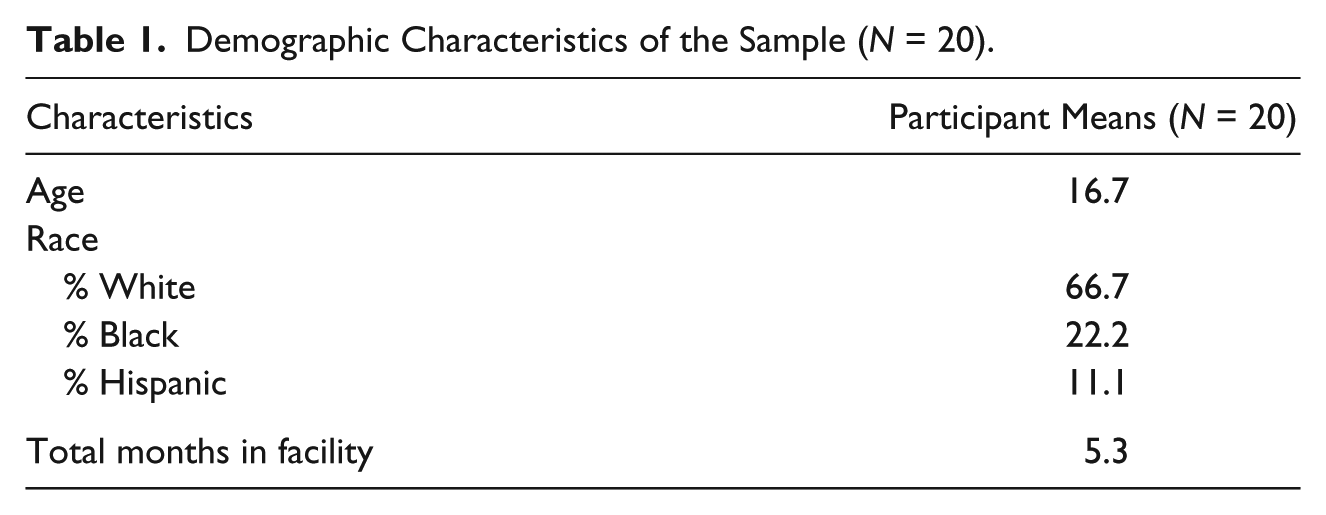
Treatment specialists at the secured juvenile detention facility referred boys to the MVP program after the treatment coordinator advertised its availability; wishing to make the program accessible to any resident, the treatment coordinator at the facility offered no criteria for referral. Students (N = 20) enrolled in the bystander program ranged in age from 15 to 18 with a mean of 16.7 years; two thirds (66.7%) identified as White, with the remaining participants identifying as African American and Hispanic (22.2% and 11.1%, respectively). The mean time spent in the treatment facility was 5.3 months with a range between 2 and 15 months. Table 1 summarizes major demographic characteristics of the boys in this study.
Demographic Characteristics of the Sample (N = 20).
After securing institutional review board (IRB) approval, one author observed all program sessions with one group of residents. Drawing on theoretical sampling techniques, where theory emerges inductively from the data in the process of conducting research (Charmaz, 2009), five of these participants were also invited and consented to participate in one-on-one interviews 1 week after the curriculum ended. These boys were asked to participate to “refine and fill out” (Charmaz, 2009) theoretical ideas that became central during the initial analysis of the data.
In addition to observing the program sessions and the five one-on-one interviews, we invited all male residents (N = 20) enrolled in the two bystander groups to participate in small focus group interviews at the conclusion of the intervention; 70% (n = 14) participated in focus groups several days after the program concluded. Each focus group contained the same members as were in the bystander group as those boys already had open lines of communication with one another. These 1-hr-long focus groups were semi-structured; open-ended questions focused on the young men’s experiences with the programming, their perceptions of the purpose of the programming, feedback on the curriculum’s activities and topics, and their socialization into gender roles.
Finally, in addition to collecting data on the young men who participated in the program, we also interviewed the three male “peer facilitator” college students, who facilitated all of the sessions, 2 weeks after their responsibilities to the program were complete. These in-depth interviews lasted approximately 60 min and consisted of open-ended questions that elicited the students’ views on their experiences with the program as peer facilitators in a juvenile facility. We digitally recorded all interviews conducted for this study, and these were later transcribed verbatim. Quotes from the interviews are used in the article to represent and illustrate common themes that emerged from several participants.
The findings presented throughout the remainder of this case study allow for a deep and thick understanding of the implementation of the program by illuminating complex social processes. To develop the themes we present here, we analyzed the data in several stages. Drawing on a grounded theory approach (Charmaz, 2009), we simultaneously collected and examined data. Initial data analysis involved open coding, with an emphasis on noting the participants’ own words rather than on making initial interpretations or limiting the number of codes (Emerson, Fretz, & Shaw, 1995). Codes emerged from the observations, interviews, research memos, research questions, and conceptual framework and were organized into categories, which then were used to re-code interviews and documents, surfacing patterns and themes. This process provided an opportunity to both expand and narrow in on topics of concern in the interviews that emerged as central issues during observation.
Findings/Discussion
The Role of Masculine Biographies
In her work on the gendered dimensions of fear and fearlessness, Jo Goodey (1997) conceptualizes the idea of the “masculine biography.” Goodey explains that the culmination of individuals’ lived experiences affects their ability to enact the dimensions or characteristics associated with hegemonic masculinity. The evidence establishes that young men involved in the criminal justice system tend to be heavily socialized and invested in a biography centered on violence, aggression, and power and use criminal or deviant behavior as an avenue to embody these traits (Anderson, 1999; Messerschmidt, 1993). The MVP curriculum fundamentally challenges the utility of enacting these characteristics, though as is evidenced by the data below, the program might benefit from taking more fully into account how the experiences of the boys in this study are significantly different from those of the college-aged men the program was originally designed for. Hence, considering the aspects of the boys’ masculine biographies is useful given the goals of this project because it allows (and reminds) us to consider the way the participant’s gender identities and lived experiences interact with the way they react and respond to the curriculum and, additionally, impacts the outcomes of the program.
Consistent with other research that examines the socialization of young men engaged in crime and delinquent activity, the residents in the current study were heavily socialized into traditional masculine gender roles that limited emotional expression and emphasized gender performances that embodied physical aggression. Throughout their childhood and adolescence, each participant explained that adults and peers modeled and reinforced violent behavior. Notably, although a small minority of participants explained they learned these messages from their fathers, most explained that by their adolescence their fathers were largely absent from their lives. Thus, older brothers, peers, and mothers typically became more powerful agents of socialization.
The most common type of masculine socialization that they received and remained committed to centered on being tough to earn respect and avoid victimization. Scott, for example, explained how the adults around him encouraged him to be aggressive: “So, I probably got it from like people talking like, ‘Oh don’t do this and don’t do that. If someone disrespects you, make sure you get in their face.’” These kinds of messages that Scott received from adults were enacted and reinforced by peers who subscribed to a similar set of beliefs. As a result, presenting himself as tough and using violence became part and parcel of Scott’s daily interactions.
Similarly, Domingo received clear messages about the importance of being hyper-violent from his older brother; gang members victimized both brothers before they too decided to join a gang for protection and brotherhood. Domingo explained that violence “feels like a requirement, to me, to be accepted . . . like even if I did lose in any kind of fight, I’ll still earn some respect from people.” Expanding on these thoughts, he explained he learned from a young age the importance of never walking away from a fight:
I don’t want to look like a punk.
Why does that matter?
Even if they’re big and I’ll know that I’ll get beat up, I’m not just going to walk away.
OK, but why do you care if they think that you’re a punk?
Because I know that they’ll think they’ll be able to do it anytime that they want. I don’t like people thinking that they can just walk all over me.
Most other participants expressed the kind of sentiment that Domingo does here: that there is an important relationship between willing to be violent, earning respect, and avoiding victimization. Indeed, for Domingo and others, being violent was so central to earning respect that demonstrating an unwillingness to be violent increased one’s risk of victimization in their communities. Thus, most of the participants were heavily invested in a masculine performance centered on embodying toughness. As we illustrate next, this kind of endorsement affected the participants’ ability to engage with a central message of the curriculum: being a pro-social bystander who prevents and minimizes the occurrence of gendered violence.
As described earlier, bystander programming promotes the idea that each individual has the opportunity to disrupt norms and actions that create a culture of violence. To engage this idea and increase self-efficacy skills, in this curriculum, facilitators provide participants with hypothetical situations that range in “seriousness” from derogatory lyrics to men being physically abusive toward women and asks participants to consider a range of pro-social intervention responses. During the sessions and interviews, when reflecting on scenarios where physical force was threatened or used, the young men invoked themselves as fearless protectors of women as illustrated in this exchange:
When you think about yourself, do you see yourself as a bystander?
An active. If I see something happening, I automatically just go in.
Can you give me an example?
Say if I see a guy slapping his girl, I’m going to go in there and do something about it.
Like what?
Usually, I’ll resort to violence. He’s going to hit her, I’m definitely going to hit him.
Did this program talk about for you, other options that you might have besides resorting to violence?
Yeah.
Yeah, but you still feel like that is what you would resort too?
Yeah, because I don’t like when guys hit girls.
Consistent with what Logan states here, most participants expressed an aversion for men who try or use violence against women. Indeed, they typically explained that the most (or only) appropriate way to intervene was to “beat them up” or “confront them” physically. This expression can be understood, in part, through the boys’ masculine biographies. Chivalrous behavior, situated within a patriarchal framework, is an extension of the culturally valued hegemonic masculine biography because it is a lived and discursive strategy that men and boys can use to establish fearless selves (Goodey, 1997), and, as illustrated above, knowing how to express themselves in this way was a central message of their childhood.
In addition to the violent responses being a version of dominant hegemonic masculinity, the participants’ responses can also be understood by considering the way their masculine biographies were shaped by witnessing violence as children. Specifically, the boys’ expressions of violence toward men who invoke violence against women result from witnessing men sexually and physically assault their mothers and sisters. Research indicates that incarcerated boys are often witnesses to serious intra-family violence (Agnew, 2002; Herrera & McCloskey, 2001; Spaccarelli, Coatsworth, & Bowden, 1995). Consistent with these research findings, several of the residents in the current study explained how the victimization of their loved ones had affected them as children. For example, Scott was adamant that it was his responsibility to protect women. He explained, Someone gets hurt around me, I want to go confront them about it. I don’t put up with that especially when a guy hits a girl because that is one of my biggest things. I don’t put up with it.
Later, he explained the historical base of this sentiment:
Kind of just from growing up. Like my family, I seen my mom get hit in front of me and stuff from boyfriends that she had. I don’t know. The first time I saw I was like “Oh my,” I didn’t know what to do. I was like 6 or 7 so I wasn’t old enough to do anything. The second time [I saw her get] hit . . . it was me and my friends out in the living room, it was me, my friend Lance, Jim, and Fifty . . . So we sittin’ there, we hear this bang like and this dude walks out. He was walking down the stairs and Jim’s like “what’s happening, what’s happening?” I hear a bang and this dude is just like—so Fifty gets up, he runs back in the room and I’m right behind him and we see my mom’s nose is bleeding and stuff. He hit her head, her like nose, she was bleeding here and split here, [bleeding] all over this brand new pink jacket I just got her like the day before. So I’m mad for that and then also furious because he just hit my mom. So I’m running out the house, Fifty and Lance behind me and he grabs the fire extinguisher and we just go and basically beat the crap out of this guy.
How old were you?
I was like 13.
Here, Scott explains how he felt helpless as a child when he witnessed a man abuse his mother. However, as he got older and gained more physical prowess, he viewed protecting his mother from these kinds of men—through physical violence—as his responsibility.
Like Scott, Xavier’s childhood experience with violence against his sister had an incredible effect on the way he viewed physical and sexual abuse against women and, in particular, his role in stopping in. About this, he explained, My sister was raped. It’s like every time that I hear the word rape it’s a slow blur. My dad was taken from me for it. My dad killed the dude that did it . . . my dad’s in prison for it. So, that’s—I don’t have my dad because of rape. Then from that day my sister, she’s not herself no more, she would have never been. She’s not herself and it’s just that people that know, they look down upon her. They say she’s not regular, she’s been raped. Rape was not her fault, she was 7 . . . He [my father] said that he wouldn’t take it back because he shouldn’t be there [in prison] for killing a guy for defending probably six people from probably getting raped again ‘cause he’s raped two other people before he raped her.
Examining this passage and Xavier’s story elucidates a source of his views on sexual violence as well as his endorsement of using physical force against perpetrators. He saw the community stigmatize his sister for being a victim of sexual assault, continued to the see the effects of this trauma on her, and learned an extreme lesson about how to respond to this type of violence from his father. For Xavier, an important piece of this lesson from his father was the way violence could illustrate love and a commitment to protecting his family. He explains, “I’m showing you that I care by beating him up [and] he’ll be afraid to do it again. That’s how I take it as.”
One important consequence of the boys’ experiences with gendered violence for the intervention rests on their emotional reaction to the material. For the facilitators, like Chad, who has less personal experience with violence than the boys, program material that personalizes violence against women by asking participants to think of women who are close to them is useful in connecting to the concepts. He explained, It was kind of ironic ’cause like when we were going over it, I was talking to my sister on the phone. A person that I used to hang around with had pushed her. So I don’t like that. That’s how I look at it now, like what if someone slapped my sister?
However, one of the other facilitators, Chris, acknowledged the difficulty of engaging students in some of the “personal” curriculum material. Talking about an activity where the facilitators ask the participants to envision a scenario where a witness avoids intervening in a situation where a woman who is close to them is the victim, Chris explains, Sometimes scenarios can be rough because they are—if you give a kid a scenario and then tell them to put their mom or their sister in the scenario it can really touch a chord with them. Sometimes you don’t really want to do that, it just makes them very angry and [they] don’t want to talk anymore. That kind of happened in our first six weeks with one [of the kids] and me and Chad [another facilitator] kind of decided we were going to be kind of careful with those ‘cause the kid just kind of closed up and was just like, “I don’t want to do this anymore.” It’s tough.
Clearly then, the residents’ masculine biographies shaped their reactions, interpretations, and even the possibility of enacting the pro-social bystander.
As developed throughout this section, the young men’s gendered relationship to and experiences with violence created their (anti-social) bystander identities prior to their participation in the curriculum. The findings presented here indicate a slightly increased propensity to intervene when confronted with an abusive situation; they indicate that—when considering MVP scenarios that are more “serious”—it is important to distinguish between the likelihood of intervention and the kind of intervention. Second, the young men only invoked aggressive bystander responses in the case of scenarios that incorporated more serious forms of violence; in fact, participants were unlikely to view scenarios that addressed sexist remarks, harassing text messages, or derogatory music lyrics as problematic or as in need of intervention.
Thus, these findings indicate that bystander curriculums created for high-risk youth must focus on (a) illuminating the relationship between minor and major forms of gender violence and (b) presenting and modeling pro-social interventions. In the next section, we briefly discuss one approach that can address this latter issue.
Performing Masculinities
As addressed at the outset of this article, performing hegemonic masculinity is often central to boys’ and men’s correctional experiences. For example, research illustrates that individuals who are incarcerated perform “prison” masculinities as a survival strategy (de Viggiani, 2012; Jewkes, 2005), that it is modeled and reinforced (often in contradictory ways) by staff (Abrams & Anderson-Nathe, 2012; Abrams et al., 2008), and that the cerebral environment emasculates boys and men, thus prompting the re-assertion of their masculinity (Cesaroni & Alvi, 2010; de Viggiani, 2012). However, in their ethnographic research of a male juvenile residential facility, Abrams and Anderson-Nathe (2012) explain that therapeutic treatment groups may provide a social context where incarcerated youth “can try on alternative modes of gender expression” (p. 85) that are often significantly different than the traditional masculine selves they construct throughout their childhoods.
The current study supports these latter findings. During weekly lesson plans, the lead author regularly observed residents engage in discourse that ran contrary to the gender identities into which many explained they were socialized. Participants, for example, openly talked about supportive relationships they had with family and friends, how they expressed love and affection in the context of a healthy relationship, and questioned the value of enacting characteristics like toughness and non-emotionality.
At the same time, however, most participants fell back on traditional performances during “heightened moments” when peers, or the program content, directly challenged or called their masculinity into question. Experiencing disagreement was a common interaction that prompted participants to re-engage their tough masculine selves during a weekly session. When participants strongly disagreed about an issue, they would use their physical bodies to try and assert control over the situation. In this institutional context, they could not use physical violence to achieve this but, instead, relied on more subtle clues to assert their masculinity. Specifically, participants (re)claimed respectability by puffing out their chest, pulling and tugging at their own clothing, cocking their head, spreading their legs out, and grabbing at their crotch. These performances were symbolic ones, intended to re-affirm the boys’ masculinity to their peers to maintain respectability, much as work done by Swain (2003) found in his studies of high school boys’ use of body language in masculinity construction.
The (novice) facilitators were aware and often frustrated by these kinds of displays because they disrupted the lesson plan as well as the goals of the program. Furthermore, although as middle-class college students they were certainly well acquainted with affirmations of masculinities, the open and sustained expressions of physical toughness created a less familiar terrain they had to learn to navigate. Over the course of the 6 weeks, however, the facilitators began to understand how to disrupt these performances and bring the residents back to the message of the curriculum. Specifically, the facilitators began to share aspects of their own lives as well as their own approaches to the bystander scenarios they had been positing to the residents. In other words, they began modeling alternative masculinities. For example, one day the residents discussed their response to a bystander situation where a group of guys was verbally harassing a girl. Max, a facilitator, drew on an experience from his life to highlight his own response to a similar situation. He explained that a few weekends past, he had intervened when a group of guys was “trash talking” a girl he did not know. When he explained that one of the guys started taunting him for trying to shift the conversation, several of the residents interrupted him exclaiming, “I bet you beat him up!” Max quickly corrected them explaining that he may have wanted to get physical because he was angry, but he did not and, instead, just walked away from the situation because he did not want to give the guy the satisfaction of knowing he had gotten to him. In response, the residents looked thoughtfully at Max and quickly re-engaged a more productive discourse about the bystander scenario on which they had been working. About these moments Xavier explained, “I like how they had these situations and told [us] about the experiences that they had and what they did, so then we could think about doing that.” Thus, as briefly illustrated here, when facilitators modeled alternative approaches (and thus, masculinities) that were based on their own lived experiences, the residents responded favorably.
Notably, the residents responded—in part—because they and the facilitators established caring and trusting relationships. In follow-up focus group interviews, the single most consistent narrative of the residents was that they most enjoyed participating in the program because of the facilitators. Using emotive language, the residents explained that the facilitators were “role models,” “demonstrated respect and caring,” “had a lot of honesty,” and provided evidence that somebody on the outside “actually does care.” In addition, the most consistent reason the residents attested to connecting to the facilitators was because, as Chad explained, “I could relate to them—they were just close to our age.” About this, Scott explained, It was cool being able to, like, have someone our own age, like being around our own age group . . . Sometimes kids are more willing to talk to people of their own age group ’cause they kind of know where they’re coming from.
As evidenced in this and the previous section, the residents’ masculine biographies shaped their interpretation of the curriculum and their experience in the program. However, here, we suggest that because the residents expressed respecting and relating to the peer facilitators, a social context evolved where the facilitators became more effectively positioned to disrupt expressions that developed from the boys’ masculine biographies. The shifts that occurred in the residents’ adherence to traditional masculinity may have resulted from their strengthening relationships with the facilitators and exposure to alternative masculinities.
Conclusion
This case study examined the implementation of a “healthy relationships,” bystander program with a small group of young men incarcerated in a juvenile residential facility. Specifically, we set out to explore the potential of a program that seeks to prevent gendered violence by deconstructing victim-blaming myths, critically examining traditional masculinity, and encouraging pro-social bystander interventions among a high-risk population. Understanding the possibility of this type of effort is important because gendered violence is primarily an activity perpetrated by men against women and because young men involved in the criminal justice system often have a history of experiencing and perpetrating violence. Clearly, the small sample size is a central and important limitation of this research; thus, while the findings are not generalizable, they do offer a number of valuable starting points that other research can consider as well as guidance for program implementation with this population.
Generally, the qualitative findings elucidate particular programmatic considerations that could improve the quality and effectiveness of this type of program with this population. Below, we further discuss these starting points, which encourage program implementers to (a) recognize the likely violent histories of incarcerated youth and how those histories may impact their “starting point” for the lessons; (b) use peer leaders who seek to develop strong relationships with the youth and offer personal stories to model alternative masculinities; (c) focus on violence reduction, rather than prevention; and (d) understand the importance of offering counseling services in juvenile correctional facilities as many youth have been exposed to violence.
The research illustrates that their pre-program intervention strategies are likely to rely on violence. A socialization process emphasizing the importance of toughness and violence, the need to respond violently as a way of avoiding victimization, and childhood experiences—in particular witnessing other men victimize their female friends and family—made non-violent interventions inconsistent with their masculine biographies. Because of the deep investment the residents have in performing hegemonic masculinity through violence, aggressive posturing, and re-affirming their status as “protectors of women,” it is crucial that the intervention programming pays particular attention to ways to disrupt these connections.
One promising approach to this, as illustrated in this research, is by using “peer” leaders to disrupt hegemonic performances by modeling alternatives. Indeed, the residents strongly endorsed the role of the undergraduate students in the curriculum; they explained that they perceived the facilitators as caring, trustworthy, and relatable. Thus, as the curriculum progressed, the facilitators became effectively positioned to challenge hegemonic performances by offering their personal experiences and perspectives to the residents. These interactions demonstrated alternative masculine expressions and allowed the residents to see other options without attacking or subjugating the gender performances to which they had grown committed. Abrams and colleagues (2008), suggest that alternative masculinities can be introduced into correctional facilities in a variety of ways including the use of role models. The current study re-affirms the validity of this call and provides one potential way to accomplish it.
As mentioned above, one goal of the program was to increase self-efficacy skills and enable participants to view themselves as pro-social bystanders who have the skill and ability to intervene when they witness attitudes or behaviors supportive of a culture of violence. This shift in thinking and behavior is particularly challenging for this population because being violent was a key component to earning respect, and an unwillingness to be violent increased one’s risk of victimization in their communities. Thus, a staged approach to the training, emphasizing violence reduction versus violence prevention, might be more effective. As noted in the research, the boys became adept at identifying and discussing healthy relationships and non-violent alternatives within the safer space of the group training but reverted to traditional performances during “heightened moments” when their masculinity was threatened. These “heightened moments” will likely be what they encounter in their communities when they leave the center. Thus, we suggest that the participants be trained in recognizing the differences between degrees of aggressiveness in masculinity performances (such as puffing their chest vs. actual fighting), where the milder version might be the thing that diffuses the situation instead of escalating it.
In addition, significant research indicates that a common pathway for youth into delinquent behavior is experiencing or witnessing violence in the context of their homes or communities (Margolin & Gordis, 2000; Stouthamer-Loeber, Loeber, Homish, & Wei, 2001). The current project points to the importance of offering counseling services in juvenile correctional facilities that can effectively address boys’ childhood and adolescent experiences with this type of “indirect” victimization. In addition, when considering the use of bystander or healthy relationships programming in juvenile facilities, the trauma history of the participants must be considered. Indeed, because bystander curriculums—more broadly—focus heavily on engaging individuals in the prevention of gendered violence, these programming may not deal systematically enough with those participants who have a trauma history.
In the end, then, juvenile facilities should consider ways to incorporate this kind of programming into their existing curriculums but not without specific adjustments and considerations that make it more appropriate and useful in this context with this population. Finally, it is noteworthy that the implementation of this program resulted strictly because of a creative partnership between a juvenile facility, non-profit agency, and university. While juvenile facilities might not have the resources or prioritize the implementation of healthy relationships or bystander programs, outside researchers and personnel familiar with these curriculums may have the capacity to create this type of programmatic effort in detention facilities.
Footnotes
Declaration of Conflicting Interests
The author(s) declared no potential conflicts of interest with respect to the research, authorship, and/or publication of this article.
Funding
The author(s) received no financial support for the research, authorship, and/or publication of this article.