







Abstract
Male unemployment may decrease the incidence of domestic violence, due to loss of economic power in the relationship, or increase the incidence of domestic violence, due to emotional outbursts fueled by increased stress. We hypothesize that Black men may face a greater loss of expected future earnings after an unemployment shock due to a more unfavorable labor market relative to White men. Consequently, we would expect that Black men would, on net, exhibit a greater reduction (or a smaller increase) in incidences of domestic violence following an employment shock. This study uses mass layoff events reported by the Bureau of Labor Statistics (BLS) at the county level (N = 3,377) for the years 2003-2008. Mass layoff events occur when a firm lays off at least 50 workers and are uncorrelated with individual-level characteristics (N = 28,939 events, affecting N = 5,337,481 individuals). Domestic violence data are taken from the National Archive of Criminal Justice and defined as occurring when an accused perpetrator is charged, but not necessarily convicted. We use a multivariate regression model to estimate how differences in the change in reported incidences of domestic violence by race correlate with changes in mass layoffs by race. We control for the poverty rate, real per capita income, percent Black, percent women, and percent of females laid off. The standard errors are clustered at the county level and include county and time dummies to account for regional and time specific trends. We observe that an increase in the number of Blacks subject to a mass layoff event do exert a negative associated influence on domestic violence while layoffs of White men exert a positive influence. Our results shed light on how the influence of economic uncertainty on incidences of domestic violence has been found to be positive in some previous research but negative in other research.
Introduction
The motivation behind and consequences of incidences of domestic violence are quite complex and span cultural, demographic, and economic circumstances. Public officials have commented on the influence of employment status in particular as an influential force in the propensity of men to engage in violence. Former United States Senate Majority Leader Harry Reid argued in 2010 that “men, when they’re out of work, tend to become abusive,” and earlier commented, “I met with some people while I was home dealing with domestic abuse. It has gotten out of hand. Why? Men don’t have jobs” (O’Brien, 2010). That job loss would cause increased stressful interactions, some of which may lead to domestic violence, has been observed in the literature (Johnson, 1995, 2008). The propensity to engage in violence due to stress would theoretically increase as a result of a negative employment/economic shock (Schneider, Harknett, & McLanahan, 2016). This reaction is captured quite well in “loss-of-control” models, which would predict an increase in domestic violence due to an increased stress in daily life (Card & Dahl, 2011).
However, the prediction that rates of domestic violence would increase in times of unemployment is in contrast with other theoretical models. In a “family bargaining model,” developed by Aizer (2010), a woman’s happiness is higher with higher levels of consumption and lower with higher levels of experienced violence from a partner. Aizer hypothesizes that a woman may stay in an abusive relationship if she is compensated through increased consumption to the point that the benefit of the higher consumption outweighs the cost of experiencing domestic violence. Consequently, if a woman’s economic power increases, this allows her either to increase her consumption with her earnings or to be able to replace a greater proportion of the household earnings with her own potential income. This increased relative economic power within the household decreases the benefit of staying with a partner who engages in domestic violence. Under this framework, a relative increase in the wages of women, or a decrease in the relative wages of men, is predicted to reduce domestic violence.
Similarly, Anderberg, Rainer, Wadsworth, and Wilson (2013) develop a related model which explicitly considers the predicted effect of unemployment on domestic violence, rather than considering changes in relative wages. This model predicts that an increase in the unemployment rate of males will result in lower incidences of domestic violence as both parties consider a potential decrease in expected future earnings while an increase in the unemployment rate of females will have the opposite influence. Both of these models rely on a framework where violence is a preference of some men and women will be compensated for the expression of this preference. A job loss will lower the expected future earnings of men, decreasing the compensation received and lowering the overall amount of domestic violence.
Taken together, the economic models developed by Aizer (2010) and Anderberg et al. (2013) predict the opposite influence of a negative employment shock on the propensity to engage in intimate partner violence than the “loss-of-control” models. We attempt to reconcile these competing predictions of an increase in unemployment (a decrease in domestic violence due to reduced potential earnings of men and an increase in domestic violence due to an increase in stressful interactions) by recognizing that the observed influence is the net effect of these competing forces. If the effect of reduced expected earnings is greater than the effect of an increase in stress, we would observe a reduction in domestic violence following an increase in unemployment. On the contrary, if the effect of reduced expected earnings is less, we would observe the opposite.
It is well established that households headed by Blacks tend to experience different economic outcomes on average than households headed by Whites, for a variety of reasons. Some of these differences may influence the observed relationship between a negative employment shock and observed intimate partner violence. For example, findings by Bertrand and Mullainathan (2004) suggest that similarly skilled individuals who have Black sounding names face a disadvantage in the labor market. Consequently, Black men may have a harder time finding employment after a negative employment shock than similarly qualified White men. If true, the expected future earnings of Blacks after a job loss would be relatively smaller than Whites. This reduced expected future earnings would result in reduced economic power for Black men within the household to a greater extent than White men, who experience no such discrimination.
According to the family bargaining model mentioned above, this implies that we may observe a relatively larger negative influence of an unemployment shock on rates of domestic violence for Blacks relative to Whites (as they are less able to “compensate” their partners). If true, the observed net effect of a negative employment shock on intimate partner violence may be different for Black men than White men. More specifically, if a job loss poses a greater reduction in predicted future earning for Black men than White men, we should observe less of an increase, or even a decrease, in the rate of intimate partner violence against their partners in the presence of a negative employment shock.
Further complicating the potential link between loss of employment and domestic violence is that it is difficult to separate the influence of unemployment from the influence of characteristics associated with unemployment and likelihood of engaging in domestic violence. To overcome this issue, researchers have considered mass layoffs (a layoff of at least 50 workers) on outcomes of interest as an alternative measure (Lindo, Schaller, & Hansen, 2013). We employ a similar technique to analyze the influence of an increase in unemployment stemming from a mass layoff event on the reported rates of domestic violence by race at the county level. As these layoffs are due to companywide issues rather than individual characteristics of affected employees, these are ideal conditions to analyze the influence of unemployment while minimizing the risk of endogeneity between unemployment and individual characteristics typically associated with poor labor market outcomes (Lindo et al., 2013).
We use data on mass layoffs from the BLS for over 1,100 counties in the United States for the years 2006, 2007, and 2008. Using regression analysis and controlling for county and time trends, we explore the link between a negative income shock and rate of reported intimate partner violence statistically, which allows us to examine this link when we hold other determinants constant. Data on incidences of domestic violence are obtained from the National Archive of Criminal Justice. Although data on the number of reported incidences are available, we adopt the stricter filter of including incidences where an individual was charged with a crime. This is in contrast to a similar study by Schneider et al. (2016) which classified domestic violence as occurring based on self-reporting questions and combining instances of violence with controlling behavior and is closer to the measure of instances requiring hospitalization used by Aizer (2010). Our focus is on the influence of an employment shock on physical violence against women in particular. Although controlling behavior and other forms of verbal abuse can cause significant harm and can escalate to physical violence, these less visible outcomes are harder to empirically measure and many government policies are often targeted toward reducing physical violence in particular.
We also use a stricter definition of domestic violence which counts the instances in which someone was charged for domestic violence. This classification allows us to use data which can be matched to the data on mass layoffs at the county level. This is necessary for our particular analysis, but introduces some limitations. One limitation with this classification is that, even when visible, many instances of domestic violence are unreported and will result in our measure underestimating the instances of domestic violence. This is problematic if differences in propensity to report domestic violence varied between Blacks and Whites. However, while some studies find that Blacks are more likely to report incidences of domestic violence than Whites (Bachman & Coker, 1995; Klein, 2009), others find the opposite to be true (Kaukinen, 2004). The benefit of using this stricter classification is that we have a consistent definition of physical violence as instances severe enough to be reported and warrant legal intervention. However, it should be noted that data which rely on self-reported instances of domestic violence also underestimate the instances of domestic violence (Ellsburg, Heise, Pena, Agurto, & Winkvist, 2001).
After controlling for state and county unobservable characteristics, poverty rates and income, we estimate the influence of an increase in unemployment of Blacks and Whites due to mass layoffs on the rate of physical domestic violence. When we do not separate those unemployed through a mass layoff by race, we find that an increase in layoffs within the county does not appear to have a significant immediate influence on rates of domestic violence. When racial considerations are incorporated, our results suggest that there is indeed a diverging racial influence on rates of domestic violence. We find that increases in the number of White workers laid off is associated with immediate increases in physical intimate partner violence while an increase in the number of Black workers laid off is associated with a decrease. This is consistent with the hypothesis that the effect of increased stress levels outweighs the reduction in expected future earnings for Whites while for Blacks, the opposite is true.
The county-level effect is of particular interest with respect to policy implications. Previous analyses which combine racial populations may not capture these potentially offsetting net influences. To the extent that reported violence follows actual violence trends, our results suggest that area wide unemployment shocks in areas with higher concentrations of Whites may be more likely to observe an increase in rates of reported intimate partner violence than areas with relatively higher concentrations of Blacks. Effects aimed at reducing the negative influence of a negative employment shock may be more effective when these findings are considered. In the following section, we discuss the mechanisms through which unemployment could influence the likelihood of engaging in intimate partner violence as well as some of the implications for our research question in particular. We then present our empirical findings and discuss the limitations of our study and potential policy implications of our results.
Background
The decision to engage in intimate partner violence, and whether to stay with a partner who engages in intimate partner violence, is a complex interaction of cultural forces, economic conditions, and the relationship dynamics resulting from individual characteristics. Johnson (1995) notes that intimate partner violence may be classified as situational or coercive controlling. In situational or common couple violence situations, intermittent violence occurs as a result of occasional stressors. These instances occur when one partner feels a need to control the situation and rarely escalate to extreme physical violence. Coercive controlling patterns, on the contrary, are characterized by a relationship in which the man engages in routine physical violence and emotional abuse as an expression of ownership. This “patriarchal terrorism” pattern of violence typically results in an escalation of severity and may include controlling behaviors such as monitoring movements, controlling eating habits, and micromanaging all aspects of daily life (Stark, 2009).
It is likely that a negative employment shock will increase the propensity of one partner to engage in intimate partner violence for couples in either of these types of relationships. For those engaged in a situational/common couple violence pattern, a job loss leads to an increase in daily stressors, a prime motivation of violence. Although severe forms of intimate partner violence are less likely for couples characterized as being in a common couple violence pattern, it is possible that a negative employment shock will create a stress so great that the couple engages in these more severe forms of intimate partner violence.
In the case of an established pattern of patriarchal terrorism, a man who experiences a job loss may feel an increased need to display power and dominance over his partner in response to a loss of economic power. By definition, our analysis only considers severe forms of intimate partner violence so it is likely we are capturing the influence of a negative employment shock on the rate of reported intimate partner violence for men engaged in patriarchal terrorism. It is also likely that a negative employment shock will increase the likelihood that a partner in either of these types of relationships will engage in other, nonphysical abusive behaviors, described by Stark (2009). Due to data limitations, we do not explore the influence of an employment shock on nonviolent behavior in this article even though there may be similar trends, and the consequences of an increase in coercive controlling behavior may be severe.
Researchers in Criminology and Sociology have engaged in extensive research documenting the effect of various cultural influences on the propensity to engage in intimate partner violence while Economics researchers have typically focused on the influence of economic conditions. While we acknowledge the large role that culture has on the rate of reported domestic violence, our primary interest in this article is the importance of economic conditions, particularly a loss of employment. This is partly due to the difficulty in simultaneously considering cultural and economic influences in aggregated data, but it is also a consequence of the relatively limited time period we consider, discussed in the “Data and Method” section. It is unlikely that large shifts in cultural attitudes occur within our time frame considered, allowing us to focus on negative economic shocks.
There are two broad strands of economic literature which link the motivations of men who engage in domestic violence to economic conditions. The first category of research emphasizes the incentives of women in violent relationships. Aizer (2010) develops a model where women are better off with increased levels of own consumption and higher levels of safety. That is, women are happier when they have greater economic resources and are happier when they are safer. Men’s happiness is assumed to be increasing in his own consumption and violence. In this model, a woman will remain with a violent partner only if her consumption is high enough that the benefit of the consumption is greater than the cost of enduring a violent partner. The level of violence observed is partly dependent on the woman’s relative economic power and her ability to provide for her own consumption.
One prediction of this model is that domestic violence will decrease when a woman’s outside labor market conditions improve, even when the woman does not work (Aizer, 2010). Her higher level of potential income increases her bargaining power and lowers the threshold of acceptable domestic violence she will endure before leaving. Men are aware of this lower threshold and respond by engaging in lower levels of domestic violence than they would if the woman did not have the same income potential. Aizer (2010) empirically supports the model implications with evidence that an increase in the relative wages of women does correspond with a reduction in violence. However, a potential criticism of the model is that cultural changes may be driving both higher wages and lower instances of domestic violence. Aizer attempts to control for these by considering the variation in relative wages and violence across different employment industries rather than simply through time. In addition, she includes a measure of the share of women in college over the sample period (1990-2003), which may be a proxy for favorable cultural consideration of attitudes toward women.
More recently, Anderberg et al. (2013) develop a model which focuses on employment rather than relative wages. They model nature choosing men who either have a disposition toward violence or do not. Those that have a disposition toward violence choose whether, and when, to reveal this disposition. Women choose to marry men, with the understanding that there may be men who do not appear to have a disposition toward violence, but do and are choosing to conceal. Women who marry men with a propensity toward violence then choose whether to leave or stay if/when this disposition is revealed.
Anderberg et al. (2013) model the choice between divorcing and staying with a man who may have a disposition toward violence. It is assumed that a woman’s well-being decreases as the man’s perceived probability toward engaging in violence increases. There is also a social stigma cost associated with divorce and, consequently, women will get divorced only when the expected benefit of divorce outweighs the expected cost of ending the marriage. The primary implication of the model is the influence of employment of both spouses on the expected benefit of remaining married. Holding all other conditions equal, a woman is more likely to divorce her abusive husband when her employment prospects increase and/or her husbands’ employment prospects decrease.
Anderberg et al. (2013) then use data from the British Crime Survey and the Annual Population Survey on labor market conditions to empirically examine the link between domestic violence and the employment prospects for both men and women. When the unemployment data are not separated by gender, a decrease in unemployment does not influence rates of domestic violence. When the data are separated to account for the labor market conditions of women and men independently, they find evidence consistent that domestic violence rates increase when the men’s employment prospects improve while the opposite is true when women’s employment prospects improve.
A second strand of research models domestic violence occurring as a response to high emotions and stress. A large body of research, summarized by Bernheim and Rangel (2012), finds evidence that individuals may act in either “hot” or “cold” states. In a cold state, individuals’ actions are the outcome of a rational cost-benefit analysis while in a hot state, individuals may act in ways that go against their stated goals and long-run incentives, often acting on impulse. A movement from a cold to a hot state may be triggered by an emotional event. Applied to domestic violence, we may observe unemployment acting as a stress trigger, where some men engage in domestic violence even though it would not be predicted in a model where individuals are assumed to be rational and measure all costs and benefits of their actions.
In a related “loss-of-control” model, it is assumed that some men have a preference for violence which is more likely to be expressed as an emotional reaction. Card and Dahl (2011) model the likelihood of violence as increasing in the event of an unanticipated and upsetting outcome from a sports game. Card and Dahl (2011) use real-time data on reported domestic violence during NFL games and find that an unanticipated outcome of a game is associated with an increase in domestic violence. The generalized implication is that negative emotional cues may positively influence the propensity to engage in violence and is consistent with a stressor moving an individual from a “cold” state to a “hot” state. Under the classification highlighted by Johnson (1995), this may be viewed as either common couple violence which has, uncharacteristically, escalated to domestic violence or the expected response of men that already engage in patriarchal terrorism.
Previous research, summarized by Schneider et al. (2016), has found trends that are consistent with the loss-of-control model predictions. In particular, there is evidence that emotional stress (Benson, Fox, DeMaris, & Wyk, 2003; Fox & Benson, 2006), low income (Cunradi, Caetano, & Schafer, 2002), and economic hardship (Golden, Perreira, & Durrance, 2013; Hardie & Lucas, 2010) are associated with domestic violence. However, both Schneider et al. (2016) and Cunradi (2010) note that many previous findings rely on data that does not fully account for individual characteristics associated with domestic violence and economic conditions (employment, income, marital quality). Schneider et al. (2016) combats this issue by considering general economic conditions rather than individual employment status.
Schneider et al. (2016) relies on a similar emotional stress motivation for incidences of domestic violence. Similar to Anderberg et al. (2013), they use individual-level data characteristics but consider the influence of general unemployment rates. The individual-level data are collected from the Fragile Families Survey data 1999-2010 and include data regarding the mothers, but not the fathers. The unemployment rate is a 12-month lag of the unemployment rate for the Metropolitan Statistical Area in which the mother resides. Schneider et al. (2016) argue that the increased fear of unemployment will take an emotional toll on individuals even when they remain employed. This emotional toll is expected to increase incidences of intimate partner violence.
In addition to examining the general relationship between economic uncertainty and changes in the rates of domestic violence, Schneider et al. (2016) also consider racial differences in the reaction to economic uncertainty. They find that White mothers did experience an increase in rates of intimate partner violence during periods of greater general unemployment while Black and Hispanic mothers faced an insubstantial effect. It is hypothesized that White households have less experience in coping with economic distress, so an increased uncertainty will result in higher stress levels than for minority households, who have experienced distress. Although the overall level of domestic violence is higher for Black and minority mothers, the increase as a result of increased uncertainty is greater for White mothers. In this way, economic uncertainty may act to reduce the difference in rates of domestic violence between groups who previously enjoyed higher economic stability (White mothers) and those who generally experienced lower levels of economic stability (Black mothers). As previously noted, Schneider et al. (2016) characterize intimate partner violence as occurring when a partner exhibits controlling behavior and is not separated from physical instances of violence. Arguably, these different types of interactions may have both different effects on the victim and different motivations on the part of the perpetrator, particularly if patterns among those couples engaged in situational violence differ from those engaged in more severe forms of patriarchal terrorism.
Schneider et al. (2016) and Anderberg et al. (2013) use area wide employment rates to circumvent potential endogeneity issues relating individual characteristics to employment outcomes and other characteristics associated with a greater likelihood of engaging in domestic violence. Although potentially effective, it is still possible that those unemployed during periods of relatively high and relatively low area wide unemployment have characteristics associated with domestic violence to a greater degree than individuals employed during these same periods.
In an attempt to minimize this potential endogeneity issue, Lindo et al. (2013) use mass layoff data provided by the BLS and analyze the influence of employment on child abuse. The mass layoff data report information on layoffs of 50 workers or more by county and is available on a monthly basis. This change in employment is more likely to reflect actual economic conditions and less likely to result in systematic differences in other characteristics related to propensity toward domestic violence than the general unemployment rate.
We re-examine the link between unemployment and domestic violence using the approach taken by Lindo et al. (2013). We hypothesize that the observed influence is the net effect of potential unemployment decreasing future expected earnings (thus decreasing predicted rates of domestic violence) and the increased stress levels resulting from potential unemployment (thus increasing predicted rates of domestic violence). It is possible that this net effect will be different for White households than for Black households. Blacks may experience labor market discrimination, reducing their future expected earnings in the event of a job loss to a greater degree than Whites (who experience no such discrimination).
Under the models proposed by Anderberg et al. (2013) and Aizer (2010), a larger reduction in future earnings/economic power would act to lower the incidences of observed intimate partner violence. Consequently, we may observe that Blacks experience a reduction in reported rates of intimate partner violence, relative to Whites. The loss-of-control models would predict an increase in rates of intimate partner violence in the presence of an economic shock for all individuals regardless of race, other factors held constant. If Blacks’ prospects in the labor market are indeed worse than that for Whites after an unemployment spell, and this severely reduces their economic power within the relationship, a general employment shock can have a relatively larger positive influence on the overall rates of intimate partner violence among White households, although overall effect may be positive or negative.
Data and Method
We examine the influence of an employment shock on rates of intimate partner violence by conducting an observational study using collected data on company mass layoffs provided by the U.S. BLS. A mass layoff includes individuals in firms which had at least 50 initial claims for unemployment insurance filed against them during a 5-week period. Summary statistics on the number of individuals affected are provided monthly but detailed estimates are available quarterly and annually. The detailed estimates include the location, age, race, and gender of individuals affected. Our sample includes individuals affected by a mass layoff for the years 2004-2008 and estimates from 2003 are included as a lagged variable for the year 2004. Summary statistics on the number of layoffs by county and year, and racial compositions of the layoffs are provided in Table 1.
Mass Layoff Event Summary.
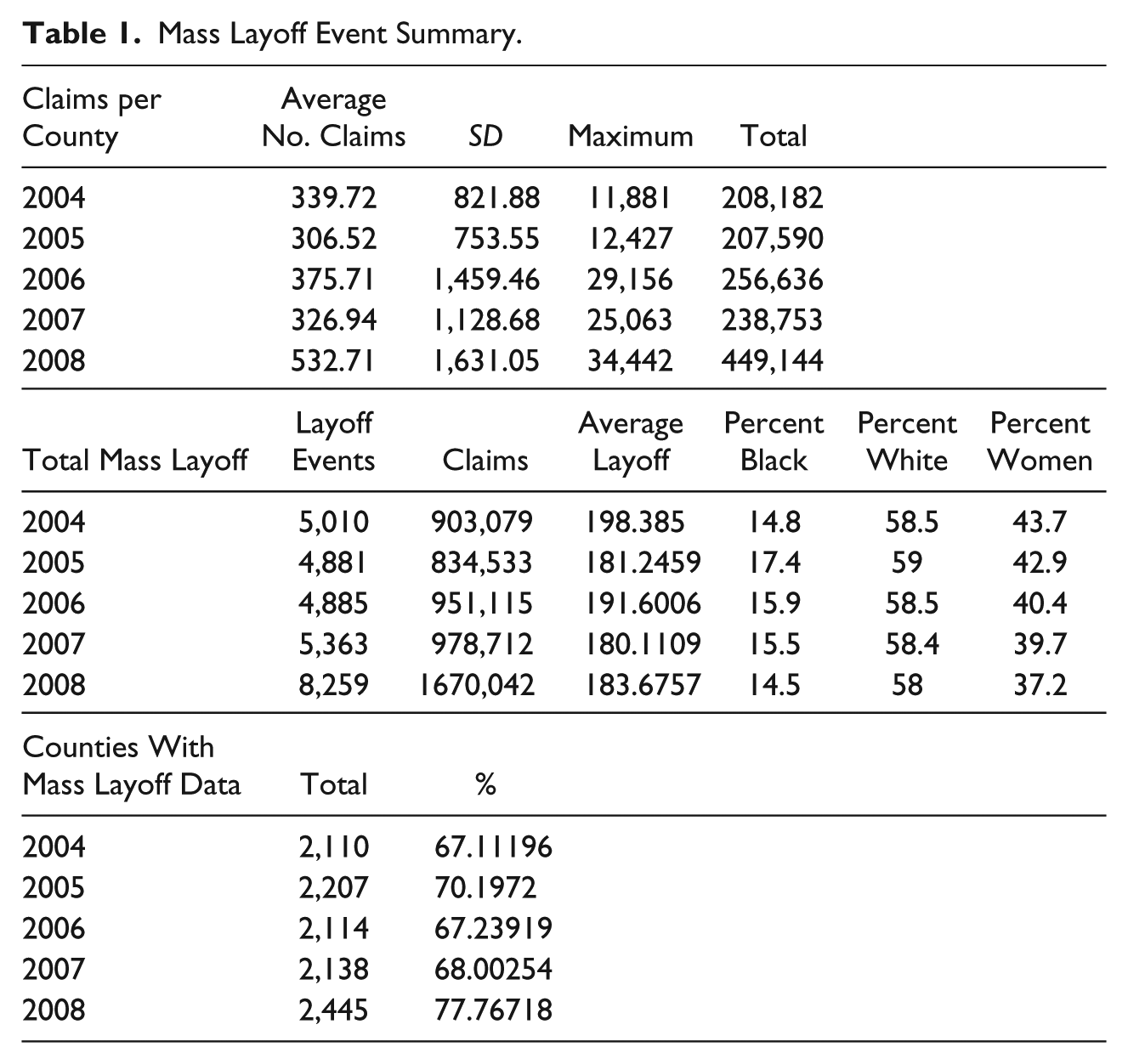
The number of layoffs per year ranged from almost 5,000 to over 8,000 while the average per county ranged from 306 (2005) to 532 (2008). The average layoff per firm was consistently around 190 workers, with approximately 15% of whom were Black and 58% White. Over 2,000 counties experienced at least one mass layoff in any given year (out of a total sample size of 3,377).
Data on incidences of domestic violence are obtained from the National Archive of Criminal Justice. We use the victim segment of the National Incident-Based Reporting System (NIBRS) portion of the Uniform Crime Report. We include only incidents where the relationship of the victim to the offender is coded as spouse, common-law spouse, a homosexual partner, an ex-spouse, or a boyfriend or girlfriend. Race is coded based on the race of the offender. Law enforcement agencies voluntarily provide information on these incidences which are recorded by local law enforcement agencies, and are then aggregated to the county level. Missing observations occur when law enforcement agencies choose not to report data.
We classify reported violence as domestic violence when the assailant is charged with a crime. On average, 63% of reported cases result in the assailant being charged with a crime, although this varies by jurisdiction (Klein, 2009). Women who have previous experience with reporting intimate partner violence to law enforcement are more likely to report than women who have not previously experienced intimate partner violence. Consequently, we expect that women in relationships which may be characterized as forms of patriarchal terrorism are more likely to have experienced repeated forms of intimate partner violence and, as a result, more likely to report.
As mentioned previously, the use of classifying intimate partner violence as occurring when an assailant is charged with a crime imposes limitations on our analysis with the primary limitation being that we are not able to measure intimate partner violence which goes unreported. Whether or not a woman reports intimate partner violence, and law enforcement concludes with a formal charge, is influenced by a variety of complex factors which include the local political climate and the characteristics of the victim and perpetrator. In addition, there is a concern that reporting rates, and consequently the rates of an assailant being charged, may be nonrandom along important indicators including race.
With respect to the limitation of measuring a subset of reported crime, rather than a larger dataset of self-reported instances, this is necessary due to data availability, but we feel that this measure does provide the advantage of being a consistent measure of intimate partner violence. Self-reported data come from a variety of surveys which often ask a similar question in different ways, and these differences can result in different measured instances of domestic violence (Culross, Fischer, & Bedair, 2010). This follows Aizer’s (2010) choice to measure domestic violence with a consistent measure of more severe episodes of intimate partner violence. 1 Regarding the second limitation of our measure, nonrandom reporting is an issue for researchers within the field of intimate partner violence in general, and our particular measure will only face additional limitations (relative to the use of survey data) if an assailant being charged with a crime is nonrandom in a different pattern than the nonrandom patterns of self-reporting. This is possible and remains a potential limitation of this study.
However, these limitations are necessary to use data which contains county identifiers. Our measure of a negative employment shock, mass layoffs, is identified at the county level and requires that our measure of reported rates of intimate partner violence is also available at the county level. The NIBRS provides annual single-incident files which we then merge with annualized mass layoff data. Summary statistics on domestic violence offenders by county are provided in Table 2.
Domestic Violence Summary Statistics.
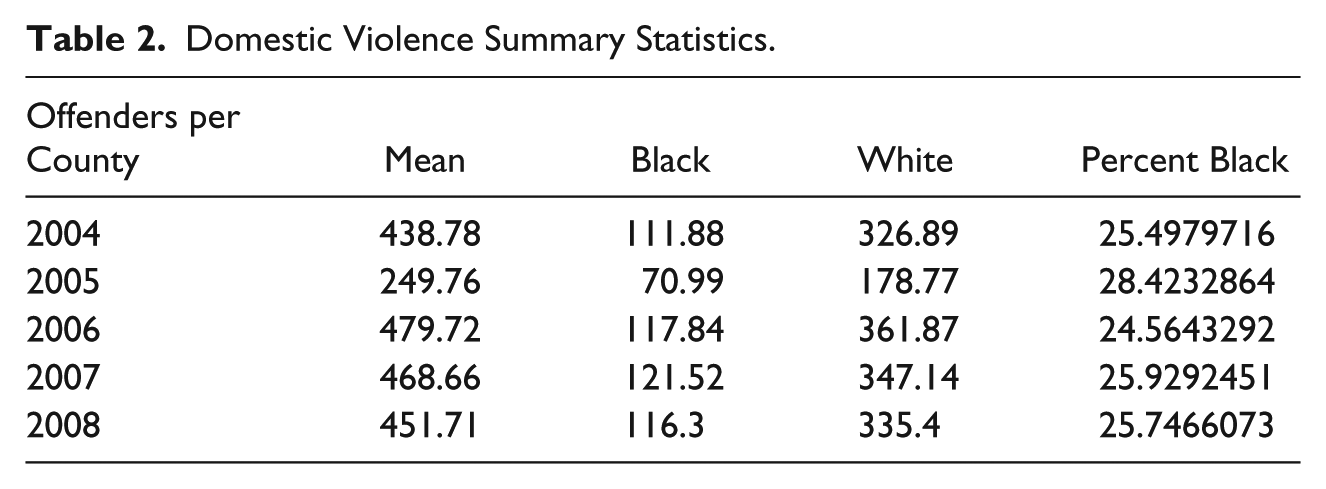
The average offenders per county for the sample years were around 450, with the exception of 2005 (250). Approximately 25% of incidences reported involve Black households, despite Black households comprising less than 15% of the overall population. We include several other variables which have been found to influence rates of domestic violence. These variables include the real per capita personal income, percent overall Black, and percent women, which are taken from the U.S. Census.
We consider all variables as the average within the county. Doing so allows us to jointly determine the influence of an unemployment shock with other influential demographic variables at the aggregate level. Consequently, we consider cross county differences rather than micro level household differences. Although it is possible to obtain individual-level records on reported violence, these data do not report whether the individual was subjected to a mass layoff event. As the layoff data are only reported at the county level, we aggregate the reported incidence of intimate partner violence to the county level. If individual behaviors are consistent with the theory, on average, these behaviors would be reflected in the aggregated county-level data.
Our model specification takes the following form:
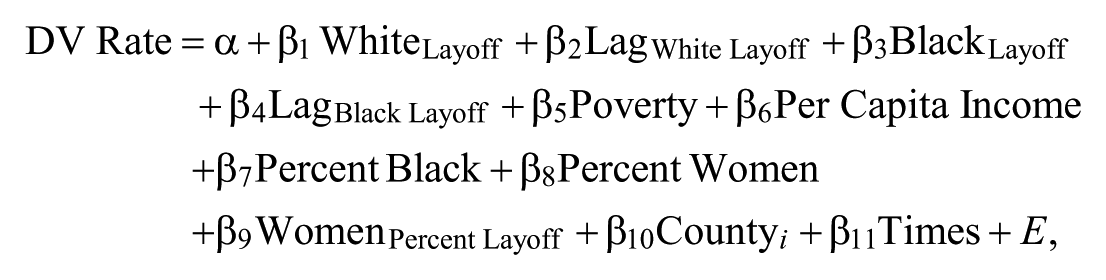
where our dependent variable is the number of domestic violence incidences per 10,000 people. We initially consider the influence of all layoffs per 10,000 individuals, but later separate those laid off by race. The influence of the lagged mass layoffs are included to account for individuals who may be unemployed a year after a mass layoff. We also include the following variables: poverty rate, real per capita income, percent Black, percent women, and percent of females laid off. The standard errors are clustered at the county level and include county and time dummies to account for regional and time specific trends. Our data also allow us to consider the influence of an increase in the layoffs by race on the domestic violence offenses by race. As a robustness check, we also limit our sample to counties with 10,000 or more individuals, following Aizer (2010).
Results
Results of our initial specification consider the influence of all layoffs on reported rates of intimate partner violence per 10,000 and can be found in Table 3. Column 1 reports the estimate without the inclusion of other control variables or county dummies. Mass layoffs are estimated to have a positive and significant influence on both contemporaneous and lagged rates of reported rates of intimate partner violence, as well as the lagged rate of domestic violence. Inclusion of the considered controls, reported in column 2, reduces the magnitude of the influence of layoffs on domestic violence and renders it statistically insignificant. Column 3 considers a similar specification but includes time dummies for the years to account for other shocks that may have affected reported rates of domestic violence across counties. Results are consistent with column 3 specifications.
Dependent Variable: Domestic Violence per 10,000.
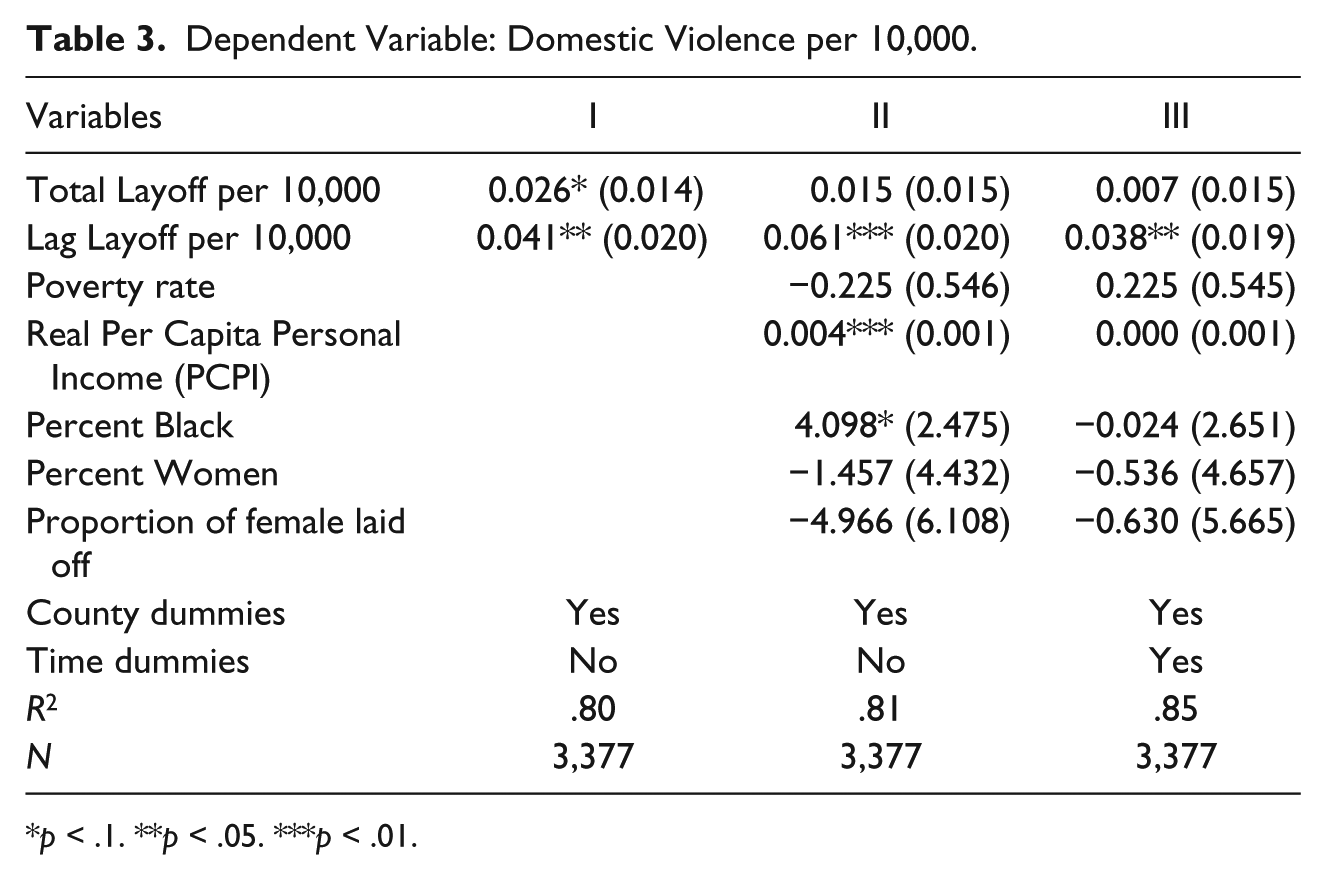
p < .1. **p < .05. ***p < .01.
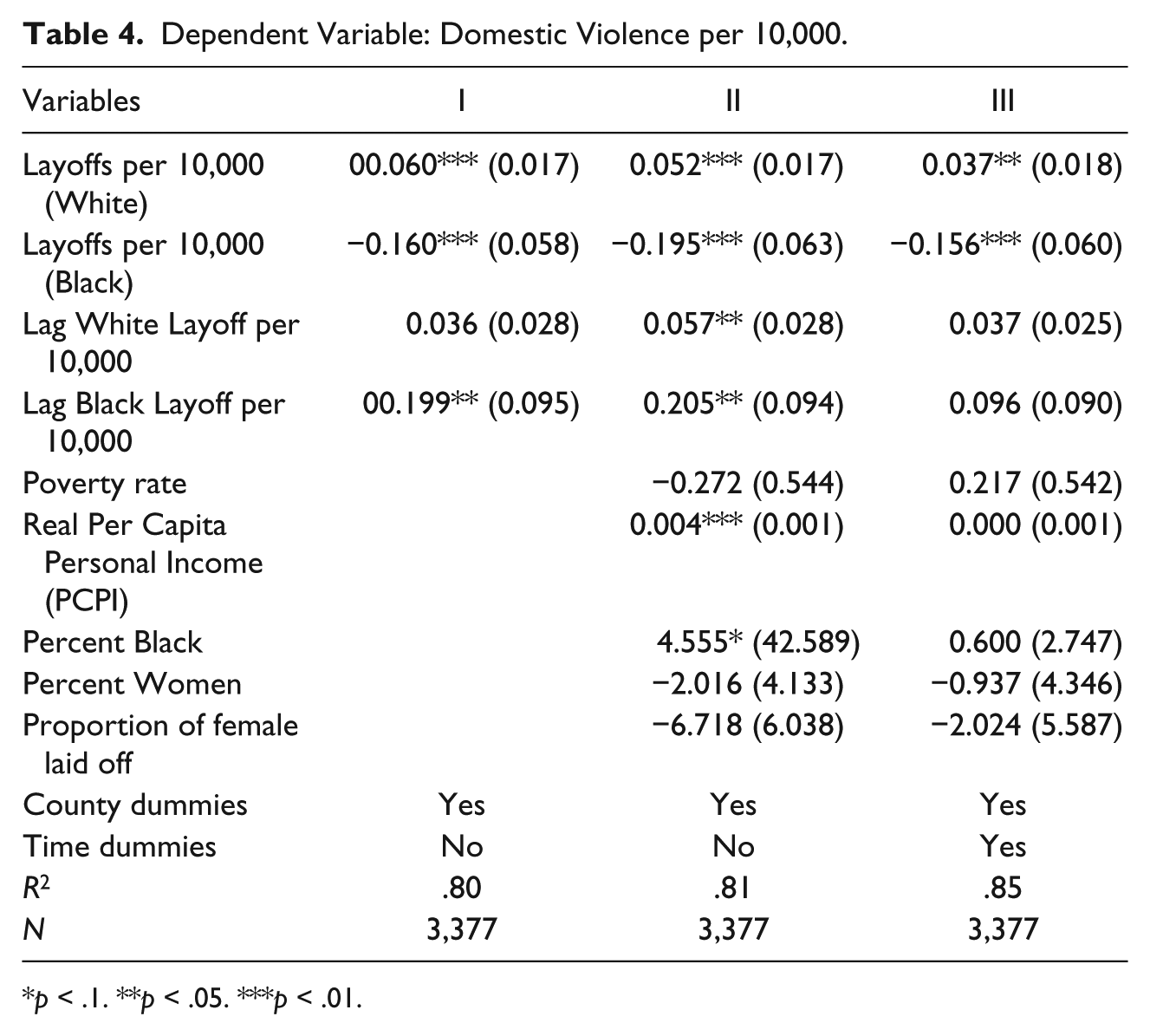
Table 4 reports a similar specification except the layoffs per 10,000 are separated by race to allow for potentially opposing influences. A simple consideration, without controls or time dummies, suggests that an increase in the number of Whites laid off is associated with an increase in the rates of domestic violence but an increase in the number of Blacks laid off is associated with a decrease. The inclusion of control variables reduces the magnitude of the influence of White layoffs but slightly increases the magnitude of influence of Black layoffs. Both variables remain highly statistically significant. The addition of time dummies reduces the magnitude of influence of all variables, but our main findings remain robust.
Dependent Variable: Domestic Violence per 10,000.
p < .1. **p < .05. ***p < .01.
These results suggest that there may be opposing influences of unemployment on reported rates of intimate partner violence by race. The finding that layoffs of Blacks are associated with a reduction in reported rates of intimate partner violence rates while layoffs of White are associated with an increase in reported rates of intimate partner violence rates is consistent with our hypothesis. If the observed influence is the net effect of family bargaining and loss-of-control emotions, a difference in the labor market opportunities after a layoff between Blacks and Whites can yield a difference in the relative magnitude of influence by race, which will result in differing net effects.
As previously mentioned, there is compelling evidence that Blacks may face labor market discrimination and, consequently, take longer to find a job after a layoff than an otherwise identical White individual. If true, this may tilt balance of the two effects toward a stronger family bargaining influence (which reduces rates of domestic violence), as observed. Even in the presence of a similar magnitude of influence of loss-of-control emotions (increasing rates of domestic violence) for Whites and Blacks, this differential net effect will persist.
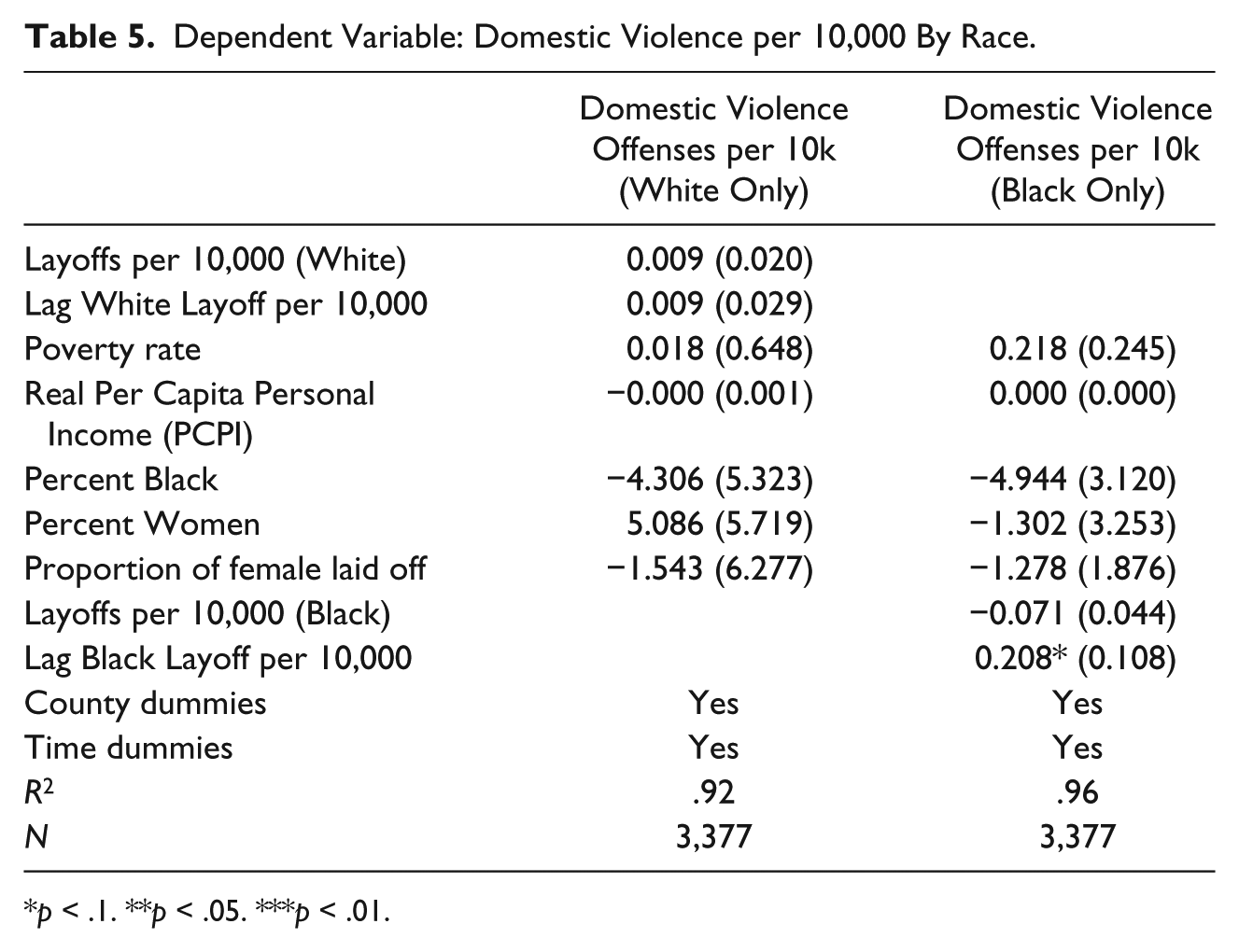
We also consider a partitioned sample, with separate estimations of White layoffs on reported rates of intimate partner violence of Whites only and Black layoffs on reported rates of intimate partner violence of Black only. These estimates, provided in Table 5, are fairly consistent with previous considerations. The influence of White layoffs on domestic violence rates is positive while the influence of Black layoffs is negative (although White layoffs are statistically insignificant).
Dependent Variable: Domestic Violence per 10,000 By Race.
p < .1. **p < .05. ***p < .01.
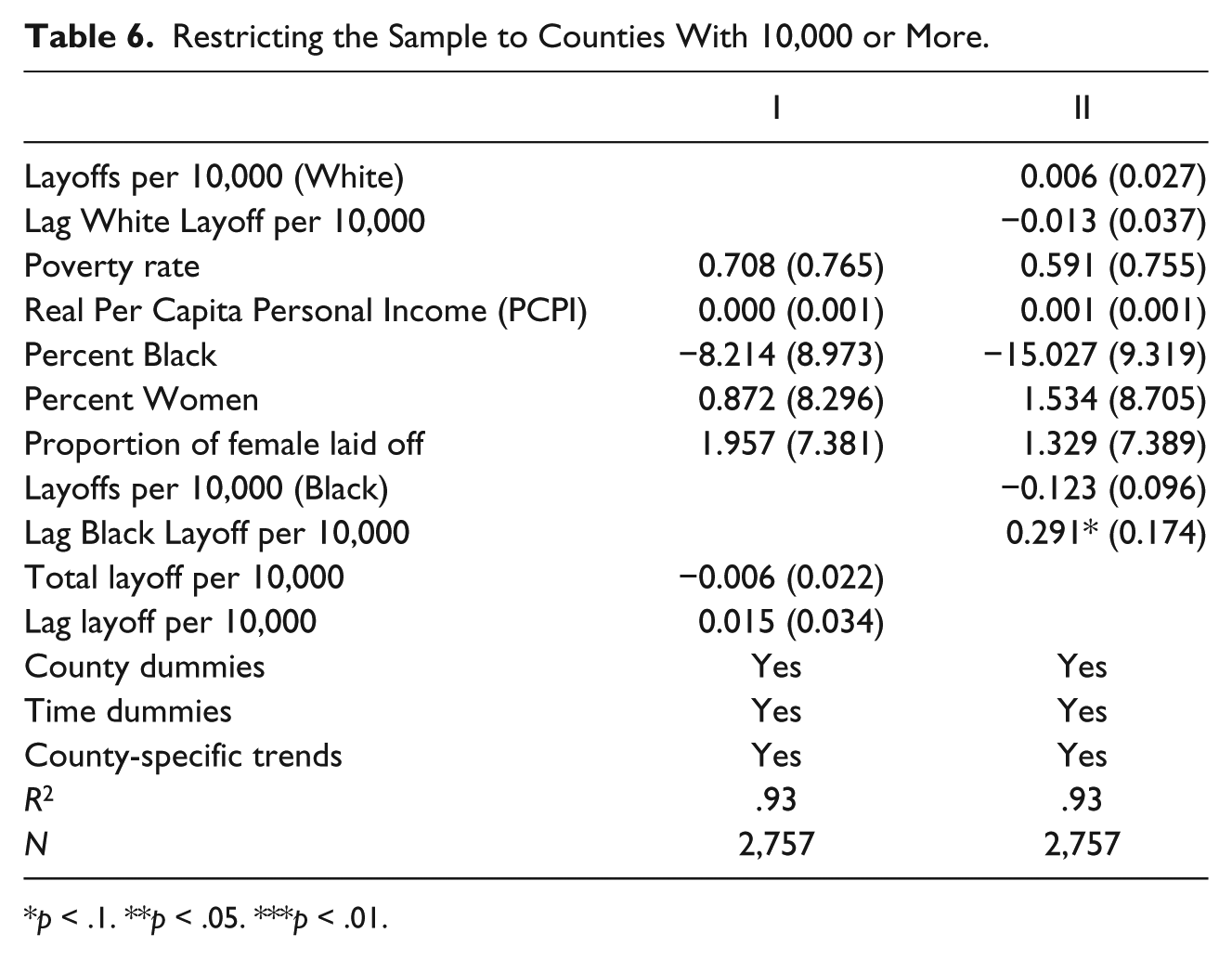
Following Aizer (2010), we also consider an estimation with a partitioned sample of counties that have at least 10,000 individuals. The results of this specification, detailed in Table 6, report fairly similar estimations as the partitioned sample. The influence of White layoffs is statistically insignificant (but positive), while the influence of Black layoffs is negative and statistically significant.
Restricting the Sample to Counties With 10,000 or More.
p < .1. **p < .05. ***p < .01.
Discussion and Conclusion
Racial differences in propensity to engage in, or suffer from, domestic violence have received consistent media attention. The stresses of unemployment and/or job uncertainty have been proposed as possible sources of increased likelihood to engage in domestic violence (Schneider et al., 2016). However, it is often difficult for researchers to disentangle the influence of unemployment on domestic violence and unobservable characteristics associated with both unemployment and domestic violence (Cunradi, 2010).
Two opposing influences of an employment shock on propensity to engage in domestic violence have been proposed in the economic literature. In a family bargaining model, any reduction in expected future earnings will decrease the rates of domestic violence as a woman’s relative economic power has increased (Aizer, 2010). Alternatively, it has also been found that emotional shocks, like unemployment, will lead to loss-of-control effects where the increased stress will raise the rates of domestic violence (Card & Dahl, 2011).
Our article points out that the observed influence is the net effect of these opposing forces. If there are racial differences in the magnitude of either force, the observed influence of an increase in unemployment by race may differ. We use data on company mass layoffs to attempt to circumvent endogeneity issues arising from the omission of influential unobservable characteristics that are associated with both unemployment and the propensity to engage in intimate partner violence. We find that in places where Black layoffs are higher, the rate of reported intimate partner violence is lower while the reported intimate partner violence rate is higher in counties where Whites are being laid off at higher rates.
These findings provide initial evidence consistent with the hypothesis that, on average, the stress effect may be smaller than the family bargaining effect among Blacks and that the opposite is true for Whites. We must note that we are limited to analyzing the effect of the economy on aggregated rates of reported intimate partner violence and our data preclude us from identifying which of the two effects dominates within each group. In other words, it is possible that the stress factor is the same for both groups, but the lower expected earnings reduce the economic/bargaining power more among Blacks. On the contrary, although less likely, the reduction in the family bargaining effect may be the same among both groups, but the stress factor is greater among White households. Disentangling these two effects necessitates the analysis of individual-level data, and is a good avenue for future research. In addition, it would be useful to tell if similar trends exist for other types of domestic violence, which may be less likely to be reported.
To the extent that it is more likely that the differences we observe are due to a larger reduction in the “family bargaining effect” among Blacks, this study provides important policy implications regarding the importance of relative economic power for Black women. While there has been an overall decline in intimate partner violence through time in the United States, the Bureau of Justice Statistics reports that in 2010, the rates are still higher among Blacks (Catalano, 2012), and policies designed to address the issues of Black women in particular may be warranted. While our analysis focuses on a negative employment shock, our findings suggest that the economic empowering of women is not only an effective tool to reduce instances of intimate partner violence, as Aizer (2010) suggests, but that it may be particularly effective for Black women. Further research is needed to determine if rates of other types of violence are similarly affected by factors related to changes in the relative economic empowerment of women.
Footnotes
Declaration of Conflicting Interests
The author(s) declared no potential conflicts of interest with respect to the research, authorship, and/or publication of this article.
Funding
The author(s) received no financial support for the research, authorship, and/or publication of this article.