







Abstract
This study tested a serial mediation model examining how dyadic trust and sexual intimacy mediate the relationship between insecure romantic attachment and perpetrated sexual violence occurring between same sex intimate partners (sexual SSIPV). A community sample of adults (N = 310; 203 women, 107 men) involved in a committed (6 months or longer) same sex romantic relationship completed an encrypted online questionnaire package which included psychometric measures designed to assess the aforementioned variables. Controlling for gender effects, analyses conducted using bootstrapping procedures supported full mediation pathways for both attachment anxiety and attachment avoidance. That is, attachment anxiety and avoidance were both directly associated to the perpetration of sexual SSIPV, and these relationships were both fully mediated by dyadic trust and sexual intimacy, in that respective order.
Despite advances in the field of intimate partner violence (IPV) to include sexual violence in research questions, studies specifically examining sexual violence occurring in same sex relationships remain sparse (Monson, Langhinrichsen-Rohling, & Taft, 2009). A small number of studies have served to establish general correlates of same sex intimate partner violence (SSIPV; for example, Bartholomew, Regan, Oram, & White, 2008; Craft & Serovich, 2005; Fortunata & Kohn, 2003), but they have mainly focused on physical and psychological forms of violence, and are often not grounded within a theoretical framework or tested empirically in more complex models such as mediation, moderation, or structural equation designs. Thus, while certain variables may be associated with SSIPV perpetration and victimization, further research is needed to continue identifying the more complex and underlying mechanisms uniting them. The overarching goal of this study is the exploration of novel theoretically grounded pathways specific to the perpetration of SSIPV, with an exclusive focus on sexual violence.
Sexual Violence Nomenclature and Prevalence in Same Sex Relationships
Over time, terminology referring to situational couple violence (e.g., “domestic violence,” “domestic abuse,” “partner aggression,” etc.) has generally converged on the conventional use of “intimate partner violence” as a means to homogenize research efforts (Centers for Disease Control and Prevention, 2015). The sexual violence nomenclature is less uniform, and includes terms such as “sexual assault,” “sexual aggression,” “sexual coercion,” and “(marital) rape,” which reflect varying degrees of severity and combinations of physical and sexual violence, psychological and sexual violence, or of all three. The Revised Conflict Tactics Scales (CTS2; Straus, Hamby, Boney-McCoy, & Sugarman, 1996) is the most widely used measure of IPV (Vega & Leary, 2007). Along with psychometric updates to the initial version, items were added in the CTS2 to assess the frequency of sexual violence perpetration and victimization. Specifically, its “sexual coercion” scales offer a broad assessment of sexual violence behaviors that may occur between romantic partners, evaluating behaviors ranging from minor severity, such as insisting that a partner engage in sex or in specific sexual acts (e.g., oral or anal sex), to more serious behaviors such as the use of verbal threats, or of physical force to coerce a partner into sexual activity. For the purpose of this study, and in line with efforts to homogenize IPV research terminology, we employ Straus and colleagues’ (1996) conceptualization of “sexual coercion,” while referring to it throughout the text as “sexual violence,” “sexual IPV,” and “sexual SSIPV,” interchangeably. Prior to reviewing general sexual SSIPV prevalence rates, a distinction between intimate terrorism and situational couple violence is essential to contextualize the nature of the data collected in the present study. Situational couple violence (sometimes termed common couple violence) is seen as occasional and less severe, occurring bilaterally between romantic partners (M. P. Johnson, 2010; O’Leary & Woodin, 2009). It is generally observed in nonclinical community samples. Conversely, intimate terrorism (sometimes termed coercive controlling violence) refers to the frequent and unilateral perpetration of severe violence toward a romantic partner (M. P. Johnson, 2010). While impossible to perfectly delineate the nature of participants’ reports of violence, it is important to note that data were collected from a nonclinical community sample.
Reports of sexual SSIPV incidences mostly vary based on definitions used and on the assessment of either annual or lifetime prevalence, and data, when available, almost exclusively focus on victimization rates. The collection of surveys done on annual rates of sexual SSIPV illustrates that perpetration reports can range between 0.1% and 54.3% (Bartholomew, Regan, White, & Oram, 2008; Craft & Serovich, 2005; Craft, Serovich, McKenry, & Lim, 2008). The 0.1% prevalence rate obtained by (Bartholomew, Regan, White, and Oram (2008) should be interpreted with great caution when contrasted with the consistently higher rates found in the literature. Where annual prevalence of sexual SSIPV victimization is concerned, rates have been found to range from 0.2% to 33.3% in male samples (Balsam, Rothblum, & Beauchaine, 2005; Bartholomew, Regan, White, & Oram, 2008; Craft & Serovich, 2005; Greenwood et al., 2002). Again, the 0.2% rate reported by Bartholomew and colleagues is low when contrasted with the available data. Balsam and colleagues (2005) have established the only available annual sexual SSIPV victimization prevalence for women, at 39.8%. The National Intimate Partner and Sexual Violence Survey provides prevalence rates obtained from randomized sampling on a national scale. While these rates are classified by sex, age, and ethnicity, no information is provided with respect to participants’ sexual orientation or involvement in either same or opposite sex intimate relationships. These rates should therefore be considered with caution, and used to broadly contextualize sexual (SS)IPV—2.1% of men and women reported sexual IPV victimization by an intimate partner in the last 12 months (see Breiding et al., 2014).
Understanding Sexual SSIPV From an Attachment Perspective
Attachment theory (Bowlby, 1969/1682) proposes parsimonious explanations as to why and how insecure attachment may be related to IPV by conceptualizing it as a strategy to maintain affective bonds (Bartholomew & Allison, 2006; Mayseless, 1991; Mikulincer & Shaver, 2016). An attachment perspective is also useful in providing a nongendered frame to the study of IPV. Hazan and Shaver (1987) pioneered the transfer of parent–child attachment and its developmental impact (see Ainsworth, Blehar, Waters, & Wall, 1978) toward adult relationships by proposing romantic bonds as being parallel to the bond between a child and his or her caregiver(s). Namely, in adulthood, the need for comfort and security remains, but they are primarily sought from the romantic partner rather than from the parent. And, much like how separation and unresponsiveness may shape a child’s attachment security or insecurity, these individual differences in attachment are also carried into adulthood (Mikulincer & Shaver, 2016). Bartholomew and Horowitz (1991) further extended this work in a quadripartite categorization system of insecure attachment, by posing attachment anxiety (model of self) and attachment avoidance (model of other) on orthogonal dimensions. The attachment anxiety dimension represents an individual’s fear of abandonment or rejection in romantic relationships, in tandem with a lack of self-worth or feelings of being worthy of love (negative model of self). Conversely, the attachment avoidance dimension is characterized by discomfort with intimacy and dependence on the romantic partner, which is rooted in expectations that others are emotionally unavailable or unresponsive to bids for support (negative model of other). Attachment anxiety and avoidance have been respectively characterized as “strategic hyperactivation” and “strategic deactivation” of the attachment system (see Mikulincer & Shaver, 2016). The former refers to an anxiously attached individual’s tendency to be hypervigilant toward a romantic partner’s levels of commitment and toward any potential threats to the integrity of the relationship, while the latter is characterized by a reduction of an individual’s feelings of vulnerability to rejection and dependence on a romantic partner.
From an attachment perspective, in line with strategic hyperactivation, IPV has been conceptualized as poorly adapted behavior used in an exaggerated protest of unmet attachment needs (Bartholomew & Allison, 2006; Mayseless, 1991). This can take the form of criticizing a partner (psychological violence), to physically becoming violent, especially if a partner withdraws from distorted bids for closeness, intensifying this behavior in response to attachment needs not met during the first attempt (Bartholomew & Allison, 2006; Mikulincer, 2006). Conversely, driven by strategic deactivation, an avoidant partner may perpetrate IPV as a means to avoid closeness, yet ultimately, hoping to instead avoid rejection by pushing the partner away (Kobak & Sceery, 1988; Mikulincer, 2006). The countless reports of associations that have been found between adult/romantic attachment insecurity and physical/psychological IPV and SSIPV perpetration and victimization are beyond the scope of this article. For reviews, see Dutton (2011) as well as Mikulincer and Shaver’s (2016) work.
The associations between insecure romantic attachment and (SS)IPV have seldom been studied in the context of sexual violence. Sex, whether consensual or coerced, is a behavior fostering physical closeness at face value. For many, especially insecurely attached (e.g., anxious) individuals, sex is a barometer for closeness and intimacy in the relationship (Davis, 2006). Anxiously attached individuals frequently use their sexuality as a proximity seeking behavior, which makes them vulnerable to the culmination of this behavior into sexual coercion or abuse (cf. Davis, Shaver, & Vernon, 2004). In fact, when considering sexual motivations specific to anxiously attached individuals, obtaining reassurance with respect to the status of the relationship through the use of sexual acts completely eclipses other motivations (Davis et al., 2004; Schachner & Shaver, 2004), including procreation, physical pleasure, emotion regulation, avoidance of the partner’s negative mood, among others. Where these individuals are concerned, the desire to feel close to their partners and to reassure themselves of the security of their relationship can motivate a direct trajectory toward the perpetration of sexual violence as a means to do so, and also primes the perception that any sexual disinterest expressed by the partner is a threat to the relationship (cf. Davis, 2006).
The motivations behind the use of sexual IPV by avoidantly attached individuals is certainly less clear when compared with individuals who are anxiously attached. That is, why would avoidant individuals engage in sex if they generally avoid intimacy? This is precisely the question Schachner and Shaver (2004) asked. They found that for avoidant individuals, the main motivations driving sexual behavior were to impress peers, to exert control over the partner, and to manipulate them. However, while attachment avoidance is generally conceptualized with respect to IPV as a strategy to push the partner away and too great a degree of intimacy, the ultimate motivation behind this behavior is to avoid being rejected (S. M. Johnson, 2004a; Kobak & Sceery, 1988). Thus, attachment avoidance conceptualized in such a way, that is, as a covert anxious attachment, would lead to sexual IPV similar to attachment anxiety described above. Furthermore, while avoidantly attached individuals generally withdraw from their partners in times of distress, it is not uncommon for them to pursue their partners for sex (S. M. Johnson, 2004b).
Recent evidence has linked insecure attachment and varying degrees of sexual violence perpetration between heterosexual individuals (e.g., Brassard, Shaver, & Lussier, 2007; Lyn & Burton, 2005; Ward & Beech, 2006). Craft and colleagues (2008) have also found preliminary evidence documenting the link between romantic attachment insecurity and perpetration of sexual SSIPV as part of a more general IPV latent variable. As such, more research is needed to continue the documentation of this direct association within same sex dyads. Furthermore, more complex trajectories uniting romantic attachment, attachment-related constructs, and sexual SSIPV remain to be identified.
Dyadic Trust and Intimacy as Mediators
Building on the conceptualization of sexual IPV as a poorly adapted attachment behavior to reestablish proximity and control, we propose that our understanding of this phenomenon may be enriched by the inclusion of dyadic trust and sexual intimacy as serial mediators between insecure romantic attachment and sexual SSIPV perpetration (see Figure 1). Across sexual orientation, trust is considered to be a fundamental aspect of romantic relationships (Gabbay, Lafontaine, & Bourque, 2012; Mikulincer, 1998), and it also contributes to the development of sexual intimacy (Weinstein & Rosen, 1991). Larzelere and Huston (1980) proposed a distinction between generalized and interpersonal trust. Generalized trust is seen as a general belief about the good nature of individuals in society at large, while interpersonal trust, framed as dyadic trust, is characterized by an individual’s subjective appraisal of his or her romantic partner’s benevolence and honesty. Intimacy, on the contrary, is a multifaceted construct (Schaefer & Olson, 1981). While sexual intimacy is an integral part of this construct, it is often erroneously defined by the concept of sexual activity in common conversation and in research protocols alike (e.g., Impett & Peplau, 2002; Theiss & Nagy, 2010). In the context of this study, we employ Schaefer and Olson’s (1981) conceptualization of sexual intimacy. It encompasses individuals’ appraisals of their sexual satisfaction, of their ability to communicate sexual desire to their partner, and of their partner’s interest or disinterested in sex. It also takes into account the inhibition of their sexual interest due to perceived partner disinterest, and the importance they place on sex in their relationship.
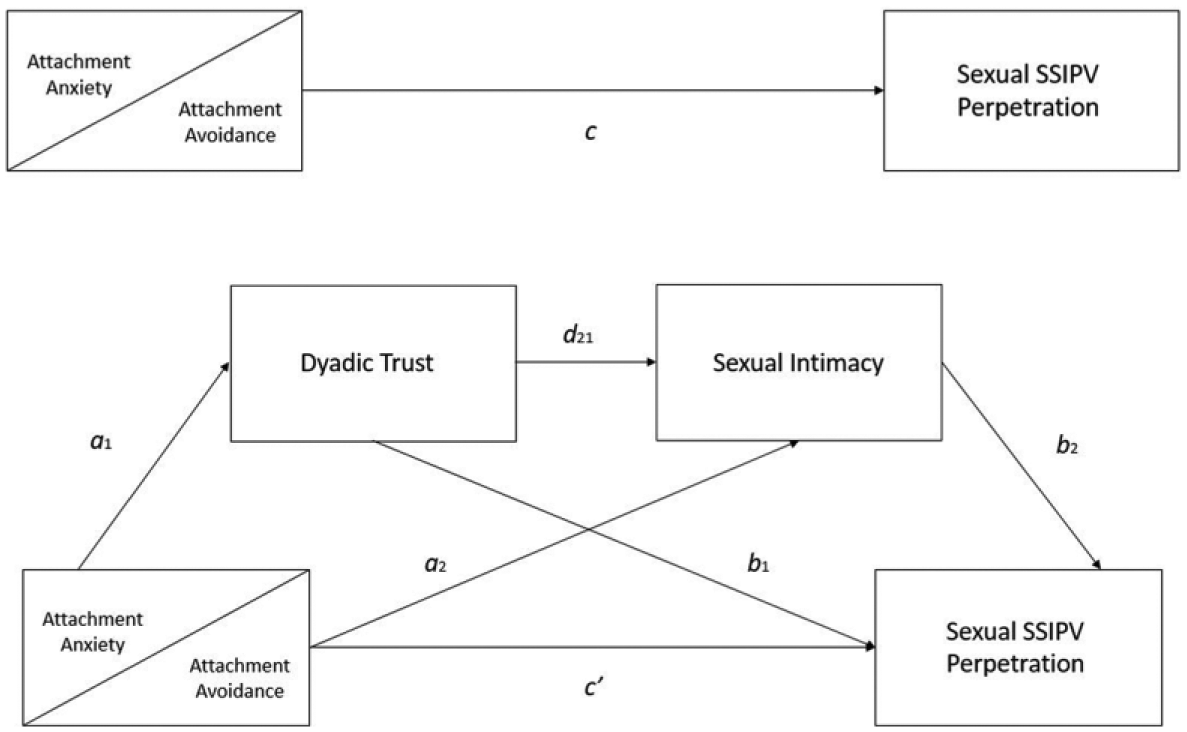
Serial multiple mediation model with dyadic trust and sexual intimacy as proposed mediators of attachment anxiety and avoidance effects on perpetration of sexual SSIPV.
From an attachment perspective, the absence of sexual intimacy is seen as a contributing factor to the perpetration of sexual (SS)IPV (see Mikulincer & Shaver, 2016). Further, low levels of sexual desire/intimacy often contribute to relational conflict, worries about one’s relationship, and eventual relationship dissolution (Sprecher & Cate, 2004). In response, insecurely attached individuals may resort to effortful, mentally preoccupying, sometimes intrusive, and occasionally even coercive attempts to persuade a partner to have sex (Shaver & Mikulincer, 2008). Such strategies may lead a person to overemphasize the importance of sex and exaggerate appraisals of a partner’s sexual disinterest or rejection (Mikulincer & Shaver, 2016). Thus, we propose that low sexual intimacy plays a significant role in explaining the relationship between insecure attachment and perpetration of sexual IPV, based on the important part it may play in creating the necessary circumstances for sexual IPV to occur. While the literature has shown clear empirical links between insecure attachment and perpetration of sexual IPV, examining the role of sexual intimacy is an essential element in understanding the mechanisms of how insecure attachment may propel individuals to become sexually coercive.
In addition to low sexual intimacy’s role in creating circumstances that can be perceived as threatening by an insecurely attached individual, and their subsequent use of sexual coercion in an attempt to assuage this threat, a second essential element is the examination of factors related to how and why these individuals may perceive the lack of intimacy itself as threatening. In other words, how does attachment insecurity prime individuals to perceive low sexual intimacy—or even misinterpret occasional refusal as low sexual intimacy—ultimately culminating in their perpetration of sexual IPV? A lack of sexual intimacy may occur in multiple ways, for example, by an actual absence of sexual activity, by a rejection of an individual’s sexual advances, or even by a perception that the romantic partner is sexually disinterested. While the absence of sexual intimacy is seen as a main circumstantial requirement to the perpetration of sexual IPV, it is reasonable to posit that poor trust in the romantic partner fostered by insecure attachment is an essential element in priming the perception of low sexual intimacy as a threat. Perceptions of romantic partners are shaped by individual differences in attachment, with attachment insecurity contributing to both real and hypothetical perceptions that the partner is untrustworthy (see Feeney & Collins, 2001; Mikulincer, 1998; Simpson, 1990). Thus, unlike securely attached individuals, anxious or avoidant individuals may be unable to consider or accept alternative rationales provided by their partners in the face of sexual rejection (e.g., fatigue), instead catastrophizing the meaning of temporarily or chronically low sexual intimacy. While direct links between attachment insecurity and decreased sexual intimacy have been observed (e.g., Birnbaum, 2007), recent evidence stemming from mediational designs has also shown that an individual’s trust in his or her partner may be deceased by insecure attachment, and that intimacy may decrease in turn as a result of poor trust in the partner (see Karantzas, Feeney, Goncalves, & McCabe, 2014).
Hypotheses
Based on attachment theory and previous research findings, it is plausible to expect that in reference to the ordering of variables in Figure 1, the association between attachment insecurities (high attachment anxiety and high attachment avoidance) and the perpetration of sexual SSIPV in the past year is mediated by a set of two variables. First, both attachment anxiety and avoidance are expected to be related to lower dyadic trust felt toward the partner (Mediator 1), and in turn to lower levels of sexual intimacy (Mediator 2). Lower levels of trust and lower sexual intimacy are expected to mediate the relationship between attachment insecurities and sexual SSIPV perpetration in a double mediation. At this time, available data are either lacking in number or insufficiently congruent (see Craft et al., 2008; Waldner-Haugrud & Gratch, 1997) to emit gender hypotheses.
Method
Participants and Procedure
The purposive sample collected for this study was comprised of 310 individuals (107 men and 203 women) involved in a same sex relationship for a minimum of 6 months. The mean age for men was 46.88 years (SD = 12.46, range = 19-68 years), and was 43.19 years (SD = 11.17, range = 18-69 years) for women. Mean relationship length was 4.98 years (SD = 4.83; range = 1-33 years), and 51.9% of the sample were cohabiting with their partners. Fifty-two men (48.6%) self-identified as “gay,” 27 (25.2%) as “bisexual,” and 28 (26.1%) as “other” (e.g., “queer; pansexual; asexual”). Ninety-six (47.3%) women self-identified as “lesbian,” 56 (27.6%) as “bisexual,” and 51 (25.1%) as “other.” The majority of participants were Caucasian (74.2%), 10.5% were Native/First Nations, 9.5% were African American, 6.9% were Asian, 5.9% were Hispanic, 2% were Middle Eastern, and 1% were of Pacific Islander descent. A 100% cumulative percentage is not reflected due to the fact that participants were able to select one or more categories when reporting on ethnicity. The sample was well educated (100% high school completion or higher).
Individuals aged 18 and above were recruited with active and passive strategies. Passive recruitment covered major Canadian and American cities, while active strategies were localized in the Canadian capital region. Ads for the study were placed in community newspapers, and pamphlets were left in strategic locations within the Canadian capital region. Online ads targeted both Canadian and American audiences. All passive material included a description of the study, and an invitation to prospective participants to contact our research assistants to obtain access to the online questionnaire package. The questionnaire package had been approved by the University of Ottawa research ethics board prior to participant access. Participants were compensated $10 CAD for their time, which was mailed to them at the home address they provided.
Measures
Revised Conflict Tactics Scales (CTS2)
The CTS2 (Straus et al., 1996) is comprised of 78 items assessing annual and lifetime incidences of perpetrated and received physical, psychological, and sexual IPV. Scales measuring negotiation strategies and sustained physical injuries are also included in the questionnaire. Using an 8-point scale, participants report how often each behavior has occurred during the past 12 months. In order, possible reports are “this has never happened,” “once,” “twice,” “3-5 times,” “6-10 times,” “11 to 20 times,” “21 or more times,” and “not in the past year, but this has happened before.” Participants’ responses are coded using midpoints, which are 0, 1, 2, 4, 8, 15, and 25, respectively. To ensure that data pertained to annual violence only, “not in the past year, but this has happened before” was coded at 0. In the current study, only data on perpetration of sexual IPV was included. Possible ranges for scores are 0 to 175, with higher scores reflecting more frequent and/or more severe occurrence of sexual violence. Internal consistencies for the initial CTS2 subscales were .87 for Sexual Violence (Straus et al., 1996). Matte and Lafontaine (2011) reported good psychometric properties of the CTS2’s Psychological Aggression scale when administered to individuals in same sex relationships. To date, the Physical and Sexual Aggression scales have yet to be validated with individuals in same sex relationships. Our reliability analyses yielded alpha coefficients of .91 for perpetration of sexual violence.
Experiences in Close Relationships (ECR)
The ECR (Brennan, Clark, & Shaver, 1998) is comprised of 36 items measuring romantic attachment on separate dimensions of anxiety (e.g., “Sometimes I feel that I try to force others to show more feeling, more commitment to our relationship than they otherwise would”; “I worry a fair amount about losing my close relationship partners”; “I get frustrated when my close relationship partners are not around as much as I would like”) and avoidance (e.g., “I prefer not to show others how I feel deep down”; “I want to get close to others, but I keep pulling back”; “I get uncomfortable when someone wants to be very close to me”). Answers are provided on a 7-point Likert-type scale (1 = strongly disagree; 7 = strongly agree). Higher scores are indicative of increased attachment anxiety and/or avoidance. Initial reliability analyses yielded alpha coefficients of .94 and .91 for anxiety and avoidance, respectively. The ECR retains good psychometric properties when administered to individuals in same sex relationships (α coefficients of .93 for anxiety and .90 for avoidance; see Matte, Lemieux, & Lafontaine, 2009). Our reliability analyses yielded coefficients of .90 for anxiety and of .87 for avoidance.
Dyadic Trust Scale (DTS)
The DTS (Larzelere & Huston, 1980) measures dyadic trust in romantic relationships using eight items and a 7-point Likert-type scale (1 = very strongly disagree; 7 = very strongly agree). Participants evaluate their partners’ benevolence and honesty, with higher scores reflecting participants’ appraisals that their partner is very trustworthy. The DTS initially demonstrated excellent reliability (α = .93), and has been shown to retain its unidimensionality and reliability (α = .90) when administered to individuals in same sex relationships (Gabbay et al., 2012). In the current sample, the alpha coefficient for dyadic trust was .83.
Personal Assessment of Intimacy in Relationships (PAIR)
The PAIR (Schaefer & Olson, 1981) is a 36-item scale that assesses emotional, social, sexual, recreational, and intellectual intimacy. It also includes a social desirability subscale labeled as conventionality. Each Likert-type six-item subscale is comprised of four points, ranging from 0 = strongly disagree to 4 = strongly agree. For this study, only the Sexual Intimacy subscale will be used, despite having administered the full measure to participants to preserve psychometric soundness. Higher scores are indicative of higher sexual intimacy. This subscale has shown a Cronbach’s alpha reliability coefficient of .70. Preliminary evidence supports the PAIR’s psychometric soundness when administered to individuals in same sex relationships (Lafontaine, Hum, Gabbay, & Dandurand, 2017). Reliability analyses in our sample yielded a coefficient of .73 for the Sexual Intimacy subscale.
Results
Preliminary and Descriptive Analyses
Data were screened prior to the main analyses to meet respective assumptions. A total of nine univariate outliers were removed (z > ± 3.29, p < .001). Due to attrition, four participants had data completely missing on dyadic trust and were thus excluded from mediation analyses. The final sample of individuals with complete scores across all variables in the model was 297. Perpetrated sexual SSIPV was positively skewed, and transformations to correct skewness were unsuccessful. A set of parallel analyses conducted with sexual SSIPV coded as a dichotomous variable yielded significance results exactly similar to those for sexual SSIPV as a continuous variable. To maximize consistency with the other continuous variables, analyses with sexual SSIPV as continuous are presented below. Descriptive statistics of participants’ romantic attachment, dyadic trust, sexual intimacy, and sexual SSIPV scores are presented in Table 1.
Mean Scores, Standard Deviations, and Ranges for Adult Attachment, Dyadic Trust, Sexual Intimacy, and Sexual SSIPV.
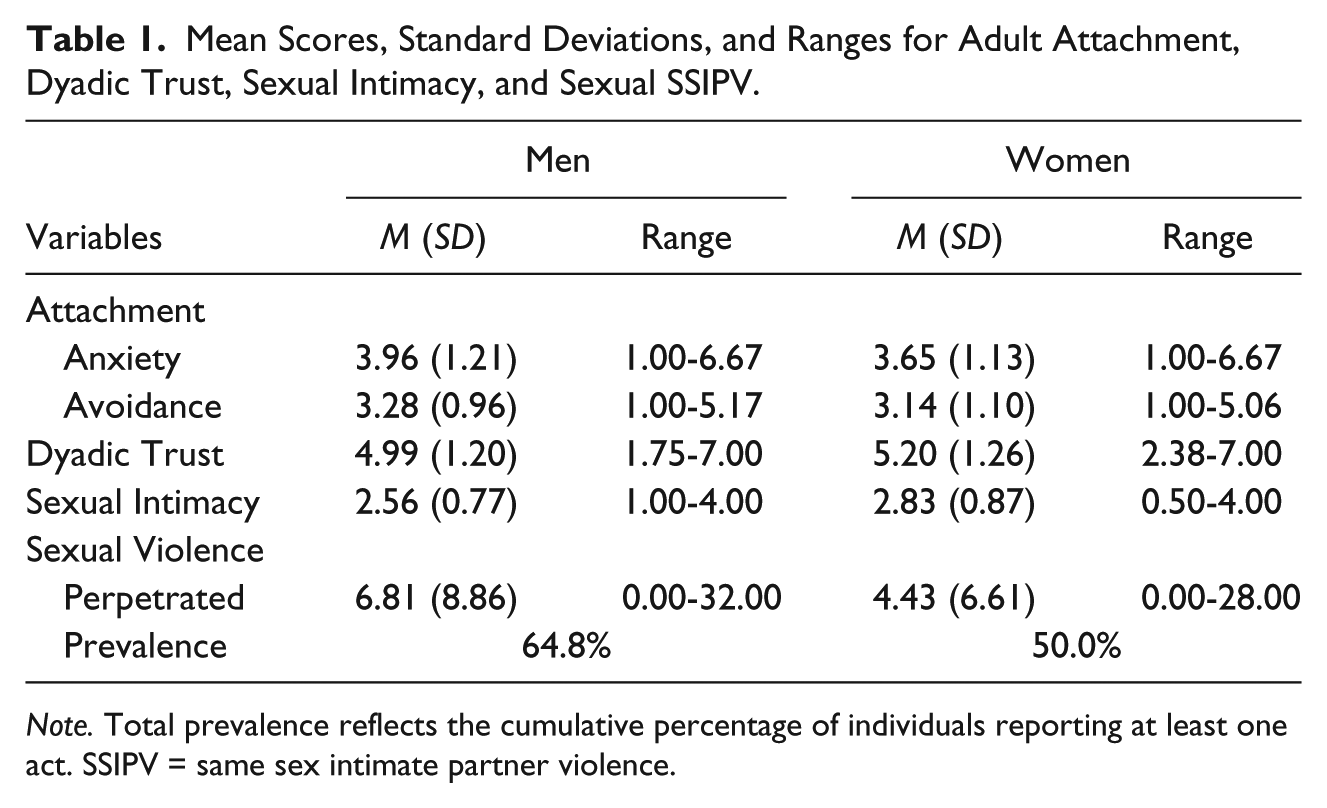
Note. Total prevalence reflects the cumulative percentage of individuals reporting at least one act. SSIPV = same sex intimate partner violence.
Serial Mediation Analyses
The proposed serial mediation model was tested using PROCESS (Hayes, 2013), a macro compatible for use in IBM SPSS Statistics Data Editor 21.0. The PROCESS macro uses an ordinary least squares regression-based path analytical framework to estimate significance and sizes of direct and indirect effects in mediator models, while implementing Bootstrap methods for inference about indirect effects in mediation models. Bootstrapping generates an empirical representation of the sampling distribution of the indirect effects (Hayes, 2009). The analysis thus yields multiple estimates of the indirect effects, which are used to generate a 95% confidence interval (CI). In sorting the values of the estimates by percentile, lower bound and upper bound values are obtained. If zero is not between these two values, the indirect effect is significant, with 95% CI. To date, this is one of the most respected, valid, and statistically powerful methods of assessing indirect effects (see Hayes, 2009; MacKinnon, Lockwood, & Williams, 2004).
Thus, in reference to Figure 1, this model was tested twice with PROCESS, once with attachment anxiety as the independent variable (IV) and again with attachment avoidance as the IV. Indirect effects a1b1 and a2b2 between anxiety/avoidance and perpetration of sexual SSIPV, through dyadic trust and sexual intimacy, were assessed at a CI of 95%, using 10,000 bootstrapping samples. To control for gender differences found on sexual intimacy and perpetration of sexual SSIPV, participants’ gender was included as a covariate across both specified models. Because of this control, however, PROCESS is unable to generate measures of effect sizes (Hayes, 2016).
Mediational Model With Attachment Anxiety
We first tested whether dyadic trust and sexual intimacy sequentially mediate the influence of attachment anxiety on sexual IPV perpetrated by individuals involved in same sex relationships. A serial mediation analysis (Model 6 in PROCESS) was conducted with 10, 000 bootstrap samples. All paths for the full process model are illustrated in Figure 1, and their corresponding coefficients are provided in Table 2. The total effect (c) of attachment anxiety on perpetration of sexual SSIPV was significant (β = 1.04, p < .01; R2 = .05, p < .001). When controlling for the effect of the mediators, the direct effect (c′) was no longer significant (β = .09, p = .79). The specific indirect effect only through dyadic trust was significant (a1b1 = 0.53; 95% CI = [0.28, 0.92]), as was the specific indirect effect through sexual intimacy only (a2b2 = 0.17; 95% CI = [0.05, 0.38]). When testing serial multiple mediation, the specific indirect effect of attachment anxiety on perpetration of sexual IPV through both dyadic trust and sexual intimacy was also significant (a1d21b2 = 0.25; 95% CI = [0.08, 0.49]).
Path Coefficients From Figure 1 Estimated Using PROCESS.
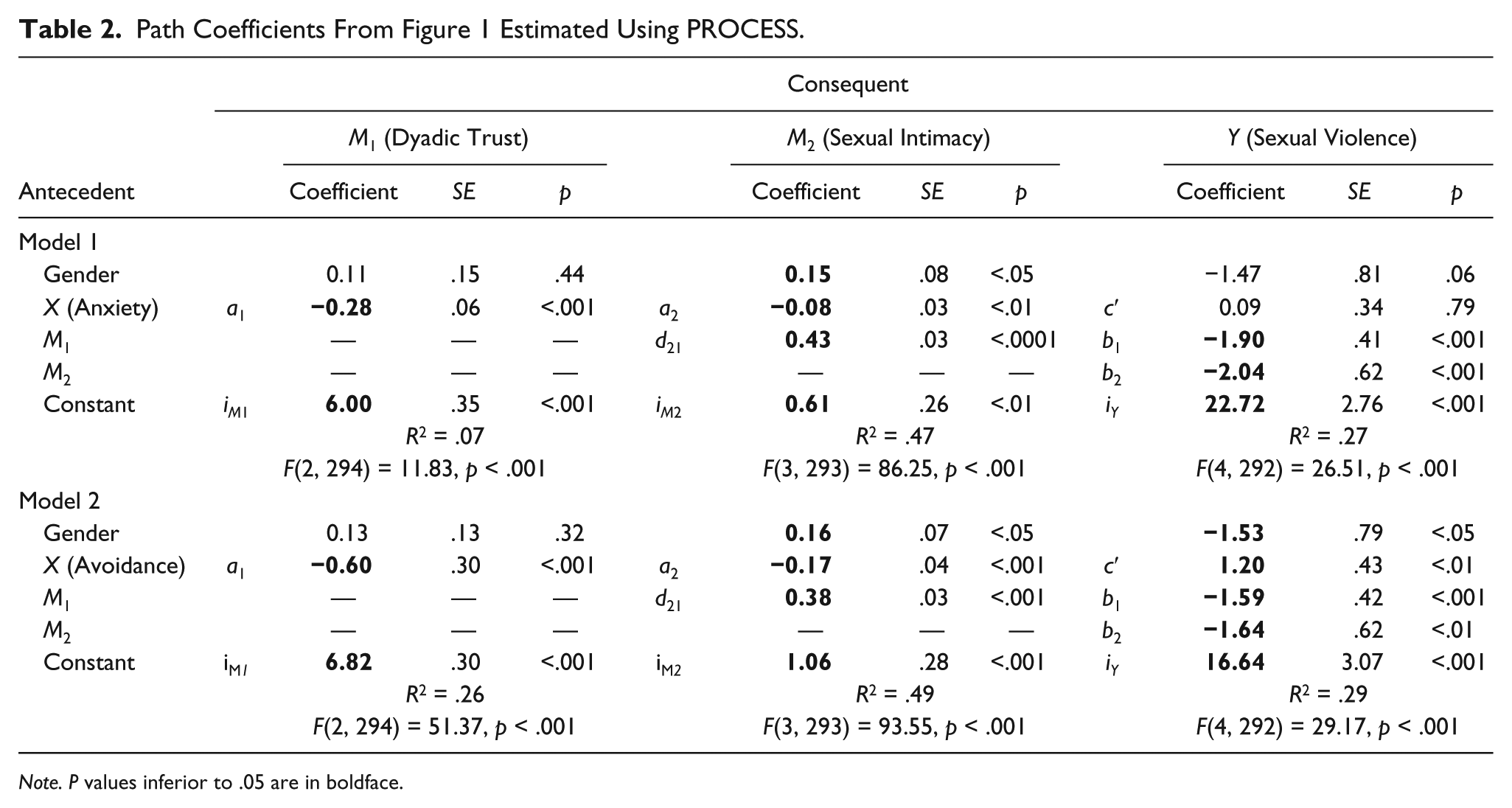
Note. P values inferior to .05 are in boldface.
Mediational Model With Attachment Avoidance
The potential mediation effects of dyadic trust and sexual intimacy on the influence of attachment avoidance on sexual IPV perpetrated by individuals involved in same sex relationships were subsequently assessed. All paths for the full process model are illustrated in Figure 1, and their corresponding coefficients are provided in Table 2. The total effect (c) of attachment avoidance on perpetration of sexual IPV was significant (β = 2.78, p < .001; R2 = .17, p < .001). When controlling for the effect of the mediators, the direct effect (c′) remained significant (β = 1.20, p < .01). The specific indirect effect only through dyadic trust was significant (a1b1 = 1.59; 95% CI = [1.16, 2.08]), as was the specific indirect effect through sexual intimacy only (a2b2 = 0.27; 95% CI = [0.06, 0.57]). When testing serial multiple mediation, the specific indirect effect of attachment avoidance on perpetration of sexual IPV through both dyadic trust and sexual intimacy was also significant (a1d21b2 = 0.37; 95% CI = [0.06, 0.72]).
Discussion
The utility of an attachment framework in the study of IPV and SSIPV has been well documented in the literature where physical and psychological violence are concerned. We first sought to assess whether or not this held true for sexual SSIPV. Beyond this, we proposed and examined a mechanism that could account for the relationship between attachment insecurity and the perpetration of sexual SSIPV. The model was based on previous theory and research framing sexual IPV perpetration as an attachment protest of unmet needs or threats to the relationship (i.e., low sexual intimacy), and documented associations between attachment insecurity, low dyadic trust, and low sexual intimacy. It was posited that attachment insecurity would be linked to low dyadic trust, associated in turn to low sexual intimacy, which would ultimately be linked to elevated levels of sexual SSIPV perpetration.
Our first hypothesis tested for a positive association between attachment insecurity and the perpetration of sexual SSIPV. Congruent with previous studies linking attachment insecurity and perpetrated physical/psychological SSIPV (cf. Babcock, Jacobson, Gottman, & Yerington, 2000; Bartholomew, Regan, Oram, & White, 2008; Rogers, Bidwell, & Wilson, 2005; Treboux, Crowell, & Waters, 2004), and echoing Craft and colleagues’ (2008) preliminary findings on sexual SSIPV, we found that participants who reported higher scores on both attachment anxiety and/or attachment avoidance also had elevated scores on sexual SSIPV perpetration. The prevalence rates we found for sexual SSIPV perpetration were also generally congruent with the available rates in the literature (cf. Craft & Serovich, 2005; Craft et al., 2008). Where dyadic trust and sexual intimacy are concerned, support was found for our second hypothesis predicting negative associations between attachment insecurity and both dyadic trust and sexual intimacy. We found that participants who were high on attachment anxiety and/or attachment avoidance also reported lower rates of dyadic trust, and had lower sexual intimacy scores.
The combination of these associations was also tested in a serial mediation model to examine if the positive relationship between attachment insecurity and the perpetration of sexual SSIPV was further explained by dyadic trust and sexual intimacy. These variables were found to mediate the relationship between both attachment anxiety and attachment avoidance vis-à-vis sexual SSIPV perpetration. While both serial mediations were found to be significant, the variance of dyadic trust and sexual intimacy appear to completely eclipse the variance shared between attachment anxiety and sexual SSIPV, as evidenced by nonsignificant direct effect reported in the attachment anxiety mediation model. This was not the case in the attachment avoidance model, with the direct effect remaining significant. The discrepancy in significance observed between direct effects in each respective model suggests that, unlike attachment anxiety’s pathway toward sexual SSIPV, the pathway between attachment avoidance and SSIPV may be further explained by other mediators above and beyond dyadic trust and sexual intimacy (e.g., control over the partner, impressing peers; cf. Davis et al., 2004; Schachner & Shaver, 2004).
Limitations
While this study provides substantial insight into the dynamics of sexual SSIPV, and evidence supporting the roles of trust and sexual intimacy in our understanding of this phenomenon, certain limitations must be acknowledged. Though participants were relatively diverse in their age and relationship length, the external validity of our findings is limited by the nature of our predominantly Caucasian, well-educated, urban sample. The cross-sectional and correlational nature of the research paradigm also impedes our ability to infer causality/directionality. Furthermore, the individual-level data and the retrospective accounts of participants, particularly around reports of SSIPV, may affect the acuity of the collected answers due to social desirability bias or distortions in recall.
Implications and Future Directions
SSIPV still receives little attention despite its comparable prevalence with IPV occurring between heterosexual partners (Jose & O’Leary, 2009). In tandem with the slow establishment of SSIPV prevalence as well as its correlates, our findings highlight the importance of examining increasingly complex models of SSIPV to elucidate this phenomenon with greater acuity. Given that SSIPV is known bidirectional between intimate partners (Bartholomew, Regan, Oram, & White, 2008; Gabbay & Lafontaine, 2017), we encourage researchers to examine sexual SSIPV victimization in future models, whether individual or dyadic. From an external validity standpoint, this model should also be tested with a more diverse sample. Given that certain studies have highlighted differences between urban and rural samples (see, for example, Blosnich & Bossarte, 2009), geographic diversity when recruiting future samples is underlined. The replication of these findings with a sample of individuals in heterosexual relationships is also encouraged.
Most of the studies on SSIPV have been atheoretical and have largely ignored sexual violence, especially as a primary focus. This is the first study linking insecure attachment, trust, sexual intimacy, and sexual SSIPV. Though outcome research exists on models of couples therapy for psychologically/physically violent couples (see Stith & McCollum, 2009), little is known about the process or outcomes of treatment for couples in which sexual violence occurs (Salwen & Leary, 2013). The findings outlined in this study do not provide comprehensive answers or guidelines for the treatment of sexual violence; however, they may provide researchers and clinicians with insight into the underlying, attachment-related motives contributing to this behavior. As is often the case with most couple conflict, attachment offers us a map into individuals’ deeper pain driving their behaviors: the longing for close connection and security (S. M. Johnson, 2004a). The assessment and targeting of dyadic trust, and of the meanings that partners may attribute to low sexual intimacy, readily fall into the practice of emotionally focused therapy for couples (EFCT; see S. M. Johnson, 2004b). Fostering dyadic trust and sexual intimacy by creating secure attachment in EFCT may contribute to the reduction of sexual SSIPV perpetration. Scientist-practitioners are encouraged to develop treatment protocols as a means to provide evidence-based interventions to address sexual SSIPV, and to explore these potential targets for treatment in doing so.
Footnotes
Declaration of Conflicting Interests
The author(s) declared no potential conflicts of interest with respect to the research, authorship, and/or publication of this article.
Funding
The author(s) disclosed receipt of the following financial support for the research, authorship, and/or publication of this article: This research project was partially funded by the University of Ottawa’s Research Development Program, Faculty of Social Sciences.