







Abstract
According to recent statistics, as many as one in five female college students are victims of sexual assault during their college career. To combat what has been called the “Campus Rape Crisis,” researchers have attempted to understand what variables are associated with sexually coercive behaviors in college males. Although investigators have found support for the relationship between pornography consumption and sexually coercive behavior, researchers typically operationalize pornography use in terms of frequency of use. Furthermore, frequency of use has been assessed vaguely and inconsistently. The current study offered a more concrete assessment of frequency of use and an additional variable not yet included for pornography use: number of modalities. Beyond examining the relationship between pornography use and sexual coercion likelihood, the current study was the first to use pornography variables in a threshold analysis to test whether there is a cut point that is predictive of sexual coercion likelihood. Analyses were conducted with a sample of 463 college males. Results indicated that both pornography use variables were significantly related to a higher likelihood of sexually coercive behaviors. When both frequency of use and number of modalities were included in the model, modalities were significant and frequency was not. In addition, significant thresholds for both pornography variables that predicted sexual coercion likelihood were identified. These results imply that factors other than frequency of use, such as number of modalities, may be more important for the prediction of sexual coercive behaviors. Furthermore, threshold analyses revealed the most significant increase in risk occurred between one modality and two, indicating that it is not pornography use in general that is related to sexual coercion likelihood, but rather, specific aspects of pornography use.
According to a 2012 report by the National Center for Injury Prevention and Control: Division of Violence Prevention, 18.3% of women report experiencing rape at some point in their lives. The same report also informs us that among those 18.3% of women, 37.4% reported that the rape occurred between ages 18 and 24. According to recent campus climate studies conducted on college campuses across the country, as many as one in every five female college students are victims of sexual assault at some point in their college career (Krebs et al., 2016). The problem of sexual assault on college campuses is so severe, that it garnered the attention of the President of the United States, Barack Obama, who has dubbed the current situation the “Campus Rape Crisis.” Although the campus rape crisis has gained more public attention in recent years, research focused on understanding this problem has been conducted for quite some time. Researchers who have examined college campus sexual assaults have identified factors associated with a propensity to engage in sexually coercive behaviors.
For the current study, sexually coercive behaviors were divided into physical coercion (use of physical force and/or getting someone drunk) and verbal coercion (lying and/or pressuring someone to have sex). These definitions are provided by the Centers for Disease Control and Prevention (2014) and have been used in other studies on sexual coercion (D’Abreu & Krahé, 2014; Kennair & Bendixen, 2012; Wright, Tokunaga, & Kraus, 2015). Alcohol use (Abbey, 2002; Carr & VanDeusen, 2004; Franklin, Bouffard, & Pratt, 2012; Gervais, DiLillo, & McChargue, 2014; Kingree & Thompson, 2015; Testa, 2002; Tuliao & McChargue, 2014), rape myth acceptance (Bouffard & Miller, 2014; Burt, 1991; Carr & VanDeusen, 2004), level of sexual arousal (Bouffard & Miller, 2014; Davis, Norris, George, Martell, & Heiman, 2006; Hald & Malamuth, 2015), and history of sexual victimization (Carr & VanDeusen, 2004; Lisak, Hopper, & Song, 1996) have all been found to be associated with sexual coercion in college males. The current study focused on another factor that has been associated with sexual coercion: pornography use. Pornography consumption has been associated with sexual coercion in previous studies (Carr & VanDeusen, 2004; D’Abreu & Krahé, 2014; Foubert, Brosi, & Bannon, 2011; Franklin et al., 2012).
Although research on pornography consumption and sexual coercion is not new, studies investigating multiple aspects of pornography use, such as well-defined pornography use frequency, number of modalities used to view pornography, and identifying when use may become problematic, have not been conducted. To better understand the complex relationship between pornography use and sexual coercion, frequency of use and number of different modalities used by the individual were utilized to examine their relationship to sexual coercion. In addition, this study examined both frequency and number of modalities of pornography use to identify whether there may be thresholds beyond which pornography use becomes most predictive of sexually coercive behaviors.
Pornography Consumption
Researchers examining the relationship between pornography use and sexual coercion have typically focused on frequency of use and the type of pornography viewed. For example, researchers have found a relationship between use of violent pornography and sexual coercion in male sexual offenders (Kingston, Fedoroff, Firestone, Curry, & Bradford, 2008) and college students (Foubert et al., 2011). A recent meta-analysis conducted by Wright and colleagues (2015), however, found that the effect size of violent genres of pornography on sexual coercion was not significantly larger than the effect size for nonviolent pornography. Because previous research indicates use of violent pornography genres (i.e., rape pornography) is associated with significantly higher levels of sexual aggression than mainstream pornography, this is a unique report. Research on the content of recent mainstream pornography could illuminate this finding.
Bridges, Wosnitzer, Scharrer, Sun, and Liberman (2010) conducted an analysis of content in pornography that was considered to be “mainstream,” and found that it contained strong aggressive tones. To determine what constituted mainstream pornography, Bridges and colleagues (2010) collected 250 best-selling and 250 top-rented pornographic films from a well-known adult entertainment magazine. Physical and verbal aggression were measured in the selected films. Physical aggression included behaviors such as slapping, gagging, biting, and hair pulling. Verbal aggression included name calling and threatening. Bridges and colleagues (2010) found that 88.2% of the scenes contained physically aggressive acts and 48.7% of scenes contained verbal aggression. This indicates that even if pornography is considered mainstream and does not fall under a violent genre per se, the pornography could still contain depictions of aggression toward women. If this is the case, then studies distinguishing between violent and nonviolent pornography may be doing so arbitrarily.
Researchers have also examined the relationship between frequency of pornography use and sexual coercion in sexual offenders and college males. Examining this relationship with a sample of sexual offenders, Kingston and colleagues (2008) found that more frequent pornography use significantly contributed to the prediction of violent and sexual recidivism, even when controlling for other factors predictive of recidivism, such as risk scores. Using a college sample, Carr and VanDeusen (2004) surveyed a sample of 150 fraternity males on measures of alcohol consumption, rape attitudes, sexual experiences, alcohol use, drug use, and pornography use. Pornography use was measured by survey questions asking about the frequency of viewing pornographic magazines, videos, Internet images, phone sex, and patronizing strip clubs. The results of their research indicated that pornography use frequency significantly increased scores on the Sexual Experience Survey (SES; Koss & Oros, 1982), which is a self-report survey consisting of items assessing sexual behaviors ranging from participation in consensual sex to forcible rape (Carr & VanDeusen, 2004). Vega and Malamuth (2007) also used scores on the SES as a measure of sexually coercive behaviors and found that in a sample of 102 male college students, frequency of pornography use significantly increased scores on the SES. It should be noted that Vega and Malamuth (2007) used a special “perpetrators” version of the SES, which did not include any items pertaining to involvement in consensual sex and focused only on sexually coercive behaviors. D’Abreu and Krahé (2014) used a similar approach in a sample of college males in Brazil. Pornography use frequency was measured by asking respondents whether they had seen images of sexual intercourse or images of other sexual acts on TV, the Internet, cell phones, or in books or magazines, on a 5-point scale ranging from never to very often. Like Vega and Malamuth (2007), a modified version of the SES that only included sexually coercive behaviors was used. D’Abreu and Krahé (2014) found that pornography use frequency was significantly related to sexually coercive behaviors.
Franklin and colleagues (2012) operationalized frequency of pornography use as ranging from never to frequently and examined frequency of pornography use, as well as other variables, and their relationship with scores on another modified version of the SES. Although the results of their path analysis did not reveal a relationship between pornography use frequency and self-reported sexual assault, the results of the bivariate analysis did indicate that there was a significant relationship between more frequent pornography use and sexual assault perpetration. It should be noted that the modified version of the SES used by Franklin and colleagues (2012) only included items capturing “physical coercion,” as defined by the current study, and did not include behaviors such as verbal coercion captured in other studies (Carr & VanDeusen, 2004; D’Abreu & Krahé, 2014; Vega & Malamuth, 2007). Researchers in other studies have found that the pornography use frequency was a stronger predictor of verbal coercion, rather than physical coercion (D’Abreu & Krahé, 2014; Wright et al., 2015).
Studies examining the relationship between pornography use and sexual coercion provide evidence in support of the idea that pornography use is related to sexual coercion. Researchers indicate that increased pornography use frequency (D’Abreu & Krahé, 2014; Franklin et al., 2012; Kingston et al., 2008) and violent pornography use (Foubert et al., 2011; Kingston et al., 2008) are both related to sexual coercion likelihood. In addition, the relationship seems to be strongest between pornography use and verbal coercion (D’Abreu & Krahé, 2014; Wright et al., 2015). Despite the gains in recent understanding of the relationship between pornography use and sexual coercion, existing studies have often included a number of methodological limitations. First, most studies operationalize pornography use solely in terms of frequency of use (D’Abreu & Krahé, 2014; Franklin et al., 2012; Vega & Malamuth, 2007) and do not account for other variables that may capture other aspects of pornography consumption, such as the number of modalities used to view pornography. Although frequency of use has been found to be associated with sexual coercion, including additional explanatory variables may shed more light on the specific aspects of pornography use that may or may not significantly contribute to sexually coercive behavior. Second, many of the studies utilizing frequency of use capture the variable in vague terminology (i.e., very often, not very often). Respondents may define frequency of use differently, which could lead to inconsistent responses that may confound the results. Using more definitive terminology (i.e., weekly, daily) may improve the quality of the data being used. Furthermore, researchers have included behaviors that differ from pornography use, such as attending strip clubs, in their conceptualization of pornography use (Carr & VanDeusen, 2004). Finally, because some studies have shown a stronger association between pornography use and verbally coercive behaviors (D’Abreu & Krahé, 2014; Wright et al., 2015), researchers should include both verbally coercive and physically coercive behaviors when examining the relationship between these behaviors and pornography use.
Current Study
The current study contains several unique aspects that will further illuminate the relationship between pornography use and sexually coercive behaviors. First, researchers have found a significant relationship between pornography use and sexual coercion. However, because most males engage in some form of pornography use (Price, Patterson, Regnerus, & Walley, 2016; Willoughby, Carroll, Nelson, & Padilla-Walker, 2016), frequency of pornography use may not be the only predictor of sexual coercion. For this reason, the current study examined the relationship between the number of modalities used to view pornography, as well as frequency of use, and the likelihood of sexually coercive behaviors. This is the first study to date to include number of modalities in an analysis of pornography use and sexually coercive behaviors. Furthermore, the study offered a more concrete operationalization of pornography use frequency. As stated earlier, previous studies have used vague terminology (e.g., “very often,” “very frequently”), which could lead to inconsistent responses between respondents. What may constitute frequent use to one individual may be different to another individual. To address this, the current study assessed frequency ranging from “never” to “daily” use, which should yield more consistent responses across individuals.
Finally, although previous research has indicated that a relationship between pornography use and sexually coercive behavior exists, researchers have yet to test whether a meaningful threshold exists beyond which pornography consumption becomes predictive of sexually coercive behavior. The current study addressed this gap in the research by conducting a threshold analysis using frequency of pornography use and number of modalities used as predictors of sexual coercion likelihood, to determine whether meaningful cut points can be established. In this study, the following is hypothesized:
Method
Sample and Procedure
The sample surveyed for the purpose of this study consisted of 469 male undergraduate students who were enrolled in introductory classes for criminal justice and psychology at a southern university in the United States. The average age of the sample was about 22 years old (SD = 4.50 years) and the majority of the sample was White (see Table 1). Six of the respondents identified themselves as homosexual and were excluded from the study because of the small number of individuals and their substantial differences in variables of interest, resulting in a final sample of 463 for the analyses.
Descriptive Statistics for Sample (N = 463).

Race categories were collapsed into White and non-White to address small sizes in the minority categories.
The criminal justice students were offered extra credit for participating in a study on “College Student Decision Making.” Any student who agreed to participate was sent an email that contained a description of the study approved by the university institutional review board (IRB) and a link to the site where they could take the online survey. The psychology students were required to participate in various research projects to complete requirements for their courses. To find research projects that the students want to participate in, they would search an online database that contains links to various research project surveys. The survey for the current study was listed in that online database. Both students who were linked to the survey through the email they received and the students who located this study through the online database were provided with informed consent information regarding the study, including the possibility of viewing an erotic video. After the students agreed, they were randomly assigned to either the group that was shown an erotic video, or the group that viewed a criminal justice lecture video. Upon completion of the video, the participants were asked to read a scenario and answer the remainder of the survey questions.
Measures
Several measures were used to assess pornography use variables, attitudinal variables, behavioral variables, and sexual coercion likelihood. Descriptive information for each of these measures can be found in Table 1.
Verbal and physical coercion likelihood
Verbal and physical coercion likelihood were assessed by the respondents answering questions after reading a hypothetical date scenario. This scenario involved a male and female who are casually acquainted meeting at a college party, and afterward, returning to the female’s apartment. Once there, the male and female began kissing and engaging in foreplay. At the end of the story, the male attempts to remove the female’s clothing, but the female states that “she is not interested in having sex but does not try to physically stop you.” To place the reader in the male’s position, the story was written in first person from the male’s perspective. Once the story ends, the reader is presented with four questions regarding verbal or physical coercive behaviors that the reader may or may not engage in. In regard to the verbal coercion scale, the reader was presented with two separate questions: (a) “how likely is it that you would verbally coax her to remove her clothes” and (b) “how likely is it that you would say things you did not mean to get her to have sex.” The questions regarding physical coercion were (a) “would you try to get her more drunk to have sex with her” and (b) “what do you think is the chance that you would have sex with her even if she protested.” All these questions could be answered from 0% to 100%, with 0% meaning not at all likely to engage in the behavior, and 100% meaning very likely to engage in the behavior.
Pornography use frequency
One of the independent variables for this study, pornography use frequency, was measured using several items. Respondents were asked how frequently they viewed Internet pornography, erotic magazines, books, and X-rated movies. The frequency answer choices for each were never (1), less than monthly (2), monthly (3), more than once per month (4), weekly (5), more than once per week (6), and daily (7).
Pornography modalities
The second independent variable for this study, number of pornography modalities utilized by the respondent, was measured with the same questions as frequency of pornography use. If the respondent reported viewing any of the categories (i.e., Internet, magazines, books), this was converted into a dichotomous variable, with one indicating that they use this modality. Subsequently, the dichotomous variables were summed to compute a “modality total” variable, indicating how many modalities the respondent used. It should be noted that the most commonly reported modality in the sample was Internet pornography, with more than 60% of the sample reporting using Internet pornography less than monthly.
Rape myth acceptance
For rape myth acceptance, the Rape Myth Scale (Lonsway & Fitzgeralds, 1995) was used. This scale contains 19 statements of common rape myths that the participants answer with a 4-point Likert-type response. The responses were strongly disagree (1), disagree (2), agree (3), and strongly agree (4) (Lonsway & Fitzgeralds, 1995). For the purpose of the analyses, the average score for all 19 items were used, and the internal reliability of the Rape Myth Scale in the sample was excellent (α = .91). For interpretative purposes, a higher score on the Rape Myth Scale indicated a higher acceptance of rape myths.
Sexual victimization
The sexual victimization control variable was measured using three questions from the SES (Koss et al., 2007) that were modified for the purpose of this study. These questions asked whether the individual had experienced sexual victimization. Specifically, respondents were asked whether they had experienced forced anal sex, oral sex, or frotterism (i.e., unwanted touching). For the analyses in this study, sexual victimization was coded dichotomously, with respondents who reported no sexual victimization coded as “0” and respondents who reported experiencing at least one type of sexual victimization coded as “1.”
Alcohol use
To measure alcohol use, the respondents were asked to choose an answer that represented how often they drink alcohol. The choices were never (1), less than monthly (2), monthly (3), more than once per month (4), weekly (5), more than once per week (6), and daily (7).
Sexual arousal
The final control variable for the study was an arousal manipulation. Each respondent viewed a 6-min video before completing the survey. Approximately half of the students viewed a 6-min criminal justice lecture video (control group = 0) and the other students viewed a 6-min erotic video (experimental group = 1). The erotic video shown to the experimental group depicted an adult male and adult female engaged in consensual sexual activities. Although this experimental condition is not of particular interest to the current study, it is important to include the arousal manipulation in the analyses for the current study, because the arousal level of the respondents in the experimental group could affect their responses to the items regarding sexual coercion likelihood.
Results
Multivariate Analyses
To test the hypotheses proposed in this study, a series of multiple regression models (ordinary least square [OLS] models) were estimated, first for the use of verbal coercion behaviors and then separately for our indicators of physical coercion behaviors. For each of these sets of regressions, the first model included the pornography use variables, and the second model included the control variables (i.e., age, race, arousal condition, rape myth acceptance, alcohol use, sexual victimization). The analyses were constructed this way to determine whether the pornography use variables were significant predictors on their own, and if they were significant, whether they retained their significance after the addition of the control variables.
Frequency of pornography consumption
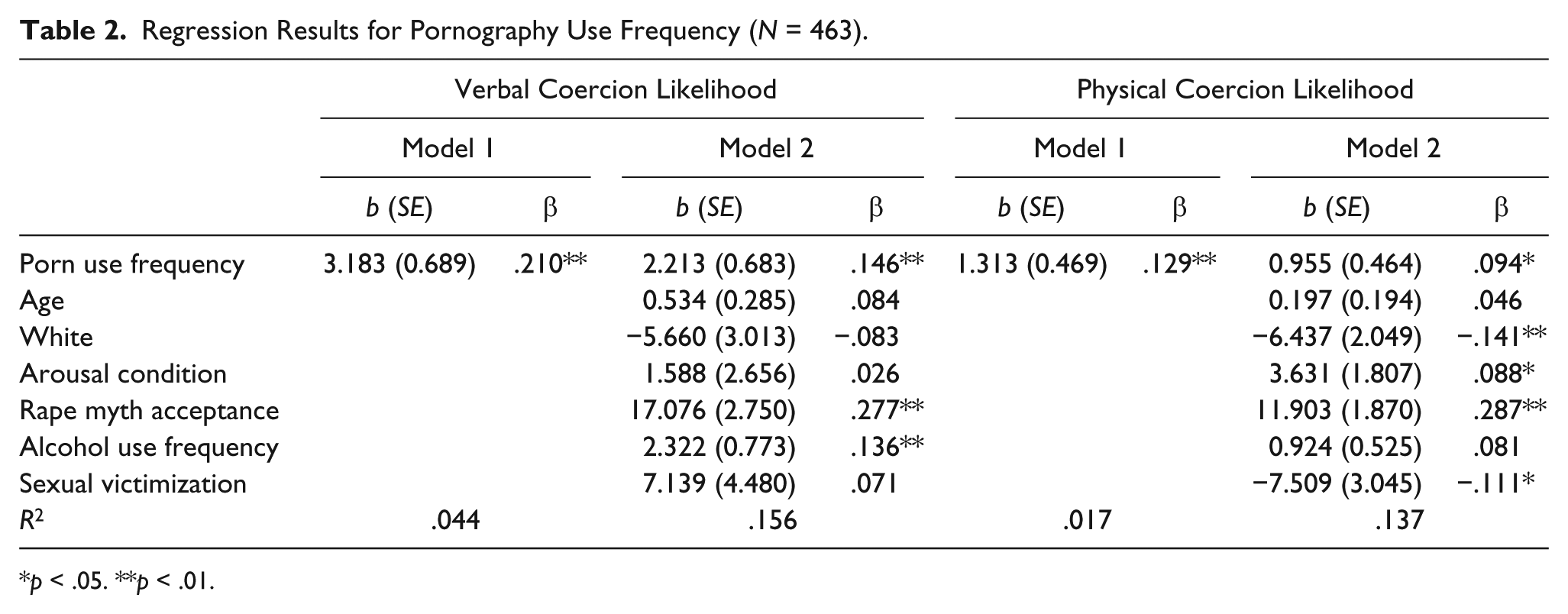
The hypothesis predicting that more frequent pornography use would predict likelihood of verbal coercion and physical coercion was tested using two sets of multiple regressions each containing two models (see Table 2). The first regression examined verbally coercive behavior. The results of Model 1 indicated that pornography use frequency (B = .21, p < .000) was significantly related to the likelihood of committing a verbally coercive act (e.g., lying and/or coaxing). Results of Model 2 also indicated that scores on the Rape Myth Scale (B = .27, p < .000), pornography use frequency (B = .14, p = .001), and alcohol use (B = .13, p = .003) were significantly related to the likelihood of committing a verbally coercive act. According to the standardized beta values, having higher scores on the Rape Myth Scale was most strongly related to self-reported likelihood of engaging in verbal sexual coercion, followed by increased pornography use frequency and increased alcohol use frequency. Age, race, arousal condition, and sexual victimization were not significant when controlling for the other variables in the model.
Regression Results for Pornography Use Frequency (N = 463).
p < .05. **p < .01.
For the regression examining frequency of pornography use and physical coercion likelihood (getting victim intoxicated and/or rape), the results of Model 1 indicated that increased Internet pornography use frequency (B = .12, p = .005) was significantly related to an increase in the likelihood of committing a physical coercive act. Results of Model 2 indicated that race (B = –.14, p = .002) was significantly related to likelihood of committing a physical coercive act. In particular, if the respondent was non-White, they reported a significantly higher likelihood of committing a physical coercive act. 1 Increased frequency of pornography use (B = .09, p = .04) was still significant in the second model, as well as rape myth acceptance (B = .28, p < .000), sexual victimization (B = –.11, p = .01), and sexual arousal (B = .08, p = .04). Having higher scores on the Rape Myth Scale and sexual arousal significantly increased the likelihood of physical coercion. Previous sexual victimization significantly decreased the likelihood of physical coercion. Age and alcohol use were not significant. The results of these analyses support the hypothesis that frequency of pornography use is significantly related to the likelihood of verbal and physical coercion, even when controlling for variables that have previously been found to be significant predictors of sexual coercion.
Modalities of pornography consumption
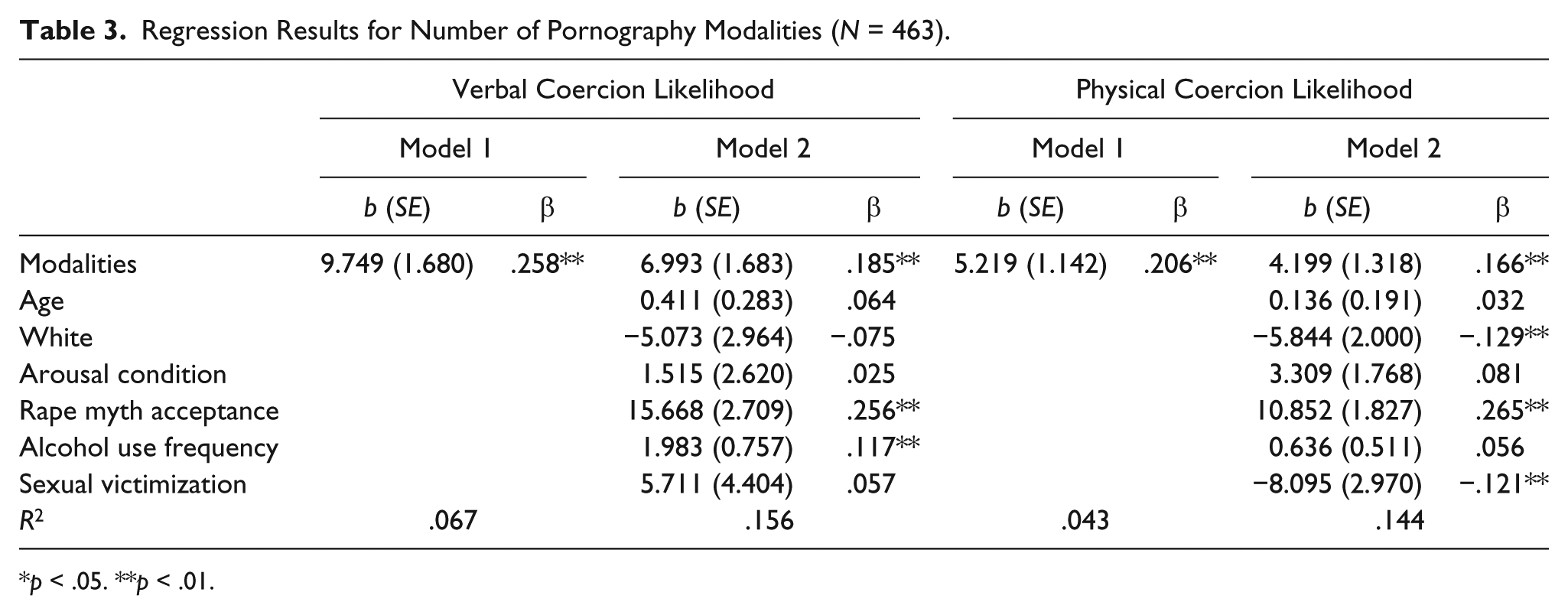
The hypothesis predicting that use of more modalities of pornography use would be significantly related to higher verbal and physical coercion likelihood was also tested using two sets of multiple regressions, each containing two models (see Table 3). The results of Model 1 indicated that the more modalities used (B = .25, p < .000) was significantly related to an increased likelihood of committing a verbally coercive act. Model 2 indicated that scores on the Rape Myth Scale (B = .25, p < .000), number of pornography modalities used (B = .18, p < .000), and frequency of alcohol use (B = .11, p = .01) were significantly related to the likelihood of committing a verbally coercive act. According to the standardized beta statistic, higher scores on the Rape Myth Scale were most strongly related to an increase in self-reported likelihood, followed by higher modality total and more frequent alcohol use. Sexual victimization, the demographic variables, and arousal condition were not significant when controlling for the other variables in the model.
Regression Results for Number of Pornography Modalities (N = 463).
p < .05. **p < .01.
For the regression analyzing modalities and physical coercion likelihood, results of Model 1 indicated that higher modality totals (B = .20, p < .000) significantly increased the self-reported likelihood of committing a physically coercive act. Results of Model 2 indicated that the number of modalities of pornography used (B = .16, p < .000), race (B = –.12, p = .004), rape myth acceptance (B = .26, p < .001), and previous sexual victimization (B = –.12, p = 007) were significantly related to the likelihood of physical coercion. Specifically, if the individual was non-White, this significantly increased the likelihood of physical coercion. In addition, higher scores on the Rape Myth Scale and total number of modalities used were related to increased likelihood of physical coercion. Sexual assault victimization significantly decreased likelihood of physically coercive behavior. Alcohol use frequency, arousal condition, and age were not significant. Findings of the analyses on number of pornography modalities used support the hypothesis that increased number of modalities used is significantly related to a higher likelihood of verbal and physical coercion, when controlling for variables previously found to be significantly associated with these behaviors.
Pornography use frequency and modality total
To determine which pornography variables were more strongly related to likelihood of verbal or physical coercion, two multiple regressions were estimated, with two models including both pornography frequency and modalities (see Table 4). The results of Model 1 indicated that higher modality total (B = .21, p < .000) significantly increased the self-reported likelihood of committing a verbally coercive act. Pornography use frequency was not significant when controlling for number of modalities. Model 2 indicated that the sexual victimization and demographic variables were not significant when controlling for other variables in the model, but scores on the Rape Myth Scale (B = .26, p < .000), modality total (B = .13, p = .01), and alcohol use (B = .12, p = .007) were significantly related to the likelihood of verbally coercive behaviors. Having higher scores on the Rape Myth Scale, using more pornography modalities, and using alcohol more frequently, significantly increased the likelihood of verbally coercive behaviors.
Regression Results for Pornography Variables (N = 463).

p < .05. **p < .01.
For the final regression that examined physical coercion likelihood, modality total (B = .21, p < .000) was the only pornography variable that was significantly related to the likelihood of physically coercive behaviors in Model 1. Results of Model 2 indicated that modality total (B = .16, p = .003), race (B = .27, p = .004), sexual arousal (B = .08, p = .04), rape myth acceptance (B = .27, p < .000), and sexual victimization (B = –.12, p = .008) were all significant predictors of physical coercion likelihood. The direction of each of these relationships mirrored the findings in the previous regressions. Age and alcohol use frequency were not significant.
Threshold Analyses
Beyond simply determining that these two aspects of pornography use may be useful predictors of sexually coercive behaviors, the current study also set out to examine whether there may be certain crucial thresholds for the frequency of pornography use and/or the number of types of pornography modalities that an individual uses, that could be helpful in further understanding the relationship between these behaviors and coercion likelihood. To examine possible cutoff points for frequency of pornography use and number of modalities, receiver operating characteristic (ROC) analyses were performed. ROC analysis uses a predictor variable, which, in this case, was pornography use frequency and number of modalities, to predict an outcome variable (i.e., sexual coercion likelihood). The statistic generated by this analysis, the area under the curve (AUC), provides an assessment of the ability of various cutoff points to predict certain outcomes (i.e., whether someone is likely to commit sexually coercive act or not). This statistic is generated by plotting the true positive rate by the false positive rate for each of the cutoff points. This statistic provides the opportunity to assess the predictive abilities of each cutoff point. For the purpose of this study, the analysis will test whether significant cutoff points in frequency of pornography use and number of modalities can be identified. In addition, sensitivity and specificity statistics will be reported, along with the number of true positive, false positive, true negative, and false negative predictions made by the cutoff points. These statistics will provide information on the ability of these cutoff points to correctly identify individuals at risk of sexually coercive behaviors (sensitivity) and correctly identify those who are not (specificity), as well as provide the number of respondents correctly or falsely identified.
The results of the analyses are presented in Table 5. For both, verbal (AUC = .582) and physical (AUC = .598) coercion likelihood, the most significant cutoff score for modality total was two or more modalities, indicating that if the individual used two or more modalities in their pornography viewing, this was the most predictive for both verbal and physical coercion. Regarding sensitivity, results indicate that 27.1% (61) of respondents at risk of verbal coercion and 29% (63) of respondents at risk of physical coercion were correctly identified. For specificity, approximately 89.3% (210) of respondents who were not at risk of verbal coercion were correctly identified, as were 90.6% (223) for physical coercion. False negative rates indicate that, for verbal coercion, 166 individuals at risk were not identified, and for physical coercion, 154 individuals at risk were not identified. False positive rates revealed that, for verbal coercion, 26 individuals were identified as being at risk when they were not, and for physical coercion, 23 individuals were identified as being at risk when they were not. Use of any modality and three or more modalities as the threshold were also tested, but the results indicated that these cut scores were less effective.
ROC Analysis for Pornography Threshold Score (N = 463).
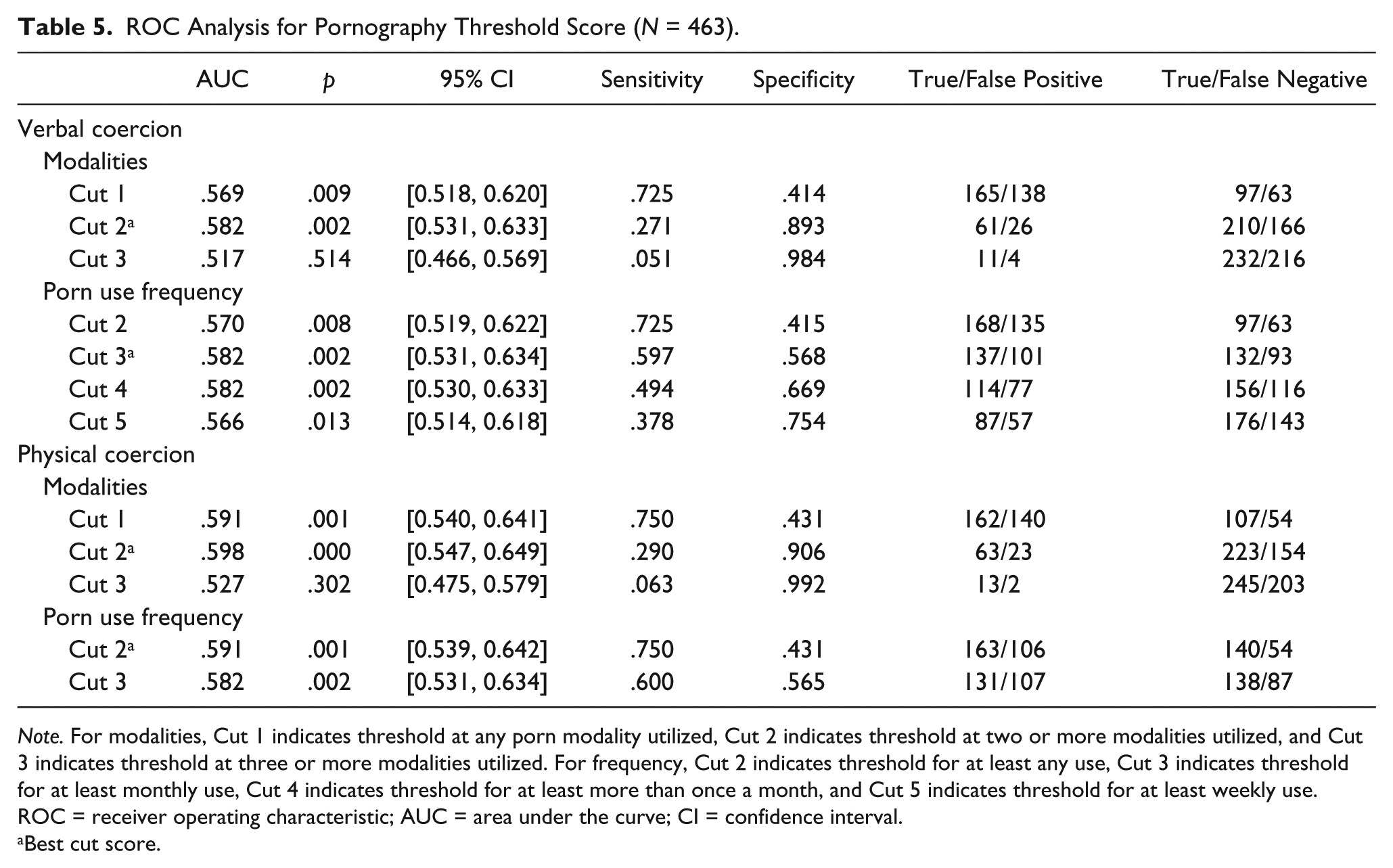
Note. For modalities, Cut 1 indicates threshold at any porn modality utilized, Cut 2 indicates threshold at two or more modalities utilized, and Cut 3 indicates threshold at three or more modalities utilized. For frequency, Cut 2 indicates threshold for at least any use, Cut 3 indicates threshold for at least monthly use, Cut 4 indicates threshold for at least more than once a month, and Cut 5 indicates threshold for at least weekly use. ROC = receiver operating characteristic; AUC = area under the curve; CI = confidence interval.
Best cut score.
For the frequency of pornography use, the most predictive cutoff score for verbal coercion likelihood (AUC = .582) was using pornography at least monthly. Sensitivity for this cutoff score indicated that 59.7% of the respondents at risk of verbal coercion were correctly identified, whereas specificity showed that this cutoff score correctly identified 56.8% of respondents not at risk. False negative rates indicated that 93 of individuals at risk were not identified as such, and false positive rates revealed that 101 individuals who were not at risk were identified as being at risk. For physical coercion likelihood, a different cutoff score was found. Results of the ROC analysis for frequency of pornography use and physical coercion likelihood (AUC = .591) indicated that any (at least less than monthly) pornography use was most predictive for this sample. Sensitivity and specificity results indicate 75% of respondents at risk of physical coercion were correctly identified, whereas 56.8% of respondents not at risk were correctly identified. False negative rates revealed that 54 individuals who were at risk were not identified as being at risk and false positive rates indicated 140 individuals who were not at risk were identified as being at risk. Weekly pornography use as the cutoff point was also tested, but was not as an effective predictor.
Discussion
The current study sought to contribute to the body of research on the relationship between pornography use and sexual coercion among college males. The contribution is unique, in that it operationalized pornography use in two ways: frequency of use and number of pornography modalities used. In addition, the analyses in this study included a threshold analysis where cut points were established for both frequency of use and modalities as they relate to the prediction of hypothetical sexual coercion behaviors. Although frequency of use has been examined in a number of previous studies (Carr & VanDeusen, 2004; D’Abreu & Krahé, 2014; Franklin et al., 2012; Kingston et al., 2008; Vega & Malamuth, 2007), number of modalities has not.
More frequent pornography use was significantly related to a higher likelihood of committing a verbally coercive act when controlling for rape myth acceptance, alcohol use frequency, sexual victimization, and arousal level. Results of the analysis indicated rape myth acceptance was the strongest predictor in the model, but pornography use frequency still remained a significant predictor. Although the relationship is not proven to be causal, it is evident that there is a link between more frequent pornography consumption and acts of verbal coercion. Increased frequency of pornography use was also significantly related to a higher likelihood of committing physically coercive acts. It should be noted, however, that frequency of use was a stronger predictor of verbally coercive behavior when compared with physically coercive behavior. Therefore, frequency of pornography use seems to be more strongly related to a male engaging in coaxing and lying in an attempt to obtain sex than getting a female drunk or sexually assaulting her, which has also been evident in previous research (D’Abreu & Krahé, 2014; Wright et al., 2015). Contrary to the study by Franklin and colleagues (2012), pornography use frequency was significantly related to intentions to commit physical coercion behaviors in our multivariate analysis. This discrepancy may exist because Franklin and colleagues (2012) utilized self-reported prior sexual assault as opposed to asking respondents the likelihood of engaging in such acts as presented in a hypothetical scenario. In addition, Franklin and colleagues (2012) measured frequency of pornography use with a scale that ranged from never to very often, which differed from the scale used in the current study. Because of this, the relationship between frequency of use and physically coercive behaviors should be examined further, with studies specifically varying the operationalization of pornography use frequency and methods for soliciting information on the use of sexually coercive behaviors.
Results also reveal that the number of pornography modalities used by respondents was significantly related to a higher likelihood of committing verbally coercive acts, as well as a higher likelihood of committing physically coercive acts. This supports the second hypothesis, that individuals who use more modalities to view pornography will have a higher chance of committing sexually coercive acts. The Internet is the most popular place in modern society to access pornography (Ogas & Gaddam, 2012) and was also the most common modality used by respondents in the current study. It is, for the most part, free and essentially anonymous. Individuals who utilize multiple modalities to view pornography, such as books, magazines, and movies, likely had to purchase these items. If an individual spends money on pornography and compromises the concept of anonymity by purchasing these items and keeping them, this implies that their use may be more involved than an individual who only uses Internet pornography. Much like frequency of use, this may indicate not only how much time the individual dedicates to his or her pornography consumption but also the effort and money the individual expends. Grouping individuals who are heavier users and who utilize more modalities can help researchers analyze whether more exposure and more dedication to their pornography use results in a higher likelihood to commit sexually coercive acts. The results of this study support this assertion, and results of the regression that included both pornography use variables shed light on whether number of modalities exerts more influence on sexually coercive behaviors.
For the third regression, both modality total and frequency of use were included in the regression to see which variable was the strongest predictor of sexual coercion. Modality total was significant in both these regressions and frequency of pornography use was not. In addition, it was more strongly related to self-reported likelihood of sexually coercive behaviors than alcohol use frequency, which has been found to be associated with sexually coercive behaviors (Carr & VanDeusen, 2004; Franklin et al., 2012; Kingree & Thompson, 2015). According to these findings, it may be that the more important domain of pornography use, according to the standardized betas from the regression model, is the number of modalities. Therefore, individuals who are willing to invest money in their habit and compromise anonymity may signal a higher likelihood of engaging in sexually coercive behaviors than individuals who frequently use pornography. In light of these findings, future research should include measures of the number of modalities of pornography used by the individual, to test this relationship further. In addition, research should capture information pertaining to the individual’s investment in their pornography use, such as how much money they spend, to test this assertion further.
Although the results of the regression analyses help to establish that there is a relationship between pornography use and sexual coercion, the results of the threshold analysis help shed more light on what this means in terms of identifying potential cutoff points for various measures of pornography use. According to the results of the threshold analysis, two or more pornography modalities was the most significant predictor of both verbal coercion and physical coercion likelihood. This means that if an individual used two or more modalities, as opposed to just one, they were at the highest risk of sexually coercive behaviors. Several points can be derived from this finding. Any reported pornography use was not the most significant predictor of sexual coercion likelihood. When an individual uses two modalities, however, results indicated the respondent was at the highest risk of sexual coercion likelihood. This lends further support to the idea that multiple modalities, possibly because this reflects a commitment of monetary investment and potentially a lack of inhibition (e.g., a willingness to compromise anonymity afforded through internet pornography use) may be indicative of problematic use. It should be noted that this is one possible interpretation. This assertion assumes that multiple modalities means Internet plus one of the other modalities (e.g., books, magazines, movies). The ability to examine this further is beyond the scope of this study; however, future research could test this assertion further by gathering more items pertaining to modalities of pornography use.
The cut score for frequency of pornography use indicated that individuals who reported viewing pornography at least monthly were at the highest risk of verbal coercion. In addition, threshold analysis indicated that the cut score for physical coercion was most significant at the less than monthly point. This means that any pornography use resulted in a significantly greater likelihood of physically coercive behavior. The fact that cutoff scores for pornography use frequency were inconsistent between physical and verbal coercion indicates that, as opposed to modalities of use, frequency may not be as accurate of a predictor. This was also evident in the relatively high rate of false positives made by the frequency cutoff scores. Furthermore, for physical coercion, the cutoff score selected for modalities was stronger than the cutoff score for frequency of use. This indicates that for physical coercion, aspects of use involving investment may be more effective at predicting physically coercive behaviors.
The results of the sensitivity and specificity analysis also provide valuable implications. For number of modalities, greater strength was demonstrated in the ability to identify individuals who were not at risk. This was evident in the high rate of specificity for both verbal and physical coercion. False positive rates for verbal coercion revealed that only 26 respondents were incorrectly identified as being at risk for verbal coercion and only 23 for physical coercion. The low sensitivity and high numbers of false negatives for both physical and verbal coercion, however, indicate that number of modalities is better at predicting those who are not at risk rather than predicting individuals who are at risk. The opposite was true for frequency of use and physical coercion, where greater strength was demonstrated in the sensitivity (ability to identify true positives) of the cutoff point. According to the results, the cutoff point for physical coercion correctly identified 163 at-risk respondents, while only incorrectly identifying 54 respondents. For specificity, however, results indicated that the cutoff point incorrectly identified 140 individuals as being at risk when they were not. This indicates that, for physical coercion likelihood, frequency of use demonstrates greater ability to identify individuals who are at risk, rather than identifying individuals who are not at risk. The cutoff point for frequency of use and verbal coercion yielded middle-of-the-road results, indicating that these cutoff points were able to correctly identify just more than half of the individuals at risk and just more than half of the individuals not at risk. Although these threshold analyses for modalities and frequency yield interesting findings, this was the first attempt at establishing a cut score for problematic pornography use. Additional research must be conducted to test these cut scores, and examine whether they are useful in predicting sexually coercive behavior. Regardless, some of these cut points make theoretical sense and provide a foundation for additional research moving forward.
Several caveats regarding the results of the threshold analysis should be noted. Although the analysis did reveal significant cutoff scores for both modalities and frequency of use, the AUC statistics were relatively low. According to a study by Rice and Harris (2005) that compared AUC values with Cohen’s d effect size values, all the significant cutoff points that were identified could be considered a “small” effect. This indicates that, although the AUC values were relatively low, they do still yield some practical significance. Furthermore, sensitivity and specificity statistics indicated that the cutoff scores for frequency of use demonstrated higher sensitivity, but relatively weak specificity. The opposite was true with modalities, where greater strength was demonstrated in specificity and less so with sensitivity. The reason for these small effects and relatively limited ability to demonstrate strong sensitivity and specificity could be related to the final caveat of this threshold analysis: the operationalization of pornography use. Although this study did include modalities along with frequency of use, there are still other factors that must be considered, such as duration of use and type of pornography used. In addition, rather than conducting separate threshold analyses for various aspects of pornography use, some type of scale combining all these aspects into a singular instrument could result in an overall improvement in the ability to identify predictive cutoff points with a stronger demonstration of sensitivity and specificity.
Finally, it was evident that sexual victimization was significantly related to physical coercion but not verbal coercion. However, the direction of this relationship was contrary to what some researchers have found regarding sexual victimization: Individuals who experienced sexual victimization were significantly less likely to engage in physical coercion. Swartout, Swartout, Brennan, and White (2015) had similar findings in a recent study they conducted. In particular, Swartout and colleagues (2015) found that individuals who perpetrate sexually aggressive or coercive acts during the college years tend to be less likely to have experienced sexual victimization in their childhood. This indicates that sexual victimization may actually have the opposite relationship to sexually coercive behaviors than what researchers have previously reported.
Although this study contributed to the body of knowledge on pornography use and sexual coercion, it was not without its limitations. First, this study did not take into account the type of pornography used. Studies have shown that individuals who view violent pornography may be more likely to commit sexually aggressive acts (Foubert et al., 2011; Kingston et al., 2008). In addition, other variables that have been found to be associated with sexually coercive behavior, such as fraternity membership (Boyle, 2015; Franklin et al., 2012; Kingree & Thompson, 2013) and athlete status (Martin, 2016), were not included in this study. It should also be noted that variables of sexual coercion were likelihood variables, not actual behaviors. Although results from these analyses do provide valuable insights into the relationship between sexual coercion and pornography, it is not entirely evident whether these findings reflect decision making in the moment for the respondents. The final limitation involved the sample in this study. The sample was a convenience sample of male undergraduate students, and further, the majority of the sample was Caucasian and only contained heterosexual males, limiting the generalizability further. Studies of this nature must be repeated in universities with more varying backgrounds, as well as populations other than college students, to strengthen generalizability.
In conclusion, campus sexual assault has been, and continues to be, a serious problem that the United States faces. To make an effective effort at curtailing what has been deemed the “Campus Rape Crisis,” researchers must focus on understanding the motivations of sexually coercive behaviors. In addition, pornographic materials are more readily available than ever. Because of this, research that is only 10 years old is further dated by the fact that pornography has become more and more available in recent years, as well as more aggressive toward women (Bridges et al., 2010). Individuals can watch pornographic materials virtually anywhere, on their portable computers or even their smartphones. There is an apparent need to better understand the relationship between the current dynamics of pornography use and the perpetration of sexually coercive acts.
Researchers have shown that pornography use is related to sexually coercive behaviors, but this relationship is still not thoroughly understood. The current study sought to contribute to the body of knowledge on this topic by shedding light on how differences in pornography use (frequency and number of modalities used) may relate to the hypothetical use of sexually coercive behaviors. The findings of the study indicate that increased frequency and modalities of pornography use do significantly increase the likelihood of sexually coercive acts, and that number of modalities used seems to be the strongest predictor between these two. In addition, the threshold analysis indicated cut scores where pornography use became predictive of sexual coercion for both frequency of use and number of modalities. Research accounting for more variance in pornography consumption habits, such as the nature of pornography consumed, can help contribute further to the current body of knowledge on the relationship between pornography use and sexual coercion perpetration and the prevention of sexual assault.
Footnotes
Declaration of Conflicting Interests
The author(s) declared no potential conflicts of interest with respect to the research, authorship, and/or publication of this article.
Funding
The author(s) received no financial support for the research, authorship, and/or publication of this article.