






Abstract
The lack of research on graduate students’ experiences with campus sexual violence and the campus climate is a glaring gap in the literature (Bonistall Postel, 2020). Thus, the current exploratory study examines the experience of graduate students at one university to determine their victimization rates and the number of disclosures they receive from peers. In addition, we compare graduate and undergraduate students’ awareness of resources on campus and their confidence in knowing where to seek assistance for their peers or themselves. Finally, we compare key influential factors related to the campus climate such as sense of community and perceptions of the university’s responsiveness to incidents of sexual violence among graduate and undergraduate students. An online survey was administered to a sample of 9,546 students, with 79.9% undergraduates and 20.1% graduates. A total of 5.2% of graduate students reported experiences of sexual violence since attending the university, with 13% receiving disclosures from peers. MANCOVA revealed that compared with undergraduate students, graduate students had significantly less awareness of campus resources, less confidence in knowing where to seek assistance, and less of a sense of community. There were no differences in perceptions of the university’s handling of sexual violence. The findings highlight the importance of including and targeting graduate students in sexual violence awareness and prevention programming on college campuses.
Attention to the problem of campus sexual violence has increased exponentially over recent years due to a number of factors including media coverage of student activism such Emma Sulkowicz, a rape survivor, carrying a mattress at Columbia University, media attention to cases such as Brock Turner, and federal efforts under the Obama Administration. Abundant guidance for addressing campus sexual violence is provided to Institutions of Higher Education (IHE) at this point in time, both through federal mandates (e.g., Jeanne Clery Disclosure of Campus Security Policy and Campus Crime Statistics [Clery] Act, 1990; Campus Sexual Violence Elimination Act [Campus SaVE Act], 2013) as well as through previous reports issued by federal agencies (e.g., the Obama Administration’s White House Task Force to Protect Students from Sexual Assault, 2014). Much of this guidance focuses on increasing accountability by IHE and ensuring that they have the proper resources and information available to students should they experience any form of sexual violence. Although the federal guidelines continue to shift, the Department of Education still mandates that IHE provide resources to victims of sexual violence (United States Department of Education Office for Civil Rights, 2017).
As demonstrated in the research, sexual violence is an issue that disproportionately affects women. Scientific studies throughout the years indicate that approximately one in five undergraduate women experience some form of sexual violence while attending college (for a review, see Fedina, Holmes, & Backes, 2018). Whereas men can also be victims of campus sexual violence, the rate at which they experience such assaults is much lower. Within efforts to understand and address campus sexual violence, undergraduate students are the primary focus, as is the case with most college health promotion programming (Bonistall Postel, 2020; Bulmer, Irfan, Barton, Vancour, & Breny, 2010). The emphasis on the undergraduate population is important due to evidence that their age and other developmental and social factors place them at high risk for victimization (Krebs, Lindquist, Warner, Fisher, & Martin, 2007). Research suggests that campus sexual assaults are often tied in with the undergraduate social scene as they may occur in party situations, where alcohol is consumed by the victim, perpetrator, or both (Armstrong, Hamilton, & Sweeney, 2006). Prevention and education work on college campuses is often geared toward undergraduates through efforts such as programs at new student orientation or educational programs that often use scenarios that are more typical for undergraduate students. Indeed, graduate student may not receive any educational programming on sexual violence prevention or campus resources for those who are victimized.
Although work with undergraduate students is essential, it is also important to acknowledge the experience of graduate students. In 2015, nearly 3 million students were enrolled in graduate education, which represents nearly 15% of the total number of students enrolled in IHE (National Center for Education Statistics, 2014). Graduate students are an often overlooked group, yet a recent study with 27 institutions indicated that approximately 4% of female graduate students reported experiences of penetration by force or incapacitation within the previous year (Cantor et al., 2015). Because graduate students are often less connected to traditional means for sharing information about services than undergraduates (e.g., residence halls, student centers), they may be less aware of resources (Hyun, Quinn, Madon, & Lustig, 2006), yet knowledge of where to obtain assistance is critical for multiple reasons. First, should an individual experience an assault, studies have demonstrated that supportive services can help mitigate the impact (Borja, Callahan, & Long, 2006; Campbell, 2006; Sylaska & Edwards, 2014; Ullman, 1999). Second, students most often disclose their assaults to peers, who can then link them with resources (Sabina & Ho, 2014). However, studies have indicated that most undergraduate students are unaware of services on their campus (Banyard et al., 2007; Sabina & Ho, 2014).
The lack of research on graduate students’ experiences with campus sexual violence and the campus climate is a glaring gap in the literature (Bonistall Postel, 2020). The campus climate related to sexual violence includes not only the prevalence of victimization but also the availability and accessibility of resources and support, the presence of policies and administrative leadership on the issues, student perceptions of the university responsiveness to the topic, and the availability of education and prevention efforts (McMahon et al., 2018). Thus, the current exploratory study examines the experience of graduate students at one university to determine their victimization rates by gender and the number of disclosures they receive from peers. In addition, we compare graduate and undergraduate students’ awareness of resources on campus and their confidence in knowing where to seek assistance for their peers or themselves. Finally, we compare key influential factors related to the campus climate such as sense of community and perceptions of the university’s responsiveness to incidents of sexual violence among graduate and undergraduate students.
Graduate Students and Campus Sexual Violence
The information available on the experience of graduate students and sexual violence is limited. To date, there are no empirical studies published in the peer-reviewed research literature, which is consistent with a general lack of research on the health status of graduate students (Bulmer et al., 2010). However, some information about the prevalence of sexual violence among graduate students can be gleaned from recent campus climate reports based on studies conducted at numerous IHE across the country, although methodological differences (e.g., definitions of sexual violence, timeframe that the incident occurred) make it difficult to compare these findings.
Related to sexual assault, the largest campus climate study that included graduate students was conducted by American Association of Universities (AAU) with 27 IHE across the country (Cantor et al., 2015). The authors found that in total, 3.4% of female graduate students reported nonconsensual penetration or sexual touching involving physical force or incapacitation. Across the University of California system including 13 sites, only 2% of women graduate students reported unwanted sexual contact (defined as “forcible fondling, sexual assault, forcible rape, use of drugs to incapacitate, forcible sodomy, gang rape and sexual assault with an object” (Rankin & Associates Consulting, 2014, p. 93), with higher percentages for those with disabilities and those identifying as genderqueer (a person who does not subscribe to traditional gender distinctions; Rankin & Associates Consulting, 2014). For single institutional reports, rates of sexual violence vary; for example, in a report released by the Massachusetts Institute of Technology (Office of the Chancellor, 2014), a total of 5% of female graduate students reported experiences of sexual assault. According to a 2015 report from Stanford University, 2% of female graduate students reported experiences of sexual assault, and 10% reported sexual misconduct (Office of the Provost, 2015). Of note, Brubaker, Keegan, Guadalupe-Diaz, and Beasley (2017) point out that these rates may underestimate experiences of sexual violence among members of the LGBTQ community due to heteronormative question wording.
Help-Seeking and Graduate Students
Despite the recent efforts of IHE to increase the availability of services, there is evidence that students still often do not access resources on campus. Research based predominantly on undergraduate students’ experiences indicate many students do not report their sexual assault experiences. For example, only a small percentage of students seek assistance from anyone on campus—ranging from 0% (Orchowski & Gidycz, 2015) to 22% (Nasta et al., 2005) in the literature. For those students who do disclose, they are more likely to share their experience with an informal support such as peers (Ahrens, 2006; Branch & Richards, 2013; Fisher, Cullen, & Turner, 2000; Fisher, Daigle, Cullen, & Turner, 2003; Orchowski & Gidycz, 2015; Orchowski, Meyer, & Gidycz, 2009; Sabina & Ho, 2014; Ullman, 2010; Walsh, Banyard, Moynihan, Ward, & Cohn, 2010). Peers represent an important avenue of support as they are often a key component in survivors’ healing process and may affect the likelihood that a survivor will access mental health services (Walsh et al., 2010). For those survivors who disclose their assault, the reaction of others has a critical impact on their decisions and healing (Ahrens, 2006; Campbell, 2008; Campbell, Ahrens, Sefl, Wasco, & Barnes, 2001; Ullman, 2010). In a recent study with adolescent survivors of sexual violence, Campbell, Greeson, Fehler-Cabral, and Kennedy (2015) found that the way that survivors’ friends reacted to the disclosure and what they did with the information heavily influenced what happened to survivors and their pathway to help-seeking.
However, there appears to be a general lack of recognition by students about where to seek assistance for their peers or themselves. For example, Banyard and colleagues (2007) found that only about 40% of students knew where the crisis center was located, and Hayes-Smith and Levett (2010) found that only 7% knew where to go to receive help if sexually assaulted. Across the 27 IHE in the AAU survey, the majority of students were not at all aware or only somewhat aware of how sexual assault and misconduct are handled at the university, where to get help if a student or friend experienced sexual assault, and where to make a report of sexual assault (Cantor et al., 2015). Less work has been done in assessing graduate students’ awareness of resources related to sexual assault. However, in the broader field of mental health, a study by Hyun, et al. (2006) found that nearly one quarter of graduate students were unaware that mental health services were provided on their campus. Similarly, Oswalt and Riddock’s (2007) study with 223 graduate students found that most were unaware of stress-related services on their campus despite self-reports of experiencing high levels of stress.
Graduate students may represent a unique group that experiences particular barriers to seeking assistance for sexual violence on campus. A national study of counseling center directors found that graduate students tend to wait longer to seek counseling services than undergraduate students (Gallagher, 2011). In addition, many graduate students may be placed in laboratories or clinical settings that feel isolated from the larger campus and may feel less of a sense of community. Graduate students may also believe that sexual assault, especially, when connected with alcohol use, is something experienced by younger, undergraduate students and may feel uncomfortable coming forward. Therefore, even as IHE increase their efforts to provide resources on campus to address the needs of those who experience sexual violence, graduate students may be less likely to avail themselves of these opportunities.
Increasingly, attention is being granted to the role of campus climates in facilitating students’ help-seeking behavior in the wake of sexual violence. In particular, there is a growing suggestion that students are less likely to seek assistance on campuses where they do not feel a sense of trust in the institution’s ability to respond. Smith and Freyd’s (2014) work has documented a sense of “institutional betrayal” experienced by a number of students who feel that their experiences of sexual misconduct were not treated like a significant event. They perceived their campus as a place where assaults seemed more likely, and that the university was not taking proactive steps to address campus sexual violence. Of the more than 32,000 female graduate students in the AAU survey, just over half (58%) felt strongly that campus officials would take a report of sexual misconduct seriously, whereas only one third felt strongly that campus officials would take action against the offender(s) and would address factors that led to the assault (Cantor et al., 2015). Similarly, Garcia, Lechner, Frerich, Lust, and Eisenberg (2012) assert that negative perceptions of college environments and their ability to provide necessary resources for victims may be influential in survivors’ decisions to seek assistance.
The literature is lacking information about the experience of graduate students and campus sexual assault, despite evidence that they are affected by this issue. Due to their unique status on campus, they may be less aware of resources and face barriers to coming forward for assistance. Graduate students may also have different perceptions of the campus climate, which can affect their ability to access campus resources. Thus, the aims of this article are to
Assess the prevalence of sexual violence experienced by graduate students by gender;
Determine the level of sexual violence disclosures that graduate student students receive from their peers;
Describe awareness of resources, confidence in seeking help, perceptions of university handling of sexual assault, and sense of community among graduate students, as well as compare these constructs for undergraduate and graduate students.
Method
Sample and Procedures
The data for this study come from a larger campus climate assessment conducted online in November 2014 at a large, public university in the Northeast. All students were invited to participate in the online, anonymous survey. The survey was publicized over a 3-week period through a broad outreach campaign including print materials, social media messages, and stations in dining halls and libraries. To incentivize participation, the research team awarded cash prizes to randomly selected students. All materials and procedures were approved by the university’s institutional review board.
In the fall semester of 2014, the university enrolled 32,206 undergraduate students and 8,514 graduate students. A total of 11,941 students responded to the survey, 29.32% of total university population. Overall, the sample of students who took the survey closely resembled the population of the university except on gender where our sample had a greater percentage of women who took the survey. Of those who took the survey, 895 were removed from the analysis for failing the reliability check (a single question asking participants to mark “Very Much True” if they were still reading), 305 were removed for providing no valid responses, and 7 were removed because they were duplicates. For the current study, students with missing data on the variables used in this analysis (n = 1,248) were also removed. The majority of those with missing data had missing values on the victimization measure (n = 1,098; 88%). The final analytic sample was 9,546 and ranged in age from 16 to 64 years. A total of 79.9 % of the sample were undergraduates, whereas 20.1% were graduate students. The average age of undergraduates was 20.36 years (SD = 3.32), and the average age of graduate students was 27.55 years (SD = 6.65). The sample included a diverse representation of ethnicity, including 46.1 % White, 31% Asian American, and smaller percentages of African American, Hispanic, and Other (see Table 1).
Demographic Characteristics of Sample.
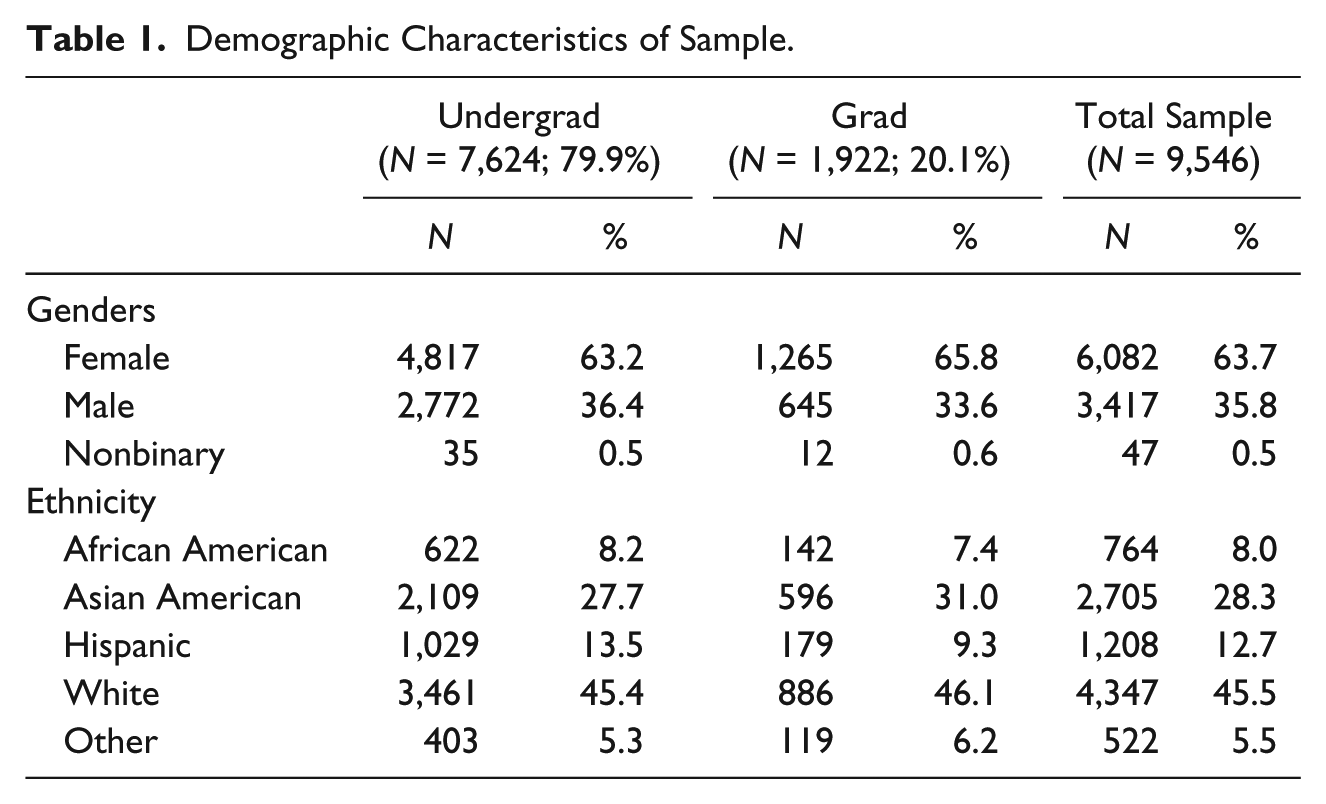
We compared the 1,248 participants with missing data on the variables used in this analysis with the final analytic sample of 9,546. There were no differences in age, t(10792) = 1.52, p = .13; gender, χ2(2) = 1.41, p = .50; or student type (undergrad vs. grad), χ2(1) = 2.67, p = .10. However, there were differences in ethnicity between those with and without missing data, χ2(4) = 33.89, p < .001. Those with missing data were more likely to identify as Asian American (34.0% of the participants with missing data identified as Asian American vs. 28.3% of the sample without missing data) and less likely to identify as White (37.1% of the sample with missing data identified as White vs. 45.5% of the sample without missing data).
Measures
Victimization
Participants responded Yes or No to six questions about sexual violence. All questions were taken from the White House Task Force’s Not Alone Toolkit (White House Task Force to Protect Students from Sexual Assault, 2014) or adapted from Krebs and colleagues (2007). Participants were asked whether anyone had unwanted sexual contact with them by (a) physical force and (b) coercion or threats of physical force. Participants indicated whether anyone had attempted but not succeeded in having unwanted sexual contact with them by (c) physical force and (d) coercion or threats of physical force. Finally, participants indicated whether anyone had sexual contact with them while they were unable to consent or stop what was happening because they were passed out, drugged, drunk, incapacitated, or asleep. For these last two questions participants indicated if they were (e) certain it had happened and/or (f) uncertain it had happened. These measures use behaviorally specific questions in line with recommended best research methods (Cook et al., 2011), and similar questions are commonly used by other researchers in the field (Fedina et al., 2018; Krebs, Lindquist, Berzofsky, Shook-Sa, & Peterson, 2016). A dichotomous victimization variable was created by coding participants who indicated Yes to any of the six items as having experienced sexual violence and participants who indicated No to all six items as not having experienced sexual violence.
Disclosure from peers
These questions were drawn from the White House Task Force’s Not Alone Toolkit (White House Task Force to Protect Students from Sexual Assault, 2014). Participants were asked, “Since coming to [university], have any other students told you they were a victim of an unwanted sexual experience?” with dichotomized response, Yes or No. If participants responded Yes, they were asked how many disclosures they had received from women and men. Reliability and validity have not been established for these questions.
Awareness of resources
Participants were presented with a list of eight campus community resources for sexual assault and asked to rate their awareness of each service ranging from 1 = not at all aware to 5 = extremely aware. This measure was created for the purposes of this study and as such validity measures have not been established. Examples of resources include the campus victim services office, the campus health center, and the Title IX office. A mean awareness score was calculated by averaging each student’s responses across the items; higher scores indicate greater awareness of resources (α = .85).
Confidence in seeking help
Participants rated their confidence in seeking help by rating their agreement with a single item that read, “If a friend or I were sexually assaulted, I know where to get help on campus.” This question was drawn from a campus climate assessment tool administered at another university and was adapted for this study (Rankin & Associates Consulting, 2008) and has been used by several institutions on campus climate surveys (e.g., Champlain College, 2017; Princeton University, 2017). Participants rated their agreement on a 5-point Likert-type scale ranging from 1 = strongly disagree to 5 = strongly agree.
Perceptions of university handling of sexual assault
Perceptions of how the university would handle a report of sexual assault were measured by asking participants to rate the likelihood of seven possible responses, such as, “the university would take the report seriously,” “the university would handle the report fairly,” and “the university would take action to address factors that may have led to the sexual assault.” This scale was adapted from the Defense Equal Opportunity Management Institute (2014) for this study, and similar measures have been used on other campus climate surveys including the AAU instrument with 27 separate institutions (e.g., Cantor et al., 2015; University of Saint Joseph, 2016). Participants rated the likelihood of each statement on a 5-point scale ranging from 1 = very unlikely to 5 = very likely. Mean scores were calculated across the items such that higher scores indicated more positive perceptions of the university’s handling of sexual assault (α = .91).
Sense of community
Participants rated their sense of community using the eight-item Brief Sense of Community Scale (Peterson, Speer, & McMillan, 2008). Agreement on each statement is rated on a 5-point scale ranging from 1 = strongly disagree to 5 = strongly agree. Sample items include, “I belong in this campus community” and “I can get what I need in this campus community.” Mean scores were calculated across the items such that higher scores indicated greater sense of community (α = .91). This scale has been validated through first and second order confirmatory factor analysis and through correlation with other established measures (Peterson et al., 2008).
Demographics
A number of demographic questions were collected, including gender identity (man, woman, transgender man, transgender woman, other) and race/ethnicity (African American, Asian American, Hispanic, White, and Other). Participants self-identified gender themselves, whereas race/ethnicity was provided through linking participants’ student identification number with their administration data. For the purpose of analysis, gender identity was recoded into three categories: men, women, and nonbinary (transgender male, transgender female, and those who responded “other”). The race/ethnicity variable was created by collapsing a larger number of racial/ethnic categories into the five used within this study.
Statistical Analysis
Data analysis was performed using IBM SPSS Statistics (Version 22.0). Descriptive statistics were calculated for all variables. To address Research Aim 1, we ran basic demographic statistics for graduate students who had experienced sexual violence while at the university. We used descriptive statistics to determine the level of sexual violence disclosures that graduate student students receive from their peers (Research Aim 2). For Research Aim 3, a MANCOVA was conducted to examine whether awareness of resources, confidence in seeking help, perception of the university’s handling of sexual assault incidents, and sense of community differed between undergraduate and graduate students. MANCOVA was chosen because the outcome measures are significantly correlated (Field, 2013). We controlled for sexual victimization because those individuals who experienced sexual violence are the students most likely to seek them, thereby potentially having greater awareness. In addition, we controlled for gender because previous research indicates that women are more likely to be aware of on-campus resources for sexual violence (Walsh et al., 2010).
Results
The first aim of the paper was to describe the prevalence of sexual violence, defined as any experience of unwanted sexual contact on six separate items, for graduate students by gender. A total of 5.2% (n = 100) of graduate students reported experiences of sexual violence since coming to the university. For female graduate students, 7.2% (n = 92) experienced sexual violence at the university compared with 1.2% (n = 8) of male graduate students.
The second aim of the study was to assess the level of disclosures of sexual violence that graduate students received from their peers. In total, 13.1% (n = 251) of graduate students had a peer disclose at least one incident of sexual violence to them. Of these students, 15.4% (n = 37) had one or more male students disclose, whereas 97.0% (n = 242) had one or more female students disclose. Of those who had a female student disclose, 51.2% (n = 124) had received a disclosure from two or more women, and 21.5% (n = 52) from three or more women.
The third research aim focused on describing graduate students’ perceptions of the university’s handling of sexual violence, confidence in seeking help, awareness of resources for sexual violence, and sense of community and to compare graduate and undergraduate students on these measures. On the measure of awareness of resources, graduate students scored slightly below the midpoint of the scale, which corresponds to somewhere between slightly and somewhat aware. For confidence in seeking help, perceptions of the university’s handling of sexual assault, and sense of community, graduate students scored slightly above the midpoint, which corresponds to being between just above neutral (see Table 2 for means).
Results of MANCOVA Comparing Undergraduates and Graduates, Controlling for Previous Victimization and Gender.
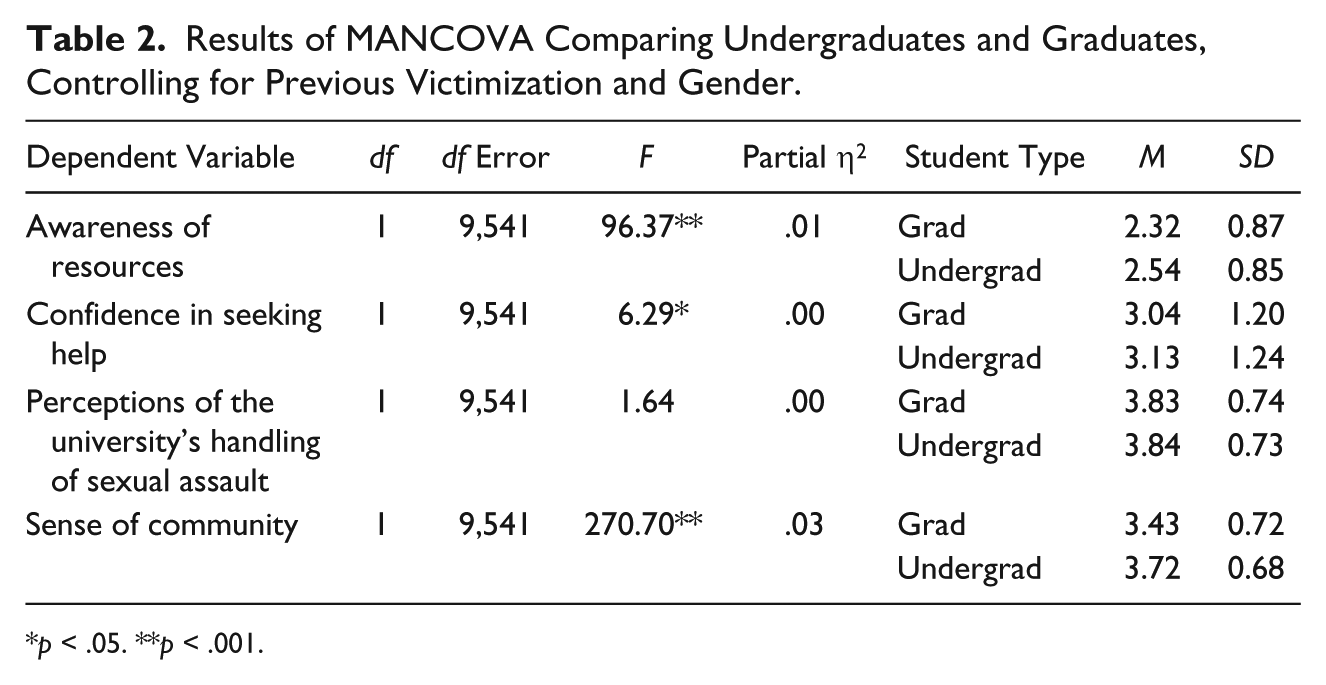
p < .05. **p < .001.
To compare undergraduate and graduate students on perception of the university’s handling of sexual violence, confidence in seeking help, awareness of resources for sexual violence, and sense of community, we conducted a MANCOVA. Graduate students scored significantly lower than undergraduates on awareness of campus resources (graduate students: M = 2.32; undergraduate students: M = 2.54), confidence in seeking help (graduate students: M = 3.04; undergraduate students: M = 3.13), and sense of community (graduate students: M = 3.43; undergraduate students: M = 3.72). However, there was no significant difference between graduate and undergraduate students on perceptions of institutional handing of sexual violence (graduate students: M = 3.83; undergraduate students: M = 3.84), although both groups of students scored slightly above a “neutral” rating of the university (see Table 2).
Discussion
Although undergraduate women have been identified as especially vulnerable to experiencing sexual violence while attending IHE, there is evidence to suggest that this issue affects graduate women students as well. In our graduate sample, 7.2% of participants who identified as women experienced some form of sexual violence since entering the university. Although women were disproportionately affected by sexual victimization, which is consistent with previous research, there were also men who reported victimization. These findings emphasizes the need for college campuses to be inclusive of graduate students in their outreach efforts, service delivery, and awareness programs and to ensure that they acknowledge that all individuals, regardless of gender, can experience sexual violence.
Our findings suggest that it is important not only for victims to be aware of resources related to sexual violence but also for the greater community of students to be informed so that they can react in supportive ways to disclosures. We found that 13.1% of all graduate respondents indicated receiving a disclosure of sexual violence from a peer, with the majority of disclosures from women. Of those students receiving disclosures from women, over 50% received more than two disclosures. This is consistent with other research that demonstrates that most students disclose sexual violence incidents to a peer (Sabina & Ho, 2014). In a study by El-Ghoroury, Galper, Sawaqdeh, and Bufka (2012) asking graduate students about their experiences with stressful challenges, they found that graduate students’ most commonly reported method of coping with stressful challenges included seeking friends’ support and talking to classmates. It is clear that peers have a critical role in receiving disclosures and potentially connecting survivors with needed resources. However, although peers have an important role to play in linking survivors with resources, their knowledge of these resources is problematic. In comparison to undergraduate students, graduate students had significantly less awareness of campus resources and significantly less confidence in knowing where to go to seek assistance. Together, these findings underscore the need for campuses to provide outreach to graduate students to raise awareness of the issue as well as how to access services on campus for themselves or a peer should an incident occur.
This supports recent work on bystander intervention education, which frames sexual violence as an issue that affects not just victims and perpetrators but also the larger community (Banyard, 2015). Although many bystander intervention programs emphasize the role of peers in preventing sexual violence, there is also a need to attend to the full spectrum of potential bystander roles—including before, during, and after an assault (McMahon & Banyard, 2012). Thus, it is critical for bystander intervention programs to address the role of peers not only in preventing or interrupting sexual assault but also in receiving disclosures after an assault has occurred. This includes ensuring that all members of the campus community are aware of resources and how to share that information with peers who disclose. Bystander education for graduate students can emphasize the importance of being prepared to respond to peer disclosures including information on campus resources. In addition, many bystander intervention education programs may rely on scenarios that may be more relevant to undergraduate situations (e.g., parties, fraternity houses) and may need to be adapted to fit the contexts that are pertinent to graduate students.
There were no significant differences in undergraduate and graduate students’ perceptions of how the university handles sexual violence, and both groups scored slightly above the midpoint. This emphasizes that although there is a generally positive view of the university, the lack of knowledge of how to access the processes and resources provided is an important area for focus. Evidence from other health promotion efforts indicates that multiple exposures to information are needed (Taylor et al., 2010), and thus, a variety of messaging efforts are likely needed to reach graduate students. Work is needed to tailor educational programs to be relevant for graduate students, including both the content and delivery of the programs. Graduate students are often in situations different from undergraduates and health concerns such as sexual violence need to be addressed within their unique contexts that may include partners, children, finances, and careers (Bulmer et al., 2010; El-Ghoroury et al., 2012).
Our results indicate that graduate students report significantly less of a sense of community than undergraduate students. Although this is not surprising, it suggests again that graduate students are less connected to the campus as a whole and therefore, outreach efforts must factor this in. In addition, the way information is delivered needs to take into account the experiences of graduate students. For example, Hyun, Quinn, Madon, and Lustig (2007) found that graduate students were not as likely to receive information about mental health services because it was located in areas that are more traditionally used by undergraduate students, such flyers or programs in residence halls or student centers. Options such as using graduate student websites and partnering with graduate school departments may facilitate the sharing of information more effectively (Oswalt & Riddock, 2007). Further research is also needed with graduate students to better understand the contexts in which sexual violence occurs, the unique barriers they may face to obtaining assistance or intervening with their peers, and their perceptions about how to engage students in educational efforts. As noted by Bonistall Postel (2020), research conducted on gender-based violence with undergraduate students should not be continually extrapolated to the experience of graduate students.
The results from this study must be interpreted within the context of a number of limitations. Only one university was involved in this study, which limits generalizability. Further work is needed to replicate these findings across other institutions. There was also likely self-selection bias introduced into the sample as all members of the student body were invited to participate rather than randomly selected. However, the survey sample was large and mostly reflective of the student body on demographic characteristics. For the specific analyses in this manuscript, Asian American students may be underrepresented and White participants may be overrepresented due to missing data. Further research should investigate whether these findings are replicable.
Other limitations should be noted as well. The question about confidence in where to get help if a sexual assault occurs was based on a single item. This question only asks whether the student has the knowledge of where to go to get help on campus if a sexual assault occurs, but there may be other places that students would seek assistance such as an off-campus rape crisis center or hospital. The questions about disclosures did not provide specific instructions about what to count and asked about receiving them from men or women but did not ask about transgender or nonconforming individuals. In addition, this study did not include specific questions about sexual harassment, which may be an even more prevalent experience for women of graduate student status. Future work is needed to ask about the spectrum of sexual harassment behaviors. Information about the relationship to the perpetrator will be important to include in future studies as well, to determine whether this affects perceptions of the university’s response. In addition, there may be important variations for graduate students based on other demographics, such specific graduate program. Certain types of students (e.g., clinical psychology) may be more aware of and more likely to use campus services. There are other subgroups of graduate students who may also have unique experiences. For example, Bonistall Postel (2020) notes the glaring absence of work on international graduate students, whose experiences may differ from their domestic counterparts in a number of important ways. Other groups to further investigate include male graduate students and LGBTQ students, who may experience unique barriers to seeking resources.
Despite these limitations, our work adds to the growing body of knowledge on campus sexual violence. Although most work on campus sexual violence is directed toward undergraduates, we demonstrate that graduate students also experience sexual violence on university campuses, yet are less knowledgeable about the resources available to them, less confident in knowing how to seek help, and feel less connected to the campus community. Our results highlight the importance of including and targeting graduate students in sexual violence awareness and prevention programming.
Footnotes
Declaration of Conflicting Interests
The author(s) declared no potential conflicts of interest with respect to the research, authorship, and/or publication of this article.
Funding
The author(s) received no financial support for the research, authorship, and/or publication of this article.