







Abstract
Childhood sexual abuse (CSA) is considered a risk factor for self-harm behaviors. According to the anti-dissociation model of self-harm, the relation between CSA and self-harm is mediated by dissociation. However, inconclusive evidence supporting this model suggests that this association may be moderated by vulnerability factors. Grandiose and vulnerable narcissism represent distinct patterns of behaviors intended to deal with unmet needs of recognition. The aim of the study was to examine a model in which the relation between CSA and self-harm is mediated by dissociation, and the relation between dissociation and self-harm is moderated by grandiose narcissism and vulnerable narcissism. A battery of self-reported questionnaires including the Childhood Trauma Questionnaire, Dissociative Experiences Scale, Deliberate Self-Harm Inventory, and Brief-Pathological Narcissism Inventory were filled out by 766 college/university students. Results indicated that self-harm was related to CSA through the mediation of dissociation. Moreover, the analyses yielded significant interactions of both vulnerable and grandiose narcissism with dissociation in predicting self-harm; the relation between dissociation and self-harm was significant among individuals with high levels of vulnerable narcissism, as well as among individuals with low levels of grandiose narcissism. These findings support the anti-dissociation model of self-harm. The findings also highlight the complex and ambiguous role of narcissism in the long-term adjustment of CSA survivors.
Self-harm behavior (also known as self-injury and self-mutilation) involves direct and intentional actions employed with the purpose of damaging one’s body tissue but without suicidal intent (Gratz, 2001; Pattison & Kahan, 1983). It has a variety of manifestations, the most prevalent of which is cutting one’s arms and legs, self-biting, and scratching with or without causing bleeding (Briere & Gil, 1998; Favazza & Rosenthal, 1993; Zetterqvist, Lundh, Dahlström, & Svedin, 2013). It may also exhibit itself in other forms of self-wounding behaviors such as punching, burning, or pulling out hair (Briere & Gil, 1998).
The prevalence of self-harm among the general population is estimated at 18% (e.g., Muehlenkamp, Claes, Havertape, & Plener, 2012). Similar rates were found among college and university students (Whitlock, Eckenrode, & Silverman, 2006). One of the risk factors for self-harm that has consistently been suggested is childhood sexual abuse (CSA; Maniglio, 2011; Van der Kolk, Perry, & Herman, 1991). Researchers have reported that its prevalence among survivors of CSA is 1.5 to 4 times higher than it is for individuals without a history of CSA (Noll, Horowitz, Bonanno, Trickett, & Putnam, 2003; Weierich & Nock, 2008).
CSA, Dissociation, and Self-Harm
A few explanations have been offered for the link between CSA and self-harm. Recent studies have suggested that maladaptive emotion regulation might explain self-harm behaviors (e.g., Gratz, Tull, & Levy, 2014). One of the common forms of emotional dysregulation, often observed among CSA survivors, is dissociation (Lanius et al., 2010). Thus, it is suggested that self-harm may serve as a means for dealing with dissociation among CSA survivors. Dissociation is known to be one of the most common and effective defense mechanisms employed by victims of repeated and recurrent experiences of CSA (Davies & Frawley, 1994). Dissociative states are characterized by a split in the individual’s consciousness, such that his or her ability to automatically merge and encode events into the memory system is disrupted (Van der Kolk & Van der Hart, 1989). Due to this disruption, only some aspects of an individual’s mind are in touch with the traumatic event, while other aspects remain unaware of it. This splitting occurs as the self’s reaction to the difficulty of dealing, in an integrative manner, with the powerful traumatic experience (Davies & Frawley, 1994).
Despite its protective quality, the tendency to disconnect from some aspects of the traumatic experience may exact a price in the long-term (Putnam, 1997). More specifically, trauma-driven dissociative symptoms may solidify into a trait-like tendency to dissociate (Marmar et al., 1994). This tendency, which becomes part of the individual’s personality, is characterized by a lack of integration and cohesion between different parts of one’s awareness and consciousness (Carlson, Yates, & Sroufe, 2009; Van Der Hart, Nijenhuis, Steele, & Brown, 2004). These dissociative experiences may be accompanied by a sense of self-alienation, numbness, and detachment from one’s emotions and experiences (Spiegel & Cardeña, 1991; Van Der Hart et al., 2004).
According to the anti-dissociation model of self-harm (see Klonsky, 2007), self-harm behaviors, which have been shown to be related to dissociation (Brodsky, Cloitre, & Dulit, 1995; Low, Jones, MacLeod, Power, & Duggan, 2000), may be considered a pseudo-solution for the emptiness, numbness, and sense of self-estrangement which characterize dissociative states. The self-inflicted pain may hinder detachment and psychic deadness insensibility and promote a sense of connection with one’s self, surroundings, and the outer world (Fliege, Lee, Grimm, & Klapp, 2009; Nixon, Cloutier, & Aggarwal, 2002). The graphic aspects of the harming (i.e., the injury, the blood, and the scars) may be experienced as proof of one’s existence and a reclaiming of one’s subjectivity. Thus, self-harm behaviors seem to be conducted to interrupt dissociative episodes and regain a sense of self and reality. Indeed, when queried about the reasons for their self-harm behaviors, individuals noted a need to feel something (45%-60% of interviewees), to relieve their numbness or emptiness (46%), to feel their body was real (43%), or to feel alive (38%; Briere & Gil, 1998; Lloyd-Richardson, Perrine, Dierker, & Kelley, 2007; Penn, Esposito, Schaeffer, Fritz, & Spirito, 2003; Zetterqvist et al., 2013). Despite this evidence, some studies have not found support for the anti-dissociation function of self-harm (e.g., Rotolone & Martin, 2012). In an extensive review of the literature, Klonsky (2007) concluded that the anti-dissociation model received only modest empirical support.
This inconclusive picture suggests that the association among CSA, dissociation, and self-harm is complicated, and may be moderated by other factors. Indeed, a few studies have suggested that coping and defense mechanisms may moderate the association between CSA and self-harm (e.g., Fliege et al., 2009). In this study, therefore, we examined the role of narcissism as a moderator of the relation between dissociation and self-harm.
The Moderating Role of Narcissism
Narcissism refers to the extent of one’s love toward one’s self and the desire, impulse, and urge to receive attention and appreciation from others (Freud, 2014; Kohut, 2013). Although this attribute may be considered a normal and adaptive quality, it may also be manifested in a pathological and dysfunctional manner (Kernberg, 1985) and is exhibited in two phenotypes: grandiose narcissism and vulnerable narcissism (Pincus & Lukowitsky, 2010). Grandiose narcissism (sometimes referred to as “overt narcissism”) is expressed by an intense need for admiration; individuals with high levels of grandiose narcissism tend to perceive themselves as one-of-a-kind, unique, and unparalleled, and they expect their surroundings to adopt this perspective (Morf & Rhodewalt, 2001). They often display extraversion, exhibitionism, social dominance, and aggression (Wink, 1991). Characterized by an absence of empathy toward others, they often take advantage of others in an effort to fulfill their own needs (American Psychiatric Association [APA], 2013).
Individuals with high levels of vulnerable narcissism (sometimes referred to as “covert narcissism”) also tend to deal with their fragile self-confidence by engaging in grandiose fantasies of being known and recognized. Yet, unlike the grandiose type, these needs and fantasies are accompanied by an intense sense of shame and thus are not overtly expressed (Cain, Pincus, & Ansell, 2008; Pincus, Cain, & Wright, 2014). This type of narcissism is characterized by high levels of introversion and shyness, as well as by a strong sense of helplessness (Wink, 1991). Although these individuals may have a sense of empathy toward others, they tend to be socially avoidant due to their fears of criticism and rejection (Besser & Priel, 2009; Pincus et al., 2014).
Both grandiose and vulnerable narcissism therefore have several features in common, mainly unmet desires for attention, love, and recognition (Kohut, 2013); indeed, studies have indicated that the two types of narcissism are associated with each other (Schoenleber, Roche, Wetzel, Pincus, & Roberts, 2015; Zeigler-Hill, Clark, & Pickard, 2008). Nevertheless, individuals with grandiose narcissism tend to react differently to threats to the self than do individuals with vulnerable narcissism. That is, the former often employ externalizing strategies, mainly aggression, whereas the latter often demonstrate maladaptive internalized reactions (Bushman & Baumeister, 1998; Cain et al., 2008; Miller, Dir, et al., 2010; Wink, 1991).
Therefore, as according to the anti-dissociation model, self-harm behaviors are employed to establish a sense of self, subjectivity, and existence that have been compromised by dissociation (Klonsky, 2007); narcissistic defenses may moderate this association. More specifically, narcissistic defenses, suggested by Howell (2003) as reflecting a relational expression of trauma-driven dissociative states, may intervene in this process; individuals who employ these defenses use their interactions with others, concrete or symbolic, in an attempt to establish subjectivity. However, the results of such attempts are different for each type of narcissism. That is, individuals with high levels of grandiose narcissism—who tend to exploit others, often aggressively, to verify their sense of subjectivity—might not need to indulge in self-harm behaviors to accomplish this purpose. By contrast, individuals with high levels of vulnerable narcissism, whose desire for recognition often leads to a sense of shame and helplessness, tend to react to ego threats by internalized reactions. Therefore, they may use self-harm as a means of establishing their sense of existence, a sense which has been deprived by the dissociative state.
The aim of the current study was to examine a model that elucidates the mechanism underlying the association between CSA and self-harm among college/university students. As illustrated in the conceptual model in Figure 1, it was hypothesized that (a) CSA would be positively associated with self-harm, (b) The association between CSA and self-harm would be mediated by dissociation, and (c) The association between dissociation and self-harm would be moderated by narcissism; more specifically, whereas vulnerable narcissism would be expected to increase the association between dissociation and self-harm, grandiose narcissism would be expected to decrease this association.
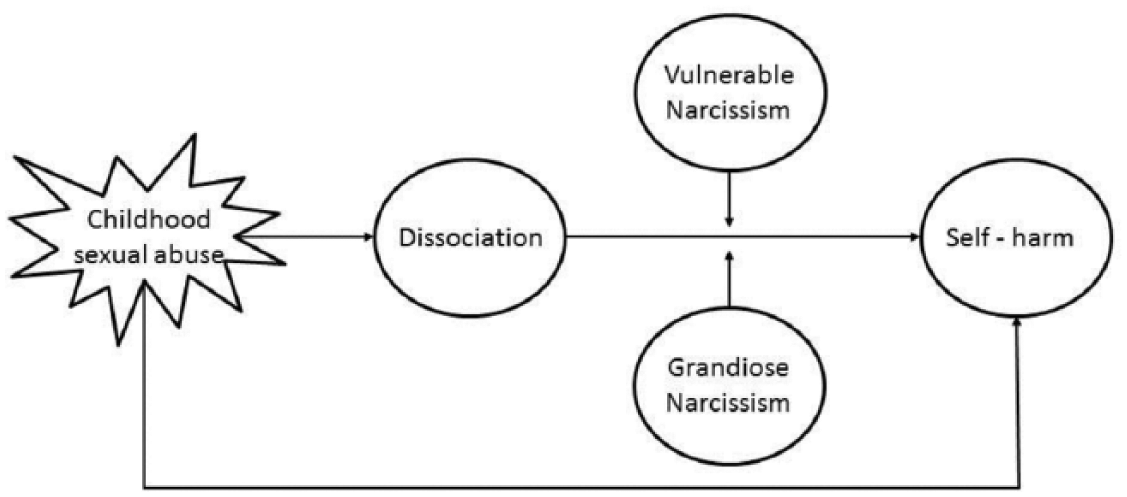
Illustration of the conceptual model.
Method
Participants and Procedure
A convenience sample of 766 Israeli university students (500 females and 266 males) was recruited via social media networks (e.g., Facebook, dedicated forums for university students in general and specific university forums in Israel). The average age of the participants was 25.95 years (SD = 13.70 years). Most of the sample, 80.9% (n = 620), were undergraduate students. The most prevalent areas of study among participants were the social sciences (28.6%) and the life sciences (23.3%), and the other areas of study were the humanities (13.5%), engineering (7%), the exact sciences (5.7%), and education (5.3%). Most participants (59.4%; n = 455) were single and defined themselves as heterosexual (93.2%; n = 714).
Potential participants were invited to participate in a study being conducted among university students on the long-term effects of negative childhood experiences. The inclusion criteria were being a college/university student, Hebrew-speaking, and being 18 years of age or older. As compensation, each participant was given the opportunity to take part in a gift voucher lottery. Data were collected after receiving approval from the university’s Institutional Review Board (IRB) and obtaining informed consent from the participants. Participants used Qualtrics Research Software to complete the questionnaires, which were presented to the participants randomly.
Measures
CSA
CSA was assessed by the sexual abuse subscale of the Childhood Trauma Questionnaire (CTQ; Bernstein et al., 2003), which consists of five items reflecting CSA (e.g., “Was touched sexually,” “Was hurt if didn’t perform a sexual act that was requested”). The items were rated on a 5-point Likert-type scale with response options ranging from 1 (never true) to 5 (very often true). Adhering to the scale’s guidelines, sum scores were used, with higher scores representing greater levels of CSA (Bernstein, Ahluvalia, Pogge, & Handelsman, 1997). The validity of the CTQ scores was supported by positive correlations between CTQ scores as reported by adolescents who were admitted to inpatient psychiatric clinics and as per their therapists’ ratings (Bernstein et al., 2003). Reported internal consistency for the CSA scale score was .92 (Bernstein et al., 2003). Cronbach’s alpha in the current study was .87.
Dissociation
Dissociation was assessed using the Dissociative Experiences Scale (DES; Bernstein & Putnam, 1986), which consists of 28 items reflecting dissociative experiences (e.g., “Some people find that sometimes they are listening to someone talk and they suddenly realize that they did not hear all or part of what was said,” “Some people are told that they sometimes do not recognize friends or family members”). Participants were asked to indicate, on an 11-point scale, the percentage of time they experienced each symptom, ranging from 0 (0%) to 10 (100%). Sum scores were used, with higher scores representing greater levels of dissociation. Carlson and Putnam (1993) demonstrated support for the scale’s concurrent validity by comparing its scores with clinical diagnosis of dissociative disorders and reliability (via 4-, 4- to 8-, and 6- to 8-week test–retest stability, split-half reliability, and internal consistency of .95). Cronbach’s alpha for the current sample was .93.
Self-harm
Self-harm was assessed using the Deliberate Self-Harm Inventory (DSHI; Gratz, 2001), which consists of 17 items describing behaviors of self-harm and self-injury, for example, “Have you ever intentionally (i.e., on purpose) cut your wrists, arms, or other area(s) of your body (without intending to kill yourself)?” or “Have you ever intentionally burned yourself with a cigarette?” Participants were asked to indicate whether they had ever conducted any of the deliberate self-harm behaviors. In line with the scale’s guidelines, participants’ positive responses were summed to create a variable of the total frequency of self-harm behavior, with higher scores representing greater levels of self-harm. Gratz (2001) demonstrated support for the scale’s validity (via positive correlations with other self-harm measures) and reliability (via 2- and 4-week test–retest stability and internal consistency of .92). Cronbach’s alpha for the current sample was .78.
Narcissism
Narcissism was assessed using the Brief-Pathological Narcissism Inventory (B-PNI; Schoenleber et al., 2015), which consists of 28 items evaluating two subscales: narcissistic grandiosity (e.g., “I find it easy to manipulate people,” “I often fantasize about performing heroic deeds”) and narcissistic vulnerability (e.g., “When people don’t notice me, I start to feel bad about myself,” “When others don’t meet my expectations, I often feel ashamed about what I wanted”). The items were rated on a 6-point Likert-type scale, ranging from 0 (not at all like me) to 5 (very much like me). Mean scores were used, with higher scores representing greater levels of each type of narcissism. Schoenleber et al. (2015) demonstrated support for structural validity (via confirmatory factor analyses), convergent validity (via positive correlations with the full inventory of PNI and other narcissism measures), and internal consistency (.86 for grandiosity and .93 for vulnerability). Cronbach’s alphas for the current sample were .79 for grandiosity and .90 for vulnerability.
Data Analysis
First, a series of Pearson correlations was computed to assess the direction and magnitude of the relations between the study variables. Then, a linear regression analysis was conducted, with self-harm as the dependent variable, and with CSA, dissociation, and the interaction between dissociation and both types of narcissism as the predictors. Age, sex, relational status (single vs. in relationship), and level of education (number of years of education) were controlled for. The predictors were entered into the model in three blocks: The first block included age, sex, relational status, level of education, and CSA; the second block included dissociation; the third included grandiose narcissism, vulnerable narcissism, and the interactions between vulnerable narcissism and dissociation and between grandiose narcissism and dissociation. All predictors were centered (dichotomous variables) or standardized (continuous variables) before they were entered into the multiple regression analysis, as suggested by Kraemer and Blasey (2004). The variance inflation factor (VIF) index was used as an indicator to examine whether these effects were biased by multicollinearity.
To further investigate the mediating and moderating hypotheses, we used an advanced moderation and mediation methodology, based on the bootstrapping approach (Preacher, Rucker, & Hayes, 2007). To examine the mediating role of dissociation in the relation between CSA and self-harm, controlling for age, sex, relational status, and level of education, we employed Hayes’ (2012) PROCESS script for mediation, using the Omnibus test for direct and indirect effects, and the Bootstrap confidence intervals (CIs) test for indirect effects (Preachers & Hayes, 2008).
To ascertain the source of the interactions between each type of narcissism and dissociation, we employed Hayes’ (2012) PROCESS script for moderation and the Johnson-Neyman technique for probing interactions. This latter procedure identifies specific regions in the range of the moderator where the effect of the independent variable on the dependent variable is significant and not significant. By employing this technique, the direction of the moderation (positive or negative effect), its power/intensity, and the levels of the moderator in which this effect occurs become apparent (Hayes & Matthes, 2009). In this analysis, 5,000 bootstrapped samples were drawn to estimate the interactions and main effects. Bias corrected and accelerated 95% CIs were computed to determine the statistical significance of the effects, as a CI that does not include zero provides evidence of a significant effect.
Missing data analysis indicated that, across variables, 0% to 19.6% of values were missing. Little’s (1988) Missing Completely at Random (MCAR) model, aimed at analyzing missing values, revealed that the data were missing completely at random, χ2(97) = 110.528, p = .164. Hence, missing data were replaced with maximum likelihood estimations based on all variables in the model, a procedure referred to as full information maximum likelihood (FIML; Arbuckle, 1996).
Results
Correlations between the study variables are presented in Table 1. As can be seen, all of the correlations among the study variables were significant, p < .001. Grandiose narcissism and vulnerable narcissism were strongly correlated. All other correlations were small to moderate in magnitude. A regression analysis was conducted with self-harm as the dependent variable, and participants’ background variables (age, sex, relational status, and level of education), CSA, dissociation, grandiose narcissism, vulnerable narcissism, and the interactions between dissociation and each type of narcissism as the predictors. Table 2 presents the regression model.
Descriptive Statistics and Pearson Correlations Among Study Variables.
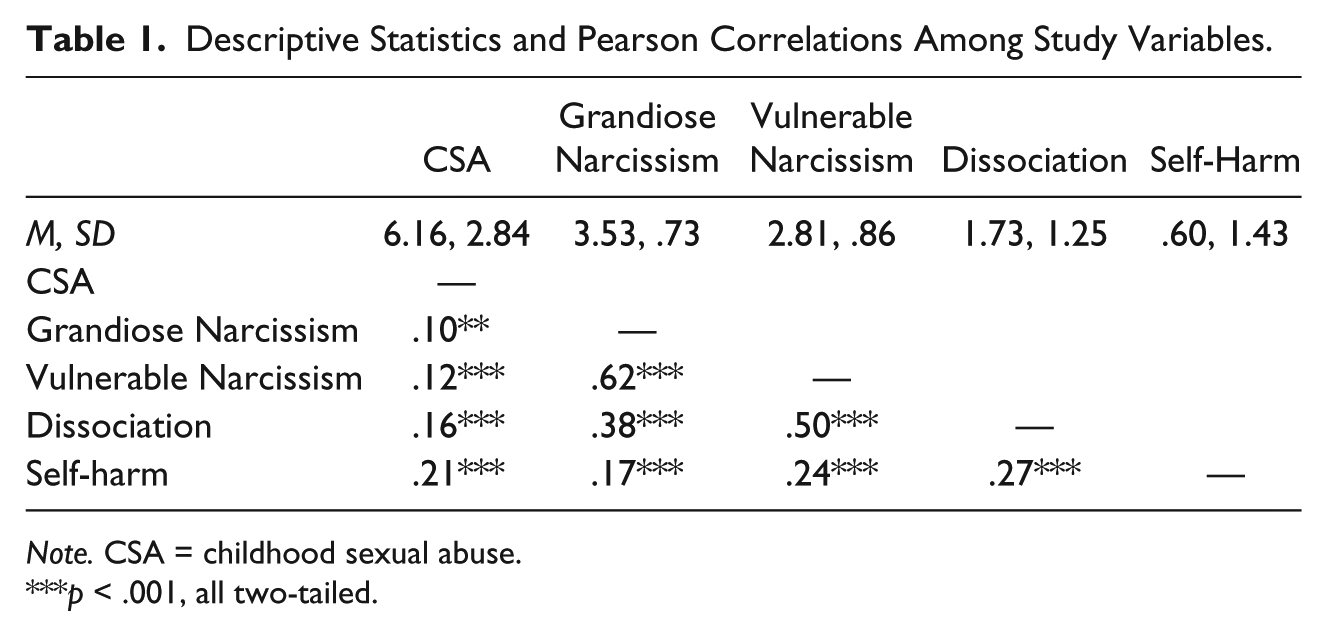
Note. CSA = childhood sexual abuse.
p < .001, all two-tailed.
Regression Models for Predicting Self-Harm.
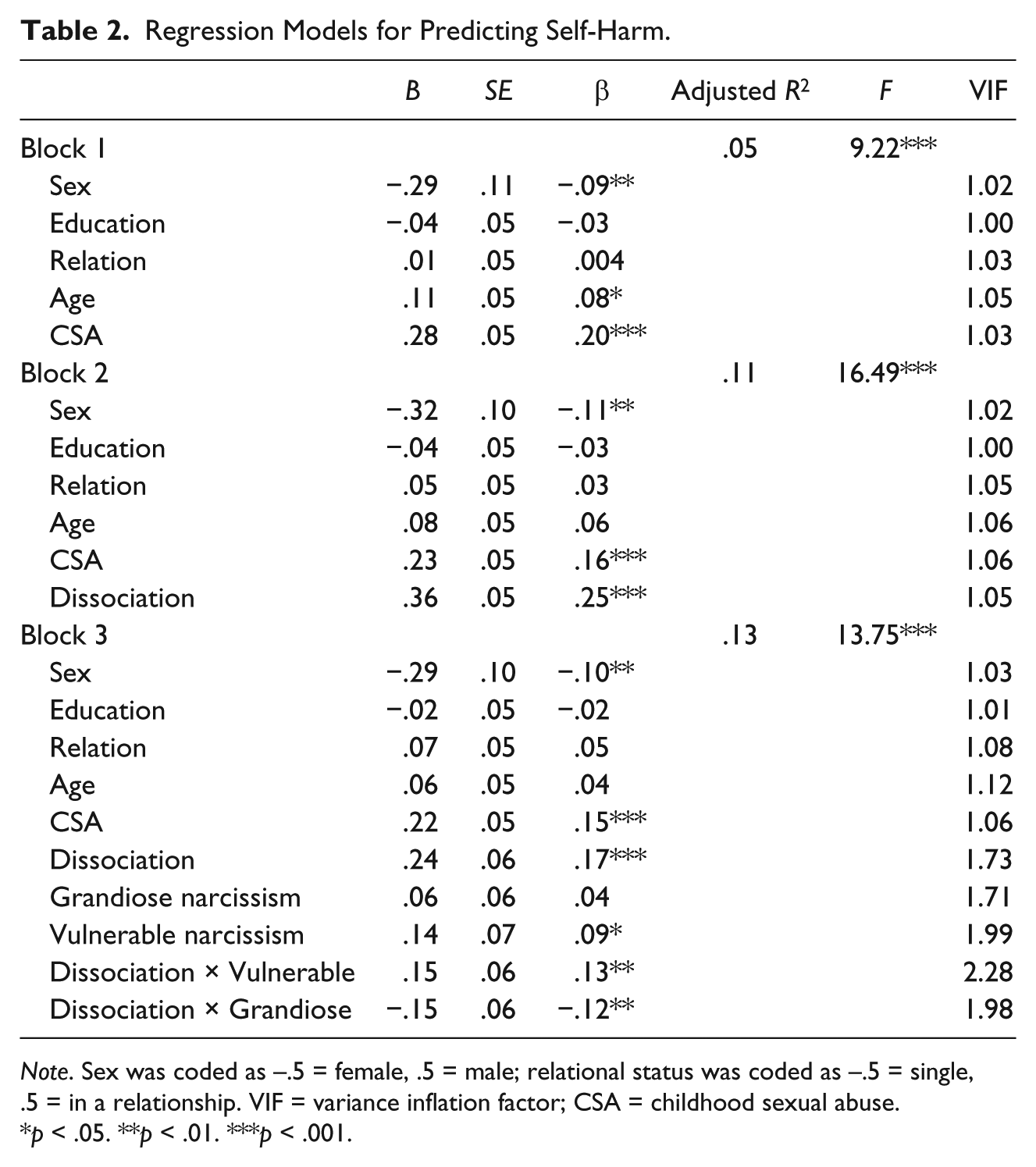
Note. Sex was coded as –.5 = female, .5 = male; relational status was coded as –.5 = single, .5 = in a relationship. VIF = variance inflation factor; CSA = childhood sexual abuse.
p < .05. **p < .01. ***p < .001.
The regression model explained 13% of the variance of self-harm, F(10, 759) = 11.84, p < .001. As indicated by the VIF indices, these effects were not biased by multicollinearity. Gender was significantly related to self-harm, as female participants reported higher levels of self-harm than did male participants. The other demographic variables were not related to self-harm.
As can be seen, CSA was positively associated with self-harm. This association remained significant when dissociation was entered into the regression model in the second stage. To investigate whether dissociation mediated the association between CSA and self-harm, a PROCESS procedure (Hayes, 2012) was computed. The analysis indicated that after controlling for age, sex, relational status, and level of education, the indirect effect of CSA on self-harm through dissociation was significant, 95% CI = [.01, .03]. The direct effect was also significant, p < .001.
Finally, both the interactions between dissociation and vulnerable narcissism and dissociation and grandiose narcissism in predicting self-harm were significant. To ascertain the source of these interactions, we applied the Johnson-Neyman technique for testing moderation effects (Hayes, 2012; Hayes & Matthes, 2009). First, we examined the significant interaction found between dissociation and vulnerable narcissism in predicting self-harm. The Johnson-Neyman technique yielded a significant moderation effect, demonstrating that among individuals with low levels of vulnerable narcissism (lower than –.55 as the value defined by the Johnson-Neyman significance region), the relation between dissociation and self-harm was nonsignificant, whereas among individuals with higher levels of vulnerable narcissism, this association was significant. More specifically, when the level of vulnerable narcissism was 1 SD below the mean, the relation between dissociation and self-harm was not significant, beta = .09, p = .36, 95% CI = [–.10, .29]. However, for values representing the mean and 1 SD above the mean of vulnerable narcissism, the conditional effects of dissociation on self-harm were .24 and .38, respectively (all p’s < .001, 95% CI for the mean = [.11, .36], 95% CI for 1 SD above the mean = [.24, .52]; see Figure 2).
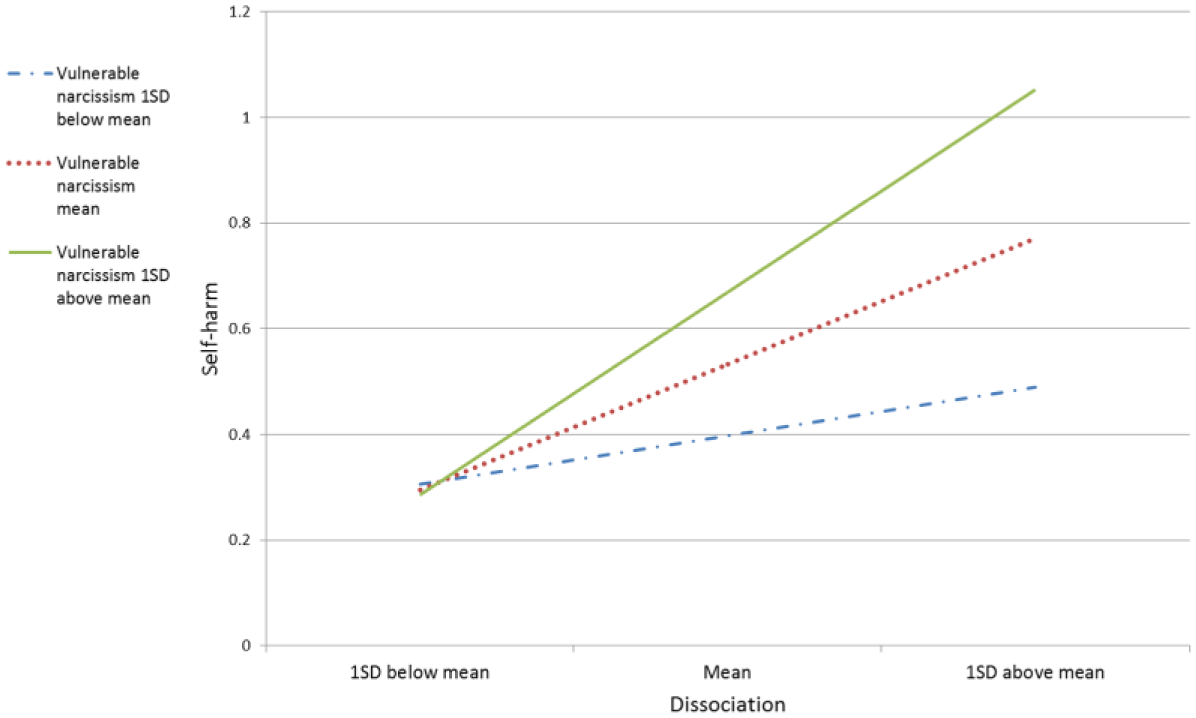
Interaction of dissociation and vulnerable narcissism in predicting self-harm.
An examination of the second interaction indicated that the relation between dissociation and self-harm was significant among individuals with low levels of grandiose narcissism (lower than .64 as the value defined by the Johnson-Neyman significance region). Furthermore, the lower the level of grandiose narcissism, the stronger the relation between dissociation and self-harm; as for values representing 1 SD below the mean and the mean of grandiose narcissism, the conditional effects of dissociation on self-harm were .38 and .24, respectively (all p’s < .001, 95% CI for 1 SD below the mean = [.21, .55], 95% CI for the mean = [.11, .36]). When the level of grandiose narcissism was 1 SD above the mean score, the relation between dissociation and self-harm was not significant, .09, p = .29, 95% CI = [–.08, .26] (see Figure 3).
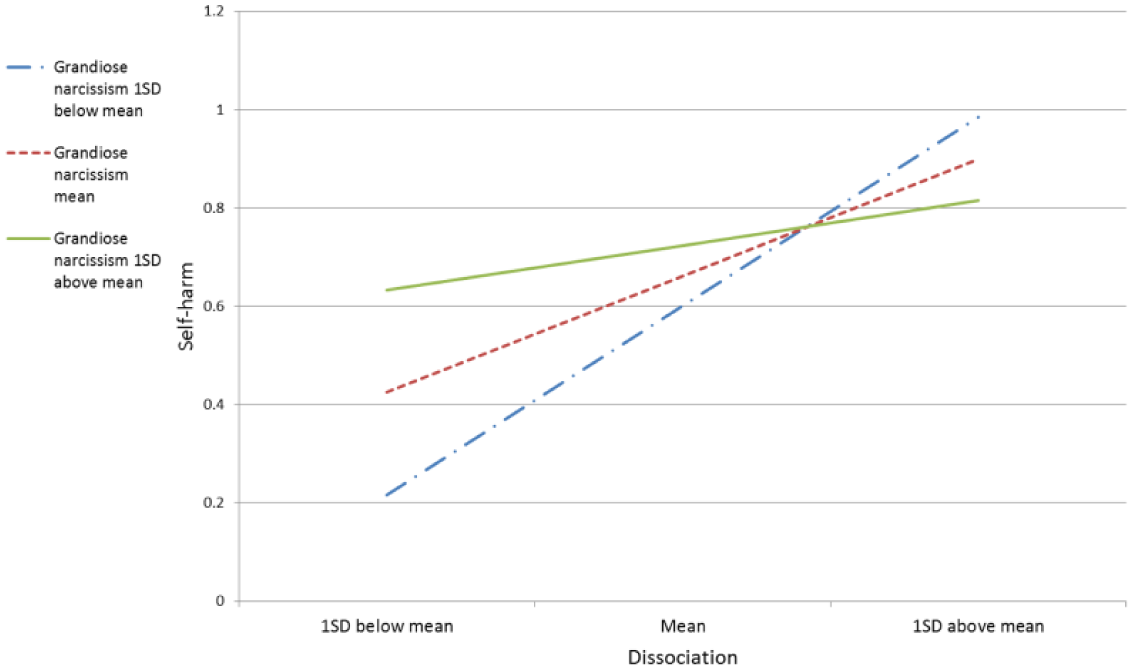
Interaction of dissociation and grandiose narcissism in predicting self-harm.
Discussion
Self-harm is a puzzling and disturbing phenomenon; the motivation of individuals to harm and inflict pain on themselves is not fully understood. Consistent with other studies suggesting that CSA should be considered a risk factor for self-harm (e.g., Maniglio, 2011; Van der Kolk et al., 1991), the findings of the current study demonstrated that CSA, essentially one of the most devastating forms of interpersonal violence, is related to self-harm via the mediation of dissociation and the moderation of both grandiose and vulnerable narcissism.
Supporting the research hypothesis, dissociation was found to mediate the relation between CSA and self-harm. The often expressed function of self-harm, that is, the need to feel something (Briere & Gil, 1998; Klonsky & Glenn, 2009; Zetterqvist et al., 2013) refines both the essence of subjectivity and the misery of the dissociative experience. “Existence precedes essence,” states Sartre (1966/1943), suggesting that the foundation of one’s subjectivity is an aware, authentic, and connected sense of self. Thus, the numbness and emptiness that characterize dissociation may deprive the individual of his or her connection to reality and therefore of his or her sense of subjectivity. Under these conditions, the motivation “to feel something, even if it was pain” (Zetterqvist et al., 2013) is understandable. Yet, although the hypothesized mediation was confirmed, the effect is moderate and partial. This finding is in line with other observations that have been made about the important but not exclusive role played by dissociation in predicting self-harm behaviors (Klonsky, 2007). The moderation effect of narcissism, which was demonstrated in the current study, provides an explanation for this small effect size.
Both vulnerable narcissism and grandiose narcissism were found to moderate the relation between dissociation and self-harm. Yet, whereas the relation between dissociation and self-harm behaviors increased among individuals with high levels of vulnerable narcissism, it decreased among individuals with high levels of grandiose narcissism. These findings may be interpreted in accordance with the different nature of the two types of narcissism. Individuals with high levels of vulnerable narcissism tend to react to ego threats with negative self-evaluations and low self-esteem (Zeigler-Hill et al., 2008). These reactions may lead to one of the main components of this type of narcissism: a fundamental sense of shame, meaning an exaggerated level of self-consciousness in which the self is perceived as faulty and inadequate (Lewis, 2000). This self-devaluating viewpoint may explain the tendency of individuals with high levels of vulnerable narcissism toward internalized maladaptive reactions, in which the self is the target for attacks (Miller, Der, et al., 2010); self-injury, which may function as a form of self-punishment (Briere & Gil, 1998), seems to be one such maladaptive reaction.
Individuals with grandiose narcissism, however, demonstrate high though unstable self-esteem (Zeigler-Hill et al., 2008) and tend to employ self-enhancement strategies to maintain it (Horvath & Morf, 2010; Raskin, Novacek, & Hogan, 1991). Thus, unlike the vulnerable type, individuals with high levels of grandiose narcissism tend to react to frustrations and ego threats by directing their hostility outwards toward others rather than inwards toward themselves (Baumeister, Bushman, & Campbell, 2000). Indeed, although grandiose narcissism has been shown to be associated with aggressive acts toward others (e.g., Bushman & Baumeister, 1998; Kim, Namkoong, Ku, & Kim, 2008), vulnerable narcissism has been shown to be associated with masochism (Hibbard, 1992; Huprich, 2014).
The findings of the current study should be examined in light of the dispute regarding the relations between grandiose and vulnerable narcissism. Although some suggest that these constructs represent two phenotypes of one phenomenon (Pincus et al., 2009), others suggest that they should be considered as two distinct attributes (Miller et al., 2011). The findings of the current study reveal the complexity regarding the typology of narcissism. Despite their opposite patterns of moderating the relation between dissociation and self-harm, grandiose narcissism and vulnerable narcissism are positively correlated with each other. Indeed, whereas the two types of narcissism exhibit somewhat different presentations, it seems that with regard to their etiology, motivation, and individuals’ subjective experiences, the similarities between them overshadow the differences.
Dissociation has been found to be correlated with both grandiose and vulnerable narcissism. Dissociating trauma survivors must accommodate the domination, exploitation, and objectification of attachment figures who have betrayed them. Thus, it seems that these relationship dynamics are re-enacted intra- and inter-personally by those parts of the survivor’s self that seek to dominate, exploit, and objectify others, as expressed especially in grandiose narcissism (Howell, 2003). However, only marginal correlations were found between CSA and both types of narcissism. Although not systematically examined, previous studies have provided evidence for the association between narcissism and physical neglect (Johnson, Smailes, Cohen, Brown, & Bernstein, 2000) and emotional neglect (Finzi-Dottan & Cohen, 2010; Lobbestael, Arntz, & Bernstein, 2010) during childhood. Interestingly, although physical and emotional abuse have been shown to be related to narcissism (Keene & Epps, 2016; Lobbestael et al., 2010), CSA has not been shown to be related to narcissism (Lobbestael et al., 2010). The differential pattern of relations between various types of childhood maltreatment and narcissism may reflect the different nature of these acts of interpersonal violence. More specifically, sexual abuse seems to be a more ambiguous and confusing experience as the individuals who ostensibly love and care for the child are also the ones abusing him or her. The interplay between childhood maltreatment, dissociation, and narcissism therefore deserves further examination, taking into consideration different types of childhood maltreatment and their differential contribution to this dynamic.
The findings of this study should be considered in light of its limitations. First, the use of self-report questionnaires implies that the tested variables are conscious subjective processes. Thus, although all variables were measured by widely used and validated questionnaires, one must take into consideration the fact that they represent self-perceptions. Second, the assessment of CSA was based on retrospective reporting (for the various limitations of retrospective assessments, see Schwarz & Sudman, 2012). Finally, due to the use of convenience sampling and a cross-sectional study design, readers should be cautious in generalizing from these results or assuming causal relationships.
The findings of this study suggest that therapists working with CSA survivors who present self-harm behaviors should take into account their dissociative states. Self-harm behaviors among patients with dissociative states are well recognized—less understood is the role of narcissism in this dynamic. As such, the intricate role of narcissism, revealed in this study as being one which either increases or decreases the use of self-harm behaviors among survivors of sexual abuse, points to the need to distinguish between the two types of narcissism. Because the Diagnostic and Statistical Manual of Mental Disorders (5th ed.; DSM-V; APA, 2013) criterion set is consistent with the grandiose variant, vulnerable narcissism is more elusive and therefore tends to be underdiagnosed (Miller, Widiger, & Campbell, 2010). Therapists should therefore be aware of the pathogenic effect of vulnerable narcissism, identify patients’ unfulfilled basic and primary needs, and carefully search for indicators of vulnerable narcissism as a risk factor for self-harm behaviors.
Despite its adaptive function in reducing self-harm behaviors in this specific dynamic, grandiose narcissism may have negative implications for the individuals’ well-being and quality of life (Brown, Budzek, & Tamborski, 2009). Thus, this type of narcissism should also be addressed within the therapeutic relationship, with the goal of strengthening other, more adaptive, defenses. By identifying basic and primary needs, patients would have the opportunity to establish a stable authentic sense of “self” that is inner-motivated, an idea illustrated by Winnicott (1971) in the following: “Hello object! I destroyed you. I love you. You have value for me because of your survival of my destruction of you” (p. 91). This recognition of the other as a subject, although one of the most challenging transitions in an individual’s development, is critical in the formation of a stable and coherent “self.” Future research should dispel the fog that surrounds the phenomenon of self-harm and pave the way for an understanding of the distinct roles played by grandiose and vulnerable narcissism.
Footnotes
Declaration of Conflicting Interests
The author(s) declared no potential conflicts of interest with respect to the research, authorship, and/or publication of this article.
Funding
The author(s) received no financial support for the research, authorship, and/or publication of this article.
