







Abstract
This study replicates and extends prior research indicating that individuals with elevated psychopathic traits are better able to identify vulnerability to criminal victimization. Specifically, the current study aims to further assess this finding, examine if criminal experience aids in the assessment in vulnerability to criminal victimization, and determine if the finding generalizes to females and non-Caucasians. Through an online survey, participants (undergraduate students; n = 247) viewed several videos of people walking alone down a hallway and subsequently rated the vulnerability to criminal victimization of the depicted person. Higher levels of psychopathic traits (measured by the Elemental Psychopathy Assessment) correlated with more accurate assessments of vulnerability when males were assessing videos of males of their same race. Prior criminal behavior, however, did not relate to better accuracy, despite its relation to psychopathic traits. Results for females were not consistent with findings for males, indicating the finding may not generalize across gender. The current findings suggest one mechanism that might explain why those with elevated psychopathic traits are more likely to offend is that they are adept at identifying vulnerability. However, this was only true for males of the same race as the “victim.”
Previous research indicates that those with elevated psychopathic traits process external stimuli in unique ways. For instance, Newman and colleagues suggest that psychopathic individuals suffer from a response modulation deficit (Newman, Curtin, Bertsch, & Baskin-Sommers, 2010). This deficit occurs when peripheral information (e.g., for punishment) is largely ignored when psychopathic individuals are engaged in goal-directed behavior. Blair and colleagues (2004) have noted a different deficit among psychopathic individuals. Specifically, they note that distress cues (e.g., fearful expressions) have to be more pronounced before psychopathic individuals are able to correctly identify the emotion (Blair et al., 2004).
Although there is evidence that the processing of some external stimuli is deficient among psychopathic individuals, other research suggests that psychopathic individuals are unusually adept at identifying certain cues, compared with those lower in psychopathic traits; namely, vulnerability to criminal victimization. Recent research (Book, Costello, & Camilleri, 2013; Wheeler, Book, & Costello, 2009) suggests individuals with elevated levels of psychopathic traits may possess greater skill identifying vulnerable persons as potential targets for criminal victimization. In these prior studies, participants watched videos of individuals walking, and were asked to rate their vulnerability in terms of whether or not the individual would be a “good victim” (i.e., easy to mug). Vulnerability ratings were then compared with the videoed person’s self-reported victimization history. Persons with higher psychopathy scores were found to be more accurate in this task, suggesting that psychopathy is associated with more accurate perceptions of vulnerability.
Although there is limited, initial evidence that individuals higher in psychopathic traits are attuned to the vulnerability of others, several questions remain unanswered. First, research has not examined whether or not criminal experience could affect the ability of the participants to identify vulnerability. A prolific offender might be better at identifying an “easy mark” than a novice would be, and persons higher in psychopathic traits are likely to have longer criminal histories (Lynam et al., 2011; Miller, Rausher, Hyatt, Maples, & Zeichner, 2014; Vaughn & DeLisi, 2008). Thus, it remains unclear whether it is psychopathic traits or criminal experience that is driving this relationship. Second, previous research has examined the relationship between psychopathic traits and victim vulnerability only among males (Wheeler et al., 2009). However, other research demonstrates that psychopathic females do not demonstrate the same cognitive and perceptual deficits that males do (Vitale, Maccoon, & Newman, 2011). Thus, it is unknown whether the same positive correlation between psychopathy scores and accuracy in identification of vulnerability to criminal victimization exists among females. Finally, previous studies have relied on videos of Caucasian participants, leaving a void as to whether the relationship between psychopathic traits and accurately identifying crime victims is generalizable with non-Caucasian hypothetical targets. The current study expands the prior research by including females as observing participants, including non-White video participants, and adding a measure of criminal experience that is separate from the psychopathy measure.
Psychopathy and Victim Vulnerability Assessment
There is some speculation, but scant empirical evidence, to suggest that those with elevated psychopathic traits might be particularly astute at identifying vulnerable individuals. Wheeler et al. (2009) examined the relationship between psychopathic traits and vulnerability to criminal victimization. For their study, they acquired 12 videos of four males and eight females, all of Caucasian descent, walking alone down a hallway. They asked the subjects of the videos if they had ever been victimized (defined as “equal to or greater than bullying”) and, if so, how many times. Half of the participants (two males and four females) identified themselves as victims. The researchers then recruited 47 male students to participate in the second part of the study. These participants were administered the Self-Report Psychopathy Scale: Version III (SRP III; Paulhus, Hemphill, & Hare, in press, as cited in Wheeler et al., 2009). Participants were instructed to put themselves in the role of a mugger and rate, on a scale of 1 to 10, whether or not they thought the person would make a good victim. The participants then watched each video and rated the person in it. Ratings of 1 to 5 were operationalized as not being an easy victim, while scores of 6 to 10 were deemed “better” victims. If the video participant’s self-reported victimization status matched the rating given by the observing participant, a 1 was recorded for that response; if it did not match, a 0 was recorded. Using this method, Wheeler et al. (2009) found a positive correlation between psychopathy scores and accuracy of assessment, r(46) = .38, p < .01. Based on these results, the authors suggested that those higher in psychopathic traits are better able to identify individuals susceptible to criminal victimization.
Drawing from the initial findings of Wheeler et al. (2009), Book and colleagues (2013) tested whether the results could be replicated using an offender sample rather than college students. The inmates were drawn from a Canadian maximum security facility, and had all been convicted of at least one violent offense. Participants agreed to allow their file information to be consulted for the study, which included a score from the Psychopathy Checklist—Revised (PCL-R; Hare, 2003) The researchers used the videos from the prior study (Wheeler et al., 2009) as their target videos, and relied on the same coding schemes. The findings reported by Wheeler and colleagues were replicated: those with higher levels of psychopathic traits were more accurate in identifying vulnerability to criminal victimization.
Beyond the similar findings from these two studies, both used related (but distinct) psychopathy measures. Wheeler et al. (2009) used the SRP III, whereas Book et al. (2013) used the PCL-R. Importantly, the SRP-III was designed to emulate the PCL-R, and as such, both measures assess previous criminal behavior. Although both studies concluded that there was a relationship between psychopathy and accuracy in assessing vulnerability to criminal victimization, it could very well be the case that it was their previous antisocial behavior that was driving this relationship. Because it makes sense that persons with greater criminal history might be better at identifying victims, independently of psychopathic traits, this may be the case for the phenomena observed by the Wheeler et al. (2009) and Book et al. (2013) studies. Therefore, to further assess the potential links between psychopathy and perceived victim vulnerability, a measure of psychopathy is needed that does not include previous offending.
Self-report psychopathy measures assess the essential traits of psychopathy, while avoiding items that explicitly include offending behavior. Thus, using a self-report measure of psychopathy avoids the pitfall of conflating psychopathic traits and offending. One measure of psychopathy that does not include prior antisocial behavior is the Elemental Psychopathy Assessment (EPA). Instead, the EPA assesses the personality traits that define psychopathy, along a framework defined by the five-factor model of personality (Lynam et al., 2011). By not including antisocial behavior in its assessment of psychopathy, this self-report measure allows for complete separation of psychopathic traits from offending.
Previous studies of the relationship between psychopathy and perception of vulnerability to criminal victimization have relied primarily on White males as participants and have not discussed potential racial differences. In their analysis of the Pittsburgh Youth Study data, Vachon, Lynam, Loeber, and Stouthamer-Loeber (2012) found that known psychopathy correlates (e.g., delinquency, antisocial personality disorder, and impulsivity) were similar for non-Whites and Whites. However, they suggested future research should examine “specific affective and information-processing deficits” (Vachon et al., 2012, p. 268), which were not included in their study. The greater ability of those higher in psychopathic traits to identify targets vulnerable to criminal victimization might be an indication of differential processing or perception. Whether psychopathic traits are related to differential processing of victim vulnerability to criminal victimization across Whites and non-Whites has yet to be explored.
Like most research on psychopathy (Verona & Vitale, 2006), Wheeler et al. (2009) and Book et al. (2013) both focused on males. This was a reasonable decision, as males have higher average rates of psychopathic traits and greater criminal activity, compared to females. However, this choice leaves a gap in knowledge: Will the same association, of higher psychopathic traits with greater victim-identification accuracy, bear out for women? Although there are exceptions (Miller, Watts, & Jones, 2011), several studies suggests that the relationship between psychopathy and other correlates, including antisocial behavior, manifest differently for females and males (Verona & Vitale, 2006; Vitale et al., 2011; Wynn, Høiseth, & Pettersen, 2012). Thus, it seems possible that the relationship between psychopathic traits and perceptions of victim vulnerability might also demonstrate a different pattern across sex.
Present Study
In an effort to extend previous research on this topic, several issues are addressed. First, we seek to replicate previous findings whereby individuals with higher levels of psychopathic traits are more accurate in identifying individuals with a history of criminal victimization. Second, we extend those previous efforts by exploring whether sex and race play any role in accuracy ratings. Recall, previous research has relied primarily on how accurate White males are at this task (Book et al., 2013; Wheeler et al., 2009). We will test whether accuracy ratings differ depending on whether the raters are White males, non-White males, non-White females, and White females. We also plan to examine whether the sex and race of the victim matters in terms of accuracy ratings. Finally, we extend previous efforts by differentiating between psychopathy and prior offending to understand whether psychopathic traits, prior offending, or both are related to accuracy ratings of judging criminal victimization vulnerability.
Method
Participants
Participants were undergraduate students enrolled in an undergraduate criminology course. They ranged in age from 18 years to 58 years, with a mean age of 20.8 years (SD = 4.3). Furthermore, participants were 54.7% female, 74.5% White, 11.7% Black, and 19.8% Hispanic or Latino (n = 247).
Measures
EPA
The EPA (Lynam et al., 2011) is a 178-item self-report measure that is designed to assess psychopathy. In both our sample and prior research, the Cronbach’s alpha for the measure is .95 (Lynam et al., 2011; Miller, Hyatt, Rausher, Maples, & Zeichner, 2014). The EPA measures 18 traits, as well as providing an overall psychopathy score. The overall psychopathy score is calculated by totaling each of the 18 traits, which each range from 1 to 5. Therefore, the minimum score possible is 18, and the highest score possible is 90. The mean score for the sample was 47.46 (SD = 6.86), with a range between 28 and 69.67. Despite the fact that we used an undergraduate sample, the descriptive statistics of the EPA we obtained were similar to previous research that relied on community members oversampled for psychopathic traits and prison inmates (Miller, Rausher, et al., 2014). Higher scores on the EPA indicate higher levels of psychopathic traits.
Crime and Analogous Behavior Scale
The Crime and Analogous Behavior Scale (CAB; Miller & Lynam, 2003) is a self-report measure that assesses criminal history. The CAB assesses a wide range of offending behaviors. However, items related to substance use or property crimes were not used in the current measure. As suggested above, it might be one’s criminal experience that facilitates their ability to identify vulnerable victims. Criminal experiences with substance use and property offending are, therefore, not conceptually related to the type of vulnerability being assessed in this study—vulnerability to being mugged. 2 The Cronbach’s alpha was .57 for this 7-item scale. Higher scores on this measure indicate greater variety of prior criminal activity in the domain of violent, interpersonal offending. Scores ranged from 0 to 7, with a mean of .92 (SD = 1.21). The most commonly endorsed item for this scale was that the participant had “been in a physical fight with another individual.”
Video Target Rating Scales
Participants were asked to put themselves in the role of a mugger and used a rating scale of 1 to 10 to rate how vulnerable the recorded person was to being mugged, with 1 being not at all vulnerable, and 10 being extremely vulnerable. Scores of 1 to 5 were recorded to indicate the person in the video was not a good candidate for criminal victimization, and scores of 6 to 10 were recorded to indicate the person was a good candidate for criminal victimization. The participant was considered correct under two conditions. First, when the participant gave a criminal victimization score of 1 to 5 and the target in the video did not report a prior criminal victimization, that was a correct response. Similarly, if the participant rated the target in the video 6 to 10 on vulnerability to criminal victimization, and the target reported being criminally victimized in the past, that was also a correct response. All other responses were classified as incorrect. Overall accuracy was calculated by adding the accuracy values and dividing by the number of videos watched. Accuracy for subgroups (by sex and race) was calculated this way as well, with only videos of people of the indicated race and gender included. This scale and method was quite similar to that employed in previous studies on this topic (Book et al., 2013; Wheeler et al., 2009).
Stimulus materials
There were 32 videos that served as the basis for making the vulnerability to criminal victimization ratings. The individuals in the videos were drawn from an upper-level criminology class and given extra credit for participation in a research study. Of the 32 videos, 17 depicted females and 15 portrayed males, 18 reported their race as White, seven as Black, six as other, and one declined to identify. The majority (75%) did not self-identify as Hispanic or Latino. They ranged in age from 19 years to 33 years, with a mean age of 22.7 years (SD = 3.3). Upon arrival, these individuals were given a consent form to sign to agree to participate in the research project, and then instructed to walk down the hall to another room where another researcher was waiting to conduct the actual study. In the destination room, participants completed a survey that inquired about their demographic information and experiences as a victim of crime, if any (see the section “Victimization Survey”). After this, they were debriefed, with the researcher informing them that they had been recorded without their knowledge as they walked down the hallway. The participant was then asked if they agreed to allow their video to be used for another study and, if so, to sign a document to that effect. All of the videos showed the student walking down a hallway by themselves. None were carrying objects (e.g., purses, backpacks) that might influence vulnerability to criminal victimization. All participants were walking away from the camera such that their face was never seen in the video clips. This was done to maximize the confidentiality of the participant. Each video was edited to be consistent in time elapsed (i.e., 8 s long).
Victimization survey
This measure was specifically created for the current study, and was reliable (Cronbach’s α = .78). This survey asks those students appearing in the videos if they had ever been a victim of 10 different crimes over the course of their lifetime, in a yes/no format. The victimizations were based on crimes listed in the section “Crime and Analogous Behaviors Scale.” Higher scores indicate being the victim of a greater variety of different types of victimization. The mean was 3.58 (SD = 2.47), and ranged from 0 to 10. Using this measure, there were four (24%) female participants’ videos and nine (60%) male participants’ videos labeled as victim videos for analysis purposes, with the other 13 female videos and six male videos labeled as nonvictims. Items used to determine previous victimization included whether the participant had ever “been physically attacked by someone” or “had something stolen from you by force (i.e., robbed, mugged).”
Procedure
Participants (in the main study) were students in a large introductory criminology class who chose to participate in an online survey as part of their research credit for that class. After completing a short demographic questionnaire, each participant viewed a total of 16 videos: four each of female victims, female nonvictims, male victims, and male nonvictims. Each video was 8 s long, with no audio. The order in which each group of videos, and the order of individuals within each group, were both randomized. Also, where there were more than four videos per category (e.g., female nonvictims), the four videos shown were randomly selected from those in the category, but no participant saw the same individual more than once. This resulted in each participant seeing equal numbers of victims and nonvictims, as well as equal numbers of males and females, but not seeing the same specific videos and/or not seeing them in the same order.
On the same screen as the video, each participant completed the video target rating scale for that video. After rating all of the videos shown, each participant completed the EPA (Lynam et al., 2011) and the CAB Scale (Miller & Lynam, 2003). Participants were permitted to skip questions, or stop the survey at any time.
Results
The first set of analyses focused on the relationship between psychopathic traits (of the participants) and the accuracy of their vulnerability to criminal victimization ratings. Overall, EPA scores were unrelated to accuracy, r(233) = –.06, p = .38. Participants with higher EPA scores were slightly and significantly less accurate when assessing videos of Black males, r(226) = –.15, p = .03. That is, people with higher levels of psychopathic traits were slightly worse at determining whether or not Black males were vulnerable to criminal victimization. All of the remaining correlations were nonsignificant (Table 1).
Correlations of EPA Score and Accuracy of Observer Groups (Rows) on Video Groups (Columns).
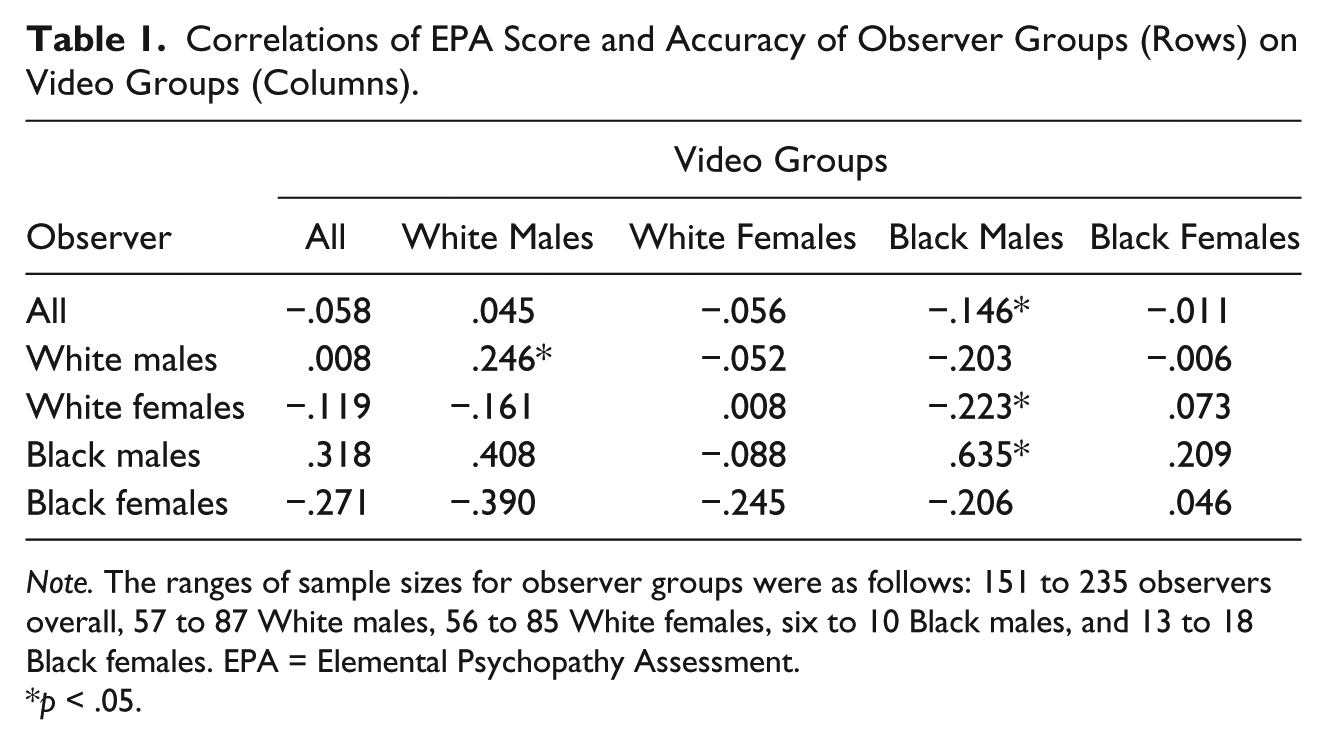
Note. The ranges of sample sizes for observer groups were as follows: 151 to 235 observers overall, 57 to 87 White males, 56 to 85 White females, six to 10 Black males, and 13 to 18 Black females. EPA = Elemental Psychopathy Assessment.
p < .05.
Wheeler et al. (2009) observed a relationship between psychopathy and accuracy in assessing vulnerability to criminal victimization based on videos of only White people shown to observers that were predominately White males. Therefore, the sample from this study was broken down by race and gender to more closely approximate the prior study. Also, there might be notable racial and sex differences in terms of those judging victim vulnerability. To assess the veracity of these possibilities, the next set of analyses focused on race and sex-specific analyses.
Group means and standard deviations are listed in Table 2. EPA scores among males were significantly higher than females’ EPA scores, t(232) = 3.83, p < .01, d = .50. However, EPA scores did not differ significantly between Black and White participants, t(198) = –.58, p = .57, d = .12. There were significant differences among the race/gender groups on the EPA, F(3, 196) = 4.51, p < .01, η2 = .06.
Means and Standard Deviations for EPA and CAB Scale, by Gender and Racial Groups.
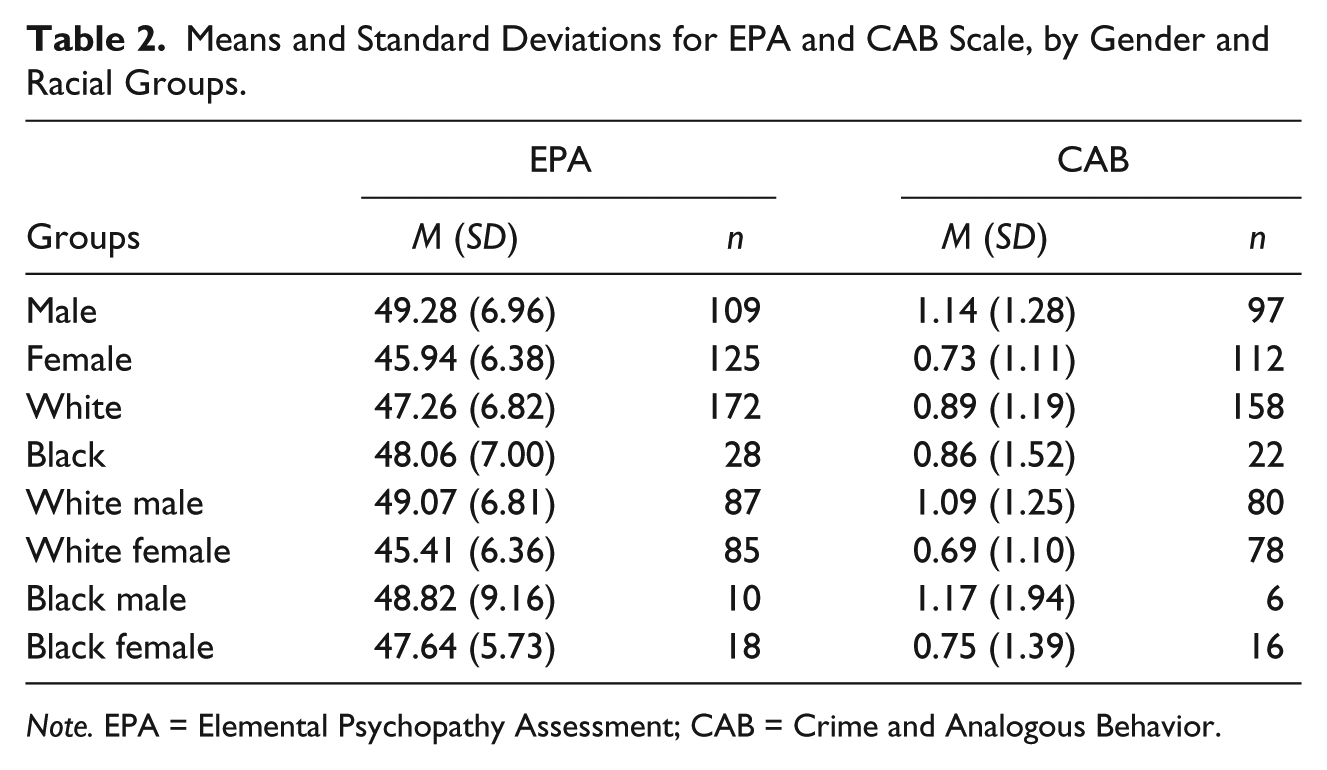
Note. EPA = Elemental Psychopathy Assessment; CAB = Crime and Analogous Behavior.
White Males
The data from the current study produced a significant positive correlation, r(85) = .25, p = .022, providing support for the possible presence of a relationship between psychopathy and ability to pick out vulnerable persons, at least for White males viewing other White males. However, as seen in Table 1, the relationship between psychopathic traits and accuracy of victim assessment did not generalize for videos of White females or Black participants (males or females), when viewed by White males. 1
White Females
No significant correlation was found between EPA scores and accuracy when assessing within-group (White female) videos, r(83) = .01, p = .95. The only modest and significant correlation found was between the White females’ EPA scores and accuracy when assessing videos of Black males, r(80) = –.22, p = .04. Nonsignificant correlations can be found in Table 1.
Black Males
All prior analyses were repeated for the Black male observer group. Within-group accuracy correlated positively with EPA scores, r(8) = .64, p = .05, meaning Black males with more psychopathic traits appeared to be better at assessing vulnerability to criminal victimization in other Black males. The EPA scores did not correlate significantly with accuracy for any other group (Table 1).
Black Females
Results for Black female observers yielded no significant correlations between the EPA score and accuracy for any group (Table 1).
CAB
The above analyses examined the relationships between psychopathy and the ability to accurately assess vulnerability to criminal victimization. Consistent with previous research (Book et al., 2013; Wheeler et al., 2009), there was some (limited) evidence of a link between the two. An alternative explanation is that accuracy of assessments of vulnerability to criminal victimization is influenced not by psychopathic traits, but instead by criminal experience that is often associated with the psychopathic personality (Lynam et al., 2011; Miller, Hyatt, et al., 2014). In the current sample, there was a moderate relationship between psychopathic traits and offending, r(206) = .30, p < .001. Because prior studies that produced positive correlations between psychopathy and accuracy used measures that included criminal experience (PCL-R and its derivative, SRP III), it is important to examine whether prior offending is also related to accurately identifying vulnerability to criminal victimization.
Using the entire sample, the CAB was unrelated to accuracy of identifying vulnerability to criminal victimization (Table 3). To more fully examine this possible relationship, analyses by sex and racial subgroups were conducted (the same as those reported in the previous section with the EPA). Group means and standard deviations are listed in Table 2. As with the EPA, males had significantly higher CAB scores than females, t(207) = 2.49, p = .01, d = .34, but racial differences were not significant, t(178) = .10, p = .92, d = .02. Comparison of all four race/gender groups found statistically significant differences, F(3, 176) = 4.51, p = .03, η2 = .05. In only one instance was the CAB related to the accuracy of assessing vulnerability to criminal victimization, and that was for Black females rating Black males, r(13) = .65, p < .01; see Table 3, However, EPA and CAB scores did not significantly correlate among Black females (r(16) = –.16, p = .56).
Correlations of CAB Score and Accuracy of Observer Groups (Rows) on Video Groups (Columns).
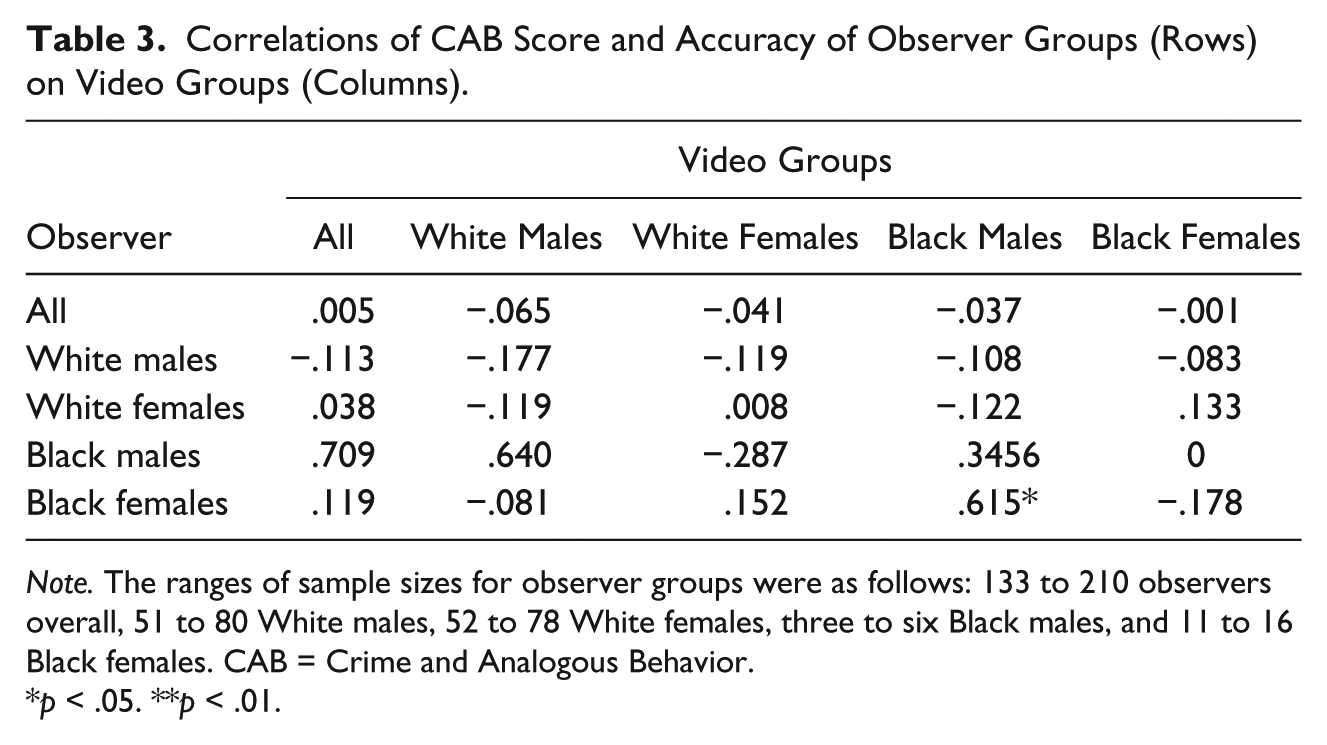
Note. The ranges of sample sizes for observer groups were as follows: 133 to 210 observers overall, 51 to 80 White males, 52 to 78 White females, three to six Black males, and 11 to 16 Black females. CAB = Crime and Analogous Behavior.
p < .05. **p < .01.
Discussion
The influence of psychopathy to inform criminological research is growing (DeLisi, 2009; DeLisi & Piquero, 2011). However, the mechanisms linking psychopathy to antisocial behavior are not well understood. Some research suggests that psychopathic individuals engage in offending because they lack moral restraint (DeLisi et al., 2014). Other research suggests that psychopathic individuals are adept at perceiving victim vulnerability. The current research, in large part, confirms the findings of prior research that used samples of only males, by showing a positive relationship between psychopathy scores (using the EPA; Lynam et al., 2011) and accuracy when assessing the vulnerability to criminal victimization of persons based on a short video of them walking (Book et al., 2013; Wheeler et al., 2009). However, the current research indicates that this association may be unique to males, and may only appear when assessing males of their same race, which marks a notable distinction between this and prior work. White males observing White males and Black males observing Black males both showed a positive correlation between their accuracy of assessing vulnerability to criminal victimization and their level of psychopathic traits, but all other EPA and accuracy correlations were negative or nonsignificant.
One of the primary aims of this research was to determine if differences in criminal experience, which are related to psychopathic traits, would account for increased vulnerability (to criminal victimization) assessment accuracy. The data do not support this hypothesis, as there were no corresponding correlations of the CAB with accuracy in the situations where the CAB correlated with the EPA. Essentially, as criminal experience does not correlate with accuracy in assessing vulnerability to criminal victimization in most cases, it is unlikely that the correlation between psychopathy and accuracy could be explained by the relationship between psychopathy and criminal experience. The only positive correlation of accuracy and criminal experience was for Black females assessing Black males, but there was no corresponding correlation between the EPA and CAB for this subgroup analysis. Also, caution is warranted when drawing conclusions from this subset of the data because the sample was rather small, after being parsed by sex and race.
We failed to find a relationship between the EPA and accuracy of assessing vulnerability to criminal victimization for females as has been found for males in prior studies (Book et al., 2013; Wheeler et al., 2009). Not finding the same effect could be due to a number of factors. One possibility is the influence of higher average empathy on the part of females (Baron-Cohen & Wheelwright, 2004). It is possible that higher empathy relates to better accuracy. At the same time, higher psychopathic traits relate to decreased empathy (Skeem, Polaschek, Patrick, & Lilienfeld, 2011). These two relationships could be counteracting each other, and obscuring a relationship between higher levels of psychopathic traits and greater accuracy. To address this possibility, future research should include a measure of empathy, especially one including multiple aspects of the construct, as research by Blair (2005) has noted that psychopaths may not be deficient in all types of empathy. Another possibility relates to the differential expression of aggression in psychopathic females. For instance, females might be more likely to engage in relational aggression than physical aggression (Knight, Guthrie, Page, & Fabes, 2002; Verona & Vitale, 2006). In the current study, participants were tasked with considering the vulnerability to a physically aggressive act. Perhaps females with elevated psychopathic traits are not very skilled at assessing such vulnerability. However, they might be more attuned to identifying vulnerability for relationally aggressive acts.
Limitations
Wheeler et al. (2009) established that those previously victimized in the videos they used displayed specific physical cues identified by Grayson and Stein (1981) that are associated with increased vulnerability to criminal victimization. In the current study, no such analysis was performed. That is, there was no consultation with a body language expert to have the videos analyzed for vulnerability cues. Future research might consider doing this to more clearly demonstrate that the video participants show signs of vulnerability, as has been assumed in this study.
The choice of location for the videos, while convenient and similar to previous research (Wheeler et al., 2009), may have also influenced the obtained results. First, as the environment was both on campus and inside a building, it could be that the body language displayed by videoed participants is different because they felt that they were in a safe environment. Research by Johnston, Hudson, Richardson, Gunns, and Garner (2004) has detailed a difference in body language based on perception of the safeness of the environment. However, modifying this safety/nonsafety perception for each individual would require informing the participants that they were being recorded, which would introduce substantial confounds. Second, the observer participants may have been biased in their assessment of the videos by using environmental factors to make their vulnerability judgment, instead of solely using body language cues. Future research should, therefore, explore the effects of different contexts, as well as consider measuring the video participants’ perception of safety and the effects thereof.
Another potential limitation of this research is its use of a student sample, as opposed to a community or offender sample. The EPA was designed to detect pathological levels of personality traits, across multiple types of samples. For context, the community sample used by Miller, Rausher, and colleagues (2014), which oversampled for higher levels of psychopathic traits, yielded a mean EPA score of 51.38 (SD = 7.05). The mean EPA score of the inmate sample used in Lynam et al. (2011; as reported in Miller, Rausher, et al., 2014) was 49.72 (SD = 7.08). Having used a sample of college students, and not having oversampled for higher levels of psychopathic traits, the current mean EPA of 47.46 (SD = 6.86) is only slightly lower. However, despite different sample origins (students and inmates, respectively), both Wheeler et al. (2009) and Book et al. (2013) found the same strength of correlation between psychopathy and accuracy. Thus, we do not believe our results were influenced by unreasonably low levels of psychopathic traits.
If future research seeks to examine racial/ethnic differences more closely, the researchers should ensure there are sufficient numbers of each category. The use of randomization to determine the specific videos shown, while strong in terms of preventing effect of presentation order or the effect of idiosyncratic individual videos, decreased the statistical power of within-group analyses for Black males and Black females. This occurred because not every Black male or Black female participant saw a Black male or Black female video, and, therefore, within-group accuracy data did not exist.
In conclusion, this research largely corroborates prior findings that males higher in psychopathic traits have greater accuracy in assessing victim vulnerability (Book et al., 2013; Wheeler et al., 2009), so long as that individual is also male and of the same race. By examining, and subsequently ruling out, the potential influence of criminal experience, the current results strengthen the argument that the findings are, in fact, related to psychopathic traits. However, this study indicates that the relationship cannot be assumed to apply among women as well. More research is needed to clarify these findings and to determine if other, so far unmeasured, factors may drive this relationship, as well as to see if the findings across race can be replicated with a larger sample size.
Footnotes
Declaration of Conflicting Interests
The author(s) declared no potential conflicts of interest with respect to the research, authorship, and/or publication of this article.
Funding
The author(s) received no financial support for the research, authorship, and/or publication of this article.