







Abstract
The wives of men who have sex with men, known as “Tongqi” in China, have increasingly attracted public attention due to their potential risks of suicide and sexually transmitted infections and HIV. However, few studies have explored the association between intimate partner violence (IPV) and suicide risk or the mediating effect of coping style on these associations among Tongqi in China. To describe these relationships, a cross-sectional online survey was conducted in China from February 2016 to February 2017. A questionnaire, which consisted of the Revised Conflict Tactics Scales, the Simplified Coping Style Questionnaire, the Beck Scale for Suicidal Ideation, and reports of suicide attempts, was completed by 178 Chinese Tongqi. Bootstrap tests were performed to determine the mediating role of coping styles on the association between IPV and suicide risks. The median IPV score was 14 (range: 0-50), with the domain of negotiation ranking highest. The average coping style score was .37±.73; 61.2% of Tongqi have had suicidal ideation, and 11.8% had attempted suicide. IPV was significantly correlated with suicidal ideation (rs = .19, p < .01) and suicide attempts (rs = .29, p < .001). Participants with a negative coping style had higher suicidal ideation (rs = –.39, p < .01) and suicide attempts (rs = –.22, p < .01). Coping style had a full mediating effect on the association between IPV and suicidal ideation and a partial mediating effect on suicide attempts. Chinese Tongqi experienced high level of IPV and suicide risks. IPV contributed to the suicide risks of Chinese Tongqi, but these associations were mediated by coping style. Therefore, interventions to improve mental health and prevent suicide risks of Chinese Tongqi should focus on helping them develop a positive coping style to achieve the goal of Healthy China in 2030.
Introduction
Intimate partner violence (IPV) refers to behaviors by an intimate partner or ex-partner that cause physical, sexual, or spiritual harm, including physical aggression, sexual coercion, and psychological and emotional abuse and controlling behavior (Centers for Disease Control and Prevention [CDC], 2017). IPV has been widely documented, particularly among women (Garcia-Moreno, Jansen, Ellsberg, Heise, & Watts, 2006). The first global systematic review on IPV showed that around one third of women globally have experienced physical and/or sexual violence by an intimate partner or nonpartner, and those who were exposed to IPV were twice as likely to experience depression and have alcohol use disorders (World Health Organization [WHO], 2013). In China, a large investigation on the prevalence of domestic violence using the Conflict Tactics Scales in seven provinces in 2012 showed that 34.8% of individuals reported physical violence and 55.6% reported spiritual violence (Cui, Hong, Su, & Liu, 2012).
Particularly, a group of women whose spouses are men who have sex with men (MSM, including gay men, bisexual men, and little proportion of heterosexual men) increasingly triggered public concern, not only due to their potential risk of HIV and sexually transmitted infections (STIs) but also due to family issues, severe IPV, and psychological problems they experienced. In recent years, new HIV cases in China attributed to MSM have increased rapidly, from 2.5% in 2006 to 27.6% in 2016 (National Center for STD/AIDS Prevention and Control, National Center for STD Control, Chinese CDC, 2017), and HIV prevalence among MSM also increased from 1.77% in 2000 (L. Zhang et al., 2013) to 7.75% in 2016 (Joint United Nations Programme on HIV/AIDS [UNAIDS], n.d.). A recent meta-analysis indicated that 17% of Chinese MSM currently have female sexual partners (Chow, Wilson, & Zhang, 2011). As a result of the stigma against homosexuality and Confucianism’s philosophy of the importance of family and filial piety in China (Steward, Miege, & Choi, 2013), experts estimate that 90% of Chinese MSM will marry women in their lifetime, which would result in over 14 million women to marry MSM; these women are known as “Tongqi” in China (M. Liu et al., 2015).
What public health scholars are concerned about is that Tongqi might be exposed to STIs and HIV infection. Several studies revealed that to gain the faithfulness of their wives and hide their homosexual orientation, MSM were more likely to have unprotected sexual intercourse with their wives (Setia, Anand, Row-Kavi, Sivasubramanian, & Jerajani, 2010); a systematic review and meta-analysis found that only 23.3% (95% confidence interval [CI]: [11.25%, 42.1%]) of married MSM consistently used condoms with their regular female sexual partner in the past 6 months (Chow et al., 2011), and men who had sex with both men and women practiced more unprotected sex than those men who had sex only with men (Pandya, Pandya, Patil, & Merchant, 2011). More specifically, the first online survey among Tongqi in China showed that 40.3% of these women did not consistently use condom with their MSM husbands during vaginal intercourse, and 10% of Tongqi practiced anal intercourse, but only 23.1% of those practicing anal intercourse consistently used condoms (Xiufang Li et al., 2017).
Meanwhile, scholars also found that IPV was one of the most profound and painful experiences for Tongqi (Yan, Li, & Zhang, 2016). Liu estimated that more than 23% of Tongqi suffered IPV (Dalin Liu & Lu, 2005), and preliminary studies showed that one third of Tongqi experienced physical abuse, 30.5% experienced verbal abuse, and 74.2% experienced spiritual abuse (B. Zhang et al., 2015). Although the frequency of sexual intercourse (only a few times per year on average) (X. Li et al., 2016) was less than the general population (2 or more times per week on average) (Pan & Huang, 2013), the reported frequency of anal intercourse (11%) ( Xianhong Li et al., 2016) was higher than the general population (8.5%) (Pan & Huang, 2013). Our analysis found that women who had anal sex with MSM were 8 times more likely to have suicidal ideation than those who did not (Xianhong Li et al., 2016). This result indicated that some of those women might have experienced anal sex coercion because anal sex in Chinese culture was still believed to be a “stable taboo” (Duby & Colvin, 2014). There are several possible reasons for the high prevalence of IPV among Tongqi. One is that there is less love and care within homo–hetero marriages, while others scholars have argued that MSM might regard violence as a revenge for their misery of marrying women (Dong Liu & Tang, 2014).
Moreover, Tongqi were reported to experience serious psychological problems. When these women found out the truth that their husbands loved men and practiced male-to-male sex, majority experienced shock, shame, denial, and depression and suffered tremendous long-term pain in their homo–hetero marriage, because in Chinese culture, women were not empowered enough to divorce (Dong Liu & Tang, 2014). Prior research with this group in China showed that 92% of Tongqi demonstrated depressive symptoms, 59.8% had suicidal ideation, and 10% had a history of suicide attempts (Xianhong Li et al., 2016).
It is noteworthy that literature has shown that IPV is associated with suicidal ideation and suicide attempts among different populations, especially among women. For example, a recent cross-sectional survey conducted among women from four major cities in the United States showed that those who had experienced IPV reported higher levels of suicidal ideation than those who did not (Fedina et al., 2021). In addition, cross-sectional studies have indicated that IPV was positively associated with suicidal ideation among Turkish women (Muyan & Chang, 2019) and married women in Kerala, South India (Indu et al., 2020). Moreover, a study focusing on 166 urban pregnant women in the U.S. Mid-Atlantic region highlighted the high prevalence of suicidal ideation among IPV victimized women (Alhusen, Frohman, & Purcell, 2015). Although a preliminary study in China indicated that Tongqi were a high-risk population for suicidal ideation and suicide attempts (Xianhong Li et al., 2016), whether IPV is a predictor of suicide risks among Chinese Tongqi is less clear.
Coping style has been shown to be a buffer for mental health and suicidal behaviors caused by violence (Xiaofei Li, Guan, Chang, & Zhang, 2014). Coping style refers to a stable psychological and behavioral strategy, active or passive, in response to external and internal negative stressors (Xiaofeng Zhao et al., 2013). One cross-sectional study conducted among community violence victim showed that a problem-focused coping style could alleviate depressed mood (Haden, Scarpa, & Tech, 2008). In contrast, hostility and dissociation, which are believed to be passive coping styles, increased the likelihood of suicidal ideation for American college students who suffered sexual assault (Keefe, Hetzel-Riggin, & Sunami, 2020). Data from a survey among 768 college students in China also demonstrated that a passive coping style had more influence than other factors on students’ suicidal ideation (Y. Li, Wang, Hu, & Li, 2009). However, to our knowledge, there has been no study that described the effect of coping style or whether coping style mediates the relationship between IPV and suicidal ideation or suicide attempts among Chinese Tongqi.
In 2016, the Chinese government issued the Healthy China 2030 target, aiming to improve and promote national health, especially ensuring health equity and giving priority to vulnerable populations, such as women and children, the elderly, the disabled, and the low-income groups (Xinhua News Agency, 2016). However, as a very marginalized and vulnerable population, there are few studies that describe the health status of Tongqi, and few empirical interventions have been carried out in China to improve their psychological well-being. Therefore, in this study, we aim to (a) describe the experience of IPV, coping style, and suicidal ideation and suicide attempts among Tongqi in China, (b) determine the relationships between IPV and suicidal ideation or suicide attempts for Tongqi, and (c) explore the mediation effects of coping style. This article highlights some key issues and offers recommendations for future prevention and intervention for suicide risks for this marginalized population in China.
Method
Study Design and Setting
This study involved a cross-sectional online survey conducted from February 2016 to February 2017. Participants were recruited through several online chatting platforms (QQ chatting groups, such as Lang man zhuan shen tongqi group, Tongqi lian meng, and Mu jin hua). The main online chatting platform was Lang man zhuan shen tongqi group, which was set up in 2014 with the aim of providing peer support, psychological counseling, and legal advice to Tongqi.
Participants and Data Collection
It is noteworthy that although China is a culturally diverse country, Confucianism’s philosophy, based on the importance of the family, continues to hold sway throughout the country. Moreover, due to the hidden nature of the Tongqi population, it would be impractical to recruit Tongqi from a single ethnic group or geographical area of China. Thus, the target population were Tongqi and ex-Tongqi (wives of MSM who had divorced) from all over mainland China. Women were eligible for this study if they were (a) female, (b) 18 years or older, (c) living in China, (d) self-reporting that their current husband or ex-husband is having male-to-male sex, (e) having access to Internet through computers or smart-phones, and (f) volunteering to participate in this study.
Data were collected using respondent-driven sampling, whereby participants were rewarded 100 RMB (US$15) after successfully completing the questionnaire and 50 RMB (US$7.5) for referring another participant. Initially, eight key Tongqi informants (seeds) were selected from the online platform of Lang man zhuan shen tongqi group and received training on the procedure to refer participants. This resulted in 178 Tongqi and ex-Tongqi from all over mainland China who filled out the online survey through sojump (http://www.sojump.com), which had a confidentiality contract with the research team.
Initially, trained research assistants explained the study purpose, procedure, benefits, and risks to the referred participants to obtain an oral informed consent. After that, participants received a web link and QR code (Quick Response code) before login, which allowed them to access the informed consent again on the first page, and if they clicked “Agree,” they could initiate filling out the questionnaire. Each Internet IP address only had one opportunity to fill out the survey, and the survey was considered invalid if it was submitted in less than 10 minutes. Participants could withdraw at any time. The questionnaire was anonymous, and there were no personal identifiers in the final data set, which was stored in a password-protected offline computer. The study protocol was approved by the Ethics Committee of Xiangya Nursing School of Central South University (Approval No. 2016041).
Variables and Measures
Sociodemographic characteristics
The survey included questions covering age, living status, education background, monthly income (both Tongqi and their husbands), marital status, and number of children.
IPV
IPV was measured using the Revised Conflict Tactics Scales–Short Form (CTS-2S), which has been widely used in different countries to evaluate the frequency and severity of IPV (Straus & Douglas, 2004). The CTS-2S covers five domains (negotiation, physical assault, injury, sexual coercion, and psychological aggression) across 20 items (10 items assessed separately for the violence perpetrator and the violence victim). Chinese scholars used the 10 items for the violence victim among women who suffered IPV and showed acceptable reliability (Cronbach’s α = .84) and validity (root mean square error of approximation [RMSEA] = .10, normed fit index [NFI] = .93, and comparative fit index [CFI] = .94) (N. Zhang, Gao, Wu, & Qiu, 2014). Items were scored using a 7-point Likert-type scale (0 = never, 1 = once, 2 = twice, 3 = 3-5 times, 4 = 6-10 times, 5 = 11-20 times, and 6 = >20 times), except the negotiation subscale, which was scored reversely. A total higher score indicates a higher level of violence. In our study, Cronbach’s alpha of the Chinese version of the CTS-2S was .71.
Coping style
Coping style was measured using the Simplified Coping Style Questionnaire (SCSQ), which included two subfactors: active coping (12 items) and passive coping (eight items). All items were rated using a 4-point Likert-type scale (0 = never, 1 = seldom, 2 = sometimes, and 3 = often). The final score was the active coping score minus the passive coping score. If the total score was positive, it indicated a positive coping style, and vice versa. The Chinese national norm for the active coping score is 1.78 ± .52 and for the passive coping score is 1.59 ± .66, with good reliability and validity (Xie, 1998), and in this study, Cronbach’s alpha was .82.
Suicidal ideation and suicide attempts
Suicidal ideation was measured by two questions from Beck Scale for Suicidal Ideation–Chinese Version (Xianyun Li et al., 2010). The active suicidal ideation question was, “Have you desired to make active suicide attempt since realizing your husband was MSM?” and the passive suicidal ideation question was, “Have you had passive suicide desire since realizing your husband was MSM?” The answers were rated using a 3-point Likert-type scale (0 = none, 1 = weak, and 2 = moderate to strong). Participants who answered “none” to both questions were considered to have never had suicidal ideation since finding out their husbands were MSM. In this study, Cronbach’s alpha was .81.
Suicide attempts were measured by one question: “Have you attempted to commit suicide since realizing your husband was MSM?” This question was rated using a 4-point Likert-type scale (0 = none, 1 = once, 2 = 2-4 times, and 3 = >4 times). Participants who answered “none” to this question were considered to have never had suicide attempts.
Statistical Analysis
Data were exported directly from the online questionnaire system and analyzed using SPSS 20.0. Frequencies and percentages were used to describe categorical variables, and means and standard deviations were used to describe the distributions of continuous variables. The differences between subgroups with or without suicidal ideation and suicide attempts were examined with chi-square tests for categorical variables and rank transformations for ordinal categorical variables. Spearman’s correlations were used to test the relationship between IPV, coping style, suicidal ideation, and suicide attempts.
A bootstrap test was performed for mediation analysis by PROCESS (a plug-in software with which SPSS can run the bootstrap test). Traditional mediation analysis would use the ordinary least squares regression, by which researchers who have correct mediation hypotheses would be frustrated by the low power of the test or by the multicollinearity (Xinshu Zhao, Lynch, & Chen, 2010). Therefore, this study used the bootstrap test to explore the relationships between IPV and suicidal ideation or suicide attempts (Preacher & Hayes, 2004). Following the procedure recommended by Hayes (2013), we chose Model 4 (Hayes, 2013). We set the bootstrap sample at 5,000 and the bias-corrected CI at 95%. Suicidal ideation and suicide attempts were the dependent variables, IPV was the independent variable, and coping style was a mediator according to our hypothesis. The level of significance was set at .05 (two-sided). Finally, the effects that IPV had on coping style (a), coping style on suicidal ideation (bi) or suicide attempts (ba), and IPV on suicidal ideation (ci) or suicide attempts (ca) were calculated by running the bootstrap test.
Results
Participant Characteristics
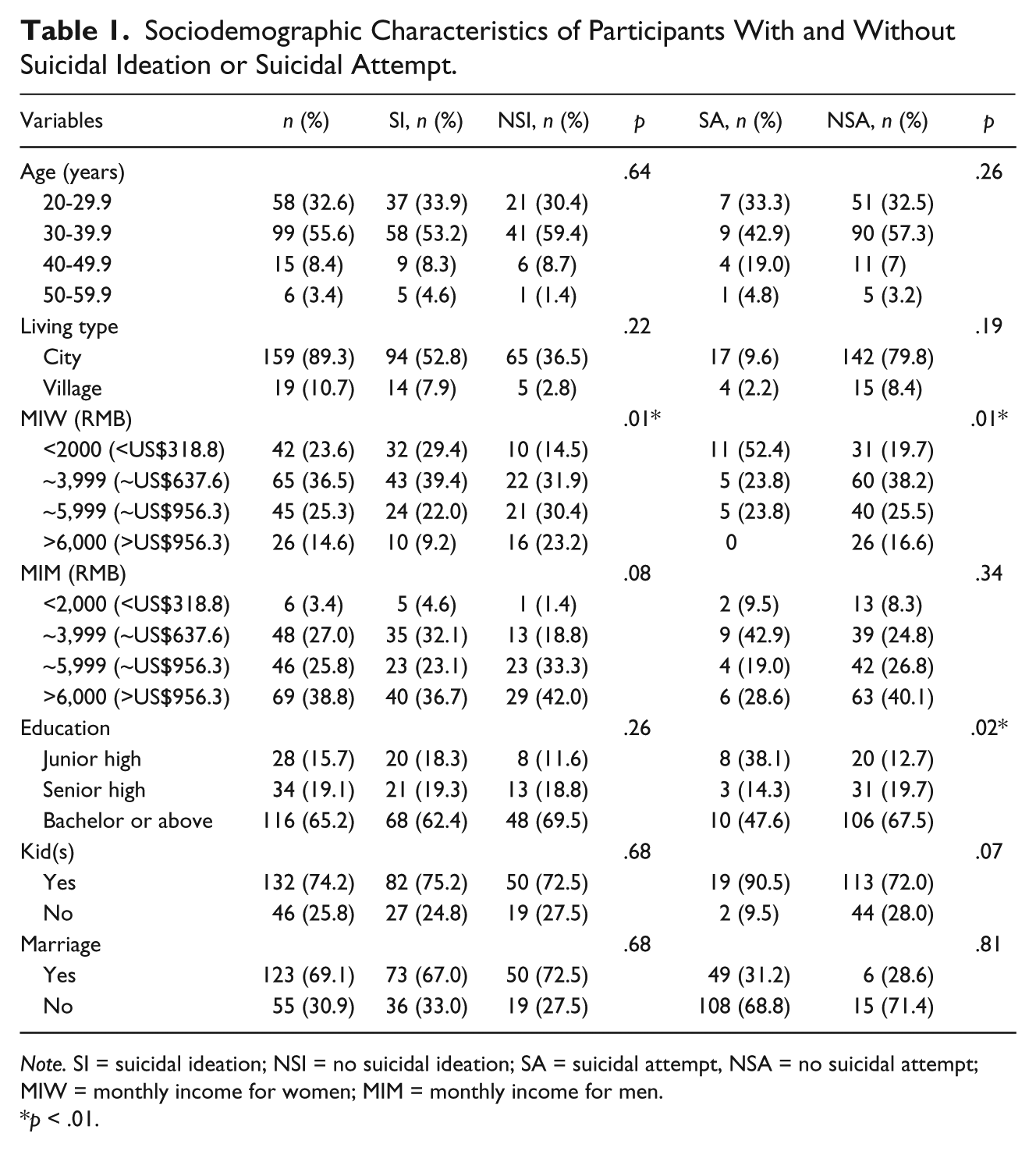
The total sample size in our study was 178, and the average age of the participants was 32.63 years (SD = 6.46, range = 40-60). The majority lived in a city (89.3%), were currently married (69.1%), had one or more children (74.2%), and had received higher education (65.2% with bachelor’s or master’s degree); 23.6% of these women had a monthly income of less than 2,000 RMB (US$318.8) and only 14.6% had a monthly income of more than 6,000 RMB (US$956.3), while it was noticeable that in terms of their husbands’ monthly income, the corresponding proportions were 3.4% and 38.8% (Table 1).
Sociodemographic Characteristics of Participants With and Without Suicidal Ideation or Suicidal Attempt.
Note. SI = suicidal ideation; NSI = no suicidal ideation; SA = suicidal attempt, NSA = no suicidal attempt; MIW = monthly income for women; MIM = monthly income for men.
p < .01.
IPV, Coping Style, Suicidal Ideation, and Suicide Attempts
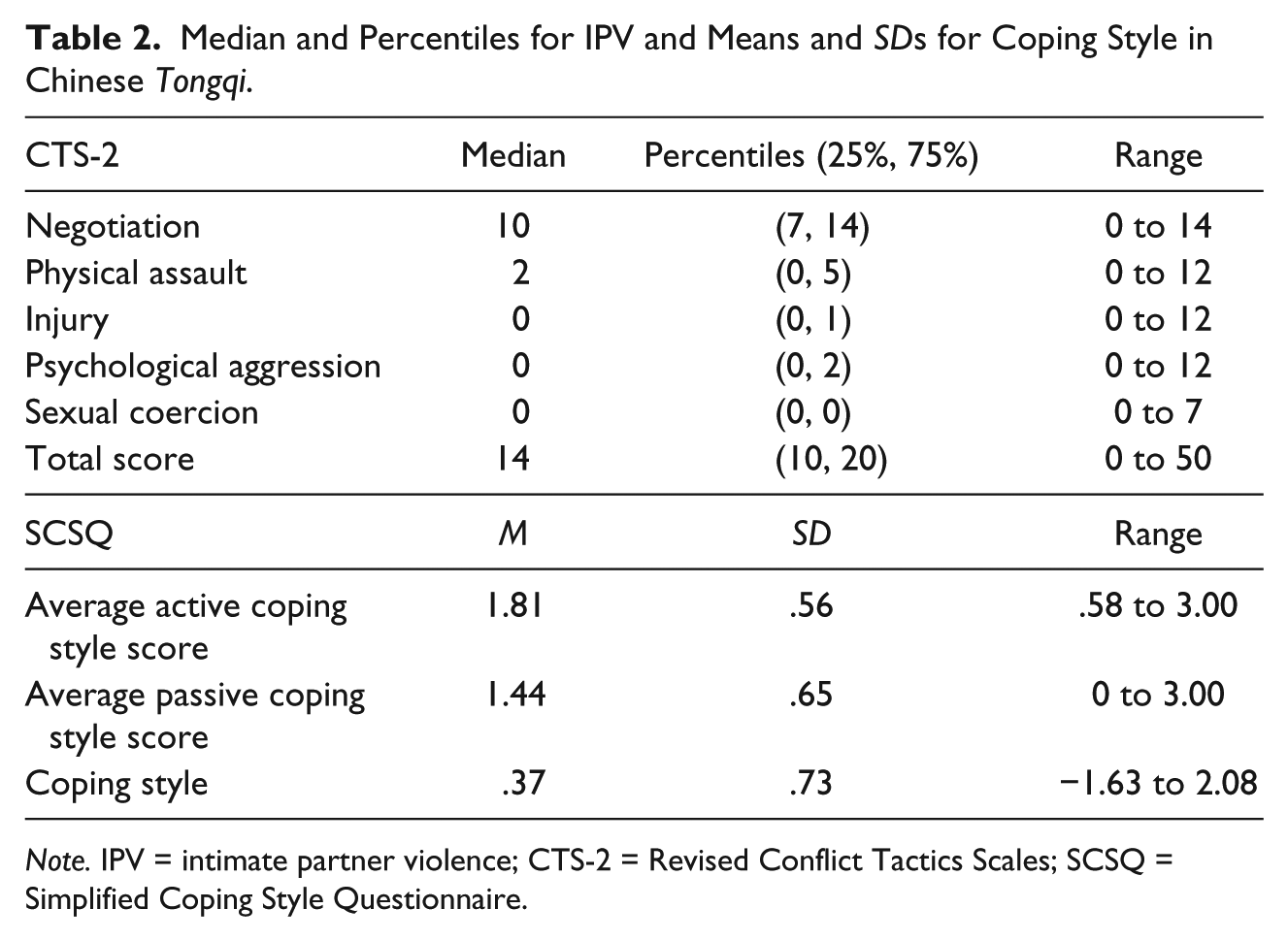
The median IPV score was 14. The “Negotiation” domain had the highest median score, followed by “psychological aggression,” “physical assault,” “injury,” and “sexual coercion” (Table 2).
Median and Percentiles for IPV and Means and SDs for Coping Style in Chinese Tongqi.
Note. IPV = intimate partner violence; CTS-2 = Revised Conflict Tactics Scales; SCSQ = Simplified Coping Style Questionnaire.
The mean active coping score among our participants was 1.81 (±.56), the mean passive coping score was 1.44 (±.65), and the mean total coping score was .37 (±.73) (Table 2).
In this study, 109 (61.2%) women ever had any suicidal ideation and 21 (11.8%) ever had attempted suicide.
Bivariate Correlations
There were almost no significant differences in any demographic characteristics between the two groups with or without suicidal ideation and suicide attempts, except for monthly income and education level, which showed that those with lower monthly incomes had higher levels of suicidal ideation (p = .01) and more suicide attempts (p = .01), and those with less education had more suicide attempts (p = .03) (Table 1).
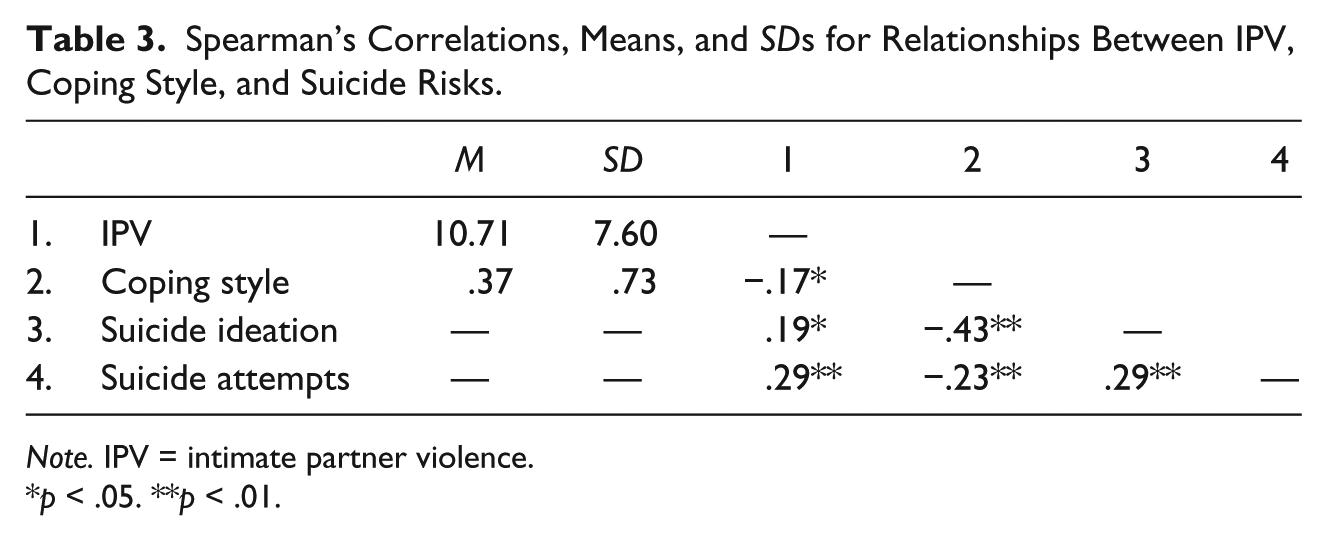
IPV was significantly correlated with suicidal ideation (rs = .19, p < .05) and suicide attempts (rs = .29, p < .01). Participants with a lower coping score had higher levels of suicidal ideation (rs = –.43, p < .01) and more suicide attempts (rs = –.23, p < .01). Participants who experienced severer IPV had more negative coping styles (rs = –.17, p < .05) (Table 3).
Spearman’s Correlations, Means, and SDs for Relationships Between IPV, Coping Style, and Suicide Risks.
Note. IPV = intimate partner violence.
p < .05. **p < .01.
Mediation Effects of Coping Styles on the Relationships Between IPV and Suicidal Ideation and Suicide Attempts
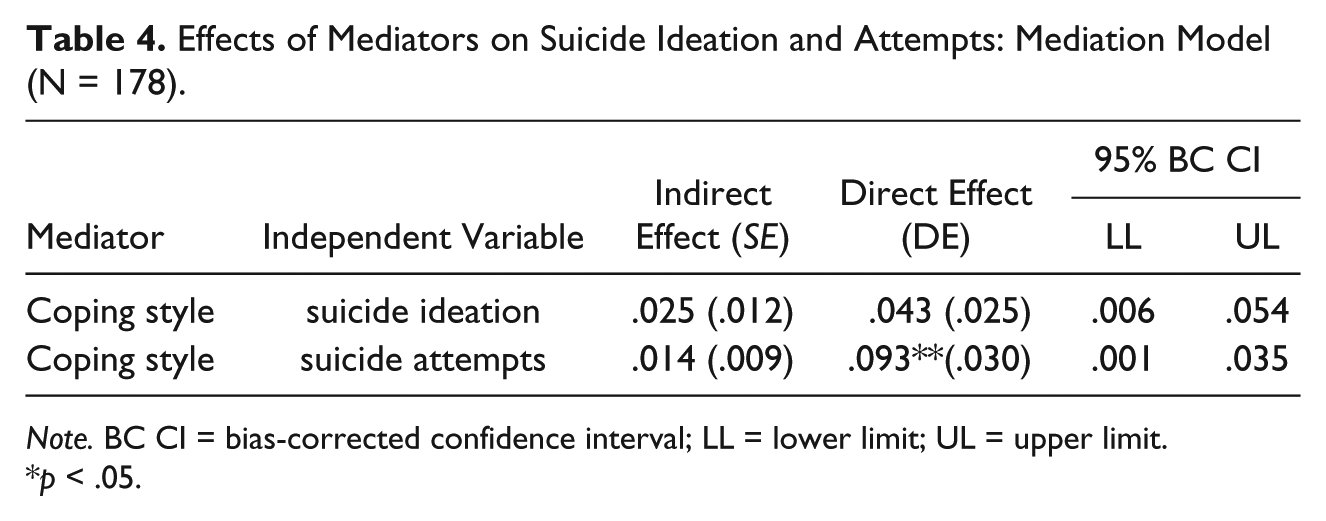
The direct and indirect effects of coping style were found to be significant in models of suicidal ideation (lower level CI [LLCI] = .006, upper level CI [ULCI] = .054) and suicide attempts (LLCI = .001, ULCI = .035) (Table 4). As shown in Figure 1 and Table 3, when coping style was included in the model, the previously significant path between IPV and suicidal ideation became nonsignificant (p > .05); the previously significant path between IPV and suicide attempts was still significant but decreased (p < .05, from .29 to .09). Overall, these findings indicated a consistent pattern in which coping style fully mediated the association between IPV and suicidal ideation and partially mediated the association between IPV and suicide attempts in Chinese Tongqi.
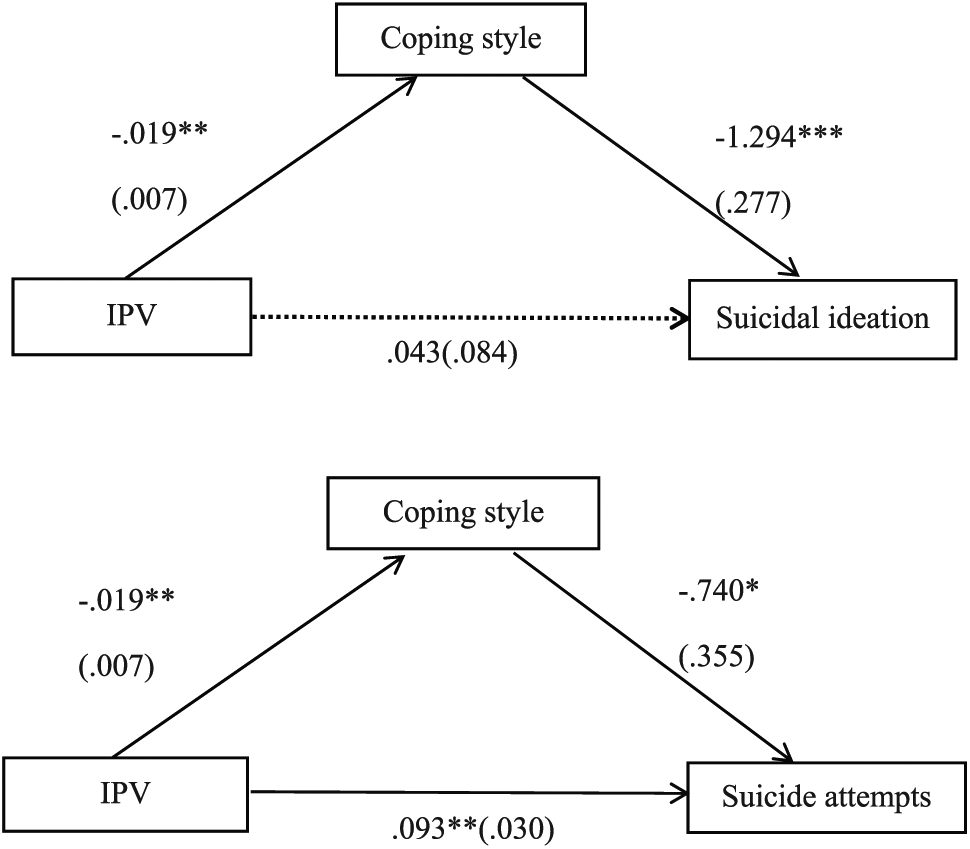
Mediation model linking IPV with suicide ideation and suicides attempts through coping style in Tongqi in China (N = 178).
Effects of Mediators on Suicide Ideation and Attempts: Mediation Model (N = 178).
Note. BC CI = bias-corrected confidence interval; LL = lower limit; UL = upper limit.
p < .05.
Discussion
This study targeted a very vulnerable and hidden population of women in China; described the status of IPV, coping style, suicidal ideation, and suicide attempts; and explored the associations between these variables. The significance of this study was that it identified that coping style mediated the relationships between IPV and suicidal ideation/attempts among Tongqi and provided a new strategic perspective on preventing suicide risks for this marginalized population. This finding had implications for encouraging the Chinese government to carry out relevant interventions to improve the psychological well-being of Tongqi, and thus to achieve the Healthy China 2030 target.
This study showed that the majority of Chinese Tongqi reported severer IPV (the median IPV score was 14 in CTS-2S) than another vulnerable group, women who lived in a Chinese rural area with lower economic support and education levels (the median IPV score in this group was 5 in CTS-2S) (N. Zhang et al., 2014). Tongqi demonstrated a poor capacity for negotiation with their husbands, with the highest score seen in the negotiation domain of the CTS-2S. This might be due to the nature of a loveless homo–hetero marriage (Yan et al., 2016) and the high stigma toward homosexuality in the context of Chinese culture (Steward et al., 2013). Thus, it may have been difficult for these women to obtain agreements from their husbands on some issues, including divorce (most of their husbands did not want to divorce; Pandya et al., 2011). It was not surprising that Tongqi suffered less sexual coercion in terms of IPV because of their husbands’ low sexual interest in them (B. Zhang et al., 2015). Therefore, the characteristic type of IPV that Tongqi experienced was mainly spiritual violence (B. Zhang et al., 2015) compared with typical Chinese families (Cui et al., 2012).
Our study showed that Tongqi had a higher rate of suicidal ideation (61.2%), which was nearly 10 times greater than the rate for all adults in China (7.0%) (Xianyun Li et al., 2010) and adolescents in south-east Asia (6.8%) (WHO, 2017). The percentage of Tongqi who had made suicide attempts was also higher (11.8%) compared with adolescents in south-east Asia (6.4%) (WHO, 2017), but was similar to the percentage of suicide attempts (12.6%) among Chinese MSM (Chen, Li, Wang, & Zhang, 2015). This result was also consistent with our previous study (10%; Xianhong Li et al., 2016), which enrolled a completely different sample of Tongqi.
IPV contributes to the high prevalence of suicide risk among Tongqi, which was confirmed by our data. Lacking negotiation capacity and experiencing high spiritual violence, Tongqi might lose confidence or self-efficacy to change their situation, and they might consider that ending life is the only way out (Sun, 2009). However, the study results indicated that coping style completely mediated the relationship between IPV and suicidal ideation and partially mediated the relationship between IPV and suicide attempts. According the cognitive model of suicide behavior proposed by Wenzel and Beck (2008), IPV could be considered as a life stress and coping style as a cognitive process; thus, those who had a passive coping style were more likely to have dispositional vulnerability factors (long-standing psychological personal characteristics) which could increase the likelihood of suicidal ideation/attempts. In this study, those Tognqi who presented with an active coping style tended to live in cities, have higher levels of education and greater economic independence, and report lower levels of suicidal ideation and attempts than those who presented with a passive coping style.
There may be several reasons why most Tongqi develop negative coping styles. First, under the traditional male- and heterosexual-dominated Chinese cultural context, wives were always in a vulnerable situation in marriages (Jiang & Yang, 2008). Although public attitudes have changed over time, wives are still expected to take care of the family and obey their husbands, while husbands are believed to be the backbones of the family and responsible for the family income, which leads to a lower family status of Tongqi compared with their husbands (Yan et al., 2016). Second, it is not easy for Chinese wives to get the custody of their children when they divorce, and therefore, to maintain an intact “family” for their child, they reluctantly keep silent about their lives (Dong Liu & Tang, 2014). In addition, there were other significant factors related to suicide risks. First, lower education level has been found to relate to suicide attempts, as reported in a study of young people in Denmark (Christiansen, Agerbo, Larsen, Bilenberg, & Stenager, 2015) and another study of elderly people in Japan (Kimura et al., 2016). Second, women who have had lower monthly incomes had higher levels of suicidal ideation and more suicide attempts. In our study, more women had monthly income less than 2,000 RMB (US$318.8) (23.6%) compared with their husbands (3.4%). In contrast, fewer women had monthly incomes higher than 6,000 RMB (US$956.3) (14.6%). Thus, Tongqi demonstrated a low educational and economic status in their families. These results are consistent with WHO data, which show that women were more likely to experience IPV if they had lower levels of education and higher levels of income inequality (WHO, 2013).
This study had several limitations. First, the sample was small and not representative due to the hidden characteristics of this population. We could only reach those women who already knew their husbands were practicing male-to-male sex and those who had access to the Internet and could connect with online Tongqi peer groups. Second, this was an online survey and it was difficult to ensure the veracity of reporting to be Tongqi; however, we invited eight key Tongqi informants to communicate with the participants to check their identities before they were invited to participate in the study. We also limited the IP addresses to avoid repeated filling out of the questionnaire by the same person. A final limitation is that only a limited number of predictors (IPV and coping style) of suicide risks were explored in this study. Future studies should take other factors such as social support or depression into account.
Despite its limitations, this study does have several implications. First and foremost, results showed an increased likelihood of Chinese Tongqi to have suicidal ideation and suicide attempts if they suffered IPV. The All-China Women’s Federation (ACWF) and related scholars should pay more attention to these vulnerable women, who account for nearly 3% of the Chinese female population (Feng, 2010). Second, in China, the “anti-domestic violence law” issued in 2015, which clarified the compulsory protection of women who experience IPV, mainly focused on physical violence. As our study showed, the characteristics of IPV Tongqi experienced were mainly spiritual violence, which could not be guaranteed by the “anti-domestic violence law.” Therefore, it is necessary to clearly define the scope of family violence in the “anti-domestic violence law” to better protect Tongqi. Third, the study results provided a new strategic perspective to prevent suicide risks of Tongqi. ACWF or other community-based organizations are recommended to focus more on improving Tongqi’s coping styles in addition to offering social support, psychological counseling, and legal assistance. Finally, Chinese women should be empowered by education on sex and sex-related knowledge, as well as gender and economic equity, so as to develop positive coping strategies when they encounter these situations.
Conclusion
These findings revealed the severe situation of IPV and suicide risks among Tongqi and identified that positive coping style could serve as a buffer. Under the world’s theme of “Health for All” (WHO, 2018), we suggest that it is important to pay special attention and provide a supportive environment for Chinese Tongqi, to achieve the goal of Healthy China in 2030.
Footnotes
Acknowledgements
We are grateful to Ms Lijing Wang, the organizer of a Tongqi’s QQ platform (Lan man zhuan shen), for support of recruiting participants; Mr. Zhang, the professor in the Affiliated Hospital of Medical College Qingdao University, for support of referring participants; and all the women who participated in our interviews.
Declaration of Conflicting Interests
The author(s) declared no potential conflicts of interest with respect to the research, authorship, and/or publication of this article.
Funding
The author(s) disclosed receipt of the following financial support for the research, authorship, and/or publication of this article: This study is supported by the National Social Science Fund (15CSH037) and Innovation-Driven Project of Central South University (2018CX036).
