







Abstract
Research indicates that violence against teachers has detrimental negative effects on teachers’ emotional and physical well-being, connectedness to school, job performance, and retention. However, no quantitative empirical research has been conducted to examine the extent of teacher victimization reported to school officials, school interventions to address teacher victimization, and teachers’ satisfaction with school handling of victimization. To address the limitations of prior research on teacher victimization, for a sample of 1,628 teachers in a large urban county, the present research investigates the extent of teacher victimization reported to school officials and examines school responses to teacher victimization. Furthermore, two key variables (school interventions and apologies from offending students) are tested as predictors of victimized teachers’ satisfaction with administrators’ responses to incidents. The findings indicate that the extent of reporting victimization to school officials by victimized teachers is quite high; however, a large number of victimized teachers perceived school intervention following incidents as ineffective and inadequate. Ordinal logistic regression analyses indicate that victimized teachers who report to school officials expect offending students to be disciplined and held accountable, and when this does not occur, they are dissatisfied. Overall, the findings suggest the urgent need for school administrators to review their current disciplinary policies regarding teacher-directed violence and to establish effective protocols to prevent and properly respond to teacher victimization.
Introduction
A growing number of empirical studies (Dzuka & Dalbert, 2007; Galand, Lecocq, & Philippot, 2007; Gregory, Cornell, & Fan, 2012; Huang, Eddy, & Camp, 2017; Martinez et al., 2016; McMahon et al., 2017; Moon & McCluskey, 2016; Moon, Morash, Jang, & Jeong, 2015; Robers, Kemp, Rathbun, & Morgan, 2014; Wei et al., 2013; C. M. Wilson, Douglas, & Lyon, 2011) have investigated the prevalence of violence directed against teachers and the negative consequences for victimized teachers. These findings consistently indicate that violence against teachers is a widespread problem that has detrimental negative effects on teachers’ emotional and physical well-being, connectedness to school, job performance, and retention. For example, Gregory et al. (2012) found that in a sample of 2,870 teachers in Virginia, 43% of participants were subjected to obscene remarks and gestures by students in the school year prior to the survey. Empirical research (Moon et al., 2015; C. M. Wilson et al., 2011) also has found that victimized teachers are at high risk for emotional and physical distress that increases levels of stress, job dissatisfaction, and turnover.
Further empirical research is necessary to better understand violence directed against teachers at school. No quantitative empirical research has been conducted to examine the extent of teacher victimization reported to school officials, school interventions to address teacher victimization, and teachers’ satisfaction with school handling of victimization. Also, there is a dearth of literature on factors related to victimized teachers’ satisfaction with school interventions. The present research, using a sample of 1,628 teachers, contributes to extant literature on violence against teachers by filling these gaps. First, the study examines the prevalence of three different types of teacher victimization (i.e., theft/vandalism, sexual harassment, and physical aggression) and the extent to which teachers reported their victimization to school administrators. Second, it examines how school administrators handled incidents of teacher victimization and whether victimized teachers were satisfied with the schools’ interventions. Finally, the present research identifies predictors of victimized teachers’ satisfaction with school responses by focusing on teacher demographics, characteristics of the incidents, and the nature of the interventions (e.g., discipline offending students, obtain an apology from offending students).
This research is important for at least two reasons. First, the research can provide valuable information on the extent of teacher victimization reported to school administrators, how school administrators respond to teacher victimization, and whether victimized teachers were satisfied or dissatisfied with the administrative response to their victimization. Second, this study can identify promising types of intervention to address teacher victimization and aid school administrators and teachers in the development of effective intervention strategies that leave teachers satisfied with how the school handles victimization.
Literature Review
Prevalence of Teacher Victimization, Extent of Victimization Reported, and Satisfaction
Relatively few empirical studies (Gregory et al., 2012; McMahon et al., 2014; Robers et al., 2014; Wei et al., 2013) have been conducted to investigate the prevalence of students’ verbal and physical aggression toward teachers at schools in the United States. As an exception to the limited research, the 2013 School Crime and Safety Report (Robers et al., 2014) found that 5.4% of public school teachers reported being physically attacked or threatened with injury by a student at school during the 2011-2012 school fiscal year. McMahon et al. (2014), using a sample of 2,998 K-12 teachers, examined the prevalence of various types of teacher victimization including physical attacks and sexual harassment. They found that 44% of study participants reported victimization by physical attacks, and approximately three-quarters of them experienced victimization through sexual harassment.
Three statewide empirical studies in Minnesota, Pennsylvania, and Virginia (Gregory et al., 2012; Tiesman, Konda, Hendricks, Mercer, & Amandus, 2013; Wei et al., 2013) found that verbal abuse and harassment directed against teachers by students were the most frequently reported types of victimization, whereas a relatively small proportion of teachers reported victimization by students’ physical aggression and assault. Gregory et al. (2012) found that for a sample of approximately 3,000 teachers in Virginia, 43% of participants experienced verbal abuse and obscene gestures from students, and approximately 3% reported physical assaults by students. For a sample of 4,731 K-12 teachers in Minnesota, Wei et al. (2013) investigated the prevalence of violence directed against teachers by students. Consistent with prior findings, they discovered that nonphysical violence (i.e., verbal abuse and sexual harassment) against teachers by students was the most common type (26%), and 5% of educators reported victimization by physical assault during the year prior to the survey.
No empirical research has been conducted to understand how victimized teachers respond to incidents, so little is known about the extent of teacher victimization reported to school officials. However, the literature on criminal victimization in the general population shows that violent crimes, especially serious violent crimes, are most likely to be reported to the police, but police were least likely to be notified of property crime and personal theft such as pick pocketing and theft of personal items (see Truman & Morgan, 2016). Some serious violent crimes such as robberies and aggravated assaults are more likely than sexual assault and simple assault to be reported to the police (Tarling & Morris, 2010). For example, the results from the National Crime Victimization Survey in 2015 (Truman & Morgan, 2016) indicate that victims reported 61.9% of robbery incidents and 61.9% of aggravated assaults to the police, but they reported 32.5% and 41.7% of rape/sexual assault and simple assault, respectively. Personal theft was reported to the police at a much lower percentage (28.6%).
Empirical research on administrators’ responses to teacher-directed victimization is almost nonexistent. Recently McMahon et al. (2017) conducted qualitative research to understand school responses to teacher victimization; they demonstrated that almost 10% of 2,431 teachers described lack of administrative support as the most upsetting aspects of their victimization experiences. Feeling blamed for the incident, powerlessness to properly respond, administrators’ inaction and siding against victimized teachers, and ineffective discipline were among the common themes of victimized teachers’ dissatisfaction with administrators’ responses (McMahon et al., 2017). This initial result shows the negative outcomes of administrators’ inappropriate responses to teacher victimization and its detrimental negative consequences for the victimized teachers.
Predictors of Victim Satisfaction
There is no extant literature on predictors of victimized teachers’ satisfaction with school intervention into teacher-directed violence. However, the literature on crime victims’ satisfaction with criminal justice responses that is not specific to teachers at school can provide useful theoretical frameworks to better understand victimized teachers’ satisfaction with administrative handling of incidents.
Over the last several decades, a significant number of empirical studies were conducted to investigate a wide range of criminal victimization–related topics, including victimization prevalence, extent of victimization reporting to police, negative consequences, and victim satisfaction with the criminal justice system response. Within a theoretical framework that focuses on procedural justice and the quality of the justice system outcome (see Laxminarayan, Bosmans, Porter, & Sosa, 2013), recent victimology research has investigated the underlying predictors of victims’ satisfaction with criminal justice agencies’ (e.g., the police, prosecution offices, and criminal courts) actions. Procedural justice is indicated by the fairness of the procedure and victims’ participation and representation in the decision-making processes (see Laxminarayan et al., 2013). Thibaut and Walker (1975), who are considered to be pioneers in empirical procedural justice research, defined procedural justice as the fairness of the means for making decisions. They identified both process control and decision control as important key criteria in procedural evaluations (Tyler, 1988). Leventhal (1980) went further to identify six dimensions of procedural justice and some of these are representation (opportunity given to a party affected by a decision to be involved in decision making), consistency (similarity of treatment), the ability to suppress biases (prevention of favoritism and other biases), and correctability (opportunity to address unfair decisions). Overall, numerous empirical findings indicate that victim perceptions of fairness of the procedures affect their satisfaction with criminal justice (Elliott, Thomas, & Ogloff, 2011; Fleury, 2002; Johnson, 2007; Robinson & Stroshine, 2005; Wemmers, 1998). For example, Elliott et al. (2011) found that in a sample of 110 victims of violent and property crimes, victims were more likely to be satisfied with police when officers were polite and concerned and when victims’ opinions and views were heard and considered.
Theories concerning retributive justice, deterrence, and restorative justice focus on victim satisfaction with the nature of the response to victimization (Laxminarayan et al., 2013). The retributive justice approach is based on the notion that perpetrators deserve to be punished in proportion to harms caused by their actions. Thus, it focuses exclusively on punishment such as incarceration and other sanctions. Deterrence refers to the prevention of future crimes and wrongdoings by the offender by levying sanctions or using rehabilitative methods. Restorative justice prioritizes restoring harms caused to victims and community and holding perpetrators accountable and responsible for their wrongdoings. Restorative justice methods include mediation and securing an apology from the crime perpetrator (Bouffard, Cooper, & Bergseth, 2017; Dhami, 2012).
Several prior studies (e.g., Felson & Pare, 2008; S. Wilson & Jasinski, 2004) have found that arrest and incarceration are significantly related to victims’ satisfaction with the police and criminal courts. For example, Felson and Pare (2008) investigated whether arrest of perpetrators, longer prison sentence, and restraining orders were significant predictors of victims’ satisfaction with police handling and the court process. They found that victims were more likely to report higher levels of satisfaction with the police when offenders were arrested and/or sentenced to longer terms of incarceration. Similarly, victims were more satisfied with the court process if restraining orders and longer incarceration sentences were imposed. A study by S. Wilson and Jasinski (2004) of 550 domestic violence victims also found a significant positive relationship between arrest of perpetrators and victims’ satisfaction with the police. Alternatively, victims were less likely to be satisfied with police when they took no actions. Restorative justice programs and policies, however, may also have positive effects on victim satisfaction. A meta-analysis of 22 studies (Latimer, Dowden, & Muise, 2005) found that victims who participated in restorative justice programs reported higher levels of satisfaction compared with those who participated in traditional justice programs.
An apology from the offender is one component of the restorative justice process, and it has been shown to be related to victims’ positive responses (Dhami, 2012). For instance, Ohbuchi, Kameda, and Agarie (1989) found that victims who received an apology from offenders were less likely to report aggression toward offenders, less likely to experience negative emotional distress, and more likely to perceive offenders positively.
The present study
To address the limitations of prior research on teacher victimization, the present research measured three different types of violence directed against teachers (theft/personal property damage, sexual harassment, and physical assault) to investigate the extent of teacher victimization reported to school officials and to examine school responses to teacher victimization. Furthermore, two key variables (school interventions and apologies from offending students) are tested as predictors of victimized teachers’ satisfaction with administrators’ responses to incidents. It is hypothesized that victimized teachers are more likely to report higher levels of satisfaction with school intervention if disciplinary punishment is imposed on offending students and/or if offending students apologize to victimized teachers. Characteristics of incidents (e.g., severity of incident, number of offending students) and sociodemographic characteristics of victimized teachers (e.g., gender, race/ethnicity, and tenure) are also included as independent variables, as prior research (Skogan, 2005; Wu, Sun, & Triplett, 2009) has found that these factors were significantly related to victims’ satisfaction with criminal justice system responses.
Data
Sample and Procedure
For this research, data come from the first wave of a National Institute of Justice–funded 2-year longitudinal study designed to increase understanding of the prevalence of violence against teachers and negative consequences for victimized teachers. The research was conducted in a large metropolitan area in the southwest region of the United States. The region has racial, ethnic, economic, and cultural diversity with Latinos comprising approximately 55% of the population and a mixture of high-, middle-, and low-income families.
To recruit a representative sample of middle and high school teachers in the region, a stratified multistage cluster sampling design was used in 2016. The sampling frame of teachers in each school was created from lists provided by school districts and/or collected from publicly available school websites. Depending on the number of teachers in each school, 10 to 30 teachers were randomly selected from the sampling frame for each school. For example, up to 30 teachers in a high school with more than 130 teachers were selected for research participation, whereas approximately 10 teachers in a middle school with 40 teachers were asked to voluntarily participate in the survey. Randomly selected teachers were emailed at least 3 times for voluntary research participation and then replaced with another teacher from the same school until at least seven to 10 teachers in each school completed the Wave I survey.
In March 2016, an electronic invitation letter with a description of research purposes/participants, voluntary participation and confidentiality, and an individualized link to the web-based Qualtrics survey was emailed to randomly selected teachers. The web-based survey was estimated to take approximately 30 min to complete, and research participants were provided with a stipend of an e-gift card ($30) after the completion of the survey in each wave to encourage and compensate their voluntary participation outside of their typical work time.
The Qualtrics’ tracking record indicated that an invitation letter with an individualized link to the web-based survey was emailed to 7,083 middle and high school teachers, and 3,102 teachers actually opened the email. Of those who opened the invitation email, 1,628 teachers from 130 middle and high schools in 14 school districts voluntarily completed the Wave I survey, yielding a 52% participation rate for confirmed recipients. Of the Wave I participants, 71% (n = 1,147) and 30% (n = 481) were female and male teachers, respectively.
Regarding the distribution of race/ethnicity among participants in the sample, 50% (n = 811) were White, followed by Hispanic (42%, n = 679), Black (5%, n = 81) and Other (4%, n = 57). Approximately half of participants had taught more than 10 years, and 27% of them reported having been teachers for less than 5 years. The overview of nationwide teacher demographic characteristics indicates that 76% of primary and secondary public school teachers are females and 82% of them are non-Hispanic White, followed by Hispanic (8%) and Black (7%) (Goldring, Gray, & Bitterman, 2013). The average tenure is approximately 14 years for teachers nationwide. Compared with the nationwide workforce of teachers, male teachers in the sample comprised a higher percentage (30% vs. 24%), mainly due to the exclusion of teachers in primary schools where almost 90% are female (Goldring et al., 2013). Because the data were collected in a large urban region with a predominantly Hispanic population, non-Hispanic White teachers are underrepresented, and Hispanic teachers are overrepresented in the sample compared with teachers nationwide.
Independent and Dependent Variables
Teachers’sociodemographic characteristics
Four sociodemographic characteristics (gender, race/ethnicity, teaching duration, and grade level) were measured. Gender is a dummy variable, coding a female teacher as “1” and a male teacher as “0.” For race/ethnicity, White was used as the reference group that was compared with Hispanic, Black, and Other. Teaching duration is a continuous variable and is measured as years of experience as a teacher. Grade level is dichotomized as a dummy variable, coding middle school teachers as “1” and high school teachers as “0.”
Victimization incident characteristics
The present research includes three incident characteristics—severity of victimization, number of students involved, and victim-offender relationship—to investigate their effects on victims’ satisfaction with school responses to the incident. Severity of victimization was measured by asking victimized teachers to rate the severity of the incident, ranging from not significant (0) to very severe (4). Number of students involved as perpetrators is a dummy variable, coded as “1” for a multiple perpetrators and “0” for a single perpetrator. To measure the victim–offender relationship, victimized teachers were asked how well they knew offending students, and a higher value on a scale ranging from 1 (do not know) to 5 (well known) indicates that the teacher knew the offending student very well.
The nature of the outcome
Two variables—school response to victimization and offenders’ apology—were included as measures of school response to teacher victimization. To indicate the retribution/deterrence approach (or its absence), victimized teachers who reported their victimization to school administrators were asked how school administrative handled the incident. The response options were that the school officials (a) did nothing, (b) questioned offender(s), (c) disciplined offender(s), (d) reported the incident to police, and (e) notified parents/caregivers. Because study participants were asked to select all options that applied, there were 13 different combinations of school responses to teacher victimization. For the present research, we grouped them into three categories: (0) “No action by school” (used as the reference), (1) “Investigation only” including school questioning offending students and/or notifying parents or caregivers of the incident, and (2) “Formal discipline” including the school disciplining offending students and/or notifying police with or without questioning students and/or notifying parents or caregivers. For offender apology (as an indicator of restorative justice), victimized teachers were asked whether offending students offered an apology to them. The response options for an offender apology are yes (1) and no (0).
Dependent variable: Teacher satisfaction with school handling
Teachers in the sample were asked whether they experienced victimization by students or parents (e.g., theft/personal property damage, sexual harassment, and physical assault) during the year prior to the Wave I survey at school. Victimization by theft/personal property damage was measured by asking participants whether they experienced theft (e.g., cash, phone) and damage to their personal property (e.g., personal car). For sexual harassment victimization, participants were asked whether they were subjects of unwanted touching, name-calling with sexual epithets, and/or obscene gestures by students or parents. Regarding physical assault, participants were asked whether they were punched, attacked, and/or assaulted with a weapon by students or parents.
For each victimization reported to school officials, victimized teachers were asked to rate their satisfaction with the school actions. The response option for teacher satisfaction with school handling is a 4-point Likert-type scale with the values (1) very dissatisfied, (2) dissatisfied, (3) satisfied, and (4) very satisfied. The results (not shown) indicate that 99.5% of all three victimization incidents reported to school involved students as perpetrators.
Results
The bar graphs in Figure 1 indicate the prevalence of three different types of teacher victimization during the 12 months prior to the survey and the extent of victimization reported to school officials. Offenses against the person, such as physical assault (n = 125) and sexual harassment (n = 173) were less prevalent than personal property theft or damage (n = 427). For teachers victimized by physical assault, 81% (n = 101) reported their victimization to school officials, and 49% (n = 85) of victims of sexual harassment reported the incidents. For theft/property damage, approximately 43% (n = 184) of victimized teachers reported the incident to school officials.
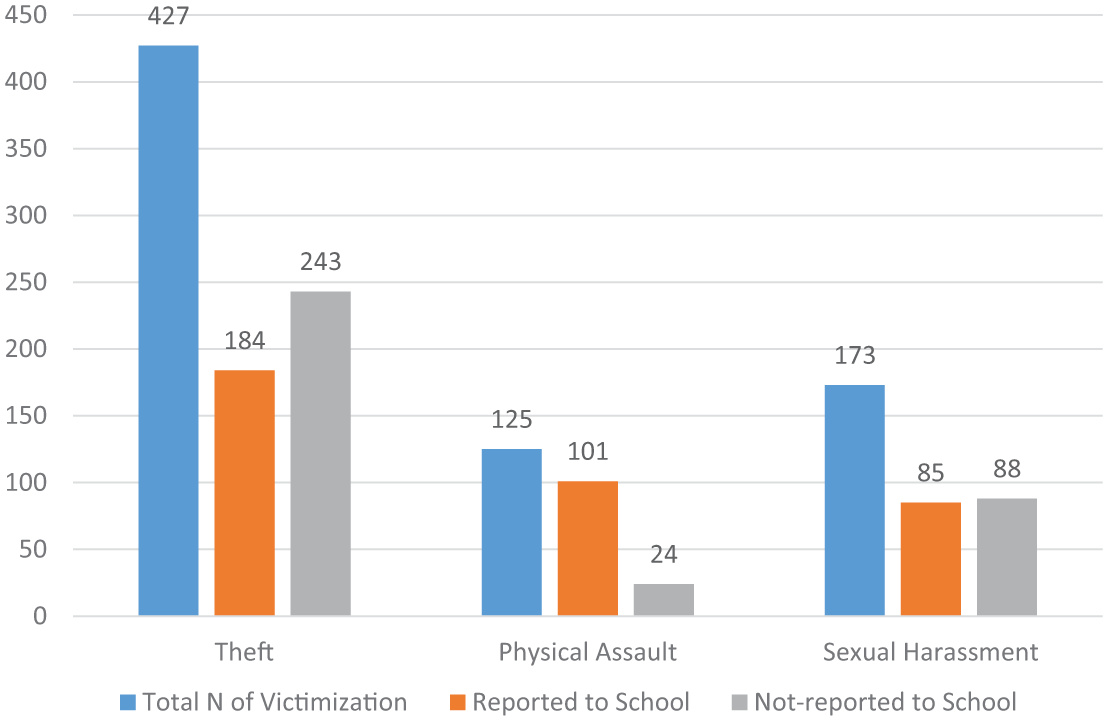
Teacher victimization by theft/property damage, physical assault, and sexual harassment and extent of reported and not-reported incidents to the school.
As can be seen in Table 1, 71% and 78% of victims of physical assault and sexual harassment cases which were reported to school were against female teachers, respectively. On average, teaching experience ranged from approximately 10 to 12 years for victims. Sixty percent of victims of theft were middle school teachers, and 69% of victims of sexual harassment were teachers at middle schools. For a number of offending students, 20%, 23%, and 26% of reported victimization of theft, physical assault, and sexual harassment, respectively, involved only one offender. Regarding school disciplinary action against offending students, 58% and 52% of victims of physical assault and sexual harassment, respectively, reported that their schools disciplined offending students. For offending students’ apology, 22%, 28%, and 27% of victims of theft, physical assault, and sexual harassment reported receiving apology from offending students, respectively.
Independent Variables for Victims of Theft, Physical Assault, and Sexual Harassment—Cases Reported to School.
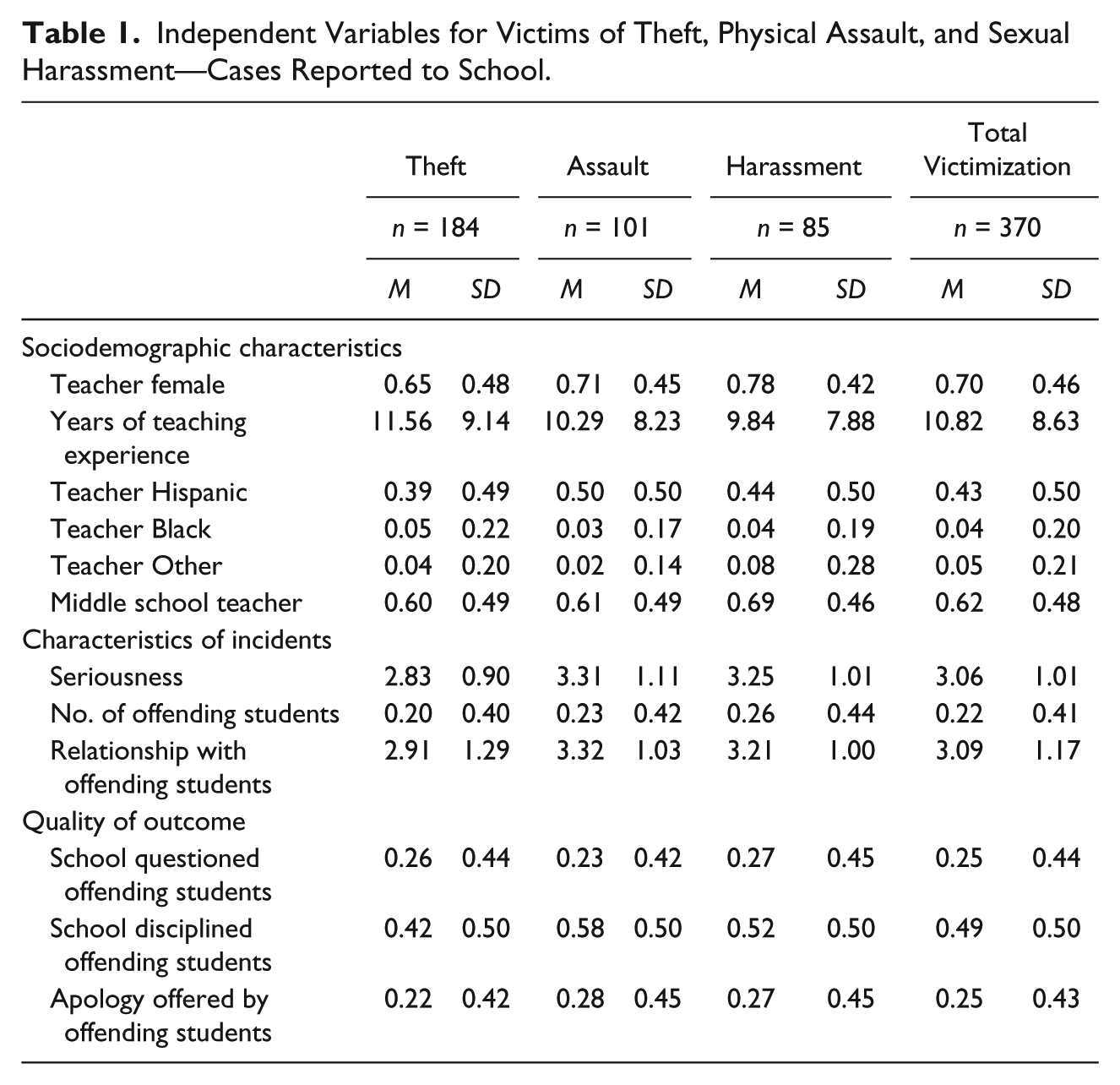
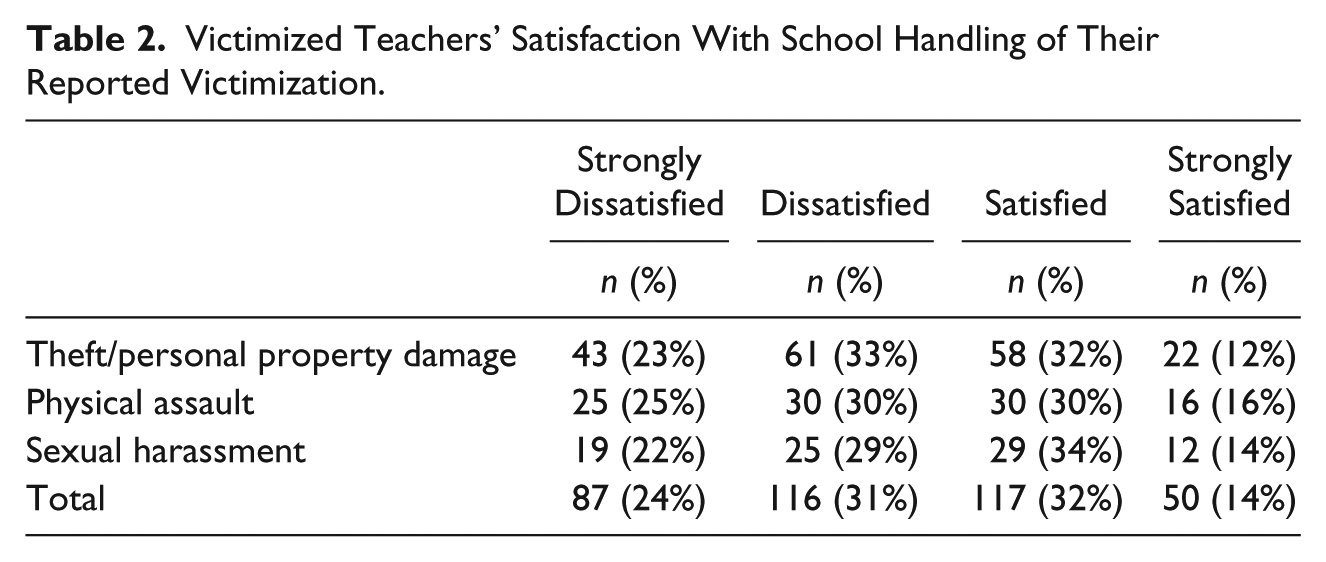
Table 2 shows the level of victimized teachers’ satisfaction with school interventions to address reported incidents. Twenty-five percent of victimized teachers were very dissatisfied, and 30% were dissatisfied with the school handling of their physical assault victimization incident. Forty-six percent reported that they were either satisfied or very satisfied with the school handling of their physical assault victimization incident. Similarly, approximately 50% of victims of sexual harassment and theft/property damage indicated that they were either strongly dissatisfied or dissatisfied with schools’ intervention into their victimization.
Victimized Teachers’ Satisfaction With School Handling of Their Reported Victimization.
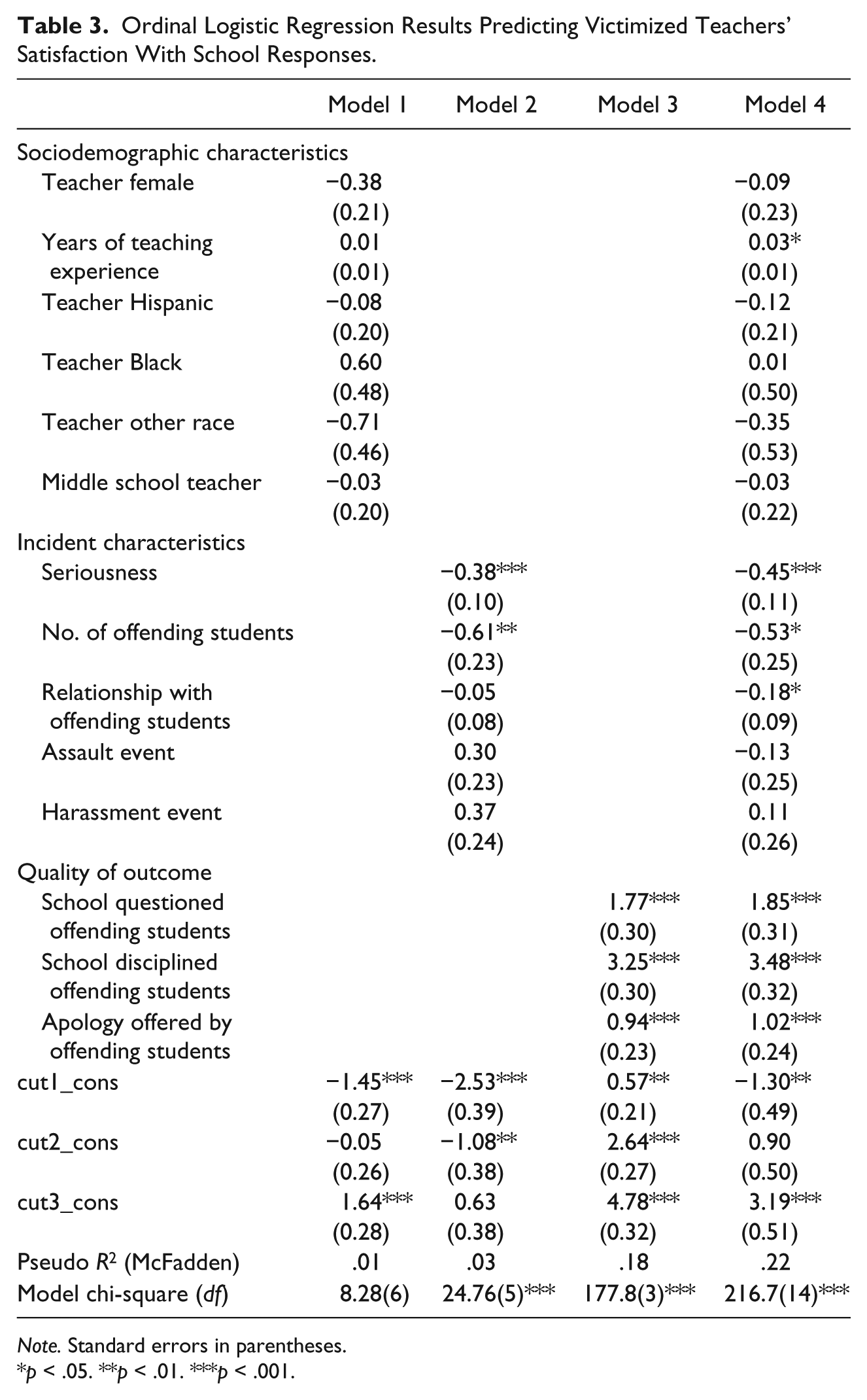
To identify the predictors of victimized teachers’ satisfaction with school intervention, a series of multiple regression analyses (see Table 3) were conducted. The dependent variable, satisfaction with school responses to victimization is measured with a four-category Likert-type scale ranging from lowest (1) to highest (4) satisfaction. Thus, the appropriate statistical analysis is ordinal logistic regression (Long, 1997). Table 3 presents the results of the ordinal logistic regressions that were estimated using in STATA 11.0. These models estimate the isolated impacts of three types of predictor variables, specifically sociodemographic (Model 1 in Table 3), incident (Model 2), and school response and perpetrator apology variables (Model 3). The final saturated model (Model 4) includes all of the predictor variables. It should be noted that the slope coefficients reported here are unstandardized. Below we convert them to odds ratios (ORs) for ease of interpretation (Long, 1997). Negative slope coefficients indicate that increases in the independent variable predict reduced satisfaction, whereas positive slope coefficients signify that increases in the independent variable predict increased satisfaction.
Ordinal Logistic Regression Results Predicting Victimized Teachers’ Satisfaction With School Responses.
Note. Standard errors in parentheses.
p < .05. **p < .01. ***p < .001.
Model 1 estimates the effects of demographic factors on satisfaction. Indicating that no slope was distinguishable from zero, this model had a poor fit (Model χ2 = 8.28, df = 6, p > .05). Model 2 tested the prediction of satisfaction from characteristics of the victimization incident, and it yielded an improvement in fit over chance (Model χ2 = 24.76, 5 df = 5, p < .05). However, the power of the model, as summarized by the McFadden’s pseudo R2 of .03, indicates nominal improvement. The slope estimates for seriousness of the victimization (b = –.38, p < .05) and the presence of more than one offender (b = –.61, p < .05) indicate that, holding constant the other predictors in the model, increases in these variables predict decreases in satisfaction that are statistically distinguishable from chance. The third model that tests the prediction of teacher satisfaction from the way reports of victimization were handled improved the model fit over chance (Model χ2 = 177.8, 3 df, p <.05). The pseudo R2 of .18 suggests that this is the strongest predictive domain among the three. Slope estimates for all three measures—school questioned student, school disciplined student, and student offered an apology—show substantial positive effects on respondents’ level of satisfaction with the handling of the victimization event.
The rightmost column in Table 3 presents the results from a full model estimating the contribution of all variables net of those in the other domains. This model has a substantial improvement over chance (Model χ2 = 216.7, 14 df, p <.05) and a moderate explanatory power demonstrated by the pseudo R2 of .22. The results suggest that, except for a slight effect of years of teaching experience (b = –.03, OR = 1.03), teacher characteristics do not significantly predict satisfaction. Holding constant all other variables, a 1-year increase in experience increases the odds of a unit increase in satisfaction by a factor of 1.03. With regard to the characteristics of the event, the statistics for seriousness of victimization (b = –.45, OR = .64) indicate that for every unit increase in seriousness, there is a .64 decrease in the odds of moving to a higher level of satisfaction. Findings for victimization by multiple offenders (b = –.53, OR = .59) suggest that the odds of an increase in satisfaction are .59 times smaller when compared with those reporting a single perpetrator. The nature of the teacher–perpetrator relationship has a similarly negative impact on teacher satisfaction (b = –.18, OR = .83), though the decrease in odds by a factor of .83 is slightly lower. Interestingly, type of victimization has no significant association with satisfaction that is distinguishable from chance variation. Regarding the relationship of school responses to satisfaction, the findings show substantial increases in odds across all three measures in this domain. Events addressed by school questioning of students (b = 1.85; OR = 6.3) or disciplining students (b = 3.48; OR = 32.4) as contrasted to schools doing nothing are associated with increased odds of higher levels of satisfaction by factors of 6.3 and 32.4, respectively. Whether students offered an apology (b = 1.02; OR = 2.77) also is related to increased odds of higher satisfaction by a factor of 2.77.
An advantage of ordinal logistic regression is that the production of changes in predicted probabilities can be estimated for comparison purposes (Long & Freese, 2006). For example, holding all variables constant at the mean, using model-based calculation, we find that the probability of self-reporting as very satisfied with the school response (score = 4) is 29% higher when the school disciplines the student and, under similar constraints of all else held constant, 21% higher if the school questioned a student. When a student offers an apology, holding all other variables constant at their means, the probability or reporting being very satisfied increases by 12%. In sum, consistent with research on victim satisfaction with criminal justice system responses, the response of the school and whether students apologize for their actions, as illustrated by the results from ordinal logistic regression analyses, have a powerful influence on satisfaction as we expected. Below we further discuss the implications of these findings for internal school processes and policies.
Discussion and Conclusion
For a representative sample of 1,628 middle and high school teachers in a large urban county, the present research investigated the extent to which teachers reported their victimization to school officials, victimized teachers’ satisfaction with school handling of their victimization, and predictors of victims’ satisfaction. We specifically focused on school responses (e.g., discipline an offending student) and on offending students’ apologies. The findings indicate that teachers who have been physically assaulted are almost 2 times as likely to report their victimization to school officials than teachers who experience theft or damage of personal property. Overall, the extent of reporting victimization to school officials by victimized teachers is quite high, considering that less than 50% of violent victimization (Truman & Morgan, 2016) were found to be reported to police. More research is needed to understand the factors affecting victimized teachers’ reporting decisions. One possibility that should be examined is that victimized teachers tend to report their victimization because they will have further contact with perpetrators, and thus they have a stake in deterring further incidents.
The findings revealed that slightly more than half of victimized teachers whose incidents were reported to school officials were either dissatisfied or very dissatisfied with school responses. These results are consistent with prior research (McMahon et al., 2017) that discovered that many victimized teachers disapproved of and were frustrated by school administrators’ responses to their victimization. These findings raise serious questions about the effectiveness of administrators’ responses to teacher victimization and administrative support of victimized teachers. Regarding the predictors of victimized teachers’ satisfaction with school responses, except for years of teaching experience, none of the sociodemographic factors were significantly related to victims’ satisfaction with school responses. Victimized teachers with longer teaching experience are more likely to report higher levels of satisfaction with school response to their victimization. Possibly more experienced teachers know how school administrations behave and therefore are better able to obtain administrative assistance.
Also, the findings show that victimized teachers’ satisfaction with school responses are significantly related to the severity of victimization, single versus multiple offending students, and teacher relationships with offending students. Victimized teachers were less likely to be satisfied with school handling of the incidents when victimization is more serious, multiple students are involved as perpetrators, and/or victimization is perpetrated by student(s) well known to victimized teachers. Regarding the school response, the study supported the hypotheses that victimized teachers are more likely to report satisfaction with school responses to incidents if offending students were questioned or disciplined, and/or apologized to them.
The results of the present research have several important policy implications for school administrators’ efforts to address teacher-directed violence and victimization. First, school officials’ inaction in responding to and investigating teacher-directed violence by students is a serious issue, as approximately one-fourth of victimized teachers who reported an incident indicated that administrators did not undertake any investigation. More than half of victimized teachers also indicated that school administrators did not properly handle, intervene in, and resolve the incidents. The results are consistent with a prior study (McMahon et al., 2017) which found that victimized teachers’ perceptions of administrators’ inaction, indifference, and inadequate intervention was one of the most upsetting aspects of victimization experiences, resulting in teachers’ feelings of powerlessness, their repeat victimization, and/or job turnover. These initial findings indicate the importance of administrators’ active intervention and support in response to teacher victimization. They also signal that further research is necessary to better understand how school administrators respond to and intervene in teacher victimization, and the effectiveness of different approaches.
Second, the results suggest that victimized teachers who report to school officials expect offending students to be disciplined and held accountable, and when this does not occur, they are dissatisfied. Though there is a heated debate on the effectiveness and fairness of schools’ disciplinary practices in response to students’ disruptive and aggressive behaviors, limited empirical findings regarding teacher victimization (Berg & Cornell, 2016; Huang et al., 2017) show that teachers in authoritative schools with effective disciplinary structures and administrative support are less likely to be victimized by students. For example, Huang et al. (2017) found that teachers in schools that enforce school rules and disciplinary practices with fairness and strictness reported less physical assault. However, other empirical studies (see Lewis, 2001; Sugai & Horner, 2006) indicate that exclusive use of discipline of disruptive and aggressive students can temporarily reduce students’ aggressive behaviors at school but does not fully address the problem and may have unexpected negative consequences, such as the students’ anger and blame directed at teachers and more generally the school. These results indicate that to prevent teacher victimization, it is important for administrators to take consistent and effective disciplinary actions following an incident of teacher-directed violence (Huang et al., 2017).
Third, there is some evidence that supports the use of a school-based reconciliation program consistent with restorative justice models based on mediation between victimized teachers and offending students. Though more study of restorative justice applications to student–teacher victimization is needed, at least the apology aspect of mediation seems to have some support as satisfying to victimized teachers. Victimized teachers who received an apology directly from an offending student may regain a sense of control, authority, and security at school, and consequently they report higher levels of satisfaction.
There are several study limitations that should be considered. First, the present research sample included a relatively high proportion of Hispanic teachers in a metropolitan area located in one region of the United States; so generalization of findings is limited. Second, no measures of procedural justice such as fair and honest treatment and ethical conduct without biases by school administrators were included. As prior empirical studies (see Elliott, Thomas, & Ogloff, 2011; Wemmers & Cousineau, 2005) found significant effects of various dimensions of procedural justice on crime victims’ satisfaction with the criminal justice system (e.g., police, prosecution, and court), future research should measure various aspects of procedural justice and investigate their effects on victimized teachers’ satisfaction with school intervention. Third, the present research focused on an apology from offending students and its effects on victim satisfaction with school responses, but prior research (see Dhami, 2012) indicates that the diverse nature of apologies, such as victims’ acceptance of an apology and forgiveness and certain conditions under which an apology is offered and accepted, is significantly related to victims’ satisfaction with mediation outcomes. Future research should be designed to measure the dimensions of apologies to better understand their unique impacts on victims’ satisfaction in the context of teacher-directed violence. Also, the present research did not fully consider restorative justice or mediation models, which have more dimensions than encouragement of apologies. Specific elements of restorative justice programs and policies may have unique effects on satisfaction with how teacher victimization is handled. Although the finding about apologies is suggestive, it is important not to over generalize this finding to diverse and complex restorative justice and mediation approaches that might be used to address student victimization of teachers. Future research needs to investigate multiple elements of restorative justice and mediation models that might be related to teacher and student outcomes after a teacher victimization. The outcomes considered should be expanded beyond teacher satisfaction to teachers’ emotional distress after victimization, and both short- and long-term effects on students (Moon et al., 2015). Finally, we examined teacher-directed violence and school interventions from victimized teachers’ perspectives; further research is necessary to explore teacher victimization from multiple perspectives including those of administrators and students (see McMahon et al., 2017).
Overall, the present research contributes to the extant literature on teacher-directed violence by investigating the extent of teacher victimization reported to school officials, victimized teachers’ satisfaction with school interventions, and predictors of victimized teachers’ satisfaction with school intervention. This research found that a large number of victimized teachers perceived school intervention following incidents as ineffective and inadequate, indicating the urgent need for school administrators to review their current disciplinary policies regarding teacher-directed violence and to establish effective protocols to prevent and properly respond to teacher victimization (McMahon et al., 2017). Longitudinal research is necessary to even better understand causal sequences of teacher victimization, school responses, and teacher safety/persistent victimization, as little is known about the relationship between schools’ disciplinary interventions following teacher victimization and their consequent effects on students or on teacher safety and revictimization.
Footnotes
Declaration of Conflicting Interests
The author(s) declared no potential conflicts of interest with respect to the research, authorship, and/or publication of this article.
Funding
The author(s) disclosed receipt of the following financial support for the research, authorship, and/or publication of this article: This project was supported by Award No. 2015-CK-BX-0019, awarded by the National Institute of Justice, Office of Justice Programs, U.S. Department of Justice. The opinions, findings, and conclusions or recommendations expressed in this publication/program/exhibition are those of the author(s) and do not necessarily reflect those of the Department of Justice.