







Abstract
Understanding and addressing violence among intimate partners requires sound assessment of their communication patterns. In prior research, the 35-item, self-report Communication Patterns Questionnaire (CPQ) has been used to assess communication patterns in violent relationships. To date, psychometric analysis of the CPQ has been examined only among nonviolent couples; no studies have examined the psychometric properties of this measure in a sample of survivors of intimate partner violence (IPV). Using confirmatory factor analysis, the present study evaluated the factor structure of the CPQ in a sample of women survivors of IPV who sought mental health assessments at a university research clinic. Analyses suggested that a modified three-factor solution (constructive communication [CC], self-demand/partner withdraw [SDPW], partner demand/self-withdraw [PDSW]) provided good fit in our sample. Internal consistency estimates for each of the modified scales were acceptable and exceeded reported coefficients in prior IPV studies. Significant bivariate correlations among modified scales, and between communication patterns and aggressive behaviors, provided initial validity evidence for the CPQ scales in our sample. We found CC to be negatively associated with partner psychological aggression, PDSW to be positively associated with all forms of partner aggression and respondent psychological aggression, and SDPW to be positively associated with respondent physical and psychological aggression. The results of this study indicate that the CPQ may be an appropriate measure for assessing communication patterns in violent relationships; however, modified scoring procedures should be used. We contextualize our results within existing models of IPV and address clinical, cultural, and contextual issues in communication patterns assessment.
Understanding and addressing violence among intimate partners requires sound assessment of their communication patterns. Communication patterns have descriptive value, predict relational functioning, and are determinants of individual well-being (Pickover et al., 2017; Schrodt, Witt, & Shimkowski, 2014). They also have been identified as targets and outcome measures in interventions, which aim to reduce intimate partner violence (IPV; Antle et al., 2013). Unfortunately, despite their relevance, no research has specifically examined the latent structure of communication patterns, nor the psychometric properties of communication measures, in violent couples. Rather, psychometric analysis of communication measures has relied on samples of intact, heterosexual, happy, or relationally distressed dyads not seeking treatment and without a history of IPV (Futris, Campbell, Nielsen, & Burwell, 2010; Noller & White, 1990). Only recently have investigators evaluated the reliability and validity of one of the most widely used assessments of communication patterns, the Communication Patterns Questionnaire (CPQ; Christensen & Sullaway, 1984), in relationally distressed, treatment-engaged clinical samples (Crenshaw, Christensen, Baucom, Epstein, & Baucom, 2017). The current article extends the literature by examining the organization of communication in the context of IPV. To do so, we evaluate the factor structure of the CPQ among a sample of help-seeking women who have experienced violence within a terminated intimate relationship.
Communication Patterns Questionnaire
The CPQ assesses partners’ use of 11 mutual symmetric communication patterns (e.g., mutual discussion, mutual avoidance) and 24 asymmetric communication patterns (e.g., demand/withdraw, discuss/avoid) at the onset of, during, and after relational conflict. Symmetric patterns include mutual constructive processes, wherein partners discuss and solve problems collaboratively, and mutual destructive processes, wherein partners avoid, withhold, and withdraw. Asymmetric patterns reflect processes in which one partner seeks change but is met by the other with avoidance, withdrawal, or defensiveness (i.e., demand/withdraw communication; Crenshaw et al., 2017). Most researchers have derived CPQ scales conceptually, following Christensen (1988), who grouped five items assessing mutual discussion, understanding, and problem solving (mutual constructive communication [CC]) and six items assessing demand/withdraw (demand/withdraw communication) (see also Noller & White, 1990). Cross-cultural studies have demonstrated moderate interpartner agreement on these conceptual scales and concurrent and longitudinal associations between CPQ scales and relationship satisfaction (Christensen, Eldridge, Catta-Preta, Lim, & Santagata, 2006; Donato, Parise, Pagani, Bertoni, & Iafrate, 2014). However, internal consistency coefficients for these scales vary across studies (Crenshaw et al., 2017; Futris et al., 2010), raising reliability concerns.
Recently, Crenshaw et al. (2017) evaluated the CPQ’s factor structure in a sample of heterosexual married couples participating in a randomized clinical trial of couple therapies. Exploratory factor analysis yielded a three-factor solution resembling the commonly used, conceptually derived scales: CC (nine items), self-demand/partner withdraw (SDPW; seven items), and partner demand/self-withdraw (PDSW; seven items). Confirmatory factor analyses (CFAs) yielded support for the three-factor structure in a large community sample and a sample of 85 marital therapy-seeking couples. In a separate sample of 52 divorcing couples, support was equivocal. It is unclear whether poor fit resulted from the small sample size, or whether a different latent structure underlies CPQ-assessed communication patterns in terminated relationships.
Communication Patterns in Violent Relationships
Absent appropriate psychometric support, the CPQ has been used in studies of violent couples and produced noteworthy outcomes. Particular interest has followed the finding that CPQ-assessed husband demand/wife withdraw communication uniquely characterizes violent couples’ communication patterns, whereas wife demand/husband withdraw communication does not differ between violent couples and distressed nonviolent couples (Babcock, Waltz, Jacobson, & Gottman, 1993; Holtzworth-Munroe, Smutzler, & Stuart, 1998; Study 1). It is thought that this pattern may represent a fundamental process underlying relational violence (Allison, Bartholomew, Mayseless, & Dutton, 2007; Babcock et al., 1993; Fournier, Brassard, & Shaver, 2010). Perhaps due to differences in scoring and reliability estimates, however, associations between husband demand/wife withdraw and specific forms of violence have differed among studies (Babcock et al., 1993; Fournier et al., 2010; Pickover et al., 2017); thus, it is difficult to synthesize results across studies and draw clear clinical conclusions.
Other findings on communication patterns among violent partners indicate that relative to nonviolent men, male perpetrators in heterosexual relationships report higher levels of SDPW, PDSW, verbal aggression, and mutual destructive processes, and lower levels of CC and mutual problem solving (Feldman & Ridley, 2000). Relative to nonviolent women, women who endorse relational aggression report more unilateral and mutual verbal aggression, mutual avoidance, and PDSW, and are more likely to try and calm things down when their partners are verbally aggressive (Ridley & Feldman, 2003). What remains unresolved by these group comparisons is whether the clustering, function, and effects of communication patterns differ when violence has occurred in the relationship versus when it has not. Factor analysis is one analytic approach that can begin to address these nuances, and analyses that address reliability and validity can increase confidence in the findings of this research domain.
Present Study
In the present study, we examined empirically the factor structure of the CPQ in a sample of women survivors of IPV seeking a mental health evaluation. Using CFA, we tested the fit of the CPQ factor structure proposed by Crenshaw et al. (2017) in our IPV-exposed sample. Given evidence of adequate fit following the removal of several items with low factor loadings (FLs), we report the internal consistency coefficients for each of the modified scales as an initial index of their reliability among women seeking help in the aftermath of IPV. Finally, we report on the bivariate associations between these scales and continuous measures of physically, sexually, and psychologically aggressive behaviors that commonly occur in violent relationships.
Our rationale for focus on survivors of violence is threefold. First, these women are at high risk of revictimization, and the way in which survivors respond to abusive partners’ anger in the past has been shown to prospectively predict risk of revictimization (Kuijpers, van der Knaap, & Winkel, 2012). As such, assessment of communication patterns may help identify women who are particularly vulnerable. Second, recent work shows links between distinct forms of IPV, communication patterns, and survivors’ psychological outcomes (Pickover et al., 2017). Psychometrically sound measurement of communication patterns in survivors is essential to advance such interpersonal conceptions of IPV-related psychopathology. Third, the function of communication patterns may be context-dependent. For instance, withdrawing in violent relationships may de-escalate conflict and reduce risk of injury (Byrne, Carr, & Clark, 2004), but absent violence, it may leave partners feeling misunderstood and less satisfied with the relationship (Weger, 2005). If true, helping survivors recognize such differences might facilitate the development of healthy, fulfilling future relationships. Should they find themselves in new, nonviolent relationships, embracing new roles in conflict (e.g., making requests for change) might foster survivors’ sense of agency. Thus, reliable assessment of communication patterns in survivors could be of great clinical utility.
Materials and Methods
Participants and Procedure
Participants were 157 women survivors of IPV who sought mental health assessments at a university research clinic. Participants were recruited through public service and research announcements distributed in advocacy centers, churches, and college campuses. Women qualified for the study if they experienced physical, sexual, or psychological IPV consistent with the Centers for Disease Control and Prevention’s (CDC) definitions (Breiding, Basile, Smith, Black, & Mahendra, 2015) and were no longer involved or living with their abusive partners. History of IPV exposure was assessed via clinical interview. The overwhelming majority of women reported on male abusive partners (i.e., heterosexual, not same-sex, relationships). Exclusion criteria included endorsed psychotic symptoms (n = 8), unreliable responding (n = 8), high distress impairing study completion (n = 1), and low cognitive functioning (n = 7). Two women who did not report relationships characterized by IPV per the CDC’s definition also were excluded. In considering the challenges of recalling conflict patterns after an extended period of time, we also excluded five women who reported on romantic relationships that ended more than 20 years ago.
Participants ranged in age from 18 to 70 years (M = 36.17, SD = 11.48); 52% of participants had separated from their abusive partners in the past year (median = 12.00 months since separation, interquartile range [IQR] = 3.00-36.00 months). On average, participants’ most recent abusive relationship lasted for 7.6 years, and 55% of participants reported multiple abusive relationships (M = 2.04, SD = 1.21, range = 1-7). As determined in the clinical interviews, most women experienced multiple types of IPV exposure; half experienced physical, sexual, and psychological IPV, and another 30% experienced physical and psychological IPV. Sample characteristics are reported in Table 1.
Sample Demographics.
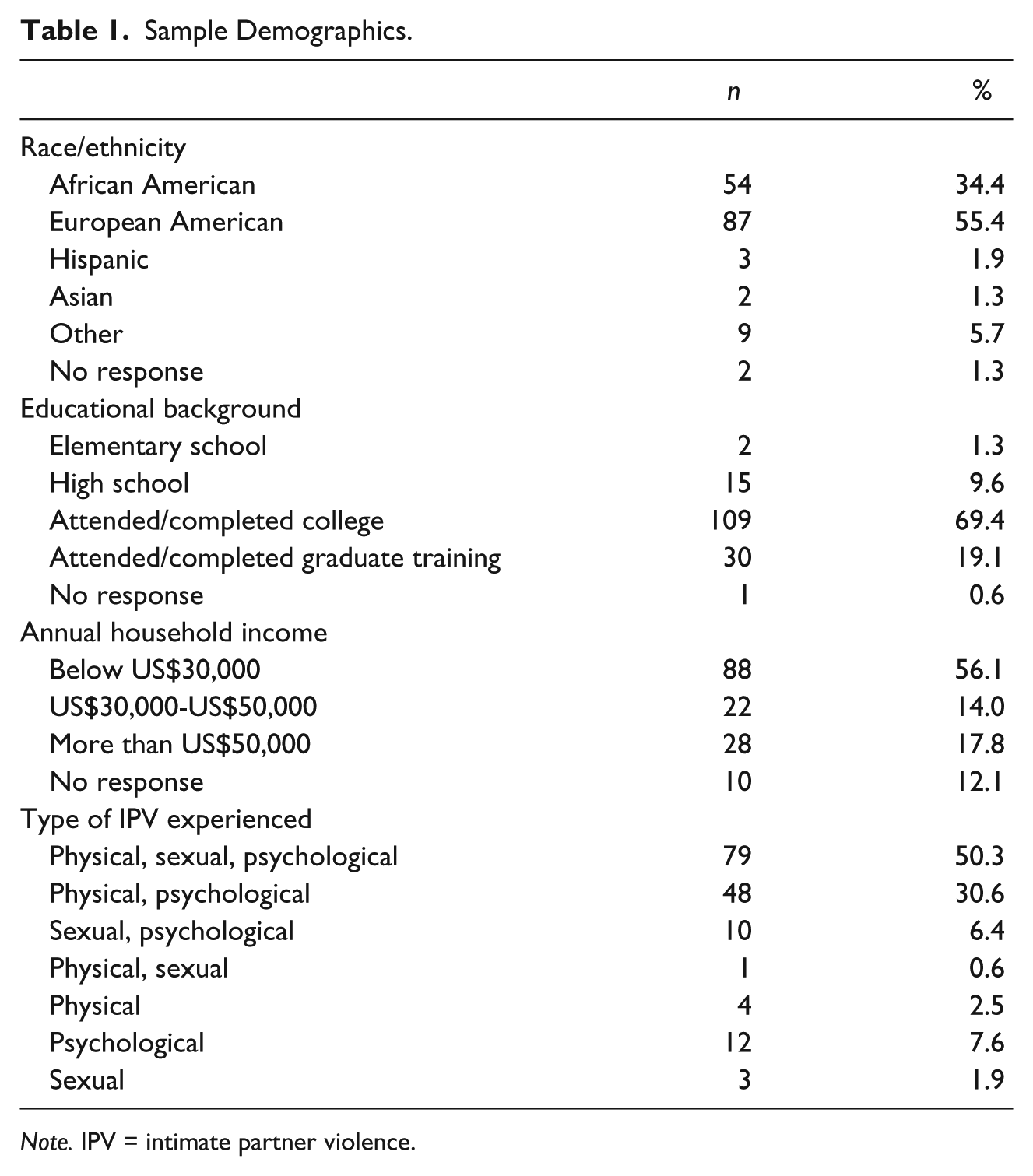
Note. IPV = intimate partner violence.
All study procedures were approved by the university’s Institutional Review Board prior to the administration of protocol. Upon arrival, participants were verbally informed of the study’s purpose, risks, benefits, and pertinent study details. Written consent was provided prior to completing the assessment battery. During postassessment feedback sessions, as needed, recommendations and referrals were provided.
Measures
Exposure to IPV was assessed using a semistructured interview developed by the last author. The interview is modeled after a similar interview for motor vehicle accident survivors (Blanchard & Hickling, 2004) and assesses IPV experienced, gender of the abuser(s), time since separation from the most recent abuser, and status of the relationship (ongoing or separated/divorced). The interview was administered by trained clinicians.
The CPQ assesses 35 communication patterns that partners use when problems arise, during, and after discussion of problems. Participants completed the CPQ with reference to their most abusive intimate partner. The CPQ uses a 9-point Likert-type scale; items are summed, and higher scores indicate more frequent use of communication patterns. Internal consistency coefficients for empirically derived CPQ scales have ranged from .62 to .88 (Crenshaw et al., 2017; Noller & White, 1990). Moderate associations have been found between wife and husband scores on Husband Demand/Wife Withdraw (r = .39) and Wife Demand/Husband Withdraw (r = .54) scales (Babcock et al., 1993).
Severity of exposure to physically, sexually, and psychologically aggressive behavior was assessed with the Conflict Tactics Scale–Revised Version (CTS-2; Straus, Hamby, Boney-McCoy, & Sugarman, 1996) 1 and the Psychological Maltreatment of Women Inventory–Short Form (PMWI-SF; Tolman, 1999). On both measures, participants responded with reference to their most abusive relationship. The CTS-2 includes a 12-item Partner Physical Aggression subscale and a seven-item Partner Sexual Coercion subscale. Response options range from 0 (this has never happened) to 6 (more than 20 times in the past year) or 7 (not in the past year, but it did happen before). Scores are collapsed to reflect never happened (0) or ever happened (1) and summed. Reliability estimates for the partner physical and sexual IPV exposure scales in this study were good (αs = .89 and .85). The PMWI-SF measures partner psychological aggression and includes two seven-item subscales, an Emotional-Verbal subscale (verbal attacks, emotional withholding) and a Dominance-Isolation subscale (isolation from resources, demands for obedience, rigid adherence to sex-stereotyped roles). Response options range from 1 (never) to 5 (very frequently) or not applicable (0). Item scores are summed; higher scores indicate more frequent and severe aggression. Reliability estimates for the Emotional-Verbal and Dominance-Isolation subscales in this study were excellent (αs = .94 and .90).
Participants’ use of physically and psychologically aggressive behavior was assessed with the CTS-2’s 12-item Respondent Physical Aggression subscale and the eight-item Respondent Psychological Aggression subscale, respectively (the PMWI-SF, our measure of psychological aggression in partners, does not assess respondent use of such behaviors). Obtained reliability estimates were acceptable (α = .76). The Respondent Sexual Coercion subscale was administered to assess participants’ sexually aggressive behaviors, but such behavior was infrequently endorsed and is not reported on in this article.
Results
Using IBM SPSS Statistics v23 (IBM Corporation, 2015), data were inspected for univariate and multivariate outliers, skew, and kurtosis. Eight univariate outliers (values ±3.29 SDs from the mean) and three multivariate outliers (identified using Mahalanobis distance and a significance threshold of p < .001; Tabachnick & Fidell, 2013) were removed prior to the main analyses. Item response distributions for all CPQ items were nonnormal. Normality is not a necessary precondition for factor analysis (Tabachnick & Fidell, 2013) as alternative analytic approaches can address nonnormal distributions.
CFA of Crenshaw et al.’s (2017) CPQ factor structure was performed with Mplus v7.4 (Muthen & Muthen, 2015) using maximum likelihood estimation with robust standard errors given nonnormal item response distributions. Per Kline’s (2011) recommendations, the following fit indices were considered: chi-square test of model fit, Steiger–Lind root mean square error of approximation (RMSEA), Bentler comparative fit index (CFI), and standardized root mean square residual (SRMR). Lower model chi-square values indicate better model fit. RMSEA values between .06 and .08, CFI values >.90, and SRMR values ≤.08 indicate good fit (Hu & Bentler, 1999; Schreiber, Nora, Stage, Barlow, & King, 2006). Results of the first CFA indicated poor model fit, model χ2(227) = 504.61, p < .001; RMSEA = .09, 95% confidence interval (CI) = [0.08, 0.10], p < .001; CFI = .64; SRMR = .11. Item-level data revealed six items with FLs less than a common criterion of ǀ.32ǀ (Tabachnick & Fidell, 2013): mutual avoidance, mutual withdrawal, mutual withholding (CC); threat/back down (SDPW); and discuss/avoid, demand/withdraw (PDSW). After removing these items, fit statistics largely indicated good fit of the modified three-factor structure to the data: model χ2(116) = 229.60, p < .001; RMSEA = .08, 95% CI = [0.06, 0.09], p < .001; CFI = .81 (poor); SRMR = .08. Removal of pressure for apology/resist (PDSW, FL = .31) yielded almost identical fit statistics and a model in which all FLs exceeded ǀ.32ǀ (Table 2); 13 of the 16 retained items’ FLs exceeded ǀ.55ǀ, indicating these variables were good to excellent measures of their factors (Comrey & Lee, 1992).
Items and Factor Loadings.
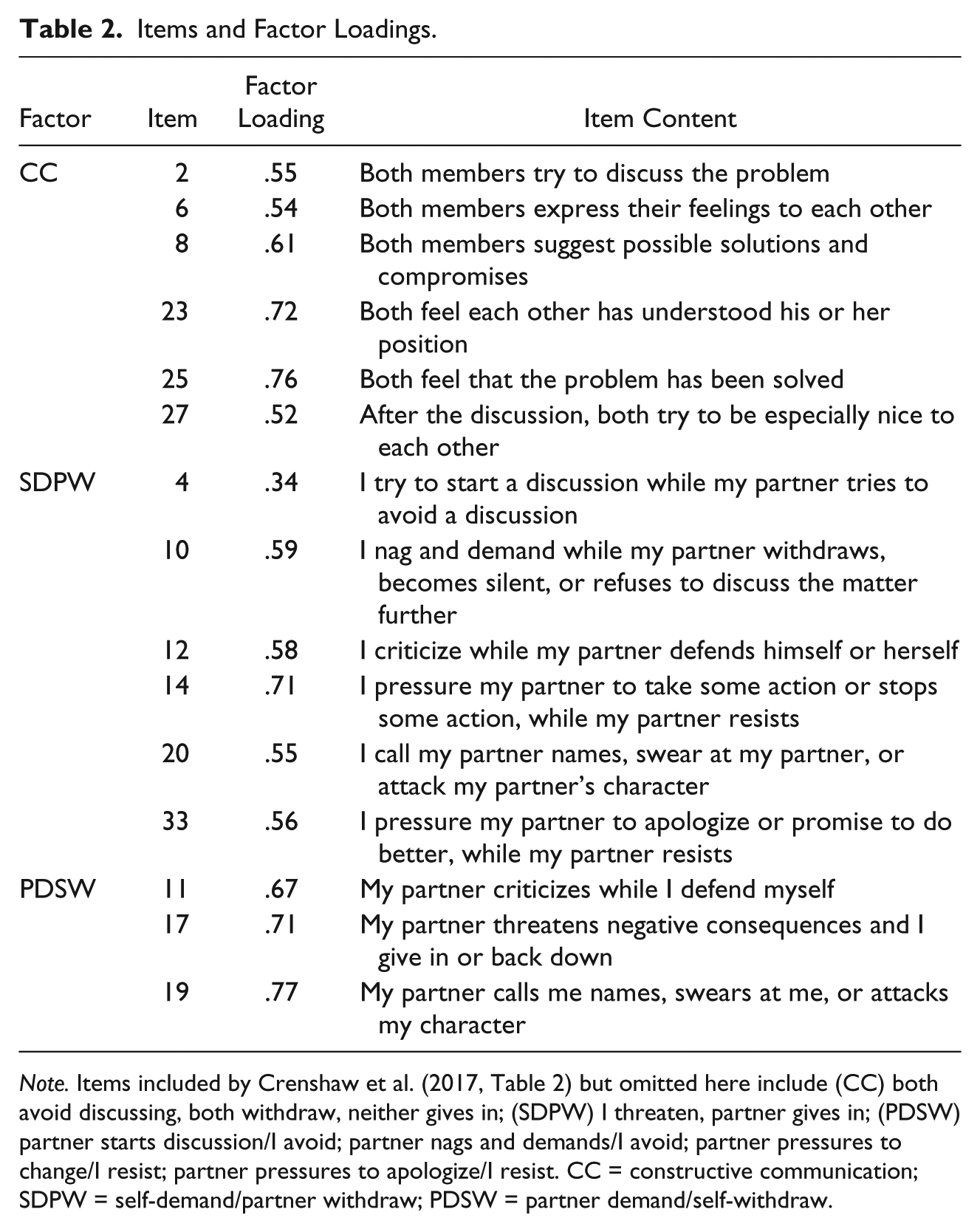
Note. Items included by Crenshaw et al. (2017, Table 2) but omitted here include (CC) both avoid discussing, both withdraw, neither gives in; (SDPW) I threaten, partner gives in; (PDSW) partner starts discussion/I avoid; partner nags and demands/I avoid; partner pressures to change/I resist; partner pressures to apologize/I resist. CC = constructive communication; SDPW = self-demand/partner withdraw; PDSW = partner demand/self-withdraw.
Internal consistency coefficients for the modified CC, PDSW, and SDPW scales were found to be adequate (α = .78, α = .70, and α = .73, respectively; Kline, 2011). Item-total statistics suggested that removal of pressure for action/resist from the PDSW scale would improve its internal consistency (α = .76). The three-item PDSW scale was used in all subsequent analyses.
Descriptive statistics and bivariate analyses are presented in Table 3. CC required a square root transformation due to positive skew. Transformations did not improve skewness and kurtosis values for PDSW and SDPW. PDSW was negatively associated with CC and positively associated with SDPW.
Descriptive Statistics and Bivariate Analyses.
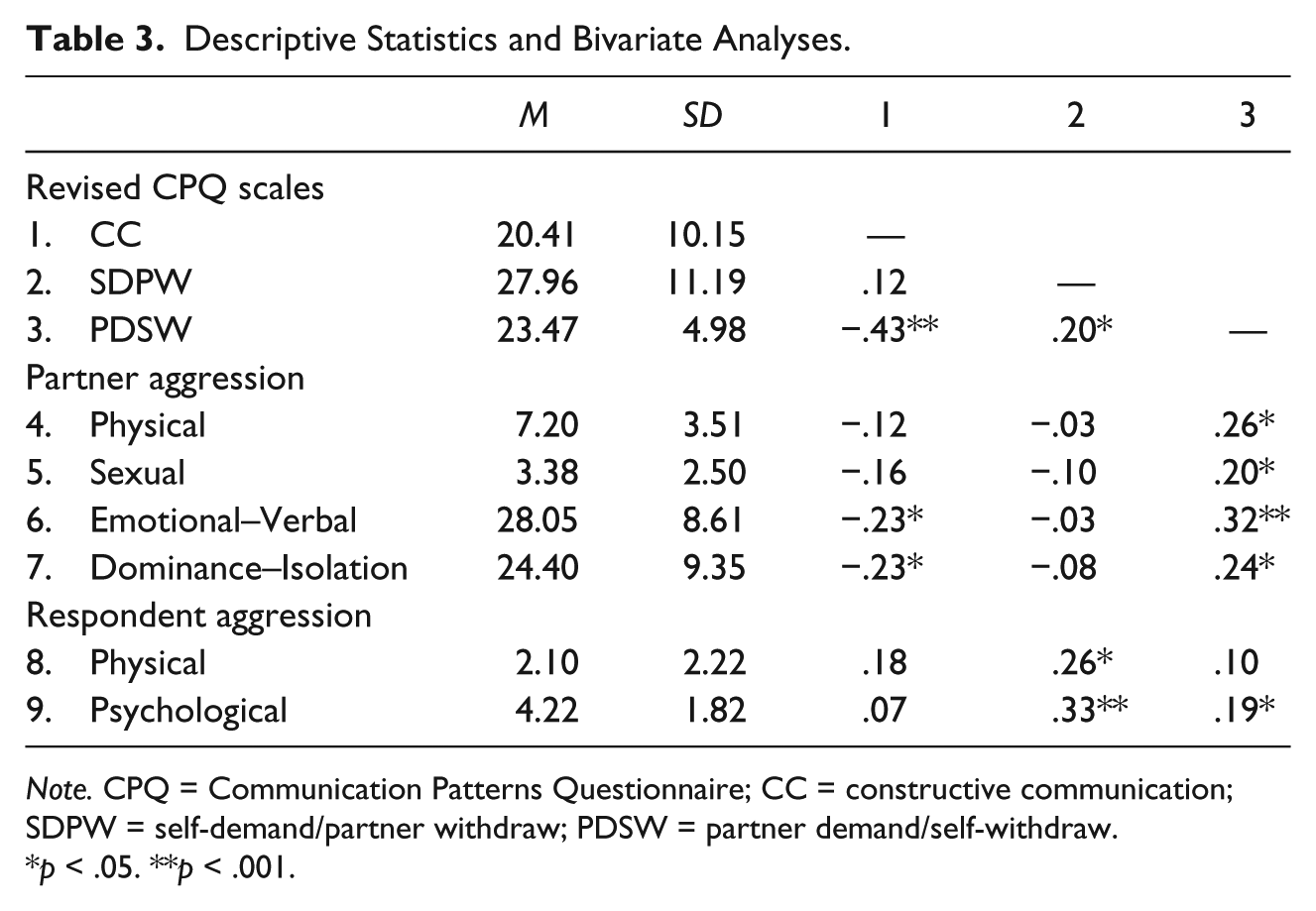
Note. CPQ = Communication Patterns Questionnaire; CC = constructive communication; SDPW = self-demand/partner withdraw; PDSW = partner demand/self-withdraw.
p < .05. **p < .001.
Correcting for nonnormal distribution, the Respondent Physical Aggression subscale was square root transformed. CC was negatively associated with partner psychological aggression (emotional-verbal and dominance-isolation). PDSW was positively associated with all forms of partner aggression and respondent psychological aggression. SDPW was positively associated with respondent physical and psychological aggression.
Discussion
Findings from the present study, which is the first to examine the factor structure of the CPQ in a sample of women IPV survivors, suggest that previously derived factor solutions in studies of happy nonviolent or relationally distressed couples do not replicate exactly in a sample of violence-exposed women. However, with several modifications, a three-factor structure did evidence good fit. Modified scales yielded internal consistency estimates in the adequate range, exceeding those reported for CPQ scales in prior IPV studies (Pickover et al., 2017). Communication patterns were correlated with one another and with aggressive behaviors, on the part of respondents and their partners. Our findings provide preliminary support for a modified three-factor CPQ structure and for the reliability and validity of CPQ-assessed communication patterns among women IPV survivors.
Our CC scale overlapped somewhat with Crenshaw et al.’s (2017) CC scale given the inclusion of mutual CC patterns. However, in Crenshaw et al., mutual destructive communication patterns also loaded negatively on CC. Those patterns did not load significantly on our CC scale. As factors are distinguished by the underlying constructs they represent, it appears that distinct constructs may underlie mutual constructive and mutual destructive communication patterns in violent relationships.
In this and other IPV studies (e.g., Ridley & Feldman, 2003), CC was infrequently used. CC was negatively associated with PDSW, the prototypic conflict pattern in violent relationships (Babcock et al., 1993), and partner psychological aggression. These associations converge with reports that bilateral difficulty with CC and unresolved conflict can result in significant distress, irritation, demanding, nagging, and violence (Finkel & Eckhardt, 2013; Ridley & Feldman, 2003), eroding the willingness or ability of partners to engage in subsequent constructive conflict resolution (Feldman & Ridley, 2000). This cycle can perpetuate conflict, and perhaps, emotional-verbal and dominance-isolation IPV in particular. Thus, our findings provide evidence of the validity of our modified CC scale and demonstrate increased specificity in the link between CC and types of aggression.
Only a small subset of the items included in Crenshaw et al.’s PDSW were retained in our version of this scale. Those items included patterns in which women actively defended themselves in response to criticism or gave in to their partner’s actions; items that indicated overt (“I resist”) or passive (e.g., avoid, withdraw) resistance were excluded. Evidently, among abused women, actively defending against and giving into demands are not mutually exclusive. The coexistence of these behaviors may represent women’s strategic efforts to secure their safety and autonomy under the threat of violence (Powers & Simpson, 2012). They engage in reparative behaviors to soothe or reduce their partners’ hostility when conflict occurs (Cornelius, Shorey, & Beebe, 2010), and even women who engage in extreme violence against men try to act calmly and listen to their partners when they become verbally aggressive (Feldman & Ridley, 2000). Thus, the observed loading of seemingly disparate responses on the same factor is consistent with a larger body of research that highlights the complexity of interpersonal conflict in violent relationships.
Our SDPW scale more closely resembled that of Crenshaw et al.’s. However, one item (threat/back down) did not load significantly on this scale in our study. This is the only item from the SDPW scale in which the partner backs down or gives in to demands. Thus, in all retained items for this scale, the partner response indicates either active (e.g., refusal) or passive (e.g., avoid, become silent) resistance to the abused woman’s demands, criticisms, and attempts at discussion.
Crenshaw et al.’s SDPW and PDSW scales mirrored one another in their item content. In contrast, although some complementary items remain on the two scales in the current study, there are a number of differences. For example, the complement of the discuss/avoid pattern is omitted from the PDSW scale, and the complement of the threat/back down pattern is omitted from the SDPW scale. It seems that at least in the context of heterosexual abusive relationships, different demand/withdraw patterns are enacted based on who is in the role of “the demander” versus “the withdrawer.” Overall, women in our study approached change with a broader set of actions than their partners and more consistently were met with resistance.
Per traditional theories of marital relationships and power (Cromwell & Olsen, 1975), those who demand change are less powerful than those who wish to maintain the status quo (e.g., withdraw). High levels of demand/withdraw in abusive relationships indicate dyadic struggles for power. Babcock et al. (1993) first noted elevated levels of both demand/withdraw patterns in violent couples, but higher levels of husband demand/wife withdraw in violent versus nonviolent distressed couples. Wife demand/husband withdraw, widely regarded as the prototypic pattern in distressed couples (Eldridge, Sevier, Jones, Atkins, & Christensen, 2007), was similarly elevated in violent and nonviolent distressed couples, relative to happy nondistressed couples. Babcock et al. emphasized the uniqueness of husband demand/wife withdraw to violent couples, postulating that abusive men use violence to assert relational control. In other words, during conflict, abusive men experience powerlessness when their demands are met with withdrawal, and they subsequently engage in violence as a retaliatory behavior to regain control. Elevated PDSW scores and associations between PDSW and SDPW in the current study align with such research. Yet, it is challenging to contextualize all our results within traditional frameworks. PDSW was associated with exposure to more severe physical, sexual, and psychological aggression, but not all retained PDSW items captured a withdrawal pattern or response that maintains the status quo. Furthermore, SDPW was associated with respondent physical and psychological aggression, suggesting that women too may use violence, either defensively or to assert relational control. Finally, our participants reported far less SDPW than PDSW, whereas Babcock et al. (1993) reported similar rates of use of these patterns in violent relationships. In sum, power-based explanations of IPV deserve further inquiry, particularly in light of shifting societal expectations regarding egalitarian gender roles.
Situational/interpersonal models of IPV emphasize dyadic affective-behavioral patterns and suggest that IPV follows from specific communication patterns that promote conflict and relationship dissatisfaction (Finkel & Eckhardt, 2013). As issues go unresolved, and conflict becomes more hostile, both partners become increasingly agitated, resorting to extreme behaviors (Feldman & Ridley, 2000). Violence might be used to force desired outcomes, or as an arousal-reducing mechanism, particularly when partners lack adequate conflict resolution skills or emotion regulation strategies (Cornelius et al., 2010). By inhibiting conflict resolution, bilateral demand/withdraw may result in and characterize cyclical, serial arguments that foster aversive cognitive and emotional responses, increasing risk of violence (Malis & Roloff, 2006). Our findings and others’ suggest that the presence and type of violence perpetrated or experienced depends on demand/withdraw roles, gender, and level of relational distress. Our findings also underscore the importance of better understanding SDPW in violent relationships, looking beyond effects on relational distress to consider implications for women’s aggression.
Most extant research has examined communication among intact couples to inform relational interventions. However, it is important that researchers and clinicians understand the communication patterns of women exposed to IPV, even when the relationship has ended. Communication patterns have been linked to fairly stable psychological processes such as attachment styles (Schrodt et al., 2014), which influence relationships across the life span (Fraley, 2002). Assessment of IPV survivors’ communication patterns could inform conflict modification in relationships with other attachment figures. Communication patterns are also linked to shame, guilt, and psychological symptomatology in IPV-exposed women (Lopez et al., 1997; Pickover et al., 2017), which can persist and complicate post-IPV recovery (Campbell & Soeken, 1999). Finally, assessment of communication patterns and women’s aggression might advance theoretical frameworks and reveal novel therapeutic targets.
The present study is limited by its small sample size and inclusion of only one partner’s report. Replication with a larger sample and collateral reports would be ideal. Moreover, communication patterns (and their functions) might vary between two different, overarching types of IPV: intimate terrorism, in which violence is primarily male perpetrated, used as a means of dominance, coercion, and control, and is more injurious and psychologically distressing to its victims; and situational couple violence, in which bidirectional conflict leads to tension and verbal arguments and escalates to (usually) gender-symmetric violence (Finkel & Eckhardt, 2013; Johnson, Leone, & Xu, 2014). Research is needed to determine whether the latent structure of communication is invariant across these groups. In addition, psychological aggression, by partner and by respondent, was assessed with different measures (PMWI-SF, CTS-2). These measures are not identical; the PMWI-SF is more comprehensive and allows for differentiation between emotional-verbal aggression and dominance-isolation aggression, relative to the CTS-2. Measurement differences may have contributed to our findings and should be addressed in future research. More broadly, our assessments of aggression were not informative with regard to context. It cannot be determined whether such behaviors were instigative in nature or whether they were enacted defensively in response to partners’ violence (Jones, Browne, & Chou, 2017). An important follow-up study would be to examine how communication patterns are used based on which partner is the (initial) aggressor and whether IPV is unidirectional or bidirectional. At least one study has found that male demand/female withdraw is a stronger predictor of men’s violence than female demand/male withdraw is of women’s violence (Spencer, Cafferky, & Stith, 2016), but clearly, further research is warranted.
The CPQ arose in the context of a largely heteronormative body of research. It is unclear whether the CPQ and our results are relevant to same-sex couples, or whether similar results might be found in relationships with one or more transgender partners; women in our study predominantly reported on heterosexual relationships and identified as cisgender. IPV in same-sex relationships and among transgender persons is prevalent (Messinger, 2011; Yerke & DeFeo, 2016), and use of communication patterns is linked to gender norms and sex-stereotyped socialization processes (Schrodt et al., 2014). Relatedly, the structure and function of communication patterns and women’s responses to IPV differ across cultures (Liang, Goodman, Tummala-Narra, & Weintraub, 2005). Despite evidence of the CPQ’s cross-cultural validity (Christensen et al., 2006), additional psychometric analysis of the CPQ is needed.
Future research should attend to the impact of sociocultural factors on communication in violent relationships and the psychometric properties of the CPQ. Communication patterns between couples may vary markedly depending on ethnicity, religion, educational background, familial experience, and cultural factors. To more deeply explore these influences, future work should focus on couples’ communication patterns among individuals from various backgrounds. In attending to cultural differences, research also should examine both partners’ perceptions of communication patterns and aggression, to derive a more complete picture of how couples communicate during conflict.
Conclusion
As researchers refine models of IPV and develop interventions, it is crucial that they have psychometrically sound measures at their disposal. For those who wish to assess communication patterns in violent relationships, the CPQ may be an appropriate tool; however, it appears that traditional scoring procedures should be modified in these cases. Researchers who wish to use the CPQ to compare communication patterns between nonviolent and violent groups must be thoughtful in their approach. Violent relationships are not simply characterized by more conflict communication; this explanation cannot account for the different pattern of FLs of CPQ items that emerged in this study. Instead, the frequency, nature, and function of certain communication patterns may vary between violent and nonviolent couples. As such, different patterns may reflect different underlying constructs in these two types of couples, complicating direct group comparisons of patterns or CPQ scales. Future research should address such conceptual issues in communication pattern research. In addition, IPV researchers will need to attend to nuances in communication based on type and direction of abuse, gender norms and identity, and sociocultural differences in conflict expression.
Footnotes
Declaration of Conflicting Interests
The author(s) declared no potential conflicts of interest with respect to the research, authorship, and/or publication of this article.
Funding
The author(s) disclosed receipt of the following financial support for the research, authorship, and/or publication of this article: This work was supported in part by the Lillian and Morrie Moss Chair of Excellence position (held by Dr. J. Gayle Beck).
