







Abstract
Within the past several decades, dating violence has emerged as a major health problem, with rates of physical violence ranging from 20% to 30% and psychological aggression ranging from 60% to 90% in college dating relationships. Despite this, there have been few successful dating violence prevention programs developed. Thus, it is imperative that research can identify the relationship between potential protective factors, such as trait mindfulness, and dating violence perpetration. This study builds upon previous research on mindfulness and dating violence by investigating this question within a sample of female undergraduate students at two universities (N = 381) over the course of one semester. Findings suggested that the nonjudging aspect of mindfulness was associated with less perpetration of psychological and physical aggression approximately 3 months later. Furthermore, several facets of mindfulness were able to differentiate individuals who perpetrated aggression at Time 2 relative to individuals without a history of perpetration. These findings build on previous work in the field and suggest that mindfulness may play an important role in the manifestation of dating violence. Directions for future research on the relation between mindfulness and dating violence are discussed.
Dating violence is a serious problem across college campuses, with rates of past year physical violence ranging from 20% to 30% and psychological aggression ranging from 60% to 90% in college dating relationships (Shorey, Cornelius, & Bell, 2008; Wincentak, Connolly, & Card, 2017). While negative consequences including depression, posttraumatic stress, anxiety, and self-injury as well as the high prevalence of dating violence have been well documented, to date few interventions have been shown to be successful (Campbell, 2002; Cornelius & Resseguie, 2007; Shorey, Febres, Brasfield, & Stuart, 2012). As a result, researchers and practitioners have advocated for research focused on a range of risk and potential protective factors that may affect the rates of perpetration and victimization, which may prove to be a fruitful avenue for intervention (Shorey, Larson, & Cornelius, 2014; Whitaker et al., 2006).
In the last decade, researchers have increasingly examined mindfulness as a possible contributor to a variety of psychological and behavioral outcomes. Mindfulness has been defined as the cognitive ability to focus on the immediate and present moment in a state of non-judgmental awareness (Kohls, Sauer, & Walach, 2009). There is a robust literature that suggests that mindfulness-based interventions are effective in reducing a range of clinical difficulties (Baer, 2003; Blanck et al., 2018; Cavanagh et al., 2013; Mikolasek, Berg, Witt, & Barth, 2018; Schumer, Lindsay, & Creswell, 2018). Some initial cross-sectional data suggested that mindfulness skills may be related to dating violence. Research demonstrated that increased mindfulness is related to reduced stress in victims of dating violence, decreased dating violence perpetration, and improved general relationship satisfaction among dating couples (Kelly & Garland, 2016; Shorey, Larson, & Cornelius, 2014). However, this research is still in its infancy, and further research is necessary to better elucidate how mindfulness skills may relate to perpetration of future violence, not simply in retrospective reports. This study builds on previous investigations by prospectively examining the relationships between mindfulness and perpetration of physical and psychological dating aggression among female college students.
Female-Perpetrated Dating Violence
While research clearly indicated that the high prevalence of dating violence is a major problem, there has been debate regarding gender symmetry in perpetration and victimization of violence (Straus, 2016). However, there is a growing body of literature that finds that not only is intimate partner violence (IPV) often bidirectional in nature (Bates, 2016; Caetano, Ramisetty-Mikler, & Field, 2005; Shorey et al., 2008), but that females perpetrate physical and psychological aggression at similar rates to men (Elmquist, Hamel, et al., 2016; Fiebert, 2010; Reed, Tolman, & Ward, 2017). Furthermore, some researchers have even demonstrated that females perpetrate more physical or psychological aggression than males (Archer, 2000; Bliton et al., 2016). While it is often found that females perpetrate less severe acts of physical violence compared with males, it is well documented that male victims of IPV suffer a number of negative health outcomes (Shorey, Zucosky, et al., 2012). Another common assumption is that females who do perpetrate partner violence are doing so in self-defense or as a reaction to their partner’s violence. However, research demonstrated that similar to males, females perpetrate partner violence for a vast array of reasons, including emotion regulation difficulties, communication difficulties, anger, jealousy, and retaliation (Elmquist, Wolford-Clevenger, et al., 2016; Hettrich & O’Leary, 2007; Leisring, 2013; Shorey, Meltzer, & Cornelius, 2010). As a result of the high prevalence of female-perpetrated dating violence, limited previous research, and compelling arguments from researchers and practitioners related to the need for targeted interventions, this research focuses specifically on female perpetrators of dating violence.
Mindfulness
Mindfulness is generally conceptualized as a dispositional way of interacting and being present in the world that allows individuals to be open to experience all thoughts, feelings, and behaviors in a less judgmental and defensive manner (Heppner et al., 2008). The empirical evidence supports this assumption, as individuals higher in trait mindfulness were less likely to interpret negative events, thoughts, or feelings as unpleasant or scary (Thompson & Waltz, 2008), and were more likely to experience positive emotions and social connectedness (Adair, Fredrickson, Castro-Schilo, Kim, & Sidberry, 2018). Trait mindfulness is also believed to promote a range of other positive cognitive experiences, including effective emotion regulation, attachment security, and self-awareness (Goodall, Trejnowska, & Darling, 2012; Hanley & Garland, 2017). Mindfulness-based treatments are regularly implemented in the treatment of a range of difficult clinical problems, such as depression and anxiety, psychological distress (Bohlmeijer, Prenger, Taal, & Cuijpers, 2010; Kuyken et al., 2016), substance use (Bowen, Chawla, & Marlatt, 2010; Singh et al., 2014), posttraumatic stress disorder (Hopwood & Schutte, 2017), and disorders that are partially characterized by impulsive behavior (Peters, Erisman, Upton, Baer, & Roemer, 2011).
Although there are numerous conceptualizations of mindfulness (Baer, Smith, Hopkins, Krietemeyer, & Toney, 2006), it is generally accepted that mindfulness is a multidimensional construct with several different facets (Baer et al., 2006; Dimidjian & Linehan, 2003). For the purposes of this study, we utilized the multifaceted definition postulated by Baer and colleagues (2006), consisting of describing, acting with awareness, nonjudging, nonreactivity, and observing. Describing references an individual’s ability to characterize their thoughts and emotions; acting with awareness describes the ability for someone to make thoughtful and calculated decisions rather than automaticity of behavior without conscious thought; nonjudging is the ability to affirm one’s emotions and thoughts while not evaluating them as right or wrong; nonreactivity refers to one’s ability to not react to emotionally inducing stimuli; and observing references the ability to perceive and recognize stimuli in one’s environment and inner experiences.
Mindfulness and Aggression
There is a growing body of literature examining the association between mindfulness and dating violence. For example, Heppner and colleagues (2008) examined a sample of male and female college students and found that mindfulness was negatively associated with the perpetration of verbal aggression and unrelated to perpetration of physical aggression. Similarly, Borders, Jajodia, and Earleywine (2010) found that dispositional mindfulness was negatively associated with both verbal and physical perpetration. However, neither of these studies distinguished between the target of the aggressive perpetration (e.g., friend, stranger, intimate partner).
Research specific to perpetration in intimate relationships has found that trait mindfulness is negatively related to physical and sexual dating violence (Ngo et al., 2018; Shorey, Larson, et al., 2014). Data have demonstrated that deficits within particular facets of mindfulness, specifically act with awareness and nonreactivity, were linked to increased female physical and psychological violence perpetration (Shorey, Larson, et al., 2014), and differentiated perpetrators and non-perpetrators. In addition, researchers found that anger management mediates the relationship between act with awareness and nonreactivity and female violence perpetration (Shorey, Seavey, Quinn, & Cornelius, 2014), and females high in nonreactivity and nonjudging of inner experiences appear to be better equipped to tolerate distress and less likely to perpetrate physical or psychological intimate partner aggression (Brem et al., 2019). There are also data to suggest that dispositional mindfulness moderated the relationship between perceived partner infidelity and female physical IPV perpetration (Brem et al., 2015). Specifically, for those low or average in dispositional mindfulness, there was a relationship between perceived partner infidelity and female dating violence, while this relationship did not exist for those high in mindfulness. In addition, higher levels of dispositional mindfulness were associated with less sexual aggression perpetration among male college students (Gallagher, Hudepohl, & Parrott, 2010), and mindfulness moderated the relationship between alcohol use, a robust correlate of IPV, and sexual aggression perpetration. Together, these findings clearly establish a relationship between mindfulness and physical, psychological, and sexual aggression perpetration and suggest that increased mindfulness may be a protective factor against perpetrating aggression. However, the current literature has all utilized cross-sectional designs and more research is needed to further elucidate these findings.
This Study
The current research replicates and builds upon previous studies by prospectively examining the relation between five facets of mindfulness and the perpetration of physical and psychological aggression in dating relationships among a sample of college women. We examined whether (a) mindfulness was associated with dating violence perpetration over time and (b) whether perpetrators of physical or psychological aggression reported less mindfulness than non-perpetrators. Because the research on the relationship between mindfulness and IPV is nascent and there are no longitudinal findings on female perpetrators and these constructs, we chose to examine the five different facets of mindfulness proposed by Baer and colleagues (2006) related to female-perpetrated dating violence. We hypothesized that individuals lower in nonreactivity and act with awareness would evidence more perpetration of dating violence in their relationships, because these facets were related to violence in previous work (Shorey, Seavey, et al., 2014) and are theoretically similar to impulsive and automatic behaviors (Peters et al., 2011) that may characterize IPV.
Method
Participants
Participants were recruited from two large, public universities in the Midwest through the introductory psychology research pool. Participants were eligible for inclusion in the study if they were at least 18 years of age and had been in a dating relationship that had lasted for 1 month or longer. The study recruited 849 females to participate at two points in time, at the beginning of the semester (Time 1) and approximately 3 months later (Time 2). This study includes only participants who completed both data collection points, which was approximately 44% of the Time 1 sample. Site A included 298 participants and Site B included 83 participants (N = 381). The samples from the two sites were compared to examine possible differences on relevant demographic or study variables. The samples were statistically equivalent on psychological and physical aggression perpetration and victimization at Time 1, ethnicity, sexual orientation, and months dating. The only significant difference between the samples was on age, t(379) = 2.60, p = .01, although this statistically significant difference is likely an artifact of the large sample, because the average age of Site A was 18.99, and Site B was 18.54, indicating a generally similar age group for both sites. Therefore, we felt it appropriate that the samples be combined for subsequent data analyses. The ethnic makeup of the total sample was 91.8% White, 2.4% African American, 1.8% Asian, 2.6% Multiracial, and the remainder identifying as Other, consistent with the ethnic makeup of the universities from which the samples were drawn. The average age of the total sample was 18.90 (SD = 1.41), with 57.5% reporting that they were Freshman, 25.6% Sophomore, 9.5% Junior, and 7% Senior. The average length in months of their relationship was 17.64 (SD = 15.85). The majority (95.7%) of participants reported that they were dating someone of a different gender at baseline. At T2, 88.7% of participants reported that they were in a romantic relationship, and 79.2% of participants reported that they were still dating the same person that they reported dating at baseline. Because dating violence can continue, or may increase, after relationships end (Anderson & Saunders, 2003), we did not exclude participants from the study if they were no longer in a relationship at Time 2 (i.e., 3 months later).
Measures
Demographic questionnaire
A basic demographic measure was used that asked participants to indicate their age, gender, sexual orientation, ethnic/racial background, length of current relationship, and year in school. This was completed at Time 1.
Mindfulness
The Five Facet Mindfulness Questionnaire (FFMQ; Baer et al., 2006) was used to examine participants’ mindfulness. This 39-item self-report instrument contains five theoretically derived subscales, including observing, describing, act with awareness, nonjudging, and nonreactivity (discussed above). The FFMQ was derived through a factor analytic study of five independently developed mindfulness questionnaires, with analyses yielding the five specific facets (Baer et al., 2006). All items were rated on a 5-point scale (1 = never or very rarely true; 5 = very often or always true) with higher scores indicating greater mindfulness (Baer et al., 2006). Previous research demonstrated good reliability and validity of the FFMQ (Baer et al., 2006; Peters et al., 2011). Moreover, the factor structure of the FFMQ was previously established in multiple investigations with college students (e.g., Baer et al., 2006; Fernandez, Wood, Stein, & Rossi, 2010). In this study, the internal consistency for the five subscales ranged between .74 and .91. The FFMQ was administered at Time 1.
Dating violence
Participants completed the Revised Conflict Tactics Scales (CTS2; Straus, Hamby, Boney-McCoy, & Sugarman, 1996). Respondents endorsed the frequency of physical and psychological aggression perpetration toward their current dating partner using a 7-point scale (0 = never, 1 = once, 2 = twice, 3 = 3-5 times, 4 = 6-10 times, 5 = 11-20 times, 6 = more than 20 times). Participants completed this measure at Time 1 and Time 2. For each violence subscale, a total score was obtained by summing the frequency of each behavior, with higher scores corresponding to more frequent aggressive behavior. This study only examined the physical and psychological perpetration subscales of the CTS2. The CTS2 demonstrated good construct and discriminant validity and good reliability, with internal consistency ranging from .79 to .95 (Straus et al., 1996). In this study, internal consistency for Time 1 physical perpetration was .93 (Time 2 α = .95) and Time 1 psychological perpetration was .75 (Time 2 α = .79).
Procedure
Participants who met study eligibility requirements completed all study measures using a secure online survey website which used encryption and disabled collection of IP addresses to ensure confidential reporting. After providing online consent, participants completed the Time 1 measures during the first 3 weeks of the semester. Approximately 3 months later, participants were either emailed (Site B) or had been previously instructed (Site A) to complete the Time 2 survey, which was also conducted online following the procedures above. Participants received credits toward their introductory psychology course for their participation, and students were free to choose an alternate activity or other studies to earn such credit. Upon study completion, participants were provided with a debriefing form and a list of local referral resources for dating violence and mental health services. All procedures were reviewed and approved by the Institutional Review Boards of both sites.
Results
All analyses were conducted using SPSS version 22.0. Given that the current sample contains only those that completed both time points, we examined differences between those who only completed Time 1 measures and those who completed both Time 1 and Time 2. Analyses demonstrated no differences among completers and non-completers on psychological or physical perpetration, or any of the mindfulness variables. While only 44% of the original sample completed both time points, the results demonstrate that there were no significant differences between those who did not complete the full study and those who did. In the current sample, prevalence rates for aggression in the previous year were as follows: psychological aggression perpetration (75%) and physical aggression perpetration (26%). For Time 2, which inquired about the use of aggression in the 3 months between Time 1 and Time 2, prevalence rates were 56% for psychological aggression and 15% for physical aggression.
Bivariate correlations, as well as means and standard deviations for the entire sample, are presented in Table 1. Correlations were conducted using log transformed violence variables to reduce positive skewness and kurtosis. Both the physical and psychological perpetration subscales were negatively and significantly associated with the nonjudging mindfulness subscale. Psychological aggression perpetration was also negatively and significantly associated with the act with awareness subscale.
Bivariate Correlations, Means, and Standard Deviations Among Study Variables.
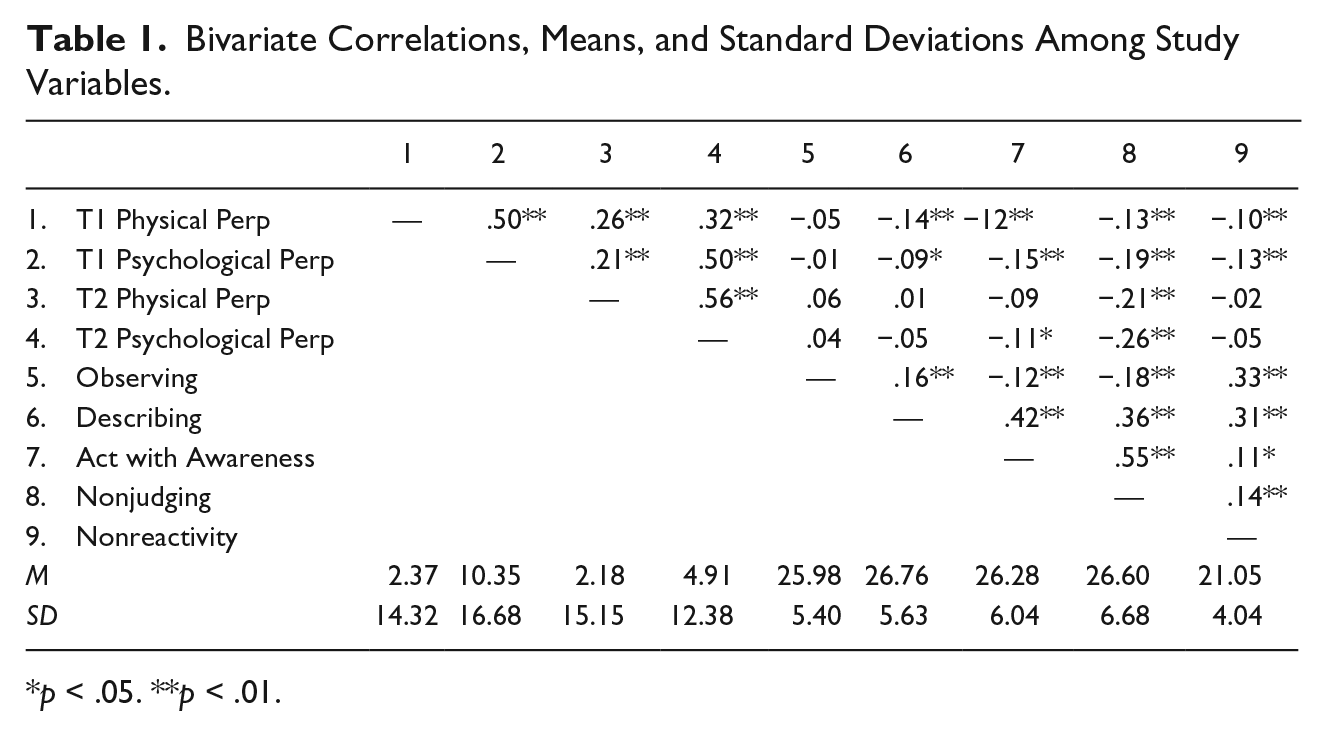
p < .05. **p < .01.
We next employed multiple regression analyses to determine whether specific mindfulness facets were uniquely related to aggression perpetration at Time 2 after controlling for Time 1 aggression and the shared variance among FFMQ facets. To examine this, Time 1 psychological and physical aggression were entered as a block and then all five mindfulness facets were simultaneously regressed on psychological and physical aggression perpetration at Time 2. Results showed a consistent pattern of findings, such that the nonjudging mindfulness facet was significantly and negatively associated with both types of aggression perpetration at Time 2 (see Table 2). No other facets of mindfulness were associated with T2 perpetration.
Multiple Regression Analyses Predicting Time 2 Violence Perpetration Controlling for Time 1 Perpetration.
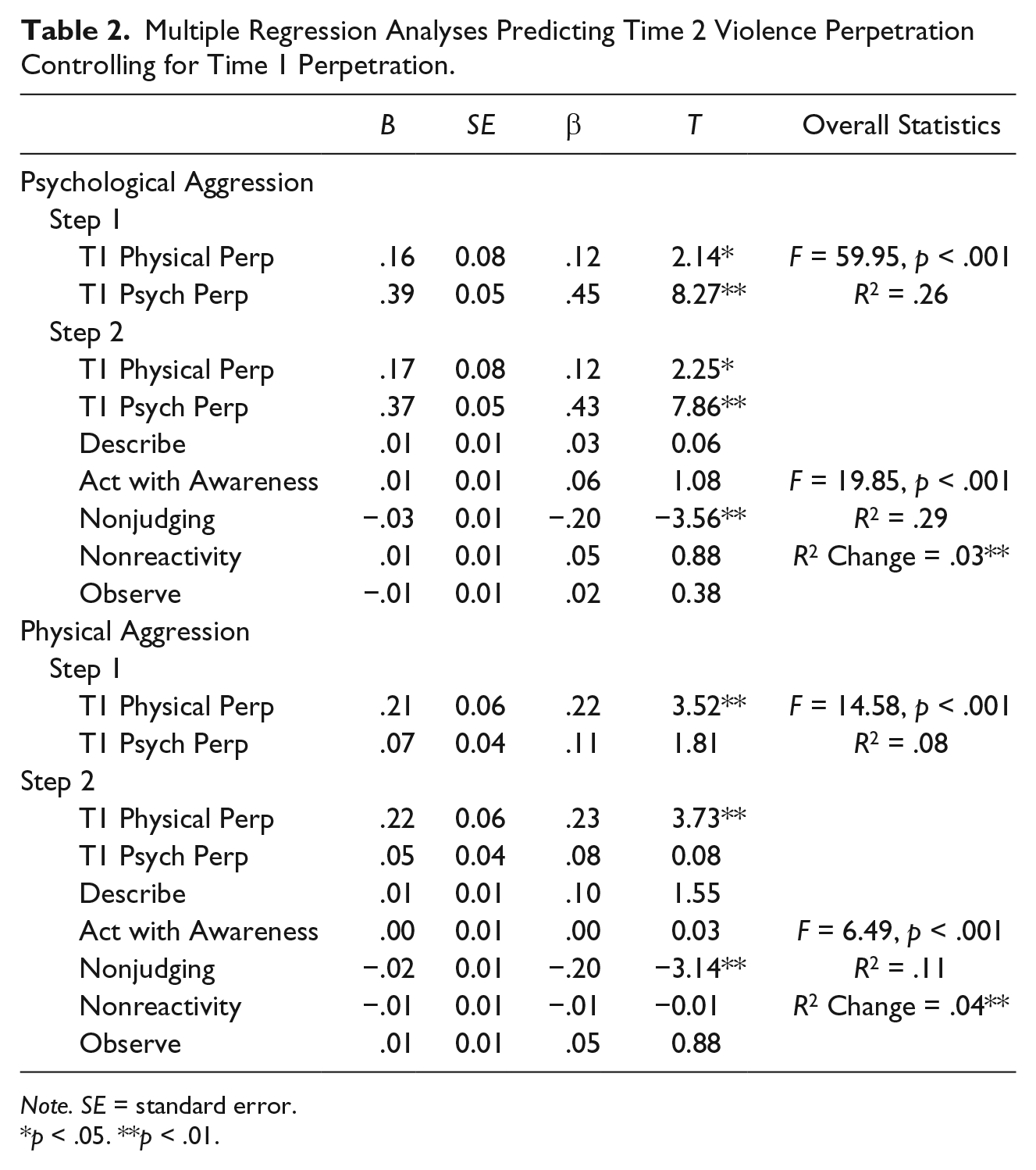
Note. SE = standard error.
p < .05. **p < .01.
Finally, we examined whether perpetrators of psychological and physical aggression, respectively, reported lower scores on the five mindfulness facets than non-perpetrators. To examine this question, we first dichotomized individuals into perpetrators and non-perpetrators. To be considered a perpetrator of either form of aggression, individuals had to indicate that they had engaged in at least one act of aggression that fell into each respective subscale of the CTS2. This method of classifying individuals into perpetrators and non-perpetrators was commonly used in the dating violence literature (Bell & Naugle, 2007; Cornelius, Shorey, & Beebe, 2010; Hesse, Strauss, Shorey, Stuart, & Cornelius, 2021; Rhatigan & Street, 2005; Shorey, Cornelius, & Bell, 2011). T-tests were then used to examine differences between perpetrators/non-perpetrators on all five mindfulness facets. As displayed in Tables 3 and 4, at both Time 1 and Time 2, perpetrators of psychological aggression reported significantly lower scores on the nonreactivity, nonjudging, and act with awareness subscales than non-perpetrators. Effect size differences (d) between groups were also calculated (Cohen, 1988). The effect sizes for differences between groups for all psychological aggression scales were in the small-medium range. Additionally, perpetrators of physical aggression reported significantly lower scores on the nonjudging and nonreactivity subscales than non-perpetrators at both Time 1 and Time 2. All effect size differences for the significant effects between groups were in the small-medium range.
Differences Between Time 1 Perpetrators/Non-Perpetrators of Psychological and Physical Aggression on Mindfulness.
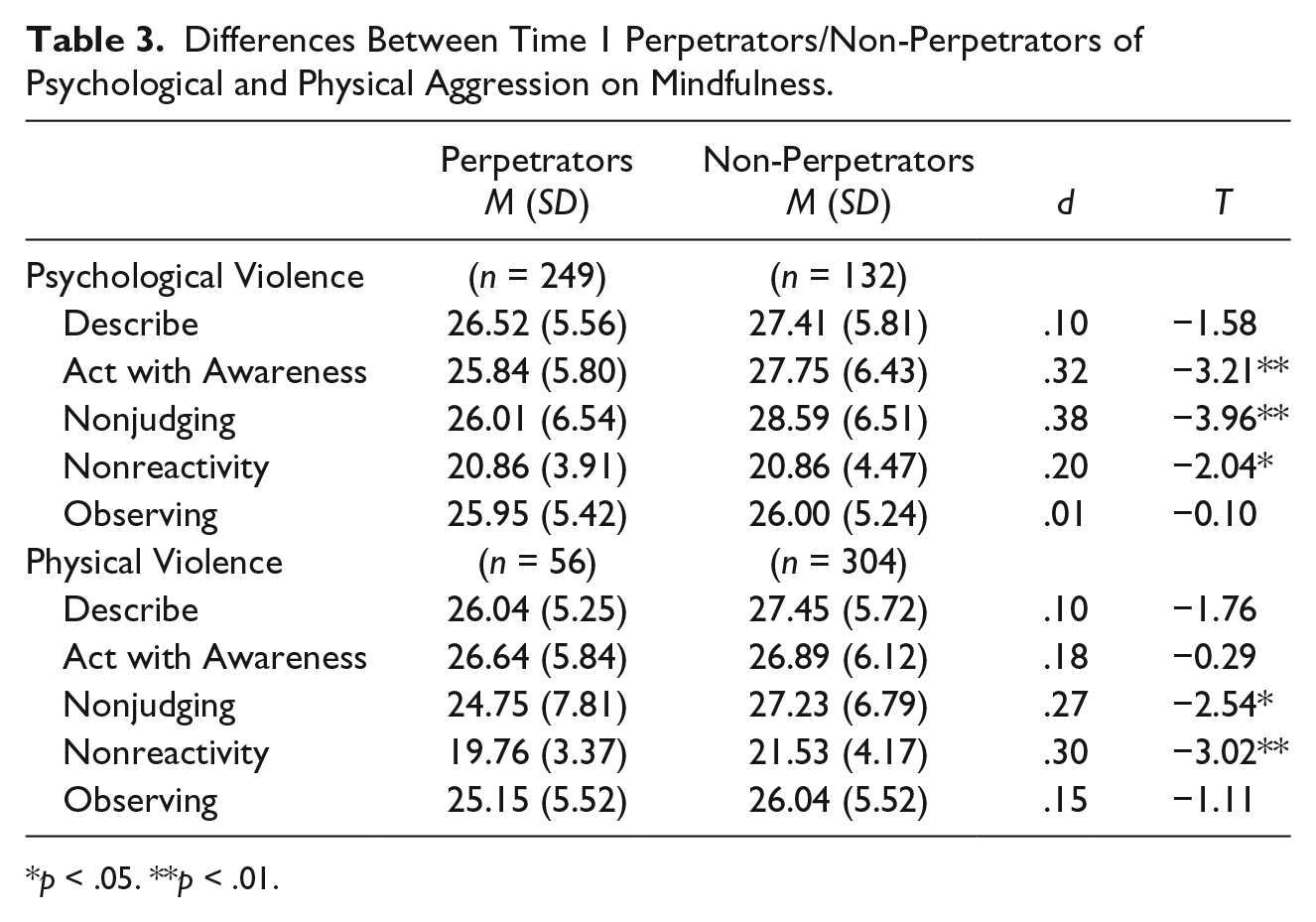
p < .05. **p < .01.
Differences Between Time 2 Perpetrators/Non-Perpetrators of Psychological and Physical Aggression on Mindfulness.
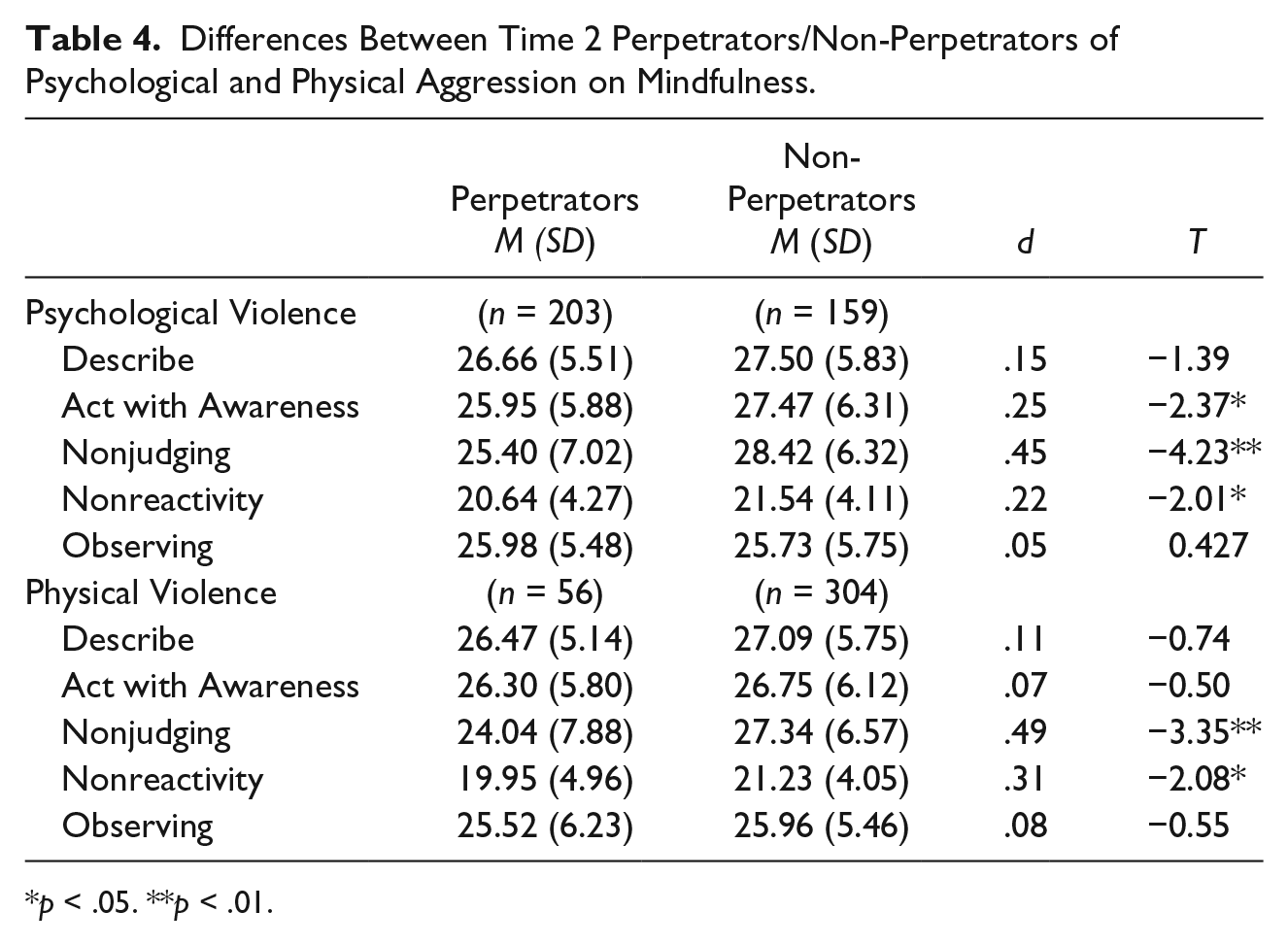
p < .05. **p < .01.
Discussion
This study was the first to utilize a short-term longitudinal design to provide additional data on the relationship between facets of mindfulness and the perpetration of dating violence. Although some prior research indicated that increased mindfulness was associated with less dating violence (Brem et al., 2015; Shorey, Larson, & Cornelius, 2014; Shorey, Seavey, et al., 2014), this field is in its infancy and more research is necessary to discern the relationship between these variables, particularly because mindfulness-based interventions are widespread and effective for a range of psychological difficulties. The findings of this investigation suggest a number of associations between different facets of mindfulness and dating violence perpetration.
Based on prior research (Shorey, Seavey, et al., 2014), we hypothesized that individuals lower in the nonreactivity and acting with awareness facets of mindfulness would evidence greater perpetration of dating violence in their relationships. Contrary to these hypotheses, the results suggested that the nonjudging aspect of mindfulness was most consistently associated with aggression. The nonjudging facet measures the ability to withhold judgment of internal experiences as good or bad, suggesting that individuals who perpetrate aggression in their dating relationships may struggle in the evaluation of these emotional states, and this may manifest in behaving in an aggressive manner. That is, it seems likely that in reacting to emotional states, particularly negative ones that precede or coincide with relationship aggression, individuals may engage in destructive behaviors, including aggression. While not directly predicted by our hypotheses, it is not inconsistent with other recent research in IPV suggesting a relationship between physical IPV perpetration and nonjudging (Brem et al., 2019). These data also suggested that nonjudging was related to lower levels of both physical and psychological perpetration through distress tolerance, which has been linked to IPV (Brem et al., 2019; Shorey et al., 2017).
In addition, there is increasing evidence within the literature that emotion regulation abilities are predictive of violence perpetration (Holley, Ewing, Stiver, & Bloch, 2017; Lilly & Mercer, 2014; Shorey, McNulty, Moore, & Stuart, 2015), and emotion regulation and mindfulness appear to be closely related (Goodall et al., 2012). Indeed, in the initial research on the FFMQ, the nonjudging facet was correlated with difficulties in emotion regulation (Baer et al., 2006). In addition, research suggested that emotion regulation can mediate the relationship between mindfulness and negative emotion lability as well as positive emotion differentiation (Hill & Updegraff, 2012). Furthermore, research indicated that anger rumination mediated the relationship between the nonjudging facet of mindfulness and general aggression (Peters et al., 2015). Thus, perhaps individuals with deficits in nonjudging are more likely to utilize poor emotion regulation strategies, such as rumination, which can, in turn, lead to aggression perpetration. While mindfulness and emotion regulation have demonstrated some overlap in factor analyses (Coffey, Hartman, & Fredrickson, 2010; Goodall et al., 2012), there are conceptual and statistical differences between these constructs. As noted by Coffey et al. (2010), it is likely that dispositional mindfulness facilitates higher emotional clarity, which then helps one manage negative affect. Therefore, although we would expect emotion regulation and mindfulness to be related, it is likely that dispositional mindfulness provides important precursors to emotion regulation. Future research should extend these findings by also assessing other predictors of dating violence perpetration, such as emotion regulation and rumination, in conjunction with mindfulness.
Consistent with previous research (Shorey, Seavey, et al., 2014), when perpetrators and non-perpetrators of aggression were compared, results demonstrated that in addition to the non-judging facet, the nonreactivity as well as the act with awareness facets of mindfulness differentiated perpetrators from non-perpetrators of psychological aggression. That is, compared to their non-perpetrator counterparts, perpetrators of psychological aggression reported a reduced ability to allow their internal experiences to just come and go from awareness without reacting to them, in addition to an increased likelihood to act automatically, without conscious thought. Furthermore, the nonreactivity facet of mindfulness also differentiated perpetrators of physical aggression. These results suggest that perpetrators of aggression were less able to accept their emotional experiences (Baer et al., 2006). Previous research examining the relationship between emotion regulation and dating violence demonstrated that perpetrators of IPV report more impulse control difficulties when they experience negative emotions (Shorey, Brasfield, Febres, & Stuart, 2011). Moreover, the nonreactivity and act with awareness facets were related to impulsiveness in general (Peters et al., 2011). Thus, it is possible that the nonreactivity and act with awareness subscales are associated with dating violence due to one’s inability to regulate one’s impulsive tendencies to avoid or remove negative emotion states, which may increase risk of perpetration in an attempt to regulate one’s emotions. Again, while emotion regulation and mindfulness may assess some of the same processes, experimental and treatment outcome studies support their distinction and suggest that mindfulness facilitates and is associated with emotion regulation (Roemer, Williston, & Rollins, 2015).
Directions for Future Research
While the intent of this study was to preliminarily establish the longitudinal relation between mindfulness and dating violence perpetration, future research should strive to further investigate the relation between mindfulness, dating violence, and other constructs previously shown to be related to dating violence. Prior research indicated that emotion regulation mediated the relationship between mindfulness and a variety of constructs, including psychological distress (Coffey et al., 2010), as well as emotion lability and positive emotion differentiation (Hill & Updegraff, 2012). At the same time, research would suggest that anger rumination can mediate the relationship between the nonjudging facet of mindfulness and general aggression perpetration (Peters et al., 2015). Other researchers have found that anger management mediated the relationship between the mindfulness facets, act with awareness and nonreactivity, and both physical and psychological aggression perpetration (Shorey, Seavey, et al., 2014). In addition, mindfulness moderated the relationship between perceived partner infidelity and female dating violence perpetration (Brem et al., 2019), as well as the relationship between alcohol consumption and sexual aggression perpetration (Gallagher et al., 2010). Thus, future research should further examine the role of mindfulness as a potential moderating variable as well as potential mediators of the mindfulness-aggression association.
It is also plausible that mindfulness-based interventions are a promising direction for dating violence prevention programs. As noted, mindfulness-based interventions have already been shown to be effective in improving a host of health outcomes including self-awareness, emotion regulation (Goodall et al., 2012; Hanley & Garland, 2017), emotional exhaustion (Hulsheger, Alberts, Feinholdt, & Lang, 2013), depression, anxiety, and psychological distress (Bohlmeijer et al., 2010; Kuyken et al., 2016). Furthermore, these interventions have been successfully implemented with college students (De Vibe et al., 2013; McIndoo, File, Preddy, Clark, Hopko, 2016). Given previous research, mindfulness-based interventions likely enhance psychological health through improvements in emotion regulation (Roemer et al., 2015). It is possible that such interventions could act directly in reducing violence perpetration or by improving another variable related to violence perpetration, such as emotion regulation, psychological distress, or decreased impulsiveness. Mindfulness interventions offer a promising approach, necessitating additional research to further explore the effectiveness, practicality, and long-term outcomes of dating violence prevention programs that incorporate mindfulness-based interventions.
Limitations
As with all research, several limitations should be addressed in future work. This study was conducted at two Midwestern universities within the United States and as a result the sample consisted of college students of primarily non-Hispanic Caucasian ethnicity, limiting its generalizability. This study is limited in its diversity of students of color, sexual minorities, socioeconomic status, religious beliefs, and nationality. Future research should consider the use of non-college students, as well as examination of the relationship between mindfulness and IPV with individuals who identify as male or non-binary. The prospective design of this study does not allow for the determination of causality among study variables. In addition, while only participants who completed measures at both time points were included in the study, only 44% of original participants completed time 2 measure. The inclusion of additional incentives, such as monetary compensation, would likely improve retention rates and should be incorporated into future research using longitudinal designs. Furthermore, we did not ask participants whether they had formal training in mindfulness meditation, or other forms of meditation, which may have impacted dispositional mindfulness. Future research should control for previous mindfulness meditation experience. There are also recent debates in the literature with regard to the definitional ambiguity of “mindfulness,” which should be clarified as we evolve as a scientific field (Van Dam et al., 2018). It is also possible that social desirability may have impacted results, such as through the under-reporting of violence and the over-reporting of mindfulness skills. Future research should include measures of social desirability and determine whether this affects the association between mindfulness and dating violence.
In summary, this study expanded upon the relation between mindfulness and female dating violence perpetration. The findings demonstrated that the nonjudging facet of mindfulness was most consistently related to both forms of violence perpetration. Perpetrators of psychological aggression had deficits in nonreactivity (the ability to refrain from reacting from emotionally distressing stimuli), act with awareness (the ability to make conscious decisions and not functioning automatically), and nonjudging facets of mindfulness. Perpetrators of physical aggression demonstrated deficits within the nonjudging and nonreactivity facets of mindfulness. These findings replicate some aspects of previous research while also yielding novel results, demonstrating the need for further investigation of the relation between mindfulness and dating violence perpetration. Future research should extend these findings while also investigating the potential mediating or moderating role of other constructs, as well as the efficacy of mindfulness-based interventions within dating violence prevention programming.
Footnotes
Declaration of Conflicting Interests
The author(s) declared no potential conflicts of interest with respect to the research, authorship, and/or publication of this article.
Funding
The author(s) received no financial support for the research, authorship, and/or publication of this article.
