







Abstract
Psychological aggression is experienced by a large proportion of people in intimate relationships, and the negative impact of this experience has the potential to weaken one’s sense of meaning in life. This study aimed to understand a mechanism through which the experience of psychological aggression in a past intimate relationship relates to less meaning in life. By applying self-compassion and meaning-making theory, we proposed that the experience of psychological aggression decreases one’s ability to be kind toward oneself in times of suffering (i.e., self-kindness), which decreases positive reframing of the experience, which sequentially decreases growth from the experience, which in turn decreases meaning in life. Participants were 253 people who experienced psychological aggression in a past intimate relationship. Participants completed measures of psychological aggression, self-kindness, positive reframing, growth, and meaning in life. Results found that psychological aggression experienced in a past intimate relationship related to less meaning in life and that the serial mediation model proposed was supported. As such, the results indicate that greater psychological aggression experienced relates to less self-kindness, which in turn relates to less positive reframing, which is sequentially associated with less growth, which is associated with less meaning in life. The findings indicate the need for counseling and psychotherapies to bolster self-kindness in people who have experienced psychological aggression in a past intimate relationship. This is because levels of self-kindness might be depleted after experiencing psychological aggression and because self-kindness appears to support adaptive meaning-making processes.
Keywords
Psychological aggression is highly prevalent in adult intimate relationships and is the most common form of intimate partner violence (Carney & Barner, 2012; Frye & Karney, 2006; Henning & Klesges, 2003). The term psychological aggression refers to non-physical aggressive behaviors in intimate adult relationships (Follingstad, 2007) that aim to harm a partner’s psychological well-being (Yoon & Lawrence, 2013). Such behaviors can include ignoring, ridiculing, criticizing, and controlling behaviors (Sackett & Saunders, 1999). Psychological aggression can have a devastating impact on one’s psychological health even years after the termination of the relationship in which the psychological aggression was experienced (Reed & Enright, 2006). For example, experiencing psychological aggression in an intimate relationship is related to depression, anxiety, and posttraumatic stress disorder (Dutton et al., 2006; Reed & Enright, 2006). Furthermore, it has been found that psychological aggression is a stronger predictor of posttraumatic stress disorder than physical aggression (Dutton et al., 1999).
There are points of difference in the literature in terms of how psychological aggression is conceptualized and measured, and there are various terms used in the literature to indicate psychological aggression (see Follingstad, 2007, for a review). Although the term psychological abuse is often used, consistent with Follingstad (2007), we use the term psychological aggression to denote the range of verbal and mental methods adults use in intimate relationships to harm their partner’s psychological well-being. We use this term because we are interested in the continuum of experience of psychological aggression and not whether it can be classed in some way as “abuse.” Experiencing psychological aggression in an intimate relationship is a stressor in its own right (O’Leary, 1999), and it is critical we understand its impact on mental health for all who have experienced it.
Meaning in Life Following Intimate Partner Psychological Aggression
It is important, in particular, to study meaning in life in people who have experienced psychological aggression in a past intimate relationship because meaning in life appears to be protective of mental health outcomes following intimate partner and other forms of violence (e.g., Gross et al., 2019; Parker & Lee, 2007). Meaning in life refers to the subjective judgment that one’s own life makes sense or is comprehensible, has purpose, and has a sense of significance or mattering (George & Park, 2016; Steger et al., 2006). The extent to which one perceives they have meaning in life relates to their global meaning (i.e., a person’s broad beliefs and assumptions about the self and the world as well as global goals to pursue) and whether their appraisal of a highly stressful or traumatic life event (i.e., situational appraisal) is discrepant from their global meaning (Park, 2010).
The experience of psychological aggression in a past intimate relationship can, like other highly stressful or traumatic experiences, violate a person’s global beliefs and assumptions about the world and the self (e.g., that the world is fair and benevolent and that the self is worthy: Janoff-Bulman, 1989), their overarching goals for life, and their sense that life has meaning (Park & Ai, 2006). It is possible that even years after the termination of a psychologically aggressive relationship, some people are still trying to make sense of or find meaning in their experience (Reed & Enright, 2006), while others have grown from the experience (Cobb et al., 2006) and possibly restored their sense of meaning in life (Park, 2010). Although preliminary research on finding meaning in the experience of psychological aggression indicates that finding meaning in such unjust suffering is an important part of restoring global beliefs about the self as worthy (Reed & Enright, 2006), there still appears to be no studies that specifically examine meaning in life in relation to psychological aggression experienced in a previous intimate relationship.
There is research, however, that indicates that for women who experienced intimate partner violence in an adult relationship, those who perceived continuing negative effects of the violence had lower scores on their general perception of the world as meaningful, comprehensible, and manageable (Parker & Lee, 2007). In addition, recent research has found that the experience of deployment sexual trauma is related to less meaning in life (Gross et al., 2019). Being on the receiving end of psychological aggression could, like other forms of interpersonal aggression, affect a sense of meaning in life in several ways. For example, when the experience of psychological aggression is unpredictable and/or unavoidable, this can challenge one’s sense of meaning in life because the notion that the world is predictable, just, and makes sense is violated and one’s sense of self-worth, identity, and esteem is threatened (Gross et al., 2019; Parker & Lee, 2007).
Meaning-Making Theory
Integrated meaning-making theory was proposed by Park (2010) as a way to integrate the key tenets of prominent meaning-making theories. This integrated theory holds that when our appraisal of a situation, such as experiencing psychological aggression in an intimate relationship, is discrepant from our global beliefs and goals, we experience distress. This distress is thought to drive meaning-making attempts, which aim to reduce the discrepancy between the appraisal of the stressor and global meaning, and to restore a sense of life as meaningful. When meaning making is successful, it results in meanings made. One meaning-making attempt often studied is positive reframing of the stressor (Park, 2010). This form of meaning making has been related to growth from the stressful situation (Helgeson et al., 2006), which is one of the most widely studied forms of meanings made and might be a way of restoring global meaning following a stressful or traumatic life event (Park, 2010; Park & George, 2013).
Without minimizing or diminishing the adverse consequences of experiencing psychological aggression in an intimate relationship, it is possible that people can identify positive changes that have occurred as a result of their stressful or traumatic experience. These positive changes or ways people have grown from a highly stressful or traumatic experience are often conceptualized as “posttraumatic growth” (Tedeschi & Calhoun, 1996) or “stress-related growth” (Park et al., 1996). Qualitative research has identified themes of posttraumatic growth in narratives of women survivors of intimate partner violence (D’Amore et al., 2018), and a review of quantitative research shows that women survivors of intimate partner violence do experience posttraumatic growth (see Ulloa et al., 2015, for a review). Women who experienced intimate partner violence had higher average scores on the Posttraumatic Growth Inventory (Tedeschi & Calhoun, 1996) when compared with other samples (Cobb et al., 2006), including a sample of breast cancer patients (Weiss, 2002). Furthermore, women who experienced higher levels of violence reported greater positive changes in the posttraumatic growth domain of appreciation of life (Cobb et al., 2006). With data collected from 23 survivors of intimate partner violence, there is also support for the hypothesis that posttraumatic growth relates to positive changes in global beliefs (Valdez & Lilly, 2015).
Self-Kindness and Meaning-Making Theory
It is important to apply meaning-making theory to the experience of psychological aggression in a past intimate relationship and, in particular, examine if positive reframing links to growth, which subsequently links to meaning in life. Furthermore, we need to understand factors that might influence meaning making and growth. Self-kindness, which refers to being kind to oneself in times of pain or suffering (Neff, 2003b), is likely to be important to study in this regard. Self-kindness is a component of the construct of self-compassion. Self-compassion broadly refers to being compassionate toward oneself in times of suffering (Neff, 2003b) and relates to better psychological outcomes, including a eudemonic view of well-being (Neff et al., 2007; Zessin et al., 2015).
The self-kindness aspect of self-compassion is particularly important to study in people who have experienced psychological aggression in an intimate relationship because this experience of psychological aggression is likely to hinder one’s capacity for self-kindness as the criticisms and put-downs inflicted on them by their partner become entrenched in the way they see and relate to themselves. Although there is research that has found that greater childhood emotional abuse relates to less self-compassion (Tanaka et al., 2011), we could find no empirical research that has specifically examined self-kindness following intimate partner psychological aggression. It is critical to study the potential reduced capacity for self-kindness in people who have experienced psychological aggression in a past relationship because this reduced capacity for self-kindness will likely have a negative impact on one’s ability to positively reframe and grow from their experience (C. C. Y. Wong & Yeung, 2017), which will limit one’s ability to restore a sense of meaning in life (Park, 2010).
C. C. Y. Wong and Yeung (2017) proposed that self-compassion promotes posttraumatic growth in trauma and crisis survivors because self-compassion is unconditional and provides an emotionally safe space for people to see reality, which in turn enables the cognitive processing of negative experiences. Their data supported this hypothesis; they found that self-compassion related indirectly to posttraumatic growth through positive reframing. This idea that self-compassion promotes posttraumatic growth through cognitive processing suggests that self-kindness might play an important role in integrated meaning-making theory (Park, 2010) for people who have experienced intimate partner psychological aggression.
The Present Study
Due to the fact that such a large number of people are affected by psychological aggression experienced in a past intimate relationship and the experience is likely to violate global beliefs and assumptions, this study aims to examine (a) the relationship between psychological aggression experienced and meaning in life, (b) the relationship between psychological aggression experienced and self-kindness, and (c) a potential pathway through which psychological aggression relates to meaning in life. First, it was hypothesized that greater psychological aggression experienced will relate to less meaning in life. Second, we hypothesized that psychological aggression would be negatively related to self-kindness. Third, we hypothesized the serial multiple mediator model depicted in Figure 1 to explain how psychological aggression experienced (X) relates to less meaning in life (Y). This model specifies that psychological aggression experienced relates to less self-kindness (Mediator 1), which in turn relates to less positive reframing (Mediator 2), which in turn relates to less growth (Mediator 3), which subsequently relates to less meaning in life.
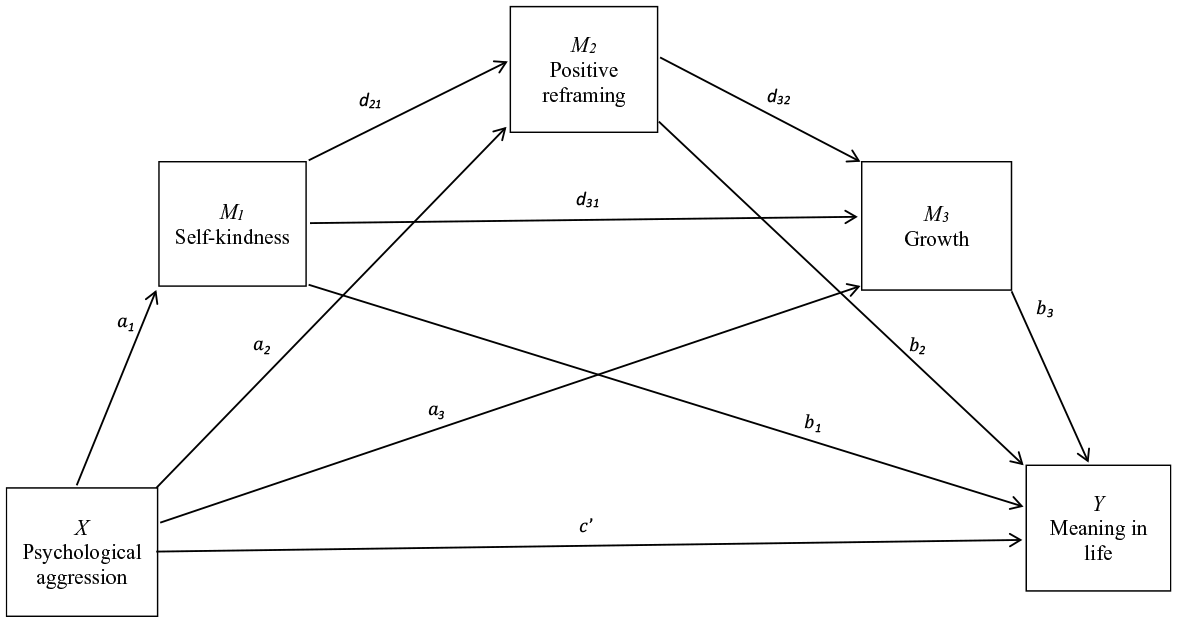
The serial multiple mediator model proposes that the relationship between psychological aggression and meaning in life is mediated by the following variables in this order: self-kindness, positive reframing, and growth.
Method
Participants
Data from 253 people (Mage = 26.10, SD = 9.70, age range = 16–84) who completed and submitted the online survey were analyzed for the present study. Of the total sample, the majority were female (89.3%) and considered themselves to have experienced psychological aggression in a past intimate relationship (90.0%). Less than half of the participants were currently single (43.5%); the remaining participants were currently in a non-domestic partnership (28.1%), domestic partnership (including marriage and de facto; 24.5%), divorced or separated (3.2%), or widowed (0.8%). Over one third of participants (37.2%) had high school education as their highest level of education achieved, and most participants (60.1%) had tertiary education, including apprenticeship and university qualifications. Almost half of the sample (47.8%) were students. In terms of employment, 41.9% of participants were employed full-time or self-employed, 37.9% had part-time or casual employment, and 13.8% were unemployed. Most of the sample (76.7%) earn less than AUD$60,000 per year, and most (74.8%) consider their cultural heritage to be Australian (10.0% consider their heritage to be European and 2.8% consider their heritage to be Indigenous Australian). The sample primarily consists of participants who do not consider themselves to be religious or spiritual (63.2%).
Initially, 266 people completed the survey; however, the data of 13 participants were excluded from the data set because those participants were still in the relationship where they experienced psychological aggression. On average, the time since the relationship ended was 4.23 years (SD = 5.72 years, minimum = 0.50, maximum = 40.00), and the time since psychological aggression ended was 3.34 years (SD = 5.27, minimum = 0.00, maximum = 38.00). The duration of the relationship that was reported on was on average 3.60 years (SD = 5.18, minimum = 0.08, maximum = 55.00). Furthermore, participants rated their level of commitment to the relationship that they were reporting on from 1 (not at all committed) to 7 (very committed) and the average rating was 6.23 (SD = 1.22, minimum = 2.00, maximum = 7.00). For the bulk of the sample, the relationship they were reporting on where they experienced psychological aggression was an opposite-sex relationship (97.2%) and a non-domestic partnership (54.5%).
Measures
Psychological aggression
The Profile of Psychological Abuse scale (Sackett & Saunders, 1999) was used to measure aspects of psychological aggression, including jealous control (e.g., “How often did your partner become angry or upset if you wanted to be with someone else and not with them?”), ignoring (e.g., “How often did your partner ignore you when you began a conversation?), ridiculing of traits (e.g., “How often did your partner ridicule the traits you admire or value most in yourself?”), and criticizing behavior (“How often did your partner request that everything be done in a precise way or it will be unacceptable to them?”). Respondents rated how often each of the 21 items occurred on a 7-point scale from 1 (never) to 7 (daily). The items were modified in three ways. First, the items were changed to be in past tense rather than present tense. Second, they were adapted where necessary to be gender neutral. For example, “him” was replaced with “them” and the item “. . . call you names with sexual connotations . . .” was extended to also include examples of male names that can have sexual connotations such as “asshole” and “dickhead.” Third, two items were updated to reflect advances in technology. For example, the item “. . . make the TV, a magazine, the newspaper, or other people seem more important than you are” was adapted to include the Internet and smart phone, and the item “. . . intercept your mail, telephone calls . . .” was updated to include email and text messages. A total score was calculated, and the Cronbach’s alpha for the full scale was .95.
Self-kindness
The Self-Kindness subscale of the Self-Compassion Scale (Neff, 2003a) was used to measure self-kindness (e.g., “I’m tolerant of my own flaws and inadequacies”). The Self-Kindness subscale has five items, which were rated from 1 (almost never) to 5 (almost always). A mean score was calculated for self-kindness. Factor analyses have supported the multifactor structure of the Self-Compassion Scale (Neff, 2003a), and observed Cronbach’s alpha was .84 for the Self-Kindness subscale.
Positive reframing
The two-item Positive Reframing subscale of the Brief COPE (Carver, 1997) was used to measure the meaning-making process of positive reframing. Respondents rated each item from 1 (I don’t do this at all) to 4 (I do this a lot) to indicate how much they have been doing each coping statement (e.g., “I’ve been trying to see it in a different light, to make it seem more positive”) to cope with stress related to their experience of psychological aggression in a past intimate relationship. The items were summed. Observed Cronbach’s alpha was .82.
Growth
The 21-item Posttraumatic Growth Inventory (Tedeschi & Calhoun, 1996) was used to measure growth (e.g., “I established a new path for life) from psychological aggression experienced in a past intimate relationship. The scale measures different categories of growth (such as relating to others and new possibilities); however, a total score for growth was used in the present study. Respondents rated each item from 0 (I didn’t experience this change) to 5 (I experienced this change to a very great degree) in terms of how much they experienced the cited change as a result of the psychological aggression they experienced in a past intimate relationship. The observed Cronbach’s alpha for the full scale was .93.
Meaning in life
Five items from the widely used Meaning in Life Questionnaire (Steger et al., 2006) were used to measure the presence of meaning in life (e.g., “I understand my life’s meaning”). The five presence of meaning in life items were rated on a scale from 1 (absolutely untrue) to 7 (absolutely true). Ratings on items were totaled to form a scale score. The observed Cronbach’s alpha was .89.
Procedure and Design
The correlational, cross-sectional study received ethics approval from the university’s human research ethics committee. Participants were recruited online via social networking sites (e.g., Facebook) and the student research participation system, where students could receive 0.50 credit points for participation in the study. Utilizing online social networking sites for recruitment was considered a good way to recruit participants from a broad range of backgrounds who have experienced some degree of psychological aggression in a past intimate relationship. There were no significant differences between students and non-students on key study variables, and all participants completed the anonymous online Qualtrics survey at a time and place of their choosing. Participants were asked to think about a past intimate relationship in which they experienced specific behaviors that indicate psychological aggression, such as being ridiculed and ignored on purpose, and respond to the relevant items with that past intimate relationship in mind.
Results
Before testing the proposed model that examines the serial multiple mediation of the relationship between psychological aggression and meaning in life through self-kindness (Mediator 1), positive reframing (Mediator 2), and growth (Mediator 3), preliminary analyses were performed. The preliminary analyses included correlations and one-way analyses of variance (ANOVAs) to check for demographic and relationship variables that covary with the model variables. Preliminary analyses were performed in SPSS (Version 25), and the serial mediation analysis was performed using the PROCESS custom dialogue box in SPSS by Hayes (2013). There were less than 1% data missing on any variable, and mean imputation was used to manage missing data.
Bivariate Correlations
As can be seen in Table 1, psychological aggression was related to less self-kindness, less meaning in life, and greater growth. Self-kindness related positively with positive reframing, growth, and meaning in life. Positive reframing related to greater growth and meaning life, and greater growth related to greater meaning in life.
Means, Standard Deviations, and Intercorrelations Between Key Study Variables.
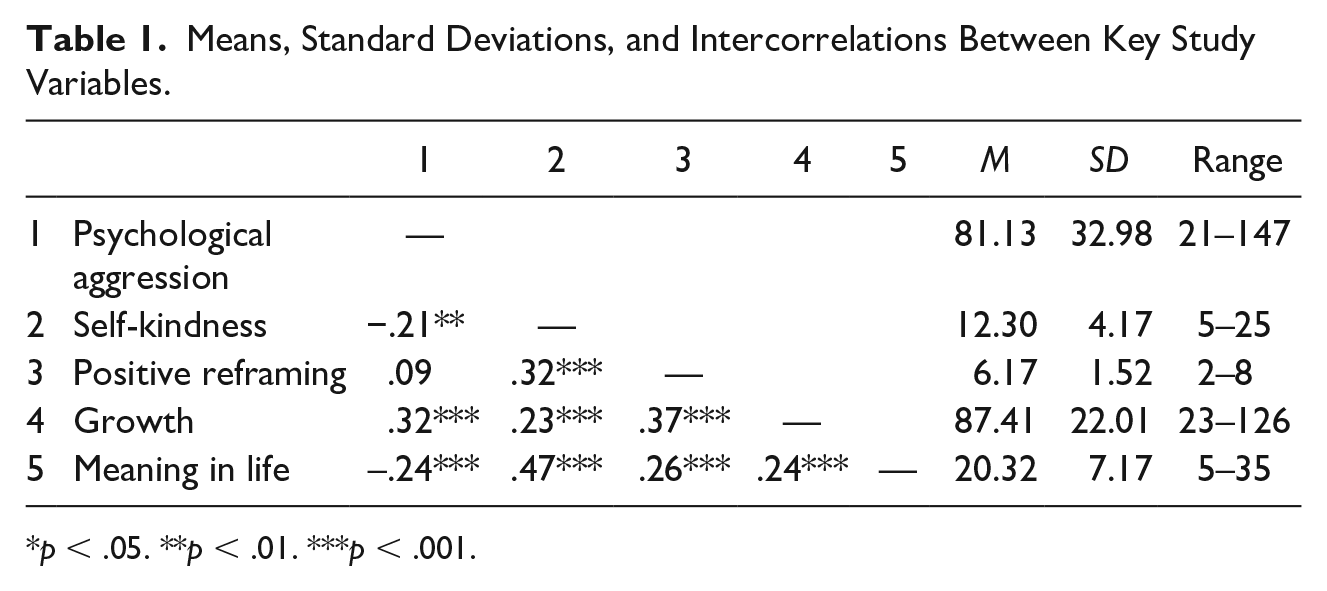
p < .05. **p < .01. ***p < .001.
Check for Covariates
First, we examined whether key study variables related to the demographic variables of age and gender. By applying a conservative alpha of p = .01 (because of the number of correlations performed), no model variables were related to age. We also performed independent-groups t tests to compare women and men on key study variables. These t tests should be interpreted with caution because only 10.7% of the sample are men, and results of a post hoc power analysis conducted in G*Power 3.1.9.2 (Faul et al., 2007) indicate that power was sufficient only to detect a large effect size. An independent-groups t test found that women (M = 83.64, SD = 32.79) scored higher than men (M = 60.19, SD = 27.05) on psychological aggression experienced, t(251) = −3.57, p < .001. Women (M = 88.90, SD = 21.54) also scored higher than men (M = 74.95, SD = 22.40) on growth, t(251) = −3.17, p = .002. Thus, gender was controlled for in the PROCESS analysis. Furthermore, the PROCESS analysis was run with and without men in the sample to see whether there was a substantive difference in the interpretation of findings, but there was not. As such, we deemed it acceptable (and necessary) to include men in the sample and control for gender. Next, we examined whether the time since the relationship ended related to any of the key study variables. Time since the relationship ended related negatively to psychological aggression (r = −.20, p = .002) and positive reframing (r = −.19, p = .002), and positively to meaning in life (r = .21, p = .001). We also examined whether the duration of the relationship related to any model variable, but it did not. Thus, we controlled for the time since the relationship ended in the PROCESS analysis.
Serial Multiple Mediation Analysis
Model 6 in PROCESS was used specifying X as psychological aggression, Y as meaning in life, and the three mediators in series as self-kindness, positive reframing, and growth. Gender and time since the relationship ended were entered as covariates, and 10,000 bias-corrected bootstrapped samples were used. Indirect effects were estimated using 95% bootstrapped confidence intervals (CIs), and there were seven indirect effects tested. The model is summarized in Table 2. All effects presented are unstandardized.
Model Summary for Serial Multiple Mediation.
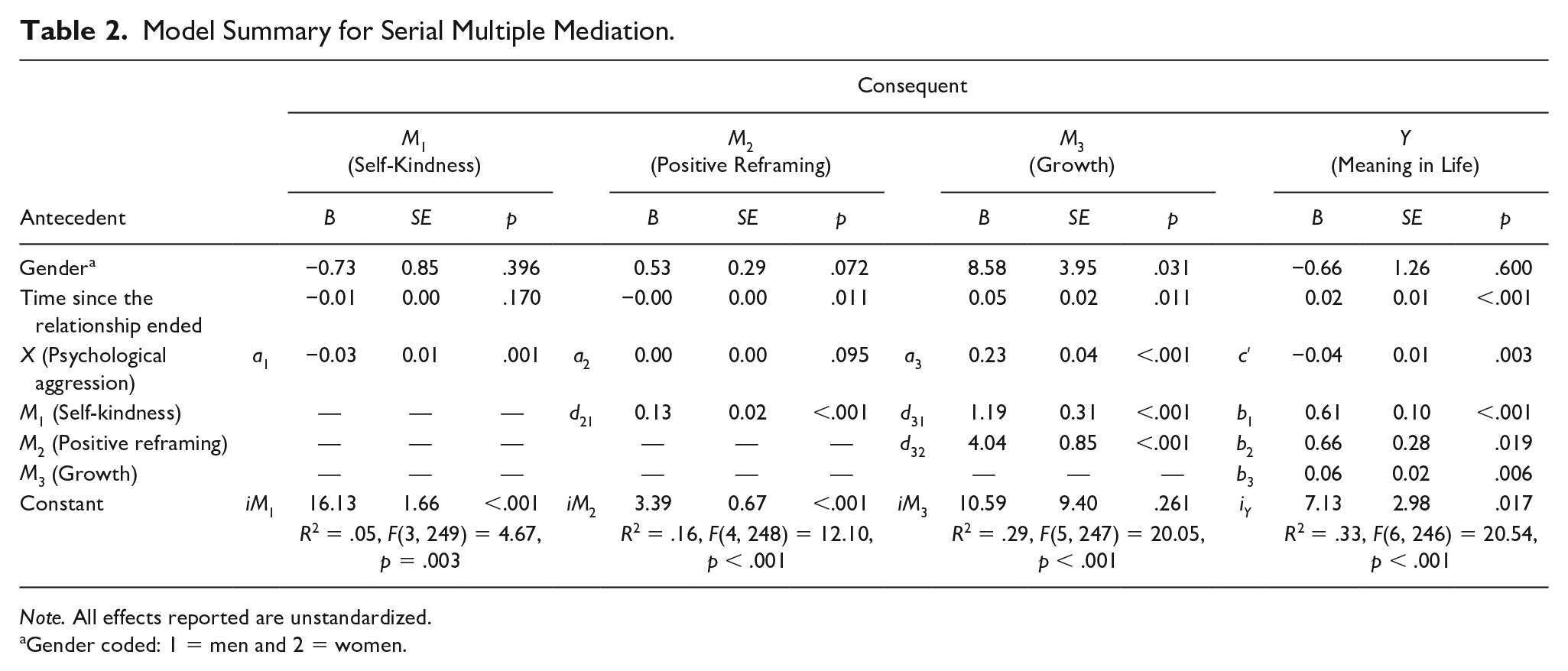
Note. All effects reported are unstandardized.
Gender coded: 1 = men and 2 = women.
The total effect (c) between psychological aggression and meaning in life was negative and significant (B = −0.04, SE = 0.01, p = .002), such that higher scores on psychological aggression experienced related to less meaning in life. The direct effect
Although the overall indirect effect of psychological aggression on meaning in life was not supported (B = −0.0040, SE = 0.0098, 95% CI = [−0.0237, 0.0151]), five of the seven indirect effects were supported. First, the indirect effect through self-kindness (
Discussion
This study aimed to address a gap in the literature by studying the relationship between the past experience of intimate partner psychological aggression and meaning in life and applying self-compassion and meaning-making theory to understand how psychological aggression experienced might relate to less meaning in life. As predicted, higher scores on psychological aggression did relate to less meaning in life. This finding suggests that in addition to negatively affecting mental health outcomes, such as depression, anxiety, and posttraumatic stress (Dutton et al., 2006; Reed & Enright, 2006), intimate partner psychological aggression has a negative impact on one’s sense of meaning in life. This finding is consistent with previous research on intimate partner violence and less sense of coherence (Parker & Lee, 2007), and supports the meaning-making literature, which holds that a stressful life event or situation can violate global meanings and our sense that life is meaningful (Park, 2010; Park & Ai, 2006). This finding alerts counselors and psychologists to the possibility that someone who has experienced psychological aggression in a past intimate relationship might have a reduced sense of meaning in life, which can make them susceptible to poor mental health outcomes and is a “pathology” worth treating in its own right.
Similar to previous research that has found a relationship between the experience of abuse and less self-compassion (Tanaka et al., 2011), we found that the experience of intimate partner psychological aggression related to less self-kindness, which we predicted. This finding alone suggests it is important for clinicians to focus on building self-kindness in clients who have experienced psychological aggression in a past intimate relationship, even if the relationship ended years ago. As such, clinicians might apply loving-kindness meditation principles (Kearney et al., 2013) and mindful self-compassion strategies proposed for survivors of intimate partner abuse (Tesh et al., 2015).
The hypothesized serial indirect effect between psychological aggression and meaning in life was supported, although the direct effect between psychological aggression and meaning in life remained significant. The first part of the serial multiple mediator indirect effect showed that, as discussed above, psychological aggression related to less self-kindness. The second part showed that less self-kindness related to less positive reframing. This finding supports the role of self-kindness in meaning making following stressful and traumatic life events and is consistent with the assertion that self-compassion promotes posttraumatic growth through positive reframing (C. C. Y. Wong & Yeung, 2017). The third path demonstrates that less positive reframing of the stressor is associated with less growth. This is consistent with much of the growth literature that shows a positive relationship between positive reframing (which is about putting a positive spin on the situation) and growth (Helgeson et al., 2006). Finally, less growth related to less meaning in life, which is consistent with previous research that has found greater growth from intimate partner violence is related to positive changes in global beliefs (Valdez & Lilly, 2015). Furthermore, this supports theory that growth following a highly stressful or traumatic life event is a way to change global meanings and restore a sense of life as meaningful (Park, 2010; Park & George, 2013). This serial mediation pathway indicates that self-kindness is important to promote following the experience of psychological aggression because if it is depleted, one’s positive reframing, growth, and meaning in life will likely be negatively affected.
Although the results of the proposed serial mediation pathway were supported, it is important to note that an alternative, simpler pathway was also supported by the results: Psychological aggression related to less self-kindness, which in turn related to less meaning in life. Another important finding is that psychological aggression was associated with greater growth, which in turn related to greater meaning in life. This finding supports previous research that found that growth is possible in the aftermath of intimate partner violence (e.g., D’Amore et al., 2018; Ulloa et al., 2015). Furthermore, this finding supports meaning-making theory because greater distress is related to greater growth (Park, 2010). This finding indicates that clinicians working with people who have experienced psychological aggression in a past relationship should listen for themes of growth, such as greater appreciation of life and changed priorities (Tedeschi & Calhoun, 1996).
The present study has provided insight into the relationship between the experience of psychological aggression in a past relationship and meaning in life. This study’s strengths include a moderately sized sample of both women and men who experienced psychological aggression in a past relationship, the incorporation of self-kindness into meaning-making theory, and the testing of a serial multiple mediator model to shed light on how psychological aggression might affect meaning in life. However, this study is not without its limitations. First, this study is cross-sectional. This limits the ability to infer causation in the mediation model. Indeed, it would be advantageous to measure each component of the mediation model at consecutive time points after the person is no longer in the relationship in which they experienced psychological aggression; however, this replicative strategy is difficult to implement, especially for this population where perhaps only those participants who are functioning well will complete a survey at all time points. The cross-sectional design also means we need to consider that greater meaning in life could predict greater growth, positive reframing, and self-kindness. Second, this study did not measure and control for other aspects of intimate partner violence; despite this, psychological aggression is a stressor in its own right, and participants were asked to think about the psychological aggression they experienced in a past relationship while answering survey questions related to positive reframing and growth. Third, a convenience sample was used, which might limit the generalizability of the findings. Finally, this study only measured the most commonly assessed type of meaning making (i.e., positive reframing) and of meanings made (i.e., growth), and the subscale used to measure positive reframing includes only two items. With only two items, this positive reframing subscale might provide a more limited measure of positive reframing than other scales, such as the positive reappraisal subscale of the Cognitive Emotion Regulation Questionnaire-Short (Garnefski & Kraaij, 2006).
Future research could measure and control for any physical aggression experienced in the past relationship and examine other forms of meaning making and meanings made. Furthermore, the role of variables, such as religion, which might affect self-kindness and meaning making should be examined. Future research on the impact of intimate partner violence in general might also measure multiple dimensions of meaning in life. As such, the Multidimensional Existential Meaning Scale (George & Park, 2017) would be useful. This would yield insight into which aspects of meaning, such as comprehension, purpose, and mattering, are affected negatively by intimate partner violence. Also, we note that the vast majority of the sample was reporting on experience in an opposite-sex relationship, and thus it is important that future research examine the impact of psychological aggression experienced in same-sex relationships as well. It is hoped the present study catalyzes future research on a self-compassionate and existential approach to adjusting to psychological aggression and intimate partner violence in general. To this end, meaning-focused approaches to counseling (P. T. P. Wong, 1998) might be examined, which also incorporate strategies that build self-kindness (Germer & Neff, 2015).
Footnotes
Author Contributions
With the exception of the first author, Christina Samios, all authors contributed equally to the study reported here.
Data Availability
The data for this study are available from the corresponding author upon reasonable request.
Declaration of Conflicting Interests
The author(s) declared no potential conflicts of interest with respect to the research, authorship, and/or publication of this article.
Funding
The author(s) received no financial support for the research, authorship, and/or publication of this article.
