






Abstract
Sextortion, a portmanteau of “sexual” and “extortion,” is the threat to distribute intimate, sexual materials unless a victim complies with certain demands. Cyber sextortion is part of a larger continuum of image-based sexual offending in which images are used for harm. Despite the serious nature of this crime, there exists a dearth of empirical knowledge of sextortion. This article employed a qualitative content analysis of media articles and court documents to explore the crimes of 152 cyber sextortion offenders. Characteristics of offenders, victims, demands, and methodology were identified and synthesized to generate a qualitative understanding of offenders who employed cyber sextortion. The results revealed four different themes of offenders based on crime characteristics: minor-focused cyber sextortion offenders, cybercrime cyber sextortion offenders, intimately violent cyber sextortion offenders, and transnational criminal cyber sextortion offenders. The diverse nature of cyber sextortion has implications for crime control policies. Certain offenders are more likely to be apprehended and prosecuted depending on the crime victim and methodology. In addition, there has been a lack of legislative action targeting cyber sextortion, which limits legal recourse available for victims. We discuss the contribution of this work to the broader literature on cyber sextortion and address some of the challenges that this crime presents to the criminal justice system.
Sextortion, a portmanteau of “sexual” and “extortion,” is the threat to distribute intimate, sexual materials unless a victim complies with certain demands (Jacobs & Franks, 2017; Patchin & Hinduja, 2020; Powell et al., 2019; Wolak & Finkelhor, 2016). In traditional extortion, offenders attempt to create a sense of fear in their victims by threatening to disseminate sensitive information. Offenders use this method to coerce and manipulate victims’ behavior. Increased access to social media and smart phones has transformed the ways in which offenders commit these crimes. In addition, the use of explicit images to control victims distinguishes sextortion from the traditional extortion of the past (Jacobs & Franks, 2017).
Cyber sextortion is part of a larger continuum of image-based sexual abuse (IBSA), which includes crimes such as revenge pornography and nonconsensual sexting, in which explicit images are used for harm (Powell et al., 2019). The methodology and motivations that drive cyber sextortion are similar to other interpersonal crimes such as intimate partner violence (Bates, 2017), cybercrime (“Record Numbers of UK Men Fall Victim to Sextortion Gangs,” 2018), and child exploitation (Acar, 2016). Yet, there are distinct differences that should be noted. Unlike other forms of interpersonal violence and image-based sexual abuse, the victim and offender may never share the same physical location or interact offline. Cyber sextortion offenders gain possession of a victim’s images through a variety of means, in many cases by manipulation or coercion (Liggett, 2019). This is distinct from other types of image-based sexual abuse, where images are initially sent with the victim’s consent but distributed without. The most important element of sextortion is that images are used to threaten victims and force their compliance. It is the power and control that an offender yields over another individual to possibly harm that is central to this crime. The uncertainty of whether images will be distributed, whether they are in fact distributed, creates fear and desperation for the victim. It is in this sense that cyber sextortion is unique.
New policies and legislation have been created to combat certain forms of image-based sexual abuse, such as revenge porn. Most legislation focuses on image distribution, leaving cyber sextortion victims with little legal recourse (McGlynn et al., 2017; Quayle & Taylor, 2011; Walker & Sleath, 2017; Wittes et al., 2016a). Furthermore, technology has globalized cyber sextortion, facilitating greater access to victims and increased anonymity for offenders. This has created substantial investigative challenges for law enforcement, such as the need for multiagency cooperation, specialized cybercrime units, and advanced technological resources (Department of Justice, 2016).
There is a dearth of research investigating cyber sextortion crime characteristics, offenders, and offender methodology. This article employed a qualitative content analysis of media articles and court documents to explore the crimes of 152 cyber sextortion offenders. Characteristics of offenders, victims, demands, and methodology were identified and synthesized to generate a qualitative understanding of individuals who engage in cyber sextortion. This article also identifies key gaps in policy and legislation regarding cyber sextortion. Thus, this study contributes to the larger body of literature on image-based offending while elucidating the specific dynamics of sextortion.
Review of the Literature
Image-Based Sexual Abuse
Discourse surrounding technology’s role within sexual violence has predominantly focused on the harmful misuse of intimate images. Individuals may disseminate these images of others to friends, employers, or widely on the Internet, without the person’s consent, which can cause substantial psychological distress for victims (Bates, 2017; Henry & Powell, 2015; Powell & Henry, 2017). The most typical example of this behavior is the crime of “revenge porn,” in which sexual images or videos are nonconsensually posted online, often by spurned ex-romantic partners (Citron & Franks, 2014; Eaton et al., 2017). The nonconsensual sharing of private sexts and the hacking of celebrity nude photos also fall into this offense type (Gordon-Messer et al., 2011; Madigan et al., 2018; Powell & Henry, 2019; Ringrose et al., 2012). Nonconsensual production of intimate images constitutes another dimension of image-based abuse. For example, the use of photo editing software to create false pornographic images of an individual, pressuring individuals to take sexual images, or invasive photographs such as upskirting and downblousing are also included (Powell & Henry, 2017). As such, image-based sexual abuse (IBSA) is a broad term used to describe the many ways sexual images are nonconsensually created, used, and disseminated (McGlynn et al., 2017).
Several studies have estimated the prevalence of IBSA, with the majority focused on image dissemination and revenge porn. A recent survey of over 4,000 Australian adults found that 11.1% have perpetrated some form of IBSA (Powell et al., 2019). Walker and Sleath’s (2017) review of several empirical articles on revenge porn found that approximately 1.1% to 6.3% of adults have been victims and 1.5% to 32% of adolescents have experienced revenge porn or have had an intimate image shared to another person without their consent. Victims of revenge porn experience significant psychological distress, and often report that the incident led to harassment, teasing, stalking, and significant social disruption (Bates, 2017; Eaton et al., 2017; Franks, 2016).
Although legislation surrounding this issue is incipient, revenge porn has garnered significant attention in the United States. Victims of revenge porn and other forms of IBSA can seek civil damages, often under the tenants of emotional distress and copyright violation (Franks, 2016; Linkous, 2014). Yet, to seek a copyright violation, victims need the resources and time to copyright their explicit images. Revenge porn and nonconsensual pornography laws may also include language pertaining to offender motivation, requiring a certain level of intent (Cole et al., 2020). For instance, approximately 59 to 75% of these statutes require that offender intent include causing emotional distress, humiliation, or to harass (Cole et al., 2020; Najdowski, 2017). Within IBSA, dissemination of images has been the focus of much attention, both empirical and legal; however, the threat to distribute intimate images is qualitatively different and requires consideration.
Cyber Sextortion
Cyber sextortion has quickly emerged as a growing online phenomenon (Clark, 2016; Department of Justice, 2016; INTERPOL, 2014; “Record Numbers of UK Men Fall Victim to Sextortion Gangs,” 2018; Wittes et al., 2016b). Cyber sextortion differs from other cyber-based abuse, such as intimate partner violence, revenge pornography, and child exploitation, in several ways. Acar (2016) highlighted three key distinctions between cyber sextortion and other interpersonal crimes: cyberspace, possession, and extortion. First, the victim and the offender may never share physical space and the crime can occur online only. The offender is in possession of images of the victim regardless of how they were obtained. And finally, the victim is forced into acts, whether sexual, behavioral, or financial, through threats to disseminate images (Acar, 2016).
Due to the unique nature of cyber sextortion, content may or may not be distributed, and current laws catered to distribution can leave victims unable to obtain legal assistance or justice. In addition, emotional distress, although clearly present in sextortion, may be more difficult to prove if images are never distributed widely across the Internet. For victims whose images are not distributed—but are nonetheless kept in possession by an offender using them to control and coerce—civil and criminal remedies are rarely available.
Despite widespread coverage in the news media and increased law enforcement interest in cyber sextortion, little empirical knowledge exists on the topic. As a result, it is unclear how many people are victims or perpetrators of this crime. The research literature has predominantly focused on minor victims of cyber sextortion (Acar, 2016; Kopecký, 2017; Kopecký et al., 2015; Patchin & Hinduja, 2020; Wittes et al., 2016b; Wolak et al., 2018). In the United States, estimates indicate that approximately 5% of teenagers have been a victim of cyber sextortion and about 3% have perpetrated cyber sextortion against others, with substantial overlap between perpetrating cyber sextortion and being a victim of cyber sextortion (Patchin & Hinduja, 2020). A large survey of 1,631 cyber sextortion victims found that the majority (46%) were minors (under 18 years old), 28% were between the ages of 18 and 19, 6% were 20 to 22 years old, and 6% were 23 to 25 years old at the time of their victimization (Wolak & Finkelhor, 2016). A large Australian survey of over 4,000 residents aged 16 to 30 years old found that 4.6% had threatened to distribute intimate images (Powell et al., 2019).
Cyber sextortion by stranger adults against minor victims has become a priority for law enforcement (Department of Justice, 2016). Minors are targeted and manipulated by adults into sending explicit pictures, which are then used to extort the minor into sexual contact or supplying more explicit images (Department of Justice, 2016; Wittes et al., 2016b). Thus, there appears to be an overlap between cyber sextortion and child sexual exploitation (Acar, 2016; Kopecký et al., 2015; Wittes et al., 2016b). The focus on youth victimization by strangers fails to account for the diversity within cyber sextortion. According to survey data, most individuals reported being victimized by someone they knew, usually former romantic partners or acquaintances (Wolak et al., 2018; Wolak & Finkelhor, 2016; Patchin & Hinduja, 2020; Powell et al., 2019). Furthermore, qualitative data on cyber intimate partner violence highlight instances where romantic partners use the threat to disseminate intimate images to control their victims (Bates, 2017; Draucker & Martsolf, 2010). In addition, the National Crime Agency (“Record Numbers of UK Men Fall Victim to Sextortion Gangs,” 2018) and INTERPOL (2014) have focused significant attention on cyber sextortion offenders who target adult men for profit. The disproportionate focus on minor victims has led to the creation of laws within the United States that protect minors from adult sexual solicitation online; however, there are few legal remedies or protections for adult male and female victims (Wittes et al., 2016a).
No matter the age of the victim, cyber sextortion involves the threat to disseminate intimate images unless victims comply with behavioral demands. These demands are varied and not always sexual in nature (Liggett, 2019; Wolak & Finkelhor, 2016). A number of victims reported that images were used by former or current sexual partners to control aspects of their behavior, such as to stay in unwanted romantic relationships (Draucker & Martsolf, 2010; Wolak et al., 2018; Wolak & Finkelhor, 2016). Other offenders commit cyber sextortion for financial motives, demanding payment in return for not distributing intimate videos (Liggett, 2019; “Record Numbers of UK Men Fall Victim to Sextortion Gangs,” 2018). Thus, cyber sextortion offenders appear to be a varied group of individuals using a similar method for their personal gain, whether that gain is related to sex, power, dominance, coercion, or money (Liggett, 2019).
To further explore the diverse nature of cyber sextortion as a unique form of ISBA and the offenders who commit this crime, this study utilized a qualitative methodological approach to analyze 152 cyber sextortion offenders. These cases were gathered through a content analysis of open source documents. The qualitative analysis revealed several distinct themes of sextortion, which were used to develop a qualitative understanding of cyber sextortion offenders. Key findings and the implications for legal policy are discussed.
Methodology
Sample
A convenience sample of 152 cases of cyber sextortion which occurred between the years 2008 and 2018 was identified using two methods. First, a broad key term search was employed to capture a wide sample of cyber sextortion cases using open source news articles and court documents. Search terms included “sextortion,” “sexual blackmail,” “sexual extortion,” “online extortion,” “cyber sextortion,” and were explored using LexisNexis and Google search engine. The Google search engine was selected because it is considered the most popular and widely used search engine (Netmarketshare, 2019). This initial key term search resulted in the identification of 160 offenders.
Once a cyber sextortion offender was identified, data were triangulated by performing additional Internet searches using the offender name and elements of the case. Searches were conducted for each of the 160 offenders to create a comprehensive offender file that included multiple news and court sources. For federal cases, incidents were tracked using PacerPro and searches of the Department of Justice press release database available online. Criminal complaints, indictments, sentencing memorandums, judgments, and court transcripts were pulled for inclusion in the analysis. For state-level and international incidents, court documents were found through online clerk’s offices where available and local law enforcement press releases. These two methods of data collection allowed the authors to gather as much relevant information for each cyber sextortion offender to include in the analysis.
There were two inclusion criteria that a case had to meet. First, a case had to include threats to distribute intimate images or videos unless specific demands were met. Second, these crimes had to occur through a technological medium, such as email, social media, messaging applications, or mobile phones. Cases where extortion was committed through traditional mail or face to face or where there were no threats to release images were not included. The rationale for using this criterion was to focus this study on cyber sextortion rather than other forms of ISBA. Using this criteria, eight cases were excluded from the analysis, which resulted in a sample of 152 cyber sextortion offenders.
Qualitative Analysis
A qualitative content analysis was performed to analyze these data (Hsieh & Shannon, 2005). Qualitative content analysis is “a research method for the subjective interpretation of the content of text data through the systematic classification process of coding and identifying themes or patterns” (Hsieh & Shannon, 2005, p. 1278). Data collected on each case were merged into a single master document that represented a qualitative case file. The unit of analysis was the cyber sextortion offender. The authors performed multiple readings of all cases to first deductively code for common terms and relevant information regarding motive and offense behaviors. This included the gender of victim and offender, age of victim, victim preference (whether offenders demonstrated a targeted sexual preference for a specific gender and age of victim), relationship to the victim, number of victims, offender location, method of procuring first intimate image of victims, cyber sextortion demands, whether the offender distributed the victim’s images, and sentencing information. Initial coding also identified key words and phrases used by news reporters, court officials, law enforcement, offender–victim dialogue, and offender self-admissions to describe cyber sextortion demands, threats, and coercive strategies (Saldana, 2009). This information was used to develop a qualitative understanding of the diversity of cyber sextortion offenders classified by the type of cyber sextortion demand, methodology, victim preference, and relationship to victim.
After the initial deductive coding, multiple readings and organizing of initial codes and groupings of codes into categories facilitated a qualitative inductive coding process guided by the central research questions, which were (a) who are the perpetrators and victims of sextortion and (b) what are the crime characteristics of these cases? Initial codes and categories were grouped and organized into common themes that emerged from the cases of each type of offender. This process revealed key themes related to cyber sextortion offenders and the crimes they committed.
Results
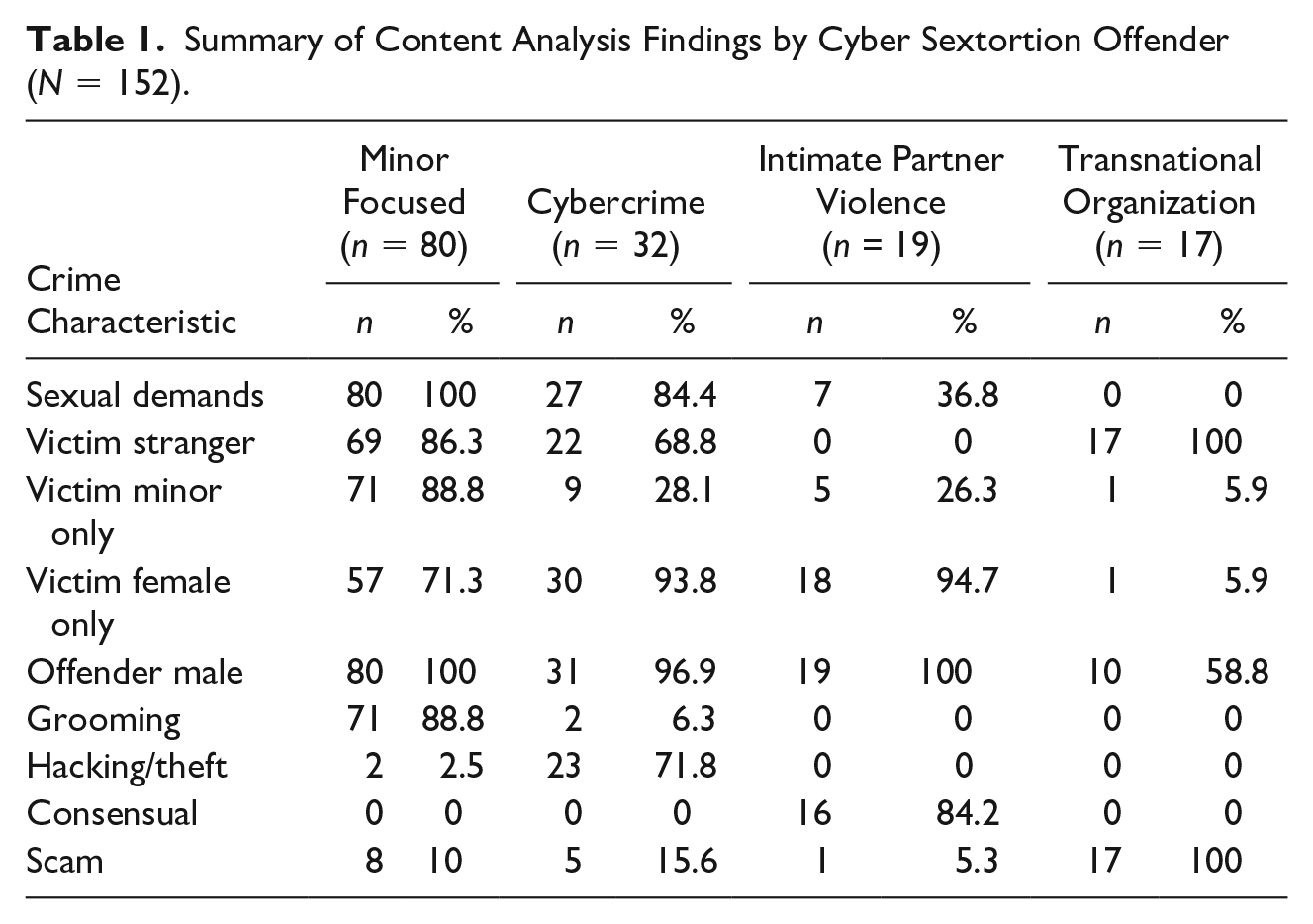
Cyber sextortion offenders differ in terms of their victim preference, types of demands, possible motivations, and the methods they employed to commit their crimes. Four distinct themes emerged from these data. These four themes are (a) minor-focused cyber sextortion offenders, (b) cybercrime cyber sextortion offenders, (c) intimately violent cyber sextortion offenders, and (d) transnational criminal cyber sextortion offenders. A summary of the results can be found in Table 1.
Summary of Content Analysis Findings by Cyber Sextortion Offender (N = 152).
Minor-Focused Cyber Sextortion Offenders
Minor-focused cyber sextortion offenders constituted the majority of cases (n = 80; 52.6%). They emerged as a unique offender group due to their demonstrated preference for minor victims, or those victims less than 18 years of age. For instance, the average age of victims targeted among these offenders was 14.22 (SD = 2.54) years old. The victim and offender in these cases were most often strangers. Despite the physical and emotional distance between the victim and offender, the threat to distribute images caused significant psychological distress for victims. The most common cyber sextortion demands among minor-focused cyber sextortion offenders were for sexually explicit material or physical sexual contact. Specifically, offenders most often ordered victims to produce more sexually explicit images and threatened to distribute their explicit images when they attempted to end contact with the offender: [Juvenile Victim 3] JV3 refused to send a photograph saying she was with her father. After [Defendant] continued to repeatedly ask for photographs without receiving any from JV3, [Defendant] stated he was going to ‘put u on blast too.” JV3 asked what [Defendant] meant and [Defendant] sent a screenshot of his telephone containing the Facebook chat message . . . with photograph JV3 took . . . The screen shot further showed the Facebook profile picture of JV3, which appeared to be her face and her first name. [Defendant] stated he would post the aforementioned screen shot to JV3’s whole school . . . [Defendant] said in exchange for phone sex and more photographs of JV3 he will not post the images to her school. (USA v. Cameron Scot Bivins-Breeden) In April 2012, a girl in Arizona reported that she had been contacted on Facebook by an individual using the profile name “Ralph Jenkins.” The individual using the Jenkins profile, later identified as Destin Whitmore, sent the teen compromising images of herself that she had previously sent to Whitmore, and he threatened to send those images to other persons, including her family members, if she did not immediately create additional images for him. (DOJ Press Release, 2015)
In this sample, 88.8% of minor-focused offenders (n = 71) used some form of manipulation and grooming to pressure minors into self-generating sexual images. Grooming is a process in which sexual offenders prime victims for attack by sexualizing conversations, building trust, and promoting silence (Craven et al., 2006; O’Connell, 2003). For example, minor-focused offenders often impersonated other minors to gain the trust of their victims: The defendant utilized a MySpace.com account in the false persona of “Brianna,” purportedly a female . . . complete with an image of a young women who appeared to be in her late teens. Using this false persona, he engaged in “chats” with his victims, who were all male children. (USA v. Bryan Jacobs)
As part of the grooming process, impersonation was used to seduce minors and manufacture a sense of trust. By deceiving victims into believing they were communicating with a similar-aged peer, offenders created a sense of reciprocity within image-sharing. In addition, online conversations turned from flattering to sexually explicit language, thus slowly grooming the victim toward increasingly sexually explicit performance (Acar, 2016; Kopecký et al., 2015): The minor victim, stated an individual who presented themselves as a young female initially contact him through Pinger . . . Victim stated the communications with offender quickly turned sexual in nature . . .” . . . Victim stated offender sent nude images of a young female through the KIK application and requested nude images of him in return. (USA v. Gregory Bogomol) In order to lure his victims, WALKER pretended to be an adolescent female . . . After determining the Child Victims were in his target group of girls between 8 and 14 years old, WALKER initiated chats with the Child Victims through Kik Messenger. During the course of their communications, WALKER broached the topic of trading picture . . . Each Child Victim had reservations about sending nude and sexually-explicit images to WALKER. WALKER overcame the Child Victims’ reservations by flirting and flattery designed to make them feel attractive and more confident about their bodies. Additionally, in order to lower the Child Victims’ inhibitions, WALKER injected sexual subject matters into their interactions . . . (USA v. Matthew Chaney Walker)
Minor-focused cyber sextortion offenders appear to be motivated by a sexual interest in minors. Approximately 55% of minor-focused offenders (n = 44) were arrested with large collections of child sexually abusive materials (CSAMs), which included images they procured from their victims. In some instances, the CSAM depicted children as young as 3 years old (USA v. Dustin Coleman). Although viewing and downloading within itself is not necessarily indicative of sexual interest in children (Lena Merdian et al., 2013; Rufo, 2012; Seto & Eke, 2017; Zilney & Zilney, 2009), long-term use of CSAM and collection of child abuse videos have been shown to significantly predict sexual interest in children (Seto & Eke, 2017) and sexual recidivism (Eke et al., 2019; Seto & Eke, 2015). Thus, sexual interest in children among minor-focused cyber sextortion offenders is important to consider as a motivation for their offending: During the search warrant, several optical discs (CD-R or DVD-R) were also seized. The discs contained numerous images of child pornography and child erotica, including nearly 80 images of Victim #1 and Victim #3. Several pornographic videos were located on the discs including videos of child rape, bondage and bestiality. (USA v. Wesley Brandt)
Furthermore, some offenders used the Internet to explicitly discuss a preference for minor victims: Offender explained, “nothing hotter than like a hot 15yo boy with a nice cock just getting pit hair and hairy legs;)” and “I looove like a 14yo with light hair on his legs and pits!;).” (USA v. Anton Martynenko) . . . email from Defendant to Victim 1 indicating receipt of a photograph of Victim 1 in undergarment: “16 [years old] is perfect. You are very sexy . . .” (USA v. John Michael Fowler) . . . [Defendant] sent VICTIM-1 the following chat messages: you got a hot lil body . . . what are you 14 15? (USA v. Jesse S Williams) The next day, Defendant told D.C. that he was really a man and a pedophile. Defendant said: “we need to have a serious chat,” “I’m not just a guy a man . . . Pedophile.” (USA v. Nicholas Glenn Wilcox)
Due to the prevalence of minor-focused cyber sextortion offenders possessing CSAM collections, and the explicit disclosure of sexual interest in young minors, it is likely that the sexual attraction to children may be the driving motivation for many of these offenders. Yet, this preference is not present among all minor-focused offenders. For instance, one offender, a 24-year-old man who targeted minor females, underwent psychiatric assessments which yielded no indicators of sexually deviant interest in children (USA v. Richard Fye). Some individuals may target minors simply because they are easier to access and manipulate.
There appeared to be clear victim preference among this group. Within the sample, 71.3% (n = 57) exclusively targeted female minors and 20% of offenders (n = 16) targeted only male offenders. Only 7.5% offenders (n = 6) showed versatility in victim preference and targeted both genders. This is consistent with previous research on preferential child sexual offenders who routinely target a specific age and gender and nonpreferential offenders who target a wide range of children based on opportunity (Knight & Prentky, 1990; Lanning, 2010).
In some cases, minor-focused offenders were able to commit harm not only online but in the “real world.” Approximately 32.5% of minor-focused offenders (n = 26) instructed their victims to sexually abuse other minors or engage in other forms of sexually deviant behavior, such as bestiality or incest: Defendant initiated a similar conversation with a 15-year old victim from Beloit, Wisconsin: “have you thought about fucking ur real mom ever??;)” He told the teenager “incest is hot.” When the teenager confessed an attraction to his step-mother, defendant suggested ways to “seduce” her. (USA v. Anton Martynenko) Communicating through the KIK service, JJ initially convinced NB [minor victim] to send JJ explicit pictures of NB’s 11-year-old sister. Once this was done, JJ coerced NB into sending more by threatening to expose him if he did not. As instructed, NB took pictures of him and his sister naked standing next to each other, his sister with NB’s penis in her hand, and of NB with his penis in her mouth, among other images of child pornography. (USA v. Joshua James Geer) He then demanded that Jane Doe One take videos of other “girls” and “sexy girls” who were undressing in changing rooms at pools, gyms, and clothing stores, and then give the videos to him. The target threatened Jane Doe One that, if she did not send him the demanded videos, he would post the sexually explicit photographs of Jane Doe One widely online, along with Jane Doe One’s actual name and address, which he listed in the e-mail message. (USA v. Michael Ford) Brandt’s threats eventually convinced an increasingly desperate Victim #1, at the explicit direction of Brandt, to pose naked with Victim #2, her six-year-old sister. (USA v. Wesley Brandt) In at least three instances [Hutchinson] coerced older sisters to engage in oral intercourse with their younger brothers while streaming the activity to him via their cell phones using an application called uzu (phonetic). (USA v. Tremain Hutchinson)
Minor-focused offenders, therefore, have the potential to inflict harm not only upon the victim but among multiple individuals. Coercing victims to abuse others—thus forcing a victim to engage as a perpetrator—adds a level of investigative complexity for law enforcement and increases the collateral consequences of offenses. Offenders can also use compliance with demands for the perpetration of others to further intimidate and scare the victim by convincing them that they are now criminals who will face serious legal trouble. Minor-focused sexual offenders had high victim counts, which indicates the potential to access many vulnerable victims.
Cybercrime Cyber Sextortion Offenders
Approximately 21.1% of cases (n = 32) were classified as cybercrime offenders. Unlike minor-focused offenders, cybercrime offenders did not specifically target minors and did not use grooming tactics. For the few offenders who did offend against minors, they did not exhibit sexual interest. These offenders used computer-based tactics to procure images and demand sexual material or contact from victims. These offenders overwhelmingly targeted female victims (n = 30, 93.8%). Almost one third (n = 10) of cybercrime offenders knew at least one of their victims. Access to explicit images was easily facilitated when victims and offenders had an existing relationship as there were more opportunities for offenders to either physically take the images or successfully hack passwords. Yet, it was more often the case that the victim and offender were strangers, which occurred in two thirds of cases (n = 21). The majority of offenders (n = 24) used theft/hacking to procure intimate images of victims, 22% used harassment tactics (n = 7), and 15.6% (n = 5) used social engineering scams to demand more sexual images or contact from victims: The conversations generally consist of the FACEBOOK ACCOUNT USER[Kelvin Acosta] attempting to manipulate the other individuals into providing their email accounts, passwords, and phone numbers . . . the FACEBOOK ACCOUNT USER offers a job and requests the individual’s personal information; then, once the individual has been tricked into providing their personal information, the FACEBOOK ACCOUNT USER often tells the individual that he has “hacked” the individual’s account and threatens to send the sexually explicit images and videos of the individual (in their account) to the individual’s friends and family unless they produce additional pornography. (USA v. Kelvin Acosta) When Vallee’s initial efforts failed to produce the desired photographs, Vallee then hacked into the girls’ online accounts. He primarily targeted their Facebook, Instagram, and e-mail accounts. He accessed the accounts by correctly guessing the answers to the security questions and then re-set the account passwords. Vallee then changed the passwords, took control over, and locked the girls out of their accounts. (USA v. Ryan Vallee)
The use of hacking illustrates the technological nature of sextortion. It overlaps not only with interpersonal crimes but also cybercrime offenses. It is important to note, however, that few of these instances involved technologically advanced or specialized knowledge. For instance, many offenders used social engineering tactics, researching victims’ online presence to obtain knowledge to guess account passwords. Others used more advanced computer skills to hack webcams and distribute malware to victims: . . . he took on the identity of a friend of the victim, tricked the victim into installing a malicious computer program on her computer (likely equipped with a special crypter that he often used to avoid antivirus detection), and then remotely stalked her capturing naked, intimate images of his unknowing, vulnerable, teenage victim. (USA v. Louis Mijangos)
Thus, cybercrime cyber sextortion offenders use some sort of theft, whether it be physical or technological, and in some cases specialized knowledge of computer hacking and social engineering to commit these crimes. Many times, these offenses resemble ransomware attacks in which victims are locked out of their accounts and told they will only be given access once the victim complies with the hacker’s demands. Cybercrime sextortionists, like all other sextortionists, used intimate images as a weapon against victims and similarly demanded payment in additional explicit content. Similar to minor-focused sextortionists, cybercrime sextortionists were able to successfully target a large number of victims, with one offender targeting nearly 800 victims (USA v. Michael Ford).
Intimately Violent Cyber Sextortion Offenders
A small number of cyber sextortion offenders targeted former or current romantic partners, and thus were classified as intimately violent cyber sextortion offenders (n = 19; 12.5%). Similar to other forms of technology facilitated intimate partner violence, intimately violent cyber sextortion offenders used cyber sextortion to control and manipulate victim behavior. All victims of intimately violent cyber sextortion offenders in this sample were female, which is consistent with the literature on traditional forms of intimate partner violence (Black et al., 2011).
Within this sample, 57.9% of offenders (n = 11) demanded nonsexual behaviors from victims, which was qualitatively different from minor-focused and cybercrime sextortionists. Nonsexual demands included that the victim remains in romantic relationships, ends new relationships with others, terminates or leaves work, and contacts or meets the offender: Krey, 37, was accused of threatening Davie police Officer Brittany Assam in an attempt to force her to quit her job. She was 22 at the time. Coral Springs police believe Krey wanted to get back together with Assam and began to threaten her when she declined. “You are going to have to leave Broward County, sweetheart,” a text message from Krey to Assam said, according to an arrest report. “Anywhere you go, I have people.” Assam testified about the 2014 incident in court Wednesday. She said he threatened her with pictures that she had sent him during their relationship. (State of Florida v. James Joseph Krey; Local10.com) She was fourteen-years-old at the time. In the beginning, CS described Jackson as charming . . . the two engaged in sexual activity . . . Jackson took videos and photographs of the conduct. Shortly after Jackson and CS met, his attitude changed. He took her phone and destroyed it. He changed passwords to her social media accounts. He gave her instructions on what she could and could not do. He controlled her. If she broke the rules established by Jackson, he would be verbally and physically abusive toward her. (USA v. Cody Lee Jackson) Kyle Stephen Hunt threatened to post nude photos of the woman, and photos of them having sex, to Facebook after she broke up with him . . . Hunt, of Meadows, N.L., had threatened to post the photos unless his ex told her friends they had not separated and were trying to work things out. He also threatened to kill himself. (The Canadian Press, 2017)
Intimate partner cyber sextortion shares similarities with revenge pornography (Citron & Franks, 2014). Yet, unlike revenge pornography, cyber sextortion involves only the threat to distribute images to control behavior, regardless of whether images are distributed or not.
Transnational Criminal Cyber Sextortion Offenders
The minority of cyber sextortion offenders were classified as transnational criminal cyber sextortion offenders (n = 17; 11.2%). These offenders targeted strangers and demonstrated no preference in terms of victim age. Consistent with other forms of cybercrime, they utilized scams and demanded money. Nine of the transnational criminal offenders (52.9%) specifically targeted male victims.
Similar to other cyber sextortion offenders, transnational criminal offenders capitalized on victims’ feelings of shame and embarrassment to control their behavior. The transnational criminal offenders are unique from the other groups identified in that they employed scams to trick victims into producing explicit images or videos. Some common examples included a webcam scam in which offenders seduced victims to engage in sexually explicit video chats. In some cases, the offender used pre-downloaded webcam sessions to trick the victim into believing the encounter was legitimate. Once the victim responded, the offender recorded the victim and used the recording to extort money from them: A half hour later I get a message on Facebook. “Listen,” it says, “I’m a man, and I recorded a video of you masturbating. Do you want to see it?” He sends me the video. It’s about five minutes of me masturbating. “I have a list of your friends and family from Facebook—your mum, your sister, your cousins,” he says. “You have one week to send me to send me 5,000 euros (£4,450), or I’ll send them the video.” (BBC, 2016) Seemingly, all cyber sextortion requires on the part of the perpetrator is an internet connection, moderate competency in English and a malicious disposition. The women that victims see stripping on screen are those in pre-recorded clips downloaded from pornographic websites, while the people behind the keyboards are usually young men—often transsexuals—working in gangs. And the Western Union transfers are invariably collected using fake ID cards. (Parry, 2017)
One of the most prolific transnational criminal cyber sextortion offenders in the sample was a woman by the name of Maria Caparas. She was arrested for operating a cyber sextortion ring in the Philippines. Caparas employed young women, transwomen, and men to solicit males online to engage in webcam sessions. These sessions were then recorded and used to extort thousands of dollars from the victims. Caparas’s victims spanned multiple countries that included China, the United States, and the United Kingdom: Youngsters working for Caparas allegedly operated in three-day shifts and could earn thousands of Hong Kong dollars a week—a fortune in a rural area where the average daily wage is HK$50 and the main employer is a cement factory in the nearby town of San Jose del Monte. One underage girl was allegedly paid more than HK$10,000 for three days’ “chatting” work. (Parry, 2017)
Transnational criminal cyber sextortion offenders are unique from other cyber sextortion offenders in that while they use sex to lure and entrap victims, their demands are strictly financial. Furthermore, although transnational offenders used some form of impersonation and trickery, these offenses progressed rapidly and demands were time-sensitive, which created an added sense of urgency for the victim.
Discussion
This study sought to understand cyber sextortion offenders based on crime characteristics, such as possible motivations, targets, and methodologies. The results of this qualitative content analysis of 152 cyber sextortion offenders revealed four different themes related to offenders: minor-focused cyber sextortion offenders, cybercrime cyber sextortion offenders, intimately violent cyber sextortion offenders, and transnational criminal cyber sextortion offenders.
Minor-focused sextortion offenders most often targeted minor victims, procured images through slower paced grooming strategies, and demanded their victims comply with an assortment of sexual behavior, such as producing more explicit images, engaging in sexual contact, or abusing other minors around them. Cybercrime cyber sextortion offenders were more direct in their interactions. Rather than building a relationship with the victim or using grooming methods, they relied on technology facilitated scams and hacking to steal images from victims and coerce them into providing more. Cybercrime cyber sextortion offenders demonstrated no preference for victims in terms of age and targeted both adults and minors. They demanded sexually explicit content from victims. Intimately violent cyber sextortion offenders targeted current or former romantic partners using images they procured during the course of their intimate relationships. Their demands were less likely to be sexual and were focused on controlling victim behavior. Transnational criminal cyber sextortion offenders were distinct from other cyber sextortionists in that they offended as part of organizations who engaged in crime as a business or for profit and specifically targeted men.
There are several key findings to consider. All cyber sextortion involves a sense of power and control over the victim that is wielded and maintained by the threat to distribute images through technological means. As such, cyber sextortionists take advantage of the highly connected space between offline and online to threaten and coerce, with the goal to promote fear of widespread exposure. Although all cyber sextortion offenders have this in common, they are a diverse group of individuals with varying motivations who employ different methodologies. The desired outcomes of threats differed greatly depending on the offender. Due to this diversity, cyber sextortion overlaps with many crime types, yet there are several ways in which cyber sextortion clearly differs from traditional forms of offline and online crime.
The offender themes that were most consistent with traditional crimes were those that involved cybercrime, intimate partner violence, and transnational violence. Cybercrime cyber sextortion offenders employed methods consistent with other forms of cybercrime, such as hacking and social engineering. This overlap illustrates the ways in which technology functions as a new tool in the execution of traditional offline crimes (Grabosky, 2001; Powell & Henry, 2017). However, the application of hacking for the purpose of sexually abusing and controlling victims is unique to cyber sextortion. Therefore, although the methods overlap with traditional cybercrime, the motivations of control are vastly different to those commonly attributed to hackers, such as curiosity, mastery, and rebelliousness (Jordan & Taylor, 1998; Steinmetz, 2015).
The crimes of intimately violent cyber sextortionists also share characteristics with traditional offline violence. Intimately violent cyber sextortionists targeted known victims—all female—for the purpose of power and control over their lives. These findings support extant research demonstrating that IBSA is a form of gender-based violence. For instance, female victims of intimate partner violence and revenge pornography report that partners used their sexual images to coerce compliance and control their behavior (Bates, 2017; Eaton et al., 2017; Ringrose et al., 2012; Woodlock, 2017). Cyber sextortion, where the threats are used but images are not distributed, is one more technology-facilitated crime used by offenders to target ex or current partners (Wolak et al., 2018).
Transnational cyber sextortion was similar to other forms of organized crime in that it involved more targeted selection of victims to make financial profit. Many transnational criminal offenders purposefully targeted successful men. For example, several politicians have resigned over transnational webcam scams, such as Rep. Ron Sandack (Goudie et al., 2016). The international nature of this type of cyber sextortion creates significant investigative difficulties, due to a lack of willingness to report on the part of the victim and the jurisdictional challenges that are involved in international crimes. The results of this study indicate the emergence of transnational criminals as a specific group of cyber sextortionists, with cases mainly reported in the media but rarely mentioned in empirical research (INTERPOL, 2014; Parry, 2017; “Record Numbers of UK Men Fall Victim to Sextortion Gangs,” 2018; Wolak et al., 2018).
The one offender theme that differed the most from traditional offline crime was the minor-focused offenders. Minor-focused cyber sextortion offenders were in many ways similar to offenders who commit sexual crimes both on and offline. For instance, they demonstrated higher levels of sexual deviance, illustrated by their large collections of CSAM and coercion of youth to abuse others. Possession and interest in CSAM may predict deviant interest in children (Seto et al., 2006), suggesting that this may be a motivation for minor-focused sextortionists. Similar to offline child sexual offenders, minor-focused offenders can be understood as either being fixated on children or simply offending as part of a lifestyle of deviant behaviors. This is consistent with existing typologies of child abusers, where some are preferential offenders who are sexually attracted to children and others show no clear victim preference and offend based on opportunity (Lanning, 2010). Minor-focused cyber sextortion offenders also used grooming and impersonation to take advantage of the way minors use technology to communicate and flirt (Gordon-Messer et al., 2011), which is commonly seen among offline predators.
However, there are distinct differences between minor-focused sextortionists and offline sexual offenders. For example, minor-focused offenders were most often strangers to the victim. This is in stark contrast to the majority of sexual crimes against minors, where the victim and offender are known to one another. In addition, lthough grooming methods are common in both crimes, extortion is relegated to sextortion. Minor-focused cyber sextortion offenders used threats to disseminate images to control victim behavior. Although power and control are central to child sexual abuse, these threats are not typical in crimes against minors in an offline environment. Offenders may record crimes or take photos of victims, but cyber sextortionists use media to directly affect victim behavior. Current research has found that new CSAM in circulation across the Internet is mostly composed of webcam stills of children engaging in explicit behavior alone in their rooms (Internet Watch Foundation, 2018; Smith, 2012). Individuals who use grooming tactics to seduce minors online into distributing sexually explicit images may be part of this trend. In addition, the use of sextortion to coerce compliance from victims represents a diverse form of sexual violence in which the perpetrator is not simply motivated to create abusive collections but instead terrorizes their victims for extended periods of time.
Limitations
There are several limitations to the present investigation that should be addressed. First, the use of a key-term search for case identification relies on news’ and court documents’ use of the term “sextortion” rather than some other iteration of IBSA, such as revenge pornography. Therefore, it is possible that many cases labeled as revenge pornography would have also satisfied inclusion criteria but were not identified using the data collection strategy.
Second, this sample included offenders who have been apprehended and arrested, thus the sample is not an accurate reflection of true prevalence of cyber sextortion. Namely, the large representation of minor-focused offenders in this sample may represent the current preoccupation among federal law enforcement in investigating and prosecuting these crimes (Department of Justice, 2016), and not that most cyber sextortion is committed by minor-focused offenders. Furthermore, prosecution of crimes against children may be more successful, leading to a wealth of court documentation that may not be available in other types of cyber sextortion offenses. Similarly, the low number of other offenders may be because they are harder to investigate and therefore do not result in apprehension. The minority of transnational criminal cyber sextortion offenders within this sample illuminated the challenges associated with identifying and charging transnational offenders. Although cyber sextortion against men by foreign offenders is the most rapidly expanding type of cyber sextortion (INTERPOL, 2014; “Record Numbers of UK Men Fall Victim to Sextortion Gangs,” 2018), this group was the smallest within this sample.
Third, the reliance on media reports of cyber sextortion may have skewed the data toward more serious offenders. News articles may only report on the most egregious examples of sextortion, which would make it difficult to generalize to other forms of sextortion. This limitation may also have led to the large representation of minor-focused cyber sextortion offenders within this study, despite research indicating that adult women are often victimized by IBSA (Henry & Powell, 2015; Lee & Crofts, 2015), such as stalking, harassment, and coercion (Crisafi et al., 2016; Spitzberg & Hoober, 2002; Woodlock, 2017). Thus, the use of media sources and open source documents provides some insight into which victims may be underrepresented in the media. It is often the case that empirical investigations involving technology take time to “catch up’ to the actual behaviors that are under study (Lamphere, 2012).
This study was also unable to examine issues such as race and ethnicity of victims or perpetrators. Sexual orientation was another variable that could not be examined but should be in the future, as existing research suggests that lesbian/gay/bisexual/transgender/queer individuals are more likely to be the victims of IBSA and violence generally (Powell et al., 2019). Despite these limitations, this study adds to emerging research on cyber sextortion offenders and illustrates their diversity.
Conclusion
Cyber sextortion has been conceptualized as part of a larger continuum of IBSA in which explicit and private images are nonconsensually created and used to threaten victims and manipulate behavior (Citron & Franks, 2014; McGlynn & Rackley, 2018). Current legislation created for other forms of IBSA, such as revenge porn, focus on the dissemination of images and the intent of the perpetrator to use dissemination to emotionally harm their victim (Franks, 2016). Laws that require image distribution will not assist victims of cyber sextortion, as their images may never be shared. In addition, language that assumes all forms of cyber sextortion are similarly motivated may not capture the myriad of demands victims experience, whether sexual, behavioral, or financial. Research has found that offenders who have targeted minor victims can be prosecuted under federal child exploitation laws, which are accompanied by lengthy mandatory minimum sentences (Wittes et al., 2016a). Conversely, offenders who target adults or use computer hacking often receive very minor sentences, even if they have targeted hundreds of victims (Wittes et al., 2016a). This is because prosecutors rely on creative changing schemes in the absence of applicable laws.
The results of this study support other empirical investigations which call for legislation to be inclusive of multiple forms of IBSA and adapt to the changing technological landscape of sexual violence (Citron & Franks, 2014; Henry & Powell, 2015; McGlynn & Rackley, 2018; Powell & Henry, 2017). Perhaps policymakers could reform existing extortion laws to account for the changing technological nature of cyber sextortion. There are existing charges that often accompany CSAMs charges, such as using a computer to commit a crime. Treating cyber sextortion as an aggravating factor could be employed by prosecutors to better serve victims.
Future research should focus on the gendered nature of these crimes, as it appears that when the cyber sextortion demands are sexual, females and minors are more likely to be victimized, but if the motivation is financial, adult males are targeted. In this sense, the experiences of cyber sextortion victims appear to be gendered and age-graded and should be explored further in research.
Finally, there should be attempts to validate these initial offender themes through statistical analyses to examine whether they exist as distinct types. The use of other methodologies and samples is necessary to develop an accurate and comprehensive understanding of cyber sextortion. Victim level data may elucidate crime characteristics from the victims’ perspective, regardless of whether an arrest occurs. Further investigation is needed to explore cyber sextortion, both as a unique crime and as part of the broader integration of technology into interpersonal violence.
Footnotes
Declaration of Conflicting Interests
The author(s) declared no potential conflicts of interest with respect to the research, authorship, and/or publication of this article.
Funding
The author(s) received no financial support for the research, authorship, and/or publication of this article.
