







Abstract
Arrests for acts of violence against women are a common occurrence for professional athletes, including National Basketball Association (NBA) players. Many sports fans, players, and those involved in professional sport believe that arrests for acts of violence against women, whether they result in a conviction or not, are highly detrimental to an athlete’s career. We matched all 30 NBA players arrested for acts of violence against women between 2000 and 2016 with similar players who were not arrested and examined the effects of the arrest on postarrest average annual salary and career longevity. We found no significant difference between arrested players’ careers and the careers of nonarrested counterparts. From a social learning perspective, this lack of punishment or loss of reward could be an important factor in continued acts of violence against women among NBA athletes.
Introduction
Athlete arrests are a common occurrence. Arrests for acts of violence against women are a serious problem among professional athletes (Moser, 2004; Withers, 2010), one which professional sports leagues’ do not sufficiently address (Ugolini, 2007; Webb, 2012). Although violence against women is clearly a larger social problem (Johnson et al., 2008; True, 2012), several studies have found that athletes commit and are arrested for more acts of violence against women than men in the general population (Johnson et al., 2008; Miller et al., 2006). And while research suggests that sanctions for these acts are negligible (Withers, 2010), many sports fans still believe that arrests and criminal allegations are likely to ruin an athlete’s career (Delgado, 2014; “Fans Rip Into TMZ,” 2018).
Yet, we have little empirical research showing whether this is indeed the case. Although scholars have examined the specific one-time sanctions (usually fines and suspensions) given to professional athletes involved in violent acts (Ambrose, 2008; Brown, 2016; Kim & Parlow, 2009), there has been no comprehensive examination of the career outcomes of athletes following arrests for acts of violence against women. It therefore remains unclear whether these arrests actually affect the athletic careers of professional athletes. The current study examines this question, looking at professional basketball players. From a criminological conflict theory perspective, the answer to this question is not straightforward. On one hand, NBA players belong to a traditionally overcriminalized and highly sanctioned racial group (Vuolo et al., 2017), suggesting that they may be sanctioned more heavily following acts of violence. On the other hand, these players are also part of a traditionally undercriminalized and undersanctioned status and economic class, one which is often able to buy its way out of criminal charges or avoid them altogether, as the criminal justice system tends to come to their aid in such cases (Lanier, 2018; Reiman & Leighton, 2015).
However, if sport leagues hope to curb negative behaviors by athletes, deterrence perspectives might suggest that the players should indeed pay a clear price for their actions in the form of tangible sanctions related to career prospects and salaries. Such sanctions might deter future acts and serve as a warning sign for other athletes. In addition, social learning theories emphasize the players’ high status and the fact that they often serve as role models (Choi & Rifon, 2007), again suggesting that meaningful and visible sanctions may send a message that such acts are socially unacceptable (Akers, 1990).
To examine the effects of arrests following violence against women on career outcomes, we collected data on all the National Basketball Association (NBA) players who were arrested for such charges between the years 2000 and 2016 (n = 30). We matched each of these players with a player who was not arrested but was as similar as possible in terms of their age, race, role on the court, career achievements, and relevant statistics. Comparing the career duration and salaries of these players in subsequent years thus allowed us to reexamine the common notion that players pay a substantial price merely for being accused of a violent act and arrested for it, even if they are not eventually convicted.
Previous Research on Violence Against Women by Professional Athletes
Previous research on athletes’ violence against women in the four largest North American professional sports leagues (National Football League [NFL], NBA, Major League Baseball, National Hockey League), has examined a number of issues. Although data on domestic and sexual violence complaints can be difficult to compile and acts of violence against women are often underreported (Fugate et al., 2005), researchers have attempted to determine the prevalence of these incidents by both professional and collegiate athletes. Dabbs (1997), citing a Washington Post review (Brubaker, 1994), noted that between 1989 and the end of 1993, 141 active and former professional and collegiate football players had been reported to the police for an act of violence against women. More recently, Schrotenboer (2019), who has kept a running online database of NFL player arrests since the year 2000, reported that between that time and December 2018, 124 NFL players had been arrested for an act of violence against women.
In terms of league and team response to athlete-perpetrated violence against women, researchers have examined how league policies govern allegations and convictions for these incidents. Although professional sports leagues and teams do pay some attention to violence against women, these leagues and teams do not legislate off-field violence against women as often and as swiftly as they do on-field violence (Brown, 2016; Kim & Parlow, 2009; Moser, 2004).
Most of the literature surrounding athlete behavior and league sanctions has looked at the NFL, where arrests and convictions for acts of violence against women have been most common among all major professional leagues in the United States (Ambrose, 2008; Brown, 2016). Very few have thus examined other leagues, such as the NBA. Moreover, previous studies have only looked at the disciplinary authority and powers of commissioners, leagues and teams (Ambrose, 2008; Kim & Parlow, 2009) following acts of violence against women committed by athletes, and did not account for the effects of these acts on athletes’ careers. Suspensions, fines, or mandated counseling have a one-time, short-term impact. These studies therefore could not capture the effect that arrests following violence against women might have on the accused athlete’s entire career and earning potential. In the current study, we examine these issues focusing on the case of the NBA.
Theoretical Framework
Criminological deterrence (Silberman, 1976) and social learning theories (Akers, 1990) provide useful perspectives for examining the persistence of violent acts by professional athletes. These theories point to the importance of legal (Silberman, 1976) and extra-legal punishment and sanctions (Akers, 1990; Nagin & Pogarsky, 2001), as well as the loss or anticipated loss of rewards or investments (Akers, 1990; Imai & Krishna, 2004) in deterring would-be criminals. Both of these theories stress the importance of consequences for curbing criminal activity. Beyond the formal, legal risks of criminal conviction and prison time, the risk of losing earnings or employment opportunities as a professional athlete may serve as an extra-legal sanction that could have a similar deterring effect on violent acts among athletes. These types of extra-legal sanctions have been observed in nonsports contexts, as research has shown that individuals with prior convictions (though not arrests) are less likely to receive callbacks for jobs (Agan & Starr, 2016; Pager, 2003). Importantly, this effect was even more pronounced for Black men (Agan, 2017; Tonry, 1995; Vuolo et al., 2017), who make up a significant percentage of NBA players. This body of research points to the possibility that NBA players might also suffer negative career consequences following acts of violence against women.
Social learning theories further suggest that high-profile athletes in professional leagues serve as prominent role models for youth and a large population of sports fans, most of whom are men (Benedict, 1997; Burch & Murray, 1999; Choi & Rifon, 2007). As such, the importance of tangible and visible consequences for their actions, particularly when using of violence, goes beyond the mere effects on the athletes themselves. When athletes who have misbehaved or committed criminal acts visibly pay a price for these acts, this has the potential to serve as an educational tool, setting or reaffirming social norms regarding violence against women (Benedict, 1997; Kim & Parlow, 2009). If the NBA and its teams were committed to deterring such incidents, deterrence and social learning theories would suggest that players should suffer negative career consequences in response to arrests and convictions for acts of violence against women.
Criminological conflict theories highlight some potentially contrasting results. Although most NBA players may belong to a traditionally overcriminalized and highly sanctioned racial group (Shor, 2008; Shor & Yonay, 2010; Tonry, 1995; Vuolo et al., 2017), which would predict harsh sanctions for criminal behavior, they also belong to a traditionally undercriminalized and undersanctioned status and economic class (Reiman & Leighton, 2015). Conflict theorists suggest that groups with high status and economic means have the power to determine what is criminal or deviant and what is not (Lanier, 2018) within a social and criminal system that benefits those with more social power and money (Barkley, 2006). The fact that the majority of NBA players are both Black and wealthy thus presents an interesting theoretical puzzle when examining the consequences of their actions.
Apart from their own personal wealth, NBA players also often have the support of even wealthier and more powerful sport organizations and their legal and public relations teams. Professional sports leagues, who are worried about the reputation of the league and its ability to attract commercial endorsements and sign lucrative television contracts, also prefer that their players’ reputations remain intact, motivating them to try to influence the legal system and encourage players to reach confidential settlements away from the public eye (Moser, 2004). Analyzing several case studies, Moser (2004) noted the difficulty that prosecutors have in convicting professional athletes of domestic and sexual violence, as prosecutors are often deterred by highly paid and powerful attorneys, who frequently frame victims as “groupies” or fans who tried to take advantage of wealthy athletes.
Method
Arrested Player Sample
The sample of arrested players used in this study consists of all 30 NBA players arrested for an alleged act of violence against women between the years 2000 and 2016. This timeframe was chosen because it is relatively recent, allowing us to collect relevant and easier-to-track information. Moreover, our research question requires a large-enough time period following on a player’s NBA career after the arrest to assess the long-term effects of the arrest. Including only players arrested until 2016 ensured that there was enough time to examine the potential effects of the arrest on their careers (at least 3 years). We tracked information on players arrested for alleged acts of violence against women using the NBA Crime Library website (NBA Crime Library, 2019), which records all arrests of NBA players.
We included in the sample players arrested for domestic violence, domestic assault, domestic battery, domestic abuse/assault, battery, or sexual assault of a woman. Using ProQuest’s North American journalism search engine, we corroborated the NBA Crime Library reports to ensure the reliability of the arrest reports. We also used these searches to fill in key information regarding the relationship of the alleged victim to the athlete, the date and location of the incident, the formal charges laid, and the conviction, sentence, or any disciplinary action doled out by the team or the NBA (if applicable). We then used data from basketball-reference.com (Basketball Statistics and History, 2019) to record the age of the player at the time of the arrest, their race, and their player statistics (described below), as well as yearly salary information both before and after the arrest.
Matched-Pairs Design
A matched-pairs research design is effective in assessing the impact that one intervening factor can have on an outcome, by comparing the results of an affected research subject with those of an unaffected, matched subject (Mallin et al., 1995). In this case, the intervening factor is the arrest for an act of violence against women. To assess “before” and “after” data for matched, nonarrested players, the date (henceforth “intervention date”) for the matched player (the player who was never arrested) was determined based on the date of the arrest for the arrested player. For example, point guard Darren Collison was arrested on May 30, 2016 for charges of domestic violence, after his seventh season in the NBA. The player matched with him, point guard George Hill, was therefore selected based on his similarities (described in further detail below) to Collison during their first seven seasons in the NBA (particularly during Seasons 5–7). Collison’s and Hill’s first 7 years in the NBA are therefore considered the preintervention period.
Criteria for Choosing Matched Pairs
As noted above, matched, nonarrested athletes were chosen based on similarities to arrested athletes in criteria that are most likely to determine NBA players’ salaries (Berri et al., 2006; Lyons et al., 2015; Yang & Lin, 2012). These include points scored per game, field goal shooting percentage, rebounds per game, assists per game, age, and draft pick number. Although we also considered matching on average salary before the time of the arrest, current salary is in fact a weaker predictor of future salary than the factors described above (Berri et al., 2006; Lyons et al., 2015; Yang & Lin, 2012).
We first matched players on their race (we matched only players of the same race). We next considered the players’ age, which had to be within 2 years of each other. 1 We then determined the intervention date, which had to be within 2 years of the arrested player’s arrest date. 2 Next, we considered players’ statistics, giving priority to points per game, followed by field goal percentage, rebounds per game, and assists per game. Draft round and number were given similar importance to the categories of rebounds per game and assists per game.
The following example illustrates the matching process: NBA superstar Kobe Bryant was arrested for sexual assault on July 4, 2003. To find the best match for Bryant, we first calculated his averages in points per game (27.9), field goal percentage (46.11), rebounds per game (6.1), and assists per game (5.5) over the three seasons preceding his arrest (2000–2001, 2001–2002, 2002–2003). We also recorded the round (first) and selection number (13) where he was drafted, his age at the time of the arrest (24), the number of seasons he played in the NBA before his arrest (seven), the position he played (shooting guard), and his race (Black).
Using basketball-reference.com’s player season finder tool, we then searched for a matched player based on as many of these parameters as possible. In the case of Bryant, we searched for Black players between the ages of 21 and 26 years, who played between the 1999–2000 and 2003–2004 seasons, were listed as playing either the guard or small forward position (as shooting guards and small forwards are often interchangeable), who scored between 24 and 30 points per game, and had four to eight rebounds per game. This initial search yielded seasons played by Tracy McGrady, Vince Carter, and Paul Pierce. Although all three players had seasons that matched these parameters, McGrady’s statistics were closer to those of Bryant than those of the other two players in terms of points per game, field goal percentage, assists per game, and age after their seventh season in the NBA. We therefore matched Bryant with McGrady. In Appendix A, we list the full set of all 30 matched pairs, as well as the most relevant criteria for the matching.
Measurements
To measure career outcomes after the intervention, we recorded two variables for player salary and two additional variables for career longevity. For player salary, the average annual salary was recorded for all players, on all contracts signed after the intervention date. Any contract signed before the arrest/intervention date, where the contractual period continued into the years following the arrest/intervention date, was not included in the calculation of players’ salary. The second salary outcome variable was salary difference, calculated to examine how a player’s salary had changed from before to after the arrest (or intervention date for the matched player), and to account for potential preintervention date salary differences between the paired players. Salary difference was calculated by subtracting the average annual salary earned by a player after the date of the intervention from their average annual salary in their last contract signed before the intervention date.
For career longevity, we first used the number of NBA seasons in which a player participated following the intervention. However, due to variation in the maximum number of years (i.e., if the arrest happened at the end of the 2016 season, a player could only have played a maximum of two NBA seasons prior to our data collection date), we also created a standardized, percentage-based variable for career longevity. NBA season percentage was calculated to measure the percentage of seasons in which a player participated out of the total available seasons following the intervention date, with a cutoff point of age 33 as the last hypothetical “potential season” before a player was expected to retire.
The NBA season percentage variable is a more accurate reflection of a player remaining in the NBA after the intervention point, as it accounts for the exact timing in which the player was active, but also for the point in their career in which the intervention occurred. For example, if two players each played five NBA seasons after the intervention date, but one player’s fifth postintervention season was at the age of 33 years and the other’s fifth postintervention season was at the age of 28 years, these players’ potential career longevity should not be considered the same. The first player played until an age where many players retire or are unable to stay in the league, while the other player was not playing in the NBA in what should be the prime of his athletic career. This potential disparity is corrected using the NBA season percentage variable. In this measure, the first player’s NBA season percentage variable score would be 100%, as he played in all of his potential expected seasons (given an expected retirement age of 33 years). In contrast, the second player’s score is only 50%, as the intervention date occurred during their age of 23 years, and they only played in five seasons out of a potential 10.
Statistical Analyses
All analyses were conducted using R. Descriptive statistics were calculated for the arrested and nonarrested groups. We calculated paired two-tailed t-tests for the entire group of matched pairs for each of the four outcome variables described above. Following this full sample test, we also conducted complimentary robustness analyses for the following three subsamples. First, we examined only less notable players, those for whom the last preintervention contract was under US$2,000,000 (n = 14). Second, we examined only convicted players, that is matched pairs where the arrested player either plead guilty or was convicted of a criminal offense (n = 9). Finally, we looked at league- or team-sanctioned players, that is, pairs where the arrested player was officially sanctioned by the NBA or by his team (n = 9).
Results
We found no statistically significant differences between the group of arrested players and the group of nonarrested, matched players in terms of the players’ career longevity or salary. This was the case for all four outcome variables, both in the full sample (Table 1) and in the three subgroups. However, given the relatively small sample size of the population in question, this lack of statistical significance should be treated cautiously. It is therefore also important to examine whether there were any differences between the groups, even if these were not statistically significant (especially since the sample consists of the entire population of cases—all players for whom it is known that they committed a violent act).
Mean Values and t-Test Results for the Full Sample (n = 30 Matched Pairs).
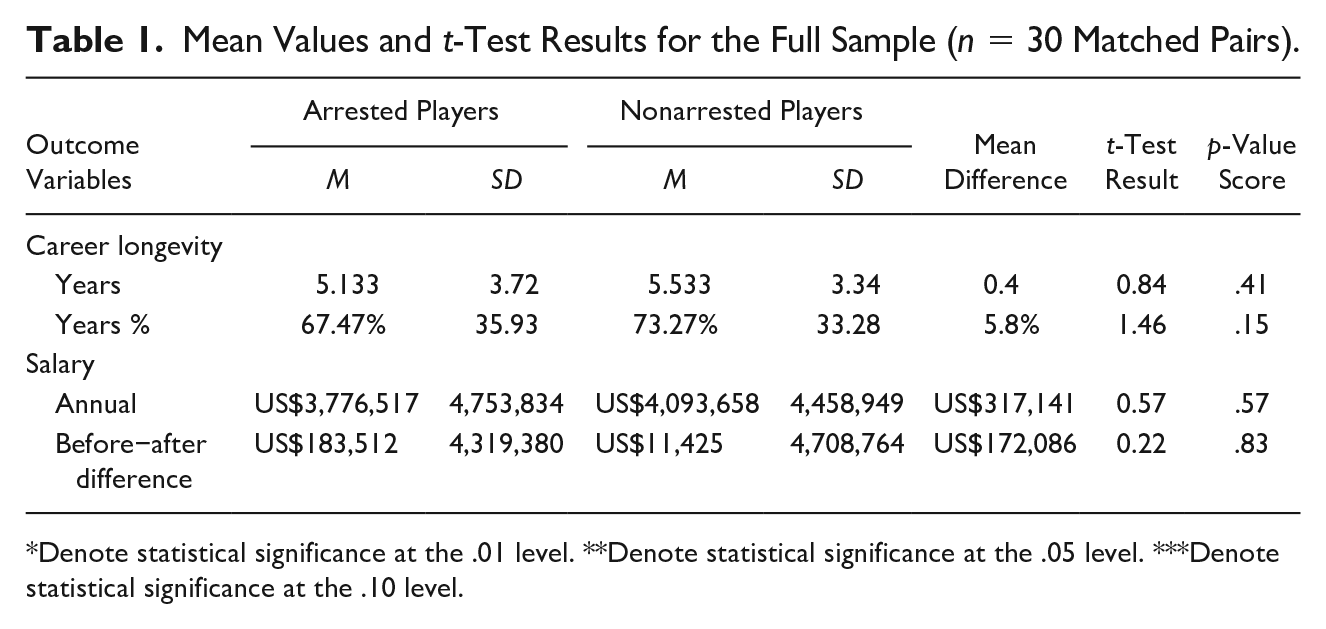
Denote statistical significance at the .01 level. **Denote statistical significance at the .05 level. ***Denote statistical significance at the .10 level.
For the full sample of 30 matched pairs, the average nonarrested player played 0.4 more years in the NBA than the arrested player, and played in 5.8% more of their potential available seasons. Nonarrested players also earned on average US$317,141 more per year than arrested players, a difference of 8%. Moreover, in terms of the salary difference, which takes into account how much a player’s salary had changed between their contracts prior and following the arrest (or intervention point for nonarrested players), arrested players actually saw a larger positive change from their pre- to post-arrest salary compared with their nonarrested counterparts. Nonarrested players’ salaries increased by an average of only US$11,425, compared with US$183,512 for arrested players. All of these differences are relatively minor and, as noted above, none of them were statistically significant.
We found similar results when examining smaller groupings of players, who theoretically should be more negatively affected by their arrests. These include less salient players (a preintervention salary of less than US$2,000,000), criminally convicted players, and league-or team-sanctioned players.
Discussion
We examined the popular claim that accusations and arrests for alleged acts of violence “ruin a person’s career”. More specifically, we explored the effects of NBA players’ arrests for acts of violence against women on their career outcomes, measured by postarrest salary and career longevity. There were only minor differences between the arrested and nonarrested players, and none of these differences was statistically significant. Although our sample was not large (n = 30 matched pairs), it should be noted that it encompassed all cases of arrests following violence against women by NBA players between 2000 and 2016. The results therefore point to negligible career consequences for arrested athletes, at least in terms of annual salary and career longevity. Moreover, while it was not within the scope of this study to examine the facts of the criminal cases themselves, only nine of the 30 players arrested were convicted (or plead guilty), and only nine of the 30 were sanctioned in the form of suspension or a fine by the NBA or their teams. Three of the nine players convicted or found guilty for their act of violence were not sanctioned by the NBA or by their teams. Cynics of sport business may find these results unsurprising, as would proponents of sociological conflict perspectives, who consider professional athletes as part of the wealthy, dominant class of people who stand above the law.
Although one should be cautious when generalizing the results beyond the group of elite NBA athletes analyzed here, it is important to note that the argument about arrests having a serious negative effect on people’s lives has not been supported by our study. This argument is often used to claim that accusations that do not result in conviction or outright false accusations are nearly or just as dangerous as the acts of violence themselves. Notwithstanding the assessment that only approximately 5% of allegations of domestic violence appear to be false allegations (Ferguson & Malouff, 2016), the results of this study suggest that the claims about the arrests themselves being enough to destroy an athlete’s career seem exaggerated or even misplaced. Although we were not able to examine the potential effects of arrests on endorsements and off-the-court financial opportunities, the professional careers and salaries of NBA players arrested for acts of violence against women appear mostly unaffected by these arrests.
For those who argue that players’ careers should indeed not suffer from arrests, because the North American legal system operates under the premise that the accused is innocent until proven guilty, it is important to note that there was no significant effect even when limiting the analysis to players who were actually convicted. Even when these players were sanctioned by either the NBA or their team, we observed no significant effect on the arrested player’s career.
Our findings also stand in contrast with research on general employment contexts, which conclusively showed that criminality had a significant negative effect on employment, particularly for Black men (Agan, 2017, Vuolo et al., 2017). Despite the fact that 28 of the 30 arrested NBA players in this study were Black, these athletes’ careers were not substantially altered by their arrests. These findings highlight the strong effect that class and wealth have both on how athletes are perceived and on their ability (and that of their team and the league) to control the narratives surrounding arrests. It appears then that in professional basketball the effects of wealth, status, and celebrity are more powerful than the racial biases that habitually affect arrested Black men’s futures.
The lack of career effects due to arrests following violence against women may also be related to the nature of the crime itself. Research examining the effects of criminality or arrests on employment normally looks at criminality generally, rather than at a specific subset of crimes, such as violence against women. Although it is now generally acknowledged that violence against women is a criminal activity, many still consider it a private, domestic act that occurs between spouses or romantic partners, and therefore something that is best dealt with privately by couples (Farris & Holman, 2015; Nair, 2001). About 23 of the 30 arrests in this study involved alleged acts against a romantic partner. These arrests are also reliant on formal complaints by the women involved, and many people are hesitant to believe the women in these cases, as the private nature of these acts often does not allow them to present tangible evidence (Catalano, 2012; Felson et al., 2002). This fact not only affects the number of arrests, but could also influence the consequences of these arrests and the rates of conviction.
According to the logic of deterrence and social learning criminological theories, the NBA’s lackluster treatment of players accused of acts of violence against women could stunt efforts to reduce the prevalence of these crimes. We are unable to directly measure whether stronger penalties for violence against women arrests would deter other athletes from engaging in violent behavior. However, studies from various contexts suggest that the threat of future extralegal consequences and adverse effects in the labor market related to arrests may serve as a powerful deterrent to future crime (Imai & Krishna, 2004; Sitren & Applegate, 2012). The fact that this has not been the case in the present setting therefore does not bode well for efforts to reduce future violence against women among athletes.
Still, it is important to note that even a potential change in the way that the NBA and its teams handle arrests for acts of violence against women is unlikely to completely eliminate violence. There are many reasons for the continued prevalence of violence against women perpetrated by athletes and only some of them may be related to a lack of sufficient response and consequences for these acts. Clearly, the context in which this violence occurs should also be considered. Professional sports are in many ways a breeding ground for fraternal, toxic masculinity that results in violence (Messner & Sabo, 1994). Some argue that the violence and aggression often demanded from professional athletes during games may have spill-over effects on their personal lives (Schneider & Tinklenberg, 2016). Others note the preferential treatment elite athletes receive throughout their lives, such as full-ride scholarships, free athletic equipment, and preferential treatment from coaches, teachers, administrators, and many others as conducive to a belief among athletes that they are above the law and do not have to pay a price for their actions (O’Hear, 2001; Trebon, 2007). Unfortunately, this belief may actually be warranted for NBA athletes, given the results of the present study. Finally, athletes may also commit acts of violence for some of the same reasons that those in the general population do, including growing up in lower socioeconomic neighborhoods with less police presence, and in families where violence is normalized and learned at a young age (Johnson et al., 2008).
Regardless of these additional factors, the lack of serious career-related consequences for NBA athletes arrested for acts of violence against women is potentially important, as social control mechanisms involved in criminality do not seem to carry much weight in this case. It is important to be cautious when generalizing the findings of this study beyond the context of the NBA, as sport- and league-specific factors could play a role in determining how elite athletes in other sports are impacted by such arrests. Still, when it comes to NBA players, neither an arrest nor a conviction for an act of violence against women is the career death-sentence many purport it to be.
Future research examining athlete arrests for acts of violence against women could examine how these arrests affect athlete sponsorship and endorsement contracts. This relationship could also be explored qualitatively, through in-depth analyses of a few professional sports cases where an arrest or conviction for an act of violence against women did have a negative effect on an athlete’s career. Such an investigation may allow us to examine the factors at play in cases where athletes do pay a price for their actions. Future research could also examine the effects of arrests following violence against women on career outcomes for athletes in other professional sports leagues, both in North America and abroad. This work could be used to test whether leagues with historically harsher consequences for arrested players have subsequently seen a drop in athlete arrests, in line with social learning principles. Finally, the impact of the #metoo movement is an interesting avenue for future research, as athlete arrests in the years following the rise of this movement may have a stronger effect on career outcomes than those before it. In the current study, we were unable to assess the effects of the #metoo movement, as not enough time has passed since these more recent arrests to assess career outcomes.
Footnotes
Appendix A
Declaration of Conflicting Interests
The author(s) declared no potential conflicts of interest with respect to the research, authorship, and/or publication of this article.
Funding
The author(s) received no financial support for the research, authorship, and/or publication of this article.
