







Abstract
“Gay panic” refers to a situation in which a heterosexual individual charged with a violent crime against a homosexual individual claims they lost control and reacted violently because of an unwanted sexual advance that was made upon them. This justification for a violent crime presented by the defendant in the form of a provocation defense is used as an effort to mitigate the charges brought against him. There has been relatively little research conducted concerning this defense strategy and the variables that might predict when the defense is likely to be successful in achieving a lesser sentence for the defendant. This study utilized 249 mock jurors to assess the effects of case type (assault or homicide) and juror characteristics (homophobia, religious fundamentalism, and political orientation) on the success of the gay panic defense compared with a neutral provocation defense. Participant homophobia was found to be the driving force behind their willingness to accept the gay panic defense as legitimate. Higher levels of homophobia and religious fundamentalism were found to predict more leniency in verdict decisions when the gay panic defense was presented. This study furthers the understanding of decision making in cases involving the gay panic defense and highlights the need for more research to be conducted to help understand and combat LGBT (lesbian, gay, bisexual, and transgender) prejudice in the courtroom.
Keywords
On October 6, 1998, Aaron McKinney and Russell Henderson, believed to be posing as two young gay men, lured 21-year-old Matthew Shepard, an openly gay University of Wyoming student, out of a local bar by offering to give him a ride home. However, instead of taking him home, the two men drove Shepard to a remote area just outside of Laramie, WY, where they began to beat him relentlessly; reports stated that he was hit in the head more than 18 times with the butt-end of a pistol. He was tied to a fence, continuously beaten, and robbed. Shepard was left tied to the fence for nearly 18 hours before being discovered by a passing biker. He later died from his injuries (Marsden, 2014; State v. McKinney, 1999, as cited in Tomei & Cramer, 2016). Instead of going to trial, Henderson plead guilty for his role in the attack to avoid a potential death penalty conviction in exchange for consecutive life sentences. Conversely, McKinney opted to go to trial using the diminished capacity defense known as the gay panic defense. McKinney’s case is now one of the most well-known attempts of the gay panic defense in U.S history (LGBTQ+ Panic Defense, n.d.).
The term “gay panic” refers to a situation in which a heterosexual individual charged with a violent crime against a homosexual individual claims they lost control and reacted violently because of an unwanted sexual advance that was made upon them. The defense is an effort by the defendant to mitigate the charges against him (Lee, 2008; Salerno et al., 2015). At McKinney’s trial, his defense attorneys claimed that unwanted sexual advances by Shepard reminded McKinney of abuse he suffered as a child and that sent him into an “emotional rage” which caused him to react violently (Janofsky, 1999). The judge in this case, Barton R. Voigt, denied the use of the gay panic defense stating that it was irrelevant and that it would “mislead and confuse the jury” (Janofsky, 1999). Without the use of the gay panic defense, McKinney’s attorney called the prosecutor and ended up agreeing to a plea deal for consecutive life sentences, just as Henderson did (Marsden, 2014).
Despite controversy surrounding the gay panic defense (American Bar Association [ABA], Criminal Justice Section, 2013), it is still used. In 2011, Brandon McInerney was on trial for fatally shooting his classmate, 15-year-old Larry King, in the back of the head. His defense was based around gay panic. His lawyers stated that King, who wore heels and makeup to school, was overly flirtatious and made sexual remarks that bordered on sexual harassment, thus led to McInerney’s violent reaction. The use of the defense led to a hung jury with seven of the 12 jurors supporting a lesser sentence of manslaughter over murder (ABA, Criminal Justice Section, 2013; Broverman, 2011, as cited in Salerno et al., 2015). Gay panic was also successfully used in 2018 by James Miller while on trial for the murder of Daniel Spencer. Miller claimed that, after he refused an attempted kiss, Spencer became very angry, threatened Miller, and Miller stabbed Spencer in self-defense. Despite no evidence supporting the claim, Miller was convicted of criminally negligent homicide which carried a sentenced of 6 months in jail and 10 years probation, a significantly lesser sentence than manslaughter or murder (Compton, 2018).
Although there are several high-profile cases in which gay panic defense was used (e.g., the murders of Matthew Shepard, Larry King, and Daniel Spencer), there is still relatively little research on gay panic defense and the variables that might predict when the defense is likely to be successful. Previous research has shown that juror characteristics such as homophobia and a more conservative political ideology are related to an increased chance that the gay panic defense would be seen as a legitimate provocation defense and result in more lenient verdicts for the defendant (Salerno et al., 2015; Tomei et al., 2020). In addition, Jonathan (2008) found that religious fundamentalism and right-wing authoritarianism predicted homophobic beliefs. Therefore, it is possible that religious fundamentalism would also predict jurors’ views of the gay panic defense.
The purpose of this study was to expand our knowledge of the conditions under which the gay panic defense is likely or unlikely to be successful. We examined how juror characteristics of homophobia, conservative political ideology, and religious fundamentalism, as well as juror gender, affected the success of the gay panic defense. We also varied case type to be either a homicide or assault case.
Use of the Gay Panic Defense
The most common use of the gay panic defense comes in the form of a provocation defense in which a heterosexual defendant claims they temporarily lost control and reacted violently after a nonviolent sexual advance was made upon them by a homosexual individual (ABA, Criminal Justice Section, 2013). It is mainly a defense used by males in homicide cases to mitigate the charges against them, usually seeking a reduction from murder to manslaughter (Lee, 2008). It is important to note that when the gay panic defense is raised, jurors are not asked to determine whether or not the defendant committed the crime because, by claiming gay panic, the defendant is not disputing the fact that he committed the crime. Jurors in this situation are asked, based on what the defense presented, to determine if the crime was “committed under the influence or extreme mental or emotional disturbance for which there is a reasonable explanation or excuse” (Dubber, 2002, p. 376, as cited in Salerno et al., 2015). In other words, the jury is asked to determine whether or not the claim of an unwanted sexual advance by the victim caused the violent reaction from the defendant. If the jury accepts the gay panic defense, they are ruling that a same-gender sexual advance is enough of a provocation to rationalize the defendant’s claim of being sent into an uncontrollable panic that led to violence (Chen, 2000). Accepting the gay panic provocation gives the jury the ability to mitigate the charges against the defendant and give them a lesser sentence than what they are charged with.
Frequency of the gay panic defense
Due to the fact that the gay panic defense is not an official defense, rather drawing on more traditional defenses such as provocation to establish a framework, it is difficult to determine the actual frequency in which the defense is used (ABA, Criminal Justice Section, 2013). There have, however, been some estimates of its use in criminal trials. Nichols (2013) stated that the strategy had been used in at least 45 trials since 2002. In referencing 189 appellate cases from 1952 to 2005 that mentioned unwanted same-gender advances, Harrington (2009) stated that the defense’s attempt at getting a reduced sentence was successful in 13% of those cases. Salerno et al. (2015) argue that because the bulk of the cases referencing gay panic are from appellate records, the actual number of cases and successful uses of the defense could very well be much higher due to successful attempts not leading to convictions that need to be appealed.
Previous Studies of the Gay Panic Defense
Plumm et al. (2010) conducted the first experimental study looking at gay panic as a provocation defense. They presented participants with a vignette of a hate crime assault that took place at either a local bar or gay bar and contained a manipulation of a provocation (victim put his arm around the defendant and asked to dance or no provocation). Both the bar and provocation manipulations in this study failed to have a significant effect on verdicts. However, the results of this study provided evidence for the presence of victim blame in gay panic defenses with participants placing more blame on the victim when he made the sexual advance toward the defendant than when the advance was not present.
Kraus and Ragatz (2011) followed up on this study and examined the effect of the gay panic defense in a homicide scenario. There were several important differences between this study and the Plumm et al. (2010) study. As mentioned, Kraus and Ragatz used a homicide (rather than an assault) in their trial scenario. Second, and importantly, the focus of this study was on the individual differences that might predict mock juror verdict decisions. They found homophobia to be a significant predictor of the amount of guilt placed on the defendant with jurors high in homophobia being less punitive toward male defendants when a same-gender sexual advance was made. Kraus and Ragatz (2011) also examined the influence of participant gender on verdict decisions, expecting that male participants would be more inclined to select the more lenient verdicts of manslaughter or self-defense compared with female participants. However, contrary to their expectations, they found that male participants provided higher guilt ratings than female participants. It was believed that the male participants perceived the defendant as a member of an out-group and unlike them due to him being a victim of a sexual advance (a violation of traditional male gender roles) therefore leading to the perception that the defendant is more culpable (Kraus & Ragatz, 2011).
Two additional studies included a control provocation condition in an effort to break apart the effect of a same-gender sexual advance from the effects of provocation in general. Salerno et al. (2015) looked at the gay panic defense in a homicide case through the scope of political orientation and moral outrage. They found a significant effect of gay panic, but only for conservative jurors. The authors explained their findings in terms of moral outrage stating that moral outrage toward the same-gender sexual advance of the victim led to less punitive judgments of the defendant; therefore, conservative jurors were less likely to choose a murder verdict in the gay panic condition. Tomei et al. (2020) followed up on the Salerno et al. (2015) study by examining the gay panic provocation defense utilizing an assault case. Overall, they found an effect of homonegativity in the gay panic conditions; participants who rated higher in homonegativity were more likely to find the defendant not guilty when the gay panic defense was presented by associating the victim with higher blame and the defendant with lesser responsibility. In addition, Tomei et al. (2020) found the same pattern of results for conservative jurors that Salerno et al. (2015) did.
The Present Study
Through replication of and extension upon the findings of Salerno et al. (2015) and Tomei et al. (2020), our study aimed to expand upon our knowledge of juror characteristics and perceptions that affect jurors’ willingness to accept gay panic as a legitimate provocation defense. This study examined the impact of the juror characteristics of homophobia, political orientation, and religious fundamentalism on the success of a gay panic defense compared with a neutral provocation defense. All three of these juror characteristics have been found to lead to prejudice toward lesbian, gay, bisexual, and transgender (LGBT) individuals. Altemeyer (2003) found a strong positive correlation between religious fundamentalism and hostility toward homosexuals due to the belief that homosexuality is a moral abomination. Furthermore, homophobic beliefs have been found to be predicted by both conservative political orientation and religious fundamentalism (Jonathan, 2008). Therefore, individuals with strong conservative values tend to be higher in religious fundamentalism and may have stronger negative attitudes toward homosexuals, potentially leading to a stronger acceptance of the gay panic defense. One goal of this study was to determine which individual difference measure or combination of measures best predicted verdict decisions in gay panic defense cases.
In addition, we examined the predictive effect of participant gender on verdict decisions with the gay panic defense. Research has shown that heterosexual men tend to harbor more rigid traditional gender role beliefs than heterosexual women, which, in turn, contributes to their higher level of negative attitudes toward homosexuality (Herek, 1988; Kite & Whitley, 1996; Kraus & Ragatz, 2011). Therefore, perceiving gay men as members of an out-group due to their violations of gender role beliefs provides a basis for heterosexual men to engage in prejudice toward them and treat them as lesser men. Based on this previous research, it could be expected that males would have a stronger reaction to the gay panic defense than women leading to more lenient verdicts rendered by men. Despite these expectations, Kraus and Ragatz (2011) found evidence supporting the contrary, that men were more punitive. Our study looked to test the effects of participant gender further.
We also aimed to expand our knowledge of the conditions under which the gay panic defense is likely or unlikely to be successful. This was done by comparing two different case types, assault and homicide. The studies that have been conducted thus far often involve only one case type, which does not allow us to determine whether case type is a relevant factor in mock juror decision making. Two case types were used in this study to see how the gay panic defense affects jurors over different severities of crime. Due to assault being much more common of a crime and less serious than murder, the gay panic defense might be used more successfully in that context. According to the justification-suppression model, jurors would be more likely to engage in their stereotypes in less severe crimes (Crandall & Eshleman, 2003; Tomei et al., 2020). The presence of the gay panic defense in an assault scenario (given its less serious nature) might create a context in which jurors can openly engage in their prejudicial views and express them in the form of verdict leniency (Tomei & Cramer, 2016). Therefore, a participant may be able to engage in their prejudice while reducing the appearance of doing so through channels of both justification and suppression: the less serious nature of the case (suppression) and the unwelcomed sexual advances of the victim (justification). Tomei and Cramer (2016) cited possible evidence supporting this claim from Plumm et al. (2010) with mock jurors placing more blame on the victim in the presence of the gay panic defense in an assault case.
Hypotheses
We predicted that, consistent with the justification-suppression model, the effects of the gay panic defense on verdict decisions would be stronger in an assault case compared with a homicide case. That is, we believed the presence of the gay panic defense would lead mock jurors to render the more lenient verdict option more often in an assault case compared with a homicide case. In addition, we predicted that, in the presence of the gay panic defense, negative perceptions of the victim, positive perceptions of the defendant, and belief that the crime committed was not a hate crime would predict leniency in juror verdicts, such that they would be more likely to say the defendant was guilty of misdemeanor assault or manslaughter. We also predicted that higher levels of homophobia and religious fundamentalism and a more conservative political orientation would predict leniency in verdicts both directly and indirectly (through negative perceptions of the victim, positive perceptions of the defendant, and belief that the crime committed was not a hate crime). It was also expected that juror gender would moderate these effects, with males being more lenient in their overall verdict decisions when the gay panic defense was presented.
Method
Participants
Participants were recruited through Amazon’s Mechanical Turk. After excluding those who failed manipulation and attention checks (n = 21), the final sample size was 249. Participants consisted of 171 women (68.7%), 77 men (30.9%), and one who identified as other (0.4%). Their age range was 20 to 81 years (M = 41.58, SD = 14.28). The distribution of the racial/ethnic backgrounds of participants was 184 White Americans (73.9%), 30 Blacks/African Americans (12.0%), 16 Hispanics/Latinos (6.4%), 11 Asians (4.4%), one Native American (0.4%), and seven participants who identified as other (2.8%). With respect to participants’ sexual orientation, 213 identified as heterosexual (85.5%), 22 identified as bisexual (8.8%), nine identified as homosexual (3.6%), two identified as asexual (0.8%), and three identified as other (1.2%). With respect to participants’ religious affiliation, 135 identified as Christians (54.2%), seven identified as Jewish (2.8%), three identified as Muslim (1.2%), two identified as Buddhist (0.8%), one identified as Hindu (0.4%), four identified as other (1.6%), and 97 stated that they did not affiliate with any religion (39.0%). The vast majority (96.0%) of participants indicated that they were jury-eligible (citizen of the United States who has not been convicted of a felony and age 18 or older).
Materials
Vignette
The four versions of the case vignette used were a combination of the vignettes used by Salerno et al. (2015) and Tomei et al. (2020). The general context of each of the versions was consistent in depicting an argument leading to a physical altercation between two men. However, the vignettes were slightly altered to reflect the manipulations of the type of crime (assault or homicide) and the provocation type (gay panic or neutral). The manipulation of the presence of a gay panic provocation was included as a sexual advance in which “the victim made a homosexual advance on the defendant, putting his hand on the defendant’s thigh and trying to kiss him” and the defense arguing that this was an extreme provocation for the defendant (Salerno et al., 2015). In the absence of the gay panic provocation, the defense simply used the argument between the two men as provocation. The type of crime was manipulated in the language of the altercation. In the assault condition it was described as “the defendant grabbed a flashlight and hit the victim several times, leaving him bloody” and in the homicide condition it was described as “the defendant grabbed a flashlight and hit the victim several times, killing him,” as described in Salerno et al. (2015).
Measures
Verdicts
After reading their assigned vignette, participants were asked to render a verdict for the defendant. Participants who received one of the assault vignettes were asked to choose either felony assault or misdemeanor assault. Juror instructions in this case included legal definitions for each of the verdict options as well as explanations of reasonable doubt and reasonable provocation. Participants who received one of the homicide vignettes were asked to choose between murder and the less serious charge of manslaughter. Juror instructions for the homicide cases included legal definitions of the verdict options, heat of passion, preponderance of evidence, and reasonable provocation.
Homophobia
Participants’ degree of homophobia was assessed using the 22-item Gay Men Subscale of the Modern Homophobia Scale (MHS-G; Raja & Stokes, 1998). Participants were instructed to indicate the extent to which they agree with the items on a scale ranging from 1 (strongly disagree) to 5 (strongly agree) with higher scores indicating more homophobic individuals. Examples of items included, “I won’t associate with a gay man for fear of catching AIDS” and “I welcome new friends who are gay” (reverse scored). This was a reliable measure of participant homophobia in this study (α = .97).
Religious fundamentalism
Participants’ levels of religious fundamentalism were assessed using the revised 12-item Religious Fundamentalism Scale developed by Altemeyer and Hunsberger (2004). Participants were instructed to indicate the extent to which they agree with the items on a scale ranging from −4 (strongly disagree) to +4 (strongly agree) with higher scores indicating higher levels of religious fundamentalism. Examples of the items include, “God has given humanity a complete, unfailing guide to happiness and salvation, which must be totally followed” and “It is more important to be a good person than to believe in God and the right religion” (reverse scored). This was a reliable measure of participant levels of religious fundamentalism in this study (α = .96).
Political orientation
Participants’ political orientation was assessed using the same item used by Salerno et al. (2015) which states, “When it comes to politics, how liberal or conservative are you?.” Participants then responded on a scale ranging from 1 (extremely liberal) to 7 (extremely conservative). The sample captured a wide range of political views with a mean near the midpoint (M = 3.76, SD = 1.80).
Hate crime perception
Perceptions of the case as a hate crime were assessed using the item “Please indicate the extent to which you agree that this was a hate crime.” Participants reported their agreement on a scale ranging from 1 (strongly disagree) to 7 (strongly agree).
Perception of the defendant
Participants’ perceptions of the defendant were assessed by combining three measures into a single variable. The first measure was an item asking participants to indicate the extent to which they were angered by the actions of the defendant on a scale ranging from 1 (not at all) to 7 (very much). The second measure was an item asking participants to indicate the extent to which they were disgusted by the actions of the defendant on a scale ranging from 1 (not at all) to 7 (very much). The third measure was the Perceptions of Blame Scale (Rayburn et al., 2003). The scale consists of 14 paired adjectives describing the defendant that are set to a 1 to 7 scale. For example, the paired adjective of “gentle and forceful” would be rated ranging from 1 = gentle to 7 = forceful. The combination of these three measures into a single measure consisting of 16 total items created a reliable indicator of jurors’ perceptions of the defendant in this study with higher scores indicating a more negative perception of the defendant (α = .84).
Perceptions of the victim
The same three measures used above to assess perceptions of the defendant were used to assess perceptions of the victim. The combination of the three measures also created a reliable indicator of jurors’ perceptions of the victim in this study with higher scores indicating a more negative perception of the victim (α = .85).
Manipulation check
To ensure that participants were aware of the gay panic manipulation, they were asked to answer yes or no to the following question: “According to the materials that you read, did the defendant claim that the victim made a sexual advance toward him?”
Procedure
This study was conducted completely online using Qualtrics with participants recruited using Amazon’s Mechanical Turk. After giving informed consent, participants completed the revised 12-item Religious Fundamentalism Scale and the MHS-G. They were then randomly assigned to one of the case vignettes containing a combination of case type (assault or homicide) and provocation type (gay panic or neutral). After reading the vignette, participants completed the manipulation check, rendered their verdicts, indicated whether they viewed the altercation as a hate crime, and completed the perception measures of both the defendant and the victim. Finally, participants completed a short demographic questionnaire that included the measure of political orientation. Upon completion of the demographic questionnaire, participants were thanked for their time and participation in the study and compensated US$0.20.
Results
Preliminary Analysis
Preliminary analyses1,2 revealed no moderating effect of participant gender on verdicts, hate crime perception, negative defendant perception, or negative victim perception; therefore, all analyses that follow have been collapsed across participant gender.
Verdicts
Overall, collapsed across case type, 73.5% of participants chose the lenient verdict option (misdemeanor in the assault case, manslaughter in the homicide case). A chi-square test of independence revealed no significant effect of provocation type (gay panic defense vs. neutral provocation defense) verdict decisions, χ2(1, N = 249) = 1.747, p = .186.
Assault case
In the assault case, 77.4% of participants chose the more lenient misdemeanor assault verdict. A chi-square test of independence revealed a significant effect of provocation type on verdict decisions, χ2(1, N = 115) = 8.584, p = .003. Participants chose the more lenient verdict option, misdemeanor assault, 65.5% of the time when the gay panic defense was argued compared with 88.3% when the neutral provocation defense was argued. This finding is contrary to our expectations, with participants being less lenient in their verdicts in the presence of the gay panic defense compared with the neutral provocation defense.
Homicide case
In the homicide case, 70.1% of participants chose the more lenient manslaughter verdict. A chi-square test of independence revealed no significant effect of provocation type (gay panic defense vs. neutral provocation defense) on verdict decisions, χ2(1, N = 134) = .689, p = .407 (see Table 1 for a full breakdown of verdicts).
Verdicts by Case Type and Provocation Type.
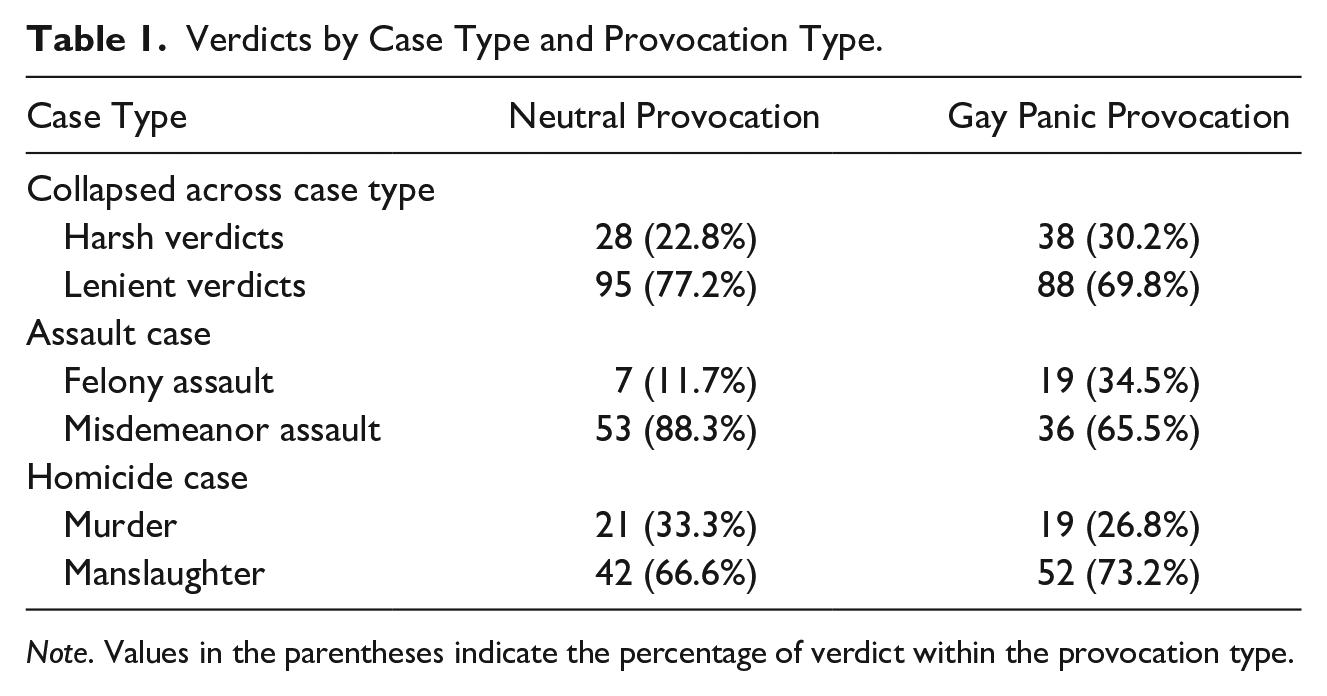
Note. Values in the parentheses indicate the percentage of verdict within the provocation type.
Predicting Juror Case Perceptions
Hate crime perception
Hierarchical linear regression analysis was used to test the unique effects of homophobia, religious fundamentalism, and political orientation on participants’ perceptions of the case as a hate crime with provocation type and case type as potential moderators of these effects. Step 1 explained a significant proportion of variance in hate crime perceptions, R2 = .246, F(4, 244) = 19.917, p < .001. A significant main effect of political orientation was observed, B = −.382, β = −.196, t(244) = −2.763, p = .006, indicating that more conservative participants were less likely to view the case as a hate crime while controlling for other predictors. There was also a significant main effect of provocation type, B = 1.715, β = .442, t(244) = 7.932, p < .001, indicating that when the gay panic defense was used participants were more likely to view the case as a hate crime. Main effects of homophobia and religious fundamentalism were not observed, Bs ≤ .304, βs ≤ .156, ts ≤ 1.843, ps ≥ .067. Step 2 explained a significant proportion of variance in hate crime perceptions, R2 = .308, F(7, 241) = 15.323, p < .001, accounting for 6.2% of the variance above and beyond Step 1. A significant interaction of homophobia and provocation type was observed, B = −.743, β = −.277, t(241) = −2.328, p = .021 (see Figure 1). Simple slopes analysis revealed that homophobia did not predict hate crime perception when the gay panic defense was absent, B = .177, β = .060, t(241) = .489, p = .625, but when the gay panic defense was present participants higher in homophobia were less likely to view the crime as a hate crime when controlling for other juror characteristics, B = −.626, β = −.322, t(241) = −2.954, p = .003. Neither religious fundamentalism nor political orientation were found to significantly interact with provocation type, Bs ≤ −.058, βs ≤ −.022, ts ≤ −.214, ps ≥ .450. Step 3 explained a significant proportion of variance in hate crime perceptions, R2 = .336, F(18, 230) = 6.649, p < .001, accounting for 2.8% of the variance above and beyond Step 2. However, no significant differences between case types were observed, Bs ≤ .388, βs ≤ .113, ts ≤ .583, ps ≥ .561.
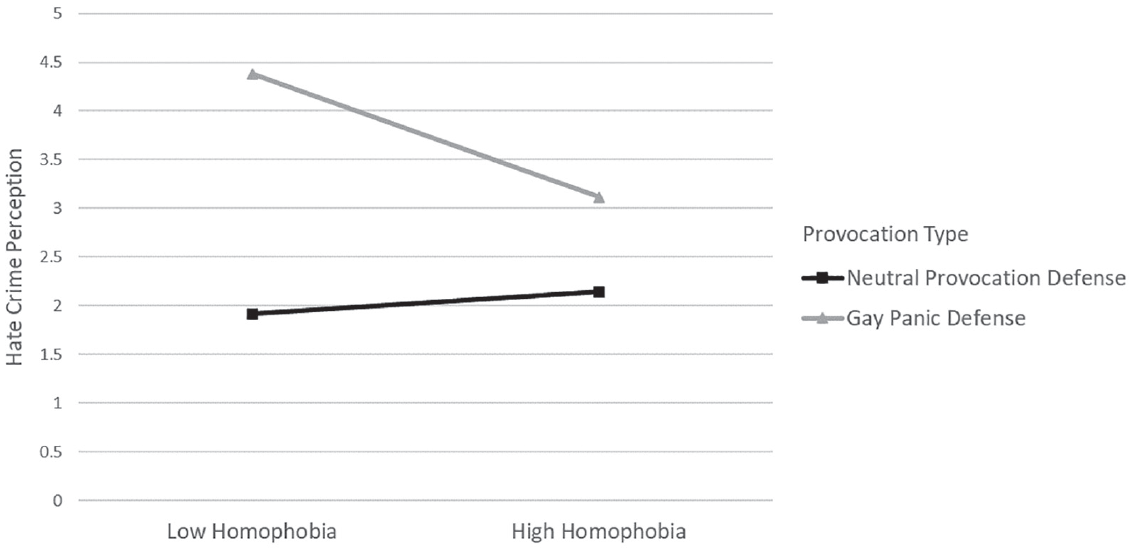
Provocation Type × Homophobia interaction predicting perception of case as hate crime.
Perception of the defendant
The same hierarchical linear regression was used. Step 1 explained a significant proportion of variance in perceptions of the defendant, R2 = .091, F(4, 244) = 6.110, p < .001. A significant main effect of homophobia was observed, B = −1.389, β = −.342, t(244) = −3.704, p < .001, indicating that participants higher in homophobia were overall less likely to place blame on the defendant when controlling for other juror characteristics. Main effects for religious fundamentalism, political orientation, and gay panic defense were not observed, Bs ≤ .394, βs ≤ .097, ts ≤ 1.244, ps ≥ .215. Step 2 explained a significant proportion of variance in perceptions of the defendant, R2 = .139, F(7, 241) = 5.771, p < .001, accounting for 4.8% of the variance above and beyond Step 1. However, neither homophobia nor religious orientation nor political orientation were found to interact with provocation type, Bs ≤ .316, βs ≤ .057, ts ≤ .505, ps ≥ .082. Step 3 explained a significant proportion of variance in perceptions of the defendant, R2 = .178, F(18, 230) = 2.767, p < .001, accounting for 3.9% of the variance above and beyond Step 2 but found no significant differences between case types, Bs ≤ .889, βs ≤ .128, ts ≤ .572, ps ≥ .568.
Perception of the victim
The same hierarchical linear regression was used. Step 1 explained a significant proportion of variance in perceptions of the victim, R2 = .146, F(4, 244) = 10.452, p < .001. A significant main effect of homophobia was observed, B = 1.144, β = .290, t(244) = 3.238, p = .001, indicating that participants higher in homophobia were overall more likely to place blame on the victim when controlling for other juror characteristics. Main effects for religious fundamentalism, political orientation, and gay panic defense were not observed, Bs ≤ .650, βs ≤ .165 ts ≤ 1.829, ps ≥ .069. Step 2 explained a significant proportion of variance in perceptions of the victim, R2 = .178, F(7, 241) = 7.439, p < .001, accounting for 3.2% of the variance above and beyond Step 2. A significant interaction of homophobia and provocation type was observed, B = 1.448, β = .266, t(241) = 2.054, p = .041 (see Figure 2). Simple slopes analysis revealed that homophobia did not predict negative perception of the victim when the gay panic defense was absent, B = .279, β = .071, t(241) = .530, p = .596, but when the gay panic defense was present participants higher in homophobia were more likely to have a negative perception of the victim when controlling for other juror characteristics, B = 1.728, β = .438, t(241) = 3.689, p < .001. A significant interaction of political orientation and provocation type was also observed, B = −1.451, β = −.271, t(241) = −2.444, p = .015. Simple slopes analysis revealed that political orientation did not predict negative perceptions of the victim when the gay panic defense was absent, B = .481, β = .122, t(241) = 1.106, p = .270, but when the gay panic defense was present, contrary to expectations, more conservative participants were less likely to have a negative perception of the victim when controlling for other juror characteristics, B = −.970, β = −.246, t(241) = −2.401, p = .017. No significant interaction of religious fundamentalism and the gay panic defense was observed, B = .290, β = .052, t(241) = .411, p = .682. Step 3 explained a significant proportion of variance in perceptions of the victim, R2 = .218, F(18, 230) = 3.557, p < .001, accounting for 4.0% of the variance above and beyond Step 2. However, no significant differences between case types were observed, Bs ≤ 2.771, βs ≤ .398, ts ≤ 1.893, ps ≥ .060.
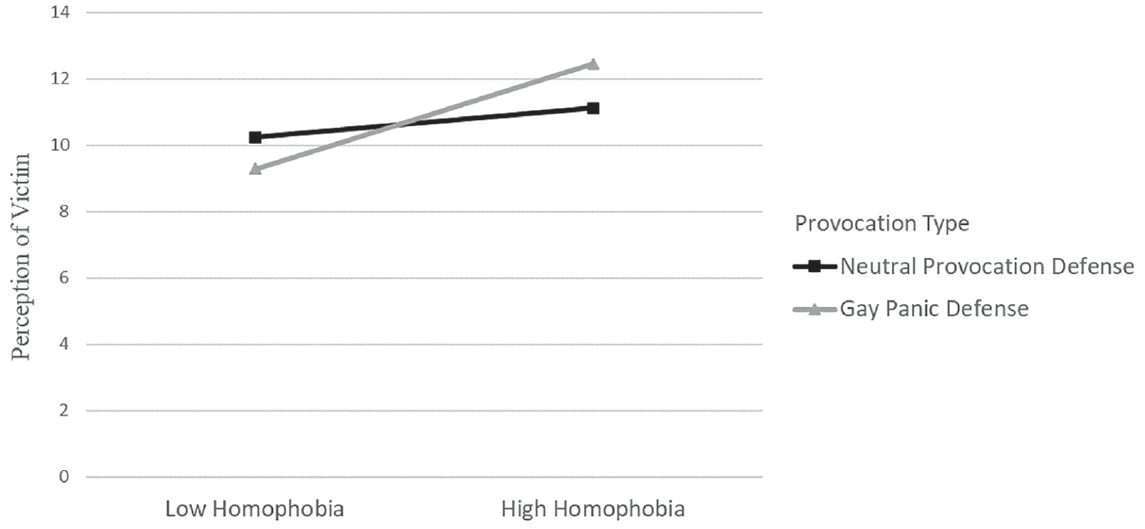
Provocation Type × Homophobia interaction predicting perception of victim.
Predicting Verdict Decisions
Case perceptions as verdict predictors
Hierarchical logistic regression was used to test the unique effects of hate crime perception, negative perceptions of the defendant, and negative perceptions of the victim on verdict decisions with provocation type and case type as potential moderators of these effects. Step 1 significantly predicted verdict decisions based on case perceptions, R2C&S = .186, χ2(4, N = 249) = 51.342, p < .001. Significant main effects of hate crime perception, negative defendant perception, and negative victim perception were observed. Increased perception of the case as a hate crime, odds ratio (OR) = .540, Wald = 10.155, p = .001, and increased negative perception of the defendant, OR = .596, Wald = 7.700, p = .006, were each uniquely associated with decreased likelihood of choosing the more lenient verdict option (misdemeanor in the assault case or manslaughter in the homicide case) resulting in harsher verdicts. A more negative perception of the victim was uniquely associated with increased likelihood of choosing the more lenient verdict option, OR = 1.693, Wald = 8.714, p = .003. Despite Step 2 being 0.8% better at predicting verdict decisions than Step 1, R2C&S = .194, χ2(6, N = 249) = 53.715, p < .001, no significant interactions between these predictors and provocation type were observed, ps ≥ .137. In addition, Step 3 was 3.3% better than Step 2 at predicting verdicts, R2C&S = .227, χ2(18, N = 249) = 64.049, p < .001; however, the effects of these predictors on verdict decisions did not vary by case type, ps ≥ .433.
Juror characteristics as predictors of verdicts
A hierarchical logistic regression was used to test the predictive effects of homophobia, religious fundamentalism, and political orientation on juror verdict decisions with provocation type and case type as potential moderators of these effects. Step 1 significantly predicted verdict decisions based on juror characteristics, R2C&S = .071, χ2(4, N = 249) = 18.237, p = .001. A significant main effect of political orientation was found, OR = 1.473, Wald = 4.037, p = .045, indicating a more conservative political ideology was uniquely associated with an increased likelihood of rendering a more lenient verdict. Main effects of homophobia and religious fundamentalism were not observed, ps ≥ .061. Despite Step 2 being 1% better at predicting verdict decisions than Step 1, R2C&S = .081, χ2(7, N = 249) = 20.982, p = .004 .001, no significant interactions between these three predictors and provocation type were observed, ps ≥ .195. Step 3 was 11.5% better than Step 2 at predicting verdicts, R2C&S = .196, χ2(17, N = 249) = 54.377, p < .001. A significant three-way interaction of homophobia, provocation type, and case type was observed, OR = 62.282, Wald = 9.201, p = .002. In the assault case, provocation type was not found to significantly affect the predictive effect of homophobia on verdict decisions, p = .066. In the homicide case, when the gay panic defense was presented, higher levels of homophobia were uniquely associated with an increased likelihood of choosing the more lenient verdict of manslaughter, OR = 12.429, Wald = 9.371, p = .002. A significant three-way interaction of religious fundamentalism, provocation type, and case type was also observed, OR = .043, Wald = 7.080, p = .008. In the assault case, when the gay panic defense was presented, higher levels of religious fundamentalism were uniquely associated with increased likelihood of choosing the more lenient verdict of misdemeanor assault, OR = 10.013, Wald = 5.465, p = .019. Conversely, when the gay panic defense was presented in the homicide case, higher levels of religious fundamentalism were significantly less likely to choose the more lenient verdict option of manslaughter, OR = .194, Wald = 5.424, p = .020.
Discussion
This study serves as a replication and extension of the research conducted by Salerno et al. (2015) and Tomei et al. (2020). Its aim was to expand knowledge of the effects of juror characteristics and perceptions on their willingness to accept the gay panic defense as a legitimate provocation defense and, consequently, render more lenient verdicts toward the defendant. In addition, this study addresses Tomei et al.’s (2020) concern that the likelihood of success of the gay panic defense might vary based on the case conditions (i.e., assault vs. murder) as a result of the justification-suppression model (Crandall & Eshleman, 2003).
Building upon existing methodology (see Salerno et al., 2015; Tomei et al., 2020), measures of religious fundamentalism and participants’ perceptions of the crime as a hate crime were used to expand upon potential juror characteristics and perceptions which might affect evaluations of the gay panic defense. The present findings serve as only a partial replication of the previous studies. We believe that this is due to the additional predictors we added into our models predicting verdicts which, in turn, altered the unique predictive ability of previously studied juror characteristics.
Consistent with the findings of Tomei et al. (2020), homophobia was found to be the most prominent factor in determining the impact of the gay panic defense. Participants higher in homophobia were less likely to view the case as a hate crime and more likely to have a more negative perception of (i.e., place more blame on) the victim regardless of case type. Higher levels of homophobia were also associated with increased likelihood of choosing the more lenient verdict of manslaughter. Interestingly, this effect was only seen in the more serious case of homicide and not in assault.
Participants’ levels of religious fundamentalism were found to have conflicting results depending on the case type they were presented with. In the assault case, when the gay panic defense was presented, participants with higher levels of religious fundamentalism were more likely to choose the more lenient misdemeanor assault verdict. This finding was consistent with expectations. Contrary to expectations, in the homicide case, higher religious fundamentalism was associated with a decreased likelihood of choosing the lenient verdict option (i.e., more likely to choose the harsher verdict of murder). This could be due to the fact that religious individuals would view killing as being more morally wrong than homosexuality and would therefore be less likely to forgive the actions of the defendant by rendering a lenient verdict. This finding provides some support for the justification-suppression hypothesis with religious fundamentalism leading to more lenient verdicts in the less serious crime of assault compared with the more serious crime of homicide.
Unlike previous studies (i.e., Salerno et al., 2015; Tomei et al., 2020), a more conservative political ideology was not found to lead to more lenient verdicts for the defendant. In addition, contrary to expectations, participants with a more conservative political ideology were less likely than participants with a more liberal political ideology to hold a negative perception of the victim when the gay panic defense was presented. This could perhaps be explained by the previous finding of the effects of religious fundamentalism in that the crime is seen as more of a moral wrong than the homosexuality of the victim, leading to more blame geared toward the defendant instead.
In another unexpected finding, felony verdicts compared with misdemeanor verdicts were much higher in the assault case when the gay panic defense was presented. Potentially, this finding could indicate that when a juror sees gay panic as an illegitimate defense rooted in prejudice, he or she may be more inclined to punish the defendant. As expected, we found no significant effect of the gay panic defense on verdict decisions for the homicide case. Overall, we did not find evidence to support the hypothesis that the effects of the gay panic defense on verdict decisions would be stronger in the assault case compared with the homicide case. The effects of homophobia, religious fundamentalism, and political orientation on participant perceptions and verdicts were generally consistent across case type and sometimes even stronger in the homicide case (e.g., homophobia predicting lenient verdicts in the homicide case compared and not in the assault case), contrary to the expectation supported by the justification-suppression model.
Implications of This Research
Similar to past research, this study provides evidence that jurors’ personal beliefs and characteristics can influence their perceptions in the courtroom and lead to unfair treatment of LGBT victims. Opponents of the gay panic defense claim the defense is illegitimate, plays off the biases of judges and juries, condones violence against LGBT individuals, and promotes institutional discrimination (Mison, 1992; Suffredini, 2001). The ABA’s 2013 report called for the ban of the defense, arguing that it sends a message to the LGBT community that their suffering is not equal to the suffering of other victims and that “successful gay and trans panic defenses constitute a miscarriage of justice” (ABA, Criminal Justice Section, 2013, p. 2). Following the concerns and calls for action by the ABA, California in 2014, Illinois in 2017, Rhode Island in 2018, and Nevada in 2019 all banned the use of the gay panic defense at the state level. In addition, New Jersey, Minnesota, Pennsylvania, the District of Columbia, New York, Connecticut, Washington, Texas, and New Mexico have all proposed bans of the defense (NY, CT, WA, TX, and NM all proposed in 2019; National LGBT Bar Association, 2019). Even at the federal level, the Gay and Trans Panic Defense Prohibition Act of 2018 has been proposed and is currently awaiting a vote in Congress (House of Representatives Bill No. 6358, 2018). This research provides further support for these arguments that the gay panic defense is fueled by a jurors’ homophobic prejudice. By eliminating the use of the gay panic defense at all levels of the court, we can begin to combat prejudice against LGBT individuals in the courtroom, specifically in scenarios such as assault cases where prejudice is more likely to have an impact.
Limitations and Future Directions
The most notable limitation to this study is the fact that it was conducted online with mock jurors who did not deliberate with each other. Although many jury studies are conducted without using deliberation as a component, it is important to note that deliberation and the sheer presence of others can affect an individual’s decision-making process. Deliberation has the potential to counteract an individual’s prejudicial beliefs and reduce their impact (Sears & Henry, 2005, as cited in Tomei et al., 2020). Therefore, future research concerning the gay panic defense, or any research concerning prejudice and juror decision making for that matter, should attempt to use an in-person jury that utilizes deliberation as much as possible to account for these effects.
It is also important to note that many other individual differences beyond the ones mentioned here could affect juror perceptions and verdict decisions in situations in which the gay panic defense is used. Masculine honor beliefs could play a major role in perceptions of the defendant’s actions. These beliefs suggest that aggression can be deemed appropriate if it is in response to a threat to one’s masculinity (Saucier & McManus, 2014). Therefore, someone higher in masculine honor beliefs may show more support for the gay panic defense, and this may be particularly true when the defense is raised against a transgendered person. Furthermore, masculine honor beliefs might be related to just world beliefs, though a process of thinking the victim got what they deserved given their actions. In addition, endorsement of male role norms as well as gender stereotypes may affect a jurors’ perceptions of the gay panic defense. Future research on the gay panic defense should incorporate one or more of these factors to see if they too are predictive of decisions in cases where the defense is raised.
There are other limitations to be noted as well: (a) There are small cell sizes in some of our verdict conditions; this could have resulted in some of our analyses being underpowered. (b) We did not analyze participant sexual orientation because our sample was over 85% heterosexual. Leaving all other sexual orientations in the sample helped to create a more ecologically valid makeup of a jury pool. (c) Our study included no manipulation check for case type. If participants failed to pay attention to the case type they were presented with, our findings concerning the justification-suppression effect could be inaccurate. (d) Finally, though categorical measures of verdicts do provide a more realistic measure of juror decisions, there was no measure included to assess the degree to which the verdict decision was supported. Although measures of defendant and victim perceptions give insight into verdict reasoning, having just two verdict options and no measure of juror support for their choice does not allow for assessing whether a juror felt strong in their choice or simply felt forced into it based on disagreement with the other option.
Conclusion
This study expands upon previous research concerning the gay panic defense, providing insight into juror characteristics and perceptions affecting their willingness to accept the defense, as well as suggesting scenarios in which the gay panic defense might be most successful. This research suggests that homophobia is the driving force behind perceptions of the case as a hate crime, negative perceptions of the victim, and ultimately verdict decisions compared with other juror characteristics. When the gay panic defense is presented, more homophobic jurors provide more lenient verdicts for the defendant. This study found limited support for the justification model predicting acceptance of the gay panic defense in different case types through religious fundamentalism leading to more lenient verdicts in the less serious crime of assault compared with the more serious crime of homicide. Overall, this study provides valuable additions to research concerning LGBT individuals in the courtroom and highlights the need for research such as this to continue.
Footnotes
Declaration of Conflicting Interests
The author(s) declared no potential conflicts of interest with respect to the research, authorship, and/or publication of this article.
Funding
The author(s) received no financial support for the research, authorship, and/or publication of this article.
