







Abstract
Client-perpetrated violence (CPV) against child protective services (CPS) workers is prevalent and problematic for workers and clients leading to psychological distress, physical injury, and compromised service delivery. With accumulating evidence of prevalence and detrimental consequences, few studies examine the characteristics of violent incidents among CPS workers. This study explores how CPS workers perceive CPV through exploring characteristics of incidents that they experienced. We applied components of the stress process model to consider the importance of workers’ perspectives when interpreting violence and its effects. We used inductive, thematic analysis to analyze interview data focused on workers’ experiences with CPV during their first 3 years as CPS workers. The qualitative subsample (N = 34) was drawn from the Florida Study of Professionals for Safe Families (FSPSF), a statewide, longitudinal sample of recently hired frontline child welfare workers. With few exceptions, workers experienced a variety of physical and nonphysical violence. Some experienced more frequent exposure than others, particularly those who defined yelling as violent. Workers identified predictable patterns of violent circumstances and people, and commonly felt that their agencies treated violence as “business as usual.” The high prevalence of violence, often predictable, indicates the importance of promoting a violence-free workplace through agency culture and responding to workers’ reports of CPV with empathy and support. In addition, given workers’ diverse perceptions of CPV, a manual could provide definitions of CPV, procedures to increase worker safety, and procedures to respond effectively to violence. Skill-based trainings can support workers at all levels to minimize, yet prepare for and handle, violence.
Client-perpetrated violence (CPV), or nonphysical or physical workplace violence perpetrated by clients, is problematic for child protective services (CPS) workers (e.g., Jayaratne et al., 2004; Respass & Payne, 2008). With responsibilities to investigate and manage cases of alleged child maltreatment, CPS workers face eight of 10 identified risk factors for workplace violence identified by The Occupational Safety and Health Administration (OSHA, 2016), including home visits, work in high crime areas, independent work, work transporting clients, and hostile clients. Victimization negatively impacts both physical and psychological health of workers (Flannery, 1999; Robson et al., 2014). In addition, it can create medical expenses for victims, lost work hours or productivity, lower service quality (Bowie et al., 2012; Flannery, 1999), job turnover (Horowitz, 2006), and a less experienced workforce (Brady & Dickson, 1999). Furthermore, CPV may lead to unsafe homes and poor child outcomes if hostile relationships interfere with workers’ abilities to conduct thorough assessments (Brandon et al., 2008). Despite documented risks and consequences, little research explores CPV among CPS workers. This study contributes to the literature by considering CPS workers’ perceptions about CPV through exploring characteristics of incidents that they experienced. Available research typically aggregates violence across clients, time, and frequency assuming that incidents are comparable in format and severity and handled with a single intervention (Glomb, 2002). However, workers may differ in their perceptions of violence. For example, one worker may perceive yelling as violent and another may not. Capturing specific incidents is important to understand relationships among workers’ perceptions, client characteristics, settings, and consequences (Schat & Kelloway, 2005).
Prevalence of CPV
Accumulating evidence, typically from convenience samples, suggests high rates of various types of CPV among CPS workers. Analysis of the only known statewide sample of CPS workers (N = 1,162) indicates that CPS workers experienced high rates of CPV within the first 2 years on the job, including nonphysical violence (75%), threats (37%), and physical violence (2%; Radey & Wilke, in press). Although estimates vary widely due to question wording and time frame, convenience studies have found similar rates such that a sizable segment of the CPS workforce encounters verbal assaults (37%–97%), threats of physical violence (11%–33%), and physical attacks (2%–34%; Horejsi et al., 1994; Ringstad, 2009; Robson et al., 2014). Among a small sample of CPS workers in California (N = 39), for example, 70% reported a psychological assault, 11% reported being physically threatened, and 22% reported a physical assault over the course of their career (Ringstad, 2009).
Larger studies examining CPS workers within broader categories of workers (e.g., social workers and social service workers) suggest similarly high rates of violence (Hunt et al., 2016; Jayaratne et al., 2004; MacDonald & Sirotich, 2001; Rey, 1996). Examining community care workers in England (N = 590), 72% of whom were CPS workers, Hunt et al. (2016) found that one half encountered hostile or intimidating parents at least weekly. In addition, 61% of workers were threatened and 20% were physically assaulted within the previous 6 months. In terms of lifetime prevalence, MacDonald and Sirotich (2001) found that among a sample of social workers (N =171), 88% reported verbal harassment, 64% reported threats of physical injury, and 29% reported physical assault.
The high rates of violence likely reflect the nature of CPS work. CPS workers generally include child protective investigators (CPIs), who investigate claims of abuse or maltreatment, and case managers (CMs), who work with families toward improved parental capacity for care in cases of substantiated maltreatment. Therefore, CPS workers conduct home visits and client interviews to determine whether children can stay in the home. The nonvoluntary nature of the contact, common characteristics of those suspected of abuse (e.g., mental health issues, history of violence, and substance abuse), and the high-stakes nature of CPS encounters increase worker susceptibility to violence (Shields & Kiser, 2003). The unpredictable nature of the environments in which encounters often take place (e.g., presence of others who may be threatening, isolation, and display of firearms) further contributes to susceptibility (Kendra & George, 2001).
Perceptions of CPV
Few studies examine perceptions of CPV during CPS investigations and home visits. One exception is a recent qualitative study conducted in Canada with child welfare workers in both community and residential settings (Lamothe et al., 2018). Findings uncovered that while workers commonly perceived CPV as a “recurring and pervasive” problem (Lamothe et al., 2018, p. 308), some expected it as part of the job and others found it shocking. Examining the broader group of social workers, other findings suggest that workers often consider violence as part of the job (Laird, 2013; Littlechild, 2005a).
Workers’ perceptions of CPV can influence how they react to escalating situations (Lamothe et al., 2018; Robson et al., 2014). For example, if a worker perceives that a mother’s raised voice during her child’s removal signals instability, a worker may contact law enforcement. Or, if the worker perceives the raised voice as a sign of love for her child, the worker may select less disruptive de-escalation tactics. Similarly, workers’ attributions for CPV influence interactions and behaviors (Lamothe et al., 2018; Virkki, 2008). If workers feel that the violence is unwarranted or malicious, for example, they may remove the child to promote child safety or avoid the client. Workers may be more lenient if they perceive the violence as situational. Lamothe et al. (2018) found that workers showed empathy for clients attributing violence to the client’s background, current painful situations, or mental illness rather than intentional malice. Similarly, Virkki’s (2008) analysis of qualitative interviews (N = 25) and thematic writings (N = 20) from Finnish social workers indicated that workers justified violent reactions due to client distress.
Workers may be particularly vulnerable to violence in the field or when conducting home visits (e.g., Kendra & George, 2001; McPhaul et al., 2013). In home settings, workers lack protection of familiar surroundings, nearby coworkers, office security personnel, or controlled entry. However, few studies consider the settings of CPV against CPS workers. Although home settings may increase violence susceptibility, workers may be at particular risk during certain job tasks (e.g., child removal, and court hearings) rather than when in certain locations (Horejsi et al., 1994; Littlechild, 2005b). Emotionally intense situations coupled with heightened power and control dynamics between workers and clients may increase the likelihood of CPV.
Organizational factors and response also may contribute to CPV. For example, if workers believe that clients yelling at them is part of the job, this culture may affect whether or not they disclose client behaviors. Little is known, however, about how organizations and their responses contribute to CPV perceptions. Among 21 CPS workers reporting violence in one locale in England, only 10 completed incident reporting forms and eight of those 10 respondents were satisfied with their agency’s response (Littlechild, 2005b). Those not reporting violence discussed less-tangible incidents and no value to reporting due to the high frequency of incidents. Together with CPV’s detrimental long-term consequences for wellbeing (Flannery, 1999; Robson et al., 2014), potential underreporting increases the importance of understanding workers’ thoughts and actions after an incident. In addition, the outcomes for CPV cases (e.g., remained on caseload, transferred to other worker, and incarcerated) and workers’ perceptions of their agencies’ reactions are important to both worker and client safety and wellbeing.
Conceptual Framework
We applied components of the stress process model to understand CPV among CPS workers (Kahn & Byosiere, 1990; Schat & Kelloway, 2005). In its simplest form, the model stipulates that an adverse stimulus or stressor (e.g., CPV) creates a psychological response (e.g., fear, anger, and none) which can affect physical, psychological, and behavioral functioning. The stress model recognizes the importance of individual perceptions, situational factors, organizational factors, and their interactions to interpreting words or actions as violent and in reacting to the words or actions. Using these inputs of the stress process model and an incident-specific approach to explore CPV (e.g., how workers perceive violence; when and where incidents occur) can identify details important for agencies to collect when analyzing CPV and its consequences to inform policies designed to improve worker safety and client outcomes.
Study Objectives
Through qualitative interviews with CPS workers throughout one state, we considered the following two research questions:
Method
Recruitment
Data included interviews from participants recruited from the Florida Study of Professionals for Safe Families (FSPSF), a longitudinal study of newly hired child welfare workers. Dependency CMs and CPIs from across the state were recruited to participate during their preservice trainings. Approximately 84% of eligible new hires between August 2015 and December 2016 were recruited (N = 1,500). Participants receive surveys every 6 months, regardless of their employment, and receive incentives in increasing amounts as the study continues (see Wilke et al., 2017 for methodological details).
To recruit the present subsample, we examined FSPSF Wave 5 data, approximately 2½ years post baseline. We included participants who remained employed in child welfare in the sampling frame (N = 630). The surveys ask participants whether or not they experienced nine different forms of workplace violence in the last 6 months (e.g., yelled at, sworn at, threatened, and physically assaulted). Although almost all workers had been yelled at since their hire, 20% had experienced physical violence. We implemented maximum variation sampling (Creswell & Plano Clark, 2011) by creating two sampling strata: experienced any physical violence and all others. Between February and April 2019, we randomly sampled participants from each group. Examining experiences of CPS workers perceiving more or less violence allowed us to consider how workers vary in their notions of violence or in their abilities to handle potentially violent situations. Fifty participants from each stratum were invited to participate and 35 completed an interview, including 19 individuals who had experienced physical violence and 16 who had not. Due to interviewer error, one audio file from the physical violence stratum was unable to be transcribed and thus excluded from analyses.
Data Collection
We emailed selected participants an invitation to participate in an interview on experiences of CPV. Interested participants were directed to a consent form, where they actively consented to participation, verified they were still working as a CPS worker, and selected an interview day and time. Trained graduate research assistants conducted semi-structured interviews, exploring topics of training and preparation for CPV, perceptions of CPV, examples of physically and nonphysically violent incidents, and thoughts about CPV toward child welfare workers. Through providing detailed accounts, rather than summative statements, workers provided insight into why they perceived CPV the way that they did. Participants received US$25 gift cards. The Institutional Review Board at the authors’ university approved all procedures.
Data Analysis
The authors implemented thematic analysis, a recursive, detailed approach appropriate for identifying and analyzing patterns using a constructionist framework (Braun & Clarke, 2006). Following verbatim transcription of the audio files, the authors independently read several transcripts from each stratum and developed initial codes and co-created a codebook. Using NVivo 12 (2018), two trained research assistants, who were also interviewers, independently applied these initial codes to the data and wrote detailed memos about their coding process. To assess interrater reliability, we examined the two coders’ agreement using two randomly selected transcript excerpts from two randomly selected transcripts, one from each stratum (i.e., experienced any physical violence, all others). Using all parent and child nodes, Cohen’s Kappa indicated moderate agreement (κ = .51; Landis & Koch, 1977). Some slight differences were noted in the specificity of the coding between coders. For example, in several instances one coder would indicate a parent node, whereas the other would indicate a child node; thus, although considered discrepant, both were fundamentally accurate. We collapsed coding files to ensure that we captured all relevant codes.
Following initial application of the a priori codebook, the first author examined each participant’s experience of violence through reading each transcript, developed initial themes, and classified whether each worker considered yelling or cursing violent. The second author independently reviewed themes and classifications. We discussed and assessed the accuracy and comprehensiveness of identified themes, revising them as needed. Any discrepancies in the coding and understanding of the data were discussed among the authors until consensus was reached. We next named the themes, defined them, and selected quotes that exemplified the data and themes (Braun & Clarke, 2006). In the presentation of the findings, the quotes are attributed to CMs or CPIs and a letter to distinguish their contributions to the themes.
Sample
The sample consisted of 34 workers: 18 CPIs and 16 CMs. Workers were aged 22–54 years at the time of hire (M = 34). The sample was predominantly women (N = 31) and racially diverse, including White (N = 17), Black (N = 11), and Hispanic workers (N = 4). All workers had a bachelor’s degree and a significant minority (N = 11) had a master’s degree or higher. Interviews lasted between 20 and 60 min, averaging 39 min. The qualitative sample did not differ demographically from the larger FSPSF sample.
Results
This study’s goal was to understand how CPS workers perceive CPV (i.e., individual differences) and the characteristics of CPV incidents they had experienced (i.e., situational and organizational factors). Almost all workers encountered CPV in their first 3 years on the job. Workers discussed clients’ “routine” shouting, cursing, and making nondescriptive threats. Incidents of nonphysical violence beyond shouting occurred a couple of times a year, on average. Physical violence was less common than nonphysical violence. One third of workers in our sample reported experiencing physical violence since their hires, and, of those with incidents, most workers experienced only one. Notably, two workers did not experience any violence—physical or nonphysical—or anything that others might perceive as violent. In response to whether others might have perceived any nonphysical violence, one worker was unequivocal: “Not at all. Not at all. Everybody that I’ve worked with has respected me . . . nothing could have been said that would be perceived as aggressive or threatening or anything like that” (A, CM). Findings suggested that workers’ thoughts and experiences of CPV were interdependent such that, workers’ experiences with CPV and how it was handled influenced how they thought about it. Themes were remarkably similar for nonphysical and physical violence; we note the few differences when applicable. Table 1 provides an overview of key findings.
CPV Among CPS Workers.
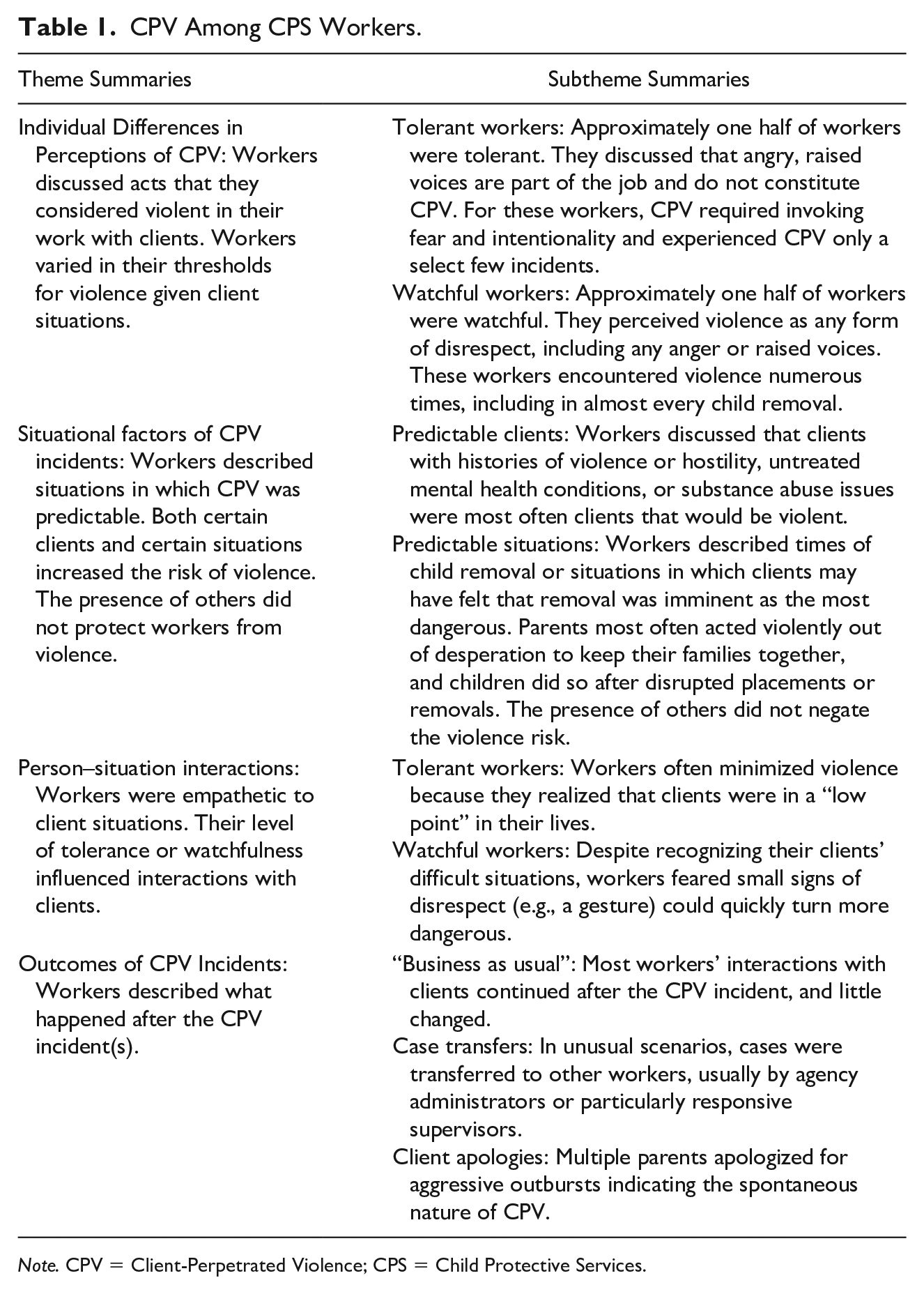
Note. CPV = Client-Perpetrated Violence; CPS = Child Protective Services.
Individual Differences in Perceptions About CPV
Tolerant
Although most workers felt verbal offensives were “pretty constant,” approximately one half did not classify shouting, cursing, or yelling as violent and we conceptualized them as a tolerant group of workers. Tolerant workers felt that angry, raised voices was part of the job. For example, one worker explained, “[P]eople will make threats, so a lot of it’s verbal. The majority of what I have experienced . . . is verbal, which to me is not anything significant” (B, CPI). For these workers, nonphysical violence included more than shouts and nonspecific threats. For example, one worker classified three incidents as violent because she had to involve law enforcement to arrest the clients; incidents without arrests did not reach this worker’s threshold. For this worker and many others, violence required invoking fear and intentionality. Notably, several workers hesitated in classifying nonphysical incidents as violent. However, later in the interview, most returned to discuss specific incidents.
Although each physical incident was unique, to reach the threshold of physical violence, most incidents included children hitting workers, parents throwing objects, or parents pushing workers. Typically, workers did not consider incidental contact as violence. For example, one worker who was bitten by a client’s dog in one instance and hit multiple times with a ball by a child in another stated she had not experienced physical violence. Similar to others not reporting physical violence, she described these occurrences as “incidental and accidental” (C, CPI).
Multiple tolerant workers credited their low level of violence to their “demeanor” or how they “present” themselves. One worker expressed common sentiment when she attributed her avoidance of CPV to her “good way of talking with people [so] that they don’t feel the need to respond to me in [a violent] manner” (D, CM). Another worker explained that she rarely experienced any violence because she did not “radiate fear.”
Watchful
Other workers perceived violence as any sign of disrespect and an inevitable part of the work. We conceptualized these workers as watchful. For watchful workers, about one half of participants, yelling and screaming constituted CPV. For example, one worker explained how a client screamed at him because he followed court orders and required more drug testing than the client’s previous worker had. Watchful workers commonly reported “frequent” violence or violence “with every removal.” For example, when asked to explain her exposure to nonphysical violence, one worker stated how clients threatened her by “even the tone of their voice in a conversation . . . as they become escalated by questions you will be asking them” (E, CPI).
Workers with lower thresholds of violence often prioritized respect for their CPS positions and adherence to protocol. For example, one watchful worker explained that the “yelling and screaming . . . and constantly threatening” made him feel “belittled” and “embarrassed,” feelings he did not deem appropriate for CPS workers (F, CM). Watchful workers prioritized following agency protocol. For example, multiple watchful workers described clients yelling at them as they adhered to protocols (e.g., home visits, drug screenings, and visitation screenings). In addition, watchful workers generally spoke of CPV as more stressful than other workers, yet, also, recognized stress as an “everyday occurrence” in child welfare.
Situational Factors of CPV Incidents
Violent incidents usually invoked fear; involved parents with a history of violence, mental health issues, or substance abuse issues; and occurred during child removal or imminent threat of removal. The circumstances of nonphysical violence and physical violence appeared largely similar. Workers received legitimate verbal threats to their lives and intense discriminatory slurs based on race, sex, and sexual orientation (e.g., “I should fuck you up, you Black bitch,” referring to a worker as a “faggot” or “White devil”). Therefore, reports of physical violence were not categorically more alarming than the nonphysical acts.
Predictable clients
Workers often identified clients susceptible to violence prior to encountering any violence. In these cases, workers sometimes preemptively planned for safety to avoid worker isolation (e.g., bringing a coworker, calling law enforcement, and conducting visits in a public place). Prior to violent events, workers often reported being fearful, typically due to clients’ violent histories, including domestic violence, assault, or hostility to prior CPS workers. In most cases, workers anticipated violent tendencies. For example, one worker explained how when “a punk dad that everybody had been called a cunt by” threatened her life in court, the reactions from her coworkers were, “Oh. He finally snapped. You finally got him . . . Like nobody was surprised” (G, CPI). This lack of surprise also stemmed from clients’ untreated mental health or substance abuse conditions that can create “erratic” and violent behavior, particularly when child removal was imminent. For example, one worker recalled a mother with untreated mental illness on her caseload: She thought that I was seeing her baby’s father, so she would drop off letters saying, “Stay away from him. The relationship with you and him won’t work.” You know, all sorts of things. She would even be hostile when we came to court, but I understood that it was because she was mentally ill. (H, CM)
In another instance common among participants, a worker described how she was cursed out by a mother on her caseload. The worker explained that cursing was predictable given the mother’s history of assault and her “firecracker” mentality: she was “always ready to say something, always just pop off and say anything if she felt like she was getting offended” (I, CM).
Most commonly, workers described feeling uneasy with predictable clients based on the case record or prior histories. However, with these predictable clients, a couple of workers also noted clients who seemed docile on paper could be violent. For example, one worker stated, “You go into a situation where you feel like you could be safe and then you get there and you’re like this vibe doesn’t feel right” (J, CPI). In descriptions of CPV, however, unpredictable clients were exceptions and usually occurred in predictable situations, as described below.
Predictable situations
Workers described similar settings for nonphysical and physical violence. Typically, workers were removing children (e.g., home visits and transporting children) or clients perceived an imminent threat of removal (e.g., courthouse). Many workers identified that these times required additional support (e.g., coworkers and law enforcement). In fact, some agencies mandated that law enforcement attend initial home visits and removals. One worker summarized the logic behind precautions recognizing, “No one’s ever happy when we remove their children from them, so they tend to get a little rowdy and argumentative” (K, CPI).
In a few instances, CPV incidents surprised workers. For example, one worker described when she found out that a father on her caseload showed up at the office looking for her and her car. She perceived prior interviews with him as unremarkable and was “shocked” by his search for her car (L, CPI). Although a few clients surprised workers with violence or threats, workers most often identified potentially violent situations beforehand.
Parents during removal
Workers viewed most parents using violence, particularly physical violence, as desperate to keep their families together. For example, a worker and mother had discussed the child’s removal in the living room and, despite the mother’s violent history, everything seemed fine. Then, when the worker was walking to her car with the child, the mother tried to take her child from the worker’s hands and hit the worker. In a similar instance, a mother threw her hospital tray and other items when a worker removed her 5-day-old infant due to intimate partner violence. In other physically violent instances, clients slammed doors in the workers’ faces, sometimes after pushing them outside the door. Workers explained clients did not want to face the workers and the potential removal that they represented.
In the most serious offenses reported, several workers explained how parents threatened to kill them after their children had been removed. In two instances, given the parents’ violent histories and the credibility of the threats, law enforcement was involved in protecting the workers—one with a workplace lockdown and one stationing an officer outside of the worker’s home for 2 weeks. In addition to threats to life, workers received less serious threats when child removal was possible. Workers commonly described particularly heated verbal exchanges with clients making less specific threats, such as “you have to leave now or you will be sorry.” At times, workers reported threats and verbal assaults based on race, gender, or sexual orientation. Rather than discriminatory on a single characteristic, workers interpreted that some clients searched their demographic profiles to attack them verbally. For example, one worker explained how one of her clients who did not know the right slur finally settled on “Well, I don’t know what the fuck you are, you dumb cracker. Whatever bitch” (G, CPI).
Children during removal
Not unlike with parents, workers also encountered violence from children when removing them from their homes or transferring them to new placements. Workers recalled incidents, for example, when a child kicked the worker inadvertently when entering the car seat and another when a young child hit the worker on the arm. Workers considered CPV from young children less serious because workers were not fearful nor did they blame the young children.
Several incidents including teens, alternatively, were serious. Multiple workers described incidents in which they were called to transport teens to new placements when placements “blew-up,” including when a teen attacked another child in the home and when a teen was unruly due to the influence of drugs. Although law enforcement officers were at the scene, workers were responsible for transporting the clients alone in their cars. These incidents often aroused fear due to the worker’s isolation. For example, one worker described her fear going into the transport of a client with multiple, disrupted placements due to his violent tendencies: I was alone with this teenage boy who was probably twice my size and had just gotten into a very physical altercation with group home staff, and sort of destroyed the group home, threatened another child, sent the other child to the hospital. And then I had to be the one to pick him up, super angry, and then transport him by myself for an hour out into the middle of the state, where there’s not much around. So I was kind of just a little bit on edge. (M, CM)
In this instance, the teen was not outwardly violent with the worker; however, the worker felt vulnerable and threatened by the circumstances.
In another example, a worker explained that a teenager “charged [her] like a football player” right outside the courtroom after she was removed from her family. The worker reluctantly pressed charges after her supervisor encouraged her to do so because of a necessary medical visit. The worker was only concerned with the incident’s impact for her client, explaining, “It’s kind of hard because . . . I’m trying to help and now this child has a record. And, you know, she was emotional. It was hard; her family just got tore apart” (N, CPI).
With and without others present
Although the purpose of worker–client encounters often predicted violence, the presence of others did not. Although the presence of others may reassure workers, emotions tied to child removals often led to CPV regardless of whether a worker was alone. For example, one worker accompanied a coworker on a visit to remove children along with multiple law enforcement officers. When the actual removal began, he explained how the client was violent despite the presence of multiple investigators and law enforcement officers: [The client] got in my face and starts like making threats like, “You take my kids I’m gonna kill you or hurt you. And don’t make me take this sling off.” And then she takes the sling off [from a collarbone injury] and starts like pretending like she’s gonna start swinging. That’s when we just kind of backed up and [were] like, “All right. Well, thanks officers. You can take her from here.” (O, CPI)
Similarly, several workers described violent incidents at the courthouse following a judge’s ruling despite the presence of bailiffs, other CPS workers, and the public. Multiple incidents in which clients became violent despite others present, including backup, suggest the spontaneous, unplanned nature of violence during removals.
Client apologies
Despite brazen behavior, multiple parents apologized after their aggressive outbursts, perhaps another indicator of the emotion-ridden circumstances of the incidents. A worker, for example, reported that a father told him, “I’m going to find out where you live and kill your family, kill your pets” (P, CPI) and later apologized for his behavior during the next visit with the family. The father admitted that he had tried to incite the worker to violence and he was sorry. In a similar instance, a father showed up in the midst of a home visit, insisted that the worker leave and began filming the worker and his car because he was not leaving fast enough. The worker described how the father later apologized: So before my next visit to the home, dad actually—well, mom actually—reached out to me to say dad wanted my cell phone. . . And she wanted to know if she could give him my cell number because he wanted to apologize. (E, CM)
Another worker explained how apologies are common among her clients with outbursts: I usually just try to use a lot of empathy and sympathy and listen to them and then usually they calm down and then they apologize and then they say they’re sorry . . . and then they just move on most of the time. (L, CPI)
Workers explained that parents often realized that they acted inappropriately. Depending on the magnitude of the incident, most workers were forgiving. For example, one worker who received an apology from a father who yelled at her to break the visitation rules felt that the exchange strengthened her relationship with him as he “toned it down” and treated her with more respect (C, CPI). Alternatively, others felt apologies were disingenuous, such as those said in court or those followed by a subsequent violence. In these cases, workers were less forgiving.
Person–Situation Interactions
Workers generally demonstrated empathy for their clients and their situations. Most workers considered CPV as circumstantial rather than malicious. Workers recognized that families involved in the child welfare system negotiated dysfunction (e.g., drug use, criminal history, household instability, and poor neighborhoods) when trying to maintain or regain child custody. Workers commonly understood that they were “coming in because of a crisis” and seeing families at their worst. One worker described typical situations of her clients: [T]hese people are scared to death. They’re afraid they’re going to lose their kids. They are already people in vulnerable positions that have very little resources, very little support systems . . . if you actually look at the majority of our cases, there is already violence. They already have violent tendencies. So why would we think that people would respond any differently to us in the field than they would in their own households? (B, CPI)
Although workers were overwhelmingly empathetic to client situations, their levels of tolerance and watchfulness contributed to their perceptions of CPV. Several tolerant participants viewed “working through” client threats or shouts as part of their positions, recognizing that their clients are in “a very low place in their lives.” An incident with a 13-year-old adolescent illustrates the potency of few resources, violent tendencies, and little support combined with a tolerant worker’s empathy for client situations. The teen held a switchblade to his worker’s throat to get Christmas presents she was delivering to his foster home. Despite her tremendous fear, the worker did not document the incident. She explained that she “probably should have called the cops,” but as the only reliable adult in the child’s life she was “trying not to make it harder on him” (Q, CM). She empathized with his situation and did not want to complicate his life with additional charges and possible convictions.
Watchful workers also expressed empathy for their clients. However, their fear in the situation and prioritization of child welfare system rules resulted in low violence thresholds. One worker explained how the client she just left had been aggressive by touching her: The mother, she touched me. It wasn’t an inappropriate touch. She touched me with her finger. It wasn’t like in any sort of derogatory way or anything. But it’s just like, “I don’t know you, and I don’t want to be touched” . . . it is just constantly having your personal space kind of invaded. . . It’s something trivial, but it’s still like it can escalate into something else. (R, CPI)
Although this worker recognized that the touch was not violent, it represented disrespect and the potential for violence. In another scenario, despite understanding the difficulty of a mother’s situation, a watchful worker described CPV (e.g., shouting) as the worker drove away from a visit location because the client arrived a couple of minutes after the worker’s required wait time. The worker prioritized protocol over a visit and felt threatened by the parent’s reaction.
Organizational Factors of CPV Incidents
Workers often considered their coworker, supervisor, or agency culture and responses when reflecting on CPV incidents. For some workers, the organizational response led them to take an incident more seriously. For example, one worker described when her program manager, her supervisor’s superior, ordered her to get a restraining order against a client who left a death threat on her voicemail. Before her manager’s instructions, she “didn’t feel anything” about the incident because “with this job, you kind of become jaded and [people] will do certain things and you don’t let them bother you” (S, CM). This type of response was atypical, however. Most workers described cultures in which workers recognized the prevalence of CPV, but did not expect change (i.e., “business as usual”) and case transfers were rare.
“Business as usual.”
Most commonly, little changed, and the clients remained on their caseloads. Several workers were angry that they had to maintain cases despite feeling unsafe. In one such instance, a worker felt under attack in the three preceding court appearances with a client. The worker explained that after court hearings the mother had, “followed me all the way to my car, rides on a bike and nearly ran over my shoes.” When the worker asked his supervisor to be removed from the case, his supervisor responded, “Yo, it’s just part of it. I get yelled at all day.” The worker explained how this response from his agency left him feeling “jaded” and alone: I shouldn’t feel like . . . I’m threatened or harassed every time I go to court . . . If you have a situation and it’s an unhealthy relationship between the client and the case manager, they don’t care, they don’t change it. They don’t change it. (F, CM)
Another worker voiced similar feelings when reflecting on her supervisor’s reaction to hearing about her experience with a client who “charged” her during an initial home visit. Even though the worker called law enforcement and everyone in the agency was notified about the client’s behavior, the “supervisor had nothing but jokes, every chance he got to make one” and no one filed an incident report (T, CPI). Several additional workers reported that their supervisors responded with laughter and considered the violence “business as usual.” One worker explained her supervisor’s response when she voiced fear in discovering that a client was looking for her and showed up at her old office: “Suck it up, buttercup. This is the job. Deal with it. This is what you do and if you can’t deal with it, then move on” (L, CPI).
Although many workers reported little change in response to their incidents of violence, in some instances, workers were encouraged to take additional precautions with clients who had been violent. Workers commented that they were encouraged to meet with “risky” clients in the office or ask a coworker to accompany them on the visit. For example, one father with a history of intimate partner violence left messages on a worker’s voicemail “cursing out” the worker. In response, the supervisor contacted the father, gave him a warning not to treat the worker in that way, and required office visits rather than in-home ones. The worker remained on the case. Although our analysis indicates that clients were violent with others around, several workers appreciated their agency’s encouragement to take coworkers on visits, conduct visits at the office, or involve law enforcement.
Case transfers
Although agencies typically did not intervene following CPV, case transfers happened in rare occasions. In some instances, the client left a caseload due to outside circumstances. For example, some workers mentioned no further contact because the child was no longer in the home and the case transferred to another agency. With internal case transfers, someone above the supervisor position typically ordered the transfer. For example, multiple workers filed restraining orders against clients which required a case transfer per law. In another instance, a program director transferred the case after reading the incident report. Yet, in unusual circumstances, supervisors ensured that the worker did not encounter the client again. For example, a worker returned from a visit with a habitually aggressive father who had just slammed the door in her face. She went to her supervisor and stated that the supervisor could fire her if she wanted, but she was not returning to the client’s home. Following, her supervisor handled all future contact with the father herself. In another atypical situation, a worker explained that her supervisor offered to handle any client that made her uncomfortable.
Discussion
Using interviews with CPS workers, we applied components of the stress process model to understand how CPS workers perceive CPV (i.e., individual differences) and the characteristics of CPV incidents they had experienced (i.e., situational and organizational factors). Consistent with previous studies (Radey & Wilke, in press; Robson et al., 2014), most CPS workers experienced CPV during the first 3 years on the job. Workers experienced a variety of physical and nonphysical incidents with a range of frequency. Congruent with the stress process model (Schat & Kelloway, 2005), findings indicate that individual differences, situational factors, and organizational factors are important to consider when addressing CPV. Despite indices that rate physical violence as more severe than nonphysical violence (e.g., Miedema et al., 2010), the details and circumstances of violence influenced perceived severity rather than its level of physicality.
Consistent with earlier studies (e.g., Horejsi et al., 1994; Hunt et al., 2016; Radey & Wilke, in press; Ringstad, 2009; Robson et al., 2014), yelling, cursing, or making nondescriptive threats were routine occurrences for almost all workers. Study participants were evenly divided on whether these verbal incidents constituted CPV. Similar to Lamothe et al.’s (2018) group of respondents who saw CPV as a client’s call for help, tolerant workers discussed the importance of placing client behavior into the context of the lives of many CPS-involved families, including mental health issues, substance misuse, poverty, or intimate partner violence (Shields & Kiser, 2003), and they frequently noted these conditions within their CPV experiences. Related, tolerant workers considered client intent and did not label unintentional actions as violent because they were “incidental and accidental.” Several tolerant workers mentioned that their outlook and approach of collaborating with and respecting families protected them from experiencing more violence. Alternatively, watchful workers classified verbal incidents as violence and mentioned their fear with “minor” actions such as a raised voice. They emphasized that seemingly minor actions can escalate to dangerous situations quickly and viewed minor incidents as blatant forms of disrespect of the worker and the role of CPS. Several watchful workers valued their CPS role and closely adhered to CPS protocol. Workers’ prior beliefs, training, and experiences likely contributed to their approaches and interpretations of violence (Strolin-Goltzman et al., 2016).
Supporting previous research (Horejsi et al., 1994; Kendra & George, 2001; Littlechild, 2005b), violence generally occurred in the process of child removal or when parents felt that removal was imminent. Similarly, incidents involving children typically occurred in the midst of placement disruption. Workers were empathetic and understanding of families’ situations, regardless of whether they felt CPV was “incidental and accidental” or disrespectful. Workers generally understood how a parent facing child removal could become violent. Similar to Lamothe et al.’s (2018) findings, many workers described violence as circumstantial rather than vengeful, indicating the combined importance of individual perceptions and situational factors in assessing violence (Schat & Kelloway, 2005; Virkki, 2008).
This study provides one of the first examinations of situational details of specific violent incidents. Notably, several workers described incidents in which clients displayed violence when others were present. Violence in the midst of others, including law enforcement officers, supports the spontaneous nature of violent incidents at highly emotional junctures (e.g., removal), when clients may ignore or not realize potential consequences of their actions. Workers’ descriptions of violent situations in the presence of others challenges the notion that working in pairs or with law enforcement can prevent all violence. Perhaps when workers felt a high threat of violence, they took another worker or law enforcement to accompany them; yet, violence occurred despite the extra safety precautions. Conversely, the presence of law enforcement or another worker may have changed the dynamic of the visit and instigated violence. Or, violence could have escalated or been worse without another person present. This area of research deserves future exploration.
Although prior studies suggest workers benefit from supportive colleagues and supervisors when exposed to CPV (Kim & Hopkins, 2015; Laird, 2013; Newhill, 2004; Stanley & Goddard, 2002), our examination of specific incidents suggest workers often handle the situation alone. In several instances, workers did not report the violence. Some workers did not report to protect clients (e.g., the cases of teens attacking workers). An agency culture of considering violence as part of the job also may have contributed to low levels of reporting. When workers reported violence, agencies often did not respond to or address workers’ concerns. Rarely, cases transferred to another worker, typically due to a decision above the supervisor or outside the agency (e.g., a restraining order). Without case transfers, workers faced clients who had been violent toward them. Several workers felt their agencies let them down in these circumstances.
Underreporting and continued client contact is consistent with the “suck it up, Buttercup” mentality that CPV was part of the job (Laird, 2013; Lamothe et al., 2018; Littlechild, 2005a), casting those who did not or could not handle it as too fragile for the profession. Telling workers to deal with it or to leave child welfare places the responsibility squarely onto workers and minimizes agency responsibility to prevent and address violence. Yet, client apologies after violent incidents indicate that clients recognized their behavior was inappropriate. Apologies may signify that clients feel remorse and wish to repair the worker–client relationship. Clients may also want to ensure that the worker does not see them as violent or incapable of caring for their children. Regardless of clients’ rationale and apologies, their actions and the existence of CPV warrants a more comprehensive agency response to the worker.
Supporting earlier work of workers’ CPV overall exposure (Lamothe et al., 2018; Robson et al., 2014), examining workers’ perceptions based on specific incidents indicate that workers often view, experience, and react to violence differently. Several workers desired a more reactive workplace with additional safety precautions. Leaving workers responsible for determining how to define, address, document, and handle violence increases worker responsibility and, potentially, has adverse impacts to service delivery. A worker’s preoccupation with personal safety could distract the worker from focusing on child safety (Bowie et al., 2012). In addition, when workers do not have rules and guidance, they may be less effective as they make individual, time-consuming determinations in how to proceed in each case.
Limitations
Before considering implications, this study should be considered in the context of its limitations. First, the sample is derived from one state and only includes workers who have remained in CPS for 3 years. We also oversampled workers who had experienced physical violence. The sample is not generalizable. Participants’ thoughts and experiences may be different from other workers, including those with more or less tenure or from other geographic locations. Second, workers provided their perceptions about CPV. Workers described CPV incidents important to them, rather than the worst, most recent, or most representative. Perhaps, recent or outlandish events influenced perceptions. Third, we did not gather client perceptions. Considering both perspectives of relationships is important (Blau, 1964). Likewise, supervisors and agency administrators may have insights that could help better understand CPV and the agency response.
Implications and Directions for Future Studies
Child welfare agencies have the responsibility for promoting a violence-free workplace (Capacity Building Center for States, n.d.). Understanding workers’ perspectives on CPV characteristics, situational factors, and organizational factors can inform CPS agency practice and policy through three main mechanisms: agency culture, manualized protocol, and skill-based training. Organizational culture can discourage violence. To create such a culture, agency administrators and supervisors can examine their beliefs, values, and actions that contribute to the workplace environment, including agency responses to violence. Child welfare agency personnel could benefit from revising the “suck it up, Buttercup” acceptance mentality to a message of “expected, not accepted.” Some workers avoid reporting because they feel their agency will not support them or will question coping abilities (MacDonald & Sirotich, 2001). In promoting a violence-free workplace, supervisors and administrators can respond to workers’ reports of CPV with empathy and support, emphasizing risk reduction and self-care. Documenting and debriefing incidents can provide CPS workers, supervisors, and administrators with learning opportunities to inform how to handle cases and minimize the risk of future violence. Relatedly, documentation can assist in promoting client safety. Workers’ personal safety fears may complicate assessments and removal decisions (Ellett et al., 2007). Although many workers do not report CPV due to perceptions that nothing would change (MacDonald & Sirotich, 2001), reporting CPV can assist in both risk assessment and client management (Littlechild, 2002). In addition to promoting worker wellbeing, agencies can promote the idea that documenting violence can assist in keeping families safe.
To assist in changing the culture, agencies could draw from practices to develop resilience after workplace violence (e.g., Strolin-Goltzman et al., 2016) to create protocols surrounding CPV. A manual could provide clear definitions of CPV and procedures to increase worker safety. For example, workers should know what to do in various scenarios, such as when they are fearful prior to a visit, a client appears potentially violent (e.g., de-escalation techniques), or they receive a client’s threat outside of the client’s presence. In addition, the manual could outline agency procedures subsequent to a violent incident (e.g., documentation) to support workers and prevent future incidents. Manuals can reflect the perspectives of administrators, supervisors, and frontline CPS workers. For example, CPS workers can provide insights into distinguishing between uniform and discretionary agency responses. Current findings indicate that CPS workers contextualized their CPV experiences in many ways; manuals need to accommodate various interpretations and reactions to CPV. Although manuals can alleviate some of workers’ reporting burden, too much prescription could infringe on worker autonomy, strain the worker–client relationship, or impede client services.
Skill-based training for workers at all levels can help workers interpret manuals and prepare for violence (e.g., OSHA, 2016). CPS workers in this study were well-aware of risk factors for CPV, including client and situational characteristics. However, they employed a range of strategies for handling violence. Trainings can equip workers for effective strategies and practice for handling potentially violent incidents and the aftermath of unavoidable violence, including documentation. Supervisors also can benefit from training to implement the manualized procedures. Several workers in this study felt their supervisors were ambivalent to their exposure to violence. Agency administrators cannot expect supervisors to implement a manual and handle violence effectively without providing them guidance to do so.
This study provides insight into CPS workers’ range of thoughts about violence; their common experiences with clients and situations; and the limited agency responses. The high prevalence of CPV and the range of workers’ perceptions and experiences introduce questions for future research. How do workers’ thoughts about violence influence effectiveness and turnover? Understanding how tolerance levels impact workers can inform practice guidelines and training. How does the presence of others affect the likelihood and intensity of CPV? This study indicates that violence happens despite the presence of others. However, additional research can provide insight into why this is the case. Also, how do demographic characteristics or location (e.g., urban, suburban, and rural) influence CPV? Although this study used a statewide sample and our analysis did not find that workers attached demographic or location characteristics to violent incidents, some workers mentioned receiving personal slurs based on their perceived race, gender, and sexual orientations. Examining incidents by worker and client characteristics may illuminate disparities in violence. For example, how do incidents differ if the client is a child or an adult? In addition to qualitative studies to understand phenomena surrounding CPV, longitudinal, quantitative studies can provide insight into whether CPV affects turnover or if CPV classifications, prevalence, or severity evolve with tenure in the field.
Footnotes
Declaration of Conflicting Interests
The author(s) declared no potential conflicts of interest with respect to the research, authorship, and/or publication of this article.
Funding
The author(s) disclosed receipt of the following financial support for the research, authorship, and/or publication of this article: The research was supported in part by the Florida Institute for Child Welfare.
