






Abstract
Despite the widespread use of sexual assault medical forensic exams (SAMFEs), practitioners and researchers continue to debate the role of SAMFEs and the evidence they provide in the investigation and prosecution of sexual assault cases. Using data from a review of sexual assault cases reported to police between 2015 and 2017 in two jurisdictions (n = 534), we use logistic regression examine whether the presence of a SAMFE predicts the likelihood of achieving criminal case processing outcomes and whether the relationship of the SAMFE with criminal case processing outcomes is moderated by other legal and extralegal case characteristics. We did not find evidence that the presence of a SAMFE in a case significantly predicts whether a suspect will be identified, arrested, or convicted overall, but we did find evidence of the SAMFE’s injury documentation value for arrest. Researchers and practitioners should account for the multiple ways SAMFEs can influence decision-making in future research and policymaking.
Introduction
Sexual assault medical forensic exams (SAMFEs) have become a standard offering to victims who seek help after a sexual assault. However, practitioners and researchers continue to debate the role of SAMFEs and the evidence they provide in the investigation and prosecution of sexual assault cases, including whether to submit all SAMFE evidence for testing and how to prioritize testing of forensic evidence (Spohn, 2016).
Questions related to the role of SAMFEs in sexual assault cases may be based in part on divergent notions of how SAMFEs and their evidence influence case outcomes. The proliferation of SAMFEs in the late 1990s was motivated by efforts not only to improve relationships between victims and criminal justice system actors but also to collect higher quality and more uniform evidence. The primary utility of conducting the SAMFE was generally considered to be the probative value of the forensic evidence collected during the SAMFE. However, studies investigating the impact of SAMFE evidence on case progression outcomes (namely, suspect identification, arrest, and conviction) have come to mixed conclusions (Alderden & Ullman, 2012; Beichner & Spohn, 2005; Campbell et al., 2009; Johnson et al., 2012). Notably, recent quantitative and qualitative work has suggested that SAMFEs may influence case outcomes by influencing investigator and prosecutor decision-making regardless of forensic evidence testing. In other words, these criminal justice actors may base their decisions about whether to move forward with a case in part on the simple existence of physical evidence or the victim’s decision to undergo the exam (Bouffard, 2000; Tasca et al., 2013; Yu et al., Under review).
Past studies have largely focused on the evidentiary value of the forensic evidence collected and analyzed in a case by examining specific findings or pieces of evidence from the SAMFE and their associations with case outcomes. For example, studies have often measured whether there is any available physical evidence (such as semen) that corroborates the victim’s testimony, or whether specific types of physical or genital injuries were recorded (Beichner & Spohn, 2005; Campbell et al., 2009). Other studies have focused on investigators’ and prosecutors’ decision-making process when deciding whether and how to move forward with a case, but without a specific focus on how the SAMFE plays into that process and how it may interact with other legal and extralegal characteristics of the case to influence decision-making (Alderden & Ullman, 2012; Campbell, Menaker et al., 2015; Spohn et al., 2014).
The goal of this study is to fill these gaps in the research by examining two research questions using data on sexual assault cases reported to police in two jurisdictions: (a) Does the presence of a SAMFE predict the likelihood of achieving criminal case processing outcomes, specifically, suspect identification, arrest, and conviction? and (b) Is the relationship of the SAMFE with criminal case processing outcomes moderated by other legal and extralegal case characteristics, specifically whether the victim knew the suspect, whether the victim willingly used drugs or alcohol at the time of the assault, whether the victim was injured, and the whether the suspect used a claim of consent as their defense? We also extend prior work by documenting outcomes from the beginning to the end of the criminal case process, including suspect identification, arrest, and conviction.
Review of the Literature
Sexual Assault Medical Forensic Exams
SAMFEs, also known as sexual assault forensic exams (SAFEs) or medical forensic exams (MFEs), have two main purposes: they provide an opportunity for the victim to receive medical care and service referrals, and they document and collect forensic evidence about the assault. We use the term SAMFE throughout this article to encompass its two distinct parts: the medical examination of the victim and the forensic evidence collection process. When referring to a specific component of the SAMFE, we specify whether we are discussing the medical exam or the forensic evidence. In 2005, the Violence Against Women Act outlined the minimum requirements for a SAMFE to include (a) examining the victim for physical trauma, (b) determining whether penetration occurred or force was used, (c) interviewing the victim, and (d) collecting physical evidence. The specific components of the exam may vary depending on local and state jurisdictional requirements or provisions of local SAMFE protocols, but the goals of the forensic evidence collection are to assist in the identification of the suspect (if necessary), to document force, threat, and fear, and to corroborate the facts of the assault (Office on Violence Against Women, 2013).
SAMFEs are typically conducted at a hospital after a sexual assault victim presents or is referred there and requests an exam. The exam is conducted by a medical professional, such as a sexual assault nurse examiner (SANE), and ideally is conducted within 72 or 96 hours after the assault. To document and collect forensic evidence about the assault, the exam includes (a) collecting physical evidence, such as swabs for blood, saliva, or seminal fluid, (b) documenting the victim’s recollection of events by the SANE or another provider, (c) taking forensic photographs to document injuries, and (d) possibly collecting toxicological evidence to determine whether the assault was alcohol-or drug-facilitated. To provide medical care and service referrals to the victim, the exam includes (a) conducting a medical examination for injuries, and (b) conducting STD testing, pregnancy testing, as well as possibly providing emergency contraception. Additionally, victims may be connected to a rape crisis counselor or victim advocate who can provide guidance about how to address any additional needs and how a criminal investigation might proceed. It should be noted that while this summary describes the typical SAMFE, the quality and content of the exam can vary across jurisdictions. In particular, the existence of a SANE program (where SAMFEs are conducted by specially trained nurses) tends to result in victims being provided better quality health care and a wider range of services, as well as collection of higher-quality evidence (Crandall & Helitzer, 2003; Ledray & Simmelink, 1997; Sievers et al., 2003).
Impact of SAMFEs on Case Outcomes
Evidentiary value of SAMFEs.
In addition to providing medical care for the victim, the main purpose of SAMFEs is to collect higher quality evidence by completing a uniform protocol. Much of the research to date is based on the assumption that the main mechanism by which the SAMFE influences case outcomes is through the evidentiary value of the forensic evidence collected and analyzed. For example, Campbell, Feeney et al. (2015) identified four primary mechanisms by which DNA evidence can provide value to the investigation and prosecution of sexual assault cases: (a) by identifying unknown suspects, (b) by confirming the identity of known suspects, (c) by identifying “serial offenders,” and (d) by exonerating suspects who are wrongly accused. Several studies have shown that cases with forensic or physical evidence are more likely to move forward through the legal system (Campbell et al., 2009; Johnson et al., 2012; McGregor et al., 2002). For example, positive DNA evidence was associated with almost three times greater odds of a case progressing further in the criminal justice system for adults (Campbell et al., 2009) and five times greater odds for adolescents (Campbell, Greeson et al., 2012). Other work has suggested that SAMFEs may also generate additional investigative leads, which leads law enforcement to collect more of other types of evidence and to more frequently refer cases for prosecution (Campbell, Bybee et al., 2012; Campbell, Patterson et al., 2010). Furthermore, studies evaluating the impact of SANE programs have found that they contribute to increased prosecution rates and further case progression (Campbell, Bybee et al., 2014; Campbell, Patterson et al., 2012).
Despite these findings, other studies have not found evidence that forensic or physical evidence plays a significant role in case progression (Alderden & Ullman, 2012; Beichner & Spohn, 2005; Schroeder & Elink-Schuurman-Laura, 2017; Spohn et al., 2001). Early work on the use of forensic evidence in criminal cases concluded that forensic evidence may have limited value in cases where consent was the key question at hand, as it could prove that sexual contact occurred, but it could not demonstrate whether the contact was consensual (Peterson et al., 1984, as cited in Johnson et al., 2012, p. 198). More recent qualitative work has confirmed that this is still a common perception among investigators and prosecutors (Yu et al., Under review). Additionally, results of the evidence analysis are often not available before particular case events occur. One study found that less than half of DNA testing was completed before an arrest was made (Schroeder & Elink-Schuurman-Laura, 2017). Additional studies have found that upwards of 90% of arrests are made before the crime lab has examined the forensic evidence and reported its findings to police (Cross et al., 2014; Johnson et al., 2012). In some situations, the forensic evidence may have never been submitted for analysis, negating much of its potential evidentiary value (Peterson et al., 2012).
Decision-making value of SAMFEs.
Both law enforcement and prosecutors have significant power over the decision-making process of whether and how to move forward with a criminal case, acting as a “gateway to justice” (Kerstetter, 1990). The initial decisions made by police officers, including the amount of resources to devote to a case, and whether to make an arrest, determine which cases reach prosecutors, who have significant discretion to decide whether and how they want to pursue the case. Quantitative research has shown that many factors, both legal and extralegal, influence investigation and prosecution decision-making processes (Alderden & Ullman, 2012; Beichner & Spohn, 2005; Spohn et al., 2014; Tasca et al., 2013). Legal factors are those factors that are legally relevant for decision-making, such as corroborating or exculpatory evidence in a case as well as offense severity, while extralegal factors are those factors that are legally irrelevant, such as victim or suspect demographic characteristics. In research regarding sexual assault case decision-making, extralegal factors often include aspects of the case that investigators and prosecutors may use to assess the victim’s credibility. For example, factors such as whether the victim engaged in risk-taking behaviors (e.g., using alcohol or drugs), had a criminal background, or was a current or former intimate partner of the suspect may play a role in whether the investigator or prosecutor views the allegation as “legitimate” and therefore worth pursuing.
Some studies have suggested that SAMFEs influence case progression through this decision-making process. One mechanism by which the SAMFE might shape investigator and prosecutor decision-making is through perceptions of victim credibility. For example, in a study of felony sexual assault cases, Bouffard (2000) found that investigators were more likely to keep a case open and to make an arrest if the victim agreed to a sexual assault exam, independent of other case characteristics or forensic testing. He concluded that the willingness of the victim to undergo an exam and participate in the investigation increased law enforcement’s perception that the victim was credible. Additional studies have also found that suspect identification and arrest were more likely to occur if a SAMFE had been conducted and that prosecutors were more likely to file charges in cases with SAMFEs (McGregor et al., 2002; Tasca et al., 2013).
Qualitative findings in these and other studies provide additional support for the hypothesis that the victim’s choice to undergo a SAMFE increases perceptions of credibility among criminal justice system actors. For example, Tasca et al. (2013) concluded from reviewing police narratives that for victims who did not undergo a SAMFE, “the lack of potential for forensic evidence was … highlighted as a negative factor that lowered the victim’s credibility” (p. 1171). Another study found from focus groups with investigators and prosecutors that a victim’s decision to undergo a SAMFE strengthened perceptions of their credibility even before forensic evidence processing occurred (Yu et al., Under review).
The use of consent defenses in sexual assault cases and whether a victim sustains an injury also appears to be inextricably tied to decision-making around charges and to the ability to obtain convictions in cases. Because the most common defense in a sexual assault case is that the victim consented to the sexual act (Kelly et al., 2005; Spohn & Tellis, 2012), demonstrating non-consent is often a pivotal issue in cases of sexual assault. Documenting injury during the SAMFE is one method for demonstrating non-consent between the suspect and victim and may be viewed by police and prosecutors as providing the evidence they would need to prove to a jury that an assault occurred. Several studies have demonstrated the importance of injury documentation, finding that cases with documented injuries are more likely to result in arrest, prosecution, and conviction (Campbell et al., 2009; Cross et al., 2014; Gray-Eurom et al., 2002; McGregor et al., 2002).
Moderation by legal and extralegal factors.
A substantial body of research has demonstrated the importance of legal and extralegal factors that often represent stereotypical and false beliefs about what should be considered sexual assault (“rape myths”). For example, rape myths assume that sexual assault is only “legitimate” when the suspect is a stranger to the victim, the suspect used force and inflicted injuries on the victim, and the victim did not engage in any “risk-taking” behaviors such as drug or alcohol use, among other assumptions. These beliefs tend to influence jury decision-making (Dinos et al., 2015), and by extension, law enforcement and prosecutor decision-making. For example, Spohn and Holleran (2001) found that the effects of extralegal factors such as victim characteristics and risk-taking behaviors played an important role in prosecutorial decision-making in cases involving acquaintances and intimate partners, but that these factors did not affect the decision to charge in cases involving strangers.
Decision-making is a complex process, and law enforcement and prosecutors may consider the presence of a SAMFE in combination with the other legal and extralegal characteristics of a case before coming to decisions during case processing. However, no published studies to date have empirically examined whether the SAMFE’s relationship with case outcomes is moderated by other legal and extralegal factors that investigators and prosecutors may use to assess the victim’s credibility. More specifically, though research has established main effect relationships between victim injury and case outcomes such as unfounding (i.e., the decision by law enforcement that there is no evidence a crime occurred), arrest, and the decision to charge (Alderden & Ullman, 2012; Beichner & Spohn, 2005; McGregor et al., 2002; Spohn et al., 2014), we have yet to examine if victim injury interacts with the SAMFE to affect case progression. This is also true for victim substance use (Schuller & Stewart, 2000; Tasca et al., 2013) and suspect-victim relationship (Alderden & Ullman, 2012; Campbell et al., 2009; Spohn & Tellis, 2012; Spohn et al., 2014). There is only limited evidence on the use of consent as a defense as a predictor of case outcomes (Spohn & Tellis, 2012); however, prior work has found that investigators and prosecutors perceive forensic evidence to have limited value where consent is the key issue (Yu et al., Under review), suggesting that this factor may be an important influence on decision-making.
In addition to not examining whether having a SAMFE interacts with other case elements to affect case progression, much of the past research was focused on answering the question of whether the availability of forensic evidence (regardless of whether it came from the SAMFE) influenced case outcomes rather than specifically focusing on the presence of the SAMFE (regardless of whether it produced any corroborating or exculpatory forensic evidence) and how it may influence case outcomes by feeding into police and prosecutor perceptions of the case. In response to these gaps in the research, this study seeks to answer two research questions: (a) Does the presence of a SAMFE predict the likelihood of achieving criminal case processing outcomes, including suspect identification, arrest, and conviction?; and (b) Is the relationship of the SAMFE with criminal case processing outcomes moderated by other legal and extralegal case characteristics, specifically whether the victim knew the suspect, whether the victim willingly used drugs or alcohol at the time of the assault, whether the victim was injured, and the whether the suspect used a claim of consent as their defense?
Data and Methods
The current study is part of a larger mixed-methods study examining the importance of sexual assault exams for police and prosecutor decision-making and case outcomes. To understand how these exams and the forensic evidence collected during the exams correlate with case outcomes, we conducted a review of sexual assault cases reported to police between January 1, 2015, and December 31, 2017, in two jurisdictions in one northeastern state. We chose to recruit sites from a single state because we wanted to hold sexual assault statute language constant instead of introducing variation in state statutes based on site. We approached several jurisdictions in the state, including one jurisdiction with whom our team had a pre-existing relationship; these jurisdictions were selected based on their willingness to participate in the study and their capacity to access and code data.
The first jurisdiction is a county with two small cities and towns of varying sizes. The county has about 230,000 residents, with an approximate median income just below $50,000. About one in six residents live in poverty (U.S. Census Bureau, 2010). All but one law enforcement agency that investigates sexual assaults in the county participated in the study, in addition to the county district attorney’s office. The second jurisdiction represents a mid-sized city of just over 200,000 residents. It has an approximate median income of just over $30,000 and about one-third of its residents living in poverty (U.S. Census Bureau, 2010). The city’s only law enforcement agency and its associated district attorney’s office participated in the study.
Data collection focused on case file reviews of 534 sexual assault cases (n = 226 from jurisdiction (a) and n = 308 from jurisdiction (b)). The inclusion criteria were (a) the suspect was classified as an adult, (b) the victim was age 13 or older, and (c) the case had an initial charge recorded by the police related to sexual misconduct and assault within the state’s statutes. The criteria medical providers use to determine whether to use SAMFE processes intended for adults rather than children may vary across jurisdictions; in the jurisdictions included in this study, providers use adult SAMFE processes for victims who are at least 13 years old. However, by legal standards, not all these victims would be considered adults.
Cases were coded prospectively from the time they were reported to law enforcement through case disposition (whether referred to prosecution or not). In 13 cases (2%), the case was sealed before its full case progression information was coded. Coders were unable to continue coding these cases, and their final disposition is unknown. Case coders had an existing connection (i.e., as either interns/consultants or employees) to participating local law enforcement and prosecution agencies and had access to the relevant local data systems and partners needed to detect study-eligible cases and to track case progress. Coders were selected by the main point of contact for the project within each agency and compensated for their time using resources set aside for this purpose from the grant that funded the project. They were not blind to the study hypotheses.
Coders monitored case eligibility and processing over time and recorded information about case characteristics and case progression into a secure, custom SQL database built on Drupal via an online interface developed and managed by the researchers. The interface provided data entry fields for the measures of interest determined by the study researchers (refer to the Section “Measures”). All coders were trained by study researchers, relied on the project codebook, and had access to the research team to answer questions and discuss case eligibility throughout the data collection phase of the project. Coders and researchers worked in tandem to clean data and interpret any coder notes provided as the information was inputted. All data collection activities were approved by the study’s institutional review board (IRB).
Measures
Criminal case processing outcomes.
Dependent variables for this study include whether a suspect was identified, whether an arrest was made, and whether there was a conviction. Each of these outcomes is coded as a binary measure, where 1 indicates that the outcome occurred. In 16 cases (3%) multiple suspects were identified. For these cases, coders documented whether there was an arrest or conviction for each suspect. We then combined the answers for all suspects such that the dependent variables for arrest and conviction measured whether there had been any arrest and any conviction in the case.
SAMFE conducted.
For each case, coders recorded whether the victim underwent a SAMFE, resulting in a binary variable coded as 1 if a SAMFE was conducted and 0 if not.
Victim and suspect demographics.
Coders recorded victim and suspect demographic information. Possible victim and suspect gender responses included female, male, female-to-male transgender, and male-to-female transgender. Due to the small number of transgender victims (n = 3) and suspects (n = 1) in the sample, we constructed binary variables measuring whether the case included any female victim vs. no female victim (1 = any female victim) and whether the case included any male suspect vs. no male suspect (1 = any male suspect). Cases that included transgender victims (either female-to-male or male-to-female) were coded as not female unless there was another female victim in the case. Similarly, cases that included transgender suspects (either female-to-male or male-to-female) were coded as not male unless there was another male victim in the case.
We also collected information about the race of the victim and suspect, which were initially coded as white, black, Asian, Pacific Islander, Native American, or some other race. For the analysis, we constructed binary any white victim vs. any non-white victim and any white suspect vs. any non-white suspect variables (1 = any white victim or suspect) for each case due to the small numbers of individuals identified as Asian (victim n = 9; suspect n = 14), Pacific Islander (victim n = 0; suspect n = 0), Native American (victim n = 1; suspect n = 2), and other (victim n = 1; suspect n = 6). Victim and suspect ethnicity were measured separately from race and are coded as binary variables (0 for non-Hispanic and 1 for Hispanic). Coders also recorded victim and suspect ages.
In addition to the cases with multiple suspects, 5 cases (.9%) reported multiple victims. For cases with multiple suspects or victims, we combined the responses for the demographic information so that each variable measures whether there were any victims or suspects with that particular demographic characteristic. Victim and suspect ages were averaged across such cases.
Case/offense characteristics.
Coders recorded information about several case characteristics.
Weapon use is recorded as a binary variable (coded as 1 if any weapon was used or threatened during the commission of the offense and coded as 0 if not). If a weapon was used, coders specified the type of weapon. We describe the types of weapons used in Table 1, but we did not include weapon type as a covariate in the regression analyses due to small cell sizes.
The weapon use variable was also used to create a binary variable for verbal threats (coded as 1 if weapon type included “threat of personal force” and 0 if not).
Offense occurred outdoors is a coded as “yes” if the offense location was recorded as “outside suspect’s home,” “outside victim’s home,” “park/outdoor venue,” or “street/alley;” coded as “no” if the location was elsewhere; and coded as a separate “unknown” category if coders recorded that the location could not be determined from the case files.
Days to report is a continuous variable that measures the number of days between the date of the offense and the date when the offense was reported to police.
Other crimes alleged is a binary variable measuring whether criminal statutes other than the qualifying sexual misconduct or assault statute were recorded in the initial police report.
Suspect known to victim is a binary variable indicating whether the suspect was known to the victim prior to the offense. We asked coders to record the suspect-victim relationship for each case—suspect known to victim is coded as “no” if the suspect-victim relationship was recorded as “stranger,” coded “yes” if the suspect-victim relationship was specified otherwise, and coded “unknown” if coders recorded that the relationship could not be determined from the case files.
The remaining victim- and suspect-related measures were constructed by combining variables across all victims or suspects in a case.
Victim participation is a binary variable constructed by combining two variables: The case clearance reason and whether any of the victims were ever considered “uncooperative” by law enforcement based on law enforcement notes in the case records. Victim participation is coded as 0 if the case clearance reason was “victim uncooperative” or if law enforcement had ever considered any victim “uncooperative,” and coded as 1 otherwise. This categorization represents a strict interpretation of victim participation in that coders coded this as a 1 only if there was no indication that the victim had ever been considered “uncooperative.”
Any victim injured is a binary variable (coded as 0 or 1) measuring whether any victim sustained any injuries during the offense, including both defensive and genital injuries.
Any victim willing drug/alcohol use is a binary variable (coded as 0 or 1) constructed by combining two questions (whether the victim willingly took drugs on the day of the offense and whether the victim willingly drank alcohol on the day of the offense) across the victims in a case.
Any victim soliciting is a categorical variable indicating whether any victim was suspected of soliciting sexual activity at the time of the offense, coded as “yes,” “no,” or “unknown.” However, we did not collect information about whether the soliciting was forced or voluntary.
Any consent defense is a categorical variable measuring whether any suspect ever claimed that the sexual contact was consensual, also coded as “yes,” “no,” or “unknown.” We did not collect information about whether the suspect used a defense other than consent.
In some cases, no answer was provided for one or more of these variables. Rates of missingness for individual variables range from 0% to 12%.
Study Sample
Table 1 describes the victim, suspect, and case characteristics used as independent variables in the analytic models. More than 90% of cases included female victims, with a median age of 16. Just over 60% of cases included white victims, and just over 10% of victims were Hispanic. For the cases in our study with identified suspects, the suspects were overwhelmingly male (95%), with a median age of 25. About half of cases included a white suspect, and just over 12% included a Hispanic suspect.
SAMFEs were conducted in just under one-third of cases reported. The majority (51%) of cases were reported to police within a day of the offense, and victim(s) participated throughout case investigation and processing in 62% of cases. In 84% of cases, the suspect was not a stranger to the victim (for example, a current or former spouse or intimate partner, family member, or acquaintance). Few assaults (9%) occurred outdoors; instead, they largely took place at the suspect’s or victim’s home. The suspect used a weapon in 20% of cases. In the majority (57%) of these cases, the weapon used was hands or fists, followed by sharp objects (18%), firearms (14%), threats of personal force (9%), and undefined/other (2%). Cases where suspects issued verbal threats comprised 4% of cases overall. Victims were injured in 11% of cases. The victim(s) willingly took drugs or alcohol at the time of the incident in 21% of cases, and victims in 6% of cases were suspected of soliciting at the time of the incident. In just over one-third of cases with identified suspects, as part of his or her defense, the suspect claimed that the victim had consented to the sexual activity. In 20% of cases, the suspect was accused of other crimes at the time of the assault in addition to the sexual assault.
Descriptive Statistics.

Patterns of Case Progression
Figure 1 shows the number and proportion of the 534 cases in our study that progressed to each step of the criminal justice process. Each box displays the number of cases with that particular outcome contingent on reaching the prior stage. It also displays the percentage of cases from the prior stage and the percentage of reported cases with that outcome. For example, the “Suspect identified” box under the “Cleared” box represents all reported cases where the case was both cleared by law enforcement and a suspect was identified. These 435 cases represent 84% of the cleared cases and 81% of the reported cases overall. Nearly all the reported cases (97%) had been cleared by police by the end of data collection, meaning that either a suspect had been arrested or the agency had closed the case by exceptional means. This includes cases cleared for any reason, including arrest, unfounding, exceptional clearances, etc. Of the 520 cases that were cleared by police, 435 (84%) had an identified suspect in the case, and an arrest was made in 135 cases (35% of cleared cases). Of the cases with an arrest, 103 (67%) resulted in conviction, which translated to 19% of all reported cases resulting in convictions.
Case processing flowchart.

Analytic Approach
Given the binary nature of the dependent variables, we conducted a series of logistic regressions to estimate the main effect of the SAMFE on the dependent variables: whether a suspect was identified, arrested, and/or convicted. Although we collected separate case outcomes for cases with multiple suspects, we chose to combine them in order to examine how the SAMFE may affect case processing at the case level, our unit of analysis. We only included cases with an identified suspect in the models for any arrest and any conviction. In each model, we first included several covariates informed by case, victim, and/or suspect characteristics identified in prior research as being predictive of the dependent variables. Next, in order to improve model efficiency and maximize sample size, we removed any covariates in each model that were not significant at the p < .10 level. We included a variable to control for site effects in all models.
Additionally, we examined whether the relationship between the SAMFE and case outcomes was moderated by four case characteristics: the suspect-victim relationship, whether any victim willingly took drugs or drank alcohol, whether any victim was injured, and whether any suspect claimed that the sexual contact was consensual. We added an interaction term between the SAMFE and each of these characteristics to the main effects model one at a time, and then computed the marginal effects in the form of the predicted probability of each outcome given the different combinations of the interaction.
In each model, we used listwise deletion to exclude cases with any missing data, as missingness for any individual variable was less than 15% (Allison, 2001). After non-significant variables had been removed from the models, 77 (14% of reported) cases were excluded from the suspect identified model due to missing data, 85 (19% of cases with an identified suspect) cases were excluded from the any arrest model, and 105 (24% of cases with an identified suspect) cases were excluded from the any conviction model. Comparison of the included and excluded cases in the reduced models showed few differences but the significant differences included: any arrest was significantly higher for excluded cases in the arrest model (45% versus 32%, p = .0259) and victim participation was significantly higher for excluded cases in the conviction model (76% versus 65%, p = .0322). Both of these differences suggest that our findings are likely conservative estimates.
Results
Main Effects of SAMFEs
Tables 2 and 3 present findings relevant to our first research question—does the presence of a SAMFE predict the likelihood of suspect identification, arrest, and conviction? Results from the full models indicated that the presence of a SAMFE did not significantly predict any of the three case outcomes (Table 2). Once the non-significant covariates were removed, the SAMFE effect became marginally significant (p < .10) for arrest and conviction (Table 3).
Full Model Logistic Regression Results: Suspect Identification, Any Arrest, and Any Conviction.
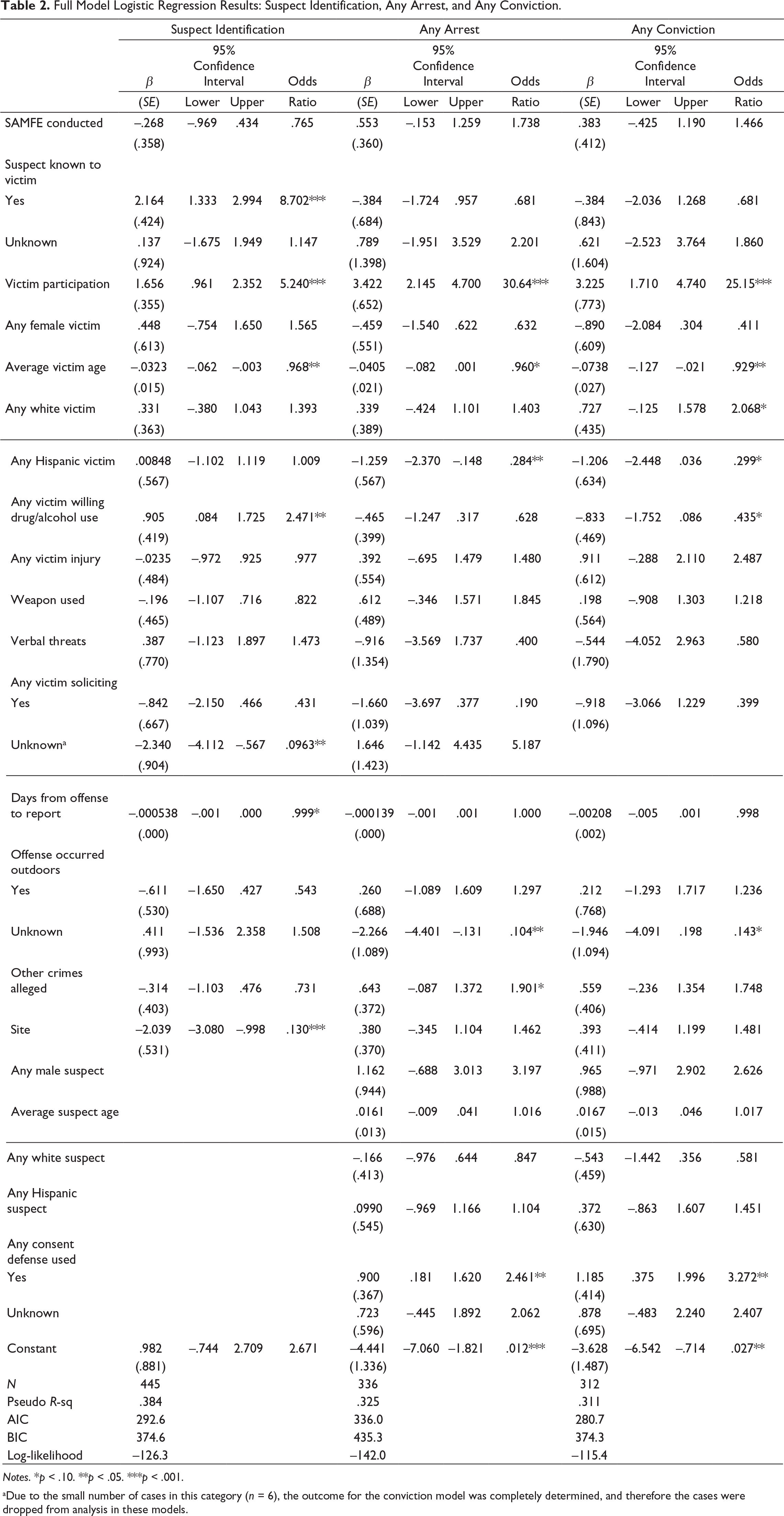
Notes. *p < .10. **p < .05. ***p < .001.
aDue to the small number of cases in this category (n = 6), the outcome for the conviction model was completely determined, and therefore the cases were dropped from analysis in these models.
Although the SAMFE did not significantly predict criminal case outcomes, several other factors were influential for each outcome. The suspect-victim relationship and victim participation were the strongest predictors of suspect identification in both models. Cases where the suspect was known to the victim prior to the incident had more than ten times higher odds of resulting in suspect identification in the reduced model, and cases where the victim participated in the investigation had 4.91 times higher odds of identifying a suspect. Cases where the victim waited longer to report to police (OR = .99) and those reported in site 2 (OR = .13) had lower odds of suspect identification.
In addition to these case characteristics, some victim demographic characteristics and behaviors proved to be predictive of suspect identification. Cases with younger victims had significantly higher odds of suspect identification, with the odds dropping by about 3% with each additional year of age of the victim. Cases where the victim(s) had willingly used drugs or alcohol at the time of the incident had 2.33 higher odds of suspect identification.
When predicting arrest in the reduced model, victim participation became an even stronger predictor compared to its effect on suspect identification (OR = 30.07). Victim ethnicity was a significant predictor of arrest, with cases that had a Hispanic victim having about 65% lower odds of arrest compared to cases without a Hispanic victim. Most suspect demographic characteristics and offense characteristics were not predictive of arrest in the full model, with the exception of the suspect’s use of a consent defense during the case. Cases where suspects claimed that the incident was consensual were nearly twice as likely to have an arrest in the reduced model (OR = 1.91).
The factors predicting any conviction in a case were similar to those predicting arrest: in the reduced model, victim participation, victim age, victim ethnicity, and suspect’s use of a consent defense all significantly predicted conviction. In addition, several other victim-related variables were significant or marginally significant. If the victim had willingly used drugs or alcohol during the incident, odds of conviction dropped by nearly 59% (p = .037), while cases where the victim was injured had 2.57 higher odds of conviction (p = .069).
Reduced Model Logistic Regression Results: Suspect Identification, Any Arrest, and Any Conviction.

Note. *p < .10. **p < .05. ***p < .001.
Moderation Effects
Our second research question considers whether relationships between the SAMFE and outcomes (suspect identification, arrest, and conviction) are moderated by other case characteristics, including the suspect-victim relationship (i.e., whether the victim knew the suspect), the victim’s willing drug or alcohol use, victim injury, and the suspect’s use of consent as a defense.
Logistic Regression Results for Interaction Terms: Suspect Identification, Any Arrest, and Any Conviction.

Note. **p < .05.
Table 4 shows the interaction term coefficients, odds ratios, and confidence intervals of the logistic regressions for each interaction and each outcome. Of the interactions we examined, only the relationship of the SAMFE to any arrest differed by whether the victim had been injured. Table 5 summarizes the marginal effects for each interaction and displays the predicted probabilities of a given case outcome for each combination of factors. In cases where the victim was injured, 17.6% of cases without a SAMFE were predicted to result in an arrest, compared with 55.8% of cases with a SAMFE. By contrast, in cases where there was no victim injury, cases with and without SAMFEs did not have significantly different probabilities of resulting in arrest (34.6 and 28.8%, respectively). We found a similar pattern for any conviction, although the interaction is not significant.
Marginal Effects of Interactions, in Predicted Probabilities.

Discussion
The primary goal of this study was to quantitatively examine whether SAMFEs have a broader utility for influencing case processing and decision-making beyond their forensic and DNA evidence, and how this influence may vary based on other case characteristics. We focused on whether the presence of the exam itself influences case outcomes, as well as whether the SAMFE’s value to and effect on case outcomes depends on other characteristics of the case. We did not find evidence that the presence of a SAMFE in a case significantly predicts whether a suspect will be identified, arrested, or convicted overall, but we did find evidence of the SAMFE’s injury documentation value for arrest.
The lack of a significant effect of the SAMFE on suspect identification may be due in part to the large proportion (though not wholly unexpected number) of non-stranger cases in our sample (84%), which makes the SAMFE much less relevant for suspect identification, both in terms of evidentiary and decision-making value (Johnson et al., 2012). Instead, victim participation is a more relevant factor, which is borne out in the strong and significant association of victim participation with suspect identification that we see in the results. Further, if the suspect is a stranger, the value of the SAMFE for suspect identification is more likely to be in the forensic evidence, as Tasca et al. (2013) found. In contrast, our analysis does not account for whether forensic evidence was recovered during the SAMFE or the quality of that evidence.
We also found that cases with SAMFEs were not significantly more likely to result in an arrest and conviction, although the effect trended toward significance in the reduced models. Among the few studies that have examined the association between the SAMFE (as opposed to evidence collected during the SAMFE) and arrest, findings have been mixed (Alderden & Ullman, 2012; Bouffard, 2000), and no prior studies have specifically examined the association of the SAMFE with conviction. Bouffard (2000) found that the SAMFE was associated with a significant increase in the likelihood of arrest, while Alderden and Ullman (2012) did not find evidence of an effect. The difference in findings could potentially be attributable to the fact that, unlike Alderden and Ullman and this study, Bouffard did not otherwise control for victim participation. Thus, the large, significant effect of the SAMFE in his results may reflect some of the effects of victim participation. At the same time, our results show only that we did not find statistically significant evidence that an effect exists, not that we found evidence of no effect. Although we cannot rule out the possibility that there is no effect, the trend toward significance from the full to the reduced models and the range of values supported by the data as shown in the confidence intervals in the reduced models suggest that there may be a smaller but separate positive effect of the SAMFE that would be detectable with a larger sample (Hoenig & Heisey, 2001).
Our hypothesis that the existence of a SAMFE in a case influences case outcomes through investigator and prosecutor decision-making, in conjunction with the previous research documenting the various legal and extralegal characteristics that also influence decision-making, led naturally to the consideration of whether the SAMFE’s influence on case progression is moderated by other case characteristics. Whether the victim in a case was injured during the assault is one such characteristic—a legal factor that may speak to the severity of the offense as well as whether force was involved. Findings from this study indicated that in cases where the victim was injured, cases with SAMFEs were significantly more likely to result in arrest. However, the same was not true of cases without victim injury. While victim injury in itself was not predictive of case outcomes, this finding indicates that the documentation of those injuries does play a role in case progression. This association may arise through extralegal factors; in other words, the documentation of an injury via SAMFEs may help to affirm victim credibility regarding claims of non-consent in the eyes of investigators and prosecutors, as some qualitative studies have concluded (Campbell, Menaker et al., 2015; Yu et al., Under review). However, this association also may also arise through legal considerations, where investigators and prosecutors perceive the injury documentation to have evidentiary value. Whether the association between injury and arrest in cases where a SAMFE was present arises through one or both of these mechanisms cannot be determined from this study, but these findings provide support to the idea that injury documentation is a valuable component of the SAMFE.
The importance of injury documentation uncovered in our findings, combined with prior studies demonstrating that SANE programs result in higher quality evidence (Crandall & Helitzer, 2003; Ledray & Simmelink, 1997; Sievers et al., 2003) and contribute to increased prosecution rates and further case progression (Campbell et al., 2014; Campbell, Patterson, et al., 2012), suggests that the value of injury documentation via the SAMFE may vary across locations depending on the availability of SANEs. This was not evident in our findings, although SANE availability was widespread among victims who received SAMFEs—SANEs were available to approximately 87% of victims who received SAMFEs in our study. Future research should investigate not only how the value of injury documentation may vary across jurisdictions with differing levels of SANE availability, but also across SANE programs with differing program emphases (i.e., prosecution vs. patient care; Patterson et al., 2006).
Finally, examining how similar or different the cases in our study are to other studies and national statistics provides context for the generalizability of our findings. Overall, the prevalence of case outcomes in our study is largely consistent with previous research. This study found that about 81% of cases had an identified suspect, which was nearly 30 percentage points higher than a similar study (Tasca et al., 2013). However, the Bureau of Justice Statistics (BJS) reports that about 78% of sexual assaults nationally are perpetrated by non-strangers (Planty et al., 2013), suggesting that our suspect identification rate would likely be in line with the national average. Similarly, like several prior studies and consistent with national statistics, we found that about 30% of sexual assault cases reported to police result in an arrest (Alderden & Ullman, 2012; Planty et al., 2013; Spohn & Tellis, 2012; Tasca et al., 2013). However, the percentage of cases reported to police in our study that ended in conviction (19%) was slightly higher than that found in other studies, such as those conducted by Spohn and Tellis (2012; 8–14%) and Johnson et al. (2012; 11%).
This study, like all research, is subject to some limitations. First, as aforementioned, our study was likely underpowered to detect significant effects. However, because conducting post-hoc power analyses on non-significant findings will always lead to the conclusion that the study was underpowered (Goodman & Berlin, 1994; Hoenig & Heisey, 2001), this practice is not advisable and we did not conduct post-hoc power analyses. Second, we were not able to fully disentangle the particular mechanism by which the SAMFE or its interaction with other case characteristics affects decision-making. Our findings may provide support for mechanisms by which case progression occurs that have been proposed in prior research, but future research should attempt to test the effects of these different mechanisms more specifically. For example, evidence that could demonstrate the relative influence of the injury documentation the SAMFE provides compared with its influence on perceptions of victim credibility would be a valuable contribution to the field. Third, we were not able to examine a decision point over which prosecutors have the most authority, namely, whether the case was accepted for prosecution. Our data were limited in this respect, as we were unable to collect a clear marker of this intermediary stage between arrest and conviction. Finally, although case outcomes generally aligned with national statistics and results of similar studies, this study narrowly focuses on two jurisdictions in a single state. Policies and practices regarding how SAMFEs are conducted, whether and how evidence is submitted for analysis, and how sexual assault cases are investigated and prosecuted all vary by jurisdiction, which may result in different findings. Additionally, due to the characteristics of the victims and suspects in our study, our results may not be able to speak to how SAMFEs may influence cases involving transgender, Asian, or Native American victims or suspects. A large, multi-site study of the effects of SAMFEs on case processing—and how such effects interact with other case characteristics to influence case processing—would increase the generalizability of the findings. Furthermore, a larger sample size may yield statistically significant results.
Despite these limitations, this study contributes to knowledge around sexual assault case processing by quantitatively examining the SAMFE’s influence on case processing beyond the existence of forensic evidence and by examining how particular case characteristics moderate the relationship between the presence of a SAMFE and case outcomes. Much of the existing literature has focused on the value of its forensic evidence, particularly DNA. Research about the influence of DNA on case outcomes has informed policy changes such as mandatory testing of unsubmitted or backlogged kits, as well as examining the effects of those policy changes. While the forensic evidence is certainly an important component of the SAMFE, we have also learned that it is rarely the only salient factor in sexual assault cases. Still, SAMFEs tend to be the main source of evidence in the sexual assault cases where they occur, and furthering our understanding of when and why SAMFEs influence case outcomes are crucial for informing policy changes that ensure SAMFEs are conducted and the evidence is processed in ways that best serve victims.
Although our findings regarding the influence of the SAMFE for arrest and conviction did not rise to the level of statistical significance, we believe they justify further inquiry. We also provide evidence that SAMFEs may have heterogeneous effects based on other legal and extralegal factors of the case by providing non-DNA evidentiary value. In particular, we find that SAMFEs may be helpful for providing documentation when the victim is injured. Future research should further test and account for the multiple ways SAMFEs can contribute to successful case outcomes.
Footnotes
Acknowledgments
We would like to thank the jurisdictions who participated in the study, as well as Kim Oppelt, Jennifer Long of AEquitas, and Jeanette Hussemann of the Urban Institute for reviewing and providing feedback on this research.
Declaration of Conflicting Interests
The author(s) declared no potential conflicts of interest with respect to the research, authorship, and/or publication of this article.
Funding
The author(s) disclosed receipt of the following financial support for the research, authorship, and/or publication of this article: Support for this research came from the Department of Justice, National Institute of Justice Award No. 2013-NE-BX-0007. The opinions, findings, conclusions, and recommendations expressed in this document are those of the authors and do not necessarily reflect those of the Department of Justice, or the Urban Institute, its trustees, or its funders.
