







Abstract
Research on youth sexual offending has focused primarily on its prevalence, risk factors, treatment interventions, and recidivism rates. Thus, there is a need to develop better understandings of the processes towards reconciliation (or the lack thereof) that occur in the context of the collateral consequences of such harm-generating behavior. This qualitative study presents parents’ perspectives on the benefits and challenges associated with the implications and outcomes of reconciliation, and of its deprivation among sexually offending youth, victims and their relatives. We analysed in-depth, semi-structured interview data among 16 parents from 10 families in Canada using thematic coding procedures. The findings reveal that in the absence of reconciliation, both relationship repair and rehabilitation are hindered by miscommunication, bitterness, and confusion. By contrast, when meaningful reconciliation occurs, offending youth are better able to take responsibility for their actions, which in many cases led to victim validation and relationship restoration among all affected parties, including immediate and extended relatives. Our research points to the importance of restorative practices in both formal and informal attempts towards accountability, reconciliation, rehabilitation, victim redress, as well as family and community reintegration.
Introduction
When children commit acts of sexual violence, their parents are faced with a number of trying circumstances. Parents must accept that the abuse happened, come to terms with it, and live with both the immediate and collateral consequences (Gervais & Romano, 2018; Romano & Gervais, 2018; Gervais & Romano, 2019). Parents’ responses can range from being entirely supportive of the child, ambivalent and uncertain, to outright rejection (Hackett & Masson, 2006; Hackett et al., 2014). Amidst the crisis, parents often experience and work through a variety of emotions and situations such as shock, confusion, stress, self-blame, shame, guilt, fear, anger, sadness, stigma, trauma, isolation, empathy for the victim, or even disbelief (Duane et al., 2002; Pithers et al., 1998; Tewksbury & Levenson, 2009; Worley et al., 2011). Children likewise are faced with the tasks of taking responsibility for their actions (Hackett et al., 2005), while trying to mitigate some community beliefs that they are dangerous and permanent offenders (Tewksbury & Lees, 2006). Thus, interventions for young people who have sexually offended need to engage relatives and their wider familial and community contexts as actively as possible (Hackett et al., 2006; Hackett et al., 2015).
Moreover, since a great deal of the literature on youth sexual offending focuses on the violence itself, recidivism rates, risk factors, victim distress and consequences, or treatment interventions (Latzman et al., 2011; Lim et al., 2012; Pittenger et al., 2019; Reitzel & Carbonell, 2006; Tidefors et al., 2010; Wright et al., 2019; Yoder et al., 2018), there is a need to build better understandings of the complex ways in which reparation and reconciliation do or do not unfold following the offending behavior. It is often the case that many parents of children who have sexually offended will be apologetic and try to make amends for their child’s offense (Jones, 2015; Pierce, 2011), but there is a dearth in the literature thoroughly exploring how those familial and community relations become transformed, entangled, or repaired after the harm has occurred. Drawing on in-depth, semi-structured interviews with 10 families of children who sexually offended, this study seeks to fill this gap by revealing the reconciliatory processes that occurred (or did not occur) between affected parents, siblings, community agents, victims and their families following the children’s sexual offense(s).
Processes of Reconciliation
When people feel guilt and shame, there is a tendency to focus on aspects of the self that led to a failure in action and to judge oneself through the eyes of another (Woods & Proeve, 2014). The upside to experiencing what can be very unstable and chaotic feelings is that they can sometimes motivate reparation in the form of apologizing, undoing damage, and making careful attempts to repair the situation at hand (Woods & Proeve, 2014). In the context of youth sexual offending and its impact on families, Hackett et al. (2014) has considered reconciliation between offenders and siblings who were victimized, and how family feelings of remorse and empathy for the victims could materialize into reconciliation efforts. They found that reconciliation tended to happen when the youth and the affected siblings both received social service support, but this potential for reparation was also sometimes constrained by complex family dynamics and functioning, including “destabilizing influence(s)” by siblings more severely impacted by the sexual abuse, parent-to-child abuse, as well as parents’ underplaying the impact of the child-to-child sexual abuse (Hackett et al., 2014, pp. 136–138).
While Hackett et al. (2014) illustrated achievements and challenges associated with reconciliation between the offending youth and abuse-affected siblings, they did not address them among other relatives. Pithers et al. (1998) recognize how relationships between parents and youth who offend are affected and impaired by distress, family chaos, need for support, and various family challenges, but do not link reconciliation to these consequences. Although Jones’ (2015) study was particularly useful in highlighting how parents blamed themselves for their child’s sexual offending behavior and worked diligently to access professional treatment resources for both their children and themselves, readers are left questioning how their experiences of feeling apologetic and stigmatized might have translated into successful reconciliation accounts between affected relatives, victims, and offenders.
Earlier work confirms that parents often blame themselves for not foreseeing the offense due to the adolescent’s history of personal abuse, and many times parents would take responsibility, feel personally guilty, and apologize to others for their children’s offense (Pierce, 2011). Hackett et al. (2005) likewise underscore the importance of youth showing remorse and taking responsibility for the abuse, although such admissions tend to be affiliated with criminal justice expectations of culpability and interventions of accountability rather than with reconciliation for its own sake and for enhancing relational bonds and mental well-being.
Given that there are limited accounts of reconciliation in studies of youth sexual violence, we borrow from the restorative justice literature which offers valid conceptualizations and critiques of such processes. “Restoration” in the context of restorative justice refers to the broader social processes that typically all affected parties (i.e., offending person, victim, families, community members) engage in order to bring about “civil renewal, individual responsibility, conflict resolution, empowerment, shaming and forgiveness” (Kenny & Leonard, 2014). In the context of our family study, restoration also involved long-term and resilient attempts by family members and parents to achieve forgiveness, reconciliation amongst all affected people, or in some cases, family reunification. We acknowledge however that some restorative justice processes—especially when the offending person and victim(s) are not related or are prescribed more formal proceedings by courts—will differ from the more informal attempts made by some of our participants to enact restoration within their families and surrounding communities.
Yet foremost, for there to be reconciliation following a sexual offense, the circumstances under which it was committed, the youth’s attitude, and the purviews belonging to the victim will all shape the outcome of such a process (Daly et al., 2013). Restorative justice circles and conferences have had some considerable success—especially in Australia—at managing the consequences of sexual violence. Namely, these programs have lowered reoffending rates by developing in youth an ethical sense of accountability for their actions while hearing and mobilizing the voices of victims, community members, police officers, therapists, and other affected people in non-stigmatizing ways (Daly, 2006; Richards, 2011). Unlike court cases, these proceedings require that youth admit responsibility and do not use the space to adjudicate facts. Rather, restorative justice circles constitute informal spaces where youth who have offended try to make up for what they did and understand the consequences of their harm so that they will be deterred from further offending (Acorn, 2004; Braithwaite, 2002).
Further, victims have a say in how their case proceeds, express how the harms affected them, and individualize the repercussions. In this way, restorative justice intends to balance the justice expectations of victims while also imposing perpetrator accountability (Koss, 2014). Restorative processes are not without their deficits though, as they can create power imbalances between the victims and offending youth, retraumatize victims, allow offending youth to trivialize the violence, diminish their guilt, or shift blame to the victim, and become co-opted by the same punitive principles embodied within the prison industrial complex (Curtis-Fawley & Daly, 2005; Daly, 2006; Marsh & Wager, 2015; Piché & Strimelle, 2007).
Yet if relationship repair is the goal between affected members who want their relationships to continue even though they may also desire vindication for wrongs, then formal, adversarial, and court processes may hinder that growth from developing (Daly, 2006). Although the participants we interviewed never had their cases brought to a place of reconciliation by criminal justice system or children’s aid officials, meaningful apologies have been considered to be an integral part of both accountability, forgiveness, and healing processes (Blecher, 2011). That said, some survivors of sexual violence have viewed some apologies by offenders as insincere at restorative justice conferences (Koss, 2014), which is why there needs to be a better understanding of how restorative practices can unfold in ways that the victims accept. This endeavor is especially complicated in our study by the victims’ young ages. There arise concerns over how age might shape the victims’ capacities to decide if they want reconciliation, or if adults should keep separate the victims and offenders for safety reasons. Thus, it is difficult to determine if prohibiting apologies are always in their best interests. When there is an absence of meaningful reconciliation, some findings indicate that victims can feel that they are without closure or disempowered (Marsh & Wager, 2015; McGlynn et al., 2012). Regaining that sense of control and having the freedom to choose reconciliation that is often absent in adversarial processes can be instrumental in the healing process (Van Camp & Wemmers, 2016).
Offending children too, when deprived of their capacity to make meaningful amends, lose their sense of agency and accountability. Agency, in a restorative justice and child-rights context, refers to youth’s capacity to engage independently in informed decision-making and directed actions regarding their own feelings and behaviors (Harris, 2010). Accountability, in a related sense, means taking responsibility for one’s actions and taking appropriate and context-sensitive measures to repair and prevent further harm (Harris, 2010; Kenny & Leonard, 2014). Harris (2010) argued against former child soldiers being instructed by non-governmental organizations that they were not at fault for their participation in war. Rather, when they were able to make amends with the affected communities, victims, and their families, they experienced a revitalized capacity for agency, dignity, self-esteem, and sense of self-worth. Communities became more cohesive, and empathy was restored among war-affected youth. But when these youth were declined the ability to take some form of accountability for the horrors of their past, they experienced seriously debilitating feelings of guilt and shame, which heightened their chances of acting out in violence (Harris, 2010). Indeed, reparation in this context is not intended to represent an equivalent value of the harm caused to the victim (Pate, 1990). The goal, however, is to illustrate how restorative relationships between the offending youth and victims may allow for the expression of views and feelings that pave the way for actions the offending youth can take to make redress to the victim and their families (Coates, 1990).
Method
Participants
Within the broader project upon which this article is based, the principal researchers (Gervais & Romano, 2018) undertook a mixed-methods approach that included qualitative interview data from parents and quantitative data by way of caregiver self-report measures (Creswell, 2014). We relied, in this article, on the qualitative interview data provided by caregivers whose male child had engaged in sexual offending behavior. The interviews were conducted between March 2011 and March 2017, and they included 16 caregivers from 10 families (Table 1). With six families, interviews included both parents; these families were comprised of biological caregivers (n = 3), 1 a biological mother and stepfather (n = 2), and adoptive parents (n = 1). The remaining four families consisted of separated and currently single mothers (n = 3), one of which was an adoptive mother, as well as a married mother (n = 1). The married mother’s preference was to respond to the interview questions in written form; however, for ease of presentation, we refer to all data being based on caregiver interviews.
Family Composition (Ages at the Time of First Instance of Sexually Offending Behavior).
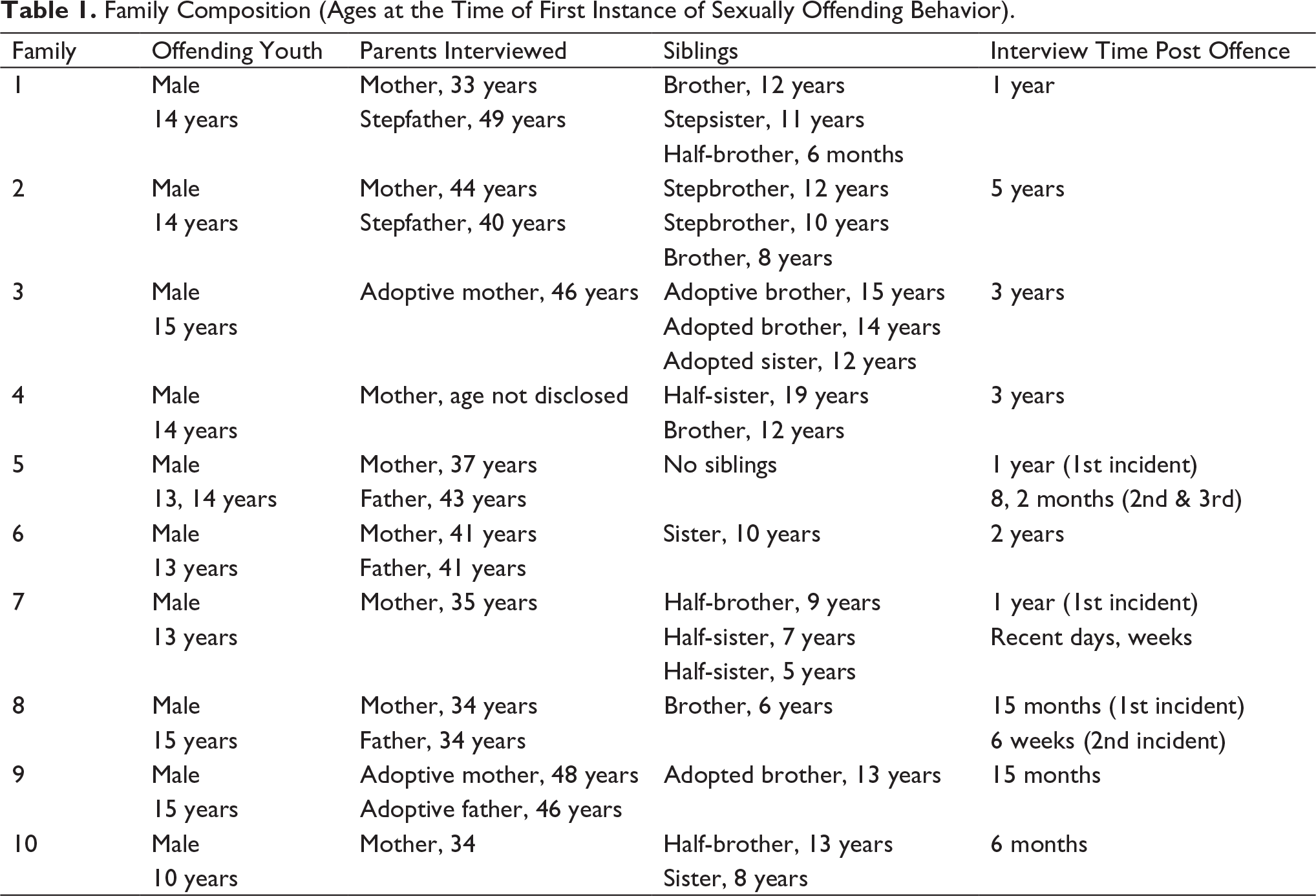
At the time of their interview, parents ranged in age from 34 to 50 years (Table 1). Of the 16 caregivers interviewed, 11 (68.8%) were employed, while 5 (31.2%) did not have employment outside of the home. Among the employed caregivers, 2 of the 11 were on leave because of health issues resulting from their child’s sexual offending behavior. Caregivers’ highest level of education included high school (n = 3; 18.8%), college (n = 8; 50%), university undergraduate studies (n = 4; 25%), and graduate studies (n = 1; 6.2%). Household income was reported to range from $55,000–$200,000 (Canadian funds); as such, and although some parents were under or unemployed at the time of their interviews, given their overall education and income levels, participants are recognized as having been in predominantly middle-class socio-economic circumstances when our study was conducted. In terms of ethnicity, the majority of families (n = 9; 90%) reported that their ancestry was of diversely blended European origins, and one family reported being of mixed African, Caribbean, and European origins. All but one of the families were living in an urban or suburban setting in the province of Ontario (Canada); the other family resided in a town in a rural area within the same province. For family size, there were between one to five children living in the home, with various relationships to the caregiver(s). All families, with the exception of one, had siblings of the offending youth (ranging from one to four). At the time of the offending behavior, the 19 siblings across the 9 families ranged in age from 6 months to 19 years, with 7 sisters and 12 brothers (Table 1). The relationships between the siblings and the offending youth were biological (n = 6), half (n = 6), step (n = 3) and adoptive (n = 4).
As indicated in Table 2, the sexual offending youth ranged in age from 10 to 15 years while victim ages ranged from 3 to 11 years. The majority of instances (n = 7; 70%) involved a relative in the immediate or extended family. The victims were siblings in four (n = 4; 40%) of the 10 families (2, 6, 7, 10). In three (n = 3; 30%) families (1, 3, 8), the victims were cousins and in the remaining three (n = 3; 30%) families (4, 5, 9), the victims were neighbors. While most victims were female (n = 6; 60%), there were also three (n = 3; 30%) male victims, as well as an instance of sexual offending that involved both male and female victims (n = 1; 10%). The age difference between the offending youth and the victim ranged from 3 to 11 years, and the sexual offending behavior ranged from a single episode to multiple episodes over an approximate 1-year period. The offending behavior included non-contact activities (i.e., offending youth encouraging another child to go through and try on a female caregiver’s lingerie) and contact activities of varying invasiveness, from sexual touching to penetration (Gervais & Romano, 2018).
Characteristics of Youth Sexual Offending Behavior, Offender-Victim Relationship.
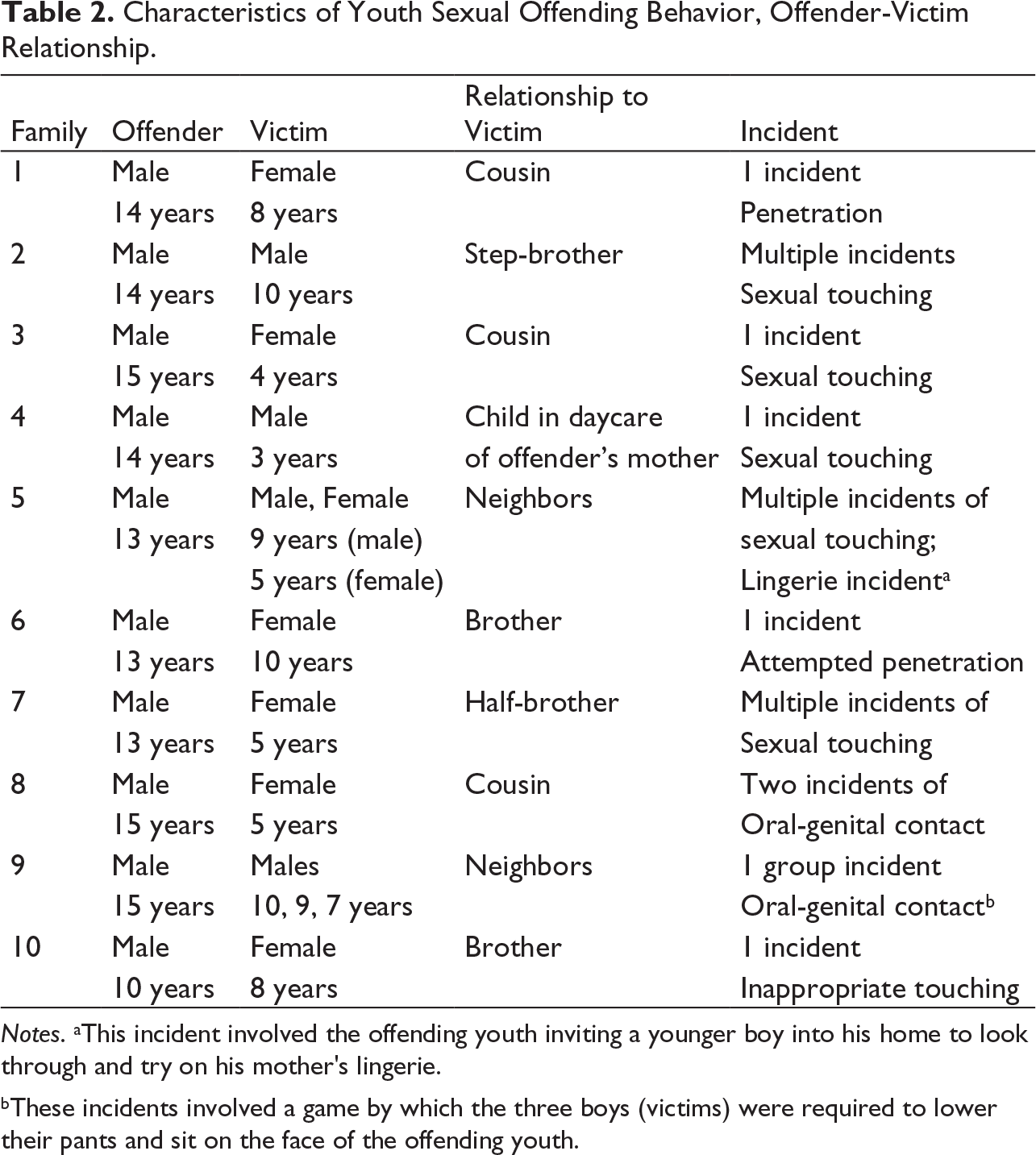
Notes. aThis incident involved the offending youth inviting a younger boy into his home to look through and try on his mother’s lingerie.
bThese incidents involved a game by which the three boys (victims) were required to lower their pants and sit on the face of the offending youth.
Regarding youth involvement with various systems, most youth (7 out of 10) had undergone a police interview, although the police interview for one youth (Family 8) was at the insistence of his mother. Following the police interview, one youth was charged and convicted, though the sentencing had not yet occurred at the time of our interview with caregivers. The majority of youth (90%) were involved with child welfare as a result of the sexual offending behavior. All youth received support from mental health services which were referred by various sources, including the police (three families), child welfare (one family), self-referred (one family), and medical or mental health professional (five families).
Procedure
Ethics approval was secured from both the hospital through which recruitment occurred as well as from the principal researchers’ university. To recruit caregivers for the study, the researchers were assisted by a staff member within a children’s hospital-based mental health unit who was providing services to the sexual offending youth and their families. This social worker informed the parents about the study and, if they were interested in completing interviews and surveys, they contacted the principal investigators directly.
In order to minimize traceable correspondence that could compromise anonymity, and to help parents minimize potential anxiety during the interview, the researchers hand-delivered copies of the interview guide and consent form to caregivers so that they might familiarize themselves with the procedures and the questions. Once caregivers reviewed the materials, interviews were scheduled at a time and location that was most convenient to them. After consent was obtained, the audio-recorded interviews occurred within the family home 2 and typically lasted approximately two hours. Interviews were transcribed by research assistants. To guarantee anonymity and respect confidentiality, potentially identifying information was removed.
Data Analyses
The interview data were organized thematically and analysed qualitatively. The authors first conducted a manual round of open coding, beginning with the broad topical areas covered by the open-ended questions and moving toward the development of initial thematic categories (Berg, 2007). Second, the authors conducted a round of analytic coding to align related themes conceptually and in consideration of the extant literature on reconciliation and restorative justice (Woods & Proeve, 2014), and on the experiences of caregivers and relatives of youth who have sexually offended (Berg, 2007; Hackett et al., 2014; Jones, 2015; Pierce, 2011; Thornton et al., 2008).
Findings
Reconciliation between the offending child and the victim.
Parents reported a range of relationship adjustments and reconciliation efforts (or a lack thereof) between the offending youth and the victim(s). In six families (2, 3, 4, 5, 7, 9), neither were relationships restored nor was reconciliation achieved between the offender and the victim. Comparatively, in the four other families (1, 6, 8, 10), relationships between the victim and the offender were re-established, although not necessarily all through direct apologies between them.
Among the families that did not experience reconciliation, Family 9 faced some of the most antagonistic and institutional barriers. In their circumstance, reconciliation between the offending youth and the victimized neighborhood children were not facilitated because the case was being addressed in an adversarial way through the criminal justice system and the offending youth’s parents denied any wrongdoing on his part due to his mental health and intellectual challenges; thus, they felt that an apology was irrelevant. While denial and limited cognitive capacities also impeded a reconciliation between the offending brother and the victimized sister in Family 7, displaced blame was also a factor: “I don’t think she has any forgiveness for her brother at all.… [because] He still says stuff to her that implies ‘it’s your fault that you said something’ and … it’s hard for her to hear that” (Mother 7). At the time of the interview, the single caregiver remained frustrated by her son’s deflecting of blame as she was aware of the implications: “Very, very, very much. I know it affects everybody.” While initially the victim and offender co-existed within their household by way of additional monitoring, including electronic devices, their relationship was eventually severed after a recurrence of sexual harm which led to the older brother being removed from the home.
By contrast, in Family 4, although a reconciliation did not occur between the 14-year-old youth who offended and the 3-year-old boy he victimized at his mother’s daycare, it was not due to a lack of willingness on the part of the perpetrator, nor of the investigating police officer:
He wanted to apologize. He wanted to talk to the victim … right off. I said, “You can’t.” And then when we had spoken to the detective again, he … said that’s huge … But he said “but … really, we can’t allow it because of [the victim’s] mom” he said. “I might have under another circumstance tried, but he said I’m not touching mom.” (Mother 4)
Despite the victim’s mother’s restrictions, the youth who harmed him continues to inquire concernedly about the victim’s well-being: “[He] always, always asks if the boy has been okay. He asks if I’ve seen him.” (Mother 4)
The youth’s mother tearfully grieved the unachieved reconciliation between the affected youth because she realized its healing potential; nevertheless, over time, she has reluctantly accepted the deprivation:
It’s both sides … and so him [the victim] being … whatever he is now, seven or eight … just to hear that [apology] … would help him through … everything in life. Letting him know that … even this guy who he still adores was accountable and was sorry.… That’s the only thing I can’t make okay, and that’s okay. (Mother 4)
Similarly, in Family 2, the possibility of a reconciliation between the 14-year-old youth who sexually offended and his 10-year-old stepbrother whom he harmed was reported to have been thwarted abruptly by the victim’s mother who forbids communication and visitation, even though a health care agent encouraged their reintegration:
[There was] just no opportunity for them to say … goodbye. (Stepfather 2)
They wanted to reintegrate, she [victim’s mother] said no. The psychologist said … “You want to give them a tool to get over this;” she [victim’s mother] said “No. He’s a child molester. No” … They haven’t seen each other in five years … Sad, eh? (Mother 2)
As the interview conversation focused on how apologies can be healing for both the victim and the offender, Mother 2 commented:
That’s what we wanted … some resolution … we can work this [out], maybe he [can] be there during the day and not sleep there? Nope, nothing.… That [an apology] was never enough for her. (Mother 2)
Despite the parents’ frustration about the existing deprivation, they were optimistically insistent that reconciliation was inevitable for relational and practical purposes in the future:
I wish it would have happened a long time ago. But … it’s going to happen … The way our family is, we are too tightly knit that … it’s just not possible that we can do a lifetime without them ever connecting again.… I’m really hopeful with the way things are evolving now because we are getting … into some parts of life that have got bigger events coming, weddings and stuff … and obviously, we have to face that, and we don’t want to have any of our family excluded from those events. So I’m hopeful that we resolve this before that starts to happen so that we can be all together. (Stepfather 2)
Among the remaining families, an apology by the son who offended was explicitly articulated only in one case, but it took years of counseling to achieve it. The parents in Family 6 reported that the siblings’ relationship did not change dramatically upon disclosure which occurred about three years after a one-time episode of sexual harm occurred between their 13-year-old son and 10-year-old daughter. Although the siblings continued to live and interact within the same household under constant supervision, and the parents kept their son in counseling in order to ensure that he “is getting help” and to reassure their daughter that “he’s not going to get away with it” (Mother 6), at the time of the study’s original interviews, a reconciliation still had not taken place because the brother kept denying the incident. His victimized sister, whom the parents described as mature, was still expecting an admission and an apology, and the parents were quite frustrated with this ongoing omission:
He knows it’s wrong. But he still … just cannot admit to himself … that he would have done that to his sister. (Father 6)
I had sat down with her right before we spoke with the police … and said to her … “What do you want to see happen with [your brother]?” And she said “… I just want him to say he’s sorry.” … And for me, … I just wanted … him to just say, “Yes I did it; I’m sorry” so we could just … move on. (Mother 6)
While at the time of our interview with the parents, neither an admission nor an apology was articulated, during a post-interview conversation, 3 the mother reported that an apology and reconciliation took place during a counselor-facilitated meeting and that the relationship between the siblings improved. Upon the sister hearing her brother’s apology, which he expressed in the presence of a counselor and the parents, she immediately hugged him and told him that she loved him and forgave him. The parents were relieved beyond measure.
In two other families (1 and 8) in which harm was perpetrated by an older male cousin and a younger female cousin, while direct apologies between the children did not occur, their relationships were restored to varying degrees as the adult relatives supportively facilitated the almost immediate resumption of family gatherings. In Family 1, while the boy’s reintegration occurred approximately a month after the incident, the extended families continue to monitor the relationship between the victim and the offender. While the victim seems comfortable with her older cousin who harmed her, he remains at a distance from her in part out of shame and out of concern for the little girl; his mother reports that he has cooperated well with treatment and has realized the seriousness of his mistake; he also engages in self-monitoring:
My son doesn’t go anywhere near her anymore. He’s polite with her … when we go over, they’ll talk … but it was nothing like it was before … like she’ll come up to him and give him a big hug “I love you [name]” … but he withdraws completely. (Mother 1)
Within Family 5, although relations between the parents of the 13-year-old youth who offended and the 9-year-old male and 5-year-old female victims living on the same neighborhood street were re-established, certain barriers seemed to hinder a child-to-child reconciliation. Their son neither apologized to nor expressed concern for the two neighborhood children with whom he had inappropriately interacted. The mother explained some of the obstacles to that would-be communication. The first one pertained to his cognitive and emotional challenges:
I don’t [think] it’s because he … wouldn’t want to; I don’t think he’s capable … yet I don’t think he’s evolved that part of his self … yet not to that degree. (Mother 5)
Nevertheless, the father conveyed their openness to an apology:
I would hope that … part of the roadmap that’s gonna unfold before us as we work with [the social worker] is … there maybe something like that that involves [our son] … writing a letter … to at least the boy or the girl. (Father 5)
Yet as the mother recalled, a second barrier established by one of the victim’s parents would likely prevent the delivery of the proposed letter of apology:
The sense that I got from … the dad [was] they did not want to draw a lot of attention to this incident because they did not want it to become a traumatic event for the girl … and so I haven’t even conceived … of him going to talk to them or apologize because I feel like that … would take it in a direction that they’re not comfortable with. (Mother 5)
Beyond avoiding an escalation of the matter, for the sake of children’s safety, the abuse-affected children no longer interacted since the incidents were disclosed, and the offending child’s parents were emphatic about the imposed separation: “No. Absolutely not! … Basically, he’s not permitted to be outside in front of the house.” (Father 5)
Reconciliation between offending child and victim’s parents.
In 90% of the cases, the youth who offended did not apologize to the victim’s parents. In 70% of cases in which apologies were not articulated, and nor were relations restored, the reasons varied from ongoing familial conflicts (Families 2, 3), denial or limited ability on the part of the youth to feel remorse and/or communicate apologies (Families 6, 7), 4 adversarial familial tensions in neighborhood-based incidents (Families 4, 9) and the offending child’s young age which limited his understanding of the impacts of the sexually offending behavior (Family 10).
Due to the extended family conflicts resulting from the sexual harm he perpetrated against his 4-year-old female cousin, the 15-year-old youth in Family 3 seemed preoccupied with tension-filled emotions instead of apologetic sentiments towards the victim’s mother seemingly out of concern for the negative impact on his own mother: “He’s quite resentful of [his aunt/mother of victim], and I think it’s not so much how [my sister/victim’s mother] has responded to him but how she’s been with me.” (Mother 3)
By contrast, relations were restored within the remaining 30% of cases. In Family 5, while there was no apology communicated by the offending youth toward both sets of victims’ parents who were neighbors, the latter re-established cordial relations with the offending youth’s family and they were supportive of his needs for compassion, treatment, and care. Nevertheless, they set parameters that prohibited any interaction between the children without supervision. Similarly, in Family 1, although a direct apology did not appear to have been articulated by the offending youth to the victim’s parents (his aunt and uncle), the latter, and particularly the uncle, were open to reconciliation and they felt that their nephew could be reintegrated within extended family gatherings; but it was certainly difficult for the shame-filled youth at the beginning:
Well initially … we continued to try and get together, but he wouldn’t come; he didn’t want to … but the other family, the father, who … does have some tremendous gifts in terms of forgiveness, … was saying “Listen, we must all come together to heal, right?” So … finally, there was enough courage … for the boy to say, “I will come; I would like to get together.” (Stepfather 1)
In the case of the only explicitly expressed apology by the offending youth toward the victim’s parents, 5 it occurred in both planned and circumstantial ways for Family 8. In a pretend “scared straight” interrogation interview insisted upon by the offending son’s mother in order to impress upon him the seriousness of his behavior, the police officer encouraged him to write a letter of apology to the victim’s parents. The letter, along with an in-person apology, led to the boy’s reintegration within the extended family:
I emailed it [the letter] to her [my sister (the victim’s mother)] … and then … he gave it to her. But … for my Grandma’s birthday, which … we always … celebrate … we were all … trying to figure something out and so mom called [my sister] and [my sister]’s like “No, just bring him. It’s fine. At some point we have to see each other, so figure it out.” So I told [our son] when we got there that he had to talk to [my sister/the victim’s mother] and to [the victim’s father], before we do anything further. And I could tell that he didn’t want to … and we said “the longer you wait, the harder it’s going to be. So … you have to do it now” … I don’t know what they talked about, but I know that he apologized to them and whatever happened in there is between the three of them. (Mother 8)
Despite the positive steps forward, as the boy’s mother reflected on the reaction to her son’s apology, some uncertainty about a complete reconciliation remained:
I don’t know if she’s forgiven him just because it’s been such a short time since it’s [the second incident] happened, right? It will take some time for us to forgive him … I think forgiveness comes once he’s done the things that he needs to do in order to show someone that he’s really sorry … and that means going to these [counseling] sessions, writing the letters, saying I’m sorry … in order to make it better. (Mother 8)
Reconciliation between offending child’s parents and the victim.
In 30% of families, caregivers reported that reconciliation was not achieved between the offending youth’s parents and the victim. In two families (3, 4), forgiveness was not obtained, but it was not due to a lack of willingness on the part of the youths’ single mothers; rather, in those cases, opportunities for apologies were prohibited by the victims’ parents. In another family (9), neither an apology nor reconciliation were yet considered because the case was being addressed in an adversarial way within the criminal justice system. By contrast, relationships were restored to varying degrees among 70% of the families. For example, apologies were communicated, and reconciliation was achieved between the offending child’s parent(s) and the victim(s) in three families (2, 6, 7), whereas when apologies were not directly verbalized by the parents to the victim, relations between them were still restored or re-established in four families (1, 5, 8, 10).
Among the families in which forgiveness was not attained, the most complex case involved Family 9. 6 An apology was not communicated and nor was reconciliation sought due to the youth’s parents’ perception that the “victims” had instigated the sexualized game of truth or dare in the local park, but that their son was wrongfully criminalized which resulted in, among other concerns, major legal and financial burdens. Thus, they held a reversed sense of pardon:
Because [our son] didn’t do anything, I mean forgiveness from the offender, there is nothing there. Would I forgive them [victims and their families] for their behavior? Hmm. Someday. Do I want to reconcile with them? Well, I never had a relationship with them really. Yeah, I don’t care. (Mother 9)
I would really like to have the entire system … ask me for forgiveness … and I’d like them to provide some sort of reconciliation in a financial means. (Father 9)
Whereas Family 9’s reconciliation was impeded by personal resentment and a formal adversarial process, that of two other families (3, 4) was prohibited by restrictions set by the victims’ caregivers. Nevertheless, the youth’s parents conveyed care and concern as they pondered would-be apologies. Given the passage of time, 7 although she felt apologetic and sometimes desperately 8 yearns to see the little boy from her daycare again, Mother 4 preferred not to stir up potentially difficult emotions for the victim:
In my gut, I would want to say sorry, but in my head, I wouldn’t want to bring it up again because it’s been that time … I see where [my son] is … I don’t like bringing it up with [my son], so I probably wouldn’t want to bring it up with him [victim] again. (Mother 4)
While Mother 3 did not yet have an opportunity to apologize directly to her victimized niece due to extended family strains, 9 she had several points to share if ever she was given the chance to speak with her niece: “I’m sorry it ever happened; I feel sick; I’m concerned about you … I’ve done everything towards getting [my son] help so that he would never do it again. I understand your fear.” (Mother 3)
Comparably, in cases in which both the offender and the victim were within the same family (2, 6, 7), parents reported that they had apologized to their victimized child and had restored their relationship with them. In Family 7, the single mother emphasized protection and open communication as she conveyed her apology to her daughter:
I just let her know that she didn’t do anything wrong, like this wasn’t her fault and … I’ve apologized to her for not protecting her, for not … knowing what was happening … [because] I definitely struggled with that, and I wasn’t able to protect her. (Mother 7)
The mother reported that both she and the daughter felt consoled following her apology:
She snuggled up and she told me it was okay … and I just let her know that … I will protect her, and I will be there, and she can talk to me … anytime she needs anything, like to be comforted, to sleep with me… anything … it was good, it was kind of … a weight off my shoulders (Mother 7)
The parents in Family 6 expressed similar support as they apologized to their daughter:
I … just said … “Honey, I’m so sorry that this has happened to you. It’s not fair …” She said “Mom, it’s not your fault.” (Mother 6)
After a long sigh and pause when he was asked to elaborate on his apology to his daughter, the father replied:
Basically the same … if there was anything that I could have possibly done to prevent this, I would have … She understands that we do acknowledge the fact that it did happen, and that we are there for her … “that we believe her”. (Father 6)
The mother in Family 2, who is also the stepmother of the victim, explained that although her apology to her stepson was brief, they were able to maintain their positive relationship despite the negative context around it:
I said … “I’m sorry this happened to you”, but … that’s the extent of it … [because] she [victim’s mother] said that she didn’t want us to talk to him about it. I’ve always had a great relationship with him [victim] … and in fact when he is here … [if] he needs something, [he’ll] run after me, “Can you do this for me?” … He never gave me a hard time … he knows that it [family conflict] is not between him and I. (Mother 2)
Relatedly, four other families (1, 5, 8, 10) were also able to maintain positive relationships with the victims and their families, even in the absence of apologies. In Family 8, although the relationships between all the affected relatives were restored immediately and very supportively, the offending youth’s parents, who were also the victim’s aunt and uncle, did not communicate a direct apology to the victim. While both the boy’s parents conceded that they had “no clue” what they would say to their niece that was age appropriate (Father 8), Mother 8 explained that the omission was also intentional because they were trying to be considerate of the victim’s broader safety and communication needs:
I haven’t talked to [my niece] about it … because … I don’t want to break her trust. I know that [my sister] … and my mom has talked to her about it … so I just left it at that … hoping that that builds a trust factor there that if anything ever did happen … later in life that she could at least come to me. (Mother 8)
The boy’s mother proudly and humorously reported that despite the absence of a direct apology to their niece, they have maintained a good relationship with her: “Yeah, nothing’s changed in that aspect … like yesterday I was getting (my younger son) off the bus and she ran and gave me a hug before she gave her mom one … [laughs]” (Mother 8)
In Family 5, whereas the mother was thoughtfully hesitant about apologizing directly to the neighborhood children affected by their son’s behavior, the father seemed more open to expressing specific concerns and wishes in an effort to reassure the children:
I would say to the parents … please express to your child in whatever way you feel appropriate that … we care for them and are concerned … and that we’re thinking of them … But I wouldn’t want to express that to the child myself … because these kids are strangers to us, right? … If we had had a relationship with their family … then absolutely … I would feel that connectedness … to say something directly to him … But I don’t have that. (Mother 5)
I would like to say … how we feel responsible. How we feel sorry. How we hope that … that they weren’t scarred by this … That it wouldn’t have a significant impact on them in the future. (Father 5)
Reconciliation between offending child’s parents and victim’s parents.
While caregivers in four families (2, 3, 4, 9) reported that they were not able to reconcile with the victim’s parents, caregivers in three families (1, 5, 8) were able to do so and/or restore their relationships. In the three remaining families (6, 7, 10), the caregivers were parents to both the offender and the victim, as the harm occurred between siblings, and thus reconciliation between the parents was not applicable; in such cases, while the parents struggled with guilt, regret, and logistical stresses, they concentrated on accessing support for both their children.
Among the four families in which parental relations were not repaired, none were as formally strained as the ones in Family 9. The offender’s parents had no communication with the victims’ parents due to the adversarial nature of the legal system through which their son’s criminal case was being processed. In Family 2, the offending youth’s mother and the victim’s father were very supportive of each other as they managed the crisis within their blended family. However, as a couple, there seemed to be a deep-seated and ongoing conflict with the victim’s mother for whom, at least reportedly, reconciliation and relationship restoration were not an option, neither for the parents nor for the victim and the stepsiblings.
Similar constraints were present in Family 3. The offending youth’s mother reported that given family strains, and due to the protectiveness toward the victim, relations with her sister (victim’s mother) were not restored since reconciliation had not yet occurred. Instead, what little and strained communication they did maintain focused on logistical details aimed at maintaining the complete separation between the victim and the offender at extended family gatherings. The emotional uncertainty resulting from the lack of forgiveness was complex and challenging:
[I felt] … really sad for [my sister and her husband] because unforgiveness can just … destroy you. I want her to forgive, more for her sake than for my sake because … she is the one who’s still really … angry … she’s stewing. (Mother 3)
How do I navigate this? … I didn’t want to be resent [ful] … It was a real journey of grace … I totally understand … that she has every reason to be angry … but … it was an interesting time. (Mother 3)
The pain associated with the deprivation of reconciliation was most evident in Mother 4’s recounting of her sense of accountability. As she explained her feelings about the unanswered apology, she texted to the victim’s mother with whom she had had a “good” and “solid” relationship, she tearfully shared: “It’s what I needed to do … I take blame, right? … I don’t think it’s brave … It’s just … the right thing [crying]. Her kid got hurt, and he was in my care.”
As the mother reflected on her emotional responses and how she still yearns to make amends with the victim’s mother, she clarified how difficult it was to accept that the matter was still not resolved, and how the desire for reconciliation remained quite pronounced because she considers the power of it to be “huge”:
You broke me down once (laughs). But … it’s just that one thing … everything else has kind of all worked itself out except that one thing that I can’t do … but it’s out of my control … and … the one thing that gets me through it all [is] I know the victim is okay. (Mother 4)
In contrast, Families 1, 5, and 8 benefited from both reconciliation and restored relations. In Families 1 and 8, which both dealt with sexual offending between cousins, forgiveness occurred relatively quickly after the incidents were disclosed, in part due to logistical and emotional support by the grandparents. While direct apologies may not have been explicitly verbalized, the offending youth’s parents’ collaboration with the victim’s parents, through which they prioritized the well-being of all the affected children, led to the positive and productive restoration of familial relations. For Family 8, the almost immediate and automatic reconciliation brought a sense of relief to the offending youth’s parents amidst ongoing complex, yet collaborative efforts to prevent further harm:
Yeah, it has. I didn’t really think my sister would not [reconcile]. I don’t think that she would blame me. … Plus (the victim’s father) knows us enough to know that we would never harm his daughter; this isn’t something that we okayed or just let happen … We take care of her just like she’s ours … and (my sister)’s pretty good in that sense that she still lets her come here; I just make sure that (our son)’s not here … we would never ever leave them alone. (Mother 8)
Similarly, when the parents in Family 5 articulated their apologies, they did not face antagonistic reactions by the two sets of victims’ parents who were their neighbors. In fact, after apologizing profusely, and expressing their remorse, as well as explaining to the victims’ parents on multiple occasions their serious commitment and concrete plans of action towards preventing recidivist behavior on the part of their son, the caregivers were met with unexpectedly cordial support:
As soon as he [the victim’s father] was done telling me what had happened, I … apologized … every which way … I assured him that … we will set into motion whatever appropriate measures need to be taken right away and we will report back … every step of the way … he thanked me for that and … he did say that they had no interest in getting the authorities involved … and … he had the interest of both kids in mind which was … comforting … because … I was expecting … him to … attack me, … and I can’t say I would have … held it against him [but] he was using words like… “We want to be part of the solution” … “We care about… your son a lot. These are confusing times for an adolescent” … [Later on] I … went out to give him a verbal update … and I just walked out to say look, I just want to let you know that our son has finally … just had his first appointment and he said, “That’s great.” … and he just shook my hand and said, “I’m here to help”. I distinctly remember that and … again I was … appreciative … and … that the other parent … it’s still quite significant that he said … “We don’t want this to be like a ball and chain to us to carry around”. (Father 5)
Although their apologies seemed well-received by the victims’ parents, as was evident by the latter’s cordial gestures and supportive comments, the offending youth’s parents still struggled with stigma and shame and thus opted to remain more “inward” and less interactive with the victims’ families on their street.
Despite the lingering emotional burdens, when we asked the parents if they felt forgiven, they qualified their affirmative answer by illustrating tangible gestures shown by some of the victims’ parents from which they took comfort, including friendly greetings as they passed by on the street. These caregivers were particularly taken aback when on two different occasions relatively soon after the incidents were disclosed, the father of one victim stopped by their house to borrow their hockey net, while the mother of the other victim asked to borrow their barbeque because she had run out of propane while preparing supper. In both instances, the offending boy’s parents readily obliged and took the opportunities to provide updates on their son’s accountability protocol which the victims’ parents had originally insisted upon, but to which they were now seemingly less concerned, all of which remained perplexing for the youth’s parents:
We had been waiting to give them the letter [confirming our son’s professional mental health care] … and here she was so …we grabbed the letter and handed it to her. And we said, “Do you know what this is?” and she said, “Oh yeah, yeah, that’s great, thank you very much.” She folded it in her pocket and said, “We don’t need to talk about it anymore.” (Mother 5)
Yeah, that she would even think of asking … that was pretty significant … Like she could have said, they could be the last people on the street with … a functioning barbeque and there’s no way in hell I’m gonna ask “them” if I can use it. You know? (Father 5)
As the mother summed up the reconciliatory feeling derived from the victims’ parents’ surprisingly cordial approach, she reiterated the couple’s gratitude:
While I’m thankful for … our … luck in coming across two families who’ve been so oddly understanding and in this last case … I would say on the verge of supportive … is far beyond what I would expect in this … kind of scenario. (Mother 5)
Reconciliation between other relatives affected by the offending behavior.
In five families (4, 5, 6, 7, 10), other relatives were not aware of the sexually offending behavior, and thus, reconciliation was not applicable; in these cases, the parents expressed relief because they were spared from having to manage their relatives’ disappointment. In four families (1, 2, 8, 9), other relatives were aware and were supportive of reconciliation and the inclusion of the offending son. In one family (3), it was reported that other relatives complicated or hindered reconciliation. More specifically, there were three families (1, 3, 4) in which siblings were negatively impacted by socially stigmatizing repercussions and they thus felt resentful towards their offending brother; while reconciliation may not have been directly facilitated, relations between those siblings were restored and in some instances were reported to have improved. In other cases, siblings were not aware (Family 8), or relations with siblings were not discussed (Family 2, 10), or were not applicable as the boy who offended was an only child (Family 5), or were complicated due to a sibling’s limited cognitive ability to understand the implications (Family 9), or were direct victims and reconciliation did not involve other relatives (Families 6, 10).
Among the families whose extended relatives were aware of the sexual offending, none seemed more contentious and thus so far removed from the possibility of reconciliation than Family 3. In their case, many relatives knew about the harm between the adolescent son and his younger female cousin; the mother reported that none of them forgave her son and all excluded him from family gatherings, even though they welcomed her and her other children. However, based on professional counseling advice, she chose not to attend family events without him in order to minimize the ostracizing effects. Such a position exacerbated tensions and led to intensely hurtful and guilt-inflicting criticisms against her by the grandparents, aunts, uncles, cousins, and in-laws. Thus, the resulting conflicts and the corresponding lack of reconciliation affected not only her and her offending son but also her other children as they too were deprived of extended family gatherings. While she recognized that her parents (her son’s grandparents) are “in a horrible position” and she understands why they are “very defensive,” she was discouraged and frustrated by the confusion and miscommunication over her willingness to reconcile with her sister (the victim’s mother) and the entire family at the outset:
Then for my dad to say, “Would you be willing to go?” … I was like, ah, duh [sarcastic laugh] … “I’ve tried!” … of course, I am willing … But honestly … I was so anxious to do it, and now like three years later, it’s like “yeah great!” [sarcastically]. But there has just been so much hurt … so much pain, you know? (Mother 3)
Despite feeling discouraged by the delay and although her “counselor wants a third party” to facilitate the process given the extent of the familial conflict, she is optimistic that forgiveness may someday be granted across the extended family as there “might be a door opening;” but in the meantime, she is comforted by the relational gains that her immediate family has made:
Well I think there is hope that there will be reconciliation, I never … thought it would take this long but even if there wasn’t, I’ve got hope that my children and I can build good strong relationships; we [already] have our family … so you know? (Mother 3)
By contrast, in other families (1, 8), reconciliation was facilitated relatively easily and soon after disclosure, and grandparents played particularly significant roles in it and in the reintegration of the offending youth within them. In Family 8, while the grandparents and other relatives ensured that their grandson remained included within the close-knit extended family, they also helped to monitor him for safety reasons, and to hold him accountable:
Everyone [grandparents, aunts/uncles, parents] has pulled [our son] aside and had their moment of expressing … how he’s let them down and that now he has to rebuild people’s trust. (Mother 8)
The parents underscored how their family unity fostered the reconciliation and reintegration and thus avoided tension and rejection: “If we weren’t close, I’m sure it would have just pushed us further apart.” (Mother 8)
Similarly, in Family 1, the reconciliation was initiated and achieved within the family without professional intervention, and the grandparents played a crucial role in the process. The grandfather’s inclusive attitude towards his grandson (offending youth), his granddaughter (victim) and their mothers (his two daughters) set the stage for reintegration early on:
My parents were aware, and the only thing my dad said is “I will not pick sides; you are my family, and I will not make any of my grandchildren or my children feel like one is loved more than the other.” (Mother 1)
At a family barbecue two months after the incident, the grandson who felt “ashamed” initially stayed in the living room and refused to join others outside and was reported to have tearfully said: “No I don’t want to go … no, I’m not welcome here; I don’t belong here; I don’t want to be here anymore” (Mother 1). The grandmother used a supportive approach, while the stepfather used self-deprecating humor to help the youth overcome his feelings of embarrassment and to join the rest of the family. The mother reported that: “after that everything seemed to vanish, like the damage that seemed to have been done,” and he was welcomed in all future family gatherings, although he attended them less often afterwards.
Discussion
Our findings demonstrate that the complex and chaotic circumstances that families contend with after their child has sexually offended greatly impact efforts towards reconciliation. In line with some extant literature (Marsh & Wager, 2015; McGlynn et al., 2012), youth who were unable to make adequate redress to their victims often left all affected parties feeling disempowered, confused, or bitter. On the other hand, despite strained intra-familial relations, families and offending youth who achieved some form of reconciliation amongst relatives or between victims tended to report experiences of healing (Gervais et al., 2020; Van Camp & Wemmers, 2016).
That being said, while Jones (2015) and Hackett et al. (2014) found that complex family dynamics can hinder the reconciliation process, our findings suggest that many parents were willing, through their own resiliency, to continue working towards reconciliation even amidst serious obstacles posed to them by the offending child, victims’ families, or the criminal justice and health care systems. In some cases, this perpetual ambition to make amends eventually broke down existing barriers such as one youth’s repeated denial of the offending behavior. Even when a full-fledged apology was not permitted by some of the victims’ family members or criminal justice officials and health care professionals, some youth and their caregivers still made smaller concerted efforts to show the victims that they were sorry, which some survivors responded to with compassionate and loving gestures.
Although more direct apologies and means for reconciliation did not occur amongst some families out of respect and concern for the victim’s safety and communication needs, some families still attempted to work within the parameters they were given to communicate their remorse and restore their relationships with the victim and their families. While it is reasonable that some parents of youth who have sexually offended may isolate themselves from the victim and their families because of feelings of self-judgment and other hesitancies (Pithers et al., 1998; Woods & Proeve, 2014), some parents in our study tried to balance their own regrets and uncertainties with the immediate needs of their own child, the victim, and the victim’s family. As was the case of Family 5, small apologetic gestures or symbolic acts of both communication and silence went very far to help restore peace with the victim’s family. These acts further emphasized the parents’ social diligence and the sensitivity they exercised in preserving relations and responding to the individual needs of both the victim and their parents.
Hackett et al. (2005) note that admissions of guilt and responsibility often occur due to the expectations imposed on offending youth by the criminal justice system; however, in our study, criminal justice staff dissuaded some families from reconciling. In the face of this “system” deprivation, both affected relatives, victims, and offending youth sometimes exhibited an agency to reconcile within the parameters they were given. One police officer who was supportive of the family’s desire to make amends (but could not allow it) remarked how “huge” this ambition was on behalf of the youth and his mother.
Our findings also emphasize the potential for extended relatives such as grandparents to serve as powerful facilitators of reconciliation when sexual violence is both perpetrated by an offending youth and experienced by a victimized youth within the same family. According to Hargrave (1994), when families have experienced severe violations of love, trust, and safety, they negotiate a difficult pathway towards achieving reconciliation and forgiveness. This process can involve identifying the origins of family pain, guilt, and shame in order to mitigate the risk of re-offending and ongoing familial conflict, as well as providing the person who has offended with the opportunity to demonstrate love, trust, and accountability to the victim, preferably through an overt act of forgiveness in order to restore relations (Hargrave, 1994, pp. 3–4). As we saw in Families 1 and 8 when grandparents were present within the family and served as supportive and mediative figures to help bridge fragile relations between the youth who offended, the victim, and the parents on both sides, the processes of reconciliation were mobilized more readily and productively than in families where the interpersonal dynamics were more tenuous (Gervais et al., 2020).
Comparatively, Mother 4, who was a single mother and had recently lost her daycare due to the harm committed by her son within it, had to lean on a police officer’s support to help navigate reconciliation (and the lack thereof) with the victim’s mother. While the more stable family dynamics present in Families 1 and 8 may suggest that families with a more privileged family structure may be able to navigate the relational processes of reconciliation more easily because of the support they can draw on, it was not the case in every instance, including in Family 6 whose parents were particularly supportive of a reconciliation between their son and daughter, but who had to draw on social workers’ facilitation to achieve it. Furthermore, while Mother 4’s financial strains and dependency on a police officer’s support may infer that lower socio-economic conditions may have hindered this family’s means to navigate relations, it is essential to point out that Family 8’s lower socio-economic position did not appear to be a factor in their ability to achieve reconciliation. Regardless of their different outcomes in terms of reconciliation between the offender and the victim, it must be recognized that both Families 4 and 8 ultimately transcended their socio-economic strains because both sets of parents were resilient and resourceful in their efforts to seek some form of support in order to achieve reconciliation. While reconciliation was not accomplished between the offender and victim in the case of Family 4, it was achieved between the mother and her son, due largely to the mother’s mature outlook and preserved responsibility to keep the best interests of her son at the forefront of her approach. Both outcomes in Families 4 and 8 suggest that a supportive family structure and close-knit bonds can produce mediative relations and resiliency in ways that are not overwhelmed by socio-economic disadvantage.
Pierce (2011) documents the ways in which some parents take responsibility for their offending child’s actions and seek to apologize to the victims and their families on behalf of their offending child. Yet our study highlights how some parents patiently worked with their children over extended periods of time to achieve a greater sense of accountability, including communicating their own apologies, rather than doing it for them. Families, in our study, experienced great frustration with the deprivation of meaningful reconciliation, but oftentimes remained very cognizant of the need for their child to come to a sense of accountability organically, rather than have it imposed on them by authorities or their parents. In some cases, this process resulted in offending youth developing a greater sense of responsibility which transformed into attempts to acknowledge to themselves and to others their harm-generating behavior (such as through diary writing), to make redress, and to repair the many damaged relationships that occurred as a result of their offense. Parents, in this sense, were allies to their children rather than overbearing agents of accountability (Gervais et al., 2020).
As noted by Family 8, forgiving one’s own child or nephew for their sexual offending behavior is not a linear process and it relies on many factors, such as the youth showing remorse, apologizing, taking counseling sessions as well as helping to ameliorate the ongoing tensions and circumstances. Even if their child had preexisting conditions such as mental health challenges that rendered them more vulnerable to offend, parents often did not shoulder their responsibility onto the condition. In line with Harris’ (2010) emphasis on the importance and benefits of recognizing the capacity and willingness of vulnerable, yet previously violent youth to be held accountable, our study showed how the two families that delicately worked with the victims’ relatives to reintegrate the offending youth back into the family and provide him with the opportunity to apologize and demonstrate his accountability, experienced greater post-offense cohesion and more effective safety-oriented collaboration. While this “team approach” advanced healing within those families, many other families did not encounter such restoration because some of the affected parties did not desire reconciliation. In this sense, our findings further echo Harris’ (2010) assertion that opportunities for accountability and reconciliation, albeit small ones, can lead to positive results and build empathy amongst those who are in close proximity, including both within and across the families of the offending child and the victims.
Similar to Harris’ (2010) illustration of conflict-affected youth who insisted on acknowledging their violent behavior and being held responsible for it in the context of post-war community rebuilding, Hackett et al. (2014, 2012) also encountered sexually offending youth for whom it was important to apologize to, and restore their relationships with their victims, especially within their families. The gains made by some participants in reconciling with affected victims and relatives both immediately and over a long period of time likewise emphasize the meaningfulness and potential of these restorative practices. Notably, in Family 6, the outcome of a long-awaited reconciliation reinforced the value of restorative processes, particularly for victims (Daly, 2006; Koss, 2014). The offending brother’s apology to his victimized sister served, at long last, to fulfill her main expectation and that of their parents: that he finally admitted to and said sorry for what he had done. The sister’s joy-filled hug and compassionate expression of forgiveness immediately following the apology, along with the parents’ deep sense of relief were both testaments to how the validation of a victim’s experience through the offender’s articulation of accountability, and the resulting relationship repair are undoubtedly worthy outcomes to continuously pursue, especially through restorative practices that are carefully prepared and facilitated in order to ensure safe and rehabilitative victim-offender interactions (Daly 2006; Hackett, 2014; Koss, 2014).
Limitations and Recommendations for Future Research
The implications highlighted in this article are based on a very small sample of caregivers whose identities and life circumstances were not diverse in terms of race, ethnicity, 10 sex, gender, sexual orientation, 11 language, ability, 12 socioeconomic status, 13 or geographic location. 14 As a result, our findings are not generalizable to a broader population of families generally and of youth who sexually offend more specifically. Furthermore, the fact that parents were self-selected into the study, and whose children and families were receiving professional mental health support points to the likelihood that the participants were more at ease sharing their experiences. In addition, the caregivers’ interview accounts focused on family experiences within relatively brief periods of time after disclosure, with the shortest timespan being a few months (Family 10), while the longest one was four years (Family 2). It is thus important that future studies are based on (a) wider recruitment efforts from multiple mental health care sources, (b) families facing a broader range of adversity and varying degrees of professional services, (c) families representing more diverse ethnic backgrounds, socio-economic status and geographic locations (both urban and rural), languages (both English and French in Canada), (d) families whose children represent various abilities, as well as identities in terms of sex, gender, sexual orientation, (e) longitudinal monitoring of both continuity and change in familial relations and reconciliation efforts, as well as (f) the direct perspectives of youth who have sexually offended and of others affected by their behavior including victims and extended relatives and acquaintances (e.g., siblings, cousins, grandparents, aunts, uncles, and neighbors) so that they themselves can clarify their own views on the sexual offending behavior, as well as their own involvement and impact within the reconciliation process.
Conclusion
By analysing the narratives of 16 caregivers from 10 families, this study has contributed detailed insight from parental perspectives about the complexities of reconciliation processes related to youth sexual offending. There were significant gains and challenges associated with efforts towards, and/or deprivations of apologetic gestures and forgiveness. In particular, our study reveals how restorative justice processes can be enacted meaningfully and appropriately at the informal level and achieve success at restoring familial, community, and victim relations. That said, the complex relations described in this article may not readily translate into a prescribed set of policies and procedures for more formal organizations to adopt in order to achieve restoration after a sexual harm has been committed by youth. But our findings do indicate, on some level, how the desire for restoration and reconciliation remains intrinsic in many families that seem to acknowledge that restoration is part and parcel of the youth rehabilitation process. Future research ought to consider more how the informal dynamics of the restoration processes can work in tandem with more formal practices more known in the literature (Daly, 2006; Daly et al., 2013) to navigate the difficult and trying circumstances that emerge following a sexual offense. Thus, the implications of this study have underscored the potential of restorative practices, whether formal or informal, to realize and work towards reconciliation, rehabilitation, accountability, agency and safety for offenders, victims, their relatives and all who are affected by the enduring detrimental consequences of youth sexual offending.
Footnotes
Acknowledgments
We thank the parents who participated courageously in this study, as well as the hospital-based social worker who helped with participant recruitment. We also acknowledge the ongoing contributions of this study’s co-investigator, Dr. Elisa Romano, as well as the initial input of Dr. Elizabeth Jeglic.
Notes
Declaration of Conflicting Interests
The author(s) declared no potential conflicts of interest with respect to the research, authorship, and/or publication of this article.
Funding
The author(s) disclosed receipt of the following financial support for the research, authorship, and/or publication of this article: Grant # 1184-13 from the Law Foundation of Ontario and the Interdisciplinary Research Laboratory on the Rights of the Child in the Faculty of Law at the University of Ottawa.
