







Abstract
This study examined the relationships between acculturative stress, intimate partner violence (IPV), and life satisfaction of immigrant Vietnamese wives. A total of 288 immigrant Vietnamese women who were married to Korean men and were living in South Korea participated in the survey. As expected, the results indicated that acculturative stress was negatively related to life satisfaction. Moreover, IPV significantly moderated the relationship between acculturative stress and life satisfaction. The moderating role of IPV is evident when the acculturative stress is low.
Since the 2000s, the number of immigrant Vietnamese women married in South Korea has significantly increased. In 2018, Statistics Korea reported that the number of marriages between immigrant Vietnamese women and Korean men was the largest percentage among cross-nation marriages in South Korea (27%). Studies have identified that immigrant Vietnamese wives are younger, less educated, and have lower Korean language proficiency than Japanese, Chinese, and Filipina wives in South Korea (Kim, 2012; Kwon, 2009). In 2019, the data also revealed that the crude divorce rate of cross-nation marriages—between South Korean men and foreign women—was 4.9%, while the crude divorce rate of South Korea, in general, was 2.2% (Statistics Korea, 2019). Many factors influence the divorce rate in immigrant Vietnamese women. Park and Park (2013) claimed that difficulties in acculturation contributed to increased divorce rates and marital issues in this population. Studies have specified that immigrant wives suffer from high intimate partner violence (IP; Ahn et al., 2018; Choi & Byoun, 2014). Therefore, in South Korea, immigrant wives have lower levels of life satisfaction compared with Korean wives (Chung & Lim, 2011). Three factors—acculturation, IPV, and life satisfaction—emerged as the main issues in this particular population. Consequently, the purpose of this study is to examine the role of IPV in the relationship between acculturative stress and life satisfaction among immigrant Vietnamese wives in South Korea.
Acculturative Stress and Life Satisfaction of Immigrant Vietnamese Wives in South Korea
Acculturative stress is a reaction to the changes that individuals undergo while adapting to a new culture (Berry, 1997). Based on Berry’s theory, several studies have reported that immigrant wives suffer several hardships during acculturation (Cho et al., 2018; Kisselev et al., 2010; Yang & Wang, 2011). Acculturative stress can progress to psychological distress, which significantly interferes with a person’s daily life if they lack suitable coping mechanisms. Thao (2016a) examined the level of acculturative stress and depression among immigrant Vietnamese wives in South Korea and revealed that acculturative stress was a strong predictor of depression. This finding is consistent with other studies that have assessed the same issue (Castro & Murray, 2010; Lee et al., 2013; Lin & Hung, 2007).
Life satisfaction is a cognitive process based on people’s perception of their satisfaction concerning their life (Diener et al., 1985). Studies have demonstrated that acculturative stress negatively affects life satisfaction (Choi et al., 2017; Jo, 2010). Nho et al. (2017) conducted a meta-analysis examining 25 peer-reviewed papers on depression among immigrant wives in South Korea. The research concluded that acculturative stress and life satisfaction were negatively related to each other and the effect size of depression was of a medium level based on both the variables. Several studies have addressed the mental health of immigrant wives in South Korea. However, those studies (Chung & Yoo, 2013; Ha & Kim, 2014; Kim et al., 2011; Lee et al., 2016) mainly focused on depression and were based on samples of women from different countries (Park & Morash, 2017).
Intimate Partner Violence Faced by Immigrant Vietnamese Wives in South Korea
In this article, IPV refers to physical, psychological, and sexual violence faced by women that are inflicted by their intimate partners (Campbell, 2002). Such violence significantly affects the physical and mental health of women in both the long and short term (Jansen et al., 2004). There is strong evidence confirming that IPV is crucially related to depression, anxiety, and posttraumatic stress disorder (Krantz, 2002; Levendosky et al., 2006; Tolman & Rosen, 2001). Women who experienced IPV had poor general health, higher rates of hospitalization, and more chronic pain (Campbell et al., 2002; Coker et al., 2000). Studies have demonstrated that IPV and acculturative stress are statistically related (Galvez et al., 2011; Njie-Carr et al., 2021). In 2019, Kim demonstrated that acculturative stress mediated the relationship between social isolation and IPV. Kim (2017) identified that women who experienced IPV having a high level of acculturative stress in comparison with those who did not suffer from violence.
The National Human Rights Commission of Korea (2019) reported that immigrant wives experience a high level of IPV (40%) compared with South Korean wives (17%). Park (2018) also reported that, of 948 immigrant women in South Korea who were interviewed, 31% had experienced verbal abuse from their partners, 26.5% suffered physical abuse, and 23.1% faced sexual abuse. While studies have assessed IPV experienced by immigrant women, they have not compared the rate of violence between different nationalities of immigrant women residing in South Korea (e.g., Chinese, Filipinas, and Vietnamese; Choi & Byoun, 2014; Kim, 2011; Park & Morash, 2017). However, qualitative research has indicated that immigrant Vietnamese wives are significantly more vulnerable to violence from their husbands because the couples often lose the opportunity to know each other before marriage as their union is facilitated through marriage brokerage agencies (Kim & Kim, 2013; Kim et al., 2011). Additionally, these women are not proficient in the Korean language or culture and marry Korean men to primarily escape poverty (Nho et al., 2017). Therefore, research on how this particular population is affected by IPV should be taken more seriously.
Study Purpose
From the insights gathered from reviewing the literature on the impact of IPV on immigrant women, especially immigrant Vietnamese women, this study aimed to assess the relationship between acculturative stress, IPV, and life satisfaction in immigrant Vietnamese wives residing in South Korea.
Based on our interpretation of studies claiming that IPV is a critical factor exacerbating life satisfaction (Park, 2018), we chose to conceptualize IPV as a moderation variable. IPV would have a moderating effect if its interaction with the predictor (acculturative stress) significantly accounts for the outcome variable (life satisfaction). The moderating role of IPV is evident if acculturative stress predicts different levels of life satisfaction based on varying levels of IPV. The moderation hypothesis would specifically hold if, under high IPV, both low and high levels of acculturation predict low levels of life satisfaction. In contrast, under low IPV and low levels of acculturative stress, Vietnamese women reported high levels of life satisfaction than women experiencing high levels of acculturative stress.
Hypotheses
Women who experience high acculturative stress have low life satisfaction.
IPV moderates the relationship between acculturative stress and life satisfaction.
Participants who do not experience IPV have high life satisfaction despite high acculturative stress.
participants who experience IPV have low life satisfaction despite low acculturative stress.
Method
Participants and Procedures
The managers of multicultural family centers in South Korea where the participants were attending classes on Korean language and culture were contacted. After receiving the managers’ permission, an electronic sampling method was utilized to recruit immigrant Vietnamese women, currently residing with their Korean husbands, to participate in the study. Participants were informed about the research objectives, regulations, and ethical considerations, and their participation was voluntary. Those who agreed to participate signed an electronic informed consent form. The consent form followed the ethical guidelines for researching violence against women (Health and Human Rights Info, 2017). Participants were informed that they could drop out whenever they wanted and could skip any questions that they did not want to answer. Additionally, they were informed that their answers would be confidential and anonymous, and used for research purposes only. Moreover, the form included details of a Vietnamese-speaking counselor and a Korean-speaking counselor in case participants required help to cope with the sensitive nature of the questions. The survey took 15 to 20 minutes to complete, and the participants were reimbursed with a coupon worth KRW 3,000 for their time.
A total of 291 responses were collected; however, eight had to be eliminated because less than half of the questions were answered. Therefore, the final sample size was 283, of which 9.4% of participants belonged to the low socioeconomic class and 84.4% belonged to the middle socioeconomic class when they lived in Vietnam. In South Korea, 4.2% of participants lived in the countryside, 6.6% lived in suburban areas, and 89.2% lived in the city. Overall, participants’ monthly income was low, with 87.8% earning less than KRW 2,000,000 (approximately US$1,640). However, their husbands were the main earners in the family, with 81.3% earning more than KRW 2,000,000 per month. The majority of participants had a high school or lower-level degree (59.3%), while 21.2% had an undergraduate degree or other higher education certifications. Most participants were unemployed (65.3%), in contrast to their husbands (94.1%). Additionally, 39.6% of the couples met through marriage brokerage agencies. The average age of participants was 29.75 years (SD = 5.22) and the mean length of stay in South Korea was 5.06 years (SD = 3.52).
Measures
Demographic variables (controlled variables). The following demographic information was collected: age (husbands’ age as well), level of education, residential area, monthly income, length of stay in South Korea, number of children, socioeconomic status in South Korea (self-evaluated), and Korean language proficiency. Subsequently, eight variables were chosen as covariates (controlled variables).
Acculturative stress. The Acculturative Stress Scale for Marriage-Based Immigrant Women (ASS-MBIW; Kwon, 2009) was used to measure acculturative stress. The ASS-MBIW is a 5-point Likert, self-reported scale containing 30 items with subsequent scores ranging from 0 to 120. The following six subscales were also included: discrimination (e.g., My family members ignore me because I cannot speak Korean well), homesickness (e.g., I miss Vietnam and the people in Vietnam), social isolation (e.g., I hesitate to go out in fear of the people around me), feelings of guilt (e.g., I feel sad when I cannot help my family in Vietnam), hostility (e.g., I feel angry when Vietnamese people are treated badly in Korea), and child concern (e.g., I worry that my children would be bullied for having a foreign mother).
There were no reverse items, and higher scores meant higher levels of stress. Previous research on the Vietnamese population reported the Cronbach’s alpha as .83 (Thao, 2016b), and .92 (Kwon, 2009) for the scale. In this study, the reliability (Cronbach’s alpha) of the six subscales were .89, .89, .83, .82, .85, .67 for discrimination, homesickness, social isolation, feelings of guilt, hostility, and child concern, respectively. The overall reliability (Cronbach’s alpha) of the scale was .95.
Intimate partner violence. The short form of the Revised Conflict Tactics Scale (Douglas, 2004) was employed. This is a 10-item scale that measures the frequency and severity of violent experiences from an intimate partner. The scale examines five aspects related to IPV: assault (e.g., my partner pushed, shoved, or slapped me), injury (e.g., I had a sprain, bruise, or small cut, or felt pain the next day because of a fight with my partner), psychological aggression (e.g., my partner insulted, swore, shouted, or yelled at me), sexual coercion (e.g., my partner used force, such as hitting, holding down, or using a weapon to compel me to have sex), and negotiation (e.g., my partner explained his or her point of view or suggested a compromise to resolve a disagreement with me).
Participants were required to rate the answers based on the following eight choices: “0 = has never happened,” “1 = not in the past year, but has happened before,” “2 = once in the past year,” “3 = twice in the past year,” “4 = 3–5 times in the past year,” “5 = 6–10 times in the past year,” “6 = 11–20 times in the past year,” and “7 = more than 20 times in the past year.” Total scores obtained ranged from 0 to 70. The reliability (Cronbach’s alpha) in previous research was α = .92 (Lilly & Graham-Bermann, 2010), while in this study, it was α = .78.
Life satisfaction. This was measured by the Satisfaction with Life Scale introduced by Diener et al. (1985). It is a 7-point Likert scale that measures the individual’s perception of satisfaction with their life in general. There were five items in this scale (e.g., ‘‘I am satisfied with my life,’’ and ‘‘if I could live my life over, I would change almost nothing’’). Participants were required to answer each question separately with options ranging from “strongly disagree” to “strongly agree.” Total scores ranged from 0 to 30 and reflected the participant’s life satisfaction score. Internal consistency (Cronbach’s alpha) in previous research was .92 (Pavot et al., 1998) and .82 (Sachs, 2003), while in this study, the value of reliability was .93 (Cronbach’s alpha).
Analysis
To test the first hypothesis, we conducted a bivariate zero-order correlation analysis to examine the negative relationship between the predictor (acculturative stress) and the outcome variable (life satisfaction). This was followed by assessing the second hypothesis. A variable is referred to as a moderator when it affects the direction and strength of the relationship between a predictor and an outcome variable. Consequently, the test for moderation involved evaluating the interaction between the predictor and outcome variable (Baron & Kenny, 1986). The moderator model examined the outcome variable (life satisfaction), the moderating variables (IPV), and the predicting variable (acculturative stress) as well as their interactions (i.e., acculturative stress* IPV).
Results
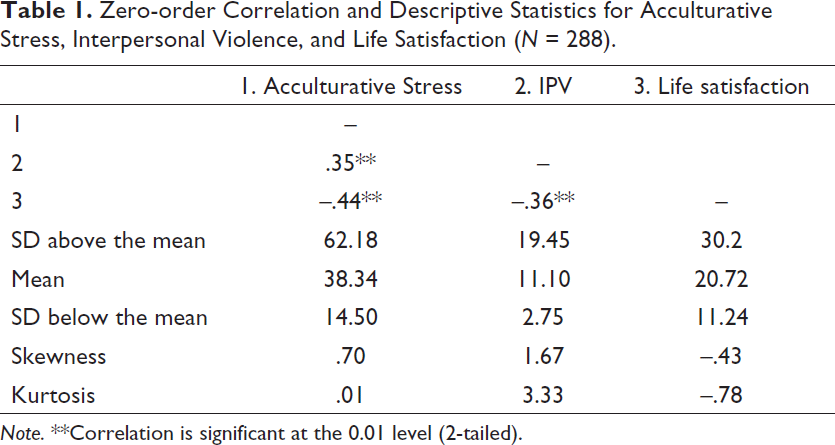
Results of the descriptive statistics on acculturative stress, IPV, and life satisfaction are summarized in Table 1. The mean level of acculturative stress was 38.34 (SD = 23.84). The participants displayed high life satisfaction (M = 20.72, SD = 9.48). The mean score of IPV was 11.10 (SD = 9.48). Assessment of the frequency revealed that 57.29 % of participants had experienced IPV in the past year and 96.18% had suffered from it ever since they married. Table 1 also includes correlation matrixes of the three main variables as well as the relationship between acculturative stress and life satisfaction. The correlation analysis and multiple regression analysis (step 1 in Table 2) revealed that acculturative stress is negatively related to life satisfaction, confirming the first hypothesis.
Zero-order Correlation and Descriptive Statistics for Acculturative Stress, Interpersonal Violence, and Life Satisfaction (N = 288).
Linear Regression Model with IPV as the Moderator in the Relationship Between Acculturative Stress and Life Satisfaction (N = 288).
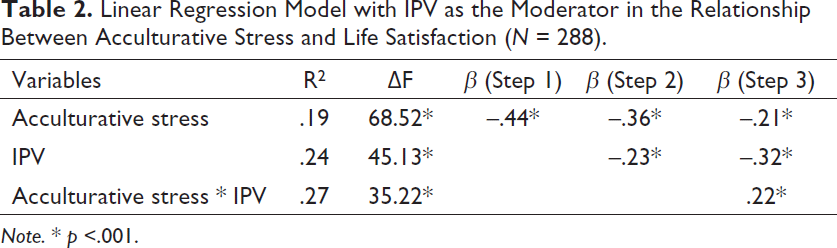
Note. * p <.001.
The linear regression model and interaction methods outlined by Baron and Kenny (1986) were used to test the second hypothesis. The analysis results revealed that the interaction between acculturative stress and IPV significantly affected the outcome variable, that is, life satisfaction (see Table 2). As indicated in Table 2, the third model, including the interaction terms, accounted for an additional 3% variance in the variance in life satisfaction. It also presented the highest predicted R-squared among the three models (27%).
Figure 1 displays the effect of IPV (divided into high, i.e., one SD above the mean and low, i.e., one SD below the mean) on acculturative stress and life satisfaction. Individuals who experienced high IPV were represented by a flattened linear relationship, indicating that decreases in acculturative stress were weakly associated with life satisfaction. In contrast, women who experienced low levels of IPV were represented by a higher negative slope, indicating that decreases in acculturative stress were significantly associated with life satisfaction.
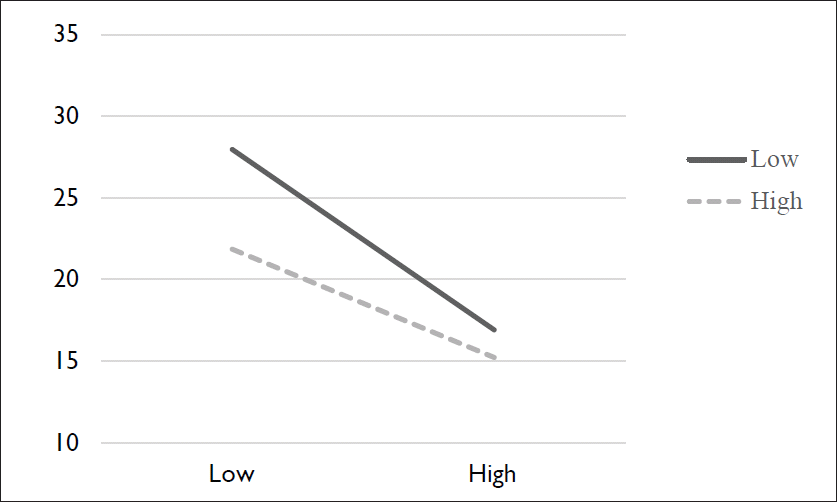
Relationship between acculturative stress and life satisfaction at different levels of IPV.
Discussion
The results of this study replicate and expand on previous findings concerning acculturative stress and life satisfaction among immigrant Vietnamese wives living in South Korea. It was found that acculturative stress negatively affected life satisfaction, consistent with previous studies (Oh et al., 2014; Sung et al., 2013; Woo & Ha, 2015). Similarly, the negative relationship between IPV and life satisfaction was consistent with previous studies (Chung & Lim, 2011; Lee & Park, 2018; Nho & Lee, 2016).
Further, our results elaborate on a nuanced effect of IPV on the relationship between acculturative stress and life satisfaction. The moderation analysis revealed that women who experienced high levels of acculturative stress reported lower levels of life satisfaction when their experience of IPV was high. In contrast, women who experienced low levels of acculturative stress and IPV reported even higher levels of life satisfaction. Regardless of the level of acculturative stress, a flattened relationship with life satisfaction was identified when women scored high on IPV, indicating the significant impact of IPV on married immigrant women. The result supports the frustration-aggression hypothesis of Berkowitz (1989). According to Berkowitz, feelings of frustration and pain significantly reduce the arousal of emotion; these unresolved feelings accumulate and gradually develop into anger or depression. In the context of this study, the violence faced by women from their husbands strongly impacts their mental health, directly affecting their life satisfaction.
When acculturative stress was low in participants, the moderating role of IPV was evident. This could be because Vietnamese women are more likely to deal with other factors during high levels of acculturative stress, making the moderating role of IPV less noticeable. However, when the process of adjustment is completed to its maximum individual extent, the impact of IPV becomes more significant because it becomes the sole stressor for women.
These results have several implications for social workers, mental health professionals, and medical practitioners. First, these professionals should be aware that physical and/or psychological violence from intimate partners significantly affects women’s mental health. Therefore, they should ensure that the woman they are helping is not facing IPV when they depict high levels of acculturative stress and low levels of life satisfaction. This study also emphasizes the important role of external factors, especially the husband, on immigrant women’s mental health. Thus, intervention processes should focus on helping such women develop their skills, such as communicating, expressing their needs, or seeking help, so that they learn to use their social network effectively.
Second, the regulation of international marriages and legal protection for immigrant women should be considered. In Vietnam, there is no specific policy that regulates international marriages between Vietnamese women and foreign men. The Vietnamese government should provide accessible programs that prepare women before they depart to their husband’s country. For example, such programs could teach women the basic language of the host country. In 2019, the Korean government enacted a policy stating that men who have broken domestic violence laws will not be allowed to marry foreign women. The policy is a significant step toward ensuring reduced rates of IPV in international marriages (Yonhap, 2019). However, provisions should be made to educate immigrant women on such policies, the negative impact of IPV, and the importance of their mental health. Last, the power differentials between native husbands and immigrant wives should be balanced by legal protection provided by the government. Considering Asian countries, Taiwan was the first to pass a policy, called the Domestic Violence Prevention Act in 1998, to protect victims from IPV. This policy has produced a positive influence on protecting immigrant women. The Act no longer accepts that family violence is simply a private matter between a couple but it utilizes the role of law to intervene in the situations. Chao (2005) proved that the policy not only increases the likelihood of victims raising their voices but also stimulates employment opportunities for abused women, narrowing the gap of power differentials among men and immigrant wives. Since these women depend on their husbands completely, a balance of the power differentials could help the latter improve their economic and social power (Tang & Wang, 2011).
Despite these implications, this study has several limitations. First, because this was a cross-sectional study, the results did not depict a causal relationship between the three variables. Therefore, sustaining the significant relationship between these variables over time cannot be ensured. Second, the objectivity of measurements should be considered. Although the study collected data based on objective measures, the participants’ responses were self-reported and entirely based on their subjectivity. Third, the snowball sampling method did not collect representative samples for this study. Fourth, the study only focused on Vietnamese immigrant wives in South Korea; therefore, the results and implications should not be generalized to other populations. This could make the results less objective. Additionally, the entire picture of IPV could not be assessed because the study did not employ any in-depth interviews.
Future research should consider utilizing the mixed-method research design to examine the variables in this population. Several studies have presented in-depth facts by using qualitative or mixed-method design (Das et al., 2016). Furthermore, IPV can be divided into various sub-types with varying ranges of severity. Consequently, in-depth interviews can be deployed to understand and analyze the relationship between acculturative stress, IPV, and life satisfaction. To complement the participants’ subjective ratings, future studies should employ measures to collect feedback from the participants’ social networks, especially their husbands. Therefore, in-depth interviews are highly recommended for further research. Additionally, the authors received feedback from the participants stating that their perspectives were not covered entirely by the study items and they wished to explain the reason behind choosing a score on the Likert scale. Future research should also consider different sampling methods, given the limitations of snowball sampling used in this study. A possible alternative could be collecting data based on residential areas as the majority of the participants in this study resided in urban areas (89.2%). Finally, future research should add more variables to the hypotheses model used in this study along with using different statistical methods to achieve a holistic result.
Footnotes
Authors’ Note
This research was the thesis of the master degree of Nhat Huy Vo and it was under the supervision of professor Sang Min Lee. Nhat Huy Vo is now affiliated with University of Social Sciences and Humanities - Vietnam National University HCMC.
Declaration of Conflicting Interests
The author(s) declared the following potential conflicts of interest with respect to the research, authorship and/or publication of this article: The author(s) declared no potential conflicts of interest with respect to the research, authorship, and/or publication of this article.
Funding
The author(s) disclosed receipt of the following financial support for the research, authorship and/or publication of this article: The authors received no financial support for the research, authorship, and/or publication of this article.
